







Abstract
This article explores affective governance in Chinese reality TV, with a particular focus on See You Again, a divorce-themed program aired on the state-run platform Mango TV. Debuted in conjunction with the Civil Code amendment imposing a divorce cooling-off period, the show is a manifestation of state interest in fostering family stability and social order. Using critical discourse analysis, this research examines how the program constructs dissolution and rekindling of marital relationships in emotionally appealing ways, capitalizing on Confucian values, as well as traces of neoliberal self-management and personal transformation. See You Again does not deliver explicit ideological messages, but it mobilizes viewers through affective techniques connecting forms of emotional comfort with the nation's goals. This research contributes to the ongoing discussion of how reality television functions as a liminal cultural space which forges intimate life and mediates public reaction to state intervention into the private domain.
Introduction
Amid the growing public discussion of divorce and the institutionalization of the “divorce cooling-off period” in China, See You Again (再见爱人, SYA henceforth) comes to intervene in the ongoing cultural politics of affect. The program is produced by Mango TV, a state-owned streaming platform, and has been gaining popularity among younger audiences, with female viewers accounting for 70% of its viewer base(Zou, 2025). SYA distinguishes itself as a reality show that focuses on couples experiencing marital difficulties, including those who have already decided to separate. Each season of the show tells the story of three couples’ road trips, which are designed to encourage them to reflect on their relationships.
Unlike previous Chinese television formats that deal with relationship conflict through expert-guided intervention, such as Gold Medal Mediation (金牌调解, a television arbitration-style show focused on family disputes) or March Toward Happiness (幸福向前冲, aimed at guiding couples back to marital harmony), SYA does not position divorce as a failure in need of correction. Instead, it acknowledges both reconciliation and separation as possible outcomes. However, this ostensible openness is not a renunciation of normative frameworks. In its well-managed dialogues, its narrative arcs, and its commentary from a cast of studio-seated observers, SYA establishes a pedagogical framework that encourages viewers to understand the characteristics of a “good” or “healthy” intimate relationship. The show has proved popular among young, single women in first and second-tier cities who often use it as a guidebook for relationships (Ye, 2023). The fourth season, in particular, has been a huge success, racking up 2.5 billion views within three months of its launch (Ding, 2025). It has even become a hit overseas, where it has been jokingly dubbed the “Global Chinese Spring Festival Gala” (Wu, 2025).
This paper examines how SYA mediates affective governance in contemporary Chinese media culture. Through a critical discourse analysis of the show's multi-season narrative structure, televised interactions, and production framing, I analyze how the program constructs normative models of intimacy that align with broader political interests. While SYA appears to validate diverse emotional experiences, including the legitimacy of ending a relationship, it simultaneously teaches viewers how to feel, behave, and relate in ways that are emotionally intelligible and morally acceptable within the ideological framework of the state. In doing so, the show functions as a cultural technology for regulating the boundaries of acceptable love in today's China.
Literature review
Affective governance in China
Unlike emotions, which signify discrete psychological states, affects represent fluid, socially mediated, and ideologically potent atmospheres. Affect marks distinctions between the self and others, thereby enabling states to uniquely manage the psychological and emotional conditions of their citizens as a form of governance (Foucault, 1991). Taussig (1992) describes this as the “official nervous system” of the body politic, in which standardized discourses stabilize regime legitimacy by managing and channeling affective energies (Heaney, 2019). However, affective governance is neither strictly manipulative nor unidirectional. Although affects frequently flow within boundaries established by dominant powers, their inherent unpredictability means they can escape state control, especially during disruptions in everyday life (Sorace, 2021). Thus, affective governance involves continuous negotiation between the state and society, demanding persistent affective coordination and internalization from citizens to maintain stability.
China exemplifies a state deeply invested in affective governance to secure political stability and public support. Historically, affective strategies employed by the Chinese Communist Party (CCP), including emotional mobilization and rituals such as “speaking bitterness,” criticism, and self-criticism, have effectively rallied popular support since revolutionary times (Perry, 2002). During the Hu Jintao–Wen Jiabao administration (2002–2012), this repertoire shifted towards addressing societal grievances and preventing instability amid rapid socio-economic transformations. Under the leadership of Xi Jinping from 2012, affective governance has undergone further changes, by transforming the personalized form of emotionalism. Xi's public persona is carefully cultivated through symbolic actions, such as dining with ordinary citizens and visiting marginalized regions, reinforced by media portrayals of sincerity, responsibility, and empathy (Shue, 2022). State-sponsored propaganda, on the other hand, strategically taps into collective emotions such as historical traumas and nationalist pride to establish affective ties to the regime (Xie, 2021).
Technological progress has further greatly influenced the affective governance of China. The CCP assimilates digital media into its propaganda system for producing affective, ideology-laden contents delivered in “ideotainment” formats (Chang and Ren, 2018; Lagerkvist, 2008). This calculus incentivizes netizens to take the initiative in creating and disseminating pro-state content, effectively entrenching official mindset within online Chinese culture.
Cultural zone, Mango TV, and mediating affect
The notion of the “cultural zone” (Li, 2019) offers a critical tool for analyzing how the Chinese state is strategically handling the production of culture and affective governance via media regulation that distinguishes itself. The model of cultural zone splits the system of governance in culture into differently regulated sub-platforms – traditional television will be most strictly controlled, and new online video platforms will first enjoy less regulated freedom of development in order to have quick, but still controlled growth (Li, 2019). This strategic arrangement enables the state to exploit market-led innovation and protect ideological dominance, reproducing socialist legacies as well as economic benefits.
The cultural zone is clearly defined in the role propaganda must play within it. While in the West propaganda is usually linked with falsehood and manipulation, Chinese officials view propaganda as a positive, educational and society community building element (Shambaugh, 2007). In the Xi era, propaganda has embraced digital infrastructures that resonate an overt ideological focus, as well as visual, affective strategies (Creemers, 2016; Esarey, 2021). Regulation, pervasive yet deliberately ambiguous, functions as a key mechanism of cultural zoning. This calculated ambiguity not only broadens the scope of state control but also reserves narrowly defined spaces in which platforms and content creators can exercise constrained forms of creativity.
In this context, Mango TV emerges as an exemplary affective space within China's cultural zone. Originally established as the online platform for Hunan Satellite TV, Mango TV has evolved significantly from its predecessor. Historically known for its entertainment and variety programs, Hunan Satellite TV faced persistent criticism for “excessive entertainment.” Symbolically, on 30 September 2021, the eve of China's National Day, Hunan Satellite TV officially announced a significant rebranding, abandoning its longstanding slogan, “Happy China (快乐中国),” in favor of “Youthful China (青春中国).” The new slogan explicitly emphasizes the station's dual role as a state-affiliated media platform with “responsibility towards Party media” and as a leading platform for “youth culture guidance” (Hunan TV, 2021). Following this strategic shift, Hunan Satellite TV substantially reduced its broadcast volume of variety shows. Mango TV inherited its production teams, significantly expanding its online variety show content and subsequently becoming the third-largest video platform in China by monthly active users (STCN, 2024).
As the only state-controlled enterprise among China's leading online video platforms, Mango TV enjoys explicit political backing under the imperative to “firmly uphold political orientation,” “vigorously foster and promote socialist core values,” and “ensure the sustained and healthy development of the cultural industry” (Zhang and Zhu, 2020). This underscores the reality that, despite being freed from traditional constraints on entertainment program quantity, Mango TV must still align its content production closely with national ideological requirements.
Consequently, affective governance in China is actualized not merely through grand-scale political propaganda but also concretely via the strategic configuration of the cultural zone and media infrastructures. As Bai and Song (2014: 1) argue, China's media is “a site of evolving hegemonic struggles among various political, economic, institutional, and ideological forces.” Within this contested arena, affect and spatiality, media forms, and ideology intertwine, creating a governance structure characterized by both flexibility and rigidity.
The subsequent analysis will focus specifically on SYA's program design, narrative structures, and mechanisms of emotional resonance with audiences participating within the state's logic of affective governance and the cultural zone. It aims to reveal how the show constructs seemingly individualized yet state-acceptable representations of marital intimacy.
Methodology
This paper draws Fairclough's three-dimensional CDA model to analyze the reality TV show SYA. CDA offers an in-depth investigation of the interplay between discourse and the larger social and cultural system (Fairclough, 2001; Wodak, 2001). The model takes discourse to be more than just language and regards it as a social practice rooted in its context, which influences and is influenced by the social structures of its context. Consistent with this, this research views discourse (based on spoken language, visual images, and nonverbal representations) as a constitutive force in the structuring of social discourse concerning class, gender, identity and power relationships (Fairclough, 1992, 1995; Fairclough and Wodak, 1997; Van Dijk, 1993; Wodak and Meyer, 2009).
The analysis of SYA begins with an investigation of the broader sociopolitical context in which the show emerged, mapping the intersection of Confucian ethics and neoliberal individualism in contemporary discussions of marriage. I then turn to the program's textual content across its four seasons, aired from 2021 to 2025, paying close attention to its narrative structures and visual and linguistic components, particularly the interpersonal interactions among participants, the storytelling of personal histories, and the design of game-like segments. The texts were encoded in three stages through NVivo based on grounded theory methodology (GTM). This approach emphasizes that theoretical concepts and explanations are generated inductively from systematic analysis of empirical data rather than imposed in advance, while drawing on researchers’ theoretical sensitivity to interpret emerging patterns (Charmaz, 2014; Strauss and Corbin, 1990). I conducted open coding first to extract some meaningful concepts, such as shooting scenes (e.g., “grassland”), argument topics (e.g., “alcoholism”), and character personalities (e.g., “arrogant”). Focused coding was then carried out, involving clustering similar concepts from the open coding process and forming higher-level categories and dimensions through repeated comparisons. For instance, terms like “ride horses”, “picnic”, and “sing” have all been clustered under the category tag of “romantic trip”. Finally, axial encoding was performed to unify the higher-level categories and dimensions for theorization. With the aim of analyzing the affective governance approach of the program, two categories were summarized: ritualizing divorce and problematizing intimacy (see Figure 1).
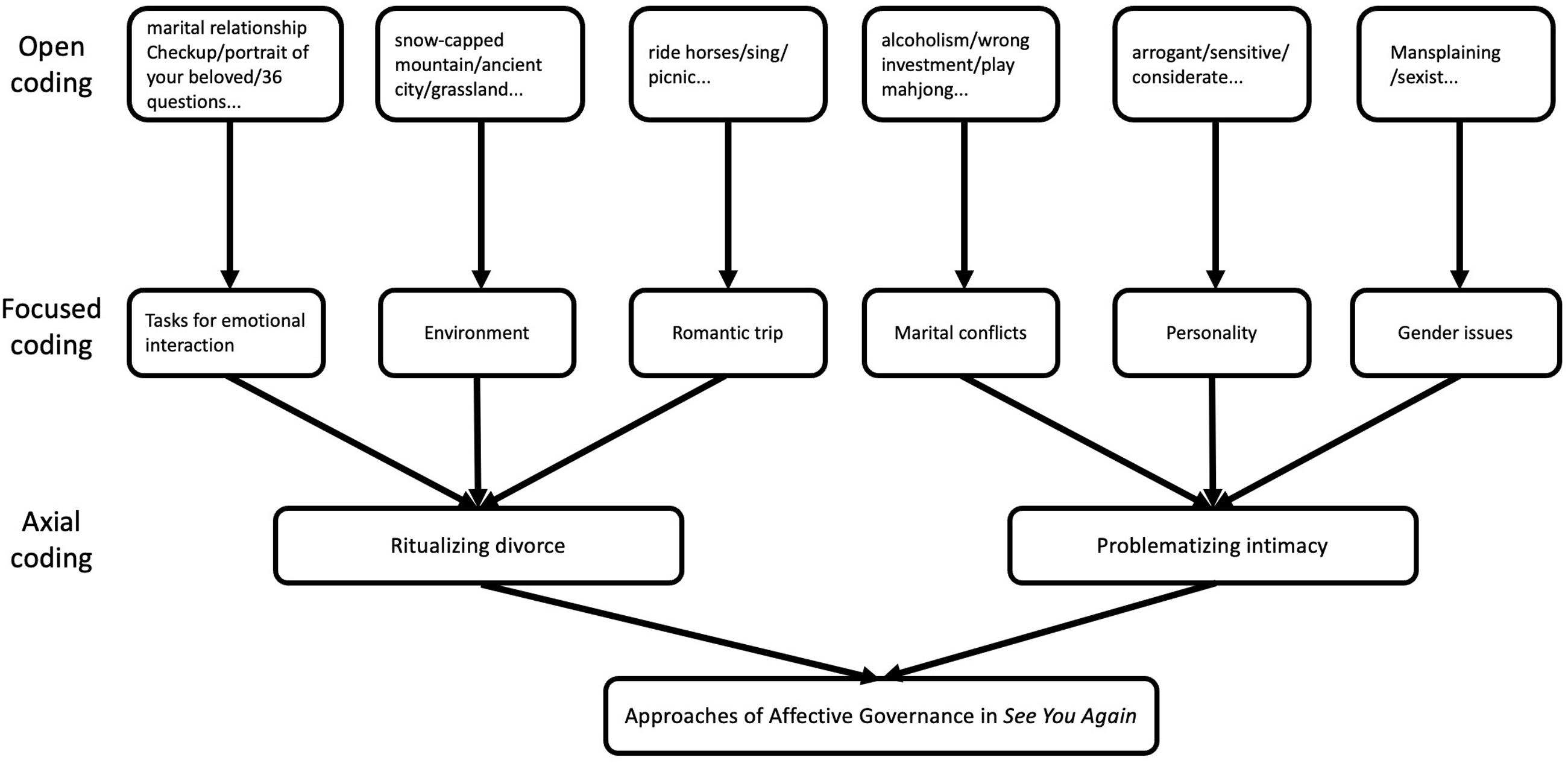
Approaches of affective governance in SYA.
I also examine the production process and creative practice articulated by the show's director, Liu Le. I draw on two podcast interviews with Liu recorded in January 2024 and March 2025, in which she reflects on the creative vision, production decisions, and ideological premises underpinning the show. These sources help illuminate how the show's discourse is consciously crafted and mediated, providing key insights into the structural logic and meaning-making processes embedded in its production. In addition, I referred to related news reports, as well as the comments of viewers from Mango TV and China's best-known film/TV-review-aggregation site Douban. Although analysis is a secondary part of the research design, it acts as a “guerrilla ethnography” approach to interpret the show (Fang and Repnikova, 2018: 2167; Peng, 2021) and contributes to analyzing the nature of the program.
Confucian values, neoliberal selves: Ideological tensions behind SYA
In the past two decades, China has undergone a striking ideological recalibration, in which Confucian traditionalism and neoliberal subjectivity coexist in uneasy tension. Nowhere is this tension more vividly illustrated than in the domain of intimacy and family life, where state-led campaigns for moral renewal and social stability increasingly collide with the individualizing logics of market-oriented reform.
Following decades of state-promoted collectivism and the erosion of Confucian ethics during the Maoist period, the early 2000s marked an official revival of Confucian discourse in both governance and cultural production. This revival was not a simple return to tradition, but rather a strategic rearticulation of selected Confucian values, particularly filial piety, familial harmony, and gendered duty, as ideological instruments for reinforcing political legitimacy in a rapidly transforming society (Bell, 2008; Cheung, 2012; Kang, 2004). Central to this moral framework is the state's renewed emphasis on cultivating “good family traditions (jiafeng)”, which are positioned not merely as personal virtues but as foundational pillars of social and political stability. In official rhetoric, the family is idealized as both a spiritual sanctuary and the moral nucleus of the nation. Discourses surrounding family life emphasize values such as intergenerational care, harmonious kinship relations, frugality, and adherence to moral and legal norms, casting them as enduring virtues deeply rooted in the Chinese cultural psyche. Within this ideological frame, the cultivation of proper family conduct is framed not just as an individual aspiration, but as a civic responsibility, a form of ethical self-regulation that extends from the household to the nation at large (Xi, 2016).
At the same time, the consolidation of neoliberal rationality has reshaped the individual as a self-responsible agent, one expected to manage emotions, optimize personal choices, and continually invest in self-development. As scholars have noted, neoliberal governance does not retreat from the intimate sphere; rather, it penetrates deeply into it, reconfiguring private affective life through the lens of personal responsibility, risk management, and entrepreneurial selfhood (Rose, 1999; Illouz, 2007). Correspondingly, emotional well-being becomes a project of self-governance, while relational breakdowns are reinterpreted as opportunities for self-reinvention. In contemporary urban China, particularly among the emerging middle class, discourses of “emotional intelligence,” “growth through heartbreak,” and “communication skills” reflect this shift toward psychologized and individualized models of emotional regulation (Liu, 2019; Yang, 2015).
It is within this ideological double bind, between Confucian moralism and neoliberal individuation, that the rising divorce rate in China has emerged as a key site of policy and cultural intervention. Since the early 2000s, the number of divorces in China has been on a steady upward trend, reaching a peak of 4.7 million in 2019. In contrast, the willingness to marry among the marriageable population aged 20 to 39, especially among women, is on the decline (Wang, 2025). In response, the government promulgated the “divorce cooling-off period” as an integral component of the newly enacted Civil Code, which formally came into effect on 1 January 2021. According to this law, couples wishing to divorce must have a compulsory waiting period of 30 days, with either party able to withdraw the application unilaterally during the period.
Framed as a safeguard against impulsive decisions, the mandatory cooling-off period exemplifies Confucian-tinged paternalism, treating marriage less as a private contract than as a moral institution essential to social stability. In the short term, the policy appears effective: the national divorce rate declined from 3.12% in 2020 to 2.0% in 2021 and remained stable in 2022. Proponents cite this decrease as evidence that the legislation promoted family stability and social order (Xu, 2022). However, this normative framework increasingly conflicts with contemporary Chinese realities, particularly for younger cohorts socialized in a milieu shaped by market logic and consumer culture. For many in this generation, personal happiness, independence, and psychological well-being outweigh traditional imperatives of duty and endurance. Remaining in an emotionally unfulfilling or abusive marriage merely for the sake of “harmony” is therefore neither viable nor desirable. Consequently, a discursive disjuncture has emerged: while state narratives stress moral restoration and the sanctity of the family, popular discourse now privileges affective autonomy and individual self-realization.
Premiering in the same year as the implementation of the divorce cooling-off period, SYA can be understood as a cultural extension of the state's governance strategies, situated at the intersection of Confucian revival and neoliberal affective logic. Apart from power dynamics in marriages, the show also addresses other common Chinese relationship issues, from the balance between family and career to the uneven division of household responsibilities. One popular comment on Douban reads: “It is recommended that the marriage registration office and divorce registration office at the Civil Affairs Bureau play this variety show on a 24-h loop, requiring those registering to watch attentively and take notes.”
The following analysis will explore how SYA, both textually and discursively, embodies these ideological tensions and performs the contradictory logics that animate contemporary affective governance.
Affective governance approaches in SYA
My hope is that after watching the show, the audience might turn around and feel like getting married; that is my vision. By the end of the season, perhaps people will realize that marriage is not so frightening.
—Producer and director of SYA, Liu Le (Lu, 2021)
Ritualizing divorce
Majestic mountains, grasslands, deserts, and lakes — SYA consistently opens with breathtaking landscape sequences, filmed with cinematic-grade cameras that lend the program a visual texture more refined than that of conventional reality shows. These carefully curated exotic landscapes function not merely as visual embellishment but as a narrative device integral to the show's overall structure. From its first season, the production team deliberately selected locations such as Xinjiang, western Sichuan, and Inner Mongolia, geographic “other spaces” that effectively rupture the routines of everyday urban life. The participating couples, primarily from China's first- and second-tier cities, are required to surrender their phones during filming, thus being placed in a semi-isolated yet emotionally intimate environment conducive to reflection and relational confrontation.
In fact, the show originated as a travel-based recreational vehicle concept, and its current form retains that spatial logic. This spatial displacement strategy removes divorced or separating couples from the emotional noise of their habitual lives and places them within a transitional space, a journey in both the literal and affective sense. Visually, this evokes a sense of emotional purification and symbolic restart. As Liu notes, “In front of a clean and quiet landscape, one tends to become sentimental” (Lu, 2021). Landscape becomes a catalyst for affective flow, memory recall, and dialogical re-engagement.
Moreover, this use of landscape strategically caters to the dual fantasy of contemporary urban audiences: the desire to escape routine and the longing for emotional healing. In the context of fast-paced and high-pressure city life, emotional expression is often repressed or sidelined. SYA constructs what may be termed a “therapeutic travel space,” a staged environment that allows viewers to project their own affective anxieties onto the screen. The show's natural landscapes create a sensory utopia that serves as a dialectical counterpoint to quotidian urban life, offering emotional respite while fulfilling middle-class aspirations for healing, renewal, and purposeful travel.
The sentiments expressed by the participants themselves further reinforce this dynamic. In the first season, Zhu Yaqiong was the only woman to apply actively for the program, and she was portrayed as a romantic idealist with a pronounced individualist ethos. Her introductory montage flashes back to her appearance in the 2006 Super Girl singing competition, during which her songwriting and performance abilities were praised by the judges. Super Girl was China's first commercially sponsored reality TV show and became a national sensation with over 400 million cumulative viewers in 2005, specially highlighted by players’ individuality and self-expression (De Kloet and Landsberger, 2016). This intertextual framing amplifies Zhu's persona when the narrative returns to her visit to the civil-affairs bureau to finalize her divorce, where her individualistic sensibility resurfaces in an emotional exchange: Director: Do your parents know why you’re going out today? Zhu: They don’t. They will respect whatever decisions I make…I often just go ahead and do things on my own. I did talk to my mom about the divorce earlier, and she said, have you thought about whether your son will be unhappy? I said, Mom, do you want me to be unhappy, or do you want my son to be unhappy? (At this point, Zhu begins to choke up.)
In the subsequent program segments, Zhu went on to express dissatisfaction with her marriage, accusing her partner Wang Qiuyu of lacking romance and never having given her a wedding nor celebrating an anniversary. This core expression is further visualized in a “divorce commemoration photoshoot” during their travels. Zhu appeared in a white wedding dress with her voiceover expressing: “My first wish [in the program] is to take a wedding photoshoot just for myself.” However, Zhu eventually decided to take a photo of herself embracing Wang when the photographer took out a stopwatch. Her confession reappeared to explain the reason: [One time] he kept writing in his room. I knocked on the door and went in, asking if he could give me a hug. He was very annoyed. I said could I hold him for just one minute, and then he gave me a hug. As the minute was almost up, he patted me on the shoulder meaning I could go out. Is this all [our relationship] is?
The one-minute hug was originally viewed by Zhu as a symbol of Wang's prioritization of his career over her emotional needs, however, the hug initiated and timed by Zhu turned itself into a symbolic, self-directed “ritual” to mark the closure of the marriage. The segment is titled My Wedding rather than Our Wedding, even though Wang Qiuyu participates in the shoot, subtly reinforcing the program's emphasis on individual emotional closure and self-acknowledgment.
The divorce commemorative photoshoot segment added a sense of ceremony to the show and was retained in the following three seasons. However, the program agenda of SYA also began to attempt to incorporate official discourse into ritualization. Starting from the third season, the show's guests were arranged as volunteers to visit a certain civil affairs bureau during their travels. Some of them took wedding photos for the newlyweds and led them to take the oath before the marriage certificate was issued. In fact, Chinese citizens are not required to take an oath when getting married at the civil affairs bureau. This step will only be carried out upon active request. Furthermore, the Ministry of Civil Affairs of China launched four versions of wedding vows for newlyweds (Lu, 2010), while the first and fourth versions of the testimony were broadcast in the program, which are also the only two that emphasize national laws and Confucian ethics: Certificate presenter: Our country practices a marriage system based on freedom of marriage, monogamy, and equality between men and women. … May I ask whether you are able to uphold these principles? Wedding vows: We pledge to honor our country and its laws, respect our parents, nurture our children, and cherish each other with mutual respect, trust, and lifelong love.
In the fourth season, the presence of Chinese state at the wedding vows ceremony was further strengthened. In the beginning of the ninth episode, a deputy director of the civil affairs bureau introduced the collective wedding service which will take place on events such as 20 May (which sounds like ‘I love you’ in Chinese) and the Qixi Festival (a traditional festival originated from Chinese folk culture with elements of love). The deputy director particularly emphasized that the wedding was “witnessed and legalized” under the national emblem. Subsequently, the guests Huang Shengyi and Yang Zi held a supplementary oath ceremony for a couple who had obtained their marriage certificates. When Yang was communicating with the couple, he once again mentioned that the national emblem gave the wedding a sense of ceremony.
Finally, moved by the ceremony, Huang reflected on the absence of a formal wedding for herself and Yang, and invited Yang to read wedding vows together. With both examples focusing on the marriage ceremony, SYA has completed a transformation from highlighting Zhu Yaqiong's character personality in the first season to promoting the official discourse through Huang Shengyi's demands in the fourth season.
Problematizing intimacy
In addition to turning divorce into a ritual, the program agenda of SYA aims to present implicit and explicit conflicts among couples. From the outset of their journey, the guests were asked to document their daily reflections and feelings about their partners, and answer the question: Do you still want to divorce today? The program team also established a series of tasks during the trip to assess the intimate relationship status of the guests. A fixed task is that couples will create portraits of their partners through oral descriptions with the same artist without meeting in person. Intimate relationships are problematized in a dramatic way by comparing the expressions, tones and the precision of couples’ descriptions of each other's appearances. Furthermore, there was a more precise “measurement” of intimacy in the fourth season of SYA. The three couples participating had all been in a relationship for more than ten years, and they were asked to undergo a “marital health checkup” before the trip to assess their understanding of each other. A series of questions referring to their spouse was administered, including the preferences of flowers, the photographs displayed on social media homepages, and the most profound regret concerning unaccomplished goals. After asking the guests if they approved of their partners’ answers, the program team gave each participant a score. The one with the lowest score received a shabbier living place as a punishment. By placing intimate relationships under a quantified evaluation system, SYA defines the “quality” of marriage and promotes recognized standards of marriage. The show's marital pedagogy will be analyzed in the next section.
In the presentation of marital conflicts, the show tends to integrate the shaping of the characters’ personalities. Arrogant, preachy male chauvinists or so-called hysterical crazy women are the representative images of the characters in the program. This logic is reflected in the show's meticulous selection of participants, as noted by director Liu Le: “The ability to express well is my top standard for choosing participants… whether they can describe something with detail and narrative immersion” (Zhankaijiangjiang, 2024). Most of the chosen participants are accustomed to being recorded on camera and have performance experience. The actor Yang Zi, who has the image of a domineering tycoon, is a typical representative among them. He always acted like an elder and a father toward his wife. Rather than simply presenting patriarchal masculinity, SYA appears to instrumentalize it to align with what Gill (2007) describes as a postfeminist sensibility. In the context of rising feminist consciousness and intensified gender debate in contemporary China (Han, 2018), the figure of the “domineering” or “fatherly” man becomes a readily recognizable symbol of gender inequality. The program transformed patriarchal excess into a consumable spectacle, attracting feminist scrutiny and online engagement (Figure 2).
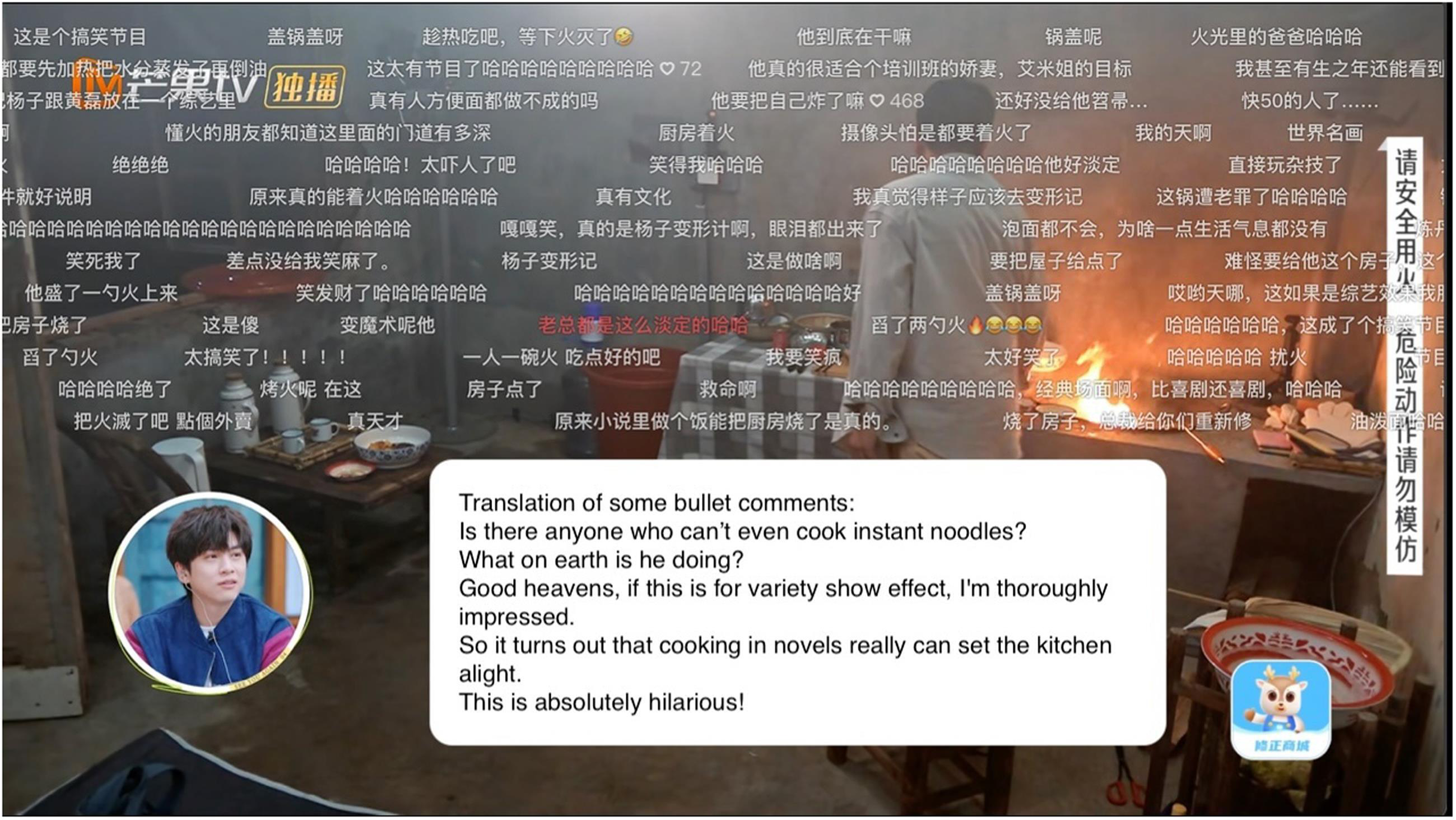
Audience's bullet comments on Yang Zi's cooking.
Furthermore, SYA creates or amplifies the drama and appeal of the program by problematizing the guests’ performances through editing techniques, as this reality show's treatment of “reality.” Liu explicitly stated: “I believe the reality conveyed in all content exists within a framework. I don’t think there is such a thing as 100% reality in this world” (Yanzhonghuashu, 2025). On the surface, this appears to be a reflection on the impossibility of fully reproducing reality. However, it reveals the program's fundamental stance in production: emotion is in fact a curated, organized, and edited product. Guests’ emotions are not only watchable, but also narratable, editable, and integrable into a coherent narrative structure. During post-production, the team conducts hours-long interviews to further distill and reframe the participants’ emotional trajectories. Liu admitted: “Sometimes I have to talk for over two hours just to get one sentence” (Zhankaijiangjiang, 2024). The complete interview context is often omitted, while emotionally potent and rhetorically dramatic soundbites are preserved and stitched together.
The program's reworking of source material continually constructs a space for debate over potential controversies, while also laying the groundwork for online abuse targeting guests, particularly non-celebrities with no filming experience. Zhang Wanting in the second season and Mai Lin in the fourth season are both highly controversial female guests. SYA portrays them as emotionally unstable, aggressive, and hypocritical by highlighting their hysterical expressions and the inflammatory language used during arguments. One viewer criticized the program, saying, “The way this program shapes public opinion has set back the understanding and discussion of feminism in China by at least a decade.” During the broadcast, both Zhang and Mai suffered severe cyber violence (Cui, 2024). Mai Lin, in particular, continued to be attacked after SYA ended: a subsequent variety show she joined was boycotted for allegedly “convey[ing] inappropriate messages […] which could foster detrimental social trends” (Fu, 2025). In her long response, Mai described being overwhelmed by shame and self-blame— “even my breathing was a fault,” while remaining unable to defend herself during the show's broadcast. Read through Ngai's (2005) notion of ugly feelings, this backlash is not simply a reaction to individual behavior but a gendered affective judgment: women's anger and distress are framed as excessive and suspect, turning grievance into an aestheticized sign of irrationality and thus delegitimizing it.
The hybrid nature of reality TV and its absence of a comparable institutional framework to journalism make ethical judgements difficult and potentially disrupt our “moral compass.” As Mast observes, the aesthetic conventions of reality television, coupled with the power disparity between producers and participants as defined and sanctioned by contracts, collectively cultivate a context for issues of intrusion, humiliation, misrepresentation, and appropriation to emerge, while resistance is stifled through strategies ranging from repressive (e.g., contractual clauses) to more subtle (e.g., total immersion) measures (Mast, 2016).
Pedagogical and commercial nature of SYA
The program SYA uses real and representative cases of couples to inspire people on how to approach marriage, family and their loved ones, helping them build healthier, more harmonious and lasting marital relationships. It hits the pain points of society and evokes widespread empathy.
— Chairman of Hunan Broadcasting System, Zhengwen Gong (2024)
The above passage is taken from Gong's presentation to the Hunan Provincial Party Committee's Publicity Department, which also noted that the fourth season of SYA achieved record-breaking viewership figures. For the producer Mango TV, the fundamental objective is to ensure programs are broadcast safely while maximizing commercial returns. Therefore, the content of SYA must first and foremost comply with broadcasting standards. In contrast to countries and regions such as the United States that have established content rating systems, China has not formulated a comprehensive and unified set of regulations in this area. However, the expression of cultural products in China must not deviate from the official ideology. Since 2012, when the CCP vigorously promoted the discourse system of “positive energy” (Yang and Tang, 2018), it has also become the main requirement of National Radio and Television Administration (NRTA) for reality shows (Dong, 2024; Network Audiovisual Program Management Department, 2025). Compared with past harsh and heavy-handed propaganda, the CCP's “positive energy” strategy represents a form of soft control. Its objective is to subtly and flexibly shape people's attitudes, social values, and political views, thereby facilitating the easing of social hostility and enhancing the regime's legitimacy (Yang and Tang, 2018).
SYA has positioned itself as a marriage documentary observation reality show since its premiere, thereby distinguishing itself from other reality programs deemed by regulatory bodies to be excessively sensationalized and vulgar. Beyond showcasing how couples interact during their travels, the program also features commentators in an observation room whose expertise spans sociology, psychology, and other adjacent disciplines. They analyze and interpret couples’ dynamics using their professional expertise or empathetic insights. This arrangement both complies with the NRTA's stipulation to increase the proportion of non-celebrities participating in reality TV (Zhang, 2015) and treats couples’ interactions as data to be generalized into more abstract forms, providing explanation and professional advice. For instance, in one scene of the program, Mai Lin half-jokingly asked her husband Li Hangliang, “Do I deserve a cup of coffee?” However, according to Huang Zhizhong, a debate champion who holds a master's degree in speech communication, the line is simply a classic piece of passive-aggressiveness in an interpersonal relationship. He explains: “One common strategy in relationships is to position oneself as unreasonably low. Why? Because the goal is to elicit a sense of guilt or alarm in the other party.” Sociologist Shen Yifei then contrasts an equal, autonomous “being in love” model with a “being loved” model, where one partner relies on the other for protection and affirmation. “Mai embodies the ‘being loved’ model,” Shen notes: when she asks, “Do I deserve a cup of coffee?” she is really asking, “Do you still love me?” Shen warns that “because love can never be fully proven, it creates a bottomless void, demanding continuous reassurance.” Shen and Huang's deliberately amplified interpretations usually supply the discussion's final frame, elevating academic analysis to the role of ultimate arbiter of emotional truth within the program's narrative structure.
This frame also speaks to the program's further dependence on expert discourse to validate its affective pedagogy. Observers who have academic or therapeutic credibility serve as more than just commentators, but as legitimizers of the show's editing choices and emotional narratives. This dynamic is evident in an episode probing whether people marry due to social-timing pressure: although guests agree that marriage should be founded on love, Shen pointedly reminds them that “there is always a time within the social clock, that is, the optimal age for childbirth.” Her remark encapsulates the program's ideological balancing act: asserting emotional selfhood while quietly reinscribing normative biopolitical claims. Given that Shen also serves as a vice president of the Shanghai Marriage and Family Research Association, she can ensure that the analysis and interpretation from the observation room aligns with official discourse. This approach has proved a resounding success: on Douban's SYA review section, quotes from Shen such as “Don’t overestimate your tolerance for a marriage devoid of love” have appeared in highly upvoted viewer reviews. Shen's profile has also risen significantly. She has gained a large following and launched a series of paid courses across multiple platforms, most of which focus on love, marriage and family relationships (Zhang and Tang, 2026). In this sense, the show assumes a soft pedagogical function: it reinforces a mode of heterosexual romantic relationship, particularly a stable monogamous marriage.
Under the premise of meeting the ideological requirements, revenue is regarded as the ultimate objective of the program. Director Liu once remarked that prior to SYA's broadcast, most brand sponsors found the program title to carry an inauspicious connotation, which proved detrimental to securing sponsorship deals (Lin, 2024). Facing the underperformance of its advertising business, Mango TV has redirected its profit sources towards subscription services. After four seasons of iteration, SYA now tackles increasingly contentious themes, including overt patriarchy, sexless marriages, and manipulative gaslighting dynamics, to reach and attract more audiences. Amid the flurry of trending hashtags and soaring view counts, sustained reflection on “love” has markedly receded, while scrutiny and moral judgment of individuals have intensified, with one “case” after another being brought forward for public adjudication, effectively transforming SYA from a show about love into a quasi-family court. Particularly as the program's viewership reached new heights in its fourth season, Mango TV introduced content requiring separate payment on top of its subscription membership. Members could pay an additional fee to gain early access to selected episodes a week ahead of their scheduled broadcast.
Furthermore, Mango TV has commenced efforts to commercialize various elements of SYA. In addition to compiling the guest quotes and game tasks from the program into a book, Mango TV partnered with Fliggy, a major online travel service platform in China, to release themed travel products tied to the program's filming locations. When Mai Lin became a hot topic, Mango TV openly leveraged her popularity to promote coffee and other products on its own e-commerce platform (Zheng, 2024). Moreover, as the program predominantly features celebrity guests, Mango TV (2025) also plans to sign contracts with them to participate in the operation of their social media accounts, offering bespoke marketing solutions for advertisers. Taken together, these dynamics reveal that SYA operates simultaneously as a vehicle of affective governance and a finely tuned commercial product.
Conclusion
This article examines the TV show SYA as a cultural product that reveals the technologies of affective governance operating within China's increasingly volatile media ecology. The show exemplifies a mode of governance that relies not on direct ideological imposition but on transmissible emotional contagion. Affect is not an energy that escapes governance (Ahmed, 2004; Ngai, 2005); rather, it is intentionally formatted and put to work. Importantly, this governance is not gender neutral. SYA demonstrates how affective modulation becomes a mechanism for reproducing ideal masculine and feminine subjects. The show delimits a narrow range of legitimate affective outcomes such as reconciliation, growth, and “healthy” intimacy while casting more disruptive trajectories as requiring repair or closure. Emotional self-regulation, communicative transparency, and relational endurance are differentially demanded across gender lines, thereby embedding gender hierarchy within a seemingly therapeutic discourse.
In a context where the family operates as an ideological apparatus facilitating China's state-led modernization (Chen, 2015), this case demonstrates how reality television participates in the ongoing reformatting of the family as a governable affective unit. Rather than foregrounding economic anxieties that frequently structure marital disputes in public discourse (Li, 2014; Wu and Zhang, 2025), SYA displaces financial strain into individualized emotional misunderstandings. Structural tensions are covered by participants’ communicative failures, thus rendering marital crisis manageable through therapeutic adjustment, a media logic that aligns with state interventions such as the divorce cooling-off period. When the official values upholding family harmony are localized as spouses’ personal growth, the program's approach reflects contemporary Chinese governance's emphasis on cultivating “self-responsible, self-enterprising, and self-governing subjects” (Zhang and Ong, 2008: 3). In so doing, SYA rhetorically and affectively links individual welfare to the broader state narrative of fostering family cohesion, societal integrity, and state consolidation.
Furthermore, the show translates state-endorsed marital norms into intimate, consumable guidance for viewers. It unsettles the binary between commerce and ideology by revealing how market-driven entertainment can operate as a hybrid governance site in which affective pleasure, moral instruction, and state-aligned values are co-constitutive. Through contentious relationship issues, diversified merchandising, and tiered pay models, the show carefully mined and monetized emotional pain points.
Ultimately, SYA demonstrates how Chinese reality television functions as a soft yet powerful affective governance device within China's state familism. Shaped by media, market and state forces, this show aims to reshape how citizens perceive conflict, take responsibility and envision future relationships. This in-depth analysis broadens our understanding of affective politics beyond sensational propaganda or overt repression. It instead reveals the subtle everyday mechanisms through which emotions themselves become a governing terrain.
Footnotes

Funding
The author received no financial support for the research, authorship, and/or publication of this article.
Declaration of conflicting interests
The author declared no potential conflicts of interest with respect to the research, authorship, and/or publication of this article.