







Abstract
This article examines how popular culture and play deal with the fear of death and supersession of humanity by technology. Barbie is corporeal, but immortal. Her persona allows devotees to project wishful-thinking into the unknown, populating the world and the future with humanoid hallucinations. Barbie has not turned to religion; she supplants religion. If she becomes mortal, she’ll die. If she becomes digital, she’ll be coming for you.
Keywords
In the age of AI, what is popular culture for? How can we situate analysis of it in everyday experience? What are its prospects? Cultural studies has approached these questions in different ways over the years, to mount contradictory, evolving agendas. I explore some of the connections in this tangled mat of signification and activity through the career of the Barbie doll, taking her to be a ubiquitous but multivalent object through which users and analysts alike seek to find meaning in identity, everyday life, and socio-techno systems (also known as culture). Now, humanity is lost without co-dependency on external systems. Popular culture is the theatre for playing with the consequences of that Faustian bargain.
In cultural studies, the necessity for systemic thinking and theory remains. Taken as a cultural-anthropological-historical-epistemological object of study that is also a knowledge system, popular culture can be relocated from identity (is something) to action (does something) in the world that is distinct, consequential, and species-wide. It has two irreducible dimensions:
In this secularised, prosaic, and profane form, popular culture is the place where individual humans can practise their individuality (how do I look?) and signal their collective identity (who am I like?), through any and all semiotic systems. The externalised performance of the self may use material objects and digital systems to pose further questions: How far do I extend? What will become of me? Who will care? How can I be remembered? Popular culture is the performative staging ground for the semiotics of connectivity. It is the semiospheric fight club where others may be treated with love or hate, desire or fear. Within that arena, you get a chance to reduce infinity to rules, chaos to code, nature to culture, tumult to tune, self to sense.
The process of living with and through machines is personified in countless popular TV series, movies, games, and songs. Dolls are ambivalent characters. In the film Coppelia (2021), the beautiful automaton wants to kill you, literally to take your life. 1 In the TV series Alien: Earth (2025), the Barbiesque protagonist is Wendy (channelling Peter Pan). Dying children are implanted with corporate AI and copied into adult humanoid robot bodies. Wendy is a confused hybrid, part child, part god, part monster.
As for cultural studies, it has long been preoccupied with a critique of class, race, and gender. In each case, naturalised personal categories are rethought as power relations. The underlying problem remains the lived experience of individual subjectivity within external creative and control systems. The ‘you’ that acts in the world is coproduced, governed, and constrained by alien entities that your own knowing self opposes. Living under corporate/state power, within what Dale Spender identified as ‘Man Made Language’ (1980), how do we mortals think through our fear of death and yearning for immortality, when we will die but the machine/system will not?
Universalism, socialism, revivalism, populism
In the analogue environment, toys, dolls, and automata are 3D playthings for popular thought experimentation. Barbie, the cynosure of them all, is a pale, sparkly, ultra-groomed aestheticisation of politics. She was a spin-off from a 1950s ‘fashion doll’ called Bild Lilli that was itself a spin-off from a racy newspaper cartoon in Bild Zeitung. Lilli dolls ‘were popular with German men as joke toys that were given at bachelor parties or hung from cars’ rearview mirrors’, and she was ‘often maligned as a “sex doll”’. 2
Desexed for US consumption, ‘Stereotypical’ Barbie promotes troubling claims to universality, globalising the American Dream for 7–12-year-old girls. She came to personify the Americanisation of popular culture worldwide (Aguiló-Pérez and Hains, 2025); the gender politics that represents desirable appearance as freedom within patriarchy (Delvaux, 2016; Jane, 2010); and the poisonous ubiquity of oil-based hydrocarbon plastics as a mass medium for consumerism (Boesenberg, 2024): Although Barbie has changed on the surface – she represents different ethnicities and can have any occupation – under the surface she's still made of the same crap … ‘Pinkwashing is the core issue, because Barbie is made out of oil by sweatshop workers.’ (The Yes Men, quoted in Boudreau, 2023) Popular culture … is the arena of consent and resistance. …. It is not a sphere where socialism, a socialist culture – already fully formed – might be simply ‘expressed’. But it is one of the places where socialism might be constituted. That is why ‘popular culture’ matters. Otherwise, to tell you the truth, I don’t give a damn about it. (Hall, 1981)
Popular political hope derived from 19th-century radicalism and religious revivalism (Thompson, 1963). Since then, successive pulses of theoretical energy have sought different purposes for it:
Politically, hope for the future was a spent force well before the end of the 20th century. It was replaced by its own negation – the apocalypse. Like revivalist socialism, this term has religious origins, not from the original Greek sense of ‘hidden truths revealed’, but as in the biblical ‘Revelations’ – the end of days (with fire and brimstone).
Now that intelligence has been ceded to external machines, our fear of man-made ecocide is symbolised in the acid dripping from the Alien xenomorph. It might be created in fact using KY Jelly mixed with Sprite, 4 but on screen the substances we recognise as a predator's blood, slime, and drool can dissolve a planet. The message – made explicit in Alien: Earth – is that the alien the Earth needs most to fear is the human species, not as individuals (who may or may not be artificial or infected with alien spores), but as a corporate persona ficta that is beyond anyone's control. Here, the manufactured child-hybrid agent may not be the real monster. That may be the child-genius tech-bro who owns her code.
Popular culture seems to be staging the very zombie apocalypse about which it keeps fantasising (Pop, 2018). In such an age (Bane, 2025), what might Barbie mean? Well, in the tradition of spoof videos (Li, 2009), she can have quite a lot of fun, at any rate. 5 According to Delvaux (2016) she is also one of those girls – from dolls, dancers, and statues to Barbie dolls, Playboy bunnies, and Pussy Riot – who ‘are not just the ubiquitous symbols of patriarchal domination but also offer the possibility of liberation’. She's not just for dress-ups.
Is she a liberated cyborg (Haraway, 1991) – or could she become one? One attribute she does have that goes beyond her plastic corporeality and throw-away reputation is immortality. Barbie cannot die.
Immortality Inc.
Behind doors designed to withstand a nuclear strike, through tunnels blasted six hundred feet into the rock, in a vault that's another seven hundred feet down, lies a trove stashed in steel cases: not bullion or jewels but microfilm, millions of reels of it. They contain billions of images of genealogical documents, an estimated quarter of all vital records on earth. (Jasanoff, May 2022)
6
The ancestor business has religious DNA, because of the records on which it relies. The Mormons have opened their archive to all, crowdsourcing anagraphical assistance in order to scale up the search process. 7 ‘Anagraphy’ is a technical term for recording data that can assign an individual to an identifiable group. It is familiar in Italian as the name of the national registry of residents (Anagrafe Nazionale). 8 In a fictionalised autoethnography of the Tuscan homeland of his own forebears, the Australian-Italian writer Moreno Giovannoni calls the practice of consulting records about one's ancestry ‘an anagraphical desire’. He describes a ‘rush of ancestral passion’ for ‘the possibility of belonging to the past, if not immortality, then a beginning without an end’ (2018: 213). Small wonder that ‘Americans’ – and here ‘we are all Americans’ (Grieve-Carlson, 2022) – are obsessed with it.
For her part, Barbie is an immortal without a beginning. Her material ancestry is intellectual property (Hunter and Lastowka, 2019), but the doll has no ancestors beyond the immediate ‘Roberts family’. 9 Her backstory is meaningless to her and has been periodically ‘retconned’. 10 Her immortality belongs to the user, who can use her anthropomorphism to project their own story (Aguiló-Pérez et al., 2025).
These phenomena – ancestral passion, anagraphical desire, and the endless live performances of immaterial beings – mean that immortality is no longer tied to religious observances. We live in a secular age, in which universalism no longer equates with world conquest in the name of monarchical godhead but is based on a dream of plural unity. Like Lady Liberty, ‘E Pluribus Unum’ has European origins, following the ‘fairly recent history of how Europe came to self-consciousness: Europe as a harbinger of universal history, as a prototype of unity amid plurality’ (Masuzawa, 2005: xi). It's also the business model of platform capitalism (Srnicek, 2016), where you can have ‘whatever you want’, so long as it's supplied by Big Tech. It motivates the AI metaverse, which, we were promised, will ‘revolutionize everything’ (Ball, 2022). There are some who conclude from this that capitalism is a religion (McCarraher, 2015). More prosaically, for a secular age, Appiah (2025) calls religion ‘a shared act of attention’. Attention culture is indeed founded in marketing-speak. One helpful ad agency has produced an A–Z of Cultural Insights, to assist clients to ‘reduce bad habits, evolve society, entice customers, enter new markets and prosper’.
‘Hope for the future’ has migrated to ‘recommendation algorithms’ (Chayka, 2024). Now that planetary computational power is devoted to finding one's own group in among the global debris of data, the search for origins and belonging is ‘disenchanted’ (in Schiller's and Weber's sociological terminology). In a secular cosmos, popular culture is the chief arena for the economic production, political performance, and cultural circulation of future-facing attention (Powers, 2020, 2022). The group whose attention is collectively attracted – the public, citizen, audience, consumer, fan, user – is the ‘identifiable group’ once categorised as ‘the faithful’. The once-religious desire to belong to such a group now sustains its own giant consumer industry (e.g. Ancestry.com), and reality-TV entertainment formats (Finding Your Roots; Long Lost Family; Who Do You Think You Are?), whose own seed-bank is that nuclear-proof vault 700 feet under Utah's Granite Mountain.
Anthropomorphic wishful-thinking
Longing to belong to a group and to distinguish that group from others is more powerful than the distinction between life and death, or between living and non-living objects. Dead and imaginary beings are ‘live’ signifiers. Fans can love them, leading to ‘waifuism’ and ‘fictosexual’ relations, where ‘metaphors and values associated with the fictional character lead to sacred, collective, and binding conditions and thus to a re-enchantment of the world’ (jacksreality, 2024).
Beloved beings transmit meanings from the past into the present and future. Some such figures are staged with high-prestige pomp (statues of rulers); others are found in the rubbish (discarded Barbies). The thing about Barbie is not that she is in any way religious, but that she is immortal, not just as unbiodegradable physical detritus but also as a talisman, a figure associated for millennia with projecting wishful-thinking into an unknown future (Bane, 2025; Dolansky, 2012; Gloyn, 2019; Negri, 2025; Newby, 2019).
The 2023 ‘biopic’ Barbie foregrounds the doll's dilemma when, given a choice, Barbie renounces immortality in order to experience whatever it means to have a vagina and face certain death. She rejects perfection (not to mention being the world's #1 Doll) in favour of human mess and mortality. Why? One commentator responded to this moment in the film as a revelation in itself: Barbie doesn’t want to be merely a perfect, infallible idea that’s always presentable and easy to package. She wants to be messy, real, and uncomfortable so she can contribute to a world that actually means something. (Hennessey, 2023)
‘Understanding the intentions of the machine’
Daria Bylieva considers three types of ancient antecedent for the contemporary AI imaginary: biological, the homunculus (Golem); mechanical, the automaton (Coppélia); and mimetic, anthropomorphic statuary (Caesar). Bylieva does not include children’s dolls, but she does comment on how children play a leading role in naturalising devices they can talk with, treating them as being alive: Children … believe that robots are social beings and they like them accordingly. … Devices become part of the family as soon as they enter the household. (2020: 17, 19)
‘Dolls’ and ‘devices’ have long been interoperable. Some pre-modern dolls were automata, with clockwork motors, articulable limbs, and open-and-close eyes. Some teddy bears were fitted with growlers. The notorious Teen Talk Barbie added her mechanical voice to children's conversations. ‘Dollbots’ is a brand of Japanese doll for AI-saturated markets. 11 Meanwhile, devices morphed into kids’ doll-like companions. Generative AI could turn a smartphone into an avatar, which in turn could ‘be anything’ from childminder to sex doll.
Lifestyle journalism around the world spent much of 2025 worrying about generative AI, because the strict boundary between adults and children was threatened. ‘Sycophantic’, ‘emotionally manipulative’, and not necessarily telling the truth, these apps certainly sound like real people. Small wonder then that ‘children, and in particular vulnerable children, can see AI chatbots as real people, and as such are asking them for emotionally driven and sensitive advice’. 12 While the headlines worried, the tech-press wowed: ‘Ami is a full-on AI entity with a cylindrical holographic display that lives on your desk and wants to have deep conversations about your feelings, dreams, and whether pineapple belongs on pizza’. 13
Bylieva observes: ‘Technologies and humanity have come a long way to find a common language. … Interaction with this alien interlocutor can contribute to the comprehension of humanity itself’ (2020: 19). She describes the desire to perfect humanity by creating something external to humanity: ‘modern artificial intelligence can be considered the embodiment of one of the most ancient dreams of humankind’. As in ancient times, ‘humanity strives above all to create something that is superior to itself’ (2024: 73, 81). However, Bylieva reminds us that love/desire are exactly equivalent to threat/fear: ‘people are as likely to be dissatisfied with the idea that a machine can have equal or greater intellectual capabilities as they are with the idea that humanity is incapable of creating such a machine’ (2024: 19). We want to create or encounter aliens that are better than us (because humans are that good); but any such intelligence will surely decide to destroy us (because that’s what humans would do). We love AI; but is it coming for us? This is a religious question, sitting right on a ‘dirty’ boundary between bio and techno, where taboo and sci-fi overlap (Konior, 2022, 2026).
Once we’ve endowed machines with autonomy, language, and intelligence, we’ve created our own gods. They may not be conscious, but we ascribe consciousness to them. 14 Humans have long peopled nature and the imagined cosmos with figments endowed with human emotions and motivations, for good and ill, because anthropomorphic wishful-thinking is ‘far broader than religion in scope’ (Guthrie, 1996: 418). The human and non-human are not opposites but a continuum. Some more-than-human figures, such as gods, ghosts, and goblins, are immortal, but they don’t act independently: they watch us and interfere; we try to persuade them to serve us (Negri, 2025).
Ghosts are the conscience of our ancestors, goblins are imagined as naughty servants (Sikes, 1880), but gods are the personalisation of governance. They act like feudal lords and tech-bros (cruel, self-important, with predatory appetites and disdain for lesser mortals). Naturally enough, the overlords of the present time seek immortality as their birthright. Among those ‘fuelling the quest for longer life’ are tech-titans Sam Altman, Marc Andreessen, Peter Thiel, and Yuri Milner.
15
The ancient pharaohs invented the gods in their own image (Romer, 2012). Now, they want to reinvent themselves in the image of gods. In September 2005, Presidents Xi, Putin, and Kim were captured on an open mic, musing about their own prospects:
President Trump's actions on earth are constrained not by mortality but only his morality, he says. He doesn’t need to be immortal because he's already done a take-over deal with God. 17
The potent mix of wishful-thinking and identification with the undead is a general human practice, just as prevalent in the current secular and scientific age as it was in ancient and traditional societies. What's new is that the ancestry we might now be imagining is shared not with human forebears but with machines. With AI, we have reached the time when humankind can relocate itself within a story of techno-immortality.
Do you guys ever think about dying?
The lines between immortality and mortality, the self and death, purity and dirt, are not conventionally associated with children's play, but Barbie already lives in this world. This is where children take centre stage. They must learn to ‘code’ and ‘decode’ the universe, while at the same time each child comes to understand that they personally must die. The US-based National Children's Hospital advises that fear of death is a developmental condition. School-age children ‘may see death as an angel, skeleton, or ghost’, while ‘a main theme in teens is feeling immortal or being exempt from death. Their realization of their own death threatens all of these objectives.’ 18
In the Barbieverse, the doll can incarnate your own hopes and fears. Anthropomorphic wishful-thinking assures the child that being dead is not the end of being, despite all evidence to the contrary (Druyan, 2003). Mattel's promotional videos for Barbie make two promises. One is addressed to the imagined 7–12-year-old girl user: ‘You can be anything. From Mermaid to Movie Star, Pet Vet to Police Officer, Fashionista to Fairy Princess, Barbie continues to celebrate the belief that You Can Be AnythingTM’. The other promise speaks directly to the all-important adult purchaser: ‘Give Limitless Possibilities™ with Barbie’. 19
The child may be constrained by class, gender, race, and circumstance, never mind mortality, but Barbie is not, until the first stirrings of mortality, when Margot Robbie’s ‘Stereotypical Barbie’ asks: ‘Do you guys ever think about dying?’ This quickly becomes a teen meme. You can buy the sticker. 20
Mattel's ‘gift’ offers a purpose for Barbie that theorists have identified as both ubiquitous and ancient. With the untimely death of a child, what is lost is not only one human identity but also that promise of limitless possibility. Such a death cannot be accepted. It is deferred by the wish that the dead and the bereaved will ‘meet again’, or that one is ‘watching over’ the other. Children project what they know – humanness and semiosis – in order to grasp the unknown, including death. This is anthropomorphism, making ‘humanlike-but-not-human beings central to religion’ (Guthrie, 1996: 416). Religions bear a Wittgensteinian ‘family resemblance’ to each other because they include a ‘shared ancestry, from which the prototypical resemblances of families derive’. As a result, ‘we see the world as more humanlike than it is’ (Guthrie, 1996: 412; and see Guthrie, 1993).
If families transmit identity as well as beliefs through successive generations, two things follow. First, ‘identity’ can never be individual, even though no two people look or think exactly alike. They need to be recognised. Identity is semiotic, learned in childhood, reproduced by repetition, communicated by dialogue. It works because it is collective, systemic, and coded, like a language system. Second, if humans start from the presumption that the ‘nonhuman universe somehow is significantly like us’ (Guthrie, 1996: 418), then families (not institutional religions) are the human source-code, and culture is the coding agency. Neither natural families nor the cultural semiosphere can be owned or ruled. This means that identity – including that of dead child or living doll – is constructed in meaning-systems and transmitted through time by institutions of language. These are indeed immortal.
Homo deludens?
Barbie offers self-recognition and family, but she doesn’t offer ancestry. Nonetheless, as a wish-fulfilment idol, she is a material successor to ancient ancestor figures. The relationships connecting family identity, death, and children have taken material form ever since Homo sapiens invented grave goods. Ancient children were entombed near the hearth and with signs of their family's social status, eventually including dolls that are interpreted as figures of ‘hope and consolation’ (Newby, 2019). 21
Doru Pop (2024: 204–5) draws attention to the uncanny similarity between such dolls and the bodily form of Barbie, for instance those found in the Crepereia Tryphaena and Grottarossa tombs in Ancient Rome (Dolanski, 2012; Newby, 2019). Pop notes that the Tryphaena doll is of similar stature to modern Barbie, has similarly articulated limbs, and is accompanied by familiar accessories including combs and mirrors. She sports a prestige hairstyle that has been identified with that of the emperor's wife Faustina the Younger. The Grottarossa doll is ‘a strange dark toy with large hips and mature breasts’. This fusion of virgin girl with a woman's figure (like Barbie) suggests the Roman child was being offered in post-mortem marriage to the gods. What might have been, but for mortality, may yet occur, in immortality: ‘This was not only an afterlife mirror of the self; it was also a cultural symbol linked with a possible immortality undertaken through material representation’ (Pop, 2024: 205). This symbolism remains culturally active in the Romantic tradition of Wagner's Liebestod, where love and death are the same. But Pop's verdict on Barbie (the movie) is not sparing: it ‘remains a manifestation of the contemporary depletion of ideological critique, the ultimate manifestation of homo deludens’ (2024: 217).
Pop's ‘deludens’ invokes Johan Huizinga's classic concept of Homo ludens – ‘the play element in culture’. Pop criticises the depletion of critique. His witty wordplay is itself an example of play, but its requirement that play should reform reality contradicts Huizinga (1944: 17). For Huizinga, play and ideological critique belong to different orders of life. Play is a separate domain of ritualised, poetic make-believe that works only because it doesn’t apply to quotidian realities. Following Plato, Huizinga equates it with religion: ‘The Platonic identification of play and holiness does not defile the latter by calling it play, rather it exalts the concept of play to the highest regions of the spirit’ (1944: 19, 26–7).
It would be wrong to claim that play in all its forms, from playground to playhouse, temple to TikTok, is uncritically deluded. Critique can be sharpened by comic inversion, in the tradition of Aristophanes’ Lysistrata. It can take the form of spoof, satire, stand-up, and entertainment. What’s more, one person’s bland entertainment for white folks (Do, 2025) is another person's daring staging of practical feminism: ‘I was stunned by Greta Gerwig's Barbie. It struck me as audacious, unrestrained, and cleverly flamboyant in ways that are downright odd in today's cinematic universe.’ 22
‘We are the mechanism for the perpetuation of language’
Barbie’s impact was amplified by its association with the film Oppenheimer, released in the US on the same day in 2023. The two films – both about the fear of death, albeit one at personal and the other at global scale – held contemporary gender presumptions up to scrutiny:
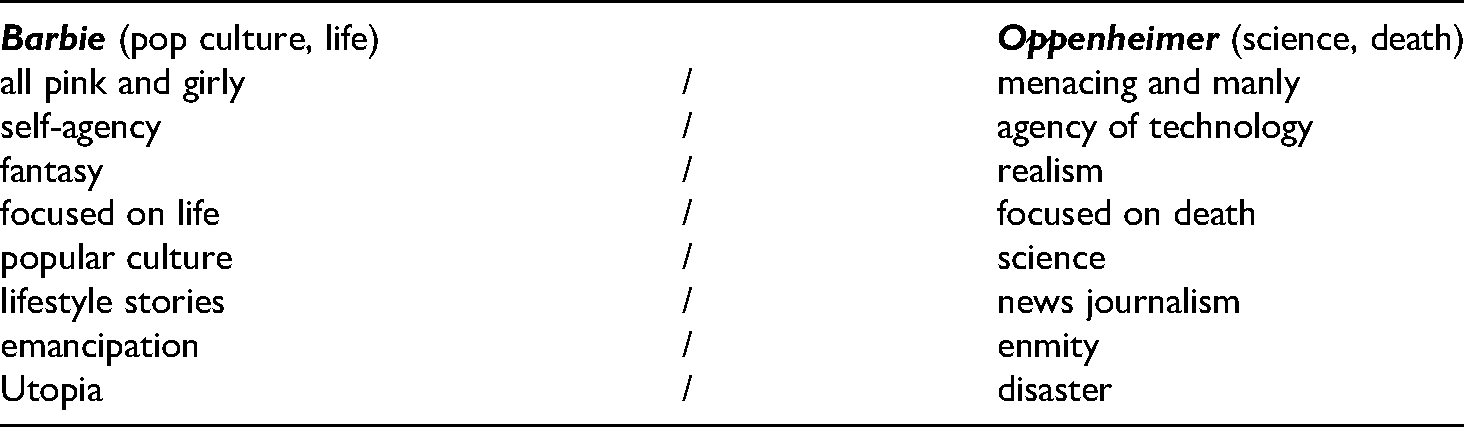
Taken together under the umbrella of Barbenheimer, these two films provoked widespread public thought. Neither Barbie’s desire for mortality (‘And then you die!’) nor Oppenheimer's dread of his own lethal agency (‘Now I am become Death’) could explain the world by itself. They needed each other.
Oppenheimer and Barbie triggered what seemed on the surface to be the most ‘deranged double bill of recent memory’, dubbing Barbie a ‘fuchsia fantasia toy story’, and Oppenheimer a ‘soul-rattling atomic bomb creation story’. 23 Barbenheimer brings into dialogue two ways of dealing with humanity’s age-old preoccupation with its own death, both personal (Barbie) and social (Oppenheimer). Barbie is about how you can only be perfect if you’re immortal, but you can’t be human unless you die. Oppenheimer is about the fear of Faustian powers over nature, whence humanity will destroy itself, along with everything else. One teaches the limits of selfhood through play, the other though history. Both films are about the agony of Americanness.
Here lies the problem of collective identity. ‘We’ (persons) fear death. Like a tantrum-throwing toddler, we demand to extend our own conscious selfhood and to exceed our mortal confinement to this time and place. ‘We’ (societies) project that wish onto artificial creations of our own making, both ‘personal’ (gods, spirits, dolls, robots), and social (race, gender, class, nation). At the same time, we must beware what we wish for. Any ‘we’-group can only be recognised in opposition to a ‘they’-world. As myths and narratives continue to insist, from the Epic of Gilgamesh to Batman’s The Dark Knight, the hero must die (preferably while defeating enemies), but the city survives, with a collective identity (place + people = nation).
If we create artificial beings (homunculi, automata, avatars … robots, drones, dolls, AI), or if we master uncanny powers (smelting metals, flying, splitting atoms … megacities, big tech, big data), and if we use those powers in an arms race of increasing lethality (better chariots … machine guns … carpet bombing … nuclear holocaust), 24 then these human-made creations will inevitably destroy their makers as well as their enemies. Daria Bylieva stresses: ‘as in ancient times, humanity strives above all to create something that is superior to itself’ (2024: 81). But then, having done so, we fear that what we’ve made will be as selfishly murderous as we are, or carelessly destructive to the point of species extinction, where we must die but the artifice survives.
The world, and the anthropomorphic stories by which it is known, are marked not by inevitable progress or inevitable destruction, but by uncertainty and unpredictability. What’s needed, according to techno-theorist Bogna Konior, is ‘an antidote’ to our ‘vision of the future as simplistically tending towards either utopia or disaster, both wholly submissive to human sensemaking’. She recommends ‘existential technologies’ to describe the ‘detachment of technology from human cognition and morality’. She wants to capture the current sensation (not the moral pre-settings) of ‘both the collapse of the ideal of linear progress and a commitment to the continued surfing of technology’s unpredictable trajectories’ (Konior, 2025a).
Konior herself plays with the possibilities of artificial intelligence to produce weird versions of her own corporeal form, by turns monstrous and angelic, or both at once (@bogna.synth). Her work on ‘angels in latent spaces’ is a ‘cyber/feminist archaeology around the questions of inhuman causality and automation, cross-reading theology and cyberculture theory’. She reads her own Catholic Polish schooling and medieval ‘female Christian erotic mysticism’ as prototypes of a ‘philosophy of the internet’. She examines ‘unnatural’ uses of technology like ‘chatbot partner apps, virtual reality sex, and xenowombs’ to identify ‘spaces of human–machine malleability and intimacy’ (Konior, 2025a, 2025b). Her approach to technology discourses is reflective, critical, and wild, seeking ways to think about humans and machines annealed together, as one and the same consciousness in a techno world, where ‘we are the mechanism for the perpetuation of language’ (2025b). 25
Thus, the very instruments of high-tech capitalist profitability can be used as a ‘memento mori’ against their own makers’ hubris. Mainstream pop culture can remind the great and the gods that they are mortal and moral beings (Reid-Walsh and Mitchell, 2000). But only if ‘you guys’ think about dying.
Angel, Antichrist, Apocalypse, Armageddon
Mattel is well aware of Barbie's potential as an angel; they’re not so forthcoming about her potential for the Antichrist → Apocalypse → Armageddon narrative path. They have released numerous versions of Barbie as ‘angelic inspiration’, ‘angel of peace’, ‘angel princess’, ‘couture angel’, and the exclusive ‘Bob Mackie Barbie Holiday Angel’, offered in three gown colours.
26
Each tincture has heraldic (ancestral/anagraphical) signification:
– – –
Angelic imaginaries may also be used to laud direct political action. Among the icons of international digital media is climate and social-justice activist Greta Thunberg. The launch of AI apps was soon followed by renditions of Thunberg as an angel, endowing her with immortality.
28
Naturally, opponents see her differently: still immortal, but of the devil’s party. Thunberg was soon fitted up for the Antichrist → Apocalypse → Armageddon role by tech entrepreneur-billionaire and far-right activist Peter Thiel: The antichrist wants to erect a one-world state, which largely seems to mean any kind of global regulatory regime. … The antichrist also is people who are against AI, especially those who seek to regulate it. … the antichrist is ‘someone like Greta, as in Thunberg, the climate activist. … Because, you know, the antichrist is popular.’ (Thiel, quoted in the Guardian, 11 October 2025)
29
Donald Trump praised the company on his social media platform, stating, “Palantir Technologies (PLTR) has proven to have great war fighting capabilities and equipment.” The tech titan’s ability to analyze vast amounts of data and sift out actionable insights through artificial intelligence has given it a groundbreaking role in the [Iran] conflict.
30
Of course, Thunberg is no angel. But her passionate speeches to world leaders implore them to ‘follow the science’: ‘I don’t want you to listen to me, I want you to listen to the scientists. … I want you to unite behind the science and I want you to take real action.’ 31 Neither Thiel nor Thunberg oppose science; but they differ radically on whether knowledge should be ‘armed’ (productive) or ‘wild’ (connective) (Hartley, 2018). Both lament the failure of collective (anagraphical) action. Thiel wants to permit the entrepreneurial class freedom-of-action (Chafkin, 2025); Thunberg wants popular activism for climate justice (Thunberg, 2022).
In her solo struggle against a seemingly all-powerful enemy, one of Thunberg’s most powerful magical weapons has been her seemingly tender age, gender, and autism. She started campaigning in her teens, finding a voice and online presence that was not only listened to by world leaders, but also by schoolchildren and their allies via Skolstrejk för Klimatet, mobilising 7 million protesters worldwide (September 2019). 32 Like Pussy Riot in a different key, Thunberg took to the danger/stronghold of the street, making it a place where feminist protest and critique of the corporate state’s actions coexist in one girl’s body (Delvaux, 2016).
Naturally, her prominence attracted the attention of Barbie. Mattel understood that ecological awareness and desire for climate justice suffused their consumer base. They got Jane Goodall to launch their ‘eco-leadership team certified carbon neutral©’ dolls, made from recycled plastic recovered from the ocean. 33 The news that ‘the future of pink is green’ was greeted with predictable scepticism (Boesenberg, 2024).
Working in the play-space of hoax and send-up, without Mattel’s imprimatur, climate activist/actor Daryl Hannah and The Yes Men published a widely reported spoof Barbie called ‘My Celia: Eco Warrior Edition’. Among the activists featured was Greta Thunberg, ‘Climate Crusader!’
34
Thunberg would reject the medieval anti-Islamic term ‘Crusader’, but she is upfront about her autism, calling it her ‘superpower’.
35
And she is quite happy to use Barbie as an ally. In July 2023, soon after Barbenheimer stormed global box offices, Thunberg was recorded at a protest in London. The late lamented Teen Vogue reports:
36
Thunberg is shown mouthing the words from the scene in which Margot Robbie's Barbie asks, “Do you guys ever think about dying?” The text on the video’s screen reads, “Do you guys ever think about the climate crisis?”
37
Alien earthlings
With apologies to George Eliot’s Middlemarch, the elusive ‘key to all mythologies’ may not be the deluded fear that ‘we’ might surpass ourselves, but anxiety that we may not; and then anxiety that, having done so, we will discover (too late!) that we are our own worst enemy. Here be dragons, monsters, vampires, zombies, aliens, and other uncontrollable versions of our cultural fears, including dehumanised ‘others’ who – after Hiroshima – can be excluded and exterminated at species scale.
Alien: Earth tries to warn us. The monsters are our metaphors for more-than-human power and control. Who will take them on? A ‘hybrid’ child-robot, speaking Xenomorphic like a native, adopting a fantasy name from Peter Pan, New Wendy is recognisably ‘one of us’. She's a heroine worthy of Haraway (1991). Sydney Chandler’s performance earned her a nomination for the aptly named ‘Independent Spirit’ of 2026. Wendy and her pet monster quickly achieved the status of immortality – as merchandise.
38
But not everyone loves a character with no faults. Wendy ‘is the worst kind of tropey modern Hollywood writing in one implausible and obnoxious bundle’: Wendy, unlike the other hybrids, is always one step ahead. She is the bravest. She is the strongest. She can speak the Xenomorph’s language and even makes one her pet who she can order to kill enemy guards. … Everyone else is easily duped and manipulated, but not Wendy.
39
Tellingly, it is New Scientist – noted for promoting scientific method not activist radicalism – that poses the question: ‘With action on climate change moving so slowly, is it time for more radical activism? Have we been left with no option but to use sabotage and property destruction as a way to protect our planet?’ 40 Science is beginning to follow Thunberg. As for Barbie, despite her play-domain apolitical nature, she too is learning how to reduce experiential tumult into an anthem for all. She’s now neurodivergent. In 2026 Mattel launched Autistic Barbie. 41 This triggered the usual kicking and screaming from the haters, for the subversive crime of ‘using pronouns’. 42 Perhaps she's channelling Greta Thunberg too? In reality, Autistic Barbie is a niche product. If you want the full experience, you’ll have to turn to ChatGPT and prompt it to merge your own image with Barbie’s. An influencer-led meme trend of April 2025, 43 this activity was publicised as a bit of fun, but the professionals recognised it for what it was, a training exercise for AI. A Sydney-based software development company reminded us that such user-created trends are teaching AI ‘what looks accurate, creative and human’, and also, how to create a good prompt: ‘For the first time … we’re seeing users share prompts in social media platforms, to improve how they interact with generative AI’. 44
This is what popular culture does. It spreads ideas like a contagion, but it is also an education. As Pussy Riot’s Nadya Tolokonnikova has put it, ‘Every generation leaves its mark. Education shapes its legacy.’ 45 We’re all training our synthetic successors. Mattel is on trend: ‘make the look even more killer’ with ‘facehugger heels’. 46 Popular culture is the rehearsal space where we can achieve a more perfect AI/tech interface, while retaining childlike desirability and better-than-human capabilities. But some lessons leave a different legacy. This is also the space where, in Pussy Riot’s immortal words, ‘Empires are not reformed, they are dismantled.’
Footnotes
Acknowledgements
For the formative conversations and encouragement that shaped this paper, I'd like to thank A/Prof Burcu Şimşek (Hacettepe University), Dr Laura Glitsos (Edith Cowan University) and Prof Wen Jin (East China Normal University).

Funding
The author received no financial support for the research, authorship, and/or publication of this article.
Conflicting interests
The author(s) declared no potential conflicts of interest with respect to the research, authorship, and/or publication of this article.
Data availability statement
All sources cited in references and endnote links.