






Abstract
This article examines the revival of a short-lived, non-canonised medium to challenge dominant assumptions in media nostalgia research. Focusing on the resurgence of the Casio TR camera on Rednote, it draws on participant observation, analysis of 120 posts, and 11 interviews. The article shows that nostalgia is organised through four platformed scenarios — acquisition, use, loss/deception, and spectatorship–demonstrating that nostalgia is socially distributed and not confined to prior ownership. Building on the concept of mnemonic imagination, the study argues that nostalgia extends beyond recollection, linking past, present, and future practices. It further shows that revival is sustained through configuration and re-interpretation: users integrate the device into hybrid media ecologies while symbolically revaluing it through narratives of youth and aspiration. The article argues that platform-mediated nostalgia does not simply preserve obsolete media, but reworks the past into a resource for present use and future-oriented cultural production.
Introduction
Scholarship on old media has shown that media obsolescence is never merely a technical matter, but is closely tied to memory, affect, and the changing cultural meanings attached to media artefacts (Gitelman, 2006; Lizardi, 2015; Natale, 2016). Yet despite this growing interest, research has tended to privilege old media that were once mainstream, commercially successful, or subsequently canonised as historically significant. Studies of media nostalgia have therefore focused disproportionately on objects such as vinyl records (Bolin, 2016; Chivers and Biddinger, 2008), film (Ochonicky, 2020), television (Baker et al., 2023), or early digital platforms and devices that have already secured a recognisable place in media history (Heineman, 2014; Kaun and Stiernstedt, 2014). In such work, nostalgia is often examined as an affective response to the disappearance of once-dominant media forms or as attachment to media already endowed with collective legitimacy. While this literature has generated important insights, it leaves less understood how nostalgia operates when the object in question was never historically central in the first place.
This article addresses that underexplored problem by asking why a short-lived, commercially failed, and non-canonised medium can nevertheless become an object of nostalgia and revival. Put differently, if a media artefact did not achieve durable market success, broad institutional recognition, or canonical cultural status, why does it still return as something worth remembering, buying, using, and discussing? This question challenges a tacit assumption in much existing scholarship: that media nostalgia depends, at least implicitly, on prior historical centrality. By shifting attention from dominant media to forgotten or marginal ones, this study argues that nostalgia cannot be reduced to the afterlife of historically important technologies alone. Rather, even ephemeral media can acquire renewed value when their meanings are reactivated through contemporary social practices. In this respect, the current revival of minor or failed media objects also speaks to wider debates in media history and media archaeology about the significance of artefacts that disappeared quickly and never fully entered the canonical record (Sterling and Kadry, 2017).
The resurgence of the Casio EX-TR selfie camera series in China offers a particularly revealing case through which to investigate this issue. Within the broader revival of so-called charge-coupled device (CCD) cameras noted in Chinese public discourse (Xinhuanghe, 2023), the Casio TR stands out as an ephemeral medium that was once intensely fashionable yet quickly rendered obsolete. Introduced in the early 2010s, the TR series was highly specialised: its rotating frame, beautification filters, and selfie-oriented design made it especially attractive to young women and closely aligned it with gendered cultures of self-photography and aspirational consumption. At the same time, its visual distinctiveness and strong association with self-presentation made it especially suited to later platform recirculation. However, the device's popularity was brief. As smartphone cameras and mobile editing applications rapidly improved, the TR lost both technical advantage and everyday necessity; Casio's exit from the digital camera market in 2018 further confirmed its obsolescence. Precisely because it was fashionable but fleeting, distinctive but non-canonised, the Casio TR provides an ideal case for examining how a marginal medium can be made newly meaningful after its apparent disappearance.
Focusing on Rednote (Xiaohongshu) as a key platform environment for the circulation of user narratives, visual display, and peer evaluation, this article argues that platform-mediated nostalgia does not simply recover the past of an obsolete medium. Rather, it transforms a short-lived and non-canonised device into a newly usable and meaningful object in the present. Drawing on three months of participant observation, qualitative analysis of 120 posts and comment threads, and 11 semi-structured interviews, the article shows that nostalgia surrounding the Casio TR is organised through recurrent platformed scenarios of acquisition, use, loss or deception, and spectatorship. Through these scenarios, ‘youth’ is reconstructed not merely as a personal life stage but as a shared socio-cultural formation shaped by aspiration, intimacy, status, and unequal access. The article further argues that the TR's revival is sustained through a dual process of platformed revaluation: technical configuration, through which users maintain, compare, troubleshoot, and integrate the device into contemporary media workflows; and symbolic reinterpretation, through which the camera becomes a collectible archive of youth, compensatory desire, and renewed self-recognition.
Theoretically, this article makes three main contributions. First, it contributes to nostalgia studies by showing that media nostalgia is not only retrospective but also future-facing. Building on work that treats nostalgia as more than simple longing for a lost past (Boym, 2001; Higson, 2014), the article argues that platform-mediated nostalgia operates through mnemonic imagination: users do not merely recall the Casio TR as it once was, but imaginatively rework its meanings so that the device becomes relevant to present routines and future-oriented cultural practice. Second, the article contributes to media studies by demonstrating that the revival of old media does not depend on historical success or canonical status alone. The renewed life of the Casio TR camera suggests that even marginal and short-lived media can be revalorised when platform infrastructures enable their circulation, evaluation, and everyday reuse. Third, it contributes to platform studies by showing that platforms are infrastructures of media afterlife. In this sense, media revival should be understood not as the simple return of historically important media, but as a platformed process through which forgotten artefacts acquire renewed legitimacy, value, and social life.
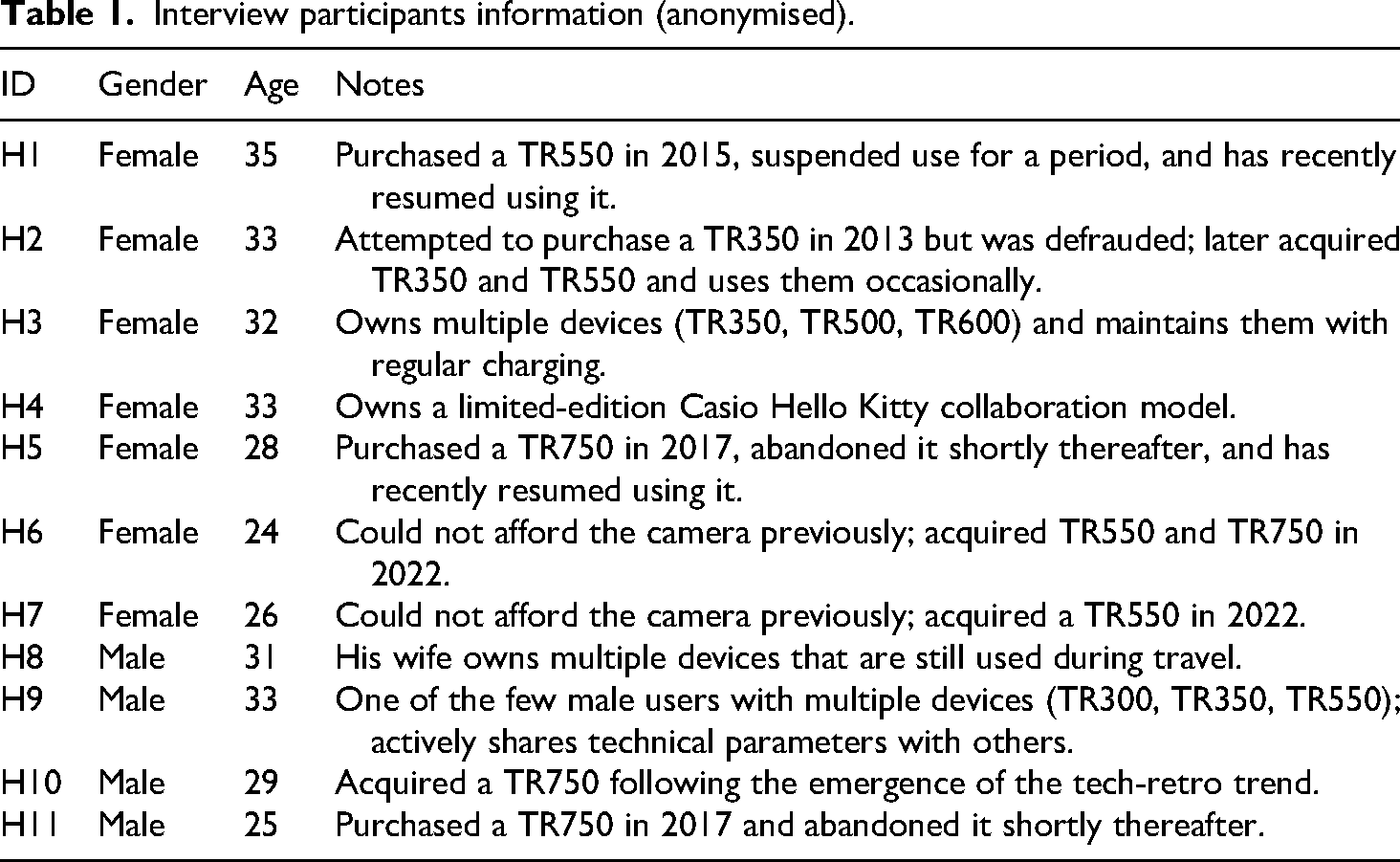
Interview participants information (anonymised).
Locating old media: From non-canonised artefacts to platform-mediated revival
Existing scholarship on old media, media memory, and media nostalgia has developed along interrelated yet frequently bifurcated trajectories. On the one hand, material culture and media archaeology studies emphasise the social life, materiality, and historical embeddedness of media artefacts (Appadurai, 1986; Gell, 1998; Parikka, 2012). On the other hand, research on media memory and nostalgia focuses on the affective, experiential, and mnemonic dimensions of engaging with technologies perceived as old (Gitelman, 2006; Gunning 2003; Lizardi, 2015; Menke, 2017). More recently, scholars have turned to the resurgence of obsolete or marginalised media, examining practices of reuse, reinterpretation, and reintegration in contemporary contexts (Natale, 2016; Niemeyer, 2014).
Despite these advances, existing research tends to treat these strands as parallel rather than integrated, resulting in a fragmented understanding of how old media become meaningful again in platform-based environments. Three gaps remain insufficiently addressed. First, research has disproportionately focused on canonised or historically successful media, leaving the afterlives of short-lived and non-canonised artefacts underexplored. Second, nostalgia is frequently conceptualised as a backward-looking affect, with limited attention to its generative and future-oriented dimensions. Third, platforms are often treated as sites where nostalgia is expressed, rather than as infrastructures that actively organise memory, visibility, and value.
To address these gaps, this literature review develops a three-part framework. Section ‘Old media beyond canon and success’ reconceptualises old media beyond canon and success, highlighting the importance of short-lived and marginal artefacts. Section ‘From media nostalgia to mnemonic imagination’ reframes media nostalgia through the concept of mnemonic imagination, emphasising its temporal and generative dimensions. Section ‘Platform-mediated revival as revaluation’ conceptualises media revival as a process of platform-mediated revaluation, through which obsolete media acquire renewed value, visibility, and social life. Together, these sections establish the theoretical foundation for analysing the resurgence of the Casio TR camera on Rednote.
Old media beyond canon and success
Since the 1980s, the humanities have increasingly shifted toward material culture, moving beyond textual analysis to examine the social relations, meanings, and value regimes associated with objects. Within this tradition, artefacts are understood to possess ‘social lives’, with trajectories that reflect broader cultural and economic transformations (Appadurai, 1986; Gell, 1998). Media technologies similarly undergo life cycles of emergence, adoption, and eventual obsolescence, becoming categorised as ‘old media’ when displaced by newer forms (Menke and Schwarzenegger, 2019).
However, despite this emphasis on the social life of media, research on old media has largely concentrated on artefacts that were once mainstream, commercially successful, or subsequently canonised as historically significant (Balbi 2015; Coopersmith, 2010; Edgerton, 2008). This includes widely studied objects such as vinyl records, film, television, and early digital platforms, all of which possess established positions within media history. As a result, the analytical focus often remains tied to media that have already achieved cultural legitimacy, reinforcing an implicit assumption that historical centrality is a prerequisite for nostalgia and revival.
This bias has important theoretical consequences. By privileging canonised media, existing scholarship risks overlooking how value is produced in cases where such legitimacy is absent. Short-lived, marginal, or commercially unsuccessful media — those that never became dominant or culturally canonised — are therefore under-theorised, despite their potential to reveal alternative trajectories of media life and value formation.
Media archaeology provides a useful corrective to this tendency by emphasising the material and historical contingency of media forms. Rather than evaluating media solely in terms of success or longevity, media archaeology treats them as sites where technological, cultural, and social processes intersect (Parikka, 2012; Niemeyer, 2014). From this perspective, ‘oldness’ is not an intrinsic property of a medium but a relational category shaped by changing technological contexts and social perceptions (Natale, 2016; Marvin, 1988). What counts as ‘old’ depends on how media are positioned within evolving systems of use, value, and meaning. This relational understanding of oldness implies that media objects are not fixed in their significance, but move through shifting value regimes over time. Drawing on Kopytoff's (1986) notion of the ‘cultural biography’ of things, media can be understood as undergoing multiple phases, including commodification, domestication, obsolescence, and potential reactivation. Importantly, this framework suggests that value is not simply inherited from the past but can be produced retrospectively through new contexts of use and interpretation.
Within this framework, short-lived and non-canonised media become theoretically significant rather than marginal. Their lack of historical centrality allows scholars to examine how media can acquire meaning without relying on established cultural narratives or institutional recognition. In other words, these media provide an opportunity to analyse how nostalgia and revival emerge not from prior importance, but from contemporary processes of reinterpretation and revaluation. Accordingly, this study focuses on the Casio TR camera as a case of a non-canonised, ephemeral medium. By examining its resurgence despite its limited historical success, the study foregrounds how forgotten media can re-enter cultural circulation and acquire renewed value through platform-based practices.
From media nostalgia to mnemonic imagination
Research on old media encompasses not only technological obsolescence but also the memories and emotional attachments associated with media use (Acland, 2007; Gitelman, 2006). Media memory operates as both a repository and a process, enabling the preservation, circulation, and transformation of individual and collective experiences. As such, media function simultaneously as mnemonic infrastructures and as objects of affective investment (Malin, 2014).
Old media are closely tied to nostalgia, understood as an emotional orientation toward the past. Nostalgia has been widely studied as a response to technological change, loss, and cultural transition (Bolin, 2016; Sobchack, 1999). It often manifests as a desire to reconnect with earlier media experiences, aesthetic forms, or sensory environments (Lizardi, 2015; Menke, 2017). Through practices of recreation, rediscovery, and reinterpretation, individuals use nostalgia to negotiate shifts in media environments and to stabilise their sense of identity (Campopiano, 2014).
However, much of this literature conceptualises nostalgia primarily as recollection and affect — that is, as a backward-looking engagement with the past. While such approaches highlight the emotional intensity of nostalgic experience, they tend to frame nostalgia as a response to loss or absence, rather than as an active and generative process. As a result, less attention has been paid to how nostalgia participates in shaping present practices and future orientations, particularly in relation to media that were never historically dominant.
Moreover, existing research often treats memory as an individual or collective repository, without fully accounting for how memory is organised, circulated, and rearticulated within platform environments. In contemporary digital contexts, memories are not simply recalled; they are shared, commented on, remixed, and stabilised through ongoing interaction. Platforms play a crucial role in shaping which memories become visible, how they are framed, and how they are collectively recognised.
To address these limitations, this article draws on the concept of mnemonic imagination (Keightley and Pickering, 2012), which reconceptualises memory as an active, creative, and future-oriented process. Rather than treating memory as passive recall, mnemonic imagination emphasises how individuals reconstruct the past in order to make sense of the present and to imagine possible futures (Gitelman and Pingree, 2003). This perspective highlights the temporal complexity of nostalgia, showing that it operates not only across past and present, but also as a resource for future-oriented meaning-making.
Within platform environments, mnemonic imagination is further shaped by processes of circulation, repetition, and collective recognition. Individual memories are articulated through posts, images, and narratives, and are subsequently validated, amplified, or transformed through comments, sharing, and imitation. In this way, nostalgia becomes a socially organised and platform-mediated process, through which personal recollections are translated into shared cultural scripts.
Accordingly, nostalgia should be understood not simply as a return to the past, but as an imaginative process that connects past, present, and future. This reframing is particularly important for analysing the resurgence of non-canonised media, where nostalgia cannot rely on established historical narratives, but must instead be actively constructed through contemporary practices.
Platform-mediated revival as revaluation
Nostalgia for old media is a multifaceted phenomenon that encompasses both the collection and reuse of media objects and the continued production of content using obsolete technologies (Bijsterveld and van Dijck, 2009; Niemeyer, 2014). Through such practices, old media can be revitalised and repurposed, re-entering circulation after periods of dormancy (Natale, 2016). This has led scholars to conceptualise obsolete media not as ‘dead’, but as ‘zombie media’ that persist through processes of repair, reuse, and reinterpretation (Hertz and Parikka, 2012).
However, existing accounts of media revival often treat it as an organic or user-driven phenomenon, focusing on practices of reuse without fully accounting for the infrastructural conditions that enable such processes. In particular, platforms are frequently understood as neutral sites where nostalgia is expressed, rather than as active agents that shape how revival unfolds.
This study instead conceptualises revival as a process of platform-mediated revaluation. From this perspective, platforms do not merely host nostalgic content; they organise how media objects become visible, comparable, and actionable. Through mechanisms such as circulation, algorithmic visibility, commenting, templated storytelling, peer evaluation, and collective troubleshooting, platforms structure both the expression of nostalgia and the practical reintegration of old media into everyday life.
Revival, therefore, is not simply a return to past media forms, but a transformation of their value. Old media are re-evaluated not only in symbolic terms—through narratives of youth, identity, and memory—but also in practical terms, as users exchange knowledge about maintenance, repair, and integration with newer technologies. This dual process of symbolic reinterpretation and technical configuration constitutes the core mechanism through which obsolete media are revalorised.
Social media platforms are particularly significant in this regard. As integral components of everyday life, they provide infrastructures for the articulation, circulation, and validation of nostalgic practices (Fu and Cook, 2019). Platforms such as Rednote enable users to share experiences, exchange knowledge, and collectively reconstruct memories associated with obsolete media (Luo et al., 2025; Zhong and Wu, 2025). Their affordances for visibility, interaction, and instruction make them key sites where old media can be rediscovered, evaluated, and re-integrated into contemporary use (Wang et al., 2022).
Accordingly, this study approaches media revival not as a spontaneous resurgence, but as a platform-mediated process through which value is actively produced. By analysing how the Casio TR camera is circulated, discussed, and re-used on Rednote, the article seeks to explain not only how nostalgia emerges, but how it becomes sustained as everyday practice. In doing so, it demonstrates that the revival of non-canonised media depends less on their historical importance than on the contemporary infrastructures that enable their revaluation.
Methods
We explore media nostalgia and media revival associated with the Casio TR camera by examining users’ memories of the device and their accounts of its renewed use. Our approach combined participatory observation on Rednote with the collection and analysis of relevant textual content, supplemented by semi-structured interviews with camera users. This multi-method design enables us to examine in detail how users discuss and recall the Casio TR camera as an old media artefact and how they translate nostalgic meanings into practices after its resurgence.
Crucially, our methodological approach is not limited to documenting user experiences, but is oriented toward theory-building. Rather than treating the data as a collection of discrete themes, we analyse how recurring practices and narratives reveal broader mechanisms through which platform-mediated nostalgia and media revival are organised. In the following sections, we detail the research site and outline how the data were collected and analysed.
Data collection
Rednote (Xiaohongshu) was selected as the research site for two main reasons. First, given its emphasis on a young user base and everyday content sharing, Rednote constitutes a key platform environment in which personal experience is routinely narrated, evaluated, and circulated (Liu, 2009). With over 300 million monthly active users (Guoji.pro, 2024), the platform primarily engages an audience aged between 18 and 34 (QianGua Com,2024). The platform's slogan, ‘Tag My Life’, underscores its appeal. Second, our initial explorations indicated that other platforms like Douban (豆瓣), Weibo (微博), and Baidu Tieba (百度贴吧) contained relatively limited discussion relevant to our research and included posts largely concentrated in the period of the TR series’ initial popularity. In contrast, Rednote hosts abundant recent discussions about Casio TR camera, including numerous posts titled ‘My Story with the Selfie Wizard’ (我和自拍神器的故事). This makes Rednote particularly suitable for examining how nostalgia is not only expressed but continuously re-articulated through platform circulation and interaction.
Data collection proceeded in two stages. First, a three-month participatory observation was conducted on Rednote from May to July 2024. Researchers performed comprehensive searches using a set of targeted keywords and hashtags: #CasioTRCamera (#卡西欧TR相机), #SelfieCamera (#自拍相机), #CasioTR100 (#卡西欧TR100), and #CasioTR350 (#卡西欧TR350). Given that the Casio TR camera remained prominent in public discourse and consumer use until 2018, the temporal scope for data selection was restricted to posts published after 1 January 2022. This ensured that the dataset reflected the camera's contemporary resurgence rather than its initial market phase.
The initial search produced an exploratory corpus of more than 500 relevant posts, which were archived for preliminary review. Two researchers then refined the dataset using three inclusion criteria: (1) exclusion of suspected commercial or promotional content; (2) a minimum engagement threshold of more than 10 comments per post; and (3) strong relevance to the study's research questions. This process resulted in a final sample of 120 posts. For ethical and organisational purposes, all samples were de-identified and assigned unique reference codes derived from the author's ID, with identifying information stored separately from analytic materials.
To deepen the participatory nature of the observation, both researchers systematically monitored and recorded interactions within the comment sections of the selected posts. This was supplemented by limited, transparency-oriented engagement, including posing questions within comment threads and joining user-led discussion groups to observe real-time peer-to-peer communication regarding the selfie camera. Throughout this period, the researchers maintained detailed field notes and held regular consultative meetings to cross-check interpretations. Any discrepancies in observation or coding were resolved through discussion to strengthen analytic consistency. Finally, observational materials were consolidated into textual records for subsequent qualitative analysis. This combination of observation, interaction, and documentation enabled us to capture not only what users said about the Casio TR camera, but how meanings were negotiated, reinforced, and circulated through platform dynamics.
The second stage of data collection consisted of semi-structured interviews. While posts and comments yielded rich material, they were often fragmented and did not always provide sufficient context regarding motivations, biographies of use, or decision-making processes. Interviews therefore served to elicit more elaborated narratives concerning users’ memories, attachments, and current practices. This enabled triangulation across posts, comments, field notes, and interviews, linking platform-level patterns to individual accounts.
Participants were purposively sampled from the authors of the 120 selected posts. Inclusion criteria required that interviewees had experience with Casio TR cameras and had actively re-adopted them within the current nostalgia trend. In addition, and consistent with the study scope, we included participants who had not owned the device previously but had encountered it as spectators and purchased it during the resurgence. Potential participants were contacted via direct messaging on Rednote. The interview phase spanned August to September 2024. Interviews were conducted remotely via Tencent Meeting and WeChat voice calls. The semi-structured protocol focused on personal memories associated with the camera, perceived drivers of nostalgia, motivations for renewed use, and concrete practices following re-adoption. Following the principle of theoretical saturation, by the 10th interview the themes began to substantially overlap with the patterns identified in posts and earlier interviews; the 11th interview yielded no additional thematic categories. A summary of the participants’ demographic characteristics and relevant background information is provided in Table 1. The final sample consisted of 11 participants (seven women; four men), aged 24–35. Interviews lasted 55–80 min. Consistent with ethical standards, all interviews were recorded with participants’ consent, guided by informed consent, voluntary participation, and confidentiality. All participants were assigned pseudonymous IDs (H1–H11), and any potentially identifying details were removed or generalised. Audio files were transcribed into textual records for analysis.
Data analysis
The selected text samples and interview materials were transcribed and, where necessary, translated into English. To preserve meaning during translation, we retained key vernacular terms (e.g., ‘自拍神器’) alongside English renderings when they carried culturally specific connotations. Aligned with the research questions, a procedural grounded theory approach guided coding through three stages. To enhance reliability, two researchers independently coded the interview data and iteratively compared codebooks, reducing the likelihood that interpretations were shaped by a single researcher's assumptions. Coding focused on meaning-making and practice rather than frequency counts, and analytic memos were used to track emergent categories across datasets.
Importantly, coding was not conducted merely to classify empirical material into descriptive categories. Instead, it was oriented toward identifying recurrent narrative scenarios through which nostalgia is organised, mechanisms of value reconfiguration through which revival is sustained, and temporal articulations linking past, present, and future within platform-mediated practices. Our analytic goal was not to count the frequency of themes, but to examine how recurring scenarios and practices jointly produce a broader model of platform-mediated nostalgia and media revival.
In the first stage, open coding was conducted line by line to examine the raw data closely. We attended to participants’ concrete descriptions of experiences, emotions, practices, and interactions related to the Casio TR camera, bracketing pre-set theoretical categories where possible. This process generated a large number of initial concepts capturing recurring actions and meanings, such as saving money to purchase the camera, receiving it as a gift, recalling specific selfie poses, engaging in re-photography practices, experiencing scams during purchase attempts, feeling envy when observing others’ use, charging and maintaining old devices, comparing photographic results with smartphones, and collecting cameras as symbolic objects. These codes remained close to participants’ language and everyday experiences. At this stage, the aim was not only to identify discrete actions, but to capture how users narratively frame their experiences, thereby laying the groundwork for identifying recurring narrative structures.
In the second stage, axial coding was used to examine relationships among initial concepts and to group them into higher-level categories based on shared contexts, actions, and meanings. Four major experiential contexts consistently emerged as sites through which nostalgia for the Casio TR camera was articulated: (1) acquiring the camera, (2) using the camera, (3) unsuccessful attempts to obtain the Casio TR Camera, and (4) observing others’ use. Rather than treating these as merely empirical groupings, we interpreted them as recurrent narrative scenarios through which users organised and made sense of nostalgic experience. In parallel, a second set of categories emerged around post-resurgence practices. Concepts related to recharging, repairing, testing image quality, exchanging usage tips, comparing models, and integrating the camera with contemporary devices were clustered into a utilitarian dimension. By contrast, concepts associated with emotional attachment, compensation for unfulfilled youthful desires, collecting vintage models, and reluctance to sell were grouped into an emotional-symbolic dimension. These dimensions were interpreted as mechanisms of value reconfiguration, through which the old medium is simultaneously made functional and meaningful again in the present.
In the final stage, selective coding integrated core categories into a coherent analytical framework. Two core findings were identified. First, media nostalgia surrounding the Casio TR camera is enacted through four differentiated pathways — acquiring, using, missing/being hurt, and observing — rather than operating as a singular or homogeneous emotional response. Second, the revival of the Casio TR camera cannot be explained by nostalgia alone; instead, it is driven by the convergence of emotional value and utilitarian value, through which the old medium is reconfigured, reinterpreted, and reintegrated into contemporary social practices. Together, these core categories form a model in which nostalgia operates through structured scenarios, and revival is sustained through processes of revaluation that connect past experiences with present practices and future possibilities.
Reflexivity and researcher positioning
Both researchers are long-term users of Chinese social media platforms and were familiar with Rednote's interactional norms prior to fieldwork. This situated knowledge facilitated entry into community discussions, but also required ongoing reflexive attention to how our own assumptions might shape interpretation. To mitigate this risk, we maintained reflexive memos throughout data collection and analysis, discussed moments of uncertainty in regular meetings, and prioritised participants’ own terms and evaluative categories when developing codes and themes. This reflexive approach was especially important in a study that sought to identify not only recurring content but also the narrative, temporal, and evaluative structures through which nostalgia and revival were organised.
Findings
Drawing from participant observation on Rednote, qualitative analysis of posts and comment threads, and semi-structured interviews, this section traces how the Casio TR camera is reanimated as both an object of memory and a resource for contemporary practice. Rather than treating nostalgia as a singular emotion, the findings show how it is organised through platformed narration and becomes legible via recurrent scenarios that users repeatedly mobilise to make sense of the device and of themselves. Importantly, these scenarios should not be understood as parallel or merely descriptive types of experience. Instead, they function as platform-mediated entry points through which nostalgia is organised, circulated, and made socially intelligible. Taken together, the four scenarios — acquisition, use, loss/deception, and spectatorship — demonstrate that nostalgia is not confined to prior ownership of the medium but is socially distributed across users with varying degrees of access, including those who engage through aspiration and observation rather than direct use. At the same time, these scenarios reveal that nostalgia is narratively templated on the platform; recurring story formats, shared expressions, and recognisable tropes enable individual experiences to be articulated in collectively intelligible ways.
Through this process, ‘youth’ is not simply recalled as an individual life stage, but reconstructed as a shared socio-cultural formation. What matters is not the authenticity of personal memory alone, but the degree to which experiences resonate with collectively recognisable narrative patterns, allowing users to align their own pasts with broader platformed imaginaries of youth. Accordingly, the findings are presented in two parts. Section ‘Media nostalgia and the platforming of youth’ maps the four scenarios through which nostalgia is organised and youth is collectively imagined. Section ‘Acquiring the Casio TR camera’ demonstrates that revival is sustained through dual revaluation: technical configuration and symbolic reinterpretation.
Media nostalgia and the platforming of youth
The findings suggest that media nostalgia for the Casio TR selfie camera on social media operates as a mnemonic catalyst that unlocks vivid recollections of ‘youth’ as a lived socio-cultural formation rather than a purely biographical life stage. Rather than being tinged with melancholy, these recollections are predominantly framed through pleasure, playfulness, and idealisation, aligning with scholarship that conceptualises nostalgia as a positive aesthetic force relatively free from sadness (Fickers, 2009; Higson, 2014). Although the Casio TR camera experienced a meteoric rise followed by a rapid descent into obsolescence within less than a decade, the current wave of nostalgic practices gradually illuminates its platformed ‘cultural biography’ (Kopytoff, 1986), in which the device becomes a shared reference point through which users narrate taste, status, intimacy, and self-presentation. This biography is not simply recovered from the past, but actively produced through platformed narration, where individual memories are articulated in ways that invite recognition, repetition, and participation.
Drawing on participant observation, post/comment analysis, and interviews, four recurrent scenarios emerged as the principal conduits through which the TR's cultural biography is narrated and tethered to memory: acquisition, use, loss/deception, and spectatorship (observing others’ use). While acquisition and use constitute the most conventional pathways, a subset of participants recounted painful episodes of deception and thwarted desire. Moreover, for those for whom the camera's price was prohibitive, nostalgic engagement was organised around watching others rather than direct ownership. Crucially, these four scenarios are not simply empirical categories, but constitute the key entry points through which platform-mediated nostalgia is structured. They demonstrate that nostalgic engagement extends beyond direct ownership, encompassing both lived experience and imagined participation. In doing so, they reveal how nostalgia becomes socially distributed, allowing users with different relationships to the device — owners, non-owners, and observers — to participate in a shared mnemonic field.
At the same time, the recurrence of these scenarios across posts and narratives indicates that nostalgia is organised through platform-specific templates. Users do not recount their experiences in entirely idiosyncratic ways; rather, they draw on recognisable narrative patterns that make their stories legible to others. Through such patterned narration, individual memories are translated into collectively intelligible forms. As a result, these scenarios function as mechanisms through which ‘youth’ is reconstructed as a shared socio-cultural formation. Rather than being grounded solely in personal biography, youth emerges as a collectively recognisable set of experiences, emotions, and social relations that are continuously rearticulated through platform interaction.
Acquiring the Casio TR camera
Acquisition constitutes a primary site of media nostalgia because ownership often initiates a user's sustained social relationship with the device. However, rather than treating acquisition simply as the moment of individual possession, our data show that it functions as a key entry point through which nostalgia is narratively organised and socially distributed. In these narratives, the price paid — whether at the time of first purchase or during later resale — functions as a pivotal identifier and an evaluative benchmark. Many users spontaneously disclose their original expenditures in comments and captions, a practice that systematically transforms price into a mnemonic anchor. Here, price exceeds numerical description; it indexes particular consumer moments, social expectations, and life stages, thereby condensing biography into a recognisable platform trope. In this sense, recalling price is not merely about economic value, but about situating the self within a specific temporal and social configuration of consumption.
Across the dataset, price operates as a recurring ‘memory marker’, especially when contrasted with present-day valuations. Originally priced at around Chinese yuan (CNY) 6000–7000, the TR camera was a relatively expensive consumer good, often associated with scarcity and aspirational desire. Limited availability further intensified demand, encouraging premium payments and cross-border purchasing. In the current second-hand market, however, prices have dropped dramatically, sometimes to one-tenth of their original value. For instance, a post by the user ‘Quanzhimeng’ noted the irony of a TR350 once bought for 6000 CNY now being available for CNY 200–300, a sentiment that resonated with over 100 concurring comments. In such posts, the price gap operates as a narrative device that aligns past and present, enabling users to collectively recalibrate the meaning of value across time.
Importantly, acquisition narratives also reveal that ownership is rarely articulated as an individual act. Instead, it is consistently narrated as a relational process embedded in social ties and dependency structures. Celebrated for its specialised selfie capabilities, the Casio TR camera primarily attracted a young female demographic that often lacked independent purchasing power at the time. As a result, parents, relatives, and romantic partners frequently appear as key figures in the acquisition narrative, embedding kinship and intimacy within the medium's biography. Users recount, for example, birthday gifts brought back by fathers during trips to Hong Kong, emotional negotiations with mothers, or romantic gestures such as a partner spending their first salary on the camera. These accounts demonstrate that acquisition is not simply about possessing a device, but about recalling the social relations and affective economies through which possession became possible. The TR camera thus emerges not as an isolated consumer object, but as a material node through which familial care, gendered expectations, and aspirational consumption are remembered and rearticulated.
Taken together, these findings show that nostalgia attached to acquisition is not grounded in the device alone, but in the broader social relations and consumer conditions that structured access to it. Price anchors memory, while relational narratives anchor meaning. As a result, what is remembered is not only ‘having the camera’, but the social world in which having or not having the camera became significant. In this way, acquisition functions as a key entry point through which nostalgia connects personal biography to shared socio-economic contexts, reinforcing the argument that media nostalgia is fundamentally social rather than purely individual.
Using the Casio TR camera
Nostalgic engagement with the Casio TR camera functions as a conduit for emotional warmth and social connection. Recollections frequently evoke shared scenes of youth — classrooms, dormitories, and group outings — often articulated through memories of taking photos with friends. A recurring narrative describes being the first in one's class to own the ‘selfie wizard’, with peers lining up to use it. Such accounts position the TR camera as a crystallisation of past media experience, affect, and interpersonal ties. While individual memories vary, they cohere around a shared cultural script in which the device signifies a recognisable era of mediated girlhood.
In this sense, the Casio TR camera can be understood not simply as a device for image capture, but as what we conceptualise as a ‘digital personal diary’. Crucially, this diary-like quality does not reside in the storage of images alone. Rather, it lies in the camera's capacity to record, structure, and stabilise practices of self-presentation, intimacy, and everyday youth culture (Stern, 1992). As a digital personal diary, the TR camera does not merely preserve what users looked like, but how they enacted themselves in relation to others — how they posed, interacted, and participated in shared social scenes. In this way, the device operates as a medium that scripts as well as records experience, embedding within its use historically specific norms of visibility, affect, and self-display.
Within these diaries, the device is consistently associated with positive affect, with users describing the act of recharging and reactivating the device as triggering a ‘flood’ of happy memories. Importantly, this mnemonic activation is often platform-driven: encountering TR-related posts prompts users to revisit and re-stage their own pasts. Importantly, the TR's ‘digital personal diary’ quality lies not simply in storing images, but in preserving routinised forms of self-photography, intimacy, and platformed self-presentation that can later be reactivated as a lived archive of youth.
Moreover, as a material media object with distinctive affordances, the TR camera shaped embodied habits and shared aesthetics. When narrating use, participants often recall habitual gestures, camera angles, and familiar locations as integral to ‘TR-style’ self-photography. Once posted, such cues rapidly generate resonance among viewers, suggesting that nostalgia is oriented not only toward the device but toward the practices sedimented within it (Lizardi, 2015; Natale, 2016). For example, a post by the user ‘Sunny’ featuring photos taken with a TR350 — tilted body, slightly parted lips, upward camera angle, and a ‘peace’ sign — prompted comments such as ‘This pose is definitely a classic Casio move’. Here, bodily posture functions not only as a mnemonic trigger, but as part of a collectively recognisable repertoire of embodied practice through which individual memories become socially legible.
User narratives further indicate that nostalgia is often rooted less in the image outcome than in the process of producing and sharing images. For participant H1, the most memorable dimension was the ‘creative pleasure’ of posting. Because early models lacked wireless transfer, users developed the practice of photographing the camera's display screen with a phone to upload images to platforms such as Renren and QZone. This ‘re-photography’ became a ritualised workaround through which a technical limitation was converted into a performative resource, it enabled users to display not only a selfie but also the fact of owning a prestigious device. This practice further illustrates that the TR camera's diary-like function extends beyond documentation to include the scripting of platform rituals. What is preserved is not only the image, but the process — the gestures, constraints, and circulation practices through which images were made meaningful.
In this sense, nostalgia here is not directed toward static visual outputs, but toward historically specific modes of doing and sharing. The TR camera thus operates as a medium through which embodied routines, social interactions, and platform practices are archived and later reactivated, reinforcing the idea that media nostalgia revives not merely objects, but situated forms of everyday life.
Missing the Casio TR camera
Our data show that the Casio TR camera often evokes joy and pleasure—positive and idealised dimensions that are central to nostalgia as an affective mode (Stern, 1992). However, this case also demonstrates that nostalgia is affectively layered rather than uniformly pleasurable. Alongside celebratory recollections, some informants reported more ambivalent or uncomfortable emotions triggered by the camera and by platform-based nostalgic talk around it. Put differently, the TR's reappearance does not simply ‘warm’ the past; it also reactivates memories of vulnerability, frustration, and unequal access. This layered affect complicates dominant accounts of media nostalgia that emphasise warmth, comfort, or aesthetic pleasure, suggesting instead that nostalgia can also carry traces of anxiety, disappointment, and social inequality.
In many media contexts, ‘loss’ is associated with negative memory, whether through losing a device or losing access to an account. However, our observation and textual analysis indicate that literal loss of the TR camera is not the predominant negative register in this case. Rather, participants rarely spoke about misplacing the camera itself; instead, they repeatedly referenced ‘tragic memories’ associated with deceptive purchasing experiences — a phrase introduced by participant H2. As noted earlier, the Casio TR series was intensely popular at launch, and many recollections emphasise that models such as the TR100, TR150, and TR350 sold out quickly. Regardless of the precise market mechanisms behind this scarcity, the outcome was similar: scarcity amplified desire and normalised paying substantial premiums, generating a sense that the camera was worth extraordinary effort and risk. In this sense, scarcity was not merely a background condition, but an integral part of the object's affective and mnemonic life.
With official stock depleted, many consumers turned to informal private channels and subsequently encountered fraud. On Rednote, the user ‘Xiaofei’ recounted being deceived during the purchasing process, a narrative that elicited extensive empathetic responses. Discussion threads suggest a recurring scam pattern: users transferred substantial sums to unverified sellers who then disappeared or closed their storefronts. These ‘tragic memories’ demonstrate that the remembered object-world of the Casio TR camera includes not only its aesthetic appeal or technical affordances, but also the market conditions and consumer anxieties through which it was pursued. Nostalgia here is therefore inseparable from experiences of risk, uncertainty, and unequal access.
Such accounts show that a youthful desire for ownership — intensified by scarcity — exposed consumers to financial risk and produced a darker layer of media nostalgia. Importantly, this suggests that nostalgia is not simply about recovering a stable or idealised past, but about re-engaging with a historically situated field of consumption marked by both aspiration and precarity.
These negative episodes have become durable markers within the collective memory of the TR camera, complicating the largely cheerful nostalgia expressed elsewhere and revealing a more complex affective structure. In doing so, they challenge celebratory narratives of media nostalgia by foregrounding how longing for past media is shaped not only by pleasure, but also by the tensions and inequalities embedded in past media economies.
Observing others’ use of the Casio TR camera
Nostalgic engagement with the Casio TR camera extends beyond those with prior ownership or direct use. Crucially, this finding challenges the implicit assumption in much nostalgia research that nostalgic attachment must be grounded in personal experience or prior possession. This study suggests that nostalgia also resonates with individuals who lacked the financial means or the opportunity to purchase the device at its peak, a phenomenon we conceptualise as nostalgic spectatorship. Spectatorship demonstrates that media nostalgia can be aspirational and vicarious, emerging not from direct use but from imagined participation in a shared media world. On Rednote, users frequently articulate this stance through memories of adolescent longing and constraint. For these individuals, nostalgia is organised around watching others use the camera and the mixed feelings that followed, including envy and admiration. Participant H6, for instance, recalled her intense fascination with peers who owned the device.
Participant H6 further noted that during the era of Baidu Tieba and Renren, owning a Casio TR camera could function as an index of baifumei (白富美), a term denoting girls imagined as wealthy and beautiful. Because of its high cost and limited availability, the camera was widely perceived as a luxury good and a marker of economic privilege. Consequently, the TR camera operated as a signifier of social distinction, enabling users to perform and display prestige; in this sense, its symbolic value could outweigh its functional utility (Kasser, 2016). In this context, spectatorship becomes a crucial site through which collective memory is formed not by direct experience, but through observation, comparison, and aspiration. What is remembered is not ‘using the camera’, but witnessing its role in structuring social hierarchies, desirability, and identity. Nostalgia here thus records not only ‘the camera I wanted’, but also the social worlds the camera helped make visible.
Within the Chinese context, nostalgia for the Casio TR camera also functions as a tribute to youth and a form of compensation for earlier shortages. This dynamic is particularly salient among the post-1990s generation, who came of age during the ‘golden age’ of digital cameras but often lacked the resources to acquire premium devices. Participant H10 noted that while the camera was prohibitively expensive around its 2011 release, its current obsolescence has made it affordable, enabling users to fulfil long-standing ‘youthful dreams’. Importantly, this compensatory logic reveals how aspirational nostalgia can be retrospectively materialised. While the original experience was one of exclusion and observation, the present moment allows individuals to re-enter the imagined media world as participants. In this sense, revival does not simply restore past use, but enables a reconfiguration of past non-use into meaningful present practice.
On Rednote, this compensation logic is captured in popular narratives of acquiring the camera at a fraction of its original price to rectify earlier constraints. For example, one post describing the fulfilment of a ‘15-year-old's dream’ for a nominal price generated over 2000 comments, with many users echoing that owning the device now operates as a belated reconciliation with girlhood desire. Through second-hand markets, devices that once signified exclusivity can ‘trickle down’ to broader social strata, making previously unattainable products newly accessible (Marzella, 2015). These findings expand the subject of media nostalgia beyond former owners to include imagined participants who engaged with the medium through observation and aspiration. This shift has important theoretical implications, it suggests that nostalgia is not limited to lived experience but can also be generated through mediated exposure and socially shared imaginaries. Ultimately, whether through successful acquisition, earlier parental refusal, or long-term observation from the margins, the Casio TR camera reconnects individuals to formative social relationships and status imaginaries through the nostalgic reconstruction of these purchasing scenarios. In doing so, spectatorship reveals that media nostalgia is not only retrospective but also projective, oriented toward imagined pasts and possible futures of belonging within a media world.
Together, these four scenarios show that platform-mediated nostalgia is not a singular feeling directed at a stable object. Rather, it is a distributed mnemonic formation organised through recurrent, recognisable scenarios that allow users to imagine youth collectively across uneven experiences of ownership, exclusion, intimacy, and aspiration.
Media revival through configuration and re-interpretation
In response to the RQ2, the resurgence of the Casio TR camera in public consciousness cannot be explained by media nostalgia alone, even when nostalgia is understood to include both symbolic and practical longing for the past. Our data suggest that users do not merely engage in scenographic recall to ‘return’ to youth; rather, they re-embed the old medium within contemporary routines, interactions, and aesthetic economies while simultaneously narrating its past significance. Observations on Rednote, together with interview accounts, indicate that users adopt a diverse range of practices after the camera's resurgence. The TR thus operates not only as a conduit to memory but also as a resource for present-day sociality and creativity, enabling new forms of use, evaluation, and circulation.
Analytically, we conceptualise these post-resurgence practices as a process of revaluation, organised through two intertwined dimensions: configuration and re-interpretation. Configuration refers to the material and technical work through which users discover, maintain, and operationalise the camera in the present, often by combining it with newer devices and platform infrastructures. Crucially, this dimension highlights that revival depends on infrastructural compatibility: old media do not persist by remaining intact, but by becoming workable within evolving media environments. Re-interpretation concerns the symbolic labour through which users re-assign meanings to the TR camera — particularly around youth, status, and selfhood — so that the device becomes valuable again beyond its discontinued market life. Together, these dimensions demonstrate that revival is not a simple recovery of past value, but an ongoing process through which value is actively produced in the present.
Configuration: Suspending obsolescence in hybrid media ecologies
The Casio TR camera is not a distant relic, its market withdrawal is recent enough that many devices remain functional when properly stored. Accordingly, for some Rednote users the camera has remained a latent presence within domestic media ecologies rather than a fully ‘lost’ object. Routine practices such as charging, cleaning, and cautious storage become forms of care through which the object's ‘social life’ is sustained, and through which users reaffirm their continued attachment. Participant H3, for instance, noted that despite long periods of idleness, she regularly charges the device and cannot bring herself to discard it because of its sentimental value.
However, these practices should not be understood as incidental acts of maintenance. Rather, they constitute the practical labour through which obsolescence is actively suspended. Charging, repairing, transferring files, and preserving batteries are all forms of infrastructural work that keep the device operational within contemporary media systems.
Following the resurgence, the TR's utilitarian and exchange values are also reactivated, transforming it from an obsolete commodity into a usable tool. A recurring Rednote narrative begins with users purchasing the camera to fulfil a ‘youthful dream’, but subsequently being surprised by its distinctive photographic results and the social attention those results attract. This surprise fuels a practical turn: users exchange detailed technical knowledge about model differences, system settings, shooting parameters, batteries, repairs, and image-export workflows. One notable user, ‘DreamJun’, documented a trajectory from middle-school obsession to acquiring six TR models, offering systematic comparisons of configurations and aesthetic outcomes. These practices reveal that the survival of old media depends on their integration into hybrid media ecologies. The TR camera does not operate in isolation; it is combined with smartphones, editing apps, and platform infrastructures that enable image circulation and visibility. In this sense, revival is contingent upon the device's ability to interface with contemporary systems of storage, transfer, and display.
Such posts, alongside comment-thread troubleshooting and side-by-side comparisons with contemporary devices like the iPhone, produce an ongoing dialogue space in which nostalgia is translated into collective technical practice. For those engaged in revival, attention often centres on cost-effectiveness in the second-hand market and on achieving specific photographic effects. Owners share fine-grained evaluations — for example, claims that the TR150 produces ‘more natural’ tones while later models such as the TR600 lean towards pinkish hues.
Through these exchanges, practices such as troubleshooting, comparison, and optimisation become central mechanisms through which the device is made to ‘work’ again. Revival, therefore, is not a passive return of functionality, but an active, collaborative process of re-operationalisation. In this sense, although the Casio TR is categorised as an ‘old medium’, its operational relevance is re-established through contemporary platform-based practices of instruction, comparison, and peer review.
Re-interpretation: Symbolic repossession and re-authoring of youth
Following its trajectory from peak popularity to obsolescence, the Casio TR camera re-enters circulation via second-hand infrastructures such as Xianyu (闲鱼). Its current valuation — often a fraction of its original retail price — enables a form of retroactive compensation for previously unattainable desires. On Rednote, users frequently narrate acquisition as a way to repair earlier regret, framing purchase as a moral-emotional act rather than a purely economic transaction. Importantly, this process of acquisition is not merely compensatory consumption, but a form of symbolic repossession. Collecting the TR camera allows users to reclaim a past that was previously inaccessible, reconfiguring the relationship between self, memory, and material culture. For example, a post by ‘Doulv Uncle’ prompted a highly affective interaction ritual in which commenters synchronised their first encounters with the camera with their current ages, thereby tying the material object to a shared timeline of youth and growing up.
However, this compensatory purchase is often accompanied by an acute awareness of temporal distance. Participant H7 observed that buying the camera ‘ten years late’ cannot reproduce the original thrill: the affective meaning of ownership at sixteen is fundamentally different from that in adulthood. This underscores a tension at the core of media revival. While revival responds to collective longing and enables belated fulfilment, it also foregrounds the irrecoverability of the past. In this sense, compensation should not be understood simply as belated purchase, but as a process of re-authoring the self's relation to youth, classed aspiration, and missed opportunity. Users do not recover their past selves; rather, they reinterpret those past desires from the standpoint of the present.
At the same time, the lowered price and renewed circulation make systematic collecting newly feasible, encouraging users to re-interpret the camera as a symbolic archive of a lost era. Collectors such as H4 value scarcity and limited editions — such as the Hello Kitty anniversary model — not only for their material distinctiveness but also for their capacity to preserve cultural markers and identity narratives. Collecting, therefore, is not simply accumulation, but a practice through which meaning is stabilised and re-signified. The object becomes a repository not only of memory, but of identity work and symbolic value.
Beyond colour or model number, collections are framed as repositories of a particular media moment. As the user ‘Miss Ding’ put it, purchasing the camera in adulthood becomes a symbolic repossession of the youth that was once financially out of reach. Such practices transform second-hand markets and platform storytelling into a space of reconciliation, what another user, ‘Ludan’, described as a ‘feast for my younger self’, in which buying and collecting function as rituals that rework regret into renewed self-recognition. In this context, youth is not a purely autobiographical or biological stage, but a culturally constructed formation that is continually reassembled through shared scripts of desire, class, intimacy, beauty, and self-display.
Taken together, the findings demonstrate that the Casio TR camera's renewed visibility on Rednote is driven by an interplay between platform-mediated memory work and everyday re-functionalisation. In Section ‘Media nostalgia and the platforming of youth’, nostalgia is shown to operate through four scenarios that render ‘youth’ narratable and collectively recognisable — sometimes joyful and idealised, sometimes marked by scarcity, deception, and unequal access. In Section ‘Acquiring the Casio TR camera’, revival emerges as more than remembrance: it is sustained through the confluence of utilitarian and sentimental value, as users configure the old device through maintenance, technical tinkering, and hybrid workflows with new media, while simultaneously re-interpreting it as a collectible archive and a vehicle for compensatory desire.
In this way, the TR camera becomes a revived medium whose value is not rediscovered from an authentic past, but newly produced in the present through platform circulation, peer evaluation, and routinised practice. Revival, then, is sustained neither by nostalgia alone nor by technical usability alone. It depends on their articulation: users must be able to make the TR work within contemporary infrastructures, and they must also have reasons to make it matter again within contemporary cultural imaginaries.
Discussion: From platformed nostalgia to future-facing revival
This study examines the resurgence of the Casio TR camera as a socio-cultural phenomenon emerging within a broader wave of media nostalgia, made visible through its re-entry into everyday life via social media platforms. By addressing the two research questions, the article clarifies not only how old media become attached to nostalgic memory (Acland, 2007; Gitelman, 2006), but also how such memory is actively reorganised into present practice and future-oriented meaning.
Central to this process is what Keightley and Pickering (2012) conceptualise as mnemonic imagination. The findings demonstrate that nostalgia surrounding the Casio TR camera is not a passive act of recollection, but an active, platform-mediated reconstruction of the past. Through recurrent scenarios — acquisition, use, loss/deception, and spectatorship — users do not simply recall prior experiences, they reorganise them into narratively structured forms that are recognisable, shareable, and actionable in the present. These scenarios show that memory is continually reworked through processes of platform circulation, recognition, and participation. In this sense, mnemonic imagination is empirically observable in how users transform fragmented personal memories into collectively intelligible scripts that link past experience to current practices and imagined futures of belonging.
More specifically, each scenario demonstrates a distinct dimension of mnemonic imagination in action: acquisition reworks past consumer conditions and social relations into present narratives of value; use reactivates embodied practices and aesthetic routines as repeatable forms of participation; loss/deception reinterprets past anxieties and inequalities as shared memory; and spectatorship transforms prior non-ownership into imagined participation and belated inclusion. Taken together, these scenarios show that memory is not simply retrieved, but reorganised into socially recognisable and future-oriented modes of engagement.
Across the dataset, users narrate their relationship to the Casio TR camera through four recurrent scenarios, which together constitute the device's platformed ‘cultural biography’. Two implications follow. First, the recollections captured here are simultaneously individual and collective. Although experiences differ — from direct ownership to long-term observation — users repeatedly converge on recognisable affects and narrative forms (e.g., joy, admiration, regret, or frustration). Through repetition and mutual recognition on the platform, these heterogeneous autobiographical fragments are assembled into a broader generational discourse in which the Casio TR camera comes to stand for an era of mediated youth. Second, the memories mobilised in nostalgic engagement extend beyond the object itself. Users recall not only models and specifications but also embodied habits, posting rituals, and social situations in which the camera mattered. In this sense, nostalgia does not merely ‘represent’ the past, it reactivates historically situated practices — aesthetics, styles, operational routines, and sensory experiences — through which old media are re-embedded in everyday life (Lizardi, 2015). This further demonstrates that mnemonic imagination operates not only as remembering what was, but as reconstructing how the past can be lived in the present. Old media thus appear not as static artefacts but as relational objects produced through the interaction of material constraints, social expectations, and user agency.
At the same time, nostalgia in this case is not exhausted by reminiscence. The Casio TR camera's return is sustained through a process of revival that resembles the afterlives of ‘zombie media’, in which media do not simply die but persist through repair, reuse, and recontextualisation (Hertz and Parikka, 2012). We identify two interlocking mechanisms, configuration and re-interpretation, that collectively reinvigorate the device within contemporary life (Natale, 2016). Configuration operates at the material and infrastructural level, encompassing maintenance, troubleshooting, model comparison, and hybrid workflows that integrate the TR with smartphones and platform circulation. Re-interpretation operates at the symbolic and affective level, enabling the ‘selfie wizard’ to remain meaningful by attaching it to narratives of youth, status, intimacy, and compensatory desire. Crucially, these mechanisms work in tandem: functional viability makes renewed use possible, while renewed meaning makes use worth sustaining (Silverstone and Hirsch, 1992). This synergy helps explain how the TR camera avoids the more typical trajectory whereby obsolete devices are relegated to storage, waste, or marginal collecting practices in the face of accelerating technological change (Karlsen and Syvertsen, 2016).
Taken together, the entanglement of media nostalgia and media revival invites a re-evaluation of the existential significance of old media and the role of platforms in shaping their afterlives. The findings support the argument that ‘oldness’ is not an intrinsic property of technology but a relational category defined by how the public perceives, experiences, and integrates devices within everyday life (Natale, 2016). In the case of the Casio TR camera, value is located not only in technical characteristics but also in the emotional records, social expectations, and durable ties formed through use (Silverstone, 2006). Importantly, the recollections documented here frequently extend beyond the device to encompass relationships with family members, friends, and partners, revealing how media artefacts can serve as repositories for both intimacy and socio-economic constraint. The camera's biography therefore indexes not only personal taste but also the broader consumer conditions and status imaginaries through which youth was lived and remembered.
Finally, the study highlights social media as a crucial catalyst that links individual affect to collective memory and thereby facilitates revival. Through ongoing circulation, commenting, and vernacular comparison, users collaboratively fill in details, stabilise shared reference points, and co-produce narratives that render the TR camera newly visible and actionable. In this sense, platforms function as infrastructures of mnemonic imagination, transforming private reminiscence into public, interactive processes through which the past is reworked into a resource for present use and future-oriented cultural production. In doing so, the study shows that media revival is not a passive return of the past, but an active, platform-mediated process through which the past is reworked to matter again in the present and for the future.
Conclusion and limitations
This article has argued that the Casio TR camera's return on Rednote is not simply a nostalgic revival of an obsolete device, but a platform-mediated process through which a forgotten medium is imaginatively linked to youth, technically reconfigured for present use, and symbolically revalued for future-facing cultural practice. Rather than treating old media as passive relics of technological history, the study shows how their meanings and functions are actively reconstructed through everyday practices, platform circulation, and collective narration. In doing so, it demonstrates that media revival is not a return to the past, but a reworking of the past in ways that make it usable and meaningful in the present.
Building on these findings, this study makes three theoretical contributions. First, it shows that media nostalgia operates as mnemonic imagination, through which the past is actively reworked into a resource for present practice and future-oriented belonging rather than merely recalled. Second, it demonstrates that the revival of old media does not depend on canonical status or historical centrality, but on the capacity of even short-lived and marginal media to be revalued within contemporary socio-technical conditions. Third, it argues that platforms function as infrastructures of media afterlife, organising how memory, visibility, and value are produced, stabilised, and made actionable. Taken together, these contributions suggest that platform-mediated nostalgia should be understood not as retrospective sentiment, but as a generative socio-technical process that reconfigures the relationship between past media, present practices, and future cultural imaginaries.
In conclusion, the study of old media artefacts should not be dismissed as contemplative retrospection or a self-indulgent retreat into nostalgia. Rather, as Zielinski (2008) suggests, engaging with media histories can function as a method for imagining broader futures by foregrounding contingency, difference, and alternative technological pathways. Against this backdrop, this article has examined how media nostalgia surrounding the Casio TR camera is articulated within platform environments and how that nostalgia becomes actionable through practices of revival. Importantly, the study moves beyond ownership-centred accounts by including participants who did not previously possess the device yet retained vivid memories of it through spectatorship and aspirational longing. In doing so, it shows how platform narration enables individual recollections to be assembled into generational discourse, thereby revealing the social relations — including kinship, intimacy, status, and inequality — embedded in the material carriers of old media.
This study also has limitations. First, the TR camera exited the market in 2018 yet began to re-emerge conspicuously around 2022; while this research documents how revival unfolds, the broader drivers of such a rapid shift — from decline to renewed popularity — require further investigation. Future work could more directly examine supply-side dynamics (e.g., second-hand market infrastructures), platform-level dynamics (e.g., recommendation systems and trending logics), and the wider cultural economy of ‘retro-tech’ aesthetics. Second, the findings are based on qualitative materials from one platform, which supports depth and contextual interpretation but limits generalisability. Future research could extend the analysis through comparative platform studies, larger-scale content analysis, or mixed-method designs that combine ethnography with computational approaches. Future research could also more explicitly examine how gendered and classed dynamics shape the reconstruction of youth within platform-mediated nostalgia, as well as how different platform infrastructures produce distinct forms of nostalgic engagement.
Footnotes
Acknowledgments
The authors highly appreciate those who participated in the interviews.

Ethical approval and informed consent statements
Ethical approval was obtained from the relevant university human research ethics committee. All participants provided written informed consent.
Funding
The authors received no financial support for the research, authorship, and/or publication of this article.
Data availability statement
Data underlying the findings are restricted by the author(s) to protect participant privacy. Data are available from the authors upon reasonable request and with permission.