







Abstract
This article contributes to studying cultural production and intermediaries through music streaming from an Eastern European perspective, answering recent calls to de-Westernise cultural and media studies. Theoretically, it combines critical approaches to the platformisation of the cultural industries and to cultural intermediaries with world-systems analysis. Through qualitative research conducted in Hungary, it explores the characteristic roles, strategies, and discourses of digital music distributors, often ignored yet key (trans)local intermediaries between local, semiperipheral musicians and global platforms. Characteristic discourses reproduced by digital distributors as cultural intermediaries are analysed through a framework of moral geopolitics wherein the Eastern European semiperipheral position informs discourses around technological and music industry development.
Keywords
Introduction
Recorded music globally has undergone significant transformation in the wake of online music and video streaming platform growth. These platforms offer services of ‘on-demand access, whether by internet or mobile telephony, to large catalogues of audio or audio-visual content centred on music, either paid for by subscription, or available “free” on an advertising-supported basis, or some hybrid of the two’ (Hesmondhalgh, 2021: 3594). Recent research has addressed how platforms are shaping cultural production (e.g., Nieborg and Poell, 2018; Poell et al., 2022), cultural labour (e.g., Hesmondhalgh, 2021; Siciliano, 2021), as well as cultural consumption (e.g., Hagen, 2015; Hesmondhalgh et al., 2023), with notable attention paid to the sphere of recorded music, which Hesmondhalgh et al., (2019: 1) claim is ‘the first major cultural industry to be transformed by online platforms.’ Platforms have been interpreted as the primary new intermediaries between producers (musicians) and consumers of music (e.g., Bonini and Gandini, 2019; Prey et al., 2020), partly taking on this role from ‘older’ intermediaries such as record labels and mass media channels.
Poell et al. (2022: 15) also highlight considerable variations in the relations between platforms and cultural producers across geographical regions, stemming from these actors’ ‘embeddedness into diverse local historical trajectories.’ Referring to ‘the uneven development of music streaming,’ Hesmondhalgh (2025b: 2–3) asks ‘whether music’ in the platform age ‘might increasingly be mediated via “neocolonial” digital technologies originating in the west,’ and whether ‘the global spread of music streaming favour[s] western technologies, business practices, and cultural forms at the expense of those associated with the Global South or the “semiperiphery” of the Global North.’ Studies have pointed to the reproduction of global social inequalities through streaming platforms’ algorithmic recommendation systems, including the reproduction of spatial disadvantages for artists through unequal conditions of visibility on Spotify (Hroch and Szczepanik, 2025; Tofalvy and Koltai, 2023). The advertising policies of streaming platforms, in particular YouTube, have been demonstrated to generate vast differences in income opportunities between content producers, including musicians, from Western Europe or the United States versus such countries as Turkey (Bidav, 2025) or Bangladesh and South Korea (Kim, 2024).
Accounts of the platformisation of the recording industry tend to focus either on cultural producers (musicians) or streaming and social media platforms as companies or infrastructures (c.f. Mehta, 2020: 231). Less scholarly attention has been paid, however, to the multitude of intermediaries, both old and new, positioned between musicians and platforms, whose work is often invisible, remaining behind the scenes, but who nevertheless play crucial roles in shaping the mentioned global social inequalities. They constitute the primary object of this analysis. Focusing on Hungary, understood as part of the Eastern European semiperiphery (Arrighi, 1994; Hroch and Szczepanik, 2025; Lukan and Zajc, 2025; Wallerstein, 2004), the article draws attention to a specific set of such intermediaries, namely digital music distributors. These are businesses offering a variety of tiered services to musicians and other clients such as smaller record labels, most importantly connecting them with streaming platforms and managing their digital accounts.
Based on qualitative research primarily comprising semi-structured interviews with music industry workers, and secondarily the analysis of various industry documents (such as reports and music industry press), I explore and analyse the characteristic roles, strategies, and discourses of these local or locally embedded, but translocal intermediaries through understanding their positions in the global streaming platform ecosystem. The analysis will shed light on power relations between local and regional actors and ‘global’ platforms, and the discourses and practices through which these are negotiated or reproduced. It will show that, despite the relative lack of scholarly attention to their work, digital distributors as cultural intermediaries may play crucial cultural, social, and governance roles in the platformised music industries, especially outside the global ‘core’ (Wallerstein, 2004).
The roles and strategies of digital distributors are explored in a local context where other key intermediary actors, such as record labels and collecting societies, are much smaller than in the global core. Distributors as mediators between musicians and platforms carry particular weight in locations such as Hungary, where major record labels are not present. Local music industry actors also fulfil specific functions in the global order of the music industries: from the perspective of the global recorded music industry (represented primarily by the majors), since the 1989/1990 regime change, Hungary has primarily been positioned as a market for ‘Western’ artists. This inquiry is therefore in line with recent calls to decolonise and de-Westernise media studies, platform studies (c.f. Poell et al., 2024: 3) or creative labour studies (e.g., Alacovska and Gill, 2019). Rather than contributing a mere non-Western case study, however, it, firstly, highlights intermediaries that play crucial roles in various countries and/or geographical regions; and secondly, it contributes to studying global power relations in the cultural industries, and analysing the (Eastern European) semiperipheral position through the roles strategies and discourses of cultural intermediaries in the global, platformised cultural industries. In this perspective, ‘non-Western’ ‘cases’ are not understood as mere variations of ‘Western’ ones. An approach grounded in world-systems analysis (e.g. Arrighi, 1994; Hopkins and Wallerstein, 1982; Wallerstein, 2004) instead may show that different states and regions are integrated in different, unequal positions into the capitalist world-system, and within that, the global music industries, resulting in structurally different roles, strategies, opportunities, and constraints for local cultural producers and intermediaries.
After presenting the theoretical background and methodology, the characteristic roles, positions, and strategies of distributors present in Hungary as mediators between local musicians and global platforms are explored. This is followed by an analysis of the dominant discourses around technological and music industry development articulated by representatives of distributors, such as ‘lagging behind’ and ‘leapfrogging,’ analysed in terms of a moral geopolitics of the semiperipheral position in the context of music streaming.
Theoretical background
A digital platform, as Van Dijck et al. (2018: 4) define it, ‘is a programmable digital architecture designed to organize interactions between users […] geared toward the systematic collection, algorithmic processing, circulation, and monetization of user data.’ A specific type of content-based platforms, including YouTube and music streaming services such as Spotify, Apple Music, or Deezer, are broadly considered the latest development in the restructuring of the recording industry. Critical accounts of this process focusing on cultural labour have addressed the question of musicians’ income from streaming (Hesmondhalgh, 2021; Marshall, 2015); how platform infrastructures, architectures, and policies shape creators’ labour through ‘platform governance’ (Caplan and Gillespie, 2020) or performance metrics (Baym et al., 2021). Parallel to this, some critical political economic accounts have pointed to streaming's contribution to (further) capital concentration and the consolidation of the recording industry (Drott, 2023). Watson and Leyshon highlight the role of venture capital(ists) in generating the ‘MusicTech’ sector, of which larger digital music services such as iTunes or Spotify have been equally part alongside ‘an explosion of small, highly innovative start-up firms building platforms, services and apps targeted variously at the production, distribution, and consumption of music in the streaming age’ (Watson and Leyshon, 2022: 327). Although platforms have been understood as the central actors in a process of (re)intermediation between creators – primarily musicians – and consumers, Watson and Leyshon's study demonstrates that there is a vast array of bigger and smaller actors mediating between platforms and recording musicians, which have received less scholarly attention. Among these, the paper primarily focuses on digital distributors, companies that offer to connect musicians and other partners, such as smaller record labels, with streaming platforms, and to manage their accounts and song catalogues on these platforms.
Distributors may be regarded as cultural intermediaries, not strictly in the sense that Bourdieu (1984) originally defined them – as actors that mediate between social classes and contribute to changing the status and meaning of cultural forms, such as journalists, critics or radio and television editors – but rather, more generally, as ‘those workers who come in-between creative artists and consumers’ and who offer ‘a point of connection or articulation between production and consumption’ (Negus, 2002: 503). Lobato explores multi-channel networks (MCNs) as a new type of cultural intermediary specifically suited to the platform economy (Lobato, 2016: 350). MCNs, he argues, emerged with YouTube-based content creation, fulfilling the task of connecting YouTuber content producers with the advertising, marketing and screen production industries, thus partly fulfilling management functions. Their roles also include shaping the ‘content’ itself by ‘increas[ing] the quality of uploaded videos,’ as well as ‘reduc[ing] intellectual property infringements and generally mak[ing] it a more appealing space for advertisers’ (Lobato, 2016: 351). Mehta looks at MCNs and talent agents in India acting as ‘negotiators, producers, distributors and marketers of content as well as talent’ (Mehta, 2020: 230–231), also reflecting on how MCNs have transformed their practices with time, moving towards assuming a ‘more active role in content creation and circulation’ (p.230). While the development and channelling of talent may be a key function of MCNs, distributors, as D’Amato (2025) argues, are also vital in the management of data and labour. Through interviews with distributor employees in Italy, D’Amato gives insight into the practices of ‘playlist pitching’ – pitching songs towards platforms with the hope of inclusion in playlists, which may boost reach and listening – as a form of promotion that hinges on understanding and managing data and analytics. Following this path, I view distributors in Hungary as cultural intermediaries that pave the way for platforms; yet, by extending existing analyses, I also focus on how distributors’ employees reproduce discourses and practices specific to the local industry's global position. I emphasize the spatial dimension of this intermediary work – mediating between the global core (platforms) and local musicians and other industry actors, such as small labels – and the involved meaning-making.
In geographical terms, analyses of music production, distribution, and consumption in the age of streaming overly focus on the global core and the centres of the global recorded music industry, such as the US, the United Kingdom, Sweden, or Germany, even if the number of ‘non-Western’ studies is growing (e.g., Adedeji and Röschenthaler, 2025; Baker, 2022; Hesmondhalgh, 2025a; Park et al., 2023; Prey and Lee, 2024; Qu et al., 2023). One question scholars – as well as industry bodies – have been asking in relation to how digital technology is (re)shaping the spatiality of the music industries is whether digital platforms have opened up opportunities for non-Western artists by enabling them to circumvent traditional gatekeepers. A network analysis-based study conducted in Hungary by Tofalvy and Koltai (2023) points to algorithmic recommendation on streaming services functioning as a new gatekeeper: positions defined by ‘core–periphery dynamics and geographical inequality’ (p.1581) impacting the chances for artists to be recommended by the algorithmic system are reproduced on Spotify, as the list of ‘recommended artists’ depends on such factors as being signed to an international – as opposed to Hungarian – record label. This example provides evidence that the operating logics of digital streaming may strongly mitigate the ostensibly shifting opportunities for international recognition, and highlights the significance of local embeddedness. Studies like Tofalvy and Koltai's, however, are few in number, and despite the growing number of accounts of music streaming and reintermediation in large semiperipheral markets such as China (Qu et al., 2023) – a leading market for platform companies, second to the USA (Poell et al. 2024: 2–3) – or India (Desai-Stephens, 2022), smaller semiperipheral states, such as those of the Eastern European region (c.f. Lukan and Zajc, 2025), remain largely overlooked.
In world-systems analysis, the semiperiphery is a diverse category, comprising countries and regions combining ‘a near even mix of core-like and peripheral’ production processes (Wallerstein, 2004: 28–29) and mediating between core and periphery (Chase-Dunn, 1988: 30). The global organisation of the production and distribution of music in the era of streaming platforms means that local cultural labour is channelled from different positions into the global value chain of music. The world-systems analysis perspective is thus helpful in revealing the constraints and opportunities for local actors in an industry that is increasingly globally interconnected and therefore impossible to understand at the national scale alone. Hroch and Szczepanik's observation in relation to ‘platform imperialism’ may well be understood to hold with regard to the notions of core and (semi)periphery: we need to be ‘drawing on concepts that had long seemed outdated but gained new relevance in 2010s with the advent of global platforms’ (Hroch and Szczepanik, 2025: 3). Galuszka (forthcoming), for example, examines export offices in Eastern Europe – Poland, Hungary, and Croatia – from a world-systems perspective (Wallerstein, 2004), reflecting on the division of labour and subsequent inequality in positions between Eastern Europe and the global core. He observes that ‘[t]he core is where the headquarters are based and where most of the “global” repertoire comes from, but to exist, the core needs peripheries, which buy the content that the core produces’ (Galuszka, forthcoming: 4). Another aspect of conceptualising the semiperipheral position, especially in relation to music as a cultural industry developing through a profound connection with (digital) technology and the IT sector, is through its relation to the adoption of technology and technological development. Regions of the global core tend to be centres of technological innovation, with (semi)peripheral regions often understood to be ‘lagging’ behind to varying extents. As Sprengel (2023) argues in relation to digital music streaming in Egypt, the ‘lag’ ‘is a lived experience of imperial power (p.244), which relies on a ‘moral entwinement of technology and temporality’ (p.245). In this logic, technology is equated with progress according to a particular, normative route of global capitalist development represented and governed by Western powers, which places the ‘lag’ and the interiorised need to ‘catch up’ by musicians and music industry workers in countries of the (semi)periphery such as Egypt in an unequal global order shaped by a history of colonialism. The ‘lag’ discourse therefore obscures the hierarchical relation of economic and political dependence between regions of the core and periphery.
In postsocialist Eastern Europe, including Hungary, the ‘catching up’ discourse has been inextricably bound – both from an internal, semiperipheral and an external, core perspective – with integration into the capitalist world system and attempting to ‘catch up’ with the Western core (Böröcz, 2006; Csányi, 2024; Melegh, 2006). During the late 2000s and early 2010s, partly preceding the 2008 global financial crisis, but also continuing in its wake, techno-optimistic discourses of digital development often went hand in hand with the expressed need and call to develop the ‘creative industries’ – what Hesmondhalgh and Baker (2011: 3–6) call the ‘doctrine of creativity.’ Consequently, parallel to ‘creativity’ becoming an overarching desired characteristic, norm, and policy objective in the global core, it was fixed as an important symbolic element of ‘catching up’ on the semiperiphery. In the 21st century, music industries have similarly been closely bound to technological development and the various discourses around it.
Rather than constituting a ‘lag,’ however, temporal delay in adapting new technology may also be acknowledged as an advantage: a phenomenon often referred to as ‘leapfrogging,’ that is, ‘skipping certain technologies, ways of organizing, or development paths that developed countries have passed through, and to apply the latest solutions immediately’ (Galuszka, forthcoming: 18). Galuszka argues that the establishment of music export offices in Eastern European countries – typically state-funded organisations for the international popularisation of local artists – in itself evidences this as ‘the application of a ready-made institutional solution that has worked well elsewhere in the past’ (Galuszka, forthcoming: 19). He claims that the speed of adaptation of new technologies and methods may work as an advantage for the purpose set by these offices, ‘help[ing] the artists they support to “leapfrog” their music onto global markets’ (Galuszka, forthcoming: 19).
At the same time, it is important to consider the differences in the music industries of various national markets within the broad, hybrid category of the (global) ‘semiperiphery.’ To understand the different national contexts of music streaming, Prey and Lee (2024) propose a typology of political economic models of platformisation based on three factors, namely platform dependence of musicians (and the share of other income avenues); the dominance of ‘global’ platforms and the presence of national or regional ones; and the degree of platform and recording industry integration. These partly cut across core/semiperiphery/periphery divisions: for example, Germany and Japan are characterised by lower platform dependence – in both cases, CD sales continue to remain profitable (Manabe, 2025; Prey and Lee, 2024: 32); while platform and recording industry integration characterises some East Asian markets (such as South Korea; see Prey and Lee, 2024: 34) but not, for instance, Eastern Europe. Based on this classification, the Hungarian music industries can be characterised by medium platform dependence, as the majority of income in music is still generated through live music (Jakab and Főző, 2020: 11, 15). Global platforms, particularly Spotify and YouTube, undoubtedly dominate – which may be explained by the small market size rather than the country's global position alone. Without the local presence of multinational major labels, musicians and record labels, which are all independent and relatively small, remain distant from (global) platforms. It is in this context, however, that digital distributors emerge as key intermediaries between local actors and global platforms.
The objectives of the present analysis are, firstly, to explore the roles (typical practices, along with their functions and means) and positions of local(ly embedded) digital distributors as new intermediaries of the digitalised, platformised global music industries; secondly, to analyse how distributors and their workers negotiate the semiperipheral position, focusing on their specific strategies (tactics for improving their own and their partners’ opportunities on the global digital music market) and how these serve the global music platform economy; and thirdly, to highlight the dominant discourses around the relative position of local music industry players on the global market, which digital distributors as cultural intermediaries and their representative workers engage with and reproduce, and analyse them in the context of music streaming from a ‘moral geopolitics’ (Böröcz, 2006) perspective informed by world-systems analysis. This inquiry contributes to studies of the production of culture and cultural intermediaries from an Eastern European, semiperipheral perspective, exploring the local embeddedness – with regard to historically shaped institutions, practices, and discourses – of a segment of the platformised global cultural industries.
Methods
The analysis relies on 11 semi-structured interviews (lasting between 60 and 150 minutes) with Hungarian employees of digital distributors (four, employed at three companies), record label employees (two), musicians (three, one of whom is also a record label employee), and representatives of the three Hungarian collecting societies, namely EJI (Bureau for the Protection of Performers’ Rights), Artisjus Hungarian Bureau for the Protection of Authors’ Rights, and MAHASZ (Association of Hungarian Record Companies). It is worth noting that record labels in Hungary have increasingly incorporated management roles; in fact, management – including of live music activities – is now often a primary function. The interview data are presented in anonymised form. The broad set of questions was aimed at understanding the specificities of work in the mentioned organisations, and the ways in which the various players see global and local music industry relations along with their own (organisations’) positions within these. The primary focus here is on distributors and the music industry professionals working for them, yet interviewing other types of actors has enabled viewing distributors’ intermediary role from different angles, which has also at times meant making sense of conflicting views informed by different positions. The interviews were analysed along with various local and global industry and trade documents (music industry reports), accounts in the Hungarian music industry press, and presentations at an industry event organised by the distributor Believe in Budapest – these helped identify the specificities and current trends of the digitalised Hungarian music industries in relation to other (core as well as [semi]periphery) music markets described in existing literature. The analysis addresses two levels: first, it is aimed at the strategies of distributors as companies mediating between partners (musicians and record labels) and global streaming platforms; and second, it is aimed at the workers’ experiences and views. The different sources also enabled a critical view of individual workers’ narratives – in the analysis, I consistently viewed articulations in relation to the specific roles and interests of the individual worker and, where relevant, their represented organisation. In sum, I aimed to explore discourses, attitudes, positioning, and practices associated with these various industry roles, and to interpret them from the broader perspective of a globally organised, platformised music economy.
Roles and strategies of digital music distributors on the Eastern European semiperiphery
Musicians not signed to a record label typically utilise the services of a digital distributor to make their music potentially available to listeners via streaming platforms. The management of data analytics, crucial for achieving any success, requires a complex set of expertise and resources, which distributors claim to offer. Besides musicians, in Hungary, distributors’ partners also include record labels – thus the song catalogues of signed musicians are often also handled by distributors – as well as other (smaller) distributors. This is a strategy responding to the small size and relative lack of power of Hungarian music companies – the interviews indicated that, similarly to individual artists, labels do not have the infrastructure to manage streaming data, nor the kind of access to platforms that would enable direct communication.
The interviewed music industry workers converged on distinguishing two main types of digital distributors. Many Hungarian musicians use the services of what were referred to as ‘DIY’ distributors: companies typically based in the global core but with a broad international reach, aimed at independent (unsigned) artists. Some of these, like CDBaby or Tunecore, were founded well before the emergence of streaming to cater for the distribution of CDs or MP3s of independent artists; others, like DistroKid, are more recent. These companies typically offer minimal services – access to platforms – for a percentage of royalty income (typically 5%) and/or a subscription fee, and have no control over an artist's catalogue. The services offered by such companies are not tailored to the local market in any manner.
Local distributors have also accompanied the appearance of streaming in the region; in fact, as in some other non-Western markets (e.g., Kenya; see Eisenberg, 2022), their emergence was linked to the convergence between the mobile telecommunications industry and music, specifically through the ringtone business. Although WM Music Distribution (WMMD) was the only Hungarian company at the time of the research (besides Dalok.hu, a non-profit, partly state-funded music distributor), locally embedded distributors were also present, that is, international companies with local or regional representation – typically an office with a varying number of employees. The largest of these was Believe Music (previously Believe Digital, founded in 2005, based in France), which celebrated ten years of Central and Eastern European presence through a regional office at the time of the research (2023); UK-based The State51 Conspiracy (founded in 1991 as an independent music company), present in Hungary since 2018 and opening an office in 2019; and Virgin (launched as a distributor by Universal Music Group in 2021) newly entering the local market at the time of the research. Competing with ‘DIY’ distributors for partners and catalogues, these local offices distinguished themselves by emphasising, in both official communication (e.g., at industry events) and their workers’ narratives:
personal contact and personalised assistance; specific knowledge of the local market, including data on consumption patterns (‘local expertise,’ as representatives of Believe emphasised at the anniversary event); the variety of services offered; the speed of the service; and the ability to aid musicians in a way that does not necessitate a broad skillset or savvy on the musicians’ part.
The ‘personal relationship – human interaction’ that distributor representatives cited as crucial was contrasted to a lack of such in relation to platforms. In the following, I examine the most important roles of distributors, namely their practices and the dual function of these in relation to their partners (mostly musicians and record labels) and to the platforms, and the means by which these are achieved. The roles and corresponding means are summarised in Table 1.
Roles and functions fulfilled by digital distributors on the Hungarian market.
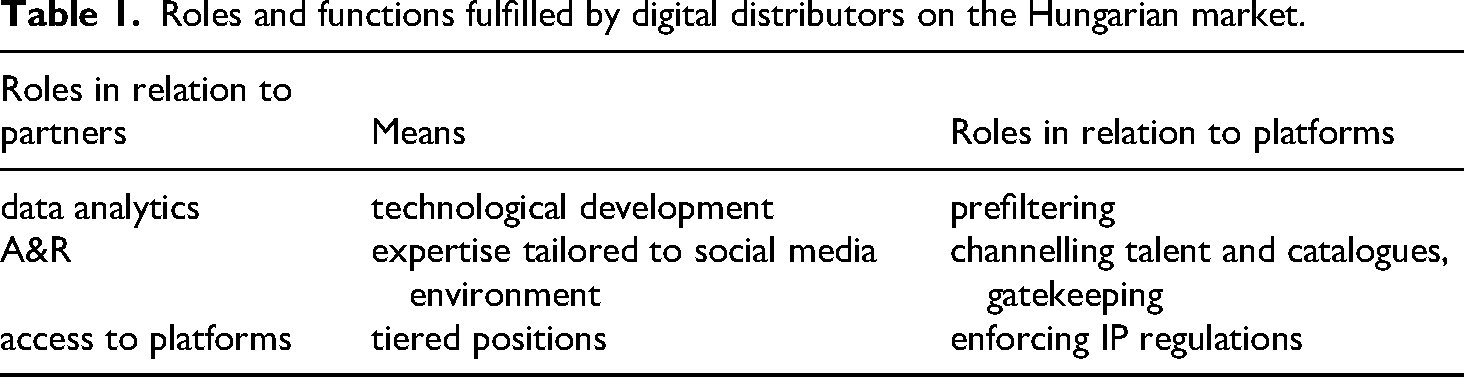
The relative lack of attention paid to distributors in the literature on music streaming suggests a certain invisibility. Yet the interviews clearly demonstrated that in this local context, locally embedded companies fulfilled active gatekeeping roles. One distributor employee described the process of choosing the ‘next partner,’ the next musician to support, based on social media trends, in their capacity as a distributor employee with a formal A&R (Artist and Repertoire) role at the company (interview, 14 October 2023). Distributors thus perform a kind of preselection or -filtering work, involving speculation on the next successful artist, sound, or trend, a function traditionally belonging to record companies; yet the basis on which distributors select incorporates the serving and channelling of streaming platforms’ operating logic. In comparison, Qu et al. (2023) describe how local music platforms in China actively seek to incorporate independent artists. Here, platforms remain distant, instead it is local(ly embedded) distributors that perform the same work.
There were also clear and formalised hierarchies among distributors in relation to platforms, which directly shaped the visibility and income opportunities of their partners. Hroch and Szczepanik (2025: 3) observe that platforms such as Spotify segment different markets, which determines their allocation of resources and editorial focus. In Hungary, none of the major platforms have local offices (each of Spotify's 12 European offices is in Western Europe; Locations, n.d.), even though Spotify introducing editorial playlists in 2020 (Rónai, 2020) arguably contributed locally to the growth of music streaming as a potential revenue source for at least some Hungarian artists – and in general, the increase of streamed Hungarian music – by visibly highlighting them on the platform interface for Hungarian users. This indicates that the existence and form of local platform representation – a local office or local editors – is definitive in determining the position and opportunities of local musicians. The research indicates, however, that distributors can negotiate positions that may improve the opportunities for local musicians, even in the absence of local offices. WMMD has secured a better position by joining, through its UK-based company, the Merlin Network, which collectively represents a large number of independent record labels and distributors globally. Believe possessed a so-called ‘preferred partner status’ with Spotify, allocated by the platform, and a ‘Tier A’ partner status with YouTube. Their employee explained the advantages granted by this status, as well as the steps taken by the company to achieve these privileged positions: ‘This means, with the biggest stores [platforms], since we always follow the constantly renewing guidelines […], a stream is calculated based on the biggest revenue per mille’ (interview date omitted to preserve anonymity). One area the employee highlights is the surveillance of fraudulent content, a task not performed by DIY distributors, which, in their case, led to many so-called takedowns (removing tracks). According to the quoted employee, abiding by the rules and, therefore, reducing takedowns to a minimum – saving administration, time, and probably money for the platform – is rewarded by the preferred partner status. Distributors thus perform tasks around keeping the content legally ‘clear’ for platforms – similarly to the MCNs in Lobato's (2016: 351) previously cited study –, who practice governance – channelling intellectual property regulations – through their partnership programme.
As Table 1 indicates, distributors offer data analytics to their partners, which, as I elaborate below, they process and utilise through increasingly sophisticated technological tools developed in-house – tools that also aid platforms by prefiltering ‘content.’ Distributors, as observed, also perform A&R functions through specific expertise tailored to the social media environment, approaching promising musicians and offering their services – while simultaneously channelling these selected artists towards the streaming ecosystem. Thirdly, they offer access to platforms – including the possibility of some form of communication, closed off to individual artists and local labels – according to their formalised position in relation to the platform, which they can improve, for instance, by demonstrating that their partners observe IP regulations.
When reflecting on their relationship with digital platforms in their work, a distributor employee who had begun educating artists and other industry professionals relatively early, when streaming platforms entered the local market, emphasised that platforms directly served as a knowledge source: ‘80 percent of my education material, […] I would say, was based on […] training and knowledge directly from the platforms’ (interview, 22 September 2023). Spreading this knowledge on the Eastern European semiperiphery at a time when monetisation and local offices were new played a vital part in preparing a receptive local space. In relation to YouTube, the industry professional simultaneously emphasised their own relative autonomy in the education process and a certain distance kept by the platform, while not obscuring the platform's motivation behind the collaboration, namely establishing an environment for digital music business purposes to: ‘more or less educate the players to build trust and to be able to do business’ (interview, 22 September 2023).
Intermediaries strategically utilise technological development and music industry expertise in order to decrease the disadvantage of their partners on the global digital music market. As an example, a(n international) distributor employee explained how utilising ‘algorithmic placing’ and Spotify's Discovery Mode (a mode that places music on listeners’ personalised algorithmic playlists) as a tool had proved a really effective method for generating streams for Hungarian artists. The distributor had developed this tool before Spotify made it global: ‘the entire beta test ran with our catalogue’ (interview, 14 September 2023). The distributor's set of tools, as the employee explained, involves selecting, with the help of a custom-developed algorithm, which tracks by which artists in their catalogue to pitch for Discovery Mode. (Algorithmic placement is not a tool utilised by major labels as they have their own deals with platforms, so it was specifically developed to channel smaller, unsigned artists, or those signed to smaller local labels.)
The opportunity of ‘beta testing’ may, at least according to distributors, thus provide an advantage for local(ly embedded) players in the global competition (Hroch and Szczepanik, 2025: 14, quote an employee at Believe who makes a similar claim). In addition to placing the distributor in a favourable position, this strategy certainly enabled some local artists to launch careers with the help of streaming. The technological development and trial-and-error involved – what an employee referred to as a ‘finetuning’ process – on the other hand, becomes integrated into Spotify's operation as an outsourced optimisation process. Locally embedded distributors have developed various other tools – especially analytic tools and interfaces – to aid the ‘experience’ and efficiency of their partners. For instance, Believe developed: a TikTok Dashboard that indicates, in a quantified form, the effect of TikTok content creation on the number of streams; tools aiding the management of income; moreover, in 2024, they made the entire interface available in Hungarian language. While enhancing efficiency and experience for both the creator and the consumer, platforms also profit from the enhanced use, without having to invest in such development. Experts working for local(ly embedded) digital distributors on the Eastern European semiperiphery thus generate knowledge capital and value for global platforms, and at the same time extend, through technological development and optimisation strategies, opportunities for local artists. This generates new content (uploaded music) and an enhanced number of streams and subscriptions, contributing to the building of a local audience, which, again, is beneficial for platforms in material terms.
Moral geopolitics and distributors as cultural intermediaries
I now proceed to highlight the discourses and narratives through which music industry professionals make sense of the roles, occupied – albeit shifting – positions, strategies, and opportunities of the local(ly embedded) intermediaries outlined above, arguing, firstly, that these contribute to the cultural intermediary status of distributors (as well as other intermediaries such as labels and collecting societies), and secondly, that they may partly be understood in the context of Hungary's semiperipheral position in the capitalist world-system. Based on existing accounts of moralised discourses around culture and technological development embedded into global power relations (Galuszka, forthcoming; Sprengel, 2023), characteristic discourses and narratives around technological development present in the interviews may be understood in terms of leapfrogging, lagging behind (typically ‘the West’), and catching up (again, to an idealised ‘West’) in relation to digital streaming.
The discourse of leapfrogging was evoked in one account of the initial years of digital streaming in Hungary, yet as something that is only partly, and not entirely, advantageous for the music industries locally. The distributor employee – already working in a similar role at the time – observed that ‘[Hungary] was a very particular market, which practically prevented consumer habits here to nicely [develop] … It's like when a child misses crawling on all fours’ (interview, 22 September 2023). The employee linked the specific pace and timing of streaming services’ entry into the region to the lack of organic development of consumer habits, as well as to the hindrance of the development of adequate market practices or strategies. In light of this, rather than leapfrogging – a more optimistic reading – the entry of streaming platforms is narrated as a ‘deep end’ – being thrown in and having to learn to swim fast.
It is worth comparing this narrative to accounts of Sweden, and Stockholm in particular, as a prominent and powerful node of recorded music production – especially since Sweden or ‘Scandinavia’ as a region were frequent reference points in Hungarian digital music industry discourse. Accounts of Stockholm highlight such aspects as the active protection of intellectual property (by the state), ‘the large number of local and international music companies’ (Power and Hallencreutz, 2002: 1838), including a strong presence of all major labels through wholly owned subsidiaries, acting as a magnet for musicians and various music industry players from other parts of the country as well as internationally. Moreover, Power and Hallencreutz (2002: 1840–1841) emphasise the importance of ‘a very supportive consumer base’– active music consumers, who are also active adaptors of new digital technology – enabling Sweden, and Stockholm in particular, to act as an important ‘testing ground’ for majors, and become the birthplace of Spotify in 2008 (Hracs and Jansson, 2020: 484).
In contrast, the interviewed Hungarian industry workers most clearly expressed their sense of ‘lagging’– implicitly or explicitly, behind the ‘developed’ ‘West’ – with regard to consumers’ habits and attitudes. By frequently mentioning the unwillingness of many Hungarian consumers to pay for digital music, the interviewed industry workers posited a moralised line of division between the industry and society – represented by their listeners – where the latter hindered the former's development. A record label employee, for example, cited subscriber numbers as key to the ‘health’ of the digital music industry and the possibility for artists (and labels) to succeed in the new streaming environment. Mentioning that YouTube was the most popular platform for streaming music, they expressed their bafflement that the majority of consumers would choose to view or listen to ads rather than pay a monthly fee (interview, 29 January 2024). The representative of MAHASZ, with a similar argumentation, but with more optimism (likely stemming from their position as a more direct representative of the recording industry), cited Scandinavia as an example and as a goal, or at least ideal, to be achieved, with 53% of the population being subscribers to streaming by 2023 (interview, 31 January 2024).
The record label employee quoted above argued that Hungarian consumers ‘need to get out of the spiral where what is online is [considered] free’ (interview, 29 January 2024). Underlying this statement is the assumption that a history of widespread online piracy and even informal trade preceding digitalisation (such as copying and trading cassette tapes) explains why Hungarian listeners are unwilling to pay for music. This echoes discourses of ‘piracy’ and the unwillingness of music listeners to pay for music in other parts of the world outside of the ‘West’ (one example being Nigeria; see Adedeji and Röschenthaler, 2025: 230). Notably, however, in relation to Sweden, Hracs and Jansson (2020: 484) mention piracy as part of the early adaptor consumer behaviour: ‘Sweden features high levels of Internet penetration and Swedish music consumers have been at the forefront of adopting digital practices, such as illegally downloading music (Pirate Bay was run by tech-savvy Swedish libertarians) and embracing new streaming services.’ Regarding the global core, therefore, piracy may even be seen as part of a healthy, active consumer market that has formed the basis of high-level music industry development, while at the same time, in relation to the Eastern European semiperiphery, informality and the ‘unwillingness’ to pay – a phrase which obscures the gaps in consumers’ material resources – automatically signals backwardness. Marshall (2013: 5) refers to cultural imperialism in relation to ‘the importation of Western ideas of intellectual property and authorship into settings where it conflicts with existing social and musical practices,’ which are particularly problematic ‘[…] when the practices of intellectual property enforcement […] contradict the material conditions experienced by music consumers (low wages), or when they contradict the experiences of sharing and community that are more explicit elements of “non-Western” musical practices.’ All this demonstrates that the moralised discourse of industry workers observed in the interviews is not isolated, but instead embedded in broader moral geopolitics (Böröcz, 2006), where the ‘Rest’ is defined against the ‘West,’ not only in the core, but also on the semiperiphery, via discourses reproduced and perpetuated by distributors along with other local industry intermediaries.
Conclusions
I have explored characteristic strategies, practices, and discourses of digital distributor employees as music industry workers mediating between recording artists and platform companies – actors whose work has so far largely been ignored in studies of the recording industry in the age of streaming. The analysis contributes to the ‘de-Westernisation’ of studies of digital platforms and the cultural industries through an empirical-based theorisation of Eastern Europe’s semiperipheral position in the context of the global platformised recording industry. Moreover, it contributes to understanding the power relations among these various local and global players – musicians, platforms, and digital distributors.
Analysing distributors on the Eastern European semiperiphery as cultural intermediaries of the platformised cultural economy contributes a critical geographical perspective to the understanding of cultural intermediation in general. Distributors actively establish and manage connections between different parties – content creators (musicians) and catalogue owners (record labels) on the one hand, and platforms on the other. These are functions already observed in previous studies in relation to other digital platform intermediaries, such as MCNs (Lobato, 2016; Mehta, 2020), nevertheless, I have argued for the importance of the spatial dimension of these connections. Distributors are locally embedded through local staff and expertise, using this embeddedness and expertise to build trust with local content producers and channel their music towards global platforms. Their position in relation to streaming platform companies, however, directly impacts the opportunities of local artists and rights owners. Negotiating their position takes place partly through engaging in the constant development of platform-related technological tools that enhance the ‘experience’ of platform users (e.g., through easier access to analytics), which in turn improves the efficiency of channelling local cultural labour into the platform ecosystem. Another means for distributors to improve their position is through the disciplinary work of enforcing an intellectual property regime on their partners on behalf of platforms.
Through distributors, local specialised know-how is also developed and utilised, on which platforms ultimately capitalise. Yet this specific expertise is also being dispersed locally, as distributors – relatively new players in the recorded music industry – become an integral part of the domestic music industries, actively maintaining connections with other local players such as labels or collecting societies and other trade organisations, being present at various industry events, distributing professional knowledge, and shaping local industry discourse. The local embeddedness of intermediaries thus partly results in the channelling of platforms’ interests through a spreading of discourse, knowledge, and practices – for instance, the overall goal of increasing the number of paying streaming subscribers was expressed across the board as something that would benefit all local players.
Finally, a crucial but so far largely ignored cultural intermediary role is the local circulation and reproduction of particular narratives around technological development, consumption patterns, and industry practices, which are informed by a moral geopolitics embedded in unequal global power relations. In concrete terms, the semiperipheral position was manifest among digital music workers in Hungary in the dominance of moralised discourses of ‘lagging behind’ in relation to a mythologised Western centre, as well as ‘leapfrogging’ in a specific sense – being thrown in at the deep end and having to find solutions quickly and with the efficient utilisation of resources that are exceedingly scarce in comparison with the global core.
Footnotes

Ethical statement
All interview data presented in the article relies on documented informed consent and is presented in anonymised form. The rest of the data is public (e.g., via industry reports). No ethical permission was required for this study.
Funding
The author received no financial support for the research, authorship, and/or publication of this article.
Data availability statement
Due to the criteria of anonymisation, the interview data have not been made public. Industry data is publicly available and cited where relevant.