






Abstract
This article examines viral-hit music in China as a non-Western case study of how platformisation reconfigures cultural production and gendered labour. It introduces the concept of the track-centred mode of music production and shows that digital platforms privilege music as measurable and controllable data commodities, treating performers as uncontrollable variables. Drawing on ethnographic research within China's music industry, it analyses how viral-hit production disproportionately instrumentalises female performers, who are stratified into three tiers: stars, grassroots musicians, and singing-dancing influencers, according to visibility, authorship, and disposability. Women in the lower two tiers face intensified exploitation. Grassroots musicians are exploited across the full production cycle, while singing-dancing influencers are bodily objectified and aggregated into post-visibility labour, a systematic, alienated form of visibility work orchestrated by the hit-making industry. The article argues that China's viral-hit phenomenon exemplifies intensified global platformisation, in which gendered exploitation is not incidental but constitutive of platformised cultural work.
Keywords
Introduction
Driven by platformisation, the Chinese music industry has been reconfigured around the production and circulation of ‘viral hits.’ This term does not simply describe a track's commercial success. 1 Rather, it denotes a type of algorithm-friendly pop music that is explicitly produced to go viral on video-based platforms (Qu and Kaye, 2025; Zhang, 2025), often at the expense of those who perform these tracks. These performers include not only the singers credited on the tracks, but also influencers who sing, dance to, or otherwise perform these tracks in their video-based content. 2 This article examines ‘viral-hit music’ as a significant yet underexplored instance of the platformisation of cultural production beyond Western contexts, asking how platform mechanisms have reshaped music production around viral hits and what implications this holds for women performers.
Gender is central to this inquiry because the viral-hit economy is not organised through a gender-neutral labour regime, but one that systematically relies on women's labour and visibility. This is not incidental but historically and institutionally produced. Both Western (e.g., McClary, 2002[1991]; Reddington, 2018) and Sinophone (e.g., Moskowitz, 2010: 69) music industries have historically and primarily confined female musicians to singer roles, commodifying their bodies while marginalising their creative agency. In contemporary China, this historical positioning intersects with a deeply feminised influencer industry (Han, 2022), which functions as a ready-made pool of female performers for viral-hit production. The viral-hit economy does not create this gendered structure from scratch. Instead, it inherits and reconfigures these conditions, instrumentalising female performers as an especially expedient and available resource for its production.
To clarify what is specific about the viral-hit phenomenon, it is useful to compare it with what are commonly known as ‘one-hit wonders’ in the West. From the 1950s onwards, one-hit wonders were created for easy consumption and often aimed at major chart (e.g., Billboard) success (Hill, 2022: 1–3). They remained tangential in a Western industry structured around star-making (Arditi, 2020). However, the platformised Chinese music industry has become institutionally organised around hits rather than musicians. This is a scalable and data-driven mode of hit making that also extends beyond what Stone (2024) terms the ‘microsong’, centred on hook-based or remixed segments of released tracks circulated through TikTok or Instagram Stories.
This marks a shift away from the traditional musician-centred mode, long dominant in both China and the West. In that mode, artists, though not always as songwriters, are treated as the core assets of the music business, nurtured and managed through long-term and resource-intensive processes (Frith, 2001: 35). The industry seeks to build recognisable careers for artists by maintaining coherence between music and public persona (Straw, 1999), and values artists’ distinct authorship and creative input (Negus, 1992, 2019). By contrast, viral-hit music typically follows what I call a track-centred (or song-centred) mode of music production, which has long existed in conjunction with other media formats, particularly film and television drama theme songs (Wong, 2003: 134–137). A defining feature of this mode is its structural disconnection between music and musicians. In this process, music is typically created first, and then a performer is selected afterward to fit the track (see also Wong, 2003: 106–112). This reverses the musician-centred power relation, in which the artist side exercises greater control over repertoire selection. Under platformisation, artists are seen as less controllable and cost-efficient, whereas songs are easier to optimise as modular, datafied assets for algorithmic recommendation, quantification, and rapid commodification.
Viral-hit production is organised around optimising tracks. Through a hierarchical chain, music copyright ultimately accrues to platforms via affiliated entities. Both short-video and music platforms act as investors and content decision-makers; hit-making labels function as content providers, often backed by platform investment; actual production is outsourced to individual producers or ‘music studios’ (i.e., small businesses or comparable creative units run by entrepreneurial musicians); and performers occupy the lowest position, optimised and instrumentalised en masse in service of one track. Instrumentalisation here refers to the way viral-hit production treats most performers as instruments of sonic and visual delivery rather than as autonomous creative labour. Their primary function is to make tracks visible and usable in everyday short-video content. Camera-oriented presentation thus takes precedence over skilled vocal and interpretive performance.
Existing scholarship on China's viral-hit music (Qu and Kaye, 2025; Yeh and Zhao, 2025; Zhang, 2025) has shown that platform ecology reorganises music production around rapid data-metric reward, producing formulaic tracks and resulting in homogeneity. However, gender has rarely been foregrounded in this body of work. This article addresses that gap through a feminist political economy lens to examine how such viral-hit music production instrumentalises women through their labour and bodily visibility. It develops the notion of post-visibility labour to describe female performers who are integrated throughout the circuit of production, circulation, and consumption—collectively mobilised and algorithmically amplified within viral-hit systems, yet individually subject to professional invisibility and devaluation.
More broadly, this article contributes to global scholarship on music platformisation. Existing research has focused on music curation and datafication, highlighting how powerful platforms shape and display content (e.g., Bonini and Gandini, 2019; Leyshon and Watson, 2025; Morris, 2015; Prey, 2020). It has also examined the creative and commercial responses of those who produce and circulate music to these platform logics (e.g., Arditi, 2023; Morris, 2020; Negus, 2019; Qu et al., 2023). However, much of this research continues to assume a musician-centred mode of production, paying limited attention to how track-centred logics marginalise and displace musicians. This article addresses that gap by examining viral-hit production in China as an institutional manifestation of platform capitalism.
The article is structured as follows. The literature section reviews scholarship on the global platformisation of cultural production, tracing debates from music optimisation to the influencer industry. The method section explains how empirical data were collected through fieldwork within both music and internet companies in China, as well as ethnographically informed observation of both short-video and music platforms. The two analytical sections demonstrate how the alignment between platform mechanisms and viral-hit production leads to the instrumentalisation and stratification of female performers. Together, they demonstrate that gendered exploitation, rooted in women's labour and bodily visibility, reproduces existing gender inequalities and is constitutive of platformised cultural production.
Literature review
The platformisation of cultural production and ‘optimisation’ of music
The relationship between platformisation and cultural production has been widely examined by scholars (e.g., Nieborg and Poell, 2018; Poell et al., 2022; Prey and Lee, 2024). Nieborg and Poell (2018) insightfully argue that cultural commodities have become dynamically modified in response to datafied user feedback. Private-owned digital platforms shape cultural production through practices of curation, organisation, and moderation of content (Poell et al., 2022); music exemplifies this shift.
As new gatekeepers, music streaming platforms deploy algorithmic recommendations, interfaces, and playlists as key instruments of power in determining how music is discovered and circulated (e.g., Bonini and Gandini, 2019; Morris, 2015; Prey, 2020). Underpinning these processes is the datafication of music, a core logic of platform capitalism that converts musical sounds, their cultural contexts, and listeners’ behaviours into measurable, analysable, and monetisable data (Hesmondhalgh, 2025: 1888; Morris, 2015).
To adapt to this landscape, Morris (2020) identifies an ‘optimisation culture’, where music is strategically designed and modified to align with platform mechanisms for enhanced discoverability and monetisation. This entails a shift in orientation, requiring creators and promoters to treat music as calculable content. While these studies provide a vital foundation, less attention has been paid to how music's virality co-constitutes these algorithmic mechanisms rather than just reacting to them. I examine this dynamic and show how the aggressive drive to optimise content can lead to the marginalisation and instrumentalisation of the very human performers who are essential to it.
Optimised music for virality in China
Scholars (Qu and Kaye, 2025; Zhang, 2025) locate the emergence of the viral-hit phenomenon around 2018. This was marked by the optimisation of about 15-second hooks designed for short video climaxes (Yeh and Zhao, 2025). Qu and Kaye (2025) and Zhang (2025) have systematically analysed this shift in the Chinese music industry driven by short-video platforms (SVPs), particularly Douyin, which now functions as a powerful ‘rule-setter’.
From around 2015, China's music industry was co-dominated by music streaming platforms (MSPs)—Tencent Music Entertainment (TME) and NetEase Cloud Music (NCM) (Qu and Kaye, 2025). However, from 2018, the rise of SVPs has gradually disrupted this MSP-centric gatekeeping. Qu and Kaye (2025: 67) argue that music optimisation becomes increasingly aligned with and driven by the interests of SVPs, extending SVPs’ influence from circulation into production. By about 2020, both MSPs were forced to adapt, competing not only with each other but also with Douyin's parent company, ByteDance (Qu and Kaye, 2025). This competition increasingly centred on acquiring the copyrights of potential viral hits (Zhang, 2025). A symbiotic yet contentious cross-platform ecosystem has been institutionalised: music controlled by TME and NCM often depends on Douyin for viral promotion and circulation, while ByteDance harvests data and chart momentum from MSPs to identify, acquire, and ultimately monetise promising tracks (Qu and Kaye, 2025; Yeh and Zhao, 2025; Zhang, 2025). In this ecosystem, Zhang (2025) shows that optimisation works through rapid responses to collective emotions and trending topics on social media. She critiques this as a process of de-creativity, through which songs become detached from personal authorship and reduced to the simple reproduction of social-media data.
While these studies reveal how platform affordances optimise music-making, they have paid little attention to its labour and gendered dimensions. In particular, Qu and Kaye's (2025) notion of anonymous hits refers to the deliberate downplaying of musicians’ identities to align with the mundane aesthetics of user-generated short-video content. This points to the marginalisation of singers in viral-hit music but leaves the gendered labour implications unexplored. This silence on gender in viral-hit music research contrasts with the extensive gendered analysis of Chinese influencer culture, which also relies on SVPs and provides an entry point for this study.
Gendered influencer labour in China
Existing studies show that influencer labour is deeply gendered and platform-supported. Women are widely perceived as suited to cultivating affective intimacy and performing aestheticised self-presentation on social media, making them a preferred target for platform capitalism (Guo, 2022; Han, 2022). Although this perception appears to create opportunities for women's entrepreneurship and self-expression, it is inseparable from discipline and commodification of female bodies, thereby reinforcing existing patriarchal hierarchies of gender and power (Guo, 2022; Ye and Krijnen, 2024).
With particular attention to Douyin, scholarship frames the female body as a site for voyeuristic consumption to generate traffic (e.g., Fu et al., 2024; Ye and Krijnen, 2024; Zhang, 2024). Bodily performances are primarily driven by female creators’ pursuit of data metrics as a vehicle for socio-economic advancement. These range from heterosexual flirtation (Ye and Krijnen, 2024), sexually fetishised body parts (e.g., feet and legs; Zhang, 2024), dancing to accentuate physical curves (Fu et al., 2024), and the positioning of female bodies as aesthetic objects in nature (Chen et al., 2025).
These studies demonstrate that platforms reward and creators reproduce gendered content in an asymmetrical feedback loop, resulting in the prominence of women's bodies on SVPs. Although music is ubiquitous in these gendered performances, less attention has been paid to how these performances is institutionally organised through the intervention of the music industry in coordination with platform capitalism. This article addresses this gap by examining how optimisation mechanisms reorganise performer labour across women's musical and visibility work.
Hybrid labour: Musical labour and (post-)visibility work
Maldistribution is a long-standing issue in musical labour and has deepened further under music platformisation (e.g., Hesmondhalgh, 2021; Negus, 2019). As Hesmondhalgh (2021) articulates, streaming platforms intensify ‘winner-takes-all’ music markets, where rewards are disproportionately concentrated among the most successful participants, typically major record labels and star artists, who also hold dominant positions. By contrast, the vast majority of musicians struggle to secure meaningful commercial returns. Similar hierarchical patterns can also be observed among performers in the track-centred mode.
Platformisation has fundamentally reshaped the definition of artistic value, prompting record companies to prioritise quantifiable engagement over the aesthetic judgements that once prevailed (Arditi, 2020). This shift favours celebrities with established data metrics, often at the expense of the long-term development of new talent (Arditi, 2023; Leyshon and Watson, 2025). Musical labour, particularly for those outside the elite, increasingly involves social media self-representation to enhance professional opportunities. Baym (2018: 19) conceptualises this as relational labour—the ongoing, affective, interactive and self-optimising work of developing connections to maintain professional work. In practice, such labour commodifies intimacy and converts engagement into data metrics. Baym's discussion remains centred on strategies for sustaining individual musicians’ careers. In the viral-hit economy, however, both musicians and other content creators are mobilised in the service of track-centred production.
Abidin's (2016) concept of visibility labour offers a particularly useful lens for analysing female performers in viral-hit music production. She defines visibility labour as the analogue and affective work through which individuals, not only influencers but also everyday users, curate their self-presentations to be seen and valued within social media hierarchies. A similar dynamic applies to female performers: their labour is feminised, yields limited material rewards, and they function as vehicles of content circulation.
Beyond Abidin's user-centred approach, the music industry instrumentalises the individual's aspiration for visibility as the primary glue integrating production, distribution, and consumption. Individually, gendered performers consume tracks and then visualise and sensualise them, binding body and music into attention-optimised content where they remain temporarily recognisable. Collectively, however, individuals’ visibility is aggregated into platform data metrics and bundled by digital platforms and hit makers, to function like a fertile ground for tracks to proliferate. Visibility labour is thereby transformed into post-visibility labour, a systematised form of work in which performers’ visibility is black-boxed at scale, algorithmically exploited, detached from their individual creativity, and absorbed into the platform's data-driven production cycle. In this process, the female body is the most expedient tool for viral-hit circulation, rendering women structurally vulnerable to exploitation. Women are not deliberately targeted; rather, their centrality represents a pre-reflective industrial decision driven by the logic of platform capitalism.
Alongside this, much political economy and feminist scholarship has also examined the self-exploitative, precarious and feminised nature of platform labour, showing how it reproduces and amplifies gendered and class inequalities through metrics-driven evaluation, the commodification of intimacy, algorithmic bias and dependence on unpaid or underpaid work (e.g., Abidin, 2016; Bishop, 2023; Duffy, 2015, 2016). Within platform capitalism, such labour is routinely devalued as manual and affective contributions are rendered invisible (Lee, 2025).
Research methods
This article forms part of a broader project examining gendered labour in China's platformised music industry. The research adopts an etic perspective, grounded in four months of ethnographic fieldwork conducted within the broader Chinese music industry, beginning in October 2023. The fieldwork involved on-site observations in both recording and internet companies, and participation in local industry events across Beijing and Shanghai. For example, during on-site visits to an internet company, I observed personnel working with music data dashboards, which generated tacit knowledge about how hit-track metrics are monitored in real time. At the 2023 Shanghai-based International Music Expo (IMX), panel discussions involving hit-music labels and influencer incubation agencies offered insight into how hit music production and labour are organised within this sector under promotional narratives. These observational materials are read alongside the formal interview data discussed below, enabling triangulation across different forms of evidence.
Around the same period, I conducted in-depth, semi-structured interviews with 27 industry professionals involved in various stages of music production and circulation. Participants were recruited through snowball sampling, initially via three Artists and Repertoire (A&R) professionals and one senior executive, with additional referrals from two influential creative industry users on Zhihu.com (a Chinese knowledge-sharing platform). The sample (shown in Figure 1) comprised industry insiders from local and international record labels, music publishers, artist management agencies, and internet companies, while some participants were entrepreneurial. Over half of the sample identified as women. Most interviewees work within, or maintain ongoing collaborations with, internet companies and viral-hit production environments. To protect confidentiality, all participants remain anonymous regardless of their public visibility. Only essential identifying details are provided in the findings, including gender, general occupational position and organisational type.
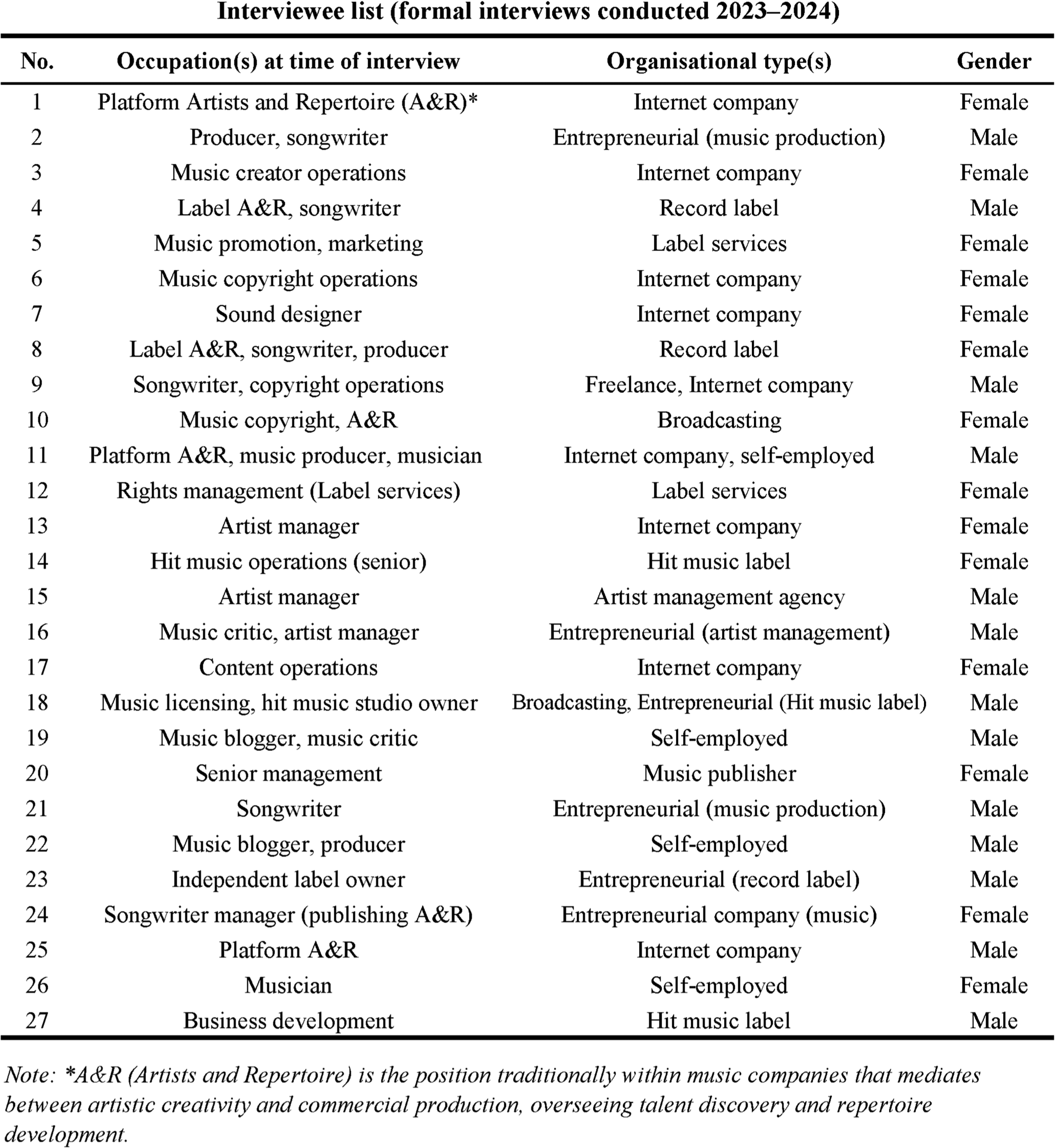
Interviewee list (formal interviews conducted 2023–2024).
Informed by these findings, between the second and third quarters of 2024, I subsequently conducted digital-ethnographically informed observation of three major Chinese platforms as a supplementary method to trace and extend interview insights back to information infrastructures (Knox, 2017) that afford the circulation of viral hits: Douyin, TME (mainly its flagship QQ Music), and NCM. The research engaged directly with each platform's ranking interface and associated media displays, and algorithmic recommendations, treated as readable material traces (Knox, 2017), to investigate how hit songs are made visible by so-called user-generated content, which in practice is often subtly shaped by the platform's algorithmic rules.
On Douyin, the trace focused on its Music Chart (音乐榜), comprising two sub-charts: the Hot Songs Chart (热歌榜) and the Rising Songs Chart (飙升榜). I scrolled through the associated short videos clustered beneath each viral track to explore how bodily visibility, particularly that of young women, was embedded in the circulation infrastructure of viral music. For the two streaming platforms, observations centred on the Hot Songs Chart (热歌榜), specifically the top ten tracks. The analysis considered cross-platform recurrences and convergences between short-video virality and streaming visibility, illuminating how digital platforms, as both capital and infrastructures, co-create the value of viral hits. Screenshots were taken as supplementary field notes to support observational records. All qualitative materials discussed in this section were coded using reflexive thematic analysis (Braun and Clarke, 2021).
Viral-hit production as a platformised track-centred mode
Platform mechanism of viral-hit music
Viral-hit music marks a further platformisation and intensification of the track-centred mode. Its production is highly datafied, with dynamic user feedback central to decision-making. According to Interviewee #9 (male, freelance songwriter, 2023), platforms and hit makers draw on extensive cross-platform data analytics to predict which melodies and lyrics best align with prevailing socio-cultural trends, and are thereforemost likely to elicit favourable audience responses. This transforms music production into a process of measuring, predicting and responding to quantified and generalised patterns of user emotion, structured around a commercial cycle in which visibility generates engagement, engagement produces data, and data are monetised. Within this system, performers are treated as interchangeable components, subordinated to the track's value. At the 2023 IMX (Fieldwork, 2023), Tao, the CEO of a leading Chinese hit-making company behind the chart-topping ‘Stars Ocean’ (星辰大海), made clear that once the song is ready, the label already has a shortlist of singers suited to the track. Huang Xiaoyun (黄霄云) was not the first choice; she was then selected because she was responsive and cost-effective for the project.
The circulation of viral-hit music is infrastructurally governed by cross-platform algorithmic recommendation systems that produce what Eisentraut (2013: 22) terms ‘quasi-enforced contact.’ These tracks are typically pushed into users’ feeds on SVPs and curated into personalised playlists on MSPs. Interviewee #4 (male songwriter with hit-making experience, 2023) explained that short-video users are repeatedly exposed to the same tracks because music companies invest heavily in algorithmic visibility: ‘once we pay the platforms, even if you’re a niche music fan with a perfect personalised feed, you can’t escape these tracks. They’ll find you anyway.’ This ubiquity operates as a self-reinforcing loop: quasi-enforced exposure directs and concentrates listening to selected tracks; those metrics are framed as indicators of popularity and feed into further algorithmic amplification.
A successful viral hit is monetised through multiple revenue streams. Streaming royalties are one of the most essential sources of these, as several interviewees from platforms and hit labels noted. This further underscores the importance of cross-platform circulation to viral hits: SVPs generate visibility and traffic, while MSPs convert that traffic into streams and revenue to maximise profitability. Interviewee #14 (female, music operations, hit music company owned by an MSP, 2023) explained: ‘Short-video platforms push users to listen to a particular short track, which then directs them to streaming platforms for the full track.’ LBI's ‘Jumping Machine’ (Nov 2024, Sony Music China) exemplifies the industrial efficiency of converting visibility into revenue. After migrating from SVPs to Asian MSPs, the track generated an estimated RMB 30–40 million in six months, with streaming accounting for 50% of the total income (Music Business China, 2025).
Over the past three years, the profitability of viral hits has also drawn traditional record labels into this arena. All three major international labels, Warner, Sony and Universal, have formed partnerships with domestic labels to strengthen their position in the viral-hit market (Zhang, 2025: 13). Such developments illustrate how data-oriented and algorithm-optimised rationalities have become institutionalised across the recording industry, reshaping its organisational practices.
The gendering of viral-hit production
The industry production of viral hits revolves around three interrelated imperatives: scalability, speed, and algorithm-friendly optimisation. These logics dilute creative possibilities by modularising creative input and by prioritising labour that can be readily deployed within high-turnover production systems. Although this arrangement affects all labour in the system, women experience a gendered intensification of this mode.
First, the demand for ‘hookiness’ channels music design towards the visual commodification of female bodies. Viral hits' success depends on immediate sensory appeal rather than cultural or aesthetic value. Typically, the music features memorable hooks with catchy rhythms and vernacular, accessible lyrics, designed to resonate with the everyday sensibilities of diverse audiences (Fieldwork, 2023). Crucially, danceability is carefully engineered into the song's design, enabling ordinary users to adapt it for short-video content creation. In this context, female bodies are the most expedient vehicle for visual spectacle and for translating rhythm into algorithmic visibility.
Second, viral-hit music is both shaped by and further entrenches SVP algorithmic systems, relying on large numbers of prolific users as promotional labour. Algorithmic visibility is not generated organically but can be purchased through algorithmic prioritisation tools such as Dou+, where trending becomes a paid metric. 3 Fieldwork data show that funds are channelled through platforms to a pool of influencers who are inexpensive, visually legible, and responsive to platform demands. Such labour pools, disproportionately composed of women, are institutionally mobilised to produce audiovisual content that circulates and amplifies the track's visibility. This operationalises post-visibility labour: performers’ individual visibility is aggregated into the platform's promotional infrastructure, serving the track rather than themselves. Consequently, production costs are kept minimal while promotional spending dominates. Interview data indicate that production budgets could be as low as RMB 10,000 to 20,000, driving down overall production quality and underpaying labour. However, promotional spending was often an order of magnitude higher (e.g., up to RMB five million in one reported case on ‘Youngsters’ [少年, released in 2019]).
Further, viral-hit making replaces the linear sequence from production to circulation with a loop recalibrated by real-time data feedback and sustained by the aspirations of performers. Many tracks are pre-released on SVPs as one-minute demos, with simple arrangements such as piano accompaniment, and simultaneously distributed to groups of music influencers for short-video content creation and circulation. Only versions generating the strongest data signals are further developed into full-length releases on MSPs. Interviewee #11 (male, A&R at an internet company, 2023) explained during my field visit: We ask them to sing the song themselves and record it as short videos. […] I then check the backend data to see whose performance is better, I may allocate some priorities to their videos, but it is more about whether they can activate engagement metrics and generate positive comments, for example, comments like ‘Sister, your singing is amazing’, or ‘Please release the full version soon’. […] A single demo might be recorded by tens to hundreds of performers. In effect, the first wave of promotion is already rolling, and we can then pick the strongest version.
This demo-testing process is also post-visibility labour in practice: it is not simply about performing music in competition for individual visibility; performers also function as low-cost testers, who help determine how a track is most likely to achieve virality, while already generating promotional momentum for that track. This testing process is orchestrated by platforms and extracts unpaid labour from gendered performers, who absorb the cost of trial on behalf of platforms and hit makers.
Third, viral-hit production is scalable yet ephemeral. Hit makers overproduce content in the hope that some of it will succeed. This practice appears gender-neutral. Yet it depends on a constant pipeline of new tracks, favouring labour that is compliant and cooperative, qualities culturally associated with women (Hochschild, 1983), as the next section shows more fully. In addition to commissions, viral-hit labels and internet companies often acquire large numbers of demos from individual musicians at a low, one-off cost and stockpile them for future use (see also Zhang and Negus, 2024: 3923–3924; Zhang, 2025: 13). Interviewee #27 (male, business development, hit label, 2024) indicated that a Wuhan-based viral-hit label, which claimed a 10 per cent domestic market share, had, by 2023, invested in more than 100 music studios. It held the rights to more than 580,000 songs and sustained the capacity to produce and circulate over 10,000 new works annually. However, many interviewees in internet companies noted that the production and circulation cycle of individual tracks is rapid, usually lasting no more than six months. As a result, performers are unlikely to be remembered by audiences.
Female performers in a three-tier hierarchy: Visibility, authorship and disposability
Following the discussion of gendered viral-hit production, this section turns to female performers stratified into three tiers: stars, grassroots musicians and singing-dancing influencers. These positions are shaped by three interrelated factors: visibility, authorship and disposability, which together determine performers’ proximity to platform recommendation systems and their capacity to translate labour into data and value. As illustrated in Figure 2, the further down this hierarchy, the harder it becomes for performers to secure visibility and authorship, while their disposability increases. Stars typically intervene later in or after the viral-hit life cycle, while grassroots musicians span it in full by producing both viral hits and the video content that drives track metrics and SVP core content. At the lowest tiers, women undertake more intensive (post-)visibility labour than direct engagement in track-making, and face pronounced bodily exploitation within viral-hit circulation. This stratification echoes Hochschild's (1983: 162–164) observation that women who are structurally disadvantaged in access to money and status are more likely to make a resource out of feeling and bodily appeal. These capacities, she argues (1983: 164), become the most vulnerable to commercial exploitation.
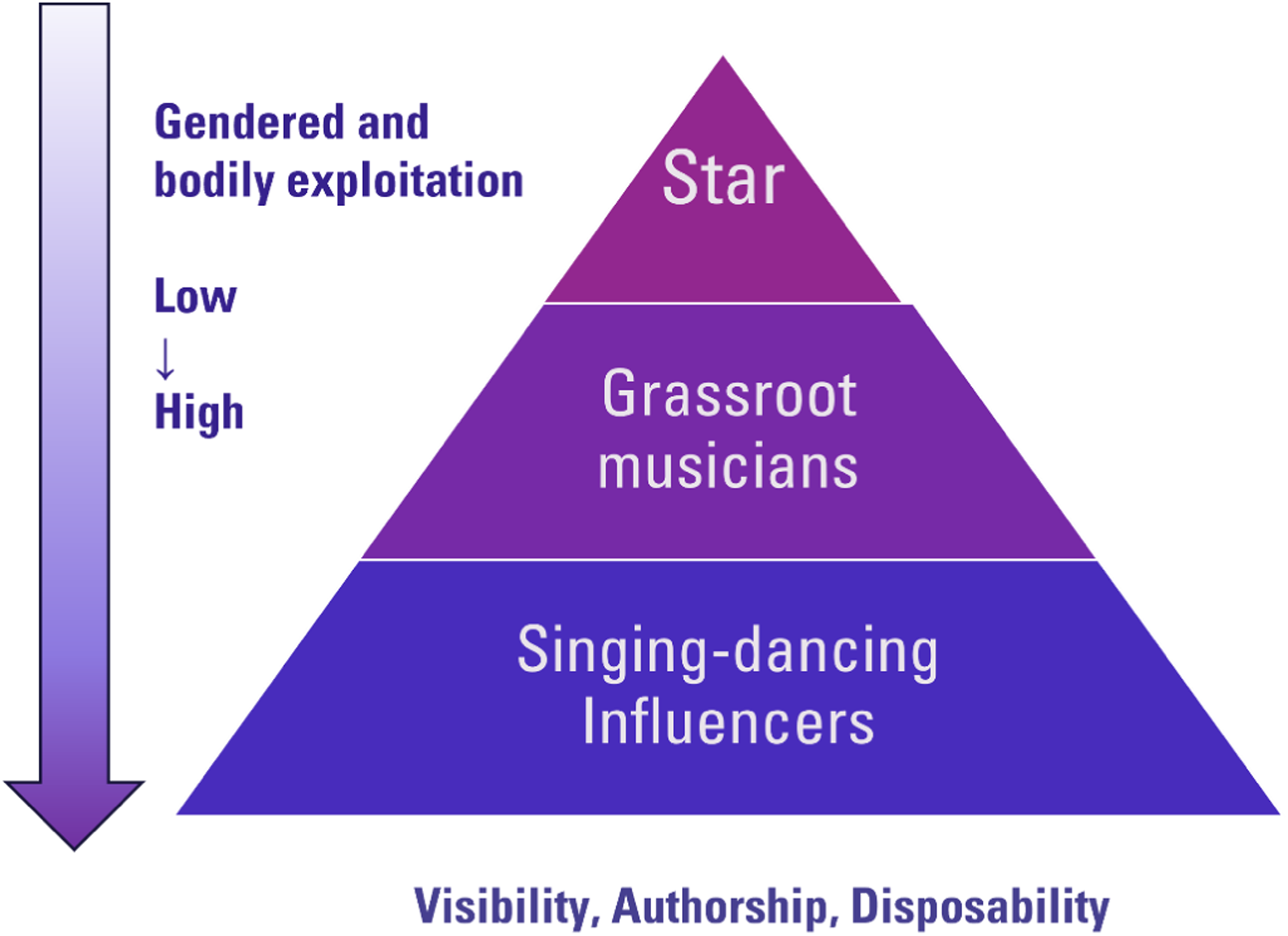
Hierarchy of female performers in hit-music production.
Stars (top tier)
Stars occupy the top tier and experience the lowest level of gendered intensification among the three tiers because their visibility and authorship are secured by cultural capital accumulated outside platform systems. They typically intervene after viral-hit production, converting vernacular platform visibility into mainstream popularity. This conversion is generally achieved through aestheticised cover performances of existing viral hits on high-profile stages, such as TV music shows or galas, rather than by joining the routine content churn. In some cases, they may be invited to perform as the original singer of a newly viral track. While they are usually not directly involved in producing tracks, their performances carry symbolic value and can reshape how a viral hit is recognised in legacy media.
A representative example of this process is the track ‘Divorce in the Republic of Ghana’ (在加纳共和国离婚). Although released in 2023, it achieved widespread popularity in April 2024 following a high-profile performance by two stars on the Zhejiang TV music show The Sound of Heaven (Season 5, 天赐的声音第五季). Observational data collected on QQ Music in mid-May 2024 reveals that the track reached a weekly popularity index of 23.19 million and ranked second on its Hot Songs Chart. This trajectory shows how stars can extend or revitalise an ephemeral track's circulation beyond algorithmic virality through skilled performance and symbolic authority, a capacity contingent on forms of cultural capital that lower-tier performers are less able to mobilise.
Stars' disposability is therefore relatively low. Platforms and hit-makers seek their endorsement for the cultural legitimacy and aesthetic elevation they can confer on a track. In turn, this consolidates their value while reinforcing a stabilised hierarchy that marginalises other performers.
Grassroots musicians (middle tier)
Occupying the middle tier are what I call grassroots musicians, relatively skilled but under-recognised, their work remains precarious and contingent on platform visibility. They are often commissioned by viral-hit labels or self-produce content, occupying an unstable position between established professional musicianship and platform labour. For women, this labour is particularly hybrid, spanning production and circulation: they function as both music creators and influencers who help circulate music. Their work enlists both creativity and physical presence, making mind and body alike instruments of work.
As creators, these grassroots musicians are often valued for their perceived reliability and cooperativeness more than their male counterparts. This appears to complicate the long-standing gender imbalance in popular music industries, where key creative positions have predominantly been held by men exercising decisive authority (e.g., Reddington, 2018; Wolfe, 2020). As Interviewee #25 (male, a platform A&R, 2024) explained: Generally speaking, female musicians are reliable collaborators with higher productivity than male musicians; male musicians are quite uncontrollable. […] As men often harbour unrealistic expectations about platform success leading to upward mobility. […] The Chinese music market is currently highly unpredictable. As investors, we feel that only output is controllable. This is an industry tactic. Rather than relying on unpredictable talent or hits, we need calculable output.
This account suggests that women's relative advantage in accessing these opportunities stems less from a redistribution of creative authority than from platform capitalism's desire for predictable and controllable labour, yet women's structural exclusion from decision-making positions remains unchanged. Interviewee #26 (2024), an early-career female musician, commented: ‘It works for me, making viral hits pays the bills, and if there are opportunities to earn, I take them.’ Following McRobbie (2016: 87–114), the apparent ‘opportunities’ available to women in the culture industries can be understood as a means of incorporating them into structures that capitalise on gendered dispositions. This readily results in women's self-exploitation, through which labour discipline is more deeply internalised.
Grassroots musicians are highly disposable, and their authorship and visibility remain structurally precarious. Beyond the buyout and reassignment practices discussed earlier in ‘The gendering of viral-hit production’ section, this precarity extends even to music that these women self-released: platforms tend to sign the track rather than the musician once data signals indicate its viral potential. Yet because the musician is simultaneously creator and performer, this arrangement effectively secures both their creative and visibility labour, under a generally three-year exclusive licensing contract that protects only the track. Interviewee #25 further claimed: The song has to go viral first. A musician at this level is not worth signing for the platform. Their personal value is negligible compared to the economic benefit platforms derive from their hit songs. […] While female musicians remain very committed to such track-based arrangements.
While grassroots musicians may not perceive themselves as producing viral hits, the platforms harvest the golden lifespan of their music and simultaneously instrumentalise their career aspirations to enhance the track's value.
Alongside music-making, grassroots female musicians are expected to maintain relational labour and visibility work through glamourised performance videos and livestreams. Douyin-showcased ‘hit musician’ Xu Huawen (徐化文, ByteDance, 2024: 18) exemplifies this: her visibility comes not through musical work alone, but through sustained visibility work. She grew from a prolific cover performer to a platform-endorsed musician through her own hit track ‘Qiu Feng’ (秋风, released in 2024), which in turn attracted covers from others. However, it is her continued glamourised cover performances that maintain her success, amassing over a billion views (ByteDance, 2024: 18). This illustrates the ecology of post-visibility labour as institutionally organised traffic exchange in which visibility work and track promotion are mutually constitutive. An engineered success cannot liberate the individual; instead, it locks them into this loop of exchange.
This carries a significant professional cost. Platforms systematically prioritise female musicians’ physical appeal over their musicianship. As Bishop (2023) argues, female artists’ expertise and craft compete with their personal and physical visibility, thereby undermining their legitimacy and seriousness. Interviewee #3 (female, platform music creator operations, 2023) explained how this is institutionalised: Our policy was to give algorithmic priority to female grassroots musicians and amateurs who were willing to show their faces, since we were a video-based platform. […] We generally leaned towards cute and adorable girls with sweet voices and some vocal skills, as they attracted a large male audience who made up most of our user base. […] Even if a girl lacked creative capabilities, if she was attractive, we were still willing to promote her.
Within the viral-hit mode, grassroots musicians are mobilised as hybrid labour. Although their creative labour and bodily performance are jointly required, the value derived from authorship is separated from the value derived from visibility, leaving them with neither stable authorial recognition nor sustainable returns.
Singing-dancing influencers (lowest tier)
At the bottom tier are singing-dancing influencers, the largest labour force in viral-hit circulation. Although the boundary between this tier and grassroots musicians is sometimes blurred, singing-dancing influencers are distinguished by their limited musicianship, particularly in music-making: they function as algorithmic boosters through rhythmic bodily display rather than as authors. Most are young women categorised as singing-dancing, music- or appearance-based daren (达人). The Chinese term daren refers to prolific users recognised for their capacity to attract viewers’ attention and monetise it (Abidin and Guo, 2023: 13).
Such female performers’ labour revolves around visually appealing song-and-dance performances designed to maximise audience engagement. They tactically consume hit tracks and produce algorithm-friendly content, generating data metrics that feed back into tracks’ exposure. However, these influencers individually struggle for visibility, making institutional affiliation necessary, which in turn intensifies gendered exploitation. As Interviewee #26 (female musician, 2024) shared: ‘For an individual content creator, visibility is actually limited. The budget you can spend on Douyin promotion is limited, your exposure will not be that high; either that, or you have to cooperate with a company.’ Influencers' lucrative agencies further prioritise performative charisma and monetisation potential, placing strong emphasis on data metrics. This results in a self-exploitation centred on volume, in which metrics are accumulated through a regime of high-volume, video-by-video piecework (Fieldwork, 2023). Through institutions, their visibility labour is thus more likely absorbed into post-visibility labour: they are systematically integrated into industry and platform activities around viral hits.
Sing-cover and dance-cover (舞蹈跟拍) formats exemplify this absorption, as they are among the most effective practices for track circulation (ByteDance, 2024). By releasing videos with the same track around the same time, performers generate algorithmic traction that helps songs climb charts and spread. This kind of strategically timed content bundling is rewarded with increased visibility because of its compatibility with platform recommendation systems. Figure 3 presents screenshots collected during platform observation, illustrating typical examples of Douyin's top-charted viral hits promoted by dance-cover challenges. In each example, the top-recommended clip is centred on female rhythmic bodily display. The first image shows the Chinoiserie-pop track ‘Luo’ (落, released in late March 2024), originally performed by Chinese-based American singer Annie. It topped Douyin's Hot Songs Chart on 5 April, 17 days after its release, driven primarily by the mass reproduction of women's ancient-costume dance, with over a million associated videos. Most videos, as shown in the left image, feature hyper-feminised yet homogenised bodily presentation shaped by heteropatriarchal norms. The track soared 26 places to number 7 on TME's overall chart the following week. Such examples demonstrate that whether visibility flows to the individual performer, to the track, or to both, the resulting traffic ultimately feeds SVPs’ core business and drives viral-hit monetisation.
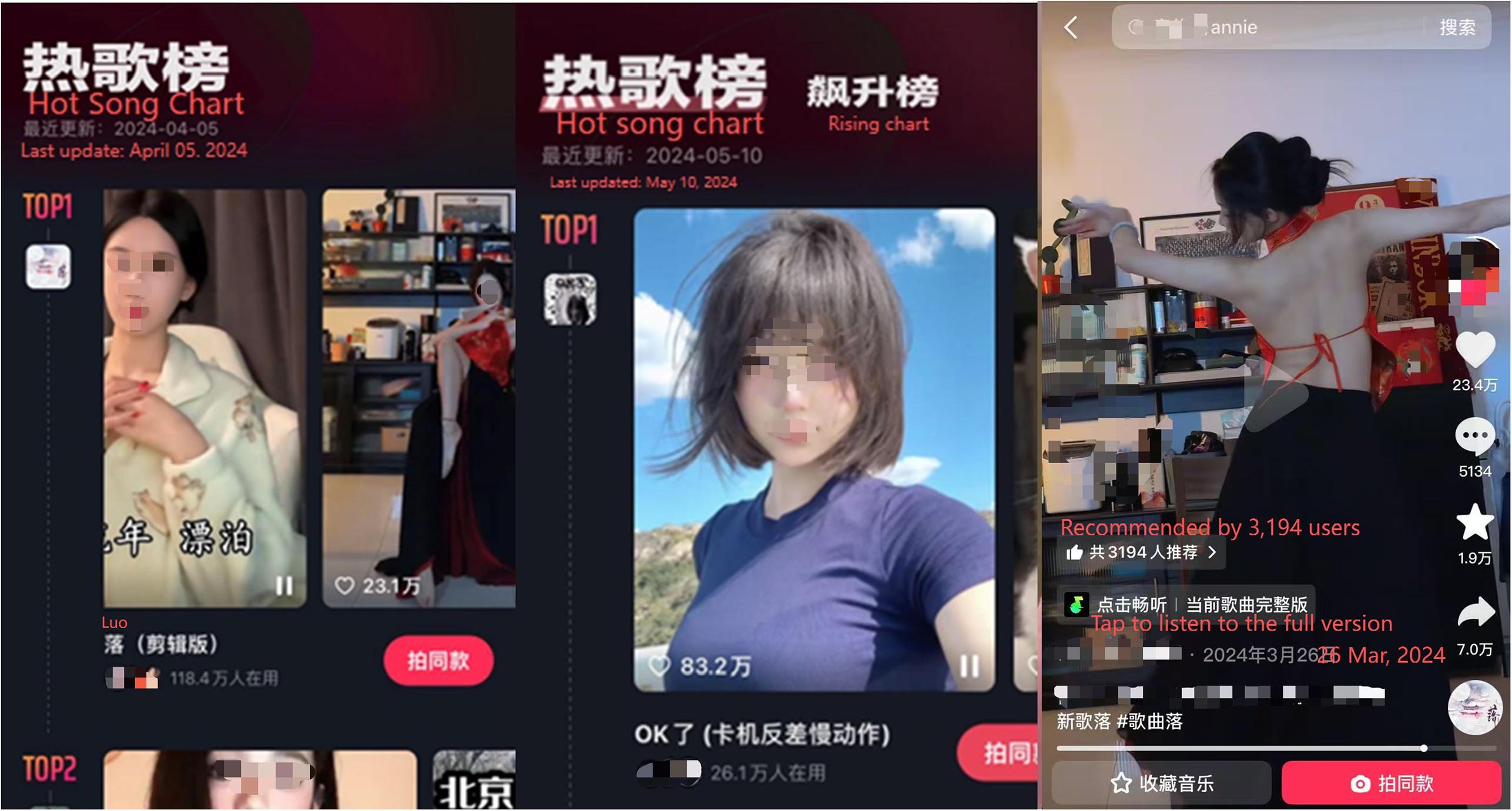
Examples of singing-dancing influencer content associated with Douyin viral-hit charts (screenshots of publicly accessible content collected in April–May 2024; user identities anonymised).
These performers are collectively hyper-visible yet individually disposable, denied both authorship and professional legitimacy. Though ubiquitous in the circulation of viral-hit music, they can easily be replaced by new faces, and they hold no rights over the music and rarely receive recognition for their performances. Although some release music regularly, most of their output consists of covers rather than original work, and very few can be repackaged as professional musicians. Interviewee #18 (male, hit-music studio owner, 2023, 2024) explained that for female influencers with modest visibility, being the original or credited singer of a viral hit serves as a credential , allowing them to leverage popularity and assert a ‘creator’ identity. This aspiration is readily absorbed into the demo-testing process discussed in the previous section. Interviewee #18 further emphasised, given the low entry barriers of this field, ‘their musical skills are often judged on whether they seem promising or show a willingness to learn, rather than on genuine competence. This situation is harsh, as they rarely possess the professional capabilities or resources needed to establish themselves as musicians.’ Women's labour remains essential to the viral-hit system yet is structurally unrecognised and unrewarded.
The devaluation of this labour further stems from its repetitive and mundane nature, which Lee (2025) observes is frequently overlooked in platform economies because it lacks traceability and measurability. Polished performances conceal intensive relational and manual efforts, including numerous invisible tasks such as shooting, editing, setting up spaces, and maintaining an uplifting presence and rapid fan interaction (Interviewee #14, female, hit-music operations, 2023). The physical and mental exhaustion, alongside risks such as online harassment, remain invisible within the viral-hit system. Much like housework, this feminised labour is often trivialised, unrecognised yet essential to career sustainability (Baym, 2018: 196).
Conclusion
This article examines viral-hit music in the context of China's music platformisation, arguing that it crystallises a new, track-centred mode of production driven by platform capitalism. The study demonstrates that platform capitalism restructures production by institutionalising optimisation, measurability and controllability as the organising principles of cultural production, fundamentally reinforcing an asymmetrical relation between platforms and creative labour. In this reconfiguration, performers, largely women, are reduced to disposable vehicles in service of tracks and their commercialisation.
The article's central contribution lies in foregrounding gender as constitutive of, rather than incidental to, this restructuring and its practice. Across all three tiers of performers, women appear to be favoured by the industry; this preference is rooted in women's gendered dispositions and bodies as a readily available and tactically deployed source for viral-hit production and circulation. This reflects not opportunity but convenience—those whose labour is most visible, responsive, and accessible are most vulnerable to exploitation.
Although grounded in China, the track-centred mode represents a cultural manifestation of a global logic of platform capitalism, and a broader trajectory for how platform economies organise creative work and reproduce gender inequality. Western music industries have also adopted the optimisation of music and data-based evaluation of artists (e.g., Morris, 2020), and the boundary between musician- and track-centred modes has gradually become blurred. The frameworks developed in this study therefore offer transferable analytical tools for examining similar configurations across diverse contexts. Given this study's focus on the institutional level, future research could further develop a situated understanding of lived experience by engaging more directly with women participating in viral-hit production.
Footnotes
Acknowledgements
I am grateful to my PhD supervisors, Professor David Hesmondhalgh and Dr Yuan Zeng, for their support throughout the research and publication process. I also thank the anonymous reviewers for their valuable and constructive feedback.

Ethical considerations
This research was approved by the University of Leeds, Faculty of Arts, Humanities and Cultures Research Ethics Committee (Ref: FAHC 22-145, 2023).
Consent to participate
All interview participants provided informed consent before taking part. On-site observations were conducted in professional and publicly accessible settings, without collecting any identifiable personal information.
Consent for publication
All participants also provided consent for the publication of research findings based on these data. While participants’ general occupations and gender are referred to in order to contextualise the analysis, no identifiable personal information such as names, specific job titles, organisational affiliations or visual materials depicting participants are included in the manuscript.
Publicly available online materials, including screenshots taken from digital platforms, were also used for illustrative and analytical purposes. No identifying information, such as usernames or IDs are disclosed in the manuscript.
Author contributions
The author confirms sole responsibility for all aspects of the research, including study design, data collection, analysis, and writing.
Funding
The author received no financial support for the research, authorship, and/or publication of this article.
Declaration of conflicting interests
The author declared no potential conflicts of interest with respect to the research, authorship, and/or publication of this article.
Data availability
The excerpts of interview and fieldwork data used in this article are presented within the text. The full qualitative datasets are not publicly available in order to protect participant confidentiality, in accordance with the approval granted by the University of Leeds Research Ethics Committee. Data sharing is not applicable to this article as no datasets were generated or analysed beyond the qualitative materials described. An anonymised interviewee list has been provided in Figure 1 of the main text.