






Abstract
This study investigates “Crazy Literature” (Fāfēng Wénxué 发疯文学) as a form of digital nonsense through which young people engage in affective sense-making about work-related precarity in China. Emerging from earlier E’gao spoof culture and subaltern tropes such as Diaosi and Sang Culture, Crazy Literature marks a shift from ironic self-deprecation of marginalized youth toward an active nihilism of an emerging precariat class often known as Dagongren (wage laborer) or Niuma (cow and horse) in the workplace. Drawing on affective rhetoric, this study tracks the circulation of work-related Crazy Literature across popular online platforms, showing how absurd language, schematic figures, and routinized performances materialize precarity and stabilize an ambient “craziness” that renders precarity an affective mode of self-making for youth in the workplace. Through circulation and commercial recuperation, “Crazy Literature” transforms venting into everyday affective resilience, turning “nonsense” into participatory and routinized forms of livability under precarity.
Keywords
Introduction
I know I’m unworthy of delivery, everyone else has received their goods, but not me, even when I try to urge you, I’m cautious. I’ve become a ridiculous joke. Everything goes against me in real life. Everyone treats me with indifference, even online. I know I’m not worthy of early shipping. I want to speak up for myself. I swear to the cold night and the icy wall, I want to join there, but I can’t. My God, I’m just a wandering pumpkin seed in a corn pumpkin soup.
No, this is not a monologue from a madman, but rather the words said by a disappointed customer when her package delivery had been delayed several times. The customer initially requested politely to have her package delivered without any further postponement, yet was only greeted with unsatisfactory excuses. Eventually, the customer unleashed her frustration, in an emotional outburst, voicing her displeasure in a seemingly ludicrous manner. This brief exchange within a shopping dispute soon swept across China's online space, leading to the viral circulation of “Crazy Literature,” garnering millions of views and discussions in China's online space (Wang, 2023).
Though referred to as “literature” in the Chinese language, Crazy Literature is neither genuinely about mental illness nor truly literature, but rather dramatic and exaggerated linguistic expressions in a exasperated tone that mimics breakdown, hysteria, or loss of control, as if the speaker is crying and shouting. Expressions of anxiety, anger, grievance, or other intense emotions are recontextualized and displaced across a plethora of lived experiences. This pattern of exaggerated, illogical, and emotionally excessive expressions renders Crazy Literature a form of “digital nonsense,” which “serve[s] as a social glue that bonds members of phatic, image-oriented, communities” (Katz and Shifman, 2017: 825). As the trope circulates in China's online space, it has become a form of recognizable affective script through which young people make sense of everyday pressures, curating forms of intimacy and “commonality and cohesion” (Mateus, 2019: 71).
In this study, we focus on how such affective togetherness is curated among an emergent “precariat class” (Standing, 2011) of the younger population in China with the circulation of Crazy Literature in online communities. Often known in vernacular terms such as Dagongren (打工人 wage laborer), Niuma (牛马 cow and horse, a self-deprecatory term for exploited workers treated like draft animals), or the more recent Malou (吗喽 lowly “monkey-like” figures), these youth possess education, skills, and a degree of financial independence, yet remain subject to excessive workloads, opaque mobility pathways, and intensive peer competitions.
As Berlant (2011: 195) suggests, “the precariat must be a fundamentally affective class.” We argue that the “digital nonsense” of Crazy Literature can be seen as an affective performance of nihilism to dramatize the affective labor of adapting to precarity, curating intimacy for those who are neither fully excluded from nor securely integrated into contemporary socio-economic life. Its “fleeting” nature enables subsequent reorientations toward emotional self-care, everyday problem-solving in the workplace, and even commercial recuperation.
Taken together, these observations invite a deeper reflection on how nonsensical expressions of affective experience manifest as nihilism and function as modes of sense-making (hence “affective (non)sense-making”). In this study, we trace how work-related Crazy Literature emerges, circulates, and transforms across interconnected texts and platforms to examine how affects of “craziness” are mobilized, transformed, and recuperated in contemporary platformed contexts to understand how “digital nonsense” as nihilism generates affectively charged rhetorical conditions that respond to precarity through shared values and practices.
From E’gao to “going crazy”: Digital nonsense, subaltern irony, and millennihilism of the new precariat
The roots of “digital nonsense” seen in Crazy Literature can be traced back to the E’gao (恶搞) spoof culture that emerged in China's early 2000s internet space (Tang and Yang, 2011). As a descendant of the “Kuso culture,” E’gao mobilized parody, exaggeration, and distortion through intentionally “crappy” aesthetics (Silvio, 2009). While initially focused on playful parodies of pop culture, E’gao gradually transformed into a rhetorical practice that unsettled dominant discourses through satire and irreverence without direct confrontation (Meng, 2011).
This transformation of E’gao took place amid China's post-Socialist transition, during which market-oriented reforms and neoliberal governance logics intensified competition and social stratification. New evaluative frameworks emerged to assess individual worth and social value, most notably articulated through the discourse of Suzhi (素质). Personal self-improvement, discipline, and adaptability became aligned with developmental goals, rendering the body a site of self-investment and moral assessment (Anagnost, 2008; Liu, 2011). Hard work and self-optimization were increasingly treated as ethical obligations, requiring individuals to internalize responsibility for success, failure, and precarity (Hizi, 2021).
However, many young people expressed an increasing sense of incapacity to fulfill such expectations (Pang, 2022). Early instances of the E’gao nonsense, such as the Diaosi (屌丝) “losers” meme, articulated the intensifying ambivalence and ironic self-deprecation of those excluded from narratives of productivity and nation-building. Subsequent tropes such as the dispirited Sang Culture (丧文化) and Lying Flat (躺平) extended this affective repertoire through resignation, withdrawal, and refusal toward intensified demands for self-optimization.
Unsurprisingly, such dispirited youth cultures have drawn criticism. Diaosi was condemned for vulgarity (Szablewicz, 2014), Sang Culture for pessimism (Xu et al., 2024), and Lying Flat for aspirational withdrawal (Sun, 2025). Across these debates, “digital nonsense” became a site of affective negotiation where young people articulated disenchantment with meritocratic promises through irony and withdrawal (Tan and Cheng, 2020). At this point, the initial E’gao parodies transformed into contested sites between young people's sense of precarity and the discourse of meritocracy (Günter, 2017; Yang et al., 2015; Zhang and Li, 2023). Feelings of precarity often gravitated towards a form of “passive nihilism” that, according to Silvestri (2021: 362), “promotes withdrawal through its belief in meaninglessness.” In these instances, nihilism becomes a mode of survival, in which the subject's own precarity is perceived as fundamentally unchangeable.
By contrast, the “digital nonsense” found in Crazy Literature resembles a form of active nihilism, particularly “millennihilism,” which is a mode of cultural expression that confronts the perceived collapse of normative promises surrounding work, effort, and futurity through irony and affective exaggeration (Silvestri, 2021). While genealogically connected to its nonsensical predecessors, Crazy Literature materializes precarity as moody expressions and absurd postures, and opens up pathways for the instrumentalization of performative mental breakdowns. According to Silvestri (2021: 361) , “millennihilism assumes a certain level of financial independence and social capital that differs from the type of dark humor used by marginalized subaltern groups.” Rather than emerging primarily from marginalized or “subaltern” identities (Sum, 2017), it is often shaped by precarious young workers during the intensification of “involution” (内卷, intense domestic competitions, see: Sun et al., 2022).
Historically, the emergence of “craziness” in contemporary digital culture resonates with a longer literary genealogy in modern China, most notably inaugurated by Lu Xun's A Madman's Diary. Similar to the ludicrous ranting in Crazy Literature, Lu Xun's “madman” utilized irrational ravings to expose the “cannibalistic” nature of traditional moral codes. Contemporary “Crazy Literature” partly inherits this legacy of madness as a rhetorical device and recalibrates the affect to suit the conditions of the new “precariat class.” As Standing (2011: 5) observes, “Precarity is no longer exclusive to nonhegemonic populations at the margins,” but a broader “class-in-the-making,” defined by insecurity and lack of work-based identity. While educational credentials have enabled broader access to white-collar and service-sector employment for the youth, these have not transformed into stable career trajectories (Zhang and Li, 2025). The madman's exposure of the “cannibalistic” traditional order is displaced into contemporary disenchantment with intensified meritocracy, where incoherent ravings become an outlet for precarious grievance.
By adopting the persona of the madman, the new precariat moved beyond the passive resignation of Sang Culture. Terms including “wage laborer” and “cow and horse” thus emerged as representations of precarious identities. This transformation from the subaltern Diaosi to the precarious corporate workers signals a transition from passive to active nihilism. Rather than relying on dispirited self-deprecation, young people perform precarious work identities to negotiate belonging and articulate distress. Emerging from this nihilistic condition, Crazy Literature branched into multiple trajectories where anxiety and playfulness, exhaustion and irony, converge. Some retain the potential to unsettle expectations surrounding productivity and self-discipline, while others move toward routinized performance of mental breakdown. As the nonsensical expressions increasingly revolve around recognizable figures, scenes, and objects, they begin to organize shared affective orientations among the new precariat. This development raises a critical question, that is, how does digital nonsense grounded in millennihilism come to function as a form of sense-making within China's online space? More specifically, how do nonsensical expressions operate as affective rhetoric to mobilize recognition and belonging among precarious young workers? Addressing this question requires understanding how such affect emerges, intensifies, and circulates across interconnected texts and practices.
Methodological framework: Affective rhetoric and the tracking of objects of emotion
Contemporary mass media communication increasingly relies on emotion-based appeals. In this study, we conceptualize “emotional appeals” from an affective-rhetorical perspective. According to Mateus (2019: 71), affective rhetoric involves “the use of affective means of persuasion to induce cooperation in beings that, by nature, respond not just to symbols but to the emotions they trigger.” Such appeals “move” affect through circulation as “an affective energy” among “signs, images, sounds and communities,” constituting a form of “material rhetoric” (Mateus, 2019: 71). We treat the affective rhetoric of Crazy Literature as a material circulation of nihilistic affect that mobilizes affective identification and belonging. To make such affective rhetoric empirically tractable, this study conducts a qualitative visual and textual analysis of Crazy Literature with “objects of emotion” as the primary unit of analysis. According to Ahmed, such objects “take shape as effects of circulation” (Ahmed, 2004: 11), and become “sticky” sites of social tension (Ahmed, 2004: 11). In the case of Crazy Literature, these objects include schematic figures, abstracted fantasies, or recurring scenes of work that render precarity visible, affectively resonant and rhetorically persuasive.
Building on this conceptualization, we focus on how recurring “objects of emotion” emerge, mutate, and stabilize. Rather than conducting a static thematic analysis, this study adopts a form of affective tracking concerned with how Crazy Literature develops across media ecologies. To operationalize this form of affective tracking, we draw inspiration from Gries's (2015) Iconographic Tracking, particularly its emphasis on circulation, mutation, and rhetorical consequentiality. Unlike Gries's focus on a single visual image, however, this study traces the transformation of Crazy Literature from early nonsensical ranting into diversified affective tropes, including workplace figures, performative “craziness,” visual memes, and routinized emotional scripts. The focus is not on a single image, but on how “objects of emotion” acquire new affective and rhetorical functions through circulation. In this sense, the study adapts Gries's procedures for recursive tracing while shifting the analytical focus toward the circulation of “objects of emotion” across media ecologies.
The first step of the analysis begins with “data hoarding” (Gries, 2015: 111). We began with Douban, a popular interest-based platform where users gather to share intimate feelings and personal experiences, resembling what Berlant (2008) conceptualizes as an “intimate public” that fosters a vernacular sense of belonging based on a shared worldview and emotional knowledge. Data collection began with work-related posts circulated within the “Crazy Literature Appreciation Group” (发疯文学鉴赏小组), which is widely recognized as a dedicated group of Crazy Literature (Yan and Guo, 2024). We treat this group as the “seed” group of our data collection. From there, related posts, phrases, and text-image assemblages were recursively collected until recurring affective patterns became saturated.
Second, collected posts were sorted into working collections on Zotero. We organized them around recurring “objects of emotion” and their affective repertoires. The focus here was on how particular “objects of emotion” became salient and rhetorically consequential across different posts and contexts.
Third, the analysis moved to a more controlled, recursive expansion of the established collections. New search terms were generated from recurring “objects of emotion.” This process traced how affective scripts mutated and stabilized across platforms while ensuring thematic saturation. Due to the scope of this study, only Xiaohongshu (Rednote) was selected as the primary site of expansion. If Douban's work-related communities operate as intimate publics, Xiaohongshu provides a more publicly and commercially oriented media ecology, where similar nonsensical expressions are reworked into other content formats.
The first three steps examine how things circulate, cluster, and transform. The final step focuses on how the “nonsense” becomes rhetorically consequential through affective circulation. As such, we turn to an affective rhetorical analysis informed by Mateus (2019). Dense clusters of “objects of emotion” were selected for close analysis, focusing on how nonsensical expressions operate as affective rhetoric through their circulation. This step examines how “objects of emotion” mobilize shared orientations, identification, and affective resonance. The analysis also focuses on relational assemblages of texts, users, and platform affordances that stabilize “craziness” as a collectively recognizable mode of attunement to work-related precarity, while remaining open to recuperation as these assemblages are shaped by platform logics and commercial circulation. This step foregrounds how Crazy Literature functions as an affective rhetoric of belonging and sense-making grounded in nihilist affect.
From verbal outbursts to routinized fantasies: Affective collections of workplace “craziness” on Douban
To account for an artifact's “multiple transformations and intense, unpredictable, and divergent eventfulness” (Gries, 2015: 111), we first engaged in an expansive search of work-related Crazy Literature on Douban. As a result, we identified 337 posts between 26 September 2021 and 23 October 2025 that fit into or are closely related to the various themes found in the “seed” Crazy Literature Appreciation Group. After an initial surge in late 2021, the phenomenon reached a secondary peak in 2023 and diversified beyond the specific label of “Crazy Literature,” particularly after 2024.
The initial findings suggest that “going crazy” predates and exceeds the narrow frame of Crazy Literature as a named trope. Although the “seed” group was founded in February 2023, the craziness trope emerged as early as 2021 across various work-related or parody-themed groups. These posts were marked by excessive repetition, escalating punctuation, deliberate breakdowns of logic, and abrupt shifts from concrete complaint to fantasy, closely resembling the original customer-service rant that popularized Crazy Literature (Figure 1). Other less intense cases relied on condensed emotional intensification through elongated exclamations attached to specific incidents, rendering distress performatively immediate and easily replicable.
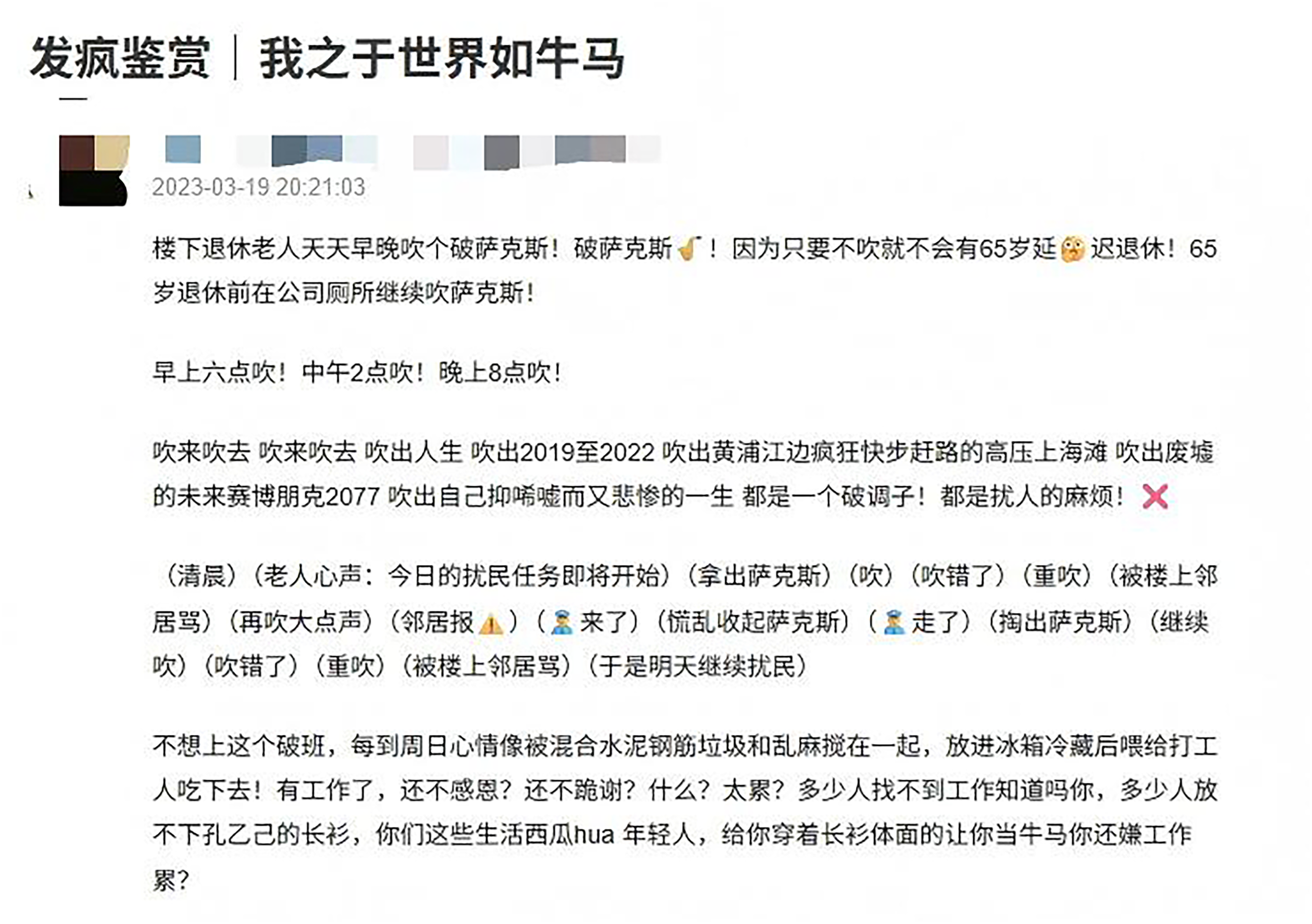
A work-related “going crazy” post of self-identification as a Niuma (“cow and horse”) featuring repetitive gibberish-like ranting about the noise from an elderly man blowing a saxophone, with bracketed annotations of fantasized scenes such as the elderly man “being scolded by neighbors” and “continuing to disturb people tomorrow,” before shifting into complaints about work exhaustion and precarity. (from Douban, anonymized).
Interestingly, another strand of posts presents a more restrained form, where “craziness” titles frame otherwise deliberative and pragmatic narratives. For instance, posts like “refuse burnout, get better bonus and salary through going crazy” (拒绝内耗,通过发疯获得了高绩效高工资) frequently proceed with pragmatic reflections where “making a scene” becomes a workplace strategy rather than emotional breakdown. Here, “going crazy” functions less as a loss of control than as a rhetorical posture for negotiating demands. While some may claim that such narratives can only be considered as remote “edge cases,” a closer examination seems to prove that many of them fit into both themes of Crazy Literature we found in the “seed” group, where users are invited to share their own “craziness.” This shows that Crazy Literature is an emergent affective practice not necessarily limited to strict textual templates. Several collections were thus identified, along with salient “objects of emotion.”
Exhaustion and affective overload
Feelings of work-related exhaustion and affective overload constitute the most salient affective collection, characterized by raw, repetitive shouting about exhaustion from overwork, including intensified resentment toward overtime, particularly the practice of Tiaoxiu (调休 holiday make-up workdays), along with the sentiment of “not wanting to go to work” (不想上班) and other similar variations. These are often exemplified by repeated denunciations of Tiaoxiu as “evil,” “dark,” and “something that should disappear from the earth.” Variations such as “it's Monday again, time to go crazy,” or broader questions like “why do humans have to work at all,” are also highly visible and frequently followed by strings of repeated shouting that mimic emotional outbursts.
Institutional absurdity and relational breakdowns
Posts on institutional absurdity and relational breakdowns depict an oscillation between pure venting and strategic emotional tactics known as “going crazy is useful” (发疯有用). Posts recount moments of “snapping” at coworkers or superiors, who become salient “objects of emotion” that signal workplace hostilities. Other posts address boundary violations and spatial intrusion, workplace oppression and unfair treatment, and quitting as both fantasy and strategy. Although the anger-driven aggressive expression in Crazy Literature is not intended as a direct verbal attack (Yan and Guo, 2024), its effects often exceed simple venting. Here, “going crazy” is narrated as a way of forcing otherwise indifferent structures to respond, where Crazy Literature is frequently associated with “usefulness” and “strategy” (Zheng and Qi, 2025: 39).
Precarious futurity
A less frequent strand of Crazy Literature fuses emotional venting with job-seeking narratives, often crystallizing in the formula of “looking for work + going crazy,” as seen in statements such as “there is no way to look for a job without going crazy” (找工作哪有不疯的) along with similar variations. While some posts adopt overt Crazy Literature styles marked by brief eruptions of despair or exaggerated declarations of “craziness,” most rely on a contrastive structure in which a “crazy” title frames relatively restrained content. Here, job-hunting itself emerges as a salient “object of emotion” that anchors anxiety, resentment, and hope. Repeated interview failures, humiliating offers, and the misalignment between qualifications and working conditions intensify this affective focus.
Performative craziness and routinized fantasies
A defining feature of this collection is the emphasis on seemingly purposeless “craziness.” Posts are characterized by abstraction and a generalized “craziness vibe” (疯感), which appeared more recently in 2023 and 2024. Rather than articulating “going crazy” or centering on specific workplace incidents, these posts foreground schematic figures and imagined situations. Salient “objects of emotion,” including self-identifications such as the aforementioned “wage-laborers” or “cow and horses,” become self-claimed identity labels for young workers, along with their “mental state” (精神状态). In many cases, “craziness” is staged through absurd scenarios or performances that materialize everyday breakdowns without narrating their causes (Figure 2). Unlike grievance-driven posts, this collection centers on “being crazy” as a mood, posture, or persona, marking a move away from direct complaint toward more routinized affective expressions, where “craziness” is treated as a “default” mental condition in the workplace rather than a reaction to outside stimuli.
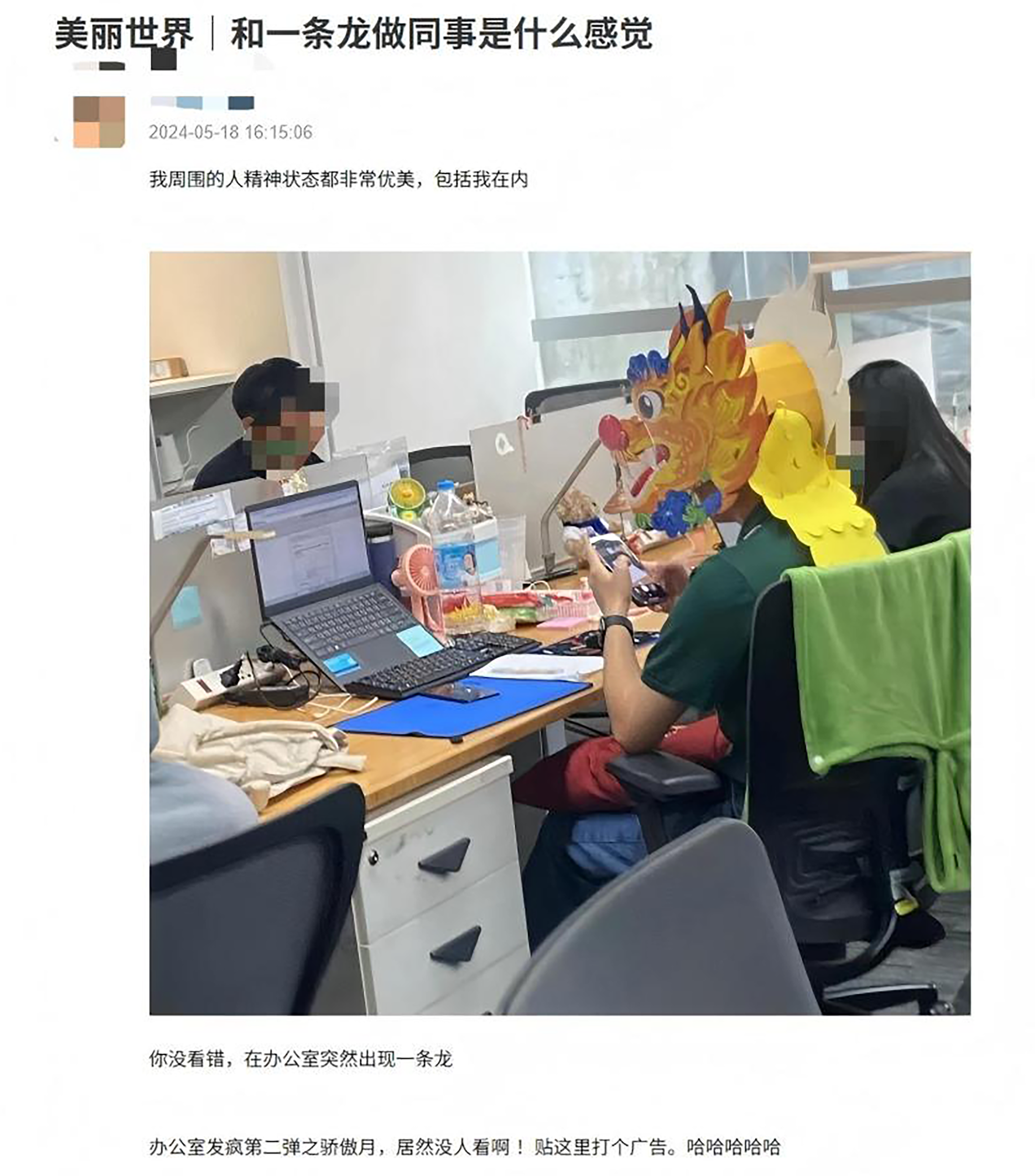
A post titled “How does it feel to work with a dragon?” featuring a colleague wearing a cartoon dragon headpiece in the office. The author jokingly describes colleagues as being in a “beautiful mental state,” turning workplace exhaustion into playful performative “craziness” (from Douban, anonymized).
Berlant observes that contemporary fantasies increasingly under strain include “upward mobility, job security, political and social equality, and lively, durable intimacy” (2011: 3). Within this context, the turn to performative craziness marks an evolution from earlier phases of Crazy Literature of explicit verbal outbursts and emotional release toward the abstract memes and visual formats prevalent today, giving rise to a calmer yet more pervasive sense of “craziness,” through which the nihilism seen in text-based verbal expressions developed into a visually appropriated experience. Such a transition is even more visible in cross-platform circulation.
Cross-platform expansion on Xiaohongshu: Diversifying the “craziness” repertoire
As aforementioned, the transition of Crazy Literature from verbal expression to visual appropriation becomes more visible during cross-platform circulation. While earlier Douban posts foregrounded visceral disgust toward work through emotional outbursts surrounding overtime, Tiaoxiu, and the dread of Mondays, “craziness” becomes visualized and normalized as the default mental state during working hours on Xiaohongshu, often condensed into memes with catchphrases such as “there is no way to work without going crazy” (上班哪有不疯的). Similar to the “everything sucks” trope found on Instagram, these nihilistic memes function as routinized affective divestment (Silvestri, 2021).
This form of “craziness,” resembling what Ngai (2012) refers to as “zany exaggeration,” becomes a playful self-mockery, with “mental status” being the recurring theme. Through displays of absurd embodied performance and ironic declarations of one's “mental status,” these memes articulate the youth's “affective dissonance” (Dobson and Kanai, 2019) toward workplace pressures. This is further complicated by the inclusion of specific relational dynamics within workplace hierarchies other than the sharp antagonism between the employer and the employee on Douban.
For example, content around “refusing workplace gaslighting” (拒绝职场PUA) and “Gen Z disciplining the workplace” (00后整顿职场) extended the generic superior-subordinate or coworker relations to gendered and generational dynamics. Many anti-gaslighting posts provide practical “scripts” for young female workers to counter workplace manipulation. The convergence of the “usefulness” of Crazy Literature with the rise of feminist discourse produces a gendered intimate public that further diversifies acts of “going crazy” as an affective tactic, where intimacy intertwines with the political scenes of women's inequality as a subaltern population (Berlant, 2008). Similar dynamics are also evident in work-related Crazy Literature that depicts generational conflicts (Wang, 2023).
Over time, Crazy Literature generated increasingly standardized figures of “going crazy” capable of repeatedly invoking and embodying workplace precarity. For example, Huafei, a character from the popular Chinese TV drama Empresses in the Palace, partly known for her tragic devotion to the emperor who ultimately abandoned her, embodying a condition of love and sacrifice without reciprocity, emerged as a meme on Douban in 2023 to represent collective workplace precarity. The figuration of the character as precarious workers became a general trend in 2024, as a way for office workers to describe and stage their own affective labor and precarity at the workplace (Figure 3).
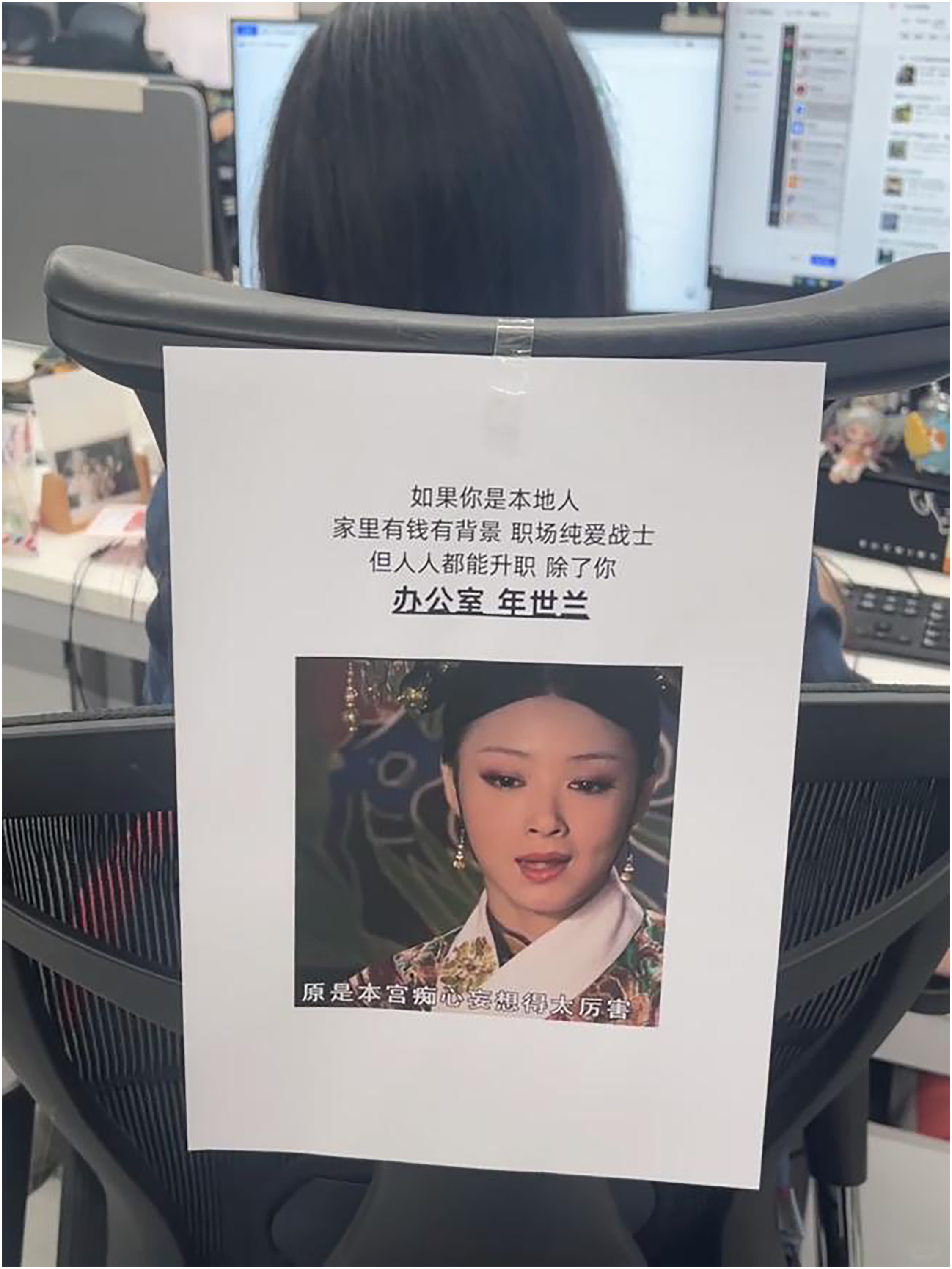
Workplace re-appropriation of Huafei from Empresses in the Palace. The sign reads, “Even though you are a local with money and family connections and a devoted worker, everyone gets promoted except you, the Office Nian Shilan (Huafei)” (from Xiaohongshu, anonymized).
Transformations of this nature signal a process of affective embodiment, whereby mediated symbols are increasingly lived and performed. Crazy Literature becomes a repertoire of affective practices through which workplace grievances are transformed into shared modes of adaptation and survival. As these texts circulate across platforms, they are widely recognized by young users as an effective means of emotional regulation. As more memes are created, earlier instances on Douban scattered around different groups are collectively transformed into a diversified memetic ecology with certain characters being constantly reused and readapted.
Crazy Literature as affective rhetoric: Precariat self-making, ambient affect, and the paradox of commercial recuperation
As Mateus (2019: 74) suggests, “affective rhetoric takes up where logic and evidence leave off.” Whether expressed through blunt declarations of “not wanting to go to work” or through strategic discussions of how to confront unfair treatment at work, these feelings of anxiety, burnout, anger, and ambivalence are “culturally infused with value, pointing to what is worth doing or preserving” (Mateus, 2019: 74), invoking a shared sense of intimacy among the precariat class. Based on the findings on Douban and Xiaohongshu, three interlocking modes of emotional appeals and framings become visible, including the formation of a precariat self-world, the construction of antagonistic others, and the normalization of performative craziness.
Precariat self-world, others as border objects, and performative craziness
Most notably, Crazy Literature contributes to the emergence of a distinct precariat self-world, centering on an affective identification of those who are always driven crazy by accumulated work-related exhaustion. As the likes of “wage laborers” become increasingly central in the circulation of Crazy Literature, they gradually became a symbol of affective togetherness among exhausted workers. Such normalization is often enabled through “cutification” (Wong et al., 2021) of precarious labor conditions, notably seen in the personification of harmless cartoon or animal figures, through which precarious young workers are increasingly personified in ways that are recognizable and replicable.
These figures correspond to what Berlant (2011: 97) calls “precarious bodies.” For the precariat, the promised reciprocity between hard work and reward has become increasingly unattainable, as hard work no longer reliably leads to secure employment and upward mobility. As Standing (2011) argues, precarity is defined less by income than by structural vulnerability and the absence of a secure work-based identity. In Crazy Literature, figures such as Dagongren, Niuma, and later Malou embody this condition of failed reciprocity. The ethos of the precariat thus provides a shared lexicon and imagery through which working youth, as “knowing agents” (Conrad, 2009: 28), craft counternarratives to the eroding reciprocity through aesthetics of exaggerated excess. It is through this transformation from nonsensical expressions to concrete and vulnerable figuration of precarious workers that “craziness” becomes a shared affective identification within a precariat self-world.
Like any other form of identification, the solidification of the self requires alienated, antagonistic others. This is particularly visible in repeated appearances of bosses, colleagues, HR staff, clients, or faceless “systems” that make one “crazy.” These figures, as the “objects of emotion” that intensify the felt craziness of the precariat, are depicted as polar opposites of the precarious “wage laborers.” Through repeated narratives of humiliation, boundary violation, exploitation, and disrespect, leaders and colleagues become affectively sticky objects, repeatedly associated with anger, disgust, and resentment.
On Douban, this antagonism takes the form of direct venting, denunciations of absurd rules, and cautious deliberations over whether to confront superiors or resign. On Xiaohongshu, these antagonisms are further re-framed through the aforementioned gendered and generational dynamics. Anti-gaslighting scripts foreground young women facing manipulative bosses or colleagues, while videos simulating younger workers’ acts of rebelling against their superiors dramatize generational differences in tolerating exploitation. While these cases expand antagonistic relations beyond the immediate workplace, both continue to construct collective identity through the delineation of others. In doing so, such antagonism further consolidates the precariat self-world.
Beyond self-identification and “othering,” Crazy Literature gradually stabilizes into a set of performative scripts that can be rhetorically accreted with recontextualization (López-Londoño, 2023). What begins as individual emotional venting becomes recognizable as a genre with expectations, shifting from posting about “craziness” online to enacting “craziness” as a daily ritual commonly described as “going ‘crazy’ on a daily basis” (日常发疯). Crazy Literature is thus practiced with clear awareness of social stereotypes surrounding hysterical emotions or the regimes of affective discipline. The circulation of “going crazy” affects signals the escapist potential of “going crazy” under conditions of affective impasse (Zheng and Qi, 2025). In this way, adapting to precarity becomes a means of dramatizing the present.
Rhetorical ambience and new assemblages
Even though the self, others, and the practice of “going crazy” remain relatively stable across the development of Crazy Literature, viral circulations have transformed the trope from an affective means of persuasion that foregrounds precarity into a shared “atmosphere” of “craziness.” At this point, Crazy Literature exceeds what Mateus (2019) defines as “emotional persuasion” in a narrow sense, becoming a form of “ambient rhetoric” (Rickert, 2013), an “attunement” to “craziness” that involves interactions among selves and others, texts and images, memes and platform affordances. This ambience, according to Rickert (2013: 24), involves “actants of varying agentive weight and value” being “threaded through each other and across networks, combining and recombining in flexible assemblages.” Often seen in the aforementioned “craziness vibe” memes, this new assemblage enacts affective gestures of “representability” (Ingraham, 2020: 60) that produce particular feelings of “craziness.” Within such assemblages, Crazy Literature functions as an affective practice of adaptation to precarity through ironic forms of over-adaptation, exactly what the nihilistic nonsense aims to achieve.
For example, one of the most recent embodiments of the precariat class, Malou, provides a clear illustration of how such assemblages mutate and recombine elements to display a recognizable schema of “craziness” across multiple affective collections. Originating as a Cantonese slang term meaning “monkey,” Malou gained wide circulation in 2024 through the rise of the stand-up comedian Fu Hang. His initial exaggerated bodily performance earned him the nickname “monkey,” and his self-deprecating narratives and working-class background resonated strongly with precarious workers, allowing Malou to condense feelings of precarity, endurance, and ironic vitality. Along with Fu Hang's rise in popularity, Malou has emerged as a new symbolic figure of the precariat. As Silvestri (2021: 362) observes, such figures offer a “cheeky recognition of social, commercial, and political futility” while inspiring “a re-visioning of success and what it means to live a good life,” a stance she characterizes as a “nihilism of grace.”
Like many of the prominent figures that manifest the precariat ethos, Malou has become a central icon in the latest iterations of “craziness vibes.” In a meme showing a Malou working in front of a laptop (Figure 4), the captions voice Malou's inner thoughts, asking “have you ever felt like working in a brothel,” creating a sense of exploitation and deprecation. The accompanying text deepens this critique. Statements such as “doing work you dislike every day while being forced to smile” indicate excessive “emotional labor” as a routine occupational requirement (Veldstra, 2020). The concluding comparison that the work is harsher and less rewarded than sex work underscores not only the harsh working duties that are not fully remunerated , but more importantly, the absence of a dignified work-based identity, a defining condition of the precariat.
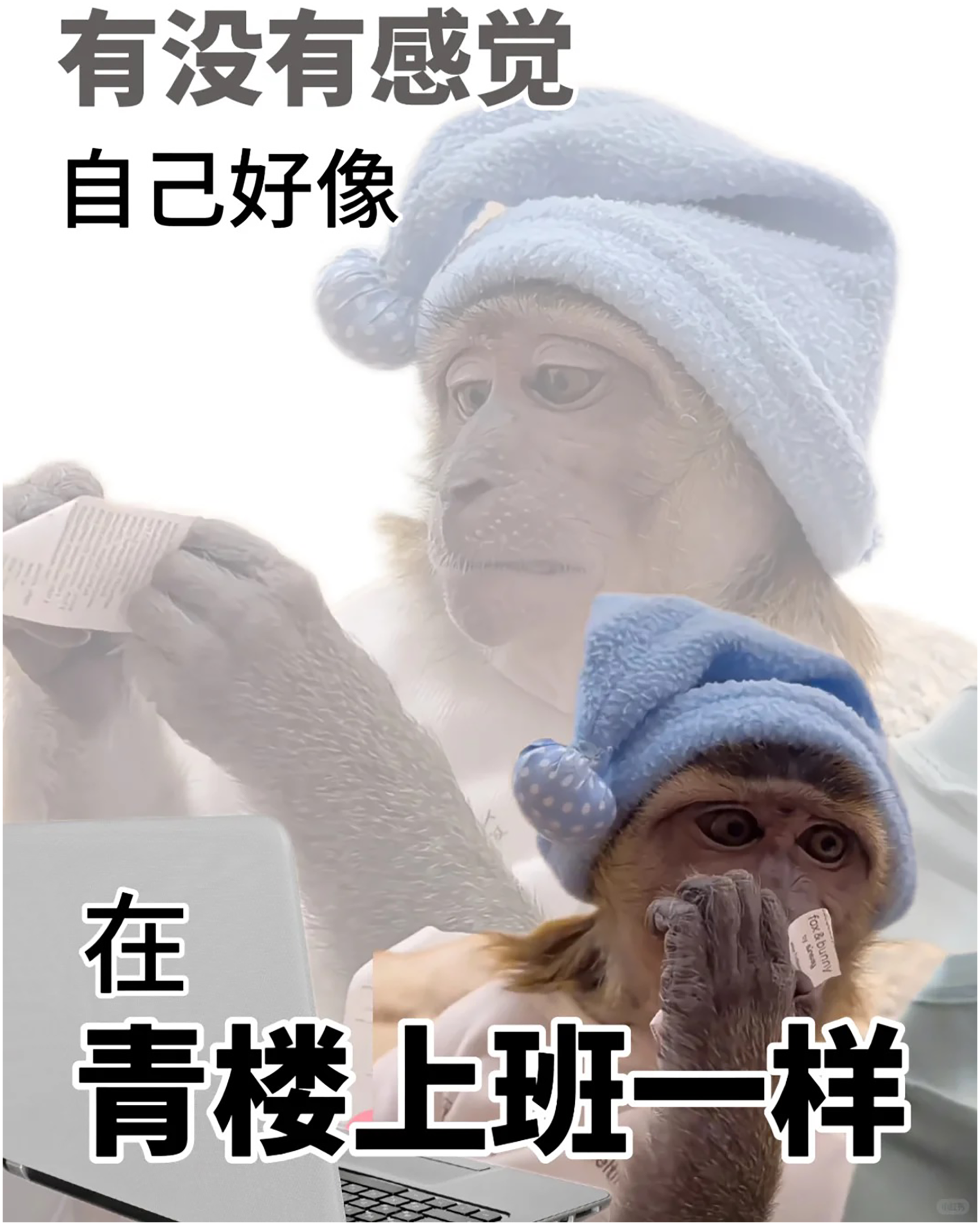
A meme that portrays Malou's inner thoughts, saying “Have you ever felt that you are working in a brothel?” (retrieved from Xiaohongshu, username anonymized).
At the same time, it reveals the affective burden placed on workers to sustain workplace relations, a pressure that helps explain the appeal of “going crazy” and underwrites the cathartic function of Crazy Literature. Similar memes of Malou continued to exaggerate contemporary labor relations through absurd historical and institutional analogies. Posts comparing workers to “slaves” in feudal hierarchies or mocking rigid corporate approval systems dramatize the emotional burdens of obedience, affective discipline, and bureaucratic absurdity (Figure 5).
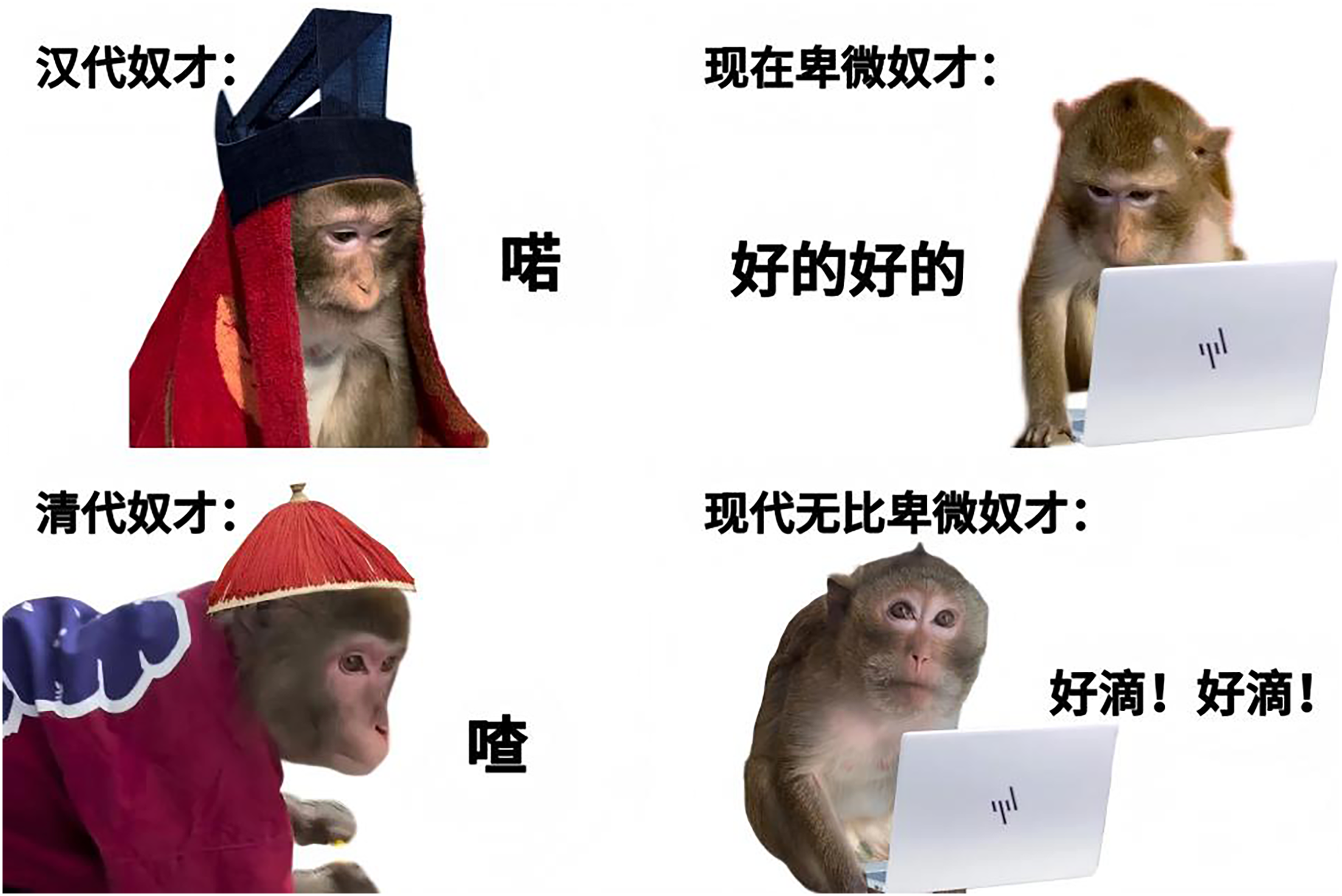
A Malou meme comparing “slaves” from the Han and Qing dynasties (on the left) with contemporary office workers (on the right). Historical forms of obedience are humorously replaced with modern workplace humble replies such as “okay okay” and “sure sure,” dramatizing the affective labor of submission in contemporary work relations (from Xiaohongshu, anonymized).
In one post, a Malou asks, “What should you do if your boss falls into the water?” The reply, “Go through the OA approval process first. We cannot rescue them without approval,” satirizes rigid bureaucratic procedures and institutional absurdity in contemporary workplace culture (Figure 6). This joke draws on a longstanding meme involving a girlfriend asking her boyfriend who he would save if both his mother and the girlfriend were drowning, a scenario whose absurdity makes it inherently fantasmatic. The boss is, of course, not actually in the water, but the meme mobilizes this exaggerated scenario to satirize workplace systems and rules, where corporate bureaucracy takes precedence over common sense and simple requests are often rejected by the management with unreasonable excuses. These everyday fantasies do not explicitly depict workers being driven mad by labor. Rather, through ludicrous imagination and institutional mockery, they convey the conditions under which the office workers are pushed toward “craziness.”
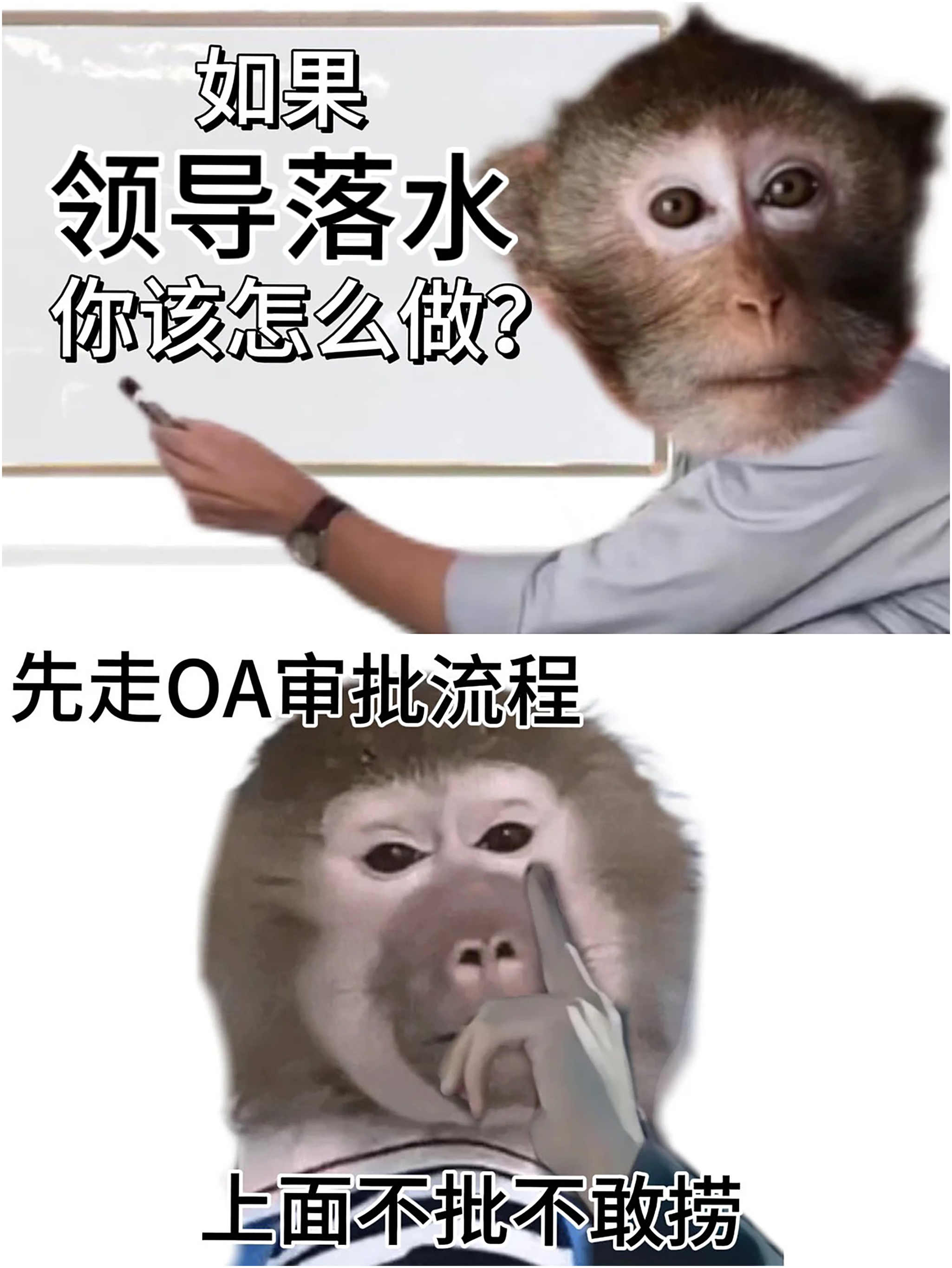
A Malou meme critiquing rigid corporate “OA approval processes” (from Xiaohongshu, anonymized).
All of these can be read as manifestations of performative “craziness.” They stage an intensified and more dramatized version of such impulses through the figure of Malou and through fictional scenarios or relational dynamics that mock work-related exploitation and absurdity. By recombining salient “objects of emotion,” including both the self and antagonistic others, with diverse situations and practices of “going crazy,” these performances render precarity an ambient affective condition that pushes working youth toward “craziness.”
Commercial recuperation
As Crazy Literature became ambient and widely circulating, it also became increasingly susceptible to commercial recuperation . Contents are often organized around promotions designed to generate revenue through traffic or the sale of related merchandise, further professionalizing and standardizing the production of “craziness” for circulation. Large corporations have also redirected brand marketing by curating a sense of proximity to the “crazy” precariat, with campaigns inviting young people to see the brand as “one of them.” A prominent example is KFC's “Crazy Thursday” campaign, which has become a durable internet trope and a recurring theme through which the brand communicates with young consumers (Zhang and Mao, 2024).
Originally launched in August 2018, the campaign was designed to boost sales before the weekend through heavily discounted meals, becoming a commercial success as the idea of obtaining meals at a low price appeared highly appealing. Apart from boosting sales, the campaign gradually developed into a meme culture. By 2021, online discussions surrounding “Crazy Thursday” had become increasingly prominent, roughly coinciding with the prevalence of Crazy Literature. KFC further capitalized on this visibility by organizing the “Crazy Thursday Literature Gala” (疯四文学盛典), officially incorporating the absurd and exaggerated aesthetics of “craziness” into its brand image.
The most influential trope emerging from the campaign was the “V me 50” (V我50) meme. Initially tied to KFC discounts where fifty yuan (roughly seven US dollars) was enough for one to enjoy a good meal during Crazy Thursday. The trope gradually detached from its commercial origin and evolved into a meme centered on funny “requests” for money through Wechat (“we” sounds similar to “v” for Chinese speakers) for deliberately absurd reasons. Through repeated circulation, the “V me 50” meme became one of the defining tropes of Crazy Thursday culture. KFC later commercialized the meme by launching “V me 50” gift cards, transforming the joke into a commodity and officially recognized meme.
A closer examination of KFC's official promotional content reveals the repeated appearance of many salient figures and “objects of emotion” identified in work-related Crazy Literature, including the aforementioned Niuma (cow and horse) and Tiaoxiu (holiday make-up workdays) memes that parody young people's precarity and exploitation (Figure 7). These motifs now appear throughout KFC's social media branding, where self-deprecatory absurdity and routinized “craziness” have become part of KFC's broader brand identity in China. This partly explains KFC's exceptional popularity in China, where its market share and sales have consistently exceeded other competitors in recent years.
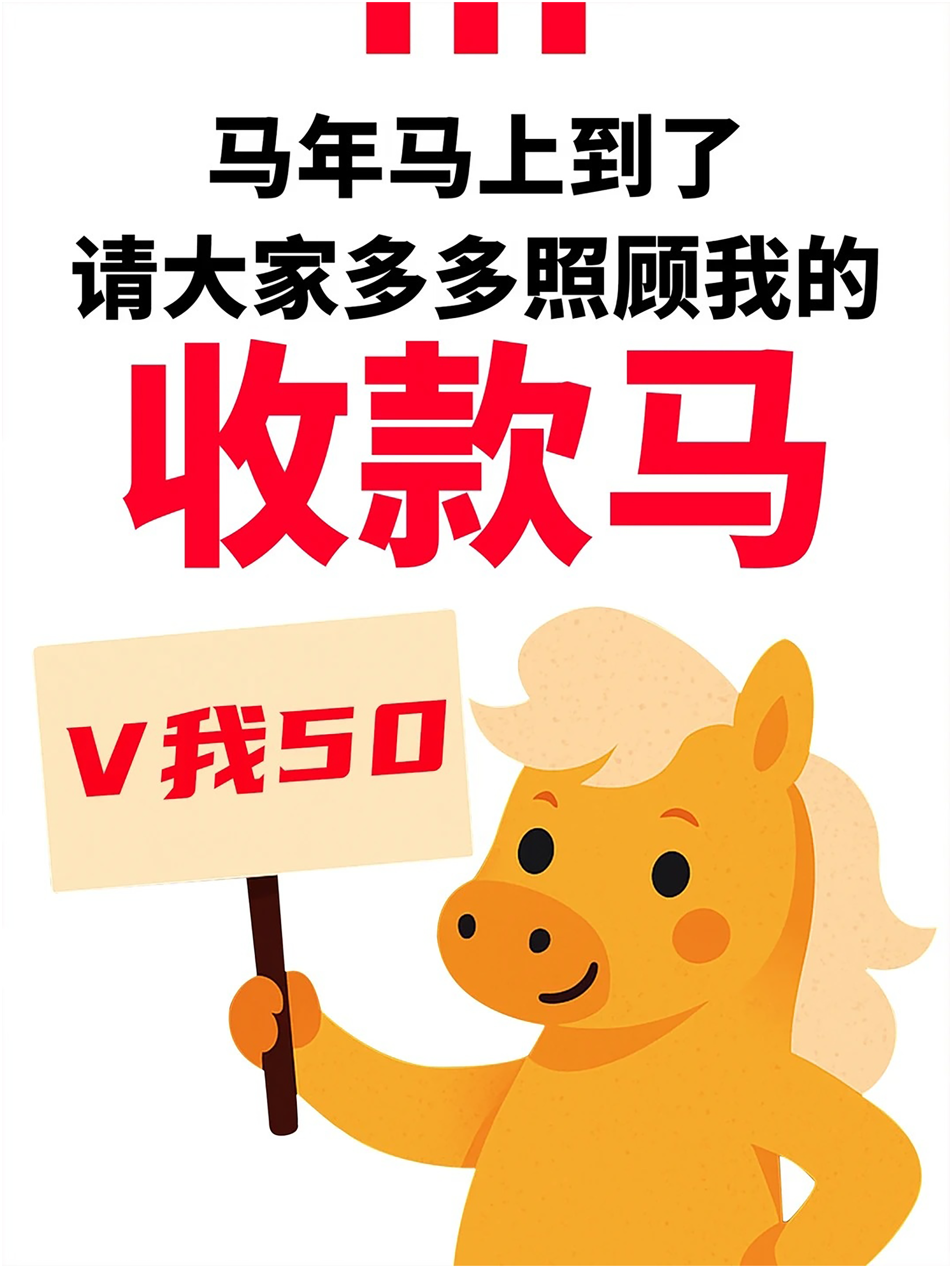
An official meme from KFC featuring a cartoon horse associated with the Niuma (“cows and horse”) trope holding a “V me 50” sign. The text states, “The Year of the Horse is coming soon, please take care of my payment horse,” employing a homophonic pun between 马 (“horse”) and 码 (“payment code or QR code”).
The case of KFC's Crazy Thursday campaign complicates the relationship between nihilism, precarity, and business recuperation. While Berlant (2011) describes the precariat as an affective class, as aforementioned, there is another important dimension which involves the “affective imaginary of this class,” where “adaptation to a sense of precarity dramatizes the situation of the present” (Berlant, 2011: 195). In the context of Crazy Literature, this dramatization increasingly unfolds through commercial participation where brands stage a sense of togetherness with the very workers whose exploitation they often perpetuate. Yet the KFC case suggests that commercial recuperation does not simply neutralize the affective force of “going crazy.” Rather, it redistributes precarity into durable forms of affective participation, where irony, absurd humor, and self-mockery become culturally recognizable practices of sustaining livability.
Here Wetherell's (2012: 158) questions about affect and accumulation are particularly relevant: “Can affect sometimes fail to accumulate, or stop accumulating and lose intensity? Does affect necessarily increase, as it accumulates?” From this perspective, the effect of commercialization on affect is far more complicated because it also reshapes intimacy. While it is true that intimate feelings and emotions may seem submerged when commercialization increases, and that intimate fantasies grounded in nihilism are constrained by platform economies, the KFC case also reveals a shift from intimate affective venting toward publicly shared forms of durable affective participation.
In other words, commercial recuperation offers a different way of negotiating what Berlant (2011: 9) calls the “attrition of fantasy.” The popularity of “crazy marketing” reflects a participatory culture of affective resilience. Young people are fully aware that brands are mobilizing “craziness” for marketing purposes, yet they continue to participate enthusiastically in these performances through ironic self-deprecation, parody, and absurd humor. These practices simultaneously provide emotional relief and generate new affect-driven forms of commercialization. Nihilistic nonsense thus persists as a durable affective practice precisely because it helps construct affective resilience.
Contemporary affect studies often portray subjects as overly susceptible to “being affected” by broader social conditions. As such, affective practices that adapt to unfulfilled living fantasies are often interpreted as “compromised” in that they allow people to merely continue the “flirtation with some good-life sweetness” (Berlant, 2011: 48). Yet, the development of Crazy Literature reveals a stronger agency of the subjects. Commercial recuperation, paradoxically, makes this agency stronger and more visible. More than simple compromise, the collective co-creation of absurd fantasies and the active participation within them resemble a form of everyday heroism. In this sense, “going crazy” becomes a mode of sustaining, instead of compromising, livability under precarity. Although it cannot resolve structural insecurity, it produces recognition, resilience, participation, and temporary forms of livability. The “craziness” remains both cruel and genuinely sustaining. In this sense, the meaning of nonsensical sense-making lies in its ability to construct small heroic fantasies within everyday life through affective participation. While earlier parody cultures were saturated with cynicism toward one's own marginality, the “going crazy” aesthetics of Crazy Literature, particularly after commercialization, revolve around self-mockery accompanied by exaggerated confidence and persistence as it dramatizes “continuing to live” as a form of everyday endurance. Compromised endurance becomes “heroic,” and what emerges instead is a mode of exaggerated affective resilience, which, perhaps, is the exact sense of the (non)sense-making in Crazy Literature.
Conclusion
In this study we have traced Crazy Literature as a form of digital nonsense grounded in millennihilism, and examined how nonsensical expressions come to function as sense-making among precariat young workers in China. Rather than a fleeting stylistic trend or irrational parody, Crazy Literature reveals a historically specific affective condition shaped by precarity, involution, and eroding promises of mobility. What appears as meaningless ranting or playful absurdity is a shared affective practice through which young workers materialize exhaustion, anxiety, and uncertainty surrounding work and futurity. Unlike earlier subaltern tropes centered on withdrawal and resignation, Crazy Literature emerges among a new precariat class marked by education, partial economic inclusion, and persistent insecurity. Under these conditions, nihilism no longer takes the form of quiet retreat as in previous tropes such as “Lying Flat.” It is instead enacted through exaggerated, excessive performances of “craziness” that foreground the incoherence of the present.
The analysis suggests that Crazy Literature operates as affective rhetoric by organizing “objects of emotion” into shared orientations of feeling and belonging for the new precariat class. Figures such as Dagongren, Niuma, and later Malou, together with antagonistic bosses, HR, and opaque systems, function as sticky objects where exhaustion, resentment, anxiety, and absurdity converge. These objects cluster into recurring configurations of burnout, institutional absurdity, precarious futurity, and routinized “craziness,” transforming individual frustration into collective affective scripts and a recognizable precariat self-world for young workers.
The emergence of “craziness” also signaled a shift in the expression of youth individualism and ethical considerations, moving from implicit identity curation to explicit identity experimentation. During its circulation, Crazy Literature gradually developed from a discrete mode of emotional persuasion into an ambient rhetorical “atmosphere.” Here, “craziness” transforms into an attunement to work and life that emerges from the entanglement of texts, images, users, and platform affordances. Through humorous exaggerations that dramatize the impossibility of being properly reciprocated financially or institutionally, this ambience of precarious vulnerability curates the affective togetherness of the precariat class and transforms the “impasse” of cruel optimism into a collectively inhabitable condition of exaggerated endurance.
At the same time, active nihilism manifested as digital nonsense is structurally ambivalent. As new assemblages of Crazy Literature travel into brand campaigns, influencer content, and entrepreneurial self-promotion, its affective intensities are partially smoothed and reformatted into standardized figures and scripts oriented toward visibility and revenue. Yet commercial recuperation does not simply erase the affective force of “craziness.” Instead, it redistributes precarity into routinized forms of participatory resilience, where ironic self-mockery and absurd humor continue to sustain collective livability even as intimate affect becomes publicly consumable. In this sense, millennihilistic nonsense is often redirected onto the structurally antagonistic “others.”
Overall, these findings suggest that digital nonsense functions as sense-making by staging a form of dramatized adaptation to precarity. It does not resolve contradictions between individual aspiration and structural constraint, but dramatizes those contradictions through exaggerated performances of persistence, inviting others to collectively inhabit precarity while sustaining small fantasies of livability, recognition, and endurance in everyday life. Seeing nonsensical expressions such as Crazy Literature through the lens of affective rhetoric shows how nonsense can “make sense” by giving precarious workers a way to materialize the feeling that “nothing will work,” while still improvising modes of living on in the present.
Footnotes

Funding
The authors received no financial support for the research, authorship, and/or publication of this article.
Declaration of conflicting interest
The author(s) declared no potential conflicts of interest with respect to the research, authorship, and/or publication of this article.
Data availability
No primary research data were generated or analyzed in this study. The article is based on publicly available digital content, all of which is appropriately cited. As such, there are no data files to share.