






Abstract
In the context of transmedia cultural production, this article explores how the design of contemporary Asian American film posters functions as an affective mechanism for transforming racial precarity into consumable happiness. It traces three key visual strategies in respective historical moments: erotic spectacle during the late Cold War period, multicultural reconciliation in the 1990s, and neoliberal luxury in the global consumerist era. It argues that these posters depoliticize ethnic trauma by translating it into universalist tropes of happiness. In doing so, the posters become part of a broader regime of emotional design that encourages alignment with dominant cultural scripts while obscuring structural inequalities. “Sugar-coated happiness” encompasses how the visuals operate as affective scripts that enable the global circulation of sanitized Asian American identities. This study contributes to ongoing debates on the role of design in shaping public affect, softening dissent, and mediating the visibility of minorities in transnational contexts.
Introduction
In Frames of War (2016), Butler asks how certain lives are rendered ungrievable–excluded from the affective frame of empathy and mourning. Her Force of Nonviolence (2020) continues this inquiry, questioning how a political order can be maintained by selectively recognizing whose vulnerability matters. For Asian Americans–a group trapped between the identity of the “model minority” and a history of obscured ethnic trauma, a tension emerges between the overwhelming presence of smiles in the public cultural sphere and an opposing sense of precarity behind those smiles. One wonders: how does the cultural language of happiness reshape the emotional contours of their narratives, and what is repressed in the process of making Asian American happiness exposed to the mainstream gaze?
This article positions the film poster as a venue of affective performance and governance, a visual mechanism wherein happiness is scripted, regulated, and circulated to reinforce or challenge certain ideological formations. It examines the posters of three Asian American films, respectively Eat a Bowl of Tea (1989), The Joy Luck Club (1993), and Crazy Rich Asians (2018), and identifies different visual strategies in them that function to depoliticize ethnic sufferings by transforming them into themes of happiness. Situating these posters within the cultural and historical reconfiguration of happiness in the United States, the article argues that the displayed happiness is indeed strategically “sugar-coated,” contributing to a wider trend of emotional design that promotes conformity with prevailing cultural norms while concealing systemic inequalities. In answering the questions above on Asian American (un)happiness, this article uncovers the hidden politics of happiness, traces the emotional costs of visual inclusion, and critiques the aesthetic regimes that continue to govern racialized emotions.
(The use of) Happiness: From national promise to affective regulation
In the United States, happiness has long functioned not merely as a private aspiration but as a national promise. Since the Declaration of Independence (1776), the “pursuit of happiness” has been enshrined as an inalienable right, binding emotional fulfillment to citizenship and legitimacy. In the postwar era, national happiness was mobilized as evidence of democratic superiority on the global stage (Tabares, 2023). This rhetoric of happiness also permeated popular discourse, exemplified by Norman Vincent Peale's The Power of Positive Thinking (1952), which framed optimism as both a spiritual virtue and a form of civic discipline. Following the Immigration and Nationality Act of 1965, happiness was increasingly woven into narratives of multicultural inclusion, aligning national identity with the promise of opportunity across cultural and racial difference. With the rise of the Positive Psychology movement in the late 1990s, happiness was increasingly reframed as measurable, optimizable, and commodifiable, reinforcing a cultural belief that “the pains, politics and contradictions of the past can be overcome” (Davies, 2015: 6). Into the 21st century, happiness has expanded into a global, multi-billion-dollar industry, circulating through self-help literature, coaching industries, and lifestyle branding (Cabanas and Illouz, 2019).
Sara Ahmed (2010) theorizes happiness as a social promise of reward granted to those who align with dominant norms of success, normalcy, and belonging. She argues that happiness functions as a regulatory ideal that orients bodies toward certain life choices while rendering other affective expressions socially illegible. This provides the primary framework for this study. Building on Ahmed's account, Berlant’s (2011) notion of “cruel optimism” illuminates the affective cost of this attachment. Individuals remain tethered to fantasies of “the good life” even when those fantasies are structurally unattainable. Happiness thus sustains aspiration while simultaneously disciplining dissent. Recent scholarship has further revealed happiness as a contested affective promise across marginalized groups, functioning as a regulatory fantasy in contexts ranging from queerbaiting community (McDermott, 2021) to aging women (De Vuyst, 2021).
Yet the racial dimension of this visualized happiness in Asian American representation remains comparatively underexamined, particularly within promotional media forms. For Asian Americans, the politics of happiness are especially fraught. Cast as a “model minority,” Asian Americans have been historically positioned as exemplars of disciplined, family-oriented, upwardly mobile happiness. As Santa Ana (2015) argues, Asian American affect has been incorporated into neoliberal narratives of resilience and multicultural optimism to mask structural violence. Emotions such as cheerfulness, gratitude, and aspirational optimism become “sticky” attachments to Asian American bodies (Ahmed, 2014), turning happiness into a social mandate.
Visual mediation becomes central at this juncture, playing a decisive role in pre-configuring how happiness is seen and felt. Film posters occupy a particularly significant place in American visual culture in this regard. As Mirzoeff (1998) notes, visual technologies encompass any apparatus designed to be looked at or to enhance vision; posters are among the most publicly circulated of such forms. Positioned in cinemas, urban streets, transit systems, and digital platforms, they function as highly condensed visual technologies of expectation (Rhodes and Singer, 2024). Gray's (2010) notion of “entryway paratexts” captures their role in shaping interpretation before audiences encounter the narrative itself. Designed for immediacy and legibility, posters compress complex histories into simplified affective cues–smiles, warmth, romantic intimacy, familial harmony–while minimizing ambivalence, anger, or structural critique. In a culture marked by “ocularcentrism” (Jay, 1993), such images perform crucial ideological work long before a film is viewed.
To analyze these materials, this article situates film posters within the broader field of advertising and promotional culture. As Dyer (1982) and Goldman (1992) observe, promotional materials tend to share a recognizable visual structure: a central photographic image, framed focal elements, accompanying text, and graphic devices that organize attention. Film posters operate within this convention, combining image, typography, spatial hierarchy, and color into a condensed visual statement that shapes narrative expectation and affective response. Rose's (2011) critical visual methodology provides a framework that integrates close visual description with attention to the broader social contexts in which images operate. Rather than separating compositional interpretation, semiology, and discourse analysis, Rose proposes a flexible approach that links visual form to the political, institutional, and economic relations that shape how images are produced and interpreted (2011: 17). Following this insight, this article begins with close analysis of compositional elements–bodies, color, spatial hierarchy, framing, and typography–while situating these within broader regimes of racial and affective meaning.
Building on this historical and methodological backdrop, the article examines the widely circulated posters of three Asian American film adaptations,
1 each corresponding to a distinct historical moment. These films are adapted from novels of the same titles, allowing the analysis to read the posters in relation to both the cinematic texts and their literary sources. The article examines the most widely circulated posters of the films upon their release, analyzing them in relation to the films themselves as well as the novels; it also compares the posters with the covers of their respective first-edition novels: while the posters represent iconic visual representations for a broad global audience, the covers offer historical insights into how these works were initially positioned. 2 Rather than treating Asian American happiness as a stable affective condition, the analysis shows how American culture repeatedly recodes Asian American bodies through historically shifting visual regimes of erotic spectacle, familial reconciliation, and neoliberal luxury.
Eat a Bowl of Tea: Sexualized joy and the erasure of Asian American male subjectivity during the late Cold War period
During the Cold War era, the United States deployed a rhetoric of freedom and democracy to construct a narrative of racial integration, serving as soft power in its global propaganda efforts; Asian (particularly Chinese) Americans were gradually incorporated into the discourse of the “model minority”, framing not merely as economically successful subjects but as living proof that the national promise of happiness remained intact (Santa Ana, 2015). Meanwhile, the imperative of happiness solidified into a broader media culture in which inclusion was often contingent upon the visible performance of optimism and harmony (Lee, 1999).
Louis Chu's Eat a Bowl of Tea occupies a critical place in this evolving regime of happiness. Published in 1961, four years prior to the 1965 Immigration and Nationality Act, the novel reflects a moment when Chinese Americans remained constrained by exclusion-era legislation and bachelor-society conditions. Set in a Chinatown, it portrays the struggles of immigrants living under the legacy of the Chinese Exclusion Act (1882). Celebrated as “a cornerstone of Chinese American literary tradition” (Kim, 1990: 155; see also Chin et al., 2019), the novel centers on constrained masculinity, communal pressure, and the psychic costs of structural marginalization.
Chu situates the narrative within scenes marked by anxiety and gendered shame. Ben Loy's sexual impotence, exposed on his wedding night, becomes a public trial intensified by paternal expectation and Chinatown gossip. Intimacy turns into a test of masculinity within a racially stratified order. Mei Oi, “pretended she did not care,” yet “deep inside her, there was terror and resentment”, imagining that she “would have been supremely happy” if not for her husband's “lack of manliness” (Chu, 1961: 246). The titular “bowl of tea” refers to a medicinal remedy meant to restore Ben Loy's potency (Chu, 1961: 244–246). Appearing in matchmaking, wedding, and communal scenes (Chu, 1961: 50, 75, 187), tea condenses familial expectation, patriarchal anxiety, and the pressures placed upon Chinese American manhood. Some critics also read tea culture in Chinese American fiction as a bridge linking kinship, ethics, and cultural continuity (Qi and Li, 2023).
Consistent with this restrained tone, the original book cover (Figure 1) adopts a minimalist design. The curved typography of “eat” and “tea” echoes the bowl's form, suggesting meanings without sensationalizing the novel's sexual tensions. The top-and-bottom split implies compression rather than exuberance. No bodies appear; no emotion is staged.
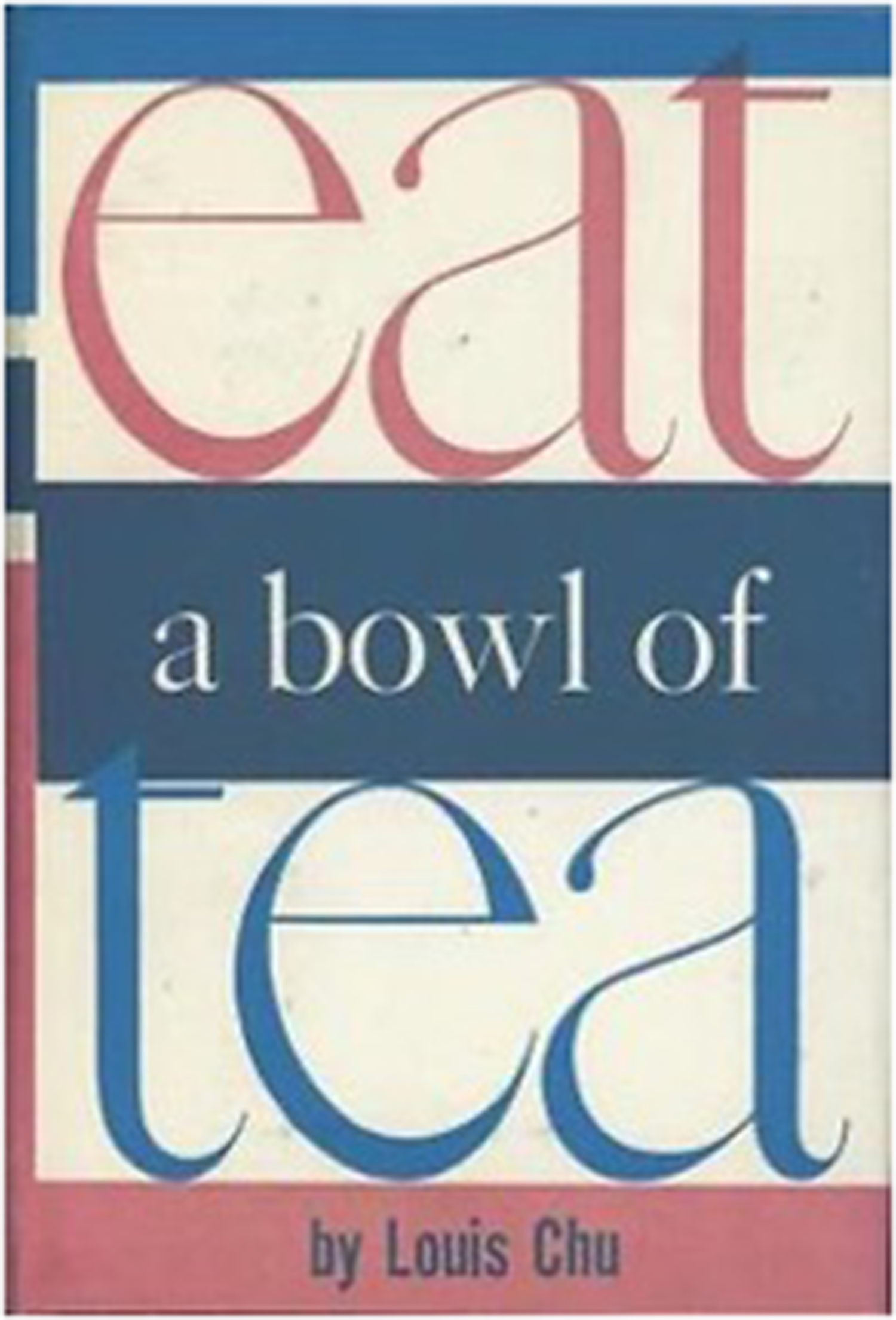
Book cover of Eat a Bowl of Tea (1961). © Lyle Stuart, 1961.
By contrast, the 1989 film adaptation (Figure 2) entered a markedly different cultural field–one shaped by three decades of model minority discourse and the consolidation of a media-driven mandate of visible positivity. On 3 October 1965, President Lyndon Johnson declared that the Immigration and Nationality Act remedied a “very deep and painful flaw in the fabric of American justice” (quoted in Ngai, 2004: 259). By abolishing national origins quotas and prioritizing skills and family reunification, the law triggered the reconstruction of Asian American family life. As Wu (2013) demonstrates, Cold War media increasingly portrayed Chinese and Japanese Americans as stable, cohesive, and upwardly mobile. Their family harmony was mobilized as proof of democratic legitimacy amid civil rights unrest and global scrutiny.

Poster for Eat a Bowl of Tea (1989). © Columbia Pictures, 1989.
Meanwhile, American society has systematically promoted the notion of “the good life,” within which a middle-class lifestyle became a common aspiration, creating an institutionalized “landscape of happiness” since the mid-20th century (Horowitz, 2018: 11–16). Norman Vincent Peale's The Power of Positive Thinking (1952) crystallized this ethos by recoding happiness as a moral discipline: optimism was not merely desirable but ethically required. Beginning in the 1970s, American family sitcoms like All in the Family (1971), Good Times (1979), and The Cosby Show (1984) performed ostensibly harmonious racial relations through laughter, which masked systemic injustice and avoided critical reckoning. As cultural critic Linda Williams (2002) argues, such emotional genres function as mechanisms for regulating and selecting “acceptable” forms of racial expression through affective modulation.
This historical shift exerts a dual temporal pressure upon Eat a Bowl of Tea. The novel, published in 1961, is anchored in exclusion-era emasculation and bachelor-society constraint. Yet the 1989 film poster circulates within a post-1965 media culture structured by optimism, model minority discourse, and commercialized happiness. Following Rose's framework, the marketing image therefore renders a historically fraught story compatible with a visual regime of pleasure.
The 1989 film poster converts the story into a spectacle of sexualized happiness. The teacup is transformed into a bathtub-like vessel cradling an implicitly nude Asian woman who smiles seductively at the viewer. What the novel thematizes as masculine anxiety and structural constraint is reframed as playful erotic display. The teacup, once burdened with cultural weight, is emptied and repurposed as visual farce. In this transformation, happiness becomes legible only through sexual display, aligning Asian American representation with a marketable script of visible pleasure.
The color scheme of the teacup is also reconfigured to convey racialized visual codes, with the bowl rendered in bright red with gold accents. In Chinese cultural traditions, red symbolizes auspiciousness, celebration, and vitality, while in Western visual contexts, it connotes passion, desire, and eroticism (Gage, 1999: 20–23). This dual coding is tightly linked to the sensual posture of the woman, creating a metaphoric invitation to visual erotic consumption. Meanwhile, the gold–which in Chinese culture is often associated with wealth, fortune, and prosperity–is used to enhance an Orientalist trope of refinement and luxury. The interplay between the red hue and gold ornamentation serves to intensify the aestheticized spectacle for global marketing (Gage, 1999: 163). Within commercial visual culture, such color coding operates as rapid semiotic shorthand.
The visual strategies extend to the representation of the woman. She reclines inside the teacup, exemplifying a sexualized and dehumanized Asian female body. Her expression–both innocent and suggestive–and her posture–at once demure and erotically charged–positions her as an object of desire and a passive figure awaiting consumption. This is intensified by how her gesture is imbued with the “flexibility and plasticity associated with Chinese acrobats” (Lee, 2014: 69), and thus fashioned into manipulable and possessable sexualized vessel. Furthermore, as Shimizu (2007) argues, Asian women in mainstream American cinema are frequently cast as hypersexualized and thus morally deviant figures, serving as racialized foils to the idealized purity associated with white women. The image in the poster thus reinforces the legacy of framing Asian women as exotic spectacles.
The juxtaposition of the Asian female body and the teacup intensifies the layered dynamics of objectification and ornamentalization. The positioning of the woman's body inside the teacup creates a visual analogy in which the woman occupies a liminal space between the material and immaterial, the “consecrated and desecrated” (Cheng, 2019: 2). The bodies of Chinese women have long been associated with porcelain in the Western cultural imagination–skin described as possessing a “pearly luster” and evoking the fragility and refinement of decorative china (Cavanaugh and Yonan, 2010). The juxtaposition in the poster reflects precisely such ornamental logic, reinforcing the hyper-symbolization of Chinese women as “a particular kind of surface–perfectly contained, perfectly empty, but also perfectly coextensive” (Cheng, 2019: 22). Within such visual politics, the curvature of the teacup mimics the contours of the woman's body, constructing her as a fetishized object on display.
This objectifying framework is further reinforced through transcultural linguistic associations. In particular, the Chinese phrase xiuse ke can 秀色可餐—which literally means “beauty that can be eaten”—is used to express aesthetic delight when encountering a beautiful woman or landscape. It carries misogynistic undertone by reinforcing a long-standing metaphorical equivalence between women and consumable objects. Since the 19th century, American popular culture has treated nonwhite female bodies as “edible” by framing them as objects of visual pleasure and as metaphorical forms of food (Tompkins, 2012: 2). The historical pain embedded in the ceremonial tradition of tea is thus reconstituted into something sensationally palatable–the Asian female body is transfigured into a stylized visual construct: a decoration devoid of interior life.
The visual erasure of the male protagonist from the film's poster constitutes a deeper narrative, metaphorical, and political “castration” (Eng, 2001). Under exclusionary immigration policies, Asian immigrants were largely restricted to single male laborers, structurally deprived of family formation and social agency. Emasculation therefore functioned as lived historical condition. The novel interrogates this history by framing Ben Loy's impotence as a metaphor for systemic exclusion.
Although the 1989 film adaptation preserves the historical milieu and gestures toward Asian American male subjectivity (Tajima, 1991), the promotional poster reorganizes the story's affective core. The male protagonist–whose impotence structures the novel's critique–is removed entirely from the visual field. Male vulnerability recedes, while a sexualized female body emerges as the dominant sign of racial difference. This substitution obscures the history of Asian American emasculation.
The tagline branding the film “a wry, irreverent, endearing new comedy” further situates the work within a post-1965 cultural climate in which minority inclusion was increasingly mediated through tonal reassurance. In the decades following immigration reform, model minority discourse encouraged images of ethnic stability and emotional coherence (Wu, 2013). Under such conditions, confronting structural trauma became less legible within mainstream visual markets than narratives of integration packaged through humor and charm. The label of “comedy” therefore does more than identify genre; it disciplines the film into an affective regime that privileges cheerful legibility over adversarial history.
Through compositional reorganization, the poster translates exclusion-era masculinity crisis into a spectacle of sexualized happiness. As a promotional image, it makes Chinese American identity legible to mainstream audiences by replacing historical injury with sexualized pleasure. Ben Loy's emasculated body, which carries the novel's critique of exclusion-era racial violence, disappears from the image. In his place, a sexualized Asian female body becomes the central object of pleasure. Ethnic visibility is thus achieved through a gendered cost: male pain is suppressed, female sexuality is displayed, and historical injury is transformed into a reassuring image of desire. Sexualized happiness therefore functions as a mechanism of conformity to a racialized and gendered visual order.
The Joy Luck Club: The reconfiguration of diasporic trauma in a multicultural context
Following the Immigration and Nationality Act of 1965, demographic transformation reshaped the United States while legal protections against racial discrimination expanded. By the 1980s, the language of racial equality was increasingly reframed through the discourse of multiculturalism, as immigrant narratives were folded into an aspirational script of the American Dream in which happiness functioned as the normative emotional horizon of citizenship (Santa Ana, 2015: 1–30). This affective regulation of happiness intensified in the 1990s alongside the rise of therapeutic media culture and positive psychology. Popular media figures such as Oprah Winfrey normalized confession, healing, and self-actualization as public virtues, reframing suffering as narratives of recovery (Illouz, 2003). Personal well-being was increasingly framed as measurable; once quantified, happiness appeared as an individual responsibility (Ahmed, 2010). Pain could be acknowledged, but it was expected to resolve into emotional repair rather than structural critique (Brown, 1995).
These pressures were particularly visible in the film industry. By the 1990s, Asian American cinema faced increasing commercial demands within a mainstream market wary of overt political critique. Earlier documentary-style works grounded in racial struggle were dismissed as “noble, uplifting, and boring as hell” (Chin, 1988: 13–19), prompting filmmakers to adopt narrative strategies more compatible with multicultural optimism. Historical trauma could be depicted, but it was required to be narratively contained, emotionally reconciled, and visually marketable.
Wayne Wang's 1993 adaptation of The Joy Luck Club emerged within this multicultural affective order. Unlike Eat a Bowl of Tea (1989), which remained relatively marginal, The Joy Luck Club marked a significant moment in Chinese American cinema by bringing an all-Asian cast and diasporic family narratives into mainstream Hollywood visibility (Dutka, 1993). Through interwoven stories of four immigrant mothers and their American-born daughters, the film translates histories of war, migration, and cultural rupture into emotionally legible narratives of intergenerational reconciliation, making ethnic difference intelligible within a multicultural framework (Siskel, 1997).
Its book cover (Figure 3) is filled with symbolic Chinese imagery: dragons relate to the plots of Chinese myths that mothers tell to their daughters; auspicious clouds and peonies symbolize longing for a better life; and waves imply the fluidity of migrating experience. These images together illustrate Chinese roots and the intergenerational transmission of diasporic figures and create space for readers’ inquiries into their metaphorical meanings in the text. In contrast to the abstract Chinese semiotics, the film poster (Figure 4) projects a harmonious, contemporaneous vision of multicultural integration. It features four Asian women smiling and toasting with champagne flutes, flanked by two of their white male partners. The background shines with a golden gradient, with the Golden Gate Bridge serving as an iconic marker of San Francisco, which is the location of the story. Through its visual composition, the poster reconfigures the novel's intergenerational, transnational trauma into an image of multicultural bliss, flattening layered narratives into a celebratory tableau of socio-ethnic assimilation.
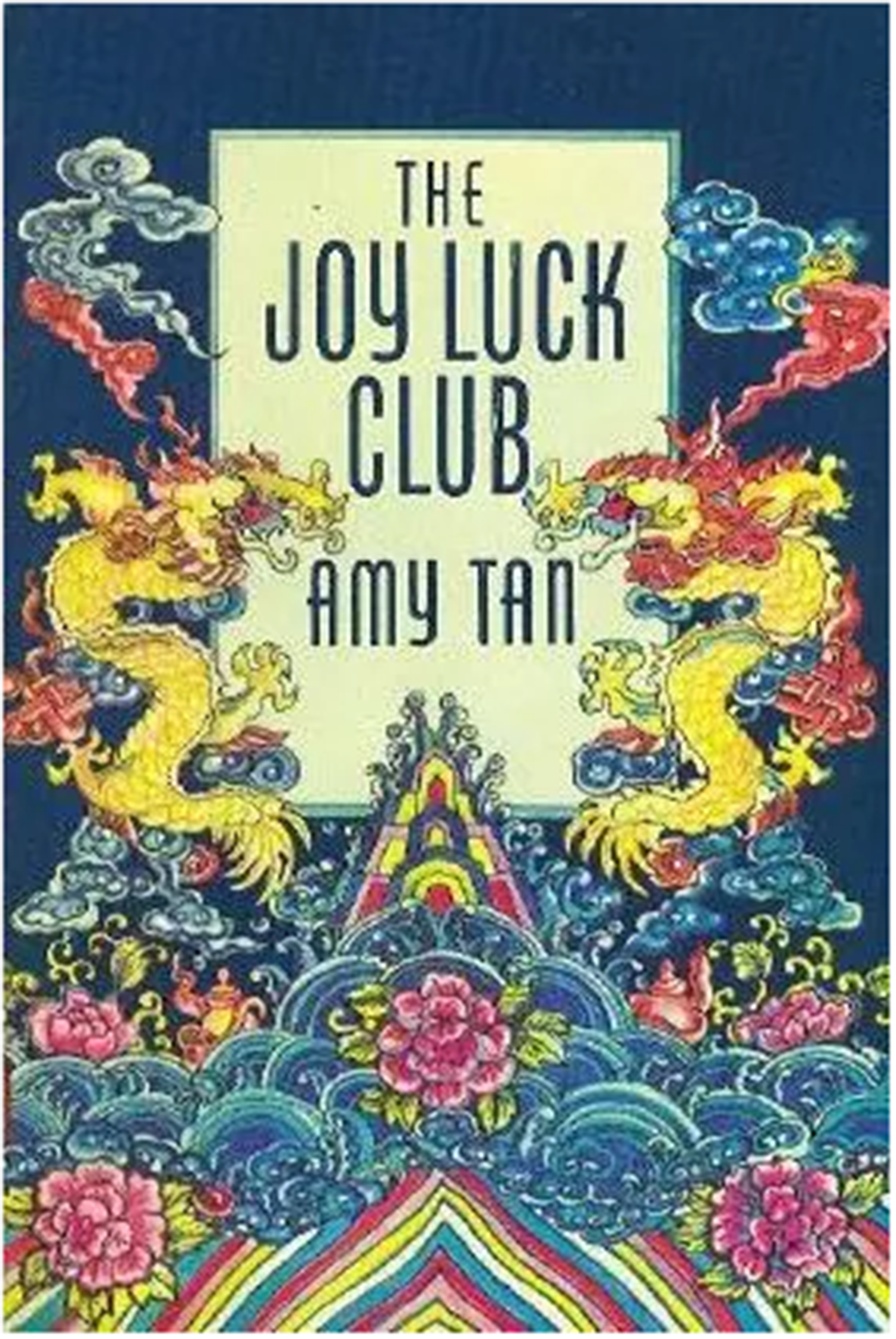
Book cover of the Joy Luck Club (1989). © G. P. Putnam's Sons, 1989.
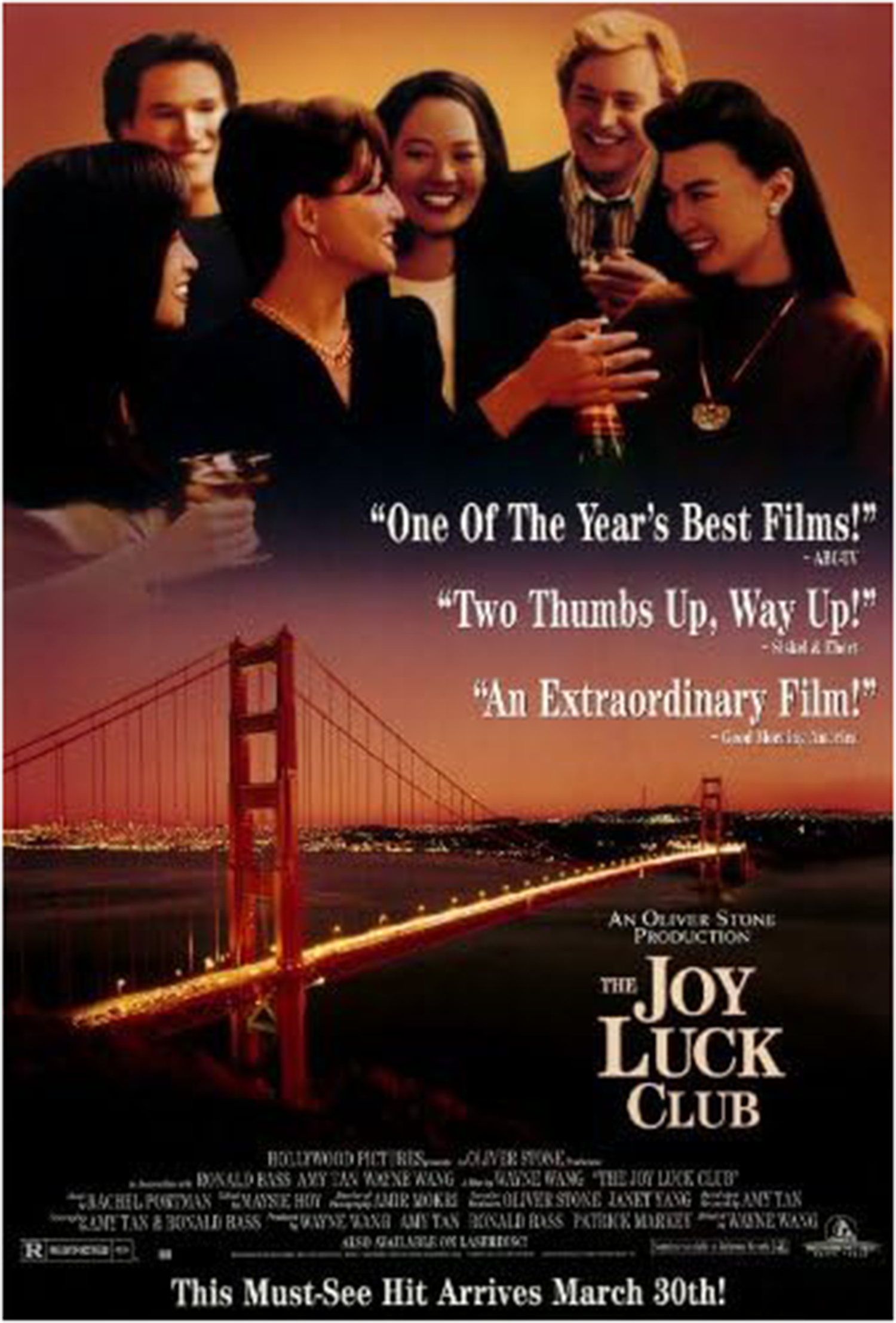
Poster for the Joy Luck Club (1993). © Hollywood Pictures, 1993.
The four Chinese American women and two white men are dressed in contemporary Western attire. The women's elegant, tailored outfits—understood as a form of “visual practice” of clothing (Entwistle, 2000)—signal not only individual affluence but disciplined modernity. Their polished appearance situates them squarely within the aesthetic grammar of the American middle class, rendering assimilation not merely cultural but visibly material. The champagne flutes they raise further align them with Western iconographies of celebration, prosperity, and lifestyle consumption.
Such visual coding resonates with the consolidation of model minority discourse under Cold War liberalism. As Bascara (2006: 5) suggests, Asian Americans were increasingly racialized as a “modernized and civilized” minority-figures through whom the United States could affirm its capitalist modernity. Within this frame, the women's smiles become especially charged. They do not merely signify joy; they function as affective proof of successful incorporation. Happiness here operates as visual evidence of postracial harmony.
The poster thus transforms the novel's and the film's complex engagements with war memory, maternal sacrifice, gendered oppression, and diasporic rupture into a celebratory tableau of reconciliation. The women are no longer marked by the weight of historical violence; they are repositioned as exemplars of successful integration—feminized embodiments of the model minority ideal. As such, the poster reproduces the dominant standards of affective citizenship, wherein Asian American female experiences are legitimate only when stripped of historical sufferings and recast as signs of consumable optimism.
While the two white males are spatially marginalized in the composition, relegated to the periphery, they remain integral to the visual architecture. Their gestures and gazes exert a latent, supervisory visual power over the Asian women, reinforcing the expectation that the latter be observed within existing hierarchies of race and gender. As Lopez (2011: 435) notes, Western cultural industries often celebrate diversity while sustaining white-male-centered visual and narrative norms. Within multicultural discourse, such imagery simultaneously stages inclusion and maintains racialized subordination.
The Golden Gate Bridge further amplifies the visual narrative of happiness associated with Asian American identity. In American cultural iconography, the bridge carries significant symbolic weight: it is a feat of industrial modernization and a monument to national recovery during the Great Depression (1929–1939), evoking pride in the resilience and superiority of American democratic institutions, symbolizing national unity and multicultural integration (Starr, 2010: 75–79).
For Asian Americans, the bridge holds a more ambivalent historical meaning. San Francisco served as a primary entry point for many early Chinese immigrants, and the bridge thus entails the legacy of Chinese laborers since the Gold Rush era (1848–1855) and the elusive promise of the “American Dream” (Starr, 2010: 16–17). However, the construction of the bridge (1933–1937) overlapped with Chinese exclusionary immigration policies, and its completion was followed shortly by the internment of Japanese Americans (1942–1946) during and extending beyond World War II. Thus, the bridge also signposts histories of exclusion, surveillance, and racialized state violence within Asian American narratives (Tang, 2002: 5–9).
In the poster, this history is visually reorganized. The bridge appears not as a site of contested migration history but as a distant scenic backdrop, while the smiling faces of the protagonists dominate the foreground. The arch of the bridge recedes into the distance through perspective, guiding the viewer's gaze toward a luminous horizon. Through this compositional hierarchy, collective histories of migration and trauma are displaced by individualized narratives of emotional fulfillment. The transpacific traumas central to the novel and film—war, infanticide, and sexual violence—are thus reframed as a visually legible story of personal belonging and happiness. As Santa Ana (2015) argues, Asian diasporic narratives often expose how the celebration of Asian American success has been mobilized to sustain a hegemonic colorblind discourse. In this visual context, the poster's emphasis on individual happiness participates in a multicultural logic that simultaneously celebrates Asian American inclusion while obscuring the structural histories that shape it.
However, Eng and Han (2000) and Cheng (2000) introduced the concept of “racial melancholia” to articulate the deep-seated psychological struggles, or unfinished mourning, endured by Asian Americans: in the process of assimilation into mainstream American society, they are compelled to relinquish certain parts of their cultural identities but are denied socially recognized grief or acknowledgment of their loss. Such tension is evident in the opening metaphor of Amy Tan's novel as well as Wang's film, in which a Chinese mother embarks on a journey to US carrying a swan, envisioning her new life with hope: “There, nobody will look down on her, because I will make her speak only perfect American English. And over there she will always be too full to swallow any sorrow” (Tan, 1989: 3; Wang, 1993: 00:00:20–00:02:30). However, upon arrival, her swan is confiscated by immigration authorities; the sole remaining feather becomes a poignant symbol of irretrievable cultural wholeness and the rupture of memory and dignity in diasporic life.
The poster resolves this ambivalence through a series of visual substitutions. Champagne flutes replace the swan's feather; synchronized smiles displace suspended mourning; tailored Western attire supersedes symbolic Chinese semiotics; the Golden Gate Bridge eclipses the memory of rupture. Each substitution streamlines historical loss into celebratory affirmation. As a marketing paratext, the image regulates feeling in advance, condensing wartime violence, maternal sacrifice, racial melancholia, and transpacific displacement into a legible script of reconciliation. What becomes visible is not simply joy, but a template of acceptable belonging: integration over antagonism.
This visual recalibration also reshapes how Asian American subjectivity is publicly imagined. By foregrounding collective celebration, the poster reinforces the model minority frame in which success appears naturalized and conflict recedes. Such representation does not eliminate trauma but relocates it into an individualized narrative of perseverance. The pursuit of the “good life” becomes both promise and burden: when structural barriers persist, disappointment risks being internalized rather than politicized. In this sense, the affective script of happiness approximates what Berlant (2011) terms “cruel optimism,” attaching subjects to an aspirational narrative that remains only partially attainable.
The promotional poster for The Joy Luck Club thus exemplifies multiculturalism as a regime of affective governance. Through curated color, spatial hierarchy, and iconography of unity, it translates diasporic trauma into a surface of celebratory cohesion. Happiness here does not erase history outright; it reframes it within a bounded emotion that privileges resolution over reckoning.
Crazy Rich Asians: The illusion of neoliberal inclusion and the reimagining of oriental luxury
Entering the late 2000s and 2010s, the American happiness regime transitioned into a distinctly neoliberal phase. Unlike the multicultural moment of the 1990s—when happiness was framed as emotional reconciliation—this new phase aligned happiness with market rationality, individual performance, and capital mobility (Williams, 2019). This shift coincided with the expansion of what is often described as the “happiness industry”: a proliferating field of self-help literature, positive psychology, corporate wellness programs, and lifestyle branding whereby happiness is produced, circulated, and consumed as a form of capital (Davies, 2015). In this configuration, well-being becomes both a personal responsibility and an economic resource.
Within this neoliberal recalibration, the model minority myth underwent a profound transformation. As Nadal (2023) argues, neoliberalism remade the model minority figure from a Cold War emblem of assimilation into a transracial ideal of economic personhood. Asian Americans are positioned to “embody and particularize the abstractions of economic rationality” (Nadal, 2023: 81). No longer merely compliant or emotionally reconciled, Asian figures are reimagined as disciplined investors, global professionals, and bearers of transnational capital mobility (Ong, 1999). The Pew Research Center’s 2012 report, The Rise of Asian Americans, exemplifies this discursive shift by identifying Asian Americans as the most “successful” racial group in the United States, highlighting “economic success and social assimilation milestones” alongside higher levels of reported life satisfaction (Pew, 2012: 1). Asian American happiness becomes legible through measurable success and economic resilience.
This logic resonates strongly within contemporary global capitalism, particularly with the rise of Asian economies and the visibility of transnational wealth (Day, 2021). Asian subjects increasingly appear as exemplary participants in liberal multicultural modernity—aligned with global finance, entrepreneurial mobility, and aspirational prosperity.
It is within this neoliberal configuration of happiness that the 2018 Hollywood film Crazy Rich Asians, adapted from Kevin Kwan's 2013 novel, should be situated. Celebrated for its all-Asian cast and commercial success, the film marked a milestone in mainstream representation. Yet its promotional materials, especially the poster, stage racial difference within a spectacle of curated affluence. Through the stylized figures of the protagonists, chromatic saturation, and ornamental density, the image aligns Asian identity with fantasies of luxury, exclusivity, and transnational wealth.
The original book cover of Crazy Rich Asians (Figure 5) has a minimalist design: a glittering golden background, implying themes and critiques of extravagant consumer culture, behind a high-contrast bold pink title and author name. In contrast, the film poster (Figure 6) is saturated with emotionally charged, visually overpowering imagery. The protagonists, Rachel Chu and Nick Young, are shown embracing beneath an ornate archway of paper fans with a peacock motif, surrounded by a glowing emerald-green background interwoven with golden light and enveloped in an aestheticized visual field. This sensory overload signals an ideological shift from a narrative that interrogates elite power structures to one that celebrates wealth and constructs a luxurious image of Asian American success and happiness.
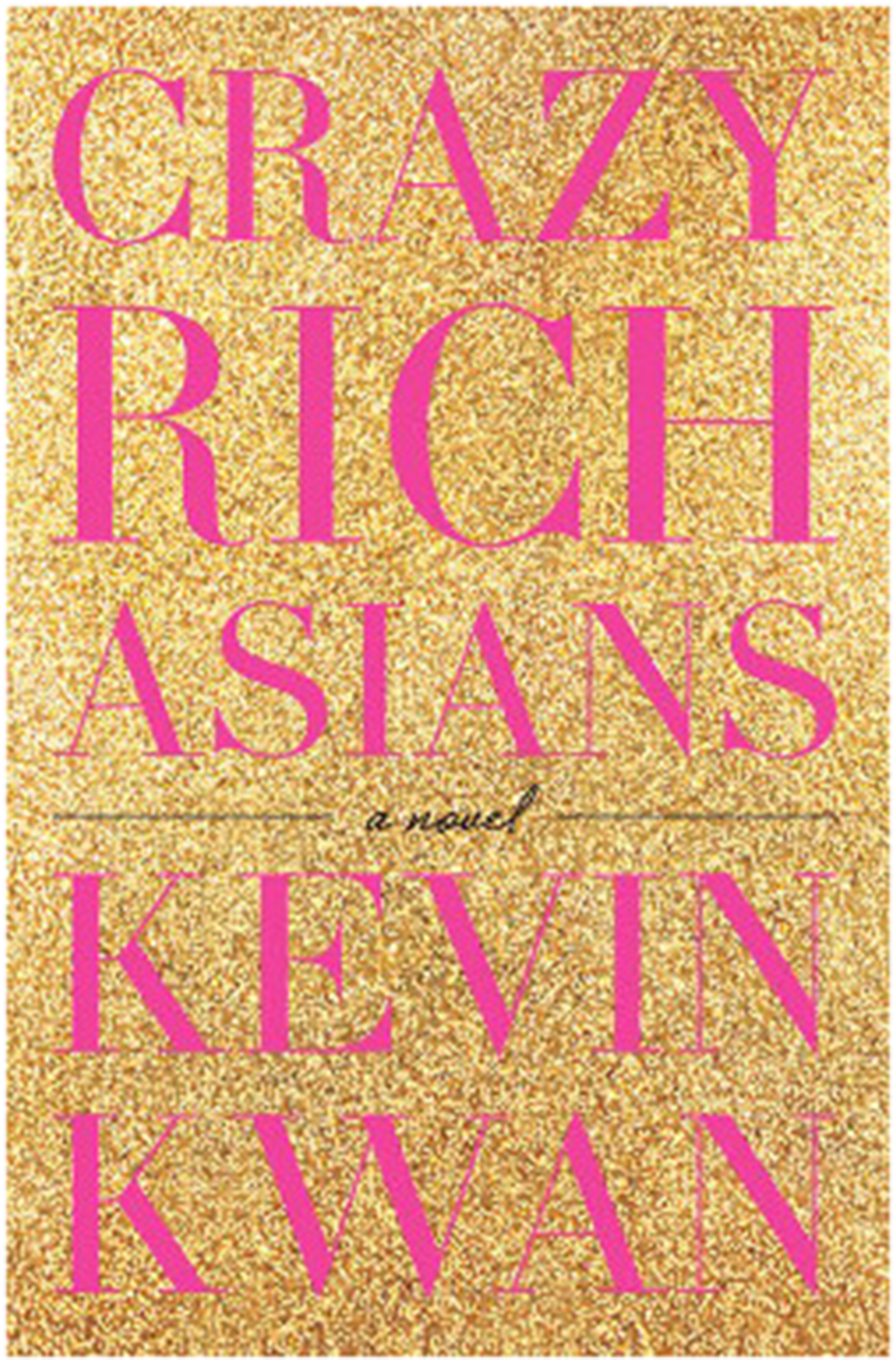
Book cover of Crazy Rich Asians (2013). © Doubleday, 2013.

Poster for Crazy Rich Asians (2018). © Warner Bros. Pictures, 2018.
This reconfiguration is most evident in the portrayal of the film's female protagonist. Rachael, a Chinese American woman from a modest background, achieves socio-economic success as a university professor. Her intercultural competence and emotional intelligence allow her to transform conflict into dialog while gaining social recognition in the elite social circles of both Singapore and the United States. This characterization aligns with the neoliberal ideal of individual autonomy, where happiness is increasingly framed as the outcome of individual merit, professional mobility, and self-management. The aesthetic rendering of Rachel on the poster consolidates the visual schema of such Asian happiness: her radiant, confident smile conveys satisfaction rooted in personal achievement; her attire also operates as a layered transcultural signifier: pink silk connotes traditional Chinese femininity, the modern cut of the dress gives it a globalized aesthetic of modern sensuality.
As Stern and Siegelbaum (2019) argue, design operates not merely as surface-level ornamentation but also as a discursive tool that conceals the racialized reconfiguration of labor and capital. The visual celebration of Rachel's cosmopolitan success obscures structural inequalities borne by Asian people in transnational economies, sidelining the struggles of those who lack access to the academic or cultural capital represented by Rachel (Hong, 2018; Cheng, 2018). By reframing structural racial inequalities as narratives of individual success, the poster participates in a broader ideological framework that neutralizes the material and symbolic exclusions faced by racialized subjects.
This visual reconfiguration is also evident in the portrayal of the male protagonist in the poster. Nick's tailored suit and composed demeanor construct a de-racialized image of an ideal Asian, packaged for mainstream appeal—a visual and behavioral harmonization that presents him as what Ahmed (2014: 127) describes as a “lovable other”: a figure conditionally included in the dominant aesthetic and behavioral expectations of whiteness. This reflects precisely the visual logic of neoliberal multiculturalism, with the success of Asian Americans presented in terms of their adaptability to white-centric mainstream etiquette (Dhingra, 2016). Nick's polished masculinity is shaped through visual codes of refinement, restraint, and social ease. These qualities allow him to embody Western manners and body language as signs of respectable cultural capital, while obscuring their relation to inherited transcultural privilege. The poster gives no indication that the character's effortless success stems from inherited family wealth and historical legacies (Kwan, 2013: passim; Chu, 2018: passim). Instead, his privilege is aestheticized as personal charisma: gentlemanly composure, affluence, and grace. This visual mechanism depoliticizes class inequality by converting it into a desirable and imitable form of individual distinction.
The poster's diagonal composition, with the couple embracing, emphasizes emotional intimacy and fuses it with the fantasy of economic success. The radiant smiles, fashionable attire, and symbols of wealth project a “promise of happiness” (Ahmed, 2010), reinforcing the neoliberal fantasy of meritocratic success–happiness that appears freely chosen but is deeply embedded in racial and gendered regimes of discipline. As Melamed (2006) argues, a core mechanism of neoliberal multiculturalism is the translation of historically racialized and class-based exclusions into individualized aesthetic differences, so that structural injustice ceases to be legible as systemic oppression and is rewritten as a personal gap of taste, effort, or refinement. As viewers are drawn into the luxurious, joyful imagery of the poster, the invisible labor of migrants toiling at the margins of global supply chains—whether in Singapore's Chinatown or behind the kitchen doors of American restaurants (Kwan, 2013: passim; Chu, 2018: 00:19:20–00:19:24)—is systematically excluded from this carefully curated visual narrative.
Beyond the central figures, the poster incorporates a range of ornamental Oriental motifs to enhance its exotic visual appeal while simultaneously stripping Asian culture of its historical depth. A majestic peacock commands attention, which in different Asian cultural traditions holds very different symbolic meanings. However, within the visual economy of the poster, its primary function is simply to amplify the poster's luxurious aesthetic. Similarly, the brightly colored flowers, fans, and silk that surround the characters reinforce a long-standing Western fantasy of Asia as lush, decorative, and sensorially indulgent. The accumulation of these signifiers in the poster points meaningfully at the core themes of Orientalism still at play in the US today: “opulence and sensuality are the signature components of Asiatic character…material consumption promises cultural possession” (Cheng, 2019: 88). Asian cultures are thus transformed into an “ornamental personhood” (Cheng, 2019: 3)—imbued with visual and economic value precisely because of its aesthetic appeal, yet disconnected from the lived histories and cultural trajectories from which the culture is formed.
The poster as a whole is a condensed spectacle of global capitalism and Orientalist luxury aesthetics that enables the viewer to “lose themselves in extravagant aestheticism” and experience what Cheng describes as a slippage between “persons and things” (Cheng, 2019: 91). This slippage refers to a veiled equating of material landscapes with emotional states, in which opulent visuals do not merely serve as decorative backdrops but actively co-produce the characters’ affective conditions. This visual machinery naturalizes social class as a matter of aspirational style, obfuscating the economies through which material wealth is accumulated.
The production of such affective imaginaries is deeply entangled with the role visual design plays in constructing and implementing new forms of racialized oppression within neoliberal regimes (Williams, 2019). The opulence and happiness on display in the poster are emblematic of its depoliticizing design aesthetic, which transforms the affective needs of Asian communities into consumable visual pleasure. The poster's dazzling visual imagery conceals the material violence experienced by diasporic communities within global capitalist systems. It also erases the realities of exploitative labor faced by Southeast Asian domestic workers and migrant laborers, whose experiences are entirely absent from the visual fantasy. The concept of happiness projected by the poster is a normative promise of futurity, redirecting affective energies away from a critique of racial injustice or economic exploitation and toward a neoliberal narrative of individual positivity and cultural assimilation. While seemingly affirming diversity and inclusion, this aesthetic strategy sustains the exclusionary logic of racial capitalism by neutralizing collective resistance and masking ongoing structural inequities. Emerging in the aftermath of the 2008 global financial crisis, the 2012 Pew report and the 2018 poster together stage Asian Americans as emblems of resilience and satisfaction at a moment of widespread socio-economic precarity. In a period marked by profound market instability, such imagery casts minority prosperity as evidence of neoliberal viability, redirecting attention from systemic instability to individualized success.
Thus, the visual rhetoric of Crazy Rich Asians is deeply embedded in the neoliberal fantasy of inclusive multiculturalism. The portrayal of its elite protagonists and the assemblage of luxury aesthetics together construct a dehistoricized illusion of happiness. This false landscape of inclusivity legitimizes the current racial capitalist order while simultaneously foreclosing the possibility of meaningful structural transformation.
Conclusion
This article examines three posters for Asian American films adapted from novels of the same title to illuminate how the visual reflects and shapes the affective governance of Asian American communities within the broader landscape of American popular culture. The posters offer a highly codified visual representation of Asian American happiness through recurring motifs: radiant smiles, romantic fulfillment, harmonious families, and material abundance. These visual tropes not only resonate with the aspirational ethos of the “American Dream” but also neutralize the historical traumas and social precarity of Asian American communities. As Ahmed (2010) argues, “happiness” functions as a politically charged affective distribution; by associating certain racialized groups with positive emotions, a subtle, yet effective, form of cultural governance is enabled. The “sugar-coated” happiness aestheticizes and depoliticizes the experiences of Asian Americans, rendering them incapable of expressing more confrontational emotions.
Diachronically, the three selected posters show how Asian American happiness has been differently governed and visualized across different periods of American history. Eat a Bowl of Tea (1989), set in 1960s Chinatown, reflects a moment in which happiness is constrained by racialized emasculation and the eroticized objectification of Asian women. The Joy Luck Club (1993), produced in the era of multiculturalism, reworks happiness through sentimental narratives of family reconciliation that soften the complexities of intergenerational immigrant trauma. Crazy Rich Asians (2018), shaped by neoliberal globalization, reframes happiness as opulence, mobility, and cosmopolitan inclusion, even as its poster promotes an illusion of neoliberal inclusivity. Together, these posters suggest that happiness is not a stable affective ideal but a historically changing visual imperative shaped by shifting political and economic conditions. These representations are not benign cultural portrayals but rather “ornamentalizing” (Cheng, 2019) products that transform historical pain and structural injustice into stylized visual pleasures. In doing so, they construct a racialized image that is consumable but ultimately ungrievable.
In recent years, global media industries have increasingly responded to calls for cultural diversity, and the growing representation of Asian Americans offers an opportunity to reconceptualize happiness within this visual culture. Yet by critically unpacking the entangled relationships between images and narratives, this article shows how Asian American figures have been both politically neutralized within the regimes of neoliberal cultural production and thus ultimately subjected to entertainment-based erasure. Berlant (2011: 263) reminds us of the necessity to summon the courage and critical insight to undo the fantasy of the “good life” in order to achieve genuine reflection and liberation. This is not a denial of happiness but a challenge to its normative, commodified, and dehistoricized formulations. It is a call to reclaim happiness as a critical, situated, and transformative affective resource. In the evolving landscape of global visual culture, the potentials for Asian Americans to move beyond the position of being objects of the gaze lies in themselves becoming re-shapers of visual narratives, articulators of emotional discourses, and co-architects of new world imaginaries.
Footnotes
Acknowledgements
Xin Zhang thanks Chengcheng You(UM) for her guidance during the early stage of this paper, and King-kok Cheung (UCLA) for her suggestion regarding the phrase “Sugar-coated”. Appreciation is also extended to the anonymous reviewers and editors for their constructive comments. Many thanks!

Funding
The author disclosed receipt of the following financial support for the research: This research is funded by the Guangdong Provincial Philosophy and Social Science Planning Project (GD24CWW01) and (GD25CW08) and the National Social Science Fund of China (25&ZD081) and (21VMZ004).
Declaration of conflicting interest
The author(s) declared no potential conflicts of interest with respect to the research, authorship, and/or publication of this article.