







Abstract
The current studies examined the experiences of undergraduate political partisans who cross party lines to support a preferred, out-of-party candidate, and thus open themselves to the possibility of being misclassified as a member of a rival political party. Strongly identified partisans who endorsed an out-of-party candidate, and thus expected others to misclassify them, reported heightened threats to belonging and coherence (Study 1), unless they disclaimed rival party status by asserting their political affiliation. In Study 2, strongly identified partisans who could be misclassified were less confident in their choice of an out-of-party candidate compared to partisans who asserted their political affiliation. These results highlight the impact of identity misclassification concerns on strongly identified partisans whose personal preferences are inconsistent with party norms.
Decades of social identity research confirm that social group memberships influence how others perceive us, shape how we construct and maintain our identity, and even inform us about appropriate social behaviors and attitudes (Abrams & Hogg, 2004; Hogg, 2003; Hogg & Smith, 2007; Tajfel & Turner, 1986). Not only do group memberships become an important part of the self, but threats to one’s standing within an in-group can have powerful affective consequences for the threatened group member (Branscombe, Ellemers, Spears, & Doosje, 1999; Jetten, Branscombe, & Spears, 2006). For example, recent research on identity misclassification suggests that at least a portion of people’s discomfort when violating in-group norms stems from their concerns that others will mistake them for a member of a devalued out-group (Bosson, Prewitt-Freilino, & Taylor, 2005; Bosson, Taylor, & Prewitt-Freilino, 2006; Prewitt-Freilino & Bosson, 2008). In the current work, we examine how political group membership and identity misclassification concerns shape the reactions of political partisans whose candidate preferences differ from the will of their party.
Researchers interested in the links between people’s affiliation and political attitudes and behaviors have long known that voters’ party affiliation is an important factor in their political decision-making (e.g., Campbell, Converse, Miller, & Stokes, 1960; Cohen, 2003; Greene, 2004). Despite partisans’ insistence that they vote according to “the issues,” most are more heavily swayed by political group membership than they can (or will) admit. For example, Cohen (2003) found that party affiliation almost exclusively determined people’s political decisions, regardless of policy implications and people’s proclaimed ideological beliefs. This tendency extends to politicians, as well: congressional voting on a diverse array of issues often falls along party lines, such that Democrats consistently vote in a liberal manner and Republicans in a conservative manner (Poole & Rosenthal, 2001). Moreover, recent research by Westen and colleagues provides neurological evidence that partisans’ reactions to candidates are motivated by strong emotional responses based on party loyalty, rather than a rational weighing of information (Westen, Blagov, Harenski, Kilts, & Hamann, 2006). Thus, people’s political attitudes and behaviors often align cleanly with their party affiliation.
What happens when one’s personal beliefs or attitudes stand at odds with one’s party? What fate awaits those who dare to cross party lines? Here, we propose that partisans who do not “toe the party line” expect others to question their status as true members of their party, or even misclassify them into another party altogether. Moreover, given prior theory and research on the role of strength of group identity on reactions to social identity threats (Branscombe et al., 1999; Branscombe & Wann, 1994), we assume that those who place greater value on their political party membership should experience these threats more strongly, and react more intensely, when their party membership is jeopardized by their support of out-of-party candidates. Thus, we anticipate that strongly identified partisans should be more affected than weakly identified partisans by the challenges to their party status that arise when they cross party lines.
In the current investigation, we extend past research on identity misclassification and role violations by asking if strongly identified undergraduate partisans who endorse a preferred, out-of-party candidate, and thus anticipate misclassification into a rival political group, are more apt than weakly identified partisans to: (a) experience threats to belonging and coherence; and (b) lose confidence in their chosen candidate. Moreover, we ask whether allowing partisans to proclaim their party affiliation to observers mitigates these effects of the role violation, as it did in past research (e.g., Bosson, Prewitt-Freilino, & Taylor, 2005). In addition to applying the identity misclassification framework to a novel group identity (political partisans), the current work increases our understanding of the specific nature of identity misclassification threats and their possible consequences, as well as how strength of identification with an in-group moderates people’s reactions to the possibility of misclassification.
Role violations and identity misclassification
When others mistake a heterosexual man who expresses physical affection toward a male friend as “gay,” or a feminist woman who forgoes a career to raise her children as “a traditional housewife,” these actors become misclassified into out-groups. According to research on identity misclassification, such erroneous categorization causes self-conscious discomfort for role violators, and can undermine their intrinsic interest in role-violating activities (Bosson et al., 2005; Prewitt-Freilino & Bosson, 2008). To illustrate, heterosexual men’s discomfort during stereotypically feminine activities (e.g., styling hair) stemmed largely from the concern that “others will assume I am gay.” When men avoided misclassification—by asserting their heterosexuality to viewers—they enjoyed and benefited psychologically from a stereotypically feminine task (Bosson et al., 2005).
This latter finding points to the utility of disclaimers, or explicit proclamations of in-group status (Stokes & Hewitt, 1976), in alleviating people’s negative reactions to role-violating behaviors. Just as Monin and Miller (2001) found that asserting their status as “nonprejudiced” freed people to express personally held prejudiced attitudes, we assume that role violators who assert their in-group membership will feel more comfortable deviating from group norms because they are relatively unconcerned about the possibility of misclassification (Prewitt-Freilino & Bosson, 2008).
Whereas past identity misclassification studies focused primarily on violations of gender role norms, the current studies extend the misclassification framework to political partisanship and explore the effectiveness of disclaimer use for partisans who endorse an out-of-party candidate. Specifically, we explored whether publicly asserting one’s party affiliation protects partisans from self-threats, and increases their confidence in their “voting” behavior, when endorsing an out-of-party candidate. Furthermore, we investigated the extent to which the strength of partisans’ party identity moderates these effects.
Psychological consequences of role violations
What is the precise nature of the self-threats that accompany role-violating behavior? We theorize that, when partisans violate a valued group identity by endorsing an out-of-party candidate, they experience threats to two important self-needs: belonging, that is, the need for positive social connections with close others (Baumeister & Leary, 1995), and psychological coherence, that is, the need for information that fits with one’s prior experiences and expectations (e.g., Swann, Rentfrow, & Guinn, 2003).
Role violations that elicit misclassification should threaten the need for belonging because challenges to one’s good standing in an in-group can undermine the positivity of people’s connections to group mates (Jetten et al., 2006). To the extent that people consider their partisanship an important social identity, critical evaluations and/or rejection from other party members likely pose painful interpersonal threats. The use of a disclaimer, however, should mitigate threats to belonging by assuring role violators that their identification with the in-group is evident to observers.
Similarly, threats to coherence may arise when partisans endorse out-of-party candidates, because behaving in a self-discrepant manner challenges people’s need for verification of their stable self-views (Swann, 1990). According to self-consistency theories, the need to be seen by others in a manner consistent with one’s self-concept reflects a fundamental psychological need for predictability, control, and coherence (Festinger, 1957; Lecky, 1945; Swann, 1990). To meet the need for coherence, people generally behave in a manner that reflects their firmly held beliefs about themselves, and they seek self-verifying evaluations from others (Swann, Stein-Seroussi, & Giesler, 1992). Thus, just as role adherence contributes to a coherent self-view (Hogg & McGarty, 1990), role violations should threaten the need for coherence among those who value strongly their partisanship, because such behaviors are both inconsistent with partisans’ self-views and liable to invite misclassification—that is, nonverifying appraisals—from observers. Whereas threats to belonging arise primarily from unfavorable evaluations by others, inconsistent appraisals (such as misclassification) should be troubling regardless of whether the erroneous impression that others hold is favorable or unfavorable (e.g., Swann et al., 1992). As such, people who face identity misclassification can experience coherence threats even in the absence of belonging threats, as in the case of individuals with concealable stigmas who pass as nonstigmatized (Bosson, Weaver, & Prewitt-Freilino, 2011). Coherence threats should be reduced, however, among political role violators who use a disclaimer because the act of proclaiming their party affiliation should serve as an identity cue that communicates a strongly held identity to observers, as well as to the self. To test this logic, Study 1 measures the effects of a disclaimer on strongly identified partisans’ feelings of belonging and coherence threats during a public role violation.
In addition to these self-threats, partisans who anticipate identity misclassification may ultimately lose confidence in their choice of a preferred, out-of-party candidate. Past work indicates that feelings of uncertainty arise when individuals engage in behaviors that cause others, or themselves, to question their “true” group membership (Hogg & Abrams, 1993; Hogg & Mullin, 1999). If so, the possibility of misclassification could compel partisans to question their own political choices, especially if their political identity is strong. Such findings would suggest that identity misclassification processes shape partisans’ reactions to candidates with whom they share attitudes but not party affiliation. Indeed, waning confidence in one’s political decisions that involve crossing party lines may partially explain the robust tendency for partisans to support in-party candidates despite ideological disagreements with those candidates (e.g., Cohen, 2003). As with threats to belonging and coherence, however, the use of a disclaimer should protect strongly identified partisans against feelings of uncertainty by reminding them, and others, of their group membership. We tested these ideas in Study 2 by measuring the effects of a disclaimer on partisans’ confidence in their choice of an out-of-party candidate.
Identity strength
As noted above, we expect the strength of partisans’ political party identity to moderate their reactions to a political role violation in both studies reported here. Specifically, we assume that those who place greater value on their political party membership, and consider it more central to the self, should experience stronger threats and react more intensely when their party membership is jeopardized by their support of out-of-party candidates. For partisans who identify weakly with their party, straying from the party line may be relatively less troubling, as those who repeatedly find themselves “living on the edge” of the in-group tend to cope with social identity threats by distancing themselves from the group or leaving it altogether (Jetten et al., 2006). In contrast, strongly identified partisans who face the possibility of misclassification into an out-group party should demonstrate even greater motivation to “prove themselves” to the in-group. For example, strongly identified group members who expect in-group rejection are willing to exert more effort on the group’s behalf than are those who anticipate acceptance (Jetten, Branscombe, Spears, & McKimmie, 2003). It follows that an opportunity to communicate their party membership to observers should protect strongly identified partisans from the threat of misclassification, whereas it should have little effect on weakly identified partisans, for whom the possibility of misclassification is relatively nonthreatening to begin with. Based on this logic, we expected the salutary effects of a disclaimer on feelings of threat (Study 1) and confidence in an out-of-party candidate (Study 2) to emerge primarily among strongly identified partisans.
Overview of studies
In the current studies, we examined the cognitive and affective reactions of strongly identified undergraduate partisans who violated a party norm by publicly endorsing a candidate who shared their attitudes, but not their party. In doing so, we tested the effects of disclaimer use on partisans’ reactions during such role violations. Study 1 examined whether the strength of partisans’ political identity moderates the effects of a disclaimer on their feelings of threat while endorsing an out-of-party candidate. In Study 2, we tested whether strength of political identity moderates the effects of a disclaimer on partisans’ confidence in and impressions of a preferred, out-of-party candidate. Across studies, we expected strongly identified partisans to react more negatively to a political role violation in the no disclaimer condition as compared to the disclaimer condition.
Study 1
In Study 1, Republican and Democratic partisans, who completed a measure of political identity strength before participating, wrote and recited a videotaped speech endorsing an out-of-party candidate whose platform they should find desirable. During the speech, participants wore either a t-shirt that announced their political affiliation (disclaimer condition) or a blank t-shirt (no disclaimer condition), and then indicated their feelings of belonging and coherence threat. We expected the strength of participants’ political identity to interact with disclaimer condition as follows: Strongly identified partisans who endorsed the out-of-party candidate should experience stronger threats than weakly identified partisans, unless they wore the political t-shirt and thereby disclaimed membership in the other political party.
Participants
Undergraduates were eligible to participate if they were at least 18 years old, self-identified as either Republican or Democrat, and rated the strength of their identification with their party during an online prescreening session. To measure strength of identity, we used a modified version of Luhtanen and Crocker’s (1992) Collective Self-Esteem Scale that consisted of five statements rated on scales of 1 (strongly disagree) to 5 (strongly agree), for example, “Being a member of this party is an important part of my self-image” and “Being a member of this party has very little to do with how I feel about myself” (reversed). These items were internally consistent (α = .83) so we averaged them to create a composite measure of political identity strength (M = 2.90, SD = .83).
A total of 39 students (27 women, 10 men, and two who did not indicate gender) participated in exchange for partial course credit. We excluded data from six participants who refused to endorse the out-of-party candidate. Note that this refusal rate, although somewhat high, is similar to what others find when using this compliance paradigm to induce people to perform behaviors that they oppose (e.g., Harmon-Jones, Brehm, Greenberg, Simon, & Nelson, 1996). Thus, the final sample consisted of 33 (12 Republican and 21 Democrat) participants who were randomly assigned to the disclaimer or no disclaimer condition.
Procedure
Upon giving their informed consent, participants learned that they would do a political decision-making task and then get videotaped reciting an endorsement speech for a candidate. The experimenter explained that two candidates were under consideration for a position on the university’s Board of Regents, and that participants would write and recite a speech endorsing one of the candidates. To increase participants’ engagement in the task, the experimenter explained that the Board of Regents regularly makes decisions that impact the lives of all students. To bolster participants’ perception that their behavior was public, the experimenter noted that Democratic and Republican student groups would watch the speeches “to learn about students’ views on this issue.”
The experimenter explained that in order to reduce bias among viewers, it was necessary to standardize people’s appearance. To do this, all participants would wear a t-shirt over their clothes during their speech. Depending on condition, the experimenter then showed the participant either a blank t-shirt (no disclaimer condition) or a t-shirt that read “Proud to be Republican [Democrat]” (disclaimer condition). The t-shirt offered in the disclaimer condition matched the party affiliation that participants indicated during prescreening, and the experimenter always sought verbal confirmation from the participant that the party affiliation indicated on the t-shirt was indeed correct. Thus, participants knew that their party affiliation either would or would not be evident to viewers of their speech.
Participants then read some information about the two candidates for the Board of Regents, including a description of a policy change that was ostensibly being considered by the board. The issue, modified from Petty and Cacioppo’s (1986) classic persuasion research, concerned the implementation of mandatory comprehensive final exams for graduating seniors at the participants’ university. The policy change would make graduation more difficult and necessitate a tuition raise. Following this information about the policy change, two paragraphs described the background and history of two fictitious candidates who were being considered for appointment to the board: Richard Benson and Tony James. The descriptions offered similar, generic information about the candidates’ backgrounds and qualifications, except for two details. Whereas Tony James supported the immediate implementation of the exams at the participants’ university, Richard Benson recommended waiting a few years before implementing the exams. Thus, most participants should prefer Benson on the basis of his cautious stance, which should shield them from being personally affected by the exams. However, we also rigged the candidate descriptions such that Benson was always described as out-of-party (e.g., he was a Democrat if the participant was a Republican), and James always shared the participants’ party affiliation.
Pilot testing confirmed that most people preferred Benson over James, when all information about the candidates’ party affiliation was removed. A separate sample of participants (48 men and 51 women; 43 Republicans and 56 Democrats) chose Benson over James at a rate of 85% versus 15%, χ2(1, N = 99) = 48.09, p < .001, d = 1.94. This preference was not moderated by sex or party affiliation, χ2s < 1. Moreover, candidate choice was unrelated to the strength of participants’ political identity, as well as the Party x Strength interaction, ps > .75. We thus felt confident that the majority of participants would perceive Benson as the more desirable candidate based on his cautious stance toward the comprehensive exam issue.
After participants read the candidate information sheet, the experimenter explained that “In this experiment, we need equal numbers of people to write and recite speeches endorsing each candidate. Looking over my log, I see that it would really help us out if you would write a speech endorsing Richard Benson, because we need more people in that condition. However, if you really want to write a speech endorsing Tony James, you can do that.” This detail was based on a classic attitude change manipulation (Holmes & Strickland, 1970; Sherman, 1970). When faced with this type of request, people typically comply and take personal responsibility for their behavior because they have the opportunity to decline.
The experimenter then gave participants a sheet on which to write their speech. Instructions asked participants to circle the name of the candidate they chose, and summarize the qualities that would make him a good regent. The experimenter asked participants not to share any personal information about themselves in their speech, so that “the people who watch your speech will not be biased.” Participants had as much time as they needed to compose a speech, after which they put on a (blank or Democratic/Republican) t-shirt and recited their speech on videotape.
To ensure that the disclaimer manipulation indeed reduced partisans’ expectations of misclassification, we asked a pilot sample of 81 strongly identified partisans (55 women and 26 men) to endorse either an in-party or out-of-party candidate on videotape, wearing either the political or blank t-shirt. We used the same cover story and candidate information as described above, except that Benson (the preferred candidate) was in-party for some participants and out-of-party for others. A total of 64 pilot participants complied with our request to support a specific candidate; after reading their endorsement speeches on videotape, they rated (on a 9-point scale) the likelihood that strangers who saw their tape would assume they belonged to the rival political party (e.g., “Would strangers who saw your tape assume you were a Democrat?”). By manipulating the preferred candidate’s party affiliation, we confirmed that: (a) people’s misclassification expectations stemmed from their endorsement of an out-of-party candidate; and (b) use of a disclaimer (the t-shirt) alleviated these misclassification concerns. Specifically, a Party x Disclaimer interaction emerged, F(1, 60) = 4.67, p < .04, f = .28, such that strongly identified partisans who endorsed the in-party candidate reported low expectations of misclassification regardless of disclaimer use (Ms = 2.06 vs. 2.06, F < 1), and partisans who endorsed the out-of-party candidate expected a lower likelihood of misclassification if they wore the disclaimer t-shirt than if they wore the blank t-shirt (Ms = 4.12 vs. 6.20, F[1, 60] = 9.09, p < .01, d = .75). We thus felt confident that public endorsement of an out-of-party candidate heightens partisans’ expectations of misclassification, and that the disclaimer t-shirt effectively assuages such concerns for strongly identified partisans.
After participants wrote and recited their speech, they completed measures of threats to belonging and coherence. On scales of 1 (not at all true) to 9 (very true), they rated seven statements about threats to belonging (e.g., “I suspect that other Republicans [Democrats] might evaluate me negatively if they saw my speech”; “I felt concerned about the impression I might make on the Republican [Democrat] students who view my videotape”; “I suspect that other Republicans [Democrats] might question my loyalty to the Republican [Democratic] party if they saw my speech”). These belonging threat items appeared in alternating order with six statements about threats to coherence (e.g., “During my speech, I felt like I was not living up to my own personal standards for how a ‘good’ Republican [Democrat] should act”; “Giving the speech posed a challenge to my personal sense of who I am”; “I felt like I was not being true to myself as a Republican [Democrat]”). The belonging and coherence threat items were internally consistent (α = .82 and .80, respectively), so we averaged them to create two separate composites. These composites were only moderately correlated, r(31) = .38, p < .03, suggesting that our measures of belonging and coherence threats measured distinct, but related, types of self-threats. Finally, participants provided demographic information and were debriefed.
Results
No main or interactive effects of participant gender or political party emerged in analyses in this study or the next one; therefore, we do not discuss these variables further.
We expected strongly identified partisans to report stronger belonging and coherence threats in the no disclaimer condition than in the disclaimer condition. To test this, we regressed the threat variables separately onto (a) disclaimer condition (coded as 0, 1), (b) strength of political party identity (after centering this variable), and (c) the Disclaimer x Strength interaction. For threats to belonging, the expected interaction emerged, β = .49, t(28) = 2.37, p < .03, d = .86, and no other effects approached significance, ps > .45. The pattern of predicted values (see Table 1) shows that, among strongly identified partisans (calculated at 1 SD above the mean, or 3.73), those who wore the disclaimer t-shirt reported lower threats to belonging than those who wore the blank t-shirt, β = .52, t(28) = 2.03, p = .05, d = .74. Among weakly identified partisans (1 SD below the mean, or 2.07), the simple effect of disclaimer condition was not significant, p > .15.
Predicted values for threats to belonging and coherence as a function of political identity and disclaimer condition, Study 1
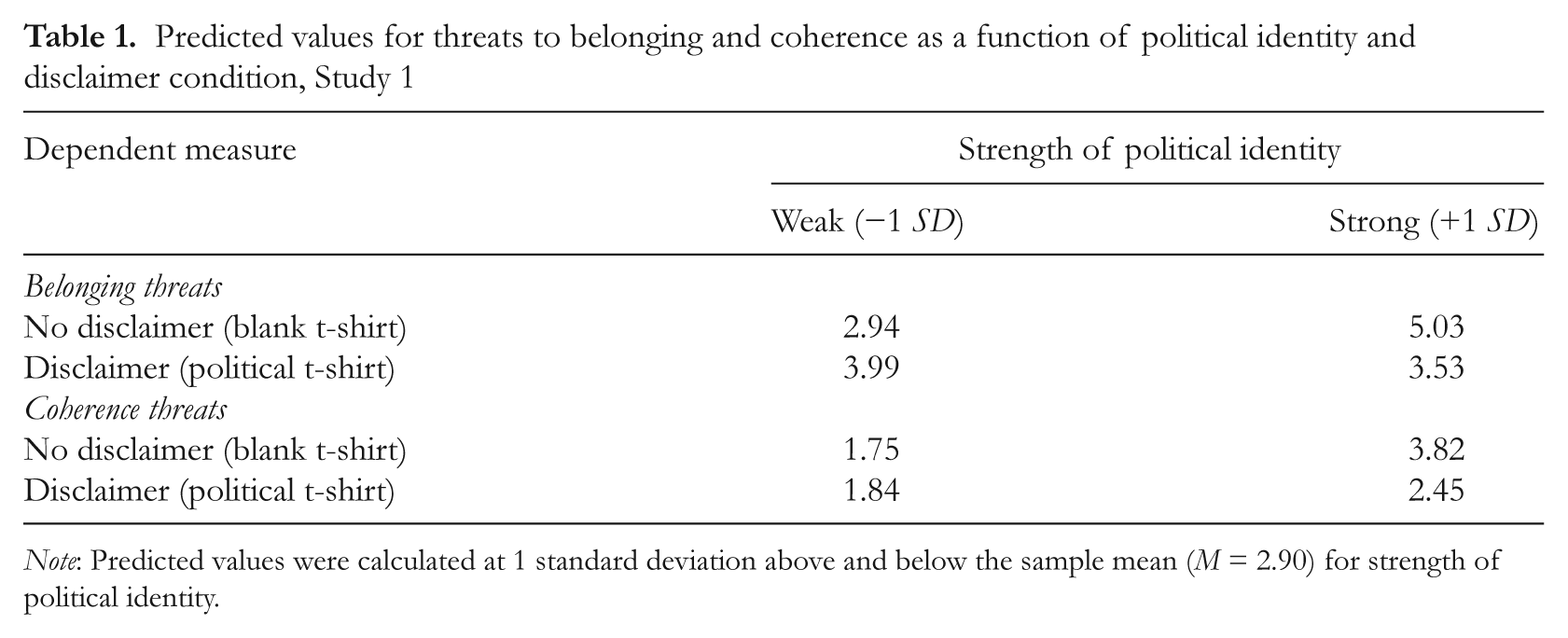
Note: Predicted values were calculated at 1 standard deviation above and below the sample mean (M = 2.90) for strength of political identity.
The analysis on threats to coherence revealed a near-significant effect of disclaimer condition, β = .29, t(28) = 1.96, p < .07, d = .72, that was qualified by the predicted Disclaimer x Strength interaction, β = .36, t(28) = 2.07, p < .05, d = .76 (strength of identity was not a significant predictor, p > .13). The values in Table 1 show that strongly identified partisans who disclaimed reported lower coherence threats than those who did not disclaim, β = .61, t(28) = 2.82, p < .01, d = 1.03, whereas weakly identified partisans were unaffected by the disclaimer manipulation, p > .84.
Discussion
As expected, strongly identified partisans who asserted their party affiliation via a t-shirt experienced weaker threats to belonging and coherence than those who wore a blank t-shirt during a public, out-of-party endorsement. Conversely, the disclaimer t-shirt had no effect on the reactions of weakly identified partisans. These findings lend empirical support to our theorizing about the self threats that arise during role violations that invite identity misclassification. Specifically, behaviors that invite misclassification threaten role violators’ needs for belonging and coherence, and the use of a disclaimer protects actors from these threats. That the strength of partisans’ party identity moderated the effects of the disclaimer on threats suggests that the identity misclassification framework may be especially relevant for understanding the reactions of role violators who identify strongly with the group whose norms they violate. Just as our work on gender role violations shows that specific situational factors amplify the likelihood and threat of misclassification (Bosson et al., 2006), the current work highlights how characteristics of individuals can make them more susceptible to identity misclassification threats. Specifically, our findings suggest that strongly identified partisans are indeed troubled by their own political role violations, but that asserting their party membership to observers can reduce their negative affective reactions to role violations. This is especially important given that the role violation in question is one that should presumably reflect most participants’ genuine personal interests.
Study 2
Study 1 established that publicly endorsing a desirable, out-of-party candidate heightens threats to two distinct psychological needs, belonging and coherence, among strongly identified partisans. In Study 2, we extended the identity misclassification paradigm further by examining whether use of a disclaimer increases undergraduate partisans’ confidence in their choice of an out-of-party candidate. Given our logic—that the prospect of misclassification should undermine partisans’ commitment to an out-of-party candidate, or cause them to question the validity of their personal views—we reasoned that a disclaimer would allow strongly identified partisans to maintain confidence in a preferred, out-of-party candidate.
We tested this assumption in Study 2 using a paradigm with greater ecological validity than the one used in Study 1. Rather than induce people to don an unfamiliar t-shirt and then endorse an out-of-party candidate on video (behaviors with limited ecological validity), we devised a new paradigm in which participants selected a candidate based on his platform alone and shared their endorsement essay and personal information with a (fictitious) partner via email. In this study, participants learned of their candidate’s party affiliation after they selected him. This should place partisans in a situation with which many are presumably familiar: having to choose between party loyalty and personal preferences when evaluating political candidates. As in Study 1, we created a sense of publicness by having participants write an essay about their candidate and show it to an ostensible partner. Unlike in Study 1, however, participants in Study 2 disclaimed by sharing with the partner, over email, several pieces of information that either did or did not include their party affiliation. This disclaimer manipulation is similar to that used in prior identity misclassification studies (Bosson et al., 2005; Prewitt-Freilino & Bosson, 2008).
A final goal of Study 2 was to test whether the party affiliation of the fictional partner—the witness to partisans’ out-of-party endorsement—moderates the effects of disclaimer use on partisans’ evaluations of their chosen candidate. Given that people care more about their status in in-groups than out-groups, our logic suggests that strongly identified partisans should experience stronger self-threats when the audience to their role violation is an in-group member. In fact, partisans may be relatively unconcerned, in general, about the evaluations they receive from an out-group member. Thus, the disclaimer manipulation can be expected to have a relatively large effect when “the stakes are higher” because the partner is an in-group (vs. an out-group) member.
The dependent measures in Study 2 included participants’ confidence in their selection of candidate, and their impressions of his competence and likability, both before they discovered the candidates’ party affiliation and again at the end of the study. We expected strongly identified partisans to report relatively low confidence in their chosen candidate, and a less favorable impression of him, after learning of his out-of-party status unless they proclaimed their party affiliation to their partner. Those in the disclaimer condition should maintain confidence in their candidate and rate him relatively favorably. Thus, we expected a Disclaimer x Strength interaction on final confidence and impression ratings, controlling for preliminary ratings. Finally, we asked whether the party affiliation of the ostensible partner moderated these effects. If so, we should observe a three-way interaction in which the salutary effects of a disclaimer among strongly identified partisans are larger when the partner is an in-group versus an out-group member.
Participants and design
Undergraduates were eligible if they were at least 18 years old, self-identified as either Republican or Democrat, and rated the strength of their political identity during an online prescreening session. Strength of political identity was measured with the same items used in Study 1, but this time responses were made on a 7-point scale (α = .85; M = 3.88, SD = 1.10). A total of 101 students (81 women and 20 men) participated in the experiment in exchange for partial course credit. We deleted data from four participants who expressed high levels of suspicion (i.e., they were “certain” there was no real partner). The final sample consisted of 98 (36 Republican and 62 Democrat) participants who were randomly assigned to condition in a 2 (disclaimer: yes vs. no) x 2 (partner’s political party: same vs. different) design.
Procedure
Participants learned that they would be paired with a partner for two brief, unrelated experiments. In the first experiment, participants would read about and form impressions of two candidates who were being considered for the Board of Regents. Participants learned that they would write an endorsement essay about their preferred candidate, and that their partner would read their essay. In the second experiment, participants would interact face-to-face with their partner in a memory task. We told participants that they would meet their partner later in the session to heighten the salience of the “audience.”
Participants then read, on a computer, an abbreviated version of the candidate information from Study 1 with no references to the candidates’ party affiliation. Thus, participants only read information about each candidate’s stance on the comprehensive exam issue (which was identical to that in Study 1). Participants then indicated which of the two candidates they would select as a regent. Consistent with the data reported earlier, most participants (n = 91; 92.9%) preferred Benson over James, χ2(1, N = 98) = 72.00, p < .001, d = 3.33. After selecting a candidate, participants used a scale of 1 (not at all confident) to 9 (extremely confident) to answer “How confident are you in your selection of candidate?” Participants then rated the competence and likability of their chosen candidate (“How would you rate the competence of Richard Benson?”; “How would you rate the likability of Richard Benson?”). These ratings were made on scales of 1 (not at all) to 9 (very much). Competence and likability ratings were correlated (r = .53, p < .001), so we averaged them to create Time 1 impression scores.
Next, participants progressed to a screen that offered additional information about the two candidates, including their political party affiliation, embedded within other mundane personal information and career details. The computer program was rigged so that Republicans who selected Benson learned that Benson was a Democrat and James was a Republican, and Democrats who selected Benson learned that Benson was a Republican and James was a Democrat. We intended to rig this second set of information so that all participants would learn that the candidate they selected was out-of-party. Due to a programming error, however, only those who selected Richard Benson learned that he was out-of-party; those (n = 7) who selected Tony James learned that their candidate shared their political party.
The experimenter then explained that participants would soon write an essay explaining their candidate choice to their partner. First, however, participants would learn some information about the partner “to help you write your essay.” The experimenter handed participants a form, ostensibly completed by the partner earlier, that contained a variety of facts including his/her name, age, major, hobbies, and political affiliation. In the same party condition the partner’s political party was matched to the participant’s, and in the different party condition the partner belonged to the rival party.
Next, participants began the essay task. Instructions, presented on computer, explained that the participant should build a case for his/her choice of candidate, but not include any unrequested personal information in the essay. Participants in the disclaimer condition then viewed an additional screen that prompted them to “please check a box indicating your political party affiliation; this is the only personal information your partner will see,” whereas those in the no disclaimer condition instead moved directly to the next screen. On this screen, participants were prompted to check a box indicating their chosen candidate. Again, most (87.8%) participants selected Benson, χ2(1, N = 98) = 55.88, p < .001, d = 2.30. Participants then had as much time as they wanted to type their essay. As an index of effort, we recorded the length of time that participants spent writing and the number of words in their essays; these were strongly correlated, r(83) = .73, p < .001, so we averaged them.
Participants then made final ratings of their confidence in their candidate selection, and the candidate’s competence and likability, on 7-point scales ranging from 1 (not at all) to 7 (extremely). Competence and likability ratings were correlated, r = .74, p < .001, so we averaged them to create Time 2 impression scores. Finally, participants provided demographic information and were debriefed.
Results
We expected strongly identified partisans in the disclaimer condition, as compared to the no disclaimer condition, to report more confidence in their selection and a more favorable impression of the out-of-party candidate. Moreover, we wondered whether this pattern would be moderated by the partner’s party affiliation. Because only those participants who selected Benson at Time 1 learned that their candidate was out-of-party, we deleted the data of the seven participants who selected James at Time 1. We also deleted the data of six participants who chose Benson initially and switched to James before writing the essay; for these people, confidence and impression ratings at Times 1 and 2 pertained to different candidates and were thus not comparable.
Confidence
In a simultaneous multiple regression analysis, we regressed Time 2 ratings of confidence onto: (a) Time 1 ratings of confidence, (b) disclaimer condition (coded as 0, 1), (c) partner’s party condition (coded as 0, 1), (d) strength of political identity (centered), (e–g) all two-way interactions among the independent variables, and (h) the three-way interaction term. Not surprisingly, Time 1 confidence was a strong predictor of Time 2 confidence, β = .63, t(76) = 7.42, p < .001, d = .93. More importantly, even controlling for Time 1 confidence, this analysis yielded significant interactions of Disclaimer x Strength, β = .33, t(76) = 2.58, p < .02, d = .58, and partner’s Party x Strength, β = .28, t(76) = 2.20, p < .04, d = .50. These interactions qualified a main effect of strength of identity, β = −.26, t(76) = −1.97, p = .05, d = .45. No other effects emerged, ps > .29.
As shown in Figure 1, the Disclaimer x Strength interaction reflected a tendency for strongly identified partisans (those 1 SD above the mean, or 4.98) to report more confidence in their choice of candidate at Time 2 if they had disclaimed to their partner than if they had not disclaimed, β = .26, t(80) = 2.21, p < .04, d = .49. In contrast, weakly identified partisans (those 1 SD below the mean, or 2.78) were unaffected by the disclaimer manipulation, p > .37. Note that the Disclaimer x Strength interaction remained significant when we controlled for the amount of effort that participants put into their essay, β = .28, t(79) = 2.51, p < .02, d = .56, indicating that these effects on confidence do not merely reflect differences in how hard participants worked to explain their choice of candidate to their partner.
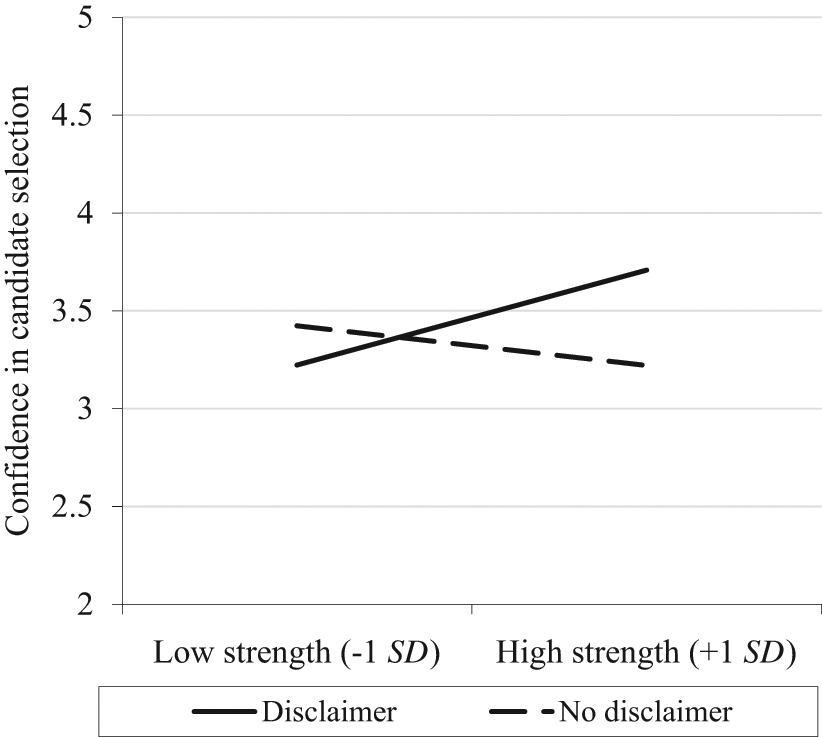
Time 2 confidence in candidate selection as a function of disclaimer condition and strength of political party identity (Study 2).
Turning next to the partner’s Party x Strength interaction shown in Figure 2, strongly identified partisans had higher Time 2 confidence when the witness to their out-of-party endorsement was a member of the other party as compared to an in-group member, β = .28, t(80) = 2.07, p < .05, d = .46. Among weakly identified partisans, the partner’s party had no effect on confidence ratings, p > .40. Again, the interaction remained significant when we controlled for effort on the essay task, β = .22, t(79) = 2.31, p < .03, d = .52.
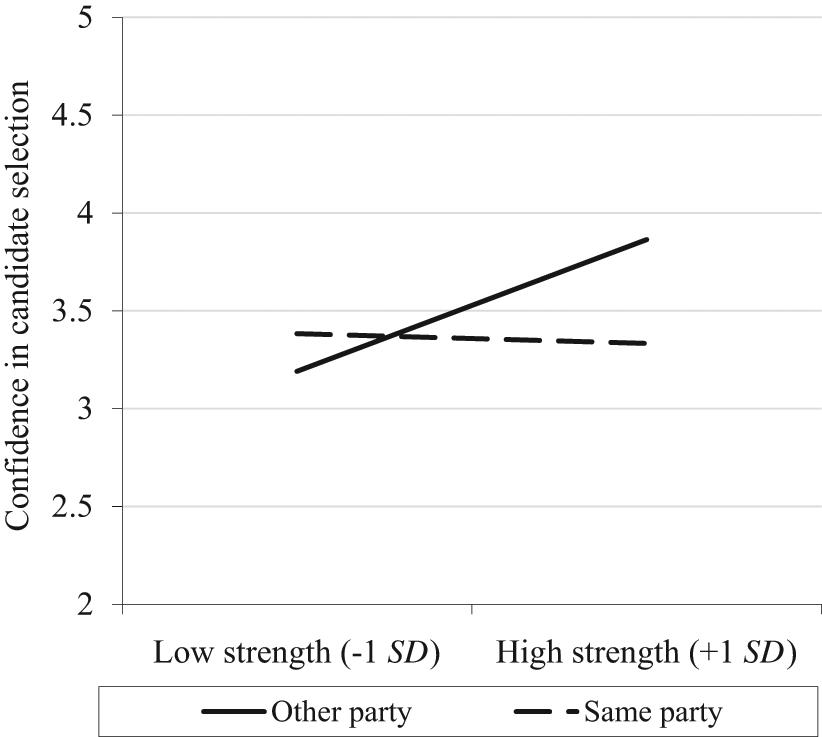
Time 2 confidence in candidate selection as a function of partner’s party condition and strength of political party identity (Study 2).
Candidate impressions
We regressed Time 2 impression ratings of Benson onto the same set of predictors (a–h) described earlier. The only significant predictor in this model was Time 1 impressions of Benson, β = .66, t(74) = 6.97, p < .001, d = .94. No other effects approached significance, ps > .20. Thus, our predictions regarding impressions of the chosen candidate were not supported.
Interestingly, this suggests that the heightened confidence we observed among strongly identified partisans who revealed (vs. did not reveal) their party affiliation was not based on increases in the favorability of their impressions of their candidate. Indeed, when we reran the multiple regression analyses described above on Time 2 confidence, but entered Time 1 and Time 2 impression ratings as covariates, the interaction of Disclaimer x Strength remained significant, t(73) = 2.28, p < .03, d > .52, although the interaction of partner’s Party x Strength dropped to nonsignificance, p > .12. Thus, disclaimer use influenced partisans’ confidence in their choice of an out-of-party candidate even when holding constant their impressions of his likability and competence.
Discussion
Strongly identified partisans who revealed their party affiliation to a partner, versus those who did not, later reported more confidence in their choice of a genuinely preferred, but out-of-party, candidate. This pattern is consistent with our assertion that disclaimer use eases people’s concerns about being misclassified into a disliked political party on the basis of role-violating behaviors. In fact, it suggests that misclassification expectations may play a role in shaping people’s reactions to out-of-party candidates, particularly when their political identity is central to their self-concept. Note, of course, that these effects were limited to partisans’ confidence in their candidate choice, and did not also characterize their impressions of him. Indeed, the interaction of disclaimer and strength of political identity remained significant when we controlled for the favorability of partisans’ impressions of the candidates, suggesting that confidence in the correctness of a role-violating behavior may wane even when some of the beliefs that (presumably) prompted the behavior remain unchanged.
We also examined the role of the audience’s in-group/out-group status in Study 2, and found no evidence of the anticipated three-way interaction with this variable. Instead, we found simply that strongly identified partisans felt more confident about their candidate choice in front of the other-party partner as compared to the same-party partner, regardless of whether they disclaimed. Although we expected the effects of the disclaimer to be stronger when the partner was an in-group versus an out-group member, in retrospect it is plausible that the act of asserting their party affiliation in this context raised concerns for role violators that countered the benefits of forestalling misclassification. For instance, people generally react more negatively to “bad behaviors” committed by fellow in-group members than by out-group members (Marques, Yzerbyt, & Leyens, 1988). Thus, strongly identified partisans who communicate their party affiliation to an in-group member might actually anticipate harsher repercussions than those who do not disclaim. If disclaimer use raises some threats while quelling others when the audience to a role violation is an in-group member, it is not surprising that the three-way interaction did not emerge. In sum, these findings suggest that strongly identified partisans should feel relatively comfortable supporting an out-of-party candidate so long as they either proclaim their party affiliation to their audience, or judiciously reveal their role violation only to out-group members.
General discussion
Given the growth in political party loyalty observed over the last few decades (Bartels, 2000; Hetherington, 2001), as well as recent research demonstrating the dramatic impact of party membership on political judgments and decision-making (Cohen, 2003; Westen et al., 2006), it is important to understand why partisans often resist party role violations, as well as the conditions under which they violate party norms with ease. To this end, the studies presented here demonstrate how identity misclassification concerns can shape partisans’ reactions to a desirable, but out-of-party, candidate.
When publicly endorsing a desirable out-of-party candidate, strongly identified partisans expect others to misclassify them into the rival political party, and Study 1 highlighted how this experience can threaten people’s distinct needs for belonging and coherence. Notably, an opportunity to assert their party affiliation to observers protected partisans’ from these self threats during the role violation. Building on these findings, Study 2 showed that strongly identified partisans were more confident in their choice of an out-of-party candidate when they proclaimed (vs. did not proclaim) their party affiliation to their partner. Moreover, nondisclaiming partisans’ hesitancy about their cross-party decision could not be explained by a lack of engagement in the task, or a tendency to evaluate their chosen candidate more negatively.
Considered as a whole, these findings add several important elements to prior work on identity misclassification. Whereas past work focused primarily on people’s reactions to gender role violations (Bosson et al., 2005; Bosson et al., 2006; Prewitt-Freilino & Bosson, 2008), the current findings demonstrate that misclassification concerns also play a role in partisans’ reactions to violations of political party norms. As such, concerns about misclassification may shape, at least to some degree, partisans’ real-world reactions to cross-party policies, issues, and candidates that they privately endorse. In addition to establishing the generalizability of identity misclassification phenomena, our focus on the factors that shape political reactions and judgments moves this work into a realm with clear and important practical applications.
Moreover, by considering role violators who varied in the strength of their political identity, these studies demonstrate that the threat of misclassification during political role violations is greatest among those who identify strongly with their party in-group. Luckily for such individuals, the use of a disclaimer effectively assuages their concerns about belonging and coherence, and allows them to maintain confidence in a cross-party decision. For weakly identified partisans, clashes between personal beliefs and the “party will” appear relatively nonthreatening to begin with, and they do not dampen subjective confidence in a cross-party decision.
Note, however, that even weakly identified group members may experience discomfort when they anticipate misclassification into a widely stigmatized out-group. In past work, we found no evidence that the strength of men’s gender identity moderated their aversive reactions to public gender role violations that would invite misclassification as “gay” (Bosson et al., 2006). That is, male gender role violators reported heightened discomfort regardless of the strength of their gender identity. This suggests that misclassification into widely stigmatized groups (e.g., gay men) may pose threats for both strongly and weakly identified role violators. Indeed, the prospect of misclassification along gender or sexuality lines is likely troubling for most men, given the high probability of backlash for violating gender role norms (Rudman & Fairchild, 2004). In contrast, although staunch Democrats and Republicans may devalue the rival party, membership in either of these mainstream political parties is not widely socially stigmatized. Perhaps role violators’ feelings of threat increase as a function of the level of stigmatization that awaits them, should misclassification occur. Anticipated stigmatization should be highest when either the out-group is widely stigmatized, or one’s personal attachment to the in-group is especially strong. Further work is needed to clarify whether this principle generalizes to other types of misclassification scenarios.
Fortunately, this work demonstrates the effectiveness of disclaimers in reducing people’s feelings of threat during desirable and/or freely chosen role violations. Whereas male role violators in our past work felt more comfortable during a public gender role violation if they first proclaimed their heterosexuality to their audience, strongly identified partisans in the current studies felt less threatened and more confident supporting an out-of-party candidate if they proclaimed their party affiliation to observers. This effect emerged regardless of whether the disclaimer took the form of a political t-shirt or an online communication. As such, there is accruing evidence that disclaimers provide a potent antidote to the discomfort that arises during behaviors that invite misclassification. What remains to be seen, however, are the effects that disclaimers have on observers’ impressions of the role violators who use them. If disclaimers assuage role violators’ concerns about rejection and erroneous appraisals, do they also convince observers of role violators’ allegiance to the in-group whose norms they violate? Future research should investigate disclaimer use as an interpersonal process, with a focus on the factors that increase versus decrease the effectiveness of disclaimers in the eyes of their intended audience.
Another important direction for future research will be to follow up on the confidence findings from Study 2. Recall that strongly identified, nondisclaiming partisans showed relatively low confidence in their chosen candidate, despite the fact that their impressions of his competence and likability were unaffected by their disclaimer use. This raises questions about the processes through which identity misclassification concerns exert their effects on partisans’ political judgments. In real-world decision-making contexts, might a lack of confidence in one’s judgments be enough to compel partisans to abandon their personal preferences and “toe the party line”? After all, we know that people are less likely to translate their beliefs into actions to the extent that they lack confidence in the correctness of those beliefs (e.g., Berger & Mitchell, 1989; Fazio & Zanna, 1978). Certainly, the overwhelming tendency for partisans to vote along party lines suggests that most partisans probably hesitate to support out-of-party candidates unless they are confident in the accuracy of their decisions. Thus, future research should examine the effects of waning confidence on partisans’ willingness to endorse a preferred, out-of-party candidate.
Although the current work focuses specifically on the experiences of partisans who support preferred out-of-party candidates, future research should also consider the implications of supporting a nonpreferred, in-party candidate. Partisans who “toe the party line”—despite holding a divergent private stance—have little to fear in the way of belonging threats. However, just as with any attitude-discrepant behavior (Festinger, 1957), acting against one’s own beliefs may threaten the need for coherence. For example, individuals with concealable stigmas (gay men and lesbians) who imagined behaviors that would invite misclassification as “straight” (e.g., holding hands with an opposite-sex person) reported heightened threats to coherence, but not belonging (Bosson et al., 2011). Similarly, when strongly identified partisans show public support for in-party candidates with whom they privately disagree, they may experience temporary coherence threats. Over time, repeated experiences of sacrificing coherence in favor of belonging might undermine partisans’ interest in politics altogether, leading to voter apathy or political disaffection (e.g., Buckingham, 1997; Hayes, 1998). Ultimately, we hope that research on partisans’ concerns about political identity misclassification will contribute to our understanding of these, and related, phenomena.
Conclusions
Luckily, people’s personal beliefs frequently correspond to the norms of their valued in-groups. However, when the will of the group contradicts personal beliefs, group members face the difficult decision of holding steadfast to their personal convictions—and risking misclassification—or “toeing the party line” and ignoring their personal beliefs. The current work shows that communicating party affiliation to others can protect strongly identified partisans from misclassification concerns and self threats when endorsing a preferred out-of-party candidate. In turn, when free of concerns about misclassification, strongly identified partisans experience heightened confidence in their choice of an out-of-party candidate. Thus, the current work underscores the impact that social identity processes play in reactions to political role violations. We hope that social science researchers and strategists will continue to consider these identity processes when analyzing real-world political decisions and behaviors.
Footnotes
Acknowledgements
We thank Erin DeWitt, Lindsey Glasco, Stacy Hall, Gary Hominick, Anh Hua, Brett Kulhman, Miche Molidor, Alex Nagelschneider, and Ernest Strain for assistance with data collection, data entry, and coding. We also thank Jamie Goldenberg for giving us valuable comments on an earlier draft of this manuscript.