







Abstract
Prejudice expectations and other interpersonal rejection concerns have been found to direct attention towards social evaluative information. In some studies, rejection concerns have been found to direct attention towards social acceptance cues, whereas other studies have found an attention bias towards social rejection cues. In the present article we argue that these attention biases constitute promotion- (vs. prevention-) oriented strategies to deal with concerns about how one is evaluated. In support of this notion, a first study demonstrated that prejudice expectations direct attention towards male faces signaling happiness (vs. contempt) among women with a chronic promotion focus, but not among women with a chronic prevention focus. A second study demonstrated that the effect generalizes to subliminally presented acceptance-related (vs. nonsocial, sexist) words, and when a promotion (vs. prevention) focus had been experimentally induced. Theoretical and practical implications are discussed.
Members of stigmatized groups are generally aware of their group’s low-status position in society and of the negative stereotypes associated with their group (e.g., Crocker, Major, & Steele, 1998; Heatherton, Kleck, Hebl, & Hull, 2000; Swim & Stangor, 1998). It is therefore not surprising that members of stigmatized groups are concerned about how they are evaluated by interaction partners from high-status groups (Vorauer, 2006), develop expectations of prejudiced treatment (Pinel, 1999; Vorauer, Main, & O’Connell, 1998; cf. Downey & Feldman, 1996), and frequently avoid interactions across group boundaries altogether (Shelton & Richeson, 2006; Stephan & Stephan, 1985).
When interactions across group boundaries do occur however, research suggests that expectations of prejudiced treatment can shape stigmatized individuals information processing and behavior in two diametrically different directions. On the one hand, prejudice expectations can contribute to self-fulfilling prophecies by causing stigmatized individuals to interpret ambiguous behaviors and facial expressions of their interaction partner as signs of prejudice (e.g., Crocker & Major, 1989; Inzlicht, Kaiser, & Major, 2008), and by negatively affecting how stigmatized individuals themselves behave towards members of the outgroup (Pinel, 2002; cf. Downey, Freitas, Michaelis, & Khouri, 1998). On the other hand, prejudice expectations have also been found to make stigmatized individuals more involved during interactions across group boundaries and to lead them to engage in compensatory prosocial behaviors in order to make the interactions more pleasant (e.g., Shelton, 2003; Shelton, Richeson, & Salvatore, 2005). Notably, compensatory efforts stemming from prejudice expectations can have a positive effect not only on how their partners experience the interaction (Shelton et al., 2005), but on the experiences stigmatized individuals have as well (Shelton, 2003; but see Shelton et al., 2005).
Recent evidence from research on selective attention suggests that each of these responses to prejudice expectations—vigilance for signs of prejudice as well as attempts to affiliate with the interaction partner—can operate preconsciously. For example, one set of studies demonstrated that prejudice expectations can cause the individual to selectively attend to subliminal prejudice cues (Kaiser, Vick, & Major, 2006). By contrast, evidence from the broader literature on social rejection concerns suggests that individuals who are concerned about interpersonal rejection selectively attend to faces signaling social acceptance (e.g., DeWall, Maner, & Rouby, 2009; cf. Rothermund, Voss, & Wentura, 2008).
In the present research we investigate whether these disparate responses can be understood as distinct self-regulatory strategies in situations in which concerns about rejection are salient. We will argue that, when a stigmatized individual is in a promotion-oriented regulatory state, prejudice expectations initiate compensatory attempts to facilitate the interaction, manifested in a selective search for signs of social acceptance. By contrast, when the individual is in a prevention-oriented regulatory state, prejudice expectations are expected to initiate a vigilant search for signs of social rejection. Below we briefly review the literature on responses to prejudice expectations and other forms of interpersonal rejection concerns, focusing on the consequences for selective attention. After that we outline why the individual’s regulatory focus (Higgins, 1997) should determine the particular strategy adopted in response to prejudice expectations and give an overview of how we examine this prediction in the present research.
Interpersonal rejection concerns and selective attention
While some of the consequences of interpersonal rejection are likely to vary considerably depending on the particular rejection experience (e.g., prejudice, peer rejection, social exclusion, unrequited love), all interpersonal rejection experiences share a common core: they pose a threat to the fundamental goal of being valued and accepted (Smart Richman & Leary, 2009; cf. Baumeister & Leary, 1995). Of particular importance for the present research, the threat to one’s need to belong is not restricted to being rejected by highly valued ingroup members. In fact, research suggests that the need to belong is threatened even when one is being excluded by members of a despised outgroup (Gonsalkorale & Williams, 2007; cf. Williams, Cheung, & Choi, 2000), or by a computer (Zadro, Williams, & Richardson, 2004). Therefore, we argue that any threat of interpersonal rejection should raise concerns about how one is evaluated and direct attention towards social evaluative information (Vorauer, 2006). The most direct support for this line of reasoning can be found in the social exclusion literature (Gardner, Pickett, & Brewer, 2000; Gardner, Pickett, Jefferis, & Knowles, 2005; Pickett, Gardner, & Knowles, 2004). For example, experiences with social rejection have been found to facilitate memory for social events as compared to nonsocial events (Gardner et al., 2000) and to direct attention to the emotional tone of voice in a vocal version of the emotional Stroop task (Pickett et al., 2004, Study 2).
While concerns about interpersonal rejection can direct attention towards social evaluative cues in general, more recent studies suggest that individuals do not allocate equal amounts of attention to all social evaluative cues. DeWall et al. (2009) found that social rejection concerns directed attention exclusively towards social acceptance cues rather than towards social evaluative cues more generally. Specifically, a series of experiments demonstrated that a social exclusion threat directed attention towards happy faces (social acceptance cues), but not towards faces displaying other emotions. Moreover, as outlined above, Pickett et al. (2004) found that a social rejection experience increased attention to vocal tone in an emotional Stroop task. However, this effect was driven primarily by trials in which the vocal tone was positive rather than negative (Pickett et al., 2004, Study 2). Thus, while social rejection concerns may direct attention towards social cues in general, social acceptance cues appear to receive particular attention.
However, as mentioned above, concerns about interpersonal rejection do not always lead to an affiliative, acceptance-oriented attention bias. Expectations of interpersonal rejection have also been found to increase vigilance for signs of interpersonal rejection. Specifically, women who were led to believe that a future male interaction partner held sexist (vs. nonsexist) attitudes directed their attention towards prejudice-related stimuli in an emotional Stroop task (Kaiser et al., 2006, Study 2). It should be noted, however, that attention to prejudice-related stimuli was only compared with attention to nonsocial words (illnesses, household objects). As prejudice-related words were the only social stimuli in this study, these findings may reflect the more general tendency for rejection concerns to direct attention towards social (vs. nonsocial) cues (Gardner et al., 2000; Pickett et al., 2004). In order to determine whether prejudice expectations can lead to vigilance for social rejection cues in particular, additional research is needed using experimental paradigms in which both social acceptance cues and social rejection cues are included.
A relevant question then is when expectations of interpersonal rejection initiate selective processing of cues that may help facilitate the interaction and improve relations with the interaction partner (social acceptance cues), and when they may verify expectations of interpersonal rejection. In the present research we address this question from the perspective of regulatory focus theory (Higgins, 1997). Specifically, we examine whether prejudice expectations direct attention towards different social stimuli depending on the individual’s regulatory focus (Higgins, 1997). Below we briefly introduce regulatory focus theory and explain why we expect regulatory focus to modulate the effect of prejudice expectations on selective attention.
The role of regulatory focus
According to regulatory focus theory (Higgins, 1997) there are two distinct self-regulatory systems that guide cognition, emotion, and behavior in goal pursuit: the promotion system and the prevention system. The two self-regulatory systems serve different needs and are associated with distinct strategic inclinations in goal pursuit. When under a promotion focus, individuals are concerned with their ideals and nurturance needs. This focus is associated with eager approach- oriented strategies aimed at reaching a positive end-state and a general sensitivity to the presence versus absence of positive outcomes (e.g., Brendl, Higgins, & Lemm, 1995; Crowe & Higgins, 1997; Liberman, Molden, Idson, & Higgins, 2001; Molden & Higgins, 2004). By contrast, when under a prevention focus, individuals are concerned with their oughts and safety needs. This focus is associated with avoidance-oriented strategies aimed at precluding a negative end-state and a general sensitivity to the presence versus absence of negative outcomes (e.g., Brendl et al., 1995; Crowe & Higgins, 1997; Liberman et al., 2001; Molden & Higgins, 2004).
In a situation in which prejudice expectations are salient—and thereby concerns about how one is evaluated (e.g., Vorauer, 2006)—we expect individuals to formulate different goals and adopt different information-processing strategies depending on their current regulatory focus. When under a promotion focus, individuals should adopt an eager, approach-oriented strategy and initiate a selective search for signs of social acceptance. As a result, they should become particularly sensitive to the presence (vs. absence) of social acceptance cues. Thus, when prejudice expectations are salient, cues indicative of social acceptance (vs. rejection) should be particularly likely to capture attention when the individual is under a promotion focus (cf. DeWall et al., 2009).
By contrast, in a situation in which prejudice expectations are salient, individuals under a prevention focus should adopt an avoidance-oriented strategy and initiate a selective search for signs of social rejection. As a result, when under a prevention focus, prejudice expectations should make individuals particularly sensitive to the presence (vs. absence) of social rejection cues (cf. Inzlicht et al., 2008; Kaiser et al., 2006). Thus, when prejudice expectations are salient and the individual is under a prevention focus, social rejection (vs. acceptance) cues should be particularly likely to capture attention.
Overview of the present research
In two studies we examine the general hypothesis that regulatory foci modulate how prejudice expectations affect selective attention. In both studies we manipulated prejudice expectations by providing the female participants with bogus feedback suggesting that their male interaction partner endorsed sexist (vs. nonsexist) attitudes (Kaiser et al., 2006). Across the two studies, we examined the role of regulatory foci in different ways. In the first study chronic individual differences in promotion focus and prevention focus strength were assessed upon arrival in the lab. In Study 2 we tested our causal claims more rigorously by experimentally inducing different regulatory foci.
Across studies, we varied the methodology used to measure selective attention. In the first study we used a dot-probe task to examine whether participants’ directed their attention towards a male face signaling social acceptance (i.e., happiness; DeWall et al., 2009) versus social rejection (i.e., contempt; Fischer & Roseman, 2007; Inzlicht et al., 2008) when presented simultaneously (i.e., competing for their attention). In Study 2 we examined whether biases in attention generalized to acceptance-related (vs. prejudice-related) words presented subliminally in an emotional Stroop task (cf. Kaiser et al., 2006).
Study 1
Method
Participants and design
Female Leiden University students (N = 58) between 18 and 38 years of age (M = 21, SD = 3.28) were randomly assigned to the prejudice expected condition or to the control condition. A measure of chronic regulatory focus served as an additional independent variable. The experiment lasted approximately 30 minutes, and all participants received €3.00 or course credit for their participation.
Procedure
Upon arrival in the lab, participants were seated behind computers in separate cubicles. Participants were informed that they were to participate in two short pilot studies and a main study on communication and impression formation. First, it was announced, they would participate in the piloting of a questionnaire. This was followed by the assessment of chronic regulatory focus using the Regulatory Focus Questionnaire (Higgins et al., 2001). Promotion focus was measured with six items (e.g., “I feel like I have made progress toward being successful in my life,” α = .74), and prevention focus was measured with five items (e.g., “How often did you obey rules and regulations that were established by your parents?” α = .78). All items were anchored at 1 = rarely to 7 = often or 1 = certainly not true to 7 = certainly true.
After that, participants were informed that the next study focused on communication between strangers, and that they would take part in a discussion with another participant in the video lab across the hall. To manipulate prejudice expectations, participants were asked to complete a questionnaire about their attitudes towards four different social issues (i.e., financial aid to developing countries, gender equality, the European Union, and sustainable energy). This questionnaire would supposedly be used to introduce them to their interaction partner (cf. Kaiser et al., 2006). Once participants had filled out the questionnaire, they received the questionnaire that was (supposedly) filled out by their interaction partner. In both experimental conditions the questionnaire suggested that the interaction partner was a 20-year-old male medical student. The only difference across conditions was how he responded to the four items concerning gender equality (Kaiser et al., 2006). In the prejudice expectations condition he agreed to a large extent with statements such as “I could not work for a female boss because women can be overly emotional” and “I don’t think it is good for the well-being of children when their mother is working.” By contrast, he strongly disagreed with these statements in the control condition. Along with the completed questionnaire constituting the prejudice expectations manipulation, participants also received a second short questionnaire in which they were asked to indicate to what extent they agreed with him on the topics (e.g., “I think we agree on the topic of gender equality”). All responses were made on a 7-point scale (0 = we do not agree at all, 6 = we agree completely).
It was then stated on the computer screen that, before leaving the cubicle to interact with their partner, they would participate in the pilot testing of a computerized reaction time task. This was followed by the dot-probe task used to measure selective attention to acceptance (vs. rejection) cues. As stimulus materials we used four photographs of male faces displaying happiness (social acceptance cue; DeWall et al., 2009) and four photographs of the same male faces displaying contempt (social rejection cue; Inzlicht et al., 2008). All stimuli were taken from the Amsterdam Dynamic Facial Expression Set (ADFES; van der Schalk, Hawk, Fischer, & Doosje, 2011). 1 The dot-probe task was introduced as a symbol-identification task in which the goal was to identify a symbol presented on the screen (“∪” vs. “∩”). Each trial started with the presentation of a fixation point at the center of the screen (1,500 ms). After that, two male faces (5 × 9 cm) were simultaneously presented on the screen (200 ms), one face at each side of the fixation point, and thus competing for attention. One of the faces signaled social rejection (contempt), whereas the other face signaled social acceptance (happiness). Immediately after that, the symbol to be identified appeared at the location where one of the faces had been presented. Participants’ were instructed to focus on identifying the symbol as quickly and as accurately as possible (by means of a key-press), and to disregard the faces presented. After a short delay (1,500 ms) the next trial then followed.
A total of eight different trials were used in a 2 (face location: contempt face to the left or happy face to the left) × 2 (symbol location: left or right) × 2 (symbol: ∪ vs. ∩ ) factorial design. There were a total of 96 trials (in random order), with each trial type presented 12 times. The computer registered the time needed to correctly identify the symbols. Faster identification of symbols presented at the same location as a contemptuous (vs. happy) male face is indicative of an attention bias for social rejection (vs. acceptance) cues (DeWall et al., 2009). Before beginning the task, participants received 10 practice trials with neutral faces.
Finally, as a manipulation check of prejudice expectations we adapted some items from the stigma-consciousness scale (Pinel, 1999) (e.g., “I expect my interaction partner to interpret my behavior differently because I am a woman,” “I don’t expect my interaction partner to judge me on the basis of my gender [recoded]”). All seven items were answered on a 7-point scale (1 = do not agree at all, 7 = agree completely), (α = .79). After that, participants were informed that the discussion would not take place and that the experiment was over. All participants were fully debriefed, thanked and paid for their participation.
Results
The data was analyzed by means of regression analyses. The prejudice expectations manipulation was effect-coded (1 for prejudice expectations and −1 for control) and the promotion and prevention focus strength variables were centered before computing the relevant interaction terms. Promotion and prevention focus strength scores were perfectly independent (r = 0) and did not differ between the two experimental groups, Fs < 1. All three independent variables (prejudice expectations, promotion focus strength, and prevention focus strength) and the interaction terms relevant for our hypotheses (prejudice expectations × promotion focus strength, prejudice expectations × prevention focus strength) were included in all regression analyses.
Prejudice expectations
Only the expected main effect of prejudice expectations emerged on expectations of differential treatment, b = .37, SE = .15, p = .01. Participants in the prejudice expectations condition expected more differential treatment from the interaction partner as a consequence of their gender (M = 4.02, SD = 1.27) than participants in the control condition (M = 3.27, SD = .84). In addition, only a main effect of prejudice expectations was found on agreement with the male interaction partner on the topic of gender equality, b = −1.72, SE = .13, p < .001. Participants in the control condition were more in agreement with the male interaction partner on the topic of gender equality (M = 4.59, SD = 1.18) than participants in the prejudice expectations condition (M = 0.86, SD = .89). No differences in agreement were found on any of the other three topics covered in the questionnaire. We thus conclude that our manipulation was perceived as intended.
Selective attention
All response times on trials on which the symbol was correctly identified were included in the analyses. An attention bias score was calculated for each participant by subtracting the average response time on trials on which the symbol appeared at the location of a happy face from the average response time on trials on which the symbol appeared at the location of a contempt face. Thus, a positive score indicates an attention bias (in milliseconds) for happy faces (social acceptance cues), whereas a negative score is indicative of an attention bias for contempt faces (social rejection cues).
Overall, participants did not display any attention bias in favor of social acceptance or rejection cues (M = −6.04, SD = 44.90), t(56) = −1.02, p = .32. However, a regression analysis revealed a marginally significant main effect of prejudice expectations on the attention bias measure, b = 10.41, SE = 5.74, p = .08. The direction of the effect indicated that prejudice expectations (vs. control) caused a slight attention bias towards social acceptance cues. More importantly, this effect was qualified by a significant prejudice expectations by promotion focus strength interaction, b = 12.89, SE = 5.68, p = .03. This interaction is depicted in Figure 1. As predicted, simple slope analyses revealed that prejudice expectations directed attention towards happy faces among individuals with a relatively strong promotion focus (1 SD above the mean), b = 23.16, p = .006. By contrast, prejudice expectations had no effect on selective attention among individuals with a relatively weak promotion focus (1 SD below the mean), b = −2.64, p = .75. No other effects were obtained on the attention bias measure. Of particular relevance for the present purposes, the prejudice expectations by prevention focus strength interaction did not approach significance, b = −5.64, SE = 6.02, p = .35. Thus, we found no support for the prediction that prejudice expectations direct attention towards rejecting faces among individuals with a strong prevention focus. We will return to this issue in the discussion.
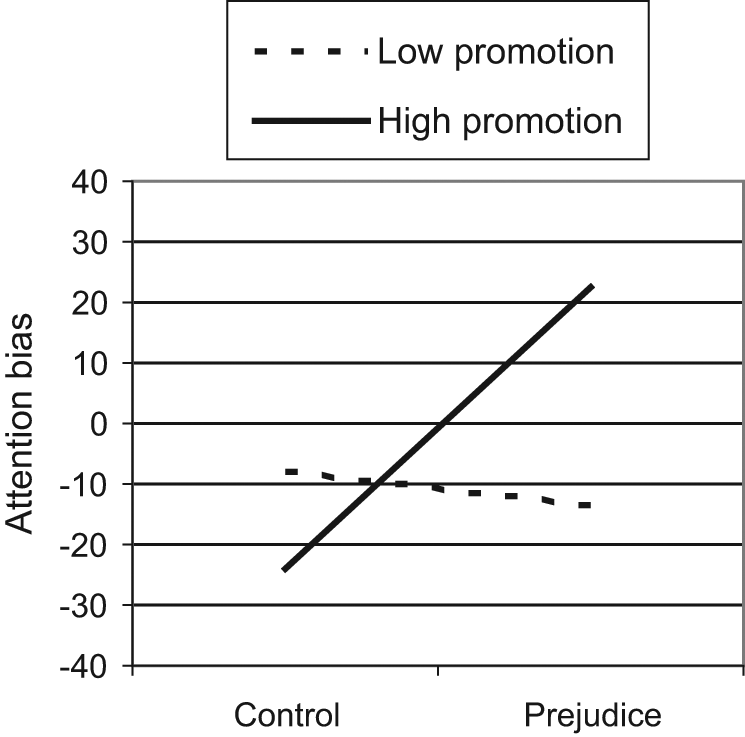
Attention bias as a function of prejudice expectations and promotion focus strength, controlling for prevention focus strength. Positive/negative scores indicate an attention bias for acceptance/rejection cues (Study 1).
Discussion
Consistent with research on other forms of interpersonal rejection concerns (e.g., DeWall et al., 2009), our findings suggest that individuals can respond to prejudice expectations by selectively attending to social acceptance cues. As predicted, however, this effect only emerged among individuals with a strong (vs. weak) promotion focus. Thus, we have initial evidence that selectively attending to acceptance cues in response to prejudice expectations constitutes a promotion-oriented strategy to deal with concerns about how one is evaluated. Surprisingly, the strength of individuals’ prevention focus did not affect attention in any way. Most relevant for the present purposes, we did not find any support for the notion that prejudice expectations direct attention towards social rejection cues among individuals with a strong prevention focus.
How can we explain the lack of vigilance among individuals with a strong prevention focus who expected prejudice? Notably, Kaiser et al. (2006) argued that individuals who expect prejudice screen the environment for prejudice-related cues preconsciously. Indeed, these researchers found that prejudice expectations directed attention towards prejudice-related words when presented subliminally, but not when they were presented supraliminally. Thus, one possible explanation to why we failed to attain evidence for vigilance towards rejection cues among individuals with a strong prevention focus is that we presented our stimuli supraliminally rather than subliminally. In Study 2 we therefore examine whether prejudice expectations and regulatory focus interactively determine whether people preconsciously direct their attention to acceptance-related (vs. prejudice-related) words presented subliminally in an emotional Stroop task (cf. Kaiser et al., 2006).
Second, in this study we relied on chronic individual differences in promotion and prevention focus strength. As a consequence, we cannot conclusively rule out the possibility that our results are attributable to some unknown third factor rather than to differences in regulatory foci. To provide more direct evidence that regulatory focus has a causal effect on selective attention, we manipulated both prejudice expectations and regulatory focus in our second study.
Study 2
Participants and design
Female Leiden University students (N = 120) between 18 and 46 years of age (M = 20, SD = 3.37) were randomly assigned to conditions in a 2 (prejudice expectations: prejudice expected vs. control) × 2 (regulatory focus: promotion vs. prevention) factorial design. The experiment lasted approximately 30 minutes, and all participants received €3.00 or course credit for their participation.
Procedure
The cover story, including the prejudice expectations manipulation, was identical to that in Study 1. After the prejudice expectations manipulation, participants were asked to participate in two short pilot studies prior to meeting up with their interaction partner in the video-lab. In reality, the first pilot study constituted the regulatory focus manipulation. Following Friedman and Förster (2001), we induced different regulatory foci by means of two different paper-and-pencil mazes. Participants in the promotion focus condition led a mouse through a maze in an attempt to attain a piece of cheese depicted outside the maze. By contrast, participants in the prevention focus led a mouse through a maze to escape from a predator bird depicted above the maze.
This was followed by the second pilot study, which in reality was the emotional Stroop task used to measure selective attention. Each trial started with a fixation cross at the center of the screen, followed by the subliminal presentation of a prime word in red or blue ink (15 ms). The prime word was immediately backward masked by a series of Xs. The number of Xs was equal to the number of letters of the prime word, and presented in the same color. The series of Xs remained on the screen until the participant indicated its color with a key-press, upon which the next trial began. The task contained two blocks of trials. In each block the same 10 primes from each category (prejudice-related, acceptance-related, and nonsocial) were presented in random order. The prejudice-related words were the same as those used by Kaiser et al. (2006; e.g., sexist, whore, slut), who also demonstrated in a pilot study that women perceived these words as threatening. Examples of the acceptance-related words used are “friend,” “respect,” and “accept,” and examples of the nonsocial words (plants) are “flower,” “rose,” and “orchid.” Thus, the task contained a total of 60 trials. Participants were instructed to indicate the color of the series of Xs as quickly and as accurately as possible.
After the Stroop task we checked the prejudice expectations manipulation with the same 7 items as in the previous study (α = .83). After that, participants were fully debriefed, thanked, and paid for their participation.
Results
Prejudice expectations
Eight participants (two in each condition) were excluded from all analyses because they failed to follow instructions, and therefore were not exposed to the experimental manipulations. A 2 (prejudice expectations) × 2 (regulatory focus) ANOVA confirmed that participants in the prejudice expectation condition expected more differential treatment from the interaction partner as a consequence of their gender (M = 4.36, SD = 1.03) than participants in the control condition (M = 3.21, SD = .97), F(1, 108) = 36.35, p < .001,
Selective attention (errors)
The data from two participants were lost due to technical problems with the Stroop task. We first examined selective attention based on how many errors participants made when indicating the color of the stimuli. More errors on trials preceded by an acceptance prime (controlling for errors on trials with a nonsocial prime) indicates that more attention is directed to the social acceptance prime, while more errors on trials preceded by a prejudice prime (controlling for trials with a nonsocial prime) indicates that more attention is directed to the prejudice prime. We tested our predictions with a series of ANCOVAs (cf. Kaiser et al., 2006; Kunda, Davies, Adams, & Spencer, 2002).
We first performed an ANCOVA on the number of errors on acceptance prime trials (controlling for errors on nonsocial trials). As predicted, only the Prejudice Expectations × Regulatory Focus interaction emerged, F(1, 105) = 4.19, p = .04,
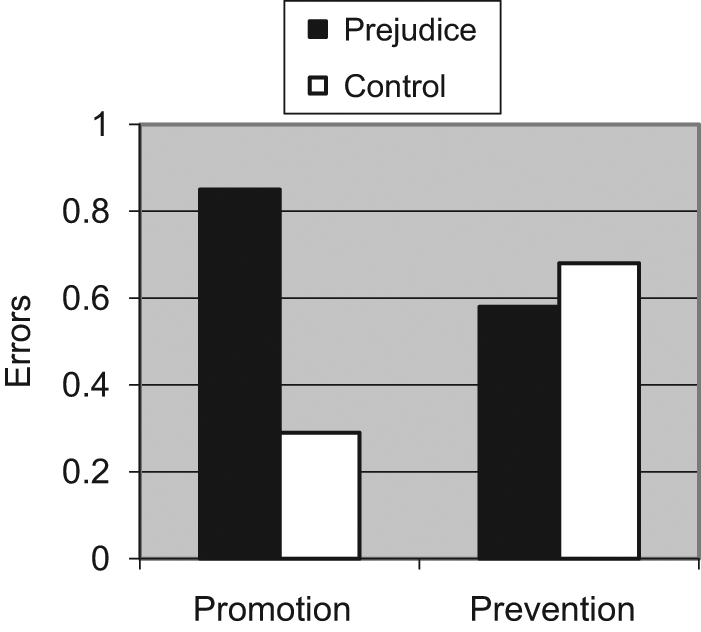
Average number of errors on Stroop trials preceded by a social acceptance prime as a function of prejudice expectations and regulatory focus, controlling for number of errors on nonsocial trials (Study 2).
An equivalent ANCOVA of prejudice prime trials (controlling for nonsocial prime trials) yielded a main effect of prejudice expectations, F(1, 105) = 6.45, p = .01,
Selective attention (response times)
We then examined selective attention based on response times. Only trials on which the color of the stimuli was correctly identified were included in these analyses, and responses more than 3 standard deviations from the mean were removed. We tested the predictions with a series of ANCOVAs.
To test whether prejudice expectations directed attention towards acceptance cues in the promotion focus condition, we conducted a 2 (prejudice expectations) × 2 (regulatory focus) ANCOVA on response times to acceptance prime trials (controlling for response times on nonsocial prime trials). Slower response times on these trials (controlling for response times on trials with a nonsocial prime) indicate that more attention is directed to the social acceptance prime. Consistent with results on Stroop errors, only the predicted Prejudice Expectations × Regulatory Focus interaction emerged, F(1, 105) = 3.02, p = .08,
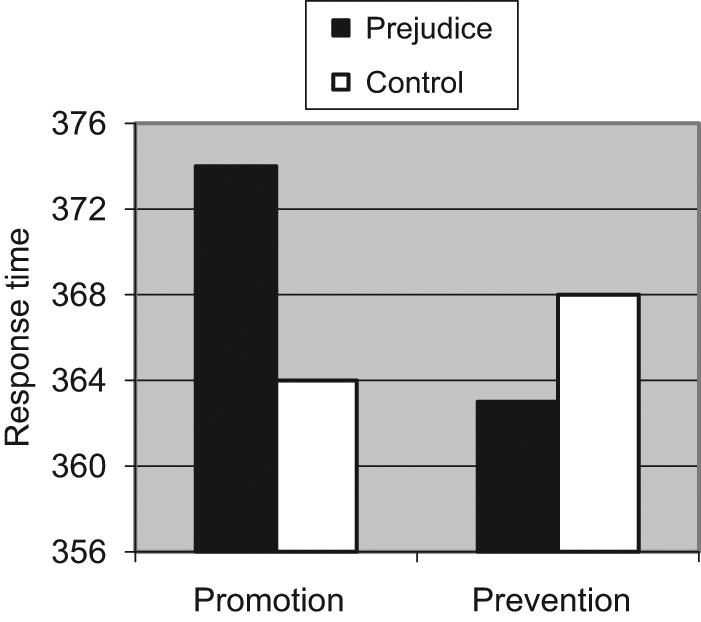
Average response times on Stroop trials preceded by a social acceptance prime as a function of prejudice expectations and regulatory focus, controlling for response times on nonsocial trials (Study 2).
To test whether prejudice expectations directed attention towards rejection cues in the prevention focus condition, we conducted an equivalent analysis on response times on prejudice prime trials (controlling for response times on nonsocial prime trials). Slower response times on these trials (controlling for response times on trials with a nonsocial prime) indicate that more attention is directed to the social rejection prime. This analysis yielded no significant effects, Fs < 1. Thus, consistent with results on Stroop errors, and with results from the first study, we found no support for the prediction that individuals respond to prejudice expectations by attending to social rejection cues when they are in a prevention focus. 2
Discussion
Prejudice expectations (vs. control) led to slightly slower responses and to a significantly higher number of errors on Stroop trials preceded by an acceptance prime in the promotion focus condition, but not in the prevention focus condition. This pattern of results provides additional support for our hypothesis that prejudice expectations direct attention towards social acceptance cues under a promotion focus. Notably, because regulatory focus was manipulated rather than measured in this study, these findings confirm that regulatory focus indeed has a causal effect on selective attention, and strongly suggest that the findings from the previous study were not due to some unknown third factor. Furthermore, this study demonstrates that the attention bias for acceptance cues when under a promotion focus emerges regardless of whether the stimuli are presented supraliminally (Study 1) or subliminally (Study 2).
Consistent with the first study, no support was found for the prediction that prejudice expectations direct attention towards rejection cues among individuals with a prevention focus. Instead, there was some suggestive evidence that individuals paid less attention to prejudice cues when they expected prejudiced treatment (irrespective of their regulatory focus), and that they paid less attention to prejudice cues when they were prevention focused than when they were promotion focused (irrespective of whether prejudice expectations were salient or not). However, because these unexpected main effects were found only in Study 2, and only on Stroop errors (not on response times), we believe they should be interpreted with caution. We will return to the broader question of why prejudice expectations did not direct attention towards social rejection cues when individuals were in a prevention focus in the General Discussion section.
General discussion
We adopted a self-regulation perspective to account for why prejudice expectations and other interpersonal rejection concerns sometimes lead to compensatory behaviors and an attention bias for signs of social acceptance (DeWall et al., 2009; Pickett et al., 2004; Shelton, 2003; Shelton et al., 2005), but in other cases lead to antisocial responses and a vigilant attention bias (Inzlicht et al., 2008; Kaiser et al., 2006). We proposed that these disparate responses can be understood as promotion- versus prevention-oriented strategies to deal with situations in which concerns about how one is evaluated are salient (Vorauer, 2006). According to regulatory focus theory (Higgins, 1997), individuals with a promotion focus are motivated to reach ideal end-states, prefer approach-oriented strategies in goal pursuit, and are sensitive to the presence or absence of positive outcomes. This led us to predict that salient prejudice expectations should direct attention towards signals of social acceptance in an attempt to facilitate the interaction when the individual is under a promotion focus. By contrast, individuals with a prevention focus are motivated to avoid negative end-states and are sensitive to the presence or absence of negative outcomes (Higgins, 1997). We therefore predicted that salient prejudice expectations should direct attention towards social rejection cues when the individual is under a prevention focus (cf. Kaiser et al., 2006).
Two studies provided convergent evidence that regulatory focus indeed moderates how prejudice expectations affect selective attention. As predicted, prejudice expectations caused an attention bias in favor of social acceptance cues under a promotion focus. Study 1 showed that prejudice expectations (vs. control) caused individuals with a strong (vs. weak) chronic promotion focus to direct their attention to male faces signaling social acceptance (vs. rejection). Study 2 demonstrated that the same pattern of results emerged when a promotion (vs. prevention) focus had been experimentally induced rather than measured, and when the acceptance-related stimuli were presented subliminally rather than supraliminally. Taken together, these findings strongly suggest that selectively attending to social acceptance cues is a promotion-oriented response to concerns about prejudiced treatment.
Meanwhile, prejudice expectations did not cause a vigilant attention bias among individuals under a prevention focus in any of the present studies. Notably, results were consistent irrespective of whether regulatory foci were experimentally induced or treated as chronic individual differences, and occurred across two different selective attention measures. Across selective attention measures we also varied the type of rejection stimuli used (contemptuous faces, prejudice-related words), as well as whether the stimuli were presented supraliminally or subliminally. Thus, whatever the reason is that prejudice expectations did not lead to an attention bias among individuals with a prevention focus, it appears to be the case across various methodologies.
So what can we make of the fact that we failed to find any evidence of a vigilant attention bias in response to prejudice expectations? First of all, it is important to note that the existing empirical evidence of such a bias is limited. To the best of our knowledge, the only studies that have demonstrated a causal relationship between prejudice expectations and attention to social rejection cues are the two studies by Kaiser et al. (2006). Notably, these studies did not contrast attention directed towards prejudice-related words with attention to socially diagnostic cues of a positive valence (i.e., acceptance cues). Instead, attention to prejudice-related words was compared with attention to threatening and neutral nonsocial words. These control stimuli were highly suitable to rule out that the bias was merely driven by negative valence. However, recent research has demonstrated that concerns about social rejection and exclusion can direct attention to social cues more generally (Gardner et al., 2000; Gardner et al., 2005; Pickett et al., 2004) and to social acceptance cues in particular (DeWall et al., 2009). In light of this, it seems plausible that the findings by Kaiser et al. may be indicative of a broader attention bias towards socially diagnostic information rather than a bias exclusively towards social identity threatening information. In short, we suspect that our current observations may be less inconsistent with the findings by Kaiser et al. than they initially appear to be.
Nevertheless, there are still good theoretical reasons to suspect that prejudice expectations could cause a vigilant attention bias towards social rejection cues, and that such a response would be orchestrated by the prevention focus. There are several possible explanations to why such a pattern did not emerge in the present studies. One possibility is that the prejudice expectations manipulation induced a strong prevention focus which cancelled out the effect of chronic prevention focus strength (Study 1) as well as the experimental prevention focus induction (Study 2). While this interpretation intuitively seems plausible (cf. Oyserman, Uskul, Yoder, Nesse, & Williams, 2007; Seibt & Förster, 2004), it fails to account for our pattern of results. After all, prejudice expectations did not lead to a vigilant attention bias across the board. Instead, prejudice expectations generated a marginally significant attention bias towards acceptance cues in our first study—an effect that was moderated by chronic promotion focus strength (and unrelated to prevention focus strength). In a similar vein, prejudice expectations appeared to reduce the amount of attention directed towards prejudice-related words in the second study, as indicated by fewer errors made on trials preceded by a prejudice-related prime. In short, while it remains plausible that a prejudice expectations manipulation could strengthen participants’ prevention focus such an effect cannot help account for the present findings.
Another explanation for the elusive vigilant attention bias is to be found among the underlying principles of selective attention paradigms and some new findings with regard to prevention focus and executive control. Selective attention is generally measured using dual-task paradigms (e.g., dot-probe tasks, emotional Stroop tasks). That is, while the participant is working on the focal task (e.g., identifying/localizing symbols or identifying the color of stimuli), stimuli that are irrelevant to the task at hand, but potentially relevant to other accessible goals, are presented on the screen. Ignoring task-irrelevant stimuli requires executive control, particularly when those stimuli are relevant to other accessible goals (e.g., Engle, 2002). Indeed, most selective attention paradigms rely upon this assumption: If the individual has another goal accessible (e.g., to reaffiliate with others), stimuli related to this goal (e.g., acceptance cues) should capture attention even though they are irrelevant to the focal task. Thus, attention biases as measured with dual-task paradigms can be conceptualized as executive control failures attributable to the influence of other accessible goals.
An interesting implication of this is that attention biases in dual-task paradigms should be more difficult to obtain among individuals with a high executive control capacity. After all, individuals with a high executive control capacity should be better able to ignore information that is irrelevant to the focal task. Notably, recent research suggests that individuals with a prevention focus respond to identity-threatening situations by recruiting additional executive control resources. As a consequence, they initially perform better on dual-task paradigms when they experience an identity threat than in a control condition (Ståhl, van Laar, & Ellemers, in press; cf. Koch, Holland, & van Knippenberg, 2008). Viewed in this light, it is possible that the rejection bias remained elusive in the present research because individuals with a prevention focus responded to the prejudice expectations manipulation by recruiting additional executive control resources. As a consequence, they may have been able to ignore stimuli related to other accessible goals (i.e., the rejection cues). This possibility could be examined in future research by including a cognitively demanding filler task prior to measuring selective attention. If this interpretation is correct, prejudice expectations should cause an attention bias for social rejection cues once the prevention-oriented individuals have exhausted some of their executive control resources.
Implications and suggestions for future research
The present research adds to a growing literature on how a self-regulation perspective can contribute to our understanding of reactions to prejudice expectations and other forms of interpersonal rejection concerns (e.g., Oyserman et al., 2007; Sassenberg & Hansen, 2007; Trawalter & Richeson, 2006). However, we are convinced that much more work can be done in this area. In a recent review Smart Richman and Leary (2009) proposed a set of plausible moderators of prosocial and antisocial responses to interpersonal rejection experiences. Specifically, they argued that prosocial (affiliative) responses to rejection concerns should be more likely when the relationship is important, when attempts to improve the relationship are expected to be successful, and when no alternative ways to satisfy the need to belong are available. By contrast, antisocial responses should be more likely when alternative ways to satisfy the need to belong are available, when the quality of the relationship is unlikely to improve, and when the rejection experience is perceived as unfair (Smart Richman & Leary, 2009).
From a self-regulation perspective, however, the relative influence of these factors, as well as the specific behavior they elicit, should ultimately depend on the individual’s regulatory focus. For example, previous research has demonstrated that positive expectancies generally have a stronger motivational impact on behavior when under a promotion focus (Shah & Higgins, 1997; Zaal, van Laar, Ståhl, Ellemers, & Derks, 2011). This suggests that expectations that the relationship can be improved primarily should initiate affiliative responses when under a promotion focus. By contrast, experiences with unfair or immoral treatment generally have stronger effects on negative affect and behavior when under a prevention focus (Oyserman et al., 2007; Sassenberg & Hansen, 2007; Zaal, van Laar, Ståhl, Ellemers, & Derks, 2011). This suggests that vigilance and antisocial responses may be particularly likely when the individual is under a prevention focus and the interaction partner’s (presumed) negative attitudes are perceived as unfair.
In addition, there is considerable evidence that individuals selectively attend to threatening stimuli when they are in an anxious emotional state (e.g., Downey, Mougios, Ayduk, London, & Shoda, 2004; Williams, Mathews, & Macleod, 1996; Yiend & Mathews, 2001). Notably, anxious emotional states emerge under a prevention focus in response to losses, whereas nongains lead to feelings of dejection under a promotion focus (e.g., Idson, Liberman, & Higgins, 2000). Another fruitful avenue for future research may therefore be to examine whether individuals with a prevention focus respond to repeated experiences with interpersonal rejection by becoming increasingly socially anxious, vigilant for signs of rejection, and prone to engage in antisocial behavior (cf. Oyserman et al., 2007; Pinel, 1999).
Finally, there may also be circumstances under which prejudice expectations and other interpersonal rejection concerns lead to affiliative responses when under a prevention focus. Recent research has demonstrated that individuals with a prevention focus switch from cautious to risky tactics in goal pursuit when risky tactics are perceived as necessary in order to escape a negative outcome (Scholer, Stroessner, & Higgins, 2008; Scholer, Zou, Fujita, Stroessner, & Higgins, 2010). We therefore speculate that individuals with a prevention focus may engage in desperate compensatory, affiliative attempts when getting along with the interaction partner is the only conceivable way to protect their sense of belongingness, or when the interaction partner’s (presumed) negative attitudes are perceived as legitimate.
In closing, we have demonstrated in two studies—using two different measures of selective attention—that individuals can respond to prejudice expectations by directing their attention towards social acceptance cues. As expected, this attention bias was found only when individuals were under a promotion focus. It seems plausible that the biased information-processing strategies adopted in response to prejudice expectations when under a promotion focus can contribute to more positive experiences when interacting with members of the outgroup (e.g., Shelton, 2003; Shelton et al., 2005). As a consequence, it may also help preventing negative self-fulfilling prophecies. On the other hand, their attention bias may also make promotion-oriented individuals less likely to pick up on subtle signs of prejudice and discrimination, and thus fail to address these issues. Ultimately, the current findings may therefore shed some new light on another—as yet unexamined—reason why members of stigmatized groups report so few personal experiences with discrimination, despite being aware of prejudice against their group, and despite the fact that they frequently expect to be targets of discrimination (Crosby, 1984; Taylor, Wright, Moghaddam, & Lalonde, 1990). To the extent that they are under a promotion focus, our findings suggest that their attention is likely to be directed towards signs of social acceptance rather than towards signs of social rejection.
Footnotes
Acknowledgements
The research reported in this article was funded by a VIDI-grant (452-06-010) from the Dutch National Science Foundation (NWO) awarded to Colette van Laar. We are very grateful to Joost Leunissen and Vincent de Rijke for their assistance in computer programming and data collection respectively, and to three anonymous reviewers for their valuable comments on an earlier version of this paper.