







Abstract
Although previous research has theorized about team interaction differences between the German and U.S. cultures, actual behavioral observations of such differences are sparse. This study explores team meetings as a context for examining intercultural differences. We analyzed a total of 5,188 meeting behaviors in German and U.S. student teams. All teams discussed the same task to consensus. Results from behavioral process analyses showed that German teams focused significantly more on problem analysis, whereas U.S. teams focused more on solution production. Moreover, U.S. teams showed significantly more positive socioemotional meeting behavior than German teams. Finally, German teams showed significantly more counteractive behavior such as complaining than U.S. teams. We discuss theoretical and pragmatic implications for understanding these observable differences and for improving interaction in intercultural teams.
Groups and teams researchers are becoming more interested in group and team processes across cultures (e.g., Bain, Park, Kwok, & Haslam, 2009; Tadmor, Satterstrom, Jang, & Polzer, 2012; Terry, Pelly, Lalonde, & Smith, 2006). Today people from multiple different nations meet on a regular basis and intercultural teams have become fixtures in our global workplace (e.g., Graf, 2004; Leung, Bhagat, Buchan, Erez, & Gibson, 2005). These growing connections across the globe imply the need to study psychological processes and behaviors at work in intercultural settings (Chao, Zhang, & Chiu, 2010). More specifically, to better understand intercultural team functioning, insights are needed concerning how core cultural perspectives influence team behaviors (Gudykunst, 2004; Thomas, Chang, & Abt, 2007; Varner & Beamer, 2011).
Building upon recent calls to study meetings across cultures in an effort to improve group, team, and organizational functioning (Elsayed-Elkhouly & Lazarus, 1995; Rogelberg, Allen, Shanock, Scott, & Shuffler, 2010; Rogerson-Revell, 2007, 2008), we investigate meeting behaviors and processes across two cultures: U.S. American culture and German culture. Presumably, meeting behaviors and meeting processes differ across cultures (e.g., Rogerson-Revell, 2007, 2008), and in this study we set out to investigate whether that is the case. First, we develop our theoretical rationale for studying culture in the meeting context, and we elaborate how behavioral meeting processes might differ depending on the cultural context in which they evolve. Second, using Hofestede’s (1980, 2001) theoretical framework of cultural value dimensions, we briefly review differences between the U.S.-American culture and the German culture as described in the existing literature. Third, we discuss the link between cultural values and meeting behaviors/processes and propose eight hypotheses concerning culturally driven differences in specific meeting behaviors. To test our hypotheses, we examine actual communicative behaviors using a previously established coding scheme (see Kauffeld & Lehmann-Willenbrock, 2012) and use sequential analysis to identify microbehavioral patterns. We conclude with a discussion of the theoretical and practical implications of our findings for global teams.
Team Behavior in the Meeting Context
Team meetings have become standard procedure in many contemporary organizations (e.g., continuous improvement process; Liker, 2006) and according to recent research and statistics, meetings appear to be an important and ubiquitous part of employees experiences in organizations (Rogelberg, Leach, Warr, & Burnfield, 2006; Rogelberg, Scott, & Kello, 2007). Calls to investigate meetings in organizations (Schwartzman, 1986) are being met with a slow increase in research investigations by various researchers (e.g., Rogelberg et al., 2010). Despite a growing body of research on team meetings (e.g., Leach, Rogelberg, Warr, & Burnfield, 2009; Luong & Rogelberg, 2005), the process components that can increase or decrease meeting effectiveness have remained somewhat vague. To understand what separates successful from less successful meetings, a growing body of research focuses on behavioral processes in team meetings (e.g., Kauffeld & Meyers, 2009; Lehmann-Willenbrock, Meyers, Kauffeld, Neininger, & Henschel, 2011).
In the present paper, we use a recently developed coding scheme for understanding team meeting processes (act4teams; e.g., Kauffeld & Lehmann-Willenbrock, 2012). Building on the team processes literature (e.g., Cooke & Szumal, 1994; Huang, 2009; Okhuysen & Eisenhardt, 2002; Wittenbaum et al., 2004) as well as earlier classifications of intragroup interaction, such as interaction process analysis (IPA; Bales, 1950) or time-by-event-by-member pattern observation (TEMPO; Futoran, Kelly, & McGrath, 1989), the act4teams coding scheme describes both functional and dysfunctional problem-solving processes in team interactions (Kauffeld & Lehmann-Willenbrock, 2012; a detailed explanation of the theoretical underpinnings of the act4teams coding scheme is described in Kauffeld, 2006). Specifically, act4teams describes four facets of (verbal) meeting behavior: Problem-solving behaviors, procedural behaviors, socioemotional behaviors, and action-oriented behaviors. Table 1 shows these four facets. Problem-solving behaviors concern behaviors aimed at analyzing problems, generating ideas, and developing solutions. Positive procedural behaviors are aimed at structuring the meeting process, for example by leading back to the topic (goal orientation, see Table 1). Negative procedural behaviors on the other hand lead to a loss of structure. Socioemotional behaviors indicate the social relationships between team members. Positive behaviors include support or giving feedback; negative behaviors include criticizing or interrupting others (see Table 1). Finally, action-oriented behaviors describe whether a team is willing to take responsibility and actively improve their work, or whether they deny responsibility or complain instead.
Meeting behaviors coding scheme.
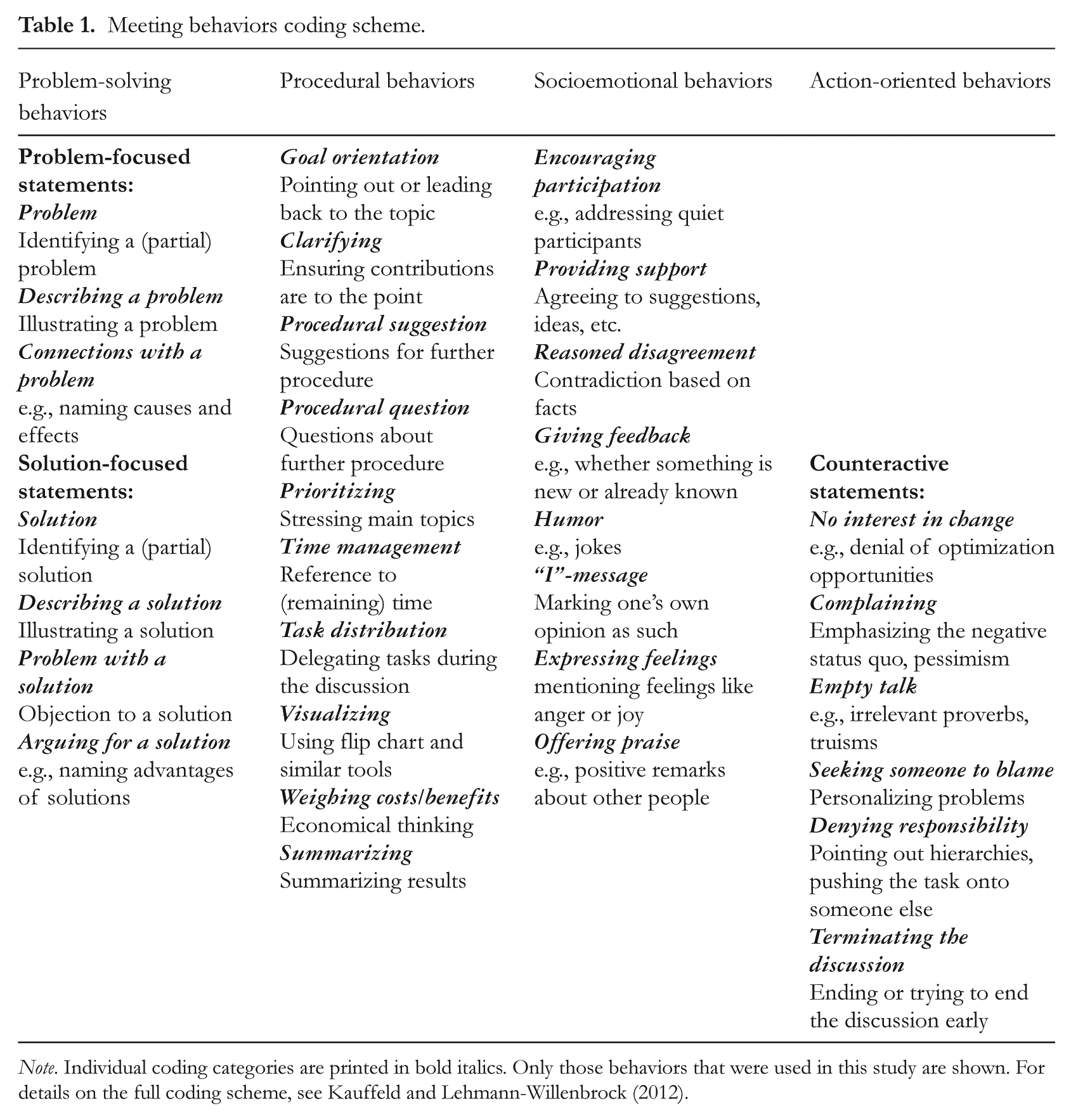
Note. Individual coding categories are printed in bold italics. Only those behaviors that were used in this study are shown. For details on the full coding scheme, see Kauffeld and Lehmann-Willenbrock (2012).
The empirical validity of this coding scheme for meeting behavior has been demonstrated by Kauffeld and Lehmann-Willenbrock (2012). Internal consistencies (Cronbach’s alpha) of the subfacets within the coding scheme ranged from .60 for solution-focused statements to .86 for positive procedural statements. Moreover, in terms of criterion-related validity, the meeting behaviors identified with the act4teams coding scheme showed significant links to relevant outcomes. Functional, positive meeting behaviors such as solution-focused statements or structuring statements were positively correlated with meeting satisfaction, subsequent team productivity, and organizational success. On the other hand, dysfunctional, negative behaviors such as losing the train of thought, criticizing others, or complaining showed significant negative links with these team and organizational outcomes beyond the team meeting (Kauffeld & Lehmann-Willenbrock, 2012).
The coding scheme as a methodology has been used in several samples from Germany (Kauffeld & Lehmann-Willenbrock, 2012; Kauffeld & Meyers, 2009; Lehmann-Willenbrock et al., 2011). However, any of the conclusions drawn in these previous studies apply to a German cultural background only. Despite recent calls for studying meetings embedded in different cultures (Sprain & Boromisza-Habashi, 2012), very little empirical research has focused on comparing team meeting behaviors across cultures. One exception is Rogerson-Revell’s (2007) study concerning the use of humor in intercultural meetings. Rogerson-Revell’s (2007) study, however, focused on meetings where participants in a given meeting were from different cultures and how cultural differences of the participants impacted their use of humor in the meeting context. To date, no study has investigated how monocultural meetings are different across cultures (e.g., an all U.S. American team meeting vs. an all German team meeting). Our study is the first to address this gap. Through a review of Hofstede’s (1980, 2001) value dimensions, we discuss some of the differences between Germany and the United States as described in the intercultural literature, and we elaborate how these differences might become observable in team meetings.
Cultures in Comparison: Germany and the United States
One way to distinguish between national cultures is by delineating value dimensions (cf. House, Javidan, Hanges, & Dorfman, 2002). One of the most prominent researchers in this domain is Hofstede (1980, 1991, 2001), who identified five value dimensions—power distance, uncertainty avoidance, collectivism/individualism, femininity/masculinity, and long-term versus short-term orientation.
Much research on value dimensions has focused on uncertainty avoidance and individualism/collectivism. Uncertainty avoidance refers to how people in a culture cope with the unpredictable and the ambiguous, how they deal with a lack of knowledge about the future, and to what extent they experience fear of the unknown (Hofstede, 2001). Cultures differ in terms of avoiding or tolerating uncertainty. Uncertainty avoidant cultures tend to believe that what is different is dangerous, and have developed ways to cope with uncertainty and potential anxiety about the future. For example, in the organizational context, important elements of uncertainty avoidance include the use of technology, rules, and rituals (Hofstede, 2001). The Uncertainty Avoidance Index (UAI; Hofstede, 2001) is used to measure tolerance for uncertainty across countries. Cultures with a high UAI (e.g., Germany) have a strong need to determine their future and tend to avoid risk. Alternatively, in low uncertainty avoidance cultures (e.g., U.S.-American), people are generally more willing to accept risks because they have greater confidence in their ability to succeed (Hofstede, 2001). Hence, Germans tend to be less comfortable with uncertainty and more reluctant to take risks, whereas U.S.-Americans are more likely to favor risky alternatives. In terms of meeting behavior, Germans tend to be more likely to carefully analyze problems and critically evaluate possible alternatives, whereas U.S.-Americans may spend less time analyzing problems and therefore may produce solutions more quickly.
Hofstede’s (2001) second value dimension describes cultures based on levels of collectivism and individualism. In individualistic cultures, each individual team member’s ideas are deemed important so teams encourage expression of original ideas, whereas in collectivistic cultures, teams tend to value consensus and loyalty over individual inventiveness (Hofstede, 2001; for empirical applications of this framework, see also Hirokawa & Miyahara, 1986; Hsu, 2007; Kim & Sharkey, 1995; Roach, Cornett-Devito, & Devito, 2005; Zhang, 2005, among others). While both the German and the U.S.-American culture are considered individualist cultures, Germans are considerably less individualistic than U.S.-Americans, who score the highest out of all countries on individualism (Hofstede, 2001).
This theory outlines the main cultural assumptions and practices that undergird our expectations that German and U.S. teams will differ in the ways they structure and proceed throughout teamwork. Next, we describe how these assumptions can be studied in practice through the lens of meeting processes.
Problem- Versus Solution-Focused Communication in Team Meetings
To date, there is little research that compares the practices of German and American team meetings. One exception is a qualitative study by Schroll-Machl (1996), who interviewed U.S. and German employees working together in intercultural teams in an electronic company in Germany. Her results showed that U.S.-Americans were oriented more toward finding solutions to accomplish a final goal, whereas Germans focused more on problem analysis (Schroll-Machl, 1996). Related research corroborates Schroll-Machl’s (1996) findings. Stewart and Bennett (1991) found that U.S. teams often employ a trial-and-error method, whereby teams identify their overall goal and then produce several different solutions to address that objective. To select the best solution, they proceed by persuading, arguing, and compromising until a final solution wins enough adherents (Hall & Hall, 1983; Schroll-Machl, 1996).
Conversely, studies on German teams highlight the importance of the problem analysis process (Schroll-Machl, 1996). Germans tend to concentrate on gathering precise details and as much information as possible (Schroll-Machl, 1996). In contrast to U.S.-Americans, German teams often do not clearly define their goals until later in the discussion after they have obtained sufficient details and information about the problem (Dentler, 1977). Furthermore, German teams tend to seek the one perfect solution instead of testing a variety of solutions (Hall & Hall, 1983).
This set of investigations provides valuable information about differences in German and U.S. team decision-making practices but has primarily relied on self-reports from members in the relevant cultures. To date we know of no studies of German and U.S.-American teams that have examined actual decision-making communication (i.e., using behavior observations) to explore and infer intercultural differences between members of these two cultures. This study offers an initial attempt toward addressing that research goal.
Based on past theory and research, we expect that German and U.S.-American decision-making interactions will show differing decision logics at play. We presume that German teams will be especially focused on problem analysis in their discussions (Hall & Hall, 1983; Hofstede, 1980, 2001; Schroll-Machl, 1996, 2008) whereas U.S.-American teams will be more solution-focused. We hypothesize: H1: The frequency of problem-focused communicative behaviors is significantly higher in German than in U.S. team meetings. H2: The frequency of solution-focused communicative behaviors is significantly higher in U.S. than in German team meetings.
Procedural Meeting Behaviors
Previous research employing the theoretical lens of Hofstede’s framework further suggests cultural differences between the U.S. and Germany on the dimension of uncertainty avoidance (Hofstede, 1980, 2001). Basically, uncertainty avoidance corresponds to the general tendency for humans to seek to avoid ambiguity (Barker et al., 2000). Heightened ambiguity is negatively related to desirable workplace outcomes, including meeting satisfaction (see Scott, Allen, Bonilla, Baran, & Murphy, in press). These findings apply to the U.S. culture, which has relatively low uncertainty avoidance. However, in comparison to the U.S. Germany scores considerably higher on the uncertainty dimension (e.g., Hofstede, 2001), suggesting that the desire to reduce ambiguity must be rather intense. One way to reduce ambiguity in the specific context of team meetings is the use of procedural communicative behaviors (see Table 1). Positive procedural communication comprises statements aimed at leading back to the subject, prioritizing, or concretizing other people’s contributions to the meeting. Based on the differences in uncertainty avoidance between Germany and the U.S. as identified in Hofstede’s (1980, 2001) research, we expect that procedural communicative behaviors will be more frequent in German team meetings.
H3: German team meetings are characterized by significantly more procedural communicative behaviors than U.S. team meetings.
Socioemotional Meeting Behaviors
As described before, the U.S. is considerably more individualistic than Germany (Hofstede, 1980, 2001). Although little is known about the ways this difference might be expressed in the meeting context, some previous research suggests that the difference in individualism between the two cultures could be linked to differences in socioemotional behavior. According to Hofstede, a typical conversation in a German cultural context is characterized by a large degree of honesty, even if it hurts. Consequently, Germans are perceived to be among the most direct communicators in the world (Yin, 2002). Presumably, the strategy “be honest even if it hurts” offers the other party the opportunity to understand and learn from possible mistakes. In a qualitative study, Yin (2002) explored the concept of German wahrheit (truth), in terms of a German standard for communicating in public. She describes wahrheit as expressions of an individual’s personal opinions, using the first pronoun: “The wahrheit can be displayed in a manner that implicitly or explicitly indicates the rightness of one’s own opinion. In public talk, as one German informant put it, ‘Telling the wahrheit hurts a little bit, but it’s okay’” (Yin, 2002, p. 249). As a result, frank and forthright discussion with open disagreement for the sake of the discussion is preferred. Indeed, not directly telling the wahrheit was perceived as hiding personal opinions or lying by the German participants in Yin’s (2002) study.
On the other hand, the U.S.-Americans in Yin’s (2002) study showed a preference for reciprocity as a communicative standard. For U.S.-Americans, communication is closely linked to the concept of sharing. This implies that personal problems, perceptions, or experiences can be disclosed and discussed freely with others (Katriel & Philipsen, 1981; Yin, 2002). In addition, Yin’s (2002) qualitative results show that the U.S.-American participants used communication as a means to convey a positive self-image (i.e., appearing informed and knowledgeable). This result could be due to the particularly high value of the U.S. culture on Hofstede’s individualism dimension. Interestingly, the U.S. participants in Yin’s (2002) study were also concerned about making others feel good about themselves as well (i.e., equally important and validated). Yin (2002) concludes that there is a reciprocity principle inherent in U.S. cultural communication standards.
We expect that these differences in communication rules (German wahrheit and American self-promotion/reciprocity) will be observable in meetings as well. Specifically, as a result of these different standards, the use of socioemotional meeting communication should differ across the two cultures. Positive socioemotional meeting behaviors such as encouraging participation, giving feedback, and marking one’s own opinion as such (“I”-messages) should serve the U.S.-American rules, whereas German meetings should show less of these behaviors. We hypothesize: H4: U.S.-American team meetings are characterized by significantly more positive socioemotional behaviors than German team meetings.
Counteractive Meeting Behaviors
Counteractive meeting behaviors comprise dysfunctional behaviors such as complaining, seeking someone to blame, or trying to end the discussion early (e.g., Kauffeld & Lehmann-Willenbrock, 2012; see Table 1). These behaviors are problematic because of their frequency, and particularly because they tend to occur in patterns (e.g., complaining cycles; see Kauffeld & Meyers, 2009; Lehmann-Willenbrock et al., 2011). Several previous studies on meeting interaction from a German cultural background have found that complaining is a pervasive behavior in team meetings (Kauffeld & Lehmann-Willenbrock, 2012; Kauffeld & Meyers, 2009; Lehmann-Willenbrock & Kauffeld, 2010). On average, a typical team meeting in German organizations contains 52 complaining statements, as opposed to only two positive action planning statements (Kauffeld & Lehmann-Willenbrock, 2012).
Given that previous studies on meeting processes used German samples, we are interested in understanding potential cultural differences in the frequency of counteractive behaviors. Some authors examining complaining patterns in (German) team meetings have suggested that complaining might be characteristic of German meetings in particular (Lehmann-Willenbrock et al., 2011). One of the reasons for the pervasiveness of complaining in German team meetings may be that German teams tend to place a stronger emphasis on problem analysis in their meetings (Kauffeld & Lehmann-Willenbrock, 2012). Arguably, when a team spends too much time focusing on problems rather than generating ideas and solutions, complaining becomes more likely.
Additionally, Yin’s (2002) findings suggest that German and U.S.-American meetings might differ in terms of the frequency of counteractive meeting behaviors. Her finding that Germans were more outspoken, cared particularly for telling the honest truth (even if it hurts), and expected others to do so as well, could imply a higher tendency to show counteractive behavior. For example, complaining as one type of counteractive behavior can also be an expression of honest criticism of the current situation. Similarly, complaining can be used as a means to “vent” about the current situation of a team (cf. Lehmann-Willenbrock & Kauffeld, 2010). We argue that these behaviors will only occur if they are socially acceptable. According to Yin (2002), open and honest criticism is far more likely among Germans compared to U.S.-Americans. Seen through this lens, we state the following hypothesis: H5: The frequency of counteractive behaviors is higher in German team meetings than in U.S.-American team meetings.
Substantiation of Intercultural Differences: Interaction Patterns
Assuming the foregoing hypotheses receive some support, it is believed that the overall differences in German and U.S.-American meetings may be further observed in the communication processes or patterns within these meetings. One promising approach to identify such patterns is sequential analysis (e.g., Bakeman & Gottman, 1997; Sackett, 1979, 1987).
Previous sequential analysis research with teams from German organizations has identified such patterns within team meetings. More specifically, this previous research has identified complaining patterns, in which one team member’s complaining encourages agreement and more complaining, getting teams “stuck” in a negative loop (Kauffeld & Meyers, 2009; Lehmann-Willenbrock & Kauffeld, 2010; Lehmann-Willenbrock et al., 2011). On the upside, previous studies have also identified positive, functional interaction cycles such as solution cycles (e.g., solution–providing support–solution), humor cycles (e.g., humor–laughter–humor), and proactive patterns (e.g., positivity–support–positivity; Hebl et al., 2009; Kauffeld & Meyers, 2009; Lehmann-Willenbrock et al., 2011).
For the current study, these previous findings suggest that any overall differences in team meeting interaction across cultures should manifest themselves in different patterns within these meetings as well. Concerning our first set of hypotheses, we would expect that the higher frequency of problem-focused communication in German team meetings (H1) versus the higher frequency of solution-focused communication in U.S.-American team meetings (H2) will be observable in terms of different communicative patterns within these meetings as well. Specifically, German team meetings would show more problem-focused patterns within their meeting process compared to U.S.-American team meetings, whereas U.S.-American team meetings would have more solution-focused cycles compared to German team meetings. Moreover, in line with the hypothesized preference for procedural communication in German meetings (H3), we would expect procedural sequences or patterns to manifest in German meeting processes more so than in U.S.-American meeting processes. Furthermore, the presumed preference for socioemotional communication in U.S.-American meetings (H4) should be expressed in terms of increased socioemotional sequential sequences, whereas German meeting processes should show considerably less socioemotional patterns. We thus hypothesize: H6: German team meeting processes are characterized by (a) more problem-focused sequences and (b) more procedural sequences than U.S. American team meetings. H7: U.S.-American team meeting processes are characterized by more (a) solution-focused sequences and (b) positive socioemotional sequences as compared to German team meeting processes.
Finally, we would also expect differential counteractive meeting behavior patterns between U.S.-American and German team meetings. Our earlier argument that counteractive behavior such as complaining becomes more likely when teams engage in substantial amounts of problem-focused communication implies sequential relationships within the team interaction process. We would expect overall counteractive behaviors in German teams to be sustained in counteractive patterns within the meeting process as well (cf. Kauffeld & Meyers, 2009; Lehmann-Willenbrock et al., 2011), whereas we would expect little or no such cycles in U.S.-American meeting processes. Specifically, we hypothesize: H8: In German meetings, counteractive behavior is more likely after a problem-focused behavior compared to U.S.-American meetings.
Method
Sample
To test our hypotheses, we analyzed a total of 5,188 meeting behaviors, nested in 125 individuals participating in 30 team meetings. Participants were 73 U.S.-American individuals (53 female and 20 male) from a Midwestern university and 52 individuals (41 female and 11 male) from a university in Germany. This resulted in a total of 15 U.S. teams and 15 German teams. The U.S. students were undergraduate students (sophomores, juniors, and seniors) enrolled in communication courses. The project occurred at the end of a semester in which they had been classmates and occasional group discussion partners, so teams were quasihistory, rather than zero-history, teams. The U.S.-American teams included 13 teams of five members and two teams of four members. Students received extra credit for their involvement.
Among the German teams, 47 of the participants were undergraduate students (sophomores, juniors, and seniors) and five participants were graduate students. With the exception of five students, all were psychology students. Thirty students (eight teams) took part in this study in their psychology class so they knew each other resulting in quasihistory teams. The other participants were recruited via a researcher request resulting in seven zero-history teams. There were eight three-person teams and seven four-person teams. The German teams were slightly smaller because recruitment proved somewhat difficult. Students earned extra credit for their involvement in the project. All students participated voluntarily.
Meeting Context and Procedure
All team meetings were spent discussing the same task that required reaching a consensus decision (see Appendix). The German students discussed a translated version of the task that was back-translated to English by two bilingual colleagues to check for accuracy and reliability before the data collection started.
The U.S. students were assigned randomly to teams of five members prior to the research session (two students failed to show up). Upon arriving at the session, each participant was given the task and asked to read it carefully. The group was convened and members discussed the task to consensus. Each group decision choice was recorded on the task description sheet and was then collected by the researcher.
The German students were assigned randomly to teams of three or four people. Upon arrival at the investigation site, each student received a copy of the group discussion task. Like the U.S. students, the German students were instructed to read the task carefully. Then, the students discussed the task to consensus and marked their group decision on the extra task description sheet provided. All student teams, U.S.-Americans and Germans, agreed to be videotaped. There was no given time limit for the group discussion. On average, we found 170.6 statements in the German group discussions and 175.3 statements in the American group discussions. The average discussion time was 10 minutes and 10 seconds in the German groups and 9 minutes and 41 seconds in the American groups.
Unitizing and Coding
The act4teams coding scheme (e.g., Kauffeld & Lehmann-Willenbrock, 2012; Lehmann-Willenbrock & Kauffeld, 2010) was used to code the verbal interaction in all group discussions (see Table 1). Unitizing and coding was performed using INTERACT software (Mangold, 2010). First, the transcriptions were unitized into sense (or thought) units (cf. Bales, 1950). Each unit expressed a single message or thought. Unitizing rules were created for identifying thought units, and coders were trained to identify these units. When unitizing was completed, each unit was coded into one of the 34 categories of the act4teams coding scheme by two bilingual coders. Interrater reliability was calculated according to Cohen (1960) using a subsample of 12 group discussions which were coded by the two coders independently. Interrater reliability reached k = .87. To account for differing lengths of discussion, the number of codes per category was divided by the length of the video in minutes and then multiplied by 10 to standardize all discussions to a 10-minute period (see Bakeman & Quera, 2011, pp. 96–97).
Lag Sequential Analysis
After coding our data, we used lag sequential analysis to explore potentially different patterns within the German and U.S.-American team interaction processes. Lag sequential analysis identifies temporal patterns in sequentially coded behavioral events. It further determines whether these behavioral sequences emerge above and beyond chance (Bakeman & Gottman, 1997; Bakeman & Quera, 1995, 2011; Benes, Gutkin, & Kramer, 1995; Sackett, 1979, 1987). We performed two separate sequential analytic procedures: One analysis for the pool of U.S.-American team meetings and a second analysis for the pool of German team meetings. Using INTERACT software, we first calculated transition frequencies between our observation categories (i.e., how often each behavioral code was followed by any other code). Based on these transition frequencies, INTERACT computes conditional transition probabilities of each event following another (Benes et al., 1995). To examine whether a transition probability differs significantly from the unconditional probability for the event that follows, we calculated z-values (cf. Bakeman & Gottman, 1997). A z-value larger than 1.95 or smaller than −1.95 implies that a behavioral sequence occurs above chance. At Lag1, sequential analysis required a minimum of 315 behavioral sequences when using 34 observational codes (see formula in Bakeman & Gottman, 1986, p. 149). This was feasible, as we had 5,188 events in our data. Lag2 analyses however were not feasible (they would have required a minimum of 10,107 sequences when using 34 observation codes; see Bakeman & Gottman, 1986). We therefore focused on Lag1 sequences (i.e., from one behavior to the behavior immediately afterwards).
Results
All hypotheses were tested at the team level. We chose a nonparametric test to examine differences in the frequencies of specific behaviors between the German and U.S. teams. The Mann-Whitney U-test (also known as Wilcoxon rank sum test; e.g., McKnight & Najab, 2010) for independent samples is a nonparametric statistic test that accommodated our small sample size at the group level. Moreover, as opposed to t tests for comparing means, the U-test does not require normal distribution. Prior to testing our hypotheses, we explored whether there were any significant differences due to the fact that some of the German groups were semihistory groups (who knew each other from class; N = 9), while others were ad hoc groups (N = 6). We compared these two subsets of the sample on all variables of interest. U-tests revealed no significant differences between them.
Differences in Problem-Focused Meeting Behaviors (H1)
Our first hypothesis posited that German teams would exhibit more problem-focused communication (problems, describing problems, and connection with problems; see Table 1) than their U.S. counterparts. The Mann-Whitney U-test (two-tailed) showed a significant difference concerning problem-focused communication in the German and U.S. teams (z = −3.26, p = .001, two-tailed). The average frequency of problem-focused communication in the German teams was 12.87 statements per 10-minute period (SD = 4.74), compared to only 5.84 statements in the U.S.-American teams (SD = 4.83). These findings support Hypothesis 1.
Differences in Solution-Focused Meeting Behaviors (H2)
Our second hypothesis predicted that U.S. teams would be more solution-oriented than German teams in terms of their observable meeting behaviors. When comparing German and U.S. teams concerning solution-oriented communication (solutions, describing solutions, connections with solutions, or problems with a solution; see Table 2), the Mann-Whitney U-test was again significant (z = −2.43, p = .015). The average frequency of solution-oriented communication for the German teams was 29.21 statements per 10-minute period (SD = 10.38). In comparison, the average frequency of solution-oriented statements for U.S. teams was 41.65 statements per 10-minute period (SD = 13.30). Hypothesis 2 was supported.
Differences in Procedural Meeting Behaviors (H3)
Our third hypothesis posited that positive procedural statements would be more frequent in the German than in the U.S.-American meetings. Indeed, we found more procedural behaviors in the German teams (M = 10.4, SD = 5.08) than in the U.S.-American teams (M = 5.68, SD = 4.57). The U-test showed that this difference was significant (z = −2.68, p = .007), thus lending support to Hypothesis 3.
Differences in Socioemotional Meeting Behaviors (H4)
Fourth, we examined differences in socioemotional meeting behaviors. Although socioemotional behaviors were frequent across all meetings, we did find a significant difference between the two cultures. As expected, socioemotional meeting behaviors were significantly more frequent (z = −3.05, p = .002) in the U.S.-American team meetings, with an average of 68.33 positive socioemotional behaviors per 10-minute period (SD = 12.03). In comparison, there were 50.08 positive socioemotional behaviors per 10-minute period in the average German team meeting (SD = 13.48). These findings support Hypothesis 4.
Differences in Counteractive Meeting Behaviors (H5)
Our fifth hypothesis suggested that German teams would exhibit more counteractive meeting behaviors compared to U.S. teams. The U-test showed that this difference was significant (z = −2.06, p = .042). In the average German team meeting in our sample, counteractive behaviors occurred more than twice as often as in the average U.S.-American meeting (M = 1.81, SD = 1.83 in the German meetings; M = 0.71, SD = 1.05 in the U.S.-American meetings). These findings support Hypothesis 5. Figure 1 illustrates the differences in the frequency of the specific meeting behaviors across the two cultures.
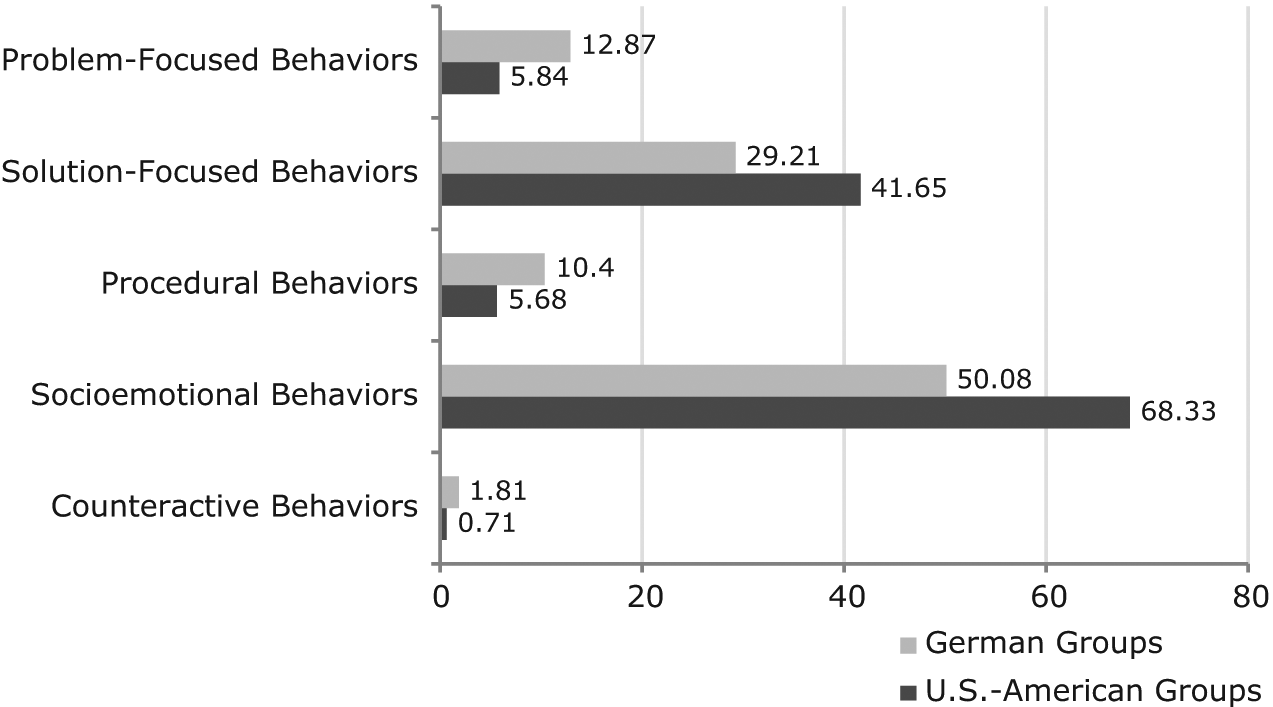
Average frequencies of meeting behaviors per 10-minute period in the German and U.S.-American team meetings.
Differences in Interaction Patterns (H6–H8)
Using sequential analysis, we tested whether the differences in communication between U.S.-American and German teams would be sustained in terms of different interaction sequences within their respective meeting processes. Hypothesis 6a posited that German meeting processes would be characterized by more problem-focused sequences than U.S.-American meeting processes. Lag sequential analysis revealed that the following significant problem sequences were significant in the German meetings: Problem–problem (z = 1.99), problem–explaining a problem (z = 8.31), and explaining a problem–explaining a problem (z = 4.76). On the other hand, we observed no significant problem-focused sequences in the U.S.-American meetings. These findings fully support H6a.
Sequential analysis further showed that German meeting processes were characterized by procedural sequences. Lending support to H6b, we indeed found significant Lag1 procedural sequences in the German team meeting processes that help explain why the overall frequency of procedural statements was higher in the German compared to the U.S.-American teams. Specifically, goal orientation–summarizing (z = 2.48), summarizing–procedural suggestion (z = 2.65) and procedural suggestion–procedural question (z = 2.03) were significant sequences in the German team meeting processes. In comparison, the U.S.-American meeting processes showed only one significant procedural sequence (procedural suggestion–summarizing; z = 2.43).
As expected, the U.S.-American teams showed a considerable amount of solution-focused behavioral sequences. Both the sequences new solution–explaining a solution (z = 4.42), explaining a solution–new solution (z = 2.24) were significant. The likelihood of new ideas following each other was also positive, albeit not significantly so (z = 1.39). In contrast, the likelihood of new ideas following each other or explanations of solutions following each other within the German interaction processes was low (z = −1.29 and z = −1.34). Similarly, however, the German interaction processes also contained significant solution–explaining a solution sequences (z = 5.36). The sequence explaining a solution–new solution was not significant (z = −.30). The overall frequency of significant solution sequences (i.e., crossover frequencies) amounted to 42 in the U.S.-American teams, compared to only 24 sequences in the German teams. Taken together, these findings largely support H7a.
Furthermore, sequential analysis revealed significant positive socioemotional patterns in the U.S.-American team meetings, such as encouraging participation–feedback (z = 4.33). However, since this sequence was also significant in the German team interaction processes (z = 3.91), we rejected 7b. Finally, we intended to use sequential analysis to test our earlier assumption that problem-focused statements, which were significantly more frequent overall in the German teams, would likely promote counteractive behavior. However, counteractive behavior was extremely rare in our sample, and we could not identify any significant sequences. H8 was rejected.
Discussion
This study took first steps to identify cultural differences between U.S.-American and German teams by analyzing and comparing team meeting behaviors across these two cultures. Our findings reinforce and extend past research findings by identifying more explicitly how culture is manifest in observable meeting behaviors. Specifically, German meetings showed a stronger focus on problem analysis and U.S. meetings focused more on solution production. Moreover, the German meetings were characterized by significantly more procedural behaviors that the U.S. meetings. A third identifiable difference concerned socioemotional communication. The U.S. meeting participants engaged in significantly more positive socioemotional meeting behaviors than their German counterparts. In addition, we found increased overall counteractive behaviors in the German as opposed to the U.S. team meetings. Finally, using sequential analysis, we found that German meetings were characterized by problem-focused and procedural patterns. U.S.-American meetings on the other hand had no problem-focused sequences, but were rather characterized by solution-focused sequences, compared to their German counterparts. Upon discussing the qualitative component of the results in more detail in the following section, we proceed to identify theoretical implications of our findings for intercultural studies and meetings research, and we offer several practical implications based on our findings.
Problems Versus Solutions
The frequencies of problem, problem identification, and problem analysis statements were all significantly more frequent in German than in U.S. meetings. Thus, the German teams focused on problem talk more so than the U.S. team members. A qualitative examination of the actual communication in the German teams showed how concerned they were with what they perceived to be a lack of information needed to solve the problem thoroughly and completely. Almost all of the German teams mentioned that the task was too vague and there was too little information to make a clear decision. Examples of these types of statements from the data include: “We have so little information about this Mr. R”; “It is hard to say because we don’t know more about this person”; “Well, we actually don’t know anything about him”; “What bothers me is that it doesn’t say how diligent he is”; or “He isn’t described well enough, I think.”
These statements reinforce Hall and Hall’s (1983) contention that Germans desire a substantial amount of background information before making a decision, and prefer clarity over uncertainty (Hofstede, 1980, 2001). Moreover our qualitative analysis showed that the German teams often communicated using if–then statements in an apparent effort to better understand the problem and the issue of risk, as illustrated by the following examples: “If he was just average then I wouldn’t advise him to go to University X”; “If he’s very ambitious and doesn’t mind the stress that much, then I would say that he should definitely try to go to that harder university”; “If he is older, then I’d even think that it should be 90 or 100 percent that he gets the degree.” These if–then statements are coded as connections with a problem (see Table 1). Overall, we found 40.3 such statements in the German meetings as opposed to only 17.6 statements in the American meetings.
In sum, the German students were concerned about the uncertainty of the information and the impact that had on their ability to thoroughly analyze the problem. These results correspond to Hofstede’s (1980, 2001) findings that Germans score higher on the Uncertainty Avoidance Index (UAI), and feel it is necessary to analyze the task very thoroughly. Also, according to Hall and Hall (1983), Germans prefer to have a great deal of background information on a problem before projecting possible solutions. Hence the German students found it hard to produce solutions because of their perception of missing information about Mr. R. One student noted that “There are just so many factors that you should take into account … also about his personality, just to really, really, to be able to rate it more precisely.”
In contrast to the German teams, the U.S. students focused more on solution production. The frequencies of solution statements overall (solutions, describing solutions, connections with solutions, or problems with a solution) were significantly higher in the U.S. than in the German group discussions. Interestingly, the only category in which the Germans produced more solution-focused statements was in the “problem with a solution” category. The difference is slight (Germans = 3.63 statements; U.S.-American = 3.06 statements per 10-minute period), but this finding again points to the German proclivity for problem analysis.
A closer look at the actual communication content showed that U.S. team members often made statements aimed at getting team members to overlook missing information about the problem, for example: “When you start thinking about it, if you try and think of things that aren’t in here, you have to realize that you can add any number on either side and so instead of doing that, well let’s just deal with what’s on the paper”.
These findings reinforce previous literature (e.g., Hall & Hall, 1983; Hofstede, 2001; Schroll-Machl, 1996), indicating that U.S.-Americans are driven to find solutions quickly and are less afraid of uncertainty. Thus, they came up with many solutions in discussions often without a complete and thorough analysis of the problem. A qualitative analysis of the data showed a plethora of these types of statements in the U.S. teams, as illustrated by the following examples: “I would advise him to go for the gusto. If it were only a 3 in 10 thing, then I would tell him [to go]”; “I’m almost going for 1 in 10 ‘cuz he’s one person, that’s all he needs, you know”; “See, if he’s done that well to get in, 4, I would say 4, I’d go 4”; or “I put 5 out of 10, because it seems like, well that’s a pretty fair shot, you know.”
Procedural Meeting Behaviors
Because Germany scores a high value on the uncertainty avoidance dimension (e.g., Hofstede, 2001), we expected that German participants should have a greater need for structure in their meetings, which should be expressed in a greater amount of procedural communication. Indeed, we found that German team meetings were characterized by significantly more procedural meeting behaviors such as clarifying, procedural questions, or visualizing than U.S.-American team meetings. For example, German teams would make procedural statements such as “Well, who wants to start?” and “So should we just start at the beginning and everyone says what they think is the right answer?” These statements would be preceded and followed by additional statements concerning procedures considered desirable in the meeting. The average German team meeting contained almost twice as many procedural behaviors compared to the average U.S.-American team meeting. This finding lends support to our rationale that differences on the uncertainty avoidance dimension are expressed in team meeting behaviors.
Socioemotional Meeting Behaviors
Although both the German and the American teams frequently showed socioemotional behaviors, we did find a difference here as well. On average, the U.S.-American participants showed a significantly higher amount of these behaviors than their German counterparts. This finding is in line with Yin’s (2002) notion of different communication standards between Germans and U.S.-Americans. Her argument that Americans use self-promotion and ingratiating statements, both to foster a positive self-image and to let others do the same, links to our finding that the American participants in our study were particularly prone to using socioemotional meeting behaviors. For example, the following kinds of statements were common in the U.S. American teams: “That’s true, okay, that’s a good point”; “That’s OK”; “Yes, I think that’s an excellent point”; and “I really think that’s a good point.” On the other hand, the German value of wahrheit (truth) before pleasantries (Yin, 2002) relates to our finding that Germans were somewhat less likely to use socioemotional meeting behaviors. Example statements to this effect include the following: “No, I don’t think that would be enough for me”; “No you got it wrong that just means that he is a normal student”; and “Well actually that is pretty unidimensional thinking again.”
Counteractive Meeting Behaviors
Finally, we also examined potential differences in counteractive meeting behaviors. We were particularly interested in these behaviors because previous field studies of German teams have shown that these behaviors are rather frequent (e.g., Kauffeld & Lehmann-Willenbrock, 2012; Kauffeld & Meyers, 2009; Lehmann-Willenbrock et al., 2011). Whereas these previous studies have only speculated that counteractive team meeting phenomena such as complaining could be “German,” we have taken first steps to examine whether there actually is a cultural component inherent in these particular behaviors. Overall in our study, counteractive behaviors were not very frequent. However, we still found a significantly higher frequency of these behaviors in the German team meetings than in the U.S.-American team meetings. Examples of counteractive statements across the two cultures include, “That is really way too difficult”; “That’s an unrealistic question anyway”; and “This is way hard.” Along our earlier argument, this increased frequency could be due to a specific communication norm in German team meetings. Yin’s (2002) discussion of the German wahrheit could also imply that Germans find it both socially acceptable and thus easier to speak their mind, even when taking a negative focus (i.e., complaining). Our findings suggest that this might be the case. In addition, some previous research suggests that a strong problem focus (as in our findings for the German meetings) can turn into complaining (Kauffeld, Lehmann-Willenbrock, Henschel, & Neininger, 2009). Supporting this notion, an additional analysis of our data revealed a high intercorrelation between problem-focused statements and counteractive behaviors in the German meetings, whereas there was no significant correlation between problem-focused and counteractive behaviors in the U.S.-American meetings.
Interaction Patterns
In addition to comparisons of the overall frequency of specific communicative behaviors across the two cultures, we also explored whether differences in communication would be sustained in terms of different interaction sequences within the respective meeting processes. For socioemotional behaviors and the (rare) counteractive behaviors in our sample, we did not identify such differences. However, we indeed found that the overall preference for focusing on problems in the German meetings and the overall preference for focusing on solutions in the U.S.-American meetings were indeed sustained by different sequential processes. Problem sequences were identified in the German, but not in the U.S.-American teams. Solution sequences on the other hand were characteristic of U.S.-American, but not of German meeting processes. Similarly, the finding of an overall preference for procedural or structuring statements in the German teams could be explained by several significant procedural sequences within their meetings, which were not found in the U.S.-American meeting processes. These findings suggest that research aimed at understanding intercultural differences in team behaviors can benefit considerably from taking a microanalytical approach to understanding team processes. Additionally, these findings suggest a general flow difference in terms of meetings in U.S.-American versus German cultural settings. U.S.-American meetings appear to center around solution-oriented discussion sequences, whereas German meetings appear more oriented toward problem identification and procedural issues in terms of discussion sequences. These patterns have implications for how decisions are made in these meetings and how these decisions might differ in terms of quality and feasibility of implementation. Future research is needed to investigate the extent to which these differences result in improvements in overall meeting effectiveness and productivity as it pertains to decision making.
Additional Theoretical Implications
Although the foregoing discussion provided some key implications of the findings, several additional theoretical implications exist. First, the findings of this study both reinforce and extend past research on German and U.S. cultural differences. This study extends past research by adopting a process analytical approach to examine actual communicative practices across different cultures. Despite offering important self-report data, past research based on questionnaires or interviews such as the work of Schroll-Machl (1996) always faces the criticism that people are not able to accurately report their problem-solving strategies. However, by coding actual group interactions, the problem-solving practices are fully available for analysis. In addition, coding and analysis of actual communication allows cultural differences to emerge in the interaction, and offers the researcher unmediated access to these differences. Future research should explore this exciting avenue for a deepened understanding of intercultural differences in the microprocesses of team interaction.
Second, the findings suggest that meetings might be an appropriate location for studying and further illuminating cross-cultural differences. Little previous research on meetings focused on cultural differences that may be manifest and interact within the interactive meeting environment (e.g., Rogerson-Revell, 2007, 2008). The current findings not only illustrate that cross-cultural differences exist within meeting processes, but that those differences may have a dramatic impact on outcomes for meeting attendees. Future research can build on this study by first identifying these differences and then examining whether differences in satisfaction, effectiveness, and productivity exist when cultural differences clash. This could be done via a multimethod design where researchers first observe/record meetings and then ask for brief survey feedback from attendees. This multimethod approach could further enhance the contribution of such a study while expanding upon the current findings in a meaningful way.
Third, the different meeting behaviors we studied here have been linked to both team and organizational outcomes in previous research using German samples (e.g., Kauffeld & Lehmann-Willenbrock, 2012). This previous research shows that behaviors such as problem-focused communication and complaining are more prevalent than solutions and action planning among German teams. The fact that we found a distinctly different distribution of communicative meeting behaviors in the U.S. teams could imply that multicultural teams might be better off because they could balance their meeting behaviors more easily. On the other hand, misunderstandings due to the different social norms for what is considered acceptable behavior in a meeting are likely to arise. Team development interventions may be necessary and future research is needed to explore this in more detail.
Practical Implications
The current findings suggest several practical implications from both a cultural perspective as well as a managerial perspective as it pertains to meetings. First, these findings suggest that providing training for team members on cultural differences in meeting behavior is important. Understanding more about how Germans and U.S.-Americans differ in their preferences of specific meeting behaviors is an important first step towards understanding cultural competencies in this context. In today’s business world, people of different cultural backgrounds meet frequently in work situations. This is positive because it brings diverse people and their ideas together, but it can also lead to misunderstanding and conflict (e.g., Varner & Beamer, 2011). The current findings only speak to differences in meeting processes between German and U.S. teams, however, there are likely differences in other cultures as well. Thus, a general sensitivity to these potential differences on the part of managers and meeting leaders is needed.
Second, organizational leaders may want to assess meeting processes in a more systematic way so as to inform meeting leaders how best to improve their meetings. This could be accomplished by having postmeeting assessments by both meeting leaders and attendees over the course of a period of time. Then, through summarizing the results of such a survey, organizational leaders could identify growth areas for the meeting leader as well as get an informed understanding of how their meeting attendees feel about certain meeting processes, behaviors, and so on. By gearing such a process towards culture, organizational leaders can increase cultural sensitivity and potentially enjoy the benefits of more effective cross-cultural meetings.
Third, not only leaders, but also team members can learn to have more effective cross-cultural meetings. Our microbehavioral approach is a useful tool for promoting team reflexivity. Videotaped and coded meeting behaviors can serve as the basis for behavior-focused feedback, which provides an excellent ground for team development measures geared to the specific team (cf. Lehmann-Willenbrock & Kauffeld, 2010). Intercultural teams who are aware of their behavioral differences in the meeting context will be empowered and able to create more efficient meetings on their own.
Limitations and Future Directions
As with any investigation, this study has limitations. First, our findings only apply to public meeting contexts. Yin (2002) has pointed out that the differences she found in communicative standards between U.S.-Americans and Germans only referred to the public sphere. For example, the German wahrheit was only part of the expectations for public discourse among Germans, whereas some of her participants explained that they would care less about always speaking the truth and would care more not to offend anyone in the private sphere. The present study cannot answer the question whether what we identified as “typical” German or American meeting behavior holds true for private conversations. However, we did not aim to categorize the members of these two cultures, but rather examined and tested subtle differences in microlevel team meeting behaviors. Future research can take these different contexts into consideration for studying intercultural differences in interaction behaviors.
Second, our small sample size at the team level limited the statistical analysis that could be employed. Still, significant effects were found with even this smaller sample size, so we think the results are fairly robust. Yet conclusions from this study about the characteristics of the two cultures should be interpreted as preliminary and should not be generalized widely. Future research is now needed to investigate these differences in different types of teams and with a larger sample size. One especially promising avenue would be to analyze differences in real work teams. A large data set of naturally occurring German work teams is already available (e.g., Kauffeld & Lehmann-Willenbrock, 2012; Lehmann-Willenbrock et al., 2011). It would be interesting to compare the data from these German work teams to naturally occurring U.S. work teams. Such research would provide findings that could be generalized more widely.
Third, related to the sample, some of the groups had a history of interaction whereas others did not which may limit their comparability. Specifically, all the U.S.-American groups were from a class and therefore knew each other prior to the group activity whereas only some of the German groups had previous interactions. Although statistical tests showed no differences between those German groups who had interactions (i.e., semihistory) and those that did not (i.e., no history; see previous U-tests), future research should attempt to match groups on this and other theoretically meaningful group demographics in order to reduce alternative explanations of the findings.
Finally, all teams were formed ad hoc and recorded in a laboratory situation. Teams in real settings who solve real problems might provide different results. Still, interestingly, the problem-solving communication strategies of the German student teams in this study were very similar to the frequency of problem-oriented categories found in real German work teams (cf. Kauffeld & Lehmann-Willenbrock, 2012). Nevertheless, more research is needed to determine whether the present findings hold true for German and U.S. teams in the field. For example, researchers could compare meeting behaviors in German and U.S. monocultural meetings in organizations to examine whether the results of the present study prevail. In addition, future research should investigate whether the differences in meeting behaviors we found in our monocultural teams remain the same or change when Germans and U.S.-Americans interact within the same team.
Footnotes
Appendix: Team Meeting Task
Mr. R. is currently a college senior who is very eager to pursue graduate study in chemistry leading to the PhD (Doctor of Philosophy) degree. He has been accepted by both University X and University Y. University X has a world-wide reputation for excellence in chemistry. While a degree from University X would signify outstanding training in this field, the standards are so very rigorous that only a fraction of the degree candidates actually receive the degree. University Y, on the other hand, has much less of a reputation in chemistry, but almost everyone admitted is awarded the PhD (Doctor of Philosophy degree), though the degree has much less prestige than the corresponding degree from University X.
Imagine that you are advising Mr. R. check the lowest probability that you would consider acceptable to make it worthwhile for Mr. R. to enroll in University X (more rigorous university) rather than University Y (less rigorous university).
Mr. R. should enroll in University X (rigorous university) if the changes are at least:
Acknowledgements
We dedicate this work to the deceased Renee A. Meyers.