







Abstract
Three experiments tested hypotheses about why humor that disparages some groups fosters discrimination whereas humor that disparages others does not. Experiment 1 showed that disparagement humor fosters discrimination against groups for whom society’s attitudes are ambivalent. Participants higher in anti-Muslim prejudice tolerated discrimination against a Muslim person more after reading anti-Muslim jokes than after reading anti-Muslim statements or neutral jokes. Experiments 2 and 3 tested the hypothesis that disparagement humor promotes discrimination against groups for whom society’s attitudes are ambivalent but not groups for whom prejudice is justified. In Experiment 2 participants higher in anti-Muslim prejudice discriminated against Muslims more after reading anti-Muslim jokes than neutral jokes, while antiterrorist jokes did not promote discrimination against terrorists. In Experiment 3 participants higher in antigay prejudice discriminated against a gay student organization more after reading antigay jokes than after reading neutral or antiracist jokes; antiracist jokes did not promote discrimination against a racist student organization.
Exposure to sexist humor negatively affects the way sexist men perceive discrimination against women (e.g., Ford, 2000; Ryan & Kanjorski, 1998) and their willingness to discriminate against women (Ford, Boxer, Armstrong, & Edel, 2008; Romero-Sanchez, Duran, Carretero-Dios, Megias, & Moya, 2010). It is clear, then, that jokes or comedy skits that disparage women are more than mere benign amusement. What is not so clear, however, is whether humor that disparages other social groups has similar effects. Consider the following jokes:
Q: Did you hear the one about the Muslim strip club?
A: It features full facial nudity.
Q: What do you call a racist’s senior year?
A: Fifth grade!
Do both of these jokes promote discrimination against their targets (Muslims and racists, respectively)? In the present research, we demonstrated that the first one does and the second does not. The present research thus delineates the generality of the prejudice-releasing effects of disparagement humor by testing novel hypotheses about why humor that disparages some groups fosters discrimination whereas humor that disparages others does not.
Disparagement Humor as a “Releaser” of Prejudice
Prejudice has been defined as a negative attitude or affective disposition toward a social group or a person perceived to be a member of that group (e.g., Crandall, Eshleman, & O’Brien, 2002; Dovidio, 2001). Ford and Ferguson’s (2004) prejudiced norm theory describes the process by which disparagement humor fosters the outward expression of prejudice. The theory is grounded in research on the way people manage the conflict between their prejudice against a social group and external nonprejudiced norms. Highly prejudiced people tend to respond to targets of prejudice in accordance with prevailing social norms (Plant & Devine, 1998). They suppress prejudice when the norms in a given context dictate restraint; they express prejudice when the prevailing norms communicate approval to do so (Crandall & Eshleman, 2003; Dovidio, 2001; Paluck, 2011; Pearson, Dovidio, & Gaertner, 2009; Wittenbrink & Henly, 1996). Crandall and Eshleman (2003) refer to events that socially sanction or justify the expression of prejudice as “releasers” of prejudice.
According to prejudiced norm theory, disparagement humor has potential to be a releaser of prejudice. The theory consists of four propositions about the uniqueness of humor as a medium for communicating derision of social groups, and has been supported by empirical research on sexist humor. First, the theory proposes that humor activates a conversational rule of levity—to switch from the usual literal, serious mindset for interpreting a message to a noncritical “humor mindset” that trivializes its subject (Berlyne, 1972; Gruner, 1997; Mannell, 1977; McGhee, 1972). Thus, disparagement humor communicates an implicit metamessage (Attardo, 1993) that, in this context, prejudice can be treated in a playful, noncritical manner.
Second, disparagement humor evokes a shared understanding of its metamessage only if the recipient approves of it—switches to a noncritical humor mindset to interpret it (Fine, 1983; Kane, Suls, & Tedeschi, 1977). Recipients who switch to a nonserious humor mindset tacitly assent to a shared understanding (a social norm) that it is acceptable in this particular context to make light of discrimination (Emerson, 1969; Fine, 1983; Kane et al., 1977; Khoury, 1985; Meyer, 2000). Supporting this proposition, Ford (2000) found that sexist humor increased tolerance of a sexist event, and this effect was attenuated when participants were instructed to interpret the humor as they would a serious, nonhumorous message.
Third, like vicarious superiority theory (La Fave, Haddad, & Maesen, 1976/1996) and disposition theory (Zillmann & Cantor, 1976/1996), prejudiced norm theory proposes that people are likely to interpret disparagement humor in a noncritical humor mindset insofar as they are prejudiced against the disparaged group. There is substantial evidence that people interpret sexist humor in a noncritical mindset insofar as they have sexist attitudes toward women (e.g., Butland & Ivy, 1990; Greenwood & Isbell, 2002; LaFrance & Woodzicka, 1998).
Finally, since prejudiced people are especially likely to interpret disparagement humor in a noncritical humor mindset, they are more likely to perceive and assent to an emergent prejudiced norm in the immediate social context, and use that norm to guide their own responses toward members of the targeted group (Ford & Ferguson, 2004; Viki, Thomae, Cullen, & Fernandez, 2007; Viki, Thomae, & Hamid, 2006). Viki et al. (2006), for instance, found that men higher in “hostile sexism”—antagonism toward women (Glick & Fiske, 1996)—reported higher rape proclivity upon exposure to sexist (vs. nonsexist) jokes. In addition, Ford, Wentzel, and Lorion (2001) found that men high in hostile sexism reported greater tolerance of a sexist event upon exposure to sexist humor. When asked to imagine themselves as managers who had made sexist remarks to a new female employee, they reported feeling less badly about themselves when they had first read sexist jokes than when they had read nonsexist jokes or nonhumorous sexist statements. This effect was mediated by an emergent prejudiced norm—the perception that others in the immediate context tolerated the sexist remarks.
The Position of Social Groups in Society: Normative Window Model of Prejudice
We propose that social groups are differentially vulnerable to the prejudice-releasing effects of disparagement humor depending on the position they occupy in society. Crandall’s normative window model of prejudice (Crandall & Warner, 2005; Ferguson & Crandall, 2006) contends that a social group occupies one of three conceptually adjacent positions in society based on the degree to which society justifies prejudice against the group and the degree to which that societal standard is consensually shared.
The left-most position is called the “justified prejudice region” and applies to groups that are largely defined as deviant (e.g., harmful, morally inferior, violators of cherished values) and deserving of mistreatment. Racists and terrorists are in this region, as prejudice against them is defined as just, completely acceptable and perhaps even mandated by prevailing social norms. In fact, because groups like racists and terrorists violate our collective values of civility and morality, negative sentiments toward them are not even considered a form of prejudice. Finally, because this norm of justified prejudice is consensual, it is stable and not likely to be affected by immediate social influences.
The right-most position is called the “unjustified prejudice region” and consists of groups that are consensually defined as good. Groups in this region might be firefighters or nurses. They are “righteous” groups; negative attitudes toward them are considered to be unjustified, wrong or inappropriate. This norm of unjustified prejudice is also largely consensual and stable.
The middle position is the “normative ambiguity region.” Groups in this region are seen as socially disadvantaged in a particular historical period. Women, for instance, are a “normative ambiguity” group (Crandall & Ferguson, 2005; Ferguson & Crandall, 2006). Blatant prejudice and discrimination against them have been largely replaced by ambivalence (Deaux & Emswiller, 1974). Many people harbor both positive and negative sentiments toward women, consistent with contemporary models of sexism such as “ambivalent sexism” (Glick & Fiske, 1996), “modern sexism” (Swim, Aikin, Hall, & Hunter, 1995), and “neo-sexism” (Tougas, Brown, Beaton, & Joly, 1995). Thus, women and other groups in the normative ambiguity region are in a position of shifting acceptability. Prejudice against them is shifting from being completely justified to being completely unjustified.
As with groups in the unjustified prejudice region, expressions of prejudice against groups in the normative ambiguity region are considered wrong and unjustified by society. Unlike groups in the unjustified prejudice region, the norm of unjustified prejudice for groups in this region is not consensual; therefore, it is unstable and vulnerable to change in a given social context. For instance, societal norms dictate that people suppress prejudice against women; however, they may express prejudice without fears of social reprisal in the presence of situational “releasers” (e.g., disparagement humor) that socially sanction or justify such expressions (Crandall & Eshleman, 2003).
The Present Research: Normative Ambiguity and Disparagement Humor
From the framework of the normative window model, we propose that sexist humor promotes expressions of sexism because women are in the normative ambiguity region; they occupy a precarious position of shifting acceptability. Thus, we hypothesized that other groups occupying a social position of normative ambiguity similar to that of women, also should be vulnerable to the prejudice-releasing effects of disparagement humor. Furthermore, considering groups against whom people may be prejudiced—groups in the justified prejudice or normative ambiguity region—we hypothesized that the prejudice-releasing effects of disparagement humor are limited to those in the normative ambiguity region. Disparagement humor should not affect expressions of prejudice against groups in the justified prejudice region—groups like terrorists—because society already approves of prejudice against them.
We tested our hypotheses in three experiments. Experiment 1 tested our first hypothesis by investigating whether humor disparaging Muslims, a normative ambiguity group, fosters the release of prejudice against Muslims in the same way that sexist humor fosters the release of prejudice against women. Experiment 2 tested our second hypothesis by comparing the prejudice-releasing effects of humor disparaging Muslims to humor disparaging terrorists. Experiment 3 provided a conceptual replication of Experiment 2, examining the effects of humor that disparaged a different normative ambiguity group, gays, and a different justified prejudice group, racists.
We conducted Experiments 1 and 2 using Mechanical Turk, a web service sponsored by amazon.com that allows people to complete studies posted online. In both experiments, we limited our sample to residents of the United States. Mechanical Turk has been shown to be as reliable as other sampling methods for collecting survey data (Buhrmester, Kwang, & Gosling, 2011). We conducted Experiment 3 using students at Western Carolina University.
Experiment 1
There is evidence that Muslims are in a position of shifting acceptability characterized by Americans’ ambivalent attitudes toward them. On the one hand, a public opinion poll conducted by Princeton Survey Research Associates revealed that Americans reported more favorable attitudes toward Muslims in 2003 (51%) than in 2000 (48%), and a 2002 survey by Chicago Council on Foreign Relations revealed that 80% of Americans believed that Muslims were singled out unfairly as targets of discrimination. On the other hand, an ABC poll revealed that the percentage of Americans who think that Islam encourages violence against non-Muslims rose sharply from 14% in 2002 to 33% in 2006. Furthermore, acts of discrimination and violence against Muslims have increased since the Twin Tower terrorist attacks of 9/11 (Oswald, 2005). Overall, public opinion polls suggest that Americans have ambivalent attitudes toward Muslims characterized by concern about protecting the rights of Muslims juxtaposed against anxiety about the civility of Muslims (Panagopoulos, 2006).
If Muslims occupy a position of shifting acceptability similar to that of women, they too should be vulnerable to the prejudice-releasing effects of disparagement humor. Accordingly, in Experiment 1 we closely replicated the procedures of Ford et al. (2001) replacing women with Muslims as targets of humorous and nonhumorous disparagement. Participants first completed a measure of prejudice against Muslims. Then, in an allegedly unrelated study, they read either anti-Muslim jokes, anti-Muslim statements, or neutral jokes. Finally, participants read about a manager of a retail clothing store who would not allow a new Muslim employee to work “on the floor” serving customers while wearing a burqa. Adopting methods used by Ford et al. (2001), we assessed the degree to which participants perceived a norm of tolerance of the manager’s behavior in the immediate context and the extent to which they would feel badly about themselves if they had behaved like the manager.
We predicted a level of Anti-Muslim Prejudice x Type of Communication (anti-Muslim jokes, anti-Muslim statements, neutral jokes) interaction effect. Participants higher in anti-Muslim prejudice should anticipate feeling less badly about themselves for discriminating against the Muslim employee in the anti-Muslim joke condition compared to the anti-Muslim statement condition or the neutral joke condition. Second, we predicted that a perceived norm of tolerance of discrimination against the employee would mediate the relationship between anti-Muslim prejudice and anticipated negative affect in the anti-Muslim joke condition.
Method
Participants and design
One-hundred-one non-Muslim residents of the United States completed the experiment in exchange for $0.25. The sample consisted of 42 males, 58 females, and one transgender participant. Participants’ age ranged from 19 to 69 with a median of 30 and a mean of 34.16 (SD = 13.68). There were 82 Whites, 4 African Americans, 11 Asians, 3 multiracial people, and 1 person of “other” descent. Participants were randomly assigned to one of three experimental conditions with type of communication (anti-Muslim jokes, anti-Muslim statements, neutral jokes) serving as a between-subjects factor.
Procedure
Upon accessing the experiment through Mechanical Turk, participants read a description of two different and allegedly unrelated tasks they would perform. Under the guise of a “Social Attitudes Survey,” participants completed a measure adapted from Cottrell and Neuberg (2005) designed to assess negative affect toward selected social groups. Using scales ranging from 1 (not at all) to 9 (extremely), participants reported the extent to which they felt dislike, antipathy, hostility, disgust, fear, aversion, and negative toward Muslims and two other groups, feminists and gays, to minimize suspicion. Cronbach’s alpha was .96 for Muslims, so we created an overall measure of prejudice against Muslims by averaging responses to all seven negative emotions (Cottrell & Neuberg, 2005).
The second task was a role-play exercise designed to create an imagined social context in which to examine the effects of disparagement humor. Participants read four short vignettes describing interactions that occurred among a group of retail sales people at an upscale clothing store. Participants were instructed to, “Imagine that you are a member of this group and a part of each of these interactions as it actually happened.” The first and third vignettes described nondiscriminatory “filler” interactions to reduce suspicion of study’s true purpose.
The second vignette introduced the type of communication manipulation (anti-Muslim jokes, anti-Muslim statements, neutral jokes). In the anti-Muslim joke and neutral joke conditions, the second vignette stated the following, “After Cindy’s story [from the first vignette], the group discussion gave way to a giddy exchange of the employees’ favorite jokes. Here are a few of those jokes.” Participants in the anti-Muslim joke condition read five jokes that were part of a conversation among five different employees. The second and fourth jokes disparaged Muslims (i.e., “How can you recognize a well-balanced Muslim? He has a chip on both shoulders!” and “Did you hear the one about the Muslim strip club? It features full facial nudity!”). The other three jokes were neutral, containing no disparaging content. Participants in the neutral joke condition read five neutral jokes.
The vignette for the anti-Muslim statement condition began with the statement, “After Cindy’s story, the group discussion gave way to an exchange of some rather serious social commentaries. The following statements are excerpts from that discussion.” Participants read five nonhumorous statements that were part of a conversation among five different employees. Each statement was intended to convey the same sentiment as the jokes in the anti-Muslim joke condition, but in a serious manner. The second and fourth statements corresponded to the anti-Muslim jokes (i.e., “I know this is controversial but I think Islam is a hostile religion. Muslims tend to hate a lot of people,” and “I agree with you guys about Muslims. Islam is a very dated and archaic religion regarding its views toward women and sexuality.”). The other three statements corresponded to the neutral jokes in the anti-Muslim joke condition.
Using scales ranging from 1 (not at all) to 9 (extremely), 31 pilot participants rated the two anti-Muslim jokes as more disparaging of Muslims (M = 6.29, SD = 1.97) than the neutral jokes (M = 1.83, SD = 1.54), t(30) = 9.59, p < .001, but equally funny (M = 3.63, SD = 1.80) as the neutral jokes (M = 4.06, SD = 1.89), t(30) = 1.19, p = .25. In addition, a second group of 58 pilot participants rated the anti-Muslim jokes as funnier (M = 4.34, SD = 1.65) than their corresponding statements (M = 1.53, SD = 0.81), t(56) = 8.24, p < .001 but equally disparaging of Muslims (M = 3.22, SD = 1.85, M = 3.19, SD = 2.15, respectively), t(56) < 1.
The fourth vignette contained the following description of a manager’s discriminatory response to a Muslim employee: It was Afiyah’s first day at work and she inquired of her manager what her duties and responsibilities would be for the rest of the afternoon. Her manager replied, “For today, just clean the stock room … Listen, Afiyah, I respect your right to practice your religion but I can’t have you on the floor with customers wearing a burqa. So, tomorrow, please try to dress more American, not so … ethnic.”
1
In keeping with previous research on sexist humor (Ford et al., 2008; Ford et al., 2001) we measured perceived normative tolerance of discrimination by asking participants to rate how offensive they thought others who were part of this social context like themselves would consider the manager’s response to Afiyah, and how critical they would be of the manager’s response. Ratings were made using scales ranging from 1 (not at all) to 7 (very). Also, following Ford et al. (2001) we measured personal tolerance of discrimination by asking participants to imagine they had responded to Afiyah as the manager had, and to use the same scales to indicate the extent to which they would feel (a) critical of themselves, (b) ashamed of themselves and (c) disappointed in themselves for having done so in that particular context.
Finally, participants gave their reactions to the studies. No participants indicated suspicion of the study’s true purpose.
Results
Prejudice against Muslims
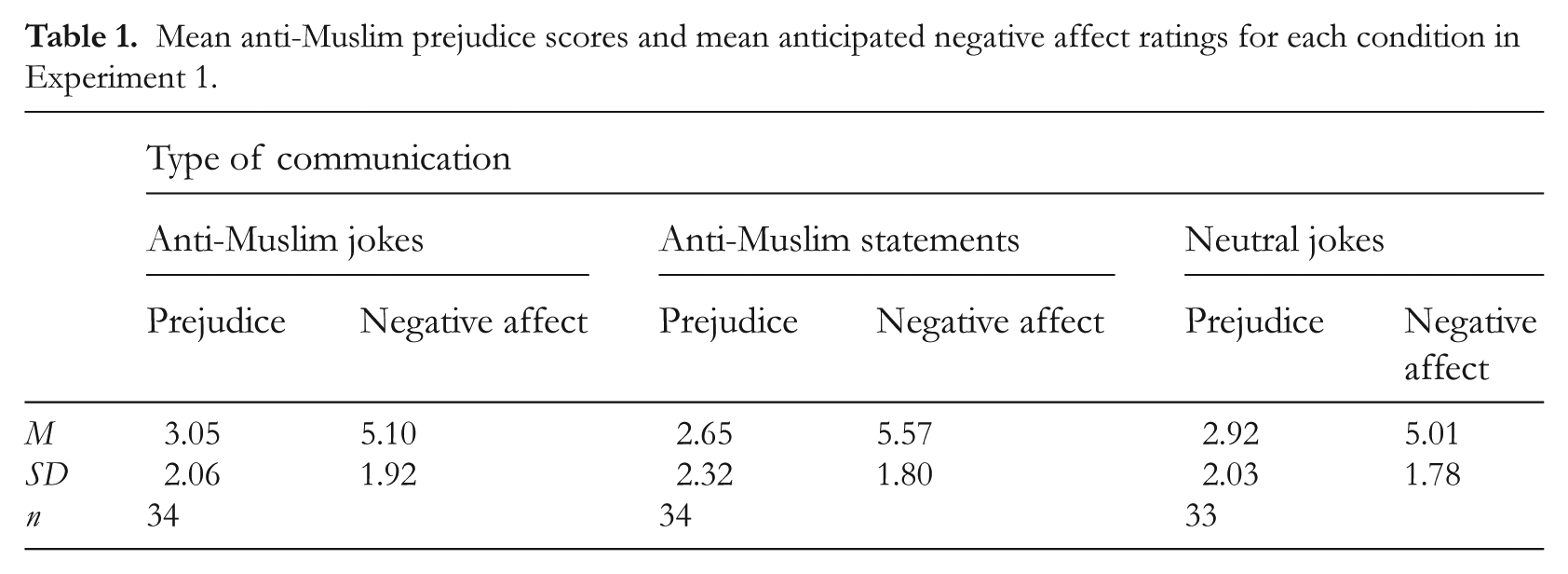
Table 1 presents descriptive statistics for each measure in each experimental condition. As can be seen in Table 1, the mean prejudice score was 3.05 (SD = 2.06) in the anti-Muslim joke condition, 2.65 (SD = 2.32) in the anti-Muslim statement condition, and 2.92 (SD = 2.03) in the neutral joke condition. A one-way analysis of variance (ANOVA) revealed no effect of experimental condition, F(2, 98) = 0.31, p = .73.
Mean anti-Muslim prejudice scores and mean anticipated negative affect ratings for each condition in Experiment 1.
Anticipated negative affect
We computed a measure of anticipated negative affect associated with discriminating against Afiyah by averaging responses to how critical, ashamed, and disappointed participants would feel about themselves if they had behaved like the manager. Cronbach’s alpha was .96. We predicted that there would be a stronger negative relationship between anti-Muslim prejudice and anticipated negative affect in the anti-Muslim joke condition compared to the anti-Muslim statement condition and the neutral joke condition.
Because our predictions call for specific a priori comparisons between the anti-Muslim joke condition and each of the other two conditions, we represented the three communication conditions (anti-Muslim jokes, anti-Muslim statements, neutral jokes) with two orthogonal contrasts (Rosenthal, Rosnow, & Rubin, 2000). The first contrast, C1, compared the anti-Muslim joke condition (coded as 1) to the anti-Muslim statement condition (coded as −1). The neutral joke condition was coded as 0. The second contrast, C2, compared the anti-Muslim joke condition (coded as 1) to the neutral joke condition (coded as −1). The anti-Muslim statement condition was coded as 0. We computed interaction terms by multiplying the standardized anti-Muslim prejudice scores by the two contrast-coded variables. We then regressed the anticipated negative affect ratings onto C1, C2, the standardized anti-Muslim prejudice score, and the two interaction terms. 2
Supporting our hypothesis, the C1 x Anti-Muslim Prejudice interaction effect was significant, β = −0.27, SE = 0.23, t = −2.38, p < .05 as was the C2 x Anti-Muslim Prejudice interaction effect, β = −0.25, SE = 0.24, t = −2.57, p < .05. Together, these significant interaction effects suggest that the relationship between anti-Muslim prejudice and negative affect associated with discriminating against Afiyah was different in the anti-Muslim joke condition compared to each of the other two conditions. Figure 1 illustrates these interaction effects, plotting the predicted means for the anticipated negative affect ratings as a function of the type of communication at one standard deviation above and one standard deviation below the mean standardized anti-Muslim prejudice score.
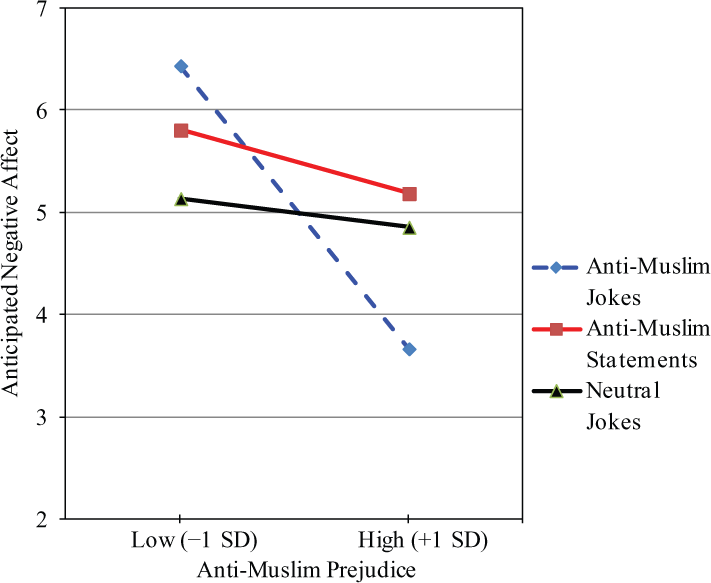
Regression lines predicting anticipated negative affect scores as a function of the type of communication condition and standardized anti-Muslim prejudice scores in Experiment 1.
As can be seen in Figure 1, the relationship between anti-Muslim prejudice and anticipated negative affect was significant in the anti-Muslim joke condition, β = −0.63, SE = 0.31, t = −4.60, p < .001 but not in the anti-Muslim statement condition, β = −0.17, SE = 0.32, t = −0.95, p = .35, or the neutral joke condition, β = −0.07, SE = 0.37, t = −0.36, p = .72.
Normative tolerance of discrimination
Participants’ ratings of how offensive others would consider the manager’s behavior and how critical others would be of the manager’s behavior were highly correlated (r = .69, p < .001) so we computed a measure of perceived normative tolerance of discrimination by averaging the two items. We reverse-coded responses so that higher scores indicated perceptions of greater normative tolerance of discrimination.
We conducted the same regression analysis on the normative tolerance ratings as we did on the anticipated negative affect ratings. There were no significant effects. Notably, the C1 x Anti-Muslim Prejudice interaction effect failed to reach significance, β = 0.15, SE = 0.19, t = 1.31, p = .19 as did the C2 x Anti-Muslim Prejudice interaction effect, β = 0.18, SE = 0.21, t = 1.45, p = .15. However, anti-Muslim prejudice was significantly related to normative tolerance ratings in the anti-Muslim joke condition, β = 0.49, SE = 0.25, t = 3.19, p < .01 but not in the anti-Muslim statement condition, β = 0.18, SE = 0.29, t = 1.03, p = .31 or the neutral joke condition, β = 0.12, SE = 0.30, t = 0.66, p = .51.
Mediation analyses
We used bootstrapping procedures described by Preacher and Hayes (2004) to determine if the relationship between anti-Muslim prejudice and anticipated negative affect in the anti-Muslim joke condition was mediated by perceptions of normative tolerance of discrimination for participants in the anti-Muslim joke condition. The bootstrapping analysis tests whether the indirect effect (i.e., the path from anti-Muslim prejudice to anticipated negative affect through perceptions of normative tolerance of discrimination) is different from zero by providing a 95% confidence interval for the population value of the indirect effect (Preacher & Hayes, 2004). If zero is not in the 95% confidence interval the indirect effect is significant at p < .05.
Using Preacher and Hayes’ (2004) bootstrapping macro for SPSS, we computed bias-corrected 95% confidence intervals for 5,000 samples with replacement and found that the indirect effect was significant, as indicated by a confidence interval that did not include zero (CI: −0.58, −0.06). This finding suggests that, in the anti-Muslim joke condition, the relationship between anti-Muslim prejudice and anticipated negative affect was mediated by a perceived norm of tolerance of discrimination.
Discussion
The results of Experiment 1 supported our first hypothesis showing that anti-Muslim humor promoted the release of prejudice against Muslims in the same way that sexist humor promotes the release of prejudice against women. Specifically, participants higher in anti-Muslim prejudice anticipated feeling less badly about themselves upon imagining they had discriminated against a Muslim person after reading anti-Muslim jokes but not after reading anti-Muslim statements or neutral jokes. Also, the mediation analysis suggests that by communicating derision of Muslims in a light-hearted manner, anti-Muslim jokes expanded the bounds of appropriate conduct, creating a local norm of tolerance of discrimination against them. And in that context people felt free to express their prejudice. In contrast, prejudiced participants in the other conditions appeared to censor their responses in accordance with the usual nonprejudiced norms; nonhumorous disparagement does not communicate that the usual critical reactions to discrimination can be suspended (e.g., Berlyne, 1972).
Experiment 2
In Experiment 2 we tested our second hypothesis that disparagement humor fosters the release of prejudice against groups in the normative ambiguity region but not groups in the justified prejudice region of the normative window model. Participants first read jokes that disparaged Muslims, jokes that disparaged terrorists, or neutral jokes. Then, participants completed a role-play exercise in which they acted as a prison warden who controlled the amount of access to necessities and privileges granted to Muslim or terrorist prisoners. Lastly, participants completed the measure of prejudice against Muslims and terrorists described in Experiment 1.
We predicted that participants higher in prejudice against Muslims would grant less access to necessities and privileges to Muslim prisoners in the anti-Muslim joke condition compared to the neutral joke condition. In contrast, participants higher in prejudice against terrorists should not differentially grant access to terrorist prisoners in the antiterrorist joke condition compared to the anti-Muslim or neutral joke conditions.
In Experiment 2 we explored an additional question about the role of disparagement humor as a releaser of prejudice. The activation of a given concept in memory can automatically activate connected concepts through “spreading of activation” along associative links (Collins & Loftus, 1975; Posner & Snyder, 1975). Because Muslims are stereotypically associated with terrorists (King & Ahmad, 2010; Mythen, Walklate, & Khan, 2009) we tested the possibility that antiterrorist jokes indirectly disparage and promote the release of prejudice against Muslims. If they do, then participants higher in prejudice against Muslims should grant less access to necessities and privileges to Muslim prisoners in the anti-terrorist joke condition than in the neutral joke condition.
Method
Participants and design
Two-hundred-five non-Muslim residents of the United States completed the experiment in exchange for $0.20. The sample consisted of 83 males and 122 females. Participants’ age ranged from 18 to 82 with a median of 34 and a mean of 37 (SD = 13.25). There were 157 Whites, 17 African Americans, 12 Asians, 8 Hispanics, 9 multiracial people, and 2 people of “other” descent. Participants were randomly assigned to one of six conditions in a 3 (type of joke: anti-Muslim, antiterrorist, neutral) x 2 (target of discrimination: Muslims, terrorists) between-subjects design.
Procedure
Upon accessing the experiment through Mechanical Turk, participants read a description of three different and allegedly unrelated tasks they would perform. Participants first read four jokes that we were allegedly pilot testing for another study. In the anti-Muslim joke condition participants read two neutral jokes and the same two anti-Muslim jokes used in Experiment 1. In the antiterrorist joke condition participants read two neutral jokes and two antiterrorist jokes. The antiterrorist jokes are described in Appendix A. Finally, in the neutral joke condition participants read four neutral jokes.
Participants then completed a role-play task in which they acted as a prison warden who controlled the amount of access to necessities and privileges granted to prisoners. After a brief introduction, participants read the following passage: You have control over prisoner access to certain privileges and basic necessities on a cellblock in a prison. The population of the cellblock consists of men, ages 18–24, who are part of a large Muslim community (men, ages 18–24 who are known members of a local terrorist organization) in Philadelphia. They have mostly been convicted of felony theft and vandalism. No one on the block has been convicted of assault or battery.
After reading about the prisoners, participants used slider bars anchored by 0 (no access) at one extreme and by 10 (unlimited access) at the other to grant the prisoners access to the following necessities and privileges: outdoors, sink and showers, drinking water, entertainment, education, fresh food, Internet, books, visits from friends/family, and everyday social interaction.
After the role-play task, participants completed the “Social Attitudes Survey” (our measure of prejudice) described in Experiment 1. Participants in the Muslim target conditions responded to Muslims; participants in the terrorist target conditions responded to terrorists. Cronbach’s alpha was .97 for Muslims and .72 for terrorists. Finally, participants gave their reactions to the studies and read a debriefing. No participants indicated suspicion of the study’s true purpose.
Results
Prejudice against Muslims and terrorists
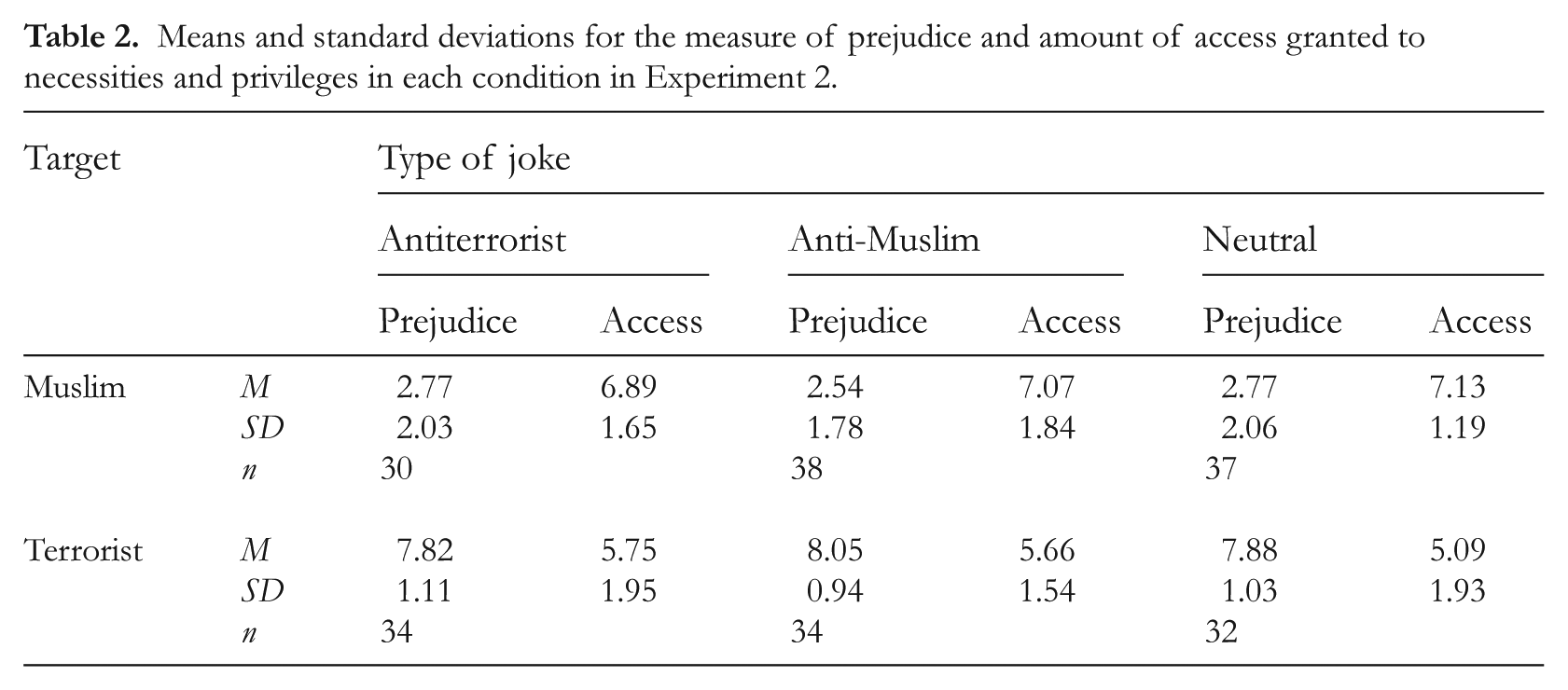
Table 2 presents the descriptive statistics for the measure of prejudice and amount of access granted to necessities and privileges in each experimental condition. As can be seen in Table 2, participants reported greater prejudice against terrorists (M = 7.92, SD = 1.02) than Muslims (M = 2.68, SD = 1.94), t(203) = 24.03, p < .001. This supports our assumption that prejudice against terrorists is more socially appropriate and justifiable than prejudice against Muslims. To ensure that responses on our measure of prejudice were not affected by the type of joke manipulation (it was administered after the type of joke manipulation), we performed a one-way ANOVA on the standardized prejudice scores with type of joke (anti-Muslim, antiterrorist, neutral) serving as a between-subjects factor. The effect of type of joke was not significant, F(2, 202) = 0.23, p = .79.
Means and standard deviations for the measure of prejudice and amount of access granted to necessities and privileges in each condition in Experiment 2.
Access to necessities and privileges granted to prisoners
First, we predicted that participants higher in prejudice against Muslims would grant less access to necessities and privileges to Muslim prisoners in the anti-Muslim joke condition compared to the neutral joke condition. Second, we predicted that participants higher in prejudice against terrorists would not differentially grant access to terrorist prisoners in the antiterrorist joke condition compared to the other two conditions. In addition, we tested the possibility that antiterrorist jokes indirectly promote the release of prejudice against Muslims. Specifically, we examined whether the relationship between anti-Muslim prejudice and access granted to Muslim prisoners was greater in the antiterrorist joke condition than in the neutral joke condition.
Accordingly, we represented the type of joke variable (anti-Muslim, antiterrorist, neutral) in two orthogonal contrasts. The first contrast, C1, was derived from our first prediction and secondary research question, comparing the anti-Muslim joke condition and the antiterrorist joke condition (each coded as −1) to the neutral joke condition (coded as 2). The second contrast, C2, compared the antiterrorist joke condition (coded as 2) to the other two conditions (each coded as −1). We also dummy-coded the target of discrimination variable (Muslims = 1, terrorists = 0). We created interaction terms by computing the products of the coded variables and the standardized prejudice scores for the targeted groups. We then regressed the amount of access to necessities and privileges granted to prisoners onto C1, C2, the target of discrimination variable, standardized prejudice scores for the targeted group, and the two- and three-way interaction terms.
There was a significant Target of Discrimination x Prejudice interaction effect, β = −0.47, SE = 0.13, t = −5.32, p < .01 showing that the relationship between prejudice and amount of access granted was significant for Muslim prisoners, β = −0.55, SE = 0.09, t = −6.66, p < .01 but not for terrorist prisoners, β = 0.02, SE = 0.10, t = 0.24, p = .81. This was qualified by the predicted C1 x Target of Discrimination x Prejudice interaction effect, β = 0.22, SE = 0.11, t = 2.11, p < .05. There were no other significant effects. Figure 2 displays the three-way interaction effect, plotting the predicted means for the amount of access to necessities and privileges granted to Muslims (Panel A) and terrorists (Panel B) as a function of type of joke one standard deviation above and one below the mean standardized prejudice score.
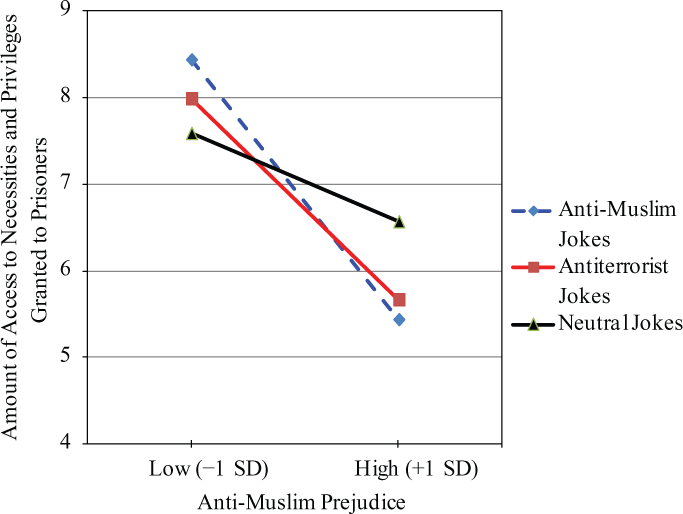
Regression lines predicting the amount of access to necessities and privileges granted to Muslim prisoners as a function of type of joke and standardized anti-Muslim prejudice scores in Experiment 2.
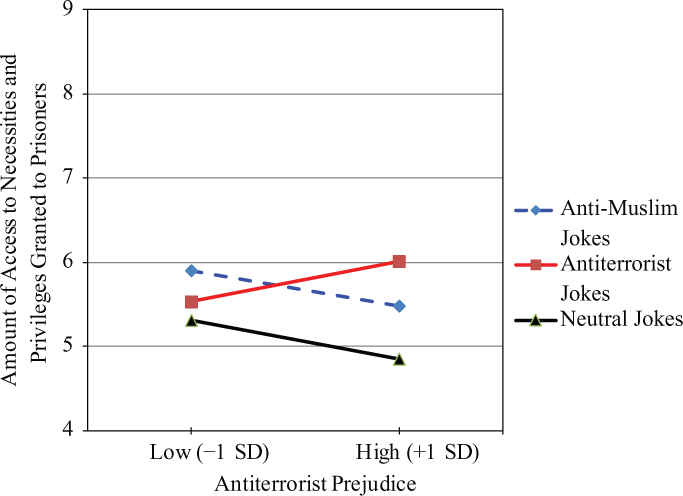
Regression lines predicting the amount of access to necessities and privileges granted to terrorist prisoners as a function of type of joke and standardized antiterrorist prejudice scores in Experiment 2.
To enumerate the three-way interaction effect, we performed a series of simple slope analyses separately in the Muslim target and terrorist target conditions. As Figure 2 (Panel A) illustrates, prejudice against Muslims was significantly related to the amount of access participants granted to Muslim prisoners in the anti-Muslim joke condition, β = −0.68, SE = 0.17, t = −5.57, p < .001, the antiterrorist condition, β = −0.62, SE = 0.17, t = −4.17, p < .001 and the neutral joke condition, β = −0.36, SE = 0.12, t = −2.26, p < .05. In keeping with our first prediction, the slope in the anti-Muslim joke condition was significantly different from the slope in the neutral joke condition, β = −0.30, SE = 0.09, t = −3.18, p < .01. Anti-Muslim jokes promoted greater discrimination against Muslims than neutral jokes. Furthermore, addressing our secondary research question, the slope in the antiterrorist joke condition differed significantly from the slope in the neutral joke condition, β = −0.23, SE = 0.09, t = −2.12, p < .05. Antiterrorist jokes also promoted greater discrimination against Muslims than neutral jokes.
Finally, as Figure 2 (Panel B) illustrates, our second prediction also was supported. Prejudice against terrorists did not significantly predict the amount of access granted to terrorist prisoners in the antiterrorist joke condition, β = 0.12, SE = 0.19, t = 0.70, p = .49, the anti-Muslim joke condition, β = −0.12, SE = 0.15, t = −0.71, p = .49 or the neutral joke condition, β = −0.13, SE = 0.18, t = −0.70, p = .49.
Discussion
Experiment 2 tested our second hypothesis that disparagement humor fosters the release of prejudice against groups in the normative ambiguity region but not groups in the justified prejudice region. Supporting our hypothesis, the results showed disparagement humor promoted discrimination against Muslims, a group in a position of shifting acceptability in society, but not terrorists, a group for whom expressions of prejudice are justified. The results also addressed our secondary research question, demonstrating that antiterrorist jokes promoted discrimination against Muslims—a group that is stereotypically associated with terrorists.
Interestingly, prejudice against Muslims was associated with less access to necessities and privileges granted to Muslims in the neutral joke condition. This suggests that, unlike Experiment 1, participants felt some degree of freedom to express their prejudice against Muslims in the absence of an explicit releaser of prejudice. Perhaps the role-play context of Experiment 2, itself, functioned to justify the release of prejudice. Muslims in Experiment 2 were prisoners, a group that can be easily rationalized as deserving negative treatment. As a result it is possible that participants higher in prejudice against Muslims felt some degree of justification for discriminating against them even in the neutral joke condition.
Although the findings of Experiment 2 are consistent with our hypothesis, they have limitations. First, the dependent measure was limited to imagined behavior. Second, participants uniformly expressed highly negative attitudes toward terrorists. The average prejudice score was 7.92 (SD = 1.02) on a 9-point scale. This raises the possibility that the correlations between antiterrorist prejudice and amount of access granted to terrorist prisoners was affected by a range restriction artifact (Bobko, Roth, & Bobko, 2001; Hunter & Schmidt, 1990) obscuring the possible effects of disparagement humor.
Experiment 3
Experiment 3 provided a conceptual replication of Experiment 2 that also addressed its limitations. Most notably, Experiment 3 examined discrimination in the form of real rather than imagined behavior. Also, Experiment 3 examined the effect of disparagement humor on the release of prejudice against a different normative ambiguity group, gays, and a different justified prejudice group, racists. Lastly, we collected data from only White participants as non-Whites presumably would have particularly strong negative affect for racists, which could exacerbate a range restriction artifact on both the measure of prejudice against racists and the measure of discrimination against racists.
It is important to note that there is evidence that gays have moved from the justified prejudice region into the normative ambiguity region (Herek, 1987; Loftus, 2001). The “gay rights movement” of the 1970s resulted in a broad normative shift in American society regarding the treatment of gay men, lesbians, and homosexuality (Schroeder, 2004). Gallup polls indicate that 56% of respondents considered homosexuality a morally acceptable lifestyle in 2011 compared to 40% in 2001 (Jones, 2011). Gay men and lesbians are being redefined not as deviant groups against whom prejudice is justified, but as disadvantaged groups who, like women and African Americans, have been unfairly denied civil rights.
In Experiment 3 we investigated whether prejudice against gays is related to willingness to discriminate against a gay student organization upon exposure to antigay jokes, and whether prejudice against racists is related to willingness to discriminate against a racist student organization upon exposure to antiracist jokes. Participants completed the measure of prejudice toward gays and racists described in Experiment 1. Then, in an allegedly unrelated task, participants read either antigay jokes, antiracist jokes, or neutral jokes. Finally, following the procedures of Ford et al. (2008), participants distributed budget cuts to several student organizations on campus including either a gay student organization or a racist student organization.
We predicted that to the extent that participants were high in antigay prejudice they would allocate greater budget cuts to the gay student organization in the antigay joke condition relative to the antiracist or neutral joke conditions. However, those higher in prejudice against racists should not differentially allocate budget cuts to the racist student organization in the antiracist joke condition relative to the antigay or neutral joke conditions.
Method
Participants and design
One-hundred-sixty-two White heterosexual participants (58 male and 104 female; median age = 18, mean age = 19.20, SD = 2.46) were recruited from the Psychology Department’s participant pool at Western Carolina University. Participants completed the experiment for credit in their Introductory Psychology course. Participants were randomly assigned to one of six conditions in a 3 (type of joke: antigay, antiracist, neutral) x 2 (target of discrimination: homosexual organization, racist organization) between-subjects factorial design.
Procedure
Participants completed the experiment using an online survey tool in the computer lab in groups of roughly 15. Participants clicked on a link to the study and were presented with an introduction of three different and allegedly unrelated tasks they would be asked to perform.
Participants first completed the measure of prejudice described in Experiment 1 for gays and racists under the guise of a “Social Attitude Survey.” Cronbach’s alpha was .87 for the measure of prejudice against gays and .84 for the measure of prejudice against racists.
Next, participants read six jokes that we were allegedly pilot testing for another study. In the antigay joke condition participants read two neutral jokes and four jokes that disparaged gay men. In the antiracist joke condition, participants read two neutral jokes and four jokes that disparage racists. See Appendix B for each of the antigay and antiracist jokes. In the neutral joke condition, participants read six neutral jokes.
The jokes were chosen in response to ratings made by 28 participants who did not participate in the study. Thirty jokes were rated on the following dimensions: funniness, degree of disparagement of homosexuals, and degree of disparagement of racists using scales ranging from 1 (not at all) to 9 (extremely). The antigay jokes were rated as equally funny (M = 3.05, SD = 2.04) as the antiracist jokes (M = 2.82, SD = 2.09), t(27) < 1 and the neutral jokes (M = 3.15, SD = 1.21), t(27) < 1. The antiracist jokes were rated as equally funny as the neutral jokes, t(27) < 1. Also, the antigay jokes disparaged gays (M = 5.78, SD = 2.60) more than racists (M = 1.07, SD = 0.38), t(27) = 9.21, p < .01. Similarly, the antiracist jokes disparaged racists (M = 6.32, SD = 2.27) more than gays (M = 1.44, SD = 1.38), t(27) = 8.82, p < .01. The neutral jokes were equally nondisparaging of gays (M = 1.09, SD = 0.47) and racists (M = 1.19, SD = 0.60), t(27) < 1.
Next, participants completed a third task developed by Ford et al. (2008) to provide participants an opportunity to discriminate against selected groups. Participants were told that the university was soliciting student input regarding how they should allocate funding cuts to selected student organizations. Participants read descriptions of the four groups and allocated budget cuts so that across the four organizations, the overall budget was reduced by 18% ($21,600). Students were instructed to allocate budget cuts to the organizations as they saw fit. We assured participants that the university would consider their recommendations.
For half the participants one of the four groups was the Gay and Lesbian Student Association (GLSA), which was “committed to serving and protecting the political and social advancement of homosexual people.” For the other half, one of the four groups was the Southern Heritage Student Association (SHSA), which was “committed to serving and protecting the continued political and social advancement of White people.” See Appendix C for a complete description of the budget cut task.
After completing the budget cut task, participants wrote at least one sentence describing their reactions to the study. None of the participants indicated suspicion of the study’s true purpose. Finally, participants were debriefed and dismissed.
Results
Prejudice against gays and racists.
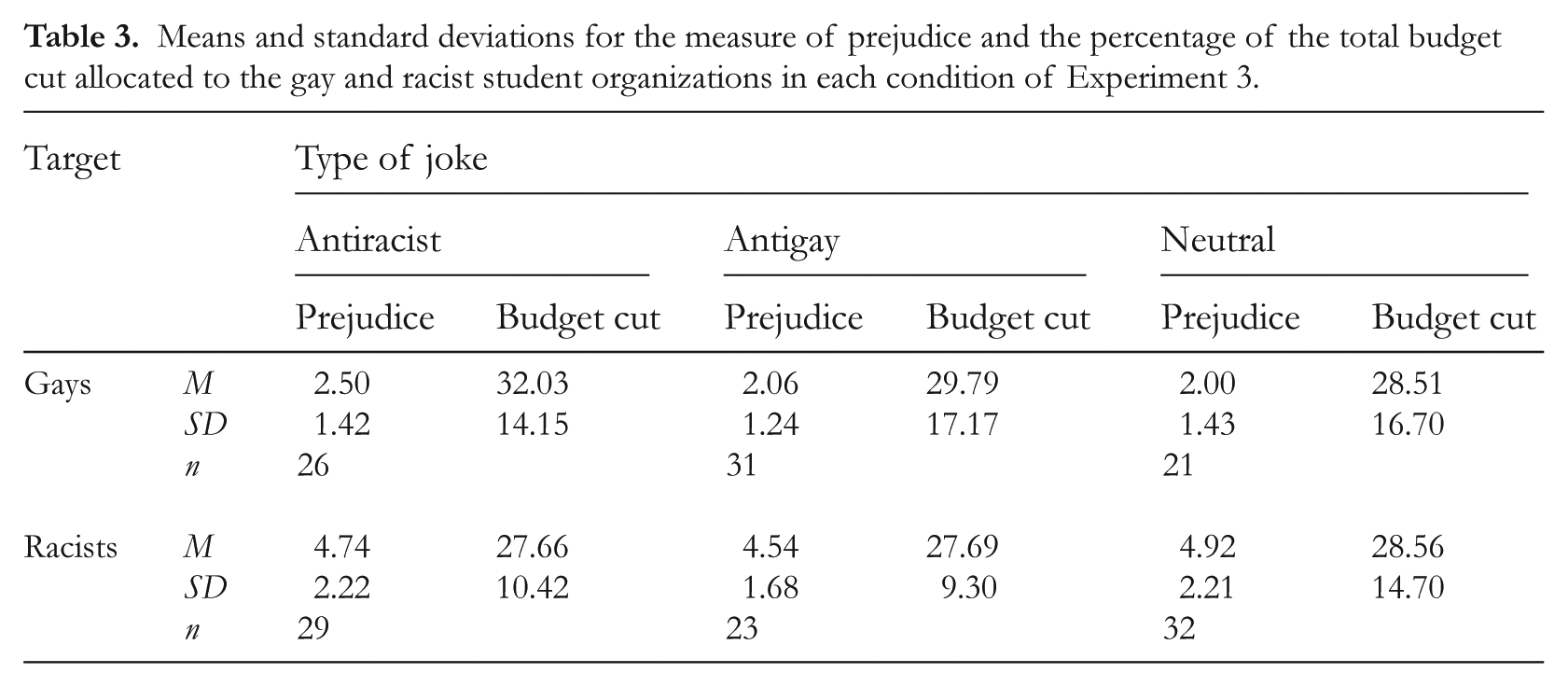
Table 3 presents the descriptive statistics for the measure of prejudice and percentage of the total budget cut allocated to the gay and racist student organizations in each experimental condition. As can be seen in Table 3, participants reported greater prejudice against racists (M = 5.03, SD = 2.03) than against gays (M = 2.33, SD = 1.55), t(161) = 13.02, p < .001. However, participants did not uniformly express highly prejudiced attitudes toward racists. In fact, in the racist target condition, the average antiracist prejudice score was near the scale midpoint of 5 (M = 4.75, SD = 2.06). This alleviates a potential concern that correlations between antiracist prejudice and budget cut allocations to the racist student organization could be affected by a range restriction artifact on the prejudice scale (Bobko et al., 2001; Hunter & Schmidt, 1990).
Means and standard deviations for the measure of prejudice and the percentage of the total budget cut allocated to the gay and racist student organizations in each condition of Experiment 3.
Budget cut allocations
We followed the same analytical strategy to test our predictions as we did for Experiment 2. First, we predicted that participants higher in antigay prejudice would allocate greater budget cuts to the gay student organization in the antigay joke condition relative to the antiracist or neutral joke conditions. Second, we predicted that those higher in prejudice against racists would not differentially allocate budget cuts to the racist student organization in the antiracist joke condition compared to the other two conditions.
We represented the type of joke variable (antigay, antiracist, neutral) in two orthogonal contrasts derived from our predictions. The first contrast, C1, compared the antigay joke condition (coded as 2) to the neutral joke condition (coded as −1) and the racist joke condition (coded as −1). The second contrast, C2, compared the antiracist joke condition (coded as 2) to the other two conditions (each coded as −1). We also dummy-coded the target of discrimination variable (gay student organization = 1, racist student organization = 0). We created interaction terms by computing the products of the coded variables and the standardized prejudice scores for the targeted groups. We then regressed the budget cut allocations onto C1, C2, the target of discrimination variable, standardized prejudice scores for the targeted group, and the two- and three-way interaction terms.
In keeping with our hypothesis, there was a significant C1 x Target of Discrimination x Prejudice interaction effect, β = 0.24, SE = 0.02, t = 1.95, p = .05. There were no other significant effects. Importantly, the main effect of target of discrimination was not significant, β = −0.11, SE = 0.02, t = −1.34, p = .18. Overall, participants allocated comparable budget cuts to the racist student organization (M = 28.01%, SD = 11.85) as they did to the gay student organization (M = 30.19%, SD = 15.95). This alleviates the concern of a possible floor effect and range restriction artifact on the dependent measure for the racist student organization relative to the gay student organization. Figure 3 displays the significant three-way interaction effect, plotting the predicted means for the percentage of the total budget cut allocated to the gay student organization (Panel A) and to the racist student organization (Panel B) as a function of type of joke one standard deviation above and one below the mean standardized prejudice score.
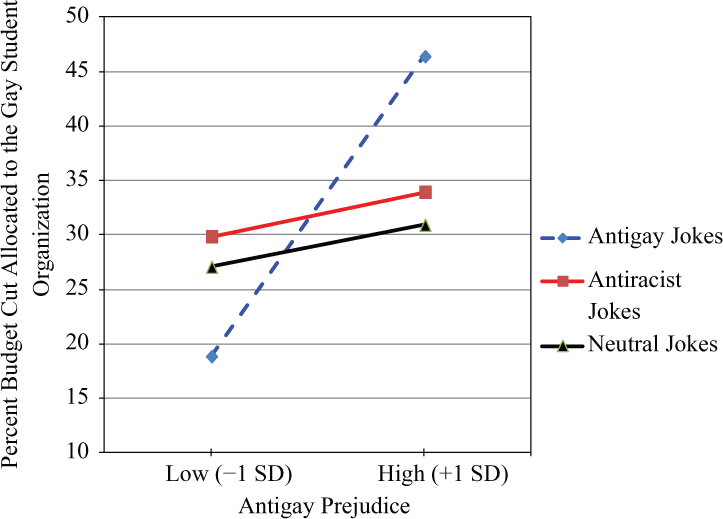
Regression lines predicting the percentage of the total budget cut allocated to the gay student organization as a function of type of joke and standardized antigay prejudice scores in Experiment 3.
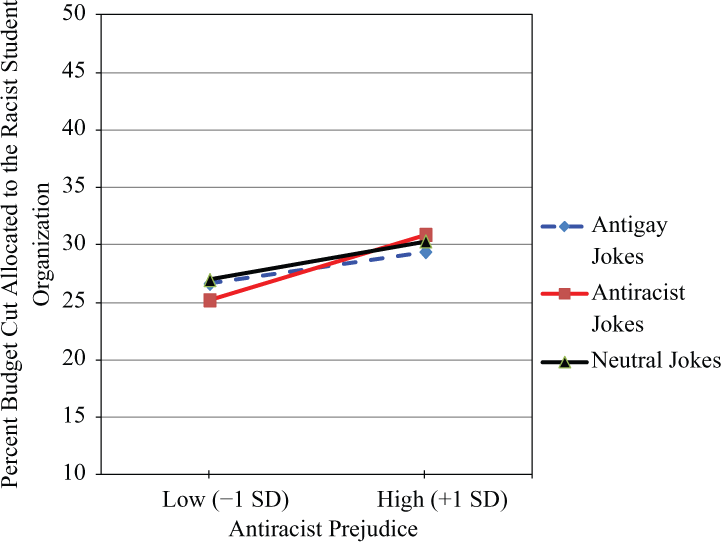
Regression lines predicting the percentage of the total budget cut allocated to the racist student organization as a function of type of joke and standardized antiracist prejudice scores in Experiment 3.
To further examine this three-way interaction effect, we performed a series of simple slope analyses separately in the gay and racist student organization conditions. As Figure 3 (Panel A) illustrates, our first prediction was supported. Prejudice against gays was significantly related to the budget cuts allocated to the gay student organization in the antigay joke condition, β = 0.61, SE = 3.29, t = 4.18, p < .001, but not in the antiracist joke condition, β = 0.13, SE = 3.26, t = 0.26, p = .54 or the neutral joke condition, β = 0.10, SE = 4.33, t = 0.45, p = .66. As expected, the slope in the antigay joke condition was significantly different from that in the antiracist joke condition, β = 0.30, SE = 2.32, t = 2.53, p < .05 and the neutral joke condition, β = 0.29, SE = 2.64, t = 2.24, p < .05. In the antigay joke condition, participants higher in antigay prejudice allocated greater budget cuts to the gay student organization relative to participants in the other two conditions. Finally, as Figure 3 (Panel B) illustrates, our second prediction was also supported. Prejudice against racists did not significantly predict budget cuts allocated to the racist student organization in the antiracist joke condition, β = 0.30, SE = 1.75, t = 1.63, p = .12, the antigay joke condition, β = −0.12, SE = 2.43, t = 0.57, p = .58, or the neutral joke condition, β = 0.12, SE = 2.44, t = 0.69, p = .50.
Discussion
The results of Experiment 3 supported our second hypothesis corroborating the findings of Experiment 2. Antigay jokes promoted the release of prejudice against gays that was otherwise suppressed. To the extent that participants were high in prejudice against gays, they discriminated against the gay student organization on the budget cut allocation task after reading antigay jokes but not after reading neutral jokes or antiracist jokes. Furthermore, antiracist jokes did not promote discrimination against the racist student organization.
General Discussion
The research presented in this article contributes to a growing literature on the social consequences of disparagement humor by demonstrating that disparagement humor can promote discrimination against not only women, but also other groups that occupy a position in society of shifting acceptability. In Experiment 1 we found that exposure to anti-Muslim humor increased tolerance of discrimination against a Muslim person for those higher in anti-Muslim prejudice just as exposure to sexist humor increases tolerance of discrimination of a woman for those higher in hostile sexism (Ford et al., 2001).
Using different procedures, measures, independent variable manipulations, and participant populations, Experiments 2 and 3 found that disparagement humor fosters discrimination against groups that occupy a social position of shifting acceptability but not groups for whom prejudice is already socially acceptable. Disparagement humor promoted discrimination against Muslims and gays but not terrorists or racists. Experiment 2 also demonstrated that humor disparaging one group can indirectly disparage and promote the release of prejudice of a stereotypically associated group.
Collectively, the findings of our experiments provide a framework for explaining why certain groups are vulnerable to the prejudice-releasing effects of disparagement humor and thus provide a more complete understanding of the social dangers of humor as a vehicle for communicating derision. An important implication of the present findings is that some instances of disparagement humor are inherently more dangerous and socially damaging than others because of the groups they target. Movies, television programs, and YouTube clips that humorously disparage groups such as gays, Muslims, or women can potentially foster discrimination and social injustice; whereas those that target groups such as racists cannot.
Limitations and Directions for Future Research
Our experiments have a number of limitations that raise questions for future research. First, according to prejudiced norm theory, disparagement humor initiates a local norm of tolerance of discrimination. It is unknown, however, to what extent disparagement humor expands the bounds of appropriate conduct. Perhaps it stretches those normative boundaries to a rather small degree and thus its effects are limited to subtle or mild expressions of prejudice like those included in each of our studies—expressions of prejudice that otherwise lie just outside the realm of acceptability.
Second, we limited our investigations to expressions of prejudice toward individuals (Experiment 1) or small groups of people (Experiments 2 and 3). Future research, thus, could address the broader, more macrolevel possibility that disparagement humor encourages the expression of beliefs that justify societal inequalities and discrimination (Jost & Banaji 1994; Jost, Banaji, & Nosek, 2004).
Third, we limited our investigation to groups against whom people harbor prejudice to release under conditions that permit it. We did not examine the effects of disparagement humor on groups for whom prejudice is considered unjustified. Thus, future research could test the possibility that disparagement humor affects responses to such groups through different mechanisms than justifying the release of prejudice.
Conclusion
The veil of disparagement humor as “just a joke” and its pervasiveness in popular culture make it an insidious means of promoting expressions of prejudice. Understanding the parameters of its prejudice-releasing effects is thus a critical project of theoretical importance and social relevance. Our findings suggest that disparagement humor functions as a releaser of prejudice against groups that occupy a social position of shifting acceptability but not groups for whom prejudice is seen as justified. A joke that disparages Muslims or gays is more than benign amusement; it has the power to promote discrimination. In contrast, a joke that disparages terrorists or racists is just a joke.
Footnotes
Appendix A: Anti-Terrorist Jokes From Experiment 2
Appendix B: Anti-Gay and Anti-Racist Jokes From Experiment 3
Anti-gay jokes
Anti-racist jokes
Appendix C: Budget Cut Allocation Task for Experiment 3
Funding
This research was supported by National Science Foundation Grants BCS-1014567 awarded to Thomas E. Ford and BCS-1014562 awarded to Julie A. Woodzicka.