







Abstract
System justification theory (SJT) posits that people are motivated to believe that the social system they live in is fair, desirable, and how it should be, especially in contexts that heighten the system justification motive. Past researchers have suggested that opposition to feminists may be motivated by the threat that feminism presents to the legitimacy of the status quo, but this hypothesis has not been tested empirically. In this article, we present three studies that directly test the idea that antifeminist backlash can be motivated by system justification. Studies 1 and 2 experimentally manipulated the SJ motive and a female target’s feminist identification (feminist vs. nonfeminist). Study 3 tested the hypothesis by measuring participants’ SJ motivation via an individual difference measure. Participants disagreed more with identical statements about gender issues made by the feminist target than the nonfeminist target, but only when the system justification motive was heightened (Study 2) or chronically high (Study 3).
Keywords
The feminist agenda is not about equal rights for women. It is about a socialist, anti-family political movement that encourages women to leave their husbands, kill their children, practice witchcraft, destroy capitalism, and become lesbians.
From mild dislike to severe contempt, antifeminist hostility is easily observed in punitive comments made by political pundits, such as Rush Limbaugh, who has referred to feminists as “feminazis” (Limbaugh, 1993), as well as more generically negative depictions in mass media (Douglas, 1995). Antifeminist hostility plays a role in women’s reluctance to identify as feminists. Studies have consistently found that despite holding egalitarian values and sharing feminist ideals, many women reject feminist self-identification and add qualifications such as “I’m not a feminist, but…” when expressing proequality sentiments (Aronson, 2003; Liss, O’Connor, Morosky, & Crawford, 2001; Percy & Kremer, 1995; Zucker, 2004). Although these women appear to identify with many of the values associated with feminist ideology, they may want to avoid traits that are stereotypically associated with feminism, which portray a woman who is “discontented, selfish, militant, and hard-line in her views” (Percy & Kremer, 1995, p. 214). Women also worry that the mere act of identifying as a feminist will lead others to treat them badly (Percy & Kremer, 1995). Feminism is commonly perceived to conflict with beauty and romance (Rudman & Fairchild, 2007), even though these negative stereotypes about feminists are untrue (Rudman & Phelan, 2007). Here, we propose that antifeminist backlash, in the form of negative attitudes toward feminists, is partly caused by system justification motivation.
The Role of System Justification Motivation
System justification theory (SJT) posits that individuals are motivated to bolster the legitimacy and fairness of their system and the status quo in general, often by denying or rationalizing injustice and unfairness (Jost & Banaji, 1994; Jost, Banaji, & Nosek, 2004). The system justification (SJ) motive serves a palliative function by allowing people to psychologically adapt to unfavourable outcomes, especially when they perceive little control over the systems that yield tremendous power over their outcomes and well-being (Kay et al., 2009; Kay & Zanna, 2009; Laurin, Shepherd, & Kay, 2010; van der Toorn, Tyler, & Jost, 2011). The SJ motive can manifest itself in terms of system-legitimizing social and psychological phenomena, such as social stereotyping (Haines & Jost, 2000; Jost & Burgess, 2000; Jost & Hunyady, 2005, Jost & Kay, 2005; Kay & Jost, 2003), anticipatory rationalization of inevitable system changes (Kay, Jimenez, & Jost, 2002), and the construal of current norms as the most desirable norms (Kay et al., 2009). SJ motivation has been shown to vary chronically as an individual difference variable, and it is heightened among those who are high in uncertainty avoidance, perception of a dangerous world, and needs for order, structure, and closure (Hennes, Nam, Sterm, & Jost, 2012; Jost & Hunyady, 2005). Prior research has uncovered conditions that make system justification more likely to occur. SJ phenomena are thought to be both (a) motivational by serving a palliative function against negative affect arising from threats to our social systems, and (b) rooted in the fact that we are dependent on these social systems over which we have only limited control. Therefore, system justification tends to be increased by manipulations that (a) “starve” the SJ goal via system threat or (b) increase the extent to which participants see themselves as dependent on the system (see Kay & Friesen, 2011, for a review).
While there are various types of feminist ideologies, all converge on the basic idea that change to the status quo is necessary to address gender inequality. Because of this explicit system-challenging agenda, antifeminist backlash may in part result from the motivation to defend the legitimacy of the social system. We are not suggesting that individuals will necessarily face opposition whenever they express proequality sentiments, insofar as talk about equality is a relatively normal aspect of American sociopolitical discourse. We do suspect, however, that disagreement with proequality statements will become much stronger when they are offered by someone who explicitly identifies with a system-challenging ideology (such as a self-identified feminist). And, to the extent that this disagreement is caused by system justification, we would further expect it to be more readily apparent in conditions that heighten the SJ motive or among those who are chronically high system justifiers.
The idea that negative reactions to feminists serve to protect the status quo has often been suggested but not explicitly tested. Individuals who attribute unfavourable outcomes to discrimination (and thereby challenge the fairness and legitimacy of the system) face negative interpersonal consequences as a result (Kaiser, Dyrenforth, & Hagiwara, 2006). Likewise, feminists are less likely to be perceived as victims of discrimination and more likely to be perceived as complainers than nonfeminists, regardless of the target’s attributions or the actual presence of discrimination (Roy, Weibust, & Miller, 2009). Percy and Kremer (1995) suggested that negative stereotypes of feminists allow for a justification of the patriarchal status quo and rejection of the legitimacy of feminist objections, but no empirical evidence was offered to support this claim. Lastly, though not in the context of feminism, Diekman and Goodfriend (2007) found that activist groups that threaten to disrupt the status quo evoke ambivalent reactions in perceivers, even when these groups are perceived as pursuing positive goals—suggesting that negative attitudes toward activists exist despite recognition of their positive qualities and intentions.
Here we offer the first (to the best of our knowledge) empirical tests of the hypothesis that SJ motivation provokes resistance to proequality sentiments, but only when they are attributed to a feminist (vs. a nonfeminist) target.
Research Overview
Our hypothesis was tested experimentally in three studies in which participants’ SJ motivation was manipulated (Studies 1 and 2) or measured (Study 3). We then examined the effects of participants’ SJ motivation on their agreement with proequality statements offered by a female target depicted as a feminist.
Study 1
Method
Seventy-six students (35 females and 41 males, ages ranged from 18 to 45, M = 21.19) at the University of Waterloo, Canada participated in the study for an experimental credit or CAN$5.00.
This study employed a 2 (system threat vs. system affirmation) × 2 (feminist vs. nonfeminist target) design. The dependent variable was participants’ agreement with the target’s ideological statements regarding gender equality.
To minimize suspicion that the system threat manipulation was related to the target evaluation, participants were told that they were taking part in two studies. First, as part of a memory study participants read a system threat manipulation that has been validated previously (Jost, Kivetz, Rubini, Guermandi, & Mosso, 2005; Kay & Friesen, 2011; Kay, Jost, & Young, 2005; Lau, Kay, & Spencer, 2008). Participants were given an article manipulating either system threat (e.g., Canada was rated negatively on social, political, and economic domains) or system affirmation (e.g., Canada was rated positively on social, political, and economic domains). The system threat manipulation heightens SJ motives by challenging the social system in which participants belong. Due to the nature of the system justification manipulation, only participants who were born in Canada or had resided in Canada for at least 10 years were recruited. Participants were instructed to read the materials carefully because they would be tested later.
After the system threat manipulation, participants proceeded to an “unrelated” study in which they answered questions about a female target after reading her autobiographical profile. Participants were randomly assigned to read a profile of a feminist or a nonfeminist. Both the feminist and nonfeminist profiles contained information about Tanya’s background and hobbies. The nonfeminist profile contained no mention of feminism, whereas the feminist profile contained three additional sentences about her feminist identification, totalling 10 sentences in the feminist profile and seven sentences in the nonfeminist profile.
Participants rated their agreement with statements allegedly made by Tanya during an interview (these statements were identical in the feminist and nonfeminist conditions). For our main dependent measure, participants were presented with six statements about her ideological views on gender issues; an agreement score was calculated by averaging participants’ responses (α = .72). To minimize participants’ suspicion that the study was on their attitudes toward gender issues, and to be consistent with the non-gender-ideological content in the profiles, we also interspersed the ideological statements with six filler statements about creative arts. The mean score on these filler statements was calculated to estimate participants’ general (non-gender-ideological) agreement (α = .82). Ratings were made on a 9-point scale (1 = strongly disagree, 9 = strongly agree). 1
Results
Participant gender was included only as a main effect covariate in the analyses presented here because it did not interact with any of the independent variables. A 2 (feminist vs. nonfeminist) × 2 (system threat vs. affirmation) ANCOVA was conducted to predict agreement with Tanya’s ideological statements, with agreement on the filler statements entered as a covariate. 2 There was a main effect of participant gender, such that female participants agreed more with the target’s statements about gender than male participants did, F(1, 70) = 10.98, p = .001. Importantly, the predicted Target × System Threat interaction was significant, F(1, 70) = 6.27, p = .015, ηρ2 = .082. 3 No other main or interaction effects reached significance (all ps > .21).
As illustrated in Figure 1, the significant interaction between system threat and target’s feminist identification unfolded as predicted. Simple effects analyses revealed a main effect of system threat in the feminist condition, F(1, 33) = 7.17, p = .011, such that participants agreed less with the feminist when assigned to the system threat condition (M = 5.42, SD = 1.49) than the system affirmation condition (M = 6.59, SD = 1.36). We also predicted a main effect of target identification in the system threat condition, such that participants assigned to the system threat condition would agree less with the feminist than the nonfeminist, however this comparison was not statistically significant (Mfeminist = 5.42 vs. Mnonfeminist = 6.12, p = .18).
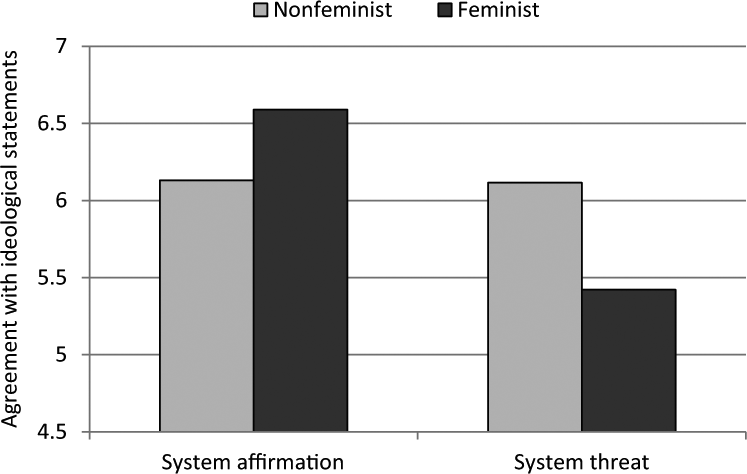
Effect of System Threat × Target’s Feminist Identification on participants’ agreement with ideological statements (Study 1).
Discussion
Whereas agreement with the nonfeminist was unaffected by the system threat manipulation, participants in the system threat condition agreed less with the feminist than those in the system affirmation condition. One interpretation of this effect is that people are especially likely to reject messages about gender inequality when they are endorsed by feminists and SJ concerns are salient.
There is one ambiguity with Study 1, though, that warrants some caution in interpreting these findings. The direction of the effect is ambiguous: it is unclear whether the effect was driven by higher agreement with the feminist in the system affirmation condition (which may have assuaged participants’ SJ motivation) or by lower agreement with the feminist in the system threat condition (which heightened participants’ SJ motivation). To address this ambiguity, we used a different manipulation of SJ motive in Study 2, where the activation of the SJ motive (via a system dependence manipulation) was compared to a neutral (non-system-affirming) control condition. This conceptual replication allowed us to examine the direction of the effect and also to demonstrate that the effect was indeed due to heightened SJ motivation.
Study 2
Method
Ninety-seven American participants (58 females and 39 males, aged 18–61, M = 32.16) were recruited for an online study through Mechanical Turk and were paid US$0.50 each. This study employed a 2 (system dependence vs. control) × 2 (feminist vs. nonfeminist target) design. As in Study 1, the dependent variable was participants’ agreement with the target’s ideological statements regarding gender equality.
Participants were again told that they were taking part in two studies to minimize suspicion. First, as part of a memory study participants read a system dependence manipulation that has been validated previously (Kay et al., 2009) or a control article describing agricultural trends as part of a memory study. The system dependence manipulation heightens SJ motives by making it salient that participants’ welfare is dependent upon the system.
After the system dependence manipulation, participants were given a target profile (Appendix A) similar to the one used in Study 1, which was modified to profile a working professional instead of a student. Participants’ agreement with ideological statements (α = .78; Appendix B) and filler statements (α = .88; Appendix C) was assessed using a modified version of the materials from Study 1. 4 Ratings were made on a 9-point scale (1 = strongly disagree, 9 = strongly agree).
Results
Participant gender was included as a main effect covariate in the analyses because it did not interact with any of the independent variables (all ps > .37). A 2 (feminist vs. nonfeminist) × 2 (system dependence vs. control) ANCOVA was conducted to predict agreement with Tanya’s ideological statements, with agreement on the filler statements entered as a covariate. 5 Importantly, the predicted Target × System Dependence interaction was significant, F(1, 91) = 7.35, p = .008, ηρ2 = .075. 6 No other main effects or interactions reached significance (all ps > .14).
As illustrated in Figure 2, the significant interaction between system dependence and target’s feminist identification unfolded as predicted. Simple effects analyses revealed a main effect of system dependence in the feminist condition, F(1, 44) = 5.16, p = .028, ηρ2 = .079, such that participants agreed less with the feminist when assigned to the system dependence condition (M = 6.59, SD = 1.87) than the control condition (M = 7.11, SD = 0.75). Additionally, those assigned to the system dependence condition agreed less with the feminist than the nonfeminist (M = 6.94, SD = 1.31), F(1, 44) = 6.72, p = .013, ηρ2 = .094. No other comparisons were statistically significant (all ps > .22).
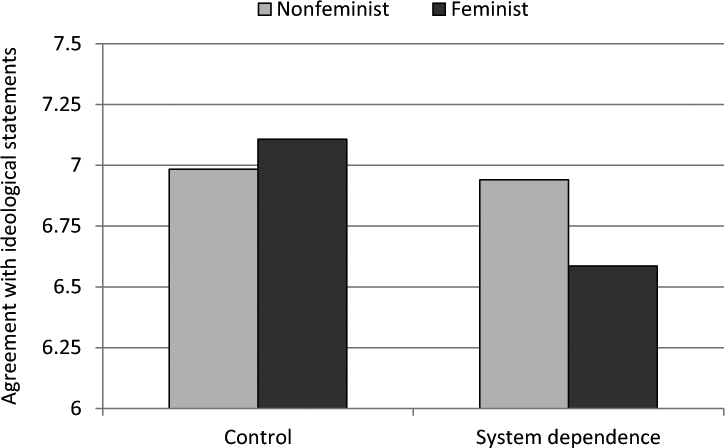
Effect of System Dependence × Target’s Feminist Identification on participants’ agreement with ideological statements (Study 2).
Discussion
Using an Internet sample and a different SJ manipulation, Study 2 replicated the results of Study 1 and was consistent with our hypothesis that antifeminist backlash, in the form of ideological disagreement, is motivated by system justification. In Study 3, we extended these findings by measuring participants’ SJ motivation as an individual difference variable.
Study 3
To demonstrate the external validity of the previous findings—specifically, the validity of the system justification manipulation—we conducted a conceptual replication by measuring participants’ gender-specific SJ score (Jost & Kay, 2005) and then correlating it with the same dependent measures. This method was also more ecologically valid, as it allowed us to examine the effects of participants’ chronic levels of gender-specific SJ on their agreement with proequality statements that were attributed to a feminist or nonfeminist target.
Method
Ninety-nine American participants (62 females and 37 males, aged 19–67, M = 36.01) were recruited for an online study through Mechanical Turk and were paid US$0.50 each.
This study employed a SJ (continuous) × Feminist Identification (feminist vs. nonfeminist target) design. The gender-specific SJ scale (Jost & Kay, 2005) was administered prior to the target profile to measure participants’ SJ motivations (α = .87). The target profiles were those used in Study 2, as were the ideological statements (α = .86) and filler statements (α = .90).
Results
Regression analysis was used to test for an SJ (continuous) × Feminist versus Nonfeminist Target interaction. SJ (centred), target condition, and participant gender were entered in the first step of the analysis and the interaction term between SJ and target condition was submitted to the second step. Participant gender exerted a significant main effect (β = .95, t(94) = 3.32, p < .001) but did not interact with SJ or target condition, so it was left out of the second step.
A main effect of SJ emerged (β = −.44, t(94) = −5.22, p < .001), such that participants higher on SJ agreed less with the ideological statements. Importantly, the predicted SJ × Target interaction was also significant, β = −.46, t(94) = −2.76, p = .007. As illustrated in Figure 3, while SJ predicted disagreement with both the nonfeminist target (β = −.25, t(94) = −2.35, p = .02) and feminist target (β = −.71, t(94) = −5.60, p < .001), a z-test revealed that the regression coefficient was greater in the second case than the first, z = 2.70, p = .007. We also analysed the simple effects of target condition among participants with SJ scores estimated at one standard deviation above and below the mean. As predicted, participants who were low in SJ did not differ in their agreement with the feminist and nonfeminist (β = .61, t(94) = 1.61, p = .11), but participants who were high in SJ disagreed more with the feminist than the nonfeminist (β = −.90, t(94) = −2.32, p = .023).
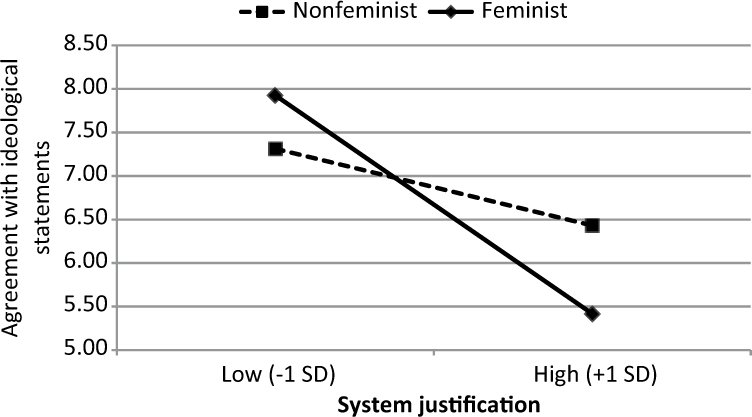
Effect of System Justification × Target’s Feminist Identification on participants’ agreement with ideological statements (Study 3).
General Discussion
In three studies we examined the effects of system justification motivation and feminist labelling on participants’ agreement with a female target. Using a student sample and an Internet sample, we have provided experimental evidence that antifeminist backlash can be motivated by system justification. As predicted, participants’ agreement with the nonfeminist was unaffected by the SJ motive, but agreement with the feminist decreased when participants’ SJ motivation was heightened (experimentally induced in Studies 1 and 2, and chronically high in Study 3).
These data provide evidence that women’s reluctance to adopt the feminist label is not unfounded, insofar as women may face opposition not for endorsing feminist ideals per se, but for explicitly identifying themselves as feminists. Unlike hostility toward many other groups in society, antifeminist hostility is often tolerated. Feminists belong to a stereotyped subcategory of women who are seen as deserving of hostile sexism (Glick, Diebold, Bailey-Werner, & Zhu, 1997), presumably because of their opposition to the status quo. Feminists, compared to other social groups, may be less “protected” by social desirability concerns or the motivation to appear nonprejudiced, because stereotypes of feminists are extremely negative, and those who express antifeminist sentiments can claim to be prejudiced only against feminists and not all women. Indeed, hostile sexism (punishment for women who oppose the status quo) and benevolent sexism (reward for women who maintain the status quo) are complementary and serve to maintain gender inequality (Glick et al., 2000).
Interestingly, our data suggest that as long as women refrain from identifying as feminists, their egalitarian views are not necessarily opposed (at least not nearly as strongly)—even when perceivers’ SJ motivation is high. This suggests a possible distinction between perceptions of system criticism and system change. Although activists often criticize the system’s flaws to demonstrate why change is necessary, social change is not inherently threatening to the system. For example, a “system-sanctioned” framing of environmental change (e.g., viewing environmental conservation as a way to preserve rather than challenge the system) eliminated the negative effects of SJ on proenvironmental intentions and behaviours (Feygina, Jost, & Goldsmith, 2010). It seems, then, that feminist self-labelling can be a double-edged sword in that it is associated with acknowledgement of an unjust gender system (Liss & Erchull, 2010) and commitment to collective action (Liss, Crawford, & Popp, 2004; Yoder, Tobias, & Snell, 2011), while also carrying negative consequences such as increased opposition, as the present research suggests. Distancing oneself from polarizing labels could make one’s call for social change more palatable, especially to perceivers who have dispositional tendencies to endorse SJ (Jost & Hunyady, 2005). It may be that when activism is endorsed by prototypical members of society—as opposed to extreme or marginalized members (e.g., feminists or the LGBTQ community)—an identical message may appear to be more “system-sanctioned” (e.g., protecting the sanctity of individual liberty or equality rather than violating the status quo) and thus more acceptable. Future research should explore this possibility and its implications for message framing and the effectiveness of social activism, as well as potential consequences that may arise, insofar as explicitly distancing from the feminist label represents another form of system justification by further stigmatizing the label and the feminist cause.
Before concluding, there is a limitation of the current paper that should be noted. Specifically, the predicted effects were only observed when we adjusted for participants’ general (non-gender-ideological) agreement in both Studies 1 and 2. Therefore, although it seems clear that the observed effect is reliable, it is equally clear that SJ is not the only determinant of agreement with the ideological statements of feminists. The results in Studies 1 and 2 may also be attributable to the use of SJ manipulations that were general in their content, because when we measured participants’ gender-specific SJ (Study 3) the predicted effects were observed both with and without controlling for general agreement.
Concluding Remarks
While there is certainly more to be done on this important topic, the current paper provides the clearest evidence to date that SJ motivation can play a causal role in engendering antifeminist backlash. To the extent that this phenomenon dissuades people from identifying as feminists, it may represent yet another way in which SJ processes prevent social change. At the same time, we observed that egalitarian attitudes, in the absence of feminist labelling, were not rejected when SJ motivation was heightened. Although more research is needed to assess the generalizability of this effect to other social groups and causes, it is conceivable that the SJ motive is more attuned to the symbolic value of challenging the status quo rather than the concrete stances that people take on specific issues. To the extent this is so, the findings presented here might also offer some insight into how the SJ motive might be circumvented (or its effects attenuated) when one is advocating for social change.
Footnotes
Appendix A: Target Profile
I started a new job and moved to a big city just a few months ago. So far I really like my job … it’s my dream job and every day I’m challenged to do or learn something new! And the transition to living in a big city has been great (there are so many amazing things to do and discover). I’m very much into visual arts and photography and so I recently started coordinating a community photography club. I’ve made great friends through the club and even organized some photo exhibits to showcase the members’ work.
I’m also an active member of a local women’s group. I think that society is unfair and women are disadvantaged a lot of the time because of their gender. I consider myself a feminist and often find myself discussing and promoting awareness of gender issues.*
*Additional passage in the feminist target condition.
Appendix B: Agreement With Ideological Statements
(1 = strongly disagree, 9 = strongly agree)
Appendix C: Agreement With Filler Statements
(1 = strongly disagree, 9 = strongly agree)
Acknowledgements
We wish to thank Richard Eibach for his helpful comments on a previous draft of this paper. We are also extremely grateful to John Jost and three anonymous reviewers for improving this manuscript.
Funding
This research received no specific grant from any funding agency in the public, commercial, or not-for-profit sectors.