







Abstract
The common ingroup identity model (CIIM) holds that viewing former outgroup members as part of a larger shared ingroup can allow social categorisation to be harnessed for social cohesion. The ingroup projection model (IPM) suggests that even where shared identification occurs, social divisions can be transposed into superordinate groups. Here we explore the potentially inclusive national identity in a region (Northern Ireland) which has historically seen a high polarisation of identities. Using three data sets (N = 2000; N = 359; N = 1179), we examine the extent to which a superordinate inclusive national identity, Northern Irish, is related to conciliatory attitudes. We find a common ingroup identity is linked to more positive social attitudes but not to more positive political attitudes. We conclude by considering the complexities of applying psychological models in the real world where structural and historical social divisions and vexing oppositional political questions can be transposed into new social and political orders.
Context of the Studies
Over the last decade in Northern Ireland, there has been an increase in the usage of the national identity label Northern Irish. This presents an opportunity to examine theoretical models which articulate a role for shared identity in improving intergroup relations. This national identity label has been linked to the post-1998 Peace Agreement landscape in this formerly violent region (Hayes & McAllister, 2009; Muldoon, Schmid, & Downes, 2009). National identity labels in Northern Ireland had previously been polarised around two identities over the course of the conflict: Protestants who identify as British and wish to remain part of the United Kingdom (UK), and Catholics who identify as Irish and wish to unify the island of Ireland. Intergroup conflicts most often arise where factors such as religion, nationality, race and ethnicity overlap to a high degree. Whilst a small minority in Northern Ireland cross-categorise, endorsing an unexpected combination of identities such as British-Catholic or Irish-Protestant (Hayes & McAllister, 2009; Muldoon, Trew, Todd, McLaughlin, & Rougier, 2007), the perceived correlation and interchangeability of the Catholic/Irish and British/Protestant identities has been widely demonstrated (Lowe & Muldoon, 2010; Muldoon, McLaughlin, & Trew, 2007).
Against this backdrop of division, the developing use of the Northern Irish national label and in particular its rise in popularity is therefore the subject of serious media and academic interest (Devenport, 2012; Hayes & McAllister, 2009). In contrast to the divisive labels of Irish and British, Northern Irish can be considered a common national identity for a significant proportion of Catholics and Protestants in Northern Ireland. Figures indicate the use of the label amongst approximately one quarter of adults (Hayes & McAllister, 2009; Muldoon, Trew, et al., 2007). One way of thinking about this identity is that it provides a common ingroup identity which transcends the extant ethno-religious social divisions (Trew, 1998). The value of shared identification for developing good relations between groups is widely accepted in the psychological literature (Gaertner & Dovidio, 2000). Indeed shared identification or superordinate identification with the Northern Irish group by traditionally opposed Catholics and Protestants may be an important vehicle for improving intergroup relations and promoting peace and reconciliation. A recent study by Hayes and McAllister (2009) finds no evidence of a change in attitudes to mixed religion marriage, integrated schooling, and residential segregation in Northern Ireland, but the increasing use of the Northern Irish label was associated with more positive views towards social integration.
Contributions From the Social Identity Approach
The stability and endurance of national allegiances in Northern Ireland and their resistance to change is unsurprising given the history of intergroup conflict (Fahey, Hayes, & Sinnott, 2005). To an extent the struggle over identity takes on a similar meaning to the struggle over power and/or resources in conflict situations, and as such it can be argued that collective identification plays a pivotal role in political conflict (Kelman, 2001). Whilst social psychological approaches to intergroup relations have contributed much to understanding of conflict (Kelman, 1999; Trew, 1996), there is increasing acknowledgment of the need to account for factors such as power, history, and context in order to develop a full understanding of these intergroup processes (Bar-Tal, 2007; Mummendey & Wenzel, 1999).
This has led researchers to consider the role that models of categorisation and identification may have in intergroup relations. Gaertner and Dovidio’s (2000) common ingroup identity model (CIIM) recognises the central role of social categorisation in creating intergroup bias. It suggests that identification with a superordinate group (such as the Northern Irish) can transcend existing boundaries, and reduce prejudice and discrimination (Gaertner & Dovidio, 2000; Nier et al., 2001). Social categorisation and internal representation of groups is at the heart of the CIIM (Gaertner & Dovidio, 2000). Recategorisation to include members of the former outgroup in a more inclusive group, can be achieved by calling attention to superordinate group memberships (e.g., the Northern Irish category) or by introducing new factors such as agreed goals or common fate (e.g., a peace agreement). In effect, a superordinate group representation reduces bias by extending group inclusiveness to former outgroups (in this case, to those of the other religious backgrounds in Northern Ireland who share a Northern Irish identity), rather than through a process of de-categorisation (no longer being in a particular group). This simultaneous or alternating salience of group membership that is possible within the CIIM model means that buying into the new Northern Irish identity does not require forsaking valued religious identities such as Catholic or Protestant. The CIIM would predict that those categorising as Northern Irish would have more inclusive and tolerant attitudes.
However, Hewstone (1996) suggests the CIIM approach may be limited in its applicability to real-world contexts due to its reliance on data from primed lab settings. An alternative to the CIIM, the ingroup projection model (IPM; Mummendey & Wenzel, 1999), emphasises the importance of historical, contextual, and structural factors that relate to both superordinate and subordinate categorisation processes. The IPM argues that the power relationships between two subordinate identity categories are crucial to understanding superordinate collective categorisation. Mummendey, Wenzel, and colleagues (e.g., Mummendey & Wenzel, 1999; Wenzel, Mummendey, & Waldzus, 2007) note that unequal power relations may lead to projection of the more powerful subordinate group identity onto the superordinate category. For example, a study within postreunification Germany of the subordinate categories East German and West German showed status differences between the two subgroups in the superordinate German category. Both East and West Germans agreed they were members of the superordinate category, but both rated West Germans as being more typically representative of the superordinate German category. Furthermore, West Germans’ ratings of their own typicality were significantly higher than East Germans’. The level of inclusion achieved by the superordinate identity was therefore compromised by the relative status of the subordinate East and West groups (Waldzus, Mummendey, Wenzel, & Boettcher, 2004). In the current case, evidence of projection of the majority Protestant group identity onto the superordinate Northern Irish identity would be consistent with the IPM.
The Present Paper
This paper uses the CIIM and IPM (Gaertner & Dovidio, 2000; Wenzel et al., 2007, respectively) to try and understand the nature of the Northern Irish identity, a national identity increasingly evident in Northern Ireland subsequent to the Peace Agreement. Our first aim then is to consider whether the Northern Irish identity is a superordinate identity including those from the traditionally opposed religious groups in Northern Ireland.
CIIM and IPM articulate how shared identification can be a vehicle for social inclusion. We consider whether a shared identity that has occurred spontaneously—the Northern Irish identity—is underpinned by relationships and processes as outlined by these psychological models. To this end, the extent to which the Northern Irish identity co-occurs with more conciliatory social attitudes is examined by contrasting participants who claim the common ingroup Northern Irish identity with participants who consider themselves traditional British or Irish categorisers. CIIM and previous work (Hayes & McAllister, 2009) would predict more conciliatory attitudes amongst the Northern Irish identifiers. Extending this work we examine not only social attitudes but also political attitudes. If the Northern Irish identity operates as a common ingroup category it would be expected that Northern Irish participants perceive less threat from their religious outgroup and express greater support for the Belfast/Good Friday Agreement than respondents who prefer the Irish or British national labels.
We then go on to examine some of the predictions of the IPM (Wenzel et al., 2007). This model suggests that prototypicality for the superordinate identity (the extent to which respondents believe they are typically Northern Irish) is an important determinant of attitudes and as such if prototypicality should covary with these attitudes in superordinate identifiers this would suggest support for the IPM. Further higher perceived prototypicality amongst Protestants who categorise themselves as Northern Irish (rather than Catholics who categorise as Northern Irish) as a consequence of their majority position is consistent with the IPM. A second key prediction here is that subordinate (Catholic and Protestant) identities will relate to attitudes even in the superordinate Northern Irish group. Further, IPM would suggest religious differences will be evident within the inclusive superordinate group, and that these differences will reflect structural and historical differentials within Northern Ireland. In this case, this might include evidence of greater perceived threat amongst Northern Irish Catholics who have had greater experience of violence during the conflict (Hayes & McAllister, 2001; Muldoon et al., 2009) and greater support for the Belfast/Good Friday Agreement amongst Northern Irish Catholics than their Northern Irish Protestant counterparts, as the former have generally been viewed as having more to gain from the peace settlement (Hayes & McAllister, 2009).
Study 1
Method
Participants
A sample of 2,000 participants comparable to the census profile of the population in Northern Ireland comprised the sample of which, 1,496 self-categorised their nationality as being either British (n = 1,015), Irish (n = 520), or Northern Irish (n = 190), with 275 refusing or stating another identity. Female participants comprised 58% of the final sample. There was no significant association between gender and preferred national identity, however respondents who categorised themselves as British (M = 49.8 years, SD = 17.4) were significantly older, F(1, 1722) = 17.14, p < .01, than those reporting their nationality as Irish (M = 45.6 years, SD = 17.1) or Northern Irish (M = 44.4 years, SD = 17.1). In total 1,501 participants provided a religious self-categorisation as either Protestant (n = 849) or Catholic (n = 652); 499 participants refused or stated another religious background.
Ethical approval was obtained from Queen’s University Belfast. Participants received an invitation describing the study, assuring the anonymity of responses, and providing contact details for the project researchers and for a counselling telephone helpline.
Measures
Self-assigned national and religious identity
Participants were asked to select their preferred nationality from a list of British, Irish, Northern Irish. Religious background was assessed with the culturally relevant and widely used question in Northern Irish surveys “What is your community background?” Response options included Catholic, Protestant, Muslim, Jewish, Don’t know, and Refuse.
Prototypicality
A single-item measure of prototypicality was included. Participants were asked subsequent to self-categorising their own national identity “To what extent are you typically Irish/Northern Irish/British?” Responses were given on a 5-point Likert scale from 1 = Strongly untypical to 5 = Strongly typical.
Threat
Eight items asked about perceived threat in relation to community and national background, and were scored on a 5-point Likert scale from 1 = Strongly Disagree to 5 = Strongly Agree. Sample items included measures of symbolic and realistic threat such as “I feel threatened if the political parties mainly representing Protestants/Catholics are in power in Northern Ireland” and “When I see an Irish Tricolour/Union Jack flown in an area, I feel as though my Protestant/Catholic identity is under threat.” Mean scores on the eight items comprised the final scale measure. Our measures of realistic and symbolic threat were highly correlated forming a reliable scale (Cronbach’s α = .70). Higher scores reflect greater intergroup threat perceptions.
Support for the peace process
Participants were asked to what extent they supported the Belfast Good Friday Agreement on a 5-point Likert scale, from 1 = Strongly support it to 5 = Strongly oppose it. This single item was included as an indicator of political attitudes and in particular willingness to support the peace process which remained controversial throughout the years of our data collection.
Procedure
The survey was carried out in 2005 using computer-assisted telephone interviewing. A random sample of household telephone numbers was drawn from domestic listings. These numbers were matched with the relevant postal address and a letter was sent to selected households, explaining the purpose of the study. Households were subsequently contacted by telephone. A quota control mechanism controlled the number of respondents by location based on adult population statistics from the most recent Census of Population (Office for National Statistics, 2001). Surveyors used the last-birthday technique to randomise the selection of respondents included in the sample.
Results
Initially we examined differences between our three national identity groups, British, Irish, and Northern Irish to test a major tenet of the CIIM using MANCOVAs. Given that prototypicality is seen as central to identification with the superordinate category, these analyses were undertaken using perceived national prototypicality as a covariate. The homogeneity of regression assumption was met. We subsequently conducted analyses attending to the religious background of each national category. This MANCOVA considered whether the religious background (i.e., the subordinate category) was still a relevant category for those identifying with the superordinate national identity of Northern Irish. Due to the low numbers of British Catholic and Irish Protestant respondents (< 2%), this analysis compares four groups: Irish Catholics (n = 434), British Protestants (n = 703), Northern Irish Catholics (n = 67), and Northern Irish Protestants (n = 81).
Analysis 1a: The common ingroup
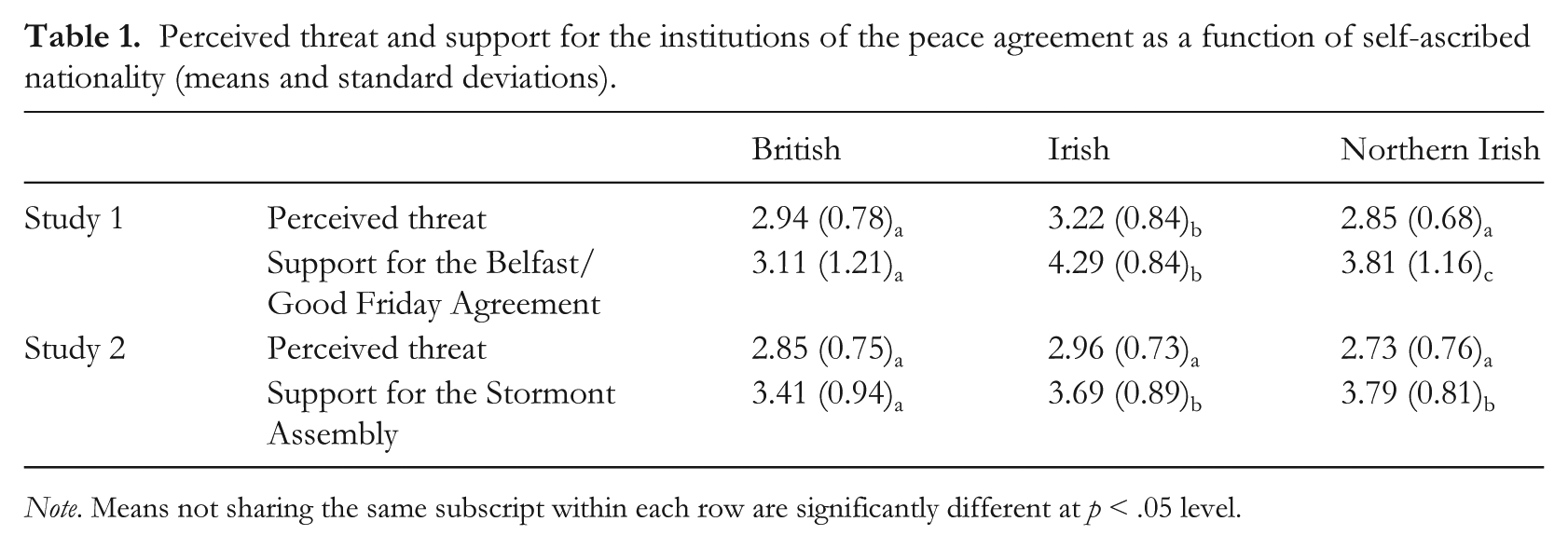
Moderate but significant correlations existed between prototypicality and perceived threat (r = .09, p < .01) and support for the Agreement (r = .14, p < .01). British, Irish, and Northern Irish respondents were compared on threat and support for the Agreement measures, F(2, 1439) = 165.00, p < .001, ηp2 = .21). In all instances, given the unequal sample sizes Pillai’s criterion was used to assess significance given its robustness in instances where there are unequal sample sizes in cells (Tabachnick & Fidell, 2001). 1 The results are presented in Table 1.
Perceived threat and support for the institutions of the peace agreement as a function of self-ascribed nationality (means and standard deviations).
Note. Means not sharing the same subscript within each row are significantly different at p < .05 level.
Preferred national identity was related to perceived threat, F(1, 1442) = 17.09, p < .01, ηp2 = .03, and support for the Agreement, F(1, 1442) = 132.02, p < .001, ηp2 = .22. In support of IPM, prototypicality covaried with threat F(1, 1442) = 8.92, p < .001, ηp2 = .02 and support for the agreement, F(1, 1442) = 14.63, p < .001, ηp2 = .05. We used Tukey’s post hoc tests to check for significant differences between subgroups. Though Tukey’s Honest Significant Difference Test (HSD) is a conservative test for a priori predictions, our large sample sizes suggested caution in evaluation of significance. Tukey’s HSD showed significant differences between British and Irish participants and between Irish and Northern Irish participants relative to threat and support for the Agreement. Irish respondents perceived the highest level of threat. Post hoc tests controlling for prototypicality (Tukey’s HSD) showed that Irish respondents had significantly higher support for the Agreement than both British and Northern Irish respondents and Northern Irish participants showed greater support than British respondents.
Analysis 1b: Ingroup projection
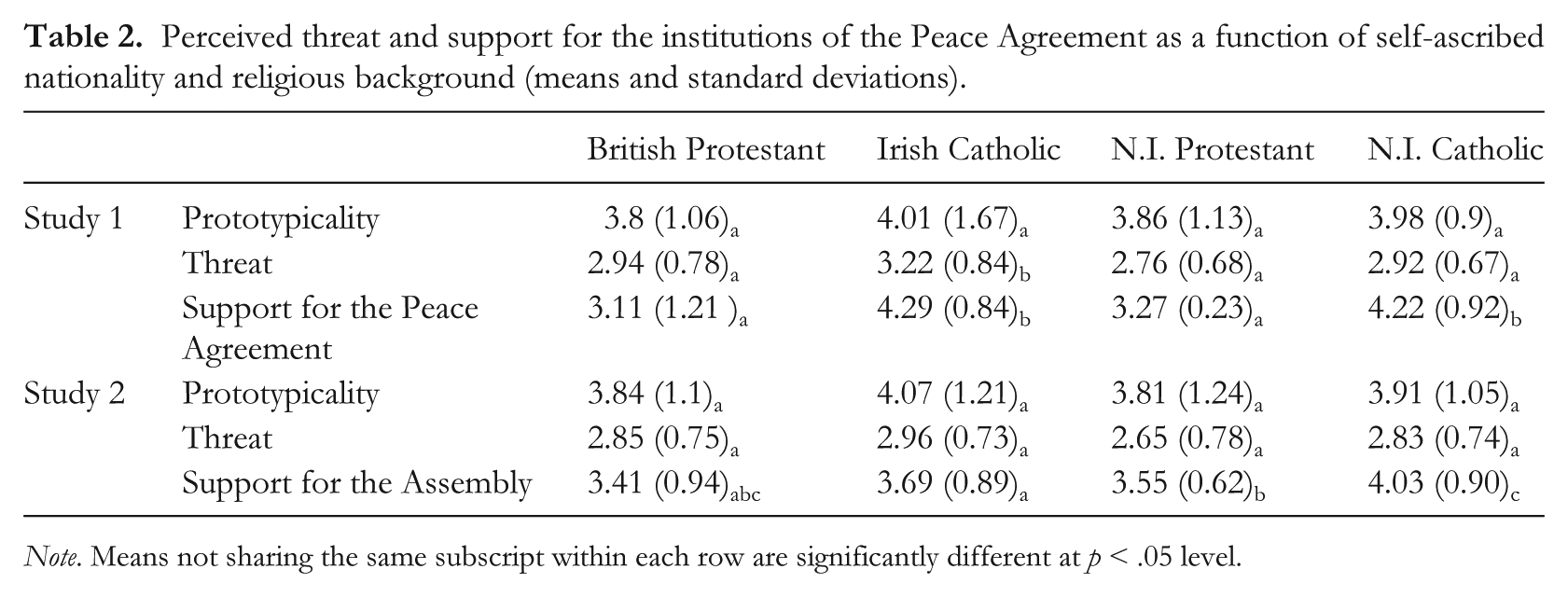
The findings mirror the results in the earlier analysis. Perceived threat was significantly different across all four groups, with Irish Catholic scores remaining significantly higher than all other groups F(3, 1256) = 14.18, p < 0.001, ηp2 = .20; and Northern Irish identifiers (Table 1) and Northern Irish Protestant (Table 2) identifiers in particular, showing the lowest level of perceived threat. No significant differences in national prototypicality between groups were apparent, F(2, 1263) = 2.4, ns. Higher support for the Agreement was associated with higher national prototypicality, F(1, 1443) = 14.61, p < .001, ηp2 = .15.
Perceived threat and support for the institutions of the Peace Agreement as a function of self-ascribed nationality and religious background (means and standard deviations).
Note. Means not sharing the same subscript within each row are significantly different at p < .05 level.
Prototypicality covaried with perceived threat F(1, 1442) = 8.89, p < .01, ηp2 = .02, again supporting a central tenet of IPM. Similarly, the findings relating to support for the Agreement evidence an interesting difference. The differences between the Irish Catholic and British Protestants remain F(3, 1231) = 114.48, p < 0.001, ηp2 = .25, and there are now differences evident within the superordinate Northern Irish group. The Northern Irish Catholic and Northern Irish Protestant groups are significantly different from one another in terms of support for the Agreement as well as significantly different from their religious outgroup with traditional national allegiances. Prototypicality did not covary with threat or support for Agreement within the Northern Irish group.
Discussion: Study 1
We hypothesised using CIIM that those who self-identified as Northern Irish would perceive less threat from their religious outgroup and be more supportive of the Agreement than traditional British or Irish identifiers. We did not find full support for these hypotheses. Northern Irish identifiers did not perceive less threat from their outgroup than British identifiers. And whilst the potential superordinate identifiers, the Northern Irish group are more accepting of the Agreement than the British group, the Irish group showed greatest support for the Agreement consistent with the historically high support for the Agreement in this group (Hayes & McAllister, 2001).
Our subsequent analysis sought to examine evidence in support of the IPM. We found some evidence in support of this model in that religious group differences (that is differences associated with the subordinate identity) are readily apparent and persist in those who identify as Northern Irish (i.e., the superordinate category). This persistence of difference within the potential superordinate identity resonates with the arguments put forward by proponents of the IPM (Wenzel et al., 2007) who claim that superordinate identities can have very different meanings for subordinate groups. Furthermore group prototypicality was related to threat and support for the Agreement as predicted by the IPM. Importantly however there were no differences in prototypicality scores related to subordinate categorisation, as would be predicted by IPM, in those who identified with the Northern Irish label. Evidence in support of the IPM model can be seen as partial.
The higher levels of threat apparent in Irish and Northern Irish Catholics evident in this first study would seem to reflect historic differentials in Northern Ireland. Historically, Catholics have been disadvantaged in terms of political power, access to employment, and fatalities over the course of the conflict (Hayes & McAllister, 2003), however that is not to say that there is not Protestant disadvantage, Protestant casualties of the conflict, or a sense of threat within this group (Schmid & Muldoon, 2013). The importance of controlling for power as a central aspect of intergroup relations is relevant to both the religious division and the conflict in Northern Ireland and limits our interpretation of these findings. Study 2 addresses this issue more fully.
Study 2
Our second study aimed to replicate and extend Study 1. There is strong evidence that experience of conflict is not distributed evenly or indeed randomly across the population (Muldoon & Lowe, 2012). For example those most affected by political violence on a global scale tend to be the very poor (Muldoon, 2013) and within nations those most likely to be exposed to conflict tend to be from the most economically deprived sections of society (Muldoon & Lowe, 2012). Equally those who assume the strongest identity positions are often those with the most experience of conflict garnering psychological strength and collective resource from their strong identities (Muldoon et al., 2009).
In Northern Ireland (as elsewhere) a central component of the political conflict has been economic. It is for this reason it has been argued that those most likely to embrace the Northern Irish label are those who have been least affected by the conflict: effectively the more affluent and powerful socioeconomic groups (Trew, 1998). A central question then is the viability of the common Northern Irish label in groups that have been most affected directly by the conflict and the indirect economic dimensions of the conflict. The situation is further complicated by the fact that exposure to political violence has been related to, and may also be conflated by religious affiliation (Hayes & McAllister, 2003). Our second study addressed this issue.
Method
Sampling procedures
A quota sampling strategy was employed that considered the levels of violence experienced in electoral wards, the religious composition of the respondents, and level of deprivation. Levels of violence was determined using the 1969–1998 dataset of Troubles-related deaths in Northern Ireland collated by Fay, Morrissey, and Smyth (1999), with the top 15% (85 wards) being classified as High-experience and the 122 wards where “Deaths per 1,000” was zero classified as Low-experience. Five rural and five urban high-experience wards (determined on a cut-off point of one person per hectare) were selected using the random sample function of SPSS. Each of these high-experience wards was matched against low-experience wards based on the rural/urban index and deprivation scores determined from Robson, Bradford, Deas (1994). Interviewers used the last-birthday technique to select individual participants from households (further details of this sampling can be found in Lowe & Muldoon, 2010). Fieldwork was conducted in 2008.
Participants
In the total sample of 359 respondents, 343 provided a self-categorisation as either Protestant or Catholic. Due to the sampling procedure targeting wards with experience of conflict, this study had a higher proportion of respondents from the Catholic community than Study 1. Protestants (n = 143) and Catholics (n = 200) from high- (Catholics 108; Protestants 57) and low-experience areas (Catholics 92; Protestants 86) were represented within the sample which had roughly equal proportions of men and women. Three hundred forty-two self-categorised their nationality as being either British (n = 127), Irish (n = 143), or Northern Irish (n = 72), with 17 refusing or stating another identity. British respondents again tended to be older (M = 49.7 years, SD = 16.8) than Irish (M = 41.2 years, SD = 16.4) or Northern Irish (M = 43.7 years, SD = 15.1) respondents. Female participants comprised 51% of the final sample.
Ethical approval was obtained from the University of Limerick and Queen’s University Belfast. Participants were presented with a letter describing the study, assuring the anonymity of responses, and providing contact details for the project researchers and for Victim Support (a charity giving help to victims of the conflict).
Measures
The same measures were used as in Study 1, with the exception of support for the political process. Given the time elapsed since the Belfast Good Friday Agreement, participants were asked to what extent they supported the political institution arising from the Agreement, the Stormont Assembly, on a 5-point Likert scale from 1 = Strongly support it to 5 = Strongly oppose it. Cronbach’s alpha for the threat measure was .74.
Results
We followed the same analytic strategy in Study 2. We first examined differences between our three national identity groups and then attended to the religious background of each national category using MANCOVAs. We examined the independent main effects of area of residence (as a proxy for experience of violence) on support for the agreement, F(1, 184) = 6.34, p < .05, and perceived threat from the outgroup, F(1, 184) = 11.87, p < .05 which were significant. The relationship between self-reported experience of violence and area of residence with identification and attitudes are well considered in the literature (see Fay et al., 1999; Hayes & McAllister, 2003) and as they were outside the main focus of our analysis they are not considered further here.
Analysis 2a: Common ingroup
A significant correlation was observed between prototypicality and perceived threat (r = .09, p < .05) but not support for the agreement (r = .024, ns). To examine the contention that the superordinate Northern Irish identifiers had more inclusive attitudes, MANCOVAs were conducted for both measures, F(2, 278) = 3.12, p < .05, ηp2 = .26. Pillai’s trace criterion was used to test significance of effects given the unequal sample sizes in our subgroups (Tabachnick & Fidell, 2001). The results are presented in Table 1. No significant differences were found between groups on threat, F(2, 293) = .32, ns. Significant differences were found between groups on support for the Stormont Assembly, F(2, 278) = 7.22, p < .01, ηp2 = .26.
Protyptypicality was not a significant covariate with either threat, F(1, 278) = 2.41, ns, or support for the Assembly, F(1, 278) = 1.87, ns. Post hoc tests (Tukey’s HSD) showed that Irish and Northern Irish participants had significantly higher support for the Assembly than British respondents.
Analysis 2b: Ingroup projection
To test the IPM, MANCOVAs were again undertaken breaking down the Northern Irish group by religious background. As in Study 1, prototypicality was entered as a covariate and Pillai’s criterion used to test significance. Fifty-eight participants who did not self-categorise on either variable or who categorised as Irish Protestants or British Catholics were excluded from further analyses.
Differences in perceived threat across groups were again not apparent, F(3, 292) = 1.81, p = ns. However the support for the Stormont Assembly was related to subordinate religious identification and with the difference evident in the Northern Irish group, F(3, 277) = 4.30, p < 0.01, ηp2 = .05. There was no evidence of religious differences in prototypicality within the Northern Irish group. This is counter to the predictions of IPM. Perceived prototypicality was not a significant covariate F(2, 293) = 1.56, ns. The distinction seen in our first analysis between British and Northern Irish on this scale is again driven by the greater support shown for the Assembly by the Northern Irish Catholic group. The Northern Irish Protestant group does not differ in terms of level of support for the Assembly when compared to the traditional British Protestant group.
Discussion: Study 2
Support for the new political dispensation in Northern Ireland and the power-sharing Agreement is highest amongst the Northern Irish group which is consistent with our hypothesis that the Northern Irish label is a common ingroup. That said, religious (subordinate) differences within the potential superordinate (Northern Irish) identity are also evident which is in line with our hypothesis that religious identification continues to exert its effect with regard to political attitudes and in particular with regard to support for the Assembly (which arose from the Agreement) in the Northern Irish group. Northern Irish Catholics are more like the Irish identifiers in terms of their support for the Assembly than they are like Northern Irish Protestants, who have similar views to the British Protestants. This suggests the ongoing importance of the religious identification within the superordinate or common national group. Though this is consistent with the IPM, the failure to observe differences between Catholics’ and Protestants’ perceived threat within the superordinate national group is not consistent with IPM. This difference does not remain in evidence even in this carefully matched sample that controls for experiences during the Troubles and economic power which are key determinants of this social judgement. Importantly, the evident differences are in relation to political attitudes.
A clear difference between these first two studies is the finding related to threat. In our first study, which was a random sample of the population, differences in perceived threat were apparent across the national and religious groups. In our second, when contextual and historical factors such as conflict experience and deprivation are controlled, no significant differences in levels of perceived threat were apparent. These findings point to the importance of contextual factors in shaping respondents’ perceptions of intergroup relations. They are also consistent with recent experimental findings which suggest power can shape understandings of commonality and intergroup relations (Saguy, Tausch, Dovidio, & Pratto, 2009). Our findings add significantly to both the CIIM and IPM literature by attending to power relations in this way. Mummendey and Wenzel (1999) argue that subordinate differences within superordinate groups are largely related to power differentials. Their absence in our matched sample that attempts to minimise power differentials between the groups in Northern Ireland, supports the importance of contextual factors and relative positions of power. The difficulty of applying universal psychological models, whether IPM or CIIM or others to real-world conflict situations that are by definition complex and highly context-specific should not therefore be underestimated.
Study 3
In Studies 1 and 2, the relationships between the common national identity (Northern Irish) and political attitudes are clearer than their link to social judgements such as prototypicality and threat. Study 1 showed reduced perceptions of threat by the Northern Irish participants compared to the British and Irish participants, but this was not replicated in Study 2, where experiences during the conflict and economic contexts were taken into account via sampling. Whilst the more positive social judgements of the superordinate Northern Irish identifiers may be taken as a positive signifier, they contrast with the persistent differences in political attitudes amongst Catholics and Protestants. We hypothesise that the target of the social judgement is central to understanding this issue and it is to this issue we turn in Study 3.
Political targets may be more resistant to change than social targets because of their strategic importance, particularly in conflicted societies, where intergroup relations are often constructed as a zero-sum game. In this third study, we consider attitudes towards political targets separately from social targets using data from a third survey of a wider range of social and political attitudes. This research was conducted as part of the 2007 Northern Ireland Life and Times Survey (NILT) involving 1,179 face-to-face interviews with adults aged 18 years or over.
Method
Participants
In the total sample of 1,179 respondents, 1,033 self-categorised their nationality as being either British (n = 460), Irish (n = 330), or Northern Irish (n = 302). This survey included a fourth possible identity, Ulster, to which only a small group subscribed (n = 41) and 46 participants refused or gave an alternative national identity and so were excluded from further analyses. Of the 1,179 respondents, 1,009 indicated their religious affiliation as either Protestant (n = 555) or Catholic (n = 454). Female participants comprised 53% of the final sample.
Again, respondents were assigned initially to three groups of identity combinations for purposes of statistical analysis: Northern Irish (n = 252), British (n = 346), and Irish (n = 276). Respondents who categorised themselves as British (M = 51.4 years, SD = 18.6) were again significantly older than those that reported their nationality as Irish (M = 47.7 years, SD = 18.9) or Northern Irish (M = 46.4 years, SD = 16.9), there was no statistical difference between age in the Irish and Northern Irish respondents. Subsequently the Northern Irish participants were subdivided by religious background: Protestants (n = 144) and Catholics (n = 108). Participants with unexpected combinations and those who did not self-categorise on either dimension were excluded from further analyses.
Measures
Self-assigned national and religious identity
As in Study 1, participants were asked to select their national and religious identity from a list of possible choices.
Attitudes to social targets
Three questions were chosen to reflect the level that participants supported integration of communities of different religious background in three areas of daily life: home, work, and schooling. The questions were: “If you had a choice, would you prefer to live in a neighbourhood with people of your own religion, or mixed religion?”; “If you were working and had to change your job, would you prefer a workplace with people of your own religion or mixed religion?”; and “If you were deciding where to send your children to school, would you prefer a school with children of your own religion only, or a mixed religion school?” Response options required indication of preference for a mixed- or single-religion setting for their neighbourhood, workplace, and school.
Attitudes to political targets
Participants were asked about their preferred political future for Northern Ireland from the following list: remaining part of the UK under direct rule from Westminster, remaining part of the UK with devolved government in Northern Ireland, becoming part of the Republic of Ireland, or an alternative solution of Northern Ireland being independent of both the UK and Republic of Ireland.
Procedure
The NILT uses a systematic random sample of addresses selected from the Land and Property Services Agency. This is the most up-to-date listing of private households and is made available to the Northern Ireland Statistics and Research Agency. Door-to-door interviews were then undertaken and interviewers listed all members of the household eligible for inclusion in the sample (i.e., all residents aged 18 or over). From this list, randomly selected respondents completed all questions using Computer Assisted Personal Interviewing (CAPITM). Fieldwork was carried out between October 2007 and January 2008.
Results
A key difference between the items in Study 3 compared to Studies 1 and 2 is that the items in the NILT involve categorical-choice responses from a series of attitude and behaviour statements, rather than the more traditional psychological scale data used in Studies 1 and 2. As a consequence, these categorical data have been analysed using nonparametric statistics.
Attitudes to social targets
There was a significant association between national identity and neighbourhood preference, χ2 (2, N = 839) = 6.62, p < .05, Cramer’s V = .09. The Northern Irish group (86% of all those preferring this national label) show a significantly greater preference for mixed-religion neighbourhoods than either the British (81% of those preferring this label) or Irish (77% of those preferring this label) groups. Table 3 also shows the proportion of each group who preferred a single- or mixed-religion workplace. Again there was a significant association between national identity and workplace preference, with the Northern Irish group showing significantly more preference for mixed-religion workplaces (97.6% compared to 93.5% of British and 90% of Irish respondents), χ2 (2, n = 857) = 12.50, p < .01, Cramer’s V = .12. Table 3 also shows the proportion of each group who stated a preference for mixed-religion schools. There was a significant association between national identity and schooling preferences, χ2 (2, N = 838) = 42.31, p < .001, Cramer’s V = .23. Again Northern Irish respondents showed significantly higher preference for mixed-religion schools (74.5%) than Irish or British respondents (48.1% and 67.9% respectively).
Proportion of each national group showing a preference for mixed-religion neighbourhoods, schools, and workplaces.
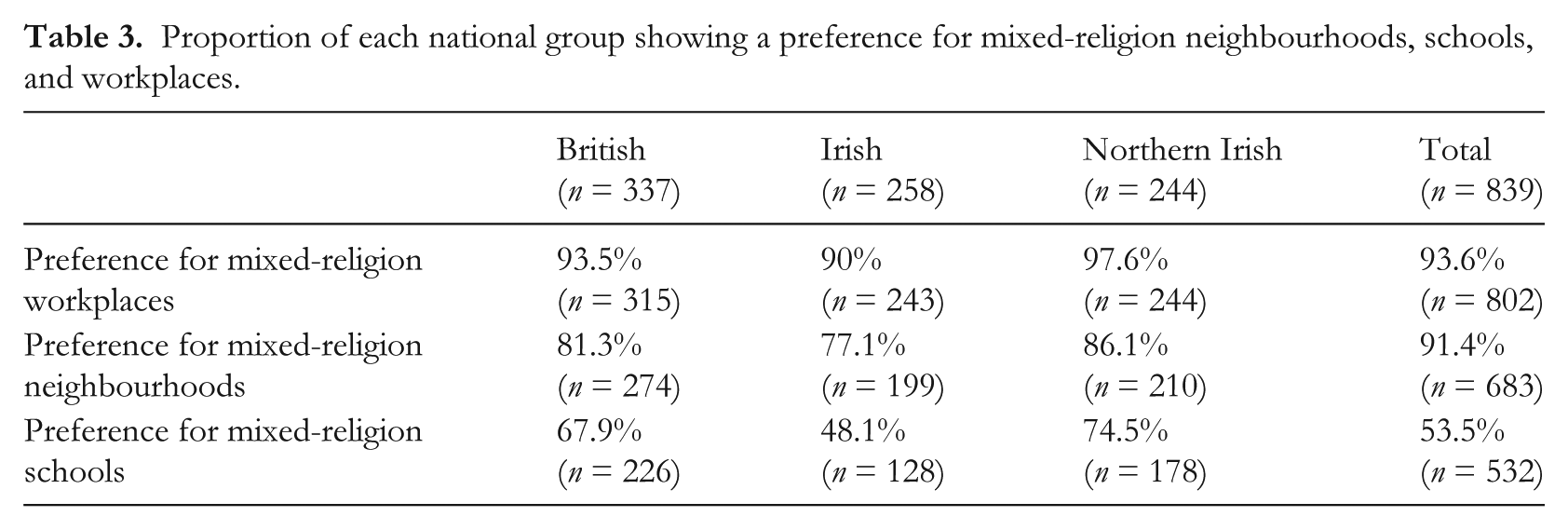
Preferences of the two religious groups for mixed-religion neighbourhoods, workplaces, and schools were also examined within the Northern Irish group. No differences between Northern Irish Catholics and Protestants were evident in relation to preference for mixed-religion workplaces and schools, Pearson χ2 (3, N = 839) = 7.24, ns, and Pearson χ2 (3, N = 857) = 2.54, ns, respectively. However, whilst the Northern Irish group show a greater preference for mixed-religion schooling generally, Protestant support (83%) for mixed-schools is significantly higher than Catholic support (63%) even within the superordinate Northern Irish group, χ2 (3, N = 838) = 53.21, p < .001, Cramer’s V = .25).
Attitudes to political targets
The political attitude question asked participants what the long-term policy for Northern Ireland should be, from a selection of four options (to remain part of the UK with direct rule from London, to remain part of the UK with devolved government, to become part of the Republic of Ireland, or to become an independent state). These results are presented in Table 4. Whilst only a small number of respondents stated Northern Ireland as an independent state was their preferred option, it remains in the analysis presented as it is considered as a viable political option. Its removal from the analysis did not alter the results.
Proportion of each national group supporting different preferences for the political future of Northern Ireland.
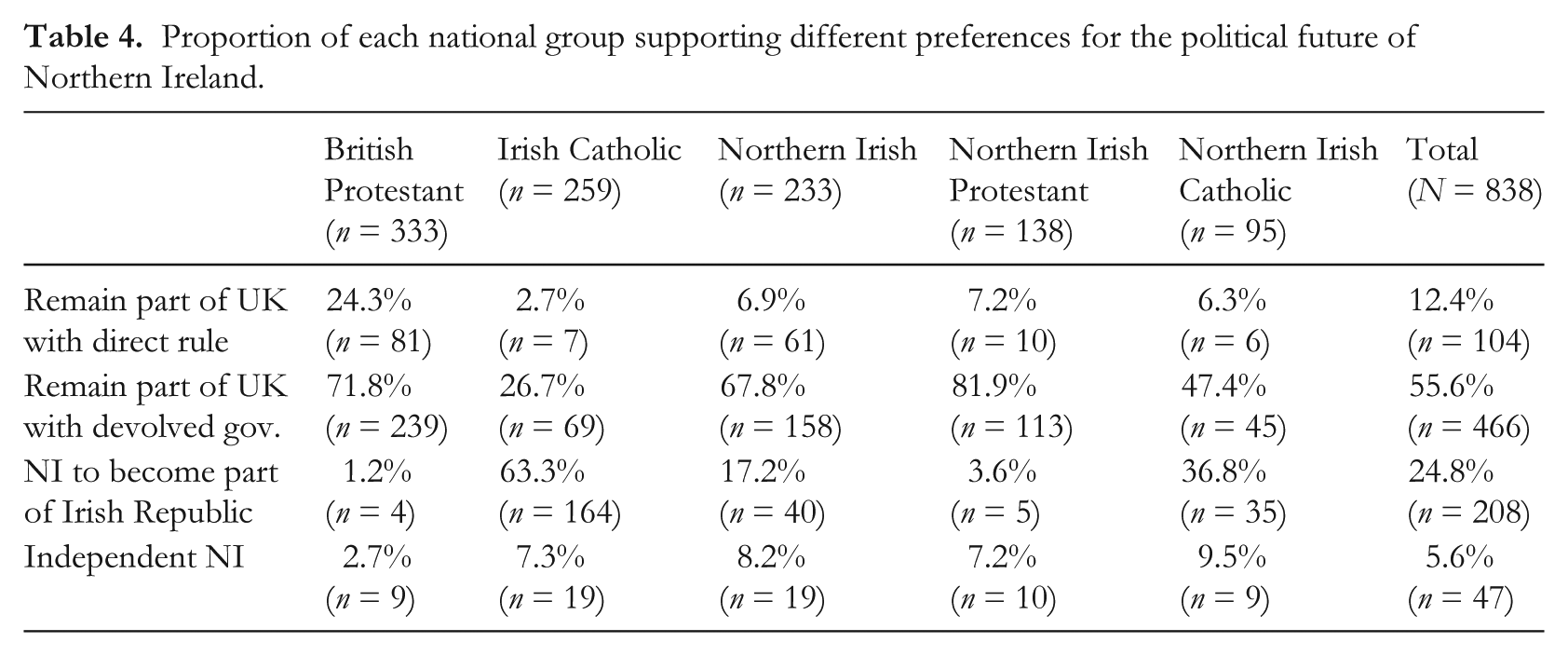
When Northern Irish is considered as a unitary group, a chi-square test indicated that there was a significant association between national identity and future political preference, χ2 (6, N = 825) = 3.63, p < .001, Cramer’s V = .47. The vast majority of British Protestants support continuing union with the UK, with only 1.2% supporting Northern Ireland to become part of the Republic of Ireland and 2.7% supporting an independent Northern Ireland. Although the Irish Catholic results are less clear-cut, the majority support Northern Ireland becoming part of the Republic (63.3%), with a significant minority (26.7%) supporting union with the UK under a system of devolved government. Considering the Northern Irish group, they appear to reflect a midway point between these two positions with 74.7% supporting some form of continuing union with the UK and 17.2% supporting union with the Republic of Ireland.
When the Northern Irish group were separated by religious background, this pattern remained significant, χ2 (9, N = 825) = 4.00, p < .001, Cramer’s V =. 40. However the Northern Irish group differs both from those with whom they share religion (British and Irish identifiers) and from other Northern Irish identifiers with whom they do not share religious affiliation. For example 24.3% of British Protestants supported direct rule from the Westminster Parliament and 71.8% favouring devolved government, whilst the Northern Irish Protestant group shows little interest in direct rule from Westminster (7.2%) and greater support for devolved government (81.9%).
On the other hand, almost 89.1% of the Northern Irish Protestants support continued union with the UK, and only 3.6% support union with the Republic of Ireland. In comparison, the Northern Irish Catholic group show less support for options that involve remaining part of the UK than either Protestant group does, although they show greater support for this option than Irish Catholics do. However, more than 10 times the proportion of Northern Irish Catholics support the union with the Republic (36.8%) than Northern Irish Protestants (3.6%).
Discussion: Study 3
The findings of Study 3 extend the previous analyses; the moderation seen in the social attitudes of participants who identified themselves as Northern Irish is seen in the greater preference for mixed settings in the neighbourhood, workplace, and schooling. However attitude differences dependent upon religious background continue to be seen regarding schooling. This may be because the Catholic population in Northern Ireland attributes its burgeoning middle-class power to a Catholic educational infrastructure.
The clear majority of Protestant participants (of both British and Northern Irish identity) wish to remain part of the UK, with most support for a form of devolved government. The majority of Irish participants support Northern Ireland becoming part of the Republic of Ireland, and a majority of Northern Irish support devolved government. However, there are clear differences between the preferences of the Northern Irish participants from the two religious traditions. Whilst 81.9% of Northern Irish Protestants favoured devolved government within the UK, this figure was 47.4% of Northern Irish Catholics. In contrast, 36.8% of Northern Irish Catholics supported Northern Ireland becoming part of the Republic of Ireland, compared to only 3.6% of Northern Irish Protestants. The question regarding the political future of Northern Ireland therefore generates different response patterns from the two Northern Irish groups. The two Protestant groups show almost zero-level support for Northern Ireland becoming part of the Republic, whilst there are high levels of support for this amongst all Catholic respondents. In short, the Northern Irish group indicates greater social tolerance to the traditional religious outgroup but even in this group religious background continues to be related to political attitudes.
General Discussion
The category Northern Irish is a shared label that potentially fulfils the requirements of the common ingroup identity model. Individuals who identify as Northern Irish reject oppositional categories (Irish/British) and prefer the shared category (Northern Irish), and that shared category is associated with more prosocial attitudes towards the previous outgroup category in Study 3.
The development of the Northern Irish identity in postconflict Northern Ireland at population level is a real-life process and has not appeared overnight (Muldoon, Trew, et al., 2007). Therefore the growth and potential meanings of this superordinate identity need to be understood more fully. For example, Trew (1996) discusses the possible benefits of a Northern Irish national identity that supports positive social attitudes without having an influence on the question of national determination. The shared Northern Irish identity may support the day-to-day maintenance of relationships across the religious divisions within Northern Ireland (Trew, 1996). Trew’s suggestion (and our findings) is not wholly consistent with the CIIM, as this new identity does not moderate political attitudes. In effect it may be that the Northern Irish identity may be a vehicle that allows people to represent themselves as socially inclusive and tolerant without changing their political attitudes or facilitating meaningful inclusion. Our findings indicate that even where the superordinate category label was applied, continuing distinctions between subordinate groups, reflective of historical differences (such as the higher levels of threat amongst Catholics than Protestants in Study 1) are evident. As proposed by IPM, superordinate identification may provide a basis for maintaining, as well as eroding division.
Whilst this approach appears to support IPM, in Studies 1 and 2 there was no observed difference in prototypicality of the Northern Irish identity for participants from Catholic and Protestant religious backgrounds. This suggests that the fit for Catholics and Protestants to the Northern Irish category is equally good which can be taken as a positive indicator of the Northern Irish identity feeling equally inclusive of the traditionally opposing religious groups. This represents a lack of support for the IPM, which predicts that majority subordinate groups will show greater typicality of the superordinate identity than minority groups. However a key difference between the label we are considering here, and national identity labels studied previously (for example German) is that the Northern Irish label has entered into usage more recently. This relative novelty may explain in part why there are no religious differences in the levels of perceived prototypicality; both parties feel they can legitimately project ownership over the identity.
Taken together these two findings highlight the difficulty of applying social psychological models to these real-world datasets. Our findings are neither clear nor unequivocal. In the first case they appear to support both CIIM and IPM, and in the latter they do not.
The specific context of national and religious identity in Northern Ireland may explain why we have observed challenges to both the CIIM and IPM. Whilst national identity in Northern Ireland can be constructed as assumed (Stevenson & Muldoon, 2010), making the boundaries permeable and social and political mobility possible, boundaries between religious groups are largely impermeable. Interestingly, our data suggest that individuals who take on the potentially shared national identity of Northern Irish continue to be thrust back into oppositional relationships by the enduring political division (shaped by religious distinctions). The political landscape of Northern Ireland does not have much space for those who want to remove themselves from this bipolar political arena and therefore adopting a Northern Irish identity does not open up new political options. This is illustrated most clearly in Study 3—the political attitudes response options reflect the most commonly discussed futures for Northern Ireland. The entrenched nature of the political dispute, which has permeated most areas of society in Northern Ireland (Muldoon, 2004; Shirlow & Murtagh, 2006), therefore conspires against the transformational potential of a common identity.
Of course, using analyses of real-world cases raises a number of methodological implications. In particular we would like to draw the reader’s attention to the fact that the datasets, although representative of the population in Northern Ireland, are limited by their reliance on self-report survey data. Furthermore, our independent variables were measured rather than being manipulated; as a consequence our findings and conclusions are correlational.
Having discussed the limitations of the Northern Irish identity as a superordinate category we wish to close on a more positive note. The developing shared identification may well yet allow an alternative space for social interaction outside of the current divisive dualist system of Northern Ireland politics, particularly as the context changes and the salience of the older subordinate adversarial identities become reduced in everyday social and political interactions.
Currently, the apparatus of division in Northern Ireland society is not only psychological but also structural. Individual common categorisations run up against bureaucratic structures that reinforce the traditional identities of Northern Ireland. The value of this new identity may be that as it develops it can become a vehicle for expressing inclusive political ideals that are not yet evident in Northern Ireland, and as such it is likely to be enhanced by any structural and political support in post conflict.
Footnotes
Funding
The research was funded by grants to from the Economic and Social Research Council (ESRC, UK), the Irish Research Council, and the EU Special Support Programme for peace and Reconciliation.