







Abstract
While “knowledge learning” about the outgroup has been regarded as one of the key mechanisms for the contact–prejudice relation since the contact hypothesis’ first inception (Pettigrew & Tropp, 2008), “learning,” more broadly, has rarely been used as an explanatory framework to investigate the consequences of intergroup contact. In this article, we lay the foundation of a learning model of anxiety and stress in ingroup–outgroup interactions. We distinguish between episodic and chronic anxiety responses to the outgroup and recommend investigations on the complexities of their dynamic interplay, as individuals accumulate and dynamically integrate their experiences with the outgroup over time. Through a review of established and emerging psychophysiological and behavioral research of anxiety during ingroup–outgroup interactions, we identify evidence consistent with this dynamic outlook of intergroup contact effects. In this context, we also advance novel and untested predictions for future investigations onto the temporal integration of contact effects during an individual’s lifespan.
Despite the well-established idea that intergroup contact improves intergroup relations because it increases knowledge about the outgroup (Allport, 1954), social psychological research using learning as an explanatory framework to investigate the consequences of intergroup contact is scant (Eller & Paolini, 2011). This may be because this tradition narrowly defines “learning” as “knowledge learning” or learning about outgroup characteristics and cognitions (see e.g., Pettigrew & Tropp, 2008). We redress this by redefining intergroup contact, more broadly, as the process by which we learn about the outgroup. From this broader stance, during intergroup contact, we do not simply acquire new knowledge about the outgroup and its members, we also learn about modal affective responses, emotions, and evaluations typically associated with the outgroup (see also Stephan, 2014). For instance, intergroup contact offers the opportunity to learn to be anxious towards, and around the outgroup, and the opportunity to revise those anxieties—we call this process of revising affective responses to the outgroup in light of new outgroup experiences, anxiety learning.
In this article, we review old and new research on intergroup anxiety in ingroup–outgroup interactions using a new learning model of intergroup anxiety and stress. We first define intergroup anxiety and discuss its central role within the intergroup contact literature; we revisit Blascovich and colleagues’ influential study (Blascovich, Mendes, Hunter, Lickel, & Kowai-Bell, 2001) identifying two key components of the model. The following section then outlines the model’s organizing principles and describes its key features and properties. We then discuss a new generation of research, which measures psychophysiological and behavioral manifestations of intergroup anxiety and stress to assess changes in anxiety over time (i.e., “anxiety learning”) during contact. We argue that these emerging time-sensitive methodologies are powerful tools for testing the predictions generated by the anxiety learning model. We also offer an overview of new data from our own research laboratory, bridging methods from the learning and conditioning research tradition and contemporary investigations of intergroup phenomena.
We aim to demonstrate that the appeal of contemporary research on intergroup anxiety rests in its ability to test new and complex segments of a time-bound process of intergroup anxiety learning, whereby episodic and chronic process variables interact over time in a complex and nonlinear fashion. Using the learning model, we identify some novel and untested predictions about how episodic and chronic process variables may interact, which we hope will guide future research.
Intergroup Anxiety Shapes Intergroup Relations, and Determines Whether Individuals Will Engage and Benefit From Intergroup Contact
Recent interest in intergroup anxiety reflects a broader cultural zeitgeist and a growing attention to how affect and emotions shape intergroup processes more generally (Esses & Dovidio, 2002; Mackie, Devos, & Smith, 2000), and ingroup–outgroup interactions or “intergroup contact” more specifically (Devine, Evett, & Vasquez-Suson, 1996; Greenland & Brown, 1999).
Intergroup anxiety has acquired a central role in the intergroup contact literature. At the broadest level, intergroup anxiety stems from negative expectations about ingroup–outgroup interactions and emerges when outgroup members are seen or expected to pose a threat to the ingroup or individual ingroup members’ goals, motives, or sensitivities (Cottrell & Neuberg, 2005; Plant & Devine, 2003; Smith, 1993; Stephan, 2014; Stephan & Stephan, 2000). Empirical investigations, however, focus on a range of specific negative expectations (e.g., threats to physical integrity, Mallan, Sax, & Lipp, 2009; threats of rejection, Mendoza-Denton, Pietrzak, & Downey, 2008; threats of uncertainty, Plant & Devine, 2003). To complicate matters, several of these alternative sources of anxiety can coexist at any given time and contribute to anxiety’s net impact on the individual and group (Blascovich, Mendes, Hunter, & Lickel, 2000; Greenland, Xenias, & Maio, 2012).
There is growing evidence for the detrimental effects of intergroup anxiety. Intergroup anxiety is associated with increased concerns for the self (Vorauer & Kumhyr, 2001), negative emotions (Crandall & Eshleman, 2003), simplified information processing and reduced attention to disconfirming information (Wilder & Shapiro, 1989), increased dominant responses (Islam & Hewstone, 1993), and decreased task performance (Blascovich et al., 2001; Mendes, Blascovich, Hunter, Lickel, & Jost, 2007). Recent experimental research has started to isolate acute and chronic adverse consequences of intergroup anxiety on health (Mendes, Gray, Mendoza-Denton, Major, & Epel, 2007; Trawalter, Adam, Chase-Lansdale, & Richeson, 2012).
The consequences of intergroup anxiety for the groups involved in contact are also well documented. High intergroup anxiety is typically associated with negative intergroup judgments, including prejudice (Bizman & Yinon, 2001), low perceived variability (Islam & Hewstone, 1993), overt hostility (Plant & Devine, 2003), and unwillingness to engage in future outgroup contact (i.e., informal group segregation; Greenland, Masser, & Prentice, 2001). Conversely, reduced intergroup anxiety explains why intergroup contact typically improves intergroup judgments. For instance, investigations of first- and second-hand experiences of cross-community friendship in sectarian Northern Ireland predicted reduced outgroup prejudice and heterogeneous outgroup perceptions, an effect mediated by sizeable reductions in intergroup anxiety (Paolini, Hewstone, Cairns, & Voci, 2004).
In 2006, we identified only 10 studies documenting the mediational role of intergroup anxiety for the contact–prejudice link (Paolini, Hewstone, Voci, Harwood, & Cairns, 2006; see also Turner, Hewstone, Voci, Paolini, & Christ, 2007). This number has grown considerably since and now includes longitudinal mediational data (e.g., Binder et al., 2009; Swart, Hewstone, Christ, & Voci, 2011). Recent research has also led to the appreciation of the generality of these effects: Similar mediational findings have been found for extended (e.g., Turner et al., 2007), vicarious (Mazziotta, Mummendey, & Wright, 2011), and imagined contact (West, Holmes, & Hewstone, 2011). Hence, it is now generally recognized that virtually any positive outgroup interaction—whether face-to-face, imagined, or via conversations with ingroup members—can improve intergroup relations by reducing the anxiety individuals feel or anticipate feeling in the presence of the outgroup.
Pettigrew and Tropp (2008) recently meta-analyzed studies testing for mediators of the contact–prejudice link to compare the mediational role of decreased anxiety, increased outgroup knowledge, and increased outgroup empathy after contact. While all three mechanisms demonstrated a significant mediational effect and contributed to explaining the contact–prejudice link, intergroup anxiety was found to be the most robust mediator (however, cf. Swart et al., 2011). Thus, among various psychological underpinnings of intergroup contact effects, reduced intergroup anxiety is prominent and thus a legitimate target for social interventions aimed at improving intergroup relations.
More recently, intergroup contact scholars have recognized that intergroup anxiety should be lessened not only to reduce its direct negative consequences on intergroup judgments (e.g., prejudice, stereotyping, etc.), but also to contain its indirect negative effects on one’s willingness to engage in further outgroup contact. Experimental and longitudinal evidence now complements established correlational evidence of an anxiety–contact avoidance link (see Greenland et al., 2012; Henderson-King & Nisbett, 1996; Levin, van Laar, & Sidanius, 2003; Page-Gould, 2012; Page-Gould, Mendoza-Denton, & Tropp, 2008; Plant & Butz, 2006; cf. correlational evidence in Paolini et al.’s, 2006, Table 11.1) and demonstrates that intergroup anxiety typically causes people to avoid intergroup interactions. Based on functional analyses of emotions, anxiety and other negative affective states signal threats to the safety and integrity of the organism, and as such, they trigger physiological and behavioral responses, the main function of which is to limit further damage and threat. Hence, one of the most common outcomes of these processes is the avoidance of potentially dangerous or threatening stimuli—in intergroup settings, the avoidance of contact with outgroup members.
Yet, approach motivators—including individuals’ promotion focus, extroversion, motivation to self-expand, egalitarian worldviews, etc.—have the potential to significantly attenuate and possibly even revert these adverse effects of intergroup anxiety (Mendes, Gray, et al., 2007; Page-Gould, 2012; Wright, Aron, & Tropp, 2002) by encouraging the individual to actively address and approach (vs. avoid) subjectively positive intergroup stressors and harness the associated heightened physiological activation towards increased task engagement, improved performance, and salutary health responses (for initial evidence, see Epel, McEwen, & Ickovics, 1998; Mendes, Gray, et al., 2007; Page-Gould, 2012; Page-Gould, Mendes, & Major, 2010; Page-Gould et al., 2008). Hence, among some individuals and under certain conditions, intergroup contact with acute task demands can lead to beneficial changes in physiology and behavior both in the short term (e.g., preparatory and challenge responses; Mendes, Gray, et al., 2007) and long term (e.g., chronic salutary health responses; Page-Gould et al., 2010; Trawalter et al., 2012). Therefore, while contact avoidance following intergroup anxiety may be widespread and a default response for most people, physiological reactivity and anxiety are not always harmful for the individual, the intergroup interaction and, by extension, intergroup relations.
To ensure that intergroup harmony can be achieved and maintained through peaceful intergroup interactions, and individuals’ wellbeing during ingroup–outgroup interaction protected, efforts should focus on increasing knowledge of intergroup anxiety. This requires an improved understanding of how intergroup anxiety develops in the first place and changes over time (aka anxiety learning), as individuals integrate a range of experiences with the outgroup over their lifespan.
To this aim, we revisit research by Blascovich et al. (2001) next, and show how their results integrate findings from two traditionally independent strands of research on intergroup contact and anxiety, and capture two distinct effects of intergroup contact on anxiety, each with their own unique time-course. These two effects will become key building blocks of our learning model of intergroup anxiety.
Intergroup Anxiety Is Exacerbated in the Present and Reduced in the Long Run: Recognizing Distinct Contact–Anxiety Links
In 2001, Blascovich, Mendes, and colleagues (Blascovich et al., 2001) published very influential research. In this work, nonstigmatized individuals (i.e., healthy White American college students) were asked to become familiar, and interact with, an unknown individual who was either a stigmatized individual (e.g., an individual with a facial birthmark, Black ethnicity, low SES status; intergroup condition) or an unfamiliar nonstigmatized individual (i.e., a White/control individual; intragroup condition). After a short face-to-face interaction with their contact partner, participants were asked to deliver a short (anxiety-provoking) video-recorded speech, which they expected to be later reviewed by their contact partner. While delivering their speech, all participants were attached to physiological equipment that recorded changes in cardiac and hemodynamic (blood flow) output.
Across three experiments, intergroup contact participants displayed signs of heightened anxiety, whereas intragroup contact participants did not. Participants paired with a stigmatized partner exhibited cardiovascular reactivity indicative of a threat response, typical of a situation where people expect task demands to outweigh their task resources (Blascovich & Tomaka, 1996), and which usually results in contact avoidance. In contrast, intragroup contact participants exhibited reactivity indicative of a challenge response, signaling that they evaluated their personal resources to be sufficient, or in excess of task demands, a response typically associated with approach behavior. Moreover, the intergroup (vs. intragroup) participants showed poorer performance during a cooperative task (i.e., fewer words found in a word-finding task).
These systematic differences in psychophysiological and behavioral anxiety between the intergroup and intragroup contact participants reflect the acute anxiety-provoking effects that discrete experiences of intergroup contact can exert in the present—at least when individuals are engaged in motivated performance tasks like those extensively used in experimental tests of the contact–anxiety link. Hence, as the individual is pressed by a difficult task and/or social evaluation, intergroup exchanges typically cause higher levels of anxiety than intragroup exchanges.
While Blascovich et al.’s 2001 article epitomizes a new generation of experimental research on intergroup contact and anxiety, their basic intergroup versus intragroup effect is not entirely new. Similar evidence was isolated in earlier studies and has been replicated several times since. Table 1 summarizes intergroup contact work on physiological and/or behavioral anxiety, which has used an intergroup versus intragroup contact experimental design, with most studies focusing on ethnicity as the intergroup dimension (however, cf. Townsend, Major, Gangi, & Mendes, 2011). 1
Intergroup contact studies that have experimentally investigated physiological and behavioral forms of intergroup versus intragroup anxiety.

Note. *For anxiety type, we rely on Blascovich, Mendes, and colleagues’ tripartite definition of physiological, behavioral, and subjective anxiety (Blascovich et al., 2001; Mendes et al., 2002). For anxiety source, we rely on Greenland et al.’s (2012) distinction of anxiety appraisal sources. **Unless otherwise indicated, effects are in the direction of anxiety being higher in the intergroup than intragroup condition. I = indicates individual-level variable (episodic anxiety relevant to a specific individual outgroup member/s). G = indicates group-level variable (chronic anxiety relevant to entire outgroup). O = indicates anxiety stemming from other individual(s). S = indicates anxiety stemming from participant self-reflecting on own anxiety; C = Continuous measure of anxiety (measure is not a one-off measurement but is rather collected continuously throughout the task; by exclusion all other measurements are discrete in nature).
Table 1 classifies studies by operationalizing intergroup anxiety in four distinguishable ways. First, studies were classified along the tripartite operational definition of anxiety and threat responses (Blascovich et al., 2001; Mendes, Blascovich, Lickel, & Hunter, 2002). Drawing from multifaceted models of generic anxiety and emotions (Lang, 1985; Zajonc, 1998), these scholars discriminate between: (a) physiological markers (i.e., autonomic system responses, like sweating and increased heart rate), (b) behavioral markers (e.g., nonverbal cues, depleted performance, and contact avoidance), and (c) subjective markers (i.e., self-reported responses). Second, each anxiety measure was classified as an individual-level (individual-specific) or group-level (broadly representative of the entire outgroup) measure. Third, the appraisal source of the anxiety measures was classified using Greenland et al.’s (2012) distinction between outgroup-focused anxiety (i.e., anxiety resulting from perceived outgroup’s threats) and self-focused anxiety (i.e., anxiety resulting from concerns over self standard and ingroup standards). Finally, measures were coded for whether they were continuous or discrete.
Irrespective of how anxiety is operationalized, the extant experimental work reveals convergent evidence for reliable differences in anxiety between intergroup and intragroup contact conditions. Critically, these differences are always in the direction of higher anxiety in the intergroup (vs. intragroup) contact condition (however, see Mendes & Koslov, 2012). Hence, it is evident that in the vast majority of experimental tests, discrete interactions with outgroup members cause an increase in anxiety levels—that is, a positive and excitatory link between intergroup contact and anxiety.
Since anxiety is an aversive emotion, it typically has a negative impact on health and performance, acts as an avoidance motive for intergroup contact, and has detrimental effects on intergroup judgments. In other words, the outcome of discrete experiences of intergroup contact—at least in the short term—is detrimental for both the individuals immediately involved and the intergroup relations in which these individuals are embedded.
Curiously, while the immediate, often adverse effects of intergroup anxiety on health and performance have begun to be acknowledged in the literature (e.g., Mendes, Gray, et al., 2007; Trawalter et al., 2012; see earlier section), this is not so for the short-term detrimental effects of intergroup contact on intergroup judgments, group-level variables, and intergroup relations more broadly. Thus, despite the straightforward bleak implications of intergroup–intragroup differences in anxiety for intergroup relations, most current experimental tests of the contact–anxiety link have not tested these implications directly. Of 60 studies identified (Table 1), only seven (11.67%) included group-level variables—like measures of outgroup prejudice, outgroup stereotyping, outgroup trust, etcetera—as outcome variables. 2 Hence, these studies do not help in ascertaining whether laboratory intergroup interactions, besides heightening the contact partners’ anxiety, also increase prejudice, stereotyping, and discrimination towards the entire outgroup and, thus, adversely impact the quality of intergroup relations more broadly.
The lack of experimental tests on group-level measures limits researchers’ awareness that intergroup contact may have sharply different short-term versus long-term effects and that any dissociations over time need to be investigated empirically and explained theoretically. As a result, this gap slows the development of a model that makes integrated predictions for both individual-level and group-level effects of intergroup contact over time and their possible interactions.
Intergroup contact does not necessarily result in high intergroup anxiety, however: Blascovich et al. (2001) captured distinct short- versus long-term effects of intergroup contact on intergroup anxiety. In a third experiment, White/control individuals (i.e., nonstigmatized) interacted with a Black (intergroup) or White (intragroup) contact partner. The overall amount of close intergroup contact participants reported having had with Black people in general prior to coming to the laboratory moderated their physiological responses. Specifically, prior contact did not moderate physiological responses for intragroup contact participants, whereas threat responses among the intergroup contact participants were higher among those who reported having had limited prior contact with the outgroup; they were significantly weaker (and nonsignificant on some indicators) among those who had had more prior close contact. These moderation findings map closely onto extensive cross-sectional correlational research on anxiety and contact (see research listed in Table 11.1 of Paolini et al., 2006). In mainstream, traditional correlational research, participants’ prior histories (vs. discrete experiences) of contact with the outgroup typically ensue beneficial and not detrimental effects on intergroup anxiety (e.g., Paolini, Hewstone, & Cairns, 2007; Paolini, Hewstone, Cairns, et al., 2004; Pettigrew & Tropp, 2008). Hence, this research tradition returns an extensive body of evidence for a negative and inhibitory link between intergroup contact and anxiety.
Blascovich et al.’s (2001) approach was groundbreaking since it isolated in a single design immediate and acute anxiety-inducing effect of discrete contact experiences and the potentially slower anxiety-reducing effects of accumulated prior intergroup contact. That is, by randomly allocating participants to an intergroup–intragroup between-group design, and then showing that accumulated contact protected participants against acute or episodic anxiety experienced during a discrete contact experience, Blascovich and colleagues demonstrated that the immediate anxiety-provoking effects of discrete intergroup contact, once integrated over time through repeated and accumulated contact, produce a long-term beneficial anxiety-reducing effect.
This temporal integration between short-term and long-term effects of intergroup contact on anxiety is displayed in Figure 1. The diagram illustrates Blascovich et al.’s (2001) moderating effect of prior, accumulated contact as two group means along the episodic anxiety y-axis, for “Low contact” and “High contact,” in the bottom panel. The diagram shows that this effect is the same beneficial effect of intergroup contact as captured in abundant past correlational research, and as displayed by the inclined slope for the relationship between intergroup contact and chronic anxiety in the diagram’s top panel. Also, while correlational studies typically do not include an intragroup/control condition, we used a dashed line in the diagram’s top panel to indicate a hypothetical correlational data set showing no relationship (or a zero-slope) between intergroup contact and intragroup anxiety. Thus, the graph identifies two equivalent inter/intragroup differences in anxiety (the “D” in each of the top and bottom panels) in the two research traditions 3 and unveils similarities between the findings of different research traditions otherwise masked by systematic differences in research designs.
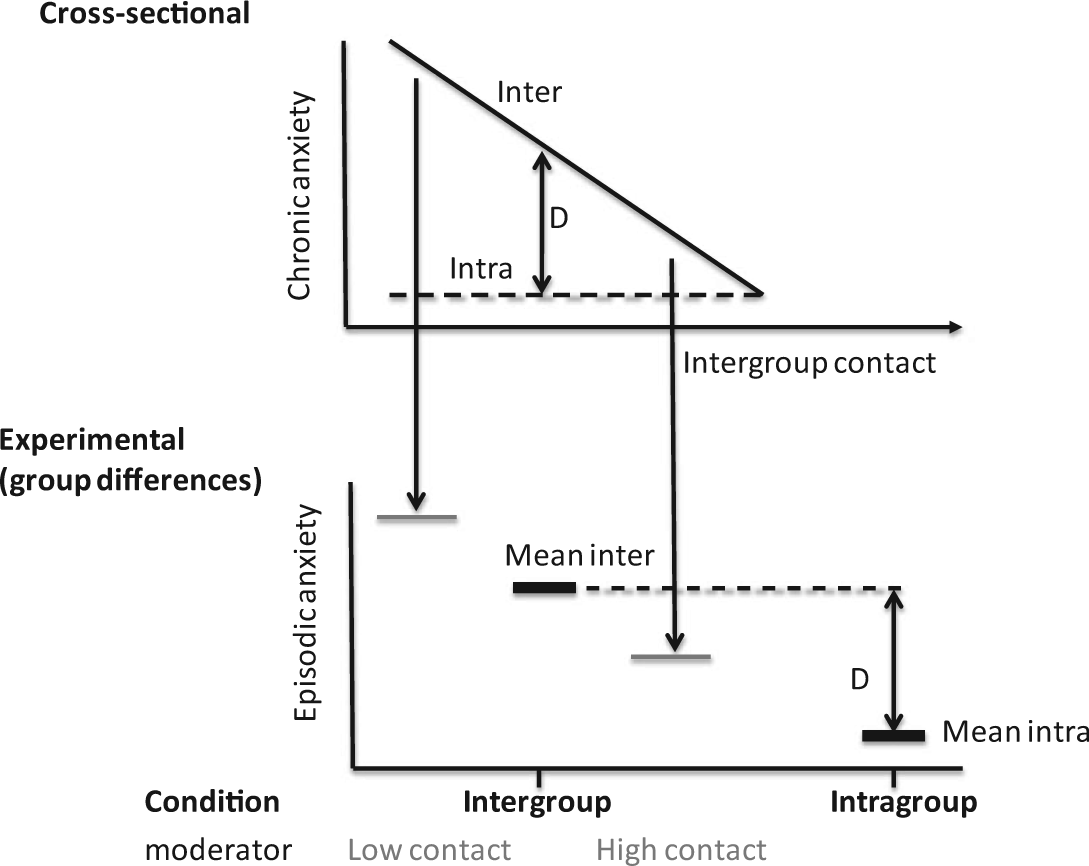
Explanatory diagram illustrating how Blascovich et al.’s (2001) groundbreaking design isolated simultaneously two distinct contact effects on anxiety traditionally investigated in separate research traditions by incorporating both an intragroup–intergroup between-group condition (Intragroup/Intergroup in the bottom panel) and a prior contact measured moderator (Low contact/High contact moderator in the bottom panel).
From this vantage point, the two prima facie contradictory contact–anxiety effects detected by Blascovich et al. (2001) and by distinct research traditions are no longer at odds with each other; rather they fit together nicely in a temporally integrated outlook of intergroup contact experiences over time. However, we recognize that these distinct contact–anxiety effects can also be explained by invoking factors and processes other than temporal integration. 4
Among the many factors that differentiate the methods in the experimental versus correlational research traditions (Paolini et al., 2006), three stand out as suitable—alternative but complementary—explanations of distinct contact–anxiety effects: (a) contact valence, (b) the on-line/memory-basis of the interaction, and (c) individuals’ motivational goals. In vivo interactions between the contact partners in most experimental tests are skewed towards negativity: These interactions are objectively more negative than positive, since the participants’ primary task is to complete difficult cognitive-behavioral tasks under expected or actual social evaluation rather than enjoying the contact partner’s company (see Blascovich & Mendes, 2010; Dickerson & Kemeny, 2004, for methodological foundations); this negativity bias may be further amplified by attentional and encoding biases towards negative (vs. positive) aspects of the interaction and contact partner during on-line processing (Baumeister, Bratslavsky, Finkenauer, & Vohs, 2001).
In contrast, correlational studies are biased towards sampling more positive interactions (Graf, Paolini, & Rubin, 2014; Paolini, Harwood, & Rubin, 2010; Pettigrew, 2008), where researchers typically probe retrospective self-reports of past interactions with outgroup members, as they took place in the field or in structured prejudice-reduction settings (Pettigrew & Tropp, 2006). Thus, they recruit a more variable and positive range of motivational states and valences (Graf et al., 2014; Paolini et al., 2010); this potential positivity bias may be further amplified by retrieval processes that favor positive (vs. negative) contact experiences (Graf et al., 2014; Unkelbach, Fiedler, Bayer, Stegmüller, & Danner, 2008). Hence, experimental studies return positive contact–anxiety effects because they disproportionately focus on on-line negative contact experiences; correlational studies return negative contact–anxiety effects because they focus on retrieved positive contact experiences.
From our theoretical perspective, however, these positive and negative contact–anxiety links are more than the mere by-product of differences in negative and positive contact: They are the constituent building blocks of a novel model of anxiety learning in intergroup contact that temporally integrates contact effects on anxiety over the individual’s lifespan.
In the next section, we first outline a broad learning meta-theoretical framework to intergroup contact effects, against which we then anchor our learning model of anxiety. We call the former “meta-theory” and the latter “model” purposely, to stress marked differences in breadth and supporting evidence: The former is a broad, overarching, testable, but yet untested, theory; the latter is more narrow, more precise in its predictions, and already enjoys supporting evidence.
A Learning Outlook to Intergroup Contact Effects
To discuss intergroup contact in a temporally integrated framework, we conceptualize intergroup contact as the process by which we learn about the outgroup. During intergroup contact, we acquire new knowledge about the outgroup and its members, and we learn about modal affective responses, emotions, and evaluations typically associated with the outgroup. As a consequence, our responses towards the outgroup may change, for better or worse, over time—through a learning process. With relation to anxiety, intergroup contact offers the opportunity to learn to be anxious towards the outgroup, but also to revise those anxieties. It is these changes in outgroup anxiety over time that we operationally define as “anxiety learning.”
Organizing Principles of Inductive and Deductive Learning
Five organizing principles can be used to describe the time course of affective, evaluative, and cognitive processes during ingroup–outgroup interactions: (a) contact experiences are discrete learning experiences with individual outgroup members and about specific ingroup–outgroup interactions, which inform about the cognitions, affect, emotions, and evaluations associated with specific outgroup members and ingroup–outgroup interactions, and result in what we call episodic or individual-level responses; (b) episodic/individual-level cognitions, affect, emotions, and evaluations form the basis of relatively context-free and time-free cognitive, affective, emotional, and evaluative responses towards, and expectations about, the outgroup as a whole and ingroup–outgroup interactions in general—what we call chronic, or group-level responses; (c) chronic/group-level responses shape, in turn, episodic/individual-level responses; that is, expectations about the outgroup as a whole and ingroup–outgroup interactions in general, affect responses to specific outgroup members and ingroup–outgroup interactions; (d) this feedback effect linking episodic/individual-level responses to chronic/group-level responses (inductive learning or individual-to-group generalization), and feed-forward effect linking chronic/group-level responses to episodic/individual-level responses (deductive learning or group-to-individual generalization), form a dynamic loop that is repeated continually as experience with the outgroup accumulates throughout one’s lifetime; (e) both episodic/individual-level and chronic/group-level responses to the outgroup change over the lifespan through reciprocal interaction, and the accumulation of repeated and diverse episodic contact experiences, reflecting individuals’ unique histories and intergroup contexts’ unique ecologies.
We first introduced the distinction between episodic/individual-level and chronic/group-level responses in an earlier paper (Paolini et al., 2006; see also Page-Gould et al., 2008; Paolini, 2008). Here, we extend it further to encompass affect, emotions, cognitions, and evaluations. Consequently, we use the labels episodic and individual-level variables interchangeably to refer to state and context-specific variables tapping onto affective, emotive, cognitive, evaluative responses to specific outgroup members in specific ingroup–outgroup interactions (e.g., episodic intergroup anxiety coded as “I” in Table 1). We use the labels “chronic” and “group-level” variables to refer to more enduring, trait-like and relatively context-free variables, tapping onto affective, emotive, cognitive, evaluative responses to the outgroup as a whole and their members more generally and measured without reference to a specific intergroup encounter (e.g., chronic intergroup anxiety coded as “G” in Table 1).
Principles (a) and (c) posit explicit links between episodic/individual-level responses and chronic/group-level responses. We suggest that these links are underpinned by two distinct forms of generalization relevant to intergroup contact experiences, namely inductive and deductive learning. In social psychology, inductive learning is often called individual-to-group (Brown & Hewstone, 2005) or member-to-group generalization (Paolini, Hewstone, Rubin, & Pay, 2004; Stark, Flache, & Veenstra, 2013). Generalization of cognitions are typically the domain of stereotype change researchers (e.g., McIntyre, Paolini, & Hewstone, 2015; Paolini, Hewstone, Rubin, et al., 2004). Intergroup contact researchers have traditionally focused on generalization of evaluations and global affect (for a discussion see, Pettigrew & Tropp, 2011; Stark et al., 2013), but recently started to consider generalization of specific emotions (e.g., empathy, anxiety; Paolini et al., 2010; Paolini et al., 2006; Stephan, 2014). Similarly, we call deductive learning, going from chronic/group-level responses to episodic/individual-level responses, group-to-member or group-to-individual generalizations (Wilder & Shapiro, 1991), which also potentially take place at the level of evaluations, specific emotions, cognitions, and affect.
A Model of Anxiety Learning in Interactions With the Outgroup
When applied to intergroup anxiety, the five organizing principles described before take the shape of the model depicted in Figure 2. Central to our time-integrated model of anxiety learning, Figure 2 illustrates the temporal integration of chronic and episodic anxiety including the inductive feed-back and the deductive feed-forward links. Figure 2 also illustrates how episodic anxiety is generated by a specific, discrete experience of contact (“episodic contact”) with outgroup members. In contrast, chronic anxiety takes its source in individuals’ cumulative past history of contact with the outgroup (or simply, cumulative contact or “CC” in figure).

Diagram depicting our time-integrated model of anxiety learning. Diamonds depict moderation effects. Episodic contact causes episodic anxiety (link from “episodic contact” to “episodic anxiety”), as well as changes in those anxieties (loop indicating “contingency-bound (anxiety) learning”). Passage of time from distant past to present is encoded using gradually lighter shades of black to grey. Past contact experiences accumulate over an individual’s lifetime to form a repertoire of cumulative contact (CC; medium grey), which underpins chronic anxiety (CA), but also moderates deductive (feed-forward, group-to-individual generalization) and inductive (feed-back, individual-to-group generalization) learning links between chronic and episodic anxiety. Out-group prejudice (OP) moderates deductive learning and category salience (CS) moderates inductive learning, while cumulative contact and chronic anxiety both moderate contingency-bound (anxiety) learning (see text for more details). The effects of contact valence are discussed extensively in the text, but are not depicted diagrammatically for sake of clarity.
Critically, we do not simply argue that episodic/individual-level processes and chronic/group-level processes should both be taken into consideration and measured. Rather, this anxiety learning model explains how episodic/individual-level processes and chronic/group-level processes interact to determine individuals’ net anxiety responses: It guides us in advancing specific predictions for these interactions, identifying emerging evidence relevant to testing these predictions, and understanding where further research is needed. Figure 2 illustrates some of this emerging complexity (see next section). For example, it shows how chronic anxiety and outgroup prejudice moderate inductive and deductive learning links, respectively.
There are several key differences between our anxiety learning model and Blascovich and Tomaka’s (1996) biopsychosocial model (BPSM) of challenge and threat. Firstly, the BPSM focuses most heavily on acute/episodic anxiety responses (i.e., episodic contact–anxiety links), whereas our learning model incorporates the impact that cumulative experiences of contact with the outgroup possibly exert on chronic and episodic anxiety responses (i.e., cumulative contact–anxiety links). Hence, even though the BPSM can be made to incorporate the effects of chronic anxiety responses by considering cumulative intergroup contact experiences as one of the resources individuals bring to episodic encounters, the BPSM’s analysis of task demands is heavily weighted (but not exclusively generated) by episodic (i.e., task-specific) resources.
In contrast, our learning model of intergroup anxiety advocates more explicitly the dynamic interaction between, and delves more deeply into, episodic and chronic experiences interacting over time. As such, it frames the acute anxiety responses of the BPSM in a more complex manner, which includes both acute and chronic anxiety and their interaction over time. Consequently, our model is unique in explicitly addressing processes of generalization, linking episodic anxiety responses to more chronic, generalized anxiety responses, and in highlighting potential mechanisms and moderators of these processes. Thus, our model brings to the forefront the mutual dynamic interplay of both acute and chronic anxiety responses over time.
This temporally dynamic outlook to intergroup anxiety raises potential complexities and dissociations that are difficult to conceive from more static outlooks of intergroup anxiety and contact. The next section clarifies how our learning model of anxiety is consistent with emerging psychophysiological and behavioral evidence for the contact–anxiety link.
The Interplay Between Episodic and Chronic Intergroup Anxiety: Emerging Evidence and Directions for Future Research
Traditional research on anxiety in intergroup contact has failed to appreciate the complex and time-dependent interplay between episodic and chronic anxiety as individuals’ experiences with outgroups accumulate over the lifespan (Paolini, 2008; Paolini et al., 2006). However, since Blascovich et al.’s (2001) groundbreaking work, time-bound analyses of intergroup anxiety and stress have started to thrive. Advancements in unobtrusive, on-line, psycho-physiological measurements of anxiety have revolutionized our understanding of episodic anxiety—including galvanic skin responses, heart reactivity, cortisol release, etcetera (see Guglielmi, 1999). Moreover, a growing use of time-sensitive research paradigms—including conditioning paradigms, cortisol release monitoring, and diary methods—make it possible to explore the processes that bridge episodic and chronic anxiety and their dynamic interplay.
In this section, we dissect these emerging research outcomes using our model of anxiety learning. We start by discussing the limited research on anxiety learning (i.e., Figure 2’s link from “episodic contact” to “episodic anxiety,” and the contingency-bound learning loop) and inductive anxiety learning (i.e., Figure 2’s link from “episodic anxiety” to “chronic anxiety”), and then move onto more extensive work on deductive anxiety learning (i.e., Figure 2’s link from “chronic anxiety” to “episodic anxiety”) and its key moderators (see diamonds on that link). Throughout, we advance untested predictions and provide ideas for new research.
Initial Evidence for Intergroup Anxiety Learning
The strong emphasis on remedial intergroup interventions in social psychology has to date unduly constrained the scope of intergroup contact research to investigations on intergroup anxiety reductions (e.g., Paolini et al., 2007; Paolini, Hewstone, Cairns, et al., 2004; Turner et al., 2007). For a fuller understanding of the dynamic interplay between episodic and chronic anxiety, we cannot avoid investigating the conditions under which anxiety both increases and decreases.
Olsson and colleagues (Olsson, Ebert, Banaji, & Phelps, 2005) have recently broken with the tradition of studying anxiety reductions. They used an aversive conditioning procedure to examine the stimulus-specific acquisition and extinction of intergroup anxiety (“contingency-bound learning” in Figure 2). 5 They presented White and Black participants with two White and two Black faces and repeatedly paired one of each with a mild electric shock, and another of each with no shock. Following aversive conditioning, participants underwent extinction: faces were presented repeatedly without any shocks. Results revealed that participants acquired anxiety responses towards the ingroup and outgroup faces paired with shock relative to the faces not paired with shock; however, learnt anxiety responses towards the outgroup (vs. ingroup) extinguished more slowly. Olsson et al. (2005) interpreted their findings within an evolutionary framework of learning preparedness, whereby outgroups constitute evolutionarily fear-relevant stimuli that are more strongly associated with fear, like spiders and snakes (Öhman & Mineka, 2001). From a learning outlook, these findings demonstrate that Pavlovian conditioning contributes to the first-hand learning of outgroup anxiety and suggest that outgroups are slower to be dis-associated from anxiety.
Our research extends Olsson et al.’s (2005) analysis to conditions in which we learn to become anxious of outgroups second-hand by observing others (Harris, Griffin, & Paolini, 2015; Harris, Paolini, & Griffin, 2015). Like Olsson et al., White Australian participants learnt to respond anxiously to the outgroup by experiencing pairings of a Black face and a mild electrical stimulation (i.e., “first-hand” contingency-bound learning). In a second experimental condition, participants instead watched a video of a White individual receiving face-shock pairings and appearing uncomfortable when one Black face was presented, and relaxed when another Black face appeared (i.e., “second-hand” contingency-bound learning). We found that skin conductance responses displayed similar levels of anxiety acquisition for both learning conditions.
This behavioral evidence for direct and observational learning of anxiety in the intergroup domain (Harris, Griffin, et al., 2015) contributes to recent neurophysiological and imaging data suggesting an overlap in the neural circuits in direct and vicarious fear learning (Olsson, Nearing, & Phelps, 2007). This evidence suggests that people not only learn to feel comfortable and respond positively to outgroups by directly witnessing positive ingroup–outgroup interactions (Mazziotta et al., 2011; Paolini et al., 2007; Paolini, Hewstone, Cairns, et al., 2004; Turner et al., 2007; Wright, Aron, McLaughlin-Volpe, & Ropp, 1997). The same mechanisms of observational and vicarious learning are also involved when experiencing negative intergroup interactions (Weisbuch, Pauker, & Ambady, 2009), thus, helping explain how people become anxious and learn to respond negatively to outgroups in the first place.
Initial Evidence for Inductive Anxiety Learning
Our research on observational learning of outgroup anxiety has also contributed to understanding the processes that underpin inductive anxiety learning or individual-to-group generalization (Harris, Paolini, et al., 2015)—the link going from “episodic anxiety” to “chronic anxiety” in Figure 2. We explored how episodic anxiety generalizes from outgroup members directly involved in the aversive contact experience (e.g., paired with the shock) to outgroup members not directly involved. For this, we used a face morphing software and generated progressively less outgroup-like variations of our target faces, as well as new faces of comparable “Black-ness.” We found that episodic anxiety generalized along a similarity–dissimilarity gradient: Intergroup anxiety generalized to Black faces that were configurally most similar (vs. dissimilar) to the target Black faces.
Importantly, social and intergroup dimensions of the observational learning experience played a key role in the amplitude of these generalization effects. The generalization effects were more pronounced among individuals from an ethnic minority (Asian Australians vs. White Australians) and when learning to become anxious from a majority model (White vs. Asian model). Moreover, perceived model believability and self-model similarity mediated these effects, confirming the need to embed any test of intergroup anxiety learning into the social and intergroup context in which these phenomena take place.
A sophisticated understanding of the processes conducive to generalization is essential to managing intergroup relations; psycho-physiological and behavioral research is scant in this area and more work is needed. Because of individual-to-group and group-to-individual generalization (i.e., inductive and deductive learning), discrete negative and positive experiences with the outgroup have far-reaching consequences on future intergroup interactions and on intergroup relations. Similarly, because of these generalization processes, positive intergroup contact is a legitimate intervention tool to improve intergroup experiences, responses of individuals and entire groups (Brown & Hewstone, 2005; Pettigrew & Tropp, 2006, 2011). Without generalizations, interventions fostering positive intergroup contact are limited to specific contact experiences with specific outgroup members and any improvements in response to whole outgroups cannot reverberate back to other individual outgroup members and future ingroup–outgroup interactions. Hence, we call for more research in this area.
Possible moderation by category salience
Tests of moderation provide a way to improve our understanding of generalization of anxiety and there are important lessons to be learnt from existing evidence: Positive generalized changes in chronic/group-level evaluations and cognitions can be achieved after contact (Pettigrew & Tropp, 2006, 2011), facilitated by positive contact and high category salience, or awareness of the ingroup/outgroup category distinction (for a review see, Brown & Hewstone, 2005). Hence, consistent with classic cognitive analyses of generalization (Rothbart & John, 1985; Rothbart, Sriram, & Davis-Stitt, 1996), for successful individual-to-group generalization, the contact partners must see themselves as representatives or typical of their group, and the contact experience as an “intergroup” (vs. interpersonal) interaction.
Whereas the previous research dealt with generalization of evaluations and cognitions, category salience may play a similar moderating role in inductive learning of emotions, and, in particular, of anxiety (see CS diamond on the link from episodic anxiety to chronic anxiety in Figure 2), an idea contemplated by Eliot Smith (1993):
Suppose almost every encounter with a group member leads to similar emotions, and that the ingroup–outgroup distinction is so salient [emphasis added] that the outgroup is viewed as quite homogeneous…. Then the perceiver would end up reacting in the same way to just about any outgroup member. (Smith, 1993, p. 305)
We found initial evidence supporting Smith’s contention in our work and that of research collaborators (see Paolini et al., 2006): Individuals more aware of their group memberships during contact displayed larger anxiety reductions after individual (Harwood, Hewstone, Paolini, & Voci, 2005, Study 2) or repeated positive contact experiences with individual outgroup members (Voci & Hewstone, 2003a, 2003b). Alternatively, those who were less aware of their group membership during contact exhibited poor (Harwood et al., 2005, Study 2; Voci & Hewstone, 2003a, Study 1) or no anxiety reductions after contact (Voci & Hewstone, 2003a, Study 2; Voci & Hewstone, 2003b, Study 1). Hence, preliminary evidence suggests that category salience is a catalyst for anxiety reductions following positive contact.
Evidence suggests that category salience may play a stronger moderating role in anxiety increases (vs. decreases) after negative contact experiences. Recent research has shown that category salience is higher when contact goes badly (Paolini et al., 2010; Paolini et al., 2014). The implications of these valence-salience effects are poignant as they suggest that generalizations of negative consequences after negative contact may be comparably larger and more robust than generalizations of positive consequences after positive contact. We have published contact data confirming that asymmetries in generalization may occur for evaluations (Barlow et al., 2012; Graf et al., 2014; however, cf. Stark et al., 2013), and future research should investigate whether these also hold for intergroup anxiety.
Evidence of Deductive Anxiety Learning
While research on the mechanisms of contingency-bound anxiety learning and inductive anxiety learning is still scant, evidence of deductive anxiety learning—that is, group-to-individual generalization—is growing faster (see Table 2). In Figure 2, we represent deductive learning by connecting chronic anxiety (“CA”) to the episodic contact-episodic anxiety link; depicted in this way, chronic anxiety moderates anxiety produced by episodic contact. In addition, we superimpose several chronic/group-level moderator variables on the deductive learning link (see diamonds on deductive learning link in Figure 2) to show that these may moderate deductive learning, and hence the anxiety produced by episodic contact. Finally, chronic anxiety might moderate changes in anxiety as a consequence of the contact experience, as depicted by the diamond on the contingency-bound learning link in Figure 2.
Intergroup contact studies that have experimentally investigated physiological and behavioral forms of intergroup anxiety and tested for moderation.

Note. *For anxiety type, we rely on Blascovich, Mendes, and colleagues’ tripartite definition of physiological, behavioral, and subjective anxiety (Blascovich et al., 2001; Mendes et al., 2002). For anxiety source, we rely on Greenland et al.’s (2012) distinction of anxiety appraisal sources. **Unless otherwise indicated, effect is in the direction of anxiety being higher in the intergroup than intragroup condition. I = indicates individual-level variable (episodic anxiety relevant to a specific individual outgroup member/s). G = indicates group-level variable (chronic anxiety relevant to entire outgroup). O = indicates anxiety stemming from other individual(s). S = indicates anxiety stemming from participant self-reflecting on own anxiety; C = Continuous measure of anxiety (measure is not a one-off measurement but is rather collected continuously throughout the task; by exclusion all other measurements are discrete in nature).
Moderation by chronic anxiety
Based on our organizing principles and learning model of anxiety, chronic/group-level anxiety should moderate (a) episodic/individual-level anxiety and (b) contingency-bound anxiety learning (Figure 2; see also Page-Gould et al., 2008). Consistent with the first prediction, Ofan, Rubin, and Amodio (2013) found that individuals’ chronic social anxiety and situationally induced intergroup anxiety moderated participants’ attendance of interethnic differences—a key cognitive precursor of intergroup threat responses—as measured by the N170 component of brain event-related potentials; a difference in N170 between White and Black faces appeared only among those high (vs. low) in dispositional social anxiety being monitored by the experimenter “for signs of prejudice” (a “public” or “audience” condition).
Consistent with the second prediction, we found evidence suggesting that chronic intergroup anxiety moderates stimulus-specific increases in episodic anxiety (i.e., anxiety learning) following direct and observational aversive conditioning of interethnic anxiety (Harris, Griffin, et al., 2015). White Australians’ chronic anxiety towards Black people in general (i.e., chronic anxiety) moderated the acquisition of intergroup anxiety, such that galvanic skin responses to the faces paired with shock were larger among those who reported a high chronic anxiety towards Black people than among those who were less chronically anxious, among both direct and observational learning participants. Hence, chronic anxiety was a catalyst of anxiety learning across both direct, and vicarious anxiety learning.
While the aforementioned research shows that chronic anxiety moderates acute anxiety responses and stimulus-specific learning of acute anxiety, recent work by Trawalter et al. (2012) demonstrates that chronic anxiety at the onset moderates also the development of chronic anxiety over time (i.e., chronic anxiety as the end point or outcome of inductive anxiety learning; for simplicity this effect is omitted in Figure 2). Using a diary method to monitor daily intergroup contact of college students, the researchers took repeated measurements of cortisol release to assess healthy and unhealthy stress responses following contact. They found that the proportion of intergroup contact that participants reported having had the previous day predicted the amplitude of cortisol boosts the following day, suggesting that all participants experienced intergroup exchanges as stressful and requiring the mobilizing of extra resources. However, chronic intergroup anxiety—operationalized as concerns about appearing prejudiced—moderated the long-term outlook of these cortisol boosts (i.e., chronic anxiety as outcome). Over the academic year, individuals initially low in chronic intergroup anxiety showed a steepening of cortisol diurnal rhythms following increases in interethnic contact, indicative of healthy chronic stress responses and increased resilience over time. However, individuals initially high in chronic intergroup anxiety showed a progressive flattening of cortisol slopes, indicative of chronic ill health and stress. The findings indicate that chronic anxiety increases the attendance of threat-related cues, accelerates the acquisition of episodic intergroup anxiety, and leads to the establishment of chronic stress responses.
However, chronic anxiety is not necessarily a predictor of negative outcomes; rather it may act more generally as an amplifier of episodic anxiety responses and anxiety learning in both increasing and decreasing directions. Page-Gould et al. (2008) measured acute stress responses as intergroup friendships between White and Latino/a college students across three sessions. Declines in cortisol reactivity as friendships developed were observed exclusively among participants high in race sensitivity, another variant of chronic intergroup anxiety (Mendoza-Denton et al., 2008), or among individuals high in implicit race prejudice. These results indicate that chronic intergroup anxiety can act as the catalyst of both positive and negative changes in anxiety.
Moderation by outgroup prejudice
Individual difference variables highly correlated with chronic intergroup anxiety may mimic the potentially complex and dissociated moderating effects we discussed earlier for chronic anxiety (see e.g., Mendes & Koslov, 2012; see also the moderation outgroup prejudice [“OP”] diamond for outgroup prejudice in Figure 2). Westie and De Fleur’s (1959) pioneering study on the physiology of intergroup relations exposed the anxiety-exacerbating effects of prejudice. They found that prejudiced individuals displayed higher skin conductance responses to Black than White photographs, whereas nonprejudiced individuals did not.
Importantly, as Westie and De Fleur’s (1959) participant groups had been carefully matched along a variety of social demographics (age, sex, social class, residential history), including previous contact with Black people, demonstrating that the higher anxiety of the prejudiced group was driven by differences in prejudice. A recent study by Mendes, Gray, et al. (2007) demonstrates that prejudice may also be associated with fewer positive outcomes. When monitoring acute neuroendocrine stress responses during a stressful task performed in front of a White versus Black evaluator, Mendes et al. found that all intergroup and intragroup participants displayed a similar pattern of malignant stress responses (catabolic/cortisol releases) to the stressful task, irrespective of their implicit race prejudice on a race Implicit Association Test (IAT). Implicit prejudice, however, moderated the presentation of the benignant stress counterpart (anabolic/protective responses): Those allocated to the Black evaluator and who were higher on implicit prejudice did not display the salutary stress responses displayed by those allocated to the Black evaluator and low in implicit prejudice, suggesting that prejudiced individuals suffer from both the presence of malignant intergroup stress and the lack of benignant intergroup stress.
The outlook of moderation by prejudice is however not necessarily bleak. As indicated earlier, in Page-Gould et al.’s (2008) experimental study of intergroup friendship formation, it was only those who had scored high (vs. low) on implicit race prejudice (or race sensitivity) at pretest, who (a) displayed significant declines in cortisol release as intergroup friendship developed, (b) showed reduced anxious mood on the days in which they engaged in intergroup interactions, and (c) reported more self-initiated intergroup interactions. Hence, while prejudiced individuals might suffer from higher anxiety levels, there is evidence that they benefit the most from prejudice and anxiety reduction interventions (for more data, see Hodson, 2011).
Moderation by prior outgroup contact
As we move outward from the core of our anxiety learning model, we expect individuals’ past outgroup contact to play a key moderating role (see Figure 2’s moderation diamond for cumulative contact on the deductive learning link). We found growing evidence that individuals’ histories of positive outgroup contact protect against intergroup anxiety and intergroup anxiety learning. As discussed earlier, Blascovich et al. (2001, Study 3) measured the amount of quality outgroup contact non-Black participants had with Black people before attending their lab session (e.g., “how much contact have you had with African-Americans as close friends?” p. 261). This study found reduced and, at times, no evidence of cardiovascular threat responses during interactions with a Black confederate among those participants who had a history of extensive and positive outgroup contact. Similarly, we measured participants’ pretest levels of quality contact with Black people (e.g., “thinking about the past interactions you have had with Black people, are most interactions pleasant?”) and found that this chronic variable buffered against the stimulus-specific acquisition of outgroup anxiety during both a direct and an observational aversive conditioning procedure (Harris, Griffin, et al., 2015). Hence, White individuals with histories of positive contact with Black people were less likely to learn to become anxious of Black faces when faced with negative outgroup experiences.
Extending this reasoning, Olsson et al. (2005) checked the moderating effects of prior outgroup contact on the extinction of intergroup anxiety, as acquired during a direct aversive conditioning procedure. At pretest, they measured the number of interracial dates as a proxy of prior quality contact with Black people, and found a significant negative correlation with the number of times a Black (vs. White) face needed to be presented without shock to reduce participants’ heightened arousal. Hence, the more past quality contact participants had with the outgroup, the faster they recovered physiologically from an aversive intergroup experience.
Results from a diary study by Page-Gould (2012) shed some initial light on the processes contributing to the anxiety-buffering effects of intimate intergroup contact. Page-Gould found that individuals who had a relatively broad and intimate network of intergroup friends were more likely to initiate (vs. avoid) new intergroup interactions following interpersonal conflict with an outgroup member—an obviously anxiety-provoking experience; whereas individuals with fewer intergroup friends were more likely to avoid outgroup members altogether after conflict. Mediational tests revealed that the network of intergroup friends buffered against the contact avoidance effects of interpersonal conflict with outgroup members by offering (intergroup) social support postconflict.
To summarize, there is growing and convincing evidence that positive prior contact shapes anxiety learning and mitigates a variety of negative outcomes in ways consistent with our model (Figure 2): It buffers against anxiety experienced during intergroup exchanges, mitigates the development of intergroup anxiety following aversive first-hand and observational intergroup contact, accelerates return to normality after heightened intergroup anxiety and encourages outgroup approach (vs. avoidance).
Altogether this evidence advances our understanding of how past contact with the outgroup shapes the presentation of anxiety during intergroup contact in the present and over time. Yet, there are at least three areas where more research is needed.
First, future research should test the moderating effects of individuals’ negative histories of past contact. Intergroup contact research has been criticized for a focus on positive contact experiences and a neglect of suboptimal and negative contact (see Paolini et al., 2010; Pettigrew, 2008; Pettigrew & Tropp, 2011). This critique extends to extant tests of moderation. Future research should test the robustness and invariance of the buffering effects discussed earlier and ascertain the extent to which these beneficial effects are restricted to cumulative positive experiences with the outgroup, like those associated with intergroup friendship and intergroup dating. Histories of negative intergroup contact, like those more frequently experienced in conflict areas (e.g., Northern Ireland, Cyprus, South Africa, etc.), should result in diametrically opposite outcomes. Rather than buffering, they should exacerbate anxiety responses and anxiety learning, and increase the amplitude of inductive and/or deductive generalization effects, possibly through their associations with chronic anxiety.
Hence, we call for replications of Blascovich et al. (2001), Harris, Griffin, and Paolini, 2015 and Olsson et al. (2005) in contexts where reasonable variations in past contact quality—positive and negative—are observed and can be measured. Experimental analogues of these field tests could involve priming or remembering positive versus negative experiences of outgroup contact (e.g., through a biographical recall task) prior to the implementation of aversive versus appetitive conditioning procedures. The implications of these predicted dissociations in anxiety learning along positive versus negative chronic moderators are important. These dissociations would imply that new ingroup–outgroup interactions are most likely to confirm (vs. disconfirm), preexisting expectations about the typical ingroup–outgroup interaction, thus, leading to a negative or positive spiraling of intergroup relations where expectations are already negative or positive, respectively.
Second, moderation evidence relies on indices that incorporate both quality and quantity of past outgroup contact such as number of intergroup friendships or intergroup dates (Allport, 1954; Brown, Maras, Masser, Vivian, & Hewstone, 2001; Voci & Hewstone, 2003a). As a result, it is unclear whether the effects of these chronic variables are driven by valence of past ingroup–outgroup interactions, by their number, or by an interaction between the two. Knowing this is key to intervention designing (Paolini et al., 2006). Based on human and animal learning research (Kent, 1997; Lubow, 1998; Mineka & Cook, 1986), there may be more scope to change (increase/decrease) anxiety early in one’s experience with the outgroup. Hence, contact quantity in its own right might have a unique effect on learning trajectories during contact. This idea is consistent with putative mechanisms of moderation advanced by Blascovich (e.g., Blascovich et al., 2001; Mendes et al., 2002) whereby contact quantity decreases anxiety and limits anxiety learning because it increases perceived control, reduces perceived uncertainty about future ingroup–outgroup interactions, and leads to increased intergroup self-efficacy (for a similar point, see Olsson et al., 2005; Plant & Devine, 2003). Because of decreasing uncertainty about the outcome of intergroup contact as contact quantity increases, we also advanced the possibility that the quality of discrete contact experiences might matter more at early stages of outgroup acquaintance (see Paolini et al., 2006, for predictions drawn from the mere exposure literature).
More generally and more importantly, the psychological underpinnings of moderation by chronic variables, as detected so far and discussed before, are interesting but remain substantially untested conjectures (for an isolated notable exception see, Page-Gould, 2012). Hence, as evidence of moderation grows, we must learn more about the exact mechanisms that chronic variables—like chronic anxiety, outgroup prejudice, prior contact quantity and quality—recruit as the individuals’ experience of contact with the outgroup evolves over time. This, we believe, is where the challenges of future research lie and future research should concentrate.
Summary and Conclusions
Past contact research has failed to look at the dynamic interplay between episodic and chronic intergroup anxiety and, as a consequence, has returned a static and selective understanding of intergroup contact effects (Paolini, 2008). In 2006, we located around 30 studies of intergroup anxiety in intergroup contact (Paolini et al., 2006), with the evidence reflecting a sharp research disconnect between experimental tests isolating the anxiety-provoking effects of episodic contact and correlational tests isolating the anxiety-reducing effects of cumulative outgroup contact. In this article, we explained how these two usually separate traditions were bridged for the first time in a single design by Blascovich et al.’s (2001) ground-breaking research.
In this article, we built up on our early analysis and review of evidence: We argued the need for a learning model of anxiety and stress responses during ingroup–outgroup interactions, encompassing both episodic and chronic anxiety towards the outgroup and their interactions, to provide a temporal integration of intergroup contact effects over the lifespan. With this learning outlook in mind, we documented and discussed recent empirical advancements.
Very recent psychophysiological and behavioral investigations of intergroup anxiety by prominent intergroup contact researchers—like, among others, Blascovich, Mendes, Mendoza-Denton, Page-Gould, Richeson, Shelton, and Trawalter—as well as clever extensions of conditioning paradigms to the intergroup domain—for example, by Olsson, Phelps, Harris, Griffin, and Paolini—all share a common learning framework; we made this explicit, here, in terms of five organizing principles. This research is, in our view, revolutionary and paradigm-shifting since it investigates how cumulative outgroup contact and chronic responses to the outgroup equip the individual for new contact encounters and shape, for better or worse, their episodic responses to the outgroup. In so doing, these studies look at multiple segments of a complex and time-bound learning process of anxiety and reveal a nonlinear and dynamic outlook of contact effects.
A model that incorporates both episodic and chronic process variables, as well as their dynamic interplay, has significant theoretical and empirical merits. Theoretically, it is sufficiently flexible and broad to potentially accommodate a disparate number of process variables (e.g., emotions, affect, evaluations, and cognitions). Empirically, it helps reconcile mixed and complex contact evidence, as well as formulate new and untested predictions. From a more pragmatic point of view, it provides a stronger and more powerful platform to predict changes in intergroup relationships over time.
We must recognize, however, that the methodological and analytical costs of testing learning models of contact as we define them here are not small: These advantages can be fully enjoyed only if both episodic and chronic measures of key process variables are included in the research design and if the latter allows for repeated assessments of these variables over time and as individuals’ experience with the outgroup grows.
It is worth noting that we have provided a limited discussion of longitudinal contact research because, while longitudinal tests of intergroup contact effects have recently flourished (see e.g., Brown, Eller, Leeds, & Stace, 2007; Christ et al., 2010; Christ et al., 2014; Tropp, Hawi, van Laar, & Levin, 2012; see also recent symposium by Gonzalez & Tropp, 2014), only some of these tests have included measures of intergroup anxiety (Binder et al., 2009; Eller & Abrams, 2003, 2004; Levin et al., 2003; Swart et al., 2011). Furthermore, only one study (Page-Gould et al., 2008) fits the physiologically centered inclusion criteria for our review of new generation research and thus was described in detail. Longitudinal designs have the potential to contribute to our analysis of complex dynamic changes in intergroup anxiety over the time course and to be instrumental in testing our anxiety learning model. Yet, those studies currently available offer limited insight in the complexities discussed therein as they have been driven by either a focus on cross-lagged relationships between contact and anxiety (Binder et al., 2009; Eller & Abrams, 2003, 2004; Levin et al., 2003) or more recently by a focus on cross-lagged relationships between anxiety and other mediators of contact–prejudice links (see e.g., Swart et al., 2011, for longitudinal links between anxiety and empathy). Hence, even in investigations where changes in anxiety (episodic and/or chronic) over time could have been explored, these changes were either not investigated, or were reported for the sole purpose of ascertaining construct stability over time or establishing baseline model estimates (see e.g., Swart et al.’s, 2011 discussion of imposed load equivalence in auto-regressive models of anxiety).
Conditional growth curve modelling—via multilevel or structural equation modelling (SEM)—is a promising alternative to past approaches to the modelling of longitudinal anxiety data. This powerful and flexible analytical approach can significantly advance our understanding of the dynamics of intergroup anxiety over the individual’s lifespan by surpassing traditional approaches in important ways (see Christ & Wagner, 2012; Curran, Obeidat, & Losardo, 2010): Once optimal baseline anxiety growth models are established (i.e., functional forms of the anxiety trajectories over time), these growth models can be expanded to include one or more predictor(s) of growth; the chronic variables we discussed in this article (e.g., chronic anxiety, outgroup prejudice, accumulated past contact). Critically for the dynamics at stake in our anxiety learning model, these predictors can be treated analytically as time-invariant (i.e., not changing over time), or as time-varying covariates (i.e., as themselves changeable over time). The former type of predictor is the kind involved in traditional moderation analysis, whereby stable or invariant characteristics of the individual or experimental treatments are used to predict lower (vs. higher) starting points in the outcome (i.e., anxiety intercepts) and/or steeper (vs. flatter) rates of change over time (i.e., anxiety slopes). Analyses with time-varying predictors, instead, assume that any given repeated measure of anxiety at any point in time is jointly determined by the underlying growth factors (i.e., the autoregressive component) and the impact of the time-varying (chronic) covariate at that time period. This means that conditional growth models that include time-varying chronic variable predictors can be expanded to incorporate changes in these chronic variables over time, and changes in the magnitude of their effects over time, as well as interactions between multiple covariates over time (for an extensive and accessible discussion see, Christ & Wagner, 2012). As such, we believe that this type of model is the way of the future in testing the dynamic and complex interplay between episodic and chronic anxiety (as well as other concurrent and potentially interacting learning processes involving other intergroup emotions, cognitions, and evaluations) over an individual’s lifespan.
To conclude, in advancing our learning outlook to intergroup contact effects, we argued that five broad learning principles—about the time course of affect, emotions, cognitions, and evaluations in ingroup–outgroup interactions—implicitly underpin large sections of contemporary intergroup research. We pointed out that while testable, these learning principles most often remain “assumed” and “untested” (hence, metatheoretical principles). Yet, recruiting and expanding on these broad learning principles allowed us to develop a more narrow, fully testable model of anxiety learning during ingroup–outgroup interactions; a learning model that is gaining some traction and is accruing significant amounts of supporting evidence. We advise that this transition from a metatheoretical learning framework to a testable learning model is not restricted to intergroup anxiety; as it is possible, and indeed, desirable in parallel areas of intergroup research. Ultimately, we hope that the learning framework we advanced here may provide a theoretically unifying umbrella that encompasses models and evidence from within the contact literature, as well as from outside the contact literature (e.g., stereotyping, attitudes, evaluative conditioning, etc.). In our view, the next level of complexity in analyses of contact effects over time will most likely require the integration of what we know from these traditionally separate research areas, towards the investigation of even higher order interactions between learning of affect, emotions, cognitions, and evaluations over time. We hope that our present analysis assists intergroup researchers in the first steps of the research endeavors that lie ahead.
Footnotes
Funding
The research reported in this article was supported by a Keats Endowment Research Fund (G0900231) awarded to all three authors.