







Abstract
It is now known that organization-based self-esteem (OBSE) correlates consistently with employee attributes that are important to the success of organizations, such as in-role and extra-role job performance, job satisfaction, organization commitment, and turnover intentions (see Bowling, Eschelman, Wang, Kirkendall, & Alarcon, 2010; Pierce & Gardner, 2004). The three major categories of OBSE antecedents (organization systems, messages from significant others, and experiences of success) have also been well studied, with one major exception. We do not know if, or how the experience of working in a group (team) environment affects employees’ OBSE level, and how OBSE might affect attitudes towards and the effectiveness of that group environment. This study develops hypotheses about the genesis of OBSE in work groups, and its relationships with work group satisfaction and perceptions of group member effectiveness. In three different organizations we found that OBSE correlates with coworker and team satisfaction, as well as perceived team member effectiveness. Theoretical and managerial implications of the results are discussed.
Over the past several decades there has emerged an extensive literature focused on employee self-esteem within work organizations (Bowling et al., 2010; Brockner, 1988; Pierce & Gardner, 2004). Early on, the science of self-esteem at work focused on global (or overall) self-esteem (Brockner, 1988). Subsequently, the work of Epstein (1979) and Tharenou (1979) was instrumental in the movement toward the examination of self-esteem with measures specific to the domain under investigation (e.g., the job itself). It was this line of thinking that led Pierce and his colleagues to develop the construct of “organization-based self-esteem,” a conceptualization and assessment of personal worthiness within the work and organizational context (Pierce, Gardner, Cummings, & Dunham, 1989).
There have now been over 100 studies of the organization-based self-esteem (OBSE) construct, indicative of its importance in organizational behavior research (e.g., Chan, Huang, Xu, Snape, & Lam, 2013; Gardner & Pierce, 2011). This literature has almost exclusively focused on work environment experiences that function as the genesis of OBSE, and its subsequent effects (see reviews by Bowling et al., 2010; and Pierce & Gardner, 2004). These antecedent and consequent conditions are briefly summarized in what follows.
Noteworthy in the summaries of OBSE research is the lack of scholarship focused on the processes by which OBSE develops and exerts its influence in work group environments. This void in research is particularly conspicuous for at least two reasons: (a) work groups and teams are now a common component in organization design; and (b) work groups and teams require social interactions, and it has long been known that self-esteem develops in part because of the messages that people convey to one another (Korman, 1970). 1 The research presented here addresses this void by developing hypotheses about how OBSE develops as a function of work group characteristics, and how OBSE might be manifested in work groups.
Theoretical Background
Organization-Based Self-Esteem
Organization-based self-esteem is explicit in nature (Pierce et al., 1989). It is positioned as an assessment of one’s worthiness within the work and organizational context. Specifically, once developed, OBSE is considered a deep-seated belief about one’s organizational worthiness. Building from Coopersmith’s (1967) work on global self-esteem, Pierce et al. (1989) defined organization-based self-esteem as “the degree to which an individual believes him/herself to be capable, significant, and worthy as an organizational member” (p. 625). During the early stages of an individual’s membership in an organization, organization-based self-esteem is very much state-like, malleable in nature, and most likely shifting and unstable as one encounters a variety of initial work experiences that speak to one’s organizational importance (e.g., level of pay, psychological contract fulfillment, task successes/failures). Over time and with the accumulation of organizational experiences this view of the self evolves into a conceptualization of the self that is more trait-like. Eventually, there forms a relatively stable belief as to one’s organizational competence, significance, and worthiness. OBSE is believed to be resistant to easy and dramatic change, and thus reflecting trait-like qualities.
Work Group Effects on OBSE
Korman (1970, 1971, 1976) theorized that there are at least three major determinants of an employee’s “chronic” self-esteem within the work and organizational context. These determinants can be classified in terms of (a) signals from work environment structures that imply evaluations of employees’ competence and ultimately their trustworthiness, (b) messages from significant others in the workplace that communicate employees’ organizational importance, and (c) direct experiences of success (or failure) accompanied by internal attributions to the self as the cause of that success (or failure). Each set of work-related experiences can be seen as shedding light on the relationship between group member involvement and OBSE.
Addressing the first source of work self-esteem, Korman (1971) theorized that in mechanistically designed social systems people tend to develop low levels of self-esteem. Mechanistic organizations achieve a high level of system-imposed control through a division of labor, rigid hierarchy, centralization, standardization, and formalization. These types of design features imply a mistrust in the abilities and willingness of people to complete their tasks on their own, without direction and control from others. Under such organizational conditions, employees eventually develop a belief system consonant with the apparent basic mistrust of people and their organizational competence, which is implicit in highly controlled systems. In contrast, organic social systems, which are more personal and democratic, and less concerned with hierarchy, procedures, and control, lead to higher levels of self-esteem within the work context because they place inherent trust in employees as competent, valuable, self-motivated organizational members.
Work groups, as social systems, also vary in the degree to which they embody mechanistic versus organic design principles. At the extreme, mechanistic work groups are directed by control-oriented managers who make all or most of the decisions affecting the work group, with little to no input from work group members. Such managers rely heavily on their position-based legitimate, reward, and coercive power to achieve employee compliance. In contrast, organic work groups are characterized by a high level of involvement of group members. The members are involved in the decisions that affect them and the group (or, more accurately, the team). They have input into such activities as setting the pace of the work, training new members, and assessing the quality of the team’s work. The nature of these activities requires members to interact frequently and cooperatively with one another to ensure the continued success of the group. Formal managers act as facilitators, ensuring that the team has the resources it needs to accomplish its work. As such, these self-governing teams experience low levels of system-imposed control and high levels of team-based involvement. Proximal work unit characteristics are expected to exert stronger effects on employees’ OBSE than more distal design features that characterize the organization as a whole. Work groups provide the majority of employees’ day-to-day experiences, ultimately shaping and reinforcing employees’ OBSE. The more that a work unit is characterized by organic, high involvement practices, the higher will be employees’ OBSE.
Korman (1970, 1976) proposed a second major source from which self-esteem emerges: the social messages received and internalized that come from significant others. To the extent that others in an organization think that an individual is capable, competent, and need-satisfying, and over time they convey those perceptions through their verbal and nonverbal communications, an individual will come to hold similar self-beliefs. In this sense an individual’s self-esteem is in part a social construction—shaped and molded according to the messages about the self transmitted by managers, coworkers, and others who evaluate the employee’s work. Once these messages are internalized and integrated into the person’s conceptualization and evaluation of the self, they become a part of the self-concept. Working in high involvement work teams communicates that message to members by entrusting them with the power to lead and manage themselves, and one another. If managers and coworkers did not believe that team members were capable of making decisions that support achievement of the organizations’ goals, then it is highly unlikely that they would imbue members with self-management power.
Finally, Korman (1970, 1976) also suggested that self-esteem finds part of its origin in direct experiences. Individuals who come to feel efficacious and competent, derived from their own experiences (e.g., publishing a research article), come to hold positive images of themselves. Generally speaking, individuals who have successful experiences and who attribute that success to themselves are more likely to experience an increase in self-efficacy, which in turn and over time raises OBSE (Gardner & Pierce, 1998). Similarly, an individual who experiences failure and attributes it to the self will eventually experience an attenuation of OBSE. Organically designed work teams are more likely to create conditions whereby success can be attributed to the self, as members are required to invest more of themselves (e.g., their emotion, thought, self-governance) into both the management of their work and in task execution. Work groups characterized by mechanistic (controlling) principles create conditions whereby successes are more likely to be attributed to the system, and not the self. Thus, the more that a work team design includes high involvement work practices, the greater the opportunity for the enhancement of team member OBSE (Pierce et al., 1989).
In sum, there is a strong theoretical basis for hypothesizing that work group experiences affect employee OBSE. These experiences reflect, in varying degrees, the three major forces that determine OBSE. It is therefore reasonable to hypothesize that experiencing mechanistic (low involvement) work units leads to low OBSE, and experiencing organic (high involvement) work units leads to high OBSE. Focusing on this single dimension of involvement leads us to hypothesize:
H1: There is a positive relationship between perceptions of group member involvement and OBSE.
Unlike their mechanistic counterparts, organic social systems are characterized by low levels of stratification. The presence of status differentials and boundaries that separate social system members impedes social harmony and task execution. Thus, the creation of interpersonal acceptance and work group cohesiveness is critical to the effective functioning of organically designed social systems. Within this context, the belief that one is an accepted member of the group and included in group-based activities is of central importance. There is a substantial amount of research that indicates that messages of value and approval from others enhance self-esteem (also see previous lines). This theoretical antecedent of self-esteem has a long history in the behavioral sciences. It can be traced back to the “looking glass” self described by Cooley (1902/1956), whereby humans construct images of themselves based upon how they believe others view them. Social interactions that consistently lead people to believe that others view them as competent lead to high self-esteem. Importantly, within a work group context, messages from others in the work group that the individual is an accepted member of the group (inclusion) also lead to high self-esteem (Blackhart, Nelson, Knowles, & Baumeister, 2009; Ellemers, Doosje, & Spears, 2004). Thus, we would expect that the perception that one is a full-fledged, respected member of a work group bolsters OBSE. Conversely, a number of studies have established that ostracism by coworkers adversely affects one’s self-esteem (e.g., Williams, Shore, & Grahe, 1998). Consistent with that, one study found that coworker exclusion adversely affects OBSE (Scott, Zagenczyk, Schippers, Purvis, & Cruz, 2014), while another found that abusive supervision of individual team members adversely affected OBSE (Farh & Chen, 2014).
What are the types of messages that lead employees to believe that they are an accepted, valuable member of the work group? When the employee believes that his/her opinions are respected by team mates, when the employee and the work group are free from interpersonal conflicts, and generally speaking, when the employee feels like s/he is working in a climate of “close, warm, and supportive” relationships (Dennisen, Penke, Schmitt, & van Aken, 2008, p. 182). There is ample research to support this relationship at the individual (nonwork group) level. A meta-analysis by Bowling et al. (2010) estimates that there are reliable, substantial relationships between perceptions of organizational support (ρ = .59), supervisor support (ρ = .40), and coworker support (ρ = .31), and OBSE. However, support at the work group level has not yet been studied. We hypothesize that analogous effects will be found within the work group:
H2: Perceptions of work group inclusion have a positive relationship with OBSE.
Work Group Consequences of OBSE
Korman (1970) employed the concept of self-consistency motivation to address the dynamics associated with self-esteem consequences. He hypothesized that “all other things being equal, individuals will engage in and find satisfying those behavioral roles which maximize their sense of cognitive balance or consistency” (Korman, 1970, p. 32). Relating this to the previous discussion about social influences, high self-esteem people look to others to reassure themselves that they are competent in domains under which they might feel threatened (e.g., a poor performance review; Slotter & Gardner, 2014). In contrast, people who have negative images of themselves will engage in behaviors (or withhold effort) and possess attitudes that are consistent with that negative image. It has been shown that perceptions of group involvement correlate consistently with job satisfaction (van Mierlo, Rutte, Kompier, & Doorewaard, 2005), and it may be that OBSE mediates that relationship.
In the years since Korman (1970) offered self-consistency theory as an explanation for organizational behaviors and attitudes, the theory itself has evolved into a number of different variations, but still with self-esteem at its core (Korman, 2001). It is now believed that high self-esteem individuals either self-enhance or self-verify their levels of self-esteem through their daily behaviors and attitudes (e.g., Dipboye, 1977; Swann, 1984). Low self-esteem individuals are motivated to protect what low levels of self-esteem they have, such as by withholding effort (self-protection), or engaging in self-enhancing activities only when they believe there is a reasonable probability of success (Korman, 2001). High OBSEs derive satisfaction from the entities that enable them to maintain their high level of OBSE, such as a high involvement work team. Inasmuch as work groups are defined by the people within it, we expect high OBSEs to be satisfied with those people. Conversely, low OBSEs develop negative attitudes towards the entities that cause them to feel inadequate, like work groups from which they feel ostracized. We expect low OBSEs to develop negative attitudes towards the causes of their low self-esteem. Thus, we hypothesize that:
H3: There is a positive relationship between OBSE and coworker satisfaction.
H4: There is a positive relationship between OBSE and supervisor satisfaction.
H5: There is a positive relationship between OBSE and team satisfaction.
As just noted, high OBSEs are motivated to perform their jobs at a high level, to verify and/or enhance their high level of OBSE. Contributing to the success of the work group also allows the high OBSE individual to self-verify (Breckler & Greenwald, 1986). This should, to some degree, increase overall work group performance and ratings of the effectiveness of the members in it (an ineffective work group is unlikely to have a preponderance of effective members). Additionally, in a team environment, it is possible that high OBSEs derive self-verification and self-enhancement from the perception that they are members of a high-performing team. Aberson, Healy, and Romero (2000) suggest that in-group bias, especially attributions of positive characteristics to the group (and its members) relative to other groups (outgroups), are self-regulatory actions that help to maintain high levels of personally attributable self-esteem (like OBSE). There is a substantial amount of research that indicates that high self-esteem individuals positively bias their ratings of their teammates (e.g., Aberson et al., 2000), and by extension, their work groups as a whole (e.g., De Cremer & Oosterwegel, 1999), though the relationships between self-esteem and in-group bias are somewhat complicated (Aberson, 1999; Aberson et al., 2000). In support of this proposition, Fitzgerald (1965) observed that “the person with high self-esteem … ‘lives’ in a friendlier environment; therefore, he [sic] perceives positive traits in himself [sic] and others” (p. 182). On the other end of the self-esteem continuum, Keller and Bishop (1985) briefly review the theoretical history of self-esteem as an antecedent of the ratings of others, and concluded that “individuals with low self-esteem will rate their peers lower than raters with high self-esteem” (p. 996). Based upon this past research we hypothesize:
H6: There is a positive relationship between OBSE and ratings of group member effectiveness.
Method
Samples and Procedures
Data were collected from three large multinational manufacturers of computer hardware and software (Companies A and B), and cellular telephones (Company C) in the US. All of the participants held software development or support jobs (e.g., software specialist, system support consultant, software engineer). In Company A there were 1,386 participants; 82% were male, 64% had a bachelor’s degree or higher, average age was 35 years, average company tenure was 5.27 years, and average job tenure was 2.62 years. Participants were organized into 90 intact work groups in this company. In Company B, a completely separate division of the same multinational company, there were 112 participants; 55% were male, 60% had a bachelor’s degree or higher, average age was 35 years, average company tenure was 8.27 years, and average job tenure was 3.59 years. Participants were organized into 19 intact work groups in Company B. In Company C, there were 138 participants; 67% were male, 76% had a bachelor’s degree or higher, average age was 41 years, average company tenure was 11.29 years, and average job tenure was 3.87 years. Participants were organized into 13 intact work groups in Company C. All participants completed surveys in groups during work hours, and were assured of anonymity. One team was excluded from analyses because it had only one member providing data. In addition, some participants did not provide their team identifier. Consequently the final sample sizes were 1,367 for participants and 121 for teams.
Measures
Organization-based self-esteem was measured with the 10-item instrument developed and validated by Pierce et al. (1989). Sample items are “I COUNT around here” and “I MAKE A DIFFERENCE around here,” where “here” refers to the organization/employer. Subjects responded on 5-point Likert-type scales (1 = strongly disagree to 5 = strongly agree).
Perceived team involvement was assessed with a scale developed for this study. Based upon a practitioner theory of self-managed team development (Abe Raab and Associates) this scale asks respondents to rate the degree to which “members of their work group get involved in the following tasks.” There were 13 task statements (see Appendix). Sample items are “Doing routine maintenance,” and “Evaluate peers in the group.” These items are similar to items in team process measures currently used in published research in psychology journals (e.g., Kuipers & Stoker, 2009), to establish some minimal level of implied construct validity (due to item similarity). Subjects responded on 5-point Likert-type scales (see Appendix). This scale was scored such that higher scores reflect higher involvement.
Perceived team inclusion was measured with four items developed for this study. They were “Does everybody in your work group have an equal say in the decisions it makes?,” “Do one or two people in your work group dominate the decision making?,” “Do you get along with the other members in your work group?,” and “Does the work group seem like a close-knit family?” Participants responded on 5-point scales (1 = always to 5 = never). The scale was scored such that higher scores reflect higher levels of perceived inclusion.
Coworker and supervisor satisfaction were measured with four items from the Minnesota Satisfaction Scale-Short Form (Weiss, Dawis, England, & Lofquist, 1967). Team satisfaction was measured with a single item that was appended to the Minnesota Satisfaction Scale items, as that scale does not have items for team satisfaction. The item read “The way in which my work group works as a team.” Participants responded on a 5-point scale (1 = very dissatisfied to 5 = very satisfied).
Perceived team member effectiveness was measured with a scale also developed for this study. Based upon a practitioner theory of self-managed team development (Abe Raab and Associates) this 17-item scale asks respondents to rate the degree to which “members of your group (excluding yourself) are effective in the following tasks?” 2 While this scale has not been previously psychometrically assessed, it does inquire about team member effectiveness on a large number of team performance dimensions (see Appendix). These items are similar to items in team effectiveness measures currently used in published research in psychology journals (e.g., Campion, Medsker, & Higgs, 1993) to establish some minimal level of shared construct validity. This scale was scored such that higher scores reflect higher effectiveness.
Analyses
Because participant responses are nested within organizations (n = 3) and groups/teams (n = 121), we began by assessing the degree to which these between subjects factors accounted for variance in our measures. A one-way ANOVA for the three companies revealed statistically significant differences for OBSE, coworker, supervisor, and team satisfaction (p < .01) and a marginally significant effect for ratings of team member effectiveness (p = .058). For the 121-team between subjects factor we used multilevel analyses to compute the ICC (1) for the dependent variable measures, and found the following values: team member effectiveness (.04), OBSE (.02), coworker satisfaction (.08), supervisor satisfaction (.05), and team satisfaction (.14), all values are statistically significant (p < .01). ICC(1) values less than .05 reflect nonsubstantial effects of the team nesting factor on participant responses (Heck, Thomas, & Tabata, 2010). Thus, nontrivial team effects were found for coworker and team satisfaction. Because we had a large sample size (n = 1,367), as well as a large number of teams (n = 121) our statistical power is high. We included the statistically significant team and organization factors in all of the analyses reported here (as random intercepts). Controlling for these nesting variables reduces the degrees of freedom in computations of the standard errors, thereby inflating the standard errors for parameter estimates (regression coefficients), and consequently reduces the chances of Type I errors (Bickel, 2007, p. 43). Thus, the results reported next represent conservative tests of the relationships embodied in our hypotheses.
Results
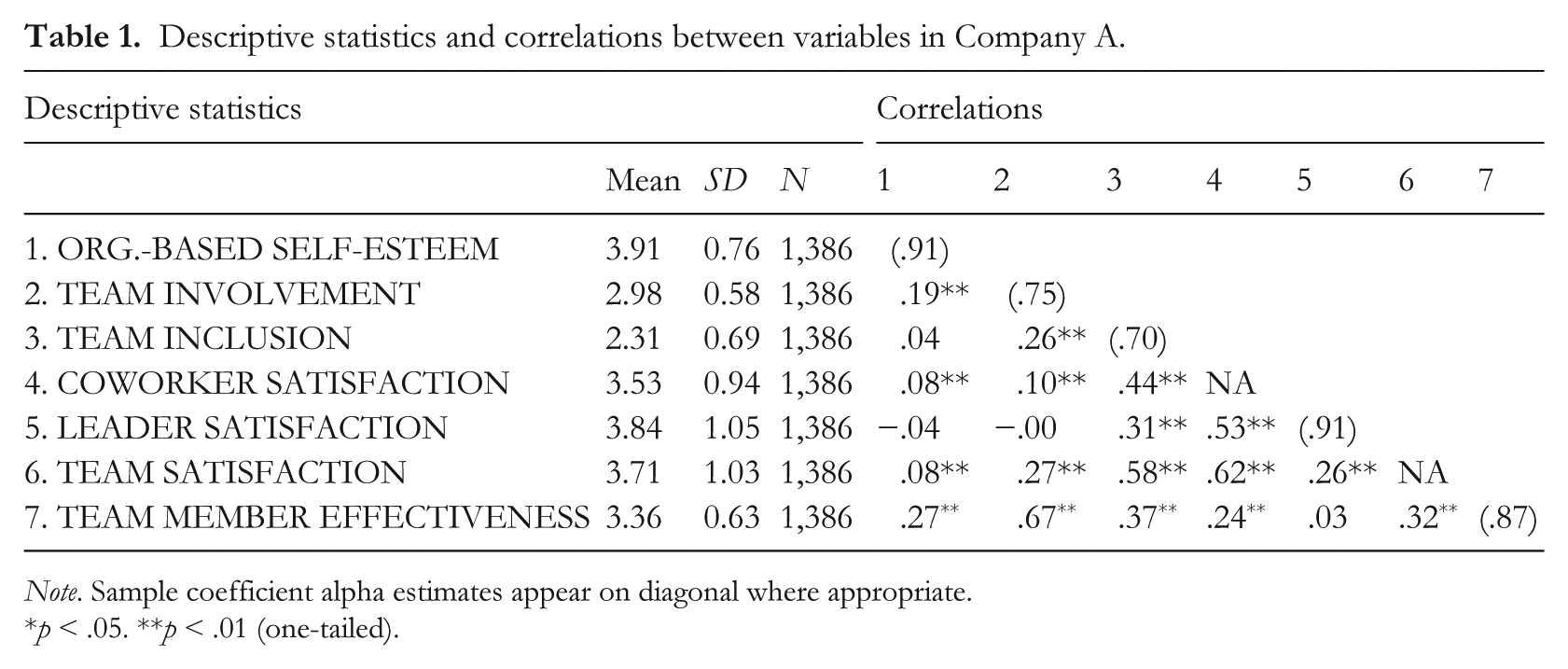
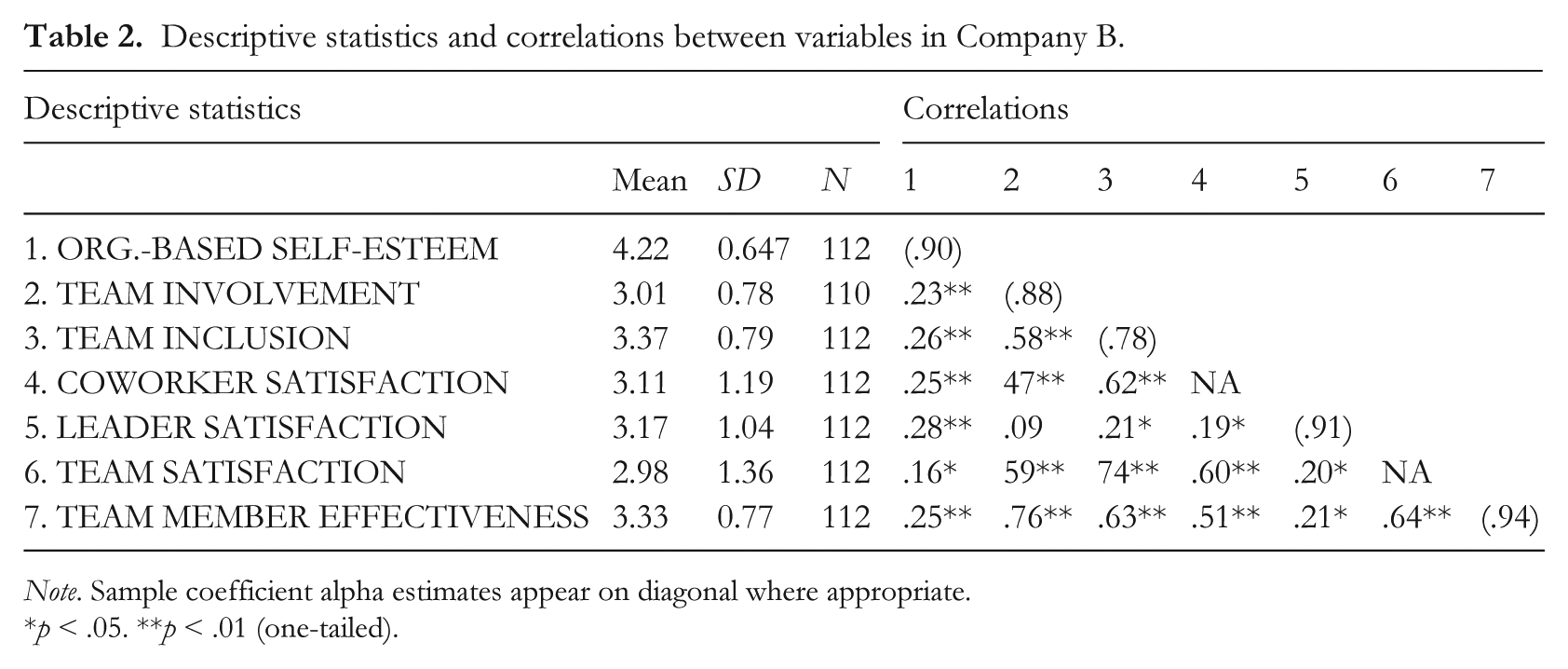
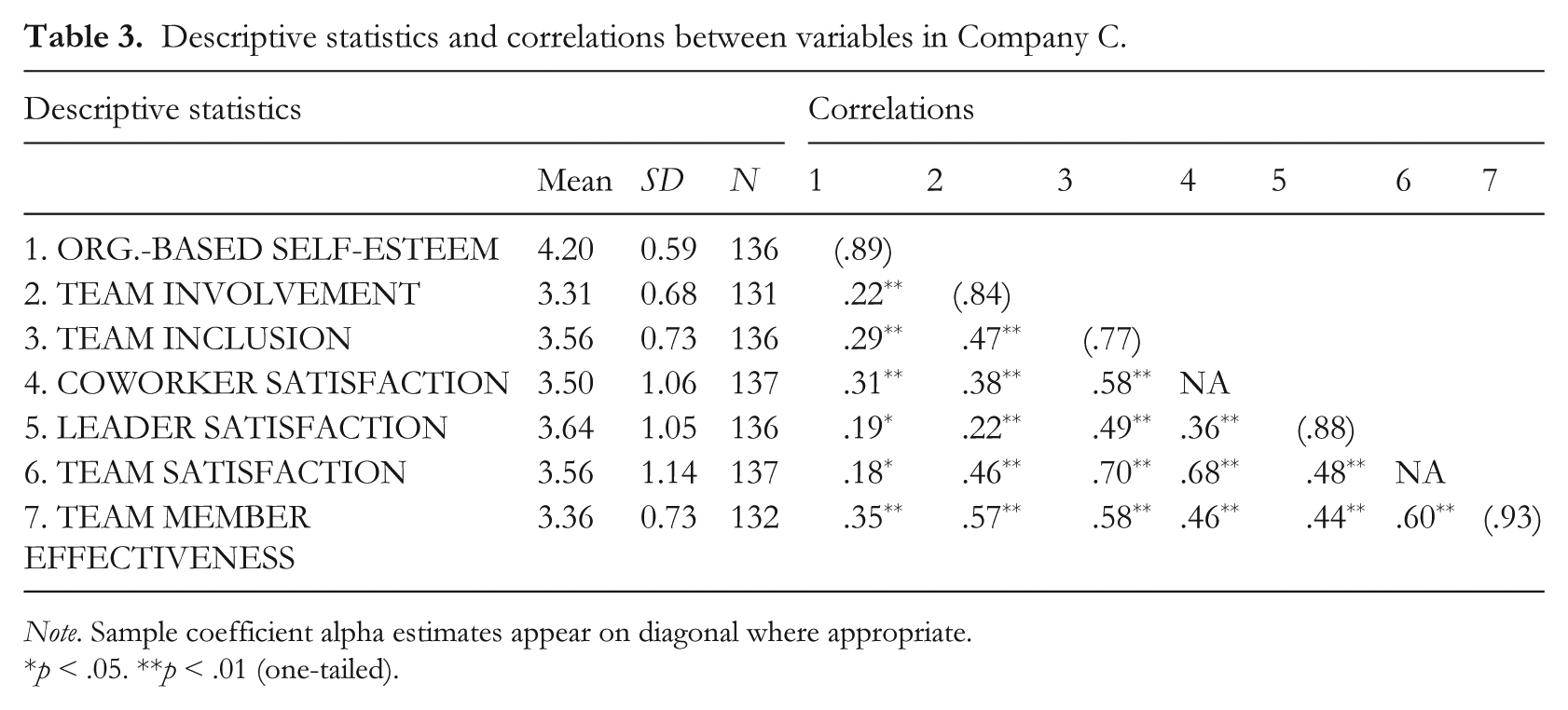
Tables 1, 2, and 3 present the descriptive statistics and intercorrelations of study variables for companies A, B, and C (respectively), and provide preliminary examinations of the study hypotheses. Hypothesis 1 stated that there would be a positive relationship between perceived team involvement and OBSE, and was supported in all three companies (Company A: r = .19, p < .01; Company B:r = .23, p < .01; Company C: r = .22, p < .01). Hypothesis 2 stated that there is a positive relationship between perceived team inclusion and OBSE, and was supported in two of the three companies (Company A: r = .04, ns; Company B: r = .26, p < .01; Company C: r = .29, p < .01). Hypotheses 3 to 6 stated that there would be a positive relationship between OBSE, and the four outcome variables. Support was found for coworker satisfaction (Company A: r = .08, p < .01; Company B: r = .25, p < .01; Company C: r = .31, p < .01), supervisor satisfaction (Company A: r = −.04, ns; Company B: r = .28, p < .01; Company C: r = .19, p < .05), team satisfaction (Company A: r = .08, p < .01; Company B: r = .16, p < .01; Company C: r = .18, p < .01), and perceived team member effectiveness (Company A: r = .26, p < .01; Company B: r = .23, p < .01; Company C: r = .34, p < .01). Thus, 13 of 15 OBSE–outcome relationships were found to be statistically significant.
Descriptive statistics and correlations between variables in Company A.
Note. Sample coefficient alpha estimates appear on diagonal where appropriate.
p < .05. **p < .01 (one-tailed).
Descriptive statistics and correlations between variables in Company B.
Note. Sample coefficient alpha estimates appear on diagonal where appropriate.
p < .05. **p < .01 (one-tailed).
Descriptive statistics and correlations between variables in Company C.
Note. Sample coefficient alpha estimates appear on diagonal where appropriate.
p < .05. **p < .01 (one-tailed).
Overall, these results suggest that OBSE is potentially enhanced by experienced involvement and inclusion. In addition, those employees who are high in OBSE are also more satisfied with their work group associates, and also perceive that their work group colleagues are effective teammates, when compared to employees low in OBSE.
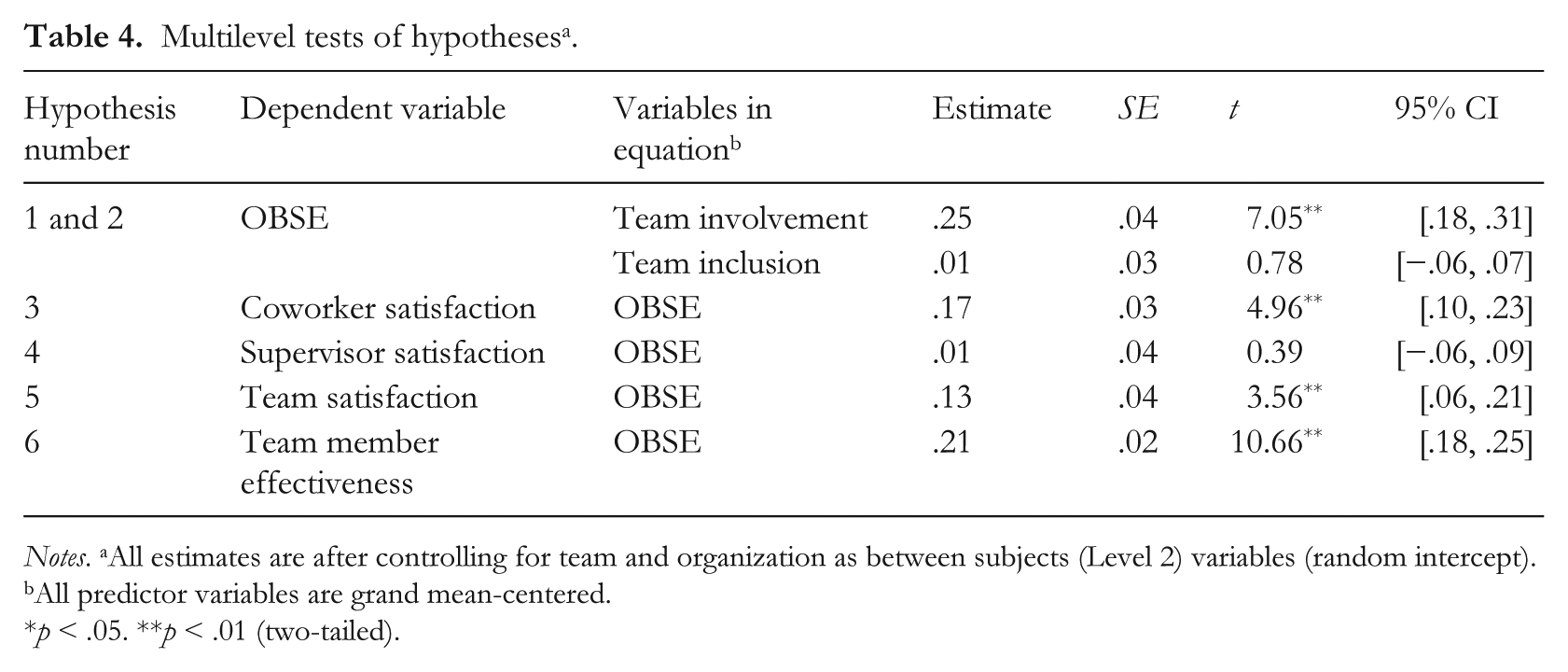
Results for the tests of the hypothesized relationships are presented in Table 4. Hypothesis 1 stated that perceptions of team involvement would relate positively to OBSE, and Hypothesis 2 proposed that team inclusion would be positively related to OBSE. Because perceptions of team effectiveness and team involvement are correlated, and because it would be constructive to know if each independently predicts variance in OBSE, this analysis examined their relationships simultaneously with OBSE. As may be seen in Table 4, team involvement was significantly related to OBSE (p < .01), in support of Hypothesis 1. Team inclusion was not significantly related to OBSE after controlling for team involvement, and thus Hypothesis 2 was not supported. Hypothesized relationships of OBSE to coworker satisfaction (Hypothesis 3), and team satisfaction (Hypothesis 5) were supported (see Table 4) by statistically significant regression coefficients (p < .01). However, the relationship between OBSE and supervisor satisfaction was not statistically significant, and thus Hypothesis 4 was not supported. Hypothesis 6 states that there is a positive relationship between individual member OBSE and ratings of team member effectiveness. This was supported by a statistically significant relationship between OBSE and coworker effectiveness ratings (p < .01; see Table 4).
Multilevel tests of hypotheses a .
Notes. aAll estimates are after controlling for team and organization as between subjects (Level 2) variables (random intercept). bAll predictor variables are grand mean-centered.
p < .05. **p < .01 (two-tailed).
Discussion
This study is the first to examine the role of trait organization-based self-esteem (OBSE) in the context of intact work groups in natural settings. We derived hypotheses based on past theoretical expositions of the OBSE construct, anchoring them in well-established self-regulatory motivational processes. In addition, we based hypotheses on consistent empirical relationships found in previous research (Bowling et al., 2010; Pierce & Gardner, 2004). We observed that employees, in three different companies, who perceive that they work in groups that are characterized by high levels of member involvement in group operations have higher levels of OBSE. This is consistent with the premise that involving employees in major decisions communicates to them (by structure and by social interactions) that they have value to the organization, and also creates conditions whereby success on the job (as well as failure) may be attributed to themselves, both affecting OBSE. We also reasoned that within a work group context, messages from others in the group that the individual is an accepted member of the group (inclusion) also leads to high self-esteem. Unexpectedly, we found that after controlling for team involvement, the perceptions of inclusion did not have statistically significant effects. It would appear that the day-to-day activities of employees have greater effects on OBSE than does the perception that one works in a group with healthy interpersonal relationships (and absence of interpersonal conflict). The involvement–OBSE relationship might be due to the level of job complexity experienced by group members. High involvement in team activities would be expected to be accompanied by job complexity, as simple tasks usually do not call for interdependent team work. If that is the case, this result is consistent with the finding in several studies that perceived job complexity is one of the strongest correlates of OBSE (e.g., Pierce & Gardner, 2004).
This observation also presents a counterfactual inference about self-esteem in general. Much has been written about the social determinants of self-esteem (the “looking glass self”; Cooley, 1902/1956). Our results suggest that direct personal experiences with task performance, irrespective of the social context in which the tasks are embedded, have the stronger effect on employee self-esteem. On the other hand, our study may imply that there is a significant boundary condition in which the relative effects of social versus nonsocial factors affect self-esteem. At work employees are generally rewarded much more for task performance than for garnering positive comments from coworkers and supervisors. As a result, task performance is of greater importance to people at work, and thus might have a greater impact on (or salience to) work-based self-esteem (i.e., OBSE). In other nonwork contexts (e.g., with family or friends), social influences might have greater salience and subsequent effects on global or domain-specific self-esteem (e.g., social self-esteem). That is, the domain in which self-esteem is measured moderates relationships between social and activity factors, and domain-specific self-esteem.
Consistent with Hypotheses 3, 5, and 6, OBSE was positively related to coworker, and team satisfaction, as well as ratings of team member effectiveness (but not supervisor satisfaction; H4). This indirectly suggests that OBSE might be related to team cohesion. Group cohesion is often conceptualized as having two subdimensions: social cohesion and task cohesion. Social cohesion is the degree to which group members want to remain a member of the group. It is reasonable to speculate that high OBSEs, who are satisfied with their teammates and team as a whole, would want to remain a member of the group. Task cohesion is the degree to which group members understand and are committed to group task goals. Our measure of perceived team member effectiveness asked participants to rate the “effectiveness of group members” on such dimensions as “understand team purpose” and “set monthly goals related to annual goals.” To the extent these items index task cohesion, we found that OBSE is positively related to task cohesion, which in turn is often related to team performance (e.g., Carless & De Paola, 2000; Chang & Bordia, 2001; Mathieu, Kukenberger, D’Innocenzo, & Reilly, 2015). While we were not able to use an explicit measure of group cohesion, it does appear that OBSE is positively related to both the social and task dimensions of cohesion. Future research might examine the OBSE–cohesion relationship more systematically, because if it is found to be positive and consistent, it suggests that high OBSE has downstream benefits for group performance, in addition to personal (e.g., organizational commitment) and organizational (intra- and extra-role performance) benefits.
Practical Implications
There has already been much written about the practical implications from research on OBSE. Effective managers understand that the verbal and nonverbal messages they communicate to their employees have major ramifications for the development of their employees’ OBSE. This study makes a significant contribution to this literature because it addresses an aspect of the employment environment, work groups, that heretofore has not been explicitly studied. Managers should maximize subordinates’ involvement, as a group, in the day-to-day responsibilities for the group (e.g., checking output quality), as well as, the irregular events that have substantial effects on the group (e.g., recruiting and hiring new group members). Managers who regularly reinforce members’ importance to the effectiveness and success of the team can increase member self-esteem based on team experiences, and subsequently OBSE.
Recommendations regarding work group creation are more problematic. In some situations it may be better to have work groups whose members are uniformly high in OBSE. To the extent that the beneficial effects of individual employee’s OBSE are additive, this should result in a highly productive and cohesive team. However, what should be done with employees whose OBSE is relatively low or even absolutely low? This seems to present an ethical dilemma, as rejection in such situations would further erode their low self-esteem. Because low OBSE individuals are more behaviorally plastic (Brockner, 1988), they tend to respond more to their work environments (for better or for worse) than those with high OBSE (Mossholder, Bedeian, & Armenakis, 1982; Pierce, Gardner, Dunham, & Cummings, 1993). Low OBSEs should be placed in intact work groups that already have high levels of involvement and productive cohesiveness (Brockner, 1988), and high average member OBSE. In time the low OBSEs should respond favorably to the change in work group culture, and increase both their OBSE and their effective behaviors and attitudes.
Study Limitations
The major limitation of this research is that all obtained relationships are based on cross-sectional survey data. Inferences about causality are severely limited in such research. It may be, for example, that work group involvement is an outcome of OBSE as opposed to being an antecedent. However, we found consistent theory-based relationships in three different companies at three different times using the same measures, which suggests that our direct relationship Hypotheses (1–6) are not chance relationships and are in fact quite stable.
A second major limitation of our study is that all data are self-report and susceptible to common method variance. In particular the team involvement and team member effectiveness measures were similar in content and scaling. The correlations between the two measures were .67, .76, and .57 in Companies A, B, and C respectively. These correlations are quite substantial, but still reflect at most 58% shared variance, leaving 42% or more unique variance in these measures. In addition, method variance may not be as large a problem as was once believed in organizational behavior research (Spector, 2006). Still, method variance may play a role in some of the results and future research should replicate and extend our results with different measures (e.g., team effectiveness) and data sources (e.g., supervisor ratings).
A third limitation is that some of our measures have not been previously construct-validated. The team involvement, inclusion, and effectiveness measures were developed for this study based upon the host organizations’ perceptions of what needed to be measured. Still, the items have face validity (see Appendix) and one would wonder what the items measure if not the constructs they were intended to measure. In addition, as noted before, many of the items are similar to items that have been previously used in published research on teams. There is some degree of validity that can be generalized to our measures from those existing measures.
In addition, we used a single-item measure of team satisfaction, which was appended to and used the format of the 20-item Minnesota Satisfaction Questionnaire. Single-item measures pose several psychometric difficulties, most notably their problematic reliability (viz., coefficient alpha cannot be computed). Still, there is some research that suggests that single-item measures possess adequate psychometric properties to be used effectively in rigorous research (e.g., Gardner, Cummings, Dunham, & Pierce, 1998; Spörrle & Bekk, 2014; Wanous, Reichers, & Hudy, 1997). We obtained statistically significant results in support of our hypotheses with this measure, which suggests that it possessed sufficient reliability (and validity). Still, we recommend that future research replicate our results with more established measures of the team-based constructs.
Finally, we positioned OBSE as a key individual difference construct that plays an important role in predicting employees’ reactions to their work groups. Groups and teams by definition are social environments, and the interactions inherent in them should affect self-esteem. However, there are many other individual differences that might also play a role in addition to self-esteem (e.g., resilience, fatigue, person–team fit).
3
One in particular that might be worth pursuing in conjunction with OBSE is the related construct of psychological ownership (Pierce, Kostova, & Dirks, 2001), as applied to perceived ownership by an employee of his/her work group. As James (1890/1950) noted long ago,
[T]he Empirical self of each of us is all that he is tempted to call by the name of me. But it is clear that between what a man calls me and what he simply calls mine is difficult to draw. We feel and act about certain things that are ours very much as we feel and act about ourselves. (p. 291)
We suspect that some of the hypotheses we make about self-esteem based on self-consistency theory have parallels with psychological ownership, and it might be worth exploring that line that distinguishes “me” from “mine.” For example, an employee with high team-based psychological ownership would more likely engage in behaviors that protect and enhance the team, just as a high OBSE employee engages in behaviors that maintain his/her self-esteem, but which also benefit the work group/team.
Conclusions
Consistent with more than 100 years of research on the effects of social interactions on self-esteem (e.g., Cooley, 1902/1956; James, 1890/1950), we found that work groups characterized by perceived high involvement had members who were high in organization-based self-esteem. High OBSEs had higher levels of satisfaction with their coworkers and their teams, compared to low OBSEs. Managers who involve work group members in the operation and governance of the work group will enhance member OBSE, which through self-regulatory processes results in many desirable outcomes for the member, the manager, and the organization.
Footnotes
Appendix
Funding
This research received no specific grant from any funding agency in the public, commercial, or not-for-profit sectors.