







Abstract
Creating a sense of interpersonal similarity of attitudes and values is associated with increased attraction and liking. Applying these findings in an intergroup setting, though, has yielded mixed support. Theorizing from a social identity perspective suggests that highlighting intergroup similarity may lead to increased antipathy to the extent that it is perceived as a threat to one’s unique social identity. To circumvent this process, we examine the influence of emotional similarity, rather than attitudinal or value similarity, with the expectation that the short-term nature of emotions may evoke less threat to one’s social identity. Moreover, given the importance of emotions in intergroup humanization processes, we expected that emotional similarity would be associated with greater conciliatory attitudes due to an increase in humanization of the outgroup. We report results from two studies supporting these predictions. Following exposure to an anger-eliciting news story, Jewish Israeli participants were given information that their own emotional reaction to the story was similar (or not) to an individual member of the outgroup (Study 1: Palestinian citizen of Israel) or the outgroup as a whole (Study 2: Palestinians of the West Bank). As predicted, emotional similarity was associated with increased humanization of the outgroup, and a subsequent increase in one’s willingness to support conciliatory political policies toward the outgroup. We conclude that emotional similarity may be a productive avenue for future intergroup interventions, particularly between groups where differences in attitudes and values are foundational to the intergroup conflict.
Similarity among individuals is often associated with increased attraction (Byrne, 1969, 1971; Byrne, Clore, & Worchel, 1966). Individuals report greater similarity to their friends and romantic partners (Bonney, 1946; Byrne & Blaylock, 1963; Loomis, 1946; Newcomb, 1956; Precker, 1952; Richardson, 1939, 1940; Schooley, 1936; Winslow, 1937), and also prefer strangers that share their same attitudes relative to strangers with dissimilar attitudes (Byrne, 1961). However, the possibility that creating a sense of similarity between individuals could help to foster more positive attitudes between members of different groups, including groups in conflict, has received mixed support (for a review see Brown & Lopez, 2001). Indeed, although interpersonal similarity may lead to liking, theorizing from a social identity perspective suggests that intergroup similarity may actually lead to increased antipathy due to a threatened social identity. The current research seeks to examine whether similarity in emotional experiences (a low-level threat to identity) may side-step these challenges and, through a process of increased humanization of the outgroup, lead to increased conciliatory attitudes.
Social Identity Theory and Similarity
Social identity theory (Tajfel & Turner, 1986) purports that individuals derive self-esteem from creating a positive distinction between one’s own group (the ingroup) and other groups (outgroups). A potential consequence of this is that emphasizing similarities between an individual and the members of another group may threaten one’s distinct social identity, and may lead to greater intergroup bias in an effort to positively differentiate one’s own group from the outgroup. As a result, although research has documented that similarity in important attitude domains fosters more interpersonal attraction (compared to less important attitudes; Byrne, 1961), the reverse may be true for individuals of different groups. That is, similarity to an outgroup member in an important attitude domain may evoke a greater threat to one’s unique social identity.
Along these lines, research has found that emphasizing a common, superordinate identity with members of an outgroup can actually increase ingroup bias (Hornsey & Hogg, 2000a, 2000b), but allowing individuals to simultaneously maintain a subgroup identity within the context of a broader superordinate identity promotes greater intergroup harmony. This dual-identity model allows individuals to find common ground with outgroup members without sacrificing their own group’s unique social or cultural identity (Dovidio, Kawakami, & Gaertner, 2000; Hornsey & Hogg, 2000a).
These findings suggest that it is possible for intergroup similarity to foster more positive intergroup relations, but that the nature of similarity between groups must strike a careful balance in which individuals are still able to maintain a positive and differentiated social identity. Given this, we sought to examine the effect of emotional similarity between individuals of different groups, rather than attitudinal or value similarity. We expected that the short-term nature of emotions may evoke less threat to one’s identity than perceiving cross-group similarity in one’s more enduring attitudes and values.
One concern with the use of emotional similarity, however, is that it may be perceived as so basic or inconsequential that it fails to evoke any positive benefits for intergroup relations. Attitudinal similarity is argued to be effective in promoting interpersonal attraction because it justifies one’s own worldview, that is, individuals feel positively reinforced upon learning that others share their attitudes and values (Byrne, 1961). A shared emotional reaction may not produce the same process. However, we hypothesize that emotional similarity will produce positive effects through a different process: increased humanization of the outgroup.
Similarity and Humanization
Gordon Allport (1954) emphasized the importance of creating a sense of common humanity between groups. Indeed, research has shown that individuals sometimes deny outgroup members human-like attributes (e.g., Haslam, 2006; Leyens et al., 2003). This phenomenon may occur via at least two different pathways. In some circumstances, individuals are denied attributes that distinguish humans from animals, that is, attributes that are uniquely human, sometimes referred to as secondary emotions (Leyens et al., 2001), such as guilt, melancholy, compassion, and hopefulness. A separate pathway is the denial of attributes that distinguish humans from inanimate objects, a key component of which is the fundamental experience of emotion, regardless of its primary or secondary nature (e.g., Haslam, Bain, Douge, Lee, & Bastian, 2005; Haslam & Loughnan, 2014), such as curiosity and impulsivity.
In the current research we chose to focus on shared primary emotions. This decision was motivated by our interest in focusing on the humanizing effect specifically of experiencing shared emotions. Manipulating similarity of secondary emotions would confound both emotion similarity and the perception of the outgroup experiencing emotions that are uniquely human. In contrast, the expression of primary emotions is not in itself specifically associated with one pathway of humanization, and therefore provides a cleaner test of our similarity hypothesis.
We expected that emphasizing shared emotional experiences between members of different groups would effectively promote humanization of the outgroup via two primary routes. First, emotional similarity may permit the individual to view the outgroup as more human-like simply because the outgroup is now perceived to be more similar to oneself. Second, because the emotional experience of the outgroup mimics the experience of the individual, it suggests that the outgroup member’s emotional experience is in accordance with appropriate social norms. This may lead to an increase in the perception of the outgroup as human because it requires uniquely human knowledge of social or cultural norms, and may require social-cognitive skills associated with being human (e.g., theory of mind). Along these lines, a recent study by Szczurek, Monin, and Gross (2012) found that those who violated affective norms, relative to those who did not, were evaluated more negatively, elicited more moral outrage, and engendered strong preferences for social distance.
It is also possible that the simple observation of the outgroup experiencing an emotion will promote humanization of the outgroup via the second pathway described before, that is, via the attribution of human qualities that would otherwise distinguish the outgroup from a machine. However, as is described next, this process is controlled for by comparing emotional similarity of primary emotions to emotional dissimilarity of primary emotions. In both contexts, the outgroup is portrayed as experiencing emotion, so such a process could not explain a humanizing effect of similarity on its own.
Overview of the Present Research
In the present research, we examined whether learning that members of an outgroup experience the same emotions as oneself leads to an increase in the humanization of the outgroup, and a subsequent increase in support for policies aimed at promoting intergroup reconciliation. Participants were asked to document their emotional reaction to an anger-eliciting news story. Afterward, they were given information that their reaction was shared (or not) either by an individual member of the outgroup (Study 1) or on average by the outgroup as a whole (Study 2). Participants then responded to questions assessing their humanization of the outgroup, and their support for peace-promoting political polices.
We sought to examine the influence of emotional similarity at both the individual and group level to ensure that the manipulation’s effectiveness is not restricted to a particular level. For example, similarity to the outgroup as a whole may be more threatening than to an individual from that outgroup, because similarity to the entire group may more strongly imply that one’s ingroup identity is not distinct (Tajfel & Turner, 1986). However, similarity to an individual outgroup member may not always generalize to positive views of the entire outgroup (Brown & Hewstone, 2005; Stephan & Stephan, 1996). Indeed, past research has documented that subtyping of outgroup members is more likely to occur when stereotype disconfirming information is concentrated to a small number of group members rather than dispersed across members of the group (Johnston & Hewstone, 1992; Weber & Crocker, 1983). Despite these concerns, we expected that the unthreatening nature of the emotional similarity manipulation would not activate concerns over protecting one’s unique social identity, and that subtyping would not occur given the relative triviality of the similarity information.
The current studies were conducted among Israeli Jews across two distinct, though related, intergroup contexts. Study 1 examined the influence of emotional similarity to Palestinian citizens living in Israel (also referred to as Arab Israelis 1 ). Because Jewish Israelis and Palestinian citizens of Israel are compatriots, relevant intergroup policy preferences relate to political tolerance within the same social and political system. Study 2 examined the influence of emotional similarity to Palestinians living outside of Israel (hereafter referred to as Palestinians). In this context, relevant policy preferences relate to the management and resolution of the ongoing conflict between the two nations. Whereas the relations between Jewish and Palestinian citizens of Israel are historically hostile, the protracted and violent nature of the Israeli–Palestinian conflict on the national level provides an even more challenging test for our hypotheses. Overall, both contexts provide a good testing ground for hypotheses concerning the positive effects of emotional similarity because intergroup negativity is deeply entrenched and characterized by the perception that the outgroup lacks human qualities (Halperin, 2008, 2011).
Study 1
In Study 1 we examined whether inducing the perception of a shared emotional reaction with a Palestinian citizen of Israel would lead Jewish Israeli participants to humanize them more, and to subsequently exhibit increased political tolerance. Political intolerance may be defined as the support for denying—or a willingness to deny—the basic political rights of individuals who belong to a defined outgroup in a particular society (Sullivan, Piereson, & Marcos, 1982). Political tolerance was selected as the outcome given its importance in contexts where a majority group may attempt to deny political rights to minority groups perceived as a threat to their position of power within the same society (Halperin, Canetti-Nisim, & Hirsch-Hoefler, 2009).
Method
Participants
Sixty-four Jewish Israeli students at the University of Haifa participated in the study; five were dropped from analyses for failing to comply with instructions (i.e., emotion responses did not sum to 100). The final sample included 59 individuals (35 females) with a mean age of 26.14 (SD = 2.72). Politically, 27.1% identified as rightist (hawkish); 54.2% identified as centrist, and 18.7% identified as leftist (dovish).
Procedure
Participants attended an individual lab session where they completed a set of demographic items and then read a short anger-eliciting passage about the increasing phenomena of hit-and-run accidents in Israel. In response to the text, participants allocated 100 points on a bar graph to three emotional responses: anger, fear, and apathy. As expected, the strongest emotional response of participants was anger, M = 51.36, SD = 25.53, relative to fear, M = 29.15, SD = 21.90; t(58) = 4.30, p <.001, and apathy M = 19.49, SD = 26.22; t(58) = 5.22, p <.001.
In order to induce emotional similarity to an outgroup member, participants were told that in the adjacent room a fellow participant with an Arab name (Achmed) was participating in the same study and that their emotion response graphs would be exchanged. As a cover story, participants were told that past research has demonstrated that being exposed to other participants’ responses in a study is helpful to individuals for thinking about their own responses. The exchanged graph presented either anger as the dominant emotion experienced by the Arab participant (high-similarity condition) or fear (low-similarity condition). Participants that did not indicate anger as their dominant response were recoded into the appropriate condition. 2 For example, if a participant indicated fear as their dominant response and were given information that the Arab student predominately experienced fear, they were coded into the high-similarity condition rather than the low-similarity condition. In total, 17 participants were recategorized. However, the patterns of effects and significance do not change if these cases are dropped instead. Participants then completed the measures described next.
Measured Variables
Similarity manipulation check
To ensure that participants in the emotion similarity condition felt more similarity with the Arab participant than those in the control condition, they responded to the following item: “I believe the other participant and I experienced similar emotions in response to the text” with responses ranging from 1 = strongly disagree to 7 = strongly agree.
Outgroup humanization
To assess humanization of the outgroup, participants indicated on a 10-point scale to what extent they associate Arab citizens of Israel with the quality of being “human” ranging from 1 = not at all to 10 = a great extent.
Political tolerance
Five items (α = .86) adapted from previous work (Shamir & Sagiv-Schifter, 2006; Sullivan et al., 1982) were used to assess participants’ political tolerance toward Arabs in Israel. For example, “Arab-Israelis should be prohibited from being members of parliament in Israel,” and “When hiring individuals, it is justified to prioritize Jews over Arab-Israelis,” both reverse-coded. Participants indicated the extent to which they agreed with each statement on a 6-point scale: 1 = strongly disagree to 6 = strongly agree.
Results and Discussion
The influence of the emotional similarity manipulation was examined via three separate independent samples t tests (see Table 1 for descriptive statistics). Relative to the low-similarity condition, individuals in the high-similarity condition expressed more similarity to the Arab-Israeli participant, equal variances not assumed: t(56.91) = 2.42, p = .019, d = .55; expressed greater humanization of Arab-Israelis in general t(57) = 2.89, p = .005, d = .74; and more support for politically tolerant policies t(57) = 2.43, p = .018, d = .64.
Descriptive statistics and correlations for Study 1 and 2.
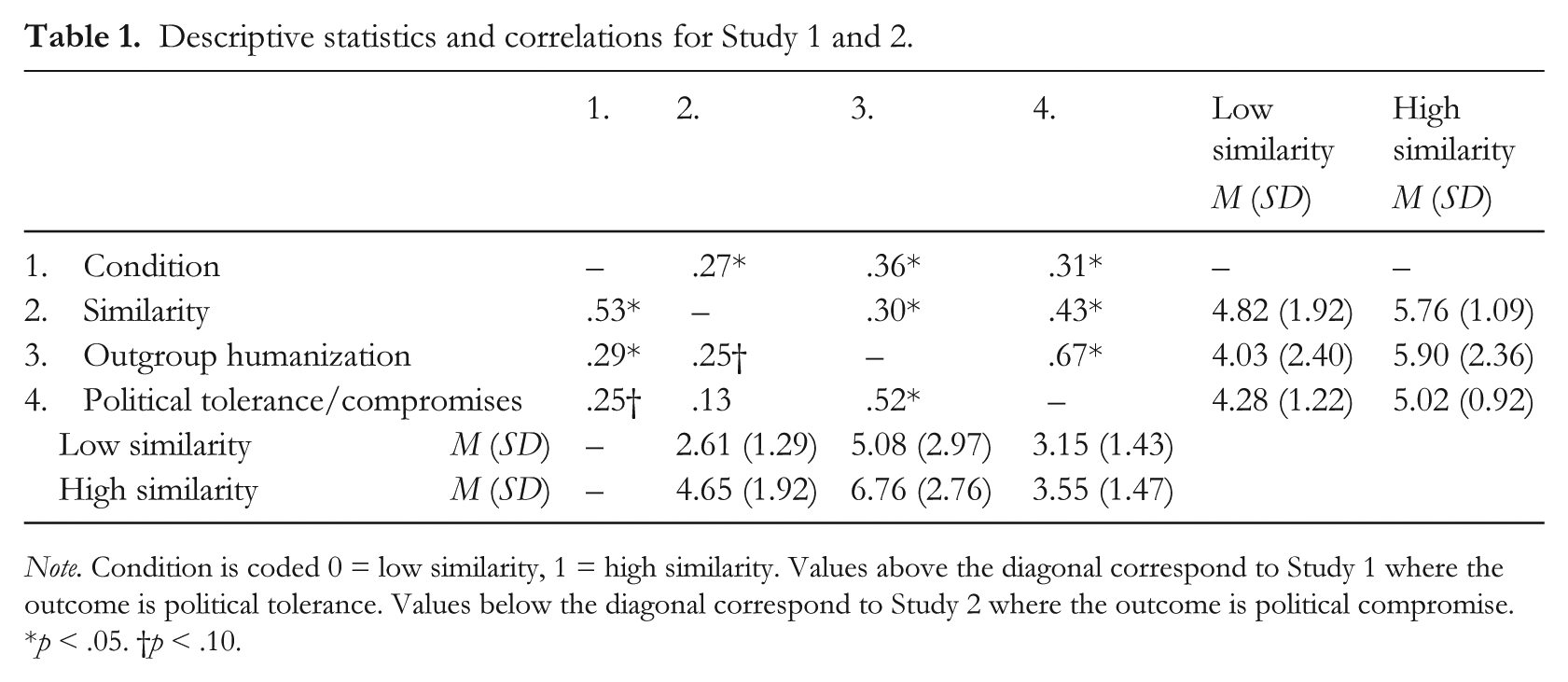
Note. Condition is coded 0 = low similarity, 1 = high similarity. Values above the diagonal correspond to Study 1 where the outcome is political tolerance. Values below the diagonal correspond to Study 2 where the outcome is political compromise.
p < .05. †p < .10.
To test the prediction that emotional similarity would increase political tolerance via greater humanization of the outgroup, a mediation analysis was conducted using Hayes’s (2013) PROCESS macro (Model 4). The model was specified with the manipulation as the independent variable, humanization as the mediator, and support for politically tolerant policies as the outcome. The total effect of the manipulation on political tolerance (b = 0.74, SE = 0.31, t = 2.43, p = .018; 95% CI [0.13, 1.36]) was reduced to nonsignificance when humanization was added as a mediator (b = 0.19, SE = 0.26, t = 0.73, p = .468; 95% CI [−0.33, 0.70]). Moreover, the indirect effect through the mediator was statistically significant (b = 0.56, SE = 0.21, 95% CI [0.19, 1.02]). 3 No significant interactions were obtained with political ideology. Standardized path coefficients for the model are provided in Figure 1.
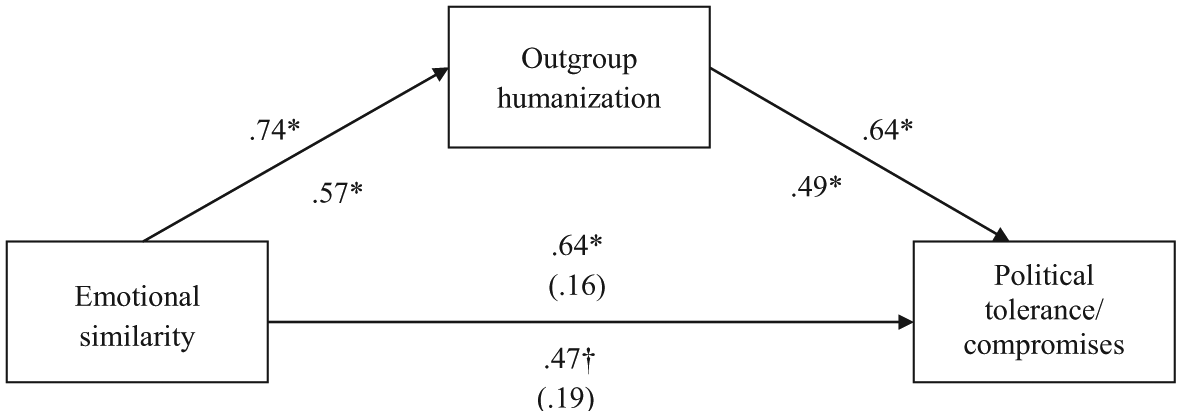
Outgroup humanization mediates the association between emotional similarity and political tolerance (Study 1)/political compromises (Study 2). Emotional similarity manipulation: 0 = low similarity, 1 = high similarity. Values reflect standardized path coefficients. Values above arrows correspond to Study 1; values below arrows correspond to Study.
These results suggest that the perception of a shared emotional experience with a single outgroup member led participants to attribute greater humanness to Palestinian citizens of Israel, and to subsequently express more support for politically tolerant policies directed at Palestinian citizens in Israel.
Study 2
In Study 2 we examined the influence of emotional similarity between participants and the outgroup as a whole, rather than an individual outgroup member. Similarity to an outgroup may be more threatening than to an individual from that outgroup, because it implies that one’s group identity is less distinct (Brewer, 1991). We expected that emotional similarity would not be perceived as threatening enough to activate the need to positively differentiate one’s group from the outgroup, but wanted to examine this possibility. Study 2 was also broadened to test our predictions with Palestinians from the West Bank as the outgroup, rather than Palestinian citizens of Israel. Given this modification, we assessed willingness to support political compromises with Palestinians as a separate national group.
Method
Participants
Data was collected from a convenience sample of 73 Jewish Israeli train passengers, but 11 individuals were dropped for reporting a non-Jewish religion (n = 4) or not reporting their religion (n = 7). The remaining sample consisted of 62 4 individuals (34 females, two missing) with a mean age of 33.45 years (SD = 14.33). Politically, 50.8% identified as rightist, 30.5% as centrist, and 18.7% as leftist (three missing).
Procedure and Measures
In exchange for candy, train passengers answered demographic items and read a short anger-eliciting article ostensibly from Ynet (a popular Israeli news website) discussing the deaths of thousands of dolphins as a result of an international company leaking sewage into the Mediterranean Sea. Participants indicated their emotional response to the article by drawing a bar graph of four emotional responses ranging from 1 to 7: anger, fear, guilt, and apathy. As anticipated, participants reacted with more anger M = 5.05, SD = 1.76, than fear M = 1.87, SD = 1.52; t(61) = 11.83, p < .001, guilt M = 2.33, SD = 1.94; t(61) = 9.53, p < .001, or apathy M = 1.23, SD = 1.48; t(61) = 10.72, p < .001.
To induce emotional similarity to the outgroup, participants were shown a graph that ostensibly summarized the average emotional response to the same article by a representative sample of Palestinians. This graph either depicted high levels of anger (high-similarity condition) or high levels of fear (low-similarity condition). Participants that did not indicate anger as their dominant response (n = 4) were recoded into the appropriate condition using the same method 1 reported for Study 1, but the pattern of effects and significance was the same if these cases were dropped. Participants then completed the similarity manipulation check and humanization measure 5 from Study 1. Three items (α = .83) assessed support for compromises in the Israeli–Palestinian conflict, specifically referring to the division of Jerusalem, freezing of the building of settlements in the West Bank, and the establishment of economic and social relations with Palestinians. Responses ranged from 1 = strongly oppose to 6 = strongly support.
Results and Discussion
The influence of the emotional similarity manipulation was examined via three independent samples t tests (see Table 1 for descriptive statistics). Individuals in the high-similarity condition expressed more similarity with Palestinians as a group; equal variances not assumed: t(57.78) = 4.98, p < .001, d = 1.05, expressed more humanization of Palestinians t(57) = 2.25, p = .029, d = .57, and more support for political compromises t(60) = 1.97, p = .053, d = .49, relative to participants in the low-similarity condition, although the last effect was not statistically significant.
To test the prediction that emotional similarity would increase support for compromise via greater humanization of the outgroup, a mediation analysis was conducted using Hayes’s (2012) PROCESS macro (Model 4) specified as in Study 1. The marginal total effect of the manipulation on political compromises (b = 0.69, SE = 0.38, t = 1.79, p = .078; 95% CI [−0.08, 1.45]) was substantially reduced when outgroup humanization was added as a mediator (b = 0.27, SE = 0.35, t = 0.77, p = .444; 95% CI [−0.43, 0.98]). Importantly, the indirect effect through the mediator was statistically significant (b = 0.41, SE = 0.20, 95% CI [.08, .89]). No significant interactions were obtained with political ideology. Standardized path coefficients for the model are provided in Figure 1. These results suggest that emotional similarity can be created between an individual and an outgroup as a whole, even in the context of the intractable Israeli–Palestinian conflict, with an influence parallel to that of similarity created with a single individual from the outgroup.
General Discussion
Across two distinct samples (college students and a more representative sample of community members) we found that an induced perception of emotional similarity, to either an outgroup individual or to members of the outgroup in general, led to increased humanization of the outgroup, and a greater willingness to support politically tolerant policies and compromises between groups. Our results suggest that shared emotional reactions may provide a new means of increasing humanization of the outgroup, and subsequently promoting more conciliatory attitudes.
Strengths of the Intervention
Past research using attitudinal- and value-based similarity to promote more positive intergroup relations has reported mixed results (Brown & Lopez, 2001). From a social identity theory perspective, emphasizing such similarities between an individual and members of an outgroup may threaten one’s distinct social identity, and subsequently lead to greater intergroup bias in an effort to create positive differentiation between groups. However, our results are consistent with the idea that emotional similarity may be perceived as less threatening than attitudinal or value similarity, perhaps as a result of the short-term and somewhat simple nature of emotional experiences. Thus, the intervention may follow along a dual-identity pathway in which a superordinate identity is fostered through the experience of a common goal, but one’s unique social identity remains intact. Along these lines, research has demonstrated that identification with a superordinate identity increases when the outgroup reacts with the same emotional response as the ingroup, specifically when the reaction is action-oriented rather than one of indifference (Livingstone, Spears, Manstead, Bruder, & Shepherd, 2011). Other studies show that when collective emotional reactions are perceived as inappropriate, people distance themselves from those groups (Goldenberg, Saguy, & Halperin, 2014). An important next step in this research then, is to explicitly examine whether a superordinate identity is generated by the manipulation, and whether this mediates the effect of similarity on conciliatory attitudes.
An additional strength of this manipulation, is that information received about emotional similarity is believable and does not strongly challenge one’s existing worldview. This contrasts sharply with similarity-based interventions that rely on highlighting objective similarities in attitudes and values between groups, which may be quite rare for highly differentiated groups in protracted conflict. Indeed, in such conflicts attitudinal- and value-based disagreements are often foundational to the conflict. A shared emotional experience can be generated easily and may also be more believable than shared attitudes and values. For this reason, the information may be accepted more readily, and the attitudes about the individual that it engenders (increased humanization) more easily transferred to other outgroup members.
Consistent with this reasoning, in the current research there was no evidence to suggest that participants were subtyping individual outgroup members as being distinct or special relative to the outgroup as a whole. Rather, participants in Study 1 expressed more support for conciliatory policies that would help the entire outgroup, not just the individual expressing similar emotions. The reason for this lack of subtyping may be twofold. First, subtyping often occurs because the information about similar attitudes and values threatens one’s social identity. Attitudes and values are enduring traits that may represent key components of one’s social identity. Subtyping the individual as unique, reduces this threat. However, emotional similarity may be perceived as less threatening given the short-term nature of emotional expressions, thereby preventing the need to engage in subtyping.
A second reason why the emotional similarity manipulation may not have led to subtyping is the relative ease with which the information can be accepted or believed. In contrast, when cross-group similarity in attitudes and values is engendered, the information may be so surprising that the individual is categorized as a special or distinct member of the outgroup (Johnston & Hewstone, 1992; Richards & Hewstone, 2001). Indeed, research has shown that individuals that slightly disconfirm an outgroup stereotype are less likely to be subtyped than those that strongly disconfirmed the stereotype (Johnston & Hewstone, 1992; Weber & Crocker, 1983). In comparison, receiving information about an outgroup member’s similar emotional experience should not be radical enough to promote subtyping of the group member.
Despite the fact that information about emotional similarity may be perceived as rather unsurprising or inconsequential, it functions to promote the humanization of the outgroup (Haslam & Loughnan, 2014). The emotional similarity manipulation suggests to participants that the outgroup is not only capable of experiencing emotions, but that they are similar to oneself, and therefore also respond to emotionally arousing situations with the socially appropriate emotion. Given the large literature documenting the de-humanization of outgroups (Haslam, 2006), with continued research, this intervention may prove to be quite useful.
Thinking more broadly about this intervention, exposure to emotional similarity with an individual from the outgroup may be a contributing factor to the formation of intergroup friendships. Indeed, it may be the shared day-to-day emotional experiences that occur outside of the conflict context that start the bond of friendship. Future research may benefit from examining this possibility directly.
Limitations and Future Directions
These findings contribute to the literature on interpersonal similarity and intergroup bias by bringing to light a new form of similarity that is effective in improving intergroup relations. Although the results are promising, more research is needed to identify the boundary conditions under which the manipulation is effective. A starting point may be to examine whether the emotion-arousing topic must be unrelated to the conflict between groups. Indeed, we expect that our intervention was effective, at least in part, because the similarity aroused by the topic was unrelated to the conflict. This is based on previous work on psychological interventions demonstrating that, especially in the context of intractable and violent conflicts, direct attempts to alter attitudes and emotions toward an adversary frequently fail, and at times even backfire (Bar-Tal & Rosen, 2009). The main reason for such backfire effects is that people’s negative attitudes and emotions toward the outgroup are so well entrenched within the group’s identity, that any challenge to these attitudes may be considered a threat to the group itself.
However, research examining responses to restorative justice trials in Rwanda (i.e., Gacaca Tribunals) suggests that direct exposure to conflict-related emotions can be effective in healing a divided community (Rimé, Kanyangara, Yzerbyt, & Paez, 2011). Although participating in the trials increased negative emotions among both perpetrators and victims (including fear, sadness, and anxiety), it eventually led to an increase in positive outcomes, such as increased movement toward a superordinate (nonethnic) identity, an increase in the perception of heterogeneity of the outgroup members, and expression of more positive stereotypes of the outgroup. Our findings may offer one potential explanation for the power of sharing emotions, even when negative. Though certainly more work is needed to understand the intergroup contexts in which direct versus indirect interventions are most likely to be effective.
Another potential boundary condition is with respect to the emotional response that is shared. Here the primary emotional response in both studies was that of anger, a primary negative emotion. It is an open question whether the same process would occur for other negative emotions, positive emotions such as happiness, or secondary emotions such as guilt or hopefulness. Indeed, in the current study we found preliminary evidence that which emotion is shared may be important. Specifically, similarity was more effective at promoting political tolerance when the shared emotion was anger, rather than fear (see Endnote 3). This may be telling given previous findings regarding the communicative role of anger in intergroup settings (e.g., de Vos, van Zomeren, Gordijn, & Postmes, 2013), as well as previous findings emphasizing the constructive role of anger in promoting conflict resolution and reconciliation (e.g., Halperin, Russell, Dweck, & Gross, 2011). Future work should examine whether negative emotions that do not have such characteristics can still yield constructive effects through emotional similarity.
Regarding positive emotions however, research on interpersonal similarity suggests that sharing positive subjective experiences (e.g., reacting to something with laughter at the same moment) increases liking, even more than objective similarities between individuals (Pinel, Long, Landau, Alexander, & Pyszczynski, 2006). Thus, there is some evidence to suggest that shared positive experiences have the potential to act in a similar fashion. However, these findings were not examined in an intergroup context and did not refer to specific emotional reactions. Future research in this area should systematically examine whether the type or valence of emotion shared is an important factor in determining the success of the intervention.
Future research may also benefit from examining the impact of the source providing information about emotion similarity. In the current work we demonstrate the effect of emotion similarity when the information about the outgroup is delivered via a third party. The strength of the manipulation may indeed depend on how credible that source of information is perceived to be by the participant. Also important, is whether the effect is limited to the dominant group in the conflict. For individuals of a subordinate group, who continually face disadvantage and discrimination, maintaining a strong and unique group identity may be even more important than it is for the dominant group. As a result, it is possible that even an emotional similarity manipulation may trigger the need to positively differentiate their group from the outgroup.
Finally future work should examine whether these effects transfer to other intergroup contexts outside of the Israeli–Palestinian conflict. This particular conflict is characterized by very low trust between groups and strong tendencies to dehumanize members of the outgroup. Given this, it may be one of the more difficult conflicts in which to promote conciliatory attitudes, thereby suggesting the manipulation may be even more effective in other contexts not characterized by such low trust (Nadler & Liviatan, 2006). However, if the manipulation is in fact operating through an increase in humanization of the outgroup as our results suggest, then in intergroup contexts where there is little dehumanization of the outgroup, this intervention may not be effective.
Other limitations of the current research include the measure of humanization, which included only one item (as did the manipulation check). Indeed, using multi-item measures of all constructs of interest, with high reliability, would have provided a more powerful test of the model. Also of importance, is that we did not include a true control condition in the current design. It is possible that the same process would occur just from hearing about the emotional reaction of an outgroup member, without the addition of emotional similarity to one’s own experience. Such an explanation is unlikely to be able to account for the full effect presented here. Indeed, we suggest that it is the experience of similar emotions that prompts an individual to see the outgroup as similar to oneself, and therefore more human, as well as capable of experiencing and expressing socially appropriate emotions. Moreover, separating the role of emotional similarity from emotional knowledge would be difficult considering that once the participant was informed of the emotion-arousing source, they would not be able to prevent themselves from forming their own reaction to the information—thereby creating emotional similarity or dissimilarity. More research is needed to tease apart these possibilities.
Conclusions
The current research provides the first evidence suggesting that emotional similarity may be a viable avenue for promoting more conciliatory attitudes between groups in conflict. We hope that the current manuscript serves as a starting point for continued research with the aim of replicating the current findings and exploring the potential boundary conditions of the effect. Indeed, creating interventions that promote willingness to support conciliatory political policies, are easy to implement, and do not threaten one’s unique social identity or promote subtyping of individual outgroup members, is a difficult task. We view the current intervention as a promising starting point in this direction.
Footnotes
Acknowledgements
We would like to thank Gal Yankovitz for her contribution to preparation of this manuscript.
Funding
This work was supported by the European Research Council Grant awarded to the last author (Grant Number 335607).