







Abstract
People’s emotional states often depend on the emotions of others. Consequently, to predict their own responses to social interactions (i.e., affective forecasts), we contend that people predict the emotional states of others (i.e., empathic forecasts). We propose that empathic forecasts are vulnerable to stereotype biases and demonstrate that stereotypes about the different emotional experiences of race (Experiment 1) and sex groups (Experiment 2) bias empathic forecasts. Path modeling in both studies demonstrates that stereotype-biased empathic forecasts regarding how a target individual will feel during a social interaction are associated with participants’ affective forecasts of how they will feel during that interaction with the target person. These affective forecasts, in turn, predict behavioral intentions for the social interaction before it even begins. Stereotypes can therefore indirectly bias affective forecasts by first influencing the empathic forecasts that partly constitute them. In turn, these potentially biased affective forecasts determine social behaviors.
Imagine a common scenario in academia: a professor must provide her student with negative feedback on a paper assignment. The meeting is scheduled and she waits for him to arrive. In preparing for such events, people often simulate how the interaction will unfold. The professor may predict how upset the student will be upon hearing the unflattering remarks. She might forecast how uncomfortable she will feel in the impending situation. In turn, she might try to think of ways to reduce her discomfort or the student’s emotional distress during the upcoming interaction. In fact, she may do all of these things to some extent. But how might these processes differ if the student were White versus Black? Or a woman rather than a man? The professor’s expectations of how the interaction will unfold may be influenced by the student’s attributes. Even without intending to treat the student differently, stereotypes may nevertheless influence the professor’s expectations, emotions, and intentions going into the interaction. The current research examines how stereotypes can bias individuals’ expectations when interacting with others.
Predicting how the self will feel in response to future or hypothetical events, called affective forecasting (e.g., Buehler & McFarland, 2001; Gilbert, Pinel, Wilson, Blumberg, & Wheatley, 1998; Wilson & Gilbert, 2003; Wilson, Wheatley, Meyers, Gilbert, & Axsom, 2000), is complex and susceptible to error. For example, people may rely on inaccurate information when imagining how an event will unfold. For a social interaction, one source of error stems from inaccurately predicting how other people would feel in that social interaction, called empathic forecasts (Green et al., 2013; Igou, 2008; Pollmann & Finkenauer, 2009). If the professor expects her student to react calmly to the negative performance feedback, then she might expect to feel relatively calm during the interaction. If that student, in reality, begins to curse at her, the professor clearly would not feel calm; she made an inaccurate affective forecast partly based on an inaccurate empathic forecast. In this and many other social situations, people’s emotional responses are dependent on others’ emotional responses. We contend that forecasts reflect this interdependence and that empathic forecasts, whether accurate or not, help to shape affective forecasts for social contexts.
Empathic forecasts (i.e., forecasts of how others will feel) may be susceptible to bias introduced by stereotypes. Indeed, people associate some social groups with specific emotions. For example, Black people are more strongly associated with anger than White people are (Hugenberg & Bodenhausen, 2004; Hutchings & Haddock, 2008), and men are more strongly associated with anger than women are (Becker, Kenrick, Neuberg, Blackwell, & Smith, 2007; Plant, Hyde, Keltner, & Devine, 2000). If forecasters associate members of certain groups with particular emotions, their empathic forecasts about members of those social groups may be influenced by those stereotypic beliefs. Although the influence of stereotypes has been documented in a variety of social judgments (see Hilton & von Hippel, 1996; Kunda & Spencer, 2003), there has been no empirical evidence to show that people use stereotypic information when forecasting individuals’ emotional reactions to specific situations. We sought to establish that stereotypes can bias empathic forecasts.
Moreover, we sought to show that stereotype-biased empathic forecasts may have important downstream consequences for social interaction. For instance, if the professor mentioned in the opening example expected a Black student rather than a White student, she might predict that the former would be angrier than the latter upon receiving negative feedback (i.e., a stereotype-biased empathic forecast). Consequently, she might anticipate feeling more fearful and uncomfortable during that interaction (i.e., affective forecast). As a result of that expected fear, she might be motivated to avoid the interaction altogether if possible. Thus, stereotypes might bias empathic forecasts, which could lead to biased affective forecasts, which may then lead to changes in social behavior such as avoidance or approach. When people cannot avoid a disagreeable social interaction, they experience poorer quality interactions due to that avoidance motivation (Plant & Butz, 2006; Plant & Devine, 2003; Plant, Devine, & Peruche, 2010). Thus, before an interaction even takes place, stereotypes may reduce the likelihood of positive interpersonal contact by creating self-fulfilling prophecies (Snyder, Tanke, & Berscheid, 1977; Word, Zanna, & Cooper, 1974) that confirm stereotypes.
Because of the complexity of intergroup interactions, stereotypes are just one variable that can influence approach intentions. Other factors, like motivation to respond without prejudice (Plant & Devine, 1998), could exert an opposing influence and nullify stereotype-consistent judgments, or in some cases even reverse the effect (e.g., Carver, Glass, & Katz, 1978; Carver, Glass, Snyder, & Katz, 1977; Dutton & Lake, 1973; Harber, 1998). Thus, we examined two pathways by which emotion stereotypes could bias behavioral intentions. The first is a direct route whereby individuals may show little stereotype-consistent bias in their intentions to interact with majority or minority group members, in part, because of motivations to appear unbiased (Devine, Monteith, Zuwerink, & Elliot, 1991; Gaertner & Dovidio, 1986).
In contrast, the second route is indirect in that the emotion stereotypes associated with different social groups bias forecasts that are made in anticipation of social interactions. Specifically, we posit that emotion stereotypes first bias empathic forecasts about how the target would feel, which would then shape affective forecasts of how the participant would feel, which in turn determine participants’ behavioral intentions. Rather than directly impacting behavioral intentions, we hypothesize that predictive processes are biased by stereotypes and lead to similarly biased behavioral outcomes. Importantly, we believed that this indirect pathway would result in stereotype-consistent effects on behavioral outcomes.
The proposed dual pathways model lends itself well to path analysis because the joint influences of the hypothesized direct and indirect pathways can be assessed simultaneously. One strength of this analytic technique is that a chain of events can be examined and the indirect effects throughout this chain can be assessed concurrently. Thus, a well-fitting path model can reveal when one factor biases a chain of events by influencing a distal variable through intermediate variables. This strategy may unearth this indirect effect even when the direct effect on that distal variable is not visible or exerts inconsistent effects. Therefore, we adopted this analytic strategy in order to test for both direct and indirect influences of emotion stereotypes on behavioral intentions.
We tested the proposed model in two experiments examining how anger stereotypes for Black versus White men (Experiment 1) and for men versus women (Experiment 2) bias empathic forecasts, affective forecasts, and behavioral intentions. Moreover, we specifically tested whether an indirect influence of emotion stereotypes via empathic and affective forecasts could be detected independent of any direct effects of emotion stereotypes on behavioral intentions.
Experiment 1
Participants were ostensibly introduced to another student via a photo and minimal information. The student’s photo was manipulated to depict either a White man or Black man. 1 Participants predicted how angry the target individual would be to receive negative feedback (empathic forecast), how afraid and uncomfortable they would feel delivering the results to the target (affective forecast), and the extent to which they were willing to deliver the feedback to him (approach intentions). We examined target race effects on each variable and used path modeling to estimate our overall theoretical model. We hypothesized that stereotypes would directly bias empathic forecasts, that empathic forecasts would be related to affective forecasts for that same situation, and that affective forecasts would be associated with behavioral intentions to avoid or approach the target.
We also had participants generate empathic forecasts gauging how the target would react to a number of alternate negative and positive events. Forecasts for these events allowed for the conceptual replication of the hypothesized effect of stereotypes on forecasts across stimuli. Additionally, presenting both negative and positive hypothetical events allowed us to test the theoretical distinction between emotion stereotypes and trait stereotypes. If Black men were predicted to be angrier than White men across all situations, even positive ones, this would demonstrate that participants simply attached the anger stereotype to targets in a trait-like manner, regardless of situation. However, if participants only expect Black men to be angrier than White men in response to negative events, this would indicate that the biases are indeed impacting the forecast process for specific events or scenarios rather than functioning as a global descriptor. We hypothesized that the emotion stereotype would specifically bias empathic forecasts for situations in which anger was a plausible response (i.e., only negative events). In other words, the influence of emotion stereotypes would be context-specific.
Method
Participants and Design
Participants were 54 undergraduate students (30 men, 24 women) at a large West Coast university who received partial course credit. Participants self-identified as American Indian or Alaskan Native (n = 1), Asian (n = 4), Native Hawaiian or other Pacific Islander (n = 1), Black or African American (n = 2), White (n = 45), and one person did not report his or her race. In a separate question, two participants indicated that they were Hispanic or Latino. Participants were randomly assigned to the White male target condition or the Black male target condition.
Procedure and Materials
An introductory paragraph explained that most students had completed very accurate tests that assess personality, intelligence, and skills, in a mass prescreening at the beginning of the academic term. Participants were then presented with a photo of a White male or with a photo of a Black male. To ensure that idiosyncratic properties of any particular photo were not responsible for observed effects, the photo was randomly selected from a set of five photos of White men or Black men, depending on condition. Participants were shown the photo with minimal information identifying the target as a 20-year-old full-time student named Joe.
Negative psychological test feedback
Participants then read that Joe’s results asserted that he was socially awkward, self-centered, would have trouble maintaining relationships, and would likely remain in low-status employment positions. We designed Joe’s test feedback to be unambiguously negative so that participants would predict that he would be upset by it. Next, participants were asked to predict how the target, Joe, would react to receiving feedback from the psychological tests he completed.
Participants predicted a series of possible emotional reactions that the target might have upon receiving the feedback (i.e., empathic forecasts). Participants used 9-point scales (1 = not at all, 9 = extremely) to make the key empathic forecasts of how angry, irritated, and mad the target would be. These empathic forecasts were embedded among forecasts of how happy, pleased, sad, depressed, afraid, and fearful the target would be. To examine the racial stereotype regarding anger, the three anger forecast items were averaged into an anger empathic forecast index (α = .76).
After the empathic forecasts for the target, participants made affective forecasts of how they personally would feel if they were to deliver that negative feedback to him. Specifically, they used the same 9-point scales to report how afraid they would be if they delivered the feedback and how uncomfortable they would feel providing the feedback. These two items were averaged into a fear affective forecast index (r = .45, p < .001).
Participants used a 9-point scale (1 = not at all, 9 = very willing) to indicate how willing they would be to deliver the feedback to the target, discuss the negative feedback with him, and interact with him generally. These three items were averaged into an approach intention index (α = .75).
Negative and positive hypothetical events
To generalize beyond the single specific event of receiving negative feedback, participants subsequently made empathic forecasts for how the White or Black target would react to four negative and four positive hypothetical events. The negative events were: being insulted by a stranger, losing $1,200.00, being cut off while driving, and having a drink spilled on him at a bar. The positive events were: being complimented by a stranger, receiving $1,200.00, getting a gift from a friend, and winning a challenging competition. The events were evaluated in random order and for each event participants generated empathic forecasts of how happy, pleased, angry, sad, and afraid the target would feel using 9-point scales (1 = not at all, 9 = extremely). 2
Results and Discussion
Reactions to Negative Test Feedback
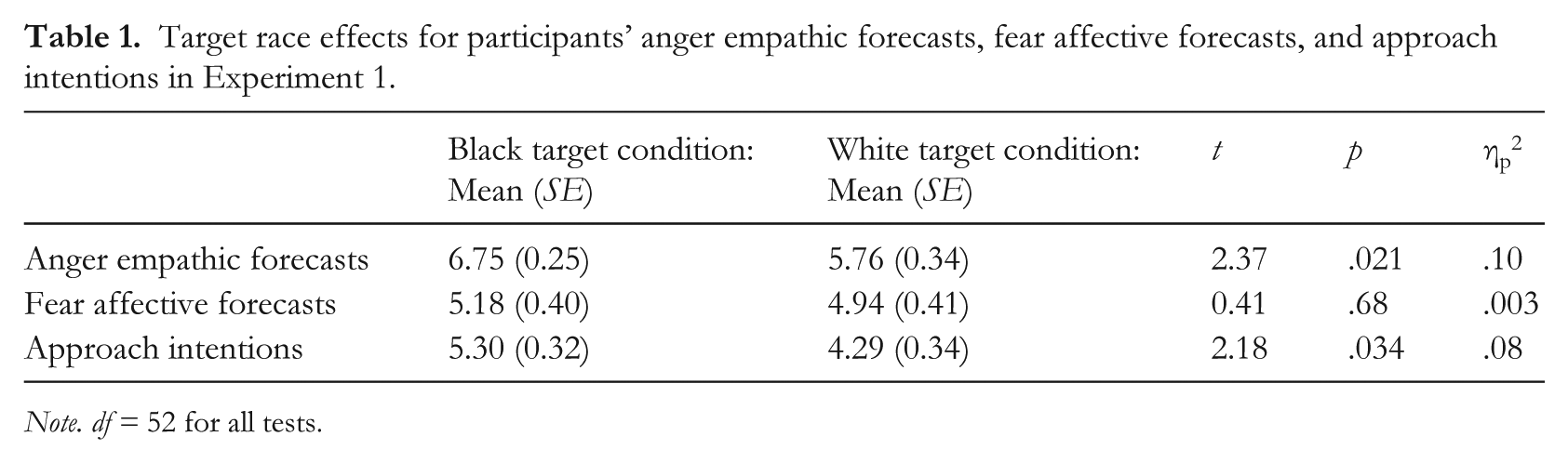
Because we hypothesized that the anger stereotype would specifically influence empathic forecasts of the target’s anger and not his other emotions, we conducted series of planned independent t tests. As displayed in Table 1, participants’ anger empathic forecasts in regard to the negative test feedback were biased by the race of the target. As predicted, participants expected that a Black man would react more angrily to receiving the negative feedback than a White man, p = .021. There was no effect of target race on empathic forecasts of happiness, sadness, fear, or pleasure in response to receiving the negative test feedback, all ps > .264. 3
Target race effects for participants’ anger empathic forecasts, fear affective forecasts, and approach intentions in Experiment 1.
Note. df = 52 for all tests.
The target’s race had no direct effect on participants’ fear affective forecasts; that is, participants expected to feel similar levels of fear when delivering the feedback to either the White man or Black man, p = .68. Finally, the target’s race influenced participants’ willingness to approach Joe, p = .034. Specifically, they indicated a preference for interacting with a Black man rather than a White man. Although it is unclear why participants expressed a preference for interacting with the Black target, this type of counterstereotypic finding might be due to participants’ attempts to override actual or perceived prejudice or discrimination, which results in a reversal of what might be expected based on stereotype content (Britt, Boniecki, Vescio, Biernat, & Brown, 1996; Plant & Butz, 2006; Plant & Devine, 2003). Other possible explanations are that participants felt more pity for the minority target receiving negative feedback relative to the White target, or that they would have preferred delivering negative feedback to a lower status group member rather than a higher status group member. Regardless of the factors driving this direct effect, we nevertheless expected an indirect effect to emerge that would influence approach behaviors in the opposite direction (i.e., less approach intention toward the Black target).
Reactions to Negative and Positive Events
We examined participants’ anger empathic forecasts for the Black or White target across four negative and four positive hypothetical events. A mixed-model ANOVA revealed that all targets were expected to be angrier in response to negative events (M = 6.86, SE = 0.16) than positive events (M = 1.57, SE = 0.134), F(1, 50) = 699.48, p < .001, ηp2 = .93. There were variations across individual events, F(3, 150) = 2.89, p = .037, ηp2 = .06, and these differences among events depended on the valence of the events, F(3, 150) = 8.73, p < .001, ηp2 = .15.
More importantly, the target’s race only biased anger empathic forecasts for negative hypothetical events but not positive events, F(1, 50) = 5.25, p = .026, ηp2 = .10. Specifically, a Black target was expected to feel angrier in response to the negative hypothetical events (M = 7.30, SE = 0.23) than a White target (M = 6.42, SE = 0.24), p = .010, ηp2 = .13. However, positive events were expected to elicit similarly low levels of anger for the Black target (M = 1.55, SE = 0.19) and the White target (M = 1.59, SE = 0.19), p = .895, ηp2 = .00.
Participants’ empathic forecasts of the targets’ happiness, sadness, fear, and pleasure varied by valence of the hypothetical events such that they expected targets to feel more positive for positive events and negative for negative events, all ps < .001. However, there was no main effect of or interaction with target race on empathic forecasts of happiness, sadness, fear, or pleasure, all ps ⩾ .10.
These findings thus extend the implications of target race for empathic forecasts to multiple negative scenarios, precluding the possibility that receiving negative test feedback somehow uniquely produced the observed forecasting effects. Further, these findings argue against the notion that Black men are indiscriminately predicted to be angrier than White men across all situations. Instead, the findings suggest that emotion stereotypes associated with race group are activated and applied specifically in the process of generating empathic forecasts. 4
Path Modeling
We tested our hypothesized dual pathway model using path analysis estimated with IBM SPSS AMOS and the method of maximum likelihood. We planned to use chi-square and RMSEA as measures of absolute fit and the CFI as a measure of relative fit (against alternative models). Small and nonsignificant chi-squares and RMSEAs equal to or less than .06 indicate good model fit. CFIs above .95 are considered to have good model fit and models with higher CFIs are preferred (Hu & Bentler, 1999; Kline, 2011).
The hypothesized model tested the direct pathway by including the direct effect of emotion stereotype on approach intentions. Further, we tested the indirect pathway by including an effect of emotion stereotype on empathic forecasts, an effect of empathic forecasts on affective forecasts, and an effect of affective forecasts on approach intentions. This hypothesized model fit the data very well, χ2(2) = 1.20, p = .55, CFI = 1.00, RMSEA = .00 (see Figure 1).

Path model showing direct and indirect paths by which emotion stereotypes may influence behavioral intentions in Experiment 1.
The model revealed two oppositional pathways by which target race could ultimately influence approach intentions. As discussed previously, the direct pathway revealed that people reported greater intention to approach the Black man than the White man. However, a simultaneous indirect pathway was uncovered as hypothesized. Participants expected that a Black man would be angrier than a White man. The angrier a target was expected to feel, the more the participant expected to feel afraid while interacting with the target. Further, if participants expected to feel more afraid, they also were less willing to interact with the target individual. Thus, in this case, the racial stereotype of Black people feeling angrier and the resulting anticipation of feeling fear appeared to indirectly contribute to greater avoidance of Black men. In sum, this experiment confirmed that forecasts may introduce stereotype bias in behavior through an indirect route.
As a comparison, a second model was tested in which affective forecasts preceded empathic forecasts in the sequence, with everything else in the model remaining identical. Essentially, this version of the model tested whether people may first project how they would feel and then predict how others would feel in response. This model fit the data very poorly by measures of absolute fit (χ2 = 12.00, df = 2, p = .002; RMSEA = .31), and the index of relative fit (CFI = .44) indicated it was inferior to the hypothesized model. Target race was not directly related to affective forecasts, and empathic forecasts were only marginally related to approach intentions, β = −.23, p = .066. This indicates that the effect of potentially stereotype-biased empathic forecasts on approach intentions is mediated by people’s predictions of how they personally will feel. 5
Finally, a third model was tested in which anger empathic forecasts in the hypothesized model were replaced with a general negative affect empathic forecast (α = .75). This model had worse absolute fit than the hypothesized model (χ2 = 2.92, df = 2, p = .23; RMSEA = .093), and the relative fit index also indicated it was inferior to the hypothesized model (CFI = .942). Therefore, our findings support the specificity of the anger emotion stereotype rather than a general negative affect stereotype of Black men.
The results from the path model should be interpreted cautiously because, despite the simplicity of the models tested, the sample size for this experiment was small for modeling purposes. Therefore, confirmation of this causal model was needed with another, larger sample. Additionally, to establish that this model pertains to emotion stereotypes generally, the effects would need to be demonstrated with another type of social group. Finally, the indirect pathway could be shown to impact multiple behavioral intentions by examining one in addition to the approach intentions used here.
Experiment 2
A second experiment was conducted to conceptually replicate the effects observed in Experiment 1. In addition to confirming stereotypic biases in forecasts, Experiment 2 generalized the findings to gender groups. Because men are more commonly associated with anger than women, we expected to demonstrate once again that emotion stereotypes bias empathic forecasts. Further, we anticipated that the indirect pathway observed in Experiment 1 would be confirmed. Specifically, emotion stereotypes would bias empathic forecasts that would be associated with affective forecasts, which in turn are associated with behavioral intentions. Further, we assessed a second behavioral intention to demonstrate that forecast processes can have broad consequences for interpersonal interactions by shaping various kinds of social behaviors. Here, we examined how forecasts were related to the intention to comfort the target individual receiving the negative feedback.
Although we expected to replicate the finding that participants who expected to feel more afraid during the interaction would seek to avoid the target person, we also hypothesized that greater expected fear would simultaneously lead to stronger intentions to comfort the target individual. Although these are seemingly opposing motives (i.e., comforting the target is approach-oriented), they can both be interpreted as attempts to minimize their own discomfort. Specifically, people may seek to escape the uncomfortable interaction if they can. If they cannot avoid the interaction, engaging in comforting behavior would be another suitable strategy for ameliorating the situation and reducing their own discomfort. Both behavioral intentions were examined simultaneously in the path model. In sum, we once again tested whether direct and indirect pathways revealed divergent consequences of an emotion stereotype.
Participants and Design
Participants were 107 undergraduate students (35 men, 72 women) at a large West Coast university who received partial course credit. Participants self-identified as Asian (n = 18), Native Hawaiian or other Pacific Islander (n = 4), White (n = 71), and Hispanic or Latino (n = 14). Participants were randomly assigned to the male target or female target condition.
Procedure
Closely following the procedures of Experiment 1, we presented participants with the scenario in which the target individual would receive negative feedback from psychological tests. In this version of the procedure, however, the photos were randomly selected from a bank of five possible photos of White men or White women, depending on condition. Once again, items were averaged to form the anger empathic forecast index (α = .78), the fear affective forecast index (r = .40, p < .001), and the approach intentions index (α = .66).
We also assessed a second behavioral intention that participants might implement. Participants used a 9-point scale (1 = not at all, 9 = very much) to report the extent to which they would try to comfort the target individual when he or she received the test results.
Results and Discussion
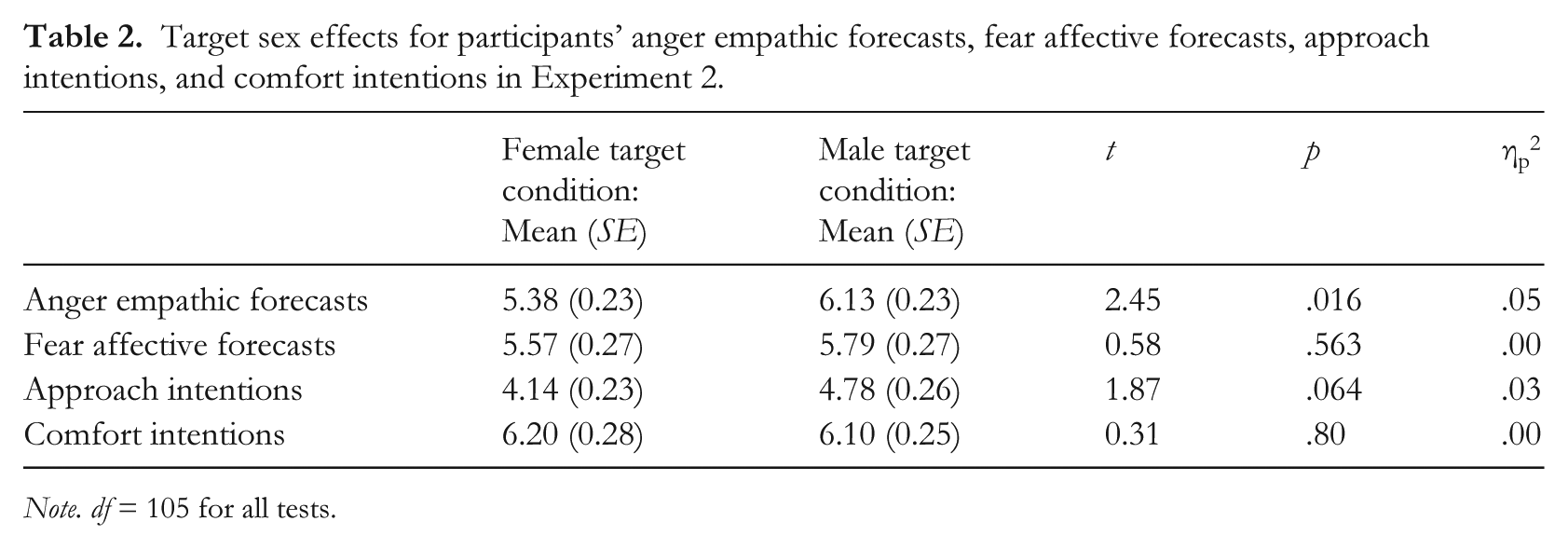
We employed the same analysis strategy as in Experiment 1. As displayed in Table 2, participants’ anger empathic forecasts were biased by the sex of the target. As expected, participants predicted that a man would react more angrily to receiving the negative feedback than a woman would, p = .016. There was no effect of target gender on empathic forecasts of happiness, sadness, fear, or pleasure in regard to receiving the negative feedback, all ps > .228. 6
Target sex effects for participants’ anger empathic forecasts, fear affective forecasts, approach intentions, and comfort intentions in Experiment 2.
Note. df = 105 for all tests.
Participants expected to be equally afraid of a man or woman’s reaction to the feedback, p = .56. Additionally, participants showed a trend to prefer interacting with a man rather than with a woman, p = .064. Finally, participants indicated that they would be equally comforting toward a man or a woman who received the feedback, p = .795. Finally, participant gender did not moderate any effects, all ps > .13. Therefore, the emotion stereotypes regarding men and women seemed to be used similarly by men and women in generating their empathic forecasts.
Path Modeling
We used the same path modeling analysis plan as in Experiment 1. In this experiment, we examined whether the path model observed in Experiment 1 could also clearly represent the data when the targets were men or women. In addition, the model included two consequences of participants’ fear affective forecasts: the approach intentions as in the prior experiment and the intention to comfort the target. The model accounted for the shared variance between these two behavioral intentions. The model fit the data very well, χ2 = .769, df = 4, p = .943, CFI = 1.00, RMSEA = .00 (see Figure 2). The target’s gender caused participants to expect a man to be angrier than a woman upon receiving the negative feedback. When the target was expected to be angrier, participants anticipated feeling more afraid when interacting with that partner. The greater fear participants predicted experiencing the more likely they were to want to avoid the social interaction, but they indicated that they were also more likely to try and comfort the target; two decidedly different behaviors, but both are strategies for exerting control in a difficult situation.
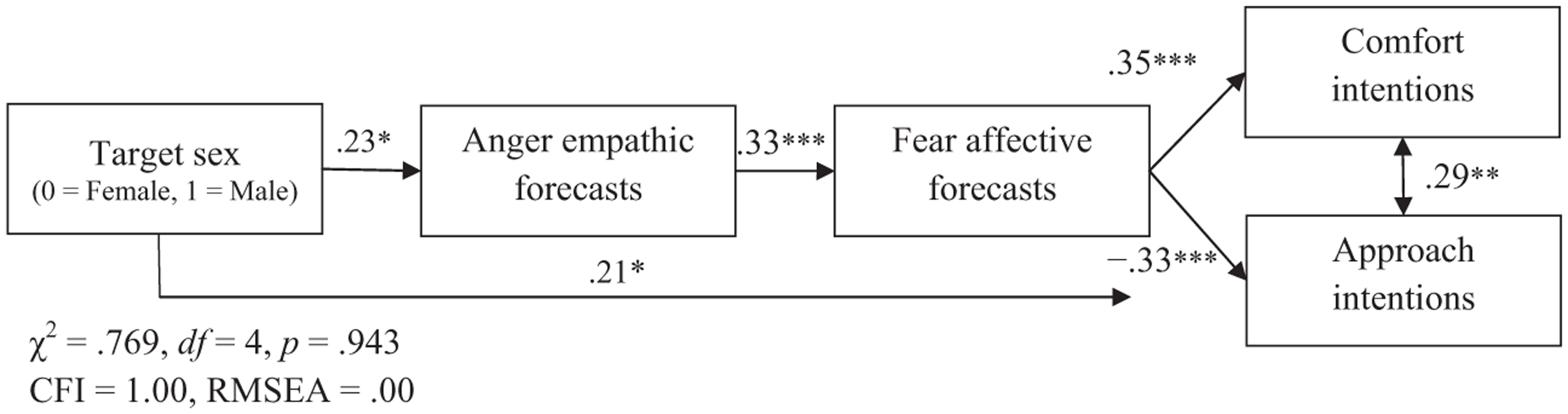
Path model showing direct and indirect paths by which emotion stereotypes may influence behavioral intentions in Experiment 2.
Once again, we tested the alternate model in which participants’ fear affective forecasts preceded the anger empathic forecasts made for the target, which fit the data poorly (χ2 = 35.51, df = 4, p < .001; CFI = .35; RMSEA = .27). The stereotype had no direct effect on fear affective forecasts and anger empathic forecasts were unrelated to either approach intentions, β = −.14, p = .151, or comfort intentions, β = .15, p = .118. As in Experiment 1, the lack of model fit suggests that the more likely sequence of events is that empathic forecasts are generated to estimate how others will react in a social situation, and only subsequently are affective forecasts made that incorporate the empathic forecast. In turn, the affective forecast serves as the primary determinant of the forecaster’s behavior. Notably, only the indirect pathway revealed how stereotypes could bias intentions to provide social support and comfort, which would otherwise have appeared entirely unrelated to the target’s social group membership.
Finally, we tested a model substituting negative affect empathic forecasts (α = .79) for anger empathic forecasts in the hypothesized model. The model was an acceptable fit to the data, χ2 = 4.39, df = 4, p = .36; CFI = .992; RMSEA = .03. However, this model’s CFI was lower than the hypothesized model’s CFI indicating that the hypothesized model was statistically preferred. Further, the key path linking target gender to negative affect empathic forecasts was nonsignificant, β = −.09, p = .33. Thus, consistent with Experiment 1, the lack of specificity in the empathic forecasts reduced the effect of target sex and this model had lower fit compared to the hypothesized model.
A critique of the path analyses in Experiments 1 and 2 is that the hypothesized model reflects the order of the measures as they were administered (empathic before affective forecasts). It is possible that the order of measures aided model fit of the hypothesized model relative to the alternative model tested. Nonetheless, we believe that the order of the measures reflects the conceptual order of the psychological processes measured. An individual’s affective forecast for an anticipated social interaction should depend on the nature of that social interaction, including the interaction partner’s emotional state. Further, as reported in Endnote 5, we obtained direct evidence of a causal link from empathic forecasts of anger to affective forecasts of fear that provides additional support for our chosen model (see Spencer, Zanna, & Fong, 2005).
General Discussion
Two experiments provided evidence for simultaneous but divergent direct and indirect effects of stereotypes on behavioral intentions. Anger stereotypes influenced empathic forecasts of how angry a target individual would be in various negative situations. We demonstrated that these empathic forecasts were related to affective forecasts of how afraid the forecaster would be if they were to interact with that target individual. Further, affective forecasts were clearly linked to how the forecaster intended to relate to the target individual during the social interaction. In other words, forecasters who expected an angrier target (due to their social group memberships), also anticipated feeling more afraid in the situation, and reported a desire to avoid the situation altogether. If avoidance was not possible, forecasters wanted to engage in comforting behaviors that would presumably reduce the target individual’s anger and ameliorate the unavoidable social interaction. The anger stereotypes applied to both racial groups and sex groups and influenced empathic forecasts across five different negative situations. In sum, anger stereotypes can impact empathic forecasts that may then bias affective forecasts and ultimately impact how forecasters behave before and during social interactions.
The current experiments provide novel evidence that anger stereotypes can bias empathic forecasting. These results are the first to link all of these factors in a process model of stereotypic bias in anticipation of social interactions. The overall theoretical model supported by these data details the sequence of events by which stereotypes can negatively, or sometimes positively, impact social interactions extremely early in the process (i.e., before the interaction starts). Even though much of these forecasting processes are intrapersonal in nature, they carry clear and potentially deleterious effects for intergroup interactions. In fact, these processes may be particularly pernicious because they can occur in advance of social interactions and thus outgroup members may be unable to stop the bias from occurring but must instead work from a disadvantaged position to counter preexisting expectations during social interactions.
One concern may be that the anger stereotypes did not have a direct overall effect on approach intentions. However, this does not invalidate the demonstrated influence of the indirect pathway. Instead, it suggests that there are other processes at work that may counter the indirect effects shown here. For example, social desirability processes may nullify, or even invert, an otherwise observable preference for interaction with White men. Thus, some of the variance in approach intentions can be explained by desirability influences. However, even among those participants reporting high approach intentions toward a Black man, there was still variability in the relative preference for interaction with a White or Black man, and it is this variance that can be explained by the indirect pathway. Suppression effects are in fact produced because different predictors account for opposing influences on the same outcome variable. Consequently, the indirect pathway demonstrated here reveals influence that is consistent with stereotype content rather than counteracting stereotypes.
Another concern may be that the particular personality traits attributed to the target (e.g., self-centeredness) affected participants’ forecasts and behavioral intentions in addition to the anger stereotype. We chose to describe the target with somewhat unattractive personality traits to reduce social desirability among participants. This was especially true in Study 1, in which we were concerned that participants would feel compelled to report wanting to interact with a Black target, and therefore we sought to provide some additional reason for them to want to avoid this person. Future studies can help generalize beyond the specific negative situation used in our experiments by examining forecasts for other types of upsetting situations (e.g., receiving negative feedback about one’s health from a doctor).
In addition, a valuable direction for future research would be to investigate nonanger emotion stereotypes and for other types of social groups. A sociofunctional approach to intergroup relations, though focused on perceivers’ emotional reactions to targets rather than their predictions of those targets’ emotions, would propose that perceivers associate groups with specific emotion profiles that depend on the specific threats represented by those groups (Cottrell & Neuberg, 2005). Indeed, the association of men, particularly Black men (who are out-group members to our participants), with anger might be particularly strong due to evolutionarily based self-protective tendencies (see Kenrick, Neuberg, Griskevicius, Becker, & Schaller, 2010). Using a sociofunctional theoretical framework, one could hypothesize other strong emotion stereotypes that reflect groups’ particular threats.
The anger emotion stereotype exerted remarkably specific effects and influenced only empathic forecasts of anger. One might think that a negative stereotype like that could color all judgments such that Black targets, for example, could be expected to react with multiple negative emotions. However, specificity in the influence of emotion stereotypes has also been documented in prior work (Moons, Leonard, Mackie, & Smith, 2009). Consequently, the emotion-specific nature of these effects indicates that researchers may benefit from assessing specific emotion forecasts rather than forecasts of global negative and positive affect as is commonly done (e.g., Buehler & McFarland, 2001; Gilbert et al., 1998; Wilson et al., 2000). Assessing specific emotions may reveal distinct consequences for psychological, behavioral, and even physiological outcomes.
Our research also highlights a distinction between emotion and trait stereotypes. We have shown that emotion stereotypes are applied when individuals have expectations that members of a social group are more prone to a specific emotion-state (as opposed to possessing a particular trait) in emotion-relevant situations. Further, stereotype-biased empathic forecasts could be biased due to emotion stereotypes or trait stereotypes. For example, an emotion stereotype of Black people is that they are angry, and a trait stereotype is that they are lazy. A perceiver could predict that a given situation, such as increased workload from the target’s supervisor, would make a Black target angry either (a) because he is prone to anger or (b) because he is lazy. Both would be stereotype-biased empathic forecasts but the former is biased by an emotion stereotype and the latter by a trait stereotype. Although empirically differentiating these processes is beyond the scope of the current manuscript, our experiments highlight this theoretical distinction.
In this work we did not assess individuals’ reactions to actual events because our goal was to examine the anticipatory processes that lead to social interactions. Prior affective forecasting research has frequently assessed how predictions of affective reactions correspond to actual subsequent experiences. However, the goal of that work was to examine absolute accuracy in forecasting. In contrast, the goal of this research was to demonstrate that stereotypes bias forecasts and that those biases may be consequential regardless of the forecasts’ accuracy. Future work should examine the implications of these anticipatory processes on social interaction behaviors, long-term relationships, and intergroup relations generally. Establishing this novel indirect pathway may provide a new way of understanding stereotyping, prejudice, and discrimination. Another interesting avenue for follow-up research is to examine the moderating role of individual differences. Some personality factors, such as empathy, may decrease reliance on emotion stereotypes, whereas other individual differences, such as racial prejudice, may increase reliance on them.
It is interesting to note that the anger stereotype associated with men and women was applied indiscriminately by both male and female participants. This suggests that anger stereotypes may broadly impact judgments including empathic forecasts made by both ingroup and outgroup members and possibly across varying levels of group identification. The endorsement of anger stereotypes by ingroup members is consistent with the acceptance of ingroup emotion stereotypes to which group members readily conform (Leonard, Moons, Mackie, & Smith, 2011; Moons et al., 2009), and the fact that both minorities and majorities often endorse stereotypes, even unfavorable ones about their own group (Jost, Banaji, & Nosek, 2004; Jost & Hunyady, 2002). Regardless of the accuracy of emotion stereotypes, this broad reliance on them suggests that they are pervasive in forecasting and may influence a wide variety of outcomes.
The current findings have clear practical implications that offer important possibilities for future research. For example, Experiment 1 suggests that Black men are less likely to receive negative feedback than White men because forecasting processes would discourage that interaction. This unwillingness to provide negative feedback may be detrimental when that feedback is integral to improvement and success. On the other hand, given the power of self-fulfilling prophecies (Snyder et al., 1977; Word et al., 1974), individuals’ empathic forecasts may lead them to elicit more anger from Black men relative to White men, ultimately resulting in stereotype confirmation. Another possible practical implication based on Experiment 2 is that women may receive a disproportionate amount of negative feedback because people are less frightened of providing it to women than men. The role of empathic and affective forecasts on intergroup interactions may become even more complex considering that majority group members often experience anxiety and impairment of executive function when interacting with minorities (see Richeson & Shelton, 2003; Richeson & Trawalter, 2005; Trawalter & Richeson, 2006). It is possible that empathic forecasts rely even more strongly on group stereotypes when the forecaster is cognitively depleted (Macrae, Milne, & Bodenhausen, 1994; van Knippenberg, Dijksterhuis, & Vermeulen, 1999) and especially when he or she is trying to inhibit stereotypic thoughts (Macrae, Bodenhausen, Milne, & Jetten, 1994). Clearly, the benefits or drawbacks of stereotypic influences on social behavior depend on the context and the target of those behaviors, but the current research sheds light on the cognitive processes that may underlie discriminatory behavior in intergroup interactions.
The current research constitutes the first evidence that stereotypes can bias the forecasting process. It also emphasizes the importance of understanding how stereotypes may influence behavior in insidious ways. Despite earnest attempts to appear nonprejudiced, it is possible that people are subtly being influenced by stereotypes before social interactions unfold. Forecasts are just one phenomenon that may promote stereotype-consistent behavior. In order to develop effective means to counter stereotype biases in forecasting, we must first understand the underlying processes. For the moment, people can be aware that they may anticipate different reactions from members of different social groups and, consequently, they may shape their behaviors accordingly.
Footnotes
Funding
This research received no specific grant from any funding agency in the public, commercial, or not-for-profit sectors.