







Abstract
A model of the relationship between need for closure (NFC) and intergroup hostility was tested in four studies. According to the model, heightened NFC promotes glorification of the ingroup which fosters support for extreme measures against the group’s perceived enemies. In a parallel process, high level of NFC induces perceptions of ingroup victimhood, which also adds support for aggressive actions toward rival outgroups. In the first two studies, conducted in Palestine’s West Bank (Study 1) and in the United States (Study 2), NFC promoted a greater sense of moral entitlement to engage in violence against the outgroup, and this was mediated by perceived ingroup victimhood. The subsequent two studies tested the full hypothesized parallel mediation model among students in Northern Ireland (Study 3) and Jewish-Israelis (Study 4). Results largely supported the proposed model. Findings are discussed in relation to additional evidence linking NFC to phenomena of intergroup hostility.
In June 2013, a U.S. drone struck the Yemeni village of Mahashama, targeting and killing the local Al-Qaida chief Saleh Hassan Hurayden. Also killed but not targeted in this attack was the 10-year-old younger brother of Hurayden, Abdulaziz (Baron, 2013). Despite the near inevitability of such collateral casualties, drone strikes continue to receive support from a majority of Americans across party lines (Pew Research Center, 2015). Support for actions that lead to deaths of innocents is puzzling, and raises the question of why people feel justified in endorsing such actions. Though a utilitarian morality that views all means as justifiable by appropriately worthy ends is common in war (Nagel, 1972), the psychological processes shaping these attitudes are insufficiently understood. Our purpose in the present set of studies was to contribute to such understanding.
The need to better understand violent intergroup conflict is underscored by the prevalence of ongoing armed conflicts around the world. These include a rebellion in Ukraine, the rise of ISIS in the Middle East, and political unrest in Burundi. While these examples involve varied actors and issues, they might nonetheless be precipitated by common psychological processes. In particular, instability and perceptions of threat might elicit a desire to reduce the uncertainty in one’s world through whatever means available. Indeed, uncertainty has been known to lead to extreme actions (Hogg, Kruglanski, & van den Bos, 2013) that in situations of intractable conflicts may quickly devolve into deadly violence.
There is a good psychological reason for such a response. Intergroup hostility may constitute a particularly effective way of managing uncertainty because it follows from a simple, Manichaean worldview in which the ingroup is good and the outgroup evil, hence deserving of punishment (Brandt & Reyna, 2010; Kruglanski, Pierro, Mannetti, & De Grada, 2006; Shah, Kruglanski, & Thompson, 1998). Unsurprisingly then, preference for extreme measures employed against enemy outgroups is associated with the need for cognitive closure (NFC) and the desire to avoid uncertainty (e.g., Orehek et al., 2010), but the mechanisms underlying this relationship have yet to be fully understood.
In four correlational studies in diverse geopolitical contexts we explore such a mechanism by investigating how a syndrome of group-centrism (Kruglanski et al., 2006) accounts for the relationship between need for closure and moral entitlement, defined as the belief in acceptability of indiscriminate violence against members of an enemy outgroup (Schori-Eyal, Klar, Roccas, & McNeill, 2017). While this literature has established a relationship between NFC and group-centrism, the meaning of group-centrism has not yet been fully explored. In the present paper we distinguish between two aspects of group-centrism, group glorification and perceived ingroup victimhood. NFC is expected to promote both attitudes, which are expected to lead in parallel to increased moral entitlement.
Need for Closure and Moral Entitlement
Need for cognitive closure reflects a desire for a firm answer, any answer, to a question and a low tolerance for ambiguity and confusion (Kruglanski & Webster, 1996). Individuals with strong chronic or acute need for closure prefer a quick, definitive decision or judgment to continued uncertainty (Kruglanski, 1989); this tendency can play an important role in interpersonal and intergroup processes (Kruglanski et al., 2006) that characterize conflict situations. Relevant to the present work, previous research has obtained support for relationships between need for closure and aggressive conflict resolution. For example, need for closure was found to be associated with a preference for hawkish conflict resolution strategies among political elites with hostile conflict schemas (Golec & Federico, 2004) and among students primed with competitive conflict strategies (Golec de Zavala, Federico, Cislak, & Sigger, 2008). Similarly, Golec de Zavala, Cislak, and Wesolowska (2010) reported a positive relationship between need for closure and intergroup hostility among individuals who self-identified as conservative. In the same vein, Federico, Golec, and Dial (2005) found that need for closure was associated with support for military action in Iraq among persons high in national attachment.
While the foregoing studies found moderated relationships between need for closure and intergroup hostility, we propose that need for closure instead gives rise to intergroup hostility, a prediction consistent with some experimental evidence. Orehek et al. (2010) found that reminders of terrorist attacks heightened individuals’ need for closure, and this promoted support for tough counterterrorism responses and for decisive leaders expected to carry them out. These findings imply a monotonic relationship between need for closure and measures of intergroup hostility, a topic explored further subsequently.
To summarize, extant literature suggests that need for closure may play a role in the preference for aggressive conflict management that achieves desirable ends for the ingroup quickly and decisively. Accordingly, it is plausible to assume that need for closure will promote moral entitlement, the belief that all means are legitimate in defense of the ingroup, including those that risk harming innocent members of an outgroup (Schori-Eyal et al., 2017).
We propose that the relationship between need for closure and moral entitlement can be explained by features of group-centrism. Group-centrism refers to a syndrome consisting of a tendency to endorse central authority, to suppress dissent, shun diversity, engage in ingroup favoritism, venerate the group’s norms and traditions, and fiercely adhere to its views (Kruglanski et al., 2006). Manifested in these attitudes and behaviors, need for closure motivates individuals to enhance the “groupness” of their collectivity to create a firm shared reality.
Characteristics of group-centrism already found to emerge under a heightened need for closure include autocratic group processes (De Grada, Kruglanski, Mannetti, & Pierro, 1999; Pierro, Mannetti, De Grada, Livi, & Kruglanski, 2003), rejection of deviants (Kruglanski & Webster, 1991), and ingroup favoritism and outgroup derogation (Shah et al., 1998). However, other expressions of group-centrism that could shed light on the relationship between need for closure and intergroup hostility have yet to be investigated. We propose that group-centrism, derived from the need for closure, can manifest itself in two additional forms that in parallel promote moral entitlement: group glorification and perceived ingroup victimhood.
Mediating Roles of Group Glorification and Perceived Ingroup Victimhood
Group Glorification
Group glorification is defined as a twofold view of the ingroup as (a) superior to others, and (b) meriting special respect or deference for the central symbols of the group (Roccas, Klar, & Liviatan, 2006). The glorification construct is akin to previous notions such as pseudopatriotism (Adorno, Frenkel-Brunswik, Levinson, & Sanford, 1950), nationalism (Kosterman & Feshbach, 1989), blind patriotism (Staub, 1989), and vertical collectivism (Triandis & Gelfand, 1998), but it remains distinct in combining ingroup superiority with the deference dimensions. By construing the group as superior and capable of providing firm answers through its unerring leaders and institutions, glorification bolsters the perception of the group as a source of clear and unequivocal reality, features attractive to those high in need for closure.
As noted earlier, we expect that need for closure will positively predict ingroup glorification (Kruglanski et al., 2006), which in turn should predict moral entitlement. Need for closure is a nonspecific motivation with respect to general information-processing behaviors (Webster & Kruglanski, 1994) whereas group glorification reflects a narrow set of attitudes about the ingroup and its relation to outgroups. Because need for closure is a more fundamental, upstream cognitive construct than glorification, we expect that this general motivation causally precedes attitudes toward one’s ingroup like glorification. It is less likely that individuals’ attitudes about their ingroup would lead them to develop a broad, comprehensive motivation that affects diverse intrapersonal, interpersonal, and intergroup processes.
The argument that NFC should causally precede group glorification is somewhat analogous to the dual-process model of ideology and prejudice (Duckitt, 2001). Duckitt, Wagner, du Plessis, and Birum (2002) found support for a model in which personality dimensions focused on behavioral dimensions (e.g., tough mindedness) influence ideological attitudes (e.g., social dominance orientation [SDO]) that in turn influence attitudes toward specific outgroups. It stands to reason that NFC, as a broader assessment of information-processing behavior, similarly serves as a trait-based catalyst for ideological attitudes about the ingroup that in turn predict hostility towards the outgroup.
Group glorification is considered a defensive form of ingroup identification that motivates individuals to maintain a sense of superiority and prevents ingroup criticism (Roccas et al., 2006). Consistent with this notion, evidence has shown that high levels of glorification predicted less demand for justice for the mistreatment of prisoners and civilians by ingroup soldiers (Leidner, Castano, Zaiser, & Giner-Sorolla, 2010). Furthermore, Leidner and Castano (2012) demonstrated that ingroup glorifiers react to threat with a shift in morality from a focus on harm and fairness to a focus on loyalty and authority. These findings are consistent with our hypothesis that group glorification promotes a sense of moral entitlement and hence support for whatever necessary to protect the group.
Our research aims to extend both the glorification literature, primarily in its identification of need for closure as an antecedent of glorification, and the need for closure literature by exploring a novel feature of group-centrism linked to intergroup hostility. Additionally, the present research will examine a second hypothesized mediator: the tendency to perceive the ingroup as a victim of undeserved injustice and hostility.
Perceived Ingroup Victimhood
We propose that need for closure’s contribution to group-centrism fosters not only group glorification, but also a sense of shared victimhood: the perception that the harm incurred by the ingroup was both considerable and unprovoked (see Bar-Tal, Chernyak-Hai, Schori, & Gundar, 2009). Because the ingroup serves as a major closure provider (Kruglanski et al., 2006), individuals under high need for closure exhibit ingroup favoritism that may also manifest itself in perception of the ingroup as an innocent victim of injustice. Group-based victimhood is usually perceived as antithetical to a self-view as a perpetrator or aggressor (Gray & Wegner, 2009; Noor, Shnabel, Halabi, & Nadler, 2012; Schori-Eyal et al., 2017). This sharp victim/aggressor dichotomy should make shared victimhood an appealing idea to individuals with a heightened need for closure.
A simplistic view of ingroup victimhood not only satisfies the need for closure, but also provides reason for aggression against the outgroup. That is, group-based victimhood places the responsibility for the conflict squarely on the outgroup, thus serving to justify the ingroup’s harmful acts against the enemy, including violence and destruction (Bar-Tal et al., 2009). In line with this logic, empirical evidence has shown that group-based victimhood increases support for aggression against the outgroup (Schori-Eyal et al., 2017). Coupled with its appeal as a means of achieving closure, this suggests that shared victimhood may mediate the relationship between need for closure and moral entitlement in parallel with group glorification.
Overview of the Present Studies
Our model was tested in four correlational studies. To lend generality to its findings, our research sampled a diverse set of populations, for the most part immersed in severe real-world conflicts: Study 1 tested the relationship between need for closure, perpetual ingroup victimhood orientation, and moral entitlement with a sample of Palestinian students from a university in the West Bank. Study 2 sought to replicate the same findings with a sample of American adults whose life experience was relatively free from intense intergroup conflict. Study 3 tested our full mediational model with a sample of Catholics and Protestants in Northern Ireland. In this model the need for closure was hypothesized to predict ingroup glorification and ingroup victimhood orientation, both of which were expected to ultimately lead to a sense of moral entitlement. Finally, the same parallel mediation model was tested in Study 4 with Jewish-Israeli students during a period of conflict escalation.
Study 1: Moral Entitlement in the West Bank
The purpose of Study 1 was to test a portion of our proposed model. The objective was to investigate whether need for closure has an indirect effect on moral entitlement mediated by perceived ingroup victimhood orientation. We began with this particular step of the model because it would constitute a novel extension of group-centrism theory into an important domain of intergroup relations.
Method
Participants
One hundred ninety-seven Palestinian students attending a university in the West Bank participated in the study. Nineteen participants were excluded from the analyses because the data they provided were incomplete, leaving a final sample of 178 participants. This sample included 55 men and 113 women, as well as 15 participants who did not report their sex. Participants ranged in age from 18 to 46 (M = 21.01, SD = 2.89).
Procedure and measures
Participants volunteered to complete the study during class times, with sessions facilitated by one of the authors (KTL) and an Arabic-speaking research assistant. Participants completed a series of scales measuring the NFC, perceived ingroup victimhood (PIVO), and moral entitlement. All scales were translated into Arabic and back-translated into English to ensure that the intended meaning of those instruments was appropriately preserved.
NFC
Need for closure was measured with a brief 14-item (e.g., “I prefer to decide on the first available solution rather than to ponder at length what decision I should make”) version of the Webster and Kruglanski (1994) measure. Response categories ranged from 1 (strongly disagree) to 6 (strongly agree), and the scale demonstrated adequate internal consistency, α = .64.
PIVO
Perceived ingroup victimhood was assessed with a brief six-item version of the measure developed by Schori-Eyal et al. (2017). Items (“Our existence as a group and as individuals is under constant threat”; “No group or people have ever been harmed as we have”; “As they have harmed us in the past, so will our enemies wish to harm us in the future”; “We must not rely on other countries and peoples”; “History teaches us that we must be suspicious of other groups’ intentions toward us”; “All our enemies throughout history share a common denominator – their hatred toward us”) were rated on a scale ranging from 1 (strongly disagree) to 7 (strongly agree). Participants were instructed to consider the extent to which they agree with each statement in relation to the history of the Palestinian people and their current situation. Prior to completing the items of the scale, participants were instructed to recall an event in which Palestinians were harmed by another group. An estimate of reliability demonstrated adequate internal consistency of this scale, α = .70.
Moral entitlement
Moral entitlement was assessed with a brief five-item version of the original scale (Schori-Eyal et al., 2017). Items (“We can use all necessary means to defend our existence”; “Harming innocents is certainly justified when our existence is being threatened”; “In times of danger, whatever means that contribute to our safety are justified”; “When another group poses a real threat to us, any member of that group is justifiably a target”; “Moral behavior during war means only taking care of your own people, not the enemy”) were rated on a scale ranging from 1 (strongly disagree) to 7 (strongly agree). Estimates of reliability revealed that the scale had moderate internal consistency, α = .60.
Results and Discussion
Hayes’s (2013) PROCESS macro was used to test our mediation model with multiple regression analyses. The total effect of the independent variable was decomposed into direct and indirect effects (MacKinnon, Lockwood, Hoffman, West, & Sheets, 2002). The direct effect represents the association of an independent variable with a dependent variable whereas the indirect effect corresponds to the effect of a mediating variable in that relationship. This macro uses bootstrapping, a nonparametric resampling procedure, to assess the significance of indirect effects. The indirect effect was tested with bias-corrected 95% confidence intervals using 5,000 random samples generated by the macro. An indirect effect was considered significant when zero was not within the range of its confidence interval. All reported results represent standardized coefficients.
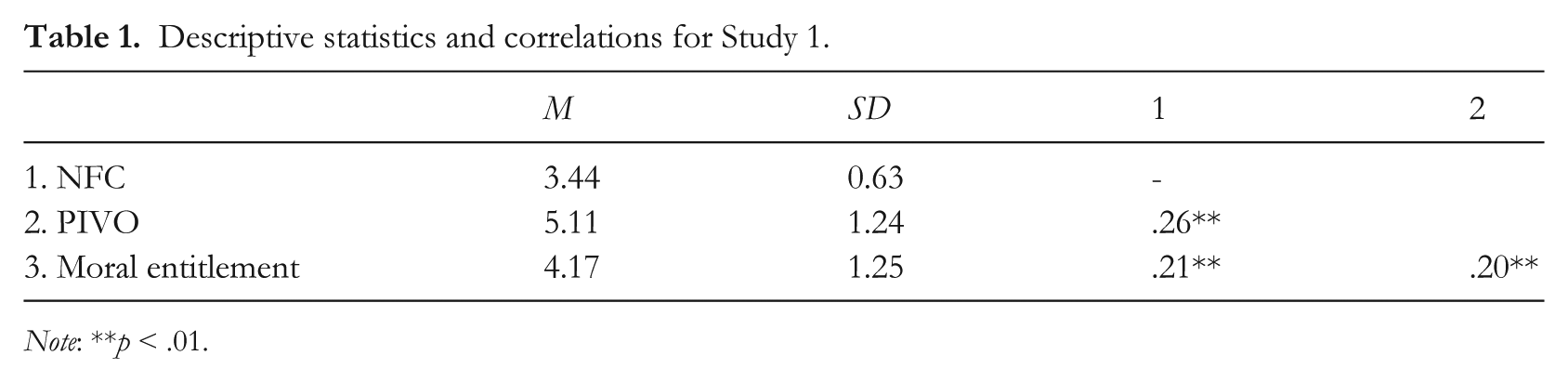
A summary of descriptive statistics and correlations is given in Table 1. Analyses revealed a significant total effect of NFC on moral entitlement when the mediator was not included in the model, β = 0.29, p < .01. A significant positive relationship was found between NFC and the mediator, PIVO, β = 0.15, p < .05. When testing the full mediation model, PIVO remained a significant predictor of moral entitlement controlling for NFC, β = 0.15, p < .05. Of greater theoretical importance, we obtained a significant indirect effect of NFC through PIVO on moral entitlement, β = 0.05, 95% CI [0.01, 0.11]. In addition, the direct effect of NFC on moral entitlement remained significant in the mediation model, β = 0.18, p < .05. The full regression model explained a significant amount of variance in moral entitlement, F(2, 176) = 6.10, p < .01, R2 = .06. In summary, results were consistent with our hypothesis that PIVO mediates the positive relationship between NFC and moral entitlement.
Descriptive statistics and correlations for Study 1.
Note: **p < .01.
Drawing from a population that has had first-hand experience with ongoing conflict, Study 1 supported our prediction that need for closure has an indirect effect on moral entitlement through its effect on PIVO. These results are consistent with the argument that individuals high in need for closure are more likely to believe that their ingroup is the target of victimization, likely stemming from a broader motivation to view the ingroup as “good” and its adversarial outgroup as “bad” (Kruglanski et al., 2006). Results were also consistent with findings that perceptions of group victimhood are associated with justification of outgroup aggression (Schori-Eyal et al., 2017). Of note, there remained a significant direct effect of need for closure on moral entitlement after controlling for our mediator, PIVO. This finding could suggest that there is indeed another mediator responsible for transmitting the effect of NFC on moral entitlement beyond PIVO, which will be explored more fully in our later studies.
Study 2: Replication Among Americans
We sought to replicate the findings of Study 1 with a sample of American respondents expected to experience appreciably less intergroup conflict than the Palestinian participants of Study 1. Should our findings replicate with U.S. participants, we would have evidence that our model pertains to moral entitlement of outgroup aggression in very different circumstances.
Method
Participants
Two-hundred twenty-two American adults were recruited online through Amazon Mechanical Turk and were awarded $0.20 as a compensation for participation. Twenty-four participants were excluded from analyses because they failed an attention filter (Oppenheimer, Meyvis, & Davidenko, 2009), and additional 11 participants were excluded because they failed to complete the questionnaire, resulting in a final sample of 187 participants; this final sample included 62 men and 125 women whose ages ranged from 18 to 68 (M = 32.35, SD = 12.91).
Procedure and measures
Participants completed the present study online. They responded to the same scales as in Study 1 respectively assessing NFC (α = .83), PIVO (α = .83), and moral entitlement (α = .85). Before completing the PIVO scale, participants were asked to think of a time Americans were harmed by another group.
Results and Discussion
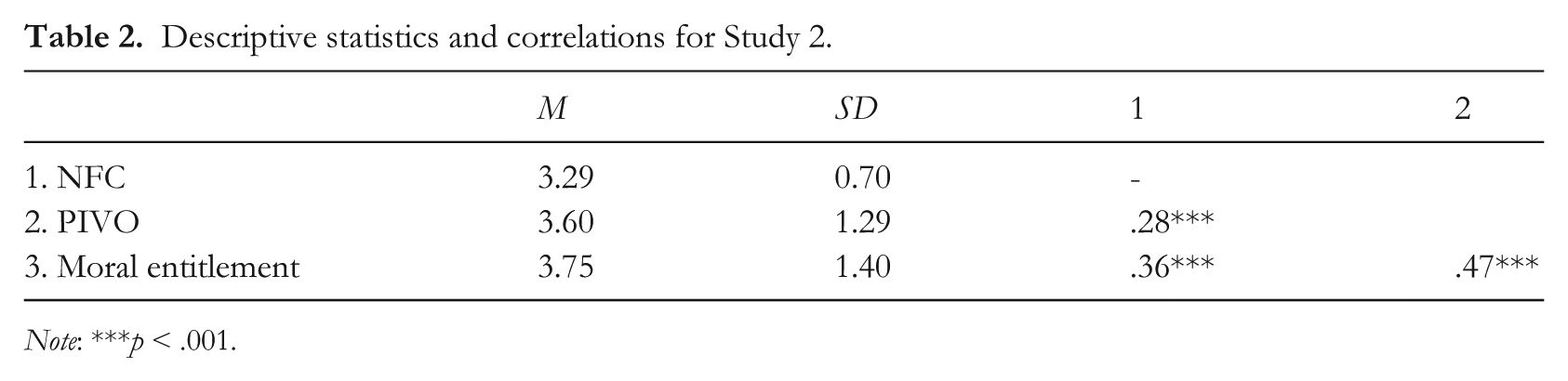
Descriptive statistics and correlations are reported in Table 2. Data analyses followed the same procedure as in Study 1. Results revealed a significant total effect of NFC on moral entitlement, β = 0.37, p < .001. Consistent with Study 1, NFC was also positively related to PIVO, β = 0.28, p < .001. In turn, PIVO was a significant predictor of moral entitlement when controlling for NFC, β = 0.39, p < .001. The indirect effect of NFC on moral entitlement mediated through PIVO was also significant, β = 0.07, 95% CI [0.05, 0.19]. The direct effect of NFC on moral entitlement remained significant when testing the mediation model, β = 0.25, p < .01, supporting partial mediation. The regression model with all variables explained a significant portion of the variance in moral entitlement, F(2, 184) = 34.59, p < .001, R2 = .27.
Descriptive statistics and correlations for Study 2.
Note: ***p < .001.
In summary, results of the present study were largely consistent with those of Study 1. Both the regression model and indirect effect results were consistent with our hypothesis that the relationship between NFC and moral entitlement is mediated by PIVO. As in Study 1, there was a significant direct effect of NFC on moral entitlement after controlling for PIVO. With a remaining direct effect, we sought to introduce a second mediator, ingroup glorification, to further decompose the relationship between NFC and moral entitlement.
Study 3: Parallel Mediation Model in Northern Ireland
Study 3 took place in the context of Northern Ireland, which has had a long-standing history of intergroup conflict between the Unionists and the Republicans. Its purpose was to build on findings of Studies 1 and 2, and introduce a test of the full proposed parallel mediation model in which need for closure has an indirect effect on moral entitlement through ingroup glorification and PIVO. This study also sought to test the possibility that ingroup glorification is a particular form of identification linked with intergroup hostility, distinct from secure forms of identification like group attachment. Group attachment reflects a combination of commitment to the group and importance of the group to self (Roccas et al., 2006) and can be contrasted with glorification’s emphasis on superiority and deference to group symbols. In line with previous research that has found differences between group attachment and glorification (e.g., Leidner & Castano, 2012; Leidner et al., 2010), we expected that group attachment would contribute little to explaining intergroup hostility, and therefore models with attachment were expected to perform worse than others.
Method
Participants
Ninety-five students attending Queen’s University in Belfast were recruited and awarded course credit for their participation. The sample consisted of 21 men and 74 women with ages ranging from 17 to 42 (M = 20.53, SD = 4.17). Most participants indicated that they were born in Northern Ireland (N = 51) or Ireland (N = 32).
Procedure and measures
Participants completed the study online. NFC, PIVO, and moral entitlement were measured using the same scales as in Studies 1 and 2. When completing the PIVO scale, however, participants received additional instructions to identify which national group they were thinking of while responding. This instruction was deemed necessary given that we intended to capture in our sample significant numbers of individuals who identified as Irish and Northern Irish. Group glorification (e.g., “In times of trouble, the only way to know what to do is to rely on the group leaders”; “This group is better than other groups in all respects”) and attachment (e.g., “I feel strongly affiliated with this group”; “Belonging to this group is an important part of my identity”) were measured with eight-item scales (Roccas, Sagiv, Schwartz, Halevy, & Eidelson, 2008) with response categories ranging from 1 (strongly disagree) to 7 (strongly agree). Reliability was adequate for NFC (α = .76), glorification (α = .86), attachment (α = .92), PIVO (α = .88), and moral entitlement (α = .88).
Results
Mediation analyses
The proposed parallel mediation model in which NFC predicts both glorification and PIVO, which both in turn lead to moral entitlement, was tested. To this end, both the total indirect effect and specific indirect effects of each possible mediational pathway in our model were estimated. The following two specific indirect effects were tested: (a) the indirect effect of NFC on moral entitlement mediated through glorification and (b) the indirect effect of NFC on moral entitlement mediated through PIVO.
Regression analyses
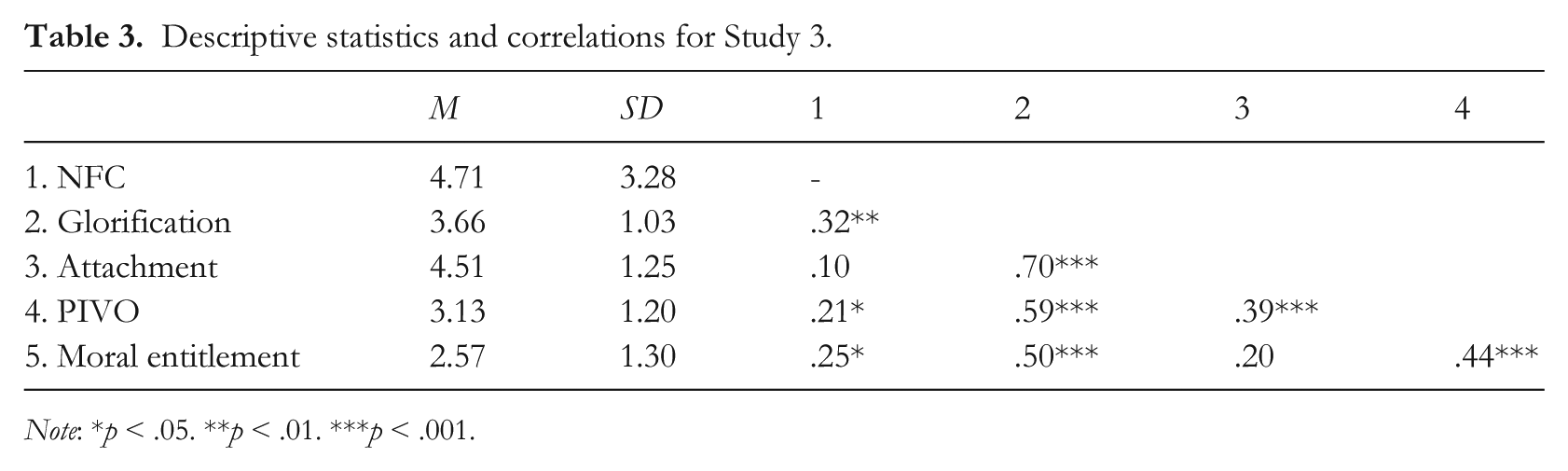
Descriptive statistics and correlations are presented in Table 3. Results of the multiple regression analyses revealed a significant total effect of NFC on moral entitlement when mediators were not included in the model, β = 0.24, p < .05. Further, NFC positively predicted glorification, β = 0.29, p < .01. NFC also positively predicted PIVO, β = 0.22, p < .01. With glorification and need for closure included in the model, PIVO was positively associated with moral entitlement, β = 0.22, p < .05. Glorification was also positively associated with moral entitlement, β = 0.35, p < .01. Finally, the relationship between NFC and moral entitlement became nonsignificant when the two mediators were included in the model, β = 0.09, p = .32. The full model accounted for a significant amount of variance in moral entitlement F(3, 91) = 12.60, p < .001, R2 = .29. The results of the regression analyses are summarized in Figure 1.
Descriptive statistics and correlations for Study 3.
Note: *p < .05. **p < .01. ***p < .001.
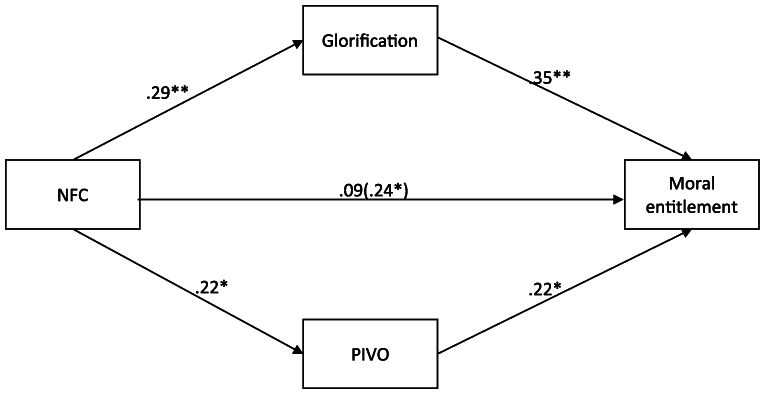
Results of the Study 3 parallel mediation model in which a significant indirect effect of NFC on moral entitlement through glorification was found.
Indirect effects
In order to directly test our mediational hypotheses, we carried out an analysis of the indirect effects. Results revealed a significant total indirect effect, β = 0.15, 95% CI [0.05, 0.28], suggesting that it was appropriate to decompose the mediation into specific indirect effects. First, we found a significant specific indirect effect of NFC on moral entitlement through glorification, β = 0.10, 95% CI [0.02, 0.25]. Second, we found a nonsignificant specific indirect effect of NFC through PIVO on moral entitlement when controlling for glorification, β = 0.05, 95% CI [−0.001, 0.15]. These results directly test and offer partial support for our hypothesized parallel mediation model. Despite regression results that show significant relationships in both steps of the indirect effect of NFC on moral entitlement through PIVO, the estimate of the specific indirect effect through PIVO was nonsignificant. Given these findings, we sought to test whether the inclusion of both glorification and PIVOin the model was necessary with a series of model comparisons.
Model comparisons
The complexity of the proposed model and the study’s relatively small sample size amplifies potential problems with bias, and we therefore complemented our analyses with a method of model comparison, using the Akaike information criterion corrected for sample size (AIC c ). The AIC c can be used to select the model that best approximates reality relative to a set of candidate models given a set of data, as indicated by the lowest AIC c value among the specified models (Burnham & Anderson, 2004). The goal of this analysis was to assess whether results from a more conservative analysis penalizing for model complexity would support the full mediation model. Specifically, we compared the evidence in favor of the parallel mediation model relative to a model in which only NFC and PIVO were included as predictors of moral entitlement and a model in which NFC and glorification were included as predictors. These models were selected because Studies 1 and 2 supported a model in which PIVO alone mediated the effect of NFC on moral licensing and we wanted to assess whether the inclusion of both PIVO and glorification truly improved on the initial model.
We also included models in which group attachment was included as a covariate. Group attachment reflects a combination of commitment to the group and importance of the group to the self (Roccas et al., 2006) in contrast to glorification’s emphasis on superiority and deference to group symbols. In line with previous research that has found differences between group attachment and glorification (e.g., Leidner & Castano, 2012; Leidner et al., 2010), we expected that group attachment will contribute little to explaining intergroup hostility, and that models with attachment will perform worse than models without it.
Despite the nonsignificant indirect effect through PIVO, the model that included NFC, PIVO, and glorification as predictors of moral entitlement emerged as the best, AIC c = −23.34, AIC c wt = .682. The AIC c weight indicates that, given the data, there is a 68.2% chance that the full model is the best of the candidate models. It is worth reiterating that the AIC c weight values represent conditional probabilities that describe the evidence in favor of a model given the observed data and the alternative models to which they are being compared. In other words, the AIC c weight values are subject to change across different samples from the same population, and should be interpreted as evidence in favor of a model compared to other candidate models given a sample of observed data, but not as evidence that a given model is “true” (Burnham & Anderson, 2002; Wagenmakers & Farrell, 2004). Full results of the model comparison analyses are summarized in Table 4.
Model selection results with models ranked according to AICc..
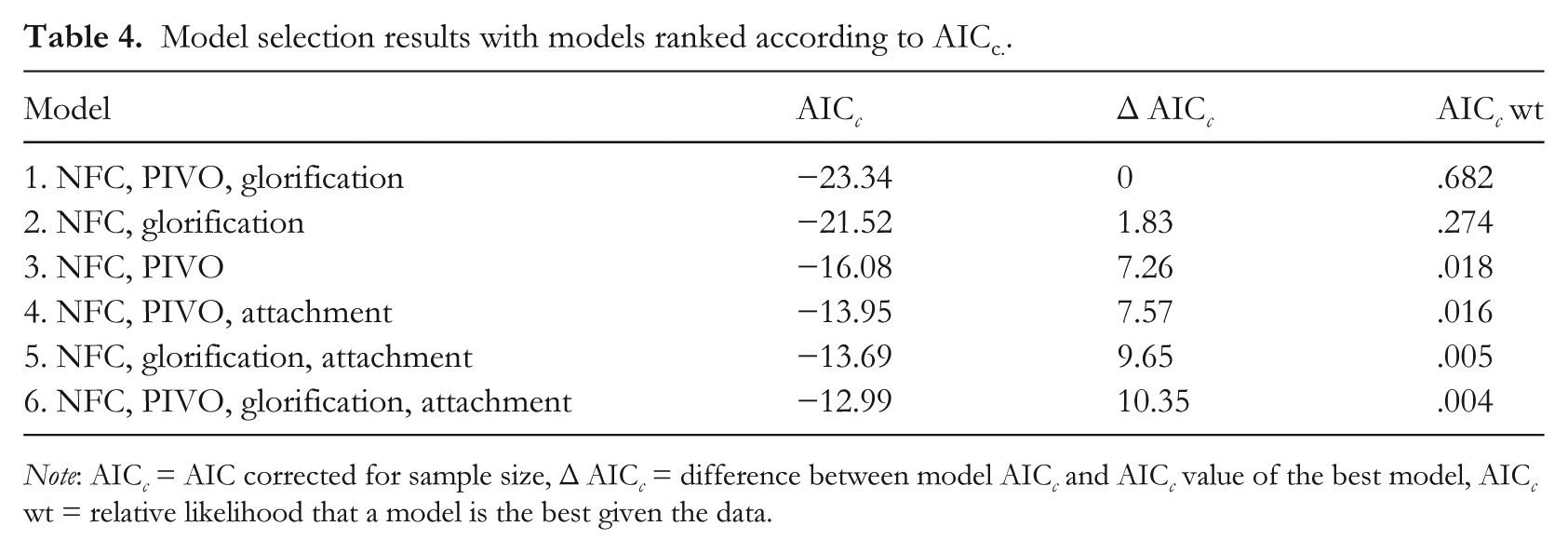
Note: AIC c = AIC corrected for sample size, Δ AIC c = difference between model AIC c and AIC c value of the best model, AIC c wt = relative likelihood that a model is the best given the data.
Discussion
The results of Study 3 provided mixed support for the full hypothesized parallel mediation model. We found, as predicted, that glorification mediated the relationship between NFC and moral entitlement. However, we did not find a significant indirect effect of NFC through PIVO despite pertinent relationships in a regression model being consistent with mediation. In light of the evidence from the regression model, support for the inclusion of both mediators in model comparisons, and support for the mediating role of PIVO in Studies 1 and 2, we sought to test the parallel mediation model in another study.
Notably, all models with group attachment as a predictor fared poorly in their model statistics. This finding is consistent with previous research linking group glorification but not group attachment to hostile attitudes toward an outgroup (e.g., Leidner et al., 2010). However, our finding is less consistent with other results linking need for closure to general group identification (e.g., Orehek et al., 2010). One explanation of this inconsistency could be that more general assessments of group identification capture levels of both attachment and glorification, and measures that distinguish between the two reveal stronger links between NFC and glorification in particular.
While Study 4 was in part motivated by an effort to provide another test of PIVO as a mediator when glorification is included in the model, we also wanted to test the model in another context. The Northern Irish context is interesting because it represents a scenario in which violent conflict persisted for years but has since been followed by relative calm and the pursuit of alternative means of resolution. Although this sample offered compelling insight into the predicted pattern of effects in a population familiar with real intergroup conflict, we were interested in further testing our full model in a context immersed in an ongoing intense conflict.
Study 4: Parallel Mediation Model in Israel
The main objective of Study 4 was to clarify the unique roles of both group glorification and PIVO as mediators of the relationship between NFC and moral entitlement. Furthermore, Study 4 was conducted in the context of the violent and ongoing Israeli–Palestinian conflict generally considered as the epitome of intractability. The data were collected among Jewish-Israeli respondents during a period of escalation in which both sides of the conflict carried out aggressive attacks against each other.
Method
Participants
One hundred and nine Jewish-Israeli students from Tel Aviv University were recruited and awarded course credit for their participation. The sample consisted of 24 men and 85 women with ages ranging from 18 to 31 (M = 22.75, SD = 2.08).
Procedure and measures
Participants completed the study in the lab as part of a larger investigation. Need for cognitive closure was measured using the Personal Need for Structure Scale (PNS; Thompson, Naccarato, & Parker, 1989). The use of PNS to measure need for closure is a result of the fact that this data were originally collected as part of a much larger project for developing several scales. The two measures reflect very similar needs and share some items (Webster & Kruglanski, 1994). Eleven items (e.g., “I don’t like situations that are uncertain”; “I enjoy the exhilaration of being in unpredictable situations”) assessed the degree to which participants desire structure, certainty, and cognitive closure. Response options ranged from 1 (strongly disagree) to 6 (strongly agree), and the scale demonstrated adequate internal consistency (α = .76). Group attachment (α = .94) and group glorification (α = .82) were measured in relation to their self-identified national group with the 16-item scale from Roccas et al.’s (2008) study. The items for glorification and group attachment were presented to participants as a single scale with items for each construct alternating. Response categories for these scales ranged from 1 (strongly disagree) to 7 (strongly agree). PIVO was measured using the full 12-item scale (α = .89) and moral entitlement was measured with the 10-item full scale (α = .92).
Results
Mediation analyses
Descriptive statistics and correlations are reported in Table 5. Parallel mediation analyses followed the same steps as those used in Study 3.
Descriptive statistics and correlations for Study 4.
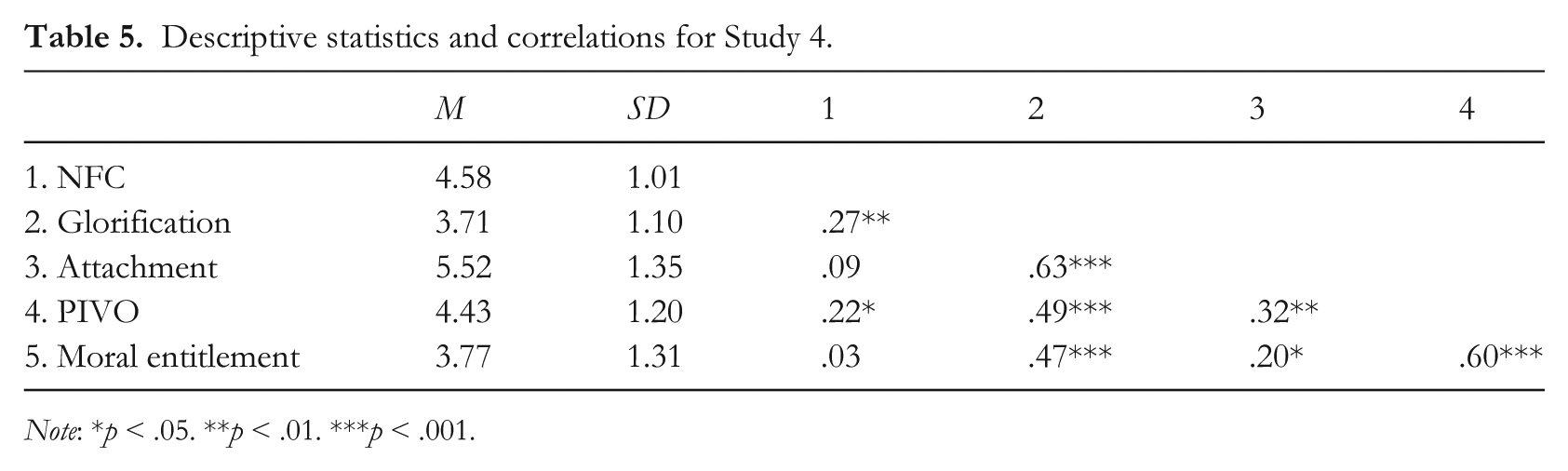
Note: *p < .05. **p < .01. ***p < .001.
Regression analyses
Results of the multiple regression analyses revealed a nonsignificant total effect of NFC on moral entitlement when mediators were not included in the model, β = 0.03, p = .77. Consistent with Study 3, NFC positively predicted glorification when controlling for group attachment, β = 0.28, p < .01. NFC also positively predicted PIVO, β = 0.22, p = .03. In turn, glorification positively predicted moral entitlement when controlling for NFC and PIVO, β = 0.26, p < .01. PIVO was also positively associated with moral entitlement in this model, β = 0.51, p < .001. Finally, the relationship between NFC and moral entitlement remained nonsignificant but trended toward a negative association after controlling for the mediators, β = −0.15, p = .06. The full model accounted for a significant amount of variance in moral entitlement F(3, 104) = 20.50, p < .001, R2 = .42. These results are summarized in Figure 2.
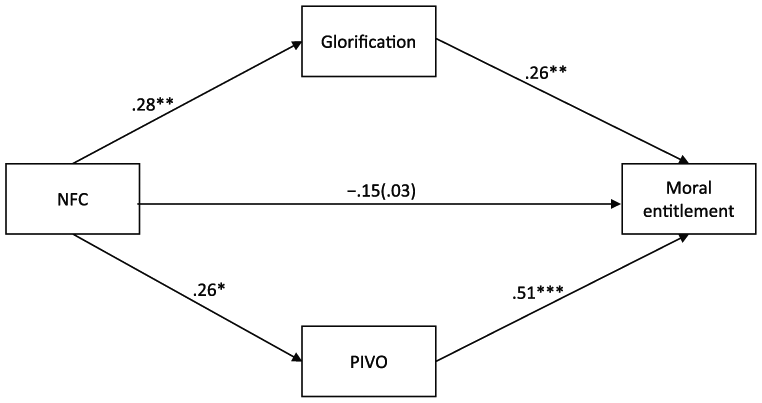
Results of the Study 4 parallel mediation model in which significant indirect effects of NFC on moral entitlement through glorification and PIVO were found.
Indirect effects
Results revealed a significant total indirect effect, β = 0.18, 95% CI [0.04, 0.35], suggesting that it was appropriate to decompose the mediation into specific indirect effects. As expected, there was a significant indirect effect of NFC on moral entitlement through glorification, β = 0.07, 95% CI [0.02, 0.15]. In addition, we found a significant indirect effect of NFC through PIVO on moral entitlement, β = 0.11, 95% CI [0.003, 0.25], a finding consistent with the results of Studies 1 and 2.
Model comparisons
As in Study 3, we ran a series of regression analyses to compare competing models using the AIC c . Once again, the model that included NFC, PIVO, and glorification as predictors of moral entitlement was revealed to be the best, AIC c = −49.42, AIC c wt = .950. The AIC c weight indicates that, given the data, there is a 95.0% chance that the full model is the best out of the candidate models. Full results of the model comparison analyses are summarized in Table 6. Given the nonsignificant NFC and moral entitlement effects in this study and previous research indicating the moderating effect of political attitudes on similar outcomes, we also tested for an interaction between NFC and an assessment of left- and right-wing political orientation. Results yielded no significant interaction on moral entitlement, PIVO, or glorification. Moreover, the patterns of relationships with NFC as a predictor remained the same when controlling for political orientation.
Model selection results with models ranked according to AICc.
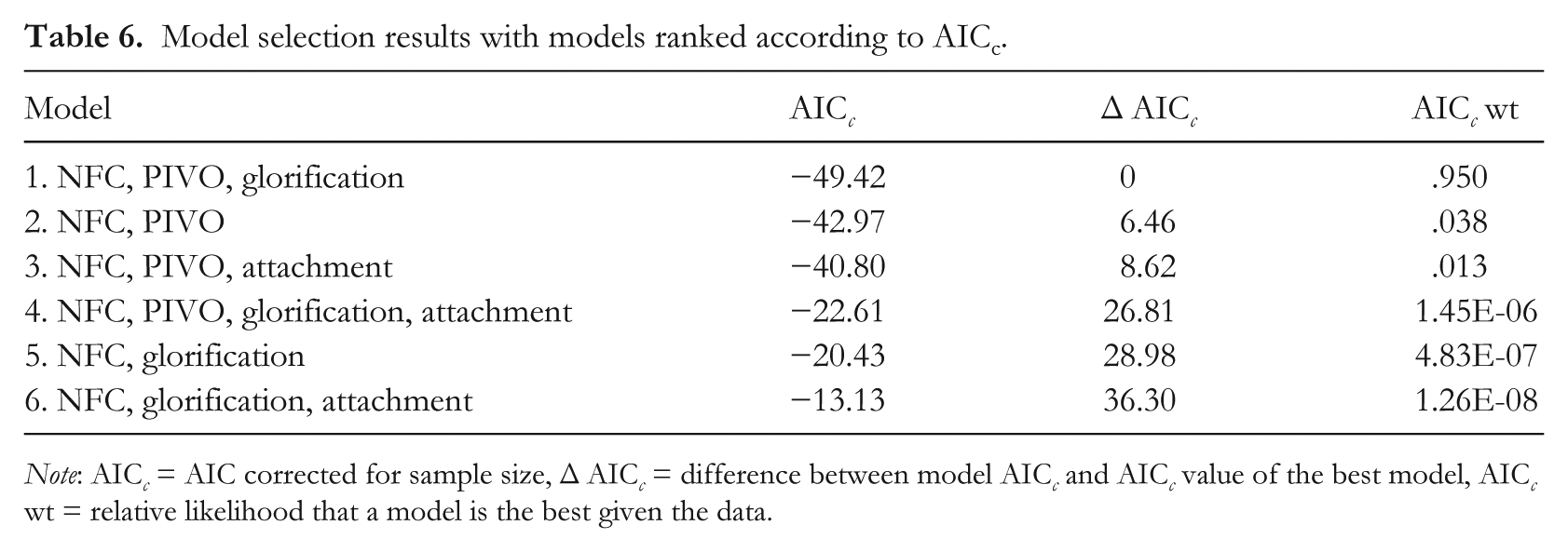
Note: AIC c = AIC corrected for sample size, Δ AIC c = difference between model AIC c and AIC c value of the best model, AIC c wt = relative likelihood that a model is the best given the data.
Discussion
The results of Study 4 were consistent with the proposed model of parallel mediation. Results supported the mediating roles of glorification and PIVO in the relationship between need for closure and moral entitlement. In addition, model comparisons again favored a model that included NFC, glorification, and PIVO while excluding group attachment. These findings suggest that both glorification and PIVO are important mediators whereas a benign form of identification, group attachment, is not relevant to predicting intergroup hostility.
The finding that glorification significantly mediated the relationship between NFC and moral entitlement was consistent with findings of Study 3. Notably, however, the mediating role of PIVO was supported when testing its specific indirect effect when this was not supported in Study 3. In contrast to the tests of indirect effects, the pattern of regression results concerning PIVO, in which NFC was positively associated with PIVO and PIVO was positively associated with moral entitlement was consistent with the regression results in Study 3. The inconsistency in the support for PIVO as a mediator suggests that this relationship requires further clarification.
Integrative Data Analysis of Study Effects
Reviewing the results across all four studies, it is apparent that some relationships were statistically significant in some studies and not in others. For example, the relationship between need for closure and moral licensing without mediators in the model was significant in Studies 1–3, but nonsignificant in Study 4. In addition, the specific indirect effect of NFC on moral entitlement through PIVO was nonsignificant in Study 3, despite consistent regression patterns, whereas the indirect effect reached significance in Study 4. Consequently, we sought to test whether these relationships would be significant when pooled across all our studies. This type of pooled analysis is called an integrated data analysis (IDA; Curran & Hussong, 2009), and can be considered a type of mega-analysis (McArdle & Horn, 2002). Curran and Hussong (2009) recommend using random effects models (i.e., multilevel modeling) only when analyzing data from at least 20 studies. Given that we are integrating data from far fewer analyses, we followed their recommendations for a fixed effects IDA.
Overview of analysis
A fixed effects analysis was conducted in which effects coding was used to specify the study that the data were from. The effects coded variables were then included in analyses as covariates to control for differences across studies. To test our mediation hypotheses, we followed the Baron and Kenny (1986) approach by performing a series of regression analyses, and tested for indirect effects with bootstrapping. First, the relationship between NFC and moral entitlement was estimated using data from all four studies. In order to test the specific indirect effects, however, we were limited to the data from Studies 3 and 4, which tested the full parallel mediation model.
Results
We sought to test the total effect of NFC on moral entitlement across all four studies (N = 588). Results revealed a significant fixed effect of need for closure on moral entitlement, β = 0.22, p < .001. Next, we sought to test support for the full mediation model using data from Studies 3 and 4 that included all four measures needed to test the model (N = 203). First, NFC was shown to be positively associated with glorification, β = 0.36, p < .001. In addition, NFC exhibited a positive association with PIVO, β = 0.23, p < .01. Next, the full parallel mediation model was run with NFC, glorification, and PIVO as predictors. Results yielded a significant relationship between glorification and moral entitlement, β = 0.27, p < .001. PIVO also showed a positive association with moral entitlement, β = 0.41, p < .001. Finally, NFC exhibited no relationship with moral entitlement when controlling for glorification and PIVO, β = −0.07, p = .32.
Next, we tested the specific indirect effects with a bootstrapping procedure, again controlling for study membership. As expected, the specific indirect effect through glorification was significant, β = 0.10, 95% CI [0.04, 0.18]. Consistent with our hypothesis, the procedure also yielded a significant indirect effect of NFC through PIVO on moral entitlement, β = 0.10, 95% CI [0.03, 0.19].
Discussion
Despite some inconsistent findings when testing effects within each study, our integrated data analyses yielded support for our hypothesized model. More specifically, our analysis yielded a significant relationship between NFC on moral entitlement, suggesting that there is indeed a relationship to be explained. Most importantly for our hypothesized model, tests of indirect effects supported the mediating role of both glorification and PIVO. The results for glorification were consistent with both Studies 3 and 4, though the mediating role of PIVO in parallel with glorification was not fully supported in Study 3. All in all then, results from our complementary analyses were consistent with the hypothesized parallel mediation model.
General Discussion
Results from four studies supported our hypothesized parallel mediation model in which need for closure is associated with both group glorification and perpetual ingroup victimhood orientation (PIVO), which in turn promote moral entitlement. More specifically, Studies 1 and 2 offered support for the mediating role of PIVO in the relationship between need for closure and entitlement whereas Studies 3 and 4 found converging support for the full parallel mediation model.
This research elucidates the antecedents of moral entitlement and other forms of intergroup hostility, suggesting that individuals characterized by high need for closure endorse aggressive intergroup action because they are motivated to derive an unambiguous and positive shared reality from their ingroup. Our research focused mainly on an endorsement of intergroup hostility pertaining to the acceptance of morally reprehensible acts against the outgroup, moral entitlement. However, we would expect our findings to generalize to less extreme forms of hostility such as ingroup favoritism (Shah et al., 1998) and toughness toward the outgroup (Orehek et al., 2010) that have previously established relationships with need for closure.
Previous research examining the relationship between need for closure and intergroup hostility has focused on how the desire for closure interacts with “hawkish” conflict resolution strategies (e.g., Federico et al., 2005; Golec & Federico, 2004). In contrast, our findings suggest that need for closure itself could serve as an antecedent of group-centrism that spurs “hawkish” attitudes and moral entitlement. While our findings are correlational, they are consistent with experimental research linking uncertainty and extremism (Hogg et al., 2013), suggesting an overall pattern of results in which intergroup hostility unfolds as a method of managing uncertainty through a clear sense of shared reality.
Our findings are also consistent with research showing that group glorification (e.g., Golec de Zavala, Cichocka, Eidelson, & Jayawickreme, 2009; Leidner et al., 2010) and group-based victimhood orientations (Noor et al., 2012; Schori-Eyal et al., 2017) are associated with increased intergroup hostility. Our research further extends these findings by introducing need for closure as an antecedent of group-centric attitudes and their downstream negative effects on intergroup conflict.
The main contribution of the present studies is in synthesizing different findings in the literature within a comprehensive, theoretically driven model that assigns the need for closure an important role as an antecedent of intergroup hostility. While need for closure, group glorification, and group-based victimhood orientations are typically studied in isolation from each other (e.g., Leidner et al., 2010; Schori-Eyal et al., 2017; but see Golec de Zavala et al., 2009), our research draws from a broad conceptual framework about the relation between epistemic motivations and group-centrism (Kruglanski et al., 2006) that provides a theoretical basis for the amalgamation of these constructs.
An important feature of our research is the different contexts from which our participants were sampled. These included situations in which intergroup conflict is an everyday reality (Palestinians in the West Bank and Jewish Israelis); a case in which violent conflict has largely been resolved but remains in recent memory (Northern Ireland); and a context in which intergroup conflict is not an immediate concern (the United States). Despite the wide range in samples and our respondents’ circumstances, our model explained a significant amount of variance in moral entitlement and showed mostly consistent mediation patterns between samples. It is important to underscore that the objective of this research was not to compare the performance of our model across cultures and contexts, but to assess whether the model accounted for individual-level variance in moral entitlement within each context. To this end, our results were successful; however, further research should be pursued to identify any differences in the antecedents of moral entitlement that may be unique to specific cultural and conflict circumstances.
Limitations and Future Directions
Several limitations of the present research deserve mention. Most importantly, the cross-sectional and correlational nature of our studies limits our ability to draw firm conclusions about the directionality of all the causal chains in our full model. Additional experimental research is needed to provide evidence of causality.
While our research illuminated important relationships among glorification, PIVO, and moral entitlement, the specific reasoning for justifying any means necessary to protect the ingroup remains a question for subsequent research. There are several plausible forms of reasoning that could justify moral entitlement, including a utilitarian perspective in which the net benefit of supporting violent conflict resolution is greater than the cost (e.g., proportionality; Rai & Fiske, 2011) or a loyalty to the group that promotes a belief that anything good for the group is moral (Haidt, 2008) and the group’s enemies are, therefore, evil and infrahuman (e.g., Leidner et al., 2010). A closer examination of the reasoning behind moral entitlement could have implications for approaches to reducing intergroup hostility by shifting the focus of moral considerations, and using techniques of perspective-taking to increase empathy (Vescio, Sechrist, & Paolucci, 2003).
In summary, we presented evidence for a process linking need for closure and moral entitlement, or justification of extreme means against enemy outgroups. While additional work addressing current limitations and potential moderators is needed, the model we propose has important implications for factors affecting the dynamics of conflict escalation as well as conflict resolution.
Footnotes
Funding
This research was supported in part by a doctoral award from the Social Sciences and Humanities Research Council of Canada awarded to the first author.