







Abstract
Two studies examined the effort that participants expended on a challenging physical persistence activity when that activity was a critical part of a divisible conjunctive task performed by two people working as a team compared to when it was structured as an individual task performed by one person working alone. It was found that participants put greater effort into that activity when they worked as part of a team task compared to when they worked alone—a motivation gain when working in groups. This gain occurred despite the absence of any apparent task-related ability differences among participants, and is most parsimoniously explained by the greater indispensability associated with working on a critical element of a divisible conjunctive group task. The implications of these results for the occurrence of motivation gains on other types of tasks and in real-world work settings are discussed.
Keywords
Motivation Gains on Divisible Conjunctive Group Tasks
An enduring question in the field of group dynamics is whether people exert any more or less effort when working on tasks as part of a group compared to when working alone. Thirty years ago, the empirical literature on this question was dominated by studies showing that people put less effort into group tasks than they put into tasks performed alone—a motivation loss when working in groups (e.g., Harkins, 1987; Harkins & Petty, 1982; Ingham, Levinger, Graves, & Peckham, 1974; Kerr, 1983; Kerr & Bruun, 1983; Kravitz & Martin, 1986; Latané, Williams, & Harkins, 1979; Weldon & Gargano, 1985, 1988; Weldon & Mustari, 1988; Williams, Nida, Baca, & Latané, 1989). However, since then a more nuanced picture has emerged that suggests people do not always exert less effort when working in groups. Indeed, under some circumstances they may actually put more effort into group tasks than into tasks performed alone—a motivation gain when working in groups (e.g., Kerr & Hertel, 2011; Larson, 2010; Weber & Hertel, 2007).
A variable that has attracted a good deal of attention as one possible cause of motivation gains in group work settings is member indispensability. Indispensability reflects the extent to which a given member can potentially impact the group’s performance for better or worse: the greater a member’s potential impact, the more indispensable he or she is. The effect of indispensability on member motivation can be understood within an expected-value framework, which suggests that the willingness to expend effort on behalf of the group is in part a function of its perceived instrumentality for obtaining highly valued outcomes, including group success, positive outcomes for oneself and others, and favorable self- and social evaluations (Hertel, Kerr, & Messé, 2000; Hertel, Kerr, Scheffler, Geister, & Messé, 2000; Karau & Williams, 1993; Kerr et al., 2007; Lount, Kerr, Messé, Seok, & Park, 2008; Lount, Messé, & Kerr, 2000; Lount, Park, Kerr, Messé, & Seok, 2008; Messé, Hertel, Kerr, Lount, & Park, 2002).
Empirical research on the role of indispensability in promoting motivation gains in groups has focused primarily on two types of tasks. One type has an additive structure, where the group’s collective performance is simply the sum of its members’ individual contributions. On such tasks, members might contribute either simultaneously (as when two or more painters paint a house) or sequentially (as when participating in a relay race). When contributing simultaneously, it has been shown that members who work with a partner who is expected to perform poorly tend to increase their own effort as a compensatory strategy (Hüffmeier, Dietrich, & Hertel, 2013; Karau & Williams, 1993, 1997; Todd, Seok, Kerr, & Messé, 2006; Williams & Karau, 1991), particularly when the partner’s anticipated poor performance is attributed to his or her lack of ability (Hart, Bridgett, & Karau, 2001; Jackson & LePine, 2003). On the other hand, when contributing sequentially, it has been shown that members who perform later in the sequence tend to increase their effort relative to working alone (e.g., Hüffmeier & Hertel, 2011; Hüffmeier, Kanthak, & Hertel, 2013; Hüffmeier, Krumm, Kanthak, Kanthak, & Hertel, 2012). Members who perform later in a sequence, as well as those who perform simultaneously but with a less capable partner, often feel that their own contributions are more indispensable to the group, and so increase their effort in order to ensure the group’s success.
Indispensability has also been studied in tasks with a conjunctive structure. These are tasks that require all members to perform well in order for the group as a whole to succeed (Kelley et al., 2003; Steiner, 1972). The classic example is that of a mountain climbing team whose members are roped together while making their ascent. The rope provides a measure of safety, but also compels all members to climb at the same pace, and no faster than the slowest of them can maintain. As a result, it is the effort of the group’s least capable (slowest, weakest) member that has the greatest impact on, and so is most indispensable to, their collective performance. Research indicates that, like indispensable members performing additive tasks, the least capable members of groups performing conjunctive tasks tend to exert more effort than they would have had they engaged in the same activity working completely alone (Hertel, Deter, & Konradt, 2003; Hertel, Kerr, et al., 2000; Hertel, Kerr, Scheffler, et al., 2000; Hertel, Niemeyer, & Klauss, 2008; Kerr, Forlenza, Irwin, & Feltz, 2013; Kerr, Messé, Park, & Sambolec, 2005; Kerr et al., 2007; Köhler, 1926, 1927; Lount, Kerr, et al., 2008; Lount, Park, et al., 2008; Messé et al., 2002; Wittchen, Schlereth, & Hertel, 2007).
Divisible Conjunctive Tasks
It seems unlikely, however, that indispensability is necessarily a function of members’ relative ability on all types of tasks. Rather, on many such tasks, indispensability—and so motivation gains—may arise even in the absence of ability differences among group members. To see this, it is necessary to recognize that conjunctive tasks vary with respect to divisibility. Some, like the mountain climbing task described above, are unitary, meaning that all members engage in the same activity, have the same goal, and use the same skills and abilities, and their contributions to the group’s product (e.g., climbing speed, distance travelled) are constrained to be equal. By contrast, other conjunctive tasks are divisible. Divisible conjunctive tasks are tasks with two or more distinct subtasks performed by different people that nevertheless must all be done well in order for the group as a whole to succeed. Thus, members contribute differently (not identically) to the group’s product on divisible conjunctive tasks. This is what distinguishes a divisible task from one that is unitary. Yet superior performance on one subtask cannot compensate for inferior performance on another; every subtask must be performed well if the group is to succeed. This is what makes the task as a whole conjunctive (cf. Kelley et al., 2003; Larson, 2010; Steiner, 1972).
Consider, for example, a two-woman cycling team whose members take turns drafting one behind the other. Doing so shelters the follower from the wind, and so enables her to keep pace with the leader while spending up to one third less energy (Broker, Kyle, & Burke, 1999). If they ride together in this fashion, taking turns leading and following, the team will travel faster and finish sooner than would be possible using any other riding arrangement. Drafting is clearly a divisible task, as the leader and follower perform distinctly different subtasks (cf. Hackman, 1969; Larson, 2010). The leader contends with the wind to a much greater extent than does the follower and has primary responsibility for navigation, which includes avoiding potholes, pedestrians, and other hazards in the road. The follower, by contrast, need only work to maintain her advantageous position directly behind. And the task as a whole is obviously conjunctive, as the leader and follower subtasks must both be performed well if the team as a whole is to succeed. But it should also be obvious that the leader’s subtask has more impact on the team’s overall success—their speed at any given moment depends primarily on how fast the leader rides. The leader’s efforts are thus more indispensable to the team’s success than are those of the follower. As such, regardless of their relative ability, we might expect riders to exert more effort when performing the leader’s subtask as part of a cycling team than when facing the same physical and cognitive challenges of wind and navigation but cycling alone (Larson, 2010).
Thus, like unitary conjunctive tasks, when groups perform divisible conjunctive tasks, some members may be more indispensable than others. But unlike unitary conjunctive tasks, that indispensability does not necessarily hinge on being less capable than other members of the group. Rather, it can arise simply from the criticality of the subtask being performed. We therefore predict that when a group is engaged in a divisible conjunctive task, members who perform particularly critical subtasks will tend to exhibit a motivation gain, putting more effort into their subtask than they would had they worked alone at the same activity. This gain is predicted to occur even when members have equivalent task-relevant abilities.
Experiment 1
We tested these ideas in two experiments. Both involved a simple but challenging physical persistence activity: squeezing a hand-held dynamometer in order to control a marker that appeared on a computer screen. This activity was organized either as a task performed by one person working alone or as the more critical element of a divisible conjunctive task performed by two people working as a team. Experiment 1 tested the hypothesis that, controlling for differences in task-relevant ability, participants would put more effort into this activity when it was a critical part of a divisible conjunctive team task compared to when it was part of an individual task performed by one person working alone.
Method
Participants and design
Eighty-eight female undergraduate students enrolled in introductory psychology courses at Loyola University Chicago participated in the study in partial fulfillment of a course requirement. Thirty-four participated individually, while the rest participated in 27 two-person teams. The experiment employed a 2 (Work Context: alone vs. team) x 2 (Hand: dominant vs. nondominant) x 2 (Trial With a Given Hand: first vs. second) x 2 (Lifting Turn Within a Given Trial: first vs. second) mixed factorial design, where the first of these was a between-subjects factor and the remainder were all within-subject factors.
Experimental task
Participants squeezed a hand-held dynamometer—an instrument that measures gripping force—in order to “lift” (move in an upward direction) one of two colored markers displayed on a computer screen (see Figure 1). The dynamometer weighed 0.75 lbs (0.34 kg), interfaced with custom software running on a standard desktop computer, and was held while sitting in a chair and resting one’s forearm comfortably on a lap pillow. 1 The harder the dynamometer was squeezed the higher the marker it controlled was lifted, with the force required to lift that marker to any given height being proportional to the participant’s own maximum gripping force (see below lines). The two markers differed in size, color, and in the force required to lift them. To lift the larger (smaller) marker minimally off the baseline required 20% (10%) of the participant’s maximum gripping force, while lifting it to its highest possible position required 40% (30%) of maximum. Accordingly, we refer to these as the heavy and light markers, respectively.
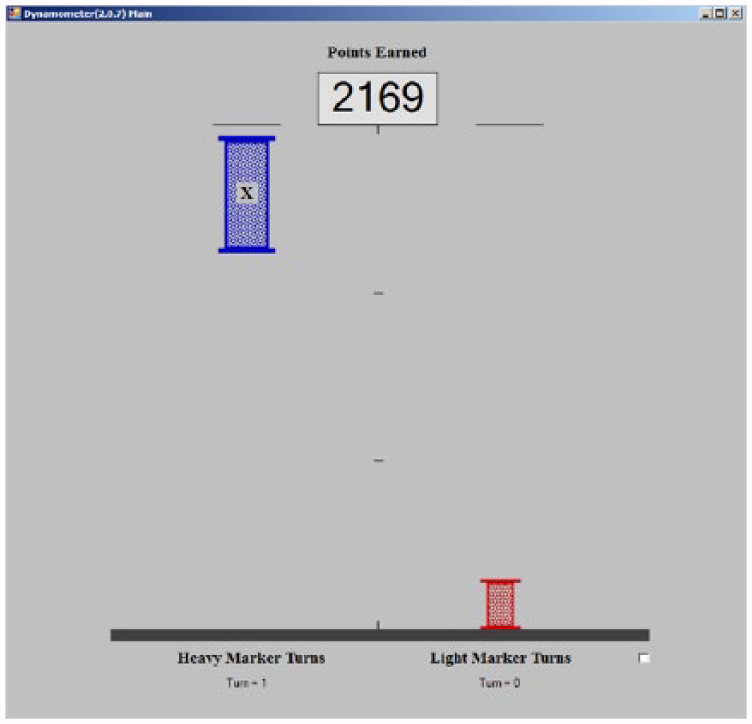
Screenshot of the dynamometer task being performed during the practice trial of Experiment 1 by one person working alone (the heavy marker is the
Alone condition
The dynamometer task could be performed either by one person working alone or by two people working as a team. When working alone, a single dynamometer was used to control the two markers in alternating sequence, starting with the heavy marker. Points were earned for every second the heavy marker was lifted off the baseline, with more points earned per second the higher it was lifted. Thus, participants in this condition were encouraged to earn as many points for themselves as they could by lifting the heavy marker as high as possible for as long as possible. 2 But doing so was fatiguing. When they became tired, participants were to press the space bar on the keyboard, which switched them to the light marker. No points accrued while lifting the light marker, but it nevertheless had to be lifted at least minimally off the baseline for a length of time equal to that just spent lifting the heavy marker. An abrasive warning tone sounded if the light marker touched the baseline. Participants were not told what determined how long they would lift the light marker. Rather, they were told only that they had to lift it for a predetermined amount of time, after which the computer would automatically switch them back to the heavy marker. This switching back and forth between markers continued until participants completed two turns lifting each, at which point the trial ended.
Team condition
When working in teams, two participants sat side-by-side in front of the same computer screen and performed the task together, with each holding her own dynamometer. One controlled the heavy marker, while the other controlled the light marker. The team earned points for every second the heavy marker was lifted off the baseline, with more points earned per second the higher it was lifted, provided that the light marker was simultaneously lifted at least minimally off the baseline. Permitting the light marker to touch the baseline at any time temporarily suspended the accumulation of points until it was lifted again. Thus, participants in this condition were encouraged to earn as many points for their team as they could by lifting the heavy marker as high as possible for as long as possible, while making sure that the light marker was always off the baseline. Paralleling what happened in the alone condition, when the team member controlling the heavy marker became tired, she was to press the space bar on the keyboard in order to switch markers with her teammate. Then, when the teammate became tired, the teammate pressed the space bar to switch back. This switching back and forth continued until each member completed two turns lifting each marker, at which point the trial ended. Teams were instructed not to speak as they performed the task, and a visual barrier placed between the two members prevented them from seeing each other except when one of them reached forward to press the space bar in order to switch markers.
It is important to note that in the team condition the heavy marker determined the momentary rate at which points could be earned (according to how high it was lifted, just as in the alone condition), whereas the light marker determined whether or not any points would be earned at all at that moment (according to whether it was at least minimally off the baseline). But lifting the light marker by a small amount was considerably easier than lifting the heavy marker as high as possible (these required 10% and 40% of the participant’s maximum gripping force, respectively). Thus, lifting the heavy marker was both more difficult and more critical to the team’s success. The fact that these subtasks varied in their objectives and difficulty, but both nevertheless had to be performed well in order for the team as a whole to succeed, makes this a divisible conjunctive task in the team condition.
Procedure
Two participants were solicited for every experimental session. When only one signed up the alone condition was run. Otherwise the team condition was run. At the beginning of the session a female experimenter outlined the general procedures to be followed, demonstrated the operation of the dynamometer, verified each participant’s eligibility for the study vis-à-vis an injury and health status checklist, and obtained her written informed consent.
Maximum force calibration
Participants were then taken through a procedure to establish their maximum gripping force. They were handed a dynamometer, shown how to grasp it properly, and asked to squeeze it as hard as possible for 3 seconds. The computer recorded (but did not display) the force applied. Participants did this twice with each hand, alternating hands between squeezes. Their maximum gripping force for each hand was defined as the greater of the two forces applied with that hand. These maximum values were subsequently used as reference points by the computer software, such that the force required to lift each marker during the experimental trials was always proportional to the participant’s own maximum gripping force for the hand being used.
Practice trial
Participants were next guided through a brief practice trial, during which the experimenter explained that the force required to lift each marker was proportional to their own maximum gripping force, that this compensated for any strength differences that might exist between participants, and so made everyone equally able to perform each subtask. The way in which points were earned was also demonstrated, including the temporary suspension of point accumulation in the team condition when the light marker was allowed to touch the baseline. This was done by inviting participants to lift (with their dominant hand) both the heavy and light markers to various points on the screen, and to hold it there long enough to observe the rate at which points accumulated but not so long as to become fatigued. To assist with this, during the practice trial the point earnings were displayed at the top of the screen in real time as they accumulated (see Figure 1). During the four experimental trials, however, the point earnings were not displayed until after each trial ended.
Experimental trials
There were a total of four experimental trials, with a 2-minute rest break between them. Just before the start of each trial, participants in the alone condition were reminded that their goal was to earn as many points for themselves as they could by lifting the heavy marker as high and for as long as possible. Likewise, those in the team condition were reminded that their goal was to earn as many points for their team as they could by lifting the heavy marker as high and for as long as possible while simultaneously keeping the light marker off the baseline. 3 Participants used their nondominant hand on Trials 1 and 3, and their dominant hand on Trials 2 and 4. During each trial in the alone condition they controlled each marker twice, in an alternating sequence as described above, starting with the heavy marker. In the team condition, one member (Member A) was randomly assigned to begin all four trials controlling the heavy marker, while her partner (Member B) began all four controlling the light marker. Within each trial, they switched markers three times, so that each had two turns lifting each marker. In both conditions, as the participants worked, the experimenter sat quietly out of sight behind a screen on the opposite side of the room. After completing all four trials, participants filled out a short questionnaire, and were then thanked and dismissed. All participants were debriefed by email at the end of the semester.
Measures
Two dependent variables were of primary interest. The first was the average force applied to the dynamometer while lifting the heavy marker, expressed as a percentage of the participant’s own maximum gripping force for the hand involved. To obtain this measure, approximately every two thirds of a second the software used in the experiment recorded the percent-of-maximum gripping force being applied to the dynamometer at that moment. The force values recorded during a given lifting turn were subsequently averaged, yielding two scores per participant per trial, one for each heavy marker lifting turn. The second dependent variable of interest was the length of time that participants persisted while lifting the heavy marker. Here too there were two scores per participant per trial, one for each heavy marker lifting turn.
Note that in the team condition, although these measures were obtained for both members, only Member A’s activity—specifically, having started each trial controlling the heavy marker—directly paralleled that of participants in the alone condition. Thus, except where indicated, the results reported for the team condition refer only to Member A. Note also that the points earned during each trial are not a suitable dependent variable in this study, as teams naturally accumulated more points than individuals (because they could earn points continuously throughout each trial, whereas participants working alone could earn points only during the half of each trial that they spent lifting the heavy marker). Further, points earned in the team condition were a function of performance on both subtasks, whereas points earned in the alone condition were a function only of performance on one subtask, lifting the heavy marker. For these reasons, point earnings are not considered.
Results
Manipulation check
Participants rated on 10-point scales how difficult it was to lift each marker (1 = very easy, 10 = very difficult) and how critical it was to be good at lifting each marker (1 = not very critical, 10 = extremely critical). They reported that it was more difficult to lift the heavy marker (M = 7.21, SD = 1.73) than the light marker (M = 2.88, SD = 1.59), F(1, 59) = 332.84, p < .001, ηp2 = .85, and that lifting the heavy marker was more critical (M = 9.25, SD = 1.12) than lifting the light marker (M = 3.52, SD = 2.83), F(1, 59) = 268.85, p < .001, ηp2 = .82. The criticality measure also yielded a significant Marker x Work Context interaction. Whereas participants viewed lifting the heavy marker to be more critical than lifting the light marker in both the team (M = 9.30, SD = 1.32 vs. M = 5.07, SD = 2.88, respectively); F(1, 59) = 69.37, p < .001, ηp2 = .54 and alone conditions (M = 9.21, SD = 0.95 vs. M = 2.29, SD = 2.11, respectively); F(1, 59) = 234.08, p < .001, ηp2 = .80, the latter difference is significantly stronger than the former, F(1, 59) = 15.68, p < .001, ηp2 = .21. This interaction occurred because participants in the team condition rated lifting the light marker as more critical than did participants in the alone condition, F(1, 59) = 18.91, p < .001, ηp2 = .24, which is consistent with how the task operated in the two work contexts. Thus, the participants seemed to perceive the two subparts of the dynamometer task as expected.
Maximum force
Participants’ maximum gripping force did not vary by work context, t(59) = 0.56, p = ns, and t(59) = 0.21, p = ns, for the dominant and nondominant hands, respectively. But maximum gripping force was significantly correlated with the average percent-of-maximum force scores obtained during the four experimental trials;
Percent-of-maximum force
To test the study’s main hypothesis, we submitted the average percent-of-maximum force scores to a 2 (Work Context: alone vs. team) x 2 (Hand) x 2 (Trial With Hand) x 2 (Lifting Turn Within Trial) mixed factorial analysis of covariance (ANCOVA), where the first variable was a between-subjects factor, the remaining three were all repeated measures factors, and maximum gripping force was included as a covariate. As expected, the maximum force covariant was significant, F(1, 58) = 7.35, p < .01, ηp2 = .11, as was the Maximum Force x Turn interaction, F(1, 58) = 4.44, p < .04, ηp2 = .07. These effects indicate that higher maximum gripping force scores were associated with less average percent-of-maximum force exerted during the four experimental trials, particularly during the second lifting turn within each trial, when participants were presumably more fatigued. More importantly, this analysis also revealed a significant main effect for work context, F(1, 58) = 4.58, p < .04, ηp2 = .07. As can be seen in Figure 2, participants applied more force when lifting the heavy marker in the team (M = 39.16, SD = 4.67) than in the alone condition (M = 36.59, SD = 4.16). No other effects from this analysis were significant. These results are consistent with our main hypothesis that, even when there are no apparent task-related ability differences between team members, people will exert more effort when performing a critical part of a divisible conjunctive team task compared to when engaged in the same activity but working alone.
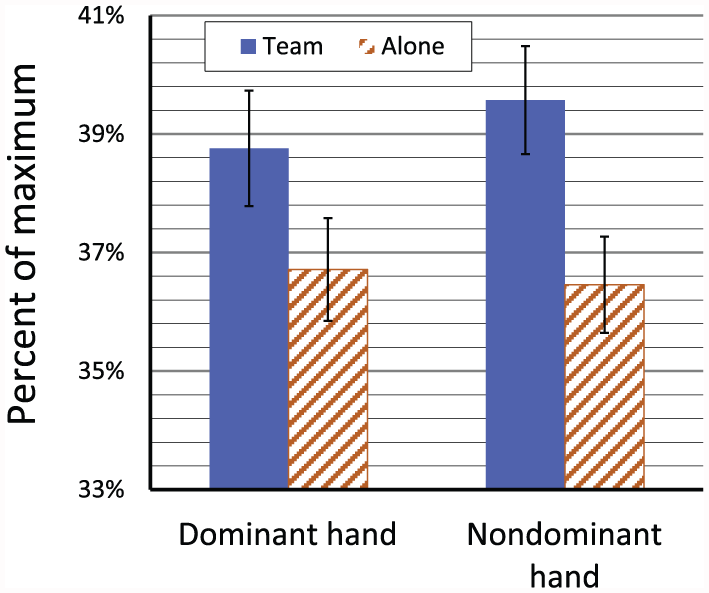
Mean percent-of-maximum gripping force exerted by participants in the team and alone work conditions when using their dominant and nondominant hands (Experiment 1).
An alternative hypothesis: Social comparison
A possible alternative explanation for why participants exerted more effort when working in teams than when working alone is that in the team condition each member may have served as a source of social comparison for the other, and that on their successive turns lifting the heavy marker each tried to outdo the other. But if this were the sole explanation for the results, there should be no work context effect when lifting the heavy marker on the very first lifting turn of the first trial, because at that point in the team condition the partner had not yet lifted the heavy marker, and so could not serve as a source of social comparison. Further, within the team condition there should be a significant member main effect when lifting the heavy marker for the very first time, with Member B exerting greater effort than Member A, because Member B’s first turn with that marker always followed Member A’s turn, whereas Member A’s first turn followed no one.
To test whether or not there was a work context effect on the very first turn lifting the heavy marker, the average percent-of-maximum force scores for that turn were analyzed separately with a one-way ANCOVA, again using the participants’ maximum gripping force as a covariate. This analysis yielded the same significant work context effect as before, F(1, 58) = 6.24, p < .02, ηp2 = .10, with participants applying more force in the team (M = 44.30, SD = 6.91) than in the alone condition (M = 40.66, SD = 4.91). Thus, even on the very first turn lifting the heavy marker, participants exerted more force when working as part of a team than when working alone. To test whether in the team condition Member B might have applied more force to the dynamometer than Member A when lifting the heavy marker for the first time, both members’ percent-of-maximum force scores for their first lift of that marker were also analyzed with a one-way ANCOVA. The member main effect from this analysis was not significant, F(1, 24) = 0.03, p = ns. Thus, there is little evidence that participants exerted more effort in the team than in the alone condition simply as a result of social comparison processes.
Another alternative hypothesis: Social facilitation
A second possible alternative explanation for why participants exerted more effort when working in teams than when working alone is that in the team condition, the partner (Member B) may have induced a social facilitation effect, either by her mere presence (Zajonc, 1965, 1980) or by her ability to evaluate Member A’s performance (Cottrell, 1972; Harkins, 2001, 2006; Henchy & Glass, 1968). Social facilitation implies a general increase in the frequency or intensity of dominant behavioral responses, which in the present context means squeezing the dynamometer harder. If social facilitation indeed produced the work context effect observed when participants lifted the heavy marker, we might expect to see a similar effect both when they lifted the light marker and when they demonstrated their maximum gripping force at the beginning of the experiment. As noted above, however, participants’ maximum gripping force did not vary by work context. Further, when the percent-of-maximum force scores generated while lifting the light marker were submitted to the same 2 x 2 x 2 x 2 mixed factorial ANCOVA as before, no significant effects were obtained. Importantly, the dynamometer was not squeezed significantly harder by those participating as Member A in the team condition (M = 13.20, SD = 1.67) than by those working in the alone condition (M = 12.58, SD =1.67), F(1, 58) = 2.08, p > .15. These data thus offer no clear support for the operation of social facilitation.
Lift duration
A 2 x 2 x 2 x 2 mixed factorial ANCOVA was also used to analyze the length of time that participants lifted the heavy marker on each turn (measured in seconds). This analysis yielded only one significant effect: an unexpected Work Context x Hand x Turn three-way interaction, F(1, 58) = 6.94, p < .02, ηp2 = .11. Follow-up post hoc tests using Bonferroni’s correction indicate that this interaction was driven primarily by an unusually long lift duration during the first lift of a given turn with the dominant hand in the alone condition. Because this three-way interaction is not of theoretical interest, it is not considered further here.
Heavy lifts over time
Finally, it is instructive to inspect the percent-of-maximum force scores generated while lifting the heavy marker as they unfolded over time. Figure 3 displays these data separately for the team (i.e., Member A) and alone conditions, collapsed across hands, trials, and turns. Note that these data reflect a diminishing number of observations over time as participants gradually became tired and switched to the light marker. For example, whereas all of the heavy marker lifts lasted at least 12 s, only 50% lasted at least 77 s, and just 30% lasted at least 100 s. Even so, it is apparent that the mean difference in force applied to the dynamometer between those working in teams and those working alone remained fairly constant over time. 4
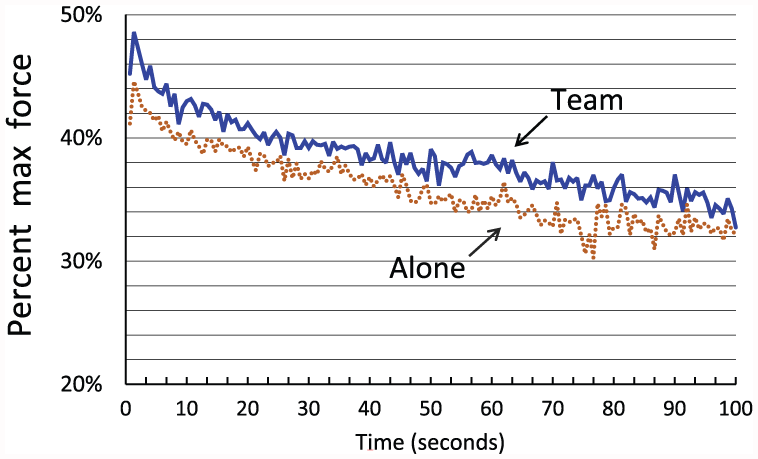
Mean percent-of-maximum gripping force exerted over time by participants while lifting the heavy marker in the team and alone work conditions (collapsed across all trials and lifts for both hands; Experiment 1).
Discussion
Participants squeezed the dynamometer harder when doing so was the more critical element of a divisible conjunctive team task compared to when it was part of a task they performed alone—a motivation gain in the team work context. Unlike research demonstrating motivation gains on unitary conjunctive team tasks, the gains observed in the present experiment occurred in the absence of any apparent task-related ability differences among participants. Not only were participants assigned randomly to conditions, and to the Member A and B roles within the team condition, the task itself was designed so that the force required to lift each marker was proportional to each participant’s own maximum gripping force. This was done to equate participants’ ability vis-à-vis the task, a point that was carefully explained to them before they started. Moreover, differences in demonstrated maximum gripping force were controlled statistically.
It is noteworthy that participants in the team condition on average lifted the heavy marker for no less time than did those in the alone condition. That they nevertheless squeezed the dynamometer harder makes it clear that they were indeed choosing to commit more of their total energic resources to the task in that condition (as opposed to applying more effort for less time).
The most plausible explanation for this motivation gain in the team condition is the greater indispensability associated with working on a critical element of a divisible conjunctive task performed by a team compared to working at the same activity alone. Simply put, more was riding on the participants’ efforts in the team than in the alone work context, and this is what spurred them on (cf. Hertel, Kerr, et al., 2000; Hertel, Kerr, Scheffler, et al., 2000; Karau & Williams, 1993; Kerr et al., 2007; Lount, Kerr, et al., 2008; Lount et al., 2000; Lount, Park, et al., 2008; Messé et al., 2002). We considered both social comparison and social facilitation as possible alternative explanations, but found little support for either. Still, it is possible that one or both processes were in fact operating, but that our methods for detecting them were insufficient. Therefore, in order to replicate the motivation gain observed in Experiment 1, and do so under conditions that better control for the operation of both social comparison and social facilitation, we conducted a second experiment.
Experiment 2
We made two major changes to the methodology employed in this second experiment. First, to eliminate social comparison as a possible alternative explanation, participants always lifted only the heavy marker, while their partner in the team conditions (now a confederate of the experimenter) always lifted only the light marker. Because these two activities differed substantially in difficulty and had different goals, performance on one provided no specific social comparison information relevant to the other. Second, to eliminate social facilitation as a possible alternative explanation, we added a second team condition in which the partner ostensibly performed her part of the dynamometer task from a different room where she could not observe the participant. This eliminated any possible social facilitation effects that might otherwise have arisen either from the mere presence of the partner or from her ability to evaluate the participant. The only remaining source of social facilitation was the experimenter, which was constant across conditions.
We predicted that, even in the absence of task-related ability differences between team members, participants would exert more effort when lifting the heavy marker was part of a divisible conjunctive team task compared to when it was a task they performed alone. Further, we predicted that this difference would occur regardless of whether the team members worked side-by-side or in different rooms.
Method
Participants and design
Ninety female undergraduate students drawn from the same population as before participated in the study, again in partial fulfillment of a course requirement. Experiment 2 involved a 3 (Work Context: solo vs. team vs. team/remote) x 2 (Hand: dominant vs. nondominant) x 2 (Trial With a Given Hand: first vs. second) mixed factorial design, where the first of these was a between-subjects factor and the other two were within-subject factors.
Experimental task
The same four-trial dynamometer task used in Experiment 1 was employed here, with the following modifications. First, each trial lasted for a fixed duration of 100 s. An on-screen timer displayed the amount of time remaining in each trial. Second, rather than alternating between lifting the heavy and light markers, each trial consisted of a single continuous lift of the heavy marker. The light marker was always lifted by the partner in the team and team/remote conditions, and was not part of the experiment at all in the alone condition (see below lines). Third, instead of grasping the dynamometer while resting their forearm on a lap pillow, participants rested their forearm on, and kept it parallel to, the armrest of their chair, with the dynamometer itself held sufficiently forward of the front edge of that armrest to avoid any contact with it. This was done to prevent participants from surreptitiously gaining mechanical advantage by subtly pressing the dynamometer into their laps. Fourth, a small rectangular target box about twice the height of the light marker was located slightly above the baseline on the light-marker side of the display. The light marker had to be held within that box in order for any points to be earned (assuming that the heavy marker was simultaneously lifted at least minimally off the baseline). Finally, the movements of the light marker during each of the four experimental trials in the team and team/remote conditions were preprogrammed and controlled by the computer—the confederate appeared to, but in fact did not control the movements of the light marker except during the practice trial of the team condition. This was done so that all participants in these conditions would see exactly the same pattern of light-marker movements during the four experimental trials.
Procedure
One participant was scheduled for each experimental session. The sign-up instructions asked them to report to a waiting area where they would be met by the experimenter. For those sessions in which either the team or team/remote condition would be run, a female confederate of the experimenter posing as another participant entered the waiting area several minutes later. Shortly thereafter a female experimenter arrived to escort the participant (and confederate) to the experiment room.
The experimenter began as before by providing an overview of the procedures to be followed, demonstrating the operation of the dynamometer, verifying the participant’s (and confederate’s) eligibility for the study vis-à-vis an injury and health status checklist, and obtaining the participant’s (and confederate’s) written informed consent. Next, in the team and team/remote conditions it was explained that the participant and confederate would work as a team on the dynamometer task, and a sham drawing was conducted to determine which part of that task they would each perform. In fact, however, the participant was always assigned to lift the heavy marker and the confederate the light marker. The experimenter then took the participant (and confederate) through the same maximum force calibration procedure as before. Finally, she guided the participant (and confederate in the team condition) through a practice trial.
Alone condition
Each participant performed the dynamometer task by herself in this condition. Thus, no confederate appeared in the waiting area, and no one besides the experimenter was present in the experimental room. The experimenter’s instructions focused exclusively on the heavy marker. The participant was asked simply to ignore the other marker on the screen, as it was not part of the experiment. During the practice trial the participant learned how to lift the heavy marker, how doing so was related to the points earned, and in particular that points were earned at a faster rate the higher that marker was lifted. The experimenter stated that the participant’s goal in each trial was to earn as many points for herself as she could, and so encouraged her to lift the marker as high as possible for the full duration of each trial.
Team condition
Participants performed the dynamometer task together with the confederate in this condition. As in Experiment 1, they sat side-by-side in front of the same computer, each holding her own dynamometer, with the participant controlling the heavy marker and the confederate appearing to control the light marker. However, the confederate actually controlled the light marker only during the practice trial. During the four experimental trials the movements of the light marker were in fact controlled by the computer. The participant could not see the confederate’s hands during those trials. Paralleling Experiment 1, points were earned in this condition for every second the heavy marker was lifted off the baseline, with points earned at a faster rate the higher it was lifted, but only while the light marker was held inside the target box. The participant and confederate thus appeared to have to work together to earn points in this condition. The experimenter stated that their goal in each trial was to earn as many points for their team as they could by lifting the heavy marker as high as possible for the full duration of the trial while simultaneously keeping the light marker inside the target box.
During the practice trial participants learned how to lift the heavy marker, while the confederate apparently learned how to hold the light marker inside the target box. Regarding the latter, the confederate initially caused the light marker to move wildly up and down, then gradually reduced the amount of movement, until finally demonstrating an ability to control its position relatively precisely. As this happened, the confederate expressed surprise at how sensitive the marker was, and the experimenter stated that only gentle, steady pressure was needed to control it. Next, the confederate was asked to lift her marker outside the target box in order to demonstrate the temporary suspension of point accumulation, and so the conjunctive nature of the task. However, during the four experimental trials the light marker (then under control of the computer) never drifted outside the target box once placed there at the start of a trial, though it did constantly move up-and-down by small amounts within that box in a realistic fashion.
Team/remote condition
Here too participants performed the dynamometer task in concert with the confederate. In this case, however, instead of working side-by-side, it was made to appear that the confederate was performing her part of the task from a computer located in another room. The experiment unfolded exactly as it did in the team condition until the end of the maximum force calibration procedure. At that point a USB flash drive plugged into the front of the computer flickered noticeably for several seconds, as if information were being written to it. The experimenter then removed the flash drive and stated that due to an equipment problem there would be a small change in how the session would be run that day. She pointed to a second desktop computer in the room that had a hand-written note taped to its screen saying, “Hard disk problem. IT has been called.” She explained that normally the confederate would perform her part of the dynamometer task from that computer. However, because it was not working properly, an arrangement had been made for her to use a networked computer located in another room on a different floor of the building. The confederate was to go to that room, login to the participant’s computer remotely, and then perform her part of the dynamometer task from there. The experimenter emphasized, however, that despite being located in different rooms, the participant and confederate would still be working together as a team. The confederate feigned puzzlement when hearing all of this, but the experimenter reassured her by saying that a second experimenter would be waiting in that other room to explain how to perform her part of the task. She then handed the confederate the flash drive and a small slip of paper with the room number where she was to go, instructed her to give the flash drive to the experimenter in that other room, and then escorted her into the hallway and pointed to the stairway that provided the most direct route to that room. The confederate then walked away and was not seen again.
Returning to the participant, the experimenter explained that the flash drive she had given the confederate contained her maximum force data, and that it would be used in the other room to make sure their two computers ran exactly as if they were located in the same room together. The experimenter then instructed the participant on her part of the task (lifting the heavy marker). After several minutes, a small window appeared in the corner of the participant’s computer screen that seemed to report the progress of a login attempt. A moment later, it indicated that a connection had been established. The light marker on the participant’s screen then began to move wildly up and down. But, as in the team condition, the movement of the light marker gradually diminished until finally its position remained relatively steady. The experimenter explained that this was just the confederate learning how to control the light marker, that it required no more than gentle, steady pressure to control, but that it usually took a minute or two of practice to master. The experimenter also noted that the connection with the confederate’s computer was only a one-way stream (this was indicated as well in the on-screen connection window), meaning that while the participant could see the movements of the confederate’s marker, the confederate could not see the movements of the participant’s marker. She could see only her own marker.
The remaining instructions paralleled those in the team condition. Thus, the participant learned that she and the confederate were to work together as a team, and that their goal in each trial was to earn as many points for their team as they could by lifting the heavy marker as high as possible for the full duration of the trial while simultaneously keeping the light marker inside the target box. The experimenter also took advantage of a moment during the practice trial when the light marker was outside the target box to call attention to the temporary suspension of point accumulation that this produced, and so the conjunctive nature of the task. Finally, after several minutes of practice equivalent to what occurred in the team condition, a signal appeared in the connection window indicating that the confederate was ready to begin.
As in Experiment 1, participants in all three conditions used their nondominant hand on Trials 1 and 3, and their dominant hand on Trials 2 and 4. Also as before, during each trial the experimenter sat quietly out of sight behind a screen on the opposite side of the room. After completing all four trials, participants answered a short questionnaire, and were then thanked and dismissed. They were debriefed by email at the end of the semester.
The measure of primary interest in this experiment was the average percent-of-maximum force applied to the dynamometer while lifting the heavy marker during each trial. This was computed exactly as in Experiment 1.
Results
Manipulation check
To check the effectiveness of the team/remote manipulation, the postexperimental questionnaire asked participants in the both the team and team/remote conditions to read a list of 10 descriptive phrases and to check those they thought described how their partner likely felt during the experiment. Participants could check as many or as few of these as they wished. As expected, participants in the team/remote condition were more likely than those in the team condition to indicate that their partner probably felt “totally oblivious to what I was doing,” χ2 (1, n = 60) = 4.32, p < .05, and less likely to indicate that their partner probably felt “keenly aware of what I was doing,” χ2 (1, n = 60) = 8.08, p < .005, and “distracted by me,” χ2 (1, n = 60) = 4.29, p < .05. There were no differences for any of the other phrases (e.g., “tense,” “competent,” “competitive with me”). Importantly, participants in these two conditions were equally likely to indicate that their partner probably felt “dependent on me to do well,” χ2 (1, n = 60) = 0.07, p = ns. Finally, and also as expected, there were no differences among the three experimental conditions in the participants’ ratings of how easy or difficult lifting the heavy marker was, or in how much effort was required to lift it, F(2, 87) < 1.15, p = ns for each.
Maximum force
As in Experiment 1, participants’ maximum gripping force scores did not vary by work context, F(2, 87) = 0.08, p = ns, and F(2, 87) = 0.21, p = ns, for the dominant and nondominant hands, respectively, but were significantly correlated with the average percent-of-maximum force scores obtained during the experimental trials,
Percent-of-maximum force
To test our main hypotheses, we submitted the average percent-of-maximum force scores to a 3 (Work Context: alone vs. team vs. team/remote) x 2 (Hand) x 2 (Trial With Hand) mixed factorial ANCOVA, where the first variable was a between-subjects factor, the remaining two were repeated measures factors, and maximum gripping force was a covariate. As expected, the covariate accounted for a significant amount of variance in this analysis, F(1, 86) = 6.29, p < .02, ηp2 = .07. The only other significant effect was the work context main effect, F(2, 86) = 4.70, p < .02, ηp2 = .10. As can be seen in Figure 4, participants in the team (M = 41.54, SD = 5.31) and team/remote (M = 42.46, SD = 6.64) conditions both exerted significantly more effort than did those in the alone condition (M = 38.62, SD = 5.39), t(86) = 2.20, p < .05, and t(86) = 2.99, p < .01, respectively, using Dunnett’s procedure. A post hoc comparison of the team and team/remote conditions was not significant (p > .40).
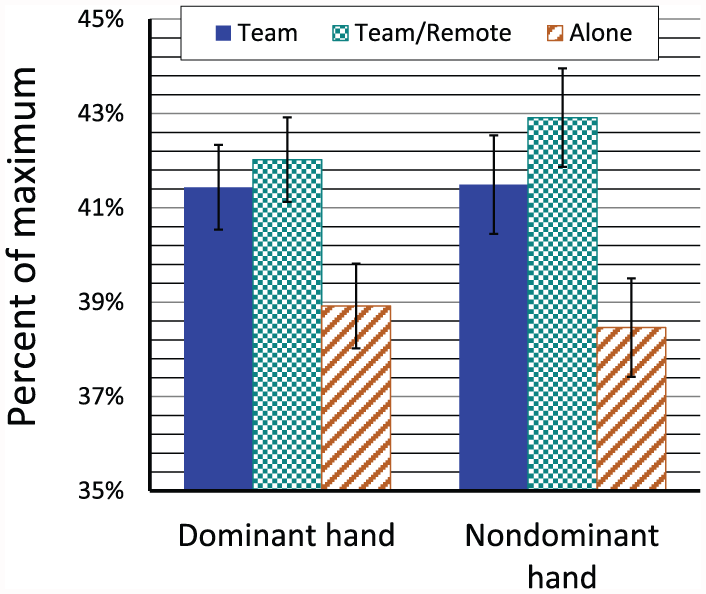
Mean percent-of-maximum gripping force exerted by participants in the team, team/remote, and alone work conditions when using their dominant and nondominant hands (Experiment 2).
Heavy lifts over time
Finally, it is again instructive to inspect the force data over time. These are displayed in Figure 5 for each of the three work context conditions, collapsed over hands and trials. Because all participants lifted the heavy marker for the same amount of time, unlike Experiment 1 each plotted data point represents the same number of observations. Still, it is clear from this figure that the force applied to the dynamometer by those who worked in the team and team/remote conditions was consistently greater than that applied by those who worked alone.
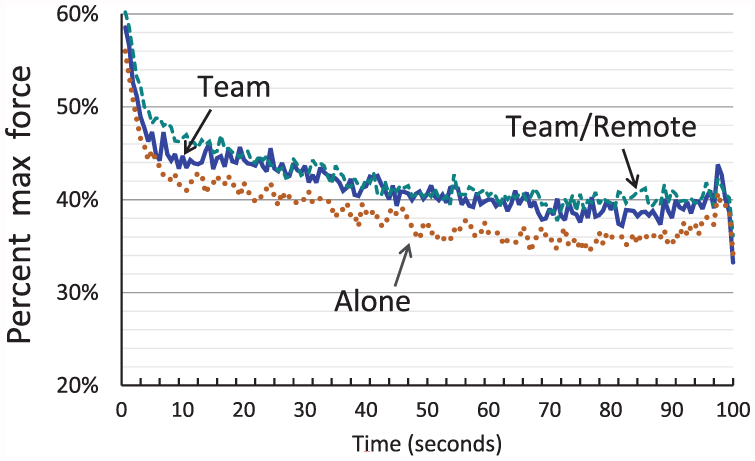
Mean percent-of-maximum gripping force exerted over time by participants while lifting the heavy marker in the team, team/remote, and alone work conditions (collapsed across both trials for both hands; Experiment 2).
Discussion
The results from Experiment 2 replicate the main finding from Experiment 1. Participants exerted more effort—applied more force to the dynamometer—when doing so was a critical element of a divisible conjunctive team task compared to when it was a task they performed alone. This motivation gain persisted for the full duration of the experimental trials, and did so even though there were no apparent task-related relative ability differences among participants.
Experiment 2 also more unequivocally rules out both social comparison and social facilitation as plausible alternative explanations for the observed motivation gains in the team work contexts. In all conditions participants lifted only the heavy marker, while their partner in the two team conditions lifted only the light marker. Because these two subtasks differed substantially in difficulty and in their objectives (i.e., lifting the heavy marker as high as possible vs. holding the light marker inside the target box located just above the baseline), performance on the latter provided no specific information relevant to the former. This eliminated the opportunity for meaningful social comparison. Further, in the team/remote condition the partner ostensibly performed her part of the dynamometer task from a location where she could neither see nor be seen by the participant. This eliminated whatever social facilitation might otherwise have arisen either from the mere presence of the partner or from her ability to evaluate the participant. Nevertheless, we found that the force applied to the dynamometer in the team/remote condition was no different than that applied in the standard team condition, and that in both conditions participants consistently applied more force than did those in the alone condition.
General Discussion
In two experiments, we examined the effort that participants expended on a physical persistence activity when it was part of a divisible conjunctive task performed by two people working as a team compared to when it was an individual task performed by one person working alone. In both experiments we found that participants exerted more effort when working as part of a team than when working alone—a motivation gain when working in groups. Importantly, this gain occurred despite the absence of any apparent task-related ability differences among participants. This stands in contrast to unitary conjunctive tasks, where motivation gains have been observed primarily among group members who perceive themselves to be moderately less capable than others in the group.
The most parsimonious explanation for the motivation gains observed here is the indispensability associated with working on a critical element of a divisible conjunctive task performed by a group. In such situations, it is not just one’s individual performance that is at stake; the performance of the entire group is at stake as well, which should give greater meaning to one’s efforts (cf. Hertel, Kerr, et al., 2000; Hertel, Kerr, Scheffler, et al., 2000; Karau & Williams, 1993; Kerr et al., 2007; Lount, Kerr, et al., 2008; Lount et al., 2000; Lount, Park, et al., 2008; Messé et al., 2002). In this regard, it is noteworthy that the teams in our two studies were formed on an ad hoc basis, and that all participants worked to earn points that had no inherent value (see Endnote 3). Even so, a group motivation gain emerged. We suspect that motivation gains of this sort may become even stronger as the group and its success become increasingly more important to members (but see Gockel, Kerr, Seok, & Harris, 2008).
It also seems likely that group motivation gains will be amplified by ability differences that are apparent to group members. Although the impact of member ability (both absolute and relative) was carefully controlled in the present studies, we do not argue that ability differences have no effect on motivation gains in divisible conjunctive tasks. On the contrary, we suspect that such differences can have a strong effect. In real-world work settings team members are often assigned to subtasks according to their abilities, with the most critical subtasks given to those who are best able to perform them. Making subtask assignments contingent upon member ability in this way is apt to cause those who perform critical subtasks to feel particularly indispensable, and so prompt them to work especially hard on behalf of the group. The present research simply indicates that it is not essential to align ability and subtask criticality in order for motivation gains to occur. Rather, the indispensability inherent in the structure of a divisible conjunctive task, by itself, can elicit motivation gains even when there are no apparent task-related differences in members’ ability. Consequently, if some other method of subtask assignment is employed (e.g., based on seniority), a motivation gain is still predicted for any member who performs a subtask that is critical to the group’s overall success.
The present research investigated motivation gains on a divisible conjunctive task with two subtasks that differed in their criticality for overall task success. We presumed at the outset that those who performed the more critical subtask would feel especially indispensable, and so would most readily display a motivation gain. However, while greater subtask criticality may contribute to felt indispensability and to the motivation gains produced, it may not be a necessary prerequisite for generating those gains. Rather, it is possible that such gains might occur even on divisible conjunctive tasks with subtasks that are equally critical for overall task success.
In this regard, it is interesting to note that Hertel and colleagues (Hertel et al., 2003; Hertel et al., 2008) and Wittchen et al. (2007) also observed motivation gains on what would appear to be a divisible conjunctive task. They had two-person teams perform an order-fulfillment task in which they were to meet the requirements specified in each of a series of customer orders by choosing from a set of product alternatives those that would be shipped to the customer, and where each team member completed a different but equally difficult part of each order (choosing computer equipment vs. office furniture). Conjunctivity was established by requiring that both parts of each order be completed correctly in order for it to count toward their team score (because an error in either part would produce customer dissatisfaction). In addition, following procedures most often employed in research concerning motivation gains on unitary conjunctive tasks, all participants in the team conditions of these experiments also received information suggesting that they were somewhat less capable at the task than their (actually fictitious) partner. However, given that the task was not only conjunctive but also divisible, we wonder whether it was necessary to have created this impression of relative inability in order to produce the observed motivation gains. Specifically, because an error on either subtask was detrimental to the team’s performance, and because one member’s errors could not be offset in any way by better performance of the other, both members should have felt indispensable, and equally so. As such, it is possible that participants may have exhibited a motivation gain on this task even without having been led to believe that they were less capable than their teammate. A perception of relative incapacity may simply not have been essential for producing the effect. This possibility seems worth examining in future research.
From a rather different perspective, it also seems likely that differential subtask criticality may contribute to motivation gains on other tasks besides those that are strictly conjunctive. For example, research by Hüffmeier and colleagues (Hüffmeier, Dietrich, et al., 2013; Hüffmeier & Hertel, 2011; Hüffmeier, Kanthak, et al., 2013; Hüffmeier et al., 2012) on Olympic swimmers shows that those who swim last in a relay race (an additive task) often swim faster than they do when swimming in otherwise comparable individual events. Such gains seem not to materialize among those who swim first in a relay. The last-swimming athletes in a relay apparently experience their contributions as being more critical to their team’s overall success because no one will swim after them and be able to compensate for any shortcomings in their performance. There are apt to be other kinds of tasks that are not conjunctive but nevertheless have subtasks differing in perceived criticality that prompt similar motivation gains in those who perform the most critical subtasks. This too is a possibility worth following up in future research.
Finally, it would also be valuable to know whether the results reported in the present research generalize to male participants. Both of our experiments involved females exclusively. This was a matter of convenience, as two thirds of those in the subject pool from which our participants were drawn were female, and there was great demand by other users of that pool for male participants. Still, it raises the question of whether the results reported here would also be obtained with males, particularly given Weber and Hertel’s (2007) meta-analytic finding that gender moderates the magnitude of the motivation gains observed when participants perceive themselves to be less capable than others in the group. It is unknown whether the same moderation might occur when participants all perceive themselves to be equally capable and work on divisible conjunctive tasks.
Coda
There has been a resurgence of interest in the possibility that people sometimes show motivation gains when working in groups, putting forth more effort on tasks performed with others than when working alone. With respect to conjunctive tasks, these gains have been conceptualized almost exclusively as a function of member ability, arising as they do in the least capable members of groups performing unitary conjunctive tasks. The present research extends this line of work to divisible conjunctive tasks, but demonstrates that motivation gains on such tasks can arise even when there are no apparent differences in members’ task-related abilities. One implication of this is that motivation gains are apt to be more common than might be suspected on the basis of previous research, simply because divisible conjunctive tasks represent a sizable fraction of all work assignments given to groups and teams in everyday work settings. Group members often engage in different rather than identical subtasks that nevertheless must all be done well in order for the group as a whole to succeed. The present findings suggest that, other things being equal, when members perform subtasks of this sort that are critical to their group’s success they are apt to exhibit a motivation gain.
Footnotes
Acknowledgements
We thank Muna Akhtar, Emily Colter, Nina Gornowicz, and Marissa Warner for their assistance with data collection, as well as Norb Kerr and several anonymous reviewers for their helpful suggestions on early drafts of this paper.
Funding
This work was supported in part by National Science Foundation Grant SES-1122357 to the first author.