







Abstract
Much research suggests that ingroup positivity is more central than outgroup negativity. We argue that this conclusion is incomplete as a description of the totality of intergroup emotions. In 4 studies, we use a novel measure of willingness to pay for intergroup gains and losses to examine the intergroup emotions of fans of the Boston Red Sox and New York Yankees. Results indicate that pleasure from a powerful rival’s losses can outstrip that from gains of one’s own group (Studies 1–2), and these patterns extend into domains not immediately relevant to the competition (Studies 3–4). A reversal in the competitive position of the two teams in the 2012–2013 season allowed us to examine whether fluctuations in competitive status moderated this pattern (Studies 3–4). Indeed, fans of the rival teams frequently valued outgroup losses more than ingroup gains, and this effect was particularly strong when one’s own team was behind in the rivalry.
Intergroup conflict, we know without looking at any statistics, is frequent and pervasive. Instances of intergroup conflict abound in daily news reports at home and abroad. Yet for most who live in middle-class secular, democratic societies, day-to-day experiences of intergroup conflict are rare, which can lead to the perception that such conflicts are largely a thing of the past or limited to war-torn zones of the world. Instead, most of the typical behavior and discourse we encounter day to day may be characterized as helpful, collaborative, and supportive. In such societies, most of us accept as ordinary and evident that the animosity we feel towards members of other groups is usually mild, and certainly is secondary and subservient to the love we feel for our own groups.
Psychological research, most of which has been undertaken in the same modern secular societies, in fact supports this idea that feelings of warmth and benevolence towards one’s own groups (heretofore ingroup positivity) generally trump hostile attitudes and emotions towards rival groups (heretofore outgroup negativity). Commentators like Allport (1954) and Brewer (1999) convincingly argue that ingroup positivity is the more pervasive feeling. People readily and consistently express support for ingroups, but more rarely display hostility or a desire to harm other groups. This pattern extends to behavioral outcomes in the laboratory. For example, Mummendey et al. (1992) show that participants favor minimal ingroups in distributing positive outcomes, but do not distribute more negative outcomes (like aversive noise and unpleasant tasks) to outgroups. Similarly, using a novel game involving an intergroup prisoners dilemma, Halevy and colleagues observed that participants will incur personal costs to benefit their ingroup, but seldom choose to optionally harm the outgroup as well (Halevy, Bornstein, & Sagiv, 2008; Halevy, Weisel, & Bornstein, 2012). Finally, these patterns are apparent in real-world intergroup outcomes. Greenwald and Pettrigrew (2014), reviewing cross-disciplinary evidence, conclude that in modern America, which is the culture best documented in intergroup research, discriminatory group outcomes arise far more from ingroup helping than from intentional injury to outgroups.
In the same 2014 review, Greenwald and Pettigrew point out a surprising scarcity of research on an important and related issue: the relative magnitude of different intergroup evaluations, 1 noting that “how ingroup–outgroup differences in negative feelings compare to ingroup–outgroup differences in positive feelings” is “a rarely addressed empirical question” (2014, pp. 671–672). Yet, what existing evidence suggests is that ingroup positivity trumps outgroup negativity. Consider, for example, attitudes towards African Americans in the United States. It is somewhat uncommon to encounter explicit reports of hostility towards Black Americans. One recent large-scale study comparing interventions to reduce implicit race bias (Lai et al., 2014) included 44 different samples of White participants who, under varied conditions, responded to feeling thermometers separately capturing positive and negative affect towards White and Black Americans (and in 13 cases, Asian and Hispanic Americans). A reexamination of these data indicates that while participants in all 44 conditions expressed more ingroup than outgroup positivity, in no case did they indicate overall outgroup negativity: Aggregate attitudes towards Black, Asian, and Hispanic Americans were consistently positive. Furthermore, even for individuals able and willing to report racial hostility, ingroup positivity appears stronger. Greenwald and Pettigrew (2014), in a reanalysis of fully 45,000 reports of racial attitudes (Ziegler, Kirby, Xu, & Greenwald, 2013), report that even for those White Americans with the highest level of race bias, thermometer ratings of warmth towards White people exceed feelings of coldness towards Black people by a factor of 4 to 1.
Given this research, an observer might conclude that ingroup positivity is simply more pervasive and powerful than outgroup negativity. While this observation seems reasonable, at least within the relatively peaceful cultures where most psychological research is conducted, one need not look far to discover counterexamples. Civil war and ethnic cleansing endure in many parts of the world, indicating the presence of social environments conducive to the experience and expression of even very extreme forms of outgroup negativity. Even in present-day America, strides in race relations have come at the tail of the hard-fought civil rights movement and corresponding downward shifts in intergroup bias. Not so long ago, people readily expressed negative intergroup sentiments (e.g., “mercenary Jews,” “ignorant Negroes”; see Katz & Braly, 1933) that are uncommon today (Dovidio & Gaertner, 1991; but see also Devine & Elliot, 1995).
Further, in the natural world as opposed to the controlled environment of intergroup research, a long time seldom passes without some public personality receiving media attention from a burst of hostile remarks about outgroups. As we wrote this paper, a candidate for president of the United States, Donald Trump, began his campaign by arguing for strong anti-immigration policies with an appeal viewed by many as openly derogatory: referring to Mexican immigrants as “rapists.” His quick rise to the top in a field of over 20 candidates, and his eventual election to the country’s highest office, indicate that such statements are not abhorrent to all Americans, and may even be popular enough to propel a comparatively inexperienced candidate to political office. And indeed, the United States is not alone in experiencing an apparent surge of outgroup fear and negativity. For example, the so-called Brexit vote has been linked to fear of outgroups, and the demographics of those who voted for and against it bear out this thesis. More broadly, driven by a global crisis surrounding refugees from fundamentalist Islamic regimes, there has been a recent wave of populist leadership throughout Europe and much of the world.
The disparity between research evidence (little expression of outgroup negativity) and readily observed outcroppings of explicit outgroup hostility in the larger world suggests that this evaluation must be further sought in experimental contexts, no matter the difficulty of producing the appropriate conditions. Until such studies have been conducted, it is a mistake to conclude, in any simple fashion, that one evaluation is more present and powerful than the other. Rather, looking for outgroup negativity may be like searching for a nocturnal bird in daylight, and lack of observation might not indicate absence.
Variation in Outgroup Negativity: Competition, Status, and Social Pressure
Numerous theorists predict that outgroup hostility will be more prevalent for groups in direct competition (Brewer, 1999; LeVine & Campbell, 1972; Sherif & Sherif, 1953). When groups compete, the success of one’s own group depends upon the rival’s failure. When outgroups represent an explicit threat, those who love their ingroup also more readily express dislike for the outgroup. For example, Duckitt and Mphuthing (1998) found that ingroup identification of Black Africans in South Africa was clearly related to negative evaluations of competing White Afrikaners, but did not predict negative attitudes towards English Whites or White people in general.
Social identity theory casts further light upon specific competitive conditions where outgroup negativity may arise. One influential model of group conflict (Tajfel & Turner, 1979) holds, among other things, that the response of group members to status differences will vary depending upon the stability of these differences. In a meta-analysis (Bettencourt, Dorr, Charlton, & Hume, 2001), members of higher status groups showed more ingroup positivity in more stable status hierarchies. Members of the lower status groups, in turn, showed greater outgroup negativity in such stable hierarchies, but only when the dimensions of evaluation were relevant to the hierarchy. This pattern is consistent with later work highlighting functional or instrumental motives for ingroup bias. Scheepers, Spears, Doosje, and Manstead (2003, 2006) argue that instrumental bias functions to facilitate competitive change. When status differences are especially large or stable, merely supporting the ingroup may be insufficient to bridge the gap, and so more extreme forms of instrumental bias involving outgroup derogation can become prevalent.
Approaching these issues from a different angle, Schadenfreude researchers similarly conclude that people bear more hostility towards competing groups seen as especially high-status or competent. For example, Cikara and Fiske (2012) show that when participants read about mildly negative things happening to others, they felt less bad for targets seen as both competitive and competent. Strikingly, in response to the misfortunes of these envied targets, participants also showed automatic responses in the zygomaticus major, a cheek muscle associated with positive affect, suggesting they enjoyed these events more than they realized or were willing to admit.
Measures of Schadenfreude, like those used by Cikara and her colleagues (e.g., Cikara & Fiske, 2012, 2013) are particularly compelling for two reasons. First, since they involve events that directly and negatively impact the outgroup, they are inherently instrumental in nature. Second, these measures are relatively mild. Subtler measures circumvent another element—social desirability—that can deflate estimates of outgroup negativity. A large body of research reveals that people are less able and willing to report taboo attitudes and emotions, such as negative views of ethnic minorities in the United States. This is one reason why measures of automatic responses usually reveal bias along dimensions of social group membership (gender, race/ethnicity, nationality, religion, sexuality) while more explicit measures often do not (Banaji & Greenwald, 2013; Devine, 1989; Gaertner & Dovidio, 1986; Greenwald & Banaji, 1995).
Together, these research streams highlight several conditions where we might see increased outgroup hostility: Socially sanctioned, competitive rivalries where both groups are highly competent, but where competitive position is momentarily large or stable. These attributes characterize professional sports rivalries well, and in this paper, given our location, we studied the intergroup rivalry between the Boston Red Sox and New York Yankees (see also Cikara, Botvinick, & Fiske, 2011). More precisely than in previous research, we examine whether for fans of these teams, ingroup positivity is expressed at greater, equal, or lesser levels than outgroup negativity, a point of interest because we know of no research to date where the latter appeared stronger than the former.
We select this rivalry first because professional sports rivalries are unambiguously competitive in nature. The Yankees and Red Sox in particular are both highly successful professional teams in a sporting league followed by many millions of people each year. Because they play in the same division, the final outcomes for the teams during the regular season are directly at odds: A win for one’s own team or a loss for the rival team both increase the chances of reaching and potentially winning the final championship.
Second, while both teams are highly competent, the relative competitive status of the two teams has a clear historical arc. While this rivalry may be unfamiliar to some globally, sports fans within the United States are acutely aware that the Yankees have historically dominated the Red Sox in a rivalry dating back over a century. At the same time, this rivalry is ideal for studying changing dynamics of intergroup competition, because the immediate competitive position of the teams can vary (e.g., from season to season) while also sometimes stabilizing in the short term (e.g., within a given season), in ways both fans and researchers can readily track in league standings.
Third, the expression of hostility in sports rivalries is culturally acceptable: At a baseball game it is commonplace for fans to hurl insults at rival players, and fans of the Yankees and the Red Sox are particularly famous for their rancor. Consider for example two common slogans associated with the rivalry: “Keep Calm and Hate the Yankees” is a real slogan used by fans of the Red Sox, and “I support two teams, the Yankees and whoever beats the Red Sox” appears on paraphernalia worn by Yankee fans.
Yet even in the context of a sports rivalry, the magnitude of outgroup negativity can be masked by social norms in its expression. Surprisingly, an initial pilot study of Red Sox fans, using self-report measures, revealed the heretofore familiar pattern of intergroup feelings: Ingroup positivity for the Red Sox exceeded outgroup hostility for the Yankees, even though the open and historic rivalry might have facilitated the expression of negative attitudes.
Specifically, during the 2012 season, 30 Red Sox fans indicated their feelings towards the Red Sox and Yankees on 11-point scales ranging from “hate” (−5) to “love” (5). In assessing their own attitudes, fans reported much greater positivity towards the Red Sox (M = 3.73, SD = 1.05) than negativity towards the Yankees 2 (M = 2.4, SD = 1.9), t(29) = 4.04, p < .001, d = 0.80, supporting Allport (1954), Brewer (1999), and Greenwald and Pettigrew’s (2014) suggestion that ingroup positivity trumps outgroup negativity. However, in this exploratory data collection, participants also estimated the feelings of a “typical Red Sox fan” towards the two teams. Here, in an interesting counterpoint to their own explicit feelings, participants indicated that for most Red Sox fans (not themselves) own-team positivity (M = 3.80, SD = 0.96) would equal but not significantly exceed negativity toward the Yankees (M = 3.57, SD = 1.22), t(29) = 0.87, p = .387, d = 0.14. 3 These results are consistent with a “better than average effect” (Alicke, 1985; Brown, 1986): Even within this socially sanctioned rivalry, fans were more able or willing to report outgroup negativity among other fans than to acknowledge these feelings in themselves. And yet, in a context where outgroup derogation is socially acceptable and even encouraged, it speaks to the power of ingroup positivity that these subtle expressions of outgroup dislike still at best rival but do not outstrip it.
The Present Research
The idea that outgroup negativity is a nocturnal bird being sought in daylight led us to consider the limitations of previous research. Our question is straightforward: Is it truly the case that outgroup hostility is a subservient feeling, such that even when experienced it is always secondary and weaker than our warmth towards our own group? Evidence to date clearly supports the idea that ingroup positivity trumps outgroup negativity, and our prestudy only further supports this. In fact, to date we know of no research whatsoever demonstrating conditions under which outgroup negativity actually exceeds ingroup positivity. Nevertheless, we question whether these patterns accurately reflect the nuances of intergroup attitudes and emotions under all possible conditions, even within modern America.
The present research was designed to test the generalizability of this proposition (ingroup positivity is stronger than outgroup negativity) by carving out conditions under which different and even opposing patterns are plausible, and by measuring them in a manner that allows participants to easily voice both kinds of evaluation. Towards this end, we retained the setting for outgroup hostility already tentatively explored: the rivalry between the fans of the Red Sox and Yankees. Dominant implicit measures, like the Implicit Association Test (Greenwald, McGhee, & Schwartz, 1998), though avoiding social desirability concerns, would be of limited value here, because they do not reliably separate ingroup positivity from outgroup negativity. Instead, we adopted a novel measure inspired by the Schadenfreude literature and designed to minimize social desirability while also emulating instrumental measures used by social identity researchers (Scheepers et al., 2003). Specifically, we measured baseball fans’ one-off monetary valuations of mild positive and negative outcomes for their own and rival teams. How much would they pay or need to be paid to witness or influence different good and bad outcomes for people on the two teams? These simple, repeating, and indirect questions did not require participants to introspect about their feelings for their own and the rival teams. Instead, in a seemingly unrelated task of expressing enjoyment of different events, we obtained multiple responses that may be classified as markers of either ingroup positivity or outgroup negativity.
In our paradigm, if ingroup positivity consistently exceeds outgroup negativity, participants should be willing to pay more to experience ingroup gains versus outgroup losses. Put simply, if a fan likes her team more than she dislikes the rival, she should enjoy her team’s triumphs more than she enjoys the losses of the rival team, and so be willing to pay more to see her team succeed than to see the rival fail; and she should pay more to prevent her team from failing than to prevent the rival team from succeeding. This pattern should appear even when conditions are highly conducive to expressing hostility.
If, on the other hand, we were to see a pattern where joy at a rival’s failure equals or exceeds that of own-team success, this would be striking both given the evidence to date, and because the outcomes of a baseball game are relatively low-stakes. If group interactions involve a particular competitive architecture, and intergroup evaluations are measured in a way that does not evoke introspection, will this be sufficient to reveal patterns strikingly different from prior research? This finding would help illuminate our nocturnal bird in its evening flight.
Overview of Studies
The four studies reported in this paper span two professional baseball seasons. We used an indirect measure—the value or costs fans attach to positive and negative events affecting their own and the rival team—to examine whether and when fans experience greater ingroup positivity or outgroup negativity. The first two studies focus on fans of the Boston Red Sox. In Study 1, Red Sox fans indicated how much compensation they would require to undertake actions that undermined their own team or supported the rival Yankees. In Study 2, Red Sox fans indicated how much they would pay to prevent actual baseball-related losses for the Red Sox and gains for the Yankees. In studies 3–4, we examined whether the patterns of intergroup emotions discovered generalized to pleasure at gains and losses outside of the zero-sum context of this athletic competition, and whether they were moderated by the current status (winning vs. losing) of the teams. In Experiment 3, both Red Sox and Yankee fans indicated the compensation they would require to forego opportunities to see own-team gains and rival losses, including both athletic (competition-relevant) and social (competition-irrelevant) items, during the 2011–2012 season (when the Yankees were dominant). In Experiment 4, we collected the same information from fans during the 2012–2013 season, when the competitive positions of the two teams had reversed, with the Red Sox now decisively dominant. The serendipity of real change in team status across the 2 years allowed us to test the moderating role of group competitive status in the evaluations of intergroup rivalry in a way that would be difficult to set up in the lab and that cannot be orchestrated in real life.
Study 1
Study 1 was designed to compare the strength of Red Sox fans’ positivity towards their own team and negativity towards the rival Yankees. In order to minimize socially desirable responses, we used an indirect measure of these two intergroup evaluations inspired by measures of Schadenfreude: the amount of compensation fans required to act in a manner that supports the Yankees or undermines the Red Sox.
Participants
Participants were 63 Red Sox fans, recruited through advertisements on craigslist.com in the Boston area during the 2011–2012 regular baseball season, when the Red Sox clearly trailed the rival Yankees. Participants completed the study online for entry into a raffle for a $150.00 American Express gift card. Data from 11 participants were removed based upon exclusion criteria decided in advance. Specifically, two participants did not complete all items, and nine had no deviation in their main responses, indicating inadequate attention to the task. Keeping these participants in the dataset does not change key results.
Recruitment decisions were constrained by contextual considerations (limited populations, need to recruit during the regular season while both teams were in contention, lack of a priori predictions about effect sizes), and so we generally constrained sampling by arbitrary time cutoffs, rather than deciding sample sizes by power analyses. However, in Study 1 and all others, care was taken to recruit a large enough sample to reliably detect medium-sized within-subject effects. Specifically, we drew time cutoffs for data collection, with the intention of adding additional time to collection should we fail to reach a usable sample of 34 in any cell. Power analysis suggests that 34 is the minimum number of subjects with which one can statistically detect a medium within-subjects effect size (d = 0.50) at least 80% of the time, using a traditional criterion (p < .05) for statistical significance.
Materials and Procedure
In Study 1, we “dared” fans of the Red Sox to undertake actions that undermined the Red Sox or supported the Yankees, during a hypothetical Red Sox–Yankees game at Fenway Park. Participants first answered a single item indicating their degree of Red Sox fanaticism. 4 Following this, they indicated how much money (between $0 and $1,000) they would need to undertake six actions undermining the Red Sox (e.g., “Boo David Ortiz”) and six actions supporting the Yankees (“Chant ‘Let’s go A-Rod’”).
We reasoned that if Red Sox fans experience more positivity towards the Red Sox than negativity toward the Yankees, they should request more money to undertake actions harming their team, relative to those helping the Yankees. Conversely, if fans experience more negativity towards the Yankees than positivity towards the Red Sox, they should request more money to help the Yankees than to undermine the Red Sox.
In order for comparisons between the two sets of items to be meaningful, it is important that these be perceived as similarly impactful. For example, Red Sox fans could very rationally request more money to undertake one set of actions not because of the group at which they were directed, but because they believed they would have a more meaningful effect. To ensure that the stimuli were balanced here and elsewhere in this paper, we conducted a series of post hoc pilot studies, described in detail in the supplemental materials. Results from this first pilot study indicated that the stimuli in Study 1 were adequately balanced, with neither set of items seen by fans as significantly more impactful than the other (p = .529), allowing us to confidently undertake and interpret further analysis.
Individual items related to the “price” of instigating Red Sox losses achieved adequate internal reliability (α = .89), as did those related to the price of instigating Yankee gains (α = .87). Accordingly, items were composited into measures of interest.
Results
First we assessed the relatedness of the attitudes. The two composites were highly correlated (r = .82, p < .001), suggesting that when measured in this fashion, ingroup and outgroup evaluations had a strong reciprocal relationship (those who expressed more ingroup positivity also expressed more outgroup negativity). The strength of this correlation makes comparison between them meaningful, but is also independently noteworthy. In the context of this study, ingroup positivity and outgroup negativity were not weakly or moderately related as is frequently reported in the intergroup literature (Brewer, 1999). Rather, they were barely distinguishable. In this context and at face value, ingroup positivity and outgroup negativity appear to be flip sides of the same coin, and therefore meaningfully compared.
If, in line with previous research, Red Sox fans experience greater ingroup warmth than outgroup hostility, they should request larger sums of money to undertake actions injuring the Red Sox than those supporting the Yankees. Interestingly, precisely the opposite pattern emerged. Red Sox fans requested significantly more money to support the rival Yankees (M = $559.18, SD = $322.21) than to taunt their own team (M = $502.56, SD = $326.64), t(51) = 2.11, p = .040, 95% CI [$2.64, $110.60], d = 0.29.
Study 2
Results from Study 1 suggest that (during the 2011–2012 baseball season) Red Sox fans experienced greater negativity towards the Yankees than warmth for their own team, in contrast with the literature on intergroup evaluations and our own prestudy, which posed the question of intergroup feelings more directly. It is interesting to note that this particular result runs counter not only to prior literature, but also to an alternative prediction one might make based on prospect theory (Kahneman & Tversky, 1979). Given the oft-cited tendency for people to apply greater value to losses (vs. gains), the greater cost selected here by fans to instigate ingroup gains as compared to outgroup losses is telling.
However, other alternative explanations of these results are still plausible. First, it is not uncommon for fans to express frustration with their own team by hurling insults at underperforming players. Such displays may simply be more familiar to fans, although this would itself be interesting. Second, it is possible that Red Sox fans may (counter to prospect theory and to our own post hoc pilot) have implicitly seen these supportive actions as more powerful drivers of a team’s success. For example, fans may have intuited that if they cheered for the competing Yankees, this would help them so much that it would indirectly hurt the Red Sox to a greater extent than booing their own team. Study 2 was undertaken as a conceptual replication to address these concerns. In it, Red Sox fans indicated how much they would pay to prevent direct competitive gains for the Yankees and competitive losses for the Red Sox.
Participants
Participants were 65 Red Sox fans, recruited in a manner identical to Study 1. Two participants were excluded due to incomplete surveys, and 19 because they had no variation in responses to main items. These exclusions did not influence key results. As in Study 1, the number of usable subjects exceeded 34, the minimum number required to detect a medium within-subjects effect size (d = 0.50) at least 80% of the time, using a traditional criterion (p < .05) for statistical significance.
Materials and Procedure
In Study 2, Red Sox fans indicated how much they would pay to prevent competitive gains by the Yankees and competitive losses by the Red Sox. Participants first rated their degree of Red Sox fanaticism. Following this, they indicated how much money (between $0 and $1,000) they would pay to prevent 10 competitive gains for the Yankees (e.g., “A Yankee player hits a line drive that escapes the opposing outfielders”) and 10 competitive losses for the Red Sox (e.g., “A Red Sox player makes an error at first base”). The framing in terms of ingroup losses and outgroup gains was again chosen to ensure that counterintuitive results could not be explained by prospect theory.
As in Study 1, we were interested in ensuring that the Red Sox losses and Yankee gains were balanced. In a post hoc pilot study, outlined in detail in the supplemental materials, baseball fans rated the impact of the different athletic events used as stimuli. Though differences between the groups of stimuli did not reach statistical significance, the positive events trended weakly (p = .136) towards higher perceived impact. This trend was driven greatly by one item that was near ceiling. The removal of this item yielded a stimuli set that was more cleanly balanced, with differences between the two sets decisively insignificant (p = .373). In order to ensure the most rigorous possible test of our hypotheses, this item was removed from all further analyses of Study 2.
The 10 items related to preventing Red Sox losses achieved high internal reliability (α = .95), as did the nine included items related to preventing Yankee gains (α = .97), and so these were composited into the main variables of interest.
Results
As in Study 1, we first assessed the relatedness of the two attitudes. The composites correlated very highly (r = .92, p < .001), suggesting again that within this context, ingroup warmth and outgroup hostility were highly related, and comparison meaningful.
If Red Sox fans experience more positivity toward the Red Sox than negativity toward the Yankees, they should offer more to prevent Red Sox competitive losses, compared to Yankee gains. However, as in Study 1, precisely the opposite patterns of results emerged. Red Sox fans offered more to prevent Yankee gains (M = $485.95, SD = $360.40) than Red Sox losses (M = $430.96, SD = $321.72), t(43) = 2.57, p = .0137, 95% CI [$11.86, $98.11], d = 0.40. In contrast to previous research, these results again suggest that outgroup negativity is more central in the context of this rivalry. Not only were both evaluations present (and powerfully related), but Red Sox fans actually displayed greater hostility for the Yankees than warmth for their own team, as evidenced by their monetary preference for preventing Yankee gains over Red Sox losses. As in Study 1, the particular framing of Study 2 rules out alternative explanations based on prospect theory.
Study 3
Taken together, our results indicate that, contrary to patterns in prior intergroup research, Red Sox fans experience more hostility towards the Yankees than warmth towards their own team (Studies 1–2). Would we expect to see the same patterns among Yankee fans?
At first glance, it may seem unlikely that baseball fans in one East Coast U.S. city would differ drastically from those in another culturally similar city. However, the hypothesis becomes more plausible considering the historical arc of the Yankees–Red Sox rivalry, and the teams’ standings in the 2011–2012 season. The Yankees are historically dominant in the rivalry, having captured 27 World Series titles compared to seven for the Red Sox at the time of this study. Moreover, at the time of data collection the Yankees were in first place in their division, with the Red Sox trailing in fourth.
Schadenfreude, or joy at the misfortune of others, has frequently been conceptualized as a means of compensating for status inferiority (Leach, Branscombe, Spears, & Doosje, 2003; Nietzsche, 1887/1967). Indeed, outgroup hostility as seen in measures of Schadenfreude may sometimes be strongest in the face of threatening high-status outgroups (Cikara & Fiske, 2012; Leach et al., 2003; Smith et al., 1996). Given the similarity of our own measures to these, it is reasonable to hypothesize that fans of the Yankees, both historically and immediately dominant in the rivalry, might not as decisively show the patterns outlined in Studies 1 and 2.
Furthermore, we were interested in the possibility that the now familiar pattern of outgroup negativity exceeding ingroup positivity would arise for the more dominant team with regard to social items, but not to athletic items. Scheepers et al. (2003, 2006) posit an interesting distinction between instrumental and identity motives of ingroup bias, with the former more tied to facilitating change in competitive situations and more motivated by group threat. For example, Scheepers et al. (2003) found that soccer fans generated more team-motivating chants in response to a threat to their team’s competitive status (the other team scoring). Within this framework, the stability and degree of group differences may influence the form that instrumental bias takes. Scheepers et al. (2006) argue that more extreme forms of bias that involve outgroup derogation, such as maximum differentiation strategies (Tajfel, Billig, Bundy, & Flament, 1971) should be expected when differences between the groups are stable or sizable, because a simple strategy of supporting the ingroup will be insufficient to bridge a large gap.
Considering these factors in the context of our current studies, we might expect fans to specifically apply more value to outgroup athletic losses (such as those in Study 2) when their team is notably behind in the standings. Given the Yankees’ historical and current competitive dominance in the rivalry, in Study 3 we decided to examine fans of the Red Sox and Yankees side by side, and to have them rate the value of both social and athletic events.
The distinction between social and athletic events served a dual purpose. The chosen social events were, in contrast to those in the previous studies, competition-irrelevant. On the one hand, this allowed us to test whether the effects observed in Studies 1 and 2 were limited by the zero-sum context of actual athletic events. Would our effects generalize at all to domains outside the immediate context of the competition? Further, the division of social and athletic stimuli allowed us to distinguish the patterns we have uncovered in terms of instrumentality: Though both sets of stimuli may be seen as instrumental in the sense that they directly impact the players and teams in question, the athletic events are more so, because they directly impact standings in the competition itself. Would fans thus apply greater to value to outgroup athletic (i.e., more instrumental) losses only when their team is behind in the competition?
Participants
Participants were 81 Red Sox fans and 48 Yankee fans, recruited from craigslist.com in the Boston and New York areas in exchange for entry into a raffle for a $150 gift card. Eighteen participants (nine Red Sox and nine Yankee fans) with no variation in item responses were excluded. Keeping these subjects does not influence key results. As before, the number of usable subjects in each cell exceeded 34, the minimum number required to detect a medium within-subjects effect size (d = 0.50) at least 80% of the time, using a traditional criterion (p < .05) for statistical significance.
Materials and Procedure
In Study 3, Red Sox and Yankee fans indicated the compensation they would require to forgo opportunities to see positive outcomes for their own team and negative outcomes for the rival team. Data were collected late in the 2011–2012 regular season, when the Yankees had a commanding lead.
Fans first indicated their Red Sox or Yankee fanaticism on a 7-point scale. 5 They then rated the compensation (between $0 and $1,000) they would require to forgo opportunities to watch 12 events: six own-team losses and six rival-team gains. Stimuli included an equal mix of social items (e.g., “Watch A-Rod receive flowers from a fan,” “Watch David Ortiz get splashed with water as a taxi drives through a puddle”) and competitive items (“Watch A-Rod hit a double,” “Watch David Ortiz get tagged out while running to third base”). Items were identical for Red Sox and Yankee fans, save that names of players were switched.
As in previous studies, we also wanted to ensure that the stimuli used in Study 3 (and again in Study 4) were adequately balanced in terms of their perceived impact. A post hoc pilot study, reported in detail in the supplemental materials suggested that neither group of events was perceived by fans as significantly more impactful than the other (p = .812).
Individual items related to how much compensation fans would require to miss own-team gains achieved adequate reliability (α = .85), as did those related to other-team losses (α = .86). Accordingly, items were composited into the variables of interest. More specific groupings related to athletic versus social items also achieved adequate reliability (all αs > .70).
Results
Overall patterns
The compensations required to miss ingroup gains and outgroup losses were again strongly correlated among both Red Sox fans (r = .75) and Yankee fans (r = .74), suggesting that intergroup emotions were reciprocal. For both Red Sox and Yankee fans, ingroup positivity and outgroup negativity appear to be two sides of the same coin.
Given Studies 1–2, but in contrast to prior research, we expected Red Sox fans to display greater hostility for the Yankees than warmth for their own team. If these results are not driven by teams’ competitive positions, similar patterns might emerge among Yankee fans. Alternatively, if previous results were moderated by competitive status, the pattern seen in Studies 1–2 might emerge for Red Sox fans, but be weakened or reversed for Yankee fans.
In fact, results support the second hypothesis. In almost all cases, fans requested money both to forsake ingroup gains and outgroup losses, suggesting the presence of both evaluations. However, results indicated differences in the comparative magnitudes of ingroup positivity and outgroup negativity for Red Sox versus Yankee fans. Consistent with Studies 1–2, Red Sox fans displayed outgroup hostility exceeding ingroup warmth. Specifically, Red Sox fans requested substantially more to miss Yankee losses (M = $395.17, SD = $305.46) than Red Sox gains (M = $265.56, SD = $248.09), t(71) = 5.45, p < .001, 95% CI [$82.23, $177.00], d = 0.67. Conversely, fans of the dominant Yankees requested sums for missing Red Sox losses (M = $301.60, SD = $244.87) that equaled but did not significantly exceed those for missing Yankee gains (M = $283.81, SD = $274.46), t(38) = 0.59, p = .559, 95% CI [$−43.23, $78.80]), d = 0.10. The interaction (Figure 1) between group (Yankees vs. Red Sox fans) and intergroup evaluation (ingroup positivity vs. outgroup negativity) was significant (p = .005).
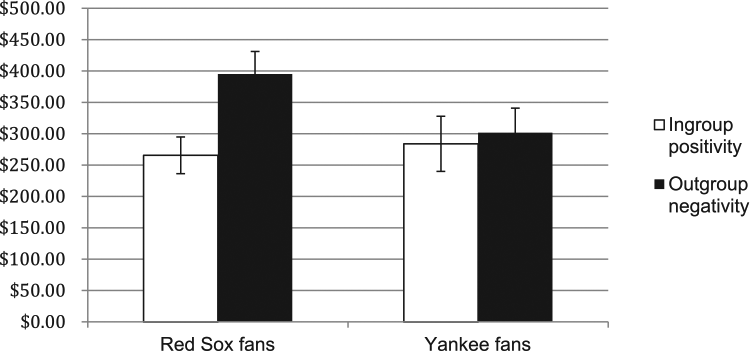
Yankee and Red Sox Fans 2012. This figure displays the relative ingroup positivity and outgroup negativity of Red Sox versus Yankee Fans in 2012.
Athletic versus social items
One goal of Study 3 was to ascertain whether the effects of Studies 1–2 extended beyond the instrumental domain of the zero-sum competitive rivalry, and whether instrumental effects in particular were dependent upon position in the competitive rivalry. To test this, we captured fans’ valuation of ingroup gain and outgroup loss events in both athletic (competition-relevant) and social (competition-irrelevant) domains.
Among Red Sox fans, the pattern of results described before arose for both social and athletic items. Specifically, Red Sox fans requested more money to miss Yankee losses (M = 361.05, SD = 319.99) compared to Red Sox gains in the athletic (competition-relevant) domain (M = 292.44, SD = 297.01), t(71) = 2.50, p = .015, 95% CI [$13.83, $123.38], d = 0.30. These effects not only extended into competition-irrelevant social domain, but were in fact stronger: Red Sox fans requested substantially more to miss Yankee social losses (M = 429.30, SD = 350.83) than Red Sox social gains (M = 238.67, SD = 275.75), t(71) = 5.67, p < .001, 95% CI [$123.55, $257.70], d = 0.69.
For fans of the dominant 2012 Yankees, the pattern of results was less consistent. Similar to Red Sox fans, Yankees fans requested more money to miss Red Sox social losses (M = 325.21, SD = 300.61) than to miss Yankee social gains (M = 220.03, SD = 235.93), t(38) = 3.00, p = .005, 95% CI [$34.35, $176.13], d = 0.50. However, when items were drawn from the competition-relevant athletic domain, they requested insignificantly less to miss Red Sox losses (M = 277.98, SD = 257.96) versus Yankee gains (M = 347.60, SD = 355.94), t(38) = −1.51, p = .140, 95% CI [$−163.12, $23.89], d = −0.25.
These results indicate that patterns of outgroup negativity exceeding ingroup positivity not only generalize outside of the competitive domain, but are more clear and consistent in the competition-irrelevant social domain. In the competition-irrelevant domain of social interaction, both Red Sox and Yankee fans also showed greater enjoyment of outgroup misfortunes than of the good fortunes of their own group. Interestingly, where Red Sox fans also showed this pattern when it came to more instrumental athletic items, Yankees fans (perhaps as a function of their team being much better situated to win the athletic competition in 2012) did not attribute greater value to seeing Red Sox athletic losses versus Yankee athletic gains. This result is consistent with Scheepers et al.’s (2006) suggestion that instrumentally motivated outgroup derogation should be more powerful when one’s group is stably behind in a rivalry.
Study 4
The most intriguing result from Study 3 is the possibility that in an intergroup rivalry, members of the group lower in the competitive hierarchy may display stronger outgroup negativity than ingroup positivity, and that position in the hierarchy limits this pattern, in particular when it comes to judgments of more instrumental (i.e., athletic) events. While Study 3 suggests that immediate competitive hierarchy moderates the patterns observed in this paper, this evidence is correlational. Another factor related to the cultures of the two cities and sports teams could drive the differences seen in Study 3. For example, it is possible that sports fanaticism simply takes a more vicious form in Boston than in New York.
In order to more clearly demonstrate the moderating role of competitive positions, one would prefer to examine the same groups after these positions have changed. Fortuitously, the 2012–2013 season provided an opportunity for precisely this naturalistic experiment. One year after Study 3, the competitive ranks of the teams had fully reversed. The Red Sox were decisively ahead in the American League East, and the Yankees trailed in third place. In Study 4, we closely replicated Study 3, to examine the influence of this competitive reversal on fans’ intergroup evaluations.
Participants
Participants were 74 Yankee fans (82% male) and 74 Red Sox fans (79% male), recruited in a manner identical to Study 3. Twenty-two participants (13 Red Sox and nine Yankee fans) were omitted because they did not complete all questions or had no variation in their main item responses. As before, the number of usable subjects in each cell exceeded 34, the minimum number required to detect a medium within-subjects effect size (d = 0.50) at least 80% of the time, using a traditional criterion (p < .05) for statistical significance.
Materials and Procedure
Study 4 was run approximately 1 year after Study 3, late in the Major League Baseball regular season, when the competitive position of the two teams had become stable, with the Red Sox in a commanding lead. The study involved the same procedures as Study 3, with one intentional exception. In the time between Studies 3–4, two Yankee players featured in Study 3 experienced setbacks that could independently influence fan feelings and confound results. Alexander Rodriguez was charged with steroid-use (likely making fans feel especially vicious towards him), and Derek Jeter had a season-ending injury (likely making fans feel especially charitable towards him). These players were replaced by other Yankee team members in the relevant survey items.
Additionally, in Study 4 we collected demographic information and perceptions of intensity and position in the rivalry. 6 These questions were placed at the end so as not to undermine the replication’s precision. Individual items related to the compensation fans would require to forgo own-team gains achieved adequate internal reliability (α = .86), as did those related to other-team losses (α = .91). Accordingly, items were composited into our variables of interest. More specific groupings related to athletic versus social items also achieved adequate reliability (all αs > .70).
Results
Overall results
As before, amounts requested to forgo ingroup gains and outgroup losses were correlated for both Red Sox (r = .61) and Yankee fans (r = .68). Though not quite as large as the correlations observed in Studies 1–3, these relationships were nevertheless very strong, again suggesting that ingroup positivity and outgroup negativity are clearly related in the context of this rivalry.
Given previous studies, we expected Red Sox fans to display more hostility for the Yankees than warmth towards the Red Sox. Since the competitive positions of the teams had switched, however, this pattern may now be tempered or reversed. Further, while Yankee fans did not show greater outgroup hostility than ingroup warmth in 2012, now that they are behind in the rivalry, they might show patterns more reminiscent of Red Sox fans in Studies 1–3. The most powerful evidence for the moderating role of competitive position would be if the relative evaluative patterns of the two groups reversed. Might Yankees fans now show a pattern where outgroup negativity exceeds ingroup positivity to a greater degree than Red Sox fans?
In fact, precisely this last pattern emerged. In 2013, Red Sox fans still requested more money to miss seeing Yankee losses (M = $286.90, SD = $294.76) than Red Sox gains (M = $197.15, SD = $214.09), t(60) = 2.97, p = .004, 95% CI [$29.24, $150.25], d = 0.40. This pattern was insignificantly tempered relative to the year before (interaction p = .296). However, Yankee fans, for whom outgroup hostility did not exceed ingroup warmth the year before, now requested far more money to miss Red Sox losses (M = $425.29, SD = $312.07) than Yankee gains (M = $274.82, SD = $256.69), t(64) = 5.22, p < .001, 95% CI [$92.89, $208.05], d = 0.66 (interaction p = .003). The three-way interaction (Figure 2) representing these patterns (Year x Team x Type of Intergroup Emotion) was significant (p = .003).
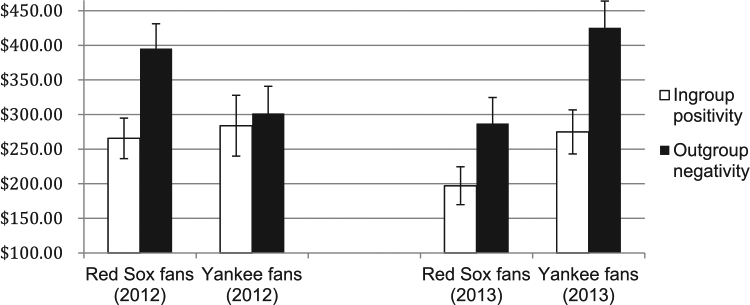
Yankee and Red Sox fans, both years. This figure shows reversals in patterns of ingroup positivity and outgroup negativity for Red Sox and Yankee fans in 2012 versus 2013.
Athletic versus social items
In Study 4, we were again able to examine whether the observed patterns extended into both the social (less instrumental) and athletic (more instrumental) domains. Recall that in 2012 (Study 3), Red Sox fans valued outgroup losses more than ingroup gains in both their responses to athletic (competition-relevant) and social (competition-irrelevant) items. However, in contrast, fans of the dominant 2012 Yankees valued outgroup losses more than ingroup gains in the social domain, but not in the athletic domain.
Interestingly, when the competitive positions of the teams reversed in 2013, these patterns of intergroup evaluations reversed alongside them. In 2013, fans of the now dominant Red Sox still attached greater value to outgroup social losses relative to ingroup social gains (M = $309.88, SD = $328.77; M = $175.31, SD = $211.93), t(60) = 3.81, p < .001, 95% CI [$63.82, $205.31], d = 0.53. However, in the competition-relevant (athletic) domain, they did not attach significantly greater value to outgroup losses (M = $263.93, SD = $287.08) relative to ingroup gains (M = $219.00, SD = $257.49), t(60) = 1.50, p = .140, 95% CI [$−15.10, $104.95], d = 0.19.
Conversely, fans of the 2013 Yankees, now behind in the competitive rivalry, showed evidence of outgroup negativity exceeding ingroup positivity in both the competition-irrelevant (social) and competition-relevant (athletic) domains. Yankee fans again attached greater monetary valuation to Red Sox social losses (M = $447.45, SD = $338.19) than to Yankee social gains (M = $270.06, SD = $271.81), t(64) = 4.73, p < .001, 95% CI [$102.47, $252.31], d = 0.60. Unlike in 2012, they now also attached greater value to Red Sox athletic losses (M = $403.13, SD = $340.86) than to Yankee athletic gains (M = $279.58, SD = $293.49), t(64) = 3.80, p < .001, 95% CI [$58.54, $188.56], d = 0.48. The complete results for both teams and years, and for both social and athletic items are summarized in Table 1.
Social and athletic evaluations by team supported and year.
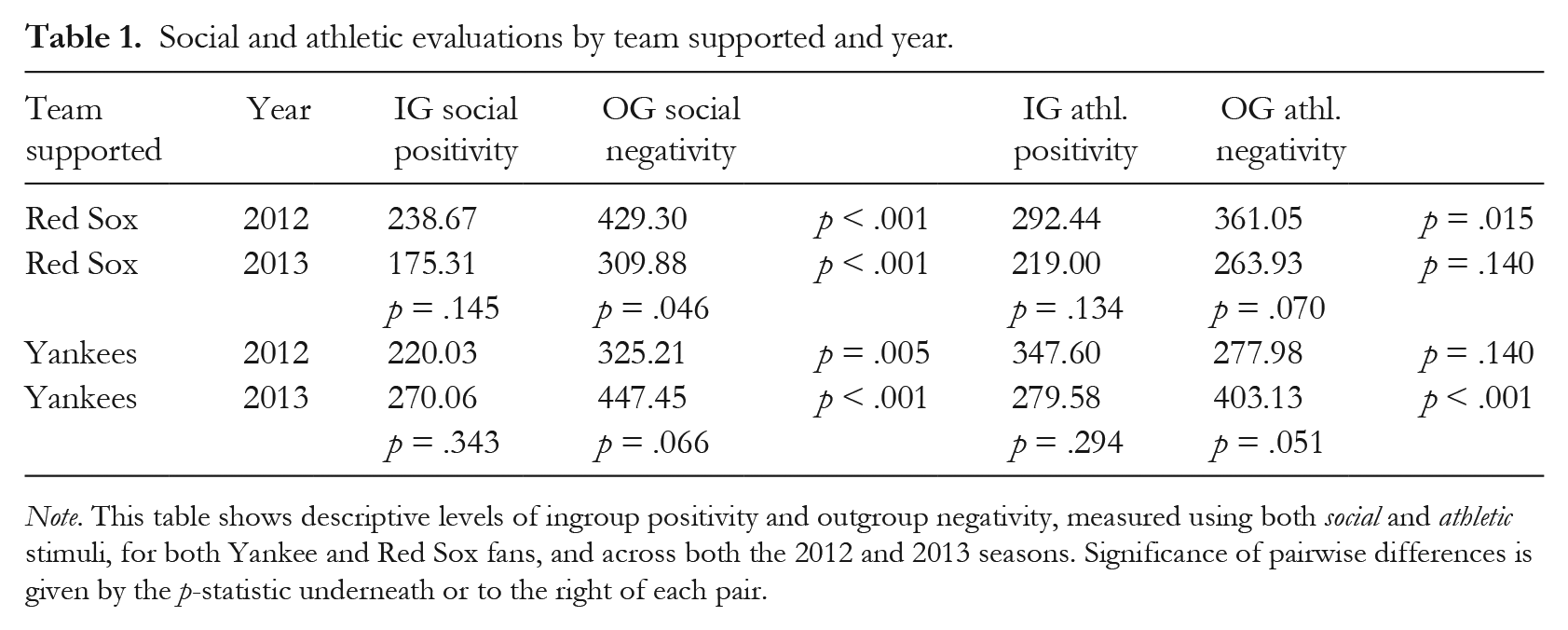
Note. This table shows descriptive levels of ingroup positivity and outgroup negativity, measured using both social and athletic stimuli, for both Yankee and Red Sox fans, and across both the 2012 and 2013 seasons. Significance of pairwise differences is given by the p-statistic underneath or to the right of each pair.
These results again suggest that in fact patterns of ingroup positivity exceeding outgroup negativity are more consistent when fans are asked about items in the competition-irrelevant social domain. It is interesting to note, however, that fans of both teams displayed this same pattern with regard to more instrumental athletic items, but only when their own team was behind in the rivalry. For fans of both teams, when ahead in the rivalry, the values placed on the rival’s competition-relevant losses did not differ statistically from those attached to ingroup athletic gains. This reversal is more statistically definitive in fans’ valuation of more instrumental athletic events than for their valuation of social events: The three-way interaction representing these patterns (Year x Team x Type of Intergroup Emotion) reached statistical significance for judgments of competition-relevant (athletic) events (p = .001), but only trended without reaching statistical significance (p = .086) for judgments of competition-irrelevant (social) events.
General Discussion
In general, fans in our studies made choices that subtly indicated more outgroup negativity than ingroup positivity, a pattern that stands in stark contrast to previous research on intergroup evaluations. While in previous research relationships between these evaluations were inconsistent and rarely strong, in our studies ingroup positivity and outgroup negativity were consistently and strongly correlated. As importantly, while in previous research outgroup negativity was only rarely observed, Red Sox and Yankee fans in the present studies consistently revealed both kinds of evaluations through their monetary valuation of good and bad events for their own and the rival team.
However, the most new and striking result to emerge from these studies is in the relative magnitude of the observed intergroup evaluations. In previous research, ingroup positivity consistently appears stronger than outgroup negativity. In contrast, Red Sox and Yankee fans in our studies displayed significantly greater outgroup negativity than ingroup positivity across five of the six main comparisons, and trended in the same direction for the sixth, though weakened in a theoretically expected manner. Furthermore, these effects were moderated by the teams’ current position in the rivalry, such that the dominance of outgroup negativity was most pronounced when one’s team was behind in the competitive hierarchy.
In the Northeastern United States, the fans of the teams we studied live relatively protected lives. The stakes of intergroup competition are comparatively low, and though hierarchy appears ubiquitous to human social systems (Sidanius & Pratto, 2001), there is certainly a stronger perception of opportunity equality relative to many societies. Such an environment should mitigate group-based conflict, and accordingly we observe and conceptualize ingroup warmth as the primary and dominant intergroup feeling. This should not however be mistaken to imply that ingroup positivity is always dominant within the human condition, as existing research might lead us to conclude.
The results in this paper suggest that under the right circumstances our experience of hostility towards outgroups can actually exceed the warmth we experience for our own groups, a baffling result from many points of view. Even in the cooperative and peaceful existence from which our subjects were drawn, something as unimportant as a sports rivalry may be sufficient to flip the switch of outgroup hostility, so that attention is turned more strongly to it than to supporting their own group. However, it is also important to note that these are effects that can be influenced by the act of measurement: The demand to express ingroup positivity but not outgroup negativity was visible even in our prestudy, where direct questioning of subjects provoked weaker reports of outgroup dislike and statistical evidence of socially desirable responding. Even in the context of a sports rivalry, once given a chance to introspect, fans are either unable or unwilling to openly acknowledge themselves as “haters” who care more about the misfortune of the rivals than the success of their own team.
Of particular interest was our finding that the patterns of relative ingroup positivity and outgroup negativity were moderated by the competitive positions of the teams. In Studies 3–4, fans more clearly displayed patterns of outgroup negativity exceeding ingroup positivity when their own team was stably behind in the season’s competition. Further, this moderation was more pronounced for athletic items that were clearly linked to immediate competition, and which thus could be characterized as highly instrumental. This pattern aligns with social identity models of bias (e.g., Scheepers et al., 2006), which hold that outgroup derogation along instrumental dimensions should be more prevalent among members of lower status groups and when the competitive hierarchy becomes more stabilized. However, our findings are particularly startling because members of the lower status group not only valued outgroup losses, but actually valued them more than ingroup gains.
At first glance, the responses of fans in our studies may seem odd and irrational. From an adaptive standpoint, why would we ever favor the misfortune of another group over the good fortune of our own? The moderating role of competitive status offers a possible clue. If we consider these patterns within the context of groups for whom competition would be higher stakes and could even mean life or death, it is relatively easy to imagine the adaptive value this malleability would offer for a species that must live in both small and large groups, and cooperate in times of war in addition to peace. As a very simple game-theoretical example, we describe a toy-war scenario in the supplemental materials. In this scenario, adding a variable related to competitive dominance quickly leads to circumstances in which negative attention towards the outgroup is more beneficial (to both the individual and the group) than positive attention towards the ingroup. Put simply, the more powerful a rival group, the more successful a strategy of aggressively undermining this group may be, relative to a strategy of lovingly protecting the ingroup. Thus, if social evaluations and emotions dynamically serve the good of the individual and social group, we might predict that negative attention towards an outgroup will be stronger (relative to positive attention towards the ingroup), the greater the outgroup’s competitive advantage. This is consistent with the surprising malleability of intergroup evaluations reported in this paper.
Of course, the stakes are much higher among people for whom competition can precipitate life and death, such as those living in wartime conditions. The real-world instances of outgroup derogation available in the media every day are powerful examples of the strength of this feeling. Experimental psychology must strive to make sense of why such instances of outgroup derogation are common in the world, but yet most experimental research fails to capture them. More generally, future research should strive to refine our theoretical understanding of intergroup evaluative dynamics, but equally it should aim to chart these dynamics, their predictors, and their implications among real-world groups at higher risk for violence. Understanding the conditions under which outgroup negativity is experienced more acutely than ingroup positivity may be a critical piece of a long-standing puzzle for social scientists and humanitarians concerning how to build intergroup peace.
Footnotes
Acknowledgements
We owe our deepest gratitude to Mina Cikara, Sa-Kiera Hudson, Lauren Westendorf, Greg Willard, Sabrina Sun, Jim Sidanius, and to all members of Harvard’s Implicit Social Cognition Laboratory for their invaluable comments and critiques on early drafts of this paper; and also to Lawrence Lessig and the Edmond J. Safra Center for Ethics for their generous support of this research.
Funding
The author(s) disclosed receipt of the following financial support for the research, authorship, and/or publication of this article: This research was supported by grants from the Edmond J. Safra Center for Ethics.
Supplemental Material
The Supplemental Material for this article is available at online.
Notes
References
Supplementary Material
Please find the following supplemental material available below.
For Open Access articles published under a Creative Commons License, all supplemental material carries the same license as the article it is associated with.
For non-Open Access articles published, all supplemental material carries a non-exclusive license, and permission requests for re-use of supplemental material or any part of supplemental material shall be sent directly to the copyright owner as specified in the copyright notice associated with the article.
