







Abstract
How do people judge the intentions of a perpetrator and the harm experienced by a victim in cases of racial discrimination? How do these judgments influence attributions to discrimination? We examined these questions in 4 studies, predicting that Whites’ and Blacks’ judgments would reflect different group-based perspectives. Supporting our hypotheses, White authors describing an arrest denied intent and ignored harm relative to Black authors (Study 1). When judging whether an event was discrimination, Whites were influenced by intent, but Blacks were influenced by intent and harm (Study 2). Finally, instructing people to take the victim’s perspective increased Whites’ judgments of intent, harm, and discrimination (Studies 3 and 4), while Blacks’ judgments generally remained the same (Study 4). Our results demonstrate one reason why Whites and Blacks judge discrimination differently—they adopt different perspectives when evaluating intent and harm—and offer a way to increase Whites’ recognition of discrimination: perspective-taking.
Imagine you are on a jury tasked with deciding if someone is guilty of racial discrimination. How should you decide? According to laws in the United States, you should decide by considering two questions. First, did the perpetrator act intentionally? And second, did the victim experience harm? These questions and the psychological constructs they correspond to—intent and harm—are embedded in prescriptive theories of blame (e.g., Heider, 1958), as well as legal theories of discrimination. Under the theory of disparate treatment, for example, an action or policy qualifies as discrimination if people are intentionally treated differently because of their racial group membership. Under another theory known as disparate impact, an action or policy is considered discrimination if it causes disproportionate harm to a racial group and is not necessary to business practice (Covington & Decker, 2002). Thus, under various legal theories, intent and harm are essential for determining whether discrimination has occurred.
But outside of the law, do people consider intent and harm when making judgments of racial discrimination? We believe they do. Because discrimination is a moral issue, and both intent and harm are central to moral judgments (Gray, Waytz, & Young, 2012), we expected people to consider the intentions of a perpetrator and the harm experienced by a victim when judging whether an event is discrimination. Broadly, we investigated whether Whites minimize a perpetrators’ intent and a victim’s experience of harm relative to Blacks. Across four studies, we investigated judgments about the intent of a White perpetrator, the harm experienced by a Black victim, and attributions to discrimination among White and Black people. We expected White and Black people to adopt different perspectives that would lead them to perceive different amounts of intent and harm and to make different judgments about discrimination.
Intent, Harm, and Judgments of Discrimination
While intent refers to a person’s desire to produce a particular outcome and awareness that an action will result in that outcome (Malle & Knobe, 1997), harm refers to the negative consequences of an action. People easily judge acts of intentional harm as immoral (Schein & Gray, 2015, Study 1), yet even in the absence of intent, perceptions of harm can cause people to believe that an action is wrong (Schein & Gray, 2017). Because discrimination is defined by the desire to treat two groups differently based on a social identity or the harm caused by doing so (Civil Rights Act, 1964), one would expect intent and harm to influence people’s judgments of whether an event is discrimination.
In support of this reasoning, people’s judgments of gender discrimination depend on a perpetrator’s intent and a victim’s experience of harm (Swim, Scott, Sechrist, Campbell, & Stangor, 2003). In one series of studies, Swim and colleagues (2003) independently manipulated the intentions of a male perpetrator and the harm experienced by a female victim of gender discrimination. They found that intent and harm significantly increased both men’s and women’s judgments of sexism. However, intent was more influential than harm: when a man clearly intended to discriminate, harm no longer affected people’s judgments of sexism. Stated differently, harm only influenced judgments of gender discrimination if intent was unknown or absent. Based on these results, it is possible that intent and harm influence people’s judgments of racial discrimination, and that like men and women, Blacks and Whites show a similar pattern of judgment. There are, however, important differences between sexism and racism (e.g., Jackman, 1994; Sidanius & Pratto, 1999) that likely affect people’s judgments of intent and harm in cases of racial discrimination and whether Whites and Blacks make distinct judgments.
One reason people’s judgments of intent and harm may be different for racial discrimination than gender discrimination is because sexism towards women is often characterized by subjectively positive intent to protect women from harm. In fact, in their studies, Swim et al. (2003) manipulated intent by comparing actions motivated by benevolent (low intent) or hostile sexism (high intent). Because benevolence motivates discrimination toward women much more often than it motivates discrimination toward African Americans (Glick & Fiske, 2001; Navarrete, McDonald, Molina, & Sidanius, 2010; Pratto, Sidanius, & Levin, 2006), past research may offer little insight into how people judge intent and harm in cases of racial discrimination.
Another reason people’s judgments of racial discrimination may be different than judgments of gender discrimination is because men and women are often closer and more interdependent than Blacks and Whites (e.g., Glick & Fiske, 2001; Rudman & Glick, 2010). A powerful demonstration of this closeness comes from research on social distance. For decades researchers studying intergroup relations have assessed negative outgroup feelings with Bogardus’s Social Distance Scale (1927), a classic measure of prejudice. While most groups prefer some distance from each other, men and women seldom express a desire for distance and frequently engage in the closest forms of social relations (e.g., marriage, family ties). For this reason, men and women may hold more similar perspectives when judging discrimination than members of other groups. Similar perspectives may explain why gender differences in perceptions of sexism are often small (e.g., Barreto & Ellemers, 2005; Becker, 2010; Becker & Swim, 2012; Glick & Fiske, 2001; Swim et al., 2003), whereas Whites and Blacks consistently perceive racism quite differently (see Carter & Murphy, 2015, for a review). Thus, an investigation of whether Whites and Blacks judge intent and harm differently than men and women is warranted.
Group Perspectives on Discrimination
An emerging body of evidence suggests that people view abstract concepts pertaining to race, such as inequality, diversity, and colorblindness, in ways that are consistent with group-based motivations (i.e., motivated construals; Knowles, Lowery, Hogan, & Chow, 2009; Unzueta & Binning, 2012; Unzueta & Lowery, 2008). Consistent with a motivated construal perspective, we argue that Whites think of racial discrimination toward Blacks in a way that relies on intent and ignores or minimizes harm. Because intent is an internal, psychological state that cannot be directly observed, proving that someone intended to discriminate can be difficult especially when discrimination is subtle or ambiguous. In comparison, harm is often concrete and easier to observe. By adopting a conception of racial discrimination that emphasizes intent and ignores harm, Whites may set a high threshold for detecting racial discrimination (e.g., Barrett & Swim, 1998). Such a high threshold may allow Whites to minimize discrimination against Blacks and to maintain a positive group image (Tajfel & Turner, 2001).
Consistent with this analysis, we predict that when intent is ambiguous, Whites will perceive low levels of discrimination, regardless of the amount of harm. This prediction is supported by research demonstrating that Whites tend to define racism in ways that focus on blatant acts with clear intentions and fail to recognize subtle forms of racism where intentions are unclear (e.g., Sommers & Norton, 2006). In addition, our prediction is supported by research showing that Whites see little institutional discrimination (O’Brien et al., 2009; Unzueta & Lowery, 2008)—a type of discrimination defined by the presence of harm, rather than the presence of intent (e.g., Blodorn, O’Brien, & Kordys, 2012). Thus, Whites’ focus on intent may cause them to overlook harm, creating a higher threshold for judging an event as discrimination.
In contrast to Whites, Blacks are often targeted by prejudice (Crocker, Major, & Steele, 1998; Richeson & Shelton, 2007) and thus may be vigilant for signs of discrimination against their ingroup. We suggest this vigilance leads Blacks to think of discrimination in a way that relies on intent or harm. Past research demonstrates that Blacks pay more attention to subtle cues of prejudice than Whites do (Salvatore & Shelton, 2007) and, because misjudging or ignoring a perpetrator’s intent would be costly, Blacks should be motivated to evaluate intent. In addition, because Black people share a group membership with the victim experiencing harm, Blacks may be more likely than Whites to take the victim’s perspective and to focus on the harm the victim experiences. Thus, Blacks may conceive of discrimination in a way that considers whether either intent or harm is present, setting a lower threshold for judging an event as discrimination.
The arguments we have laid out suggest that Whites and Blacks judge discrimination differently because they make different judgments about intent and harm. Our arguments also suggest that Whites and Blacks judge discrimination differently because they adopt different perspectives that are aligned with group-based motivations. Therefore, in two studies, we examined whether directing Whites to take the perspective of a Black victim increases their recognition of discrimination. Perspective-taking, or imagining the world from another’s point of view, reduces prejudice and stereotyping toward outgroups (e.g., Shih, Wang, Trahan Bucher, & Stotzer, 2009; Vescio, Sechrist, & Paolucci, 2003), and reduces Whites’ denial of group-based inequality (Todd, Bodenhausen, & Galinsky, 2012; Todd, Bodenhausen, Richeson, & Galinsky, 2011). As a result, asking Whites to take the perspective of a Black victim may lead them to perceive more intent and more harm, perceptions that should increase judgments of discrimination. In line with this argument, we predicted that perspective-taking with a Black victim would increase Whites’ judgments of discrimination but the same perspective-taking would do little to change Blacks’ judgments.
Current Research
Across four studies, we assessed how Whites and Blacks judge intent and harm in cases of racial discrimination and the extent to which they make attributions to discrimination. In our first study, we examined how White and Black authors wrote about an arrest where the White police officer’s intent and the harm experienced by the Black victim were both ambiguous. We expected White authors would be more likely than Black authors to deny the officer acted intentionally, to ignore harm to the victim, and to adopt the arresting officer’s perspective. In our second study, we had people read an article and judge whether the event in the article was discrimination. By manipulating intent and harm, we examined how both constructs influence Whites’ and Blacks’ attributions to discrimination. We expected both Whites and Blacks to be more likely to judge the event as discrimination when the perpetrator’s intent was clear as opposed to ambiguous. However, we only expected Blacks to be more likely to judge the event as discrimination when the victim experienced high as compared to low harm.
After examining in our first two studies how Whites and Blacks adopt different perspectives and are influenced by different information when judging whether an event is discrimination, our last two studies investigated how perspective-taking changes people’s judgments of discrimination. In Studies 3 and 4, we had people take the perspective of a victim or remain objective while reading about a discrimination lawsuit. While we expected perspective-taking with a victim of discrimination to increase Whites’ judgments of intent, harm, and discrimination, we did not expect a change in Blacks’ judgments. Collectively, our studies offer an explanation for why Whites and Blacks judge discrimination differently and suggest that perspective-taking may help reduce this difference.
Study 1: Describing an Arrest
In Study 1, we investigated how White and Black authors described an ambiguous case of racial discrimination: the arrest of a Black Harvard professor, Dr. Henry Louis Gates, Jr., by a White police officer (Goodnough, 2009). In 2009, Gates found himself locked out of his home after returning from a trip abroad. While he attempted to gain entry, a neighbor called the police to report a possible burglary. After the police arrived, Gates and the responding officer argued. Eventually, the officer arrested Gates and charged him with disorderly conduct. The event received national media attention and, in the conversation that followed, people debated whether the event was an instance of discrimination. Given the ambiguity of the situation, we wanted to know how opinion columnists describing the event wrote about intent and harm. We predicted that White authors would deny that the officer acted intentionally, ignore harm, and take the officer’s perspective more than Black authors.
Method
To find articles about the arrest, we used LexisNexis Academic—a database of newspapers and magazines. We searched the database using the terms “Henry Louis Gates” AND “arrest.” Our search yielded 221 documents. Next, we had a research assistant screen the articles for inclusion. To be included, articles had to be: about the arrest, written by a single author who was Black or White, published as an opinion or editorial piece in the US, and published within 1 year of the event. Thirty-six articles met these criteria.
Coding procedure
We determined the race of each author by conducting a Google image search of the authors’ names. Nineteen articles were written by White authors, 17 by Black authors. Before coding, we removed all identifying information from each article (e.g., author name, publication outlet, title, date), ensuring coders were blind to the authors’ race. Then, two coders (both White female undergraduates between 19 and 21 years old), who initially knew nothing about the arrest, read every article and judged how much the author’s denied the intentions of the arresting officer and recognized harm to Gates or African Americans. Additionally, the coders judged whose perspective the author took and whom the author blamed for the event.
Measures
Coders made all judgments on 7-point Likert-type scales (1 = not at all, 7 = very much) except where noted. Interrater reliability was acceptable for each measure, with correlations ranging from r = .66 to .81, ps < .001. Therefore, we averaged responses across the two coders into one score for each measure listed below. For this study and all other studies, dependent variables are listed in the Method section in the order they were assessed.
Harm
Coders answered two questions asking how much the author wrote about the harm Gates experienced: “To what extent does the author focus on Gates’s potential feelings of humiliation, embarrassment, or frustration?” and “To what extent does the author focus on negative consequences to Gates as a result of the incident?” We averaged these items to create an index of harm to Gates (r = .77, p < .001). One additional question asked how much the author focused on harm to Black people because of racism.
Denial of intent
Three questions asked how much the author denied that the police officer’s behavior was intentional: “To what extent does the author deny the police officer intentionally targeted Gates because of his race?” “To what extent does the author deny the police officer intentionally tried to harm Gates because he is Black?” and “To what extent does the author think the police officer was just doing his job/following protocol?” These items were highly reliable (α = .94) and averaged together.
Perspective-taking
One question asked whose perspective the author seemed to take (1 = Sgt. Crowley, 7 = Dr. Gates).
Blame
Four questions asked where the author placed blame for the event with higher scores indicating greater blame on Gates: “Who does the author think is more at fault for the incident?” (1 = Sgt. Crowley, 7 = Dr. Gates; reverse-coded), “To what extent does the author claim Gates’s reaction/behavior made the situation worse?” “To what extent does the author think the police officer was justified in his actions?” and “To what extent does the author think Gates was justified in his actions?” (reverse-coded). We averaged these items into a blame index (α = .97).
Results and Discussion
Table 1 displays overall means, standard deviations, and correlations among Study 1 variables. To examine differences between White and Black authors, we conducted a one-way ANOVA with all dependent variables entered simultaneously. Significant group differences emerged on every dependent variable except harm to Gates. Table 2 displays a summary of group means, F ratios, effect sizes, and confidence intervals. 1
Means, standard deviations, and correlations among Study 1 variables.
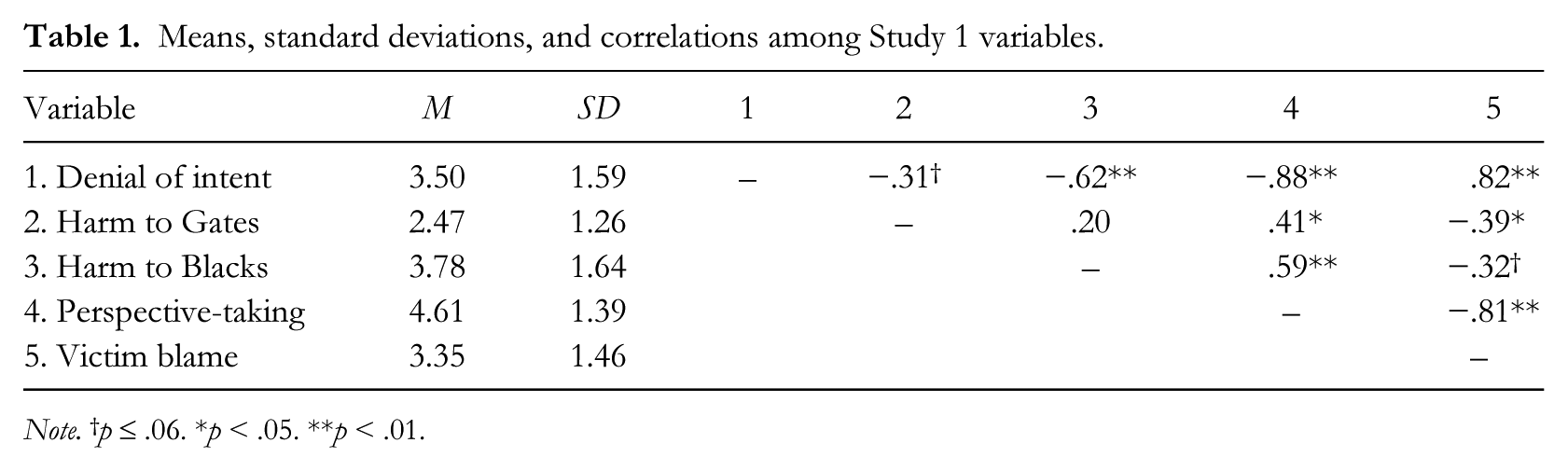
Note. †p ≤ .06. *p < .05. **p < .01.
Means and standard deviations by author race, F ratios, Cohen’s ds, and confidence intervals.
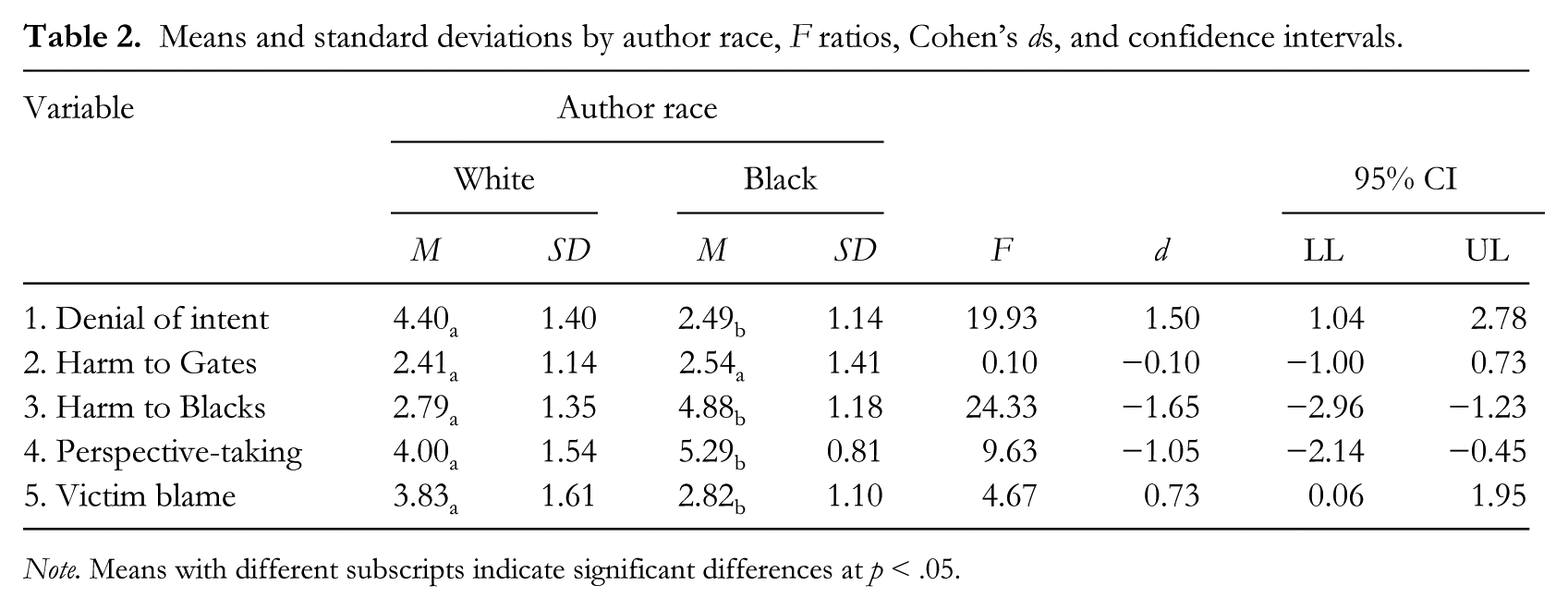
Note. Means with different subscripts indicate significant differences at p < .05.
As we predicted, White authors denied that the officer acted intentionally, adopted the police officer’s perspective, and blamed Gates for the incident more than Black authors did (see Table 2). Meanwhile, Black authors wrote about the harm African Americans experience because of racism more than White authors did. Surprisingly, Black and White authors did not differ in their descriptions of the harm Gates experienced. This nonsignificant finding may be because the charges against Gates were eventually dropped or because the overall harm ratings by coders were relatively low. Despite this null effect, the results largely suggest that White people focus on intent and take the perpetrator’s perspective when judging whether an event is discrimination, while Black people may focus on harm more than Whites do.
Overall, Study 1 provided initial support for our hypotheses, and a strength of the study is our examination of real-world cultural artifacts. However, because we used opinion columns, we cannot be certain that each article reflected the author’s personal opinion and not an opinion tailored to the newspaper’s audience. To overcome this limitation, we used experimental methods in our remaining studies and directly measured people’s judgments.
Study 2: Judging an Event
In Study 2, people read a fictitious newspaper article and judged whether the event described in the article was discrimination. Across study conditions, we experimentally manipulated information about the perpetrator’s intent and the victim’s experience of harm to examine whether Whites and Blacks are differentially influenced by information about harm when judging discrimination. We predicted that both White and Black people would perceive more discrimination when the perpetrator’s intentions were clear as compared to ambiguous. However, we also predicted that race and harm would interact. While we expected Black people to perceive more discrimination when the victim experienced high harm as compared to low harm, we did not expect harm to influence Whites’ judgments of discrimination.
Method
Participants and design
Two hundred and thirty-three adults from Amazon’s Mechanical Turk (MTurk) completed the study online in exchange for a small payment. A power analysis using G*Power (Faul, Erdfelder, Lang, & Buchner, 2007) suggested n = 199 for 80% power to detect a medium-sized between-subjects effect (d = 0.40). We excluded nine participants because they were born outside of the US, leaving 224 people in the sample (119 White Americans, 105 Black Americans; 55% female, 45% male; Mage = 32.74). Study 2 used a 2 (Intent: high vs. low) x 2 (Harm: high vs. low) x 2 (Participant Race: Black vs. White) between-subjects design.
Procedure
After giving consent, participants were randomly assigned to read one of four articles. All versions of the article described the same scenario but manipulated information about intent and harm. The article described the detainment and questioning of an African American high school football player, named Terrence Washington. Washington was described as a 17-year-old student who was detained by the cashier of a local convenience store while trying to buy a drink and a snack before football practice. Participants read that while in the store, the cashier suspected Washington of shoplifting and “refused to allow him to leave until the police arrived to question him.” When the police arrived, they found Washington had not stolen anything and he was let go.
In the low intent condition, people read a statement the cashier made to the police that said, “the store was extremely crowded . . . and I honestly thought I saw the young man grab something and put it in his pocket. So I followed store policy and called police.” Furthermore, the cashier told the police, “It turns out I made a mistake—I just didn’t want to let someone get away with stealing something, so I stopped him.” In the high intent condition, the cashier told the police, “the store was extremely crowded . . . and I thought the young African American looked suspicious, like he had put something in his pocket. So I called the police.” The cashier also said, “I guess I made a mistake—I just didn’t want to let another one of them get away with stealing something, so I stopped him.” Our manipulation of intent relied primarily on the cashier’s desire to stop Washington because of Washington’s race.
The articles ended by describing the harm Washington experienced. People read that Washington had been suspended from the football team because of a team rule stating, “any player involved in an altercation with police will be suspended.” In the low harm condition, people read that Washington was suspended for the first quarter of the next game, and in the high harm condition people read that Washington was suspended for the next three games (a quarter of the season). After reading the article, participants answered questions assessing their judgments of the event and manipulation checks. Then, they answered demographic questions and were debriefed.
Measures
Attributions to discrimination
We measured attributions to discrimination with five items commonly used in past research (Major & Sawyer, 2009). Participants answered each item on a 9-point Likert-type scale (0 = not at all, 8 = extremely). Example items include: “To what extent was Terrence a victim of discrimination?” “To what extent do you think the cashier was discriminatory towards Terrence?” and “To what extent do you think the cashier’s behavior was due to Terrence’s race?” The items were averaged together to form a highly reliable (α = .96) composite score of attributions to discrimination. 2
Manipulation checks
Using a 9-point scale, participants answered two questions about harm: “How much harm do you think Terrence experienced?” and “How much of a negative impact will this event have on Terrence’s life?” (0 = no harm at all or no negative impact, 8 = a lot of harm or a very negative impact; r = .81, p < .001); and two questions about intent: “To what extent do you think the police officer intended to be prejudiced against Black people?” and “To what extent do you think that the police officer intended to harm Terrence because he was Black?” (0 = not at all, 8 = very much; r = .71, p < .001). We averaged the harm and intent items separately.
Results and Discussion
Table 3 displays the overall means, standard deviations, and correlations for Study 2 variables. We analyzed each dependent variable with separate 2 (Intent: high vs. low) x 2 (Harm: high vs. low) x 2 (Participant Race: White vs. Black) ANOVAs, and we tested the predicted effect of harm on attributions to discrimination for Black participants using planned contrasts.
Means, standard deviations, and correlations among Study 2 variables.
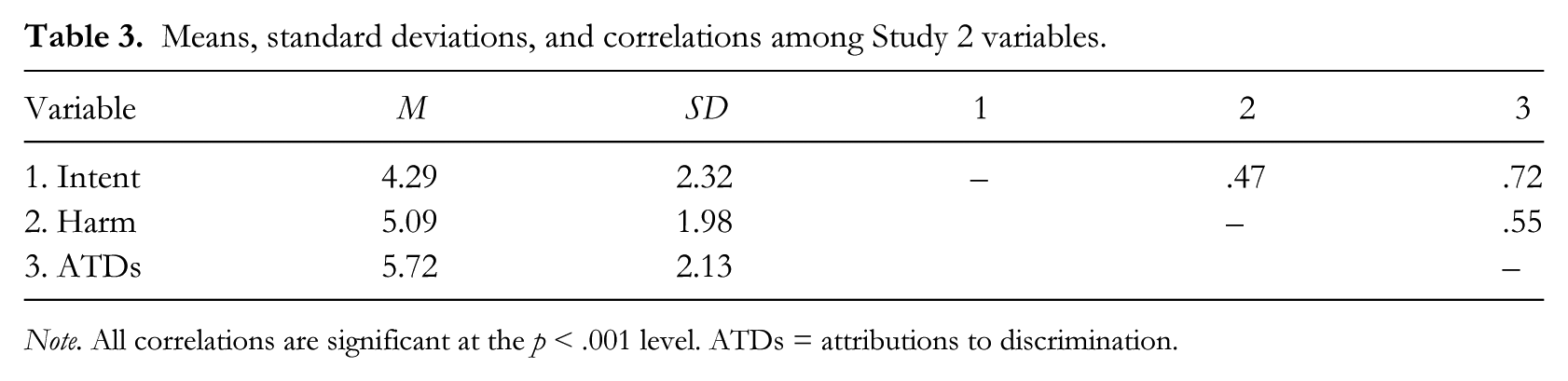
Note. All correlations are significant at the p < .001 level. ATDs = attributions to discrimination.
Manipulation checks
Participants judged the cashier’s behavior as more intentional in the high intent condition (M = 4.84, SD = 2.37) than the low intent condition (M = 3.79, SD = 2.16), F(1, 215) = 14.73, p < .001, d = 0.46. Participants also judged that Washington experienced more harm in the high harm condition (M = 5.42, SD = 1.90) than in the low harm condition (M = 4.78, SD = 2.01), F(1, 216) = 6.20, p = .01, d = 0.33. While these analyses showed our manipulations were effective, additional significant effects emerged on both perceived intent and perceived harm.
First, consistent with our motivated construal perspective, White participants (M = 3.65, SD = 2.35) judged that the event was less intentional than Black participants (M = 5.03, SD = 2.05), F(1, 215) = 23.78, p < .001, d = 0.62, and less harmful (M = 4.66, SD = 1.91) than Black participants (M = 5.58, SD = 1.91), F(1, 216) = 13.06, p < .001, d = 0.48.
Second, there was an Intent x Harm interaction on participants’ judgments of intent, F(1, 215) = 4.68, p = .03. This significant interaction was due to the fact that the intent manipulation had a bigger impact on judgments of intent in the high harm condition, F(1, 215) = 17.22, p < .001, than in the low harm condition, F(1, 215) = 1.47, p = .23. No other significant effects emerged on perceived intent. A marginally significant Intent x Harm interaction on participants’ judgments of harm also emerged, F(1, 216) = 3.67, p = .06. This effect was due to the fact that the harm manipulation had a bigger impact on judgments of harm in the high intent condition, F(1, 216) = 9.26, p < .01, than in the low intent condition, F < 1. No other significant effects emerged on perceived harm. These interactions are consistent with past findings showing a lack of independence between perceived intent and perceived harm (Swim et al., 2003). 3
Attributions to discrimination
As we predicted, people in the high intent condition (M = 6.28, SD = 1.94) perceived significantly more discrimination than people in the low intent condition (M = 5.21, SD = 2.17), F(1, 216) = 17.22, p < .001, 95% CI [0.58, 1.62], d = 0.52. Also as expected, White people (M = 5.20, SD = 2.25) perceived less discrimination than Black people (M = 6.31, SD = 1.81), F(1, 216) = 18.65, p < .001, 95% CI [−1.67, −0.62], d = 0.54. Although the main effect of harm was not significant, F < 1, the predicted interaction between race and harm was, F(1, 216) = 4.25, p = .04.
As we expected, planned contrasts revealed that harm did not influence White people’s judgments of discrimination, F(1, 216) = 1.19, p = .28, 95% CI [−1.11, 0.32], d = −0.18. In fact, Whites saw slightly less discrimination in the high harm condition (M = 4.98, SD = 2.27) than in the low harm condition (M = 5.38, SD = 2.24). Conversely, for Black people, judgments of discrimination were higher in the high harm condition (M = 6.65, SD = 1.45) than in the low harm condition (M = 5.98, SD = 2.06), F(1, 216) = 3.24, p = .07, 95% CI [−0.07, 1.46], d = 0.38 (see Figure 1). No other significant interactions emerged: Intent x Harm: F(1, 216) = 1.57, p = .21; Intent x Race: F(1, 216) = 1.22, p = .27; Intent x Harm x Race: F(1, 216) < 1.
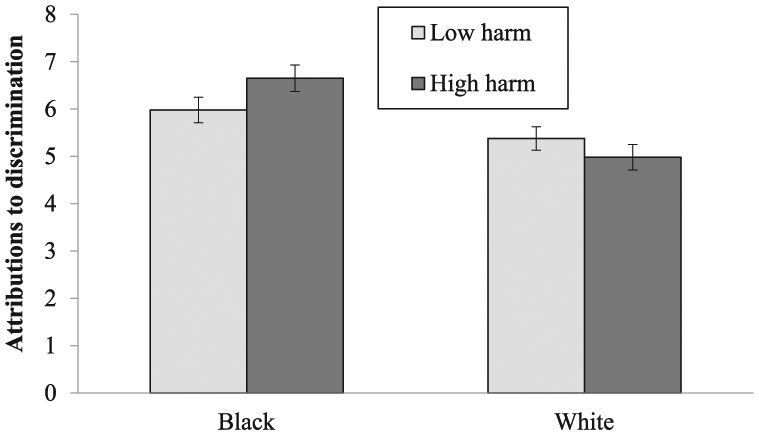
Attributions to discrimination as a function of race and harm in Study 2. Error bars represent standard errors.
Study 2 supports our prediction that both White and Black people are influenced by information about intent when judging whether an event is discrimination. Specifically, participants made greater attributions to discrimination when intent was clear rather than ambiguous. Study 2 also shows that when compared to Black people, White people are less sensitive to information about harm when judging whether an event is discrimination. Collectively, the results from our first two studies suggest that Whites and Blacks may adopt different perspectives and may be influenced by different information when judging whether an event is racial discrimination.
Study 3: Taking a New Perspective
In Study 3, we investigated whether perspective-taking changes White people’s perceptions of a perpetrator’s intent, harm to a victim, and judgments of discrimination. We predicted that taking the perspective of a Black victim would lead Whites to perceive more intent and more harm. We also predicted that perspective-taking would cause Whites to make higher attributions to discrimination.
To test our predictions, we asked White participants to perspective-take or remain objective while reviewing a court case of institutional discrimination against a Black job applicant. Like other forms of subtle bias, institutional discrimination often lacks clear evidence of intent, and consequently, Whites often fail to recognize this form of discrimination (Nelson, Adams, & Salter, 2013; O’Brien et al., 2009). Thus, using a scenario that describes institutional discrimination offers a rigorous test of the effect of perspective-taking on judgments of discrimination because if Whites are taking a Black victim’s perspective, they should shift from denying intent and ignoring harm to recognizing more intent and more harm.
Method
Participants, design, and procedure
One hundred and seventy-five undergraduate students (121 women, 54 men) participated for course credit. We excluded 27 participants because they identified as a racial minority and one person who had participated in similar studies in the past, leaving a final sample of 147 White participants (Mage = 19.41). A power analysis using G*Power (Faul et al., 2007) suggested n = 199 for 80% power to detect a medium-sized between-subjects effect (d = 0.40); however, we were limited to data collection in one semester. The experiment was a between-subjects design: perspective-taking versus objective.
After obtaining consent, the experimenter informed participants they would evaluate a pending court case in which the defendant was accused of discrimination. Then, the experimenter read a glossary of legal terms, providing participants with definitions relevant to the case. Afterward, the experimenter left participants to complete the study on the computer using Medialab, a software program for psychology experiments (Jarvis, 2010).
When the computer portion began, participants were randomly assigned to the perspective-taking condition where they were instructed to take the victim’s perspective or to the objective condition where they were instructed to remain objective while reading the case. Next, participants read about Tyrone Williams, a 35-year-old Black man with a degree in accounting who filed a lawsuit against Bryant Bookkeeping, claiming he was the victim of discrimination when he applied for a job at the company. Specifically, Williams claimed that Bryant Bookkeeping used a discriminatory employment test that disadvantaged Black applicants. The brief contained statistics showing that the test resulted in only 4% of newly hired employees being Black, even though 20% of applicants were Black. The brief also stated that Williams’s attorney had a psychometric analyst review the test, and the analyst found several questions that were not relevant to the job description and culturally biased against Black Americans. Once these items were removed, Williams’s score was in the hirable range.
The brief ended by informing participants that Williams eventually received a job from another company, but because he was out of work for several months, he lost his home in foreclosure. As compensation for his time out of work, Williams sought $30,000—the equivalent of 6 months’ salary. After reading the brief, participants were given 4 minutes to write a short review of the case. In the perspective-taking condition, participants were instructed to write what they would be thinking, feeling, and experiencing if they were in Williams’s situation. In the objective condition, participants were instructed to write about the details of the case. Instructions were adapted from Todd et al. (2011). After writing their essay, participants answered the dependent measures.
Measures
Intent, harm, and attributions to discrimination
We measured harm (r = .60, p < .001), intent (α = .87), and attributions to discrimination (α = .92) with the same items used in Study 2, plus one additional intent item: “To what extent do you think that the company intentionally did not hire Tyrone because he is Black?” The scale for all items ranged from 0 (not at all) to 6 (very much).
Legal judgments
We asked participants to make several legal judgments about the case.
Verdict
Participants answered how much they agreed that, “Tyrone Williams should win his case against Bryant Bookkeeping” on a scale ranging from 0 (strongly disagree) to 6 (strongly agree).
Time compensation
Participants responded to the question, “When you think about the time that Tyrone Williams spent unemployed, how much of that time should Williams receive compensation for?” on an 11-point scale ranging from 0% to 100% in increments of 10%.
Monetary compensation
Finally, participants indicated how much money they thought “Tyrone should be allotted by Bryant Bookkeeping” on an 11-point scale ranging from $0 to $50,000 in increments of $5,000.
Manipulation check
Participants were asked how much they tried to “imagine what Tyrone Williams might be thinking, feeling, and experiencing” and how much they tried to “be objective and emotionally detached” (0 = not at all, 6 = very much). We reverse-coded the second item and averaged them to form a perspective-taking scale (r = .22, p = .01).
Results and Discussion
Table 4 displays overall means, standard deviations, and correlations among Study 3 variables. We tested our hypotheses by conducting a one-way ANOVA with all dependent variables entered simultaneously. Table 5 displays a summary of group means, F ratios, effect sizes, and confidence intervals for Study 3 variables.
Means, standard deviations, and correlations among Study 3 variables.
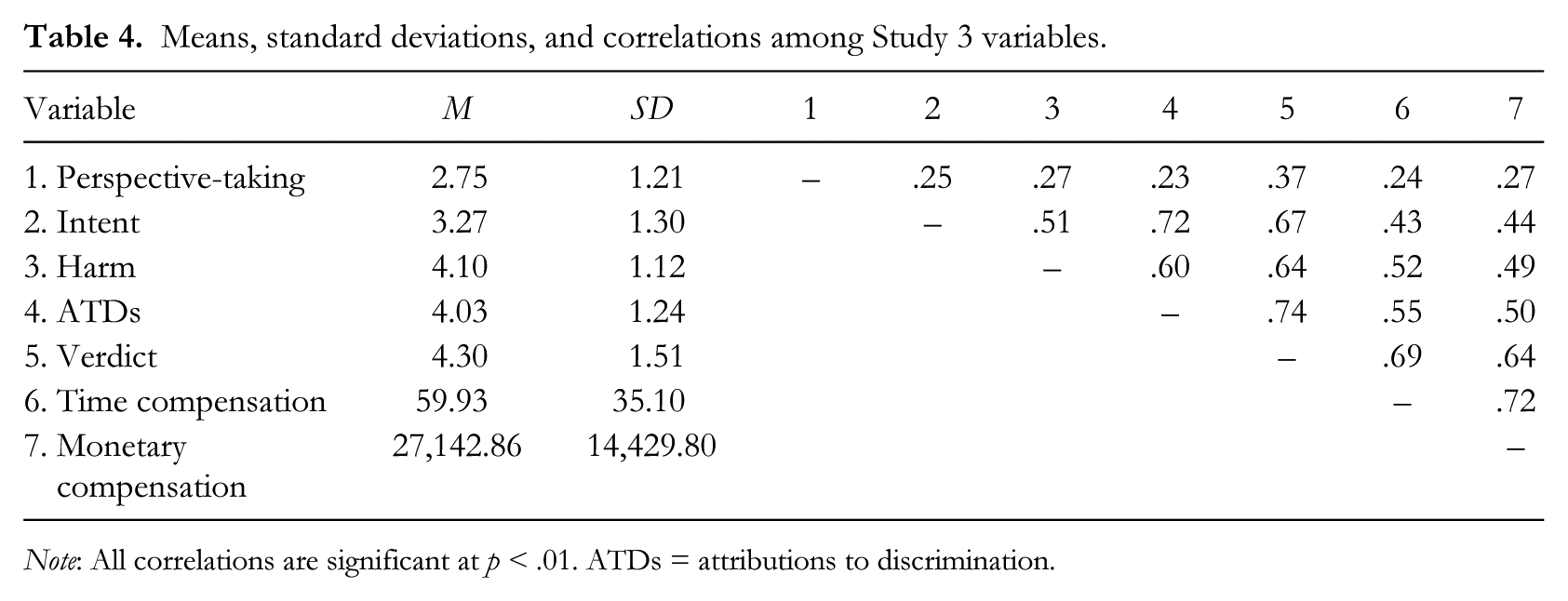
Note: All correlations are significant at p < .01. ATDs = attributions to discrimination.
Condition means and standard deviations, F ratios, p values, Cohen’s d, confidence intervals, and correlations among Study 3 variables.
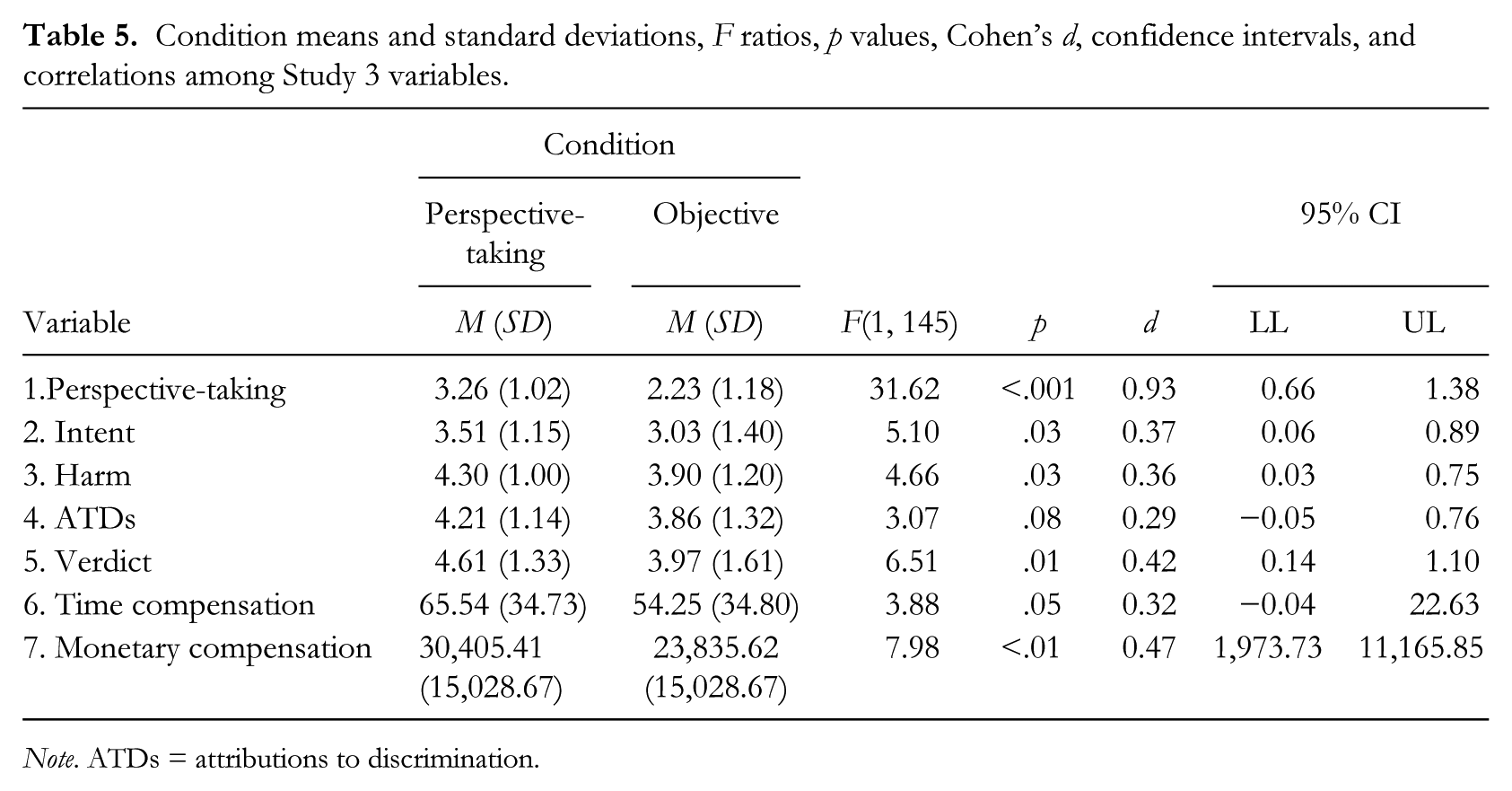
Note. ATDs = attributions to discrimination.
Manipulation check
Participants reported taking the victim’s perspective more in the perspective-taking condition than in the objective condition, suggesting our manipulation was effective (see Table 5).
Hypothesis testing
Perspective-taking with a Black victim increased White participants’ perceptions of intent, perceptions of harm, and attributions to discrimination when compared to those in the Whites in the objective condition. In addition, perspective-taking influenced Whites’ legal decisions about the case. Whites who took the victim’s perspective were more likely to decide on a verdict in the victim’s favor, and to allocate more time and more money to the victim than those in the objective condition. All of these effects were statistically significant, with the exception of the effect of perspective-taking on attributions to discrimination, which was nearly significant (see Table 5).
In Study 3, White people perceived more intent and more harm when they took the perspective of a Black victim than when they remained objective. Furthermore, perspective-taking caused Whites to judge the event as discrimination, render a verdict in the victim’s favor, and allocate more time and money as compensation than remaining objective did. The findings provide further support for our argument that people normally judge discrimination from group-based perspectives. However, when asked to take the perspective of the outgroup, Whites presumably see the event similarly to how Blacks would: greater intent, more harm, higher attributions to discrimination, and siding more in favor of the Black victim than Whites in the control condition. In our final study we sought to replicate this effect and to test how perspective-taking with a victim influences Black people’s judgments.
Study 4: Perspective-Taking and Attributions to Discrimination
In Study 4, we asked White and Black people to take the perspective of a Black victim or to remain objective while evaluating a court case of discrimination. Our goal was to replicate the findings of Study 3 with a different sample of participants from MTurk and to test whether perspective-taking changes Blacks’ evaluations of intent, harm, and discrimination. We hypothesized that perspective-taking and participant race would interact. While we expected perspective-taking to increase Whites’ perceptions of intent and harm and their judgments of discrimination, we predicted that perspective-taking with a Black victim would have little or no effect on Black people’s judgments. The primary reason for this latter prediction is that, as we argued earlier, we believe Blacks are naturally more likely than Whites to adopt the victim’s perspective (their ingroup perspective) when judging discrimination. If this is true, then taking the perspective of the victim should not change Blacks’ judgments. Finally, in contrast to Studies 2 and 3 where the perpetrator’s race was implied, in Study 4 we explicitly stated the race of perpetrator as White.
Method
Participants, design, and procedure
Two hundred and twenty-seven adults (115 women, 112 men) completed the study on MTurk in exchange for a small payment. We excluded seven people because they were born outside of the US and 22 people because they did not follow the essay directions that were part of our perspective-taking/objective manipulation. A research assistant who was blind to the study’s purpose, design, and hypotheses, made all decisions about whom to exclude for not following directions. The final sample consisted of 198 people (103 White Americans, 95 Black Americans, Mage = 36.38). A power analysis using G*Power (Faul et al., 2007) suggested n = 199 for 80% power to detect a medium-sized between-subjects effect (d = 0.40). Study 4 used a 2 (Perspective-Taking: perspective-taking for victim vs. objective) x 2 (Participant Race: Black vs. White) between-subjects design.
After giving consent, participants were randomly assigned to take the perspective of the victim or to remain objective while reading the same legal brief used in Study 3. The brief differed in only one way: we told participants that the hiring manager at Bryant Bookkeeping was a White man named Jacob Conners. Participants read that the victim, Tyrone Williams, claimed that Conners instituted the test to keep African Americans from obtaining employment at the company. After people read the brief, they were given 4 minutes to write a short review of the case following the same instructions from Study 3. After writing their response, participants answered the dependent measures.
Measures
Manipulation check
The manipulation check of perspective-taking consisted of the same two items used in Study 3 (r = .38, p < .001). Participants provided their answers on a scale ranging from 1 (not at all) to 7 (very much).
Intent, harm, and attributions to discrimination
We measured attributions to discrimination (α = .96), harm (r = .71, p < .001), and intent (α = .96), with the same items used in Study 3. The scale for all items ranged from 0 to 8.
Legal decision-making
Participants answered questions about the verdict, time, and money compensation using the same items and corresponding scales as Study 3.
Results and Discussion
Table 6 displays overall means, standard deviations, and correlations among Study 4 variables. We tested our hypotheses by conducting separate 2 (Participant Race: White vs. Black) x 2 (Perspective: perspective-taking for victim vs. objective) ANOVAs. We tested the predicted significant effect of perspective-taking on dependent measures for White participants using planned contrasts. Table 7 displays condition means and standard deviations for all dependent variables.
Means, standard deviations, and correlations among Study 4 variables.
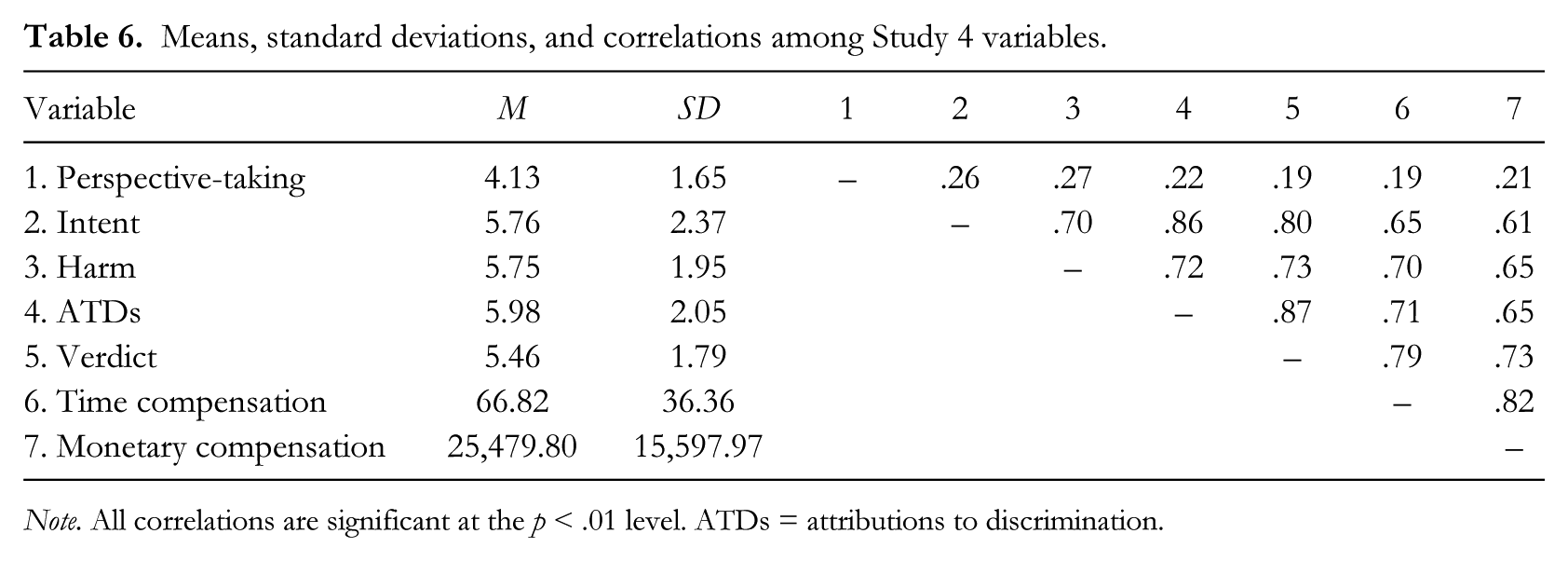
Note. All correlations are significant at the p < .01 level. ATDs = attributions to discrimination.
Condition means and standard deviations for Study 4 variables.
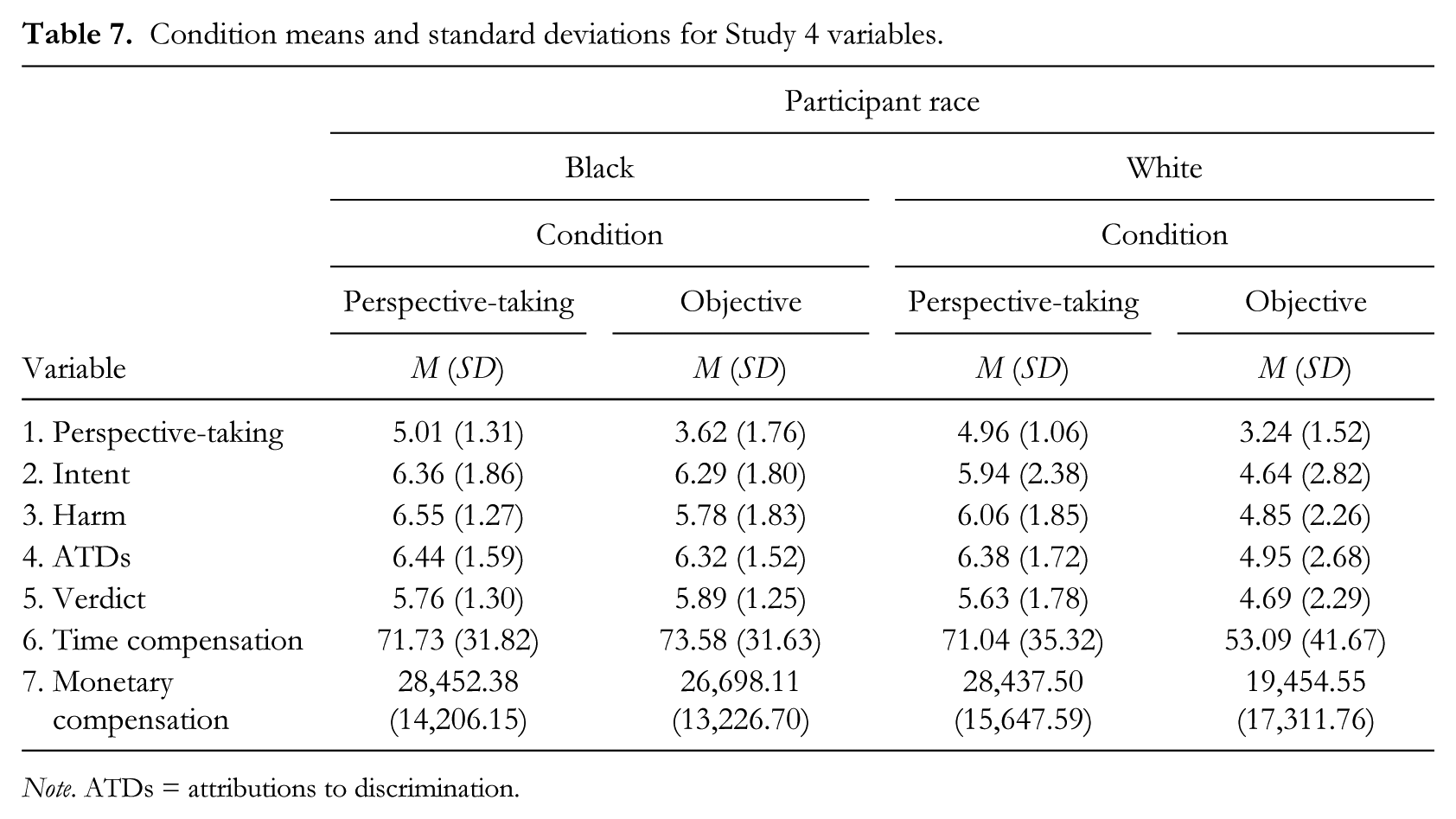
Note. ATDs = attributions to discrimination.
Manipulation check
Participants reported taking the victim’s perspective more in the perspective-taking condition (M = 4.99, SD = 1.18) than the objective condition (M = 3.43, SD = 1.65), F(1, 194) = 55.99, p < .001, d = 1.09. Whites and Blacks did not differ in their effort to take the victim’s perspective and race did not interact with perspective-taking, Fs < 1.12, ps > .29.
Intent
Overall, participants perceived more intent when taking the victim’s perspective (M = 6.15, SD = 2.15) than when remaining objective (M = 5.46, SD = 2.51), F(1, 194) = 4.47, p = .04, 95% CI [0.05, 1.33], d = 0.30. In addition, Black participants perceived more intent (M = 6.32, SD = 1.82) than White participants (M = 5.29, SD = 2.69), F(1, 194) = 10.07, p < .01, 95% CI [0.39, 1.68], d = 0.45. Most importantly, however, there was a marginally significant interaction between race and perspective-taking, F(1, 194) = 3.63, p = .06. Planned contrasts showed that while perspective-taking increased Whites’ perceptions of intent relative to remaining objective, F(1, 194) = 8.46, p < .01, there was little difference between Black participants who engaged in perspective-taking or remained objective, F < 1, p = .89 (see Table 7).
Harm
Perspective-taking (M = 6.31, SD = 1.61) increased participants’ perceptions of harm relative to remaining objective (M = 5.31, SD = 2.10), F(1, 194) = 13.79, p < .001, 95% CI [0.47, 1.52], d = 0.53, and Black participants perceived more harm (M = 6.17, SD = 1.64) than White participants (M = 5.45, SD = 2.16), F(1, 194) = 7.11, p < .01, 95% CI [0.19, 1.24], d = 0.38. The predicted interaction between perspective-taking and participant race was not significant, F(1, 194) = 0.72, p = .40. Planned contrasts demonstrated a significant effect of perspective-taking on perceptions of harm for Whites, F(1, 194) = 10.89, p < .001, d = 0.59, and for Blacks, F(1, 194) = 3.93, p = .05, d = 0.49, although the effect was larger for White participants (see Table 7).
Attributions to discrimination
Participants were more likely to judge the event as discrimination when taking the victim’s perspective (M = 6.41, SD = 1.65) than when remaining objective (M = 5.64, SD = 2.28), F(1, 194) = 7.62, p < .01, 95% CI [0.22, 1.33], d = 0.39. In addition, Black participants (M = 6.38, SD = 1.54) judged the event as discrimination more than White participants (M = 5.67, SD = 2.38), F(1, 194) = 6.43, p = .01, 95% CI [0.16, 1.27], d = 0.35. Importantly, there was an interaction between race and perspective-taking, F(1, 194) = 5.49, p = .02 (see Figure 2). Planned contrasts showed that while perspective-taking significantly increased Whites’ judgments of discrimination relative to remaining objective, F(1, 194) = 13.63, p < .01, there was little difference between Black participants who engaged in perspective-taking and those who remained objective, F < 1, p = .77 (see Table 7).
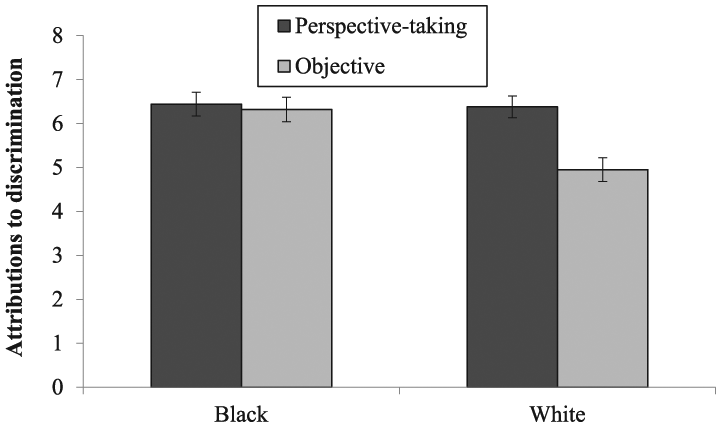
Attributions to discrimination as a function of perspective-taking and race in Study 4. Error bars represent standard errors.
Verdict
Participants who engaged in perspective-taking (M = 5.69, SD = 1.57) were more likely to believe the victim should win his case than those who remained objective (M = 5.29, SD = 1.94), but the effect was not significant, F(1, 194) = 2.66, p = .10. Black participants (M = 5.82, SD = 1.27) were more likely than White participants (M = 5.16, SD = 2.11) to believe the victim should win his case, F(1, 194) = 7.22, p = .01. But importantly, the interaction between race and perspective-taking was again significant, F(1, 194) = 4.56, p = .03. Perspective-taking significantly increased Whites’ judgments that the victim should win the case relative to remaining objective, F(1, 194) = 7.43, p < .01, but the same was not true for Blacks’ judgments, F < 1.00, p = .73 (see Table 7).
Time compensation
Participants who engaged in perspective-taking (M = 71.22%, SD = 33.55) allocated more time compensation to the victim than those who remained objective (M = 63.15%, SD = 38.32), although the effect was not significant, F(1, 194) = 2.41, p = .12, d = 0.22. Black participants (M = 72.63%, SD = 31.56) allocated more time than White participants (M = 61.46%, SD = 39.69), F(1, 194) = 4.21, p = .04, d = 0.31. Again, the interaction between race and perspective-taking was significant, F(1, 194) = 3.90, p = .049. Perspective-taking significantly increased Whites’ allocation of time relative to remaining objective, F(1, 194) = 6.51, p = .01, but the same was not true for Blacks’ judgments, F < 1, p = .77 (see Table 7).
Money compensation
Participants who engaged in perspective-taking (M = $28,444.44, SD = 14,908.79) also allocated more money to the victim than those who remained objective (M = $23,009.26, SD = 15,795.71), F(1, 194) = 6.08, p = .02, d = 0.35. Black participants (M = $27,473.68, SD = 13,622.45) allocated more money than White participants (M = $23,640.78, SD = 17,081.04), F(1, 194) = 2.78, p = .097, d = 0.25; although this effect was only marginally significant. The interaction between race and perspective-taking was also marginally significant, F(1, 194) = 2.75, p = .099. Planned contrasts revealed the predicted pattern that perspective-taking significantly increased Whites’ allocation of money relative to remaining objective, F(1, 194) = 8.90, p = .003, but the same was not true for Blacks’ judgments, F < 1, p = .58 (see Table 7).
Study 4 replicated the results of Study 3 with a different sample by showing that perspective-taking with a Black victim causes Whites to perceive a White perpetrator as having higher intent to discriminate and a Black victim as experiencing more harm. As in Study 3, perspective-taking also led Whites to be more likely to judge an event as discrimination and to make legal decisions that side with the Black victim. Study 4 extended the results of Study 3 by showing that perspective-taking does not produce the same effect for Blacks, with the possible exception of perceptions of harm. Thus, Study 4 provides additional evidence that Whites and Blacks adopt different perspectives when judging discrimination and suggests that for Whites, this perspective can be changed.
General Discussion
Whites and Blacks often disagree about whether an event constitutes discrimination. Four studies examined people’s judgments of intent, harm, and discrimination in cases involving a Black victim. When a perpetrator’s intent was ambiguous, Whites denied that the perpetrator acted intentionally more than Blacks (Study 1). When given varying information about intent and harm, Whites’ and Blacks’ judgments of discrimination were influenced by intent, but only Blacks’ judgments were influenced by harm to a Black victim (Study 2). Finally, asking Whites to perspective-take with a Black victim increased their perceptions of intent and harm, attributions to discrimination, and legal judgments in favor of the victim (Studies 3 and 4). The same act of perspective-taking, however, generally did not increase Blacks’ judgments (Study 4).
Implications for Research
What implications do our findings have for the literature on people’s judgments of discrimination? People judge whether an event constitutes discrimination by matching features of the situation to a theoretical prototype. Prototypical discrimination occurs between people from different groups, who hold unequal status, and interact in a domain where the victim is negatively stereotyped (Baron, Burgess, & Kao, 1991; Inman & Baron, 1996; O’Brien, Kinias, & Major, 2008). As a result, people judge events with these characteristics as discrimination more than events without them. Major and Sawyer (2009) have previously suggested that intent and harm make discrimination prototypical; however, in Study 2, only Blacks drew on the harm element of the prototype when people were not asked to engage in perspective-taking. This is consistent with our past research that demonstrates people from high and low status groups draw on different elements of the prototype when judging whether an event is discrimination (O’Brien, Major, & Simon, 2012; Simon, Kinias, O’Brien, Major, & Bivolaru, 2013).
While Whites may typically rely on intent and downplay harm when judging racial discrimination, Studies 3 and 4 demonstrate that perspective-taking can lead Whites to see racial discrimination more similarly to Blacks: recognizing more intent and greater harm. These studies build on past research demonstrating the benefits of perspective-taking for intergroup relations: reducing stereotyping and prejudice towards outgroups and increasing Whites’ recognition of inequality (see Todd & Galinsky, 2014, for a review). To our knowledge, our findings are the first to demonstrate that perspective-taking with victim of discrimination increases recognition of discrimination against the victim.
Implications for the Law and Organizations
What implications do our findings have for the law and for organizations? First, we believe our results suggest that considering multiple perspectives is imperative for anyone involved in judging or trying a discrimination lawsuit. Judges and jurors are White more often than they are Black, meaning that the people responsible for deciding whether discrimination has occurred may focus on a perpetrator’s intent more often than a victim’s experience of harm in cases of White-on-Black discrimination. Furthermore, because proving intent (an internal mental state) is harder than demonstrating harm, people may decide discrimination has not occurred when, in fact, it has. This error may be especially likely in cases of disparate impact where intent is by definition irrelevant. Thus, considering multiple perspectives in such cases may not only lead people to a more even-handed evaluation of the evidence, but also to different decisions than if they considered intent alone.
A second implication of this work is for people claiming they have experienced discrimination within an organization. Although people typically do not see much discrimination within organizations, they see even less discrimination when an organization signals that it values diversity by instituting diversity policies (e.g., Kaiser et al., 2013). As a result, it may be more effective for people who experience discrimination in an organization to get others to take their perspective before attempting to demonstrate intent or harm. Furthermore, it is possible that Whites infer information about an organization’s intentions when the organization has diversity policies. In other words, people may erroneously infer that an organization did not intend to discriminate based on their past behavior of promoting diversity.
Conclusion
Intent and harm are central to moral judgments of right and wrong, and as we have shown, can play an important role in judgments of racial discrimination. The perspective people adopt when evaluating an event can shape not only their perceptions of intent and harm but also their judgments of discrimination. Therefore, as long as people disagree about the prevalence of discrimination, and as long as claims of discrimination are settled in courts, understanding how people think about intent and harm and how they judge discrimination will not just be important theoretical questions; they will be questions of great practical importance too.
Footnotes
Acknowledgements
We thank research assistants from the Social Perception Lab at Tulane University for their help collecting and coding data.
Funding
The author(s) disclosed receipt of the following financial support for the research, authorship, and/or publication of this article: Portions of this research received funding from Tulane University’s CELT awarded to the third author, Dr. Laurie T. O’Brien.