







Abstract
Even though social change efforts are largely aimed at impacting upon public opinion, there is an overwhelming scarcity of research on the potential consequences of collective action. We aimed to fill this gap by capitalizing on the widespread 2017 Women’s March that developed across the US and worldwide in response to Donald Trump’s inauguration. We assessed changes in gender system justification of men and women over time—before and right after the Women’s March (N = 344). We further considered participants’ level of gender identification and reported levels of exposure to the march as predictors of change. Results showed that gender system justification decreased over time, but only among low-identified men with relatively high exposure to the protests. For men highly identified with their gender, gender system justification actually increased with greater exposure to the protests. For women, we did not observe changes in gender system justification. Implications for collective action and for gender relations are discussed.
January 21, 2017 will be remembered as a landmark in the history of women’s movements. Immediately following Donald Trump’s inauguration as President of the United States, at least half a million people gathered in front of the White House in Washington, DC and rallied for advocating women’s rights. This protest, which was among the largest single-day demonstrations in U.S. history, was followed by hundreds of marches across the U.S. and worldwide. Estimates are that a combined total of four million people marched in U.S. metropolitan areas including Chicago, Los Angeles, New York City, and Seattle (Chenoweth & Pressman, 2017), and about a million more people marched outside of the US across 160 different cities (Khomami, 2017). This action occurred against the backdrop of a highly controversial presidential campaign in which Donald Trump’s frequent statements and positions were regarded by many as antiwomen or otherwise offensive (Darweesh & Abdullah, 2016). According to key organizers of the protests, the main purpose of the action was to “send a bold message to our new administration on their first day in office and to the world that women’s rights are human rights” (Tatum, 2017). Thus, like many other collective action efforts, one of the main goals of the march was to promote women’s rights and raise awareness of inequality and injustice, with the assumption being that such awareness would be instilled within those exposed to the action.
But did the march have such an effect? In the current research, we capitalize on the 2017 Women’s March that developed across the US to introduce the following question: Do those exposed to collective action develop greater awareness of group-based inequality? Despite the clear significance of this question, both on a practical and theoretical level, it is a topic that has been surprisingly understudied and underaddressed in research on collective action. The bulk of work on collective action has been devoted to understanding what motivates individuals (mainly those belonging to disadvantaged groups) to engage in action. In this way, collective action has been normally considered as an outcome measure, and rarely as a variable that predicts potential consequences (Louis, 2009). This gap in the literature is troubling for several reasons. First, activists can largely benefit from knowing whether their actions indeed exert the intended impact—an understanding that can have far-reaching implications for how actions are planned and executed. Relatedly, social change efforts can be significantly more effective if they are well informed by evidence-based understandings of their consequences. Moreover, theory and research on collective action can greatly develop and advance by incorporating insights into what works and for whom.
Recent research by Thomas and Louis (2014) is one of the few attempts of which we are aware that investigate how bystanders respond to collective action. They included a central outcome measure of collective action success—bystanders’ perceptions of the legitimacy of the relevant power structure. This focus reflects the intuitive assumption that collective action is a vehicle through which the illegitimacy of power structures can be effectively exposed (see Haslam & Reicher, 2012) and maps on to models of social change which suggest that protests are aimed at influencing third parties (apart from the activists themselves and the government; Subašić, Reynolds, & Turner, 2008). A central finding in Thomas and Louis’s (2014) research was that nonviolent forms of collective action (presented via experimental vignettes) are more effective in conveying to the public a sense of illegitimacy of the status quo, compared to no action at all, and also compared to violent forms of action.
Drawing on this pioneering research, we investigated the effects of exposure to collective action on bystanders’ perceptions of the legitimacy of the relevant power structure. We aimed to advance existing knowledge in several important directions. First, given the overwhelming scarcity of research on the consequences of collective action, our first goal was to broaden the knowledge in this field. Second, the research by Thomas and Louis (2014) excluded participants who indicated that they opposed the cause of the protest, reflecting an attempt to investigate how “sympathizers” (who have the most potential to be affected by the action; Klandermans, 1997) are impacted by different forms of action. While the focus on sympathizers is highly informative, it does little to advance our understanding of the potential impact that collective action can have on those who are initially apathetic to, or even against, the cause of the action. Such understanding is critical, particularly given that protesters often aim at influencing precisely those who are not in favor of their cause. We therefore investigated a wider collective action audience, considering both those likely to be in favor of the cause defined by the march (i.e., advancing and protecting women’s rights) and those less likely to be in favor of it.
Research on attitude polarization provides some insight into how messages might be received by those less and more in favour of a specific issue. This work suggests that a person’s initial attitudes can strengthen and intensify after exposure to the topic via either a group discussion (Myers, 1975; Myers & Lamm, 1976) or even as a consequence of simply thinking about the topic (Chaiken & Yates, 1985). Thus, to the extent that exposure to a protest brings the topic to people’s awareness, it is likely to have the potential to polarize opinions. In the current context that would mean that among those who initially perceive gender inequality as illegitimate and problematic (i.e., sympathizers), such views would be strengthened as a function of exposure to the march, whereas those who tend to view gender inequality as legitimate (i.e., nonsympathizers) might view it even more so as a function of exposure to the march. With respect to nonsympathizers, this idea is further consistent with reactance theory (Burgoon, Alvaro, Grandpre, & Voulodakis, 2002; Rains, 2013), positing that when people feel pressured to accept a certain view they may respond by strengthening the opposing attitude. As such, persuasive attempts might not only be ineffective, but can also lead to the opposite of the desired results (see research on boomerang effect; Buller et al., 2000; Dillard & Shen, 2005).
Drawing on this logic, in the current research we tested how exposure to the Women’s March shaped gender attitudes of both those likely to be sympathizers and nonsympathizers of the cause. Specifically, in addition to assessing degree of exposure to the march, we considered people’s gender and level of gender identification as predictors of gender attitudes. Previous research points to gender identification as an important predictor of how supportive men and women are of women’s rights and gender-based causes. For example, in a study by Iyer and Ryan (2009), women who were high on gender identification perceived the glass cliff phenomenon (according to which female leaders are more likely to be appointed to leadership positions in periods of crisis, increasing their chances of failure; Ryan & Haslam, 2005) as illegitimate and pervasive compared to women low on gender identification. Men showed the opposite pattern with high-identified men perceiving the glass cliff as more legitimate. Other research has revealed that women low on gender identification were less positive toward a woman who confronted (vs. did no confront) sexism, whereas no differences in evaluation were found for women high on gender identification (Kaiser, Hagiwara, Malahy, & Wilkins, 2009). Similar results were found when men and women evaluated an aggressive versus nonaggressive confrontation of a sexist remark (Becker & Barreto, 2014). Weakly identified women reacting more negatively to an aggressive (vs. nonaggressive) confronter, and highly identified women did not differ in their reactions. The opposite pattern was found for men, such that highly identified men reacted similarly to weakly identified women and were more judgmental toward aggressive confronters.
Overall, these findings suggest that low-identifying women are likely to be less invested in women’s issues (“nonsympathizers” in the current context), and that highly identified men are likely to be nonsympathizers as well. Thus, building on the literature on collective action, attitude polarization, and gender identification, we hypothesized that for low- (but not for high-) identifying men, exposure to the Women’s March would predict greater perceptions of gender inequality as illegitimate (Hypothesis 1). We had a similar prediction for high- (but not for low-) identified women, expecting them to view gender inequality as more illegitimate to the extent that they were exposed to the Women’s March (Hypothesis 2).
Overview
The 2017 Women’s March provided us with a unique opportunity to examine our predictions regarding the consequences of exposure to collective action. We are lucky to have had the opportunity to measure our participants 2 months prior to the march (after the U.S. presidential elections were over), and then to survey them again on the eve of the march (with data being collected for a week). This enabled us to track changes in participants’ views regarding gender inequality over time, with measurements occurring before and after the march. Moreover, to get a sense of the extent to which each participant was actually exposed to the march, we assessed levels of exposure to the protests. Thus, our analyses included gender, gender identification, and degree of exposure to the march as predictors of changes in views regarding gender inequality over time. The longitudinal analysis has the important advantage of allowing us to assess our assumption that views regarding gender inequality might have been shaped by exposure to the Women’s March—instead of the possibility that personal views on gender affected levels of exposure to the protests. An association between reported exposure to the march and change in gender views over time would lend little validity to this latter possibility.
To assess views regarding gender inequality we used the validated measure of gender-related system justification (Jost & Kay, 2005; Kray, Howland, Russell, & Jackman, 2017), which taps into individuals’ tendency to justify and accept the extant gender hierarchy as legitimate and necessary. Even though system justification tendencies can be considered a relatively stable personality inclination, research has shown that they can vary as a function of situational variants (Kray et al., 2017)—rendering them a highly suitable outcome for assessing consequences of exposure to collective action that pertains to gender. Finally, given the potential centrality of political orientation especially at the particular time point when the study was run, we controlled for whether the participant voted for Donald Trump across all analyses.
Method
Participants and Procedure
The study was run in two waves through Amazon Mechanical Turk in exchange for US$1.15 (awarded to each participant at each wave). Time 1 was collected in the middle of November 2016 (after Donald Trump was elected president) and the survey was open for 1 week. Time 2 was opened for collection on January 21, 2017, on the eve of the Women’s March in Washington, and we continued collecting responses for a week. We sent out invitation for the Time 2 survey only for participants who partook in the Time 1 survey. For Time 1 we had 496 participants and for Time 2 we had 347 participants (30% attrition). The final sample included only those who partook in Time 2 (48.4% female; age: M = 35.16, SD = 11.09). We further removed three individuals who did not identify as either female or male when asked about their gender. The responses of the remaining 344 participants were used for further analyses.
Measures
We assessed all questions on a 7-point Likert scale (1 = strongly disagree, 7 = strongly agree; unless otherwise indicated). All measures across Time 1 and Time 2 were identical, except for exposure to the Women’s March, which was only measured at Time 2.
Exposure to the Women’s March
Participants’ degree of exposure to the Women’s March was assessed in Time 2 only with the following item: “To what extent were/are you exposed to the Women’s March in person, through the TV, news, or social media?” The word “exposed” was bolded in the original survey. Participants were requested to respond on a continuous scale from 0 (not at all) to 100 (very much).
Gender identification
We assessed gender identification with two items, revised and shortened from Luhtanen and Crocker’s (1992) centrality subscale (see also McCoy & Major, 2003): “Being a man/woman is an important part of my self-image” and “Being a man/woman is an important reflection of who I am.” We first asked participants about their gender, and according to their response, they got these two items either with the word “man” or “woman” embedded in the questions. The two items were averaged into a gender identification scale (for women: r = .96, p ≤ .01; for men: r = .94, p ≤ .01).
Gender-related system justification
We measured gender system justification (gender SJ, hereafter; Jost & Kay, 2005; Kray et al., 2017) with four items: “In general, relations between men and women are fair,” “The division of labor in families generally operates as it should,” “Everyone (male or female) has a fair shot at wealth and happiness,” and “Society is set up so that men and women usually get what they deserve.” These items were averaged into a gender system justification scale (for men: α = .87; for women: α = .87). 1
Finally, at the end of the survey we asked participants to indicate who they voted for with the following choice options: Hillary Clinton, Donald Trump, Other, I did not vote. Based on this question, we created an item of voting choice with two levels, those who voted for Trump (29.1%) and those who did not (70.9%). We controlled for this across all analyses in order to make sure that the observed effects were not shaped by participants’ support for Donald Trump, whose statements were the likely trigger of the Women’s March.
Results
Analytic Strategy
Our goal was to test whether degree of exposure to the march, combined with gender and with levels of gender identification, predict changes in views regarding gender inequality over time. To that end, we used gender SJ measured at Time 2 as an outcome measure while controlling for gender SJ at Time 1. This approach is preferable to using difference scores, which has several drawbacks, such as unreliable construct validity and spurious correlations with other variables (e.g., Edwards, 1994; Johns, 1981).
Preliminary Analyses
Repeated measures analysis of variance (ANOVA) revealed that levels of gender identification did not significantly vary between Time 1 and Time 2, either for men (MTime1 = 4.84, SDTime1 = 1.46; MTime2 = 4.90, SDTime2 = 1.45; p > .25) or for women (MTime1 = 5.46, SDTime1 = 1.46; MTime2 = 5.51, SDTime2 = 1.41; ps > .25). There were also no significant overall differences in levels of gender SJ between Time 1 and 2, either for men (MTime1 = 4.24, SDTime1 = 1.31; MTime2 = 4.23, SDTime2 = 1.42; p > .25) or for women (MTime1 = 3.51, SDTime1 = 1.47; MTime2 = 3.53, SDTime2 = 1.53; p > .25).
We further examined the correlations among all variables at each time point. Participants’ gender (coded as men = 0, women = 1) was associated with gender identification (r = .21, p < .05 at Time 1; r = .21, p < .05 at Time 2), with gender SJ (r = −.25, p < .05 at Time 1; r = −.23, p < .05 at Time 2), and with exposure to the march (r = .21, p < .05), indicating that women, overall, were more highly identified with their gender than men, reported greater exposure to the march, and were less likely to justify gender inequality. Moreover, and as indicated in Table 1, for men, but not for women, gender SJ at Time 2 was associated with exposure to the march and with gender identification (at both time points). Finally, for both women and men, exposure to the march had no relationship with level of gender identification, suggesting that the effects of these two measures (degree of exposure and degree of gender identification) can be effectively assessed in combination.
Correlations between study variables at Time 1 and Time 2.
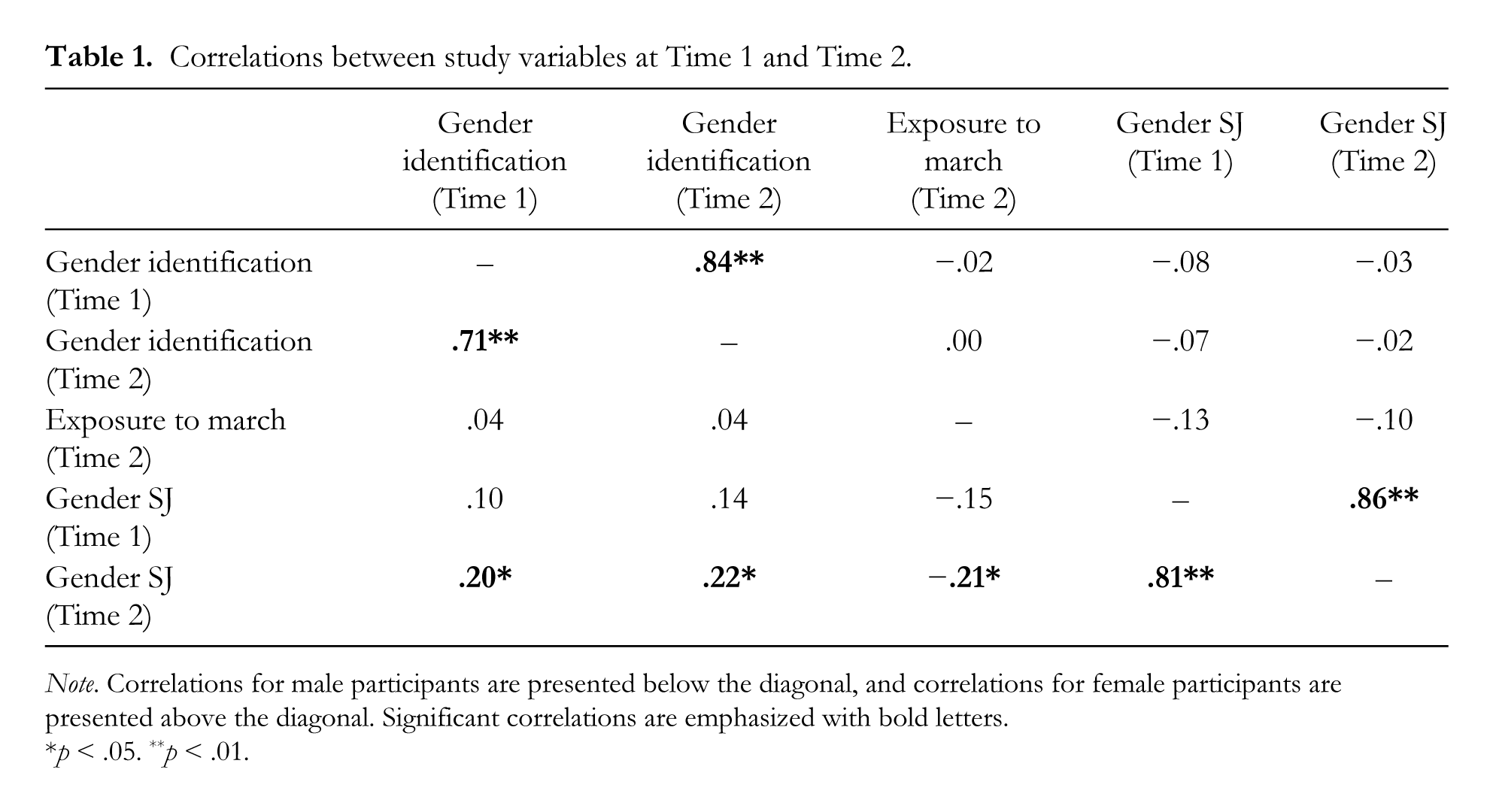
Note. Correlations for male participants are presented below the diagonal, and correlations for female participants are presented above the diagonal. Significant correlations are emphasized with bold letters.
*p < .05. **p < .01.
Main Analyses
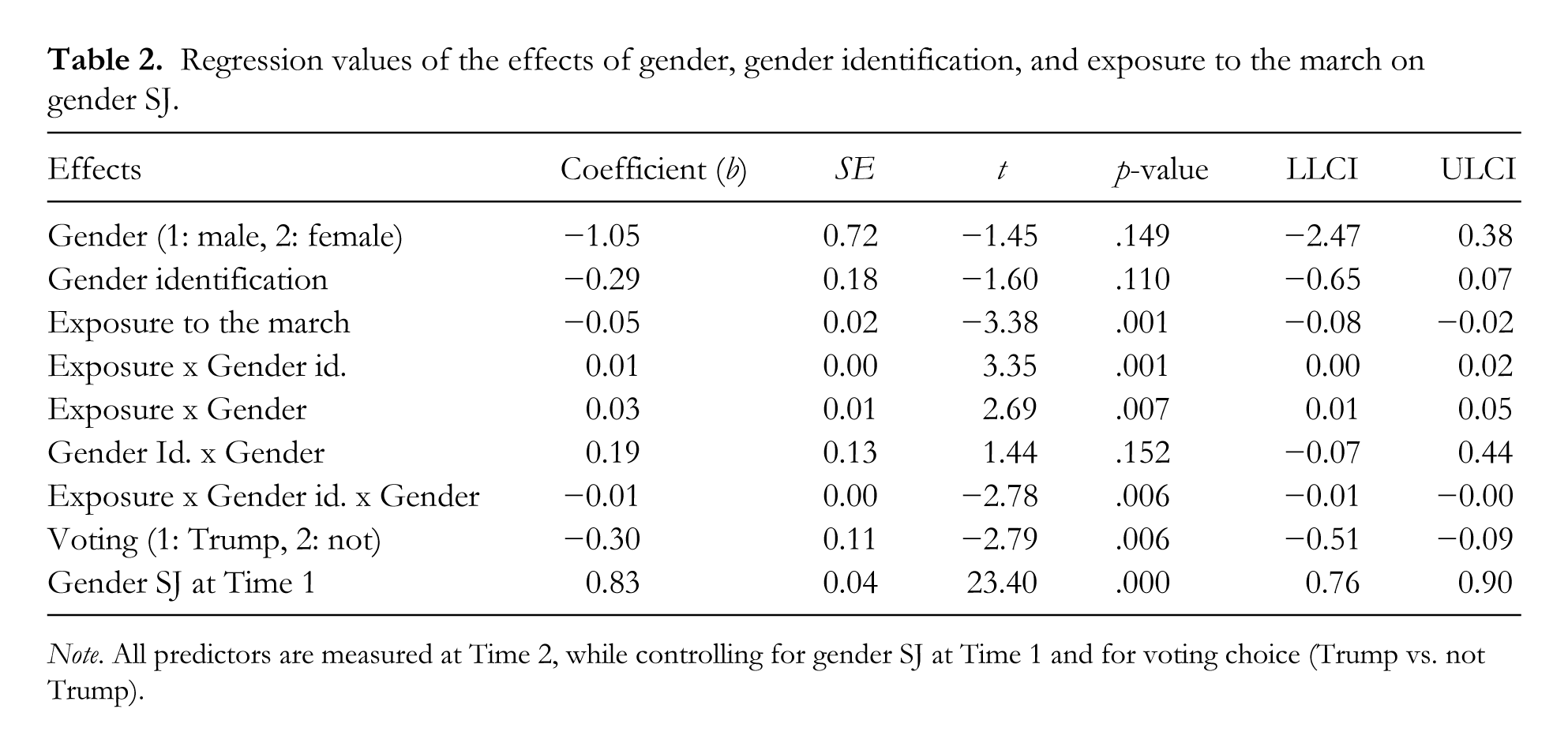
To test our main prediction, we ran a regression analysis (using Hayes’s PROCESS macro Model 3, based on 5,000 bootstrapped samples; Hayes, 2013) with degree of exposure to the march, participants’ gender, and gender identification (all measured at Time 2) as independent variables and gender SJ at Time 2 as the outcome variable. We ran the regression analysis controlling for gender SJ at Time 1 and for voting choice (Trump vs. other). The regression coefficients are shown in Table 2.
Regression values of the effects of gender, gender identification, and exposure to the march on gender SJ.
Note. All predictors are measured at Time 2, while controlling for gender SJ at Time 1 and for voting choice (Trump vs. not Trump).
The analysis revealed a main effect of exposure to the march, indicating that the more participants reported being exposed to the march, the lower was their gender SJ at Time 2 (controlling for gender SJ at Time 1). We also found a significant two-way interaction between exposure to the march and gender identification. Follow-up analyses revealed that among participants who reported higher exposure to the march, lower levels of gender identification were related to a lower gender SJ at Time 2 (controlling for gender SJ at Time 1. For highly exposed: b = 0.12, SE = 0.04, t = 2.85, p = .005, 95% CI [0.04, 0.21]; for moderately exposed: b = 0.07, SE = 0.03, t = 2.23, p = .026, 95% CI [0.01, 0.13]). The effect was not significant for participants who had less exposure to the march (p > .25). For low gender identifiers, higher levels of exposure were related to lower gender SJ at Time 2 (controlling for gender SJ at Time 1), but this effect was only marginally significant, b = −0.00, SE = 0.00, t = −1.79, p = .073, 95% CI [−0.01, 0.00]. The simple effects for moderate or high identifiers were not significant (ps > .25). Additionally, there was a significant two-way interaction between exposure to the march and participants’ gender. Follow-up analyses revealed no significant simple effects (ps > .25).
We also obtained a significant three-way interaction between degree of exposure to the march, participants’ gender, and gender identification. Follow-up analysis among men revealed a significant two-way interaction between exposure to the march and gender identification (b = 0.01, SE = 0.00, t = 3.52, p < .001, 95% CI [0.00, 0.01]; see Figure 1). As expected, among men who had low levels of gender identification, exposure to the march was related to lower gender SJ at Time 2 (controlling for gender SJ at Time 1; b = −0.01, SE = 0.00, t = −2.88, p = .004, 95% CI [−0.01, −0.00]). There was also a significant effect among men who were high identifiers, pointing to the opposite direction: the greater the exposure these highly identifying men had to the march, the higher was their system justification score at Time 2 (controlling for gender SJ at Time 1; b = 0.01, SE = 0.00, t = 2.09, p = .037, 95% CI [0.00, 0.01]). These findings fit our predictions regarding men and reflect a polarization response.
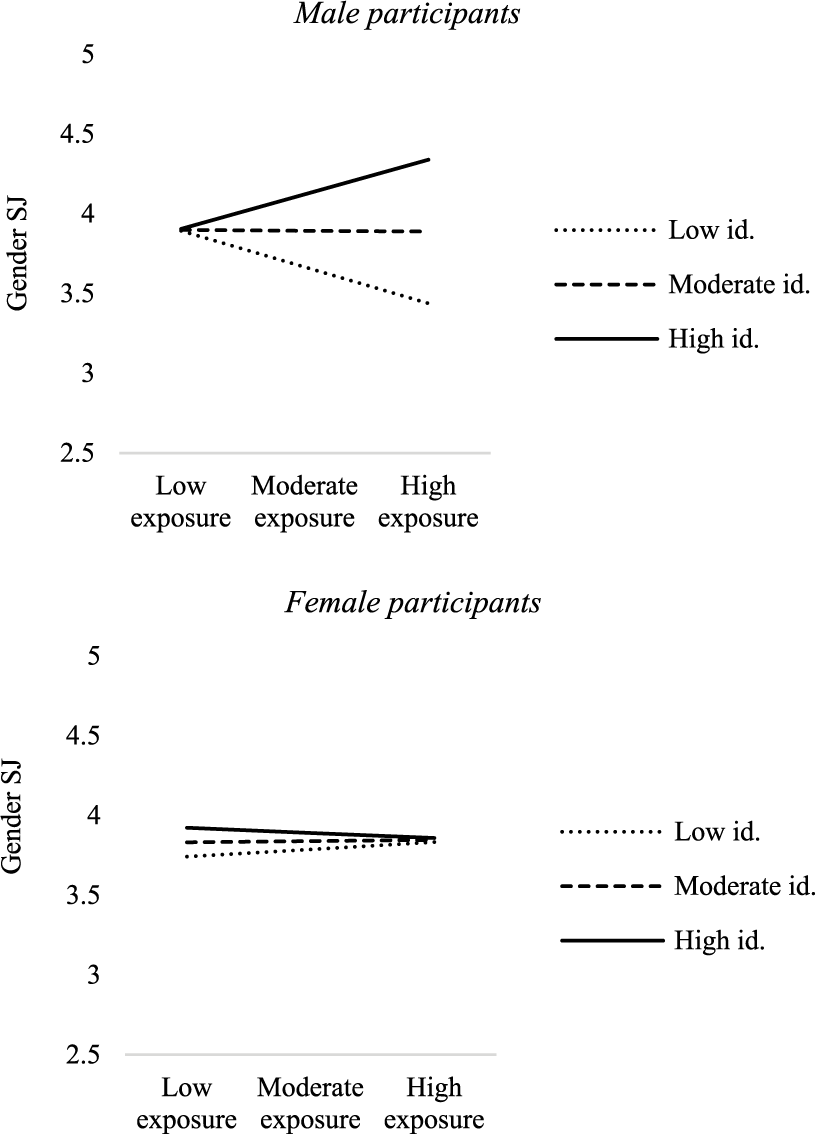
Gender-related system justification at Time 2 by gender identification and exposure to the Women’s March for male and female participants separately.
For women, there was no significant two-way interaction (p > .25) or simple effects (ps > .25). The directions for the simple interaction effects (see Figure 1) indicated that more exposure to the march was related to higher gender SJ among low and moderate identifiers, and among women with high identification, the opposite pattern was observed. These patterns, however, were not significant (ps > .25).
Discussion
Collective action in the form of demonstrations and protests can be significant in fighting social inequalities. The implicit assumption is that such action can shape public opinion in support of the protesters’ cause, and thereby indirectly also impact upon policy change (Burstein, 2003). In the current research, we addressed an understudied question—whether such assumptions are indeed valid by examining change in gender system justification over time as a function of exposure to the 2017 Women’s March. The bulk of work on collective action has been dedicated to understanding what drives members of disadvantaged groups to engage in social change efforts (van Zomeren & Iyer, 2009; van Zomeren, Postmes, & Spears, 2008). Our research question is therefore novel and informative in the sense that it addresses this gap in the literature through examining the consequences of collective action for those exposed to it.
Our results show changes in gender system justification as a function of degree of exposure to the protests, but this was only true among male participants. Low-identifying men perceived gender inequality as less legitimate as a function of exposure to the protests. Men who highly identified with their gender group showed the opposite pattern of results, such that, over time, their degree of justification of gender inequality increased as a function of exposure to the protests—suggesting a troubling backlash reaction. These differential findings for highly identified and low-identified men map on to the distinction between sympathizers and nonsympathizers, showing that those likely to be affected by collective action are those already in favour of the protesters’ cause (see Klandermans, 1997; McDonald, Fielding, & Louis, 2013; Thomas & Louis, 2014). Moreover, the findings for men are consistent with research showing that highly identified men, compared to low identifiers, perceived subtle gender discrimination as more legitimate (Iyer & Ryan, 2009) and are more judgmental toward aggressive confronters of sexism (Becker & Barreto, 2014). The current research corroborates these findings for highly identified men, using a highly ecologically valid context.
Nonetheless, when looking only at Time 1, gender identification was not associated with gender SJ for men. Moreover, at Time 2, when exposure to the protests was low, there was no association between gender identification and gender SJ for men. Indeed, identification predicted gender SJ only for men who were exposed to the march. These findings are in line with our contention that the march served as a cue that potentially triggered reactions to gender inequality. When such cues were absent, gender identification was not predictive of attitudes towards gender inequality for men in our study.
For women, the interaction between identification and exposure to the protests was not significant. This is somewhat inconsistent with previous research, which indicates that low-identified women are prone to be less committed to advance women’s rights, while findings for high-identifying women are sometimes mixed (Becker & Barreto, 2014; Iyer & Ryan, 2009; Kaiser et al., 2009). Even the correlation table (Table 1) demonstrates that whereas for men there was a significant correlation between identification and gender SJ at Time 2, for women identification did not relate to gender SJ at any time point. This gender difference in the extent to which gender identification is predictive of gender SJ maps on to recent findings by Kray et al. (2017), who found that gender identification was a stronger predictor of gender SJ for men than for women (Kray et al., 2017). They explain this finding by suggesting that men’s gender SJ reflects egocentrism arising from identification with the dominant group in the gender hierarchy. For women, the support of gender inequality might be a more complex and ambivalent process, particularly when considering the meaning of gender identification for them. Women can identify strongly as “women,” but it would make a difference whether they identify with a traditional or a progressive gender role (Becker & Wagner, 2009). Accordingly, each type of identity content can produce a different set of gender attitudes among women for whom their gender identity is a core part of their self-concept. This might explain why in past research with highly identified women, the pattern of findings is inconsistent (Becker & Barreto, 2014; Iyer & Ryan, 2009; Kaiser et al., 2009), and why in our own research women’s level of identification was not a strong predictor of their attitudes towards gender inequality.
Furthermore, research has shown that women vary in the extent to which they identify as women and also as a feminist, and the combination of the level of identification on these dimensions can produce qualitative differences in gender attitudes (van Breen, Spears, Kuppens, & de Lemus, 2017). For example, identification with women has been shown to be related to characteristics such as femininity and self-stereotyping, while feminist identification is related to attitudes toward the group’s social position, such as support for collective action and perceptions of sexism (van Breen et al., 2017). Future work in this domain can therefore greatly benefit from considering, beyond gender identification, people’s level of feminism and adherence to traditional gender roles—variables that were not considered in the current study.
Another limitation of our study is the conceptualization of exposure to the march. It is important to note that we measured perceived exposure, we did not manipulate it. To this end, we cannot infer that the march itself affected gender SJ, as many other events occurred between both measured time points, some of which might also be related to exposure to the march. A manipulated variable of exposure could provide more definite findings regarding the effect of the march. Moreover, people’s personally held sexist attitudes could influence their level of exposure to the march—a problem we attempted to overcome by controlling for attitudes at Time 1. Thus, even though our design has clear advantages on the ecological validity side, future work in this domain can advance this body of knowledge by further considering manipulated forms of exposure to collective action.
Furthermore, given that we ran the study on Amazon Mechanical Turk, the sample was not representative of U.S. population. This is evident when considering the voting pattern of participants. Only 29.1% reported that they voted for Trump (Trump won 46.09% of the popular vote). Thus, our findings should be interpreted in light of this restricted sample in terms of political inclination, implicating a liberal trend in responses. However, even though the majority of participants in the sample did not vote for Trump, examination of the mean levels of gender SJ did not reveal an overly liberal sample (across time points the mean level of gender SJ was 4.2 for men and 3.5 for women on a 7-point Likert scale), rendering this concern less troubling for the purpose of this study.
A further limitation in our work is that it did not touch on psychological mechanisms for the effects. While we have an understanding of on whom the Women’s March had the most impact (low- and high-identified men), we cannot say why. Several processes can come into play in this regard, which opens up several additional fruitful directions for future research. First, it could be the case that for low-identified men, those who marched might have been seen more positively, communicating an important cause and mission. Recent work has shown that the communication of group-based anger by the outgroup can enhance empathy and thus mitigate conflict intentions among ingroup members (de Vos, van Zomeren, Gordijn, & Postmes, 2013). Such empathy might arise from assuming that the angry agent has constructive intentions towards the ingroup and that she aims at maintaining a positive long-term relationship. Such perceptions, or more precisely, metaperceptions about the protesters’ intentions, might also be infused by gender stereotypes, ascribing benevolent intentions to the protesters who were, by and large, women. Such possibilities remain to be seen in future work.
Another explanation for our results might concern similarities in values or opinions. Low-identifying men, who were previously found to hold less sexist attitudes than high-identifying men (Iyer & Ryan, 2009), probably felt energized and gained normative reassurance by observing half a million people marching for a cause they also connect with (McDonald et al., 2013; Myers & Lamm, 1976). Such feelings of shared identity around common norms can be powerful in leading those exposed to the protest to support its cause. This explanation echoes Louis’s (2009) argument that protesters could use messages about a superordinate identity to recruit support from the general public, and thus sympathy and support for their goals.
Meanwhile, the backlash found for high-identifying men could be explained with reactance theory (Burgoon et al., 2002; Rains, 2013), which indicates that people who are exposed to an opposing view, and especially if they feel pressured to change their attitudes, might become defensive and strengthen their previously held attitudes (Dillard & Shen, 2005). Previous research also indicated that high group identifiers may be motivated to express dissenting views from perceived group norms when they feel those norms are harmful to the collective interest of the group (Packer & Chasteen, 2010)—highly identified men might have perceived the march as a norm conflict and therefore felt a stronger need to express opposing views. It is important for activists to understand the underlying mechanism for this backlash effect, and thus future research should further investigate this process not only for theoretical but for practical reasons as well.
Relatedly, future work can also benefit from studying the downstream effects of the changes observed in system justification over time. For example, one possibility is that an increase in gender SJ, as observed among highly identifying men, can subsequently reduce their potential anger towards the Trump administration’s actions and decisions with respect to human rights (see Jost, Becker, Osborne, & Badaan, 2017). Such an effect would suggest that the protests might even have, inadvertently, fostered further resistance to change in the status quo—implicating a backlash that is beyond a temporary change in gender system justification.
In closing, our work advances understanding of the aftermath of one of the largest demonstrations in world history. On January 21, 2017, more than five million people came together on all seven continents of the world (Chenoweth & Pressman, 2017). As stated on the Women’s March website (https://www.womensmarch.com/march/),
we were answering a call to show up and be counted as those who believe in a world that is equitable, tolerant, just and safe for all, one in which the human rights and dignity of each person is protected.
Given that so many people took part and were exposed to these messages, it is of great interest to understand whether such exposure indeed predicted more equality-oriented gender attitudes. Our research demonstrates that large-scale collective action can have a polarizing effect on those exposed to it. On the one hand, it can produce a backlash among those who are (likely) nonsympathizers of the cause, leading them to be even less in favour of the change promoted by the action. On the other hand, it can elicit a favourable reaction on the part of those who are sympathizers of the cause, and potentially even further mobilize them to promote the desired change. Together, this work adds an important missing piece to current research on collective action and sets the stage for productive research and practical efforts aimed at advancing change in a domain much resistant to it.
Footnotes
Funding
The author(s) received no financial support for the research, authorship, and/or publication of this article.