







Abstract
First-generation students show lower academic performance at university compared to continuing-generation students. Previous research established the value in taking a social identity perspective on this social-class achievement gap, and showed that the gap can partly be explained by lower compatibility between social background and university identities that first- compared to continuing-generation students experience. The present paper aimed to increase insight into the processes through which this low identity compatibility leads to lower academic achievement by examining first-year university students’ adjustment to university in two key domains: the academic and the social domain. These were examined as two routes through which the social-class achievement gap may arise, and hence perpetuate this group-based inequality. Adjustment was examined both through students’ actual integration in the academic and social domains, and their internally experienced concerns about these domains at university. A longitudinal study among 674 first-year university students (13.6% first-generation) showed that first-generation students experienced lower identity compatibility in their first semester, which was in turn related to lower social, but not academic, integration. Lower identity compatibility was also related to more concerns about the social and academic domains at university. Low identity compatibility was directly related to lower academic achievement 1 year later, and this relationship was mediated only by lower social integration at university. These findings show that to understand, and hence reduce, the social-class achievement gap, it is important to examine how low identity compatibility can create difficulties in academic and particularly social adjustment at university with consequences for achievement.
Keywords
Going to university is an important life transition for young people that some make more easily than others (Holmbeck & Wandrei, 1993; Jetten, Iyer, Tsivrikos, & Young, 2008). This transition seems to be especially difficult for first-generation students, whose parents do not have a higher education degree (Iyer, Jetten, Tsivrikos, Postmes, & Haslam, 2009; Reay, 2005). For example, their academic achievement is lower, and their drop-out rate is higher compared to continuing-generation students (Stephens, Brannon, Markus, & Nelson, 2015). As such, it appears that education can maintain social inequalities even though it is meant also as a force to erode them (DeParle, 2012; Stephens, Fryberg, Markus, Johnson, & Covarrubias, 2012).
The social-class achievement gap (i.e., the academic achievement gap between first- and continuing-generation students; Harackiewicz, Canning, Tibbetts, Priniski, & Hyde, 2016) cannot be fully explained by differences in academic preparation and financial resources between first- and continuing-generation students (i.e., those who have at least one parent with a higher education degree; Jetten et al., 2008; Oyserman, 2013; Stephens, Markus, & Fryberg, 2012; Stephens, Townsend, Markus, & Philips, 2012). Previous research has established the value in taking a social identity perspective (Tajfel & Turner, 1979) on this group-based inequality, and has shown that the social-class achievement gap can be partly explained by lower compatibility between social background and university identities that first- compared to continuing-generation students experience (Stephens, Fryberg, et al., 2012). The present paper aims to increase insight into the processes through which this low identity compatibility can lead to lower academic achievement, and hence to provide insight into key social identity processes that can be addressed to reduce the social-class achievement gap.
A Social Identity Perspective on the Social-Class Achievement Gap
The transition to university is a change in identity (Iyer et al., 2009; Jetten et al., 2008; Stephens et al., 2015) that can be very challenging, particularly when an existing identity is experienced as in consistent with the new identity (Ethier & Deaux, 1994; Iyer et al., 2009; Jetten, O’Brien, & Trindall, 2002). Previous research has shown that this more often is the case for first-generation students compared to continuing-generation students—first-generation students experience less compatibility or fit between their social background identity and their new identity as a university student (Iyer et al., 2009; Jetten et al., 2008). Several factors have been suggested to play a role in this lower experienced compatibility. First, compared to first-generation students, more people in continuing-generation students’ social environment go to university, and going to university is also expected more of continuing-generation students personally (Iyer et al., 2009). Hence, continuing-generation students see going to university as a “normal” part of their lives (Reay, 1999). Consequently, the new university student identity is experienced as more compatible with the social background identity for continuing- compared to first-generation students.
Another way in which first-generation students can experience less compatibility or fit between these two identities is the experience of a mismatch in norms and values between their background and the university environment (de Vreeze, Matschke, & Cress, 2018). Stephens and colleagues showed that middle-class norms of independence (e.g., expressing one’s own views, paving one’s own path) are prevalent at universities (Stephens, Fryberg, et al., 2012; Stephens, Townsend, et al., 2012). This constitutes a mismatch with norms from first-generation students’ mostly working-class backgrounds that are more likely to emphasize interdependence (e.g., connecting to others, being attentive to others’ needs, and being part of a community; Fiske & Markus, 2012; Stephens, Fryberg, & Markus, 2011). This mismatch in norms and values partly explained first-generation students’ lower academic achievement (Stephens, Fryberg, et al., 2012).
Processes Underlying the Social-Class Achievement Gap
So far, less is known about the processes through which low experienced compatibility between social background and university identities leads to lower academic achievement—processes which may then be addressed to reduce the social-class achievement gap. The present research provides insight into these underlying processes by examining first-year university students’ adjustment to university in two key domains: the academic and the social domain. We investigate adjustment in these domains both through first-year students’ actual integration in the academic and social domains, and their internally experienced concerns about these domains at university.
Academic Adjustment in the Transition to University
First, the transition to university entails an integration into the academic environment: knowing where to find and how to access university and academic support services, knowing how to prepare for classes and exams, and understanding and making use of the university’s academic infrastructure. Students who experience low identity compatibility feel less well prepared before starting at university (Jetten et al., 2008), suggesting that actual academic integration may also be more difficult for these students. Moreover, students who experience low identity compatibility may also be more concerned about their achievement at university. Although previous research has not shown a direct link between identity compatibility and academic concerns, first-generation students have been shown to be more uncertain about academic fit at university (Granfield, 1991; Harackiewicz et al., 2014; Johnson, Richeson, & Finkel, 2011). We argue that this may be particularly the case to the extent that they experience low compatibility between their social background and university identities—and thus predict that first-year students who experience low identity compatibility will be less well academically integrated at university and will experience more internal academic concerns.
In turn, we expect this lower academic integration and more academic concern to harm these students’ academic achievement at the end of their first year at university. Lower actual academic integration translates into students having fewer opportunities to do well at university since integration entails having access to important resources to perform well, such as academic support services, the university’s academic infrastructure, and knowing how to prepare for classes and exams. Additionally, experiencing concerns and worries about academic achievement at university is stressful (Stephens, Townsend, et al., 2012) and cognitively demanding (Cadinu, Maass, Rosabianca, & Kiesner, 2005; Johns, Inzlicht, & Schmader, 2008; Johnson et al., 2011). This cognitively demanding side of academic concerns may make it more difficult for students to succeed at university, and is hence also expected to predict lower academic achievement at the end of their first year at university.
Social Adjustment in the Transition to University
In the transition to university it is not just lower academic adjustment that may make it more difficult to achieve for students who experience low identity compatibility. We argue that social adjustment at university is also a key process through which low identity compatibility can lead to lower academic achievement. However, this process has, to the best of our knowledge, not yet been examined in relation to the social-class achievement gap.
Specifically, the transition to university also entails integration into a new social environment, with students getting to know and spending time with fellow students and participating in social activities organized by student organizations (Severiens & Wolff, 2008; Stephens et al., 2015). This social integration has not been examined from an identity compatibility perspective, but has been linked to students’ generation status. It has been suggested that first-generation students have fewer opportunities to participate in social activities because they have lower financial resources (Stephens et al., 2015), and that it is more difficult for them to get a sense of belonging to the university (Ostrove & Long, 2007; Rubin, 2012). We expect that particularly students who experience a larger gap between their social background and the university environment have more difficulty integrating socially into the university environment.
Difficulty with social integration into the university student environment is problematic because it may negatively influence academic achievement. First, the university student environment is a potential social network that can support coping with stressful events in the new environment (Cohen & Wills, 1985) and be a source of social belongingness, which has been shown to be positively related to motivation and performance in a domain (van Laar, Bleeker, Ellemers, & Meijer, 2014; Walton & Cohen, 2007). Second, this social network can also be a source of information and knowledge, for example, by studying together, exchanging class notes, and discussing subject matter. In this way, difficulties with social integration into the new university environment for students who experience low identity compatibility may be an important process through which the social-class achievement gap arises.
Again, we see adjustment to university not only consisting of actual integration into a domain, but also of internally experienced concerns about that domain. Besides encountering more difficulty with actual integration into the social domain, first-year students who experience a larger gap between their social background and going to university may also be more concerned about the social domain at university (e.g., about making social contacts, feeling lonely at university). Experiencing such social concerns is stressful (Baumeister & Leary, 1995; Leary, 2010). Having to cope with this additional stress and experiencing this additional cognitive demand (Baumeister, DeWall, Ciarocco, & Twenge, 2005) may make it more difficult for students to succeed at university, and is hence also expected to predict lower academic achievement at the end of their first year at university.
The Present Research
In conclusion, in the present paper we argue that to understand, and hence reduce, the social-class achievement gap, it is important to examine how low experienced identity compatibility can create difficulties in academic and social adjustment to university, and how this, in turn, can lead to lower academic achievement. That is, difficulties in both academic and social adjustment for students who experience low identity compatibility are examined as routes through which disparities in academic achievement between first- and continuing-generation students may arise, and hence perpetuate this group-based inequality. We predict that first-generation students, compared to continuing-generation students, experience lower fit or compatibility between their social background and university identities in the first semester at university. Additionally, we predict that lower identity compatibility relates to lower academic and social integration and to more internal academic and social concerns at university, and that these, in turn, are related to lower academic success at the end of the first academic year.
Methods
Participants and Procedure
An online survey was conducted among 674 first-year university students (71.7% female; Mage = 18.56, SDage = 2.41). The research was conducted at the University of Leuven, a major flagship public university in Belgium. Although it is a highly prestigious university (ranked 47 in the Times Higher Education World University Rankings in 2018), there are no selection procedures (with the exception of the studies of medicine and dentistry) and the tuition fees are low compared to international standards (below €1,000). Seventy-two percent of participants resided in student housing in Leuven, 17% commuted to Leuven (as Belgium is small, this means a commute of usually no more than 1 hour), and 11% lived with their parents in or near Leuven.
All departments were invited to participate in this research by the university’s Educational Advice Service Center. When departments agreed, the survey was sent to the department’s first-year students during their second and third month at university. The study was presented as an investigation to gain insight into first-year students’ experiences at the university so far, and was completed voluntarily. Participants represented the wide range of departments at the university: Arts (36.6%), Medicine (24.8%), Movement and Rehabilitation Sciences (12.3%), Pharmaceutical Sciences (9.3%), Social Sciences (Communication Sciences, Political Sciences, and Sociology; 8.8%), Law (7.0%), and 1.2% from other departments (Economics and Business, Psychology and Educational Sciences, Sciences, Engineering, and Architecture). Most participants (89%) indicated being Belgian and 15.3% (also) selected other options, such as Dutch, French, Italian, Turkish, Moroccan, or Polish. Based on linked university administration data on parental education level, 13.6% of the sample (92 participants) was identified as first-generation student, defined as students for whom both parents do not have a higher education degree (i.e., at least a bachelor’s degree; Wohn, Ellison, Khan, Fewins-Bliss, & Gray, 2013). This percentage in the sample is equivalent to the overall percentage of first-generation students at the university. Seventy-eight percent of the sample consisted of continuing-generation students (i.e., at least one parent with at least a bachelor’s degree), and the status of 8.5% of the sample could not be determined 1 (parental education level of both parents unknown, or education level of one parent unknown and one parent without a higher education degree). 2
Measures
Unless otherwise indicated, items were answered on a 7-point scale (1 = strongly disagree, 7 = strongly agree). Measures are scored such that higher scores indicate being higher on the concept. Table 1 presents an overview of correlations between all variables. The supplemental materials document includes the verbatim wording of items of the measures, and provides an overview of additional measures not included in the manuscript.
Correlations between variables.
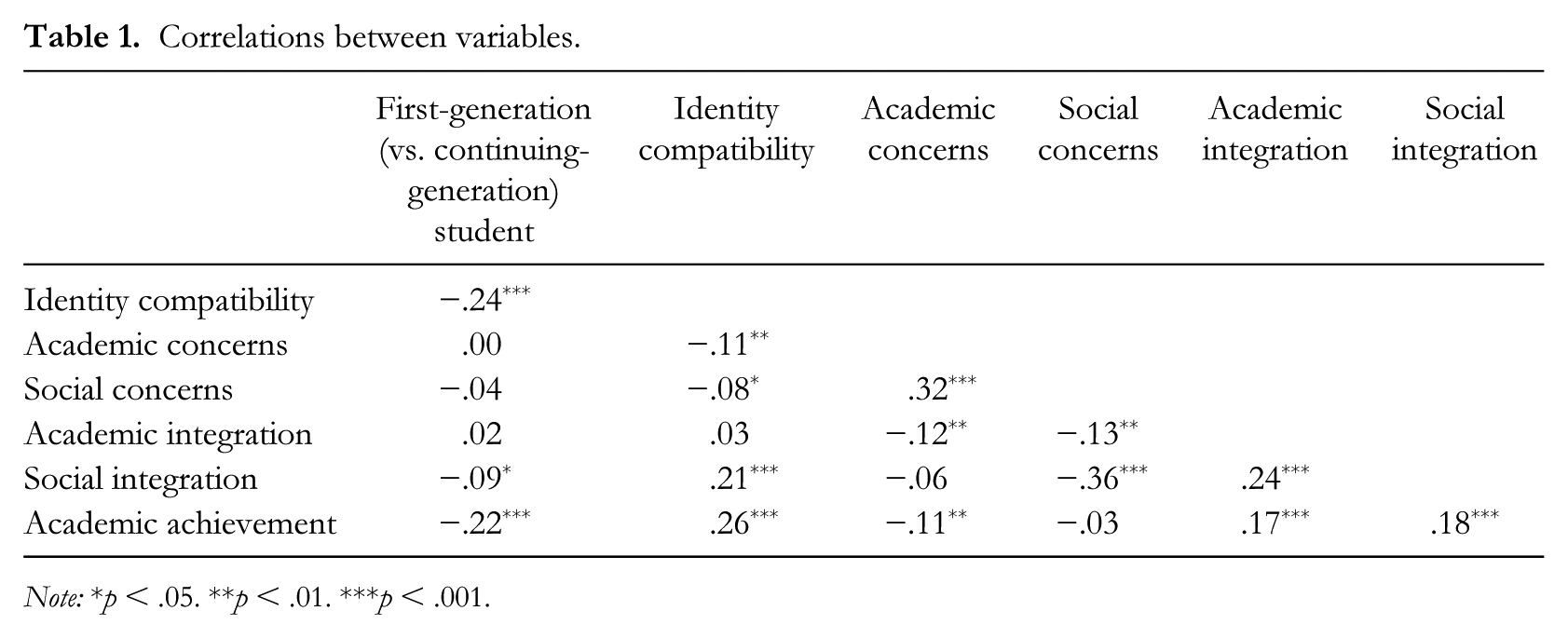
p < .05. **p < .01. ***p < .001.
Identity compatibility
The identity incompatibility measure (Iyer et al., 2009) was introduced by telling participants that students differ in the extent to which they feel like going to university fits their social background (where they come from, how things work in their family, what friends from home do), and that we would like to ask them a few questions about different aspects of their social background. Three items then assessed the amount of compatibility students perceived between going to university and three aspects of their social background: immediate family background, wider social background, and friendship networks (α = .69; M = 4.50, SD = 1.41). 3 To answer each item, participants could choose between seven sets of circles, ranging from no overlap between going to university and their social background (low compatibility) to almost complete overlap (high compatibility; see the supplemental materials document for a visual representation; adapted from Aron, Aron, & Smollan, 1992; Tropp & Wright, 2001).
Academic integration
The measure of academic integration consisted of 29 items covering a wide range of areas related to the degree to which students had integrated into the academic university environment. The scale consisted of items related to whether students know where to find and how to access university services, know how to prepare for classes and exams and where to find academic support services, and understand and make use of the university’s academic infrastructure. This measure was created consulting previous studies measuring integration in or adjustment to the academic domain (e.g., Baker & Siryk, 1999; Ostrove & Long, 2007; Rienties & Tempelaar, 2013), and items were tailored to the present specific university context. Example items were “I know where to find information on deadlines and procedures for my studies,” “I regularly visit the online student portal of my department,” and “I know how to prepare for exams” (α = .84; M = 5.28, SD = 0.62).
Social integration
The measure of social integration consisted of eight items assessing the degree to which participants had integrated into the social environment at university. Items asked about getting to know and spending time with fellow students, participating in (social) activities organized by student organizations, and feeling connected to other students (based on the Social Adjustment subscale of the Student Adaptation to College Questionnaire and adjusted to the present university context; Baker & Siryk, 1999). Example items are “I spend time with fellow students outside of classes,” “I participate in activities organized by my major’s student organization,” and “When I have a question regarding my studies, I have the courage to ask a fellow student” (α = .83; M = 4.61, SD = 1.16).
Academic concerns
Participants were asked to indicate the extent to which they were concerned about experiencing several things at university relating to the academic domain (i.e., not attaining good grades, not feeling competent at university, not successfully completing university, and performing poorly academically), ranging from 1 (not at all concerned) to 7 (very concerned; α = .90; M = 4.72, SD = 1.34; items were constructed based on the Confidence in Learning subscale of the Science Motivation Questionnaire; Glynn & Koballa, 2006; see also Glynn, Taasoobshirazi, & Brickman, 2009; Wohn et al., 2013).
Social concerns
On the same scale, participants were asked to indicate the extent to which they were concerned about feeling lonely at university, feeling excluded at university, having few social contacts at university, and feeling like they do not belong at university (α = .93; M = 2.79, SD = 1.42). These items were constructed based on the Need to Belong Scale (Leary, Kelly, Cottrell, & Schreindorfer, 2013). The order of the academic and social concerns scales was counterbalanced.
Academic achievement
At the end of the academic year (i.e., 1 year after data collection), university administration data were made available regarding participants’ academic achievement during their first year at university. These data were provided by the Educational Advice Service Center and linked to the data anonymously. The academic achievement measure is the percentage of study credits participants obtained during the first academic year (the number of study credits students should take in the first year is the same for all students). Obtained study credit is a measure of the number of courses (weighed for how big or important those courses are) for which a student passed the final exam (i.e., a result of at least 10 out of 20). With a result below 10, the student has to take the course again in the next academic year. If a student obtained the study credits of all courses in their first academic year (i.e., had a result of at least 10/20 for all courses), then he or she has an academic achievement of 100% (M = 70.66, SD = 32.66). This measure is used as the academic achievement measure at the university at which the data were collected, 4 with crucial consequences when this achievement is considered too low after the first academic year: Students are not allowed to continue their major when they obtain less than 30% of their credits in the first year.
While it would be highly interesting to test the predicted effects on academic achievement at the end of the academic year while controlling for a baseline measure of academic achievement at the start of the academic year, unfortunately no such baseline measure was available. We elaborate more on this matter in the Discussion section.
Results
Descriptive Results
We started by examining whether first- and continuing-generation students differed on the measures in the study. First, this confirmed that there was an achievement gap between first- and continuing-generation students in our sample. An analysis of variance showed that first-generation students (M = 54.97, SD = 35.80) had lower academic achievement in the first academic year than continuing-generation students (M = 74.63, SD = 30.48), F(1, 600) = 30.40, p < .001, ηp2 = .05. First-generation students also more often fell in the category of obtaining less than 30% of their credits in the first year and consequently were not allowed to continue their major more often than continuing-generation students (30.8% of first-generation students did not obtain the necessary credits vs. 12.3% of continuing-generation students), χ2 (1, N = 602) = 20.47, p < .001.
Additionally, as expected, first-generation students (M = 3.74, SD = 1.09) experienced less compatibility between their social background and university identities compared to continuing-generation students (M = 4.66, SD = 1.41), F(1, 608) = 35.91, p < .001, ηp2 = .06. Moreover, first-generation students (M = 4.39, SD = 1.37) were less socially integrated at university than continuing-generation students (M = 4.68, SD = 1.09), F(1, 526) = 4.44, p = .036, ηp2 = .01. No differences between first- and continuing-generation students were found in academic integration (p = .841), academic concerns (p = .886), or social concerns (p = .486). 5
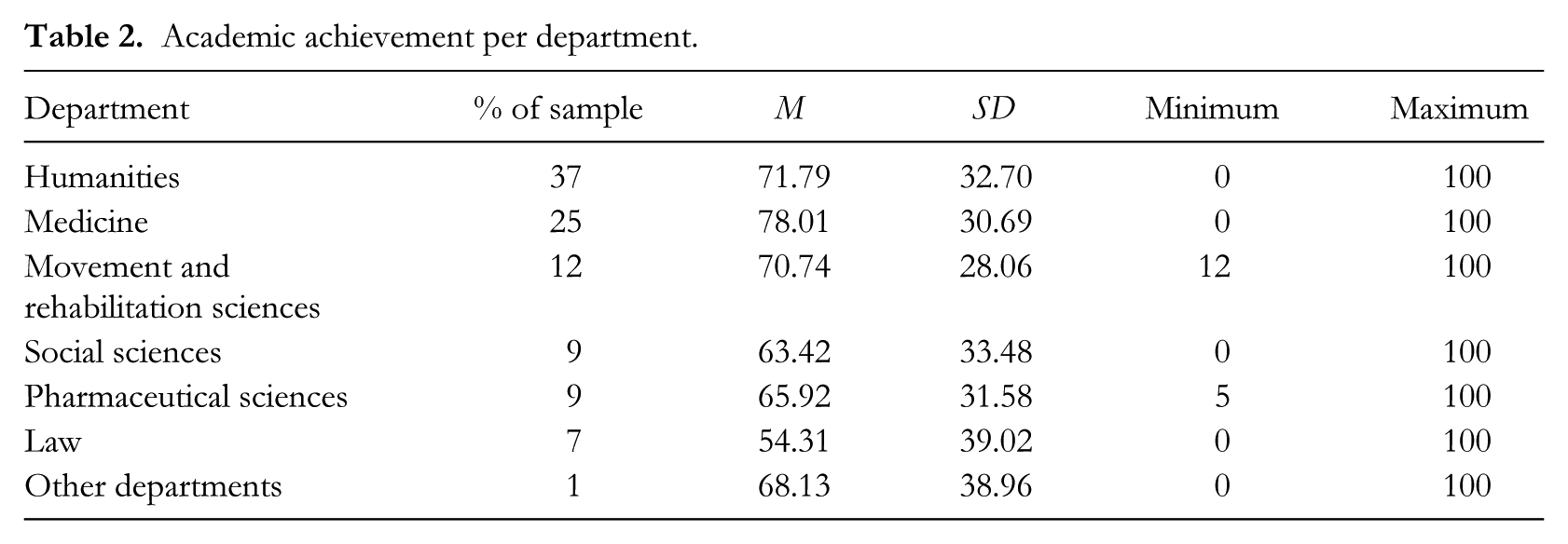
Finally, before turning to the main analyses, we checked whether academic achievement varied between departments. Table 2 shows the average academic achievement by department. An analysis of variance showed that several departments indeed differed significantly from each other in average academic achievement scores, F(6, 645) = 4.11, p < .001, ηp2 = .04. Law had a significantly lower average academic achievement than humanities (p = .019) and medicine (p < .001), and medicine had a marginally significantly higher academic achievement than social sciences (p = .063). Yet, the intraclass correlation showed that only 3% of the variance in academic achievement was at the department level (p = .197). Thus, there was no significant proportion of variance in academic achievement at the department level.
Academic achievement per department.
Statistical Model
We estimated a path model in Mplus 5 (Muthén & Muthén, 1998) to test the hypotheses that first-generation students experience lower identity compatibility, that low identity compatibility predicts lower academic and social integration and higher academic and social concerns, and that these, in turn, are related to lower academic achievement 1 year later. Continuous independent variables were centered around the mean, and correlations between mediators were included in the model. 6 A first model only including the hypothesized relationships showed insufficient model fit (CFI = .85, TLI = .49, RMSEA = .11, SRMR = .05; Bentler, 1990), and model modification indices suggested adding the direct effects of generation student status on academic achievement, and of identity compatibility on academic achievement. Adding these effects to the model significantly increased the model fit, χ2dif = 49.34, dfdif = 2, p < .001. This final model is depicted in Figure 1 and showed good model fit, χ2 (4 df) = 5.54, p = .24; CFI = 1.00, TLI = .98, RSMEA = .02, SRMR = .01). 7
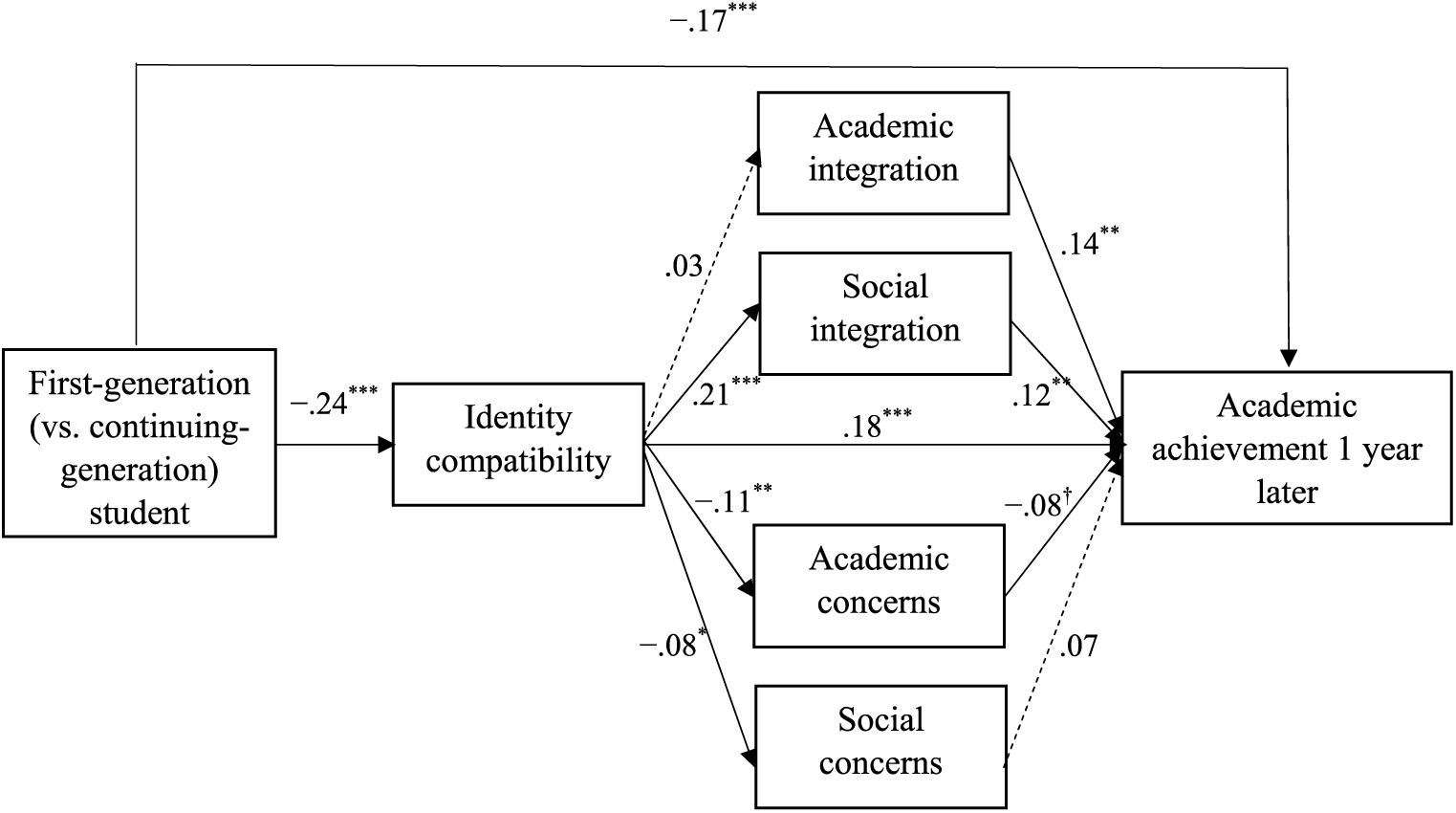
Path model of the final model showing standardized parameter estimates, χ2 (4 df) = 5.54, p = .24; CFI = 1.00, TLI = .98, RSMEA = .02, SRMR = .01.
Main Results
In presenting the results of this model, we first outline the effects of one variable on the next variable in the model, and then we discuss the direct and indirect effects of the mediating paths in the model.
First, in line with the findings of the descriptive analyses reported before, results showed that first-generation students experienced lower identity compatibility than continuing-generation students (β = −0.24, SE = 0.04, 95% CI [−0.31, −0.16], p < .001). 8 In turn, identity compatibility predicted significantly higher social integration (β = 0.21, SE = 0.04, 95% CI [0.13, 0.29], p < .001), but, contrary to expectations, did not predict higher academic integration (β = 0.03, SE = 0.04, 95% CI [−0.05, 0.11], p = .509). Identity compatibility also predicted lower academic concerns (β = −0.11, SE = 0.04, 95% CI [−0.18, −0.03], p = .006) and lower social concerns (β = −0.08, SE = 0.04, 95% CI [−0.16, −0.01], p = .033) at university. This confirms the hypothesis that experiencing compatibility or fit between social background and university identities is related to an easier transition to university in terms of social integration into that environment, and in terms of experienced academic and social concerns at that setting. Identity compatibility was not associated with being more academically integrated into university (we elaborate on potential explanations for this in the Discussion section).
Next, examining how integration and concerns relate to academic achievement 1 year later, results showed that students had higher academic achievement at the end of the academic year when they experienced higher academic integration (β = 0.14, SE = 0.04, 95% CI [0.06, 0.23], p = .001) and higher social integration (β = 0.12, SE = 0.05, 95% CI [0.03, 0.21], p = .007) in the first semester. Academic achievement was not predicted by reported social concerns in the first semester (β = 0.07, SE = 0.04, 95% CI [−0.02, 0.15], p = .120), and academic achievement was only marginally negatively predicted by academic concerns (β = −0.08, SE = 0.04, 95% CI [−0.16, 0.00], p = .056). We return to potential explanations for this in the Discussion section.
Second, we discuss direct and indirect effects of the mediating paths in our model. Results showed significant direct relations between identity compatibility and academic achievement (β = 0.18, SE = 0.04, 95% CI [0.11, 0.26], p < .001), 9 and between being a first-generation student and academic achievement (β = −0.17, SE = 0.04, 95% CI [−0.25, −0.09], p < .001). 10 The results showed indirect effects of generation status on the integration and concerns variables via identity compatibility in the expected directions: Compared to continuing-generation students, first-generation students experienced more social concerns (β = 0.02, SE = 0.01, 95% CI [0.00, 0.04], p = .044) and more academic concerns (β = 0.03, SE = 0.01, 95% CI [0.01, 0.05], p = .013), and were less integrated socially (β = −0.05, SE = 0.01, 95% CI [−0.07, −0.03], p < .001) via lower identity compatibility. No indirect effect of generation status on academic integration via identity compatibility was found (β = −0.01, SE = 0.01, 95% CI [−0.03, 0.01], p = .512).
Finally, we inspected the indirect effects of generation status on academic achievement via identity compatibility and the integration and concerns measures. This revealed a small but significant indirect effect via social integration (β = −0.01, SE = 0.003, 95% CI [−0.02, −0.001], p = .026): First-generation students’ lower academic achievement at the end of their first academic year was partly explained by lower social integration at university via lower identity compatibility. No indirect effect was found for academic integration (p = .520), academic concerns (p = .132), nor social concerns (p = .216). Combined, these findings suggest that particularly lower social integration into the university environment (rather than academic integration or concerns)—as predicted by lower perceived compatibility between social background and university identities—appears to be a route through which the social-class achievement gap arises.
Discussion
The present research examined lower academic and social adjustment at university for first-year students who experience low identity compatibility as two routes through which disparities in academic achievement between first- and continuing-generation students may arise, and hence provides insight into key processes that can help reduce the social-class achievement gap. Replicating previous work (Iyer et al., 2009; Jetten et al., 2008), first-generation students, compared to continuing-generation students, experienced lower fit or compatibility between their social background and university identities in the first semester at university. Moreover, conceptually replicating the work by Stephens et al. (Stephens, Fryberg, et al., 2012), low identity compatibility was directly related to lower academic achievement at the end of the academic year. Moving beyond previous work, social and academic adjustment to university were examined as underlying processes for these effects.
Adjustment Processes Underlying the Social-Class Achievement Gap
Adjustment was investigated both through first-year students’ actual integration in the academic and social domains, and through their internally experienced concerns about these domains at university. First, we predicted that lower identity compatibility would be related to lower academic and social integration at university. This was confirmed for social integration, but not for academic integration. This finding is in line with previous work demonstrating that achievement gaps between traditionally underrepresented and dominant groups often persist even when students have the necessary academic skills and material resources (Bailey & Dynarski, 2011; Stephens et al., 2015). Further underpinning the importance of the social domain is the finding that although both social and academic integration predicted academic achievement, only social integration was a mediator of the effect of generation status via identity compatibility on academic achievement. Thus, the current work underpins the importance of social adjustment as an understudied factor in the social-class achievement gap: lower social integration, in particular among students who experience low identity compatibility, seems to be a route through which disparities in academic achievement between first- and continuing-generation students may arise. This social integration is also a factor that universities can address. For example, introduction activities that universities organize for incoming students are often primarily focused on academic integration. The present findings indicate that it is also key to incorporate activities that foster students’ social integration at university. Future research could also examine the effectiveness of such initiatives for students’ social integration, particularly for students who experience low identity compatibility.
Second, we predicted that lower identity compatibility would be related to more internal academic and social concerns. The results indicated the importance of distinguishing between actual integration and internally experienced concerns when examining academic and social adjustment to university. In line with expectations, first-year students experiencing low compatibility between university and social background identities experienced more concerns about both the social and academic domains. However, their academic success at the end of the academic year was predicted by their actual academic and social integration into the university environment and not by their internally experienced concerns. On the one hand this is hopeful, as universities can address this practical side of actual integration relatively easily (as discussed before). However, students who experience low identity compatibility do experience more social and academic concerns. Although these concerns did not predict their actual academic performance, it could be that the cognitively demanding psychological side of experiencing these internal concerns and worries (Cadinu et al., 2005) is still predictive of other important outcomes such as well-being. Previous work has shown that making salient the incompatibility between social background and university identities among first-generation students reduces their well-being (i.e., increased stress levels and negative emotions; Stephens, Townsend, et al., 2012). It would be interesting in future work to examine whether social and academic concerns are indeed harmful for first-generation students’ well-being—and whether one or the other may be a more important factor (see e.g., van Laar, Levin, & Sinclair, 2008).
The Importance of a Social Identity Perspective on the Social-Class Achievement Gap
On a more general note, the results further underpin that the transition to university is an important process of social identity change that is more challenging when one’s social background identity is perceived as inconsistent with one’s new identity as a university student (Ethier & Deaux, 1994; Jetten et al., 2008). It shows the value of taking such a social identity perspective to understanding the social-class achievement gap. Contrary to previous research, which demonstrated direct negative effects of being a first-generation student on university outcomes (e.g., Harackiewicz et al., 2014; Pascarella, Pierson, Wolniak, & Terenzini, 2004; Rubin, 2012), being a first-generation student was in the present study only directly related to being less socially integrated at university, and not to being less academically integrated or to having more social or academic concerns. That is, first-generation students mainly struggled to the extent that they experienced low identity compatibility. Although our sample of first-generation students was quite small (n = 92), its percentage of the sample (13.6%) was equivalent to that in the total university population and the sensitivity analysis showed that we were able to detect even small differences between first- and continuing-generation students. Still, future research would need to replicate these findings. This research could also examine the role of the university context as a potential explanation for the difference between the current and previous findings. Most previous research on first-generation students has been conducted at U.S. universities in which admission is highly selective and tuition fees are high. The present research was conducted at a Belgian highly ranked but also highly accessible university: it is accessible to anyone with a high school diploma, there is no additional selection procedure, tuition fees are low, and there are reduced fees and additional governmental financial support for students whose parents’ income is below a certain threshold. In such contexts, being a first-generation student may be less salient (Jury, Smeding, & Darnon, 2015; Orbe, 2004) and may only have negative effects when this is accompanied by the experience of a low fit between one’s social background and university identities. This is consistent with much research indicating that it is not an identity itself that is problematic, but the experienced threat that can come along with this identity (e.g., Hall, Schmader, & Croft, 2015; van Laar et al., 2008).
Limitations and Future Research Directions
The findings in the present paper are in line with more general findings regarding the importance of social identities for well-being (Jetten, Haslam, & Haslam, 2012). People have a tendency to underestimate the influence of social identities on individuals’ outcomes (Haslam et al., 2018), and we hope that the current research helps to stimulate a stronger focus on social identity processes in research on the social-class achievement gap. For example, future research could gain more insight into the role of social identity processes in the social-class achievement gap by following participants from before their enrollment at university. This would allow an examination of whether the here identified social-class achievement gap is already apparent in high school, for example. In the present research we did not have a measure of students’ high school performance that could enable us to examine to what extent this gap arises at university and to what extent this gap already existed (such a measure also does not exist in Belgium). Examining this would provide valuable insights as to what specific interventions would be helpful to try and reduce this achievement gap. Previous research already identified a difference between first- and continuing-generation students in their expectations for university: Compared to continuing-generation students, first-generation students perceived lower identity compatibility before university entry, and this predicted feeling less well prepared academically for university (Jetten et al., 2008). It would be interesting to examine whether this lack of identity compatibility also predicts their expectations with regard to the social domain. Moreover, such future research could also investigate the link between these expectations about the social and academic domains before starting at university and actual experiences at university once started. One of the reasons why we may have found that low identity compatibility was particularly related to lower social (rather than academic) integration may be that students anticipate potential academic difficulties, but are surprised by social difficulties. Expecting academic difficulties may trigger coping mechanisms (e.g., participating in activities that universities organize to increase academic preparation and efficacy, such as summer classes or introductory sessions); and this may help students to integrate into the academic domain more easily. This could explain why there was no significant relationship between identity compatibility and academic integration in the present study. If social difficulties are indeed less anticipated before university entry, then coping mechanisms to facilitate social integration will not be activated. Future work could examine prior expectations about the social and academic domains, the coping strategies that are triggered by anticipated difficulties, and their effect on academic and social adjustment once at university. The degree to which such difficulties are expected, and whether these expectations become active already prior to university entry or only after experience in the university setting, is also likely to vary with the dialogue surrounding socioeconomic status in the context—with some contexts (e.g., the UK, US) having more active dialogue around socioeconomic status than others (e.g., Belgium, the Netherlands). Awareness of possible hurdles related to first-generation status, both social and academic, is also then likely to vary with these contexts.
Future research should also measure identity compatibility and academic and social adjustment to university over time. In the present research, these measures were all assessed at the same time, limiting the ability to draw causal conclusions about low identity compatibility leading to lower social and academic adjustment. Future longitudinal research assessing these measures over time could conduct cross-lagged models to examine both directions. It could be that identity compatibility increases academic and social adjustment—as assumed in the present study—as well as that academic and social adjustment increase perceived identity compatibility over time. Such findings would indicate that helping students to adjust into the social and academic environments at university increases students’ experienced compatibility between their social background and university identities, with long-run positive achievement consequences.
Conclusion
The transition to higher education is an important life transition that is often more difficult for first-generation students, as demonstrated by a persistent social-class achievement gap (Bailey & Dynarski, 2011; Reay, 2005). The present research demonstrated the value in taking a social identity approach to this achievement gap and showed that first-generation students encounter more difficulties with social integration and experience more academic and social concerns to the extent that they experience lower compatibility between their social background and university identities. Particularly, social integration was shown to be an important route through which the social-class achievement gap may be maintained. As such, the present research provided insight into key social identity processes that can be addressed to reduce the social-class achievement gap, and hence reduce this social inequality in higher education.
Supplemental Material
Supplemental_material – Supplemental material for A social identity perspective on the social-class achievement gap: Academic and social adjustment in the transition to university
Supplemental material, Supplemental_material for A social identity perspective on the social-class achievement gap: Academic and social adjustment in the transition to university by David M. Marx, Sei Jin Ko, Jean-Claude Croizet, Jenny Veldman, Loes Meeussen and Colette van Laar in Group Processes & Intergroup Relations
Footnotes
Acknowledgements
We would like to thank the University of Leuven’s Educational Advice Service Center for their assistance with data collection.
Funding
The author(s) disclosed receipt of the following financial support for the research, authorship, and/or publication of this article: This work was supported by an Odysseus grant to Colette van Laar (grant number G.O.E66.14N), a post-doctoral grant to Loes Meeussen (grant number 12X4718N) and a fellowship grant to Jenny Veldman (grant number 11A2418N), all from the Research Foundation of Flanders.

Supplemental Material
Supplemental material for this article is available online.
Notes
References
Supplementary Material
Please find the following supplemental material available below.
For Open Access articles published under a Creative Commons License, all supplemental material carries the same license as the article it is associated with.
For non-Open Access articles published, all supplemental material carries a non-exclusive license, and permission requests for re-use of supplemental material or any part of supplemental material shall be sent directly to the copyright owner as specified in the copyright notice associated with the article.
