







Abstract
Perceptions of social estrangement felt by African American college students can account for group-based inequalities evident in a wide range of educational outcomes. Moreover, racial incidents, occurring on and off college campuses, make race more salient for African American students and influence emerging identity development. By recruiting African American students enrolled at predominantly White institutions (PWIs) as well as at historically Black college and universities (HBCUs), this study examined how individual differences in sensitivity to racial status related to self-reported scores of students’ academic success and satisfaction. African American participants (N = 352) contributed to a longitudinal study surveying the daily life experiences of African American college students. We predicted that across the participant groups, assessed outcomes would be similar, but not identical due to varying campus climates. Results indicated that at both HBCU and PWI institutions, race matters at the individual level and campus climate impacts groups differently.
W. E. B. Du Bois (1903/2005) said, “Education is that whole system of human training within and without the school house walls, which molds and develops men” (p. 58). Du Bois, like most students today, observed educational institutions not only as places for instructive development but also for personal development. For many degree-seeking individuals, college is a life-changing experience. Most students view it as a time to focus on interpersonal relationships and academic concerns (Beard, Elmore, & Lange, 1982). Similarities can be seen across the college experience; however, no two individuals will encounter identical journeys through academic pursuits. Additionally, these new-found experiences are compounded by emerging racial consciousness occurring at the individual, group, and institutional levels.
At the individual level, African American students may be susceptible to discrimination or nuisances based on their race. This also has group-level implications, as an individual may not personally identify with a group but nevertheless reap unjust behavior due to others placing him/her in the group. At the institutional level, practices and policies may be set in place that indirectly negatively impact race relations. The institution can bring equity into the narrative or cause the continuation of unjust behavior, be it intentional or not. The purpose of this paper is to explore social and academic factors across two campus climates and how these experiences influence the academic pursuits of African American college students.
Levin (2003) suggests the challenge facing educational institutions today is how to treat people as individuals to ensure equality of opportunity, while at the same time acknowledging the persisting inequalities that demonstrate how race continues to matter in society. Racial minorities often have additional concerns while attending college, especially at predominantly White institutions (PWIs). It has been shown that majority White colleges and universities do not facilitate a positive multiracial environment for all the students and that this failure has negative ramifications for minority students (Willie, 2003). This could be especially straining for African American students due to their continuing historically oppressed minority status and the salience of race on these campuses. African American college students attending PWIs often are negatively influenced by the salience of the campus composition such that living in a world where race matters and a mere race presence can have a negative effect on academic achievement, especially if thoughts of oppression and racial discrimination are regularly playing in the background.
Living in a Universal Context of Racism
The universal context of racism (UCR) is a race-based theory which proposes that historical targets of racism and racial discrimination are constantly sensitized to the possibility that their racial status may contribute to unjust outcomes and experiences (Jones, 2003). Hence, the UCR affirms that racism is an accessible, explanatory construct with motivational approaches to foster ego resiliency. The dual process of the UCR involves self-protective and self-enhancing reactions to negative encounters and threatening environments. Additionally, the UCR accounts for individuals who do not “see” race. This may be explained in terms of properties that express the degree to which racism is salient and accessible and is used to explain race-relevant events. The UCR can promote a general motivation to transcend its negative or inhibitory effects and to maintain sustained goal-directed behavior.
The UCR is not solely based on past experienced occurrences by the individual nor do these evaluations always lead towards an expectation of racial discrimination. Therefore, use of the UCR does not mean that all race-relevant experiences by African Americans are interpreted as racism. Even though this construct utilizes historical racism as a method for the accessibility and justification to interpret racial events, it is not limited to the past. Also, individuals may differ in the degree to which they perceive the present as representative of the past. African Americans may assimilate the past of racism to the present to interpret racial events or they may contrast the present with the past to explain the event within terms other than racism. Some may only view a situation through the UCR when a race representation has been presented, while others may consistently view the world through the UCR lens as it may remain chronically accessible. This theory is also a measurable construct that can identify aspects of accessibility.
Jones, Engelman, Turner, and Campbell (2009) argue that the UCR acts as a monitoring system for the detection, interpretation, or avoidance of racism. It is based on two types of motivational consequences: self-protective and self-enhancing. Self-protective motivations cause one to be motivated to detect the occurrence or likelihood of racism and protect or defend oneself against it. Self-enhancing motivations operate to maintain, defend, and/or improve one’s self-worth and humanity. Both motivations are significant to maintaining worth in the face of racism.
Success and Satisfaction in College
The significance and meaning of success and satisfaction for all college students is not the same. At times, success is only thought to be achieved once the goal of graduation is completed. Others view the steps and milestones towards college graduation to be as important as reaching commencement. When studying success from a more immediate perspective instead of the long-term standpoint of graduation, researchers tend to view grade point averages (GPAs) as a criterion. It is believed that academic performance demonstrates to some degree that the individual has successfully integrated into the academic environ-ment (Massey, Charles, Lundy, & Fischer, 2003). For African American students attending PWIs however, academic performance is significantly related to campus climate issues. A sense of alienation for African American students on White campuses can negatively affect GPAs (Loo & Rolison, 1986). This can be seen regardless of their academic ability. Thus, more can be attributed to GPAs than simply understanding coursework.
Social isolation in school is more strongly associated with low academic interest for ethnic minority students than for ethnic majority students (Zirkel, 2004). Research by Walton and Cohen (2007) suggests that minority-group members’ uncertainty about the quality of their social bonds may result in negative impacts on learning when the lack of social connectedness is confirmed even subtlety. This sense of belonging uncertainty can occur even in the absence of fears of confirming the stereotype—being subject to racial bias or anticipated intellectual evaluation (Walton & Cohen, 2007). Furthermore, the American Council on Education found that a sustained sense of belonging among student populations contributed to significant differences in rates of increased economic status and social mobility for the graduates of color from selected minority-serving colleges compared to graduates of color from non-minority-serving peer institutions (Fain, 2018). In sum, the experiences of the students, especially their campus adjustment and sense of belonging, must be considered with an enlightened context.
There is an association between satisfaction and success, satisfaction is less concrete to measure; it is usually implied by success. Satisfaction with one’s college experience should include a sense of accomplishment, but it should also include self-worth and peace of mind. Success and satisfaction are not mutually exclusive yet do not necessarily go hand in hand. Some students will graduate and feel a sense of empowerment while others graduate and simply feel relief. Some may have mediocre GPAs but priceless fond memories that will last a lifetime, while others will experience total dissatisfaction and never graduate.
At times, African American students may make sacrifices in one area of learning to achieve the ultimate goal of graduating and maintaining their self-worth. Never is the learning viewed as insignificant, however it will not be used to define the person. With this said, degree attainment alone should not classify academic success. How the student feels at the end of the journey is also significant. Satisfaction is personal success.
Across both PWI and HBCU campus configurations, African American students who continue their academic journeys into advanced degree programs are more often underserved and underrepresented, compared to undergraduate students enrolled in the same disciplines (Carter-Sowell, 2018; Okahana, Klein, Allum, & Sowell, 2018). Additionally, this marginalized group status is associated with attrition rates for African American graduate students that are higher than the attrition rates for Hispanic/Latinx graduate students (Sowell, Allum, & Okahana, 2015). Despite these trends, the recent results of longitudinal studies suggest that targeted institutional actions, including early and frequent interventions, may reinforce positive perceptions of success and/or satisfaction for African American graduate students to degree completion (Butler-Purry et al., 2017). Altogether, the perceptions of success and satisfaction in academic pursuits for African American students are a complex undertaking at any phrase in the education pipeline.
The Multidimensional Model of Racial Identity
The ability for African American college students to attain success and satisfaction may be influenced by their racial identity. Studies have shown the impact of identity development (Banaji & Prentice, 1994), especially the importance of racial identity development in African American students. Racial identity refers to the attitudes and beliefs regarding the significance and meaning that people place on race in defining themselves (Sellers, Smith, Shelton, Rowley, & Chavous, 1998).
The multidimensional model of racial identity (MMRI) emphasizes the connections associated with the unique experiences that result from being designated as Black in American society. The MMRI focuses on describing the category of individual racial identity as a process. This model uses situational factors to determine whether a particular identity is salient at a given point and time. Three assumptions generate the MMRI (Sellers, Smith, et al., 1998). The first assumption is that identities are stable properties of the person but can be influenced by situations. Second, individuals have several different identities that have distinctive levels of importance to them. Third, an individual’s perception of what it means to be Black is the most valid indicator of racial identity, so the MMRI makes no value judgment as to what constitutes a psychologically healthy or unhealthy identity.
It has been found by several researchers that African Americans appear to hold their race in high esteem and are able to separate their personal in-group views from how they believe society views their race (Crocker, Luhtanen, Blaine, & Broadnax, 1994; Rowley, Sellers, Chavous, & Smith, 1998). This is likely due to the level of cultural respect and identity African Americans have for their group. Many regard having a strong identification with being Black as a protective factor against racism (Azibo, 1996; Baldwin, 1980). Racial identity has also been found to act as a buffer against experiences of racial discrimination (Mossakowski, 2003; Sellers & Shelton, 2003).
The concept of racial identity is commonly believed to be highly significant to African Americans in terms of academic achievement (Sellers, Chavous, & Cooke, 1998) and psychological health (Nghe & Mahalik, 2001; Pillay, 2005; Sellers, Copeland-Linder, Martin, & Lewis, 2006). Previous research has shown that African American students’ group identification and ideological beliefs about race are positively related to their college performance (Mitchell & Dell, 1992; Sellers, Chavous, et al., 1998).
Comparing Campus Climates at HBCUs and PWIs
African American students are attending more PWIs but with increasing attrition rates. They are graduating at a rate that is 21.3% lower than that of Caucasians (Cross, 2002). A research review by Chavous (2002) suggested that dropout behavior for Caucasian students has been related to academic variables, while dropout behavior among African Americans is more likely due to feelings of social estrangement and developmental concerns in addition to academic factors. These feelings of social estrangement and developmental concerns can be explored by viewing some of the differences for African Americans attending historically Black colleges and universities (HBCUs) versus PWIs.
According to Brower and Ketterhagen (2004), African Americans at PWIs exerted more effort to achieve the same goals than their Caucasian classmates. In their studies, it was found that by the end of the first year of college, African American students’ grade point averages had fallen slightly from 2.6 to 2.4, while those of the Caucasian students remained the same at 3.0. It was also noted that the African American students had to work harder to negotiate between academic and social demands while managing their daily college life tasks (Brower & Ketterhagen, 2004). At PWIs, in addition to the basic issues of beginning college, African American students must also deal with an array of other concerns. African American students at PWIs may spend a lot of energy and time dealing with feelings of alienation and frustration from their campus environment, as well as a lack of campus support. They may feel the need to seek out other African American students or faculty as a buffer or protection against potential negative feelings of isolation (Tatum, 1997).
The National Center for Education Statistics reported that roughly 12.9% of African American undergraduate students attend HBCUs (Provasnik, Shafer, & Snyder, 2004). Nevertheless, HBCUs graduated approximately 21.5% of all African American undergraduates (Provasnik et al., 2004). Despite the small populace of African American students attending HBCUs, these institutions advanced a greater percentage of undergraduate students of color than PWIs. If race is central to one’s self-concept, then it will positively affect the perception of one’s achievement (Seller, Chavous, et al., 1998). Students at HBCUs are in an environment where they are more likely to foster positive images of their race and embrace culture awareness. However, at PWIs, negative images or stereotypes of African Americans may be more prevalent, causing distress and lowered self-esteem (Cokley, 2002).
Existing in an environment where race is constantly salient and students are continuously reminded of their minority status pose numerous barriers to success and negatively shapes satisfaction. Racism and circumstances of racial discrimination can inhibit success and satisfaction for college students by placing restrictions on their ability to function properly. Of all ethnic and racial groups, African Americans are more likely to report experiencing racial discrimination (Kessler, Mickelson, & Williams, 1999). It has been stated that 41% of African American college students reported occasionally hearing disparaging racial remarks and 59% reported that they had been the target of racial insults at least once or twice (D’Augelli & Hershberger, 1993). Many African American college students experience racial discrimination once every other week and ambiguous incidents more often (Swim, Hyers, Cohen, Fitzgerald, & Bylsma, 2003). Further studies have also found that more than 75% of college students agree that racial hostility can still be felt, although not openly expressed, on some college campuses (Biasco, Goodwin, & Vitale, 2001).
Research focusing on African American college students found that being involved in acts of racial discrimination decreased feelings of comfort and increased feelings of threat in relation to future encounters with Caucasians as compared to how they typically felt during these interactions (Swim et al., 2003). This leads to great concern for African American students who must interact with Caucasians daily at PWIs. If previous experiences with Caucasians have been negative for African American students, this may create a sense of caution and mistrust in relation to future interactions.
Not all African American students on the campuses of PWIs have experienced first-hand racial discrimination. Many can recall incidents expressed by classmates and friends. Others may report ambiguous situations that may or may not be considered acts of racial discrimination. According to a study by D’Augelli and Hershberger (1993), for African American students at a PWI, 48% stated that it would be very likely for another African American student to be mistreated on campus, 32% said fairly likely, 15% somewhat likely, and only 4% said not likely at all.
Perceived racial discrimination is also an important factor that may affect psychological well-being for African Americans, consequently affecting college satisfaction (Branscombe, Schmitt, & Harvey, 1999; Mossakowski, 2003; Sellers, Caldwell, Schmeelk-Cone, & Zimmerman, 2003). Just assuming or feeling that a situation is racially motivated can have a negative impact. Major, Quinton, and McCoy (2002) provided a review of who is most likely to attribute negative incidents to discrimination. Their review suggested that the more individuals are identified with their group (Operario & Fiske, 2001) and the higher they are in sensitivity to stigmatization (Mendoza-Denton, Downey, Purdie, Davis, & Pietrzak, 2002; Pinel, 1999), the more likely they are to make attributions to discrimination.
Perceiving a hostile racial climate on campus has been associated with lower academic adjustment, performance, and college persistence (Chavous, 2002). Perceiving racial discrimination can also lead to race-related stress, which is caused by the psychological discomfort that results from a situation or event that an individual appraises as troubling because of racial discrimination or isolation (Plummer & Slane, 1996).
The Current Study
This study will explore the significance of race for success and satisfaction in African American college students at both HBCUs and PWIs. It is predicted that the perceptions will manifest in a similar yet not identical manner for the two types of institutions due to their campus climates. It is hypothesized that (a) African American students who live within the universal context of racism will be more sensitized to their race and its daily impact; (b) Racial identity will not be forecasted by the type of institution the students have selected to attend; (c) Differences in self-esteem will be universal across institutions; (d) Students attending the PWI will self-report more experiences of racial discrimination; and (e) Students attending the HBCU will self-report higher GPAs.
Method
Participants
Data for this study were drawn from the African American Daily Life Experiences (AADLX) Study, which is a large longitudinal data set designed to investigate the experiences of African American college students over a 4-year period. For the current study, two time points over a 1-year period were examined from 2006 to 2007.
The participants were from three campuses: two large predominately White institutions (PWIs), one from the South (n = 152) and the other from the Midwest (n = 170), in addition to a medium-sized historically Black college/university (HBCU) in the Southeast (n = 136). The ages of the participants ranged from 18 to 21 (M = 18.73, SD = 0.68). Every participant self-selected their race as African American and 75% were female. The same students were assessed approximately 1 year later; HBCU (n = 130), PWI from the South (n = 151), and PWI from the Midwest (n = 156).
The participants from the two PWIs were collapsed into one group. Also, only students who completed both time points were included for examination to test for longitudinal effects. This reduced the population to 352 students (246 from the PWIs and 106 students from the HBCU). The population remained 75% female with an average 1-year age increase.
Procedure
Across the institutions, African American students were asked to participate in a study concerning their daily life experiences. At the PWIs, students who self-selected as African American were recruited by telephone and email lists obtained from each institution’s registrar’s office. At the HBCU, students were recruited by multiple methods, including flyers and classroom announcements. At each institution, participants completed the annual survey online in a research laboratory or computer-based classroom. The survey took approximately 45 minutes to complete. Participants were monetarily compensated ($15.00) each year for completion of the annual survey.
Measures
General demographic information was assessed, including age, gender, ethnicity, and family socioeconomic status.
Universal context of racism
The universal context of racism (UCR) is measured by eight items (Campbell, 2010). The items evaluate the degree to which race-relevant events are accessible (e.g., “I think about my race every day”), explanatory (e.g., “Situations I am in are often determined by my race”), and/or motivational (e.g., “I am suspicious of the motives of people of other races”). Responses are given on a 7-point Likert scale (1 = strongly disagree, 7 = strongly agree). The results of the calculated Universal Context of Racism Scale showed clear internal reliability (α = .84), with higher scores suggesting greater awareness of the probability of the impact of racism.
Racial identity
The Multidimensional Inventory of Black Identity (MIBI) was used to assess racial identity. The MIBI (Sellers, Rowley, Chavous, Shelton, & Smith, 1997) is a 56-item measure of the three stable dimensions of racial identity (centrality, ideology, and regard) developed from the multidimensional model of racial identity (MMRI) for African Americans (Sellers, Smith, et al., 1998). In the current study, a modified 27-item version of the MIBI was administered. Participants indicated their agreement with the items on a 7-point scale (1 = strongly disagree, 7 = strongly agree).
For this study, a composite racial identity score was created by combining the Centrality subscale (e.g., “Being Black is important to my self-image”) and the Private Regard subscale (e.g., “I feel good about Black people”). This produces a racial identity assessment that is focused on the respondent’s attributed significance to race and their positive feelings towards being Black. Preceding research on racial identity using the multidimensional model of racial identity has found that various combinations of the Multidimensional Inventory of Black Identity are plausible given the theoretical context of study and population to be assessed (Seaton, Yip, & Sellers, 2009). The racial identity assessment displayed solid internal reliability (α = .79), with higher scores representing greater significance and positive feelings towards being Black.
Student success
Self-reported grade point averages (GPAs) were used as the primary measurement of success. Researchers rarely find a difference between self-reported and actual GPAs (Benton, 1980). In some studies, GPA inflation has been noted (Dobbins, Farh, & Werbel, 1993); however, this is more common in face-to-face interviews (Martin & Nagao, 1989). Since the surveys were administered online, such concerns did not arise.
Student satisfaction
In an ideal environment, satisfaction with one’s college experience would include a sense of accomplishment, but more importantly, good mental health and a sense of self-worth. Satisfaction for this study is addressed through personal success as self-worth. The Rosenberg Self-Esteem Scale measures global self-esteem (Rosenberg, 1989), which has been related to self-worth (Gray-Little, Williams, & Hancock, 1997). Example items from this 10-item scale included, “I feel that I’m a person of worth, at least on an equal plane with others” and “I certainly feel useless at times” ‘(reverse-scored). Participants used a 5-point Likert scale to respond to the statements (4 = strongly agree, 0 = strongly disagree). The measure presented adequate internal reliability (α = .71), with higher scores suggesting more positive self-esteem.
Perceived racial discrimination
The Daily Life Experience (DLE) subscale of the Racism and Life Experience Scale (Harrell, 1994) was used to assess exposure to racial discrimination. The Daily Life Experience subscale is a self-report measure that assessed the daily hassles or frequency of “microaggressions” because of race in the past year (Harrell, 1994). The subscale consisted of 18 items (e.g., “Being left out of conversations or activities”). Participants were given a 6-point Likert scale to respond to the items (0 = never, 5 = once a week or more). The measure demonstrated strong internal reliability (α = .86), with higher scores implying more frequent racial discrimination experiences.
Results
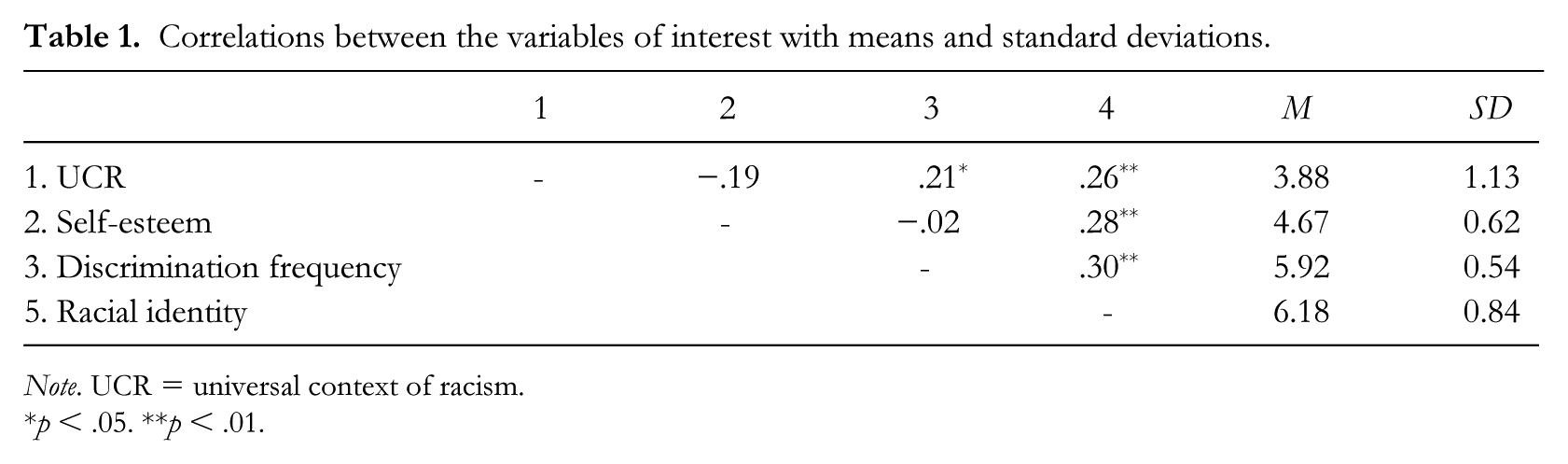
The racial identity assessment had significant positive correlations with all variables: self-esteem, discrimination frequency, and the universal context of racism. As theory would suggest, the higher scores on the Universal Context of Racism Scale were positively correlated with more frequent perceptions of daily racial discrimination. As predicted, African American students who live within the UCR were more sensitized to their race. The overall means, standard deviations, and correlations for the variables of interest are shown in Table 1.
Correlations between the variables of interest with means and standard deviations.
Note. UCR = universal context of racism.
p < .05. **p < .01.
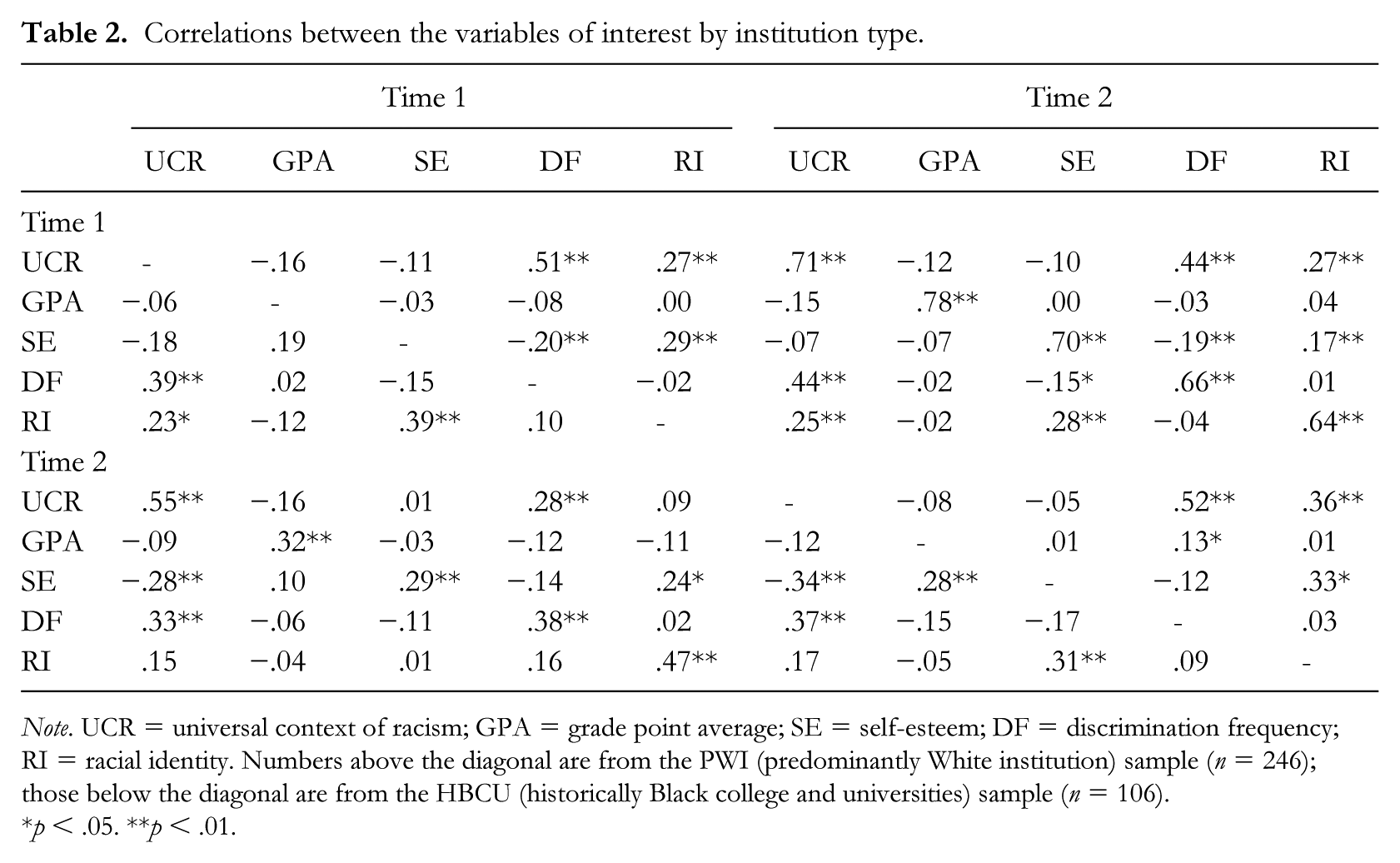
The universal context of racism was positively correlated with perceptions of racial discrimination (r = .39, p < .01) and with racial identity (r = .23, p < .05) at Time 1 for students attending the HBCU. This was also true for the UCR and perceptions of racial discrimination (r = .37, p < .01) at Time 2; however, racial identity was not significant but marginal (r = .17, p = .09). These correlations also held true for students attending the PWIs for Time 1 and Time 2, with UCR being positively correlated to perceptions of racial discrimination (r = .51, p < .01; r = .52, p < .01) and to racial identity (r = .27, p < .01; r = .36, p < .01). Correlations across the time points by institution type can be found in Table 2.
Correlations between the variables of interest by institution type.
Note. UCR = universal context of racism; GPA = grade point average; SE = self-esteem; DF = discrimination frequency; RI = racial identity. Numbers above the diagonal are from the PWI (predominantly White institution) sample (n = 246); those below the diagonal are from the HBCU (historically Black college and universities) sample (n = 106).
p < .05. **p < .01.
Success and satisfaction as measured by GPA and self-esteem were not correlated with the UCR at any time point or across institution type. GPA was negative in direction but not significant at Time 1 or Time 2 for the HBCU, and likewise for the PWIs. Additionally, this was also true for self-esteem at Time 1 for both institution types. However, at Time 2, self-esteem had a negative significant correlation with the UCR for the HBCU (r = −.34, p < .01), but this was not significant for the PWIs (r = −.05, p = .42). Interestingly, self-esteem and GPA were not correlated except for the HBCU sample at Time 2 (r = .28, p < .01), where higher GPAs were related to positive self-esteem.
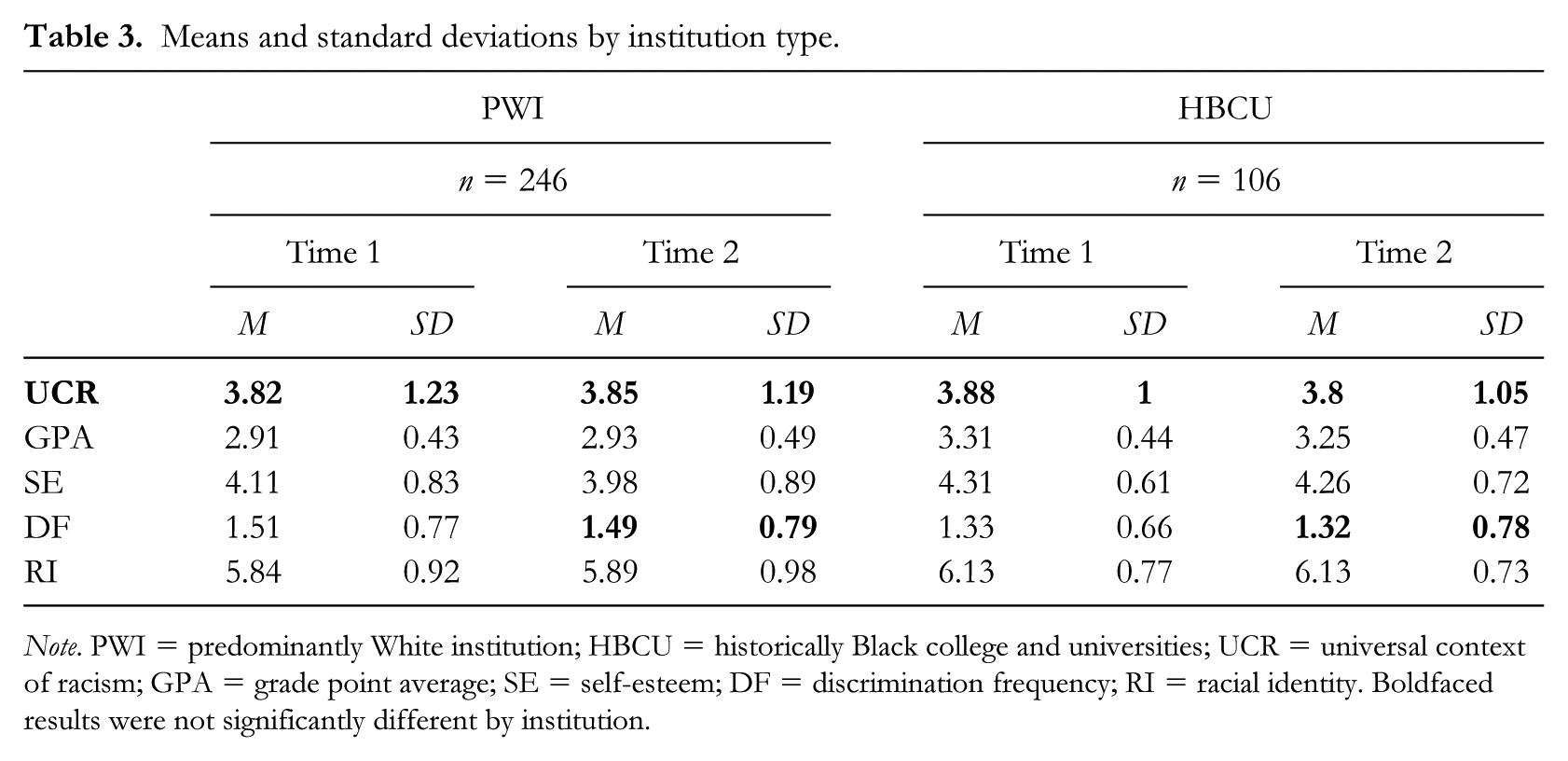
Using analysis of variance (ANOVA), mean differences between institution types were found for all variables except the UCR at Time 1 and Time 2, as well as the amount of discrimination frequency perceived at Time 2. Table 3 presents the means and standard deviations by institution type at Time 1 and Time 2. Students attending the HBCU (M = 6.13, SD = 0.77; M = 6.13, SD = 0.73) viewed their race as more significant than their PWI counterparts (M = 5.84, SD = 0.92; M = 5.89, SD = 0.98), thus not supporting our hypothesis that racial identity would not vary by institution type.
Means and standard deviations by institution type.
Note. PWI = predominantly White institution; HBCU = historically Black college and universities; UCR = universal context of racism; GPA = grade point average; SE = self-esteem; DF = discrimination frequency; RI = racial identity. Boldfaced results were not significantly different by institution.
At both times, students attending the HBCU (M = 3.31, SD = 0.44; M = 3.25, SD = 0.47) self-reported a higher GPA than the PWI students (M = 2.91, SD = 0.43; M = 2.93, SD = 0.49). The GPA mean difference coincides with our prediction and reflects a previous finding in the literature that African American students at HBCUs self-report higher GPAs than African Americans at PWIs (Sellers, Chavous, et al., 1998). As hypothesized, differences in self-esteem were found with a decrease for the students at the PWIs by Time 2 (M = 3.98, SD = 0.89), possibly alluding to the stressors found on this type of campuses.
Discussion
African American college students who live within the universal context of racism were more sensitized to their race. Regardless of the type of institution attended, African American students who view the world through a cultural lens are more likely to recognize situations as racially motivated. This finding speaks to the historical role racism continues to play in the daily experiences of African Americans. The campus climate did not create a difference in the monitoring system for the detection, interpretation, or avoidance of racism that the UCR creates. This concept of the UCR goes deeper than a stereotype of yet another label or category that one can move in and out of. This is a race-based historical phenomenon that is ingrained in our systems starting at birth.
In the beginning of the year, students who attended the PWIs self-reported more experiences of racial discrimination. However, by the second assessment no differences were shown. Since it is uncertain whether the students surveyed lived on or off campus, the students at the PWIs may have been exposed to more opportunities of racial discrimination given their time spent on such campuses.
Racial identity did vary across institutions. While there was a slight increase for the students at the PWIs, the HBCU students, by comparison, reported higher racial identity levels over the academic year. This correlation data cannot explain whether African American students who hold the significance of their race as central to their identity are more likely to choose a HBCU. Various factors can impact the selection process, including geographical location, financial aid packages, and degree offerings.
Institution type did influence levels of self-esteem. Engaging the social aspects of the undergraduate experiences, to many, is just as important as the academic aspects. Having a sense of social isolation on campus may have resulted in a less fruitful college experience, especially for the African American students attending the PWIs. This social value or sense of belonging is an important aspect of college life (Chavous, 2002).
African American students at the HBCU did self-report higher GPAs. This is consistent with findings from the literature. When students were asked to self-report their GPAs, African Americans at PWIs reported a mean GPA of 2.54, while African Americans at HBCUs self-reported a significantly higher mean GPA of 2.99 (Seller, Chavous, et al., 1998). It is possible that simply by being in a PWI environment, perceived or actual feelings of isolation, lack of belonging, or perceived racial discrimination may have affected the African American students’ perception of their achievements. Some may also argue for the negative image of some HBCUs being less rigorous. This, however, is an empirical question that would need further study.
While numerous strides have been made for African Americans’ academic pursuits, there are still several steps that need to be taken. African American students are still discussing issues concerning negative campus climates, social exclusion, and a presence of racial stigma that were debated by DuBois in the early 1900s. Today’s students must contend with new less overt methods of racism and practices that make racial discrimination almost appear legal (Dovidio, Kawakami, & Gaertner, 2000). With the graduation rates of African Americans slowing, increasing innovative methods of survival need to be addressed to reduce attrition.
Race is never a straightforward concept to confront. It is intertwined with biological and socially constructed phenomena. It is historical and contextual; a concept that is often debated but rarely understood. This study is only the beginning of a larger work that needs to explore the differences within African American college students. Experiences of African Americans cannot be summed into one singular story. All HBCUs should not be grouped into one entity as if all balanced the same infrastructure. Never in the literature are PWIs spoken of as whole units without separation of the Ivy League, state schools, and small lesser known colleges.
This study presented research on college attrition, racial discrimination, and racial identity to explore how African Americans who are historical targets of racism and racial discrimination, constantly sensitized to the possibility that their racial status may contribute to unjust conclusions, are able to maintain success and satisfaction with their collegiate experiences. Race matters by means of showing how, regardless of what type of institution an African American student chooses, they will experience racial discrimination in everyday life. Having race as a central part of their identity may help navigate this journey. College students share similar goals to advance their knowledge about themselves and the world; however, not all campuses deliver the same. There is no one-size-fits-all campus plan. The blueprint for the perfect college or university does not exist. Each individual student must determine what environment fits their needs. Similarities and differences between our students and institutions of higher learning suggest the need for diverse strategies and novel approaches for the education of the next generation.
Footnotes
Funding
The author(s) disclosed receipt of the following financial support for the research, authorship, and/or publication of this article: This data was collected through support of the National Institute of Mental Health Grant, NIMH 5 PO1 MH58565-03 and based upon work partially supported by the National Science Foundation, under NSF Cooperative Agreement Award Nos. HRD – 1308144.