







Abstract
Understanding group-based inequalities in education requires attention not only to performance and achievement outcomes, but also to whether and how students sustain motivation for their educational and career paths over long periods of time. The self-regulation of motivation (SRM) model describes how students’ choices to persist are driven by the dynamic interaction between goals-defined motivation, which typically guides choices to start or reengage in an activity, and experience-defined motivation (or interest), which becomes a proximal predictor of persistence once engaged in the activity. Social influences can shape both kinds of motivations in ways that systematically contribute to differences in student persistence across groups and in how people self-regulate motivation. In this paper, we detail the ways in which social roles and group norms, interpersonal bias, and institutional structural barriers can shape motivational experiences and persistence of underrepresented groups of students through several specified processes within the SRM model. We describe how the model might illumine underlying causes of differential participation rates in certain fields, and we discuss key directions for future research.
Students’ choices about which educational and career paths to pursue, including their selection of college majors, shape many aspects of their future lives. Although people often believe that educational interests and choices are determined primarily by intrinsic factors, initial selection and retention rates in specific majors (e.g., STEM) vary systematically as a function of gender, social class, and ethnicity. Such patterns suggest that systematic social influence processes contribute to students’ “choices” to change educational or career directions (e.g., Aschbacher, Li, & Roth, 2010; Bergin, 2016; Diekman, Steinberg, Brown, Belanger, & Clark, 2017; Eccles, 1994; Fuligni, 2007; Lent, Brown, & Hackett, 1994; Reay, David, & Ball, 2005). One type of motivational explanation for these influences focuses on how these systemic differences influence ability, perceived ability, and preparation (e.g., fewer courses or less rigorous classwork), and consequent solutions are aimed toward overcoming these obstacles (e.g., tutoring; e.g., Valencia, 2012).
This paper focuses on another type of explanation: social influences on interest and self-regulation of motivation. Our model examines how social influences affect the process through which students develop and maintain (or lose) interest, particularly where there are participation gaps as a function of gender, social class, and/or ethnicity. Our work is consistent with social psychological theories of how systematic sociocultural influences translate into intraindividual tendencies (e.g., Piff, Kraus, & Keltner, 2018; Stephens, Fryberg, Markus, Johnson, & Covarrubias, 2012), and with social identity approaches (e.g., Ellemers, Spears, & Doosje, 2002) more generally. Both of these models (as well as others, see Adams, Biernat, Branscombe, Crandall, & Wrightsman, 2008) detail that individual and structural characteristics do not operate independently to shape behavior, but rather that they interdependently interact to shape thoughts, feelings, and behavior. Our model focuses specifically on how interest and self-regulation processes can be affected by these interdependent social influences in ways that produce group differences in educational choices and persistence.
The Importance of Interest for Educational Choices and Persistence
The role of students’ interest experiences in college major retention was highlighted by Seymour and Hewitt’s (1997) interviews with STEM-talented women who switched out of STEM majors. The top two reasons identified for switching were a lack or loss of interest in STEM majors and the belief that non-STEM majors held greater interest. Similarly, findings from a multi-institutional quantitative study of senior undergraduates who were identified as having rigorous preparation for STEM suggested that the major difference, for both men and women, between those who stayed in STEM and those who left was interest in the STEM field relative to interest in other fields (Renninger & Schofield, 2012). A meta-analysis of the vocational interest research also illustrates that interest is a primary positive predictor of academic and career selection, performance, and persistence (Nye, Su, Rounds, & Drasgow, 2012). Although actual achievement and self-efficacy are clearly important factors in students’ choices (e.g., Brown et al., 2008; Lent et al., 1994), these reviews on why students leave a field suggest that these factors are necessary but not sufficient. Rather, the experience of interest is a key ingredient to students’ career and academic persistence.
How do students maintain and regulate their experience of interest in the moment and over the course of a college career? To answer this question, we draw from the self-regulation of motivation (SRM) model (Sansone & Harackiewicz, 1996; Sansone & Smith, 2000; Sansone & Thoman, 2005), which provides a conceptual framework for understanding whether and how students maintain motivation to persist over long periods of time. Developed, tested, and refined over two decades, the model describes how choices to persist are driven by the dynamic interaction between goals-defined motivation, which typically guides choices to start or reengage in an activity, and experience-defined motivation (and in particular, the experience of interest), which typically guides choices to persist once engaged in an activity. The model assumes that the experience of interest is a rewarding state (Renninger & Hidi, 2011) that is embedded within the process of goal-striving, and as such can be important at multiple points in the self-regulatory process.
For example, the reason why individuals may select certain activities over others is because they perceive them as consistent with their well-developed interests (Durik, Huntoon, Lindeman, & Coley, 2018; Lepper & Henderlong, 2000) or passions (Vallerand, 2010). Further, individuals could have the express goal to experience interest while engaged. These reasons and goals reflect what is traditionally conceptualized as “intrinsic motivation,” where activities are chosen for their own sakes, because they are interesting and valued (e.g., Deci, 1992; Wigfield & Eccles, 2000). However, individuals could experience interest as a byproduct of engagement, without that being their goal; conversely, even if they held that goal, they might not actually experience interest once engaged. The SRM model suggests that experiencing interest can motivate individuals while engaged regardless of whether it was their reason for engaging in the activity; similarly, not experiencing interest could negatively impact persistence and reengagement, regardless of the reason why individuals started the activity. 1
Initial tests on this model focused on the significance of motivation that arises from sought, experienced, or anticipated interest for persistence, as well as on the ways in which goal processes and interest experiences interact to drive persistence (e.g., Sansone, Sachau, & Weir, 1989; Sansone, Weir, Harpster, & Morgan, 1992). We focus here on the ways in which social influences can shape the self-regulation of motivation for underrepresented groups of students through several specified processes within the SRM model that might illumine differential participation rates in certain fields (Sansone, Thoman, & Fraughton, 2015; Thoman, Sansone, & Geerling, 2017).
Group Differences in Interest for Educational Choices and Persistence in Specific Fields
To examine how self-regulation of motivation processes may be supported (or undermined) differentially and systematically as a function of students’ social identities, we describe research illustrating why interest in certain educational domains differs as a function gender, social class, and ethnicity. We focus on group differences in persistence rates for selective educational paths (e.g., STEM fields), because interest is experienced with connection to a specific topic, object, activity, or set of highly related topics/activities (Renninger & Hidi, 2016). Most examples described in what follows focus on STEM interest because it provides a context where group differences in participation during college tend to increase over time, and a substantial empirical literature exists in this area. However, SRM findings and predictions should generalize to any academic field in which group underrepresentation historically exists and individuals may experience social identity concerns (e.g., architecture, philosophy, nursing, etc.).
Both in STEM fields and in others where we observe group differences in education it is important to recognize that specific social groups and intersectionality of different groups can create distinct experiences of inequality in educational contexts and that these differences may affect self-regulation of motivation. For example, Harackiewicz et al. (Harackiewicz, Canning, Tibbetts, Priniski, & Hyde, 2016) describe key differences in motivational patterns identified in a baseline survey of a large sample of undergraduate biology students as a function of social class, ethnicity, and their interaction. Whereas student concerns about their biology background in their sample differed only as a function of ethnicity (and not social class) and belonging uncertainty differed only as a function of social class (and not ethnicity), helping motives differed across groups as a function of both social class and ethnicity —helping motives were highest among first-generation underrepresented minority students. These patterns suggest that when considering how social influence processes shape student interest and the self-regulation of motivation, a nuanced sociocultural model is needed to examine why specific kinds of social and structural influences may be more important in the context of one type of group comparison (e.g., social class) than others (e.g., gender or ethnicity). Explicating a full sociocultural model for social influences that are unique to each group is beyond the scope of this paper, but we expect that some processes may be more relevant for certain group differences than others. For example, the interpersonal biases of others may be more likely to influence interest experiences as a function of gender and ethnicity than as a function of social class because of the greater likelihood that gender and ethnicity are more visible group memberships than social class. In contrast, institutional structural barriers associated with financial resources (e.g., high fees for graduate school applications) may be more likely to discourage goals adoption (e.g., the goal of going to graduate school) for students as a function of social class, where economic resources are highly related to group membership.
Across the social influences processes and group differences we describe in what follows, our model is consistent with contemporary sociocultural models that highlight the interdependent nature of individual and structural characteristics (rather than framing them as unique causes). Stephens, Fryberg, et al. (2012) have detailed how the sociocultural self, a psychological state that is the product of the “ongoing mutual constitution of individual and structures” (p. 723), guides behavior by shaping individuals’ construals of situations and environments. For example, the culture of valuing independence over interdependence in higher education can create psychological mismatch barriers for working class students, whereas this culture fits the sociocultural backgrounds of middle class students. In Stephens, Fryberg, et al. (2012) model, the psychological mechanisms are grounded in theories of self and self-construals of the individual’s experiences with a specific social context. Interest, in contrast, is tied to content and characteristics of specific objects/topics and can be considered independent of a specific social context (O’Keefe, Dweck, & Walton, 2018). Thus, our model considers how social influences processes not only shape interest for certain educational topics or activities within specific social contexts, but also how effects within a given context can have lasting impacts on interest and educational choices even when students move to another educational context. Before returning our focus to these social influences, we provide a more detailed overview of the SRM model.
Overview of the Self-Regulation of Motivation Model
Like most self-regulation models in psychology, the SRM model describes individuals’ initial choices and actions as goal-directed (e.g., Pintrich, 2000). In the context of education, motivation to begin a given educational task or activity is determined both by the student’s expectations for achieving success on that activity or field and by the value of achievement (e.g., Atkinson, 1954; Eccles et al., 1983; Wigfield & Eccles, 2000). 2 Once individuals begin the task or activity, they monitor their progress toward their goals, and in most models of self-regulation, motivation derives from evaluations of progress toward goal achievement (e.g., Carver & Scheier, 1990). The outcome of this evaluation motivates students to persist if they are making good progress, or quit the activity if they have achieved the goal or given up on the goal.
The SRM model (see Figure 1) states that experience-defined motivation is a second important source of motivation that arises during the process of goals-pursuit. Especially for activities that take place over long periods of time, the SRM model suggests that the experience of interest that arises (or not) during engagement becomes important for whether or not people choose to persist in or quit the activity. That is, the reason why individuals choose to quit or persist can change over the course of activity engagement. Many motivational theories indicate that the strength of motivation to reach goals can be influenced by one’s reason to persist (e.g., Deci & Ryan, 2000; Elliot, 1999). For example, persistence may be strengthened when people are motivated to reach goals that are self-determined (Deci, 1992). The SRM model adds that the experience of working on the activity can emerge during activity engagement as a proximal reason to quit (if boring or overly frustrating) or persist (if interesting). Although interest has been defined in many ways (O’Keefe & Harackiewicz, 2017; Renninger & Hidi, 2011), the SRM model focuses on the motivational properties of the experience of interest, a dynamic state that arises through an ongoing transaction among goals, contexts, and actions (Sansone & Smith, 2000). The interest experience creates a generally positive affective tone, directs and focuses attention, and promotes exploration and sustained engagement (Sansone & Thoman, 2005); at its extreme, this may be experienced as “flow” (Csikszentmihalyi, 1975).
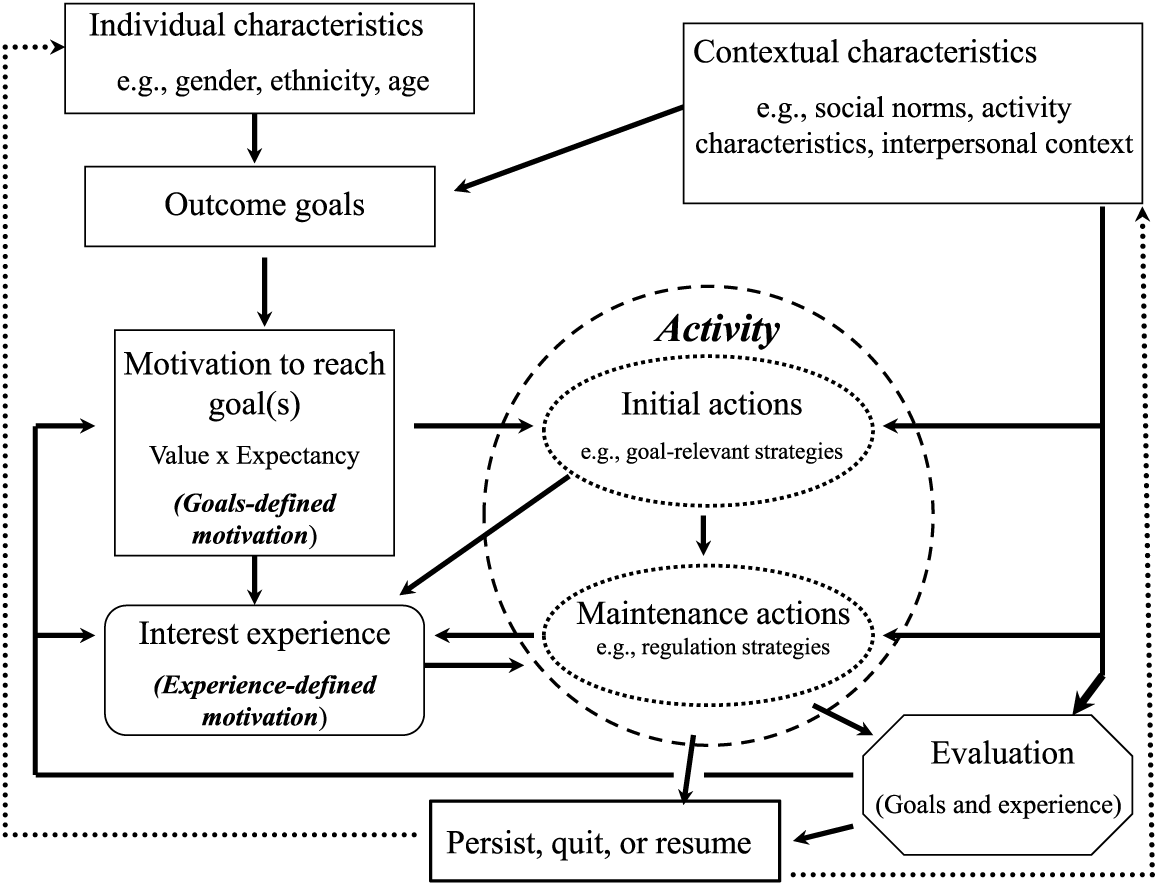
Self-regulation of motivation model.
Goals-defined motivation can itself affect the interest experience. For example, motivation defined in terms of goals associated with an individual’s interests and values can lead to greater interest while engaged (Bergin, 1999). Conversely, motivation defined in terms of goals to avoid the demonstration of incompetence can create worry or distraction, leading to lower interest (Elliot, 1999; Smith, Sansone, & White, 2007). Individuals’ actions in service of reaching goals can also affect the interest experience (e.g., if a student focuses primarily on information perceived as relevant to a test, rather than exploring all available information). Further, the model suggests that interest can be affected by the extent to which the context matches or facilitates goals (Sansone et al., 1989). Rather than conceptualizing students as intrinsically motivated (i.e., motivated by the current or anticipated experience of interest) or extrinsically motivated (i.e., motivated by goals and potential outcomes), the SRM model thus embeds interest within self-regulation processes over time. That is, goals drive initial actions and choices, but once engaged, it is difficult to maintain motivation over long periods of time without regularly experiencing interest. Maintaining motivation over the long term requires both goal- and experience-defined motivation, and these motivations can interact and influence each other over time.
Further, the model suggests that people not only monitor and regulate progress toward goals but also their experience while working toward those goals (Sansone et al., 1992). If evaluation of one’s experience suggests that interest is lacking, students can choose to quit, persist as is (without interest), or change how they work on the activity (or something about the activity context) in a way that makes the experience more interesting.
Applying models of self-regulation to long-term pursuits is more complicated than instances of one-time engagement in a learning activity. In a single instance of engagement, students must maintain motivation long enough to complete the task. How they evaluate their experience on that task seems less relevant than evaluation of progress toward goals if the measured outcome is task performance. However, if persistence over long periods of time is the desired outcome, it matters how students evaluate both their progress and experience because both evaluations influence their likelihood of reengaging in the same or similar tasks. Defining educational attainment in terms of longer term outcomes, such as degree completion, requires attention to whether and how students sustain motivation over time.
The Socially Influenced Self-Regulation Process
The SRM process can change as a function of inputs at various points. For example, changes in goals or the orientation toward a task (Sansone et al., 1989; Smith, Wagaman, & Handley, 2009) and changes in the strategies used while engaged with a task (Isaac, Sansone, & Smith, 1999; Sansone & Morgan, 1992) can fundamentally alter whether people experience interest and whether they do anything to regulate their experience. We ask: how do systematic social inputs at specific points within the SRM model likely change the self-regulation of motivation process for groups of students with specific gender, social class, and ethnic identities who are pursuing selective career paths with traditional group-based inequalities in participation?
To address this question, we focus on three types of social influence inputs: social roles and norms as defined by majority groups; interpersonal biases against members of underrepresented groups; and institutional structural barriers within education institutions that may influence processes beyond effects due to normative social roles and expectations. In examining how social roles and norms affect self-regulation of motivation processes, we emphasize factors that begin in people’s lives before they encounter a given activity in a field, but set the stage for what individuals bring to the activity and how the activity and surrounding context are structured. For interpersonal bias, we focus on how experienced or perceived bias can influence what individuals experience during the time when they are engaged with a given activity. Lastly, we consider how institutional structural factors that may not be (or may no longer be) explicitly maintained as barriers to certain group still can function as unintended consequences of systems initially created by majority group members. Importantly, these three sources of social influence are not independent of each other (e.g., social roles can lead to the creation of institutional barriers; bias can lead to creation of social roles and norms, etc.), but we organize our review by describing research illustrating how these factors can create psychological constraints or affordances within specific educational contexts that influence students’ pursuits and persistence through their effects on goal adoption and motivation to reach goals, as well as through the experience and appraisals of interest. As illustrated in Figure 2, the model also suggests that these social influence inputs can affect persistence by constraining or directing motivation regulation strategies. Because relatively little research has tested these predictions to date, we discuss this point of the model later.
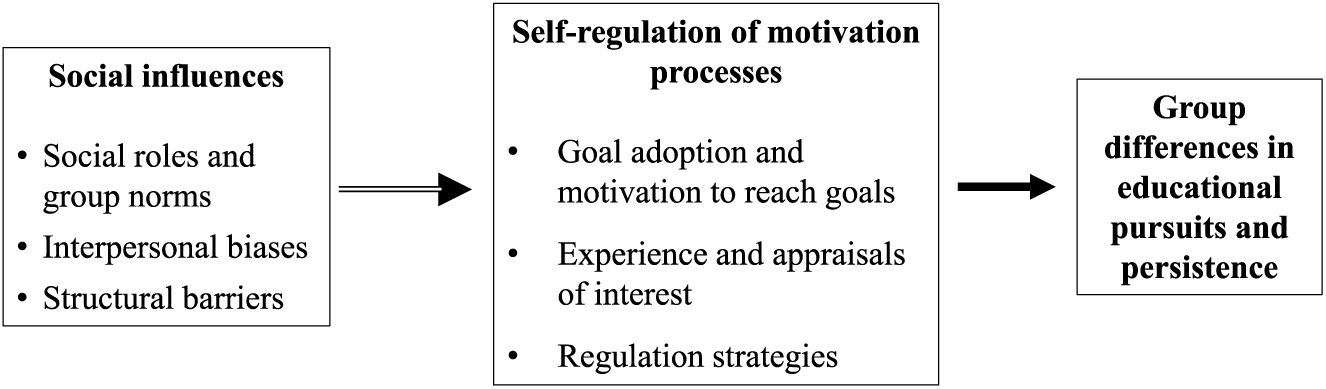
How social influences can perpetuate group differences in educational outcomes as a function of self-regulation of motivation processes.
Social Roles and Group Norms
One way in which the SRM model can help to inform understanding of group differences in educational attainment is by describing how social roles and group norms—including beliefs and norms about individuals with certain social identities (e.g., men vs. women), and about certain academic fields (e.g., STEM vs. non-STEM)—can influence interest (Eagly & Wood, 2011). Social norms set prescriptive and descriptive rules and standards for behavior that can lead to smoother social interactions and the accomplishment of social goals (e.g., Cialdini & Trost, 1998). Through the transmission of social norms, people are able to infer what appropriate behavior looks like in a given situation; thus, social norms often set expectations for individual behavior in a given context. In this way, the representation of certain social identities, relative to others, in academic domains might influence individuals’ expectations about who is more or less likely to succeed in those domains. For instance, the high levels of representation of White and Asian men from middle- and upper class backgrounds in STEM might lead students to infer that those groups’ traits and skills are what is necessary for success in STEM. Thus, people may infer of students who do not share social identities with those majority groups that they do not have the skills and traits necessary to be successful in STEM (or students may infer it about themselves), and as a result, their interest and persistence in STEM are impeded. Social roles and group norms therefore help shape what individuals bring to a new activity or educational path, and how students approach and structure the activity and surrounding context.
Social roles and group norms influence student goal adoption and motivation to reach goals
The SRM model suggests that to have opportunities to experience and develop interest, students must initially choose to engage in goal-directed activities. Thus, changing the likelihood that students with certain social identities will adopt goals to pursue certain activities is the first point in the SRM process, where social roles and group norms can lead to differences in interest across groups of students.
More than three decades of research by Eccles and colleagues has detailed how social roles and socialization experiences shape achievement motivations and outcomes as a function of children’s and adolescents’ social identities (e.g., Eccles, 1994, 2009; Eccles et al., 1983; Wigfield & Eccles, 2000). For example, parents tend to have greater success expectations and tend to provide more support and encouragement for boys’ compared to girls’ involvement in masculine activities, including early STEM activities (e.g., Eccles et al., 1993; Fredricks, Simpkins, & Eccles, 2005; Jacobs & Eccles, 2000; Simpkins, Fredricks, & Eccles, 2012). More broadly, research illustrates that parents, teachers, and peers all act as important socialization agents who coregulate children’s goals, values, and interests through various forms of social influence (e.g., Alexander, Johnson, & Leibham, 2015; Bergin, 2016; Hulleman, Thoman, Dicke, & Harackiewicz, 2017; McCaslin, 2009; Ryan, 2001).
A family’s social class background can also influence how parents model and transmit group norms (e.g., Hupp, Smith, Coleman, & Brunell, 2010) that shape children’s interest development. For example, Lareau (2011) found that whereas working class and poor parents tended to view children’s development as unfolding spontaneously, middle-class parents took a more active approach to assessing and cultivating their children’s talents and interests. Parenting behaviors such as decisions about which toys to buy and which classes, teams, or lessons to pay for provide different opportunity structures for their children’s interest development (Bergin, 2016), and these behaviors are shaped by cultural and social identities of families and their children. Indeed, engaging in extracurricular STEM activities as a young adult, especially when supported by a family member, cues an initial interest in STEM fields (VanMeter-Adams, Frankenfeld, Bases, Espina, & Liotta, 2014).
Cultural stereotypes about students and about norms of academic disciplines can also influence whether or not students choose to initially engage in certain activities or consider stereotyped fields as legitimate options. In addition to stereotypes about ability, stereotypes about the people in and culture of computer science and engineering, for example, signal to girls and young women that these disciplines are not appropriate for them (Cheryan, Master, & Meltzoff, 2015). For example, observing stereotypically masculine group norms conferred via environments, or stereotypes of socially isolated scientists or “tech geeks” can convey that these characteristics are required of people to succeed in STEM, steering girls and young women away from initially choosing the goal of pursuing STEM paths (e.g., Cheryan, Plaut, Davies, & Steele, 2009; M. C. Murphy, Steele, & Gross, 2007; Smith, Lewis, Hawthorne, & Hodges, 2013). If such cultural stereotypes lead a student to avoid STEM-related activities in the first place, she will be unlikely to have opportunities to experience or develop interest in those fields.
Even if students from underrepresented backgrounds do adopt the goals to engage in the activities, social roles and group norms can still negatively impact their motivation to reach these goals by making individuals value the goals less or be less confident in their abilities to reach them (e.g., Eccles, 1994, 2009). As noted, lowered motivation to reach the goals can in turn create lower interest.
Social roles and group norms influence student experience and appraisals of interest
Because individuals often hold multiple goals while working on an activity, for example, purpose and target goals (Harackiewicz & Sansone, 1991), performance and mastery goals (e.g., Barron & Harackiewicz, 2001), competence and interpersonal goals (e.g., Sansone & Morgan, 1992; Wentzel, 1999), their experiences can differ even when ostensibly working on the same activity. An important construct for understanding the relationship between goals and interest across individuals is goal congruity. Goal congruity refers to the degree to which an individual’s personally valued goals “match” with the opportunities provided by an academic task or domain. Goal congruity is positively related to the experience of interest (Sansone et al., 1989); over and above features of an activity itself, the congruity between a student’s goals and the task at hand predicts interest.
Goal congruity processes can lead to systematic group differences in student interest for a given field when that field is seen as missing opportunities to fulfill goals that are highly valued by individuals from certain groups more than others. Several studies have examined goal incongruence in the context of gender differences in science interest. Women tend to exhibit lower levels of interest in STEM fields than men (e.g., Su, Rounds, & Armstrong, 2009; Watt et al., 2012), and this can be at least partially explained by goal incongruence among women students. Women students tend to more highly value communal work goals (e.g., wanting to work with and help others at work) than men students (e.g., Diekman, Brown, Johnston, & Clark, 2010; Morgan, Isaac, & Sansone, 2001). However, STEM careers are generally perceived (by women and men) as not affording opportunities to fulfill communal goals. This lack of congruity between women students’ goals and what they perceive to be afforded by science careers is associated with less interest in science careers and a lower likelihood of pursuing these types of careers (e.g., Boucher, Fuesting, Deikman, & Murphy, 2017; Cheryan et al., 2015; Diekman et al., 2017; Morgan et al., 2001).
The phenomenon of goal incongruence is not unique to women in STEM. Underrepresented minority students and first-generation college students (students whose parents did not earn a 4-year degree) also tend to endorse communal goals and values to a greater extent than students from majority backgrounds and continuing-generation students, respectively. Enhancing the degree that these students perceive academic fields as “matches” with these goals increases their interest (e.g., Jackson, Galvez, Landa, Buonora, & Thoman, 2016; Smith, Cech, Metz, Huntoon, & Moyer, 2014; Thoman, Brown, Mason, Harmsen, & Smith, 2015). For example, first-generation, but not continuing-generation, college students were more interested in working in science to the degree that they perceived that communal purpose goals could be afforded by science careers (Allen, Muragishi, Smith, Thoman, & Brown, 2015).
Even after students have advanced to higher levels of engagement within an academic field, goal congruence continues to predict interest. For example, Thoman and colleagues collected data from students who worked as research assistants in faculty-led laboratories, typically as junior- and senior-level students (Thoman et al., 2015). They found that underrepresented minority (but not White) students who perceived higher degrees of prosocial communal value in their lab work, experienced greater psychological involvement with their work, which increased their interest in continuing to pursue a science research career. Because these participants were undergraduate lab assistants already engaged in scientific research, this study suggests that the effects of goal congruence on interest are not unique to initial interest in pursuing a career, but rather play an important role in determining sustained interest at multiple points throughout a student’s academic career. Social roles and group norms thus often reinforce the status quo (e.g., Jost, Banaji, & Nosek, 2004), influencing conditions of goal congruity that contribute to group differences in educational outcomes. At the same time, the group norms set within the microculture of a specific classroom or laboratory context can support students’ immediate and long-term interests, even if they are traditionally underrepresented in these fields (e.g., Hulleman et al., 2017; Thoman, Muragishi, & Smith, 2017).
The SRM model further suggests that social roles and group norms that influence how students approach activities can influence students’ appraisals of interest. However, this is a point in the SRM process where little research has been done and where many research questions remain open. For example, how do students evaluate and make appraisals about their experience when they enjoyed an activity (e.g., building a software application) but it is in a domain that they’re not expected to enjoy (e.g., computer science for women)? Do they discount the experience (i.e., thinking that this instance was fun, but future related activities would not be on a regular basis)? In a recent study of middle school students, Hogheim and Reber (2017) found that although boys and girls reported similar levels of interest experiences on mathematics activities, boys reported greater individual interest in the field of mathematics than girls. This pattern suggests that gender roles and norms may create a potential disconnect between the interest experienced while engaged and how women (but not men) evaluate the field of mathematics.
Interpersonal Biases
Another way in which the SRM model can contribute to our understanding of group differences in educational attainment is by detailing how interest experiences can be affected by interpersonal bias. For students who are members of stigmatized or underrepresented groups in selective fields or learning environments, social interactions within educational contexts have the potential to reveal others’ bias against them. For example, teachers and faculty have different perceptions of student experience/knowledge, ability, and effort in science, depending on students’ gender and race, and they are more likely to offer opportunities for advancement to men (e.g., Moss-Racusin, Dovidio, Brescoll, Graham, & Handelsman, 2012; Riegle-Crumb & Humphries, 2012), especially to White men (Milkman, Akinola, & Chugh, 2012). Women receive less feedback than men (Jones & Dindia, 2004), and the feedback for women students is less specific and constructive, tending not to challenge or critique students’ ideas and work (Duffy, Warren, & Walsh, 2001; Seymour & Hewitt, 1997). Teachers may also withhold feedback altogether for stigmatized students because of concerns of being seen as a racist (Crocker & Major, 1989; Croft & Schmader, 2012). Furthermore, general perceptions of bias toward, or negative stereotypes about, one’s group can lead to social identity threat concerns even in the absence of a specified biased source of feedback (Steele, Spencer, & Aronson, 2002). Indeed, chronic stereotype threat concerns are one reason why high achieving African American and Latinx students do not persist in STEM (Woodcock, Hernandez, Estrada, & Schultz, 2012). Such explicit biases and/or internalized biases can systematically influence student interest via multiple processes specified in the SRM model.
Interpersonal biases influence student goal adoption and motivation to reach goals
Perceptions of interpersonal bias or the salience of one’s stigma can change the goals with which students approach an activity, which in turn affects how they work on that activity and their experience during the activity. Smith et al. (2007) reminded highly achievement-focused women about negative gender stereotypes of math ability before a computer programming task. Compared to control (no stereotype reminder) conditions, salience of the gender–math stereotype increased women’s adoption of avoidance goal orientations to “not fail” at the programming task. Greater avoidance goal adoption, in turn, predicted lower interest in the computer programming task, which was positively correlated with interest and engagement in future computer-related activities. Brodish and Devine (2009) similarly found that greater adoption of performance avoidance goals and worry mediated the relationship between identity threat and math performance. Experimental studies have also demonstrated that identity threat created by the salience of social class stereotypes leads to lower performance expectations among working class students (Croizet & Claire, 1998; B. Spencer & Castano, 2007). A large-scale longitudinal study of undergraduate science students demonstrated that these processes are not unique to the lab setting. Woodcock, Hernandez, and Schultz (2016) compared academic outcomes among students in a long-standing training program for minority students in science with a control group of propensity-score-matched nonprogram students. Nonprogram students were less likely than program participants to persist in science, and this difference was partially mediated by goal adoption processes. Although both program participants and nonprogram students reported similar levels of stereotype threat, only for nonprogram students did greater perceptions of stereotype threat predict lower adoption of mastery goals, which in turn predicted lower interest in a scientific career. Certainly, social influences guide everyone’s initial goal adoption, but bias-induced goal adoption patterns for marginalized and underrepresented groups can create group differences in education outcomes—unless these processes are strategically disrupted.
Even if students adopt initially positive goals, interpersonal biases can cause them to devalue those goals. For students who face negative stereotypes and interpersonal bias in a stereotyped domain, one coping option is to psychologically disengage from the domain by devaluing the importance of achievement (Major, Spencer, Schmader, Wolfe, & Crocker, 1998). Identity threats based on gender, ethnicity, social class, and other dimensions can lead to devaluation of achievement when there are no other immediate means of protecting one’s self-views (e.g., Forbes, Schmader, & Allen, 2008; Schmader, Major, Eccleston, & McCoy, 2001; Schmader, Major, & Gramzow, 2001). Recent studies and reanalysis of existing data have raised concerns about the strength and replicability of stereotype threat effects on performance (e.g., Flore & Wicherts, 2015; Zigerell, 2017; see S. J. Spencer, Logel, & Davies, 2016, for review), with a call for greater attention to the potential moderators of stereotype threat effects. These concerns have focused on performance rather than on the type of motivational variables we described before, but given these concerns, more investigation is needed to determine proper effect-size estimates and moderators of stereotype and social identity threat effects on motivational outcomes.
Interpersonal biases influence student experience and appraisals of interest
Separately from how students approach a task, others’ biases can still influence students’ experiences of interest during task engagement. Thoman and Sansone (2016) conducted an experiment in which undergraduate students worked on a forensic science task, and during the session participants were randomly assigned to receive feedback that was overtly biased in favor of the man (promale bias) or not (control conditions). In Study 1, women who received less positive feedback than men because of promale bias reported lower task interest than those in the control conditions. In contrast, in Study 2, men who received more positive feedback than women because of promale bias reported higher task interest than those in the control conditions. For both men and women, the diverging effects of bias translated beyond feelings of immediate interest in the task, as task interest predicted interest in finding out more about potential related careers. An important implication of this set of studies is that experiences of bias not only have the potential to undermine interest for those who are harmed from that bias, but the same experience can boost interest for those who benefit from that bias. Although effects on interest during one specific situation may be relatively small, the accumulation of such effects over time in fields where bias is prevalent can potentially lead to increasingly diverging interests across groups.
Even after the activity is complete, the SRM model suggests that people continue to evaluate both their progress toward goals and their interest experiences. This process helps account for how and why interest appraisals can be influenced by social interactions that occur even after activity engagement (Thoman, Sansone, & Pasupathi, 2007). People share their experiences with others, talking about what happens to them, ideas about what they think their experiences mean, and opinions about whether they liked or enjoyed those experiences. Others’ reactions to their disclosure about activities have implications for reconstructing memories and experiences (Pasupathi, 2001), including appraisals of interest. That is, after engagement stops, the feedback and reactions from others about an individual’s interest can influence how he/she reevaluates it. This process matters for long-term educational pursuits because evaluations of interest in activities (e.g., physics lab activities) shape the likelihood of wanting to engage in those particular activities again (e.g., enrolling in a physics class) and possibly even over time (e.g., major in physics).
The process by which other people can shape interest for novel tasks during conversations was first demonstrated in an experiment by Pasupathi and Rich (2005). Friend dyads (college students) were randomly assigned to be either speakers or listeners. Speakers played a computer game, rated their interest in the game, then described their experience to their friends (the listeners), and then rated their interest again after the conversation. Unbeknownst to speakers, experimenters randomly assigned their friends (the listeners) to one of three experimental conditions corresponding to different instructions for listeners. Results indicated that when speakers engaged with listeners who were instructed to listen as they normally would, interest levels were maintained. Interest levels were also maintained when listeners had been instructed to disagree with the speaker’s statements because in those cases, speakers had to generate counterarguments to support their positive experiences. However, interest declined after the conversation when listeners were instructed to appear unresponsive, suggesting that when others convey a lack of interest or value to one’s sharing of an interest experience, appraisals of interest may be diminished. The influence of others’ feedback on evaluations of interest has been demonstrated outside the lab and on interest for actual college classes (Thoman, Sansone, Fraughton, & Pasupathi, 2012; Thoman et al., 2007).
These processes may be amplified for some students and may contribute to group differences in educational outcomes. Recent findings from a longitudinal survey study of freshmen in college science majors support this notion (Jackson, Leal, Thoman, & Zambrano, 2019). For women, but not men, feeling encouraged and understood when talking about science interests (i.e., listeners were responsive and encouraging) predicted science career interest one semester later, over and above their initial science career interest. This was particularly true for women with low or average levels of identification with science. These results suggest that women in science, especially those who are in the early phases of developing fit and identification with their academic field, might be the most affected by the reactions conveyed by others. Research on workplace interactions among STEM faculty similarly suggests that gender biases continue to shape the content of STEM-related conversations in ways that can trigger identity threat experiences for women (Holleran, Whitehead, Schmader, & Mehl, 2011).
Appraisals of interest can also be influenced by social recognition feedback (i.e., feedback that indicates that others see the individual as a “science person”) for underrepresented minority students in STEM. From interviews with successful women from ethnic minority backgrounds, Carlone and Johnson (2007) found that being recognized as a “science person” was important for their interest and persistence in science, but that women’s bids for recognition were often disrupted by social identity concerns. These students felt that they were being recognized by others as a person from a stigmatized group, rather than as “a science person.” Students from ethnic and racial minority groups use social feedback to make meaning of and evaluate whether others recognize them and their interest, and these attributions have important implications for how they evaluate their interest.
Institutional Structural Barriers
Institutional structural factors that may not be (or may no longer be) explicitly maintained as barriers to certain group can still function as unintended consequences of systems initially created by majority group members. These structures can include broad system-level structures, such as how universities and academic programs are organized geographically, as well as more micro-level classroom-specific structures, such as how instructors develop or communicate pedagogical decisions. These structures can also interact with person-level factors in ways that create institutional cultures that indicate valuation of goals and norms that are more aligned with the cultural backgrounds of some groups than others’ (e.g., Stephens, Fryberg, et al., 2012). At multiple levels, structures created initially by majority group members may generate unnecessary barriers to effective self-regulation of motivation for students from lower status or underrepresented backgrounds.
Institutional barriers to student goal adoption and motivation to reach goals
Structural barriers take many forms to limiting students’ goal adoption to pursue their initial interest in STEM. From equitable access for low income students to availability of role models for women, underrepresented minority students, and first-generation college students (e.g., Estrada et al., 2016), to accessibility of technology and mobility accommodations for differently abled students (Burgstahler & Chang, 2014), numerous structural barriers restrict students’ goal adoption. Relative to the other types of social influences discussed here, social psychological approaches to understanding group differences in educational outcomes (including ours) have been less likely to consider the role of broad social and institutional contexts in individuals’ choices to persist, so we focus on several areas that warrant further attention.
Most people assume that when students maintain interest in STEM topics and graduate with STEM degrees they will enter the STEM workforce. The transition from education to workforce represents a point when people must adopt new (though similar) goals. Such transition periods are critical to students’ development and well-being (Anderson, Jacobs, Schramm, & Splittgerber, 2000), and may be a point in the interest development process when interests may be particularly malleable and susceptible to social influences (Hulleman et al., 2017). Even if students expect to experience interest in a STEM job, structural and institutional barriers can influence goal adoption. One such barrier that contributes to women opting out of STEM careers is the lack of support for family concerns and policies that support work–life balance (see Weisgram & Diekman, 2015, for review).
Similarly, pervasive inequitable structural barriers associated with educational mobility can differentially influence students’ goals for whether and where they pursue postgraduate degrees. Advancement in many selective academic fields typically requires multiple geographical career moves (e.g., from undergraduate to graduate school, to a postdoctoral fellowship, and so on), with few alternatives for advancement. Underrepresented college students, such as Latinx students and first-generation students, are more likely than majority students to choose colleges that are close to their family (e.g., Nunez & Cuccaro-Alamin, 1998; Perez & McDonough, 2008). Choosing to remain close to one’s family rather than pursue other, perhaps better suited, options can limit students’ educational opportunities (Engle, 2007). Allen et al. (2015) found that first-generation undergraduate research assistants reported less interest than their continuing-generation peers in moving away from their families to complete a graduate degree, and this effect was stronger when these first-generation students endorsed communal goals more. These findings indicate that the degree to which first-generation students endorse personal and cultural values that are in line with their upbringing exacerbates the effect of not wanting to move away from their families on their likelihood of being interested in pursuing a graduate degree in science.
Although not linked to specific educational paths or majors, research on social class and the experience of culture mismatch among working class/first-generation college students suggests that when independent (vs. interdependent) norms and cues are made salient, working class students adopt lower performance expectations (Stephens, Fryberg, et al., 2012) and experience more negative emotions (Stephens, Townsend, Markus, & Phillips, 2012).
Institutional barriers to student experience and appraisals of interest
Colleges and academic departments create institutional structures to support students’ career development and employment opportunities. Internship programs, for example, are common at most universities and in many departments. Internships can provide valuable work experience and help students make relevant personal connections, and they are thought to provide students opportunities to refine their interests and career decisions (e.g., Hergert, 2009; Packard & Nguyen, 2003). However, many internships (about half) are unpaid (National Association of Colleges and Employers [NACE], 2012). This unpaid internship structure may disproportionately disadvantage students from lower income backgrounds, for whom unpaid internships may be unaffordable if they require students to reduce work hours at a paid job, limiting their opportunities for potential interest-enhancing experiences.
At the curricular level, instructors make choices about how to structure their class activities and assignments. If activities are created to benefit most, the structures may be less likely to promote interest for minority students. For example, traditional instructional approaches that focus on transmitting scientific knowledge through lectures and traditional textbooks appear to still dominate undergraduate instruction in STEM (Burgan, 2006; Freeman et al., 2014). However, traditional instruction may disproportionately benefit majority students (Burgan, 2006; Considine, Mihalick, Mogi-Hein, Penick-Parks, & Auken, 2017). There is growing evidence that supports the effectiveness of moving away from the traditional pedagogy in closing the achievement and engagement gaps in STEM between minority and majority students (e.g., Freeman et al., 2014; Miyake et al., 2010; P. Murphy & Whitelegg, 2006; Smith, Brown, Thoman, & Deemer, 2015). Inclusive pedagogy that is responsive to and incorporates different perspectives and diverse backgrounds of students can foster equity by supporting underrepresented students’ interest regulation processes. For example, Allaire-Duquette, Charland, and Riopel (2014) found that women students’ emotional engagement was stronger when they were solving physics problems involving the human body rather than a technical context.
Social Influences on Motivation Regulation Strategies
The SRM model posits that when interest is missing during activity engagement, people can choose to quit, persist as is, or regulate their experience. In the latter case, students can change how they perform the activity and/or change something about the activity context in ways that make their experience more interesting. We propose that social influences, including social roles and groups norms, interpersonal biases, and structural barriers can affect whether students regulate motivation, whether they are encouraged by others to regulate motivation, and how they regulate motivation (and whether these means are sanctioned by others).
Educational researchers have studied gender differences in cognitive strategies for self-regulated learning (e.g., Weiss, Heikamp, & Trommsdorff, 2013), but few studies have examined group differences in motivation-regulation strategies. Adult students report regulating interest differentially as a function of why they are unmotivated (Wolters & Rosenthal, 2000), and regulating interest is a more abstract kind of strategy that does not emerge at the youngest ages (e.g., 5- to 6-year-olds; Cooper & Corpus, 2009). However, there has not been a systematic examination of how the regulation of interest might be affected by social influence or social identity processes.
Although there are few direct tests of these possibilities, the social psychology and motivation literatures provide indirect support for some of the model’s predictions and suggest paths for exploration. For example, feeling concerned about potentially confirming negative stereotypes about one’s group can promote a cognitive mindset that Carr and Steele (2009) called “inflexible perseverance,” which decreases the likelihood of adopting new, more efficient strategies during a task when older ones are ineffective. Although this study is based on a small sample size, results suggest the possibility that even if a student does identify the need to regulate interest, the cognitive inflexibility triggered by social identity concerns may constrain the student’s perceived regulation options. For example, when women feel concerned that male STEM classmates may not relate to them as colleagues or study partners, they avoid standing out from others to prove that they fit in (Seymour & Hewitt, 1997). This concern may motivate women to work in less creative ways, in accordance with her normative perceptions of how a student should perform a STEM activity.
Additionally, the experience of or concerns about interpersonal bias could influence the regulation options that students perceive to be available or how others respond to them when they do regulate interest (Thoman, Smith, Brown, Chase, & Lee, 2013). For example, one common interest regulation strategy is to work with other people, and this may be especially true for those with a greater orientation toward others (Isaac et al., 1999). Students with concerns about bias, however, may worry about reaching out to classmates for fear of confirming negative stereotypes about their group—creating the potential paradox that those who might benefit most from working with others as an interest regulation strategy are potentially most concerned about what it might convey about their ability. In addition, if students change how they perform an activity in order to make it more interesting, the possibility arises that teachers may misattribute the reasons for why students changed their behaviors (e.g., the students misunderstood the directions). Teacher misattributions for students’ behaviors are more likely to occur when teacher and students are from different cultures (e.g., Chang & Sue, 2003), suggesting that cultural biases (even unintentional ones) can influence potential teacher feedback about students’ interest regulation efforts. Over time, such constraints on interest-enhancing strategy use for certain groups of students will perpetuate group differences in educational outcomes.
Finally, there may be unintended structural barriers to creating interest because the way learning tasks and evaluations are typically structured, favor the preferences of the majority culture that initially created a particular learning approach or paradigm. For example, emphasis on “doing your own work” or encouragement to think about “how learning X will benefit you” might be beneficial for building interest through individual competence attainment and utility value. However, these approaches may be less compatible with the preferences of students coming from more interdependent cultures, whether they are from more collectivistic ethnic backgrounds, working class families, or from different genders (Isaac et al., 1999; Markus, 2017; Stephens, Fryberg, et al., 2012).
Implications and Future Directions for Considering Group Differences in Interest
Too often the social structures that support majority and high-status students (White, upper class, men) impede low-status students’ advancement; instead, the assumption is often that students are making different “choices” as a function of different “preferences” (Ceci, Williams, & Barnett, 2009). Yet, social structures and influences that disproportionally benefit high-status students’ motivation processes necessarily influence the choices and preferences that low-status students are making. When patterns of group differences in educational choices are interpreted as evidence that individuals from underrepresented backgrounds do not want careers in selective fields where they are underrepresented, backlash against efforts to broaden diverse participation in these fields becomes justified. This argument assumes that individuals’ interest in pursuing careers is solely the result of the content of the discipline. In contrast, our model suggests that the experience of interest is embedded within the goal-striving process. Interest and motivation to persist are influenced not just by content of an activity or student competencies, but by a host of factors within the social and cultural contexts. Social influences contribute to whether individuals initially develop and maintain interest and pursue specific educational and career paths. Social roles and group norms, interpersonal biases, and structural barriers systematically contribute to differential patterns of persistence over time.
Social psychological research on group differences in educational attainment has primarily focused on performance, with stereotype threat effects on performance as the most prominently known to researchers and policymakers (e.g., Corbett & Hill, 2015; Hill, Corbett, & St. Rose, 2010). Motivation research suggests, however, that achievement is necessary but not sufficient to explain persistence in long-term educational pursuits (e.g., Harackiewicz, Smith, & Priniski, 2016). Addressing social influences on performance is therefore important, but will ultimately not alone solve the problem of group differences in educational attainment. The SRM model provides one framework with which to think about how students maintain motivation over time. The model’s key contributions to this area of research are highlighting the importance of students’ experiences of interest during their pursuit of long-term educational goals, and specifying processes through which social influence effects on interest can occur. Even if students highly value a STEM degree and achieve early success in their classes, if interest is missing during that process, they are likely to switch majors for one in which they experience interest (Renninger & Schofield, 2012; Sansone et al., 2015; Seymour & Hewitt, 1997). Interest should therefore be a concern for anyone who wishes to broaden participation and reduce attrition rates in specific fields. For those interested in group differences in persistence, it is also important to consider how systematic social influences shape student interest as a function of students’ social identities.
Relationships Between Interest and Other Motivational Experiences
Of course, interest is not the only motivational experience variable that matters. Social psychological studies explaining group differences in educational interest and choices have often focused on students’ sense of belonging (see Lewis, Stout, Pollock, Finkelstein, & Ito, 2016; Master, Cheryan, & Meltzoff, 2016, for reviews). Motivation associated with interest and belonging are distinct and have distinct implications in this context, but they are also likely to be related to one another. Interest represents motivation toward the topic or activity, whereas belonging represents motivation to connect to others. These motives have different implications for educational pursuits. For example, for women in STEM, gender bias can lead to lower feelings of belonging (Cheryan et al., 2009; M. C. Murphy et al., 2007) and interest (Thoman & Sansone, 2016). If gender bias leads to lower belonging, women should be likely to want to leave that social context but persist in the field more broadly, if they feel that they will experience greater belonging in other similar contexts. However, if the initial experience of gender bias lowers their interest, that lower interest will make them unlikely to engage in similar future activities even if they expect to experience greater belonging (see also Tellhed & Jansson, 2018).
Further, experiences of interest and belonging are often correlated, meaning that efforts to regulate one may (unintentionally) influence the other (Thoman et al., 2013). Motivational researchers do not yet fully understand the relationship between interest and belonging, though it is likely that the causal structure of their relationship is reciprocal. Several studies suggest that when students experience lower belonging in STEM or higher belonging in other fields, their subsequent reports of STEM interest are lower (e.g., Cheryan et al., 2009; M. C. Murphy et al., 2007; Thoman, Arizaga, Smith, Story, & Soncuya, 2014). However, because interest is an important indicator of one’s academic identity, it is also reasonable to assume that declining feelings of interest in a field are likely to make a student feel like he or she does not belong there. The relationship between belonging and interest, and perhaps how their relationship changes over time, may also differ across students. For example, developing a sense that one belongs in a given field may be more difficult than developing interest in topics for underrepresented students in that field than for majority students, whose privileged social identity allows them to never question whether others see them as a legitimate potential member of that field (Thoman & Sansone, 2016).
Methodological Considerations
Continued study of how group differences in educational persistence arise through the lens of the socially influenced SRM model holds promise, and several methodological considerations should influence design choices. First, researchers must be sensitive to the dynamics of naturally fluctuating experiences and the time scale of measurement. This approach necessitates the development of theories that consider the timing of interest experiences and self-regulation of motivation, and also the incorporation of methodologies that track change over time within programs of research. For a given study, researchers need to choose the time scale of measurement. Is the researcher interested in fluctuations in interest experiences over the course of an hour-long activity, for example, or over the course of an academic semester, or several years? Creative measures exist for assessing momentary changes in interest (e.g., Ainley & Patrick, 2006), and event sampling or diary methods can be used to track changes over days or weeks (e.g., Geerling et al., 2019; Tanaka & Murayama, 2014; Thoman et al., 2014). Studying motivation at a single “slice of time” allows for greater specification of contextual parameters, but when studying motivation over time, it is critical to consider the theoretically relevant time scale that captures the phenomenon being studied, as well as patterns of potentially coordinated change between interest and other motivational variables (Sansone & Thoman, 2005; Thoman, Sansone, et al., 2017). Given the variety of processes through which social influences can affect a student’s interest, one would expect different types of influences to matter differently across points in time.
Interest researchers must also determine the appropriate level of specificity and type of measure for the object of interest most relevant for a given study. Interest can be measured at the level of a specific topic (e.g., migratory patterns of sea turtles), a class (e.g., marine ecology), or a major/career (e.g., marine biology). Appropriate measures exist for each level of specificity (e.g., Ainley & Patrick, 2006; Linnenbrink-Garcia et al., 2010; Renninger & Hidi, 2011). Most interest research relies on self-report measures, but other studies have utilized facial expressions (Reeve & Nix, 1997) or neuropsychological measures (Panksepp, 1998). Experimental studies have also relied on inferences from behavioral measures, sometimes including measures of choice and persistence (e.g., Thoman & Sansone, 2016). The latter two can create problems with the desire to draw strong inferences about interest because they may reflect changes in other motivations, but carefully designed experiments and well-coordinated series of measures can minimize concerns.
Finally, although we only consider the effects of a single social identity of individuals in this paper, future work on social influences on interest will need to grapple with the fact that individuals have multiple social identities (Else-Quest & Hyde, 2016). Women of color, for example, may be subject to unique challenges as they simultaneously experience biases and concerns about their belonging related to their race and gender identities (Charleston, Adserias, Lang, & Jackson, 2014; Ong, Wright, Espinosa, & Orfield, 2011). Individuals with multiple underrepresented identities might face even greater barriers to interest maintenance at each level of the process that we outlined before (e.g., goal adoption, appraisal processes). Additionally, considering unique experiences associated with specific group memberships and their intersections raises new questions about some processes described in our model. For example, future research could test whether the reasons why people are interdependent (e.g., broader cultural values or responses to more micro-level socioecological constraints) create differences in the nature of their interpersonal goals or what would be considered a match with those goals (e.g., goals to help each other vs. goals to interact and be around people). Because groups differ in their experiences of inequalities, methodological challenges of mapping the implications of these experiences to processes that affect interest and self-regulation of motivation across uniquely intersectional groups are complex.
Conclusion
Group differences in educational attainment result from both social influence and group processes within specific contexts (e.g., high-stakes exam performance) as well as from motivation processes that unfold over time. To persist in specific educational and career paths over many years, students must set specific goals, maintain motivation to reach those goals, and regularly experience interest in activities and topics associated with their chosen field during the process of goals pursuit. When interest is missing, students must self-regulate their motivation, or they are likely to quit. A variety of social influences systematically shape these experiences and choices for students from underrepresented and lower status backgrounds, perhaps in ways that these individuals are often unaware of. Understanding how these social influences shape students’ educational choices, experiences of interest, and whether or not students maintain that interest is critical for comprehending group-based inequalities in educational attainment.
Footnotes
Author’s Note
Garam A. Lee is now affiliated to the University of Virginia, USA.
Funding
The author(s) disclosed receipt of the following financial support for the research, authorship, and/or publication of this article: Preparation of this article was supported in part by grants from the National Science Foundation (NSF; DRL-1622991) and the National Institutes of Health (NIH; 2R01GM102703). Any opinions, findings, and conclusions or recommendations expressed in this material are our own and do not necessarily reflect the views of the NSF or NIH.
