







Abstract
A key prediction of uncertainty-identity theory is that under conditions of high self-uncertainty, people will identify more strongly with their group. This has been supported by numerous studies. To quantify this relationship, a meta-analysis was conducted on 35 studies from 30 papers (N = 4,657). The relationship between self-uncertainty and group identification varied significantly as a function of how psychologically real the uncertainty was, as reflected in how uncertainty was operationalized and how the study was conducted. Self-uncertainty operationalized as social identity uncertainty had the strongest relationship with identification (r = −.26, 6.8% variance accounted for), followed by indirect operationalization of self-uncertainty (r = .23, 5.3% variance accounted for), and direct operationalization of self-uncertainty (r = .14, 2.0% variance accounted for). The relationship did not differ between measured self-uncertainty (r = −.13, 1.7% variance accounted for) and manipulated self-uncertainty (r = .17, 2.9% variance accounted for). Implications and future directions are discussed.
Keywords
People form, join, and identify with groups for many different reasons and to satisfy many different motivations; for example, to feel safe; to accomplish things that require the coordinated action of many people; to satisfy a need for social attachment and belonging; to satisfy a need for consensual validation of one’s attitudes, behaviors, and sense of self; to reduce uncertainty about oneself and one’s place in the world. In this article we focus on this last motivation for group identification—self-uncertainty reduction.
First introduced almost two decades ago (Hogg, 2000), and subsequently more fully developed (e.g., Hogg, 2007, 2012, 2015) and extended to explain radicalization, populism, social disintegration, and extremist group behavior (e.g., Hogg, 2014), uncertainty-identity theory has conceptualized how feelings of self-uncertainty motivate and are reduced by group identification and thus impact people’s behavior. Because feeling uncertain about oneself is generally aversive and maladaptive (e.g., Jonas et al., 2014), people are motivated to reduce self-uncertainty. Self-uncertainty can very effectively be reduced by group identification because the self-categorization processes associated with identification transform self-conception to conform to a shared social identity that prescribes and consensually validates how one should think, feel, and act (cf. Turner, Hogg, Oakes, Reicher, & Wetherell, 1987).
Thus, the most basic prediction of uncertainty-identity theory is that people who feel self-uncertain seek membership in a new group or identify more strongly with an existing self-inclusive group or social category. Numerous studies have supported this prediction, and this is documented in various narrative reviews (e.g., Hogg, 2007). However, a quantitative review has not yet been conducted to examine the overall strength of the relationship between self-uncertainty and group identification. The present article addresses this lacuna—it quantifies the relationship between uncertainty and group identification by meta-analyzing relevant studies. The article also meta-analytically explores the extent to which different operationalizations of self-uncertainty (research has operationalized self-uncertainty in many different ways) moderate the size of the effect.
Uncertainty-Identity Theory
The key premise of uncertainty-identity theory is that feelings of uncertainty about or reflecting on one’s self motivate behavior aimed at reducing the uncertainty, and that the process of self-categorization associated with group identification very effectively reduces the uncertainty (Hogg, 2000, 2007, 2012, 2015). Uncertainty-identity theory is framed by, and invokes processes specified by, social identity theory (see Abrams & Hogg, 2010; Hogg, 2018), particularly the latter’s analysis of the role of self-categorization and group prototype-based depersonalization (Turner et al., 1987). Although the pursuit of self-enhancement through positive intergroup distinctiveness plays an important motivational role in intergroup behavior (Tajfel & Turner, 1986), uncertainty-identity theory proposes self-uncertainty reduction as a fundamental motivational process underlying group identification and the dynamics of social identity phenomena and group behaviors.
Uncertainty has long been considered to play a significant role in motivating behavior (e.g., Fromm, 1947), and there are many social psychological analyses of uncertainty and uncertainty-related constructs (e.g., Arkin, Oleson, & Carroll, 2010; Festinger, 1954; Kahneman, Slovic, & Tversky, 1982; Kruglanski & Webster, 1996; McGregor, Prentice, & Nash, 2009; van den Bos, 2009). The key point for uncertainty-identity theory is that uncertainty is particularly motivating when it is experienced as a feeling of uncertainty about or reflecting on one’s sense of self and identity—self-uncertainty. Because the self is a fundamental organizing mechanism for human behavior (see Swann & Bosson, 2010), uncertainty about self is maladaptive (e.g., Jonas et al., 2014)—uncertainty makes it difficult to plan action and to anticipate how others will treat and think about you. People need to know who they are and how to behave and what to think, and who others are and how they might behave and what they might think. Thus, self-uncertainty seeks resolution and motivates behavior.
The experience of self-uncertainty can vary from, at one extreme, a challenge to be confronted and resolved, and at the other, an anxiety-provoking and stressful threat to protect oneself against. The determining factor is whether one believes one has the cognitive, emotional, and material resources to deal with the demand on the system that the uncertainty represents (e.g., Blascovich, Mendes, Tomaka, Salomon, & Seery, 2003; Blascovich & Tomaka, 1996). Uncertainty experienced as a challenge will sponsor promotive behaviors to resolve the uncertainty; uncertainty experienced as a threat will sponsor more preventive behaviors (cf. regulatory focus theory; Higgins, 1998). But in both cases self-uncertainty motivates uncertainty reduction.
According to uncertainty-identity theory, one of the most effective ways to resolve self-uncertainty is through group identification (cf. Turner et al., 1987). People cognitively represent social groups as prototypes—fuzzy sets of attributes (attitudes, feelings, behaviors) that define and capture similarities within a group, and differentiate it from other groups. Ingroup prototypes not only describe the group’s identity-defining attributes but also prescribe how one should behave as a group member. The process of categorizing oneself as a group member generates a feeling of attachment and identification with the group, and depersonalizes self-conception to conform to the descriptive and prescriptive prototype that defines the ingroup’s social identity and accentuates its differences from other groups’ identities. Furthermore, because ingroup members largely share their prototypes of the ingroup and relevant outgroups, self-categorization also provides consensual validation from others of one’s social identity and self-concept.
Thus, group identification very effectively reduces self-uncertainty, and self-uncertainty reduction is a powerful motivation for group identification. Most empirical research has focused on the latter, which is also the focus of our meta-analysis. However, the former has some empirical support from both direct (e.g., Hogg & Grieve, 1999; Mullin & Hogg, 1998) and indirect (e.g., McGregor, Nail, Marigold, & Kang, 2005) tests.
The relationship between uncertainty and identification is nuanced in a number of ways. A significant focus of research is group entitativity, and associated social identity clarity, as a moderator of the uncertainty–identification relationship. Because entitative groups have clear intergroup boundaries and internal structure, and members who are similar and interdependent (e.g., Hamilton & Sherman, 1996), such groups provide exactly the sort of distinctive and consensual social identity that people yearn for under uncertainty. Under uncertainty, people identify more strongly with entitative than nonentitative groups (e.g., Hogg, Sherman, Dierselhuis, Maitner, & Moffitt, 2007), and even disidentify from very nonentitative groups (e.g., Wagoner & Hogg, 2016). This reasoning has been further developed to provide an uncertainty-identity theory account of radicalization, populism, and group extremism (e.g., Hogg, 2014).
Other research has asked what aspect of self-uncertainty most strongly motivates group identification (Hogg & Mahajan, 2018). Adopting Brewer and Gardner’s (1996; see also Brewer & Chen, 2007) distinction between (a) the individual self, based on personal traits that differentiate the self from all others, (b) the relational self, based on connections and role relationships with significant others, and (c) the collective self, based on group membership that differentiates “us” from “them,” Hogg and Mahajan (2018) argue, and show, that collective self-uncertainty is the strongest predictor of group identification. However, all aspects of self can be resolved by identification—uncertainty in one domain can readily bleed across to create uncertainty in another, particularly if different aspects of self and different identities share attributes and are not well differentiated from one another (Roccas & Brewer, 2002; see also Grant & Hogg, 2012).
Self-uncertainty may not only primarily reside in the individual, relational, or collective self, but it may have a wider set of different sources and origins. These can include unusual new social contexts, life crises and watersheds, relationship changes, new work circumstances, technological and social change, immigration and emigration, and sociopolitical and economic turmoil. Collective self-uncertainty can be particularly aroused by uncertainty about the defining attributes of a group that one identifies with (social identity clarity and distinctiveness is absent; Wagoner, Belavadi, & Jung, 2017), about how well one fits into and is accepted by a group that is central to one’s sense of self (Goldman & Hogg, 2016; Hohman, Gaffney, & Hogg, 2017), and about how well one’s group as a whole fits into a larger collective within which it is nested (Wagoner & Hogg, 2016). But ultimately it is only when conditions create a feeling of self-uncertainty that the motivation to reduce it is aroused.
Introduction to the Present Study
The most basic prediction from uncertainty-identity theory is that under conditions of high uncertainty, particularly self-uncertainty, people will identify more strongly with groups. Numerous studies have supported this key prediction, as is well documented by narrative reviews (e.g., Hogg, 2007, 2012), but the magnitude of the relationship and the quantitative impact of different operationalizations of key variables, specifically self-uncertainty, have yet to be explored. It is this lacuna that is addressed by the meta-analysis reported in the present article.
Uncertainty-identity theory research has manipulated or measured self-uncertainty in a variety of direct or indirect ways to investigate its impact on or association with group identification. Earlier studies (e.g., Grieve & Hogg, 1999; Mullin & Hogg, 1998) manipulated self-uncertainty indirectly by having participants feel more or less uncertain about judgments they made on an experimental task. Such task-related uncertainties were assumed to induce self-uncertainty given the context of the experiment—psychology students participating in a psychological laboratory experiment.
Later studies directly manipulated or directly measured self-uncertainty. Self-uncertainty has usually been directly manipulated by means of a cognitive prime in which participants are instructed to think about things that make them feel (un)certain about themselves, their lives, and their futures, and to write down three aspects that make them feel most (un)certain (e.g., Grant & Hogg, 2012; Hogg et al., 2007; Hohman et al., 2017; Hohman & Hogg, 2015). These primes have been shown to be an effective way to manipulate self-uncertainty. Direct measures of self-uncertainty present the experimental prime in a measurement format.
Indirect measures (and more recent indirect manipulations) of self-uncertainty have often focused on uncertainty about a group’s identity—identity uncertainty (Wagoner et al., 2017; Wagoner & Hogg, 2016). The rationale, drawing on Hogg and Mahajan’s (2018) arguments—that (a) uncertainty in one domain can bleed into another and (b) collective-self-focused uncertainty should have a stronger association with group identification—is that uncertainty about the nature of a group’s attributes and identity (e.g., lack of consensual definition) will elevate self-uncertainty related to that social identity. Thus, ingroup identity uncertainty should be associated with weakened identification, particularly when other more clearly defined self-inclusive identities are available to identify with. Several studies have demonstrated this by showing that social identity uncertainty leads to weaker group identification when the group is the source of self-uncertainty (Jung, Hogg, & Choi, 2016; Jung, Hogg, & Lewis, 2017; Wagoner & Hogg, 2016).
The key prediction of uncertainty-identity theory, that self-uncertainty leads to or is associated with enhanced group identification, has been well supported. Narrative reviews (e.g., Hogg, 2007, 2012) document this. However, what is absent is an answer to the question of how much variance in group identification is associated with self-uncertainty—what is the effect size? Our goal here is to conduct a meta-analysis to answer this question. However, as we have seen, self-uncertainty has been operationalized in many different ways (involving direct and indirect manipulations and measures) that may impact this effect size.
Specifically, we anticipate that the effect will be stronger when the operationalization of self-uncertainty has greater psychological realism, involvement, and impact. We suspect that the indirect manipulations and measures (e.g., task uncertainty) that have been used have greater psychological salience and thus greater impact on self-uncertainty than the direct manipulations and measures (e.g., self-uncertainty primes) that have been used. Thus, the second goal of our meta-analysis was to consider the operationalization (type) of self-uncertainty as a moderator of the uncertainty–identification relationship. In doing this, type of uncertainty was categorized into three groups: direct self-uncertainty, indirect self-uncertainty (e.g., task uncertainty), and social identity uncertainty (collective self-uncertainty).
We hypothesized the following:
H1: Given the variety of operationalizations, it is unlikely to be a strong overall relationship between self-uncertainty and group identification, but rather a small positive relationship (r < .18) based on the effect sizes discussed by Bosco et al. (Bosco, Aguinis, Sinh, Field, & Pierce, 2015).
H2a: Although social identity uncertainty can have a positive or negative relationship with group identification depending on whether the ingroup is the source of the uncertainty, most studies examining social identity uncertainty examine identification with a group that is the source of the uncertainty. Thus, it was hypothesized that there would be a moderate (−.39 ⩽ r < −.18) negative relationship between social identity uncertainty and group identification.
H2b: There would be a moderate positive relationship (.18 ⩽ r < .39) between indirect self-uncertainty and identification.
H2c: There would be a small positive relationship (r < .18) between direct self-uncertainty and identification.
Another moderator closely related to what we have called “type of self-uncertainty” is whether self-uncertainty was measured or manipulated. When measuring self-uncertainty, participants are typically asked to answer a single-item question about self-uncertainty or a multi-item scale that focuses on one’s self, relationships, and place in the world (e.g., Hohman & Hogg, 2015; Rast, Gaffney, Hogg, & Crisp, 2012). Manipulated self-uncertainty has involved task uncertainties or cognitive primes as mentioned earlier. Since measured uncertainty elicits preexisting uncertainty, it is likely stronger and more psychologically real, and thus more likely to predict identification. Therefore, we anticipated that there might be a stronger relationship between uncertainty and identification for measured uncertainty compared to manipulated uncertainty.
Because one key moderator of the uncertainty–identification relationship is, as discussed before, group entitativity, we would have liked to include entitativity as an additional moderator in our meta-analysis. Unfortunately, we were unable to do this since there were too few studies of entitativity that met our inclusion criteria.
Method
Study Selection
To be included in the analysis, self-uncertainty as defined by uncertainty-identity theory had to be measured or manipulated. Also, identification with a self-inclusive group had to be measured.
Identification, which is a context-specific sense of belonging, attachment, and ties to a group, can be distinguished from identity centrality, which is a more enduring cognitive representation of a social identity as a significant part of a person’s overall self-concept. This distinction comes directly from self-categorization theory (Turner et al., 1987), specifically, its analysis of the interaction of identity centrality/accessibility and contextual fit in making a specific social identity the psychologically salient basis of self-conception and behavior. Although self-uncertainty will, if it is enduring, of course influence identity centrality, the context-specific and transitory nature of studies of the uncertainty–identity relationship will be associated with context-specific identification rather than changes in enduring identity centrality. Thus, we excluded from our meta-analysis studies that measured identity centrality and not group identification.
If studies did not report statistics and such statistics could not be acquired, they were excluded from the analyses. Studies needed to report sample size, and statistics from which an effect size could be calculated (e.g., means and standard deviations, simple zero-order correlations, F statistic, and p values).
Search Strategy
Computer searches were conducted using the keywords “identity uncertainty” or “self uncertainty,” and “identification.” These searches were conducted through PsycINFO and Google Scholar. Backward searches were conducted from narrative reviews (Hogg, 2007, 2012). To reduce publication bias, authors such as Hogg and his many collaborators and colleagues were also contacted for potential relevant studies regardless of publication status. The search was not limited by a particular time frame, journal, or type of publication. Such searches and contacts yielded 592 studies for potential inclusion. The last date of search was July 17, 2018.
Thirty-seven studies could not be properly evaluated because they were non-English. After screening abstracts, 371 studies were eliminated. Thirty-seven studies were kept after inclusion of the application criteria. Of these studies, one manipulated both uncertainty and identification, one measured identification as a “Democrat” or “Republican,” and six did not include in the primary report sufficient statistical information needed to compute effect sizes. Attempts to contact authors yielded statistics for one study. See Figure 1 for PRISMA flow chart and Appendix A for PRISMA checklist (Moher, Liberati, Tetzlaff, & Altman, 2009).
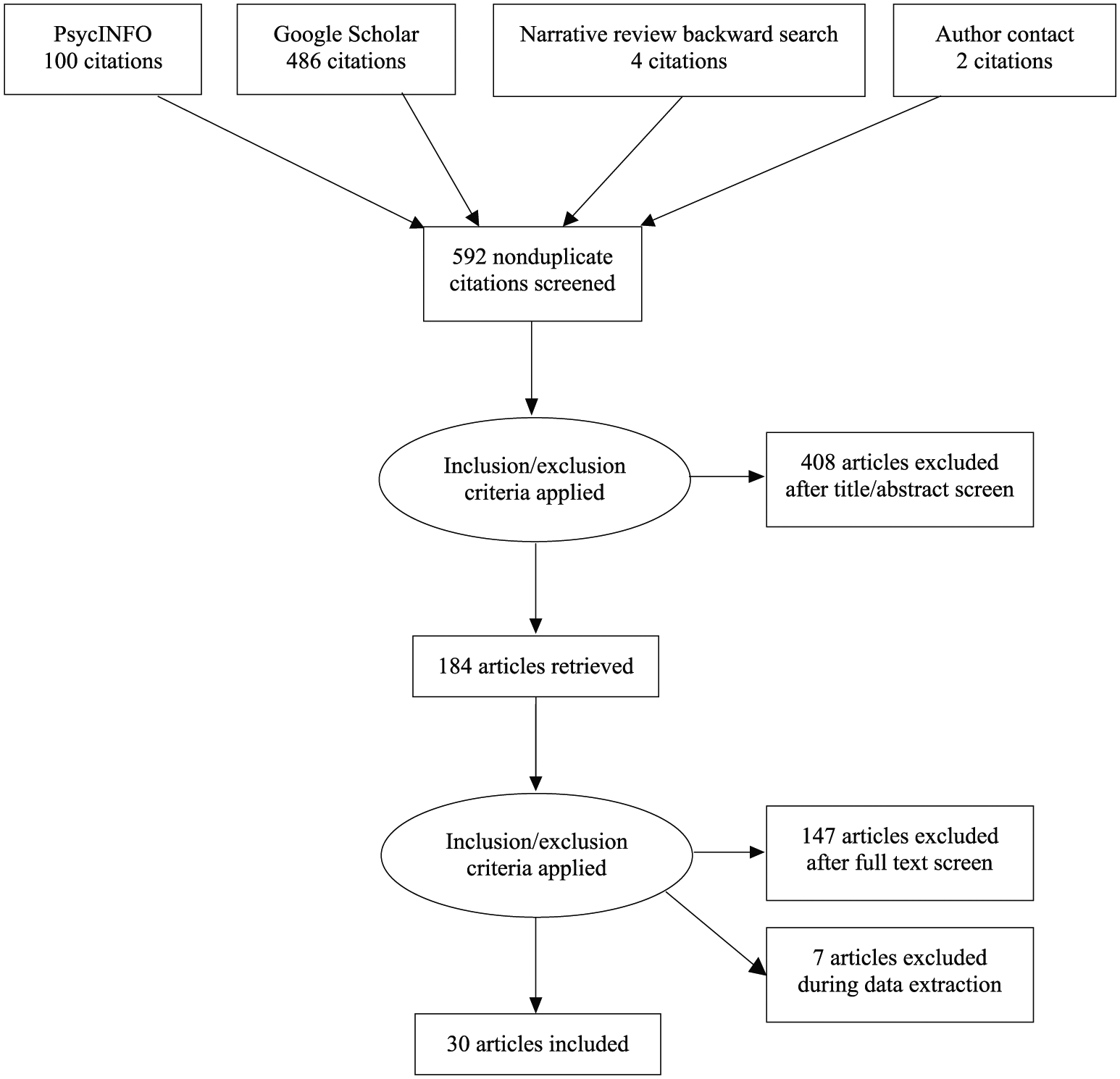
PRISMA flow chart.
Coding
In addition to the treatment-level moderator of type of uncertainty and study-level moderator of whether uncertainty was measured or manipulated, two additional study-level characteristics were coded to assess for possible differences as well as publication bias. These were publication status and research group.
Treatment-Level Coding
Uncertainty type
Self-uncertainty has been operationalized in various ways. Self-uncertainty was coded into one of the following three groups: direct self-uncertainty, indirect self-uncertainty (e.g., task uncertainty), and social identity uncertainty (collective self-uncertainty).
Study-Level Coding
Uncertainty design
Since measured uncertainty elicits preexisting uncertainty, it is likely stronger and more likely to predict identification. Studies that measured uncertainty were coded as “measured,” while studies that manipulated or primed uncertainty were coded “manipulated.”
Publication status
Studies that were published or currently in press in peer-reviewed journals were coded as “published,” while others were coded as “unpublished.”
Research group
Because Hogg developed uncertainty-identity theory, studies in which one of the authors was Hogg or one of his associates were coded as “Hogg and associates.” This included dissertations and master’s theses where Hogg or one of his associates was a committee member. All other studies were coded as “other.”
Meta-Analytic Strategy
Simple correlations (r) were used as the estimate of effect size. These correlation coefficients were converted to Fisher’s Z and then converted back to correlation coefficients in order to stabilize the variance. This particular effect size was chosen because, while level of uncertainty has been used as a nominal variable in experimental studies, in cases where level of uncertainty has been measured, it has generally been measured on a Likert scale. Group identification is typically also measured on a Likert scale. Therefore, treating the variables like continuous data made more sense (Hedges, 2008).
If available, correlation coefficients were calculated using sample sizes, means, and standard deviations. If those were not available, zero-order correlations were used to calculate the correlation coefficients. Finally, if zero-order correlations were also not available, statistical tests such as F tests or t tests were converted into correlation coefficients.
Publication Bias
Publication bias refers to when studies with certain characteristics, such as larger effect sizes or statistically significant findings, are more likely to be accepted and published in journals than those that have smaller effects or insignificant findings. This can lead to an overestimation of the population effect size, affecting the validity of meta-analytic results. While there are numerous tests and adjustments for publication bias in meta-analysis, most are not appropriate for dependent effect sizes. Given the dependency of effect sizes, the current study examined a funnel plot and assessed publication bias through Egger’s regression test (Egger, Smith, Schneider, & Minder, 1997) using robust variance estimation. Egger’s regression test involves a metaregression with precision predicting the normalized effect estimate. Potential publication bias is indicated by a significant slope coefficient.
Results
Study Characteristics
The meta-analysis drew on 30 different sources, which included 35 samples with a total of 4,657 participants. These yielded 40 effect sizes examining the relationship of uncertainty and group identification.
Assumptions
Four samples contributed more than one effect size, which violates the assumption of independent effect sizes of most meta-analyses (Gleser & Olkin, 2009). Robust variance estimation was used to address this issue of dependency of effect sizes (Hedges, Tipton, & Johnson, 2010), and the Robumeta package for R was used to adjust for the small sample size (Fisher & Tipton, 2015). Additionally, because the mean number of effect sizes per sample was 1.14, a stricter alpha value of .01 was used to determine significance (Hedges et al., 2010; Tanner-Smith & Tipton, 2014). A rho value of .80 was used, with sensitivity analysis suggesting reliable results for all analyses.
Overall Summary Effect
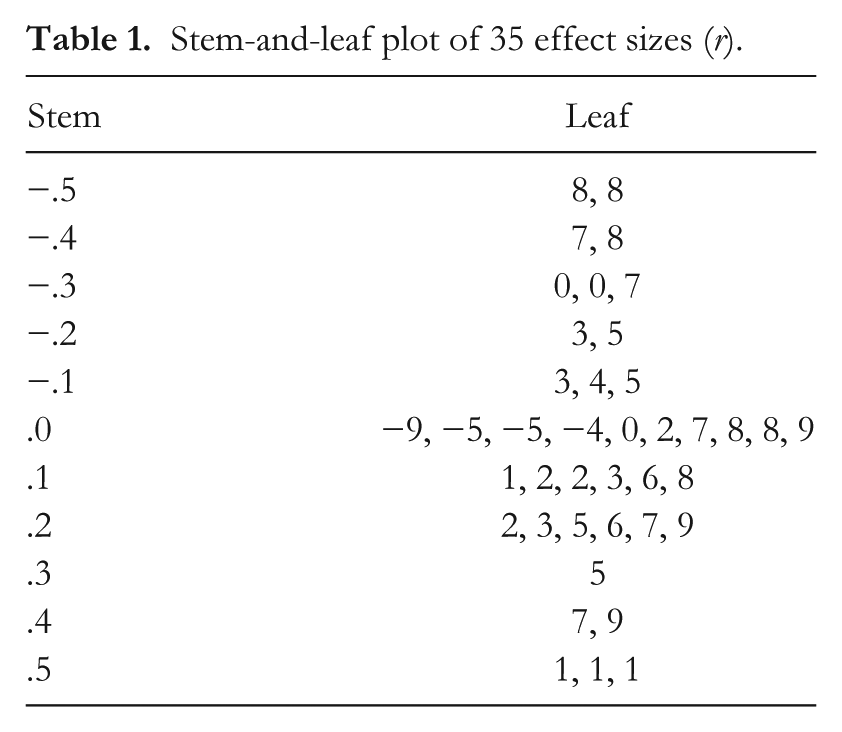
The overall distribution of effect sizes can be seen in Table 1. Unsurprisingly, and consistent with the overall prediction under H1, there was no significant summary effect between uncertainty and identification (r = .08; 95% CI [−0.01, 0.18]). While the small and nonsignificant correlation between uncertainty and identification suggests that changes in uncertainty are not associated with changes in identification, a large percentage of the variance in effect sizes was associated with variation between the studies (I2 = 88.68%).
Stem-and-leaf plot of 35 effect sizes (r).
Moderation Analyses
The studies were categorized on the basis of (a) how self-uncertainty was operationalized (uncertainty type: direct self-uncertainty, indirect self-uncertainty, and social identity uncertainty), and (b) research design (measured vs. manipulated self-uncertainty).
Uncertainty type
The first moderation analysis focused on the types of uncertainty examined in the studies: direct self-uncertainty, indirect self-uncertainty, and social identity uncertainty (see Table 2). There were 21 effect sizes from 21 samples in the direct self-uncertainty subgroup. Consistent with H2c, there was a small summary effect (r = .14; 95% CI [0.04, 0.25]) with still a large amount of variance between studies within this subgroup (I2 = 83.56%). For indirect self-uncertainty, there were seven effect sizes from seven samples. Consistent with H2b, there was a medium summary effect (r = .23; 95% CI [0.12, 0.34]). There was still a bit of variance between studies within this subgroup (I2 = 37.00%). For social identity uncertainty, there were 12 effect sizes from eight samples. Also consistent with H2a, there was a medium summary effect (r = −.26; 95% CI [−0.44, −0.06]); however, there was a large amount of variance between studies (I2 = 92.23%).
Uncertainty type as a moderator.
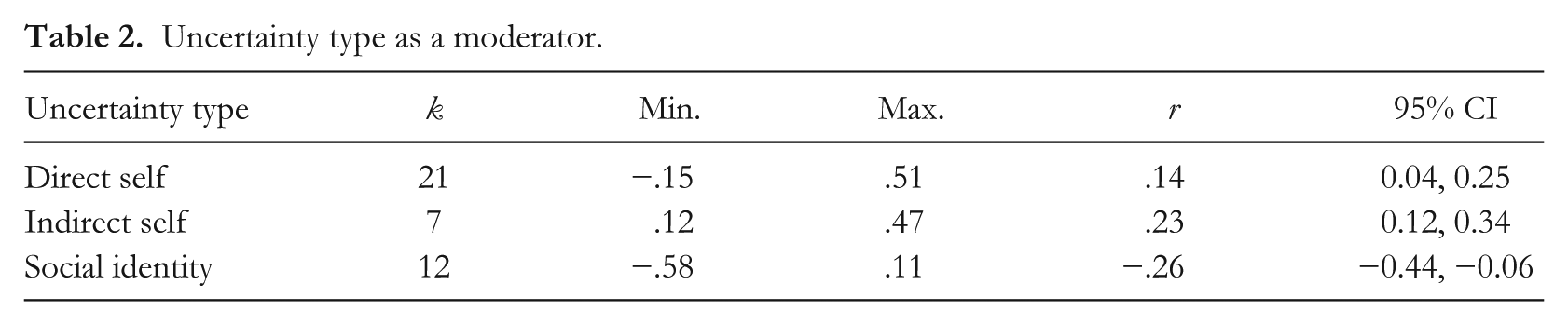
Direct self-uncertainty was significantly different from indirect self-uncertainty (p = .005) and social identity uncertainty (p = .001). However, indirect self-uncertainty and social identity uncertainty did not significantly differ (p = .230).
Research design
The second moderation analysis examined the research design; specifically, whether uncertainty was measured or manipulated (see Table 3). For manipulated uncertainty, there were 26 effect sizes from 25 samples that yielded a small summary effect (r = .17; 95% CI [0.06, 0.26]). There was a large amount of variance between studies within this subgroup (I2 = 84.66%). For measured uncertainty, there were 14 effect sizes from 11 samples that also yielded a small summary effect (r = −.13; 95% CI [−0.40, −0.09]). There was also a large amount of variance between studies within this group (I2 = 89.41%). While the direction of effects is different, there was no difference in magnitude between measured and manipulated uncertainty (p = .239).
Research design as a moderator.

Uncertainty type and research design
A chi-square test of independence was conducted to examine the relationship between uncertainty type and research design. The analysis revealed a significant association between uncertainty type and research design, χ2(2) = 10.27, p = .006. Studies that manipulated self-uncertainty used more direct self-uncertainty than indirect or social identity uncertainty. Studies that measured self-uncertainty used more social identity uncertainty than direct or indirect self-uncertainty; there were no measurement studies that examined indirect self-uncertainty.
Publication status
There were no differences depending on whether effect sizes were published (r = .08; 95% CI [−0.03, 0.19]) or unpublished (r = .12; 95% CI [−0.18, 0.40]). However, there were too few degrees of freedom (< 4) to have full confidence in this finding.
Research group
There were 27 effect sizes from 24 samples published by Hogg and associates, and 13 effect sizes from 11 samples published by others. No differences existed between effect sizes published by Hogg and associates (r = .10; 95% CI [−0.03, 0.22]) and others (r = .06; 95% CI [−0.11, 0.22]).
Publication Bias
The funnel plot of the study correlation size and standard error did not indicate much asymmetry (see Figure 2), suggesting that publication bias is not an issue. This was formally tested using Egger’s regression test using robust variance estimation. The slope was not significant, b = 3.99, SE = 2.17, p = .092.
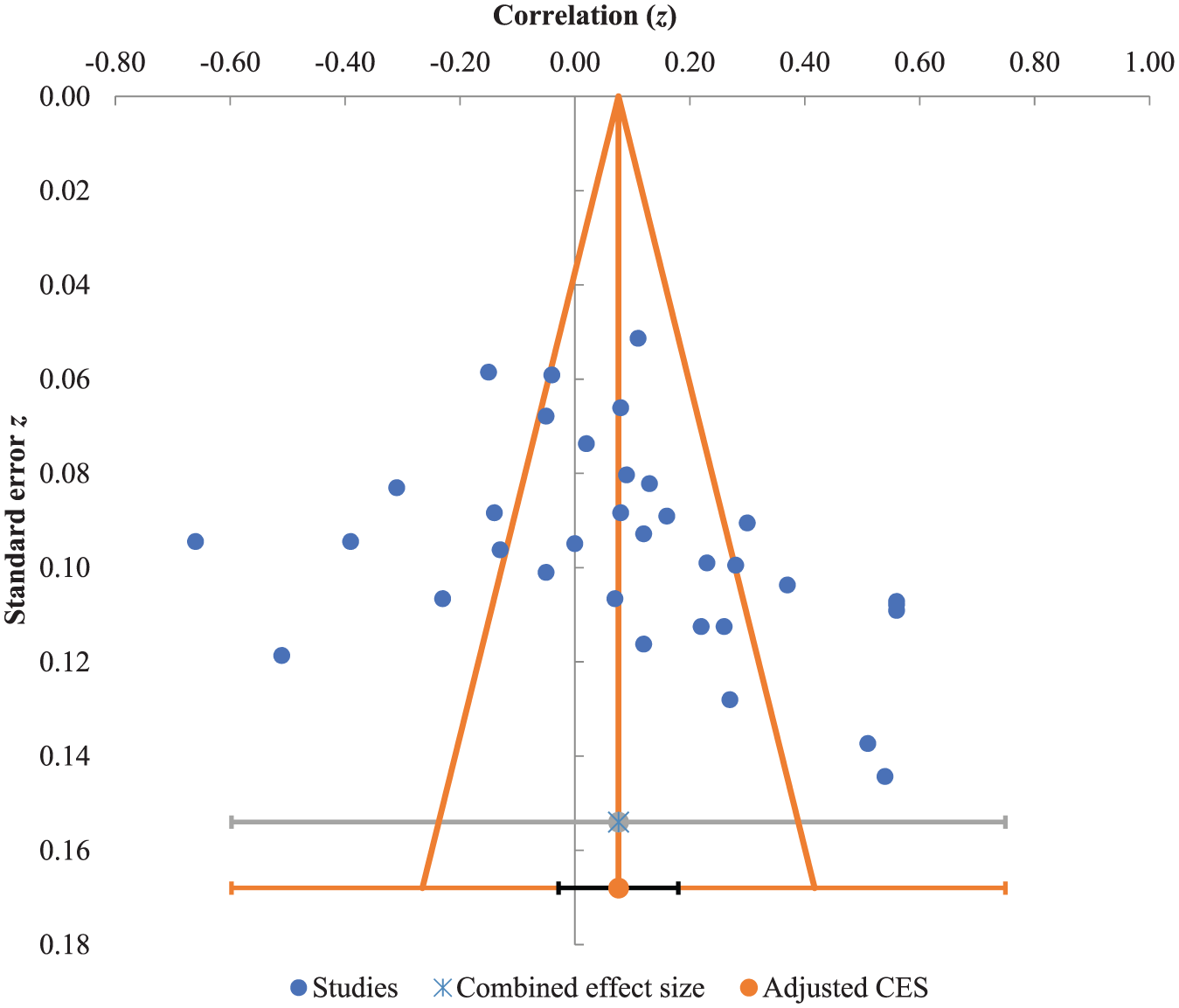
Funnel plot of observed effect sizes (x-axis) and standard error of effect sizes (y-axis).
Discussion
Uncertainty-identity theory, initially introduced almost 20 years ago (Hogg, 2000), and subsequently more fully developed (Hogg, 2007, 2012, 2015) and extended to help explain extremism (e.g., Hogg, 2014), proposes that feelings of self-uncertainty seek resolution, and that the process of self-categorization associated with group identification very effectively accomplishes this. Self-uncertainty is a key motivation for identifying with groups, and identification reduces self-uncertainty because it not only prescribes how one should think, feel, and behave, but also furnishes consensual ingroup validation of one’s identity and sense of self.
Uncertainty-identity theory’s most basic prediction is that under conditions of high self-uncertainty people will identify more strongly with a self-inclusive group. This association between self-uncertainty and group identification has, as reported by narrative reviews (e.g., Hogg, 2012), been confirmed across a large number of studies over the past 20 years. These studies have operationalized self-uncertainty in many different ways. However, there has yet to be a quantitative review to examine (a) how much variance in identification is explained by self-uncertainty (the overall effect size) and (b) how the effect size may be moderated by the way in which the various studies are conducted and operationalize self-uncertainty (whether self-uncertainty is directly or indirectly measured or manipulated). The present research addresses this gap in the literature.
We conducted a meta-analysis of 30 inclusion-criteria-conforming studies, which yielded 35 samples involving 4,657 participants. The overall association between self-uncertainty and identification was not significant. Uncertainty explained less than 1% of variance in identification. However, there was a very large variance between studies, suggesting, as we strongly anticipated, that how the study was conducted and how self-uncertainty was operationalized might be very important moderators. This anticipation was well supported.
The first moderator was how self-uncertainty was operationalized. Studies were divided into three categories: (a) those that operationalized self-uncertainty indirectly, typically via some judgment task; (b) those that operationalized self-uncertainty directly by priming or measuring self-uncertainty; and (c) those that operationalized self-uncertainty indirectly by focusing on identity uncertainty. Direct self-uncertainty explained only 2.0% of variance in identification (a small effect, r = .14), while indirect uncertainty explained 5.3% (a moderate effect, r = .23). This is not surprising as a key tenet of uncertainty-identity theory is that uncertainty only motivates uncertainty reduction if the uncertainty is psychologically real and impactful—the indirect operationalizations used in uncertainty-identity theory research are more “real” than the direct primes used in this research.
The strongest relationship between uncertainty and identification was found when social identity uncertainty was measured or manipulated—social identity uncertainty explained 6.8% of variance in identification (a moderate effect, r = −.26). This is the strongest correlation because the focus of uncertainty is explicitly related to the collective self (cf. Hogg & Mahajan, 2018). The correlation is negative because studies of social identity uncertainty that were included in the meta-analysis all examined identification with a group that was the source of their self-uncertainty rather than identification with a novel group. High uncertainty about the identity of a group that one belongs to weakens identification, because (much like low entitativity groups) such a group does not provide the sort of clearly defined identity that reduces uncertainty. There is a clear need for further research into the relationship between identity uncertainty and self-uncertainty.
Despite being the strongest of the three types of relationships, it is still important to note that social identity uncertainty did not significantly differ from indirect self-uncertainty. However, there was still substantial observed variance between studies for social identity uncertainty (I2 = 92.23%). One possible explanation for the large amount of variance could be identity centrality. While social identity uncertainty would lead to group disidentification, this should depend on how central and important the group is to one’s self-concept.
A large amount of variance between studies was also found for direct self-uncertainty (I2 = 83.56%). One other possible moderator that could be responsible for this variability, which we foreshadowed in the introduction, is group entitativity. A key prediction of uncertainty-identity theory is that entitativity moderates the uncertainty–identification relationship such that uncertainty strengthens identification with high entitativity groups and weakens identification with low entitativity groups. Studies support this, but unfortunately there were insufficient such studies that met our inclusion criteria, so we were not able to include entitativity as a moderator in our meta-analysis.
The second moderator we were able to examine was whether studies had measured or manipulated self-uncertainty. Measured uncertainty accounted for 1.7% of variance in identification (a small effect, r = −.13), while manipulated uncertainty accounted for 2.9% (a small effect, r = .17). Although we had anticipated that measured uncertainty would yield a larger effect than manipulated uncertainty (because the former always invoked real groups and preexistent identities, whereas the latter largely did not), there was a considerable amount of observed variance for both measured (I2 = 89.41%) and manipulated uncertainty (I2 = 84.66%), which could explain the lack of difference between the two effect sizes. The reason that the correlation is negative for measured uncertainty is that nine of the 15 effects that measured uncertainty examined social identity uncertainty, and as we discussed before, identity uncertainty is negatively related to identification—of the 13 effects overall that examined social identity uncertainty, all but two yielded a negative relationship. The chi-square analysis showed that the two moderators of uncertainty type and research design were related. However, because of the small number of studies, the two moderators could not be run simultaneously.
Our meta-analysis shows the importance of uncertainty type in examining the relationship between self-uncertainty and group identification. However, the number of studies we were able to include in our meta-analysis is relatively small (Crano & Brewer, 2002), though not unacceptable. Several potential studies were excluded due to lack of proper statistical information to calculate effect sizes. Another obvious observation is that most of the studies included were associated with Hogg and his colleagues. Given that Hogg developed uncertainty-identity theory, and this area of research is relatively new (about 2 decades old), this is unavoidable and not surprising.
Our meta-analysis has confirmed the core premise of uncertainty-identity theory that self-uncertainty strengthens or is associated with group identification, and that the relationship is stronger as a function of increasing psychological reality of self-uncertainty. It also confirms that uncertainty about an ingroup’s social identity—identity uncertainty—can raise self-uncertainty that weakens ingroup identification because the group does not offer a clearly enough defined identity to reduce self-uncertainty.
Footnotes
Appendix A
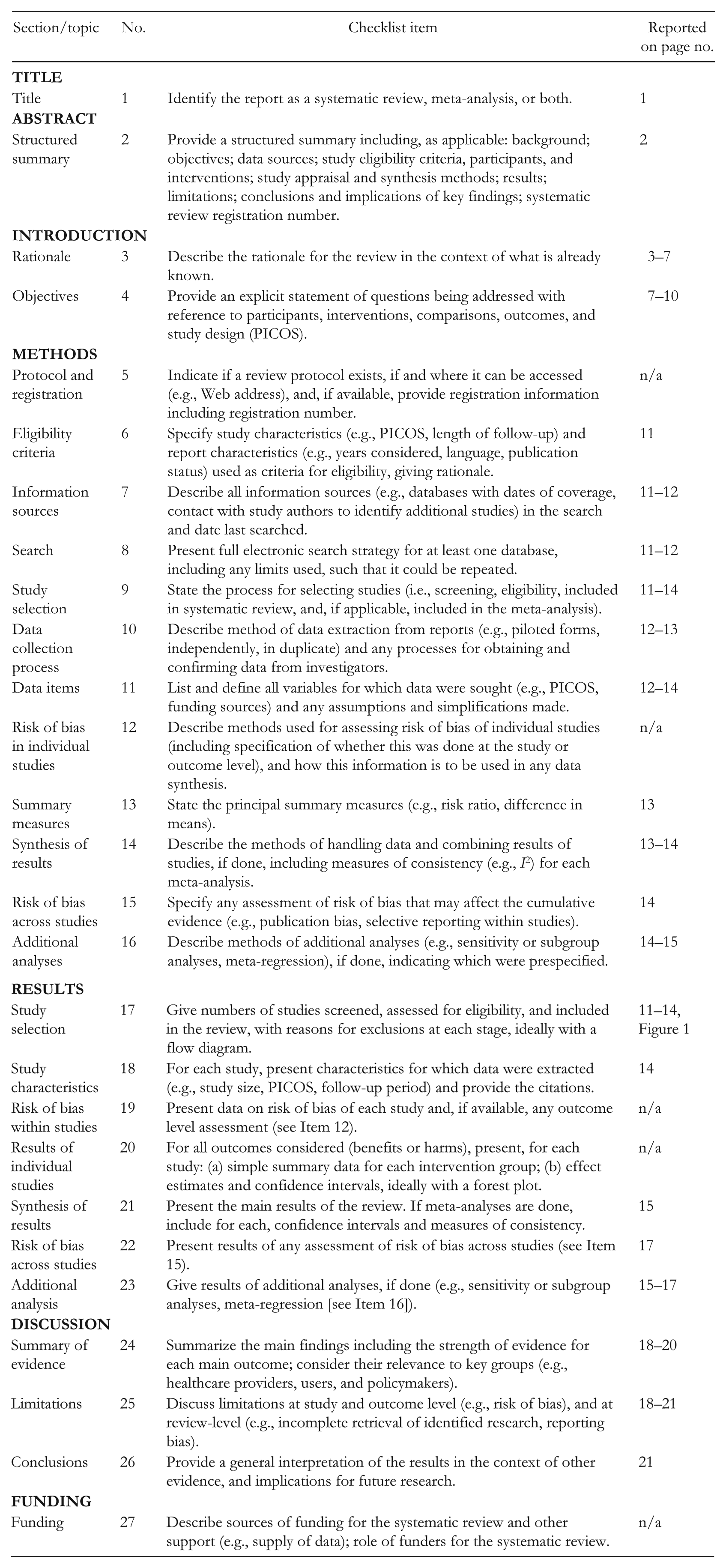
| Section/topic | No. | Checklist item | Reported on page no. |
|---|---|---|---|
|
|
|||
| Title | 1 | Identify the report as a systematic review, meta-analysis, or both. | 1 |
|
|
|||
| Structured summary | 2 | Provide a structured summary including, as applicable: background; objectives; data sources; study eligibility criteria, participants, and interventions; study appraisal and synthesis methods; results; limitations; conclusions and implications of key findings; systematic review registration number. | 2 |
|
|
|||
| Rationale | 3 | Describe the rationale for the review in the context of what is already known. | 3–7 |
| Objectives | 4 | Provide an explicit statement of questions being addressed with reference to participants, interventions, comparisons, outcomes, and study design (PICOS). | 7–10 |
|
|
|||
| Protocol and registration | 5 | Indicate if a review protocol exists, if and where it can be accessed (e.g., Web address), and, if available, provide registration information including registration number. | n/a |
| Eligibility criteria | 6 | Specify study characteristics (e.g., PICOS, length of follow-up) and report characteristics (e.g., years considered, language, publication status) used as criteria for eligibility, giving rationale. | 11 |
| Information sources | 7 | Describe all information sources (e.g., databases with dates of coverage, contact with study authors to identify additional studies) in the search and date last searched. | 11–12 |
| Search | 8 | Present full electronic search strategy for at least one database, including any limits used, such that it could be repeated. | 11–12 |
| Study selection | 9 | State the process for selecting studies (i.e., screening, eligibility, included in systematic review, and, if applicable, included in the meta-analysis). | 11–14 |
| Data collection process | 10 | Describe method of data extraction from reports (e.g., piloted forms, independently, in duplicate) and any processes for obtaining and confirming data from investigators. | 12–13 |
| Data items | 11 | List and define all variables for which data were sought (e.g., PICOS, funding sources) and any assumptions and simplifications made. | 12–14 |
| Risk of bias in individual studies | 12 | Describe methods used for assessing risk of bias of individual studies (including specification of whether this was done at the study or outcome level), and how this information is to be used in any data synthesis. | n/a |
| Summary measures | 13 | State the principal summary measures (e.g., risk ratio, difference in means). | 13 |
| Synthesis of results | 14 | Describe the methods of handling data and combining results of studies, if done, including measures of consistency (e.g., I2) for each meta-analysis. | 13–14 |
| Risk of bias across studies | 15 | Specify any assessment of risk of bias that may affect the cumulative evidence (e.g., publication bias, selective reporting within studies). | 14 |
| Additional analyses | 16 | Describe methods of additional analyses (e.g., sensitivity or subgroup analyses, meta-regression), if done, indicating which were prespecified. | 14–15 |
|
|
|||
| Study selection | 17 | Give numbers of studies screened, assessed for eligibility, and included in the review, with reasons for exclusions at each stage, ideally with a flow diagram. | 11–14, Figure 1 |
| Study characteristics | 18 | For each study, present characteristics for which data were extracted (e.g., study size, PICOS, follow-up period) and provide the citations. | 14 |
| Risk of bias within studies | 19 | Present data on risk of bias of each study and, if available, any outcome level assessment (see Item 12). | n/a |
| Results of individual studies | 20 | For all outcomes considered (benefits or harms), present, for each study: (a) simple summary data for each intervention group; (b) effect estimates and confidence intervals, ideally with a forest plot. | n/a |
| Synthesis of results | 21 | Present the main results of the review. If meta-analyses are done, include for each, confidence intervals and measures of consistency. | 15 |
| Risk of bias across studies | 22 | Present results of any assessment of risk of bias across studies (see Item 15). | 17 |
| Additional analysis | 23 | Give results of additional analyses, if done (e.g., sensitivity or subgroup analyses, meta-regression [see Item 16]). | 15–17 |
|
|
|||
| Summary of evidence | 24 | Summarize the main findings including the strength of evidence for each main outcome; consider their relevance to key groups (e.g., healthcare providers, users, and policymakers). | 18–20 |
| Limitations | 25 | Discuss limitations at study and outcome level (e.g., risk of bias), and at review-level (e.g., incomplete retrieval of identified research, reporting bias). | 18–21 |
| Conclusions | 26 | Provide a general interpretation of the results in the context of other evidence, and implications for future research. | 21 |
|
|
|||
| Funding | 27 | Describe sources of funding for the systematic review and other support (e.g., supply of data); role of funders for the systematic review. | n/a |
Appendix B
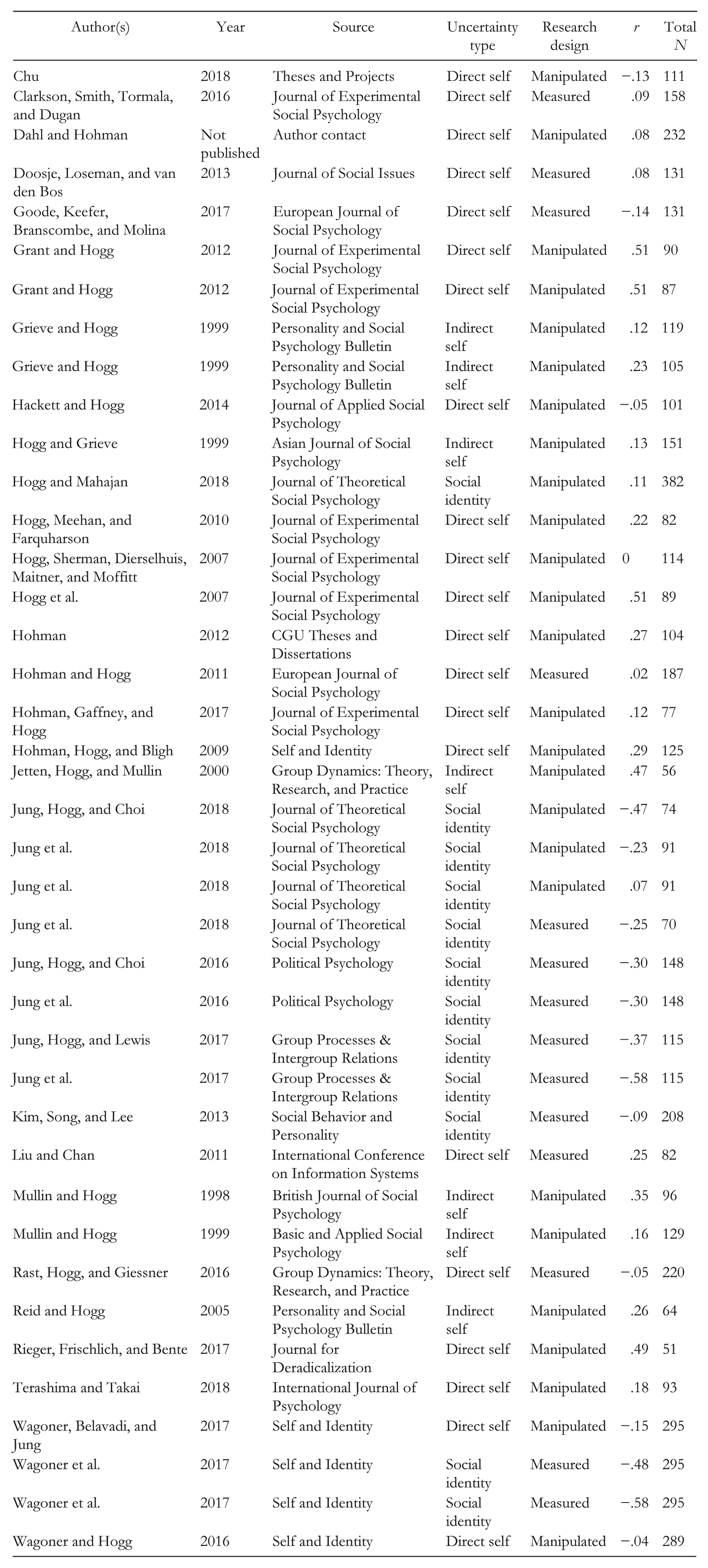
| Author(s) | Year | Source | Uncertainty type | Research design | r | Total N |
|---|---|---|---|---|---|---|
| Chu | 2018 | Theses and Projects | Direct self | Manipulated | −.13 | 111 |
| Clarkson, Smith, Tormala, and Dugan | 2016 | Journal of Experimental Social Psychology | Direct self | Measured | .09 | 158 |
| Dahl and Hohman | Not published | Author contact | Direct self | Manipulated | .08 | 232 |
| Doosje, Loseman, and van den Bos | 2013 | Journal of Social Issues | Direct self | Measured | .08 | 131 |
| Goode, Keefer, Branscombe, and Molina | 2017 | European Journal of Social Psychology | Direct self | Measured | −.14 | 131 |
| Grant and Hogg | 2012 | Journal of Experimental Social Psychology | Direct self | Manipulated | .51 | 90 |
| Grant and Hogg | 2012 | Journal of Experimental Social Psychology | Direct self | Manipulated | .51 | 87 |
| Grieve and Hogg | 1999 | Personality and Social Psychology Bulletin | Indirect self | Manipulated | .12 | 119 |
| Grieve and Hogg | 1999 | Personality and Social Psychology Bulletin | Indirect self | Manipulated | .23 | 105 |
| Hackett and Hogg | 2014 | Journal of Applied Social Psychology | Direct self | Manipulated | −.05 | 101 |
| Hogg and Grieve | 1999 | Asian Journal of Social Psychology | Indirect self | Manipulated | .13 | 151 |
| Hogg and Mahajan | 2018 | Journal of Theoretical Social Psychology | Social identity | Manipulated | .11 | 382 |
| Hogg, Meehan, and Farquharson | 2010 | Journal of Experimental Social Psychology | Direct self | Manipulated | .22 | 82 |
| Hogg, Sherman, Dierselhuis, Maitner, and Moffitt | 2007 | Journal of Experimental Social Psychology | Direct self | Manipulated | 0 | 114 |
| Hogg et al. | 2007 | Journal of Experimental Social Psychology | Direct self | Manipulated | .51 | 89 |
| Hohman | 2012 | CGU Theses and Dissertations | Direct self | Manipulated | .27 | 104 |
| Hohman and Hogg | 2011 | European Journal of Social Psychology | Direct self | Measured | .02 | 187 |
| Hohman, Gaffney, and Hogg | 2017 | Journal of Experimental Social Psychology | Direct self | Manipulated | .12 | 77 |
| Hohman, Hogg, and Bligh | 2009 | Self and Identity | Direct self | Manipulated | .29 | 125 |
| Jetten, Hogg, and Mullin | 2000 | Group Dynamics: Theory, Research, and Practice | Indirect self | Manipulated | .47 | 56 |
| Jung, Hogg, and Choi | 2018 | Journal of Theoretical Social Psychology | Social identity | Manipulated | −.47 | 74 |
| Jung et al. | 2018 | Journal of Theoretical Social Psychology | Social identity | Manipulated | −.23 | 91 |
| Jung et al. | 2018 | Journal of Theoretical Social Psychology | Social identity | Manipulated | .07 | 91 |
| Jung et al. | 2018 | Journal of Theoretical Social Psychology | Social identity | Measured | −.25 | 70 |
| Jung, Hogg, and Choi | 2016 | Political Psychology | Social identity | Measured | −.30 | 148 |
| Jung et al. | 2016 | Political Psychology | Social identity | Measured | −.30 | 148 |
| Jung, Hogg, and Lewis | 2017 | Group Processes & Intergroup Relations | Social identity | Measured | −.37 | 115 |
| Jung et al. | 2017 | Group Processes & Intergroup Relations | Social identity | Measured | −.58 | 115 |
| Kim, Song, and Lee | 2013 | Social Behavior and Personality | Social identity | Measured | −.09 | 208 |
| Liu and Chan | 2011 | International Conference on Information Systems | Direct self | Measured | .25 | 82 |
| Mullin and Hogg | 1998 | British Journal of Social Psychology | Indirect self | Manipulated | .35 | 96 |
| Mullin and Hogg | 1999 | Basic and Applied Social Psychology | Indirect self | Manipulated | .16 | 129 |
| Rast, Hogg, and Giessner | 2016 | Group Dynamics: Theory, Research, and Practice | Direct self | Measured | −.05 | 220 |
| Reid and Hogg | 2005 | Personality and Social Psychology Bulletin | Indirect self | Manipulated | .26 | 64 |
| Rieger, Frischlich, and Bente | 2017 | Journal for Deradicalization | Direct self | Manipulated | .49 | 51 |
| Terashima and Takai | 2018 | International Journal of Psychology | Direct self | Manipulated | .18 | 93 |
| Wagoner, Belavadi, and Jung | 2017 | Self and Identity | Direct self | Manipulated | −.15 | 295 |
| Wagoner et al. | 2017 | Self and Identity | Social identity | Measured | −.48 | 295 |
| Wagoner et al. | 2017 | Self and Identity | Social identity | Measured | −.58 | 295 |
| Wagoner and Hogg | 2016 | Self and Identity | Direct self | Manipulated | −.04 | 289 |
Acknowledgements
We are grateful to Nicolas Barreto and Chris Aberson for their valuable insight and critiques of this work. We are also grateful to colleagues who shared their unpublished data to make this research possible.
Funding
The author(s) received no financial support for the research, authorship, and/or publication of this article.
