







Abstract
Negative attitudes toward vegetarians/vegans (i.e., veg*ns) are common, particularly among those who desire/like/consume meat more. In two studies, we replicated and extended past work, showing that visual reminders of meat’s animal origins (vs. images of meat alone) decreased meat consumption willingness via increased empathy for animals, distress about meat consumption, and disgust for meat. We also assessed how animal–meat reminders influence antiveg*n attitudes. In Study 1 (N = 299) experimental animal–meat reminders (vs. meat-alone images) indirectly reduced negative attitudes toward veg*ns via increased empathy and distress (together, but not independently). The same manipulation in Study 2 (N = 280) lowered antiveg*n attitudes through greater empathy and lowered veg*n threat through greater distress. Implications for promoting less antiveg*n attitudes are discussed.
Beyond motivations to eliminate animal suffering, adopting a vegetarian or vegan (veg*n) diet is associated with countless health and environmental benefits (e.g., W. J. Craig, 2009; MacKenzie, 2015; McKnight, 2014; Shepon, Eshel, Noor, & Milo, 2018; Wolf, Asrar, & West, 2017). Indeed, recognition of veg*nism’s benefits is growing and more people are adopting a veg*n diet in the Western world (Laumann, Gagnon, Michael, & Michaels, 1994; Newport, 2012; Saner, 2016). Yet negative attitudes towards veg*ns may prevent people from reaping the benefits of successfully adopting a meat-free diet. Meat-eaters express prejudice toward veg*ns that is equal to, or exceeds, their prejudice towards other widely studied marginalized groups (e.g., Blacks, gays/lesbians, immigrants; MacInnis & Hodson, 2017). People also often freely associate negative words with vegetarians, calling them “sadistic,” “judgmental,” and “militant” (Minson & Monin, 2012). Further, recent research suggests that those who like, desire, and consume more meat show significantly more negative attitudes towards vegetarians (Earle & Hodson, 2017; Ruby et al., 2016). Thus, the current studies assess whether changing the way people think about meat and its association with animals can reduce antiveg*n attitudes.
Meat–Animal Associations and Meat Consumption
People find the use of animals for human consumption distressing, even if they eat meat themselves. Deemed the “meat paradox,” this distress results from conflict caused by not wanting to harm animals but nonetheless eating animals and animal by-products (e.g., Loughnan, Bastian, & Haslam, 2014; Piazza et al., 2015). Scholars suggest that to lessen this dissonance, humans developed strategies to widen the psychological and physical distance between meat production and meat consumption (e.g., Plous, 2003; Prunty & Apple, 2013; Rothgerber, 2014). This distance allows people to avoid reminders that animals have been killed, and usually suffered, to produce the meat that they consume. For example, most societies now use large-scale corporate farming, such that most people do not witness the raising and slaughtering of farm animals (Leroy & Degreef, 2015). Further, before meat is seen by consumers, animals’ bodies are skinned, often cut into small pieces, and packaged such that the meat bears little resemblance to the animal from which it came (Leroy & Degreef, 2015). In other words, across multiple strategies, meat becomes disassociated from its animal origins.
Of interest to the present project, reminding people of meat’s animal origins lessens meat’s appeal. In multiple studies, Kunst and Hohle (2016) showed participants images that explicitly associated meat with the animal from which it came (e.g., an image of a sheep paired with lamb chops), or images that did not remind participants of animal–meat associations (e.g., an image of lamb chops alone). Such animal–meat reminders (vs. images of meat alone) increased empathy for the animals used to produce meat and disgust for the meat itself. These emotions, in turn, were associated with lower willingness to eat meat and increased willingness to choose a vegetarian meal option.
In two studies, we attempted to replicate Kunst and Hohle’s findings (2016) by assessing whether exposure to meat–animal association images (vs. images of meat alone) would lead to less willingness to eat the meat via increased empathy for animals that become the meat. Moreover, given that animal–meat associations lead people to directly confront the meat paradox (that one does not want to harm animals, but also that one consumes meat), we predict that exposure to such associations will elicit distress (e.g., guilt, discomfort) about one’s meat consumption, which in turn will also be associated with lower willingness to eat the meat. Indeed, Piazza et al. (2015) found that greater guilt about one’s meat consumption is associated with greater willingness to reduce the purchase and consumption of animal products. Thus, we also extended Kunst and Hohle’s findings by considering increased meat consumption distress as an additional mediator of the relation between animal–meat reminders (vs. meat-alone images) and meat consumption willingness. To test these predictions, we used the manipulation from Kunst and Hohle (2016, Study 3), which exposed participants to an image of a lamb with prepared lamb chops (animal–meat reminder condition) or an image of lamb chops alone (meat-alone condition). We also added two images to each condition. Therefore, the animal–meat condition exposed participants to a lamb paired with lamb chops, a cow paired with a beefsteak, and a pig paired with a ham. The meat-alone condition exposed participants to identical meat images but without the live animal (i.e., images of lamb chops, a beefsteak, and ham alone). Including these additional images removes the potential that the manipulation was only relevant to a specific animal–meat pairing.
Meat–Animal Associations and Antiveg*n Attitudes
In addition to replicating and extending work by Kunst and Hohle (2016), we also sought to uncover previously untested mechanisms relevant to attitudes towards veg*ns (i.e., human social groups). Given that greater liking, desire, and consumption of meat predicts more negative attitudes towards vegetarians (e.g., Earle & Hodson, 2017), and that desire to eat meat can be reduced by increasing proanimal emotions (e.g., animal empathy, meat distress), we argue that animal–meat reminders might also reduce antiveg*n attitudes via proanimal emotions. That is, empathy for animals, disgust for meat, and distress about meat consumption may reflect veg*n values, suggesting that similar psychological processes underlie both meat consumption willingness and attitudes towards veg*ns. For instance, greater meat consumption guilt is associated with veg*n values, including deriving a sense of morality from one’s food consumption decisions and less speciesist attitudes (Piazza, in press; Piazza et al., 2015). Further, fostering disgust for meat and empathy for animals is associated with greater likelihood of choosing a vegetarian (vs. meat) meal option (Kunst & Hohle, 2016). In other words, proanimal emotions, such as animal empathy and meat distress, appear to be associated with more veg*n values and behavior. As such, meat–animal reminders may lead to less negative attitudes toward veg*n people, via emotions such as animal empathy or meat distress, in the same manner that meat–animal reminders predict positive attitudes toward vegetarian food and beliefs. Such reasoning is also consistent with theoretical arguments that emotions like pity and guilt facilitate more prosocial and reconciliatory attitudes towards outgroups (Cottrell & Neuberg, 2005). That is, guilt about one’s meat consumption may facilitate more prosocial attitudes (i.e., less negative evaluations) toward those who do not eat meat (i.e., veg*ns). As such, we investigate how responses to meat–animal pairings flow on to attitudes towards veg*ns, a novel, yet important target variable.
Moderating Role of Ideologies and Meat Rationalization
We reasoned that certain individual differences may moderate the effect of animal–meat associations or proanimal emotions on antiveg*n attitudes or meat consumption willingness, given the important role that these constructs play in predicting prejudice and in prejudice-reduction interventions (e.g., Asbrock, Christ, Duckitt, & Sibley, 2012; Dhont & van Hiel, 2009; Hodson, Harry, & Mitchell, 2009). For instance, conservatism, typically defined as preference for inequality and resistance to change (Skitka, Mullen, Griffin, Hutchinson, & Chamberlin, 2002), is associated with a lower likelihood of adopting a vegetarian diet (Ruby, 2012) and lower chances of maintaining a meat-free diet (Hodson & Earle, 2018). Similarly, right-wing authoritarianism (RWA), defined as preference for tradition, convention, and aggression toward norm violators (Altemeyer, 1996), is associated with greater meat consumption, liking of meat, and beliefs that vegetarianism is a threat to one’s way of life or culture (Dhont & Hodson, 2014; Dhont, Hodson, & Leite, 2016; MacInnis & Hodson, 2017). Likewise, social dominance orientation (SDO; Ho et al., 2015), defined as endorsement of intergroup inequalities and hierarchies in human social groups, is associated with greater willingness to exploit animals (e.g., Dhont & Hodson, 2014; Dhont, Hodson, Costello, & MacInnis, 2014; Hyers, 2006), prejudice toward veg*ns (MacInnis & Hodson, 2017), and greater threat reactions to vegetarianism (Dhont & Hodson, 2014; Dhont et al., 2016). Additionally, Piazza et al. (2015) proposed that there are “4Ns” relevant to rationalizing meat consumption. That is, individuals may endorse beliefs that meat-eating is natural, normal, necessary, and nice (i.e., tastes good), each to justify causing harm to animals via consumption of animal products. Greater 4N endorsement is associated with less moral concern for, and less attribution of mind (e.g., capacity for agency and experience) to animals, as well as less guilt and discomfort regarding animal product consumption. Because those higher (vs. lower) in conservatism, RWA, SDO, or the 4Ns tend to differ in views regarding the acceptability of killing animals, they may also differ in emotional responses (e.g., animal empathy) or attitudes following exposure to meat–animal associations.
Past research also reveals that left- and right-wing adherents, even if having comparable initial responses to stimuli, can nonetheless differ in how these reactions translate into attitudes (Skitka et al., 2002; see also Hodson et al., 2013). This suggests that such ideological beliefs may also moderate people’s reactions in the context of meat consumption and amplify the effects of their emotional responses. Specifically, left- and right-wing adherents may differ in how proanimal emotions affect their attitudes toward veg*ns. On the one hand, those higher (vs. lower) in right-wing adherence may show even greater antiveg*n attitudes when experiencing negative emotion, such as distress about meat consumption, consistent with work on conservative threat sensitivity (e.g., Hibbing, Smith, & Alford, 2014; Jost, 2017). On the other hand, those lower in right-wing adherence may experience greater antiveg*n prejudice when experiencing a negatively valenced emotion such as meat guilt, consistent with a conservative shift in which left-wing adherents adopt more conservative beliefs when experiencing negative emotion or threat (e.g., M. A. Craig & Richeson, 2013; Nail, McGregor, Drinkwater, Steele, & Thompson, 2009; Pliskin, Bar-Tal, Sheppes, & Halperin, 2014). Given these contrasting hypotheses, we explore conservatism, RWA, and 4N beliefs as moderators on path relations in Study 1, and conservatism, RWA, and SDO as moderators in Study 2. Hypotheses were preregistered at aspredicted.org. 1
Study 1
First, we attempted to replicate and extend Kunst and Hohle’s (2016) findings by assessing whether exposure to animal–meat association images (vs. images of meat alone) leads to less willingness to eat the meat via increased empathy for animals that become the meat and distress about one’s meat consumption. Importantly, we also hypothesized that exposure to animal–meat association images (relative to meat-alone images) leads to less antiveg*n attitudes. We further predicted an indirect effect of experimental condition on antiveg*n attitudes via proanimal emotions, such that animal–meat association (vs. meat-alone) images would lead to more animal empathy and meat distress, and that these emotions in turn would predict lower levels of antiveg*n attitudes. Therefore, in the current study, we assess the novel idea that animal–meat associations and proanimal emotions, previously seen as relevant to meat and animals, also have social implications for human groups (i.e., veg*ns). Examination of meat distress in this context is also novel and builds on past work focusing on empathy and disgust. Moreover, we assess responses to three animals (cow, pig, and lamb) in a single study, another novel expansion of previous work. We further predicted that those who score higher (vs. lower) on 4N endorsement would experience less animal empathy and meat distress when exposed to reminders of meat’s animal origins, given that these individuals tend to employ more meat consumption justifications. That is, we expected that the positive relations between the animal–meat reminders (vs. meat-alone images) and proanimal emotions would be weaker among those higher in beliefs that rationalize meat consumption. We also assessed whether right-wing adherence would moderate the relation between emotions and meat consumption willingness and between emotions and antiveg*n attitudes.
Method
Participants and procedure
To assess statistical power, we followed the procedure provided by Thoemmes, MacKinnon, and Reiser (2010). This approach uses Monte Carlo simulation and estimates power as the percentage of cases in which specified parameter estimates differ significantly from zero. This approach is recommended for complex mediation designs (e.g., multiple mediators, sequential mediation, etc.). Guided by the results of Kunst and Hohle (2016), we assessed power using this approach in Mplus Version 7.4 (see Thoemmes et al., 2010, for more details regarding required estimates and calculations for this procedure). This analysis revealed that 150 participants would yield power of .80 or above for the paths and indirect effects in the hypothesized mediation model given two-tailed significance tests (i.e., α = .05). Data were collected from 353 U.S. residents recruited via Amazon Mechanical Turk. Duplicate IP addresses (n = 3), those who do not eat meat (n = 13), and participants who failed an attention check (n = 38) were excluded. 2 This left 299 participants (55.9% female, 44.1% male; Mage = 39.19, SD = 12.84), 78.3% of whom were White, 10.0% were Black, 9.4% were Asian, 5.0% were Hispanic/Latino/South American, and 2.6% identified as being of another race/ethnicity. 3
The cover story and study call informed participants that the study concerned reactions to advertisements. Participants first completed measures of RWA, conservatism, and the 4Ns, presented in random order. Then participants were told that they would see advertisements for various meat dishes and were randomly assigned to see three images (presented in random order) featuring meat dishes with the animal from which the meat came (animal–meat association condition) or three images of meat dishes alone (meat-alone condition). Under each image were questions about empathy felt for the animal that was used in the meat dish, distress about one’s own meat consumption, and willingness to consume the meat dish. Finally, participants indicated their attitudes toward vegetarians and vegans, before providing demographic information and being debriefed.
Materials
Right-wing adherence
To assess political conservatism, a three-item measure from Skitka et al. (2002) was used, whereby participants indicate how liberal or conservative they are in general, in economic policy, and in social policy (1 = very liberal, 7 = very conservative; α = .92). A 12-item scale adapted from Altemeyer assessed RWA (1996; e.g., “What our country really needs, instead of more ‘civil rights’ is a stiff dose of law and order”; 1 = strongly disagree, 7 = strongly agree; α = .93). Higher scores indicate greater conservatism (vs. liberalism) and RWA, respectively.
The 4Ns
The 4Ns (Piazza et al., 2015) assess cognitive rationalizations for meat-eating and includes 16 items to capture beliefs that meat-eating is necessary (e.g., “A healthy diet requires at least some meat”), normal (e.g., “Not eating meat is socially unacceptable”), natural (e.g., “It is only natural to eat meat”), and nice (e.g., “Meals without meat would just be bland and boring”). Participants responded using a 7-point Likert scale (1 = strongly disagree, 7 = strongly agree; α = .92). Higher scores reflect greater meat consumption rationalization.
Animal–meat association manipulation
Participants were randomly assigned to view three meat–animal association images or three images of meat dishes alone. In the animal–meat reminder condition, participants saw an image of a lamb paired with prepared lamb chops taken from Kunst and Hohle (2016), as well as an image of a cow with a prepared beefsteak, and an image of a pig with prepared ham, both created for this study. In the meat-alone condition, participants saw identical images featuring only the meat dishes, with the live animals removed from the pictures. The images were identical aside from the presence or absence of the live animal (for images, see https://osf.io/25jfr).
Proanimal emotions
Participants completed a measure of empathy for the animal used to produce the meat dish (e.g., “When I see the picture above, I feel sorry for the animal that was used to produce the meat”; 1 = totally disagree, 7 = totally agree; Kunst & Hohle, 2016). Responses were aggregated across images to create an overall animal empathy score (α = .98). To assess meat distress, participants indicated the extent to which the image made them feel “proud” (reverse-coded), “guilty,” and “uncomfortable” about their typical meat-eating behavior on a 7-point scale (1 = not at all, 7 = extremely; Piazza et al., 2015). Responses were aggregated across images to create an overall score of distress felt about one’s meat consumption (α = .97). 4
Meat consumption willingness
To assess meat consumption willingness, participants indicated how negatively or positively they felt about the prospect of eating the meat in the image on a 0 (extremely negative) to 100 (extremely positive) scale, with higher scores indicating greater desire to consume that meat (Kunst & Hohle, 2016). Responses were averaged across images to create a single measure of willingness to eat the meats shown (α = .93).
Antiveg*n attitudes
To assess attitudes toward veg*ns, participants completed an attitude thermometer, indicating how favorable they felt towards vegetarians and vegans on a 0–100 scale. Scores were reverse-coded such that higher scores indicate more negative attitudes. Given our interest in attitudes towards those who do not eat meat, we averaged antivegetarian and antivegan items (interitem r = .87) to create a single measure of antiveg*n attitudes. As filler groups, participants also evaluated gluten-free people, lactose-intolerant people, environmentalists, and people who eat a specific diet for religious reasons.
Results
Missing data (0 to 0.7% for each variable) were estimated using FIML in Mplus Version 7.4 (Muthén & Muthén, 2015). Table 1 shows zero-order correlations among variables. Assignment to the animal–meat reminder (vs. meat-alone) condition was associated with greater animal empathy and meat distress, as expected, and lower meat consumption willingness. Unexpectedly, experimental condition was not associated with antiveg*n attitudes at the bivariate level. All three individual difference variables were positively correlated, suggesting that those higher in right-wing adherence tend to use greater meat consumption rationalizations. Greater conservatism and 4N endorsement were associated with lower animal empathy, lower meat distress, greater antiveg*n attitudes, and greater meat consumption willingness. Greater RWA was associated with more antiveg*n attitudes. Meat distress and animal empathy were negatively associated with antiveg*n attitudes and meat consumption willingness.
Correlations and descriptive statistics (Study 1).
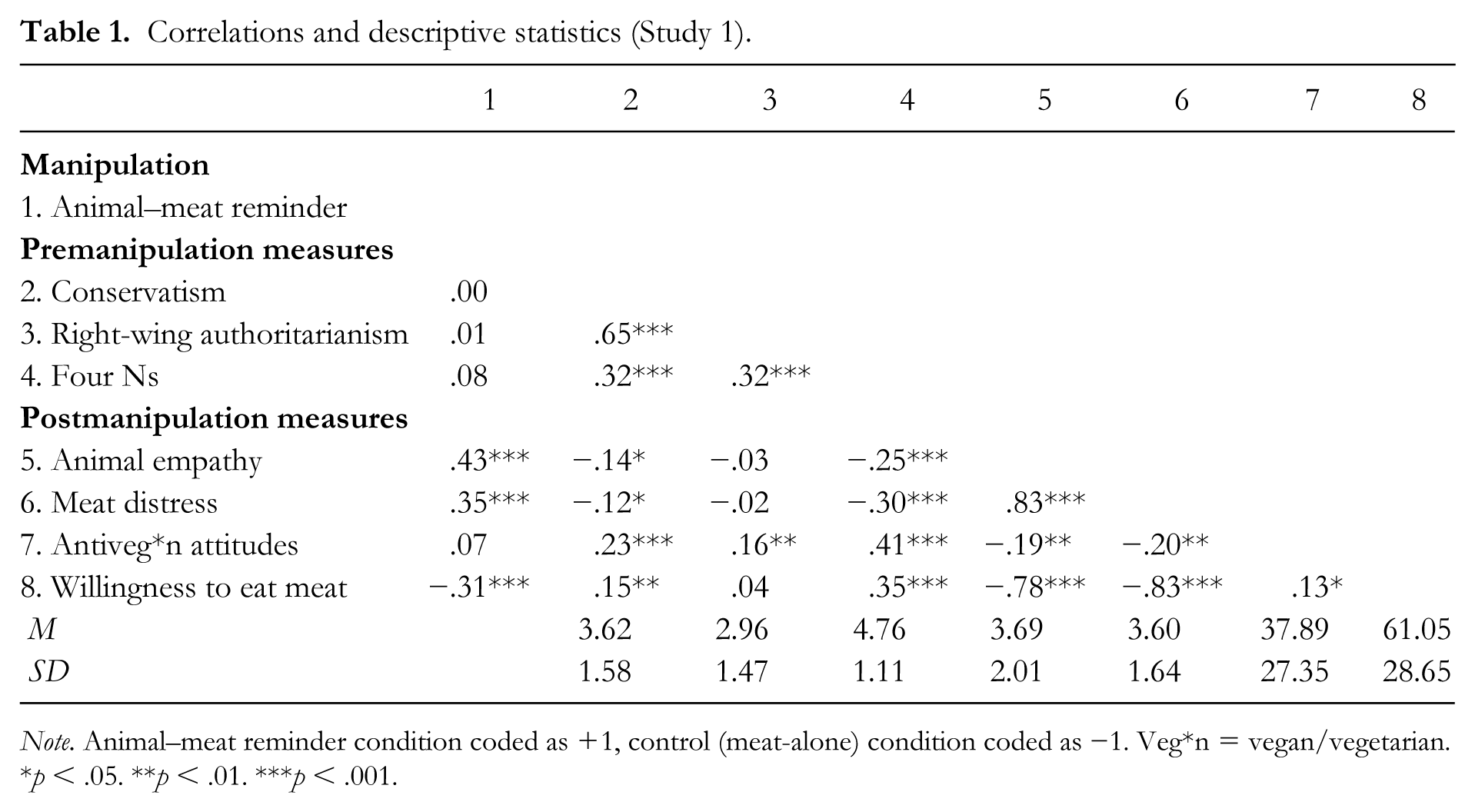
Note. Animal–meat reminder condition coded as +1, control (meat-alone) condition coded as −1. Veg*n = vegan/vegetarian.
p < .05. **p < .01. ***p < .001.
Model results
A mediation model was first specified using maximum likelihood estimation in Mplus Version 7.4. Experimental condition was effect coded (meat-animal reminder coded as +1, meat-alone coded as −1) and entered as the exogenous predictor in the model. Animal empathy and meat distress were entered simultaneously as mediators, and antiveg*n attitudes and meat consumption willingness were entered as criteria. The model was fully saturated (df = 0). Residuals of mediators were allowed to covary, as were residuals of outcomes. Parameter estimates and significance tests are based on bias-corrected estimates generated from 5,000 bootstrap samples. Standardized path coefficients can be seen in Figure 1. Participants in the animal–meat reminder (vs. meat-alone) condition experienced more animal empathy and meat distress, as hypothesized. Both greater empathy and distress were associated with less meat consumption willingness, but neither empathy nor distress were related to antiveg*n attitudes.
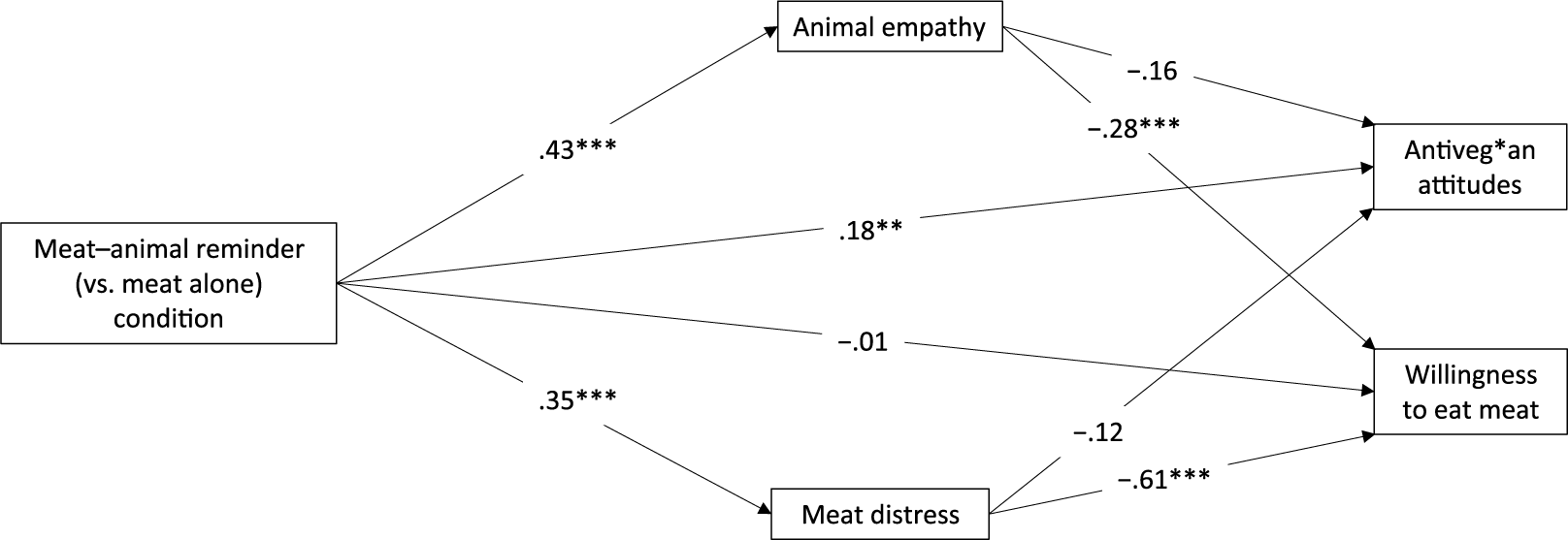
Mediation model predicting willingness to eat meat and antivegan/vegetarian attitudes (Study 1). Standardized paths shown. Residuals were allowed to covary but are not shown for brevity; there was a residual correlation between animal empathy and meat guilt (r = .80, p < .001), and a marginal residual correlation between antiveg*n attitudes and willingness to eat meat (r = −.12, p = .056).
There was a significant positive total effect of animal–meat (vs. meat-alone) condition on meat consumption willingness (see Table 1). However, with the inclusion of emotions as mediators, the relation between experimental condition and meat consumption willingness was nonsignificant, suggesting that animal empathy and meat distress accounted for much of this total effect. Moreover, there was significant total indirect effect of condition on meat consumption willingness (see Table 2 for indirect effects), such that exposure to animal–meat reminders (vs. images of meat alone) fostered more animal empathy and meat distress, which in turn predicted lower willingness to eat the meat presented in the images. Specific indirect effects for empathy and distress were each significant, suggesting that each emotion independently accounted for some of the relation between animal–meat reminders (vs. meat-alone images) and lower meat consumption willingness.
Indirect effects of experimental animal–meat reminder (vs. control) condition on criteria (Study 1).
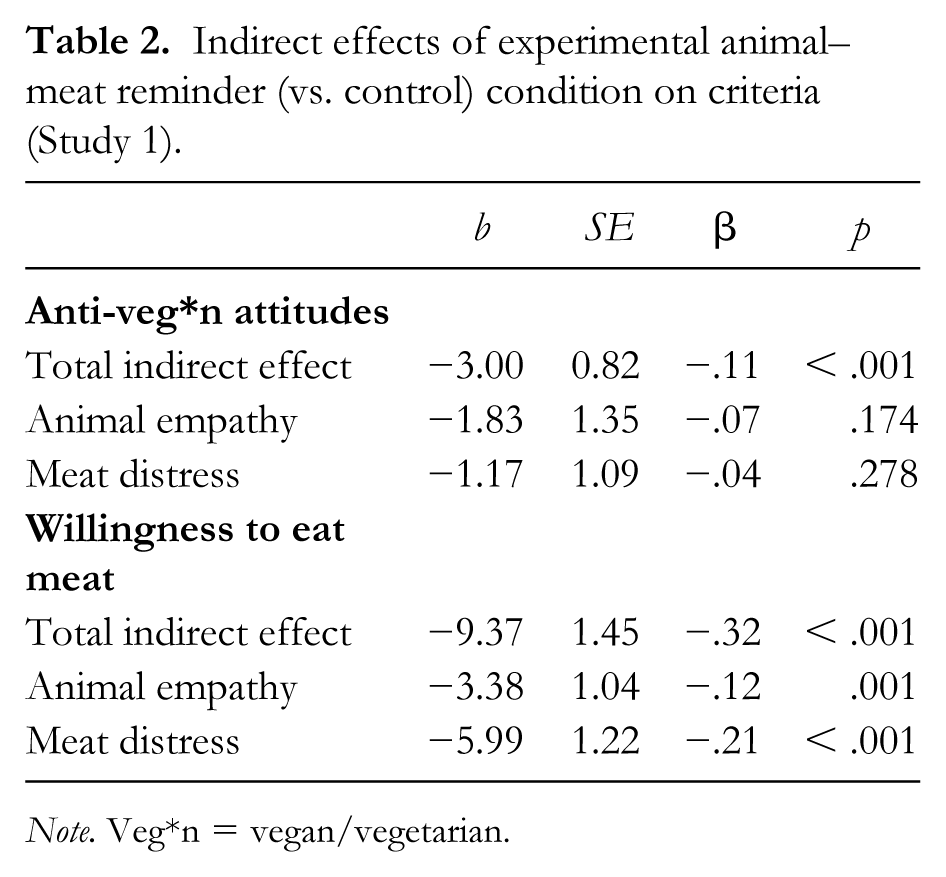
Note. Veg*n = vegan/vegetarian.
The total effect of experimental condition on antiveg*n attitudes was nonsignificant (see Table 1). However, there was a significant total indirect effect of condition on antiveg*n attitudes, such that the animal–meat association (vs. meat-alone) condition predicted greater empathy for animals and distress about meat consumption, and together these emotions predicted less negative attitudes toward veg*ns. However, neither the specific indirect effect of empathy nor that of distress was significant. Presumably, the correlation between empathy and distress leading these mediators to compete for variance, coupled with relatively weaker associations between emotions and antiveg*n attitudes (vs. meat consumption willingness), resulted in a significant total indirect effect and nonsignificant specific indirect effects. When empathy and distress were tested in separate models, there were significant specific indirect effects for both empathy (b = −3.05, SE = 0.85, β = −.11, p < .001) and distress (b = −2.31, SE = 0.68, β = −.09, p = .001). After including emotions, the relation between experimental condition and antiveg*n attitudes was positive. Given the nonsignificant total effect of condition on antiveg*n attitudes, this suggests a possible suppression effect, whereby the inclusion of empathy and distress in the model resulted in a significant positive direct effect (MacKinnon, Krull, & Lockwood, 2000). 5
We next tested two additional models. In one model, the 4Ns were specified as the moderator on the relation between experimental condition and emotions (a-paths), and conservatism was specified as the moderator on relations between emotions and criteria (b-paths). In the other model, the 4Ns were specified as the moderator on the a-paths, and RWA was specified as the moderator on the b-paths. All interactions were nonsignificant (ps range from .270 to .999), indicating that the effect of animal–meat reminders (vs. meat-alone images) on emotions did not depend on individual differences in meat consumption rationalizations, and that the effect of emotions on criteria did not depend on individuals’ degree of conservatism or RWA. For full results, see Table S1 (supplemental material).
We additionally conducted mixed-model ANOVAs to test whether the effect of condition on emotions or meat consumption willingness differed by animal type. Contrasts were largely nonsignificant (ps range from .079 to .311), except that the condition had a significantly stronger effect on empathy for the pig relative to lamb, F(1, 297) = 19.57, p < .001, and cow, F(1, 297) = 11.14, p = .001. The condition also had a significantly stronger effect for pig, relative to lamb, on meat distress, F(1, 297) = 4.23, p = .041, and meat consumption willingness, F(1, 297) = 5.88, p = .016.
Discussion
Overall, the animal–meat reminder (vs. meat-alone) manipulation clearly induced animal empathy and meat distress and decreased meat consumption willingness (see Table 1). Both animal empathy and meat distress were uniquely related to lowered meat consumption willingness, and both proanimal emotions significantly mediated the effect of animal reminder manipulation on meat consumption willingness. This finding adds to the existing knowledge base by examining meat distress as a novel emotional reaction to meat–animal associations and uncovers an indirect effect via meat distress. In this way, both negative emotions (e.g., distress) and positive emotions (e.g., empathy) appear to play an important role.
Despite the manipulation exerting no overall (total) effect on antiveg*n attitudes, and that neither empathy nor distress uniquely mediated the relation, there was a significant total indirect effect, providing some evidence that animal–meat reminders indirectly lower antiveg*n attitudes via animal empathy and meat distress. 6 Further, those who rationalized their meat consumption in the pretest measures (i.e., scoring higher on the 4N scale) were significantly more likely to express antiveg*n bias (r = .41; see Table 1), confirming our expectation that thinking about animals is relevant to thinking about people who protect and do not eat animals, such as veg*ns, justifying further exploration of this broader theme. With hindsight, however, the inclusion of the 4N scale in the premanipulation measures exposed all participants to ideas about eating animals (e.g., “You cannot get all the protein, vitamins, and minerals you need on an all plant-based diet”), all coded in the direction that rationalizes meat consumption, such that the 4N scale may have primed rationalizations inadvertently. In Study 2, participants did not complete any pretest measures relevant to animals or eating meat, offering a cleaner manipulation without such potential interference.
Of interest, individual differences in rationalizations about meat, as captured by the 4N scale, did not moderate paths between the animal–meat reminder manipulation and animal empathy or meat distress. These manipulations, therefore, appear powerful enough to make people in general more concerned about the animals involved, and more self-critical about eating meat, highlighting their potential for more applied interventions. Likewise, conservatism and RWA did not moderate paths from emotions to criteria, meaning that those on the political left and right respond to the induced emotions similarly. Such findings are consistent with a culture-wide sense of discomfort about using animals as sources of food that are not necessarily specific to subpopulations of people.
Study 2
As in Study 1, Study 2 assessed whether animal–meat reminders (vs. meat-alone images) influence meat consumption willingness or antiveg*n attitudes. Of note, there are several methodological differences between Study 1 and Study 2, despite sharing stimuli and reaction measures. First, in Study 2, participants did not complete the 4N scale prior to the manipulation, arguably making for a purer manipulation of animal–meat reminders relative to control (meat only). Second, in addition to conservatism and RWA, we included a pretest measure of SDO (Ho et al., 2015), which has been implicated in greater willingness to exploit animals, antiveg*n prejudice, and threat reactions to vegetarianism (e.g., Dhont & Hodson, 2014; MacInnis & Hodson, 2017). Relatedly, in addition to measuring attitudes in terms of disliking the outgroup (as in Study 1), which represents only one aspect of intergroup bias, in Study 2 we also measured the extent to which meat-eating respondents feel that veg*ns threaten cultural values and practices. Finally, in addition to exploring animal empathy and meat distress as potential mediators (as in Study 1), Study 2 also included a measure of meat disgust (a construct included in the work of Kunst and Hohle [2016]).
Our preregistered hypotheses concerned antiveg*n attitudes and veg*nism threat. We hypothesized that the animal–meat reminder (vs. meat-alone) manipulation would elevate animal empathy, meat distress, and meat disgust in ways that would then in turn predict lower antiveg*n attitudes and lower perceived veg*n threat. Like Study 1, we additionally expected that the animal–meat reminder (vs. meat-alone) manipulation would lower meat consumption willingness via increased animal empathy, increased meat disgust (see also Kunst & Hohle, 2016), and increased meat distress. Unlike Study 1, we preregistered exploratory analyses of each ideological variable (conservatism, RWA, SDO) as potential moderators of all model paths (i.e., from manipulation to mediators and criteria, and from the mediators to criteria).
Method
Participants and procedure
A power analysis conducted using the same procedure as that for Study 1 revealed that 250 participants would yield power of .80 for the paths and indirect effects in the hypothesized mediation model given two-tailed significance tests (α = .05). U.S. participants (N = 351) were recruited via Amazon Mechanical Turk. Duplicate IP addresses (n = 8), those who do not eat meat (n = 46), and participants who failed an attention check (n = 17) were excluded, leaving 280 participants (57.1% female, 42.5% male; Mage = 39.16, SD = 12.79), 79.6% of whom were White, 10.4% were Hispanic/Latino/South American, 7.9% were Black/African American, 6.4% were Asian, and 2.2% identified as being of another race/ethnicity.
As in Study 1, the cover story and study call informed participants that the study concerned reactions to advertisements. Participants first completed measures of conservatism, RWA, and SDO, presented in random order. Participants were then randomly assigned to view animal–meat reminder images or meat-alone images, which were identical to those presented in Study 1. Presented under each image were measures of animal empathy, meat distress, disgust for the meat presented, and meat consumption willingness. Finally, participants provided attitudes and threat perceptions regarding vegetarians and vegans, before providing demographic information and being debriefed.
Materials
Right-wing adherence
Right-wing adherence was assessed via measures of conservatism, RWA, and SDO. Conservatism (α = .94) and RWA (α = .93) were assessed in the same manner as in Study 1. SDO was assessed via the eight-item short-form SDO7 scale from Ho and colleagues (2015; e.g., “Some groups of people are simply inferior to other groups”; 1 = strongly oppose, 7 = strongly favor; α = .90). Higher scores indicate higher degrees of SDO.
Animal–meat association manipulation
Participants were randomly assigned to view three animal–meat association images or three images of meat dishes alone (presented in random order). Images were identical to those used in Study 1.
Proanimal emotions
Measures of animal empathy (α = .98) and meat distress (α = .96) were identical to measures used in Study 1. To assess meat disgust, participants indicated how much the meat displayed made them feel “disgusted,” “grossed out,” “queasy/sick to my stomach” (1 = not at all, 7 = a great deal; Kunst & Hohle, 2016). As with empathy and distress, responses were aggregated across images to create an overall meat disgust score (α = .94).
Meat consumption willingness
Participants’ willingness to eat the meat in the images was assessed as in Study 1 (α = .92).
Antiveg*n attitudes
Antiveg*n attitudes were assessed as in Study 1 (interitem r = .88).
Veg*n threat
To assess the extent to which participants felt threatened by veg*ns, participants completed a measure of vegetarianism threat (Dhont & Hodson, 2014) adapted to refer to vegetarians and vegans collectively (e.g., “The rise of vegetarianism/veganism poses a threat to our country’s cultural customs”; 1 = strongly disagree, 7 = strongly agree; α = .88). Higher scores reflect a greater sense of veg*n threat.
Results
There was one outlier on SDO (score exceeding 3 SD from the mean) which was winsorized (converted to the value at 3 SD). Missing values (0–0.4% for each variable) were estimated using FIML in Mplus Version 7.4. Table 1 shows zero-order correlations among variables, which were generally comparable to those from Study 1. Additionally, greater SDO was associated with less animal empathy, less meat distress, more antiveg*n attitudes, and greater veg*n threat, but not associated with meat disgust or meat consumption willingness. Veg*n threat was positively associated with all three ideology measures and antiveg*n attitudes, and negatively associated with meat distress.
Model results
Using the same procedure as in Study 1, we specified a mediation model testing whether animal–meat reminders (vs. meat-alone images) predicted less meat consumption willingness, less antiveg*n attitudes, and less veg*n threat (c-paths); whether animal–meat reminders (vs. meat-alone images) predicted greater animal empathy, greater meat distress, and greater meat disgust (a-paths); and whether these emotions in turn predicted less meat consumption willingness, less antiveg*n attitudes, and less veg*n threat (b-paths).
Figure 2 shows standardized path coefficients. 7 As expected, participants in the animal–meat reminder (vs. meat-alone) condition experienced more animal empathy, more distress about their meat consumption, and more disgust for the meats in question. In turn, greater empathy was associated with lower meat consumption willingness and less antiveg*n attitudes. Greater distress was associated with lower meat consumption willingness and less veg*n threat. Greater disgust was associated with less meat consumption willingness, and unexpectedly, greater veg*n threat. These latter effects should be interpreted with caution, however, given that there were no zero-order relations between disgust and antiveg*n variables (see Table 3).
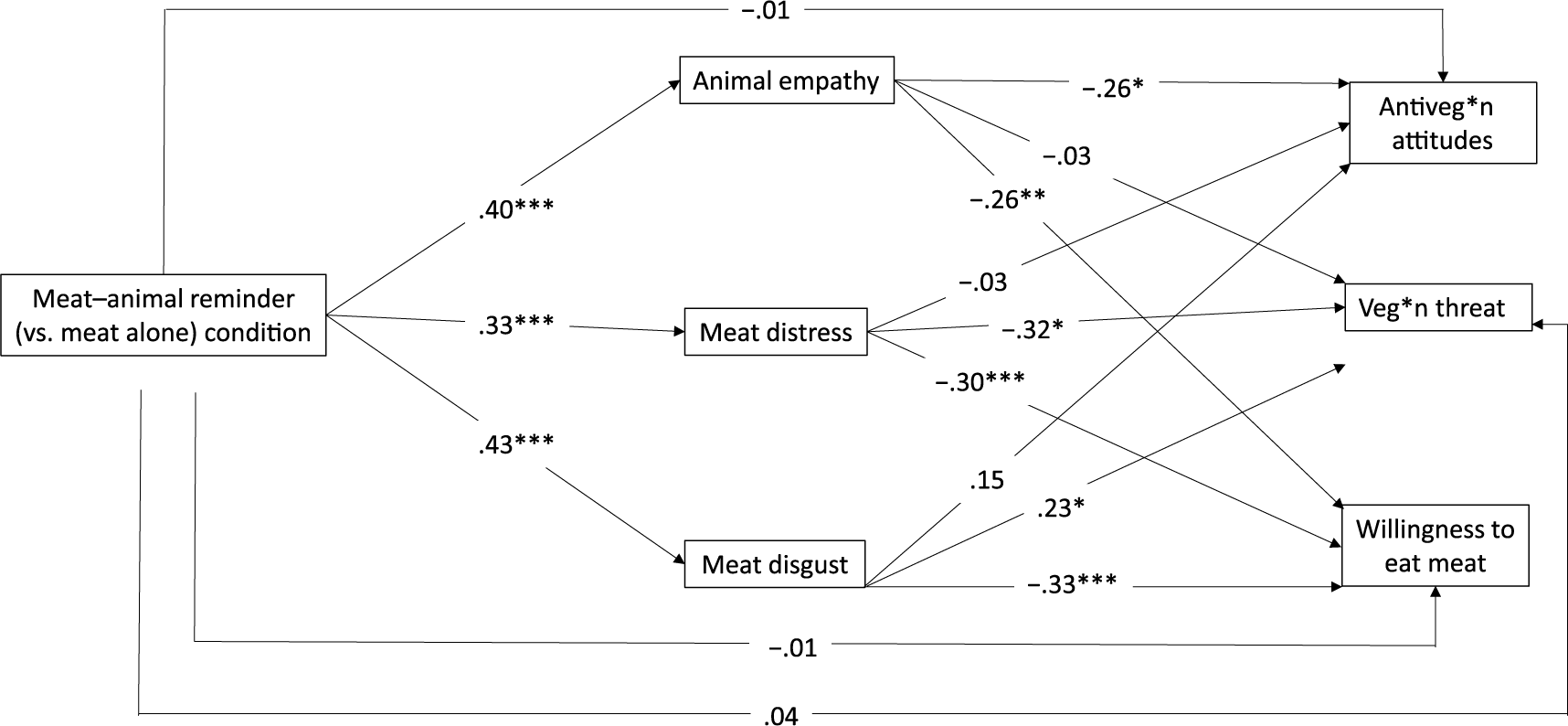
Mediation model predicting willingness to eat meat and antivegan/vegetarian attitudes (Study 2). Standardized paths shown. Residuals were allowed to covary but are not shown for brevity. There were significant positive residual correlations between emotions (rs .63 to .76, ps < .001). There was a significant positive residual correlation between antiveg*n attitudes and veg*n threat (r = .40, p < .001). Residual correlations between antiveg*n attitudes and willingness to eat meat (r = .01, p = .884), and between veg*n threat and willingness to eat meat (r = .07, p = .334), were nonsignificant.
Correlations and descriptive statistics (Study 2).
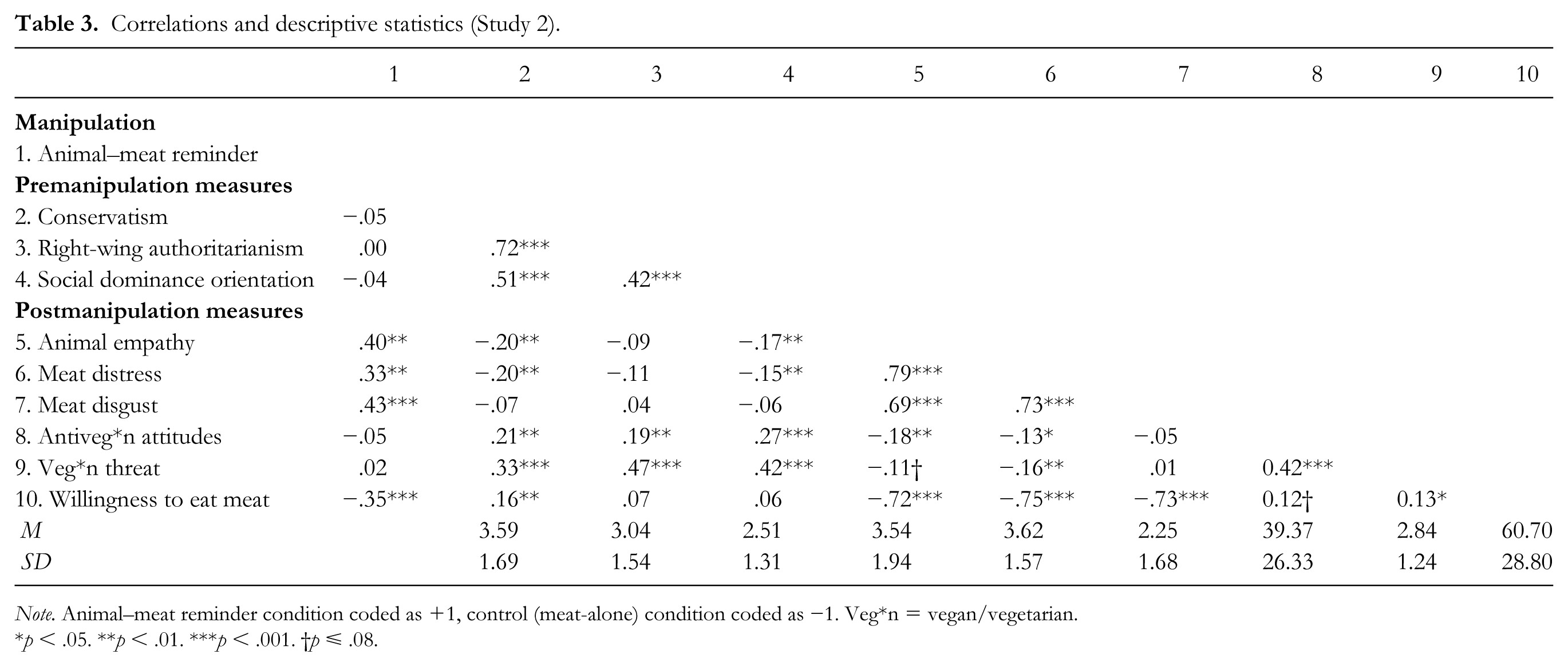
Note. Animal–meat reminder condition coded as +1, control (meat-alone) condition coded as −1. Veg*n = vegan/vegetarian.
p < .05. **p < .01. ***p < .001. †p ⩽ .08.
Comparable to Study 1, there was a significant total effect of animal–meat (vs. meat-alone) condition on meat consumption willingness (see Table 3), that was reduced to nonsignificance after the inclusion of emotion mediators in the model. There was a significant total indirect effect of animal–meat reminder (vs. meat-alone) on meat consumption willingness, with specific indirect effects via empathy, distress, and disgust, such that exposure to animal–meat reminders (vs. images of meat alone) fostered more animal empathy, meat distress, and meat disgust, each of which in turn predicted lower meat consumption willingness (see Table 4). Also comparable to Study 1, the total effect of experimental condition on antiveg*n attitudes (and, in this case, veg*n threat) was nonsignificant (see Table 3). Nonetheless, there was a significant indirect effect of condition on attitudes via empathy, such that animal–meat associations (vs. meat alone) predicted greater empathy, which in turn predicted lower antiveg*n attitudes. Additionally, there was a significant indirect effect of condition on threat via meat distress, such that the animal–meat reminders (vs. meat-alone) predicted greater distress, which in turn predicted lower perceptions that veg*nism threatens one’s cultural practices.
Indirect effects of experimental animal–meat reminder (vs. control) condition on criteria (Study 2).
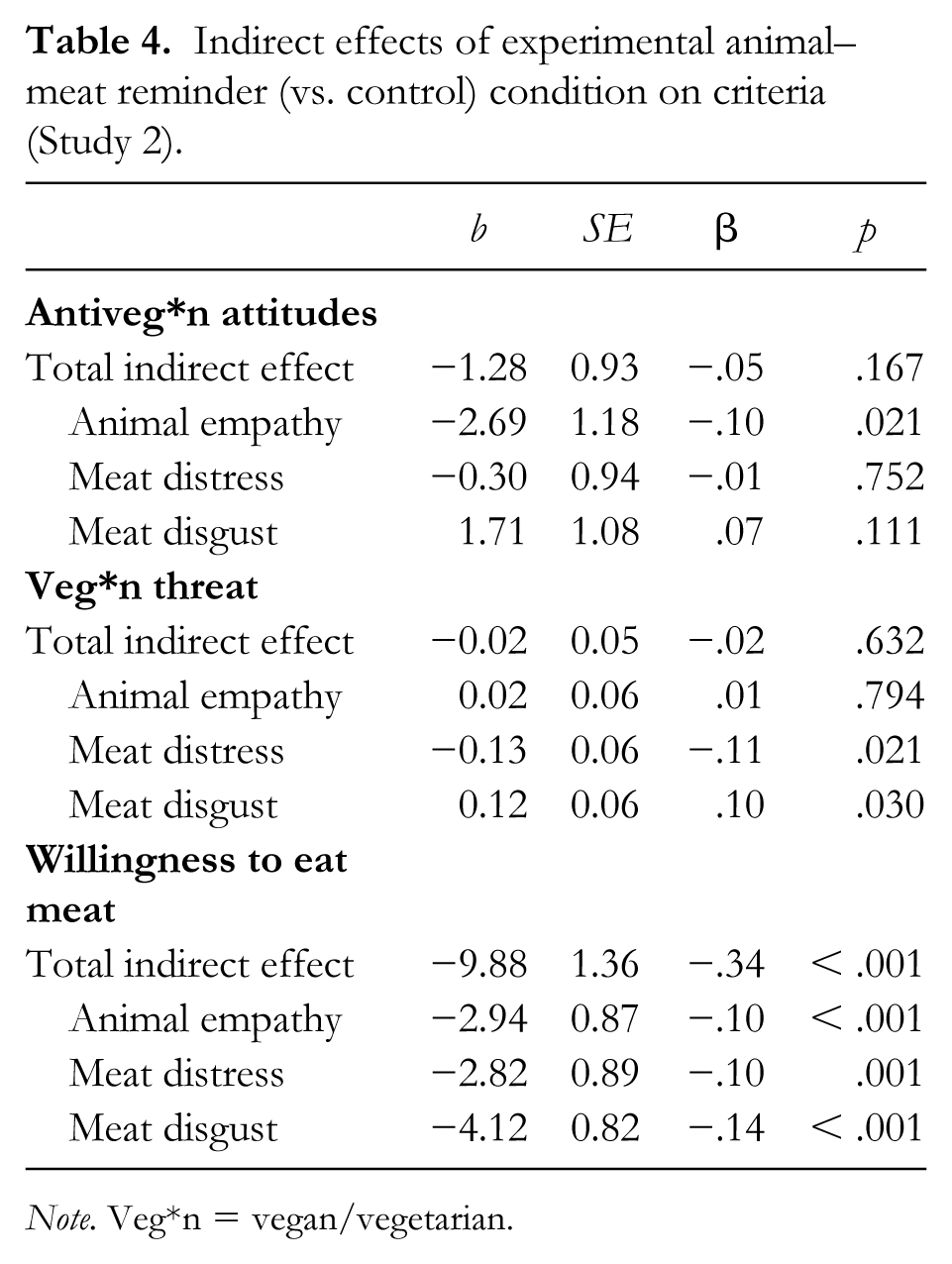
Note. Veg*n = vegan/vegetarian.
Unexpectedly, there were also positive indirect effects of experimental condition on veg*n threat via disgust. This suggests that, after statistically accounting for animal empathy and distress, animal–meat reminders fostered meat disgust, which in turn, was associated with more veg*n threat. These findings may suggest that animal–meat associations simultaneously reduce (via empathy or distress) and foster (via disgust) threat and may help to explain the nonsignificant total effect of condition on threat. However, this finding should be interpreted with caution, given the nonsignificant bivariate correlations between meat disgust and antiveg*n measures (attitudes and threat).
We next tested whether ideology variables moderate the c-paths, a-paths, or b-paths. Separate models were tested for each measure of right-wing ideological adherence (conservatism, RWA, and SDO). Interactions largely were nonsignificant (ps range from .110 to .953), with some exceptions (see Table S2, supplemental material), suggesting that the strength of model paths largely did not depend on participants’ degree of conservatism, RWA, or SDO. 8 That is, animal–meat reminders were equally effective in fostering proanimal emotions, and emotions were equally associated with attitudes, threat, and meat consumption willingness, regardless of participants’ ideologies.
Last, we conducted mixed-model ANOVAs to test whether the effect of condition on emotions or meat consumption willingness differed by animal type. Contrasts were largely nonsignificant (ps range from .319 to .906), except that the experimental condition had a significantly stronger effect on empathy for the pig relative to cow, F(1, 278) = 7.45, p = .007, and lamb, F(1, 278) = 4.36, p = .038.
Discussion
Findings of Study 2 were largely consistent with those of Study 1, showing that animal–meat reminders led to more proanimal emotions, which in turn predicted less meat consumption willingness. There was also a significant indirect effect of animal–meat reminders (vs. meat-alone images) on reducing antiveg*n attitudes via increased empathy for animals, as hypothesized. Further, this study extended findings from Study 1 by showing an indirect effect of animal–meat reminders (vs. meat-alone images) on lower veg*n threat via increased distress about one’s meat consumption, as hypothesized.
Like Study 1, Study 2 revealed no total effect of animal–meat reminders (vs. meat-alone images) on antiveg*n attitudes nor on veg*n threat. Coupled with significant indirect effects of condition on evaluations via empathy and on veg*n threat via distress, this suggests an unmodeled process that works in the direction opposite to empathy or distress that simultaneously fosters antiveg*n sentiment (see MacKinnon et al., 2000; Rucker, Preacher, Tormala, & Petty, 2011). Future research should explore this possibility, and we offer suggestions to guide these endeavours in what follows.
General Discussion
In the current research, we aimed to test the novel idea that contexts fostering proanimal emotions have implications not only for animals and meat consumption, but also have social implications for human group relations. In two studies, we replicated and extended Kunst and Hohle’s (2016) findings, confirming that visually reminding people that meat comes from live animals increases willingness to refrain from meat consumption, not only by increasing empathy for animals and disgust for meat, as seen in previous work, but also through increasing distress about one’s meat consumption, a novel mediator not examined by Kunst and Hohle. Another important extension of Kunst and Hohle’s findings is the examination of responses to multiple meat–animal associations in both studies (pig–pork, cow–beef, lamb–lamb), rather than a single animal–meat pairing (e.g., pig–pork). Importantly, we extended their program of work by showing that fostering proanimal emotions via animal–meat associations not only affects perceptions of animals and meat-eating, but also indirectly affects perceptions of people who do not eat meat.
Study 1 revealed a total indirect effect via animal empathy and meat distress, such that animal–meat reminders (vs. meat-alone images) increased empathy and distress, which together predicted less antiveg*n attitudes (although neither independently mediated the effect of the manipulation). Study 2 revealed a specific indirect effect via empathy, such that animal–meat reminders fostered greater empathy for animals used to produce meat, which in turn predicted less antiveg*n attitudes. Study 2 simultaneously revealed an indirect effect of animal–meat reminders (vs. meat-alone images) on veg*n threat via distress, such that animal–meat reminders fostered distress about one’s meat consumption, which in turn predicted lower beliefs that veg*nism threatens one’s way of life. Thus, animal empathy may be particularly important for reducing antiveg*n attitudes, whereas distress regarding meat consumption may be particularly important for reducing veg*n threat.
However, total effects of experimental condition on antiveg*n measures were nonsignificant in both studies. Contemporary statisticians argue that it is meaningful to interpret indirect effects in the absence of total effects (e.g., Fritz & MacKinnon, 2007; Hayes, 2013; MacKinnon, 2008). Moreover, the absence of total effects, coupled with significant indirect effects, in our studies suggests that meat–animal reminders can also foster antiveg*n attitudes and veg*n threat via some unmodeled variable (see MacKinnon et al., 2000 and Rucker et al., 2011, for statistical explanation of this phenomenon). For instance, exposure to animal–meat associations may have reminded meat-eaters about the harm they cause to animals via meat consumption. This may have led meat-eaters to feel morally inferior to veg*ns who, by refraining from meat consumption, do not contribute to the suffering of animals. This sense of moral inferiority relative to veg*ns may have caused participants to report especially negative attitudes towards those who do not eat meat. Past research by MacInnis and Hodson (2017) demonstrates that meat-eaters express greater prejudice towards those who become veg*n for moral reasons (e.g., animal rights, environmental reasons), relative to those who become veg*n for nonmoral reasons (e.g., health). Further, when people believe that vegetarians see themselves as morally superior to meat-eaters, meat-eaters consider them “do-gooders” and express more negative attitudes toward them (Minson & Monin, 2012). Such findings suggest that perceived personal moral inferiority contributes to antiveg*n sentiment. As such, future research may explore how feelings of moral inferiority present a barrier to reducing antiveg*n attitudes, and whether feelings of moral inferiority account for the unmodeled mechanism that explains the nonsignificant total effect between condition and antiveg*n sentiment in the current studies.
Relatedly, past work suggests that disgust is associated with perceptions of immorality and can facilitate greater condemnation of immoral behaviors (Horberg, Keltner, Oveis, & Cohen, 2009). Therefore, disgust regarding meat consumption may have facilitated beliefs that meat-eating is particularly immoral, helping to foster a sense of moral inferiority among meat-eaters relative to veg*ns, and greater backlash against those who do not eat meat (see Minson & Monin, 2012). This may explain why disgust was not related (at the bivariate level) or positively related (when controlling for empathy and distress) to antiveg*n sentiment. Therefore, future research may explore ways in which antiveg*n attitudes can be reduced by increasing empathy for animals and distress about meat consumption without facilitating disgust or a sense of moral inferiority among meat-eaters. Moreover, in the current research, we examined empathy, distress, and disgust as simultaneous mediators. Future work could explore the possibility that certain emotions precede others in reactions to animal–meat reminders, as well as directly manipulate these emotions (e.g., induce animal empathy, not necessarily on the basis of an animal–meat manipulation) to better determine their causal impact on antiveg*n attitudes.
Further, as a relatively new research area, future work can examine the effects of other meat–animal reminders. We focused on visual reminders (i.e., images), but written descriptions, video, or auditory animal–meat reminders may also be examined empirically. Future work may also examine attitudes towards animals in addition to proanimal emotions. We also discovered that meat–animal associations had a stronger impact on empathy for the pig relative to the cow or lamb in both studies and had a stronger impact on meat distress and meat consumption willingness regarding the pig relative to the lamb in Study 2. This finding is novel and suggests that people may be particularly susceptible to experiencing more proanimal emotions and less meat consumption willingness when faced with pig–pork reminders relative to other meat–animal pairings. Future work may explore why different meat–animal pairings have different effects on animal-relevant emotions or attitudes. Further, our results suggest that the effect of animal–meat reminders on proanimal emotions, antiveg*n attitudes, and threat were largely independent of right-wing adherence or preexisting cognitive rationalizations for meat consumption (such as the 4Ns). Therefore, facilitation of animal empathy and distress about meat consumption appears to be a promising avenue for reducing antiveg*n attitudes and veg*n threat for people on both ends of the political spectrum, and for people who vary in meat consumption justifications.
Nonetheless, our participants were American residents, and past research suggests a particularly strong positive relation between meat consumption and antivegetarianism in the United States compared to some European and South American countries (Earle & Hodson, 2017). Cultures also arguably differ in the extent to which people are separated from the slaughtering and packaging of animals for human consumption (e.g., Amiot & Bastian, 2015), and recent work suggests that animal–meat association effects are significantly less pronounced in places where people are used to seeing unprocessed meat (Kunst & Palacios Haugestad, 2018). As such, we encourage cross-cultural examination of meat–animal reminder effects in relation to antiveg*n attitudes.
Overall, the current research offers greater insight into antiveg*n attitudes and veg*n threat. Evidence from two studies suggests that fostering empathy for animals and distress about one’s own meat eating may be key to not only reducing meat consumption, but also to reducing negative attitudes and threat regarding veg*ns. Reducing such attitudes may be fundamental in encouraging others to adopt a meat-free diet, which has numerous benefits for animals, human health, and the environment at large (e.g., Craig, 2009; McKnight, 2014; Wilson, 2018; Wolf et al., 2017).
Supplemental Material
Supplemental_material – Supplemental material for Eating with our eyes (closed): Effects of visually associating animals with meat on antivegan/vegetarian attitudes and meat consumption willingness
Supplemental material, Supplemental_material for Eating with our eyes (closed): Effects of visually associating animals with meat on antivegan/vegetarian attitudes and meat consumption willingness by Megan Earle, Gordon Hodson, Kristof Dhont and Cara MacInnis in Group Processes & Intergroup Relations
Footnotes
Acknowledgements
Thanks to Holly McEwen for help generating stimuli.
Funding
The authors disclosed receipt of the following financial support for the research, authorship, and/or publication of this article: This work was supported by a Brock University Chancellor’s Chair for Research Excellence Award to Gordon Hodson (Grant No. 336-222-071).

Supplemental Material
Supplemental material for this article is available online.
Notes
References
Supplementary Material
Please find the following supplemental material available below.
For Open Access articles published under a Creative Commons License, all supplemental material carries the same license as the article it is associated with.
For non-Open Access articles published, all supplemental material carries a non-exclusive license, and permission requests for re-use of supplemental material or any part of supplemental material shall be sent directly to the copyright owner as specified in the copyright notice associated with the article.
