







Abstract
To gain insights into whether schools striving to improve intergroup dynamics should curb disliking or facilitate liking across students of different ethnic groups, the current study examines the associations between interpersonal affect and intergroup relations in multiethnic schools. Given (i.e., outgoing) peer nominations of liked and disliked grade-mates were coded by ethnicity in 26 public middle schools, including all Asian, Black, Latinx, and White students (N = 4,350). Controlling for earlier intergroup attitudes and the availability of ethnic ingroup and relevant outgroup grade-mates, multilevel analyses show that liking (but not disliking) of cross-ethnic grade-mates was associated with more positive attitudes toward that particular ethnic group. Implications of these findings for intergroup relations among adolescents in multiethnic schools are discussed.
For the first time in modern history, youth of color make up half of the population under the age of 18 in the United States (Child Trends Databank, 2014). Although schools are less diverse than the school-age population (Frankenberg, Hawley, Ee, & Orfield, 2017), some students attend schools with multiple ethnic groups, particularly in metropolitan areas. Given that adolescence is a vital stage for the development of intergroup attitudes that extend into adulthood (Wölfer, Schmid, Hewstone, & van Zalk, 2016), the present research investigates intergroup attitudes of young adolescents in multiethnic public middle schools in the United States. When and how multiethnic middle schools can facilitate positive intergroup attitudes is a critical question at the current time of increased polarization and racism (Pew Research Center, 2017). Extending past research on majority–minority relations by including interminority dynamics, we are able to investigate intergroup attitudes across Asian, Black, Latinx, 1 and White youth.
While extensive research has documented the effects of intergroup contact and close relationships (e.g., friendships) on beliefs about ethnic outgroups among youth (for a review, see Pettigrew & Tropp, 2006), less is known about the role of interpersonal (unidirectional) likes and dislikes toward individual outgroup members in diverse settings. To address this void, the main aim of the current study is to test whether liking and/or disliking of ethnic outgroup grade-mates generalizes to group-level attitudes. This question is theoretically important as it complements research on the effects of close mutual relationships (e.g., cross-ethnic friendships) and intergroup relations. Interpersonal liking and disliking capture private feelings that may also be relatively easy to facilitate. For example, when Latinx and Asian youth sit next to one another in class, they may not develop a friendship, but at least one of them is likely to feel more positively about the other based on greater familiarity (see van den Berg & Cillessen, 2015). By comparing positive and negative sentiments toward ethnic outgroup grade-mates, we are also in the position to shed light on the question of whether multiethnic schools should focus on facilitating positive interpersonal affect among classmates, help to curb negative sentiments, or do both to improve intergroup attitudes.
Consistent with intergroup contact theory (Allport, 1954; Pettigrew & Tropp, 2006), sustained interactions with individuals from different groups promote favorable intergroup attitudes (e.g., Brown & Hewstone, 2005; Pettigrew, 1997). In particular, close cross-ethnic relationships are presumed to amplify contact effects (R. N. Turner, Hewstone, Voci, Paolini, & Christ, 2007) because the mutual affect is expected to generalize toward the entire group (Pettigrew, 1998). Indeed, adolescents who are friends with peers of other ethnicities demonstrate lower levels of racial prejudice and more positive intergroup attitudes (Chen & Graham, 2015; Davies, Tropp, Aron, Pettigrew, & Wright, 2011; Graham & Echols, 2018). However, there are multiple constraints on the formation and maintenance of cross-ethnic friendships. Formation and maintenance of cross-ethnic friendships require prolonged proximity that then facilitates mutual liking. Yet in high school for example, academic tracking often segregates Black and Latinx youth into separate classes from their Asian and White peers (Hamm, Brown, & Heck, 2005). Lack of proximity then hinders development of particular cross-ethnic friendships (e.g., between Black and Asian students; Chen & Graham, 2015). Moreover, cross-ethnic friendships are sensitive to social norms (i.e., settings with greater ethnic social segregation discourage cross-group friendships; for a review, see Rutland & Killen, 2015). In some schools, social norms do not support any cross-ethnic affiliations (Verkuyten & Thijs, 2013) or friendships with peers from particular groups (Thijs, 2017). When opportunities to develop or maintain mutual close relationships across ethnic groups are constrained, the question is whether peer sentiments that are not necessarily publicly observable might give us insights into youths’ generalized intergroup attitudes.
Interpersonal likes and dislikes—or peer acceptance and rejection—play an important role in adolescents’ social worlds (Killen, 2007; Veenstra, Lindenberg, Munniksma, & Dijkstra, 2010). Youth are uniquely preoccupied with avoiding social exclusion (Gieling, Thijs, & Verkuyten, 2010), and peer acceptance is one of the strongest correlates of self-esteem (Harter, 1993). However, research on peer acceptance and rejection typically examines the well-being of those who are liked or disliked by their classmates, rather than intergroup attitudes of those expressing liking and disliking. In the current study, we capitalize on underutilized information about whom youth report liking and disliking, relying on open-ended peer nominations of liked and disliked grade-mates, by name. By coding the ethnicity of the participant (i.e., nominator) and the nominee, we examine whether ethnicities of liked or disliked grade-mates are related to participants’ generalized attitudes toward different ethnic groups within multiethnic middle schools.
It is presumed that we can learn about generalized intergroup attitudes by investigating which peers adolescents like and want to spend time with or dislike and want to avoid. For example, Jennifer (an Asian student) may desire to spend time with Sofia (a Latinx student) and desire her company, without Sofia needing to reciprocate Jennifer’s feelings. Although after getting to know Jennifer, Sofia may grow to like her in return (such that friendship develops), the initial preference might indicate Jennifer’s lack of prejudice toward Latinx peers. Similarly, if Jennifer wants to stay away from Brianna (a Black student), this interpersonal stance may indicate her prejudice toward Black peers, in general. As such, the present work examines the utility of assessments of peer preferences and dislikes in capturing adolescents’ general intergroup attitudes in the context of multiethnic middle schools.
Research related to stereotype change suggests that people (re)calibrate their perceptions of outgroups after personal experiences or interactions with individual outgroup members (for a review, see Paolini & McIntyre, 2019). Such adjustments likely occur because of counterstereotypical information about specific outgroup members (e.g., positive interactions with a negatively stereotyped outgroup) may encourage an individual to revise their cognitive schema about the outgroup, in general. Holding discordant views about an individual outgroup member and their respective outgroup as a whole can create a state of cognitive dissonance (Festinger, 1957), which individuals tend to avoid. Although likely shaped by a variety of factors, such as prior interactions and broader peer reputation in school (LaFontana & Cillessen, 2002), we expect that adolescents’ interpersonal likes and dislikes of specific ethnic outgroup grade-mates will be related to their generalized intergroup attitudes.
It is unclear, however, whether both positive and negative sentiments are independently related to adolescents’ generalized intergroup attitudes. Although contact broadly promotes more favorable intergroup attitudes (Pettigrew & Tropp, 2006), some work utilizing adult samples suggests that negative contact more robustly shapes intergroup attitudes than positive contact, even though positive contact is more frequent (Graf, Paolini, & Rubin, 2014). These results are consistent with self-categorization theory (J. C. Turner, 1985), suggesting an asymmetry between positive and negative interpersonal experiences, such that negative encounters with individual outgroup members should more easily generalize to evaluations of ethnic outgroups as a whole (Paolini, Harwood, & Rubin, 2010).
To our knowledge, only one empirical paper has tested such associations in adolescent samples in school contexts by assessing interpersonal attitudes via liking and disliking. Using a continuous scale (varying from disliking to liking) to measure interpersonal attitudes of each individual Dutch, Turkish, and Moroccan classmate in a large sample of primary schools in the Netherlands, Stark, Flache, and Veenstra (2013) found that both positive ratings (i.e., liking) and negative ratings (i.e., disliking) were related to racial stereotype endorsements of these ethnic groups. Cross-lagged panel analyses across one school year, further indicated that there was a stronger effect of interpersonal liking and disliking of cross-ethnic peers on stereotype endorsement, rather than the inverse (i.e., stereotypes affecting their interpersonal sentiments). Such findings strongly suggest that personal feelings toward peers of a particular ethnic outgroup can indeed generalize to attitudes toward the ethnic group as a whole. As far as we know, however, these findings have not been replicated in other countries and cultural contexts. Given that the samples used were both ethnic majority Dutch (approximately two thirds), it is unclear whether the results would replicate in U.S. schools with higher minority representation and overall ethnic diversity.
Studying intergroup relations outside of controlled experiments, in various cultural and school contexts introduces a number of complexities. For example, the relative number or availability of ingroup and particular outgroup members varies across schools and is important to take into account when predicting intergroup attitudes. One specific advantage of studying multiethnic schools is to be able to disentagle societal and numerical representation (i.e., the societally dominant group is at times in the numerical minority). This is important in part because intergoup contact effects have been shown to be stronger for members of dominant groups (Tropp & Pettigrew, 2005), but societal dominance and numerical representation are often conflated in said research. Moreover, when examining intergroup attitudes in schools with multiple ethnic groups, the ingroup and outgroup sizes are not confounded—which they would be in a school with only two major ethnic groups (i.e., predominately Black and White schools, in which ingroup and outgroup size are inversely related). Depending on societal and historical context, there might also be ethnicity-specific nuances in the relations among groups. Findings from European countries suggest fairly consistent rank ordering of intergroup attitudes (e.g., Hagendoorn, 1995), such that one might expect attitudes toward the societal majority to be consistently most favorable. However, shared experiences (e.g., racism, stereotypes, marginalization) across certain ethnic minority groups might also result in alliances, and thus more positive attitudes, between particular minority groups (Rastogi & Juvonen, 2019). For example, Black and Latinx youth may view one another as sharing a common “disadvantaged ethnic minority” identity (common ingroup identity; Gaertner & Dovidio, 2000). Proximity—for example, Asian and White youth being placed in similar classes via academic tracking—might similarly draw particular groups closer.
Adding to the complexity, U.S. relations between Black and non-Black youth have historically been especially segregated, and cross-ethnic friendships with Black peers remain relatively uncommon (Quillian & Campbell, 2003), potentially resulting in particularly negative attitudes toward Black peers. Regarding Asian youth, attitudes toward them may be unfavorable if, given the model minority myth (Chou & Feagin, 2015; Conchas & Pérez, 2003), they are perceived as competitive and thus a possible academic threat to other groups (ethnic competition theory; Blalock, 1967; Scheepers, Gijsberts, & Coenders, 2002). Thus, when examining predictors of intergroup attitudes in multiethnic schools, it is critical to consider contextual variations across schools, such as availability of ingroup and outgroup representation, as well as to expect ethnic differences in intergroup attitudes.
Current Study and Hypotheses
The main goal of the present study is to examine whether interpersonal liking and disliking of specific ethnic outgroup grade-mates are related to generalized intergroup attitudes toward the respective ethnic group in diverse urban middle schools. Our analyses focus on the first year of middle school because the transition from elementary to middle school is often associated with increased exposure to peers from various ethnic groups (Kalogrides & Loeb, 2013), and because ethnicity becomes an increasingly salient social identity during early adolescence (French, Seidman, Allen, & Aber, 2006). Relying on a large sample attending 26 public middle schools in California, we are able to analyze Asian, Black, Latinx, and White youths’ intergroup attitudes toward each respective ethnic outgroup by the end of sixth grade.
In line with findings from Stark et al. (2013), our primary hypotheses are that (a) liking of a particular ethnic outgroup grade-mate would be associated with more positive intergroup attitudes toward that peer’s ethnic group, whereas (b) disliking would be associated with more negative intergroup attitudes toward that peer’s ethnic group. We expect this pattern of results for all ethnic groups. When testing these main hypotheses, we take into account that many adolescents likely want to affiliate with their established friends. Cross-ethnic friendships are indeed robust predictors of intergroup attitudes (e.g., Feddes, Noack, & Rutland, 2009; Pettigrew & Tropp, 2006). We therefore test whether interpersonal liking and disliking predict intergroup attitudes over and above having at least one reciprocated cross-ethnic friendship from the relevant ethnic outgroup. Thus, we examine the potential unique effects of liking individuals of particular ethnic outgroups outside the scope of friendship—something which has yet to be studied in the context of intergroup relations. This approach provides a particularly conservative test of the potential associations between liking, disliking, and intergroup attitudes.
Given that we test these hypotheses in the context of 26 schools that vary in their ethnic composition, it is important to take into account the relative sizes of ethnic ingroups and outgroups. In addition to testing our primary hypotheses, we expect the relative size or representation of ingroups and outgroups to affect intergroup attitudes. Regarding outgroup size, we tested competing hypotheses: (a) that, in line with contact theory (Allport, 1954), larger outgroups would have more positive attitudes reported toward them due to increased contact, (b) or, in line with ethnic competition theory (Blalock, 1967), larger outgroups would have more negative attitudes reported toward them due to perceived threat (especially for the societal majority). Regarding ingroup size, we expect that when students’ ingroup size is large, their affiliative needs would be met with same-ethnic peers, resulting in less positive intergroup attitudes. In terms of ethnic differences in intergroup attitudes, we hypothesize that students of all ethnicities would report more positive ingroup attitudes than outgroup attitudes (e.g., Brewer, 1999; Verkuyten, 2007), consistent with social identity theory (Tajfel & Turner, 1979). We did not have specific a priori hypotheses about ethnic differences in outgroup attitudes. We did, however, conducted a series of exploratory descriptive analyses in which we report (a) ethnic differences in attitudes towards each outgroup, and (b) differences in attitudes towards outgroups within each pan-ethnic group.
The current study contributes to the existing literature on intergroup attitudes in several ways. First, we examine attitudes of the four largest pan-ethnic groups in the US separately, as opposed to dichotomizing between White and ethnic minority youth as a heterogeneous “outgroup” (e.g., Graham & Echols, 2018; Knifsend & Juvonen, 2014), allowing for examination of interminority as well as minority–majority relations and attitudes. Second, we measure liking and disliking of cross-ethnic peers separately (rather than on a single continuum) to learn whether positive or negative interpersonal sentiments are more closely associated with generalized intergroup attitudes. Third, we rely on rigorous control variables in the study: students’ initial intergroup attitudes from the fall of their first year in a new middle school (i.e., sixth grade), the relative size of ethnic in- and outgroups (i.e., availability), and potential impact of cross-ethnic friendships on intergroup attitudes.
Method
Participants
Participants were part of the ongoing, longitudinal UCLA Middle School Diversity Project. The initial sample (53% girls) included 5,991 ethnically diverse adolescents: 12% Black/African American, 13% East/Southeast Asian American, 20% White/European American, 31% Latinx/Latinx American, 14% multiethnic, and 10% other ethnicities. The analytic sample for this project included participants who self-identified as members of one of the four largest pan-ethnic groups (i.e., East/Southeast Asian, Black, Latinx, and White), participated in both fall and spring sixth-grade surveys, and provided peer nomination data. Fifty-two participants were excluded because they did not make any peer nominations. The resulting analytic sample (N = 4,350) was 15% Black/African American, 18% East/Southeast Asian American, 26% White/European American, and 42% Latinx/Latinx American; and 51% were girls. No differences in intergroup attitudes were observed when comparing the 52 excluded participants (6 Asian, 13 Black, 22 Latinx, and 11 White students) with the present analytic sample, with one exception: those excluded from the analytic sample reported significantly less positive outgroup attitudes toward Asian peers (M = 3.06, SD = 1.02) than those included in the analytic sample (M = 3.55, SD = 0.95), t(3, 544) = 3.20, p = .001 (higher values indicate more positive attitudes).
The ethnic compositions of both the original sample and the analytic sample are relatively consistent with the broader demographics of school-age youth in the state of California (where all data were collected), in which Latinx youth were the largest group (50%), followed by White youth (27%), followed by Asian (9%) and Black (7%) youth (see https://dq.cde.ca.gov/dataquest/). Of note, we deliberately oversampled Asian and Black youth to have sufficiently large sample sizes to compare ethnic groups to one another. In addition, schools were systematically selected such that at least one school had each of the four major pan-ethnic groups as a clear numerical minority, majority, or one of two balanced groups.
Procedure
Participants were recruited, during the fall of their sixth-grade year, from 26 public California middle schools. The schools in the project sample were carefully selected based on their overall diversity and ethnic compositions to allow for examination of the role of school ethnic context. Six of the schools were ethnically diverse with no single ethnic majority group, nine schools had relatively equal sizes of two large ethnic groups, and 11 had a clear numerical majority ethnic group. In the latter two school types, ethnicity of the numerical majority groups varied as well. Parents or legal guardians provided written informed consent (provided in Spanish, Chinese, Vietnamese, and Korean as necessary), and participants provided written assent as well. Parents/guardians also provided their education level as a measure of students’ socioeconomic status (SES). Two $50.00 gift cards were raffled at each participating school for students who returned signed consent forms regardless of whether they had permission to participate. Of consent forms distributed, 81% were returned, and 83% of the students who returned forms received parental consent to participate. Participants completed written questionnaires in the classroom setting during the fall and spring of their sixth-grade year, with trained research assistants reading the surveys out loud. They each received $5.00 in compensation for completing each survey. Students in self-contained English language learner or special education programs were not recruited for the study due to the language demands of the survey. The survey and procedures were approved by the University of California, Los Angeles Institutional Review Board.
Measures
Full measures are available to view in the supplemental online material.
Student demographics
Participants were asked to indicate their gender during the fall of sixth grade, and this was dummy-coded with boys as the reference group. Ethnicity was similarly reported during the fall and spring of sixth grade (spring used for analyses), using a list of 13 choices including a write-in option for “other.” This information was recoded into pan-ethnic groups including the four largest used for the current study (Asian, Black, Latinx, and White). Ethnicity was dummy-coded such that White students were used as the reference group for analyses examining attitudes toward Asian, Black, and Latinx students (as the most consistent reference group in similar studies), and Latinx students (as the largest ethnic group) were used as the reference group for the analysis examining attitudes toward White students. Parental education level was used to assess students’ socioeconomic status (SES), including the following groups: some high school or less (SES1, 22%, reference group), high school diploma or General Education Diploma (GED; SES2, 13%), some college (SES3, 28%), 4-year college degree (SES4, 20%), and graduate degree (SES5, 17%). Comparisons of participant SES as a function of ethnicity are reported in the supplemental analyses. Overall, White students were significantly higher in SES than all other ethnic groups. Asian and Black students did not differ in their SES, but both were significantly higher in SES compared to Latinx students.
Student generational status was assessed by asking students if they, and each of their parents, were born in the US or outside the US. This information was dummy-coded such that first-generation students were used as the reference group, with all other students (i.e., second generation and beyond) as the second group. Overall, 11% of students in the sample were first-generation immigrants (i.e., born outside the US), 50% were second generation (i.e., born in the US, with at least one parent born outside the US), and 39% were third generation or beyond (i.e., they and their parents were born in the US). Overall, 25% of Asian students, 12% of Latinx students, 4% of Black students, and 4% of White students self-identified as first-generation immigrants.
School demographics
School demographic data for each of our 26 schools were obtained using the California Department of Education website. These data were used to calculate several contextual predictors. The representation of each of the four pan-ethnic groups of interest was assessed for sixth grade in each school and included as a proportion score in the model as a measure of the target ethnic group size (MAsian = 17%, SDAsian = 17; MBlack = 17%, SDBlack = 16; MLatinx = 37%, SDLatinx = 17; MWhite = 23%, SDWhite = 18), ranging from 0% to 68%. The proportion representation of participants’ own ethnic group in the sixth grade was calculated as a measure of the ethnic ingroup size (M = 40%, SD = 18), ranging from 1% to 68% of same-ethnic peers in grade-mates in their school. Given that each school has multiple ethnic groups, the ethnic ingroup size therefore captures a student-level, rather than a school-level measure. Finally, we used data on the proportion of students eligible for free and reduced-price lunch at each school as an indicator of the overall SES of students in a given school (M = 49%, SD = 19), ranging from approximately 20% to 80% of eligible students.
Liking, disliking, and friendship nominations of grade-mates
During the spring of sixth grade, participants were provided with a list of student names in their grade at school for unlimited number of peer nominations (Gommans & Cillessen, 2015). In the current analyses we rely on ecologically valid and developmentally relevant questions, asking with whom students would like to “hang out” to capture interpersonal liking, and would not like to “hang out” to assess interpersonal disliking. We did not rely on questions about “liking” because young adolescents often interpret “liking” colloquially in English, inferring romantic interest rather than positive platonic feelings about peers (e.g., Neemann, Hubbard, & Masten, 1995). All nominations were coded by self-reported ethnicity of the nominated peer. Because we relied on peer nominations that assess liking and disliking separately, our analyses provide a more conservative empirical test of the potential distinct effects of positive and negative interpersonal sentiments on generalized intergroup attitudes than the procedures relying on bipolar rating scales ranging from liking to disliking (e.g., Stark et al., 2013).
Given the limited range of nominations of a particular ethnic group grade-mates, and because previous research suggests even just one cross-ethnic relationship changes intergroup attitudes toward the relevant ethnic outgroup (Page-Gould & Mendoza-Denton, 2011), we dichotomized all nominations. That is, the variables assessing liking and disliking indicate whether any of the respective nominations included at least one ethnic outgroup peer (0 = no nomination, 1 = at least one nomination) from each of the three other ethnic groups. For example, if a participant self-identified as Asian, we calculated whether or not that student nominated at least one Black student, one White student, and one Latinx student, respectively, for both liking and disliking. Finally, in the analyses, we accounted for the total number of relevant liking and disliking nominations, because those who nominate a greater number of peers for either question may be more likely to also nominate cross-ethnic peers.
Given potential overlap between with whom students want to affiliate and their existing friendships, we controlled for friendship nominations. Participants listed their “good friends in their grade.” If two participants listed each other, that was considered a reciprocated friendship. These nominations were coded by ethnicity to consider whether each participant had developed at least one friendship with a peer from each of the other three ethnic groups. We rely on reciprocated friendship nominations to capture mutual friendships, rather than unidirectional nominations that can include “desired” friendships (Echols & Graham, 2013). This allows us to examine potential effects of interpersonal liking over and above existing and verified friendships.
Intergroup attitudes
Our dependent variables consist of intergroup attitudes toward each of the four major pan-ethnic groups. Consistent with measures of social distance (Bogardus, 1933), we asked developmentally relevant questions about participants’ interest in interacting with peers from each ethnic group. Participants were asked if they would like to eat lunch, get together at their house, dance together at a party, or sit together on the school bus with peers from the four ethnic groups. Participants indicated their responses on a 5-point scale (1 = no way! 5 = for sure yes!; higher values indicated more positive attitudes). The order of ethnic groups was counterbalanced across the questionnaires. Intergroup attitudes (αAsian = .89; αBlack = .88; αLatinx = .88; αWhite = .87) were measured for all four groups such that participants also reported attitude measures for their ethnic ingroup. Along with measuring ingroup and outgroup attitudes in the spring of sixth grade, baseline outgroup attitudes were measured in the fall of that grade.
Analytic Approach
To address the primary research questions, the data were analyzed using restricted maximum likelihood (REML) multilevel models (MLMs) using the Proc Mixed procedure in SAS software (Version 9.1.3). MLM as a statistical strategy is advantageous because it takes into account the nested structure of the data (i.e., students nested within schools). In the current analyses, to account for the fact that students in the same school tend to be more similar to one another than those from different schools, we allowed for random intercepts across schools. Initial analyses included interactions (e.g., between liking and disliking nominations; between ingroup size and outgroup size), but because they did not significantly predict the outcome variable, they were dropped to retain the most parsimonious model.
A series of four two-level models (one for each pan-ethnic target outgroup: attitudes toward Asian, Black, Latinx, and White peers) were estimated to examine intergroup attitudes (ATTij). The main predictors capture participant interpersonal liking and disliking. As described in the Method section, we used a dichotomous variable for liking (LIKij) and disliking (DISij) of at least one grade-mate of the target ethnic group. Covariates (COVk) included demographic and school-related characteristics at Level 1 (i.e., individual level): gender, ethnicity, generational status, SES, and ethnic ingroup size in sixth grade. Individual covariates also included baseline intergroup attitudes toward the relevant outgroup and concurrent ingroup attitudes. In addition, we took into account whether the participant had at least one reciprocated friendship with a target ethnic group grade-mate, as well as the total number of liking nominations given and the total number of disliking nominations given (regardless of ethnic group). Level 2 (i.e., school-level) covariates included proportion of students eligible for free or reduced-price lunch and target ethnic group size in sixth grade. A general equation is shown here:
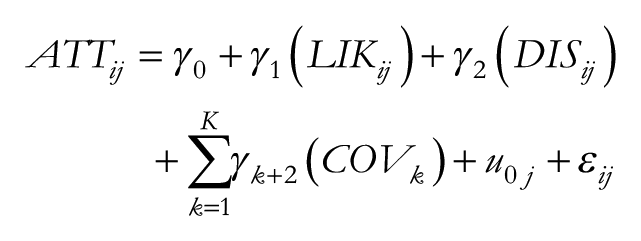
Gender, ethnicity, generational status, and nomination variables were dummy-coded as described in the Method section. Liking, disliking, and friendship nominations included in each model were specific to the target outgroup. For ethnicity, White participants served as the reference group when examining attitudes toward Asian, Black, and Latinx peers, and Latinx participants served as the reference group when examining attitudes toward White peers.
Results
Descriptive information about nominations used to capture interpersonal liking and disliking is reported in the supplemental online material. Of note, Latinx youth received the most liking and disliking nominations, consistent with them being the largest ethnic group in the sample. The results reported in what follows are divided into two sections. In the first section we use a series of ANOVAs to examine intergroup attitudes both in terms of participant ethnic group differences and target ethnic group differences. Primary hypotheses examining the effects of interpersonal liking and disliking are tested with multilevel modeling in the second section, where we assess if liking predicted more favorable intergroup attitudes and if disliking predicted less favorable intergroup attitudes. Here, we also describe results associated with our secondary hypotheses exploring the effects of ethnic ingroup size, ethnic outgroup size, and other contextual covariates such as school SES.
Attitudes Toward Ethnic Ingroup Versus Each Ethnic Outgroup
A series of one-way ANOVAs were conducted to examine (a) differences in ingroup attitudes, (b) differences between ethnic groups in attitudes toward a given outgroup (e.g., Asian, Black, and Latinx participants’ attitudes toward White peers), and (c) differences in attitudes expressed toward the four target ethnic groups within each participant ethnic group (e.g., differences in Asian participants’ attitudes toward Asian, Black, Latinx, and White peers). To account for six planned comparisons between groups, a Bonferroni adjustment was used (α = .008). Mean attitudes, separated by participant and target group ethnicity are reported in Figure 1.
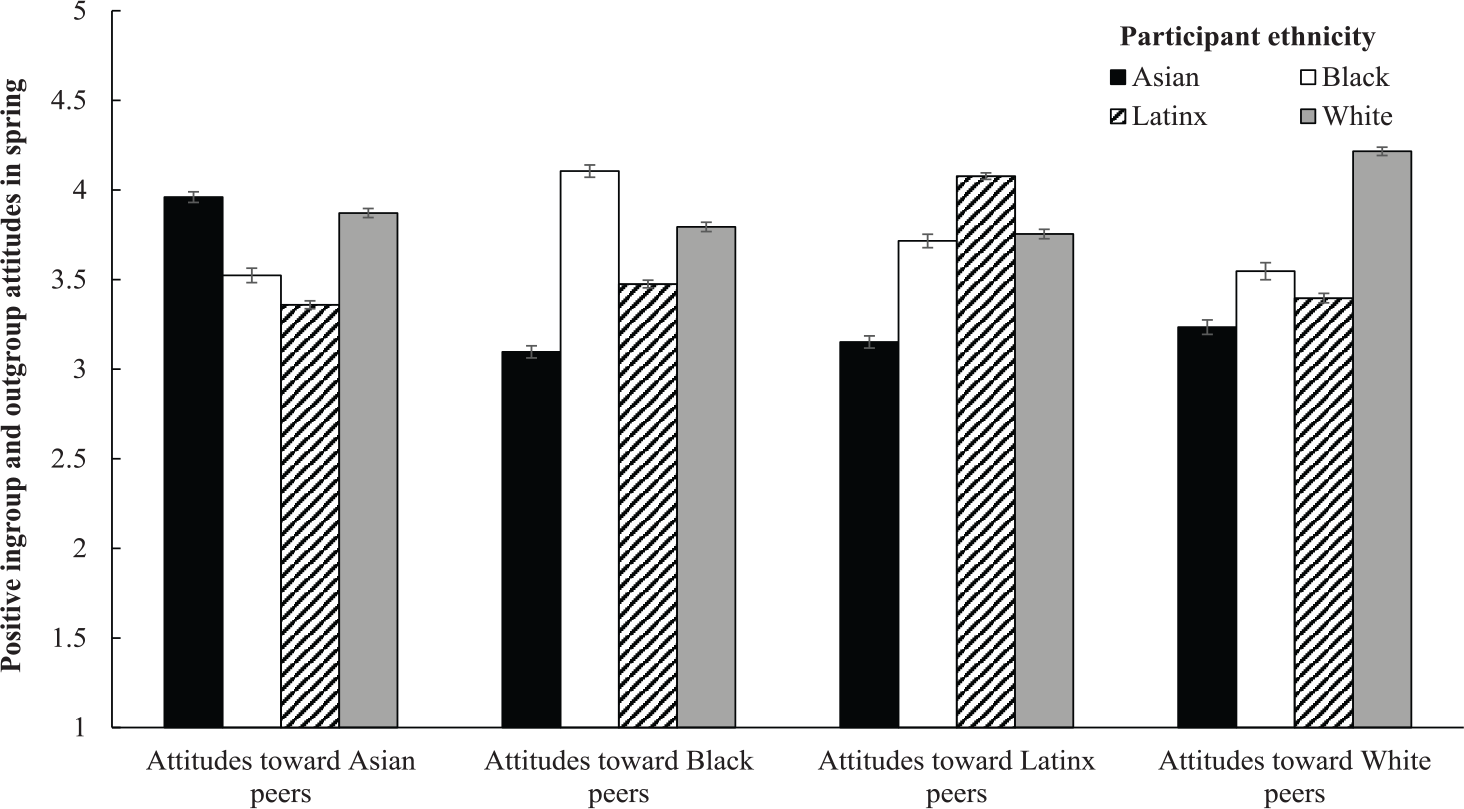
Average levels of positive attitudes toward each ethnic outgroup and ingroup in the spring of sixth grade, by participant ethnic group.
Attitudes toward ethnic ingroups
As hypothesized, a preference for ethnic ingroup peers was observed for all ethnic groups (all ps < .001). An additional one-way ANOVA was used to examine mean ratings of ethnic ingroup attitudes. There were ethnic differences across the four groups in how students rated members of their own ethnic group, F(3, 4259) = 16.45, p < .001. More specifically, White participants (M = 4.22, SD = 0.77) rated their ingroup significantly more positively than Asian (M = 3.96, SD = 0.81) and Latinx (M = 4.08, SD = 0.76) participants rated their respective ingroups (ps < .001). After correcting for multiple planned comparisons (α = .008), Black participants (M = 4.11, SD = 0.85) rated their ingroup similarly to White participants (p = .03). Black and Latinx participants also rated their ingroups similarly to each other (p > .99). Lastly, Asian participants (M = 3.96, SD = 0.81) rated their ingroup significantly less positively than all other ethnic groups (ps ⩽ .004).
Outgroup attitudes between ethnic groups
Analyses of ethnic differences among nominators in attitudes toward each outgroup were exploratory. Regarding intergroup attitudes toward Asian peers, F(3, 4254) = 115.59, p < .001, White participants (M = 3.87, SD = 0.83) reported significantly more favorable attitudes than Black participants (M = 3.52, SD = 1.00; p < .001), who reported more favorable attitudes than Latinx participants (M = 3.36, SD = 0.94; p = .001). Regarding intergroup attitudes toward Black peers, F(3, 4255) = 177.18, p < .001, White participants (M = 3.79, SD = 0.86) reported significantly more favorable attitudes than Latinx participants (M = 3.48, SD = 0.89; p < .001), who reported more favorable attitudes than Asian participants (M = 3.10, SD = 0.92; p < .001). Regarding intergroup attitudes toward Latinx peers, F(3, 4248) = 213.68, p < .001, White participants (M = 3.75, SD = 0.88) and Black participants (M = 3.72, SD = 0.93) did not differ in their attitudes (p > .99), but both groups reported significantly more favorable attitudes than Asian participants (M = 3.15, SD = 0.92; ps < .001). Regarding attitudes toward White peers, F(3, 4284) = 180.65, p < .001, Black participants (M = 3.55, SD = 1.18) reported significantly more favorable attitudes than Latinx participants (M = 3.39, SD = 1.12; p = .01), who reported significantly more favorable attitudes than Asian participants (M = 3.23, SD = 1.10; p = .002). Overall, White participants reported the most favorable intergroup attitudes, while Asian participants reported the least favorable intergroup attitudes.
Outgroup attitudes within ethnic groups
Exploratory analyses were also conducted examining differences in attitudes toward each ethnic outgroup. For each pan-ethnic group, there were significant differences in their attitudes toward each ethnic group: Asian: F(3, 2223) = 283.28, p < .001; Black: F(3, 1797) = 95.20, p < .001; Latinx: F(3, 5253) = 459.87, p < .001; White: F(3, 3228) = 184.19, p < .001. Again, the expected ingroup preference was found across groups (ps < .001). The rank ordering of outgroups was different across the four pan-ethnic groups (i.e., did not reflect a consistent social hierarchy). Post hoc tests revealed that, more specifically, Black participants’ outgroup attitudes were most favorable toward Latinx youth (ps < .001 in comparison to White and Asian youth), and Latinx participants’ outgroup attitudes were most favorable towards Black youth (ps ≤.001). Among both Black and Latinx youth, attitudes toward White and Asian youth were similar (pBlack = .547 and pLatinx = .096). Although not readily apparent due to White participants’ overall higher attitude ratings across groups and Asian participants’ overall lower attitude ratings across groups, there was a similar pattern for White and Asian participants. In other words, the highest ranked outgroup for White participants was Asian youth (ps < .001), and for Asian participants the highest ranked group was White youth, although Asian youth rated Latinx peers only marginally lower (p = .015 in comparison to Latinx youth; p < .001 in comparison to Black youth). Together, these results suggest a particular alliance between Black and Latinx youth, as well as one between White and Asian youth.
Multilevel Models Predicting Intergroup Attitudes
Intraclass correlation coefficients (ICCs) are an indicator of the extent to which differences in outcomes can be attributed to similarity among participants at Level 1 nested within Level 2. In our analyses, students (Level 1) were nested within schools (Level 2), and all ICCs were small and similar across evaluations of the four pan-ethnic outgroups (ICCAsian = .06, ICCBlack = .05, ICCLatinx = .06, ICCWhite = .05), such that approximately 5% to 6% of the variance in outgroup attitudes could be attributed to similarities among students in the same school.
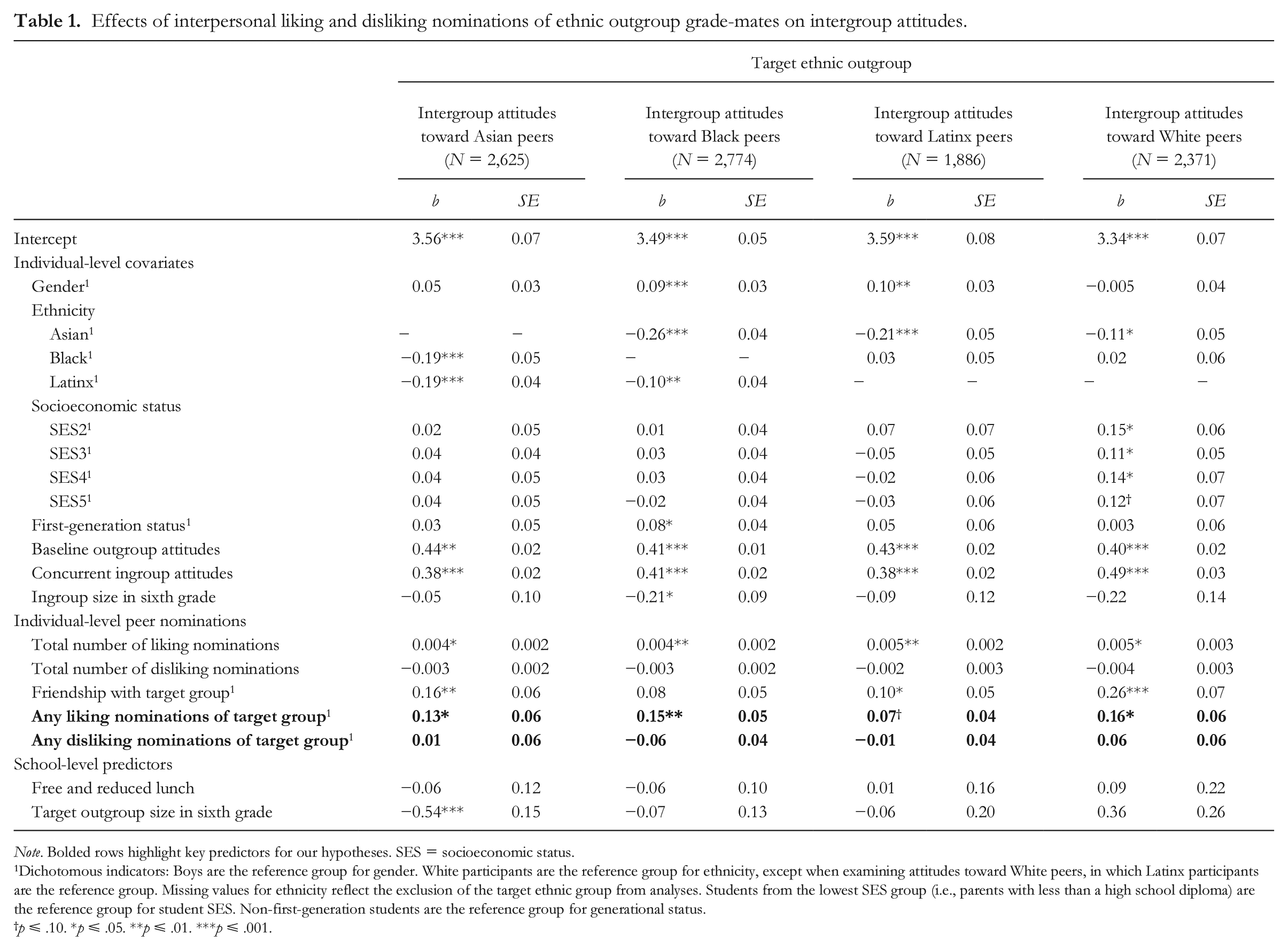
Coefficients and standard errors from multilevel models are shown in Table 1. The results are reviewed starting with gender, ethnic, SES, and generational status differences in intergroup attitudes, as well as our other individual-level control variables. Second, we report the effects of our primary predictors of interest, based on nominations of grade-mates capturing interpersonal liking and disliking. Lastly, we report the effects of our context-related variables: ethnic ingroup size, ethnic outgroup size, and the average SES of families served at each school.
Effects of interpersonal liking and disliking nominations of ethnic outgroup grade-mates on intergroup attitudes.
Note. Bolded rows highlight key predictors for our hypotheses. SES = socioeconomic status.
Dichotomous indicators: Boys are the reference group for gender. White participants are the reference group for ethnicity, except when examining attitudes toward White peers, in which Latinx participants are the reference group. Missing values for ethnicity reflect the exclusion of the target ethnic group from analyses. Students from the lowest SES group (i.e., parents with less than a high school diploma) are the reference group for student SES. Non-first-generation students are the reference group for generational status.
p ⩽ .10. *p ⩽ .05. **p ⩽ .01. ***p ⩽ .001.
Individual-level covariates
As shown in Table 1, gender differences were obtained for attitudes toward Black and Latinx peers, with girls reporting more favorable attitudes than boys. Differences in intergroup attitudes towards Black peers based on generational status were observed, such that second- and third-generation students reported significantly more favorable intergroup attitudes compared to first-generation students. Ethnic differences in intergroup attitudes were also observed, such that compared to White participants, all ethnic minority participants reported less favorable attitudes toward each ethnic outgroup, with one exception: White and Black participants did not differ in their attitudes toward Latinx peers. When the reference ethnic groups were rotated (e.g., to examine differences between ethnic minority groups), several additional ethnic differences were obtained. Compared to Latinx participants, Asian participants reported less positive attitudes toward Black peers (b = −0.17, p < .001). Compared to Black participants, Asian participants also reported less favorable attitudes toward White peers (b = −0.14, p = .02). Compared to Black participants, Asian participants also reported less favorable attitudes toward Latinx peers (b = −0.25, p < .001). Differences in intergroup attitudes based on students’ SES were examined, and the reference groups were rotated to allow all possible group comparisons. Overall, there was no effect of participants’ SES on their intergroup attitudes with one exception: students of color from the lowest SES group (i.e., students whose parents had less than a high school diploma) reported significantly less favorable intergroup attitudes toward White peers in particular, compared to their peers from higher SES backgrounds (ps < .10).
Controlling for baseline attitudes during the fall of sixth grade (T1) toward each ethnic outgroup, more favorable ingroup attitudes were associated with more favorable attitudes toward each ethnic outgroup (T2). While the total number of nominations capturing interpersonal liking (regardless of ethnicity) did not significantly predict students’ attitudes toward any of the four pan-ethnic outgroups, a greater number of overall nominations capturing interpersonal liking (regardless of ethnicity) positively predicted students’ attitudes toward outgroups. This effect was obtained for attitudes toward all four ethnic outgroups. Replicating a robust friendship effect on intergroup attitudes, those students who had at least one reciprocated friendship with a member of the target ethnic outgroup demonstrated more favorable attitudes toward the relevant ethnic outgroup as a whole. This friendship effect was obtained for all but attitudes toward Black peers.
Liking and disliking
The bolded coefficients in Table 1 represent the predictors for our primary hypotheses: that liking of individuals would predict more positive intergroup attitudes, and disliking would predict more negative intergroup attitudes. We found no support for disliking of target outgroup grade-mates predicting attitudes toward any ethnic outgroup. In contrast, liking at least one Asian, Black, and/or White grade-mate predicted significantly more favorable attitudes toward these ethnic outgroups. The only exception was attitudes toward Latinx peers, for whom the effect was marginally significant (p = .09). That is, over and above participant demographics, school ethnic and socioeconomic context, and reciprocated friendships with the target ethnic group, students who liked at least one target outgroup grade-mate demonstrated more favorable attitudes toward that ethnic group as a whole, with the exception of students’ attitudes toward Latinx peers.
School context-related covariates
Secondary to our examination of liking and disliking, we also examined the contextual effects of ethnic ingroup size and school SES. Ethnic ingroup size significantly predicted intergroup attitudes toward Black students only (p = .03), such that participants’ smaller ethnic ingroup size was associated with more favorable attitudes toward Black peers. Ethnic outgroup size significantly predicted attitudes toward Asian American students only (p < .001), such that fewer Asian students at school was associated with more favorable attitudes toward Asian peers, in general. School-level SES as measured by proportion of students eligible for free or reduced-price lunch was unrelated to students’ intergroup attitudes.
In sum, while interpersonal disliking did not predict attitudes toward ethnic outgroups, interpersonal liking of individual ethnic outgroup grade-mates was fairly robustly associated with better attitudes toward the relevant ethnic outgroup. We also largely replicated the association between cross-ethnic friends and more favorable intergroup attitudes toward the relevant ethnic outgroup found in the broader literature. Of note, attitudes toward Asian peers were more favorable in schools with a smaller proportion of Asian students, whereas attitudes towards Black peers were more favorable in schools in which students’ ethnic ingroup was relatively smaller in size.
Discussion
Understanding factors related to positive intergroup attitudes is of the utmost importance given the increased ethnic diversity of the school-age population in the US. Focusing on the critical transition from elementary to middle school, where youth are typically exposed to greater ethnic diversity than ever before in their classrooms (Kalogrides & Loeb, 2013), the present study provides some important insights into how interpersonal sentiments that are not necessarily publicly observable relate to generalized intergroup attitudes in multiethnic schools. The results show that for three of the four target ethnic groups, merely liking at least one cross-ethnic grade-mate is associated with more positive attitudes toward the relevant ethnic outgroup as a whole, consistent with our hypotheses. These effects were robust, as we controlled for reciprocated cross-ethnic friendships as well as earlier intergroup attitudes. In contrast, inconsistent with our hypotheses, disliking a particular cross-ethnic grade-mate was unrelated to attitudes toward the relevant ethnic outgroup as a whole. Taken together, these findings suggest that positive interpersonal sentiments capturing liking matter more than disliking for generalized intergroup attitudes in U.S. urban multiethnic middle schools. As such, U.S. schools that aim to promote positive intergroup relations between students of different ethnicities would likely benefit from providing opportunities for youth to develop positive interpersonal sentiments towards individual outgroup peers.
Asymmetry Between Interpersonal Liking and Disliking
Our findings regarding the effects of interpersonal liking largely replicate those obtained in the Netherlands with very different within-school ethnic configurations and different methods for measuring interpersonal sentiments (Stark et al., 2013). Relying on peer nominations, we showed that naming at least one cross-ethnic peer whom they liked was associated with improved attitudes toward the peer’s ethnic group across the first year in middle school. Moreover, even when controlling for ethnic ingroup and outgroup size, as well as cross-ethnic friendships, interpersonal liking of at least one ethnically dissimilar grade-mate was associated with more favorable attitudes toward that ethnic group for intergroup attitudes towards Asian, Black, and White students (but not Latinx students).
Unlike the findings from Stark et al. (2013), we found no evidence that disliking a particular cross-ethnic peer relates to young adolescents’ intergroup attitudes toward that particular ethnic group. In the current study, students who disliked specific cross-ethnic grade-mates did not report more negative attitudes about the relevant outgroup. It is possible that interpersonal disliking is driven primarily by negative traits or behaviors (e.g., personality, aggression, social status) of individual peers (for a review, see Killen, Mulvey, & Hitti, 2013). Peer nominations of disliking may, in fact, reflect more idiosyncratic reasons for wanting to avoid a particular peer (e.g., perhaps that peer is bullied), consistent with findings from the peer relations literature suggesting that (although related) interpersonal disliking may function independently from intergroup prejudice (Killen et al., 2013). Differences in measurement may also help to explain why our findings regarding the effects of disliking on intergroup attitudes differ from those documented with the Dutch sample. Whereas Stark et al. (2013) measured liking and disliking of all classmates on a bipolar continuum (although, for the analyses, the high and low values indicating liking and disliking were split), we relied on two separate questions that measured the liking and disliking of grade-mates that participants spontaneously nominated. It also remains possible that our findings differ from those of Stark et al. (2013) due to the greater ethnic diversity and differing sociocultural context of California schools. Examining the effects of interpersonal liking and disliking on intergroup attitudes in a variety of cultural contexts is an important future direction.
Our pattern of results with adolescents contrasts with work conducted in adult populations, which has shown that negative (compared to positive) interpersonal interactions with outgroup members are more robustly associated with general intergroup attitudes (Graf et al., 2014; Paolini et al., 2010). However, these studies examined the effects of contact specifically, whereas the present research examines interpersonal sentiments (i.e., liking, disliking) rather than the quality of actual intergroup interaction. As such, it may be that while negative (compared to positive) interpersonal interaction is more robustly associated with intergroup attitudes, positive (compared to negative) interpersonal affect might be more strongly linked to intergroup attitudes.
Ethnic Differences
Latinx youth were the only target ethnic group for which associations between liking of individuals and attitudes toward the group were marginally significant. This might be explained by the greater frequency with which they were nominated compared to all other ethnic groups, likely as a function of them being the largest ethnic group in the sample. In other words, liking a Latinx peer may be normative in the sample regardless of individual students’ ethnicities as a function of substantially greater numerical representation in the schools. Relatedly, although White youth are a historically advantaged social group (and Latinx youth a historically disadvantaged group), in the case of our study, Latinx youth generally represented the numerical majority both in the broader social context of California (see https://dq.cde.ca.gov/dataquest/) and in the schools in which we collected data. As such, just as prior research has demonstrated that contact had a weaker impact on ethnic minority individuals’ attitudes toward White majority peers, liking may have a weaker impact on attitudes toward Latinx youth given that they are the regional numeric majority in our sample.
Further considering the role of the ethnic context, we find that ethnic ingroup size and relevant ethnic outgroup size predict attitudes only toward specific ethnic groups. Again, it is of note that the schools represented in this study systematically varied in their ethnic diversity, with each of the four pan-ethnic groups represented as both numerical minority and majority across schools. Although some ethnic groups tended to have greater numerical representation than others (e.g., Latinx youth were more often in the numerical majority than other groups; Asian and Black youth were more often in the numerical minority), ethnicity and numerical representation at school were not conflated in the study sample. As such, the differences in our ethnicity-specific findings regarding ingroup and outgroup size cannot be explained by potential differences in school ethnic composition.
Consistent with our hypothesis based on ethnic competition theory (Blalock, 1967; Scheepers et al., 2002), larger relative representation of Asian students was associated with less favorable attitudes toward Asian peers. This aligns with ethnic competition, as well as with the idea that stereotypes of Asian students as academically high achieving might result in them seen as an academic threat to other students (Wong, Lai, Nagasawa, & Lin, 1998). This ethnic group-specific finding underscores the need for researchers to disaggregate “outgroup” into the specific ethnic groups when studying intergroup attitudes, as well as the importance of considering the role of the relative number or availability of ethnic outgroup members in shaping intergroup attitudes.
We also observed individual and contextual effects unique to attitudes towards Black peers. When the (non-Black) participants’ ethnic ingroup was larger, attitudes toward Black peers were less favorable. This was consistent with our hypothesis that when students’ ingroup size is large, their affiliative needs can be met with ingroup members, resulting in worse intergroup attitudes. Additionally, first-generation students showed significantly less favorable attitudes toward Black peers. Further, having at least one cross-ethnic friend from a particular ethnic group predicted more favorable attitudes towards Asian, White, and Latinx peers, but not Black peers. Together, these results suggest that relations between Black and non-Black youth are likely distinct from other intergroup dynamics. Past studies suggest there is a particular racial divide present in multiethnic schools between Black and non-Black adolescents, related to the segregation of Black students from cross-ethnic peers in their social and academic worlds (e.g., Quillian & Campbell, 2003). In addition, Black youth are especially likely to self-sort friendships based on similarity of ethnic identity strength (Hamm, 2000). It is also possible that some of our findings might reflect contextual or representational differences rather than distinct attitudes toward any one ethnic group. The representation of Black (and Asian) participants across the schools in our sample was less evenly distributed than that of Latinx and White students, due to demographics of the region. As such, we interpret the present ethnicity-specific factors that relate to intergroup attitudes toward Black and Asian peers with caution and call for further research that can parse out ethnic biases from school contextual features.
Our initial descriptive analyses indicated differences in intergroup attitudes based on the participants’ ethnicity. Interestingly, White students showed the most favorable attitudes toward each ethnic outgroup, compared to the other three pan-ethnic groups. As demonstrated in other work, some White adolescents who are aware of societal inequalities possess feelings of guilt or defensiveness (Grossman & Charmaraman, 2009). In adult samples, extensive work has demonstrated that White people harbor concerns about appearing to others as prejudiced (Plant & Devine, 1998; Richeson & Trawalter, 2008), and this may affect the extent to which they respond honestly on self-reported surveys about race (i.e., social desirability). As such, it may be that White respondents in the current study inflated their attitudes about ethnic outgroup members due to concerns about appearing prejudiced. It is also possible that, because White youth likely benefit from particular privileges and are historically advantaged in the U.S. social context, they may subjectively experience contact with outgroup members as less threatening given their dominant place in the broader social hierarchy. Relatedly, the positive effects of cross-ethnic friendships on intergroup attitudes are more robust among societally dominant group members like White youth (Tropp & Pettigrew, 2005). Finally, although we did not observe any differences in intergroup attitudes as a function of participant SES with one exception (students of color in our lowest SES group reported less favorable attitudes toward White peers), it is also important to note that the White students in our sample were significantly higher in SES compared to the other ethnic groups.
Why Asian students have generally more unfavorable intergroup attitudes is less clear, although there are several plausible reasons. One potential explanation is that Asian American adolescents report particularly high levels of race-based harassment and discrimination from peers at school (Rosenbloom & Way, 2004), and they are also significantly more likely to be socialized by their families to mistrust ethnic outgroup members (Else-Quest & Morse, 2015). As such, this may result in less interest in contact with ethnic outgroup peers. Such findings were consistent with larger average disparities between ingroup and outgroup ratings reported by Asian youth in our sample. However, it is also possible that such ethnic differences in ingroup ratings (e.g., Bellmore, Nishina, Witkow, Graham, & Juvonen, 2007) may capture an overall response bias that generalizes to ratings of other ethnic groups. It is important to note that Asian students in this sample also reported the lowest ingroup attitudes as well as intergroup attitudes, suggesting an overall downward bias in responses. Although the current analyses cannot provide evidence as to why this downward bias may exist, it—and the other ethnic differences outlined—warrant further investigation.
Future Directions and Implications
The current findings do not allow us to make any causal or directional inferences about interpersonal liking and intergroup attitudes, as our goal was to examine whether interpersonal sentiments might provide some insights into concurrent intergroup attitudes. Now that we know how interpersonal and intergroup relations relate to one another, future research should examine these processes longitudinally and across critical transitions (e.g., when youth transfer to a new school with a different ethnic composition). Furthermore, future work would benefit from examining the relations between interpersonal liking and disliking and intergroup attitudes in other cultural and ethnic contexts. The present work focuses on a U.S. sample in predominantly ethnically diverse schools, and results may differ in more ethnically homogeneous schools and across different cultural contexts.
Although cross-ethnic friendships may be the “gold standard” for the promotion of positive intergroup attitudes (Allport, 1954), based on our findings from a large and ethnically diverse U.S. sample, liking at least one cross-ethnic peer is associated with more positive general attitudes toward the respective ethnic outgroup. As such, promoting opportunities for students to develop at least a desire to affiliate with cross-ethnic peers could be beneficial for intergroup attitudes. Further, this approach to improving intergroup relations would be less limited by availability of peers and mutuality of positive feelings than would be attempts to promote friendship, given that friendship requires reciprocity and repeated contact. It is therefore critical to understand how to facilitate such liking toward cross-ethnic peers. Reflecting the school ethnic composition, it is critical that students attend classes that are at least as diverse as their schools (Juvonen, Kogachi, & Graham, 2017). Schools should therefore strive to minimize de facto segregation and encourage positive interactions across ethnic groups.
To promote favorable sentiments and affinity across groups, relatively simple methods can be utilized. One pertains to careful consideration of seating arrangements (Audley-Piotrowski, Singer, & Patterson, 2015; van den Berg & Cillessen, 2015). By promoting physical proximity across groups by seating students of different ethnic backgrounds next to one another, it is possible to increase interpersonal liking and change peer reputations of marginalized youth (van den Berg, Segers, & Cillessen, 2012). Additionally, extracurricular activities may be particularly effective in uniting youth across ethnic groups (Knifsend & Juvonen, 2017). That is, youth who share the same interests or hobbies likely want to affiliate with one another in ways that may unite them across ethnic groups. As such, if youth from different ethnic backgrounds engage in extracurricular activities together, they are likely to develop positive feelings towards ethnic outgroup peers with whom they otherwise might not interact (even if a friendship does not form), thereby promoting favorable intergroup attitudes. In sum, schools that aim to improve their intergroup relations would likely benefit from creating deliberate opportunities for youth to develop positive affect towards cross-ethnic peers, which our study suggests would be more effective than curbing negative affect towards outgroups.
Supplemental Material
SOM_10_15_19 – Supplemental material for Interpersonal attitudes toward cross-ethnic peers in diverse middle schools: Implications for intergroup attitudes
Supplemental material, SOM_10_15_19 for Interpersonal attitudes toward cross-ethnic peers in diverse middle schools: Implications for intergroup attitudes by Ariana N. Bell, Danielle S. Smith and Jaana Juvonen in Group Processes & Intergroup Relations
Footnotes
Acknowledgements
We thank Sandra Graham, Leah Lessard, Ritika Rastogi, and Hannah Schacter for the invaluable feedback on earlier drafts of this manuscript, and the research assistants from the UCLA Middle School Diversity Project.
Funding
The author(s) disclosed receipt of the following financial support for the research, authorship, and/or publication of this article: The research was funded by grants from the National Institutes of Health (Grant No. 1R01HD059882-01A2) and the National Science Foundation (Grant No. 0921306) awarded to Sandra Graham and Jaana Juvonen, as well as the National Science Foundation Graduate Research Fellowship awarded to Ariana Bell (No. DGE-1650604), and the UCLA Graduate Summer Research Mentorship Fellowship and Edwin W. Pauley Fellowship awarded to Danielle Smith.

Supplemental material
Supplemental material for this article is available online.
Notes
References
Supplementary Material
Please find the following supplemental material available below.
For Open Access articles published under a Creative Commons License, all supplemental material carries the same license as the article it is associated with.
For non-Open Access articles published, all supplemental material carries a non-exclusive license, and permission requests for re-use of supplemental material or any part of supplemental material shall be sent directly to the copyright owner as specified in the copyright notice associated with the article.
