







Abstract
K. D. Williams (2009) theorized that chronic social exclusion would inescapably lead to a detrimental stage of resignation, characterized by depression, alienation, unworthiness, and helplessness. However, few studies empirically addressed this assumption. Considering immigrants as a population at risk of persistent exclusion, we investigated how social connections with the native-born majority and other immigrant minorities moderate the exclusion–resignation link. In Study 1 (N = 112 asylum seekers), participants mainly connected with other immigrants showed a significant association between chronic exclusion and resignation. Crucially, this link vanished for people with social connections mainly composed of native people. In Study 2, we replicated and extended these results running secondary analyses on a data set of 2,206 immigrants (CILS4EU). This work, suggesting that the exclusion–resignation link can be moderated by social factors, highlighted the relevance of immigrants’ connections with the native majority for counteracting the risk of segregation when tackling the social issue of immigrants’ everyday exclusion.
Human beings have a pervasive drive to form and maintain at least a minimum quantity of lasting, positive, and significant interpersonal relationships.
The classic quote opening this article summarizes the fundamental aspects of the belongingness hypothesis (Baumeister & Leary, 1995), according to which, the daily motivation of individuals towards social connections is based on a psychological need. People need to achieve a minimum quantity and quality of social connections, and they require those connections to be frequent, pleasant, stable, and close. A key prediction of the belongingness hypothesis is that a lack of satisfaction of the need to belong is associated with a wide range of negative consequences, including low psychological well-being (Lieberman, 2013) and increased mortality (House, Landis, & Umberson, 1988; Rubin, 2017). Psychologically, an unmet need to belong has been linked with the loss of meaning in life (Stillman et al., 2009), impaired self-regulation (Baumeister, DeWall, Ciarocco, & Twenge, 2005), and feelings of depression (Wong et al., 2016). Physically, people with poor social connections are more likely to suffer from several diseases (for a review, see Aldridge et al., 2018), dysfunctions in cardiovascular activation and cortisol level, and to report poor sleep quality (Cacioppo et al., 2002).
Most of the experiences that threaten individuals’ need to belong can be conceptualized as social exclusion. Social exclusion has been broadly defined as the experience of being kept apart from others physically (e.g., segregation) or emotionally (e.g., being ignored or told one is not wanted; Riva & Eck, 2016). The literature on social exclusion identified two main instances of exclusion: rejection and ostracism (Wesselmann & Williams, 2017). In episodes of rejection, people receive direct negative attention from others, and they experience a relational devaluation and the suggestion that they are not wanted (Wesselmann et al., 2016). Rejection may take the form of dehumanizing language (Andrighetto, Riva, Gabbiadini, & Volpato, 2016), discrimination or stigmatization (Smart Richman, Martin, & Guadagno, 2016) or microaggressions—brief, subtle, everyday comments, insults, and discriminating behaviors (Constantine, 2007; Sue et al., 2007). In contrast, when ostracized, people experience being ignored by others (Williams, 2009). The perception of being ignored may arise from verbal and nonverbal cues such as being forgotten (King & Geise, 2011), not being given eye contact (Nezlek, Wesselmann, Wheeler, & Williams, 2012), or being part of a conversation with people talking in an unspoken language (i.e., linguistic ostracism; Dotan-Eliaz, Sommer, & Rubin, 2009).
Perceived and Objective Chronic Social Exclusion
Social exclusion can be both an objective and a subjective state. The condition of a prisoner in solitary confinement is easily recognizable as an objective condition of social exclusion. Exclusion is in this case defined by the actual impossibility to connect with others because of the walls of the cell. Leaving aside this case, we can consider the life experience of members of groups like homeless and immigrants as likely conditions of objective social exclusion. For members of these groups, it is often difficult to form and maintain stable relations with the members of other groups (e.g., the majority). Moreover, considering the sociometric tradition, we can consider the peer nomination measures in schools to be an objective index of how other people judge the inclusionary status of a specific target (nominating the target as popular rather than the person nobody wants to affiliate with) within a given class (e.g., Tobia, Riva, & Caprin, 2017). In all these cases, the physical and social contexts define the actual occurrence of social exclusion.
However, it is not necessary to experience an actual lack of social connections to feel excluded, because social exclusion can be just a subjective experience (see Riva, Wesselmann, Wirth, Carter-Sowell, & Williams, 2014). Previous research has shown that people with borderline personality disorder feel excluded even when objectively included in an interaction (De Panfilis, Riva, Preti, Cabrino, & Marchesi, 2015). Moreover, loneliness has been defined as perceiving a lack of social connections regardless of their actual presence (Hawkley & Cacioppo, 2010). In these cases, people perceive social exclusion without the need to consider whether such perception has an objective basis.
In sum, there are cases in which being excluded and feeling excluded go hand in hand. However, there are also cases in which the two are dissociated, either because people feel excluded when they are not (as in the case of borderline personality disorder) or because they do not feel excluded when they are. These associations and dissociations make the study of social exclusion, which can examine both actual experiences and subjective states, particularly fascinating.
Temporal Need-Threat Model of Ostracism
Following the work of Baumeister and Leary (1995), the most comprehensive theoretical model conceptualizing social exclusion effects is the temporal need-threat model of ostracism (Williams, 2009). Williams analyzed the behavioral and psychological reactions of targets of ostracism, focusing on the temporal development of their responses. At first, the individuals realize they have been ostracized. The detection happens quickly and crudely, as social exclusion is an evolutionary threat for human survival that endangers individuals’ group membership. In this stage, called the reflexive stage, the targets of ostracism feel negative emotions and they experience a threat to four fundamental needs: belonging, self-esteem, control, and meaningful existence/need for recognition. Subsequently, in the reflective stage, individuals appraise the meaning, the motives, and the relevance of the episode of exclusion, preparing to behave in ways that will reestablish optimal levels of the most saliently threatened needs. Individuals will react prosocially (DeWall, 2010) when inclusionary needs (i.e., belonging and self-esteem) are the most threatened. They will react antisocially (Twenge, Baumeister, Tice, & Stucke, 2001) when power and provocation needs (i.e., control and recognition) are the most threatened. Social withdrawal could also be a third behavioral response that people may exhibit according to their disposition (i.e., preference for solitude; Ren, Wesselmann, & Williams, 2016) and their cognitive appraisal of the situation (e.g., low expectations of reinclusion; Smart Richman & Leary, 2009).
The last stage of Williams’s model (2009) is the resignation stage. When episodes of social exclusion persist, people’s resources necessary to refortify the threatened needs become depleted over time, and they enter a psychological condition characterized by feelings of resignation. Among people exposed to persistent social exclusion, thwarted belongingness could develop into alienation, self-esteem into depression, reactance into learned helplessness, and attempts to prove their worthiness into feelings of unworthiness (Williams, 2009).
Because of the challenges of investigating chronic social exclusion empirically (e.g., difficulties of reaching a chronically excluded sample), only a few qualitative (Williams, 2001; Williams & Zadro, 2001; Zadro, 2004) and quantitative studies (Riva, Montali, Wirth, Curioni, & Williams, 2016) have focused on this research topic. The available studies suggest that the outcomes associated with the resignation stage (i.e., alienation, depression, helplessness, and unworthiness) are the psychological responses typically observed in populations experiencing persistent exclusion. Nevertheless, the resignation stage remains the part of Williams’s model that has received less empirical attention (Wesselmann & Williams, 2017). Although Williams envisioned a direct and univocal link between experiences of prolonged ostracism and the resignation stage, we argue that individual or situational variables may moderate the association between chronic exclusion and resignation. In this regard, to our knowledge, no study so far has explored the possibility that variables can modulate the development of the outcomes associated with the resignation stage in chronically excluded populations.
Social Exclusion in Immigrants
Because of their group membership, many people worldwide experience social exclusion for a prolonged period of time, for instance, people with mental and physical disabilities, the homeless, and prisoners (Williams, 2009). Among these groups, immigrants are at risk of experiencing persistent episodes of social exclusion for different reasons. First, the process of relocation implies several losses in which close social connections and relatedness to others are often disrupted (Bennett, Boshoff, & Rigby, 1997). Immigrants may experience separation from the family, friends, work, and living context of their country of origin (Saldaña, 1992; Yakushko, Watson, & Thompson, 2008). They may struggle with establishing new social relationships (Ammons, Nelson, & Wodarski, 1982; Berry, 1992), with being involved in the new community (Munton & Forster, 1990), with adapting to new lifestyles and learning new languages (Stack, 1981). As psychological responses, immigrants may feel isolated (Rothberg, 1991), lonely, and uprooted, with a sense of not belonging anywhere or to anybody (Keyes & Kane, 2004).
Second, decades of studies have shown how members of majority groups can develop stereotypes, prejudice, and racism that can turn into discriminating, dehumanizing, and aggressive behaviors towards ethnic minorities, targeting groups like immigrants with exclusionary threats (Brigham, 1971; Brown, 2010; Esses, Medianu, & Lawson, 2013; Jones, 1997; Tsuda, 1998; Verkuyten, 1998; Williams, Neighbors, & Jackson, 2003). Mullen and Rice (2003) showed how immigrant groups are exposed to both direct (e.g., lower admission and naturalization rates) and indirect (e.g., discriminating public portrayals) forms of social exclusion. Sue (2010) showed how ethnic minorities are targeted with persistent microaggressions in daily interpersonal interactions that communicate hostile, derogatory, and rejecting messages. The negative consequences of race-related exclusionary threats (e.g., perceived ethnic discrimination) on physical and psychological health have been well demonstrated via meta-analytic reviews and empirical research (Pascoe & Smart Richman, 2009; Schmitt, Branscombe, Postmes, & Garcia, 2014; Sue, 2010).
Intergroup Connections in Immigrants
Relocation stressors and hostility of the hosting communities can expose immigrants to persistent social exclusion, but conditions may exist that buffer its negative effects. Researchers working on domains related to social exclusion (e.g., perceived discrimination) found several individual and contextual moderators mitigating or worsening the negative impacts of social threats on disadvantaged social groups. Authors found that poverty and low socioeconomic status worsened the negative impact of perceived ethnic discrimination (Miller, Rote, & Keith, 2013), whereas social (Cohen & Wills, 1985) and ethnic support (Noh & Kaspar, 2003) protected from its negative consequences. Individual factors such as a pessimistic outlook on life (Kaiser, Major, & McCoy, 2004) and emotion-focused coping strategies (Noh & Kaspar, 2003) increased the negative consequences of exclusionary threats, whereas religious activities (Bierman, 2006) and problem-oriented coping strategies (Noh & Kaspar, 2003) were found to be protective factors.
Considering the work of Baumeister and Leary (1995), we reasoned that another important factor that could moderate the relationship between experiences of social exclusion and their related negative consequences in immigrants is the quantity and quality of social connections, focusing on connections with different social groups (i.e., majority and minority). However, according to the main research traditions of social capital and intergroup contact related to intergroup connections in immigrants, the available picture is fuzzy.
The research on social capital showed that individuals’ social networks and the resources channeled in them are involved in different areas of societal development (Szreter & Woolcock, 2004). Putnam (2000) discriminated between bonding and bridging social capital. Bonding capital refers to relationships with similar ones (e.g., same social identities), and it provides strong ties (Granovetter, 1973) essential for the ingroup cohesion and support (Putnam & Goss, 2002; Walseth, 2008). Bridging capital refers to relationships with dissimilar others (e.g., people with different ethnic background), and it allows the group to access external resources necessary for integration into the wider society (Granovetter, 1973). If bonding permits the “getting by,” bridging is crucial for “getting ahead” (Putnam, 2000, p. 23). Many authors agree that bridging capital is more important for integration into the wider society, given that it diminishes ingroup bias and fosters intergroup trust (Marschall & Stolle, 2004), whereas bonding capital carries the risk for minorities to close within their community at the expense of their wider social integration (Uslaner & Conley, 2003). The generally shared argument is that bridging is more likely to generate positive outcomes than bonding (Coffé & Geys, 2007).
However, previous research underlined the importance of similar ethnic groups for asylum seekers and refugees’ social integration (Duke, Sales, & Gregory, 1999; Hale, 1993) and health (Beiser, 1993). Ager and Strang (2008) found that both social bridges and bonds were fundamental means for refugees’ integration. Others found that bonding and bridging capital were associated with better mental health (Poortinga, 2012), even if the effect of the bonding capital was reduced for ethnic minorities compared to White people (Kim, Subramanian, & Kawachi, 2006). Conversely, Mitchell and LaGory (2002) found that bonding capital among racially segregated communities was associated with higher psychological distress. At a socioeconomic level, Muller (1998) found that ethnic enclaves had positive effects on immigrants’ employment. By contrast, Lancee (2012) found that immigrants’ bridging capital was associated with positive labor indicators, whereas ethnic bonding showed a nonsignificant or even negative association with them.
Overall the literature on the outcomes of bonding capital of minorities at risk of social exclusion appears conflicting: some argued that it can benefit immigrants with the expression of their identity and the maintenance of their cultural roots (Ager & Strang, 2008), whereas others stated that it—especially when bridging capital lacking (Villalonga-Olives & Kawachi, 2017)—can lock immigrants in ethnic niches that impede the access to societal resources, upward social mobility, and broader social integration (Portes, 1995; Ryan, Sales, Tilki, & Siara, 2008).
The literature relying on intergroup contact theory (Allport, 1954) showed that different types of intergroup social connection could generate conflicting outcomes. In general, it has shown that intergroup social contacts might positively affect minority groups’ psychological well-being while facing an exclusionary threat. Bagci and Turnuklu (2018) found that social contacts with majority members were associated with better psychological well-being among minorities. Others found that friendship with majority-group peers buffered minority students from the lack of belongingness and life satisfaction resulting from expected race-based rejection (Mendoza-Denton & Page-Gould, 2008), and it reduced cortisol reactivity in people with high expectations of race-based rejection (Page-Gould, Mendoza-Denton, & Tropp, 2008). Cross-ethnic friendships served as a protective mechanism against the negative psychological consequences of negative contact (Paolini et al., 2014). Relatedly, several studies demonstrated that cross-group friendships and contact with majority-group members might benefit minority students with increased positive academic attitudes (Cardinali, Migliorini, Andrighetto, Rania, & Visintin, 2016), skills (Saenz, Ngai, & Hurtado, 2007), and results (Shook & Fazio, 2008; Wölfer, Caro, & Hewstone, 2019).
In contrast with previous findings, Brenick, Schachner, and Jugert (2018) found that cross-ethnic friendships with majority-group peers exacerbated the negative consequences of perceived discrimination in ethnic minority students. They also found that cross-ethnic friendships with other minorities, particularly when perceived support for interethnic connections in classrooms was low, worsened the negative consequences of perceived discrimination. Differently, other authors found that cross-ethnic friendships in multiethnic contexts protected from the negative consequences of perceived ethnic discrimination in South Asian British children, but they did not control for whether the cross-ethnic friendships were with majority- or minority-group members (Bagci, Rutland, Kumashiro, Smith, & Blumberg, 2014).
According to the literatures on social capital and intergroup contact (e.g., Putnam, 2000; Cardinali et al., 2016), although the benefits of social connections with the majority group seem to be well known, how social connections with other immigrant minorities can moderate immigrants’ psychological responses to social exclusion is far from being clear. Moreover, the exposed literature mainly focused on the effects of perceived discrimination and stigmatization of immigrants that are only conceptually related to the specific constructs of rejection and ostracism. 1 We could not find any study investigating how immigrants’ psychological responses to persistent episodes of rejection and ostracism may be modulated by social connections with natives or immigrant groups. The present research aims to fill this gap by investigating how intergroup connections shape immigrants’ responses to chronic social exclusion.
The Present Research
The present research examined whether the relationship between experiences of perceived and objective chronic social exclusion and the resignation stage can be modulated by intervening factors. In two studies, we focused on immigrants as a well-known population at risk of experiencing frequent and persistent episodes of exclusion. Study 1 focused on self-reported perceptions of social exclusion, whereas Study 2 focused on a peer-reported index of exclusion. In both studies, we investigated the role of social connections with the native population and other immigrants, and the prevalence of social connections with native people over other immigrants as potential moderator of the relationship between experiences of social exclusion and the resignation stage (Studies 1 and 2) and life satisfaction (Study 2).
Based on the available literature, we hypothesized that immigrants with higher social connections with majority-group members would show a reduced detrimental impact (i.e., lower resignation and higher life satisfaction) of their experiences of chronic social exclusion. Given the conflicting findings from the literature on social contact and capital, we could not strongly predict how connections with minority-group members would moderate the relationship between chronic exclusion and the outcomes, thus this was a more exploratory research question. Finally, we explored how the prevalence of social connections with native people over other immigrants influenced immigrants’ psychological response to chronic exclusion.
Statistical Analysis
We investigated the research questions via multiple moderated regression models. First, we analyzed how social connections with natives and immigrants moderated the relationship between exclusion and the outcomes. Then we observed how the prevalence of connections with native over immigrant people moderated the exclusion–outcomes link. All the independent variables were standardized before the analyses to reduce multicollinearity (Holmbeck, 2002). To investigate significant interaction effects, we conducted simple slopes analyses observing the effect of the predictor on the dependent variable at 1 SD below the mean, the mean value, and 1 SD above the mean of the moderators. The analyses were conducted using the software R-Studio (RStudio Team, 2016) and IBM SPSS Statistics.
Study 1
We recruited a sample of asylum seekers as a sample of immigrants at high risk of experiencing persistent social exclusion. The data for this study were derived from the first wave of an ongoing longitudinal study that we have been conducting since 2017. The longitudinal study is aimed at investigating a wider range of factors at individual (e.g., resilience traits), social (e.g., social connections), and situational levels (e.g., integration-promoting programs) that may predict different asylum seekers’ responses (e.g., prosocial and antisocial behaviors) to the chronic social exclusion they are exposed to. From that large number of intervening factors, 2 we focused on the measures assessing general perceptions of social exclusion, the resignation stage, and social connections with Italians and immigrants. Then, we tested how the quantity and quality of the social connections with the two groups moderated the relationship between self-reported social exclusion and the resignation stage.
Participants
We conducted an a priori power analysis using the software G*Power (Faul, Erdfelder, Buchner, & Lang, 2009) to estimate the minimum sample size required to reach an adequate level of statistical power in the analyses planned. With an alpha of .05, in a model with six total predictors (as the most extended model tested), the results recommended the recruitment of at least 55 participants to achieve adequate power (β = .80) to detect a medium effect size (f2 = .15) for the single regression coefficient. In three welcoming centers (CAS [Centri di Accoglienza Straordinaria]: centers for extraordinary hosting) in Northern Italy, we recruited 112 male immigrants (Mage = 25.9, SD = 6.5, range = 18–59 years; Meducation = 10.2 school years, SD = 4.1, range = 0–19 school years), doubling the minimum sample required. We recruited only men because they represented the vast majority of users of the welcoming centers we had access to. The majority of the sample (86.9%) came from Western Africa (Nigeria, Gambia, Ivory Coast, Guinea, Mali, Sierra Leone, Ghana, Senegal, Cameroon, Benin, Liberia, Burkina Faso), 9% from Asia (Pakistan and Bangladesh), two participants came from Egypt, and one from Somalia (two unknown); 41.1% of the participants were Christian, 55.4% were Muslim, and one was Jewish (three unknown). Most of the participants were unmarried (75.9%), 15.2% were married, and 7.2% were separated, divorced, or widowed (two unknown). Participants had been living in Italy for 15.1 months (SD = 8.2, range = 4–48 months); 94.6% were asylum seekers, while 5.4% (n = 6) already held a status of international protection. These six participants were removed from the analysis so that we could focus only on asylum-seeking immigrants, controlling for the effect of legal status.
Procedure
Three major hosting center operators experienced in welcoming asylum seekers were approached to obtain access to our sample. Data were collected through a paper-and-pencil self-report questionnaire that was available in three languages: English, Italian, and French (native speakers reviewed the translations). The data collection process consisted of two phases. First, we briefed the participants in collective meetings regarding the aims and methodology of the study. Then, we organized group sessions for administration of the questionnaire. Cultural-linguistic mediators supported the researchers. Mediators translated the researchers’ explanation of the study procedure in the participants’ native languages, and they intervened during the questionnaire administration to help participants understand questionnaire items and to translate researchers’ clarifications. After signing the informed consent form, participants took approximately 60–90 minutes to complete the questionnaire. This research was approved by the Ethical Committee of the University of Milano-Bicocca.
Measures
Predictors: Social exclusion
The self-reported index of social exclusion measured how rejected and ignored participants felt in their daily life. The score was computed averaging two items assessing the two main components of social exclusion (“I feel rejected,” “I feel ignored”). The index showed a good internal consistency (r = .74, p < .001) and it ranged from 1 to 5, with a higher score indicating a higher perception of exclusion.
Outcomes: Resignation stage
We measured the outcomes associated with the resignation stage computing an index of resignation stage, including items that tapped into alienation, depression, unworthiness, and helplessness (for a similar procedure, see Riva et al., 2016). Items that tapped into alienation were derived from the Social Connectedness subscale of the Social Connectedness Scale (Lee & Robbins, 1995). Examples of adopted items are “I felt disconnected from the world around me” and “I felt so distant from people.” For depression, 3 we included items of the Symptom Checklist-90 (Revised) – Depression subscale (Derogatis & Unger, 2010). Examples of adopted items are “I felt no interest in things” and “I felt that everything was an effort.” For unworthiness, we included items of the Rosenberg Self-Esteem Scale (Rosenberg, 1965). Examples of adopted items are “On the whole, I was satisfied with my self” and “At times, I thought I was no good at all.” Finally, for helplessness, 4 participants answered some items of the Beck Hopelessness Scale (Beck, Weissman, Lester, & Trexler, 1974). Examples of adopted items are “My future seemed dark to me” and “I had great faith in the future” (see the complete list of items in the supplemental material). For all items, participants were asked to rate how much they felt or thought as stated in the items in the previous 3 months on a 5-point response scale (1 = not at all, 5 = extremely). The resulting index of resignation stage showed good reliability (Cronbach’s α = .84), with higher scores indicating higher levels of resignation.
Moderators: Social connections
We measured quality and quantity of social connections with Italians, asylum seekers’ national group members, and immigrants from other countries (in this order in the questionnaire), asking participants to list up to 10 persons they had regularly interacted with in the previous 3 months. Participants also rated how close they felt to each person on a 5-point response scale (1 = not close at all, 5 = extremely close). First, we computed three indexes of social connection averaging the responses on the closeness scale weighted by the number of social connections nominated (i.e., summing the closeness scores; Page-Gould, 2012). Then, we averaged the indices of social connections with immigrants’ national group members and with immigrants from other countries in a superordinate index of social connections with other immigrants. The Italian and immigrant connections indices ranged from 0 to 50, with higher scores indicating closer and more numerous social connections with the members of the two groups.
To consider the ratio between Italian and immigrant connections, we created an index representing the prevalence of social connections with Italians over other immigrants. The index was computed by subtracting the immigrant social connections from the Italian ones. The measure ranged from −37 to 40, with positive scores indicating a greater prevalence of Italian over immigrant connections, and negative scores indicating greater connections with immigrants over Italians. A score of 0 meant that participants had the same quantity and quality of social connections with Italian and immigrant people.
Sociodemographic information
We asked participants to indicate their gender, education (in years of full-time education attended), nationality, marital status, religion, status of their asylum claim, months of stay in Italy, and the way they reached Italy.
Results
Preliminary analyses: Correlations and descriptive analyses
Correlations among variables of Study 1 are reported in Table 1. We found that perceptions of chronic social exclusion were positively associated with the outcomes linked with the resignation stage. We also found that feelings of exclusion and resignation were higher in those immigrants who felt less connected with Italian people. Perceptions of social exclusion were not related to the degree of social connections with other immigrants. The analysis showed that social connections with Italians and with other immigrants were positively associated, indicating that people more connected with one group were also more related to the other group. Finally, participants had closer and more numerous relationships with other immigrants compared to Italians, |t|(187) = 2.57, p = .011 (see Table 1).
Means, standard deviations, and correlations for the core constructs of Study 1.
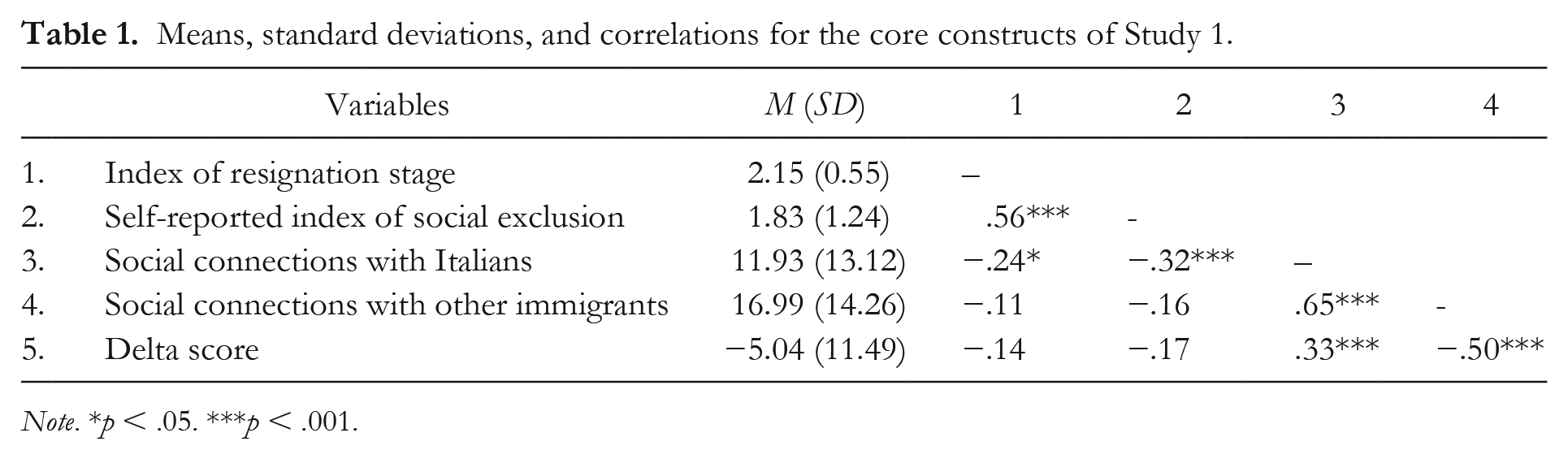
Note. *p < .05. ***p < .001.
Primary analyses
We ran a series of multiple moderated linear regression models to investigate (a) how social connections with Italian and with other immigrants, and (b) the prevalence of social connections with Italians over other immigrants moderated the relationship between perceptions of chronic social exclusion and the resignation stage. The results are presented in Table 2 and controlled for the length of stay in Italy.
How intergroup social connections moderate the relationship between perceived social exclusion and resignation stage (Study 1).
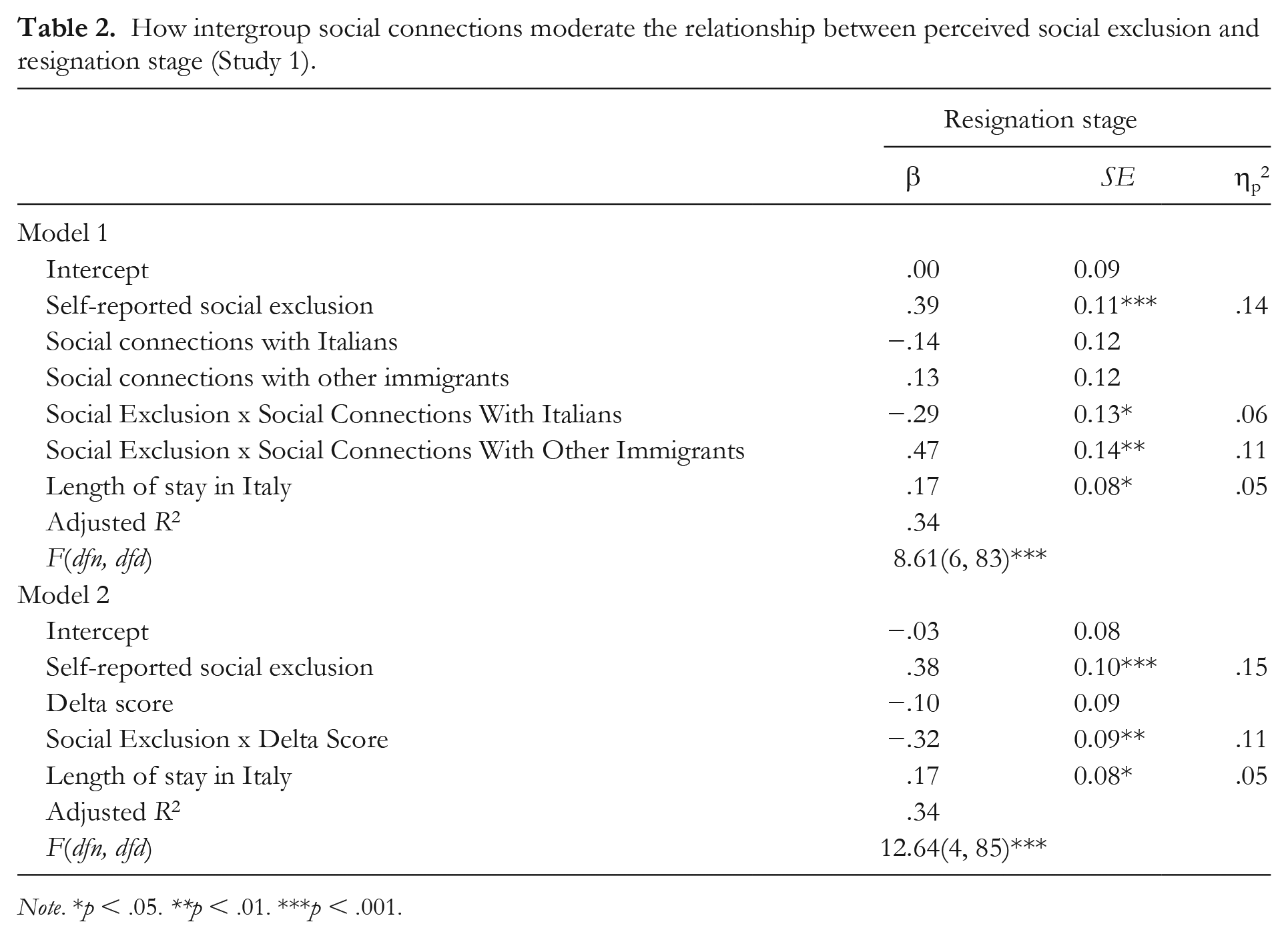
Note. *p < .05. **p < .01. ***p < .001.
Model 1 showed significant interactions both for social connections with Italians and with other immigrants. Simple slopes analysis revealed that exclusion was more strongly associated with resignation for participants with higher connections with other immigrants (+1 SD: β = .86, SE = 0.17, t = 4.97, p < .001; mean: β = .39, SE = 0.11, t = 3.63, p < .001; −1 SD: β = −.08, SE = 0.19, t = −0.45, p = .65; see Figure 1). Conversely, exclusion was less strongly associated with the resignation stage for participants with higher connections with Italians (+1 SD: β = .09, SE = 0.21, t = 0.44, p = .66; mean: β = .38, SE = 0.11, t = 3.63, p < .001; −1 SD: β = .68, SE = 0.12, t = 5.59, p < .001; see Figure 2).
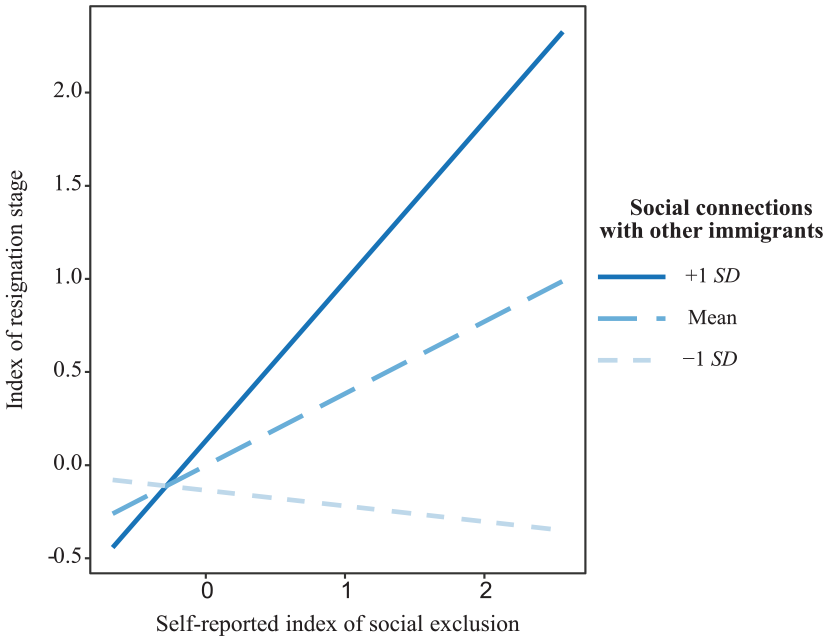
The moderating role of social connections with other immigrants on the relationship between the self-reported index of social exclusion and the index of resignation.
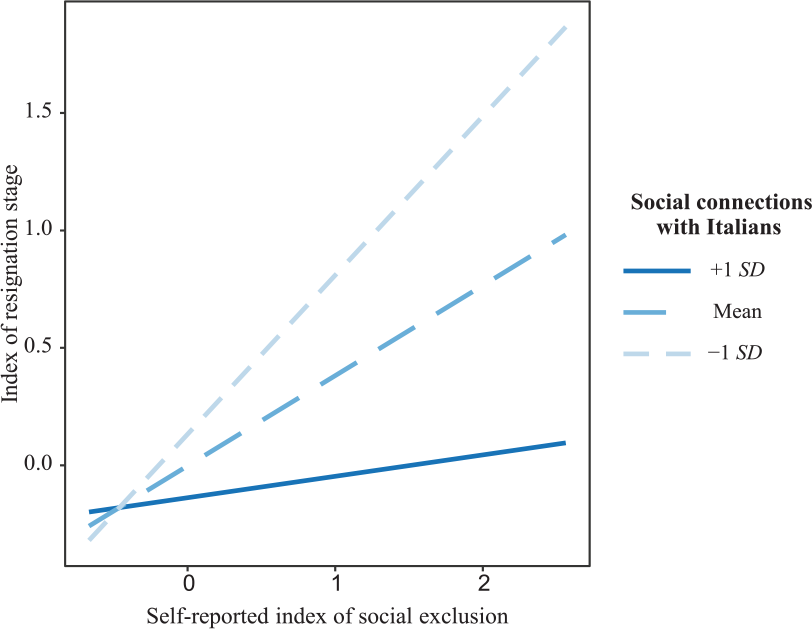
The moderating role of social connections with Italians on the relationship between the self-reported index of social exclusion and the index of resignation.
Model 2 showed a significant moderation effect of the delta score. Simple slopes analysis showed that exclusion was no longer associated with resignation when social connections with Italians prevailed over those with immigrants (β = .06, SE = 0.16, t = 0.37, p = .71). Conversely, exclusion was increasingly associated with resignation when immigrant and Italian social connections were equal in terms of number and closeness (β = .38, SE = 0.10, t = 3.94, p < .001) and even more when immigrant connections prevailed over Italian ones (β = .69, SE = 0.11, t = 6.58, p < .001; see Figure 3).
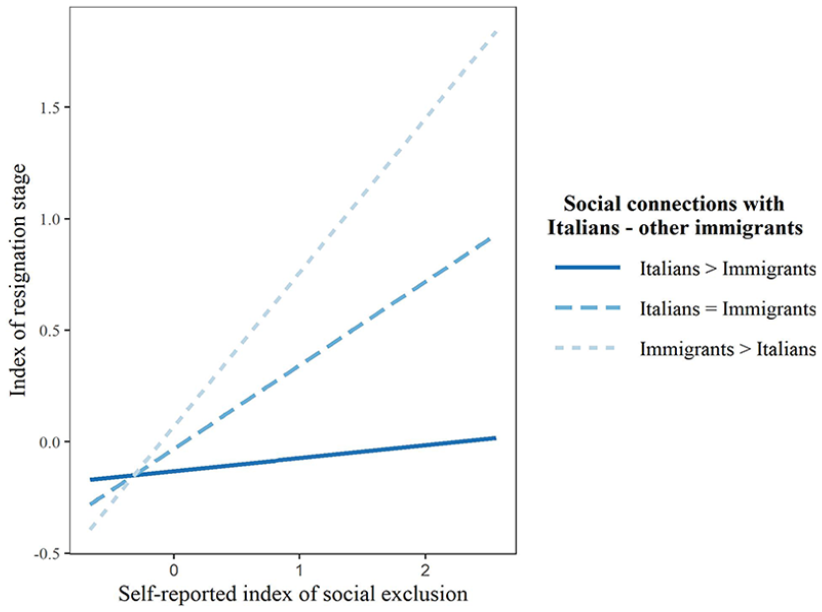
The moderating role of prevalence of social connections with Italians over those with other immigrants on the relationship between the self-reported index of social exclusion and the index of resignation.
Study 2
Study 2 aimed to replicate the pattern of results of Study 1. We used a large-scale, longitudinal data set with almost 20,000 students from four European countries (UK, Germany, the Netherlands, and Sweden). Study 2 tested the relationships found in Study 1 in a larger sample of immigrant population with different demographic characteristics (i.e., 2,206 adolescents). Study 2 further extended Study 1 in three other ways. First, the participants were both male and female. Second, we shifted from considering self-reported perceptions of social exclusion to a peer-reported index of exclusion. Third, to triangulate the results, we used a measure of life satisfaction as well as the resignation stage as dependent variables.
Participants and Procedure
Participants were part of the “Children of Immigrants Longitudinal Study in Four European Countries” (CILS4EU; Kalter et al., 2016). The data presented in this study came from the first wave of data collection conducted in 2010–2011. From the whole sample (19,634 participants), we selected only first-generation immigrant participants—children who were born in a foreign country. The selected sample consisted of 2,206 adolescents (50.3% male) who were, on average, 15.6 years old (SD = 0.8, range = 14–18 years). A total of 28.1% of the participants were recruited in the UK, 24.7% in Germany, 14.5% in the Netherlands, and 32.7% in Sweden. On average, participants migrated to the survey country when they were 7.2 years old (SD = 4.3, range = 0–18 years). Information on the participants’ country of origin was not available in the data set due to an anonymization procedure. The data were collected in the regular national school setting with the support of research assistants. Participants answered questionnaires that focused on migration-specific characteristics, sociocultural integration, psychological well-being and behavioral problems, weak and strong social connections with several ethnic groups, and social network data, among other topics.
Measures
Predictor: Social exclusion
We computed a peer-reported index of social exclusion in the classroom based on a peer-nomination measure. Participants were asked to write down the ID numbers of up to five classmates they would not sit by (“Who would you NOT want to sit by? Here, you may write down no more than five ID numbers”). From this question, we computed the peer-reported index of social exclusion by counting how many times each participant was listed by other classmates. The scores indicated the number of people who would not sit by each of the participants. The index ranged from 0 to 23, with higher scores indicating a higher peer-reported index of social exclusion.
Outcome 1: Resignation stage
The questionnaire measured only two (depression and unworthiness) out of the four outcomes associated with the resignation stage (alienation and helplessness were not measured). We could not compute an overall resignation index including all the four outcomes theorized by Williams (2009). However, results from Study 1 and past research (Riva et al., 2016) showed that responses to the four outcomes are usually highly related. Therefore, for Study 2, we computed an index of resignation stage by averaging the available two single items measuring depression and unworthiness (“I feel depressed,” “I feel worthless”). The index showed sufficient internal consistency (r = .58, p < .001), and higher scores indicated higher levels of resignation (range = 1–4).
Outcome 2: Life satisfaction
An index of life satisfaction was measured with a single, self-reported item (“On a scale from 1 to 10 where 1 is very unsatisfied, and 10 is very satisfied, how satisfied are you with your life in general?”). The response scale ranged from 1 to 10, with higher scores indicating higher life satisfaction.
Moderators: Social connections
Participants responded to two series of items measuring the frequency of intergroup social connections in the school and the neighborhood. Participants rated how often they spent time with people from different ethnic groups, and the reference groups varied across the survey countries based on the ethnic composition of the survey societies. 5 We averaged these items in two indexes: (a) social connections with native people from the survey country and (b) social connections with immigrants in the survey country. The two scales ranged from 1 to 5, with higher scores indicating more frequent connections with native/immigrant people.
As in Study 1, we computed a delta score assessing the prevalence of native social connections over immigrant social connections. We calculated the index by subtracting the native social connections index from the immigrant social connections index. The delta score ranged from −4 to 4. Scores above 0 indicated a higher prevalence of native over immigrant connections, whereas scores below 0 indicated a higher prevalence of immigrant over native connections. A score equal to 0 indicated that participants’ social connections with native people occurred with the same frequency as connections with other immigrants.
Results
Correlation analyses (see Table 3) showed a negative association between the index of life satisfaction and the index of resignation stage. As expected, higher levels on the peer-reported index of social exclusion were associated with lower levels on the index of life satisfaction, and although only marginally, positively linked with levels on the index of resignation stage. We also found that those with lower connections with other immigrants were highly rejected by other students. We observed that immigrant adolescents with high (vs. low) social connections, regardless of group membership, showed higher (vs. lower) life satisfaction, whereas only social connections with other immigrants were associated with lower resignation. The mean values of the delta score, social connections with the native population, and with other immigrants suggested that immigrant adolescents in this sample had more frequent social connections with the native population than with other immigrants, |t|(3513) = 5.83, p < .001.
Means, standard deviations, and correlations for the core constructs of Study 2.
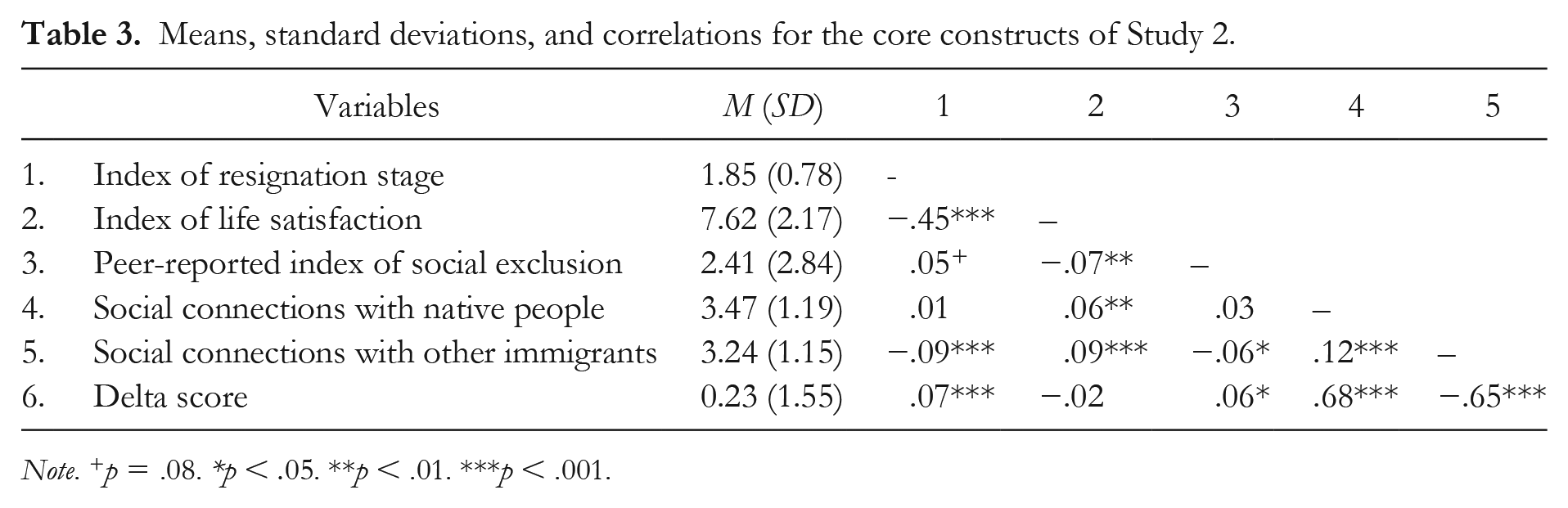
Note. +p = .08. *p < .05. **p < .01. ***p < .001.
Primary analyses
We ran two series of multiple moderated regression models aiming at investigating (1) how social connections with the native population and with other immigrants moderated the relationship between peer-reported social exclusion and (a) the self-reported outcomes associated with the resignation stage, and (b) life satisfaction; (2) how the prevalence of social connections with the native population over those with other immigrants moderated the associations between exclusion and (a) resignation, and (b) life satisfaction. Table 4 reports the regression models controlling for the effect of host countries, gender, age, and length of stay in the host country.
How intergroup social connections moderate the relationship between perceived social exclusion and (a) resignation stage and (b) life satisfaction (Study 2).
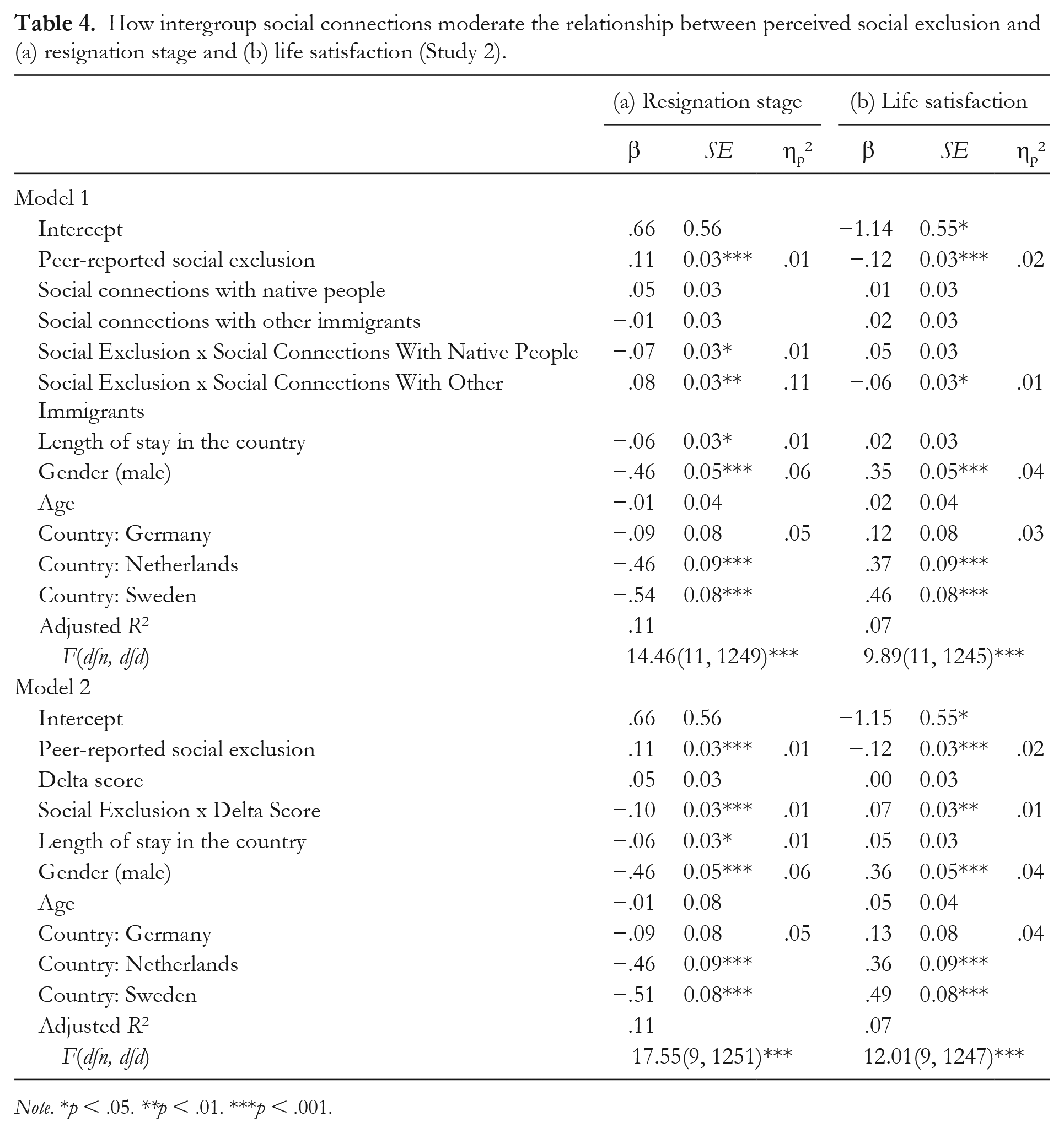
Note. *p < .05. **p < .01. ***p < .001.
In Model 1a, we observed that social connections with the native population and with other immigrants significantly moderated the relation between exclusion and resignation, in the same direction as in Study 1. Simple slopes analysis showed that for participants with higher social connections with natives, participants presented a lower association between exclusion and resignation (+1 SD: β = .04, SE = 0.04, t = 1.15, p = .25; mean: β = .11, SE = 0.03, t = 3.85, p < .001; −1 SD: β = .17, SE = 0.04, t = 4.04, p < .001; see Figure 4). By contrast, higher connections with other immigrants led to a stronger exclusion–resignation association (+1 SD: β = .19, SE = 0.04, t = 4.50, p < .001; mean: β = .11, SE = 0.03, t = 3.99, p < .001; −1 SD: β = .03, SE = 0.04, t = 0.88, p = .38; see Figure 5).
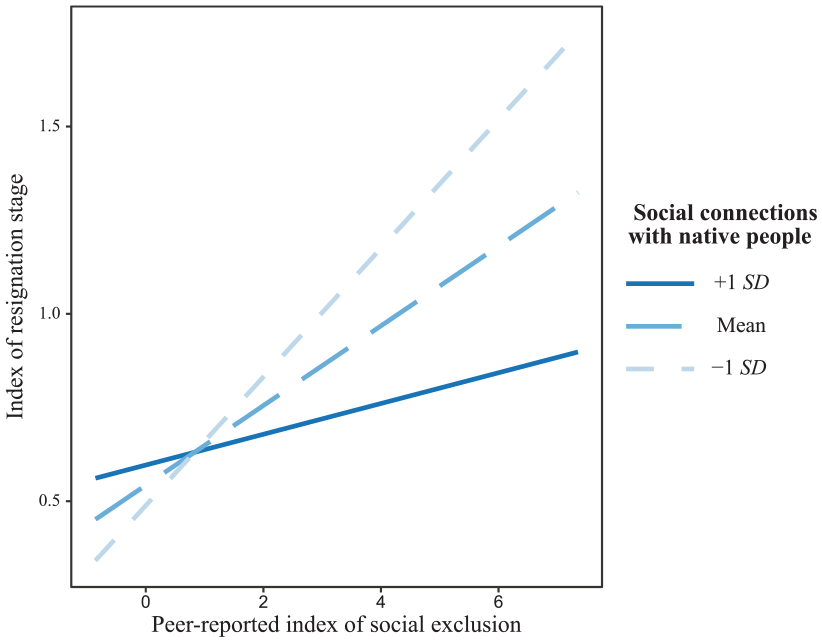
The moderating role of social connections with native people on the relationship between the peer-reported index of social exclusion and the index of resignation.
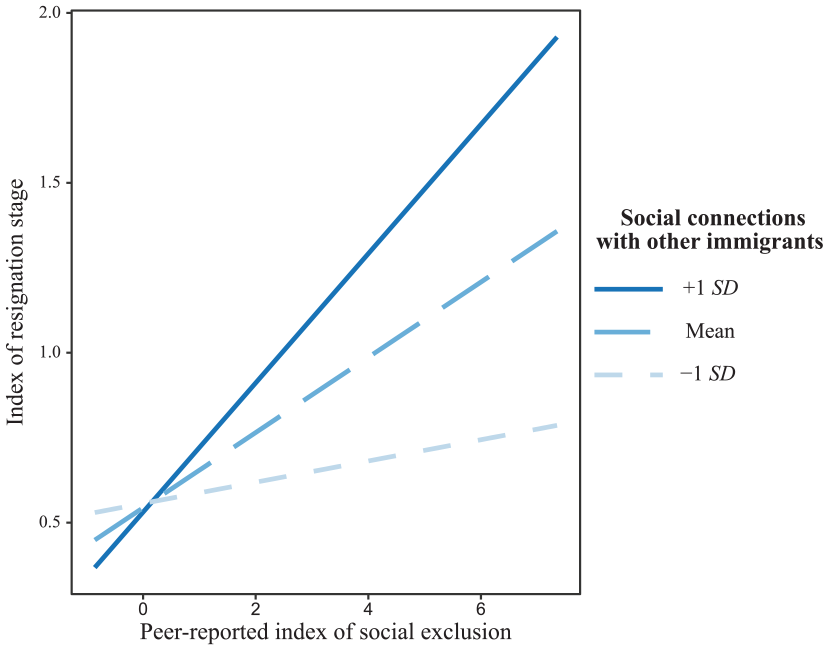
The moderating role of social connections with other immigrants on the relationship between the peer-reported index of social exclusion and the index of resignation.
Model 2a showed a significant effect of the delta moderator. Simple slopes analysis confirmed that when social connections with natives prevailed over social connections with other immigrants, exclusion was no longer associated with resignation (β = .02, SE = 0.03, t = 0.50, p = .62). By contrast, when social connections with other immigrants occurred with the same frequency as social connections with the native population (β = .11, SE = 0.03, t = 4.00, p < .001), exclusion was increasingly associated with resignation. This relationship became even stronger when social connections with other immigrants prevailed over social connections with the native population (β = .21, SE = 0.04, t = 4.95, p < .001; see Figure 6).
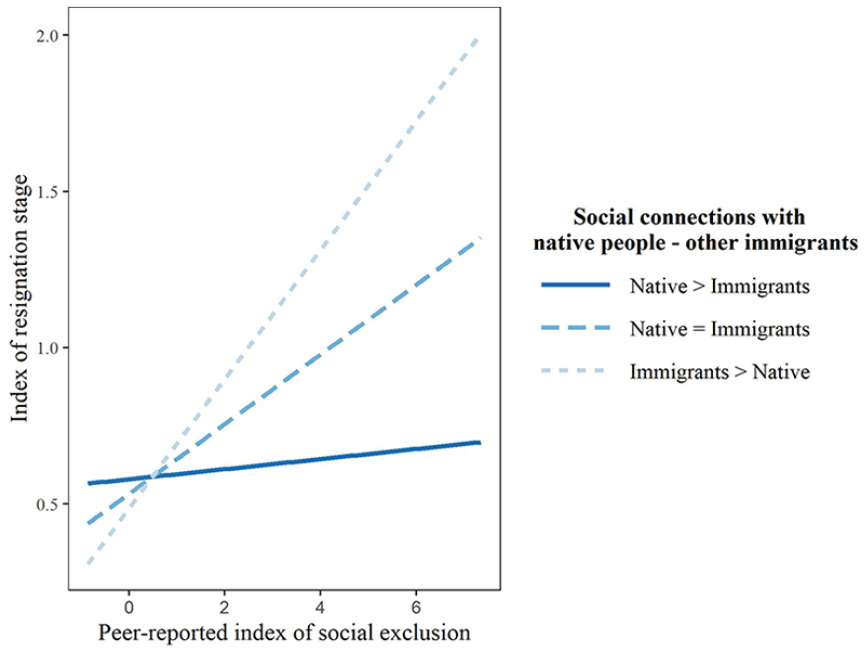
The moderating role of the prevalence of social connections with native people over those with other immigrants on the relationship between the peer-reported index of social exclusion and the index of resignation.
The model testing the influences of native and immigrant social connections on the link between peer-reported exclusion and self-reported life satisfaction (1b) showed that only social connections with other immigrants moderated the link between exclusion and life satisfaction. The effect of connections with the native population, even if in the expected direction, was only marginally significant (p = .055). Simple slopes analysis revealed that more excluded participants presented greater scores on the resignation outcomes for higher social connection with other immigrants (+1 SD: β = −.17, SE = 0.04, t = −4.16, p < .001; mean: β = −.12, SE = 0.03, t = −4.29, p < .001; −1 SD: β = −.06, SE = 0.04, t = −1.78, p = .07; see Figure 7).
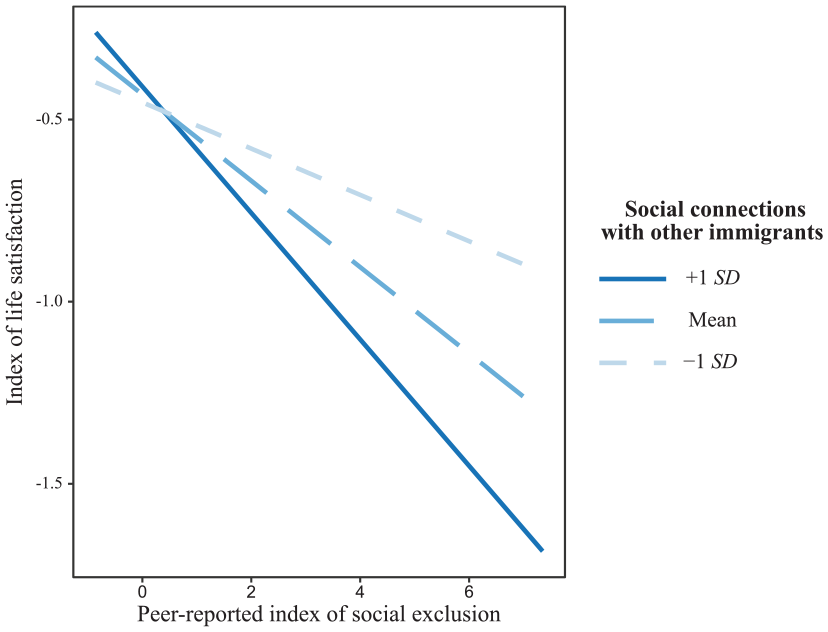
The moderating role of social connections with other immigrants on the relationship between the peer-reported index of social exclusion and the index of life satisfaction.
Finally, Model 2b showed a significant moderation effect of the delta score. Simple slopes analysis showed a negative and significant relationship between exclusion and life satisfaction for those participants whose social connections with other immigrants were as frequent as those with the native population (β = −.12, SE = 0.03, t = −4.39, p < .001). The strength of this relationship increased when social connections with other immigrants prevailed over those with natives (β = −.19, SE = 0.04, t = −4.71, p < .001). By contrast, life satisfaction was no longer affected by social exclusion when participants’ social connections were more frequent whit native people than with other immigrants (β = −.05, SE = 0.03, t = −1.51, p = .13; see Figure 8).
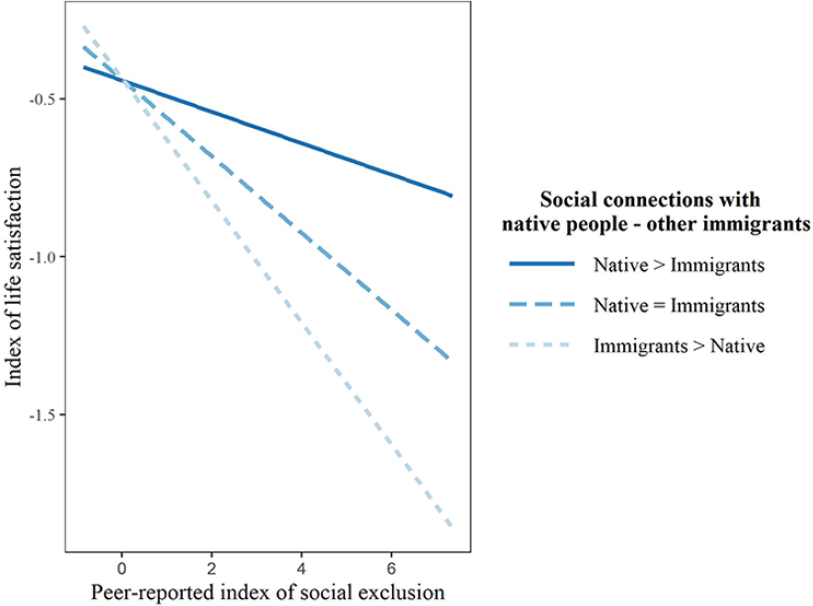
The moderating role of the prevalence of social connections with native people over those with other immigrants on the relationship between the peer-reported index of social exclusion and the index of life satisfaction.
General Discussion
The present research investigated how social connections with the native majority and other immigrant minorities moderated immigrants’ psychological responses to chronic social exclusion. In Study 1 (N = 112) and Study 2 (N = 2,206), we found that social connections with native people protected immigrants from the negative psychological consequences (resignation and life dissatisfaction) of chronic social exclusion. Conversely, social connections with other immigrants worsened the negative impact of exclusion. The prevalence of social connections with natives over those with other immigrants protected from the negative outcomes of social exclusion. Contrarily, the prevalence of social connections with other immigrants over those with natives aggravated the negative psychological consequences of social exclusion.
The contribution of these results is twofold. First, while confirming the exclusion–resignation link, our findings showed that the resignation stage is not the inevitable effect of chronic social exclusion. Second, the results showed that social connections with different groups differently contributed to feed excluded individuals’ sense of belonging, thus buffering the negative effects of persistent exclusion. The result that social connections with the native majority protected from the negative psychological consequences of social exclusion is consistent with existing theories regarding the beneficial power of social connections (Baumeister & Leary, 1995), the advantages of the bridging social capital (e.g., Marschall & Stolle, 2004), and the positive outcomes of intergroup social contact (e.g., Bagci & Turnuklu, 2018). Positive social connections with majority groups may promote a sense of belonging, integration, and acceptance in society, thus protecting devalued minorities from the negative consequences of social exclusion (Bagci, Turnuklu, & Bekmezci, 2018a, 2018b; Mendoza-Denton & Page-Gould, 2008).
The finding that immigrants’ connections with other minorities worsened the psychological outcomes associated with chronic social exclusion suggested that being connected with others is not always a benefit for excluded minorities.
Group identification could be a possible mechanism explaining the moderating effect of intergroup social connections. The growing body of the “social cure” literature (Jetten, Haslam, & Haslam, 2012) has shown that group membership positively affects well-being providing individuals with self-esteem, meaning, sense of belonging, and support (Jetten et al., 2012; Jetten et al., 2017; Wakefield, Bowe, Kellezi, McNamara, & Stevenson, 2019). In an early work, Branscombe, Schmitt, and Harvey (1999) theorized the “rejection–identification model,” according to which, members of a devalued group could cope with the sting of social rejection by identifying with their minority group: the derived feelings of relatedness, similarity, and support would protect them from the negative impact of discrimination (Neblett, Rivas-Drake, & Umana-Taylor, 2012). However, this theoretical model received mixed empirical support (for meta-analytic findings, see Pascoe & Smart Richman, 2009) and if some studies focusing on immigrants have supported it (Verkuyten & Yildiz, 2007), many have not (see Bobowik, Martinovic, Basabe, Barsties, & Wachter, 2017; Çelebi, Verkuyten, & Bagci, 2017). This is because when membership occurs with devalued social groups (Jetten et al., 2017) or it is associated with burden and distress rather than support (Johnstone, Jetten, Dingle, Parsell, & Walter, 2016; Kellezi, Bowe, Wakefield, McNamara, & Bosworth, 2019), the group can be a “social curse” rather than a cure, with detrimental impact for its members’ health (Kellezi & Reicher, 2012).
Social connections with other immigrants could increase participants’ belongingness and identification with other disadvantaged groups, which in turn could lead minority-group members to be more vulnerable to social exclusion. Goodwin, Williams, and Carter-Sowell (2010) found that African Americans who attributed ostracism to group-status characteristics (i.e., race) had a slower recovery from social exclusion. The authors argued that memberships in derogated groups might aggravate the sting of social exclusion. Others found that African Americans facing situations triggering race-based rejection expectations, perceived rejection more frequently and reacted more intensely to it (Mendoza-Denton, Downey, Purdie, Davis, & Pietrzak, 2002). Wirth and Williams (2009) found that when participants’ group identification was a permanent and salient feature of the self, they recovered less from ostracism. Begeny and Huo (2017) found that minority-group members with greater group identity centrality tended to perceive more discrimination and social threats, which negatively affected their psychological health (see also Rubin & Stuart, 2018; Sellers & Shelton, 2003). These findings are in line with those showing that minority-group members highly identified with their ingroup were more vulnerable to the effect of perceived discrimination or other social threats (Bagci et al., 2018b; Eccleston & Major, 2006; Major, Quinton, & Schmader, 2003; McCoy & Major, 2003; Noh, Beiser, Kaspar, Hou, & Rummens, 1999; Yoo & Lee, 2008). Social exclusion would thus greatly affect the psychological condition of those immigrants who are mostly connected and in turn identified with other immigrants.
In conclusion, the status of the group immigrants relate to could be crucial in reducing feelings of psychological resignation. The present findings can be accounted by Jetten et al.’s (2017) hypotheses. Being connected and identified with a high-status group might enhance members health and well-being. Conversely, identification with low-status groups can have negative consequences (Hypotheses 3a and 3b). For immigrants who strive to integrate into the higher status majority (Tajfel & Turner, 1979) and whose belonging is thwarted because of their minority status, the connections with majority members might foster their feelings of belonging to a higher status group, with positive implications for their health. Conversely, social connections with other immigrants would exacerbate excluded immigrants’ sense of isolation and inaccessibility to the majority, aggravating their resignation and low satisfaction in life. Being connected to other minority-group members might oppose immigrants’ movement up the social ladder (Tajfel, 1975), through social bonds that “constrain rather than facilitate” social integration (Rumbaut, 1977, p. 39), leading them to a reluctant acceptance and resignation to their condition of social exclusion.
These results showed methodological reliability, following Sakaluk’s (2016) “exploring small, confirming big” approach to replicable psychological science. The replication of the results in two different samples of immigrants gives additional conceptual strength to the methodological reliability, given that the two different groups of immigrants we analyzed are likely to experience different forms of social exclusion. Asylum seekers might primarily experience social exclusion due to relocation stressors such as the exclusionary threat derived from their pending legal condition (Ager & Strang, 2008) and the multiple losses that (Bennett et al., 1997), besides employment and financial difficulties (Lipson, 1991), can contribute to create a sense of exclusion and uprootedness. Conversely, immigrant adolescents in school settings are more likely to experience social exclusion related to victimization and bullying by their peers (Vieno, Santinello, Lenzi, Baldassari, & Mirandola, 2009), and isolation due to low social integration (Zeitlin-Ophir, Melitz, Miller, Podoshin, & Mesh, 2004).
The length of stay in the host country was another factor differently affecting asylum seekers’ and immigrant adolescents’ experience. We found that asylum seekers’ psychological outcomes worsened with the increase of months spent in Italy, whilst immigrant adolescents showed better outcomes as the years of stay in the host countries increased. This finding resonates with the classical U-curve effect of cross-cultural adjustment (Lysgaard, 1955; Oberg, 1960) that—even if challenged by more recent evidence (Ward, Okura, Kennedy, & Kojima, 1998)—has shown that psychological distress, even if low in the early stages of immigration, might increase in the first months of relocation, decreasing again in the long run.
Limitations and Future Research
Some limitations need to be addressed in future research. Except for the peer-reported index of social exclusion in Study 2, all the dependent variables and moderators in both studies were self-reported and, even if post hoc analyses (see the online supplemental material) showed that common method bias is not significantly affecting the results, future studies should control this limitation using alternative measures, focusing for example on behavioral dimensions of psychological health.
Other potential confounding factors can critically affect the results. Preexisting psychopathology might be one of them. Immigrants and especially asylum seekers show a high prevalence of psychological disorders like posttraumatic stress disorder, major depression, and anxiety (Fazel, Wheeler, & Danesh, 2005; Missinne & Bracke, 2012). Individuals’ levels of psychopathology might affect their perception of exclusion and impact on their resignation and life satisfaction, making them less prone to seek social connections with others (regardless of their group membership). This confounding variable could have affected the results presented, and future studies need to control for immigrants’ psychopathology to be capable to trace back individuals’ resignation to the experiences of social exclusion.
Moreover, this work presented cross-sectional results and we could not infer a causal direction in the effects. Even if the exclusion–resignation link has already been shown, it is possible that immigrants with higher levels of alienation, unworthiness, helplessness, and depression were more prone to perceive social exclusion. Future studies should use more complex research designs, such as experimental studies to generate causal predictions and interpretations of the results. Experimental designs could also provide more detailed explanations of the psychological processes underlying these findings. Experimental studies can manipulate different aspects of the identification with an experimentally excluded social group (e.g., centrality, affect, and ties; see Cameron, 1999, 2004) to better understand the conditions in which ingroup attachment hurts or helps. Also, we did not have information regarding the nationality of the participants in Study 2. The version of the CISL4EU international data set we used was anonymized according to ethical principles. Thus, we could not have information regarding the nationalities of the participants. Collecting more comprehensive data, future research could focus on cultural differences in the investigation of social exclusion in immigrants. Future research should also consider the role of the source of social exclusion. In the present work, we investigated the effects of perceived and objective social exclusion of immigrants, focusing on immigrants’ general feelings and experiences of social exclusion regardless of what caused them, and we did not distinguish if participants’ exclusion derived from ingroup members, the native majority, or other minorities. Given that previous studies highlighted the importance of the source of social exclusion, showing that individuals with a collectivistic self-concept feel more threatened from the exclusion by ingroup members than by outgroup ones (Pfundmair et al., 2015), future research should deepen the understanding of immigrants’ responses to social exclusion accounting for its sources. 6
The current findings can be crucial for further scientific development in the general domains of minorities’ exclusion and integration. Future research should focus on other potential moderators that could better explain the development of long-term consequences of social exclusion in the immigrant population, as well as in other devalued social groups. We expect that the pattern of findings presented in these studies could also apply to homeless people, sexual and religious minorities, people with mental illness, elderly people, ex-detainees, and to other social groups at risk of marginalization from the broader society. We expect that being primarily connected with their marginalized ingroup would worsen the negative effect of individuals’ experience of social exclusion, whereas connection with the majority and higher status group would help them cope with the consequences of social exclusion.
Conclusion
The present work considered a possible moderator of the exclusion–resignation link. Showing that social connections with different social groups differently shape immigrants’ response to chronic social exclusion, we contributed to articulate and extend existing theories on social exclusion, starting a new area of investigation to further articulate K. D. Williams’s seminal model of social exclusion (2009). Based on empirically grounded theory, social workers and scientists could use these findings to develop integration programs for immigrants, such as interventions to connect them with the host society.
Supplemental Material
Appendix_A – Supplemental material for How intergroup social connections shape immigrants’ responses to social exclusion
Supplemental material, Appendix_A for How intergroup social connections shape immigrants’ responses to social exclusion by Marco Marinucci and Paolo Riva in Group Processes & Intergroup Relations
Supplemental Material
Supplemental_Materials – Supplemental material for How intergroup social connections shape immigrants’ responses to social exclusion
Supplemental material, Supplemental_Materials for How intergroup social connections shape immigrants’ responses to social exclusion by Marco Marinucci and Paolo Riva in Group Processes & Intergroup Relations
Footnotes
Funding
The author(s) disclosed receipt of the following financial support for the research, authorship, and/or publication of this article: The study from which we derived the data presented in Study 1 was supported by the Italian nonprofit organization Fondazione Roberto Franceschi ONLUS (Grant No. 2017-NAZ-0176).

Supplemental material
Supplemental material for this article is available online.
Notes
References
Supplementary Material
Please find the following supplemental material available below.
For Open Access articles published under a Creative Commons License, all supplemental material carries the same license as the article it is associated with.
For non-Open Access articles published, all supplemental material carries a non-exclusive license, and permission requests for re-use of supplemental material or any part of supplemental material shall be sent directly to the copyright owner as specified in the copyright notice associated with the article.
