







Abstract
Much research demonstrates that people high in religiosity tend to be prejudiced against value-threatening groups. Therefore, some researchers have suggested that people who are not religious may be less prejudiced. Are nonreligious people characterized by general tolerance? If not, what are the bases of their prejudices? This research investigated prejudice toward Christians and atheists among people who identify as nonreligious (atheist, agnostic, and spiritual-but-not-religious), documented this prejudice in the form of exclusion behaviors (Study 1) and self-report of affect and social distance (Studies 2–3), and explored potential mechanisms of nonreligious prejudice toward Christians: individual differences in belief style and biases against Christians (Studies 2–3). Results showed the nonreligious are not generally tolerant and that differences among these groups in belief superiority, feelings of distrust, and fear of contamination by unpalatable ideas all explained differences in prejudice toward Christians. These findings help provide a more comprehensive picture of religious intergroup prejudice.
Evidence from numerous correlational and experimental studies shows that religiosity, whether measured as an individual difference or primed as a concept, is related to prejudice toward groups that are perceived to threaten socioreligious values (M. K. Johnson, Rowatt, & LaBouff, 2012) such as gay people (Blogowska, Lambert, & Saroglou, 2013; Whitley, 2009), feminists (Blogowska & Saroglou, 2011), other religious groups (such as Muslims; Rowatt, Franklin, & Cotton, 2005), and nonreligious people (Harper, 2007; for reviews of work on religion and prejudice, see Hunsberger & Jackson, 2005; Rowatt, Carpenter, & Haggard, 2014). Most such research has focused specifically on Christian participants, although some has examined members of East Asian religions or Muslims (Clobert, Saroglou, & Hwang, 2015; Ramsay, Pang, Johnson Shen, & Rowatt, 2014; Verkuyten, 2007).
Based on this research, some may assume that people who are not religious would report less prejudice than religious people. Indeed, some researchers have suggested that atheists exhibit attenuated or nonexistent biases against religious believers (Gervais, Shariff, & Norenzayan, 2011; Jackson & Hunsberger, 1999). Unfortunately, the existing research on religiosity and prejudice is of limited value to understand prejudice among the nonreligious. Indeed, methods for investigating prejudice among the less religious are very limited. For example, religiosity measures are typically not developed to discriminate well at the lower end of the spectrum (i.e., unbelief; Galen, 2012). Relatedly, “nonreligious” participants, such as spiritual-but-not-religious and atheists, are often lumped together despite important differences in both the extent to which they are not religious (quantitative) and in other related traits that influence prejudice (qualitative). Indeed, these nonreligious identities have been shown to relate to different patterns of personality (Saucier & Skrypinska, 2006), cognition (Willard & Norenzayan, 2017), analytic thinking (Pennycook, Ross, Koehler, & Fugelsang, 2016), and coping with death anxiety (Vail, Arndt, & Abdollahi, 2012). Just as lumping together multiple religious identities has complicated studies of religious persons (Nielsen, Hatton, & Donahue, 2013), and has been critiqued in the study of other ideological identities (Cohrs, Kampfe-Hargrave, & Riemann, 2012; Duckitt, 2001), lumping together multiple nonreligious identities may cloud important psychosocial distinctions. Studies are emerging on the diversity and complexity of the various beliefs associated with nonreligiosity (e.g., Vainio & Visala, 2015) and their relationship to religious intergoup bias (Kossowska, Czernatowicz-Kukuczka, & Sekerdej, 2017; Silver, Coleman, Hood, & Holcombe, 2014). However, early examinations, especially of nonreligious intergroup bias, should begin by investigating the role of different self-selected nonreligious social identities since the identity, rather than specific beliefs, is likely to be the salient factor that influences intergroup perceptions (Tajfel & Turner, 1979). That is, do people who choose to identify as atheists, agnostics, or spiritual-but-not-religious differ categorically in their prejudice towards others? Further, the relationship between nonreligiousness and prejudice remains unclear because the target groups typically used in research on religious intergroup bias are perceived to threaten socioreligious values, which the nonreligious may not share. Studies examining the nonreligious often do not examine tolerance or prejudice towards broader targets, like those which may threaten nonreligious values, such as members of religious groups. Data are therefore needed to illuminate whether nonreligious social identities are associated with general tolerance.
Beyond, if we find that the nonreligious are not generally tolerant, what motivates their prejudice? Are the mechanisms of intergroup bias towards the religious similar or different than toward the nonreligious? This body of research has largely drawn from social identity and value threat theories and demonstrates that religiosity is related to these prejudices partly because of its association with other individual differences in belief styles that are rigid, arrogant, and predict prejudice such as dogmatism, right-wing authoritarianism (desire for social order), and religious fundamentalism (Altemeyer & Hunsberger, 1992; Rowatt et al., 2005). The religious’ rigid style of belief predicts prejudice against groups that may pose a threat to their social identity and values (Wetherell, Brandt, & Reyna, 2013) or that are simply dissimilar to them (Brandt & Van Tongeren, 2017). Further, prejudice towards the nonreligious has been explained from sociofunctional perspectives (Cook, Cottrell, & Webster, 2015; Gervais, 2014), suggesting that because the nonreligious may not share a belief in a powerful moral watcher, they are more likely to behave immorally, and thus the content of nonreligious prejudice is primarily distrust (Gervais, 2013; Giddings & Dunn, 2016; LaBouff & Ledoux, 2016). The same social processes that are involved in religious bias towards the nonreligious are certainly possible when it comes to attitudes towards the religious by the nonreligious. Rigid belief style can certainly apply to the nonreligious as well and motivate prejudice (e.g., Kossowska et al., 2017). Perception of threat to values is not restricted to traditional values but extends to values held by the nonreligious (what these are and the extent to which nonreligious identities hold onto them probably vary; Brandt & Van Tongeren, 2017). Distrust can also be rooted in a broader evaluation of moral incompatibility and of limited capacity for making sound judgments, and therefore applies to the nonreligious’ evaluations of dissimilar groups. Further, two other more nuanced biases studied in the broader prejudice literature (Cottrell & Neuberg, 2005) may well motivate prejudice of the nonreligious towards the religious. One is the fear of contamination by unpalatable ideas; members of nonreligious groups may not feel threatened per se by other ideologies but may not want to be in contact or exposed to them. In an intereligious prejudice context, a related concept, disgust of cultural contamination was found to be an important predictor of anti-Muslim attitudes among Christians (Choma, Haji, Hodson, & Hoffarth, 2016). Another is the perception of realistic threat; members of nonreligious groups, and especially atheists, face real discrimination from society at large (e.g., Swan & Heesacker, 2012) and may want to protect themselves from the contact with religious groups.
Available Empirical Research
Empirical psychological inquiry into the intergroup attitudes of nonreligious people is scant as they have rarely been the focus of or even systematically included in such research. Moreover, research on whether the mechanisms of nonreligious prejudice mirror the ones identified for religious prejudice is even rarer. However, a few studies suggest potential directions. Large surveys of representative samples in the United States have measured people’s feelings toward various religious groups, notably among three “nonreligious” groups—atheists, agnostics, and those who do not identify as any religious or nonreligious group and select as their religious affiliation: “nothing in particular” (Pew Research Center, 2014b, 2017). In a survey by the Pew Research Center (2017), atheist participants from the US rated Christian groups below the midpoint of a 100-point scale that ranged from cold to warm feelings. Agnostics showed higher scores than atheists toward these same groups but did not rate the Christian groups as warmly as the Christian groups rated themselves. People who identified with “nothing in particular” showed the least variation in their scores toward different targets (ranging from 51 for Evangelical Christians to 65 for Buddhists).
Very recently, Uzarevic, Saroglou, and Muñoz-García (2019) surveyed agnostics’ and atheists’ views of mainstream religious groups in three Western European countries (much less religious than the US) and found that they did not positively perceive Catholics. In the UK sample only, atheists had even more negative views of Catholics than agnostics. Consistent with findings in studies of religious persons (e.g., Hill, Cohen, Terrell, & Nagoshi, 2010; Shen, Yelderman, Haggard, & Rowatt, 2013), they further found that among all participants, rigid nonreligious beliefs (i.e., a strong critical attitude towards religion, that is, antireligious critique) predicted prejudice against Catholics. This body of research however did not provide information regarding nonreligious people who identify as spiritual-but-not-religious, a growing identity among the nonreligious.
Another recent study (K. A. Johnson, Sharp, Okun, Shariff, & Cohen, 2018) suggests that the spiritual-but-not-religious report less positive views toward religion, and toward Christians specifically, compared to people who identify as religious, but still more positive than those who identify as nonreligious (this research did not distinguish between atheists and agnostics). Both the spiritual-but-not-religious and the nonreligious reported perceived dissimilarity with religious groups, which in turn predicted less positive views toward religion. Other research, which measured (un)belief in God as a unidimensional construct, further found that people who expressed both high and low levels of belief in God showed prejudice toward groups that threaten their respective values. Specifically, high believers expressed negative attitudes towards atheists, gay men and lesbians, liberals, and feminists, whereas low believers expressed negative attitudes towards Catholics, Tea Party members, conservatives, and Christians as indexed by ratings on a thermometer scale (Brandt & Van Tongeren, 2017, Study 2). Similarly, Kossowska et al. (2017) found that both people who are rigid believers and rigid nonbelievers showed prejudice toward their respective value-threatening groups (specifically atheists and gay people vs. Catholics and prolife supporters).
In sum, although sparse, this body of research is informative in multiple ways. First, people who identify as nonreligious are probably not generally tolerant. Second, people who identify with different nonreligious categories show variability in the amount of prejudice they express toward various target groups (e.g., atheists reporting colder feelings toward Christians than people who identify with “nothing in particular”), and this variability may not be simply the result of a difference in the degree of unbelief, but rather may be the result of a difference in identity and perceptions of intergroup threat. Third, rigidity of belief and perceived dissimilarity may play a role in predicting prejudice among the religious as well as among the nonreligious. However, the study of the mechanisms of such prejudice is virtually nonexistent.
The Present Research
In the present research, we aim to expand on this literature in four primary ways. First, we operationalize nonreligiosity in terms of identification with various nonreligious groups (Baker & Smith, 2009) and not simply as a function of “low” religiosity. As we have argued before, these nonreligious groups differ categorically, rather than simply being on a continuum of nonreligiosity. Study 1 included atheists (who do not believe in God) and agnostics (who do not know whether God exists); Studies 2 and 3 added the growing “spiritual-but-not-religious” category. The addition of this group is critical because like religious identifiers, the spiritual-but-not-religious hold certain beliefs regarding what is sacred, yet their beliefs and practices are not organized by traditional religious institutions, which they may reject in ways consistent with or inconsistent with other nonreligious identities (Fuller, 2001; K. A. Johnson et al., 2018; Zinnbauer & Pargament, 2005).
Second, building on research focusing on religious prejudice, we identified targets that represent the potential violation of both religious and nonreligious values: Christians and atheists. We are especially interested in prejudice towards Christians, as they represent the dominant religious group in the location of the study, the United States, and have generally negative views toward nonbelievers (Swan & Heesacker, 2012).
Third, we operationalize intergroup bias at both the attitude (prejudice) and behavioral (discrimination) levels. Intergroup biases are investigated both as general negative evaluations towards target groups and as exclusionary behaviors (adapting the well-known Cyberball paradigm; Williams, Yeager, Cheung, & Choi, 2012) to capture religious nonbelievers’ overall negative attitudes towards target groups.
Finally, and most critically, we explore two families of mechanisms to explain potential intergroup bias expressed by members of different nonreligious groups toward Christians. First, we examine individual differences in belief style (Studies 2–3). Given the role of fundamentalism and dogmatism in explaining the relation between religion and prejudice (e.g., Altemeyer & Hunsberger, 1992), we hypothesize that nonreligious groups will vary in their prejudice towards believers as a function of differences in beliefs’ rigidity and feeling of superiority. Second, we investigate sociofunctional mechanisms of intergroup bias by going beyond general negative attitude measures to assess specific prejudice biases (Study 3). Based on the religious prejudice research and sociofunctional perspectives on prejudice, we tested (a) feelings of distrust, (b) fear of contamination by unpalatable ideas, (c) perceived symbolic threat to values and worldviews, (d) and perceived realistic threat given previous negative intergroup experiences, each of which may mediate differences in intergroup attitudes among nonreligious groups. Ultimately, this research stands to broaden our understanding of religious intergroup bias by examining the extent to which these processes operate similarly or differently among different groups of nonreligious persons.
Study 1
Study 1 investigated behavioral religious intergroup bias among participants who were either atheists or agnostics. Intergroup behavior was assessed through objective behaviors involving affiliation/exclusion: participants played a virtual ball-tossing game with targets identified as atheist, Christian, and unknown religious affiliation. This behavioral task provided the opportunity to investigate participants’ differential treatment towards three simultaneous targets who differed in religious identity.
Method
Some data from Study 1 were reported in Van Cappellen, Fredrickson, Saroglou, and Corneille (2017), which presents data collected among Christians (not included here) and agnostics with a focus on religiosity (as a continuous variable) and religious fundamentalism as predictors of intergroup behavior.
Participants
Data were pooled from three studies using identical recruitment strategies: Study 1 (n = 84; December 2013), Study 2 (n = 82; January 2014), and Study 3 (n = 187; June 2014). In the selected sample of nonreligious participants, we tested for the effect of data sets on the primary dependent variables (three scores that involved the number of throws toward the Christian, atheist, and neutral targets, as explained later), which was not significant. Participants were workers on Amazon Mechanical Turk who were paid $0.70 for participating in a study described as investigating attention. Location was restricted to the United States and only complete responses were analyzed. We focused our analyses on a subsample of participants who self-identified as either agnostic (n = 69) or atheist (n = 68). A total of 50.4% were men (Mage = 32.2, SDage = 10.6). Since this study was not run for the purpose of testing the questions presented herein, sample size was not determined a priori but only by the available number of nonreligious participants in the subsample. Most participants identified as White/Caucasian (87.6%), and the remaining participants were Asian (6.6%), Black/African American (2.9%), American Indian (1.5%), or Hawaiian (0.7%), one participant did not report their race. In addition, 11.7% identified their ethnicity as Hispanic.
Procedure and measures
The three studies from which the data were pooled were each conducted online and highly similar in procedure. Their main difference regarded variations on a task following the Cyberball game described here, which aimed at measuring conformity, and which will serve ongoing investigation. As described in Van Cappellen et al. (2017), participants played an online game in which they tossed an on-screen ball with three other “players” (Cyberball 4.0; Williams et al., 2012). The Cyberball game served as a measure of intergroup affiliation and exclusion as used by Degner, Wentura, Gniewosz, and Noack (2007). After being told that playing this game helps to practice visualization skills, participants were asked to visualize the experience and create a mental picture of what would be going on if they were playing the game in real life rather than on computer.
Participants were told that they would be playing the ball-tossing game with three other participants. These participants were explained to be sampled from another study that compares people who participate in different walking groups (such as “the Forests and Lake walking group,” “the Go Green walking group,” “the Atheists walking group,” or “the Causeway Christian walking group”) to those who do not participate in any type of walking group. This deception allowed us to vary the identity of the other players via the walking group to which they supposedly belonged.
The identities of the three players were manipulated to always include an atheist (from “the Atheist walking group”), a Christian (from “the Causeway Christian walking group”), and a neutral player (“no walking group”). The participant’s religious affiliation was not displayed; participants provided this information only at the end of the survey along with other demographic questions. The computer, controlling the three bogus players, had them throw the ball randomly to one of the players, including the participant. Each time the participant threw the ball, the identity of the target player was recorded. A total of 30 throws were exchanged, with the participant throwing the ball at least seven times.
In line with Van Cappellen et al. (2017), to allow us to observe the distribution of the throws to the three targets, we analyzed each participant’s first six throws, so scores ranged from 0 to 6 for each of the three targets. Importantly, by analyzing participants’ first six throws, we can observe fair behavior (i.e., throwing the ball twice to each of the three players) instead of forcing a bias with an uneven number of throws. These numbers yielded three scores that involved the number of throws toward the (a) Christian, (b) atheist, and (c) neutral player. As a manipulation check, we also assessed participants’ knowledge of the other players’ identity right after the game. Only participants who answered correctly were included in the analyses, resulting in a final sample size of 137 participants (16 participants failed).
No other measures related to the assessment of prejudice were administered. However, we report for transparency that in each study, participants were first randomly assigned to a religious or neutral priming (using a scrambled sentence task or a religious identification question). In the selected sample of nonreligious participants, we tested the effect of priming on the three scores that involved the number of throws toward the Christian, atheist, and neutral targets, which was not significant. We therefore do not further discuss priming effect.
Results and Discussion
See Figure 1 for means and standard errors for the number of throws that were directed toward each target as a function of the participant’s religious affiliation. First, an omnibus mixed ANOVA with the number of throws to each target as a within-subject factor and participants’ religious affiliation (dummy-coded agnostics = 1, atheists = 2) as a between-subject factor showed no significant interaction between the two factors: the assumption of sphericity was violated, so the Greenhouse–Geisser correction was applied, F(1.80, 214.13) = 0.77, p = .451, η2p = .01. These results indicate that atheist and agnostic participants did not differ from each other in their intergroup behavior.
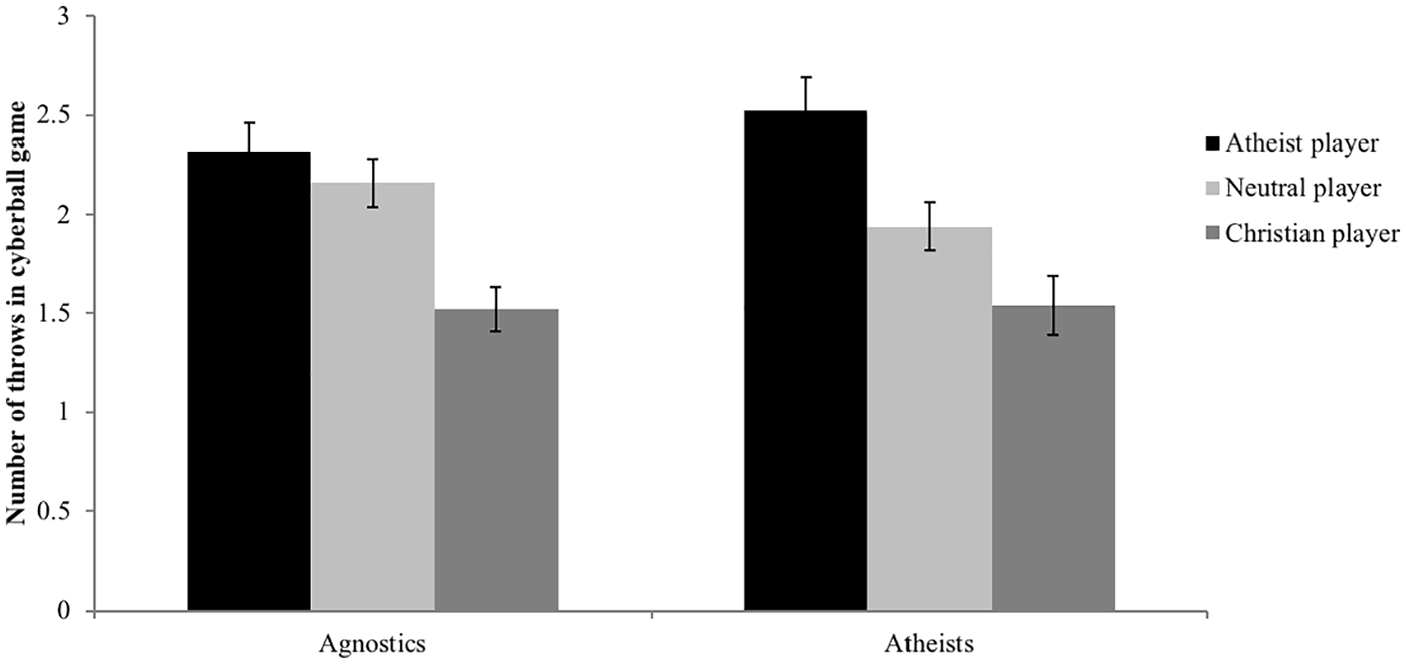
Mean number of throws in the Cyberball game toward each target player by participants’ religious affiliation.
However, participants within each of these two groups displayed intergroup bias as shown by paired-sample t tests contrasting the number of throws toward the Christian, atheist, and neutral targets separately for atheist and agnostic participants. Atheist participants demonstrated ingroup/outgroup difference as well as ingroup favoritism by throwing the ball more often to the atheist player (M = 2.52, SD = 1.40) than to the Christian player (M = 1.54, SD = 1.20), 95% CI of the mean difference [0.38, 1.59], t(64) = 3.27, p = .002, and the neutral player (M = 1.94, SD = 0.97), 95% CI of the mean difference [0.07, 1.10], t(64) = 2.25, p = .028. In addition, a marginal effect suggests that atheists may also show outgroup exclusion by throwing the ball more often to the neutral player than to the Christian player, 95% CI of the mean difference [0.01, 0.81], t(64) = 1.94, p = .057. Similarly, agnostic participants threw the ball more often to the atheist (M = 2.32, SD = 1.03) than the Christian player (M = 1.52, SD = 0.83), 95% CI of the mean difference [0.37, 1.24], t(55) = 3.68, p = .001, and also showed greater preference for the neutral player (M = 2.16, SD = 0.91) than for the Christian player, 95% CI of the mean difference [0.27, 1.02], t(55) = 3.42, p = .001. However, they showed no significant difference between the atheist and the neutral target, 95% CI of the mean difference [0.23, −0.31], t(55) = 0.69, p = .496.
In sum, although fair behavior was possible (by throwing the ball twice to each target), both atheist and agnostic participants showed intergroup biases. Atheists showed a greater preference for their own group, as well as marginally greater exclusion of the Christian player compared to the neutral player. Agnostics had a somewhat different pattern of results. They did not prefer the atheist player over the neutral one, suggesting that they did not regard the atheists as an ingroup. Yet, they favored all other players over the Christian. Interestingly, agnostic participants resembled atheist participants by not behaving as if Christians were their ingroup. To our knowledge, this study provides one of the first snapshots of atheists and agnostics’ discriminatory behavior toward Christians, so these findings should be interpreted cautiously. It is also worth noting that these behaviors were observed in the absence of obvious reputational concerns, since the religious affiliation of the participants themselves was not displayed during the game and participants were anonymous from one another (see a recent set of studies on how reputational concerns play out in prosocial behavior toward Christians/atheists among atheist/Christian participants; Cowgill, Rios, & Simpson, 2017).
Study 2
Study 1 found that people who were not religious (i.e., atheists and agnostics) displayed evidence of discrimination towards Christians by preferring throwing a ball in a virtual game to an atheist player and a player whose religion was neutral/unknown than to a Christian player. Study 2 extended Study 1 by (a) adding an increasingly common nonreligious group (spiritual-but-not-religious) and defining the labels agnostic and atheist for participants; (b) administering explicit and self-report measures of prejudice commonly used in international surveys (a measure of social distance to various groups and a feeling thermometer) toward two targets: Christians and atheists; and (c) exploring the role of belief flexibility/rigidity as a potential individual difference explaining the relationship between nonreligiosity and prejudice.
Method
All measures were administered online as part of a larger cross-sectional study on trait emotions, style of religious and spiritual beliefs, attitudes toward various outgroups, and prosociality. We present results from all of the measures of prejudice toward Christians and atheists, which were our primary outcomes of interest. We also collected data among Christian participants and measures of prejudice toward another religious group, Muslims (these data are available at https://osf.io/q78h4/).
Participants
Participants were workers on Amazon Mechanical Turk (n = 350). Location was restricted to the United States and only complete responses were analyzed. In exchange for $0.50, they participated in a study described as investigating emotions, beliefs, and personality. We focused our analyses on a subsample of participants who self-identified as either agnostic (“not sure if God exists or not”; n = 57), atheist (“God does not exist”; n = 40), or spiritual-but-not-religious (n = 45). Since this study was not run for the purpose of testing the questions presented herein, sample size was not determined a priori but only by the available number of nonreligious participants in the subsample. A total of 59.2% were women, Mage = 36, SDage = 14. Most participants identified as White/Caucasian (86.6%), and the remaining participants were Asian (2.1%), Black/African American (9.2%), American Indian or Alaskan Native (1.4%), or Hawaiian (0.7%). In addition, 7% identified their ethnicity as Hispanic.
Procedure and measures
Prejudice
The target groups were Christians and atheists. First, participants rated the extent to which they feel very cold/unfavorable (0) to very warm/favorable (100) toward each target group on a feeling thermometer. Second, for each target group, participants also provided a measure of social distance and responded to three questions: “Would you like to have this person as a (1) neighbor, (2) political representative, (3) husband/wife?” (1 = totally dislike, 7 = totally like). The scores on the three items were averaged, after being reversed, to provide a social distance score of prejudice for each target (for similar methods, see e.g., Clobert et al., 2015). Reliability was good (Christians: α = .84; atheists: α = .93).
Belief flexibility
As part of the larger study, participants completed the full Quest Scale (Batson, Schoenrade, & Ventis, 1993). Participants rated their degree of agreement with each item on a 9-point Likert-type scale (1 = strongly disagree, 9 = strongly agree). Yet, the Quest Scale is confounded with religiosity: many items assume the respondent to be religious (van Pachterbeke, Keller, & Saroglou, 2012). To measure belief flexibility and openness to challenges independently of religiosity, two items from the scale were selected: “I do not expect my religious convictions to change in the next few years” (reverse-scored), and “My life experiences have led me to rethink my religious convictions.” These items were selected because, at face value, they do not imply that one currently holds proreligious beliefs and, indeed, these items were not correlated with a measure of religiosity (i.e., average of importance of God and of religion in one’s life), as shown by the following correlations computed among the entire sample of participants which included religious participants as well (N = 350), Item 1: r = .00, ns; Item 2: r = −.04, ns. Responses on the two items were averaged to create an index of belief flexibility, r(142) = .18, p = .031.
Results and Discussion
Table 1 presents means and standard deviations for the prejudice and belief flexibility measures by participants’ religious affiliation (see also Figure 2). There were no extreme outliers in the data as assessed by inspection of the boxplots for values greater than 3 box-lengths from the edge of the box.
Means, standard deviations, main differences, and post hoc tests on self-report measures of prejudice and belief flexibility (Study 2).
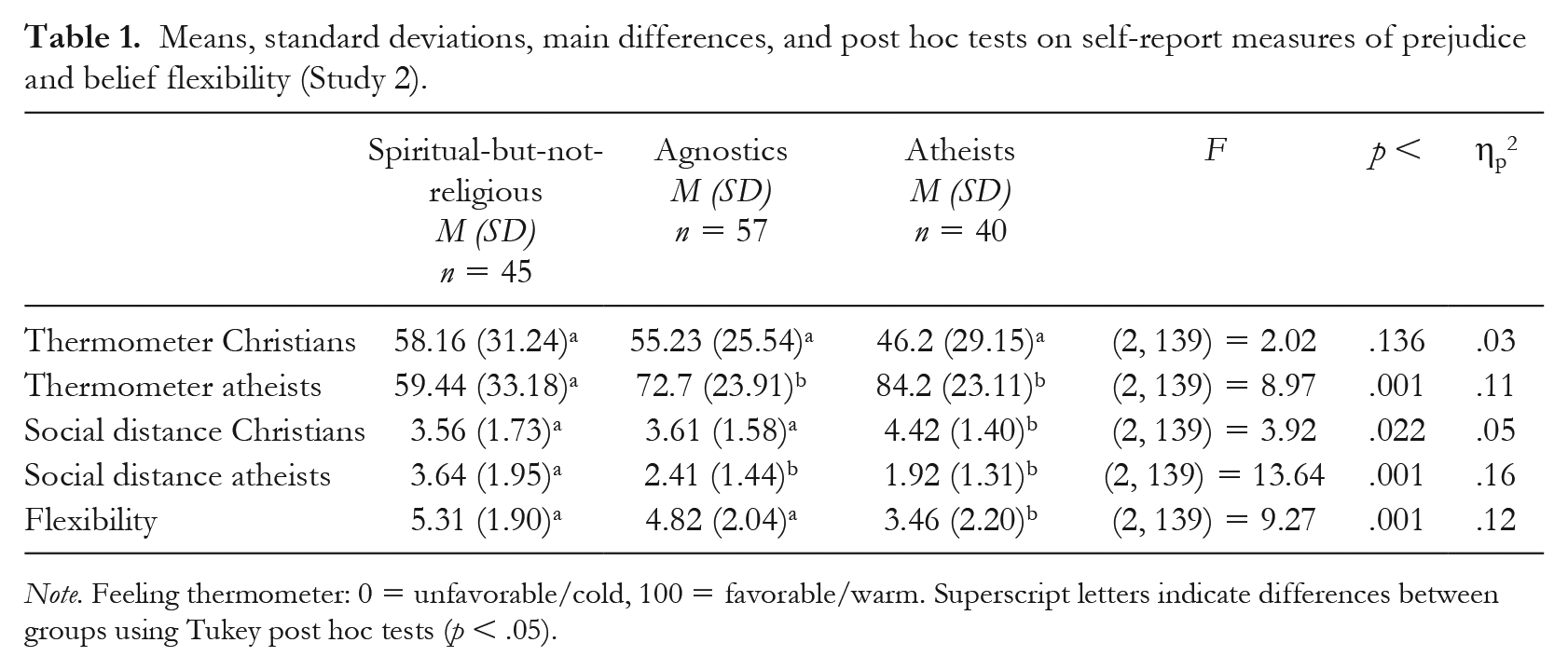
Note. Feeling thermometer: 0 = unfavorable/cold, 100 = favorable/warm. Superscript letters indicate differences between groups using Tukey post hoc tests (p < .05).
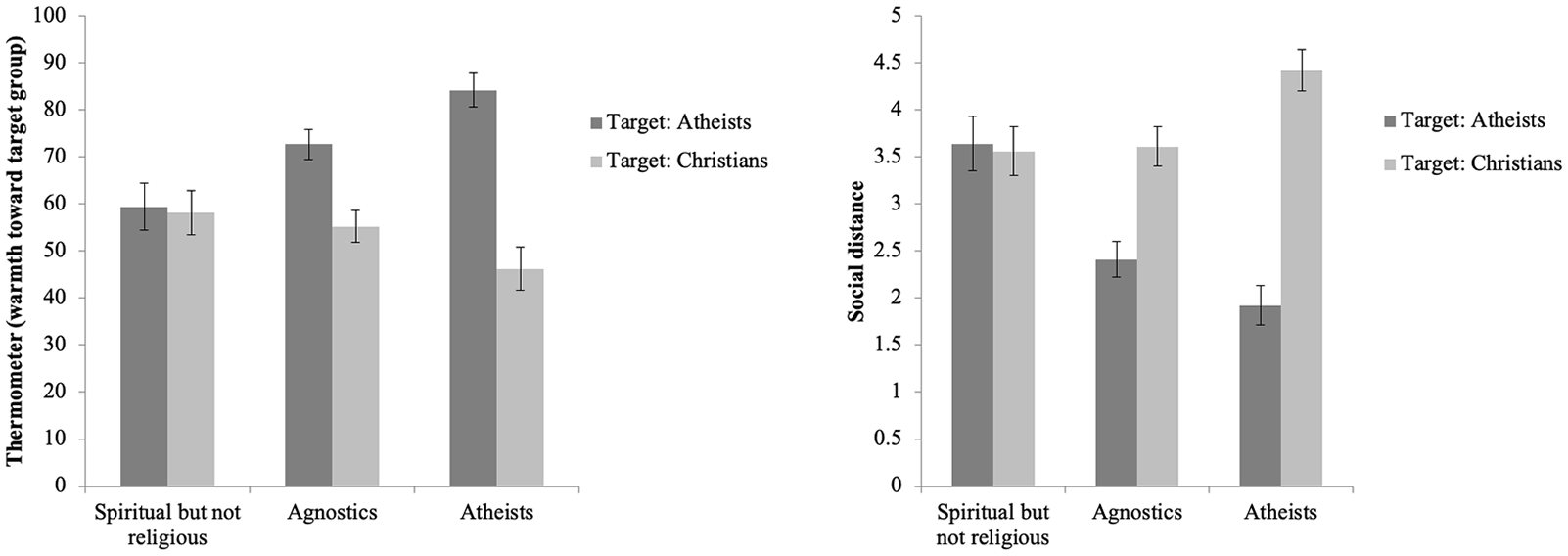
Mean reported warmth (left) and social distance (right) felt toward each target by participants’ religious affiliation.
Feeling thermometer and social distance
Regarding the feeling thermometer, an omnibus mixed ANOVA with prejudice targets (i.e., Christians and atheists) as a within-subject factor and participants’ religious affiliation (i.e., spiritual-but-not-religious, agnostic, or atheist) as a between-subject factor, showed a significant interaction between the two factors, F(2, 139) = 11.14, p < .001, ηp2 = .14. The same interaction emerged for the social distance measure, F(2, 139) = 14.66, p < .001, ηp2 = .17.
To plot these interactions, we first tested the simple main effects of participants’ religious affiliation and then the simple main effects of the prejudice target, as described in what follows.
First, for each nonreligious identity (i.e., separately for spiritual-but-not-religious, agnostics, and atheists), we ran a one-way repeated measure ANOVA on feelings towards Christians versus towards atheists to address the question: do participants within each nonreligious group display prejudice toward Christians compared to atheists? See Table 1 for related means and standard deviations. As expected, atheist participants reported warmer feelings toward their own group than toward Christians, F(1, 39) = 42.28, p < .001, ηp2 = .52. Participants who identified as agnostic also reported warmer feelings toward atheists than towards Christians, F(1, 56) = 27.88, p < .001, ηp2 = .33. However, participants who identified as spiritual-but-not-religious reported similar, slightly warm, feelings toward both Christians and atheists, F(1, 44) = 0.04, p = .849, ηp2 = .00. Similar results were observed when repeating these analyses on the social distance measure. Indeed, atheist participants reported smaller social distance toward their own group than toward Christians, F(1, 39) = 57.96, p < .001, ηp2 = .60. Participants who identified as agnostic also reported smaller social distance toward atheists than towards Christians, F(1, 56) = 34.13, p < .001, ηp2 = .38. However, participants who identified as spiritual-but-not-religious reported similar social distance toward both Christians and atheists, F(1, 44) = 0.03, p = .863, ηp2 = .00.
Second, separately for each of the two prejudice targets, a one-way ANOVA tested for differences in prejudice by participants’ religious affiliation (i.e., spiritual-but-not-religious, agnostic, and atheist) and was followed by Tukey post hoc tests to address the question: do nonreligious groups differ from each other in the amount of prejudice reported toward Christians and the amount of prejudice reported toward atheists? Results showed (see Table 1 for statistics) that atheists, agnostics, and participants who identified as spiritual-but-not-religious did not differ in their reported feelings toward Christians (all around the midpoint of the scale, which corresponded to slightly cold among atheists and agnostics, and slightly warm among participants who identified as spiritual-but-not-religious). However, the nonreligious groups did differ on their reported feelings toward atheists. Atheist and agnostic participants rated the atheists’ group target more warmly compared to participants who identified as spiritual-but-not-religious. Similar results were observed when repeating these analyses on the social distance measure, with one exception: atheist participants showed greater social distance from Christians than participants who identified as agnostic or spiritual-but-not-religious.
Belief flexibility
A one-way ANOVA followed by Tukey post hoc tests examined differences in belief flexibility by participants’ religious affiliation (see Table 1). As one might expect, agnostics and the spiritual-but-not-religious both displayed greater belief flexibility compared to atheists.
Belief flexibility as mediator of prejudice toward Christians
Finally, we examined whether nonreligious groups’ differences in belief flexibility could account for (mediate) their differences in prejudice toward Christians. Given that the nonreligious groups only differed in social distance toward Christians but not on the feeling thermometer, we could only test one plausible mediation model: the indirect effect of the contrast atheists (coded 1) versus spiritual-but-not-religious and agnostics (coded 0) on social distance toward Christians through belief flexibility. We tested for mediation using PROCESS Version 3 (Hayes, 2017), Model 4, using 5,000 bootstrap samples. The 95% bootstrap confidence interval for the point estimate using 5,000 bootstrap samples is [−0.50, 0.15], which includes zero and therefore does not show evidence for mediation (see Figure S1 in the online supplemental material for mediation paths’ betas). Note for those interested: the same model with social distance toward atheists as the dependent variable was not significant either [−0.46, 0.31].
In sum, Study 2 investigated whether Study 1’s findings concerning discriminatory behavior would replicate when prejudice was measured explicitly using self-report. Indeed, socially desirable responding should lead to little report of prejudice and therefore null findings. All nonreligious groups reported comparable prejudice scores regarding Christians, with one exception: atheist participants reported further social distance toward Christians compared to other nonreligious participants. The nonreligious groups did differ in the extent to which they reported prejudice toward atheists. Indeed, Study 2 provided additional evidence that participants who identify as atheist and agnostic show preference for atheists over Christians. However, participants who identified as spiritual-but-not-religious did not show preference between atheists and Christians. Finally, despite finding that agnostics and the spiritual-but-not-religious both displayed greater belief flexibility compared to atheists, belief flexibility did not account for differences in their reported scores of social distance toward Christians. This null result may however be due to limitations of the measure of belief flexibility itself. Indeed, belief flexibility was measured with only two items from the Quest Scale (Batson et al., 1993) that do not assume respondents to be religious. This measure, although face-valid, has not been validated for use among nonreligious participants.
Study 3
Study 3 replicates and extends Study 2 by (a) targeting the same nonreligious groups but collecting data from a larger sample, (b) measuring self-report prejudice toward the same targets (i.e., atheists and Christians), (c) assessing a broader range of individual differences in belief style using established measures that do not presume proreligious belief, and (d) adding the assessment of four specific biases that may explain the reported prejudice toward Christians.
Research investigating religious intergroup bias has consistently pointed to styles of belief that are more strongly associated with prejudice (e.g., Hodson & Dhont, 2015). These investigations have relied upon measures that presume religious belief (e.g., religious fundamentalism and right-wing authoritarianism; M. K. Johnson et al., 2011) and are thus unsuitable for use with nonreligious populations. However, the same underlying styles of belief may motivate nonreligious biases as well, if measured more broadly and appropriately for nonreligious participants. To examine whether the belief styles underlying fundamentalism and authoritarianism are also involved in nonreligious prejudice, we selected measures including dogmatism (rigidity of one’s belief), intellectual humility (capacity to recognize that one’s belief may be wrong), and belief superiority (belief in the correctness of one’s belief compared to what others believe). Research has provided evidence for these measures to be applicable to both sides of the religious spectrum (Hopkin, Hoyle, & Toner, 2014; Toner, Leary, Asher, & Jongman-Sereno, 2013; Uzarevic et al., 2019). Although theoretically distinct, we hypothesized that all three constructs represented plausible mechanisms for prejudice toward Christians, with atheists displaying the greatest endorsement.
Further, although prejudice is often construed as a general negative evaluation of a target, it can also be the result of more nuanced biases toward a target. We investigated feelings of distrust, fear of contamination by unpalatable ideas, perceived symbolic threat to values, and perceived realistic threat (i.e., perceived prejudice received from the target group and negative experiences with the target group), all plausible mechanisms based on the religious prejudice literature—which has identified perceived symbolic threat to values and distrust—and on the broader prejudice literature, which suggests contamination and realistic threat to be relevant biases among the nonreligious towards the religious. Unlike for belief styles, we did not have specific hypotheses and explored which religious identity would be more strongly associated with specific biases. Understanding the role of these specific biases in attitudes towards the religious has important implications for understanding the nature of religious intergroup bias, and for the development of interventions to reduce it.
Method
Participants
Participants were workers on Amazon Mechanical Turk. Location was restricted to the United States. In exchange for $0.50, they participated in a study described as investigating emotions, beliefs, and personality. Demographic information was collected first, and only those who identified as nonreligious (atheist, agnostic, spiritual-but-not-religious) were directed to the present study. All other participants were taken to a different study investigating other questions. A total of 1,000 participants of all religious affiliations were recruited overall with the expectation that around 50% of them would identify as a member of a nonreligious group (Lewis, Djupe, Mockabee, & Su-Ya Wu, 2015). Indeed, a total of 444 qualified for this study. A total of 15 participants were not included in analyses because they did not complete all measures, and five additional participants were excluded due to suspicious responses, that is, they selected the same value across most measures, therefore the final analysis: n = 424; (68.4% women, 31.6% men; Mage = 38, SDage = 12.84; two participants did not report age). This sample size is larger than what was required following a power analysis using G*Power that would ensure 80% power to detect the smallest significant difference in Study 2. The majority identified their race as White/Caucasian (84.9%), and the remaining identified as Black/African American (9.2%), Asian (5.9%), American Indian or Alaskan Native (3.8%), Hawaiian (.2%), or other (2.1%), in which 4.7% identified as more than one race. In addition, 9% identified their ethnicity as Hispanic (10 participants did not report ethnicity). For this study, participants identified as agnostic (“not sure if God exists or not”; n = 139), atheist (“God does not exist”; n = 113), or as spiritual-but-not-religious (n = 172).
Procedure and measures
All measures were administered online. Prejudice and biases towards Muslims, Jews, and Buddhists were also assessed but are not presented here because of our focus on prejudice toward the majority religious group in the US, Christians (these data are available at https://osf.io/q78h4/).
Prejudice
The same two measures (feeling thermometer and social distance) as in Study 2 were used. As in Study 2, the target groups were atheists and Christians. Reliability for the social distance measure was good (atheists: α = .88; Christians: α = .83).
Mechanisms of prejudice
Individual differences in belief style
Three scales were used to measure individual differences in belief style. Participants completed a Dogmatism Scale (Uzarevic, Saroglou, & Clobert, 2017; abbreviated from Altemeyer, 2002), which measures the rigidity of one’s beliefs (α = .84). Altemeyer (2002) defined dogmatism as an unjustified and unchangeable certainty over one’s beliefs. Participants rated their degree of agreement (1 = strongly disagree, 6 = strongly agree) with six items (e.g., “It is best to be open to all possibilities and ready to reevaluate all your beliefs”; reverse-scored). Participants also completed the Intellectual Humility Scale (Leary et al., 2017) to measure the degree to which people recognize their beliefs may be wrong (α = .87). Participants rated the degree to which six statements described them (1 = not at all like me, 5 = very much like me), such as “I question my own opinions, positions, and viewpoints because they could be wrong.” Lastly, participants responded to an item measuring belief superiority (adapted from Toner et al., 2013). Participants indicated the extent to which they believe their views about the existence of God are no more correct than other viewpoints (1) to totally correct—mine is the only correct viewpoint (5).
Specific biases
A total of four biases were assessed to explain prejudice toward Christians: feelings of distrust (four items: “I do not trust this group’s moral values and moral judgement”; “I do not trust this group’s intellectual judgement or decision making”; “I trust this group to act in the best interest of those around them,” reverse-scored; and “I trust this group to evaluate situations accurately,” reverse-scored; α = .86); fear of contamination by unpalatable ideas (two items: “I do not want to be around this group and influenced by their ideas or views” and “I do not trust others who are around this group because they are influenced by their ideas or views”; r = .69); perceived symbolic threat (three items: “This group threatens my personal rights and freedom,” “This group’s moral values are inconsistent with my group’s moral values,” and “This group threatens society’s good functioning and progress”; α = .82); perceived realistic threat (four items: “This group is prejudiced against me and the groups that I am affiliated with,” “This group is prejudiced against other groups that I am not affiliated with,” “I have personally experienced or witnessed a member of this group or this group’s institution using an aspect of their faith as an excuse for immoral behavior,” and “I have personally been physically or emotionally attacked, rejected, or hurt by a member of this group or by this group’s institution in general”; α = .78). Participants rated their degree of agreement on a 5-point Likert-type scale (1 = strongly disagree, 5 = strongly agree).
Results and Discussion
Table S1 presents the correlation matrix for the measures of belief style and specific biases in the entire sample. Table 2 presents means and standard deviations for all measures by participants’ religious affiliation (see also Figure 3). There were no extreme outliers, as assessed by inspection of the boxplots for values greater than 3 box lengths from the edge of the box.
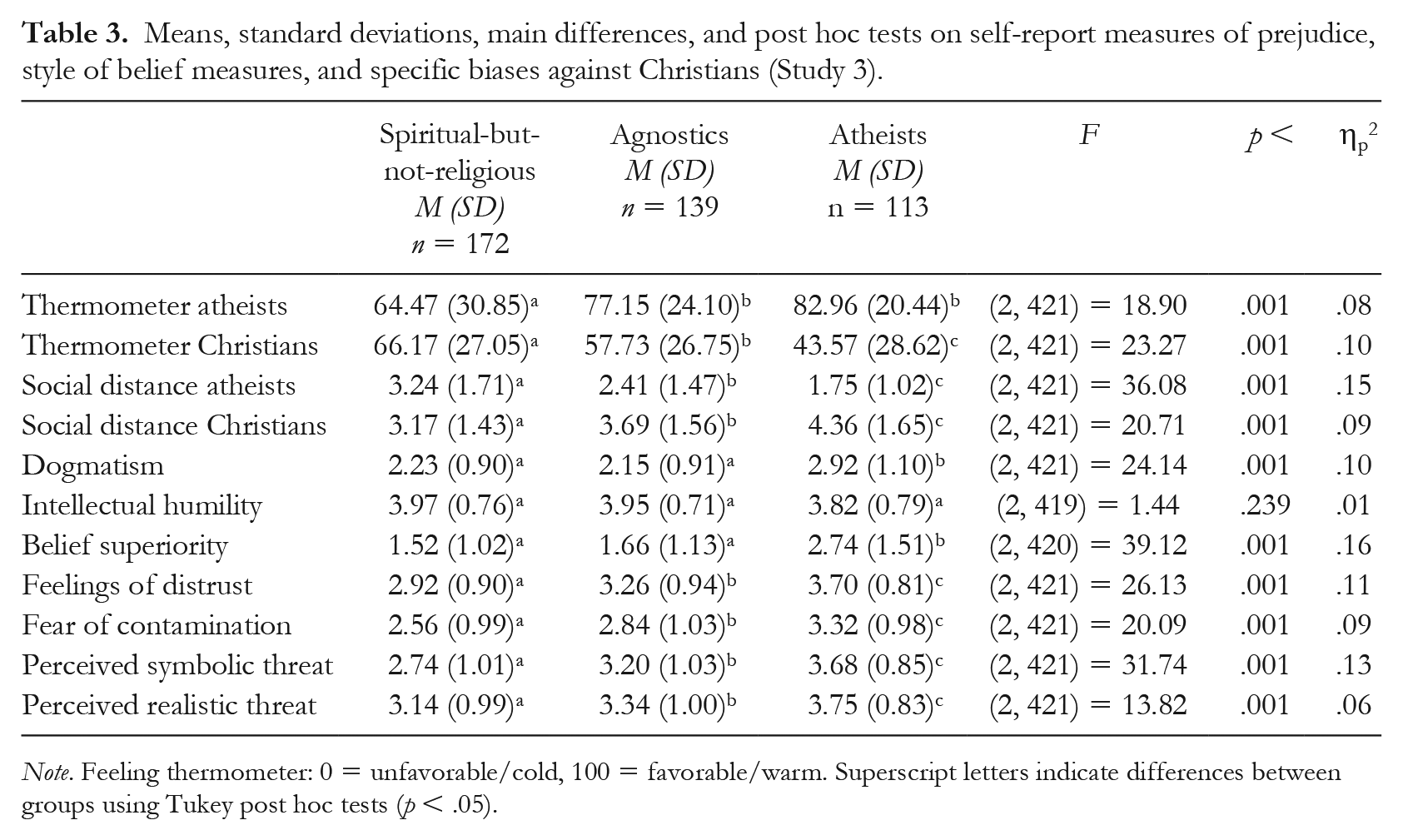
Means, standard deviations, main differences, and post hoc tests on self-report measures of prejudice, style of belief measures, and specific biases against Christians (Study 3).
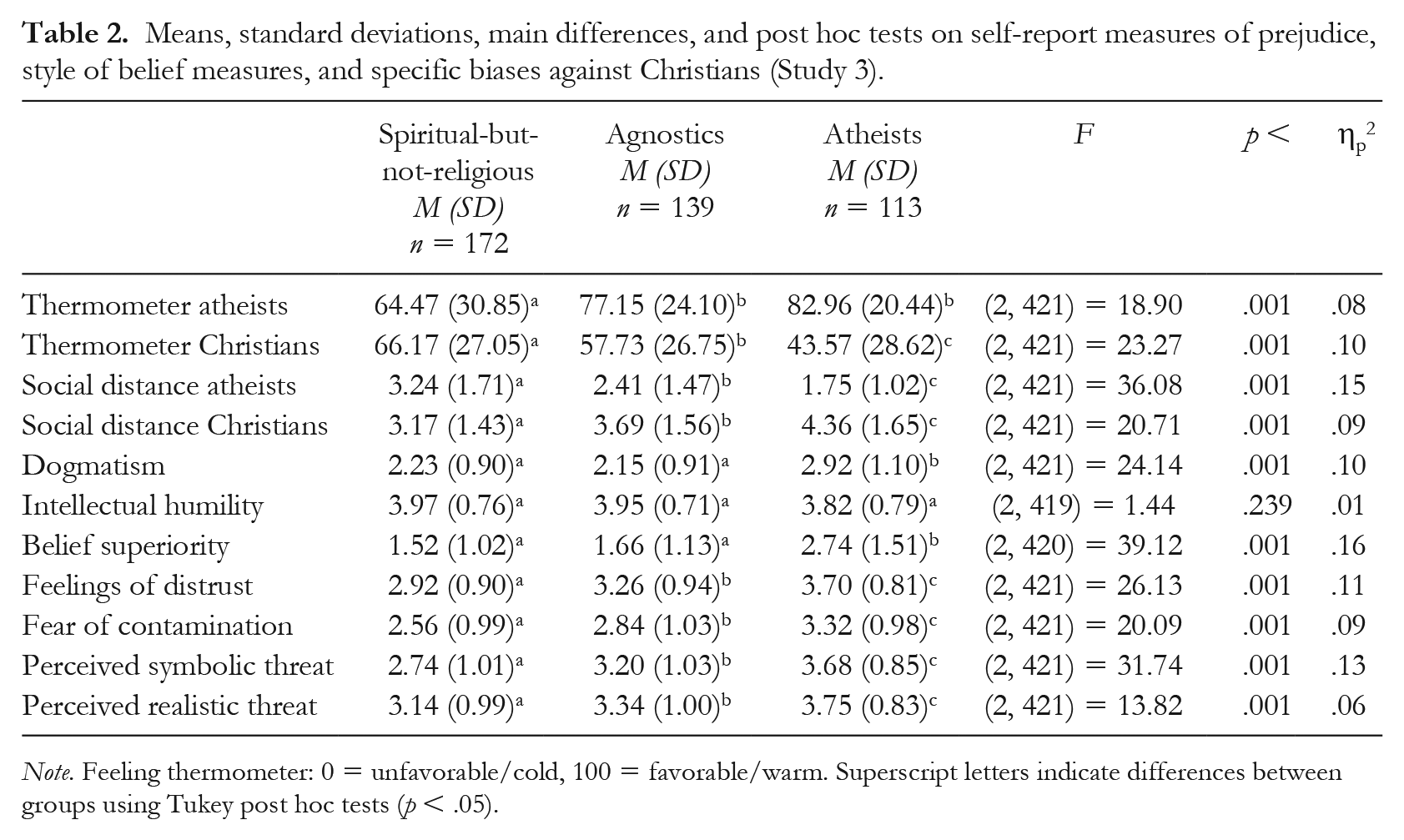
Note. Feeling thermometer: 0 = unfavorable/cold, 100 = favorable/warm. Superscript letters indicate differences between groups using Tukey post hoc tests (p < .05).
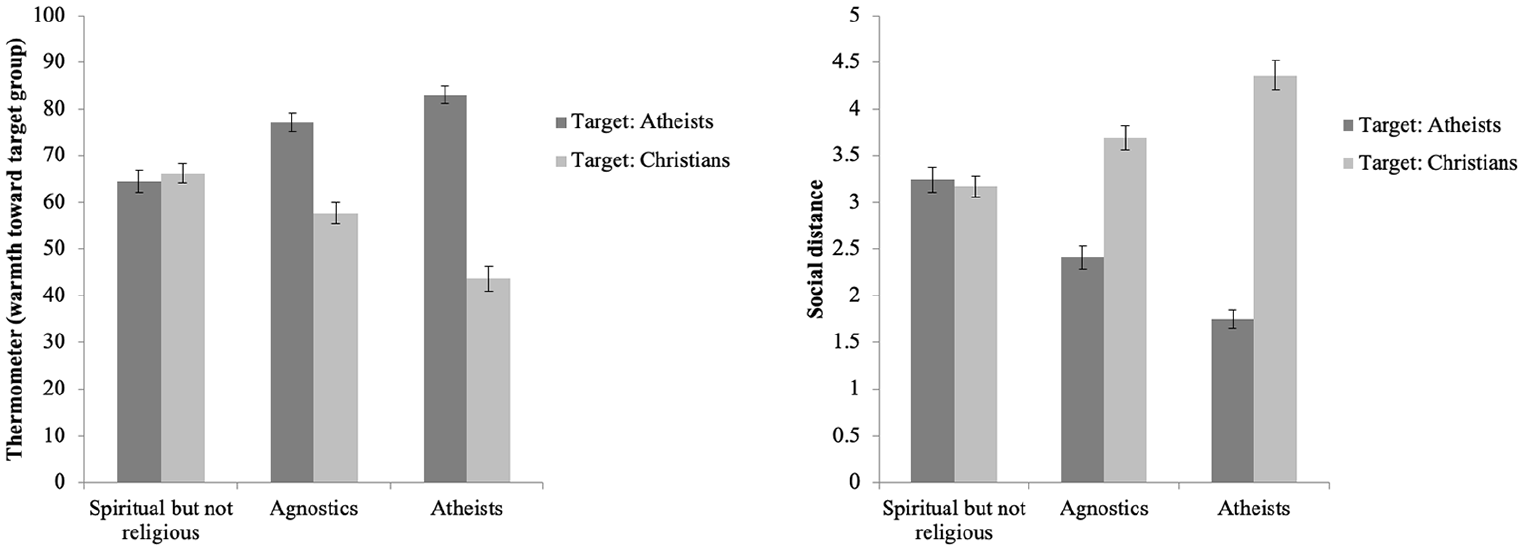
Mean reported warmth (left) and social distance (right) felt toward each target by participants’ religious affiliation.
Feeling thermometer and social distance
See Table 2 for related means and standard deviations. First, regarding the feeling thermometer, an omnibus mixed ANOVA with prejudice targets (i.e., atheists and Christians) as a within-subject factor and participants’ religious affiliation (i.e., atheist, agnostic, spiritual-but-not-religious) as a between-subject factor confirmed the expected significant interaction between the two factors, F(2, 421) = 53.94, p < .001, ηp2 = .20). Second, the same interaction emerged regarding the social distance measure, F(2, 421) = 69.36, p < .001, ηp2 = .25. Similar to Study 2, to follow up these interactions, we first tested the simple main effects of participants’ religious affiliation and then the simple main effects of the prejudice target, as described in what follows.
First, for each group of participants (i.e., separately for atheists, agnostics, and spiritual-but-not-religious), we ran a one-way repeated measure ANOVA on feelings toward Christians versus toward atheists. As expected, atheist participants felt warmer toward their own group than toward Christians, F(1, 112) = 149.14, p < .001, ηp2 = .57. Those who identified as agnostic also reported warmer feelings toward atheists than toward Christians, F(1, 138) = 63.54, p < .001, ηp2 = .32. However, participants who identified as spiritual-but-not-religious reported similarly slightly warm feelings toward both Christians and atheists, F(1, 171) = 0.40, p = .526, ηp2 = .00. Similar results were observed on the social distance measure. Indeed, both those who identified as atheist, F(1, 112) = 193.02, p < .001, ηp2 = .63, and as agnostic, F(1, 138) = 79.73, p < .001, ηp2 = .37, reported greater social distance towards Christians than towards atheists, whereas the spiritual-but-not-religious’ reported social distance did not differ between Christian and atheist targets, F(1, 171) = 0.22, p = .644, ηp2 = .00.
Second, for each of the two prejudice targets, a one-way ANOVA tested for differences in prejudice by participants’ religious affiliation (i.e., atheist, agnostic, spiritual-but-not-religious) and was followed by Tukey post hoc tests (see Table 3). Reported feelings toward atheists significantly differed as a function of participant religious affiliation. As expected, atheist and agnostic participants reported warmer feelings toward atheists than did spiritual-but-not-religious participants; however, atheist and agnostic participants did not differ from one another. Reported feelings toward Christians also significantly differed between all three religious affiliations, that is, atheists reported the coldest feelings toward Christian targets, the spiritual-but-not-religious reported the warmest feelings, and agnostics fell in the middle (near the midpoint). Similar results to the feeling thermometer were observed for the social distance measure, with one exception (see Table 3): whereas atheist and agnostic participants did not differ in feelings toward atheists using the feeling thermometer measure, atheist participants did report even less social distance from atheists than agnostic participants.
Means, standard deviations, main differences, and post hoc tests on self-report measures of prejudice, style of belief measures, and specific biases against Christians (Study 3).
Note. Feeling thermometer: 0 = unfavorable/cold, 100 = favorable/warm. Superscript letters indicate differences between groups using Tukey post hoc tests (p < .05).
Individual differences in belief style
A one-way ANOVA tested for differences in scores on the dogmatism scale, intellectual humility, and belief superiority by participants’ religious affiliation, followed by Tukey post hoc tests (see Table 3). As expected, participants who identified as atheist showed greater belief superiority and dogmatism than both agnostic and spiritual-but-not-religious participants. However, contrary to our expectations, there were no differences in intellectual humility by participants’ religious affiliation.
Specific biases
An omnibus mixed ANOVA with the four specific biases towards Christians (i.e., feelings of distrust, fear of contamination, perceived symbolic threat, and perceived realistic threat) as a within-subject factor and participants’ religious affiliation (i.e., atheist, agnostic, spiritual-but-not-religious) as a between-subject factor, confirmed the significant interaction between the two factors; throughout, when Mauchly’s test of sphericity indicated that the assumption of sphericity was violated, we report results using the Greenhouse–Geisser correction: F(5.37, 1131.08) = 2.73, p = .016, ηp2 = .01. This was followed up with tests of the simple main effects of biases.
Results from a one-way ANOVA testing for differences in specific biases by participants’ religious affiliation and followed by Tukey post hoc tests (see Table 3 for statistics and Figure 4) showed that feelings of distrust of morality, fear of contamination, perceived symbolic threat, and perceived realistic threat all significantly differed as a function of participants’ religious affiliation: across all measured biases, atheists reported the highest levels, the spiritual-but-not-religious reported the lowest levels, and agnostics fell in the middle.
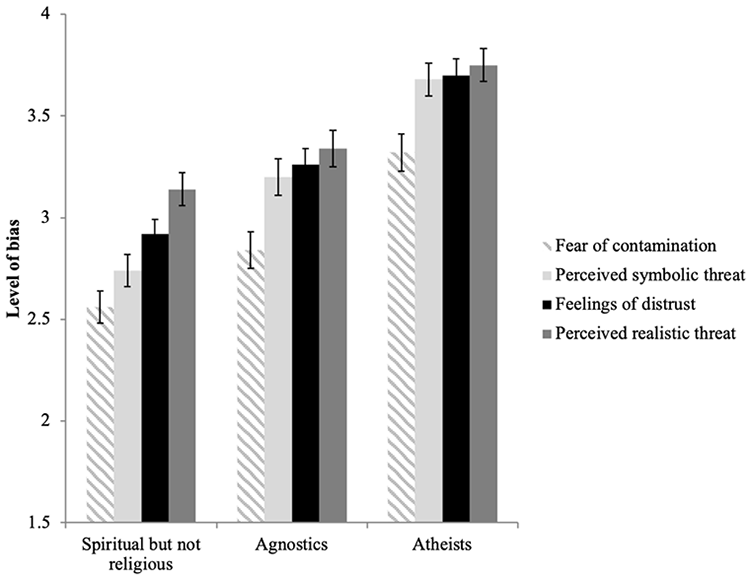
Mean of reported specific biases against Christians by participants’ religious affiliation.
Further, a one-way repeated measure ANOVA followed by pairwise comparisons using Sidak adjustment for multiple comparisons (reporting differences at Sidak adjusted p value < .05) showed that atheist participants endorsed to various degrees the four specific biases towards Christians, F(2.65, 296.33) = 16.85, p < .001, ηp2 = .13, and specifically, rated fear of contamination lowest compared to all other biases, whereas all other biases did not differ from each other (see Table 3 for means). The same pattern of results was found for agnostic participants, F(2.52, 347.75) = 23.51, p < .001, ηp2 = .15. Lastly, spiritual-but-not-religious participants reported differences between the four biases, F(2.72, 465.18) = 37.31, p < .001, ηp2 = .18, and rated them in the following order (all differences were significant at p < .05): perceived realistic threat > feelings of distrust > perceived symbolic threat > and fear of contamination.
Belief superiority and dogmatism as mediators of prejudice toward Christians
Dogmatism and belief superiority were then tested as mediators for the indirect effect of participants’ religious affiliation on prejudice towards Christians. Since these constructs are theoretically distinct and show a moderate correlation with one another, we tested them in independent models to compare the patterns of relationships between the two variables. We tested for mediation using PROCESS Version 3 (Hayes, 2017), Model 4, using 5,000 bootstrap samples. Given that atheists differed from the other nonreligious participants in dogmatism and belief superiority (see Table 3), we created separate contrasts for atheists versus agnostics (respectively coded 1 and 0) and atheists versus spiritual-but-not-religious (respectively coded 1 and 0; but not for agnostics vs. spiritual-but-not-religious, as they did not differ). The results showed consistent evidence for mediation through belief superiority for the indirect effect of participants’ religious affiliation on warmth and social distance towards Christians. See Figure 5 for the significant mediation models with beta statistics for each path for social distance (for warmth as an outcome, see Figure S2 in the supplemental material). However, dogmatism was a significant mediator in only one of the four tested models (i.e., the contrast of atheists vs. agnostics on warmth toward Christians; see Figure S3 in the supplemental material).
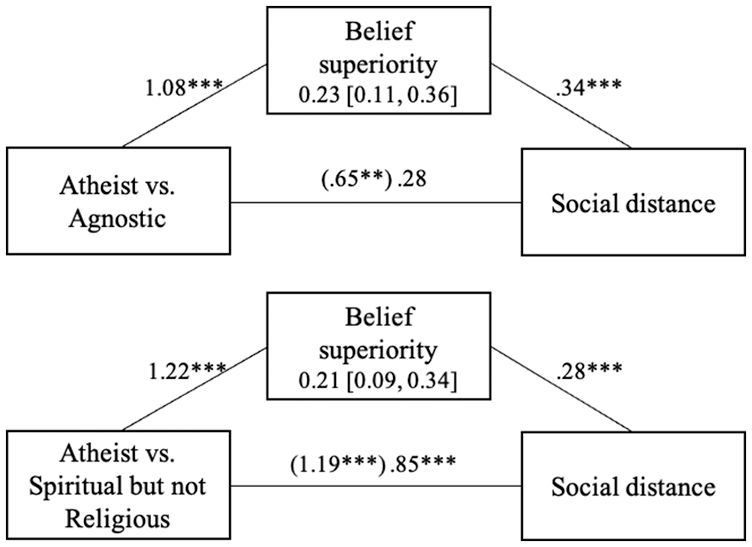
Single mediation models: effect of participants’ religious affiliation on social distance toward Christians (Study 3) as mediated by belief superiority.
Specific biases as mediators of prejudice toward Christians
We created separate contrasts to estimate the indirect effect of participants’ religious affiliation on prejudice towards Christians: atheist versus agnostic participants (respectively coded 1 and 0), atheist versus spiritual-but-not-religious participants (respectively coded 1 and 0), and agnostic versus spiritual-but-not-religious participants (respectively coded 1 and 0). For each contrast and for each of the two prejudice measures, we tested for mediation by including in a single model all four biases as potential mediators, therefore controlling for one another. There were no issues with multicollinearity (i.e., no variance inflation factors [VIFs] greater than 5; highest VIF was 3.9). This also allowed to control for a general negative evaluation of Christians, and instead target specific biases. We again used PROCESS macro Version 3 (Hayes, 2017), Model 4. Consistently across the three contrasts, results showed evidence for mediation through feelings of distrust and fear of contamination by unpalatable ideas. See Figure 6 for the significant mediation models with beta statistics for each path for social distance (for warmth, see Figure S4).
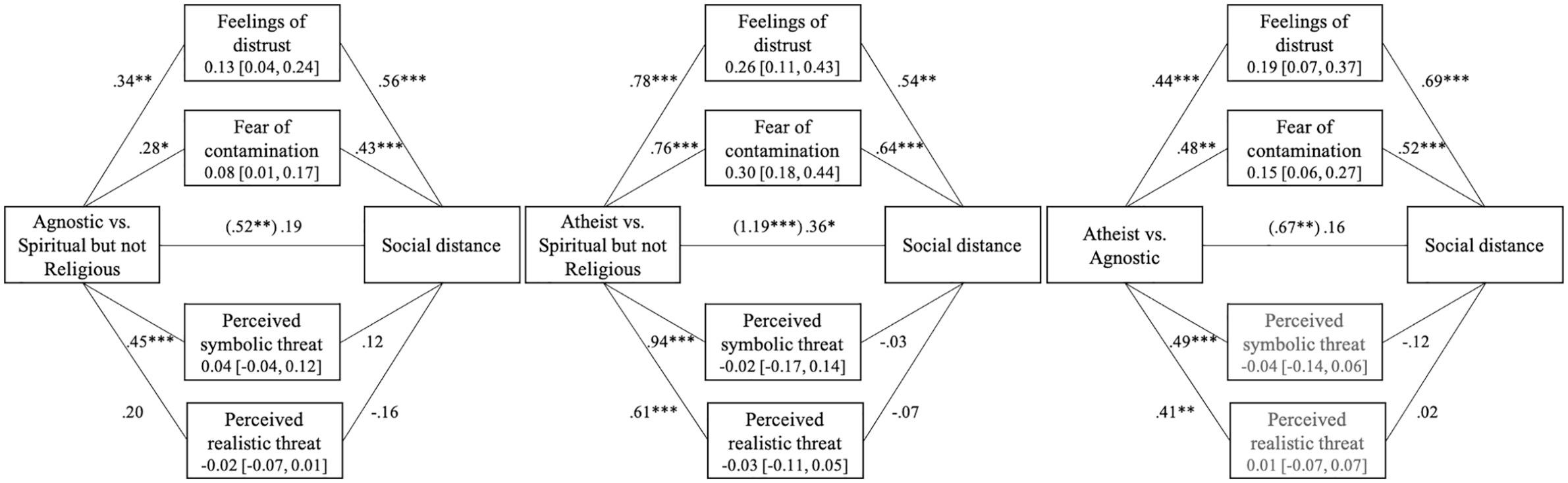
Multiple mediation models: effect of participants’ religious affiliation on social distance toward Christians through specific biases (Study 3).
In sum, different nonreligious identities demonstrated different patterns of negative attitudes towards Christians, suggesting that atheists, agnostics, and those who identify as spiritual-but-not-religious express different evaluative attitudes towards this religious outgroup. These general negative attitudes appear to be driven by individual differences in belief superiority and by the specific biases of feelings of distrust and fear of contamination by unpalatable ideas (above and beyond perceived symbolic and realistic threats).
General Discussion
With the rise of the number of people who identify as nonreligious (estimated at 23% in 2014 according to the Pew Religious Landscape Survey; Pew Research Center, 2014a), researchers have turned their attention to the ways that nonreligious people are perceived and treated by society (e.g., Gervais, 2013) and to strategies that might reduce the prejudice they face by religious people (LaBouff & Ledoux, 2016). However, we know little about their characteristics as a group and whether they uniformly display tolerance or prejudice. The present research aimed at extending previous literature by shedding light on the intergroup attitudes and behaviors of qualitatively different nonreligious groups (instead of lumping them together under a low religiosity index). This research stands to improve our understanding of a critical social concern, religious intergroup prejudice, which has been treated in psychology mostly unilaterally so far: not tackling directly the prejudice of nonreligious groups toward the majority religious group in the West, Christians, and the specific reasons for this prejudice.
The primary goal of this research was to study intergroup bias in the behaviors and attitudes of people who identify as nonreligious (i.e., agnostics and atheists in Study 1; adding the spiritual-but-not-religious in Studies 2 and 3) toward people who identify as Christians. We documented intergroup bias in three forms: a behavioral measure of intergroup affiliation/exclusion where participants who identified as atheist or agnostic played a virtual ball-tossing game with ostensibly Christian, atheist, and unidentified players (Study 1); self-report affective ratings toward Christians and atheists (thermometer scale); and self-reports of preferred social distance toward Christians and atheists (Studies 2–3). Overall, our findings suggest that atheists, agnostics, and spiritual-but-not-religious represent meaningful identity groups that display different attitudes toward Christians and atheists. Importantly, we find that people who are not religious do not display general tolerance and are prejudiced against certain religious groups. In terms of behavior, atheists showed a clear preference for their group compared to Christian or unidentified group members (Study 1). Agnostics’ behaviors toward Christians resembled those of atheists. In the virtual ball-tossing game (Study 1), agnostics included the Christian player in the game less than they included the atheist and neutral players. In terms of prejudiced attitudes (Studies 2–3), agnostics showed the lowest prejudice against atheists, not significantly different than atheist participants’ ratings of their own group. Participants who identified as spiritual-but-not-religious (Studies 2–3) showed similarly warm attitudes towards Christians and atheists. It is worth noting that results regarding self-reported prejudice were observed in the absence of reputational concerns (Cowgill et al., 2017) and also in the absence of experimentally manipulated threat (Kossowska et al., 2017; Ysseldyk, Haslam, Matheson, & Anisman, 2011). Future research should investigate why the spiritual-but-not-religious show more equanimity toward both Christians and atheists. Some reasons may include the lack of clear ingroup identity centered on specific ideologies; the proximity with both groups, one being a nonreligious group and the other being the majority religious group, with which spiritual-but-not-religious people may used to identify; the greater importance placed on spiritual values devoid of attachment to group-based religious teachings; the lack of prejudice experienced from Christians, which reduces the draw to reciprocate. Future research may also want to address a limitation of the present studies, which is that explicit prejudice against Christians may cover prejudice toward other associated identities, such as conservative political identity, low education status, or female, which covary with religious identity (Pew Research Center, 2014b).
The second primary goal of this research was to investigate the mechanisms explaining the prejudice of the nonreligious groups toward Christians. We investigated both individual differences in belief style among nonreligious identities and the endorsement of specific biases toward Christians. We found that thinking one’s religious beliefs are superior to others’ did partially explain why nonreligious people were prejudiced towards Christians. However, in contrast to what is observed in the study of intergroup prejudice among the religious, we learned that how rigidly the nonreligious hold their beliefs (as assessed by an index of belief flexibility in Study 2, and of dogmatism and intellectual humility in Study 3) did not contribute to explaining their prejudice towards Christians. This is consistent with Brandt and Van Tongeren’s (2017) findings that two indicators of belief rigidity—strength and certainty in belief—failed to explain the prejudice of people who were low in religious fundamentalism toward groups that were dissimilar to them. Here, atheists did report more dogmatism and belief rigidity than the spiritual-but-not-religious and the agnostics. In Study 3, the specific construct of dogmatism was also a significant mediator in one of the tested models, and is probably worth investigating further when studying the differences in prejudice between atheists and agnostics. In addition, we cannot exclude the possibility that differences in belief rigidity may influence prejudice toward other target groups. Interestingly, a study conducted in three European and secularized countries found that both atheists and agnostics scored lower in dogmatism than the religious. Yet, when indicators of dogmatism were measured more subtly (e.g., “myside bias”), atheists and agnostics scored higher than religious participants (i.e., Christians; Uzarevic et al., 2017). Implicit measures may represent a valuable addition to explicit measures and may reveal a different story for religious prejudice.
To further address the mechanisms by which religious intergroup bias operates for nonreligious participants, we investigated the role of specific biases in the observed prejudice towards Christians. Given that interreligious bias may be a consequence of feelings of distrust and perceived intergroup threat to values (Brandt & Van Tongeren, 2017; Gervais, 2013; Kossowska & Sekerdej, 2015), we measured these and other specific biases identified in the broader prejudice literature (Cottrell & Neuberg, 2005). Our results show that, among the nonreligious, feelings of distrust in Christians’ moral and intellectual judgment as well as fear of contamination by Christians’ views or ideas motivated prejudice towards Christians above and beyond perceived symbolic and realistic threats. However, we do note that these mediation results are limited because we measured these specific biases and overall negative attitudes at the same time. Therefore, our models, based on theories, should be further tested empirically by manipulating the mediators and observing their effects on the dependent variable (Fiedler, Harris, & Schott, 2018). In sum, the mechanisms identified in this research are both similar (feelings of distrust) and different (belief superiority, fear of contamination by Christians’ views, but no clear role of belief rigidity) to the mechanisms identified so far in the religious intergroup prejudice literature, which has focused mostly on Christian participants.
The present research is limited in the extent to which its findings can be generalized to the larger population and to other religious contexts. The samples selected for the present studies are not representative of the U.S. population. In fact, MTurk workers are less religious as a whole than the U.S. general population (Lewis et al., 2015), so nonreligious people are overrepresented. We purposefully sampled from MTurk to obtain a large enough sample of nonreligious people, but the sample sizes for each nonreligious group were still limited. Moreover, additional research is needed to determine whether the relationships observed here generalize to other countries and contexts in which religious intergroup relations are sociofuntionally different (e.g., in overt interreligious or ethnic conflict). The mechanisms of prejudice among people who are not religious toward religious groups may be importantly influenced by their status (dominant or not) in society (for similar research in more secular European countries, see Uzarevic et al., 2019). In addition, attitudes towards Christians may not generalize to attitudes towards Muslims or Buddhists, who are generally evaluated more negatively or more positively, respectively, than Christians (Pew Research Center, 2017). Finally, our research does not investigate biases among those who identify as “nothing in particular” when it comes to religion. These people, who do not affiliate with any religious or nonreligious group, may or may not constitute a cohesive group with specific psychological traits and related prejudicial attitudes.
In sum, our current understanding of religious intergroup prejudice and its mechanisms is currently dominated by studies among the religious. The present research aimed to address this limitation by sampling from three common nonreligious identities. We find that despite previous findings that religiosity is related to prejudice toward certain groups, the conclusion that people who are not religious are generally tolerant is not supported. Across three studies, people who identified as atheist, agnostic, and spiritual-but-not-religious showed varying levels of prejudiced behavior and attitudes towards Christians. In addition, we learn that these attitudes appear to be motivated by feelings of belief superiority as well as by the specific biases of feelings of distrust toward Christians and fear of being contaminated by their ideas. These findings suggest reciprocal prejudice between the religious and the nonreligious, and these negative attitudes share some of the same roots of religious bias towards the nonreligious. They have implications for our understanding of the effects of religion on intergroup relationships and of the attitudes of qualitatively different nonreligious identities such as agnostics and the growing group of spiritual-but-not-religious. Future research should continue to investigate the psychological and contextual causes of these forms of prejudice, which may require exploring beyond factors typically examined in studies of religion and prejudice.
Supplemental Material
Online_Supplemental_Material – Supplemental material for Prejudice toward Christians and atheists among members of nonreligious groups: Attitudes, behaviors, and mechanisms
Supplemental material, Online_Supplemental_Material for Prejudice toward Christians and atheists among members of nonreligious groups: Attitudes, behaviors, and mechanisms by Patty Van Cappellen and Jordan P. LaBouff in Group Processes & Intergroup Relations
Footnotes
Acknowledgements
We thank Marta Benito, G. Steven Crocker, Cody DuBois, Megan Edwards, Joseph Konstanzer, Rachel Olsen, and Taariq Shabazz for their help with data collection, cleaning, and analysis. We thank Mark Leary (Duke University) for his helpful comments on an earlier version of this manuscript. The data presented are freely accessible through the Open Science Framework ( ).
).
Funding
The author(s) disclosed receipt of the following financial support for the research, authorship, and/or publication of this article: Study 2 was funded by an award from the Positive Psychology Science Fund at the University of North Carolina at Chapel Hill to the first author.
Supplemental material
Supplemental material for this article is available online.
References
Supplementary Material
Please find the following supplemental material available below.
For Open Access articles published under a Creative Commons License, all supplemental material carries the same license as the article it is associated with.
For non-Open Access articles published, all supplemental material carries a non-exclusive license, and permission requests for re-use of supplemental material or any part of supplemental material shall be sent directly to the copyright owner as specified in the copyright notice associated with the article.
