







Abstract
Two studies tested the impact of subtle cues that associate masculinity with science, technology, engineering, and mathematics (STEM) success on women’s STEM experiences. Study 1 was a field study conducted in a university campus engineering building where photos of graduating classes were displayed. In Study 2, STEM majors viewed a mock website that depicted either exclusively male or mixed-gender STEM students. Across both studies, women reported greater fundamental need threat—a composite of threats to belonging, self-esteem, control, and meaningful existence—after viewing photos of exclusively male STEM students than did men. This gender effect disappeared when photos included female STEM students. Direct effects of gender and photo condition on career intentions were not observed, but indirect effects were obtained through need threat. Thus, because fleeting exposure to subtle background images associating STEM success with masculinity can negatively impact women’s fundamental needs, cues in academic environments should be carefully considered.
Women are generally underrepresented globally in science, technology, engineering, and mathematics (STEM). For example, in 2012–2015, women in the United Kingdom comprised only 15.5% of engineering and technology undergraduates (The Institute of Engineering and Technology [IET], 2016). This gender discrepancy is problematic because of the increased need for STEM majors and the need for more diverse perspectives in these positions (Congressional Commission on the Advancement of Women and Minorities in Science, Engineering and Technology Development [CAWMSET], 2000). Researchers have explored this problem from many different perspectives, citing ability (Hyde, 2014), socialization (Yee & Eccles, 1988), gender stereotypes (Miller et al., 2015; Nosek et al., 2009), communion (Diekman et al., 2011), and discrimination (Moss-Racusin et al., 2012; Steele et al., 2002), among other contributors (for reviews, see American Association of University Women [AAUW], 2010; Ceci et al., 2014).
Recent research has explored gender differences in belonging as one important contributor to women’s underrepresentation in STEM. This explanation is compelling because it is consistent with a wealth of research on the fundamental importance of human belonging (Baumeister & Leary, 1995; Walton et al., 2012), and because resolving threats to belonging positively impacts members of stigmatized groups’ motivation and achievement (Cohen & Garcia, 2008; Shnabel et al., 2013; Walton & Cohen, 2007). Specifically, belonging predicts intent to pursue STEM (Good et al., 2012), and perceived similarity to people in STEM is a strong predictor of STEM interest even after controlling for other factors (Cheryan & Plaut, 2010). Exposure to and identification with female STEM experts can bolster women’s positive attitudes towards STEM, self-efficacy, and interest in STEM (Dasgupta, 2011; Stout et al., 2011). An intervention that normalizes students’ concerns about belonging in STEM can also improve women’s performance and facilitate their STEM friendships (Walton et al., 2015).
Information about who belongs can be obtained from many sources, including physical environments (Cheryan et al., 2011; Schmitt et al., 2010). Women express less interest in computer science than men when they are in a classroom with objects that signal masculinity (e.g., video games, Star Trek posters). However, these gender differences disappear in environments with more neutral objects (e.g., a coffee maker, nature pictures; Cheryan et al., 2009). Female STEM majors also express lower belonging and less STEM interest after watching a video advertising a STEM conference that depicts a ratio of 3 men to 1 woman, as opposed to a gender-balanced representation (Murphy et al., 2007). Men, whose gender is already stereotypically associated with STEM, are generally impervious to these manipulations.
In most of these past studies, participants were explicitly asked to engage with or respond to the environment that, unbeknownst to them, was manipulated. In all of these past studies, participants knew that they were going to be in a study before entering or viewing the environment; and none of these past works used naturally preexisting environments. The current work extends this past research on the importance of masculine STEM cues by testing their effects under even more brief, subtle conditions, similar to those in everyday life. Demonstrating that these effects occur even with fleeting, incidental everyday exposure provides greater evidence for the importance of making intentional choices about how academic spaces are created.
The desire to test the effects of masculine STEM cues under even more subtle conditions is rooted both in practical concerns regarding just how mindful communities should be about the messages academic environments send and in exclusion research more broadly. A robust amount of research demonstrates that being excluded is a negative experience which threatens four fundamental needs—belonging, self-esteem, control, and meaningful existence (Williams, 2009)—and can increase negative mood (Bernstein & Claypool, 2012). Threats to these four fundamental needs have been observed under explicit conditions such as in-person exclusion paradigms where people are not acknowledged by others (Williams, 2007), as well as under subtle conditions such as when people do not know pop culture information that others are aware of (Iannone et al., 2018) or when people do not receive eye contact (Wesselmann et al., 2012). The fact that even very subtle forms of exclusion increase fundamental need threat is consistent with evolutionary theorizing that being extremely sensitive to potential cues of exclusion is adaptive (Leary, 1999; Williams, 2007). This reasoning suggests that humans are sensitive to very subtle forms of exclusion today because this sensitivity allowed our ancestors to detect early signs they might be excluded, such that they could alter course and remain in the groups that they needed to survive and pass on their genes. In fact, this has spurred a wealth of literature that demonstrates that signs of exclusion threaten needs under a variety of subtle and even seemingly illogical conditions (Williams & Nida, 2011).
The current work conceptualizes women’s underrepresentation in STEM as exclusion. Drawing on the tradition of demonstrating just how sensitive people are to cues that they may be excluded, we likewise use fundamental need threat—a composite of threats to belonging, self-esteem, control, and meaningful existence—as a primary dependent variable. We expect women will report more need threat and decreased interest in pursuing a STEM career relative to men when exposed to brief, subtle cues that indicate male-only success in STEM. We expect that this gender difference will dissipate when participants are exposed to cues that include examples of female success in STEM. Thus, the current work also extends prior research on women’s STEM experiences, which to date has focused on the need to belong, to explore the larger composite of all four fundamental needs typically investigated in exclusion research. We included mood as a variable in our investigation, as it is also a primary dependent variable in exclusion traditions. However, we included mood as an exploratory dependent variable, as the effects of exclusion on mood vary depending on exclusion paradigm, and the current work uses novel paradigms (Bernstein & Claypool, 2012).
We tested the impact of subtle cues that associate masculinity with STEM success on fundamental need threat and interest in STEM in two studies. Study 1 was a field study conducted in a university campus engineering building where photos of graduating classes were displayed. The purpose of this first study was to make a strong case for the importance of subtle masculine cues in STEM environments by using a preexisting engineering environment, drawing no attention to that environment, and using unsuspecting passersby as participants. In Study 2, STEM majors viewed a mock website that depicted either exclusively male or mixed-gender STEM students. The purpose of Study 2 was to provide a conceptual replication of the importance of subtle masculine STEM cues and to address methodological concerns from Study 1.
Study 1
Method
Participants and design
Four hundred and fifty-eight people (200 female) were approached to be part of the study. Sample size was determined using practical concerns. Because this was our first time using this paradigm and we expected that the manipulation was subtle, we had each experiment run until the end of the semester.
Eight participants were removed from the analyses because they had problems understanding the survey questions because of English language difficulties, and four participants were removed from the analyses because they reported having completed the survey previously, leaving a sample of 446 participants (197 female).
The design was a 2 (participant gender: male vs. female) × 2 (photo condition: men only vs. mixed gender) between-subjects design.
Procedure
The study took place in an engineering building on a large university campus in the Midwestern United States. Specifically, the study was conducted in a hallway that prominently displays photographs of all the graduating engineering classes along the walls. These photographs served as naturally occurring exemplars of success. There was a point in the hallway where, on one side of the hallway, the graduating classes of 1924 and 1925 were displayed, one above the other. These photographs only included male faces, providing viewers with no female exemplars of success in engineering. On the same point in the hallway but on the opposite wall, the graduating classes of 1981 and 1982 were displayed, one above the other. These photographs included a majority of male faces, but a noticeable number of female faces as well (12%), providing viewers with at least some exemplars of female inclusion and success in engineering (see Appendices A and B in the supplemental material for photos of the stimuli). One of two male experimenters was stationed at this point in the hallway, but was randomly assigned to position his body such that approaching participants would view the men-only or mixed-gender picture. Experimenters were blind to the study purpose. We were interested in assessing participants’ reactions to exemplars of success as naturally as possible, and without raising suspicion. In an effort to minimize the degree to which our methods may disrupt natural reactions, we used two male experimenters, given the general association between masculinity and scientists (Miller et al., 2015). Future research may explore whether having a female research assistant as an example of women in science (albeit social science) may be enough to mitigate or eliminate the effects of the photographs.
Initially, when any person approached and was walking alone and not engaged in simultaneous behavior (e.g., not on the phone), they were treated as a participant. This initial data collection strategy yielded more male than female participants, perhaps unsurprisingly given the gender discrepancy in engineering majors and the fact that it was conducted in an engineering building. So as data collection progressed, experimenters were instructed to approach every third passing male and every passing female who met the cited criteria to help obtain a more gender-balanced sample and thus allow us to appropriately test for gender effects. Note that in both the initial and adapted data collection strategies, all participants were still randomly assigned to photo condition.
The experimenter approached participants with a clipboard and asked if they had time to complete a short survey. The experimenter angled his body such that participants had a clear and centered view of either the male-only or the mixed-gender photographs while he asked them questions. Participants were asked to indicate their major or intended major. Then participants were asked to respond to 10 items “with respect to how you feel right now in your major.” Based on items from Williams (2009), participants were asked two belonging items (e.g., “I feel that I belong”), two self-esteem items (e.g., “My self-esteem is high”), two meaningful existence items (e.g., “I feel invisible”), and two control items (e.g., “I feel I have control”). These eight items were averaged (reverse-coding when necessary) to form a need threat composite, with higher scores indicating greater need threat (α = .84). Participants also indicated how they felt on a 5-point scale (1 = negative, 5 = positive). Finally, participants were also asked to respond to the item “I envision my future career being in my major.” Items were measured on 5-point scales (1 = not at all, 5 = extremely). The experimenter recorded participant gender and photo condition regardless of whether the participant was able to complete the survey.
Results
Participation
Participation in the survey was a dichotomous measure indicating whether or not the participant agreed to answer the survey. The majority of participants (281; 63%; 130 female) completed the survey. A logistic regression was conducted predicting participation using participant gender, photo condition, experimenter, and their interactions as predictors. No significant effects were obtained. Thus, participation rate did not differ by gender, photo condition, or experimenter.
Primary analysis strategy
We conducted 2 (participant gender: male vs. female) × 2 (photo condition: men only vs. mixed gender) between-subjects analyses of variance on the need threat composite, mood, and intent to pursue a career in one’s major. See Table 1 for bivariate correlations among these dependent variables for both Studies 1 and 2. Initial analyses included experimenter as a factor, but because no interactions with experimenter emerged, we report this simplified design.
Bivariate correlations among variables in Studies 1 and 2.
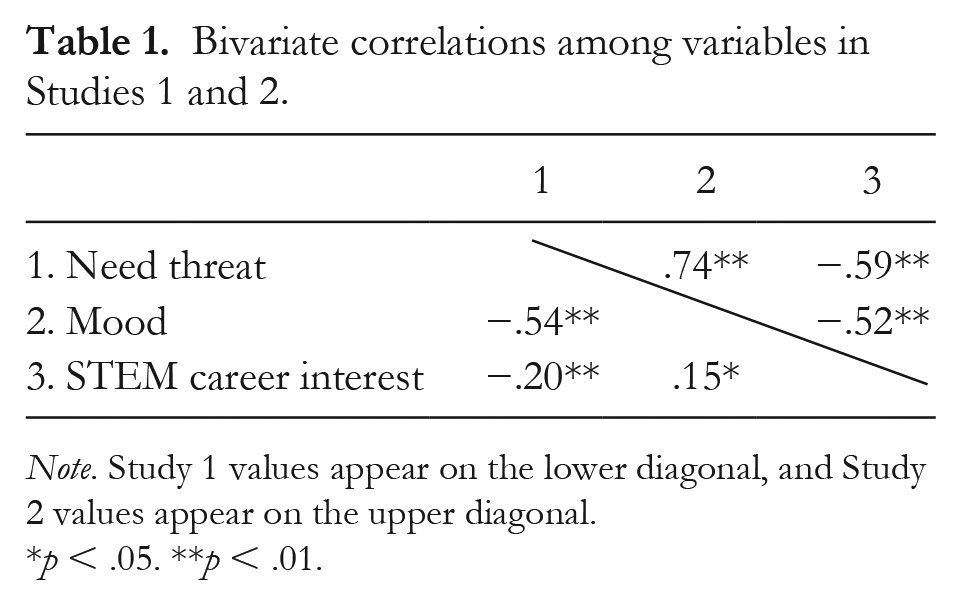
Note. Study 1 values appear on the lower diagonal, and Study 2 values appear on the upper diagonal.
p < .05. **p < .01.
Because the current study was conducted in an engineering building and used naturally existing exemplars of engineering success, the manipulation is particularly relevant to students in STEM fields. Thus, our primary analyses were conducted on the subset of participants in STEM majors. Participants’ majors were coded into STEM and non-STEM categories by two coders (ICC = 1.00), and the single discrepancy was discussed to resolution. The majority of students were STEM majors (222; 79%; 86 female), unsurprisingly given the study location. The most represented STEM majors were electrical engineering (70) and computer engineering (39). We did not conduct analyses on the non-STEM subsample, given its small size (59) and the fact that the experimental manipulation is less relevant to this subsample of participants. However, results on the entire sample demonstrate a similar pattern as those described next.
Need threat
A marginal main effect of participant gender emerged, F(1, 218) = 3.44, p = .065, ηp2 = .02. Female STEM majors (M = 2.00, SD = 0.57) reported marginally more need threat than male STEM majors (M = 1.87, SD = 0.54). The main effect of photo condition was nonsignificant, F(1, 218) = 0.91, p = .341, ηp2 = .00.
More importantly, the interaction between participant gender and photo condition was significant, F(1, 218) = 4.07, p = .045, ηp2 = .02 (see Figure 1). As predicted, when in front of the men-only exemplar of success, female STEM majors reported significantly more need threat (M = 2.12, SD = 0.65) than male STEM majors (M = 1.83, SD = 0.53), F(1, 218) = 7.26, p = .008, ηp2 = .03. However, when in front of the mixed-gender exemplar of success, female (M = 1.90, SD = 0.47) and male (M = 1.91, SD = 0.56) STEM majors reported similar levels of need threat, F(1, 218) = 0.01, p = .907, ηp2 = .00.
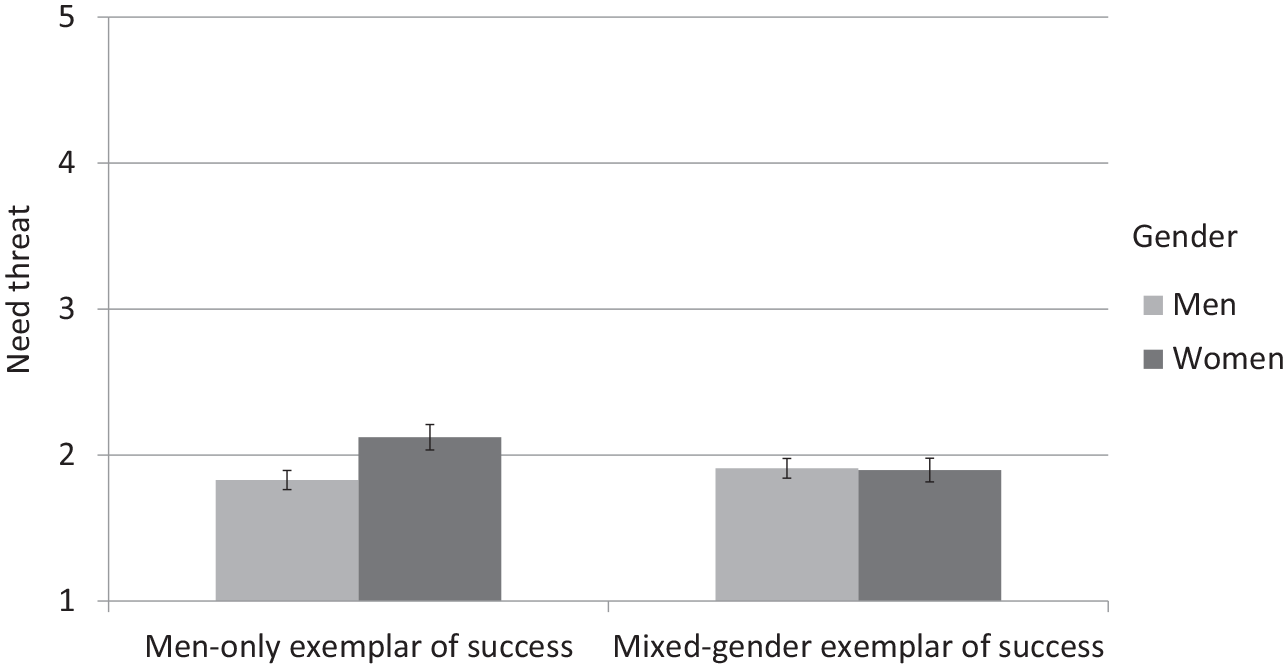
Effects of Gender and Photo Condition on Need Threat in Study 1.
Mood
Neither the main effect of participant gender, F(1, 218) = 0.67, p = .416, ηp2 = .00, nor the main effect of photo condition, F(1, 218) = 0.30, p = .582, ηp2 = .00, were significant. The interaction between participant gender and photo condition was also nonsignificant, F(1, 218) = 1.40, p = .237, ηp2 = .01.
Intent to pursue a career in one’s major
Neither the main effect of participant gender, F(1, 218) = 0.87, p = .353, ηp2 = .00, nor the main effect of photo condition, F(1, 218) = 0.75, p = .386, ηp2 = .00, were significant. The interaction between participant gender and photo condition was also nonsignificant, F(1, 218) = 0.82, p = .367, ηp2 = .00.
Moderated mediation analyses
Although there was no direct interactive effect of gender and photo condition on career choice, we conducted an exploratory moderated mediation analysis using Hayes’s (2013) recommendations. We used Hayes’s (2013) PROCESS macro (Model 8) with 5,000 bootstrap samples, and found evidence for significant moderated mediation, as the 95% confidence interval for the index of moderated mediation did not include zero, B = 0.11, SE = 0.08, 0.002 ⩽ X ⩽ 0.300 (see Figure 2). As anticipated, the indirect effect of gender on interest in a STEM career through need threat was significant when participants were exposed to male-only exemplars of success, B = −0.11, SE = 0.07, −0.283 ⩽ X ⩽ −0.010. However, this indirect effect was nonsignificant when participants were exposed to mixed-gender exemplars of success, B = 0.00, SE = 0.04, −0.073 ⩽ X ⩽ 0.077. Thus, although the interaction between participant gender and photo condition did not directly affect STEM majors’ anticipated career choices, we obtained evidence that gender is related to intent to pursue a STEM career indirectly through need threat only when participants viewed exclusively male examples of STEM success.
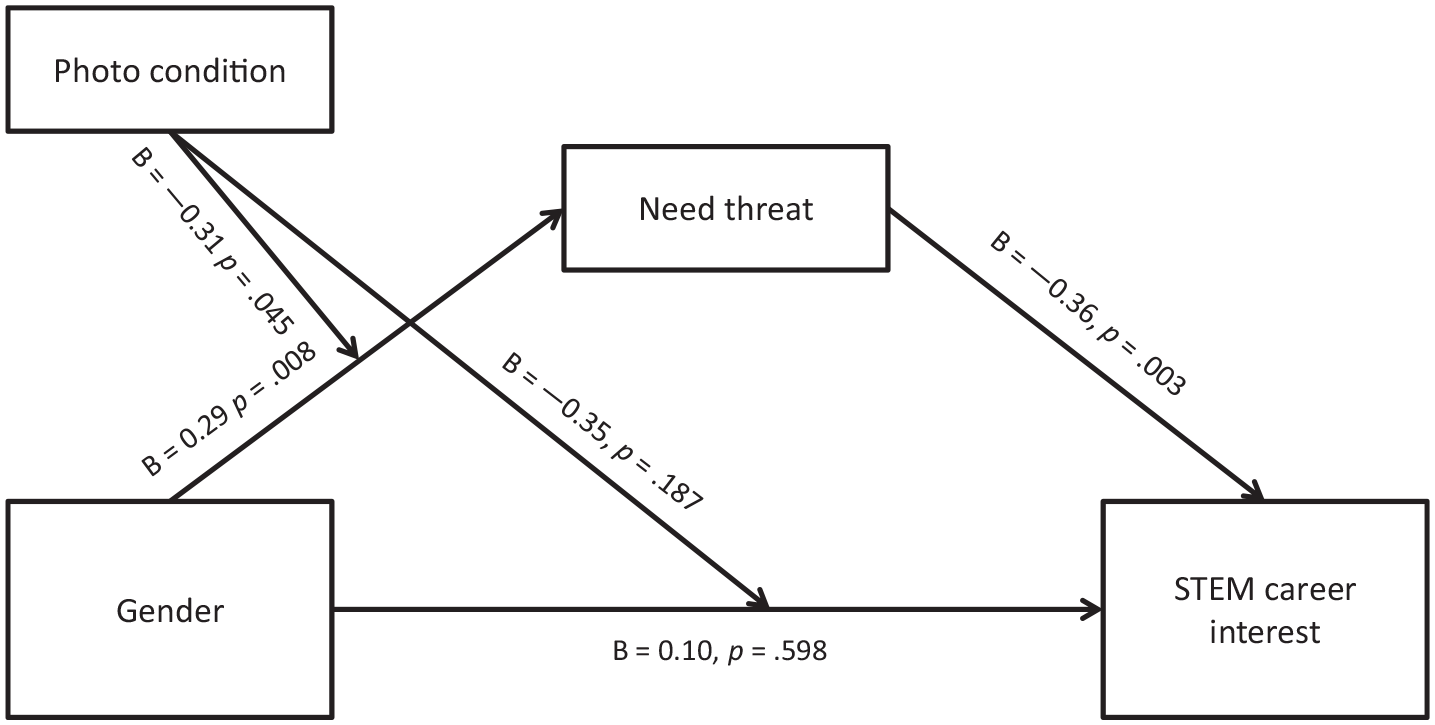
Study 1 Moderated Mediation Analyses.
Discussion
As expected, female STEM majors reported more need threat than male STEM majors only in the presence of the photo of all male engineering graduates. The fact that the current study was brief (2 minutes) did not draw participants’ attention to the stimuli in any explicit way, and the fact that it occurred in a well-traveled hallway that students had likely traveled through previously provides strong evidence that preexisting cues about who succeeds in STEM environments can impact women’s fundamental needs.
This fleeting exposure to exemplars of engineering success did not directly impact participants’ intent to pursue a STEM career. This null effect may be due to the subtle nature of the manipulation, the single-item measure of career intent, or the fact that career intent is a more downstream outcome. Indeed, exploratory moderated mediation analyses found an indirect effect of gender on interest in a STEM career through need threat, but only when participants were exposed to exclusively male exemplars of STEM success.
We used preexisting environmental cues, and were therefore unable to control aspects of our stimuli. For example, the manipulation confounded year and proportion of women. One may be tempted to suggest that our effects are influenced by the fact that participants may identify more with recent than older photographs. However, this reasoning is inconsistent with the findings, as no main effect of photo condition was obtained, and this would not explain the interaction between participant gender and photo condition. Year and gender representation will be naturally confounded in many existing environments because women’s representation in STEM has increased over time (National Science Foundation, 2019). Thus, we do not believe this confound detracts from our findings that naturally existing environments can have negative effects for women’s experiences in STEM.
Nonetheless, a conceptual replication was conducted to mitigate methodological concerns. STEM majors viewed a mock STEM department web page that depicted exclusively male or mixed-gender incoming students, and completed dependent measures. There are three primary benefits of this paradigm relative to that of Study 1. The mock web page was identical across conditions except for the percentage of women represented, eliminating concerns about class year or other potential third factors. The study was conducted online, eliminating concerns about experimenter gender effects. Finally, the paradigm enabled the collection of more demographic information and use of multi-item measures of mood and interest in a STEM career.
Study 2
Method
Participants and design
Five hundred and fifty-eight undergraduate students participated in exchange for partial course credit in introductory psychology courses. Students had many potential research participation opportunities available to them through an online sign-up system. This study was only visible to participants who, in a prescreen, indicated a college affiliation within the university that contained at least one STEM major. To ensure analyses focused on self-identified STEM majors, a question at the end of the study asked, “Is your major a STEM field (science, technology, engineering, or mathematics)?” Participants were also asked “Have you declared your major?”; to which they could respond “yes” or “no.” The a priori research plan was to analyze only data from participants who indicated their major was STEM, and to collect data on approximately 400 participants. Four hundred and thirty participants identified as STEM majors, 377 of whom were declared STEM majors. Based on reviewer comments, we focus analyses on declared STEM majors, as these individuals have made a more formal decision to intend to pursue STEM, and should be more likely to experience the kind of situational cues that are the focus of this work and personally relate to questions about their future career. One of these participants was excluded from analyses because they were younger than 18 years old. Our research question and hypotheses focused on men and women, and we did not have adequate power to statistically analyze gender nonbinary individuals. Thus, five additional participants were excluded from analyses: one gender nonbinary individual, and four individuals who preferred not to indicate their gender. The final sample contained 371 declared STEM majors (204 male; 218 Caucasian, 91 Asian, 7 African American, 11 Latinx, 1 Native American, and 43 people indicating other or multiple identifications). On average, participants were 19.28 years old (SD = 1.36).
The design was a 2 (participant gender: male vs. female) × 2 (website condition: exclusively male vs. mixed gender) between-subjects one.
Procedure
Participants completed the survey entitled “Online Environments” online and at their leisure. After providing informed consent, participants were told that the study concerned how people respond to online environments, such as websites. Participants were told that they would be looking over a mock website and then answering a series of questions regarding their opinions and feelings.
Participants then viewed a mock website that described a hypothetical “Science, Technology, Engineering, and Mathematics Collaborative at Middle University.” As they looked over the mock website, they were asked to imagine that they were considering applying to a summer position in this department. The mock website was an image designed to look like a department homepage. It included sections on “Upcoming Events,” “Departmental News,” photos of the facilities, and photos of incoming students. The mock website image included 12 photos of incoming students and was identical except in one condition all were male, and in the other condition three of the 12 photos were changed to female (25%). The photos of incoming students were stimuli from the Chicago Face Database (Ma et al., 2015). The three female photos and the male photos they replaced were matched on ratings of age and attractiveness. As with Study 1, the goal of Study 2 was to use a subtle manipulation, similar to real-life STEM majors’ experiences. Thus, the photographs of the incoming class were relatively small in size, and, as a whole, these photos took up less than a sixth of the mock website space. The exclusively male and mixed-gender mock websites appear in full in Appendices C and D of the supplemental material, respectively.
After being randomly assigned to look over one website photo for at least a minute, participants completed filler items (e.g., “The website was easy to understand,” “The font was easy to read”), as well as need threat and mood items in a randomized order, followed by measures assessing interest in a STEM career and then manipulation checks. All items were presented randomly within measures.
Need threat
Participants responded to 16 items assessing need threat. Participants were asked to indicate how they felt as they looked over the program website. Based on items from Williams (2009), participants were asked four belonging items (e.g., “I felt that I belonged”), four self-esteem items (e.g., “My self-esteem was high”), four meaningful existence items (e.g., “I felt invisible”), and four control items (e.g., “I felt like I had control”). Participants responded on a scale from 1 (not at all) to 7 (extremely). Consistent with previous research and Study 1, responses were combined into a single index, reverse-coding as necessary, with higher numbers indicating greater need threat (α = .87).
Mood
Participants responded to nine items assessing mood adapted from Williams (2009). Participants were asked to indicate how they felt as they looked over the program website (e.g., “I felt positive,” “I felt tense”). Participants responded on a scale from 1 (not at all) to 7 (extremely). Reverse-coding as necessary, responses were combined into a single index with higher numbers indicating more negative mood (α = .84).
Intent to pursue a career in one’s major
Participants responded to six items designed to measure intent to pursue a STEM career. Participants were asked to indicate how they felt as they looked over the program website (e.g., “I envisioned my future career being in STEM”). Participants responded on a scale from 1 (not at all) to 7 (extremely). Reverse-coding as necessary, responses were combined into a single index with higher numbers indicating greater intent to pursue a STEM career (α = .90). The entire measure is provided in Appendix E in the supplemental material.
Manipulation checks
Given the subtlety of our manipulation, we employed three manipulation checks. A dichotomous manipulation check asked participants whether or not there were women pictured on the website they viewed. A second manipulation check asked participants to indicate approximately what percentage of the website photographs depicted women. A final manipulation check asked participants the degree to which they agreed with the statement “The STEM Collaborative appeared to be a welcoming environment for women.” Participants responded on a scale from 1 (strongly disagree) to 7 (strongly agree).
Participants completed demographic information, including information regarding their gender, race, and major. Participants also completed demographic information not mentioned in this text, and a few exploratory items were also included to aid future research. All of these items and the questions mentioned in this text are available by request from the first author. Finally, participants were debriefed and thanked for their participation.
Results
Manipulation checks
Participants’ “yes” or “no” responses to the item “There were women pictured on the website I looked at,” were significantly associated with their website condition, χ2 (1, N = 371) = 126.77, p < .001. In the mixed-gender website condition, 95.31% of participants correctly indicated that there were women pictured on the website. Interestingly, in the exclusively male website condition, only 58.66% of participants correctly indicated that there were no women pictured on the website.
An additional manipulation check asked participants to estimate the percentage of website photographs that depicted women. This manipulation check was subjected to a 2 (participant gender: male vs. female) × 2 (website condition: exclusively male vs. mixed gender) between-subjects analysis of variance. A significant main effect of website condition emerged, F(1, 367) = 139.66, p < .001, ηp2 = .28. Participants who viewed the mixed-gender website estimated a greater percentage of female photos (M = 36.59, SD = 17.08) than participants who viewed the exclusively male website (M = 15.10, SD = 17.63). The main effect of participant gender, F(1, 367) = 0.17, p = .685, ηp2 = .00, and the interaction between participant gender and website condition were nonsignificant, F(1, 367) = 0.02, p = .885, ηp2 = .00. Note that degrees of freedom vary slightly across analyses due to missing data, as participants were able to indicate “prefer not to respond” to any question in Study 2.
The final manipulation check asked participants to indicate the degree to which the STEM collaborative they read about appeared to be a welcoming environment for women, on a 7-point scale. This manipulation check was also subjected to a 2 (participant gender: male vs. female) × 2 (website condition: exclusively male vs. mixed gender) between-subjects analysis of variance. A significant main effect of website condition emerged, F(1, 367) = 84.23, p < .001, ηp2 = .19. Participants who viewed the mixed-gender website perceived the STEM collaborative as having a more welcoming environment for women (M = 4.11, SD = 1.17) than participants who viewed the exclusively male website (M = 2.91, SD = 1.42). A marginal main effect of participant gender emerged, F(1, 367) = 3.63, p = .057, ηp2 = .01, with male participants perceiving the environment as marginally more welcoming for women (M = 3.58, SD = 1.43) than female participants (M = 3.46, SD = 1.42). The interaction between participant gender and website condition was nonsignificant, F(1, 367) = 1.13, p = .289, ηp2 = .00.
Primary analysis strategy
We conducted 2 (participant gender: male vs. female) × 2 (website condition: exclusively male vs. mixed gender) between-subjects analyses of variance on our primary dependent variables.
Need threat
No main effect of participant gender emerged on need threat, F(1, 366) = 1.11, p = .293, ηp2 = .00. The main effect of website condition was significant, F(1, 366) = 5.50, p = .020, ηp2 = .02. Need threat was greater among participants who viewed the exclusively male website (M = 3.75, SD = 0.96) than participants who viewed the mixed-gender website (M = 3.56, SD = 0.90).
This main effect was qualified by a significant interaction between participant gender and website condition, F(1, 366) = 4.81, p = .029, ηp2 = .01 (see Figure 3). After viewing the website with exclusively male photos, female STEM majors reported more need threat (M = 3.94, SD = 1.00) than male STEM majors (M = 3.63, SD = 0.91), F(1, 366) = 4.98, p = .026, ηp2 = .01. However, after viewing the website with mixed-gender photos, female (M = 3.50, SD = 0.92) and male (M = 3.61, SD = 0.88) STEM majors reported similar levels of need threat, F(1, 366) = 0.69, p = .406, ηp2 = .00. 1
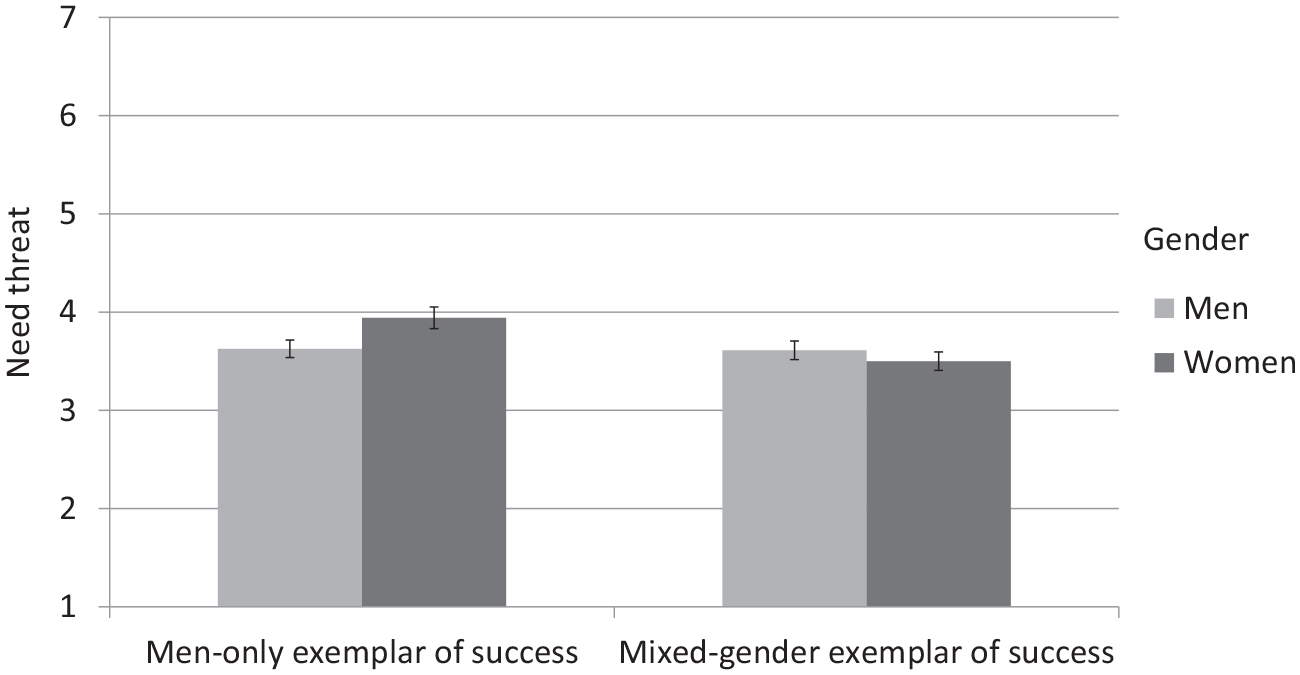
Effects of Gender and Photo Condition on Need Threat and Mood in Study 2.
Mood
No main effect of participant gender emerged on mood, F(1, 366) = 0.67, p = .415, ηp2 = .00. The main effect of website condition on mood was also nonsignificant, F(1, 366) = 0.19, p = .660, ηp2 = .00.
A marginal interaction between participant gender and website condition on mood emerged, F(1, 366) = 3.27, p = .071, ηp2 = .01. After viewing the website with exclusively male photos, female (M = 3.30, SD = 1.07) and male (M = 3.19, SD = 0.93) STEM majors reported similar levels of negative mood, F(1, 366) = 0.47, p = .496. However, after viewing the website with mixed-gender photos, male STEM majors reported marginally more negative mood (M = 3.34, SD = 1.15) than female STEM majors (M = 3.05, SD = 1.04), F(1, 366) = 3.66, p = .056, ηp2 = .01.
Intent to pursue a career in one’s major
No main effect of participant gender emerged on intent to pursue a STEM career, F(1, 366) = 1.70, p = .193, ηp2 = .01. The main effect of website condition was significant, F(1, 366) = 6.40, p = .012, ηp2 = .02. Participants reported greater interest in pursuing a STEM career in the mixed-gender condition (M = 4.39, SD = 1.33) than in the male-only condition (M = 4.06, SD = 1.38). The interaction between participant gender and website condition was nonsignificant, F(1, 366) = 1.53, p = .217, ηp2 = .00.
Moderated mediation analyses
Although there was no direct interactive effect of gender and website condition on intent to pursue a career in one’s major, we conducted an exploratory moderated mediation analysis using Hayes’s (2013) recommendations. We used Hayes’s (2013) PROCESS macro (Model 8) with 5,000 bootstrap samples and found evidence for significant moderated mediation, as the 95% confidence interval for the index of moderated mediation did not include zero, B = 0.36, SE = 0.17, 0.035 ⩽ X ⩽ 0.716 (see Figure 4). As anticipated, the indirect effect of gender on interest in a STEM career through need threat was significant when participants viewed the exclusively male website, B = −0.27, SE = 0.13, −0.531 ⩽ X ⩽ −0.018. However, this indirect effect was nonsignificant when participants viewed the mixed-gender website, B = 0.09, SE = 0.11, −0.121 ⩽ X ⩽ 0.315. Thus, although the interaction between participant gender and website condition did not directly affect STEM majors’ anticipated career choices, we obtained evidence that among those who viewed the exclusively male website, gender was related to intent to pursue a STEM career indirectly through need threat.

Study 2 Moderated Mediation Analyses.
Discussion
Study 2 replicated the effects of Study 1 using a paradigm with higher internal validity. Women reported more need threat than men only after viewing a STEM website with exclusively male photos. Study 2’s paradigm was similar to that used by Murphy et al. (2007), but like Study 1, the manipulation was more brief, subtle, and similar to real-life circumstances than previously used paradigms. Study 2’s manipulation was briefer (approximately 1 minute). This manipulation was also subtler than past work, as the photographs comprised approximately a sixth of the visual information presented on the website and included fewer female representations of success. The mock web page was also high in external validity as it was modeled after real university departmental websites.
Participants in the exclusively male condition were less likely to report that women were depicted on the website, estimated a lower percentage of women on the website, and perceived a less welcoming environment for women than participants in the mixed-gender condition. Although the differences between conditions indicate a successful manipulation, the descriptive statistics tell an interesting story. Of those participants in the exclusively male condition, 41.75% incorrectly indicated that there were women pictured on the website. This finding speaks to the subtlety of the manipulation and may also imply that it is difficult to notice the absence of gender diversity. Indeed, the average estimate of female representation in the exclusively male condition was 15.52%, a significant overestimation, t(203) = 12.47, p < .001. Even participants in the mixed-gender condition, which depicted 25% women, overestimated the percentage of women depicted, with an average estimate of 36.51%, t(211) = 9.76, p < .001. If people generally overestimate gender parity, and have a difficult time recognizing when groups are homogenous, this may influence a number of downstream outcomes, including support for efforts to promote gender inclusion. These manipulation check results suggest a need for future research on the ability to accurately perceive gender representation, and its consequences.
General Discussion
Across two studies, women experienced more need threat than men after briefly being exposed to cues that associate STEM exclusively with men. Men’s and women’s need threat was similar after brief exposure to STEM cues that included both men and women. These findings extend prior research by demonstrating that, like other exclusion experiences, women’s underrepresentation in STEM threatens not only belonging, but the composite of threats to belonging, self-esteem, control, and meaningful existence traditionally studied in exclusion research. These findings also extend previous research on masculine STEM cues (Cheryan et al., 2009; Murphy et al., 2007) by demonstrating effects using even more subtle paradigms high in external validity. Both studies also involved quite brief exposure to stimuli similar to those that students would encounter in everyday life, and did not draw participants’ attention to the photographs of STEM students in any explicit way. Thus, this pair of studies provides strong evidence that existing cues in academic environments that reinforce the association between STEM and masculinity negatively impact women’s fundamental needs. These findings are consistent with previous research demonstrating that people are responsive to fleeting exclusion information (Leary, 1999; Williams, 2007), and suggest communities should take more conscious stock of the subtle cues in academic environments. 2
Neither study found that fleeting exposure to exclusively masculine examples of engineering success directly impacted male and female participants’ intent to pursue a STEM career differently. Study 2, but not Study 1, did find that, overall, participants who viewed the mixed-gender website reported greater interest in STEM careers than participants who viewed the exclusively male website. In both studies, there was significant moderated mediation, such that the indirect effect of gender on interest in a STEM career through need threat was observed when participants were exposed to male-only examples of STEM success, but not when participants were exposed to mixed-gender examples of STEM success. Although a single, brief exposure to cues that associate men with STEM success may not be sufficient to directly reduce women’s interest in pursuing STEM careers, repeated exposure to these cues, or these cues compounded with other cues (e.g., percentages of men in current classes), may directly impact women’s career choices more so than men’s.
The methodological strengths and weaknesses of Studies 1 and 2 nicely complement each other. The field study method of Study 1 is high in external validity and psychological realism. However, this paradigm precluded the ability to control aspects of the stimuli, including class year. Study 2’s online mock website paradigm enabled high internal validity, as the stimuli were identical except for the percentage of female representation, and the online paradigm eliminated experimenter gender concerns. While Study 2 used a sample of STEM students who were enrolled in psychology courses and therefore may not be representative of STEM students in general, Study 1 used a random sample of STEM students who were walking down an engineering hallway. A strength of both studies was their emphasis on fleeting exposure (no more than 2 minutes) and subtle manipulations.
A limitation of both studies is power. A priori power analyses were not conducted. However, sensitivity analyses for main effects and interactions were conducted using G*Power (Faul et al., 2007). These analyses indicate that, given each of their sample sizes, the weakest effect size Study 1 could detect with 80% power is Cohen’s f = 0.19, and the weakest effect size Study 2 could detect with 80% power is Cohen’s f = 0.15. As these are moderate effect sizes, future studies on subtle environmental cues would benefit from increased power.
The current work is promising in that it suggests that relatively small proportions of female success in environmental cues may be sufficient to create nonthreatening STEM environments, at least when considering brief exposure to subtle cues. Study 1 suggests that 12% female representation may be enough to mitigate women’s need threat. Study 1 used preexisting engineering environmental cues, and we were therefore unable to control aspects of our stimuli, including the proportion of women. The stimuli in Study 2 were created for the purpose of this work. The percentage of female representation was increased to 25% given that Study 2 expanded from engineering to STEM in general, where women are not quite as starkly underrepresented (Catalyst, 2019). Notably, both studies still include less female representation than previous work (e.g., Murphy et al., 2007). Future research is necessary to determine how much female representation is sufficient to create welcoming environments for women, especially as previous research that focuses on less subtle paradigms generally suggests the need for at least one-third female representation (for a discussion, see Dasgupta, 2011).
In order to have subtle, inconspicuous manipulations, measures were kept brief. The need for brevity prevented us from measuring additional downstream effects of exposure to masculine exemplars of STEM success. Future work may benefit from exploring additional outcomes, including performance (Spencer et al., 1999) and participation (Latu et al., 2013).
Future research may also explore these effects in different contexts. Representations of men’s past leadership success in academic, workplace, and political contexts (e.g., pictures of past presidents) may also threaten needs for women in leadership. Men may likewise be vulnerable to cues that associate traditionally feminine domains, such as nursing, with exclusively female exemplars of success.
Our results demonstrate that even exposure to subtle, background images that associate STEM with masculinity can negatively impact women’s need threat. These results speak to the importance of critically examining environments and the cues they may send, even small and subtle reminders that may have previously been assumed to be innocuous. We suggest that displaying more gender-diverse representations prominently, such as in more heavily trafficked areas, may be beneficial for women’s experiences in STEM. However, exactly how to position these cues in ways that still honestly reflect the past and encourage a more diverse future is worthy of study. The effects that masculine environmental cues have on women’s need threat in STEM is just one factor that contributes to women’s underrepresentation in STEM (Ceci et al., 2014). However, these often-overlooked environmental cues are important to consider, as making more mindful choices about what aspects are highlighted in academic environments is a relatively low-cost change that can be made to facilitate women’s success in STEM.
Supplemental Material
sj-pdf-1-gpi-10.1177_1368430220975475 – Supplemental material for The impact of fleeting exposure to female exemplars of success in STEM
Supplemental material, sj-pdf-1-gpi-10.1177_1368430220975475 for The impact of fleeting exposure to female exemplars of success in STEM by Megan McCarty, Janice Kelly and Kipling Williams in Group Processes & Intergroup Relations
Footnotes

References
Supplementary Material
Please find the following supplemental material available below.
For Open Access articles published under a Creative Commons License, all supplemental material carries the same license as the article it is associated with.
For non-Open Access articles published, all supplemental material carries a non-exclusive license, and permission requests for re-use of supplemental material or any part of supplemental material shall be sent directly to the copyright owner as specified in the copyright notice associated with the article.
