







Abstract
Some cisgender women oppose policies granting transgender women access to women-only bathrooms. We examined whether this opposition stems from perceiving that transgender women threaten the distinctiveness of the social category “women” (gender distinctiveness threat). Cisgender women (N = 520) read about a state bill enabling transgender women to use women’s bathrooms. Participants further read that enacting the bill would mean their state officially believes that “transgender women are real women” or “transgender rights are human rights”; in the control condition, this information was omitted. Participants reported their support for the bill and level of gender distinctiveness threat. Cisgender women who read that the bill would imply their state believes transgender women are real women (vs. transgender rights are human rights) reported lower bill support, and this effect was mediated by distinctiveness threat. Perceived threat to the distinctiveness of womanhood may help explain cisgender women’s reluctance to include transgender women in women-only spaces.
Despite being typically thought of as members of the broader LGBT community, transgender people (i.e., people whose gender identity differs from their sex assigned at birth) face more bias than do lesbian, gay, and bisexual people (Cragun & Sumerau, 2015; Norton & Herek, 2013). The prevalence of antitransgender bias may be associated with the perception that transgender people threaten the gender binary—the widely endorsed notion that there are only two genders, female and male, that are discrete, immutable, and determined by biology (Hyde et al., 2019; Morgenroth & Ryan, 2020). Indeed, antitransgender bias is particularly apparent in gender-segregated life domains (Buck & Obzud, 2018). A prominent example is the continued debate regarding transgender people’s access to gender identity-appropriate public bathrooms. Many cisgender (i.e., nontransgender) people are opposed to gender identity-inclusive bathroom policies. For example, a 2017 Gallup poll revealed that in a representative U.S. sample, 48% of respondents stated that transgender individuals should be required to use public restrooms that match their sex assigned at birth, whereas 45% stated transgender individuals should be allowed to use public restrooms that match their gender identity (McCarthy, 2017). A similar split in opinion was observed in a 2019 poll, which found that 45% of respondents favored or strongly favored “laws that require transgender individuals to use bathrooms that correspond to their sex at birth rather than their current gender identity,” whereas 47% opposed or strongly opposed such laws (Jones et al., 2019). Thus, public opinion on this issue remains sharply divided. In the present work, we examined whether resistance to gender-inclusive bathroom policies among cisgender women in particular might stem from a perception that transgender women pose a threat to the distinctiveness of the social category “women.”
Antitransgender attitudes are context-dependent, such that cisgender people endorse more negative attitudes toward transgender individuals when considering gender-segregated, relative to gender-integrated, life domains (Buck & Obzud, 2018). Gender-segregated life domains are contexts in which women and men are typically separated from each other. Thus, for example, cisgender people are more likely to agree that transgender individuals should receive equal healthcare coverage and be protected against employment discrimination than they are to agree that transgender individuals should have access to bathrooms, locker rooms, dormitories, and sports teams that align with their gender identity (Buck & Obzud, 2018). Gender-segregated life domains make binary gender distinctions salient, and cisgender people often struggle to determine where transgender people belong in such contexts (Westbrook & Schilt, 2014). This struggle can be alleviated by supporting policies that reinforce the “naturalness” of the gender binary by, for example, denying transgender women access to women’s restrooms (Roberts et al., 2017; Westbrook & Schilt, 2014).
Indeed, the debate regarding which public restrooms transgender individuals should have access to remains ongoing. For example, North Carolina’s Public Facilities Privacy and Security Act, known as HB2, was passed in 2016 as a response to a local ordinance passed in the city of Charlotte that protected transgender people’s right to use public restrooms appropriate for their gender identity. HB2 required people to use public bathrooms matching the sex noted on their birth certificate, overturning Charlotte’s local legislation (Barnett et al., 2018). Although the “bathroom bill” portion of HB2 was repealed in 2017, similar antitransgender rights legislation has been proposed elsewhere. Notably, the majority of this debate has focused on transgender women’s access to women’s bathrooms rather than transgender men’s access to men’s bathrooms. This focus may be driven by benevolent sexist ideologies according to which women are inherently vulnerable (Buck & Obzud, 2018; Westbrook & Schilt, 2014). For instance, a common argument for opposing gender identity-inclusive bathroom policies claims that such policies would endanger women and girls by enabling sexual predators’ access to women-only spaces (Bovens & Marcoci, 2020; Westbrook & Schilt, 2014). Although such arguments regarding safety are frequently brought up in this debate, research has shown that not only are reports of safety violations in public restrooms extremely rare in general (Hasenbush et al., 2019); even more importantly, these violations have not increased in localities that have enacted trans-inclusive bathroom policies (Hasenbush et al., 2019), and cases of cisgender men faking transgender identity to gain access to women-only spaces are vanishingly rare (Barnett et al., 2018; Serano, 2021). Thus, these arguments do not hold up to empirical scrutiny.
Perhaps reflecting a desire to safeguard women-only spaces (Nanney, 2017), resistance to granting transgender women access to women’s bathrooms is often strongly voiced by cisgender women (Outten et al., 2019). For instance, whereas public opinion polling suggests that women are more supportive of gender-inclusive bathroom legislation than men are, sizable proportions of respondents identifying as female nonetheless state that transgender people should be required to use public restrooms that match their sex assigned at birth (e.g., 40% of female respondents in a 2017 Gallup poll; McCarthy, 2017). This is surprising, given that women tend to endorse more positive views regarding members of marginalized groups than men do (e.g., Lee et al., 2011). In particular, heterosexual women (vs. men) hold more favorable attitudes toward gay men, lesbian women, and bisexual people (Herek, 2002a, 2002b; Norton & Herek, 2013). In fact, straight women (vs. men) report more positive attitudes toward transgender people as well (Nagoshi et al., 2019; Norton & Herek, 2013). What, then, explains some cisgender women’s reluctance to include transgender women in women-only spaces such as public bathrooms? Here, we consider the possibility that this reaction may be associated with the perception that transgender women broaden the meaning of womanhood in a way that threatens the distinctiveness of gender categories. That is, transgender women may evoke gender-based distinctiveness threat among some cisgender women.
People experience distinctiveness threat when an outgroup appears to be too similar to a valued ingroup (Jetten et al., 2004). According to social identity theory, an important part of people’s sense of identity and self-worth comes from their group memberships (Tajfel & Turner, 1979, 1986). People are therefore strongly motivated to perceive their ingroups not only as positive but also as clearly distinct from outgroups, because distinctiveness serves to justify the ingroup’s existence as separate from other groups (Jetten et al., 2004; Plante et al., 2015). Although some degree of perceived similarity to an outgroup can foster cooperative intergroup relations, too much similarity is threatening because it blurs group-based distinctions and reduces the value of one’s social identity (Jetten et al., 2004). Distinctiveness threat may lead to efforts to increase differentiation between groups, particularly among individuals who are strongly identified with their ingroup (Jetten et al., 2004; Plante et al., 2015; Roccas & Schwartz, 1993). It is possible that some cisgender women perceive transgender women as diluting fundamental differences between women and men, for instance by calling into question presumed biological determinants of binary gender categories (Broussard & Warner, 2019; Morgenroth & Ryan, 2020; Westbrook & Schilt, 2014). Such gender distinctiveness threat may motivate some cisgender women to exclude transgender women from the group “real women.” One way to attempt to do so is by denying transgender women access to women-only spaces such as public bathrooms. Accordingly, we suggest that opposition to gender identity-inclusive bathroom policies may be especially strong among cisgender women who perceive transgender women as a source of gender distinctiveness threat.
Prior work is consistent with our reasoning. For example, Outten et al. (2019) assessed straight cisgender women’s support for two different kinds of “bathroom bills.” Specifically, participants read about a proposed state bill that would grant transgender women access to either gender-neutral or women-only public bathrooms. Participants also reported the extent to which they perceived transgender women as a threat. Rather than directly considering the notion of gender distinctiveness threat, Outten et al. (2019) labeled these perceptions “intergroup threat” and defined them as reflecting the general notion that transgender women pose a threat to women and womanhood. Straight cisgender women who reported more intergroup threat on these items were less likely to support both bills. However, highly threatened cisgender women were less supportive of the bill especially when it would grant transgender women access to women-only (vs. gender-neutral) bathrooms. By contrast, the reverse pattern was observed among cisgender women scoring low on perceived intergroup threat (Outten et al., 2019). Thus, it appears that explicitly trans-inclusive public bathroom policies (but not gender-neutral policies) are more strongly opposed by cisgender women for whom transgender women represent a group-based threat. Notably, however, Outten et al.’s (2019) findings do not directly speak to which dimension of intergroup threat (e.g., threat to the value, resources, or distinctiveness of the ingroup) may be driving this relationship.
The goal of the present study was to more explicitly and directly examine the possibility that some cisgender women’s reluctance to include transgender women in women-only spaces stems from gender distinctiveness threat in particular. Accordingly, we considered perceived threat to notions of who is considered to be a “real woman,” and sought to extend the findings of Outten et al. (2019) in several ways. First, going beyond general intergroup threat considered by Outten et al. (2019), we specifically assessed perceptions that transgender women threaten the distinctiveness of women as a social category. We predicted that such perceptions would be associated with cisgender women’s opposition to granting transgender women access to women-only public bathrooms.
Second, in addition to measuring gender distinctiveness threat as an individual difference predictor, we also sought to manipulate it. Specifically, cisgender women participants read about a proposed state bill that would allow transgender women to use women-only public bathrooms. In one condition, participants further read that enacting the bill into law would imply that their home state officially believes that “transgender women are real women.” We expected this framing to evoke the notion that transgender women may blur the lines distinguishing “real women” from “real men.” Additionally, we anticipated that this framing would be particularly unpalatable to cisgender women scoring high on our measure of more chronic gender distinctiveness threat. In another condition, participants instead read that passing the bill would imply that their home state officially believes that “transgender rights are human rights.” As including transgender women in the category “humans” does not threaten the distinctiveness of gender categories, we anticipated that this framing would not evoke acute gender distinctiveness threat and would be more acceptable to cisgender women scoring high on our measure of gender distinctiveness threat. We also included a control condition in which participants simply read a description of the proposed bill without any additional information about its more symbolic meaning. In summary, we tested the following preregistered (https://aspredicted.org/45m4c.pdf) hypotheses:
Hypothesis 1: Support for the proposed bill will be lower among cisgender women who read that the bill would imply that transgender women are real women, relative to cisgender women who read that the bill would imply that transgender rights are human rights; responses in the control condition will fall in between the other two conditions.
Hypothesis 2: Cisgender women who perceive transgender women as a source of gender distinctiveness threat will voice less support for the proposed bill regardless of which condition they are assigned to.
Hypothesis 3: Experimental condition and measured gender distinctiveness threat will interact such that bill support will be distinctively low among cisgender women in the transgender women are real women condition who score high on our measure of gender distinctiveness threat.
Third, we included additional measures to further examine cisgender women’s reactions to gender-inclusive bathroom policies. The effects of distinctiveness threat on intergroup orientations may be stronger among individuals who are more strongly identified with the ingroup in question, whereas low identifiers may be generally less affected by dampened or blurred distinctions between the ingroup and the comparison outgroup (Branscombe et al., 1999). For example, in a meta-analysis, Jetten et al. (2004) found that low distinctiveness between groups resulted in attempts to differentiate between the ingroup and the comparison outgroup primarily among high (vs. low) ingroup identifiers. Based on this prior work, we sought to isolate the effects of gender distinctiveness threat from any potential effects associated with identification with one’s gender. Accordingly, we measured participants’ gender identification, allowing us to test the hypothesized effect of gender distinctiveness threat while statistically controlling for all main and interactive effects of gender identification. We also measured prejudice against transgender women as a control variable.
Finally, we included an open-ended question asking participants to write 1–2 sentences about their general opinions regarding laws that regulate people’s access to public restrooms. This question served to provide insight into participants’ spontaneously expressed views about such policies. We did not specifically direct participants to write about these policies with regard to transgender people’s rights, so as to avoid asking a leading question. However, given that this question was presented at the end of a study that concerned transgender women’s access to public bathrooms, we expected that participants’ personal opinions about this particular issue would be salient to them. Using an open-ended question to enable participants to voice these opinions in their own words allowed us to capture a more nuanced view than that provided by a closed-ended (e.g., survey) methodology that constrains responses to ideas explicitly represented in scale items. Indeed, open-ended methodologies have proven valuable in public policy and clinical settings where they have allowed researchers to assess participants’ thoughts beyond the limits of closed-ended questionnaires, enabling more fully informed policies and interventions in domains such as climate change attitudes and addiction treatment (Tvinnereim et al., 2017; Wilson et al., 2016). As is commonplace in qualitative research (Given, 2008), our approach to these responses was data-driven, inductive, and exploratory. Thus, we did not develop a priori hypotheses or coding categories to analyze these data; instead, we used descriptive coding to identify and categorize themes expressed by participants. Our goal was to use these data to provide a more detailed understanding of what cisgender women think about the inclusion of transgender women in women-only public spaces such as bathrooms.
Method
Participants
Our preregistered goal (see https://aspredicted.org/45m4c.pdf) was to obtain data from 150 cisgender women per condition for a total N = 450. Given anticipated data loss due to a priori exclusion criteria (see below for more detail), the study was made available to 650 participants recruited from Mechanical Turk in return for $1.00. As preregistered, we used CloudResearch.com (Litman et al., 2017) to only recruit participants who self-identified as women and to prevent respondents with duplicate IP addresses and IP addresses originating from outside of the U.S. from completing the study. In total, 675 participants accessed the study. In an attempt to ensure that all participants whose data were analyzed were cisgender women (see Cameron & Stinson, 2019; Tate et al., 2013), we assessed participants’ gender identity with a free-response item (“I identify my gender as. . .”) and sex assigned at birth with a multiple-choice item (response options: female, male, intersex, and other). The second author content-coded participants’ self-reported gender identity as either woman (e.g., “female,” “woman,” “cisfemale”; n = 631) or not woman (e.g., “nonbinary,” “male”; n = 20). Participants whose gender identity was content-coded as woman and who reported being assigned female at birth were categorized as cisgender women. As preregistered, data from participants who were not categorized as cisgender women or who did not report their gender identity or sex assigned at birth (n = 46) were excluded.
As also preregistered, we excluded data from participants who took less than 2 minutes to complete the study (reflecting potential inattention), gave the same numeric response to all items, failed to recall the content of the proposed state bill they read about (i.e., did not select “This bill would allow transgender women to use women-only bathrooms” when asked to recall the bill’s content), provided an incoherent response to the open-ended item asking them to summarize their opinion about laws regulating people’s access to public restrooms (see below for more detail), or stated they were not U.S. citizens or did not report their nationality. The final sample included 520 cisgender women (Mage = 40.83, SD = 12.80, range = 18–73), 396 of whom reported being exclusively heterosexual, 412 of whom self-identified as White, and 512 of whom reported their first language was English. On average, participants were slightly liberal in terms of political orientation (M = 3.45, SD = 1.86; 1 = very liberal, 7 = very conservative); 245 participants identified with the Democratic Party, 144 with the Republican Party, 115 as independents, and 16 as having another political affiliation. Outliers were not excluded, and participants with missing data were included in all analyses for which they had provided data. The final sample size (N = 520) yielded 95% power to detect r = .16 (two-tailed, with α = .05).
Procedure and Measures
We report all experimental conditions and all measures included in the study (stimuli and measures are available at https://researchbox.org/145). Participants were informed that the study examined “people’s reactions to proposed public policies.” Participants then learned the study specifically concerned opinions about a proposed policy regarding transgender people’s access to public restrooms, and were provided with the following definition of transgender identity: Transgender people are people whose gender identity (which refers to a person’s internal sense of their gender) is different from the sex they were assigned at birth. For instance, transgender women identify as women, even though they were born anatomically male. Transgender people typically wish to live their lives in a manner consistent with their gender identity rather than the sex indicated on their birth certificate.
Participants next read that there has been much public debate regarding transgender people’s rights, particularly in the domain of access to public bathrooms, with many state legislatures passing related bills. Participants were then instructed as follows: Please imagine that your home state is debating passing a state law that would enable transgender women to use women-only bathrooms in public spaces. If this bill were to pass in your home state, it would mean that it would be legal for transgender women to use women-only restrooms in public buildings.
In the control condition (n = 164), no additional information was provided. In the human rights condition (n = 169), participants next read: “Moreover, if this bill were to pass in your home state, it would also mean that your state officially believes that transgender rights are human rights.” In the real women condition (n = 187), participants instead read: “Moreover, if this bill were to pass in your home state, it would also mean that your state officially believes that transgender women are real women.” The three conditions were otherwise identical.
Participants proceeded by responding to the following measures using 7-point scales (anchored at 1 = strongly disagree and 7 = strongly agree, unless otherwise specified below; see Table 3 in the Results section for descriptive statistics). First, immediately after reading about the proposed bill, participants responded to three items assessing their support for it (adapted from Outten et al., 2019): “If my state were to propose a bill like this, I would be in support of it,” “I would be willing to vote for legislators who support bills like this,” and “The idea behind this bill is consistent with my personal views” (Cronbach’s α = .99).
Next, participants responded to six items assessing gender distinctiveness threat (adapted from Outten et al., 2019; Plante et al., 2015; Schmid et al., 2009). Example items include “I think that cisgender women have the right to be concerned that transgender women are redefining what it means to be a woman” and “It is not right that transgender women and cisgender women are treated as if they are the same” (α = .95; interitem correlations ranged from r = .64 to r = .88). These items tapped into a classic conceptualization of distinctiveness threat as arising from the perception that an outgroup is too similar to or not sufficiently distinct from the ingroup (Branscombe et al., 1999). Distinctiveness threat is typically manipulated by implying that an ingroup is highly similar to a comparison outgroup (Jetten et al., 1997, 2004; Plante et al., 2015; Spears et al., 1997; Vieira de Figueiredo & Pereira, 2021). Accordingly, we sought to assess the perception that transgender women are not considered or treated as sufficiently distinct from cisgender women.
Participants also reported their degree of gender identification on four items from the Identity Subscale of the Collective Self-Esteem Scale (Luhtanen & Crocker, 1992; e.g., “The gender group I belong to is an important reflection of who I am”; α = .89) and their level of prejudice against transgender women on a 12-item scale (Billard, 2018; e.g., “Transgender women are unable to accept who they really are”; α = .99).
After completing all measures, participants responded to attention checks and exploratory questions. First, participants were asked to recall the content of the proposed bill they read about; as noted above, data from participants who did not select “This bill would allow transgender women to use women-only bathrooms” were excluded. Second, participants were asked, “In your opinion, if the proposed state bill that you read about were passed into law, how much would it expand the rights of transgender people?” (from Outten et al., 2019; 1 = very little, 7 = significantly; M = 5.41, SD = 1.44). Third, participants were asked to indicate whether they had seen the following mentioned when reading about the proposed bill: “transgender rights are human rights,” “transgender women are real women,” or whether neither of these was mentioned.
Fourth, participants were asked, “In general, what is your opinion about laws that regulate people’s access to public restrooms? Please write a sentence or two to summarize your views on this issue.” This item was first used to exclude participants whose responses indicated inattention or were incoherent, casting doubt on the validity of the data they provided. Responses were coded independently by both authors as either valid, copy-pasted from elsewhere (e.g., from a website, as suggested by a Google search), incoherent (e.g., did not answer the question; not in English), or missing data. Interrater agreement was high at 93.6%; the second author reconciled all disagreements. Data from participants who were coded as having provided copy-pasted or incoherent text were excluded from analyses, as noted above and as preregistered.
Participants’ descriptions of their views regarding laws regulating people’s access to public restrooms were then read in depth by the first author, who developed content categories based on recurring themes. We followed the basic steps of inductive thematic analysis (Braun & Clarke, 2006), beginning with identifying apparent patterns in participants’ open-ended responses, then generating coding categories based on these themes, discussing and refining the coding categories, and finally coding all responses into the finalized categories (see Cox et al., 2021, for a similar approach, also in the context of assessing opinions regarding transgender people’s access to public bathrooms). The category generation process was conducted on data from the final sample of N = 520, after a priori exclusion criteria had been taken into account. We developed nine coding categories; category descriptions and coding frequencies are presented in Table 1. The categories were designed to be mutually exclusive so that each response could be coded into a single category that best represented the opinion voiced by each participant. While we acknowledge that some participants may have expressed more than one opinion, upon inspection of the data, we determined that the majority of participants in fact focused on a single distinct opinion. As a result, we deemed mutually exclusive coding the most appropriate approach to these data.
Coding categories and frequencies (with percentages) of participants’ descriptions of their views regarding laws regulating people’s access to public restrooms.
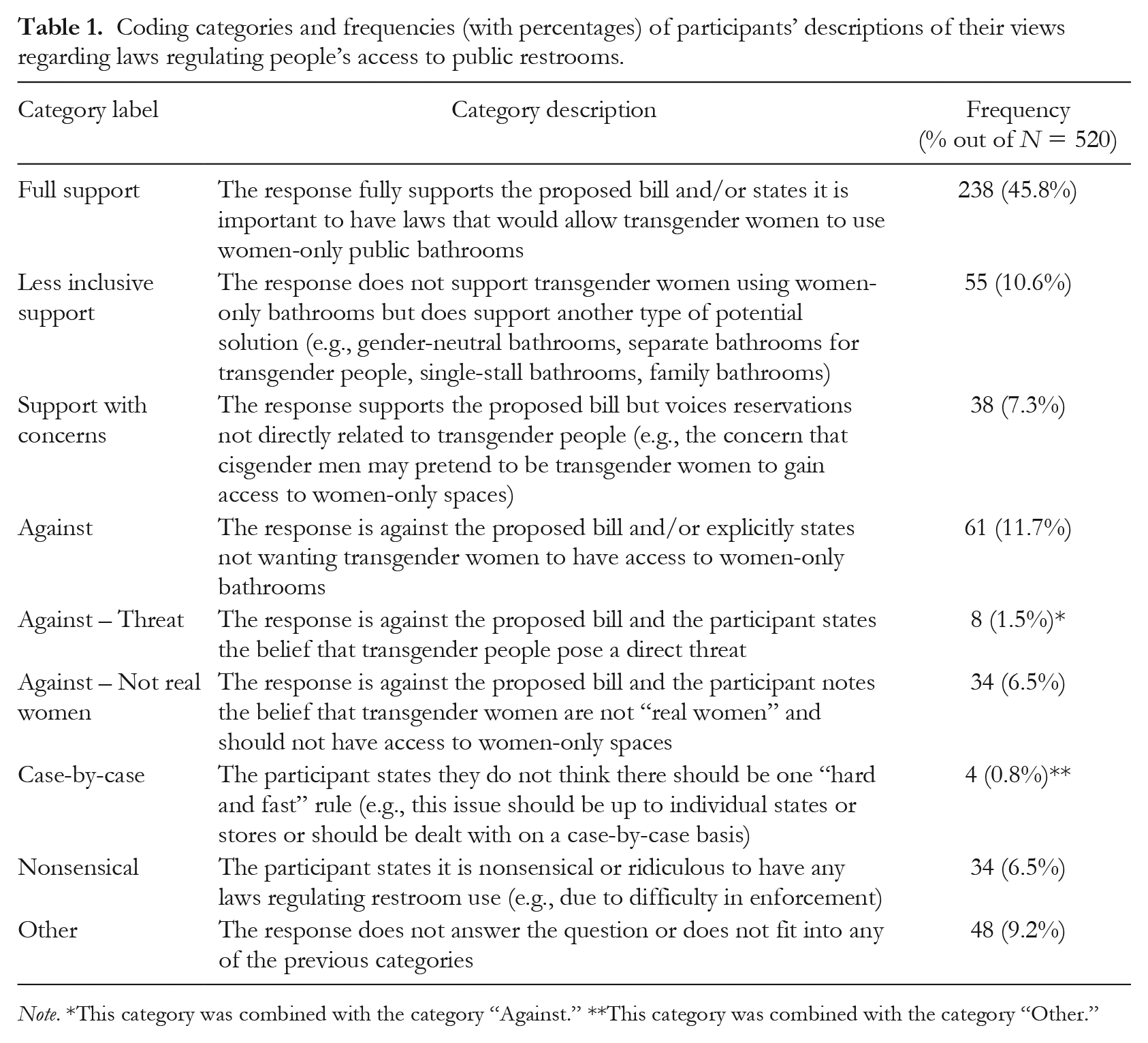
Note. *This category was combined with the category “Against.” **This category was combined with the category “Other.”
Two independent coders (the first author and a second coder who was unaware of the aims of the study) sorted each response into one of the nine categories. Interrater reliability was acceptable (Krippendorff’s α = .63; percent agreement = 71.9%; coder instructions are available at https://researchbox.org/145). Disagreements were reconciled by the second author. Due to low frequencies of responses coded as “Against – Threat” and “Case-By-Case,” these categories were omitted from analyses. All responses initially sorted into “Against – Threat” were recoded as “Against” and those sorted into “Case-By-Case” were recoded as “Other.”
Participants finally provided demographic information, including a question asking whether they personally knew anyone who identifies as transgender (response options: yes, no). This item thus assessed interpersonal contact with transgender people. Two hundred and five participants reported knowing someone who is transgender; these participants were further asked to report their relationship with the transgender person they knew by selecting as many as applied from a list of options. Twenty-eight participants selected family member; four selected spouse; 44 selected close friend; 130 selected acquaintance; 28 selected coworker or colleague; and 15 selected “other.” Participants were then debriefed and compensated.
Results
Initial Exploratory Analyses
Data are available at https://researchbox.org/145. Exploratory correlations collapsing across conditions are presented in Table 2. Support for the proposed state bill that would grant transgender women access to women-only public bathrooms was lower among cisgender women scoring higher (vs. lower) on gender distinctiveness threat (supporting Hypothesis 2), gender identification, and prejudice against transgender women.
Correlations among key measures collapsing across conditions.
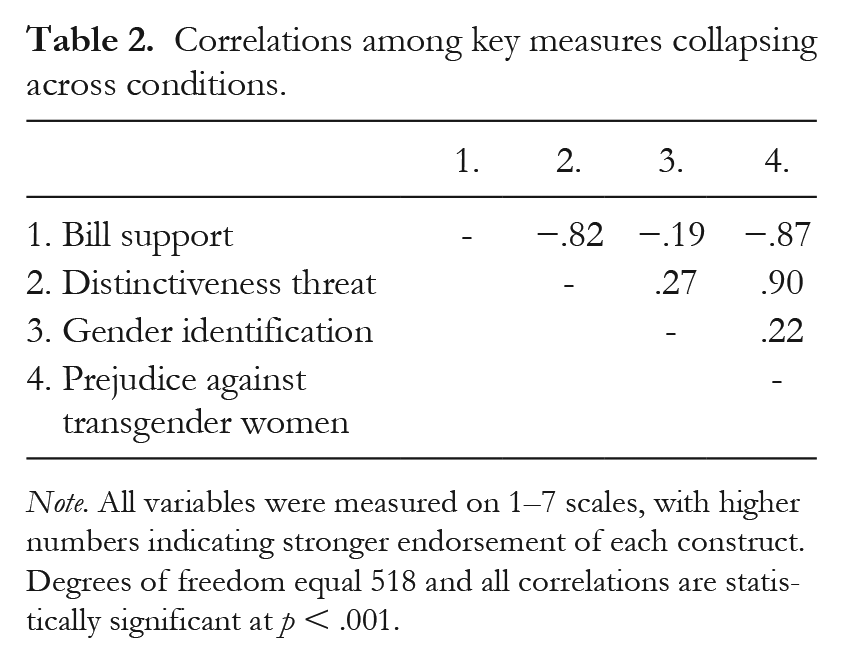
Note. All variables were measured on 1–7 scales, with higher numbers indicating stronger endorsement of each construct. Degrees of freedom equal 518 and all correlations are statistically significant at p < .001.
We next conducted one-way ANOVAs exploring differences across conditions. Descriptive statistics across the full sample and within each condition are reported in Table 3.
1
We observed no reliable omnibus effects of condition on gender identification, F(2, 517) = 1.76, p = .172,
Descriptive statistics for all dependent measures across the full sample and by condition.
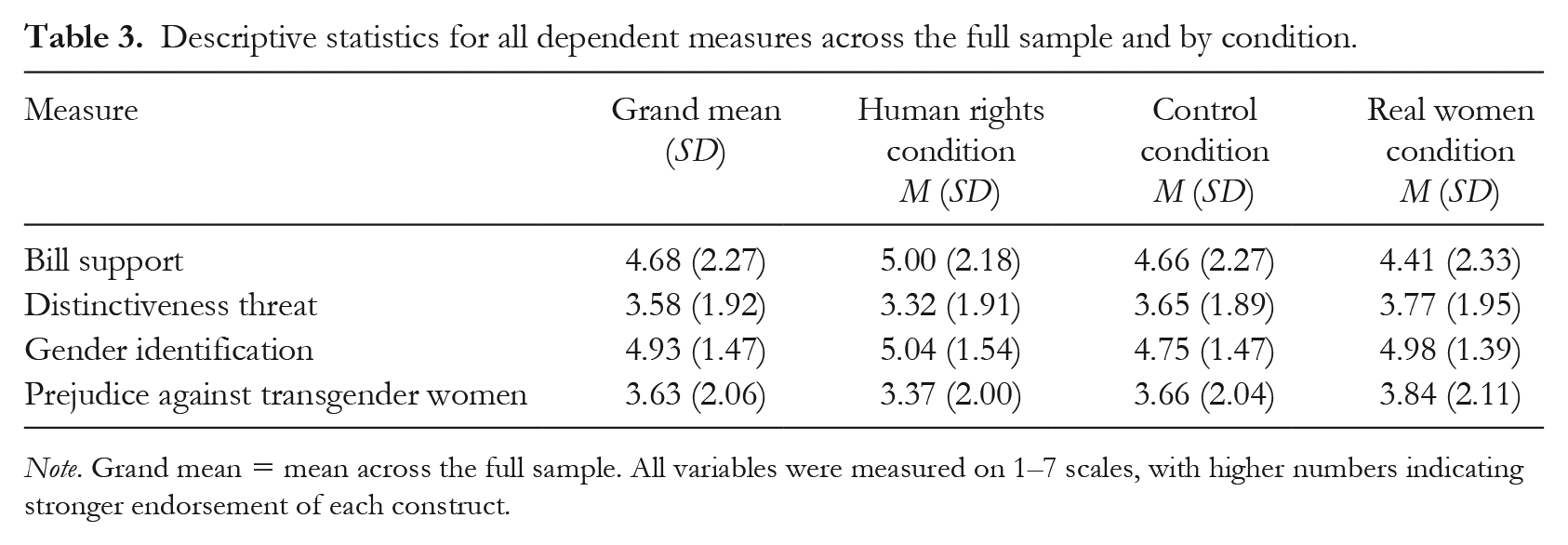
Note. Grand mean = mean across the full sample. All variables were measured on 1–7 scales, with higher numbers indicating stronger endorsement of each construct.
Preregistered Analyses
We conducted a moderation analysis with mean-centered gender distinctiveness threat, mean-centered gender identification, indicator-coded condition (entered in Step 1 of a stepwise linear regression analysis), and all two-way (entered in Step 2) and three-way interactions (entered in Step 3) among these variables as predictors of bill support. We specifically predicted the two-way interaction between condition and gender distinctiveness threat (see https://aspredicted.org/45m4c.pdf), such that bill support would be distinctively low among cisgender women in the real women condition scoring high (+1 SD) on gender distinctiveness threat. Full results are presented in Table 4. The omnibus three-way interaction was not statistically significant, ΔR2 = .00, F(2, 508) = 1.57, p = .210, and neither was any other interaction effect (see Table 4). Thus, we did not observe support for our main prediction (Hypothesis 3). The sole statistically significant association observed in this analysis indicated that higher gender distinctiveness threat predicted lower support for the proposed bill.
Preregistered stepwise regression analysis predicting support for the proposed state bill.
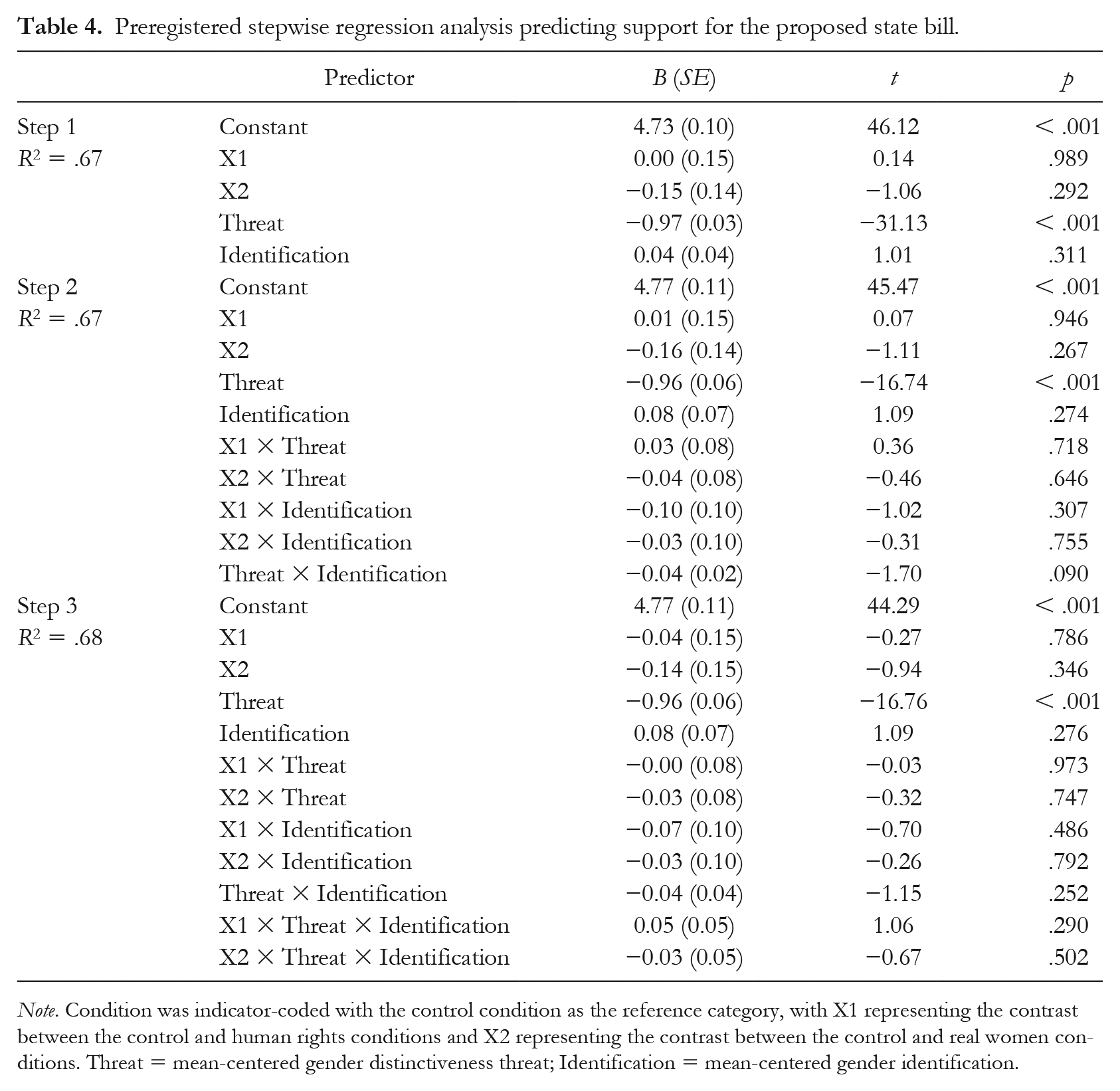
Note. Condition was indicator-coded with the control condition as the reference category, with X1 representing the contrast between the control and human rights conditions and X2 representing the contrast between the control and real women conditions. Threat = mean-centered gender distinctiveness threat; Identification = mean-centered gender identification.
We reconducted this analysis while statistically controlling for prejudice against transgender women, as preregistered. In this model, bill support was negatively associated with gender distinctiveness threat, b = −0.23, SE = 0.07, t(507) = −3.21, p = .001, and prejudice against transgender women, b = −0.76, SE = 0.05, t(507) = −14.02, p < .001; all other effects were statistically nonsignificant.
Exploratory Analyses of Bill Support
Having failed to observe support for Hypothesis 3, we conducted exploratory analyses to better understand the pattern of results. Specifically, we followed up on the finding that cisgender women endorsed less support for the proposed state bill if they read that the bill would imply that their home state believes that transgender women are real women, relative to implying that their home state believes that transgender rights are human rights (note, however, that neither of these conditions differed reliably from the control condition). It is plausible that variation in gender distinctiveness threat might help explain this difference between the two conditions. That is, gender distinctiveness threat may function as a mediator rather than a moderator, such that considering the inclusion of transgender women in the category “women” (relative to considering the inclusion of transgender women in the category “humans”) may elicit gender distinctiveness threat among cisgender women, which may in turn predict lower support for the proposed bill.
To explore this possibility, we conducted a mediation analysis using PROCESS Version 3 (Hayes, 2017) with indicator-coded condition as a multicategorical predictor, mean-centered gender distinctiveness threat as the mediator, and bill support as the outcome (PROCESS Model 4 with 10,000 bootstrap resamples). All regression coefficients are reported in Figure 1. As shown in the figure, participants reported greater gender distinctiveness threat in the real women (vs. human rights) condition, b = −0.45, SE = 0.20, p = .027; the other two pairwise comparisons were statistically nonsignificant. Gender distinctiveness threat (statistically controlling for condition) was negatively associated with bill support, b = −0.96, SE = 0.03, p < .001. Participants also reported lower support for the proposed state bill in the real women (vs. human rights) condition, as demonstrated by the reliable total effect of this pairwise contrast on bill support, b = 0.59, SE = 0.24, p = .014. 2 Moreover, when distinctiveness threat was included in the model, the difference between the real women and human rights conditions on bill support was no longer reliable, as indicated by the direct effect, b = 0.16, SE = 0.14, p = .264. All other total and direct effects were statistically nonsignificant. Finally, tests of indirect effects supported the notion that gender distinctiveness threat mediated the difference between the real women and human rights conditions on bill support, ab = 0.44, SE = 0.20, 95% bootstrapped CI [0.06, 0.82]. Other indirect effects were statistically nonsignificant (i.e., the 95% confidence intervals for the two indirect effects originating from contrasts with the control condition included zero). 3
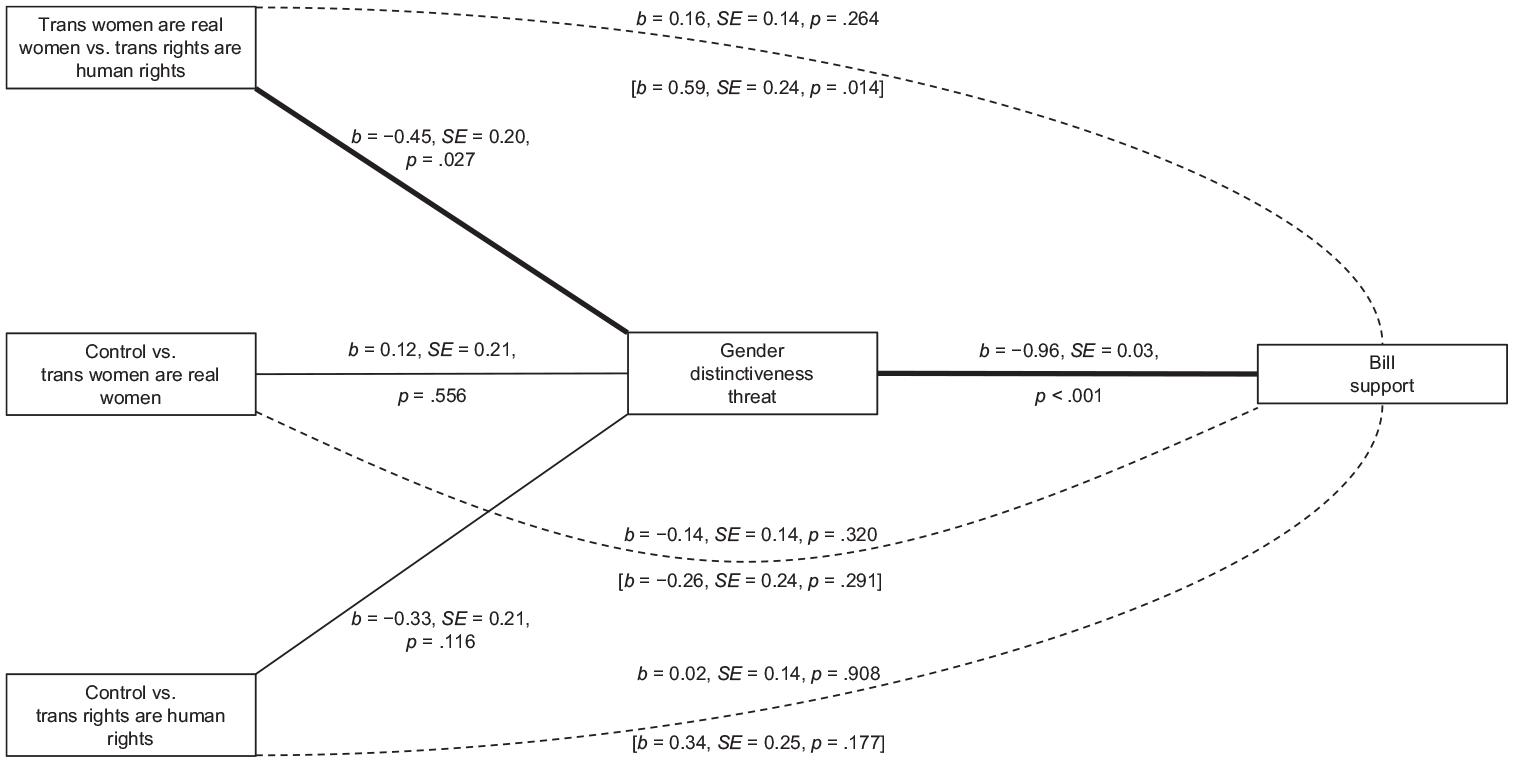
Gender distinctiveness threat mediates the difference in bill support between the real women and human rights conditions.
Exploratory Analyses of Content-Coded Open-Ended Data
We finally explored participants’ content-coded descriptions of their views regarding laws regulating people’s access to public bathrooms. We began by testing whether participants’ responses were coded into the seven categories at different rates as a function of condition (see Table 1 for category descriptions and Table 5 for frequencies by condition). We observed no reliable condition differences, χ2(12) = 19.13, p = .086, Cramer’s V = .14.
Coding frequencies (and percentages) by condition for participants’ descriptions of their views regarding laws regulating people’s access to public bathrooms.
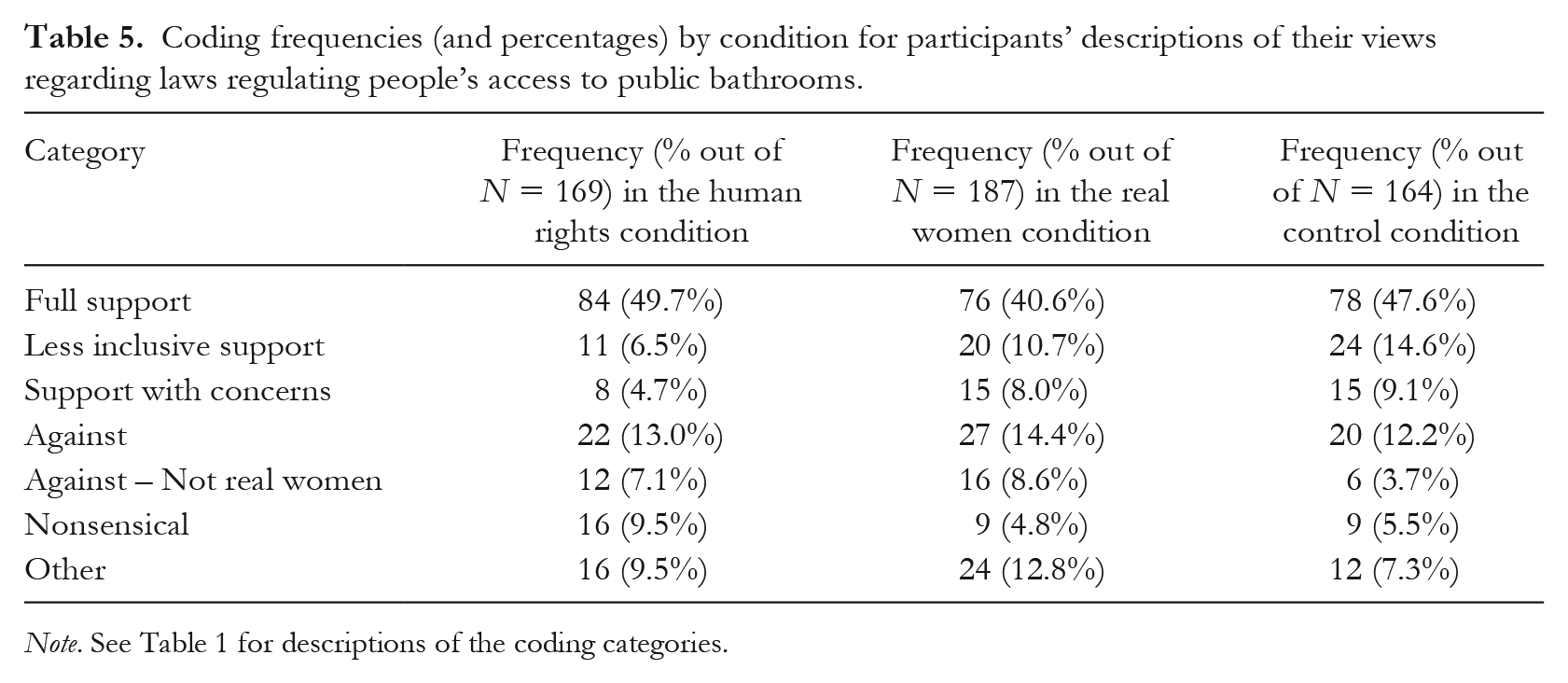
Note. See Table 1 for descriptions of the coding categories.
We next explored whether participants’ views regarding laws regulating people’s access to public bathrooms might predict—either independently or jointly with condition—their support for the proposed state bill granting transgender women access to women-only public bathrooms. Accordingly, we conducted a 3 (condition: human rights vs. real women vs. control) × 7 (coding category) between-subjects ANOVA on bill support, which revealed a statistically significant main effect of coding category, F(6, 499) = 111.25, p < .001,
Mean differences and Bonferroni-corrected pairwise comparisons examining the association of participants’ content-coded views regarding laws regulating public bathroom access with bill support and gender distinctiveness threat.
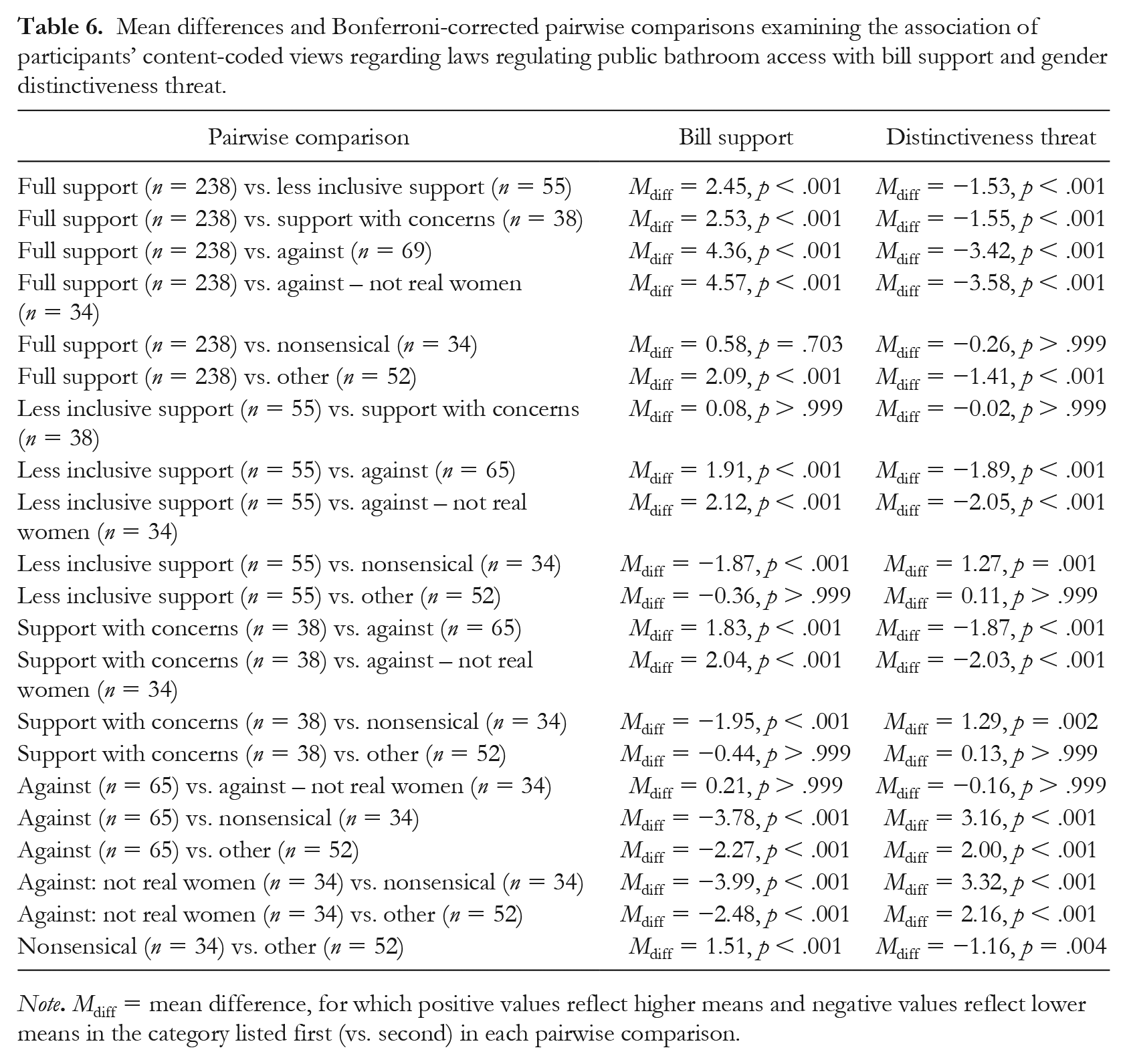
Note. Mdiff = mean difference, for which positive values reflect higher means and negative values reflect lower means in the category listed first (vs. second) in each pairwise comparison.
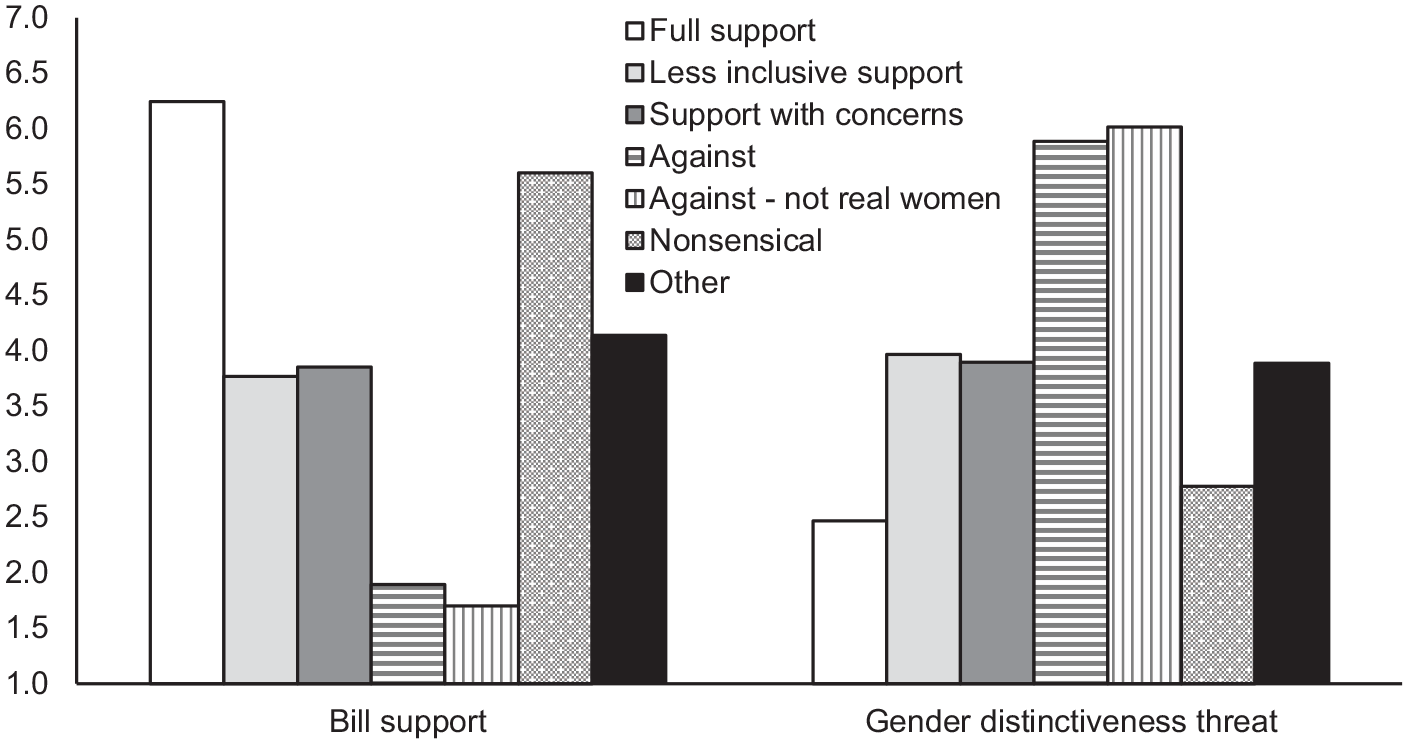
Bill support and gender distinctiveness threat as a function of participants’ content-coded descriptions of their views regarding laws regulating people’s access to public bathrooms.
We conducted this same analysis on gender distinctiveness threat and observed the mirror image of the pattern found for bill support. The main effect of coding category was reliable, F(6, 499) = 73.00, p < .001,
Discussion
The primary goal of the present study was to provide insight into why some cisgender women are reluctant to welcome transgender women to women-only spaces, exemplified by public bathrooms. We specifically examined the possibility that this reluctance may be associated with the belief that transgender women are broadening the meaning of womanhood in a way that is perceived as diluting fundamental distinctions between “real women” and “real men” (i.e., gender distinctiveness threat). We found that cisgender women who perceived transgender women as s source of gender distinctiveness threat were less supportive of a proposed state bill that would grant transgender women access to women-only public bathrooms. In addition to this correlational finding, we observed that cisgender women who read that the proposed bill would imply that their home state officially believes that transgender women are real women were less supportive of the bill, relative to cisgender women who read that the bill would imply that their home state believes that transgender rights are human rights (neither of these conditions was reliably different from the control condition, however). This result is consistent with the interpretation that some cisgender women are against public policies that suggest the inclusion of transgender women in the category “women,” whereas the implied inclusion of transgender women in the category “humans” does not appear to evoke a similarly negative reaction.
We had originally hypothesized that cisgender women who more strongly perceived transgender women as threatening the distinctiveness of gender categories would find the implication that transgender women are real women to be especially unpalatable (see also Outten et al., 2019). However, we did not observe evidence for this hypothesized moderation. Instead, our exploratory mediation analyses indicated that cisgender women who were exposed to the notion that transgender women are women (vs. the notion that transgender rights are human rights) may have experienced greater gender distinctiveness threat, which in turn was correlated with lower support for the proposed bill. Thus, rather than a subset of our participants experiencing greater gender distinctiveness threat at baseline, a sense of threat was evoked by exposure to the notion that transgender women belong to the category “real women.” One means of coping with distinctiveness threat is by enhancing intergroup differentiation (Jetten et al., 2004; Plante et al., 2015), which can be accomplished by opposing legislation that is viewed as blurring group boundaries (Roberts et al., 2017). Taken together, the pattern we observed is in line with the notion that gender distinctiveness threat is one reason why cisgender women may resist the inclusion of transgender women in women-only spaces. One possible explanation for our data being more consistent with mediation than moderation is methodological. Specifically, we measured distinctiveness threat after participants had been exposed to the experimental manipulation, enabling the manipulation to causally affect threat perceptions (see Figure 1). Had we measured distinctiveness threat before exposing participants to the manipulation, this could not have occurred. Indeed, although we were inspired by the findings of Outten et al. (2019) to hypothesize that distinctiveness threat would serve as a moderator in the present study (as it did in Outten et al., 2019), in retrospect our conceptual model, study design, and findings are each more consistent with mediation.
Although we have interpreted our results as consistent with the idea that considering the inclusion of transgender women in the category “real women” can increase distinctiveness threat, an alternative interpretation is plausible as well: Exposure to the idea that transgender rights are human rights may induce a higher level categorization of transgender women into the superordinate ingroup of humans, and this more inclusive categorization could reduce distinctiveness threat. Indeed, according to the common ingroup identity model, encouraging people to recategorize outgroup members into a new, more inclusive common ingroup helps reduce prejudice by redirecting positivity toward the former outgroup (Gaertner et al., 1993). Recategorization has been shown to reduce dimensions of group-based threat (e.g., realistic and symbolic threat; Riek et al., 2010). Given that neither of our two experimental conditions differed reliably from the control condition, our data cannot straightforwardly speak to whether heightened or reduced distinctiveness threat underlies the observed pattern. However, categorization at more inclusive, superordinate levels (e.g., “human” instead of “woman”) can in itself serve as a source of distinctiveness threat (Hornsey & Hogg, 2000), especially if the superordinate category is extremely inclusive (Brewer, 1991). Given that the level of common humanity is arguably one of the most inclusive categories possible (McFarland et al., 2012), we consider it more likely at a conceptual level that our results reflect heightened rather than reduced distinctiveness threat. Future work is needed to test this possibility directly, however.
In addition to our primary findings, our data also revealed intriguing patterns in terms of participants’ open-ended descriptions of their opinions regarding laws regulating people’s access to public restrooms. First, whereas a large proportion of participants (45.8% of the full sample) spontaneously expressed support for gender identity-inclusive bathroom legislation, over half of participants did not do so. Some voiced only limited support, and yet others were explicitly against such legislation. Unlike attitudes toward individuals with minority sexual orientations that have become substantially less negative over time (Charlesworth & Banaji, 2019), openly negative attitudes toward transgender people thus remain widespread (see also James et al., 2016). Although attitudes toward transgender people are routinely considered jointly with attitudes toward minority sexual orientation groups, our data underscore the need to distinguish among groups categorized together under the LGBT umbrella. Had we relied only on survey responses (e.g., our primary outcome variable of bill support), we would not have been able to observe the extent to which participants were willing to express antitransgender attitudes. For example, our open-ended data showed that some participants went so far as to spontaneously voice the opinion that transgender women should not be considered “real” women. These responses lend further support to the notion that concerns about who should count as a “real” woman are indeed associated with some cisgender women’s opposition to transgender rights.
Second, our open-ended data revealed three apparent clusters of cisgender women who reported differential levels of both bill support and gender distinctiveness threat—those voicing clear support for trans-inclusive bathroom legislation, those strongly opposing such legislation, and those landing in the middle, endorsing neutral or inconclusive attitudes. This “middle” cluster consisted of cisgender women supporting “bathroom bills” that are less inclusive of transgender women (e.g., increasing the availability of gender-neutral or single-stall bathrooms) and cisgender women concerned about the possibility that trans-inclusive bathroom legislation may be abused (e.g., by predatory cisgender men seeking access to women-only spaces), in addition to those expressing a mix of responses that were not easily categorizable. We offer the tentative interpretation that favoring less inclusive legislation over fully trans-inclusive public policies and pointing to the possibility that including transgender women in women-only spaces may open the door to sexual predators may represent mere justifications for antitransgender attitudes. This interpretation is also consistent with Outten et al. (2019), who found that cisgender women who were threatened by transgender women were more supportive of gender-neutral than trans-inclusive bathroom policies. Furthermore, our findings have practical importance insofar as societal debate regarding transgender rights continues to focus on putative problems such as sexual predators’ exploitation of the expansion of these rights. That there is no empirical support backing such concerns (Barnett et al., 2018; Hasenbush et al., 2019; Serano, 2021), together with our observation that voicing this concern predicts lesser support for transgender rights and may serve to simply conceal antitransgender views, suggests it may be beneficial to refocus societal debate on more legitimate issues.
Although our data are specific to attitudes toward policies concerning the rights of transgender women, we suggest that distinctiveness threat can help explain reactions to other groups as well. In particular, distinctiveness threat may be at play whenever people consider outgroups that appear to blend across identity-relevant group boundaries. For example, perceivers are more likely to categorize multiracial individuals as belonging to the minority (vs. majority) group reflected in their racial identity (Ho et al., 2020). Thus, Black-White biracial individuals are more likely to be considered Black than White (Ho et al., 2011). One reason this response occurs among White perceivers is the desire to safeguard the dominant social status of the White ingroup (Cooley et al., 2018). However, perhaps this pattern could in part be explained by race-based distinctiveness threat, whereby multiracial individuals are perceived as threatening the distinctiveness of racial categories and are denied membership in the perceiver’s racial ingroup as a means to increase intergroup differentiation. Similar processes could underlie responses to other “in-between” groups as well, such as bisexual and gender nonbinary people (Burke et al., 2017; Morgenroth et al., 2021). Future research would benefit from investigating the extent to which attitudes toward transgender women are unique versus integrated under more general responses to groups that are perceived as diluting intergroup distinctions.
Despite our findings being consistent with the conceptual framework of social identity theory (Tajfel & Turner, 1979, 1986) and suggesting promising directions for future research, we acknowledge key limitations. Most importantly, our findings are limited to cisgender women’s attitudes toward granting transgender women access to women-only public bathrooms. We focused on this issue given that the debate regarding transgender people’s civil rights tends to revolve around transgender women’s access to restroom facilities (Outten et al., 2019; Westbrook & Schilt, 2014). Future work would benefit from examining whether cisgender people also perceive transgender men as a source of gender distinctiveness threat, and whether cisgender men oppose transgender men’s access to men-only spaces due to such perceptions. Given that cisgender women are a marginalized-status group relative to cisgender men, it is possible that cisgender women (vs. men) are more concerned about maintaining the distinctiveness of their gender (representing a form of horizontal hostility; White & Langer, 1999). Moreover, public bathrooms represent only one gender-segregated life domain. Research has begun to address cisgender people’s views on trans-inclusive policies in additional domains such as sports participation (Flores et al., 2020) and admission to women’s colleges (Nanney, 2017; Outten & Lawrence, 2020). Whether gender distinctiveness threat predicts attitudes across different domains remains an open question. It is possible that antitransgender views are evoked more generally due to the gender-segregated nature of a context (Buck & Obzud, 2018); however, it is also possible that bathrooms represent a context that is particularly likely to elicit threat (Schilt & Westbrook, 2015; Westbrook & Schilt, 2014).
Additionally, although the items we used to measure distinctiveness threat align with the traditional conceptualization (rooted in social identity theory; Tajfel & Turner, 1979, 1986) of this form of group-based threat as arising from the perception that a valued ingroup is too similar to a comparison outgroup, our items cannot speak to the specific reasons why some cisgender women view transgender women as threatening the distinctiveness of gender categories. People may find the blurring of group boundaries threatening for a number of reasons. For instance, in the context of the present study, some cisgender women may believe that because transgender women have previously experienced male privilege, their inclusion in the category of women is inappropriate and thus threatening. Future work may productively investigate whether such beliefs underlie gender distinctiveness threat and, more broadly, whether people are able to articulate why they experience distinctiveness threat in specific intergroup contexts.
Finally, although the fact that we took steps to ensure that all our participants were cisgender women is a methodological strength (Tate et al., 2013), our sample was also primarily heterosexual and White. The viewpoints of women from more marginalized groups are therefore not well represented in our data. Future work may assess whether racial or sexual orientation minority cisgender women’s responses to transgender women are qualitatively different from those of straight, White cisgender women. For example, it is plausible that cisgender lesbian (vs. straight) women’s attitudes toward transgender women might be either more positive (e.g., Cortland et al., 2017) or more negative (e.g., Hines, 2019; Weiss, 2003).
In conclusion, we find that eliciting a sense of threat to the distinctiveness of gender categories among cisgender women reduces the degree to which they support policies that grant transgender women access to women-only public bathrooms. That the language used to describe the symbolic meaning of a public policy can impact support for the policy has important implications for policymaking and the continuing debate regarding transgender rights. Language evoking a sense of common humanity (e.g., emphasizing that transgender rights are human rights) may be more successful in reducing cisgender people’s resistance to trans-inclusive public policies in gender-segregated life domains.
Supplemental Material
sj-pdf-1-gpi-10.1177_13684302211042417 – Supplemental material for Evoking gender distinctiveness threat in cisgender women lowers their support for gender-inclusive bathroom policies
Supplemental material, sj-pdf-1-gpi-10.1177_13684302211042417 for Evoking gender distinctiveness threat in cisgender women lowers their support for gender-inclusive bathroom policies by Talia R. Hayes and Anna-Kaisa Reiman in Group Processes & Intergroup Relations
Footnotes
Author note
Talia R. Hayes is now at Lipscomb University. This research is based on Talia Hayes’s undergraduate honors thesis completed at the Department of Psychology, University at Albany, SUNY and advised by Anna Reiman.
Funding
The author(s) received no financial support for the research, authorship, and/or publication of this article.

Supplemental material
Supplemental material for this article is available online.
Notes
References
Supplementary Material
Please find the following supplemental material available below.
For Open Access articles published under a Creative Commons License, all supplemental material carries the same license as the article it is associated with.
For non-Open Access articles published, all supplemental material carries a non-exclusive license, and permission requests for re-use of supplemental material or any part of supplemental material shall be sent directly to the copyright owner as specified in the copyright notice associated with the article.
