







Abstract
Recently, major societal events have shaped perceptions of race relations in the US. The current work argues that people’s motivations to be nonprejudiced toward Black people have changed in concert with these broader societal forces. Analyses of two independent archival datasets reveal that nonprejudiced motivations changed predictably in accordance with shifts in the social milieu over the last 15 years. In one dataset (N = 13,395), we track movement in internal and external motivations to respond without prejudice from 2004 to 2017. Internal motivation initially decreased before ticking upward following multiple events suggesting worsening race relations (e.g., noteworthy killings of unarmed Black men, resurgent racialized politics). Conversely, external motivation initially increased but reversed course across the same time span. A second dataset (N = 2,503) corroborates these trends in two conceptually related nonprejudiced motivations. Results suggest that changes in nonprejudiced motivations may reflect broader shifts in the sociopolitical climate.
“Black Leaders Say Storm Forced Bush to Confront Issues of Race and Poverty.” (The New York Times, 2005). “Obama Elected President as Racial Barrier Falls.” (The New York Times, 2008). “A President Who Fans, Rather Than Douses, the Nation’s Racial Fires.” (The New York Times, 2018).
Over the last 15 years, key social and political events have shaped perceptions of racism in the United States and influenced the extent to which racial prejudice toward Black Americans is perceived as socially acceptable (Crandall et al., 2018; Leach & Allen, 2017). Although some events inspired optimism about racial progress (e.g., the 2008 presidential election of Barack Obama and his reelection in 2012), other events highlighted America’s continued struggle with race (e.g., racial bias in policing practices; Kahn & Martin, 2016). Empirical evidence makes it clear that racial prejudice persists in American society and remains widespread among most White Americans at the automatic level (e.g., Schmidt & Axt, 2016). However, many White Americans who recognize the presence of racial biases are motivated to curb outward expressions of prejudice for personal and/or social reasons (Dunton & Fazio, 1997; Plant & Devine, 1998).
Although researchers conceptualize nonprejudiced motivation in different ways, they generally agree that people who are sufficiently motivated to avoid expressing prejudice can successfully prevent prejudiced responding in the short term. This can be accomplished by influencing the extent to which automatic prejudice is activated (Devine et al., 2002) or by stymieing the behavioral expression of existing automatic prejudice (see Fazio & Olson, 2014). Across approaches, nonprejudiced motivation plays a key role in limiting or licensing the public expression of prejudice and shaping behavior toward derogated individuals. Drawing from work indicating that social norms change over time and can shape attitudes and behaviors (Ajzen, 1991; Cialdini, 2007; Crandall et al., 2002), we posit that changes in perceived nonprejudiced norms may similarly correspond to changes in motivations to respond without prejudice toward Black people. In the present work, we explore trends in different nonprejudiced motivations over the past 15 years, a period characterized by great social and political change. We expect that, over this time, people’s nonprejudiced motivation ebbed and flowed in concert with prominent perceived changes in nonprejudiced social norms that reflected the prevailing sociopolitical climate.
Nonprejudiced Motivations
Prejudiced expressions can be conceptualized as the downstream consequence of the automatic prejudice that characterizes many White Americans (for a review, see Fazio & Olson, 2014). Individuals vary in the degree to which they are motivated to control their prejudices. Among individuals relatively low in motivation, automatic prejudices often guide impressions, judgments, and behavior (Fazio et al., 1995). In contrast, individuals relatively high in motivation to respond without prejudice—likely derived from personally held egalitarian beliefs, social image concerns, or both—can often inhibit the expression of prejudice. Actual levels of prejudice may be especially low in some individuals with deeply internalized motivation (Devine et al., 2002). Moreover, even when motivated individuals harbor some prejudice, it can be inhibited or corrected given adequate opportunity (e.g., time, cognitive resources) to perform such corrections (e.g., Olson & Fazio, 2004). Thus, motivation can counter the influence of automatic prejudice and prevent its expression in judgments and behavior (Fazio & Olson, 2014).
Given the key role of motivation in determining the attitude–behavior link, multiple measures have been designed to capture people’s motivations to respond in a nonprejudiced manner. The Internal and External Motivation to Respond Without Prejudice scales (IMS and EMS, respectively; Plant & Devine, 1998) assess the degree to which personal values and social concerns motivate people to respond without racial prejudice. Internal motivation stems from a personal dedication to egalitarianism, whereas external motivation stems from a fear of negative social consequences were one to express prejudice. The Motivation to Control Prejudiced Reactions (MCPR) Scale (Dunton & Fazio, 1997) similarly assesses two motivations for inhibiting prejudiced expressions; concern with acting prejudiced (concern) refers to a blend of personal and reputational reasons for inhibiting prejudice, whereas restraint to avoid dispute (restraint) more narrowly targets one’s willingness to curb expressions of prejudice in the interest of avoiding conflict.
Both pairs of measures have proven useful in capturing the different motives for inhibiting or responding without prejudice. Indeed, several studies have found that accounting for the source of motivation has important implications for racially relevant responses (e.g., Amodio et al., 2003, 2008; Devine et al., 2002; Plant & Devine, 2001; Richeson & Trawalter, 2008). For example, people high in internal motivation and low in external motivation exhibit lower levels of prejudice and demonstrate more ability to regulate the expression of both implicit and explicit prejudice (Amodio et al., 2003, 2008; Devine et al., 2002). By contrast, people who are primarily externally motivated tend to express resentment and anger toward perceived social pressure to be politically correct, and often express backlash against this pressure when it is removed (Plant & Devine, 2001).
Research on motivations to control prejudiced reactions and their implications for behavior also demonstrates the utility of considering different nonprejudiced motivations (Maddux et al., 2005; Olson & Fazio, 2004; Towles-Schwen & Fazio, 2003, 2006). For example, people predominantly high in concern with expressing prejudice are more likely to have positive and more frequent interracial interactions compared to those predominantly high in restraint to avoid dispute. Further, individuals high in concern motivation vigilantly monitor any existing negative racial attitudes so as to inhibit the overt expression of prejudice (Towles-Schwen & Fazio, 2001). Conversely, people high in restraint motivation seek to avoid appearing prejudiced by eschewing situations in which race-related conflict might arise. When the associations between motivations to respond without prejudice and motivations to control prejudiced reactions have been examined, concern tends to correlate with IMS (.45 > r < .59), and restraint tends to correlate, albeit less so, with EMS (.24 > r < .39; e.g., Fazio & Hilden, 2001; Plant & Devine, 1998). Thus, past work supports the idea that personal nonprejudiced motivations (IMS and concern) and socially derived nonprejudiced motivations (EMS and restraint) capture distinct but conceptually related constructs.
Nonprejudiced Social Norms
In addition to motivations affecting people’s attitude and behaviors, extensive work demonstrates that people tend to be particularly sensitive to the normative climate and often tailor their behaviors to align with perceived social norms (Aarts & Dijksterhuis, 2003; Nolan et al., 2008; Prentice & Miller, 1993; Schultz et al., 2007). As such, we suspect that perceived norms play a role in shaping people’s motivations to control and respond without prejudice.
However, people’s perceptions of social norms and of what society deems acceptable can change across contexts and time (Blanchard et al., 1994; Crandall et al., 2002, 2018; Tankard & Paluck, 2017). Research has demonstrated that major sociopolitical events can affect perceptions of prejudice-related social norms (Crandall et al., 2018; Tankard & Paluck, 2017). For example, the Obergefell v. Hodges (2015) Supreme Court decision, which guaranteed same-sex couples the right to marry, led to a significant increase in the perceived social acceptance of same-sex marriage (Tankard & Paluck, 2017).
While the sociopolitical climate grew more supportive of LGBTQ+ rights in the mid-2010s, other major events during that time may have had the opposite effect on race relations. For example, public opinion polling suggests that perceptions of positive race relations between Black people and White people in the US dropped dramatically following the notable deaths of Michael Brown and Freddie Gray, two unarmed Black men who died in police custody. After the 2014 death of Michael Brown, perceptions of positive race relations declined over 20% (Pew Research Center, 2017). Perceptions of positive race relations weakened an additional 30% in the immediate aftermath of the 2015 death of Freddie Gray (Pew Research Center, 2017). In addition to perceiving worsening race relations during the mid-2010s, Americans also grew more likely to acknowledge the prevalence of racial discrimination in the US. In 2016, 48% of Americans reported there was “a great deal” or “a lot” of discrimination toward Black people in the United States, up from only 32% in 2012 (American National Elections Studies, 2016).
The race-relevant nature of multiple societal events over the past 15 years, some antiprejudicial and some proprejudicial, gives reason to suspect that perceived nonprejudiced norms may have changed in response to shifts in the sociopolitical climate. For example, the 2008 presidential election of Barack Obama symbolized a progressive milestone for much of society (Effron et al., 2009). Indeed, Americans in general expressed increased optimism about the state of race relations, and Black Americans specifically reported being better off than they were 5 years before the 2008 election of the country’s first Black president (Pew Research Center, 2010). Empirical work also suggested an initial reduction in automatic prejudice upon increased exposure to President Obama (Plant et al., 2009). By contrast, the highly publicized killings of unarmed Black men in the mid-2010s challenged America’s “postracial” status. Social movements, such as the Black Lives Matter (BLM) movement, consequently emerged and focused the national spotlight on extant societal and institutional racism. Perceptions of race relations further worsened during the 2016 U.S. presidential election, which culminated in the victory of a political outsider with a history of notably racialized appeals (e.g., “birtherism”) and a long history of racial discrimination and intolerance (Graham et al., 2019). These events and others likely altered people’s perceptions of nonprejudiced norms in the United States over this period. As testament, 42% of Americans reported worrying a “great deal” about race relations after President Trump’s 2017 inauguration, more than double the number that reported such concern after Obama’s 2008 campaign and inauguration (Gallup, 2017).
The national conversation around police-involved deaths of Black men and lingering anti-Black discrimination likely increased motivated antiracism advocacy for some (e.g., the Black Lives Matter movement). However, others may have looked to separate sociopolitical events during that same time as evidence of weakened societal restrictions on the expression of prejudice (e.g., backlash against the BLM movement, resurgent White nationalism, the rise of the Alt-Right). Indeed, the number of hate groups in the US abruptly increased in 2015 (Potok, 2016), concurrent with the launch of Donald Trump’s presidential campaign and the highly racialized 2016 presidential election cycle. Moreover, data from the Federal Bureau of Investigation (FBI) reveal that race-based crimes ticked upward over this same time period, increasing from 2014 to 2017 (FBI, 2017). Together, these findings suggest that as the sociopolitical context changes, so too do nonprejudiced norms and, we posit, so too do nonprejudiced motivations.
Specifically, we argue that perceived changes in the sociopolitical climate should coincide with shifts in externally derived nonprejudiced motivations (i.e., EMS and restraint motivations, which stem from reputational or conflict-avoidance concerns). When perceptions of the social context indicate that nonprejudiced social norms are prevalent in society, people will likely be motivated to curb expressions of prejudice and avoid violating that norm. Indeed, such nonprejudiced motivations are associated with heightened concerns about appearing prejudiced and a tendency to conform to nonprejudiced social pressure (e.g., Fazio & Olson, 2007; Plant, 2004; Plant et al., 2010). Salient nonprejudiced social norms should heighten the perceived likelihood of incurring reputational damage or provoking race-related conflict if one were to express prejudice, resulting in elevated external and conflict-avoidance (i.e., EMS and restraint) nonprejudiced motivations.
Perceived changes in the sociopolitical climate should also coincide with shifts in personal motivations (i.e., IMS and concern motivations, which reflect an individual’s commitment to nonprejudiced standards). Indeed, people with nonprejudiced personal standards respond to discrepancies between these standards and expressions of prejudice with a motivation to eliminate this bias (Monteith, 1993; Monteith & Walters, 1998; Plant & Devine, 1998). It is likely that prejudice-relevant events and normative shifts in society more broadly are highly salient to those with a strong personal nonprejudiced motivation. Indeed, theories of self-regulation suggest that people actively seek to reduce perceived goal discrepancy and adjust their behavior to correct for a perceived mismatch between personal standards (e.g., being a kind person) and goal-relevant events (e.g., how they treat their neighbor; Carver & Scheier, 1990). Applying this theorizing to the current work, when people with nonprejudiced personal standards (i.e., those relatively high in IMS and concern) perceive egalitarianism in society, there is no mismatch between their personal standards and society. As a result, their personal motivation may seem less relevant or necessary. Conversely, in the face of growing societal prejudice and racial tensions, people with nonprejudiced personal standards may view their standards as highly salient and vital to espouse in hopes of bringing society in line with their standards. The result may be a heightened relevance of people’s nonprejudiced personal standards. Thus, personal nonprejudiced motivation should rise when those who are personally motivated perceive evidence of societal prejudice and racial tension and recede when those who are personally motivated perceive evidence of positive race relations.
The Current Work
In the current work, we explored how different nonprejudiced motivations changed across shifting social contexts, specifically during the socially tumultuous period of 2004 to 2017. We expected that nonprejudiced motivations would change predictably over this time span as people reflect the prevailing norms and, hence, shift their opinions, motivations, and behaviors in response to them (Ajzen, 1991; Cialdini, 2007; Festinger, 1954; Manning, 2011; Pool & Schwegler, 2007; Sassenberg et al., 2011; Tajfel & Turner, 1979). Specifically, we expected fluctuations in the different types nonprejudiced motivations to reflect perceptions of institutional and societal shifts over this period, such that major events would differentially heighten or attenuate nonprejudiced motivations depending on the source of each motivation.
Specifically, EMS and restraint levels should be relatively high when major events suggest the presence of strong nonprejudiced norms; EMS and restraint should be lower, however, when major events and cultural movements suggest weakened nonprejudiced norms. In contrast, IMS and concern levels should be relatively high when society is perceived to be espousing racial prejudice and race relations are tense; IMS and concern levels should be lower when society is perceived to be trending toward racial egalitarianism and governed by strong nonprejudiced norms.
Recent Trends in Perceived Race Relations
In order to test our hypotheses, we needed assessments of perceptions of social norms and race relations during the same time frame for which we had measures of nonprejudiced motivations. Most years in June, Gallup conducts phone interviews with adult U.S. citizens to obtain their opinions about race relations in the US. Each of the Gallup surveys has at least 1,000 respondents. In 2016, Gallup released a report summarizing the results of these surveys by year (2001–2008, 2013, and 2015–2016) and self-reported race/ethnicity (i.e., Whites, Blacks, Hispanics; Gallup, 2016). Given that our hypotheses revolved around temporal changes in Whites’ nonprejudiced motivations and considering that both samples in the current work included only White participants, we focused on the responses of White people to the following question asked in the Gallup surveys: “Next we’d like to know how you would rate relations between various groups in the United States these days. Would you say relations between—Whites and Blacks—are very good, somewhat good, somewhat bad, or very bad?” (Gallup, 2016).
The report provided by Gallup indicated the percentage of White people who selected each response (Gallup, 2016). For the purposes of the current work, we summed the percentages for “very good” and “somewhat good” as a proxy for perceptions that race relations were good in the US. Given the limited number of data points, we did not directly test changes in perceptions of race relations. Instead, we plotted the percentage of people who thought race relations were good on the same graphs as our measures of IMS and EMS and fit a trendline to the Gallup data. This allowed us to visually examine the relation between nonprejudiced motivations and perceptions of race relations. 1
Study 1
In our first study, we examined changes in nonprejudiced motivation over time using the IMS and EMS scales (Plant & Devine, 1998). Because we were interested in changes in motivation across periods of time that varied in sociopolitical climate, we analyzed trends across a 14-year period (2004–2017) spanning vastly different social and political contexts. As suggested previously, there was strong reason to anticipate that White Americans perceived racial progress as generally good, if not improving, from the early 2000s and through Obama’s two elections (Gallup, 2016; Newport, 2008; Saad, 2005). Indeed, national yearly polls indicate that Americans perceived race relations to be improving from 2004 into Obama’s presidency. However, following Obama’s second election, the highly publicized shootings of unarmed Black individuals, backlash against the BLM movement, and eventual nomination and election of Donald Trump were likely strong indicators that racial tensions were prevalent and nonprejudiced norms had weakened (Gallup, 2016; Kahn & Martin, 2016; Pew Research Center, 2017). The Gallup (2016) data used in the present work present evidence of this worsening trend in perceived race relations.
Based on these temporal shifts in perceived race relations during the time span covered by this study and the Gallup poll data, we expected to observe a negative quadratic trend in external motivation, such that it would rise as societal events suggested strong nonprejudiced social norms (e.g., the election of Obama) but decline when changes in the climate indicated weakened nonprejudiced norms (e.g., backlash against the BLM movement, rise of the Alt-Right, campaign and election of Trump). In contrast, we predicted a positive quadratic trend to emerge for internal motivation, such that internal motivation would decline during times of ostensible racial progress but tick upward when the social climate highlighted societal prejudice.
Method
Participants and procedure
We assessed changes in motivation by analyzing archival data—a useful approach to capture change over time (Cheung et al., 2017). Participants were 14,034 White undergraduate students enrolled in the subject pool at a large southeastern university. Participants completed the IMS and EMS scales (Plant & Devine, 1998) during the mass screening protocol at the beginning of each semester. We excluded participants from the total sample if they did not complete all 10 items on the IMS/EMS scale (n = 638). Therefore, our final sample was 13,395 White undergraduate students (4,559 males, 8,821 females, 15 unreported gender) enrolled at a large public university between 2004 and 2017 (see Table 1 for a breakdown of sample size by year). The samples providing responses over time were similar in their race, age, region of the country, education level, and the situations under which they provided their responses to ensure that changes in motivation were not solely due to changes in sample characteristics.
Motivations to respond without prejudice sample: Sample size, descriptive statistics, and correlations by year.
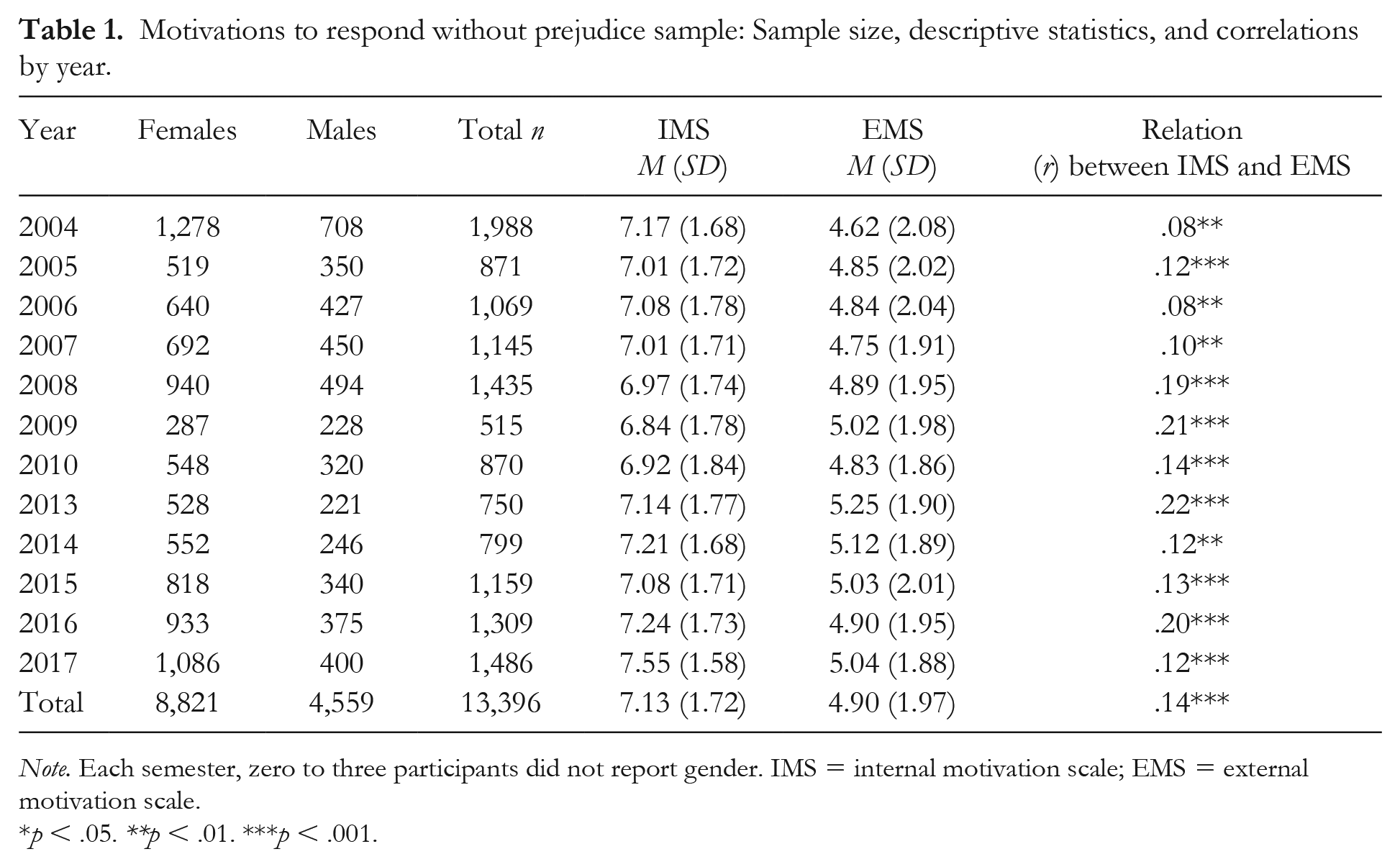
Note. Each semester, zero to three participants did not report gender. IMS = internal motivation scale; EMS = external motivation scale.
p < .05. **p < .01. ***p < .001.
Five items assessed IMS (e.g., “I attempt to act in nonprejudiced ways toward Black people because it is personally important to me”; α = .85), and five items assessed EMS (e.g., “I try to hide any negative thoughts about Black people in order to avoid negative reactions from others”; α = .82). All items (see supplemental material) were rated on a scale ranging from 1 (strongly disagree) to 9 (strongly agree). As seen in Table 1, IMS and EMS were not administered every semester and, unfortunately, were not administered at all in 2011 and 2012.
To assess statistical power, we performed a sensitivity analysis using G*Power 3.1.9.3 to obtain an estimate of the smallest detectable effect size (f2) given our sample size and number of predictors with a power of .80, alpha of .05, and two-tailed tests (Faul et al., 2009). After converting f2 to r2 (to be consistent with the effect sizes we report hereafter), we found that the minimal detectable effect size was r2 = .001. Raw data and syntax can be accessed on the Open Science Framework database (https://osf.io/9725d/?view_only=8d176d25021c4f9eb6358a5778626708).
Results
In order to examine our predicted trends in motivation over time, we conducted multiple hierarchal regressions testing our two hypothesized quadratic relationships between time and each motivation. In each model, we predicted nonprejudiced motivation from its alternate motivation (Step 1), time (Step 1), and time squared (Step 2). That is, when internal motivation was the outcome variable, external motivation was included as the covariate, and vice versa. The results were virtually identical whether or not the other motivation was included as a covariate, so we used the more conservative approach of controlling for it (for a summary of results without covariates across studies, see Table S1 in the supplemental material; for a summary of results when controlling for demographic characteristics of the sample [i.e., gender, age, political party, religion], which were identical in significance and strength, see Table S2 in the supplemental material).
For the analysis of EMS, we found a positive linear effect of time, b = 0.11, 95% CI [0.08, 0.14], t(13392) = 6.56, p < .001, r2semipartial = .06, in Step 1 such that, overall, external motivation increased over time. There was also a significant positive effect of IMS on EMS, b = 0.15, 95% CI [0.13, 0.17], t(13392) = 15.60, p < .001, r2semipartial = .13. Importantly, we also observed a significant negative quadratic effect of time, b = −0.10, 95% CI [−0.14, −0.06], t(13392) = −4.57, p < .001, r2semipartial = −.04, indicating that EMS initially increased over time before reversing course and decreasing in later years (see Figure 1).
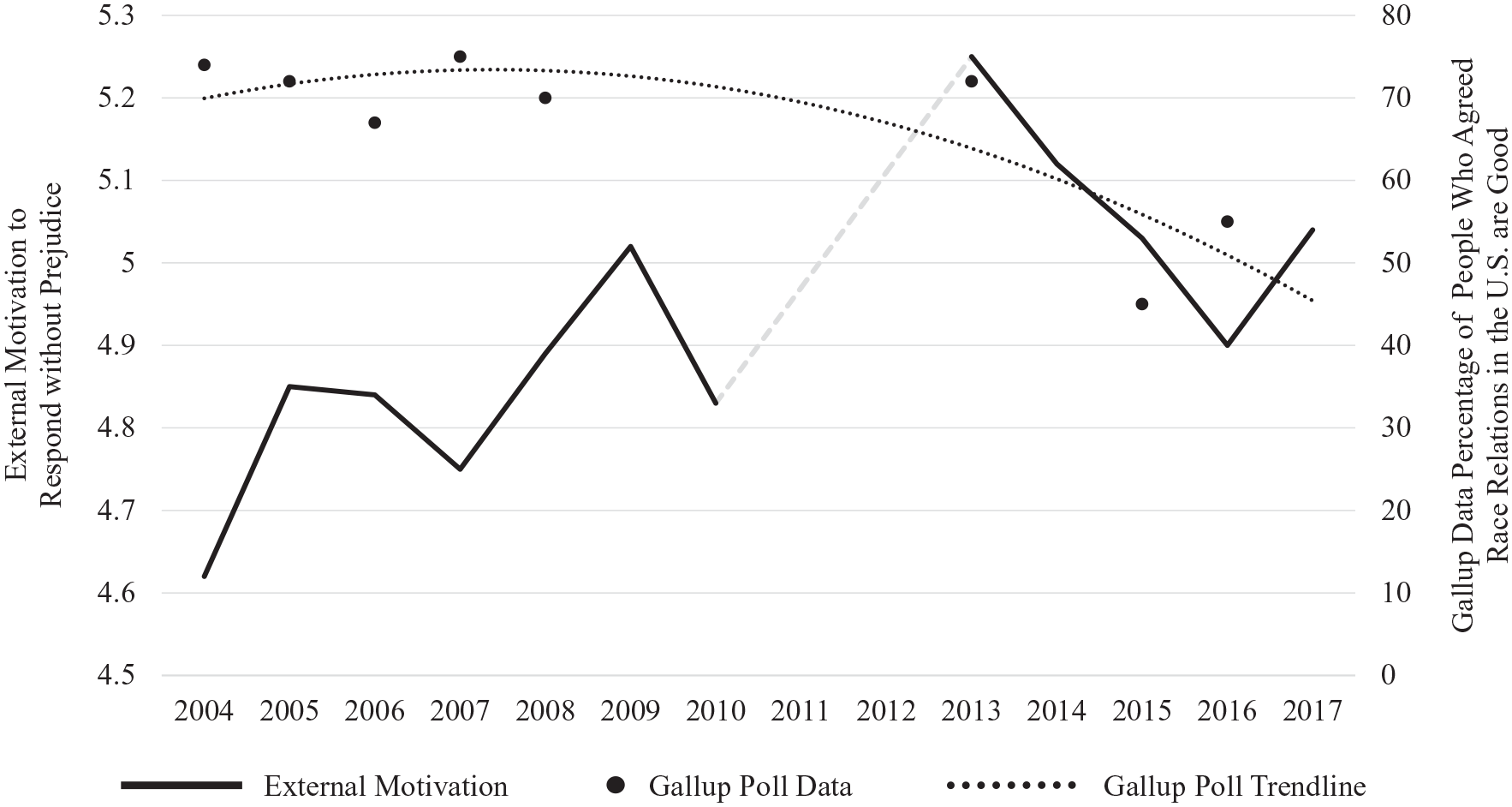
Changes in external motivation plotted with changes in perceptions that race relations are good in the US (Gallup sample).
For the analysis of IMS, we also found a significant positive linear effect of time, b = 0.08, 95% CI [0.05, 0.11], t(13392) = 5.50, p < .001, r2semipartial = .05, in Step 1, such that internal motivation increased over time. There was also a significant positive relationship between EMS and IMS, b = 0.12, 95% CI [0.10, 0.13], t(13392) = 15.60, p < .001, r2semipartial = .13. However, as predicted, there was a positive quadratic effect of time, b = 0.18, 95% CI [0.14, 0.22], t(13392) = 9.42, p < .001, r2semipartial = .08, indicating that IMS initially decreased over time but began to tick back upward in later years (see Figure 2).
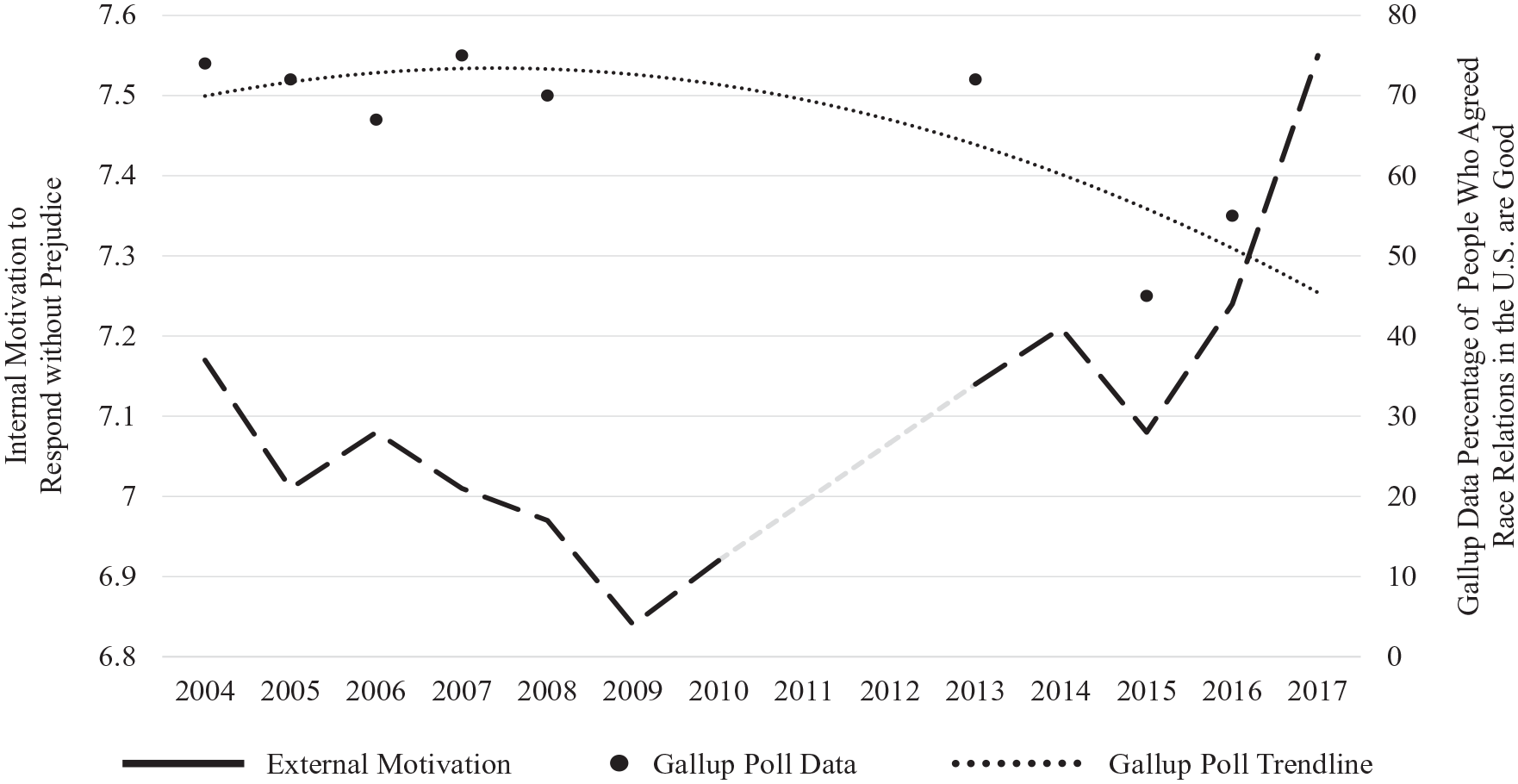
Changes in internal motivation plotted with changes in perceptions that race relations are good in the US (Gallup sample).
Next, we examined whether these changes in internal and external motivation over time corresponded with changes in perceptions of race relations in the US. Because we did not include a measure of perceptions of race relations in the mass screening sessions in which participants completed the internal and external motivation scales, we used the Gallup poll data to test this hypothesis. Given the limited number of data points, we did not directly test changes in perception of race relations. Instead, we plotted the percentage of people who thought race relations were good on the same graphs as internal motivation and external motivation, and fit a parabolic trendline to the Gallup data since there we only had Gallup data for 8 of the years. This allowed us to visually examine the relation between internal motivation, external motivation, and perceptions of race relations. Consistent with our predictions, we found that perceptions that race relations were good appeared to correspond with increases in external motivation (see Figure 1) but decreases in internal motivation (see Figure 2).
Finally, because there was a break in years where EMS and IMS were collected between 2010 and 2013, we wanted to directly test for the presence of linear trends in the data within the two contiguous time frames (i.e., 2004–2010 and 2013–2017). Specifically, we were interested in examining whether there were linear trends from 2004 to 2010 where EMS increased and IMS decreased, and then linear trends from 2013 to 2017 where EMS decreased and IMS increased. In order to examine these predictions directly, we conducted two regression analyses (one for 2004–2010 and the second for 2013–2017). In each model, we predicted nonprejudiced motivation from its alternate motivation and time.
Consistent with the previous analyses, the alternate motivation was a significant covariate in each analysis, but we will focus on the potential linear effects since they were of key interest. In each case, the linear trend was consistent with predictions. For the analysis of EMS during 2004–2010, we found evidence of a linear trend of time such that EMS increased over time, b = 0.05, 95% CI [0.03, 0.07], t(7890) = 4.50, p < .001, r2semipartial = .05. For the analysis of IMS during 2004–2010, we found evidence of a linear trend of time such that IMS decreased over time, b = −0.05, 95% CI [−0.07, −0.03], t(7890) = −5.00, p < .001, r2semipartial = −.06.
For the analysis of EMS during 2013–2017, we found evidence of a linear trend of time such that EMS decreased over time, b = −0.07, 95% CI [−0.11, −0.04], t(5500) = −3.75, p < .001, r2semipartial = −.05. For the analysis of IMS during 2013–2017, we found evidence of a linear trend of time such that IMS increased over time, b = 0.11, 95% CI [0.07, 0.14], t(5500) = 6.48, p < .001, r2semipartial = .09.
Discussion
Using a large, archival dataset spanning 14 years, we found that internal and external motivations to respond without prejudice trended differentially, but predictably, across a period of marked sociopolitical change. External motivation increased into the Obama era, when perceptions of race relations were positive. During this time, nonprejudiced social norms were likely prevalent and provided a fair degree of social pressure to curb the expression of racial prejudice (Effron et al., 2009; Fiske & Hancock, 2016; Gallup, 2016). However, external motivation began to wane during Obama’s second term and onward, when perceptions of race relations grew more negative. During this time, nonprejudiced social norms were likely less prevalent, as suggested by the concurrent backlash to the BLM movement, the rise of the Alt-Right, and the onset of a markedly racially charged 2016 election cycle. Moreover, this decrease in external motivation coincides with the observed decrease in perceptions of positive race relations in the Gallup (2016) data and the stark rise in the number of hate groups active in the US (Potok, 2016).
In contrast, internal motivation showed the opposite pattern of change during this same period. Initially, internal motivation declined leading into the Obama era, when nonprejudiced social norms were likely prevalent. During this time of ostensible racial progress, internally motivated people may have perceived society’s standards to be in line with their own personal egalitarian beliefs; hence, such individuals may have relaxed their personal commitment to be nonprejudiced as their egalitarian goals for society seemingly had been achieved. However, internal motivation began to increase during Obama’s second term, as greater national attention was focused on the effects of societal prejudice (e.g., with the highly publicized deaths of Black men at the hands of police). Internal motivation further increased during the highly racialized 2016 presidential election cycle and Trump’s subsequent rise to political power—when the discrepancy between society’s nonprejudiced standards and internally motivated people’s egalitarian beliefs may have been particularly prominent. As with external motivation, the trend in internal motivation over this time coincided with the observed decrease in perceptions of positive race relations in the Gallup (2016) data.
Study 2
In Study 1, we observed movement in both internal and external motivation to respond without prejudice, especially over the later years when racial tension seemed to rise. To corroborate these findings, we conducted a similar exploration using a second, independent archive of data spanning the final 6 years examined in Study 1 (i.e., 2012–2017). Study 2 extends the findings of Study 1 by tracking changes over time in conceptually similar, but different, types of nonprejudiced motivations: concern with acting prejudiced and restraint to avoid dispute (Dunton & Fazio, 1997). Because of the earlier discussed relationship between these measures, we expected EMS and restraint and IMS and concern to exhibit similar trends over time. We predicted that restraint, like EMS, would decrease from 2012 to 2017 as people particularly sensitive to prejudice-related social norms may have perceived weakening in such norms (i.e., evidence that prejudice was becoming more socially tolerated). In contrast, we predicted that concern, like IMS, would increase during this time as people with nonprejudiced personal standards perceived increased evidence of societal prejudice (e.g., police-involved killings of unarmed Black men) that conflicted with their own beliefs.
Method
Participants and procedure
Participants were 2,503 White undergraduates enrolled at a separate large public university from 2012 to 2017. Because data were initially collected for independent research projects, we did not have access to other demographic information. However, like in Study 1, each sample cohort consisted of participants with similar demographic characteristics (age, level of education, etc.). All data were culled from mass screenings for prior research projects conducted at the same university from 2012 to 2017, yielding an archive of separate samples of undergraduate respondents from these years. No participants were excluded from our analyses. Using the same procedure for the sensitivity analysis outlined before, we found that the minimal detectable effect size was r2 = .002.
To assess potential change in nonprejudiced motivations over time, we analyzed responses on the MCPR scale (Dunton & Fazio, 1997) from 2012 to 2017. The scale comprises two subscales: (a) Concern With Acting Prejudiced Subscale, which targets self-image-derived reasons for acting nonprejudiced, and (b) Restraint to Avoid Dispute Subscale, which targets conflict-avoidance reasons for acting nonprejudiced. The 17-item MCPR scale is factor-scored into two distinct motives (see Table S3 in the supplemental material for factor loadings; Dunton & Fazio, 1997). As in Dunton and Fazio’s (1997) original study, some concern items in our work loaded especially highly on the Concern factor, and some restraint items loaded especially highly on the Restraint factor. Thus, we created factor scores for concern (e.g., “I get angry with myself when I have a thought or feeling that might be considered prejudiced”) and restraint motivations (e.g., “I always express my thoughts and feelings, regardless of how controversial they might be” [reverse-scored]) using the factor loadings from a principal components analysis with varimax rotation.
Respondents indicated their agreement with each item on a scale ranging from 1 (strongly disagree) to 7 (strongly agree). 2 Given that the MCPR was not administered every semester during this time span, time was coded to accurately reflect the actual temporal intervals between time points based on the mean date of data collection (e.g., each year equaled 1, such that the midpoint of the first time point of collection [March 2012] would equal 1; January 2013 would be 1.75, etc.). Raw data and syntax can be accessed on the Open Science Framework website (https://osf.io/9725d/?view_only=8d176d25021c4f9eb6358a5778626708).
Results
Although time was negatively skewed due to more participants completing the measures in recent than earlier years, patterns of results were identical when using the raw time data or time data reflected and transformed to remove the skew. For ease of interpretation, we report analyses using the raw time data. Multiple regression analyses examined the effect of time on concern and restraint. Given that the present data were only collected during more recent years when racial tensions were rising and nonprejudiced norms decreasing, we only modeled linear effects rather than quadratic ones (for descriptive statistics and specific dates of data collection by time point, see Table 2; for a comparison of standardized means of EMS, IMS, restraint, and concern, see Table S5 in the supplemental material).
Motivations to control prejudiced reactions sample: Sample size, descriptive statistics, and correlations by time point.
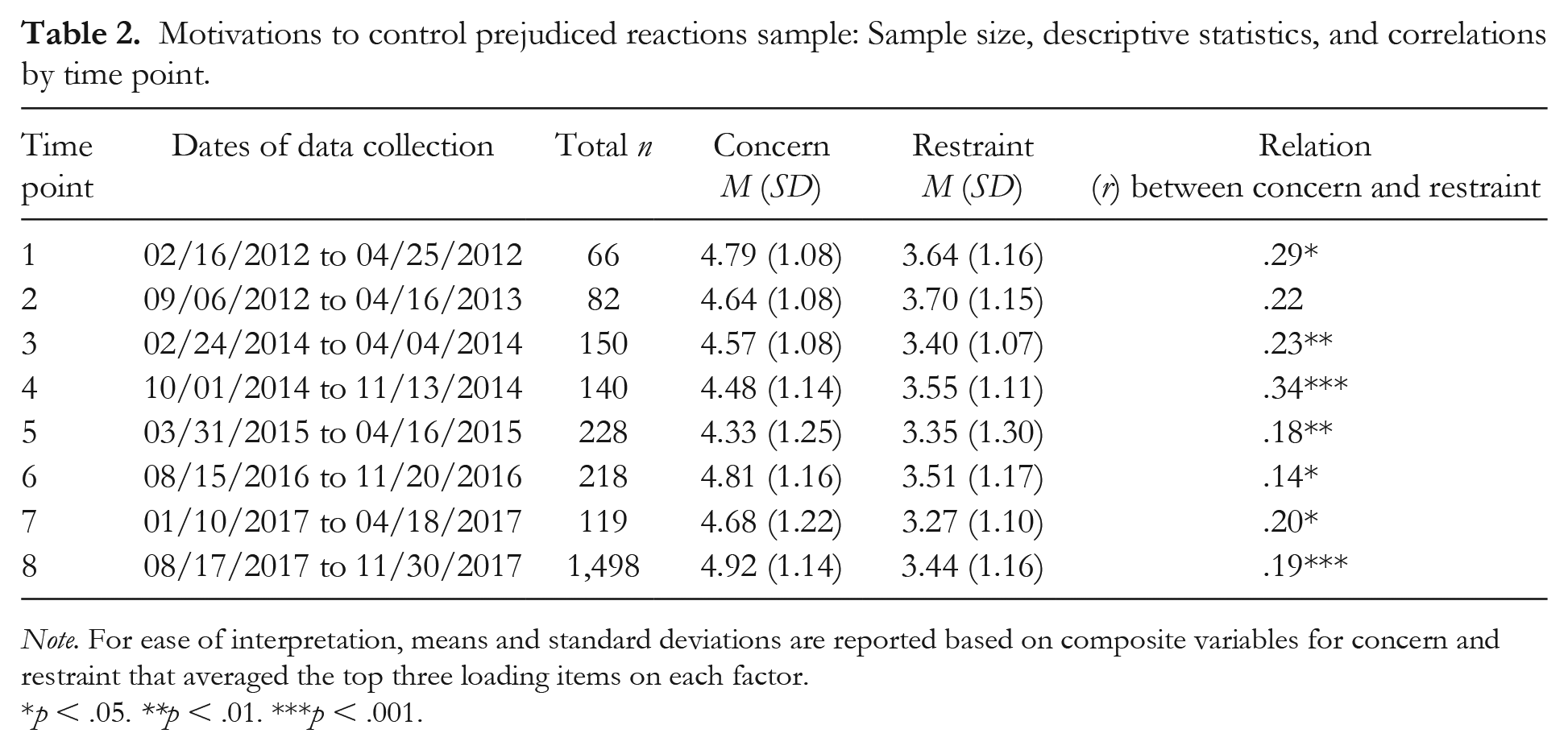
Note. For ease of interpretation, means and standard deviations are reported based on composite variables for concern and restraint that averaged the top three loading items on each factor.
p < .05. **p < .01. ***p < .001.
Consistent with our hypothesis, restraint declined from 2012 to 2017. In line with predictions, we observed an overall linear decrease in restraint from 2012 to 2017, b = −0.05, 95% CI [−0.03, −0.08], t(2380) = −3.90, p < .001, r2semipartial = −.08. Moreover, this decrease in restraint appeared to correspond with perceptions that race relations were worsening, as shown in the Gallup polling (2016) from Figure 1, and the observed decrease in EMS during this time (see Figure 3).
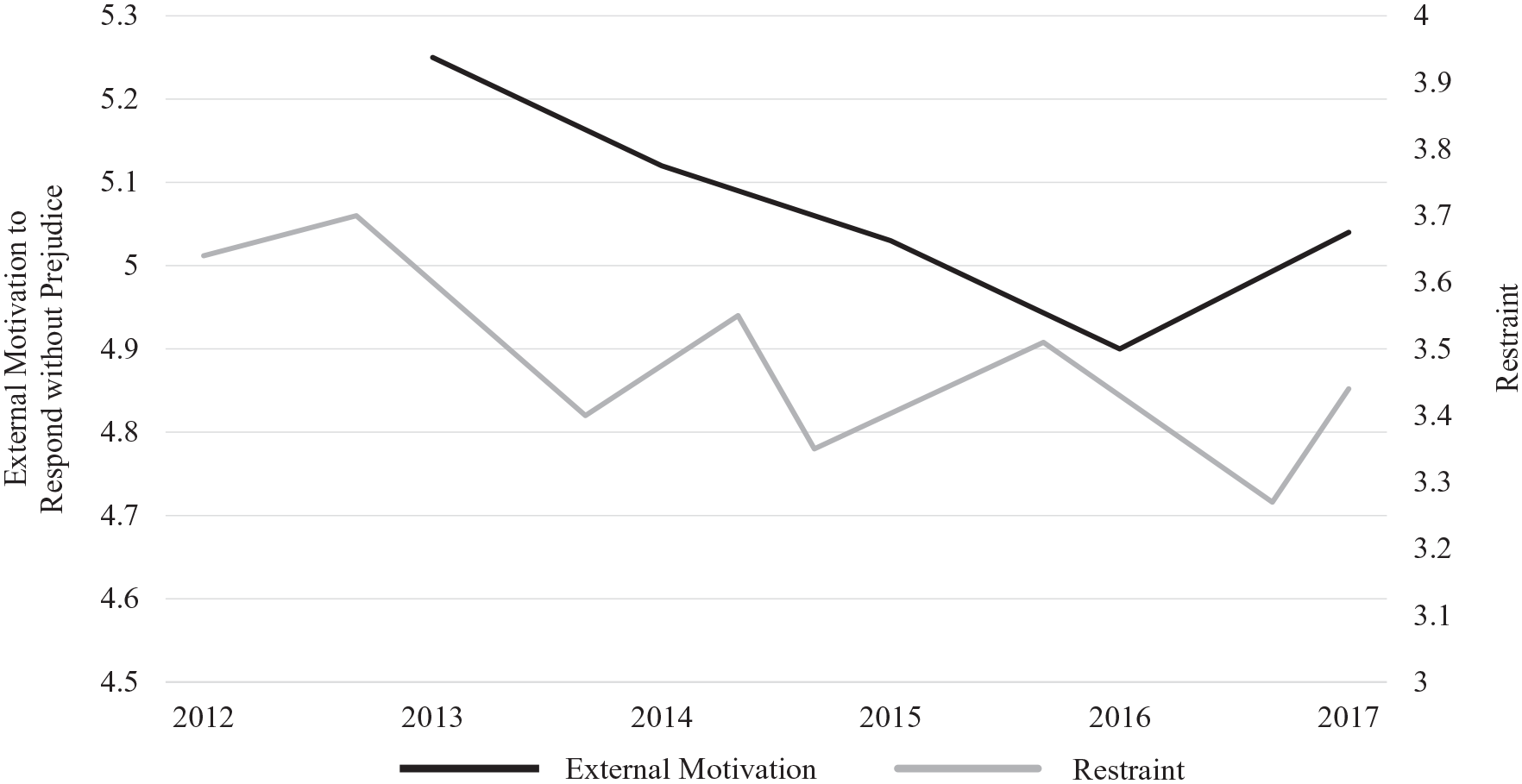
Changes in restraint plotted with changes in external motivation from 2012 to 2017.
Results also revealed support for our hypothesis that concern increased from 2012 to 2017. We observed an overall linear increase in concern over time, b = 0.12, 95% CI [0.09, 0.14], t(2380) = 9.27, p < .001, r2semipartial = .19. As with the previous decrease in restraint, this increase in concern appeared to correspond with perceptions that race relations were worsening, as shown in the Gallup polling (2016) from Figure 1, and the observed decrease in IMS during this time (see Figure 4).
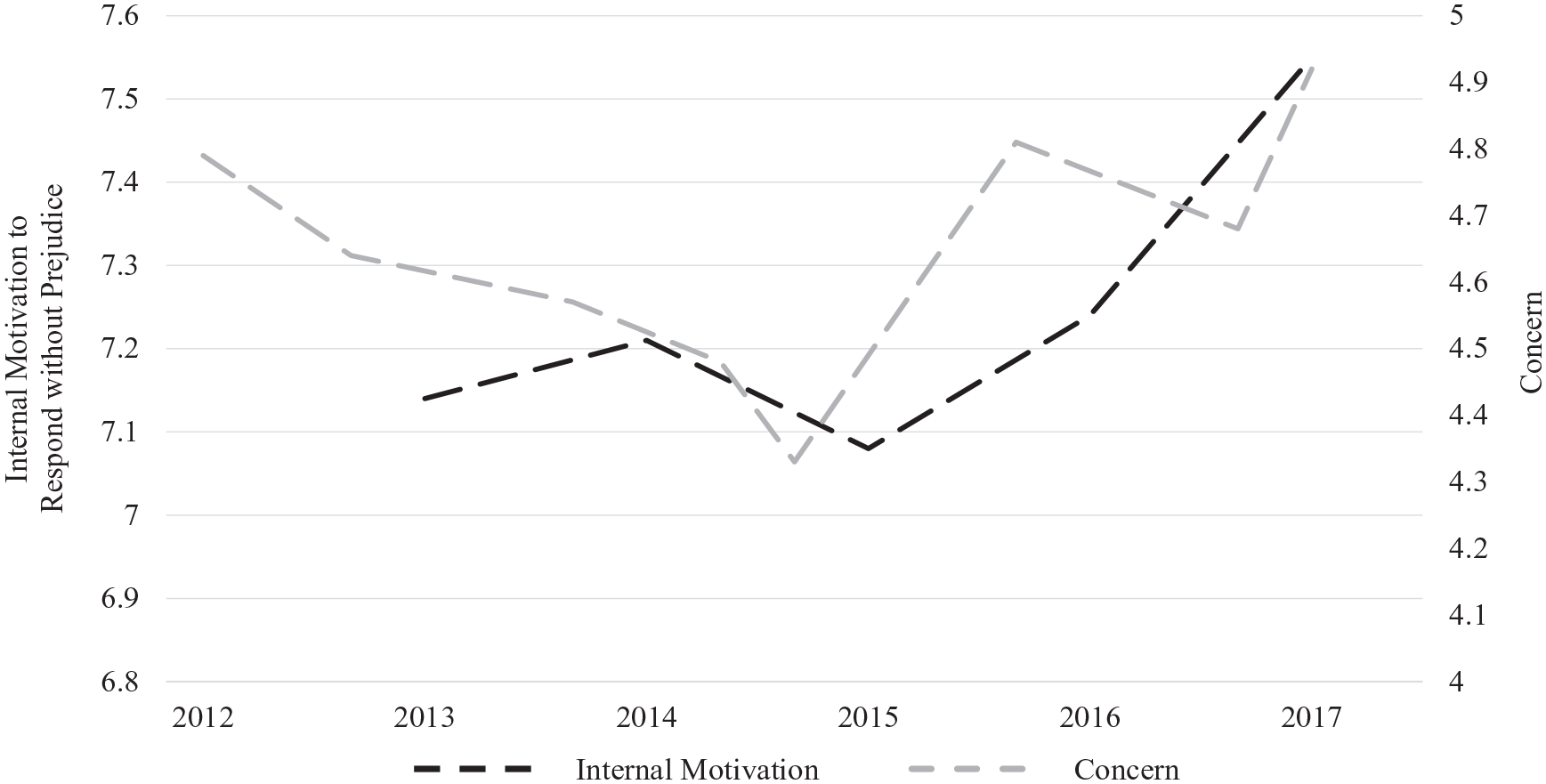
Changes in concern plotted with changes in internal motivation from 2012 to 2017.
Discussion
Collectively, the results of Study 2 corroborated the trends of nonprejudiced motivations during the later years observed in Study 1 using a second, independent archive of data with the similar, but distinct, nonprejudiced motivations of restraint and concern. Like EMS, restraint decreased toward the end of Obama’s presidency and continued to decrease as the expression of prejudice became more normative (e.g., race-based hate crimes increased from 2014 to 2017; FBI, 2017). In contrast to restraint but similar to IMS, concern increased over this same tumultuous period of time.
General Discussion
Despite years of efforts to obtain racial equality, both explicit and implicit racial prejudice remain pervasive and have widespread societal implications (Schmidt & Axt, 2016). Key to limiting prejudice and its expression are people’s motivations to respond without prejudice (Dunton & Fazio, 1997; Fazio & Olson, 2014; Plant & Devine, 1998). Therefore, understanding what engenders or impedes these motivations has important implications for the future of race relations in the US. To this end, the current work drew upon two large archival datasets and Gallup poll data on perceptions of race relations to examine changes in nonprejudiced motivations in recent years. In two studies, we considered whether these changes corresponded to changes in perceptions of race relations and nonprejudiced social norms. We found that temporal changes in people’s motivations paralleled a number of race-relevant sociopolitical events, such as the last several presidential elections and the seeming rise of competing social factions (i.e., the BLM movement in response to police killings of Black men and the rise of contemporary White supremacy in the Alt-Right). As people’s perceptions of broader social norms regarding race relations worsened, socially derived motivation (EMS and restraint) decreased, and self-derived motivation (IMS and concern) increased.
Given that people high in external motivation or restraint to avoid dispute are especially attuned to race-relevant social norms and seek to avoid confrontation about race (Dunton & Fazio, 1997; Plant & Devine, 1998), the extent to which they feel the need to monitor their expression of racial prejudice likely changes to fit current nonprejudiced norms. Consistent with this framework, we observed an initial spike in EMS into the second presidential term of Barack Obama. We suspect this increase in socially derived motivation reflected increased caution to adhere to prevailing nonprejudiced norms among people fearful of the social consequences of expressing prejudice. However, EMS and restraint began to decrease as perceptions of race relations worsened following multiple highly publicized murders of Black men in the mid-2010s and rising backlash to antiracism advocacy like the BLM movement. Notably, EMS and restraint further plummeted with the nomination and election of Donald Trump—a shift reflected in the 17% decrease in the number of White people who said race relations were good from 2013 to 2016 in the Gallup poll data. Those who primarily avoided prejudice because of its social unacceptability may have perceived weakened nonprejudiced norms as evidence that society had become relatively uninterested in curtailing its expression (Crandall et al., 2018). That is, when changes in the racial climate and key sociopolitical events suggested that prevailing norms no longer imposed strict social restrictions on prejudice, some White Americans (i.e., those typically concerned with the negative social consequences of expressing prejudice) may have perceived less of a need to avoid the expression of racial prejudice.
In contrast, IMS decreased leading up to and following the seemingly progressive milestone of Barack Obama’s presidential elections. This initial reduction in IMS was likely in response to the ostensible racial progress suggested by Obama’s unprecedented rise and eventual electoral success. Indeed, past research demonstrates that President Obama’s election suggested to much of society the achievement of a long-desired postracial America, which assuaged concerns of racism’s lingering prevalence in society for many White Americans (e.g., Effron et al., 2009; Kaiser et al., 2009). For egalitarian-minded individuals, this racial milestone may have suggested that the personal goal of egalitarianism had been met and thus, they could relax their internally derived motivation to be nonprejudiced. In contrast, IMS and concern increased during the later years of Obama’s presidency as national attention turned to multiple highly publicized police killings of unarmed Black men and the rise in vocal antiracism advocacy like the Black Lives Matter movement. Moreover, both of these motivations continued to increase during the political rise of Donald Trump, whose presidential campaign employed markedly racialized political rhetoric and who, as president, likely continued to suggest the presence of weakened nonprejudiced social norms (e.g., by condoning neo-Nazi demonstrators at the deadly “Unite the Right” rally in Charlottesville, VA, labeling them “very fine people”; Trump, 2017). Many egalitarian-minded individuals may have perceived a worsening racial climate as evidence that racial prejudice remained a problem in society. Hence, they may have shifted their personal motivations accordingly in reaction to the perceived mismatch with their goals and values (Carver & Scheier, 1990; Smith et al., 2015; Venables & Fairclough, 2009).
Implications
Overall, the current work has both practical and theoretical implications. This work provides insight into how nonprejudiced motivations and social perceptions might influence race relations and prejudice expression more broadly. We build upon existing research demonstrating that internal/concern and external/restraint motivations distinctly impact several important outcomes (Amodio et al., 2003, 2008; Devine et al., 2002; LaCosse & Plant, 2019; Olson & Fazio, 2004; Olson & Zabel, 2016; Plant et al., 2010). When norms regarding the expression of prejudice weaken, so too do external and restraint motivations. As a result, people who may have avoided expressing prejudiced beliefs due to external pressure may be more likely to express and even act on these beliefs (Olson & Fazio, 2004; Plant & Devine, 2001). As resurgent overt racism in the US indicates (e.g., FBI, 2017; Potok, 2016; Tesler, 2013), a decline in externally derived motivations to avoid prejudice could have deleterious implications for the targets of racism. That is, some people may be more likely to express racist views and engage in discriminatory behaviors when perceived social norms suggest that such behaviors are societally tolerated.
However, the present work also suggests that people’s internal and concern motivations increase with perceptions that race relations are poor. Therefore, people who have nonprejudiced personal standards may be even more driven to eradicate their biases and promote nonprejudice when they feel that prejudice is more prevalent in society. Based on prior work, such heightened internal or concern motivations may have a range of positive implications for the quality of interracial contact and the expression of racial bias (Devine et al., 2002; Dunton & Fazio, 1997; Fazio & Hilden, 2001; Fazio et al., 1995; LaCosse & Plant, 2019; Plant et al., 2010). It is also possible that the weakening of external and restraint motivations and the likely subsequent increase in expressed bias by some people may contribute to heightened internal and concern motivations in other people. Although this may help alleviate some of the negative implications described before, it may also foment conflict and polarization among White Americans, further sharpening existing sociopolitical divides in the US.
Limitations and Future Directions
Although the current work is informative, its limitations offer important avenues for future research. We provide correlational, temporal evidence that nonprejudiced motivations change over time along with perceived race relations in a theoretically sensible manner. However, more work is needed to discern whether changes in internal and external motivations to respond without prejudice and perceptions of race relations always correspond with changes in concern and restraint. We found that concern generally increased, and restraint generally decreased over time, but not every year-by-year time point comparison was significant. One reason for this discrepancy may be the underlying basis of concern and restraint. Unlike internal motivation to respond without prejudice, concern stems from both personal and reputational worries about expressing prejudice (Dunton & Fazio, 1997). Thus, concern motivation may change with perceptions of race relations in less reliable ways. Restraint may change with perceptions of race relations in less reliable ways because it depends on people’s assumption that disputes and/or confrontation will arise from the expression of prejudice (Dunton & Fazio, 1997). In situations where people are surrounded by like-minded others—such as on college campuses—their restraint motivation may be less likely to change since the likelihood of conflict may be lower. Taken together, future research should pinpoint when changes in motivations to be nonprejudiced and motivations to control the expression of prejudice converge and when they diverge.
Future research would also benefit from further exploration into the magnitude of changes in nonprejudiced motivations over time. In the present work, we found relatively small effect sizes using large samples. The term relative is important though, as effect sizes smaller than .30 are typical and comparatively large in studies of individual differences (Gignac & Szodorai, 2016). Moreover, science consistently demonstrates that small effect sizes can have serious implications when considered at the population level (Funder & Ozer, 2019).
Another avenue for future work would be a direct test of the causal role of norms in influencing changes in motivations, as well as whether motivations influence changes in norms, or whether motivations and norms influence each other. Further, in all datasets, responses were from different participants across time points. Future work should examine both nonprejudiced motivations and perceptions of race relations in a single nationally representative longitudinal sample to examine the correspondence between the two, as well as accounting for both within- and between-person changes over time. Although we do not anticipate that these motivations shift quickly in response to momentary situational changes in norms and race relations (e.g., a one-time experimental manipulation), following changes in both norms and motivations over time in the same samples may provide valuable insight. Despite these limitations, we believe the current work provides strong initial evidence for the correspondence between changes in the perceived quality of race relations and nonprejudiced motivations.
In addition to examining changes in race relations, nonprejudiced social norms, and nonprejudiced motivations further, future research should focus on changes in social norms and motivation more generally. Past research has chiefly focused on how norms and perceptions influence behavior (Ajzen, 1991; Cialdini, 2007; Festinger, 1954; Sassenberg et al., 2011; Wood, 1999). However, our work suggests that contextual perceptions and social norms may impact people’s motivations related to that context. For example, perceptions of the severity of climate change and social norms related to recycling may impact people’s motivations to recycle or use green products. Exploring this type of research question in the future could provide important insight into the advancement of social change in a variety of contexts.
Conclusion
As the headlines at the outset of this paper illustrate, the U.S. sociopolitical climate has undergone rapid and substantive change over the last decade and a half. Our findings indicate that motivations to be nonprejudiced differentially track these changes. Whereas socially derived motivations move in correspondence with perceived race relations, self-derived motivations act in opposition. Thus, this work demonstrates that people’s reasons for inhibiting racial prejudice depend on the source of motivation as well as the perceived racial climate. Taken together, these findings suggest that social norms and institutional changes not only influence attitudes and behavior, but in doing so, may also impact motivation.
Supplemental Material
sj-docx-1-gpi-10.1177_13684302221089768 – Supplemental material for Changes in nonprejudiced motivations track shifts in the U.S. sociopolitical climate
Supplemental material, sj-docx-1-gpi-10.1177_13684302221089768 for Changes in nonprejudiced motivations track shifts in the U.S. sociopolitical climate by Douglas L. Kievit, Jennifer LaCosse, Stephanie R. Mallinas, David S. March, Jonathan W. Kunstman, Kevin L. Zabel, Michael A. Olson and E. Ashby Plant in Group Processes & Intergroup Relations
Footnotes

References
Supplementary Material
Please find the following supplemental material available below.
For Open Access articles published under a Creative Commons License, all supplemental material carries the same license as the article it is associated with.
For non-Open Access articles published, all supplemental material carries a non-exclusive license, and permission requests for re-use of supplemental material or any part of supplemental material shall be sent directly to the copyright owner as specified in the copyright notice associated with the article.
