







Abstract
Early theories of status dynamics in small groups portrayed intragroup status as a limited resource—as the status of one group member rises, the status of another must fall. Recent theorizing presents an alternative view: that the amount of status available to group members can be variable rather than fixed. Building on this view, we theorize that the average level of intragroup status changes as a function of group performance, such that the intragroup status of an average group member is higher in groups with higher performance and lower in groups with lower performance. We further theorize that changes in group solidarity partly account for the link between group performance and intragroup status. Across three preregistered studies, we find support for these hypotheses, which we hope will kindle interest in identifying other factors that can account for changes in intragroup status equilibria.
A desire for social status—the admiration, respect, and deference afforded by others—represents a fundamental human motive (Anderson et al., 2015; Barkow, 1975). People can acquire higher status in many ways, from possessing good looks (Anderson et al., 2001) and valued expertise (Bottger, 1984; Bunderson, 2003) to being gregarious (Anderson et al., 2008; cf. DesJardins et al., 2015) and having the right temperament (Boehm et al., 2015). Status can also be acquired through conspicuous consumption (Frank, 1985), being sought out for help and advice (Flynn et al., 2006; Flynn & Yu, 2021), or, in some cases, through boasting and self-aggrandizement (Kyl-Heku & Buss, 1996). At the same time, there may be a limit to elevating one’s social status, at least within the confines of one’s group.
In early theorizing about status in small groups, researchers referred to intragroup status (status conferred by fellow group members) as a relative, rather than an absolute, social position anchored to a fixed equilibrium (e.g., Bales et al., 1951; Berger et al., 1972, 1980; Ridgeway & Berger, 1986). According to these seminal accounts, conferrals of intragroup status draw from a limited resource; to wit, there is only so much status to go around (e.g., Bendersky & Hays, 2012). This fundamental assumption that intragroup status has a zero-sum quality has intuitive appeal; after all, individual group members with low status can legitimize the claims to high status made by other group members (Whyte, 1943). However, more recent research on the determinants of social status suggests that the overall amount of intragroup status can be variable, rather than zero-sum (e.g., Anderson, Willer, et al., 2012). That is, some groups can have higher average levels of intragroup status relative to other groups.
Status scholars have yet to identify factors that can raise or lower the average level of intragroup status from one group to the next. In the present research, we theorize that intragroup status will increase following a period of stronger group performance (i.e., when the group has succeeded in achieving its goals). To account for this proposed link between group performance and intragroup status, we highlight the role of group solidarity as an underlying psychological mechanism. Solidarity refers to a sense of fellowship and community felt by individual members of a collective who are united by shared goals, responsibilities, and interests—what Durkheim (1956) referred to as “organic” solidarity (cf. Leach et al., 2008). Individuals in high-performing groups likely feel greater solidarity with their fellow group members than do individuals in low-performing groups because the former recognize that fellow members may have contributed to their success in achieving group goals.
We test these predictions using a set of three preregistered studies that rely on varied methods and samples, which, in combination, offer both internal and external validity. In general, our goal is to take an initial step toward identifying factors that lead to variation in intragroup status across groups. More specifically, we suggest that some groups are simply better than others—they get outstanding results that foster stronger feelings of solidarity, which, in turn, change how group members see one another. In this sense, an increase in group performance can alter the equilibrium of intragroup status conferrals, suggesting that some groups do, in fact, have more status to go around.
Status Dynamics in Groups
Group scholars have theorized about how group membership can influence an individual’s social status, but these theories focus on external evaluations of the group. For example, social identity theory (Tajfel, 1974; Tajfel & Turner, 1979) posits that people can derive a positive social identity in groups that are judged as having higher status in intergroup comparisons. Social dominance theory (Sidanius & Pratto, 1999) also has an external view, but focuses specifically on ways in which higher status groups maintain their status advantage by suppressing and pigeonholing members of lower status groups. In contrast to these two paradigms, status characteristics theory (Ridgeway & Berger, 1986) turns its view inward, examining how the basis of status becomes defined in small groups and how these status characteristics shape the judgment of group members in biased ways.
According to status characteristics theory, individual group members can elicit higher status from fellow group members by possessing personal characteristics associated with high performance expectations (“specific” status characteristics; e.g., technical competence, cognitive intelligence, mechanical skill; Anderson et al., 2001; Anderson & Kilduff, 2009) or belonging to a social category associated with high performance expectations (“diffuse” status characteristics; e.g., race, sex, age; Leonardelli & Tormala, 2003; Ridgeway & Berger, 1986). Individual group members can also elicit higher status from fellow group members by engaging in more prosocial behavior (e.g., Flynn et al., 2006), acting in ways that are judged as moral by fellow group members (Bai et al., 2020), and exhibiting high levels of commitment to the group’s goals through personal sacrifice (e.g., Willer, 2009).
A key tenet of status characteristics theory is that status differentiation within the group reflects salient individual characteristics that generate a priori expectations for group performance (Berger et al., 1980). “Once formed, such performance expectations are known to determine the distribution of opportunities to perform, the rate of performance outputs, the likelihood that a performance output is positively rewarded, and the exercise of influence” (Berger et al., 1972, p. 254). Status characteristics theory presumes that these performance expectations assigned to individual group members are invariant, rather than fluctuant. That is, the distribution of social status in a newly formed group is, for the most part, predetermined, such that group members “do not create a social organization de novo, out of the interaction of their members, but instead maintain external status differences inside the group” (Berger et al., 1980, p. 479; see also Dovidio et al., 1988).
Another critical aspect of status characteristics theory is the concept of a “prestige order,” which organizes intragroup status conferrals through relative ranking (Berger et al., 1972, 1980; Ridgeway & Berger, 1986). This simple array represents each group member’s level of perceived esteem among fellow group members (e.g., Anderson & Kilduff, 2009; Bendersky & Hays, 2012; Murnighan & Conlon, 1991). The concept of a prestige order implies that “evaluations and expectations are relativized; hence, actors are simply said to be higher, the same, or lower than other actors” in their group (Berger et al., 1980, p. 482). Given its demarcation, legitimacy, and stability, the prestige order constitutes an informal status hierarchy within the group, which can have a meaningful influence on subsequent group behavior, including patterns of participation, interpersonal conflict, and leadership emergence (Berger et al., 1980; Blau, 1963; Yu et al., 2019).
Past theorizing about the prestige order in small groups assumes the presence of a group-level status equilibrium (Berger et al., 1980). That is, if the social status of a single group member increases, the social status of another group member (or other group members) must decrease to bring the average level of intragroup status back in line. This conceptualization of intragroup status as a fixed, limited resource first appeared in early theorizing about status dynamics in small groups and remained a foundational principle for decades (e.g., Berger et al., 1972; Blau, 1963; Whyte, 1943). However, the assumption that there is a fixed amount of status available to group members has evolved, with some researchers suggesting that intragroup status conferrals are not necessarily zero-sum (Anderson, Willer, et al., 2012; Blader & Yu, 2017). We build on this emerging view—that intragroup status can be variable (i.e., the status of an average individual in one group may be higher or lower than the status of an average individual in a different group). Further, we suggest that differences in group performance, which result from the behavior and ongoing interactions of individual group members, can partly account for these changes in average intragroup status.
Group Performance and Intragroup Status
Group performance refers to the execution of shared tasks and the achievement of collective goals (Ilgen et al., 2005). Higher group performance corresponds to several beneficial outcomes for individual group members, including higher levels of subjective well-being (Salanova et al., 2003), positive affective tone (Collins et al., 2013), and interpersonal trust (De Jong et al., 2016). Group performance can be evaluated in absolute or relative terms. In absolute terms, group performance is judged according to an accepted metric that dictates whether a group outcome is good or bad. In relative terms, group performance is judged according to whether the group’s outcome compares favorably with that of other groups. We make no distinction between these two measures of group performance. We believe that an increase in either absolute or relative performance would have a similar effect on the average level of intragroup status. Thus, we refer to “group performance” broadly in our theorizing, rather than specify the exact measure of group performance.
According to past research, members of better performing groups tend to feel more secure and optimistic (e.g., Chang & Bordia, 2001). At times, they may develop a “rosy view” of the group, giving the group and its leadership too much credit for positive outcomes (Butterfield & Powell, 1981). In contrast, members of unsuccessful groups can be quick to displace blame, attributing it to other members of the group instead of themselves (Schlenker et al., 1976). Such changes in group performance shape ongoing social interactions among individual group members (Hackman, 1992; Hackman & Katz, 2010; Ilgen et al., 2005; Levine & Moreland, 1994; McGrath, 1991). For example, group members’ moods and affective displays tend to be more positive following success, and negative following failure. As for feelings of attachment, a decrease in group performance can undermine the behavioral commitment shown by individual members (e.g., prompting social loafing, withdrawal, or turnover), just as an increase in group performance can strengthen that commitment, as evidenced by increased time and energy spent working toward group goals (Riggs & Knight, 1994).
We argue that the positive influence of group performance on individual group members also applies to intragroup status—increasing the average amount of status conferred to individual members of high-performing groups, and decreasing the average amount of status conferred to individual members of low-performing groups. As the group acquires information about changes in its performance (whether positive or negative), based on mutually understood performance criteria (whether objective or subjective), this alters the standing of each individual group member, such that the average level of status increases or decreases overall. Put differently, recent gains in group performance yield “dividends” that group members allocate as they update perceptions of their own and other group members’ standing within the group.
The Mediating Role of Group Solidarity
We account for our proposed link between group performance and average intragroup status by highlighting the role of solidarity. Success in achieving group goals can lead group members to feel a keen sense of identification with the collective, thereby engendering feelings of solidarity among individual group members (Durkheim, 1956; Leach et al., 2008). These feelings of solidarity are often described as socioemotional bonds that reinforce normative expectations of social support (Markovsky & Lawler, 1994). However, feelings of solidarity might also reflect a belief that such norms have been upheld. That is, when group members experience success, they may be inclined to presume that other individual group members are exhibiting high levels of behavioral commitment toward the group’s goals (i.e., limiting “free riding”; Cartwright & Zander, 1968), or that members of the team are “doing their part” to help the group achieve its objectives.
The link between group success and feelings of solidarity can also be explained by theories of social exchange in small groups (e.g., Lawler, 2001), which claim that frequent, successful interactions among group members arouse positive emotions, strengthen behavioral commitment, and instill a sense of unity (Lawler, 2001; Lawler et al., 2000). According to Lawler and Yoon (1996), when group members experience patterns of successful social exchange, they attribute their subsequent positive feelings to their interpersonal relationships with other group members. This results in group members’ social relations becoming valued objects in themselves (so-called “expressive relations”). As their successful interactions continue, group members further strengthen these socioemotional bonds with one another that reflect deeper feelings of solidarity (Lawler, 2001; Lawler et al., 2000; Sherif, 1961; Willer et al., 2012; Wiltermuth & Heath, 2009).
In contrast, a decrease in group performance could hinder the psychological experience of solidarity (Lawler & Yoon, 1996). In a poorly performing group, which fails to achieve its collective goals, socioemotional bonds often become fractured, as group members experience frustration. Based on the group’s poor performance in the past, group members may harbor doubts about the group’s ability to work together successfully in the future. Ultimately, such doubts may lead individual members to exhibit lower levels of behavioral commitment to the group because they suspect that other group members are doing the same (Thye et al., 2002). When people feel less willing to make a personal sacrifice on behalf of the group (i.e., feel less “invested”; Leach et al., 2008), or expect that other members lack commitment to the group and its goals, they tend to feel lower levels of solidarity with their fellow group members (e.g., Willer et al., 2012).
We posit that feelings of solidarity, born out of group success, will in turn lead to a higher valuation of fellow group members (i.e., boost intragroup status conferrals) for two reasons. First, the strong socioemotional bonds that characterize solidarity should yield higher conferrals of social status because people tend to hold others in higher esteem when they share a valued social connection, such as membership in a successful group (Lawler et al., 2000; Tajfel & Turner, 1979). Indeed, past research has shown that stronger feelings of solidarity can prompt individuals to behave more generously toward fellow group members (e.g., Willer et al., 2012). Along a similar vein, we posit that members of more successful groups may be more generous when conferring intragroup status to fellow group members, whereas members of less successful groups may be more tight-fisted, deciding to withhold their deference and limit their feelings of respect and esteem.
Second, we have noted that feelings of solidarity might result from a belief that fellow group members have upheld normative expectations of behavioral commitment, as evidenced by the group’s success. Such confidence in fellow group members’ behavioral commitment may, in turn, generate higher conferrals of social status. Past research has found that group members attribute higher status to individuals who demonstrate their commitment to group goals by making personal sacrifices on behalf of the group (Willer, 2009). These two critical aspects of solidarity—social bonds and behavioral commitment—may work hand in hand to account for the effect of group performance on intragroup status. Buoyed by this sense of attachment, individual members of successful groups may be more inclined to respect their fellow group members, admire their contributions, and defer to their opinions (Lawler & Yoon, 1996).
In summary, we have suggested that an increase in group performance will lead to an increase in the average level of intragroup status, as members of successful groups develop stronger socioemotional bonds. This sense of solidarity, born out of a strong track record, will reinforce group members’ expressive relations and engender greater feelings of esteem (i.e., social status). To be clear, we expect this positive effect of group performance on intragroup status conferrals to manifest above and beyond the influence of liking. As other scholars have noted (Huo et al., 2010), intragroup status and interpersonal liking are not interchangeable concepts. An individual can show respect and admiration for fellow team members while not liking them, and, conversely, an individual can find fellow team members endearing but not hold them in high esteem. To provide greater clarity and precision in our hypothesis tests, we will (in two studies) capture ratings of both liking and status to isolate the effect of group performance on average intragroup status.
Overview and Predictions
We put forth two hypotheses. First, we propose that an increase in group performance leads to an increase in a group’s average level of intragroup status. Second, we propose that the relationship between group performance and intragroup status is mediated by solidarity. Figure 1 summarizes our hypotheses.
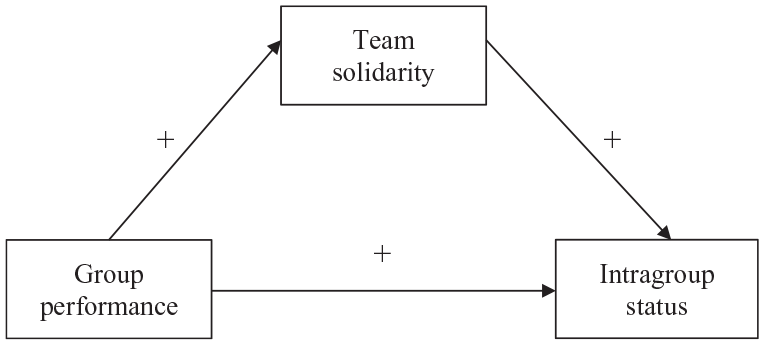
Theoretical model for the hypothesized main effect and mediation effect.
We conducted three studies to test these two predictions. In Study 1, we recruited participants to complete a competitive task with a randomly assigned team, and then rate the social status of their teammates after learning of their team’s performance. Using this controlled setting, we tested the effect of group performance on intragroup status (Hypothesis 1), and whether solidarity mediated this effect (Hypothesis 2). In Studies 2 and 3, we developed two additional tests of our hypotheses that complement each other in terms of external and internal validity. In Study 2, we recruited a sample of full-time employees to recall a work-related team experience that was either successful or unsuccessful, and then rate the status of their fellow team members. In Study 3, we employed a causal test of our predictions by manipulating high or low levels of group performance in a simulation and then capturing intragroup status.
A critical concern in testing the link between group performance and status conferrals is the possible influence of a halo effect, whereby support for our main hypothesis might be attributed to a general boost in subjective evaluations “across the board.” Most studies on the determinants of status fail to address possible halo effects. Here, we address this issue in two ways. First, as mentioned, we measure interpersonal liking in two studies and control for its influence in all analyses. Support for our hypotheses entails a positive relationship between group performance and intragroup status above and beyond the effect of liking. Second, in one study (Study 2), we analyzed the effect of group performance on perceptions of physical attractiveness. We do not expect that better group performance will lead group members to see one another as better looking. If this was the case, it would strongly suggest a halo effect.
Hypotheses and analysis plans were preregistered for each study. Data and materials for all three studies, as well as summaries of all supplemental analyses, are available at the Open Science Framework (https://osf.io/thzwb/?view_only=7b3f7ac0864e445081b4073feac98ed1).
Study 1
In Study 1, participants worked in teams on a competitive task: The marshmallow challenge. Each team was instructed to build the tallest standing tower using only spaghetti and marshmallows. We aimed to test whether objective group performance would predict subsequent ratings of intragroup status, such that members of better performing teams had higher levels of intragroup status on average (see supplemental material for additional analyses involving rating variability). We preregistered our hypotheses and analytic strategy (https://aspredicted.org/blind.php?x=qx6rb7).
Method
Participants
We recruited 160 university students to participate (89 women, 68 men, three unreported; Mage = 23.0) in one of four study sessions (each session had 40 participants). Participants were assigned to complete the study in four-person teams. We aimed to have enough power to test our hypothesis, but our sample size was limited by the number of subjects available to participate in our studies and the availability of the room we booked to conduct the study sessions, which could accommodate a maximum of 10 teams per session. In the end, we ran four sessions that included 40 teams. According to a sensitivity analysis, our sample size provides 80% power to detect r = .43 with α = .05, two-tailed (Faul et al., 2007).
Materials and procedure
Upon arrival, each participant filled out a name tag with their initials, randomly drew a number from one to 10 (from a bag held by a research assistant), and sat down at a table that corresponded to the number drawn. Once everyone was seated, a research assistant read the following instructions for the marshmallow challenge: Each team has 18 minutes to build the tallest, free-standing structure using the materials supplied to each team. The marshmallow must be attached to the top of the structure you build. Make sure that the tower can stand stable for at least 1 minute with the marshmallow on top. After 18 minutes, we will measure the height of each structure that remains standing with the marshmallow on top. Optional: While you build the tower, you can have your tower measured up to 2 times. If you choose to do so, raise your hand and we’ll come by to measure the height of your tower. Your team’s final performance is determined by the highest measurement. At the end, we’ll announce the performance of each team and tell you how your team ranks among all the teams.
After hearing these instructions, each team began building their tower using the following materials: 1 yd (0.91 m) of tape, 1 yd (0.91 m) of twine, 20 spaghetti sticks, one marshmallow, and one pair of scissors. During the building process, the research assistant kept track of time and gave three warnings at the 10-minute, 13-minute, and 16-minute marks. At the end of the 18-minute building period, research assistants quickly measured the tower structures that were still standing and had been created within the rules. Tower height was measured from the bottom to the top of the structure.
One research assistant stood at the front of the room and announced the performance of each team. During this announcement, another assistant wrote down the team code and their performance (i.e., tower height) on a large whiteboard, where it remained for all participants to see throughout the remainder of the study.
Participants were then reseated at a new table along with participants from other teams. We reseated participants in this manner so that they would not be sitting next to their teammates while completing our round-robin measures of status. After completing the survey, which also included measures of solidarity and performance, each participant received $20 as payment. The instructions for running the marshmallow challenge and the script for the study questionnaire are included in the online supplemental material.
Social status
Following others (e.g., Anderson et al., 2001; Flynn & Brockner, 2003), we measured status by asking participants to rate each of their fellow team members along a 5-point scale (1 = not at all, 5 = extremely) for each of the following items: (a) “How well-respected is this team member?”; (b)“How valuable is this team member’s contributions in teamwork?”; and (c) “How much influence does this team member exert over decisions in teamwork?” An average of these responses (across all three teammates) formed a reliable composite of intragroup status (α = .86). To aggregate data for our team-level analyses, we calculated rwg using the rwg(j) function in the “multilevel” package in R (Bliese et al., 2022). The median rwg was .89, and the mean rwg was .86. See the supplemental material for separate rwg statistics for each team.
Team performance
To serve as an objective measure of group performance, we used the measured height of the team’s tower. In addition, we used three items to capture participants’ own subjective ratings of group performance on a 5-point scale (1 = not at all, 5 = extremely): (a) “How effective was your team?”; (b) “How efficient was your team?”; and (c) “How successful was your team?” An average of these three responses formed a reliable composite of group performance (α = .89). The median rwg was .92, and the mean rwg was .88. See the supplemental material for separate rwg statistics for each team.
Solidarity
To capture solidarity, we used a measure created by Leach et al. (2008). This measure aligns closely with our theorizing about solidarity, focusing on the development of socioemotional bonds and behavioral commitment that characterize organic solidarity (Durkheim, 1956). Using a 7-point scale (1 = strongly disagree, 7 = strongly agree), participants rated the following three items: (a) “I feel a bond with my team”; (b) “I feel solidarity with my team”; (c) “I feel committed to my team.” An average of these responses formed a reliable composite of overall group solidarity (α = .88). The median rwg was .72, and the mean rwg was .49. See the supplemental material for separate rwg statistics for each team.
Results
We conducted a set of analyses at the group level using both the objective measure of team performance (i.e., the height of the tower) and the self-reported measure of team performance as the dependent measures. See our supplemental material for additional analyses that involve alternative measures of intragroup status and team performance as well as analyses at the individual level. Table 1 summarizes descriptive statistics for Study 1.
Descriptive statistics and correlations among variables: Study 1.
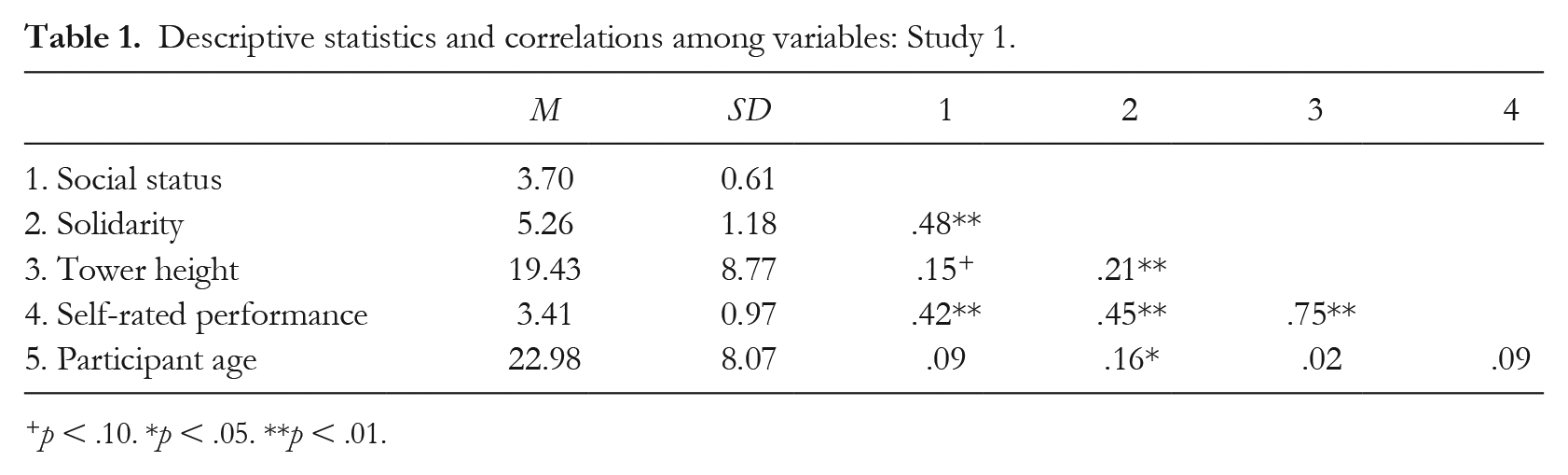
p < .10. *p < .05. **p < .01.
Social status
We conducted correlational analyses using R by aggregating the data to the group level. Teams with higher objective performance tended to have a higher level of status conferred to individual team members. The effect of self-rated team performance on average intragroup status at the team level was significant, r = .53, t(38) = 3.80, p < . 001, whereas the effect of objective team performance (height of the tower) was marginally significant, r = .28, t(38) = 1.79, p = .08.
Mediation analysis
The relationship between team performance (i.e., tower height) and intragroup status was fully mediated by team solidarity. We tested the significance of this indirect effect using bootstrapping procedures with the “Mediation” package in R (Tingley et al., 2014). Standardized indirect effects were computed for each of the 5,000 bootstrapped samples. The bootstrapped standardized indirect effect was 0.007, 95% CI [0.001, 0.01]. Thus, the indirect effect was significant. After controlling for the indirect effect, the direct effect of team performance on intragroup status became nonsignificant. The bootstrapped standardized direct effect was 0.003, 95% CI [−0.005, 0.01].
We also found the relationship between self-reported team performance and intragroup status was partially mediated by team solidarity. We again used the “Mediation” package in R to test the significance of the indirect effect using bootstrapping procedures. Standardized indirect effects were computed for each of the 5,000 bootstrapped samples. The bootstrapped standardized indirect effect was 0.07, 95% CI [−0.01, 0.14]. Thus, the indirect effect was marginally significant. After controlling for this indirect effect, the direct effect of team performance on intragroup status was still significant. The bootstrapped standardized direct effect was 0.13, 95% CI [0.02, .027]. Table 2 summarizes the results of these analyses. See our supplemental material for additional mediation analyses.
Effect of subjective team performance on team status as mediated by team solidarity across all three studies.
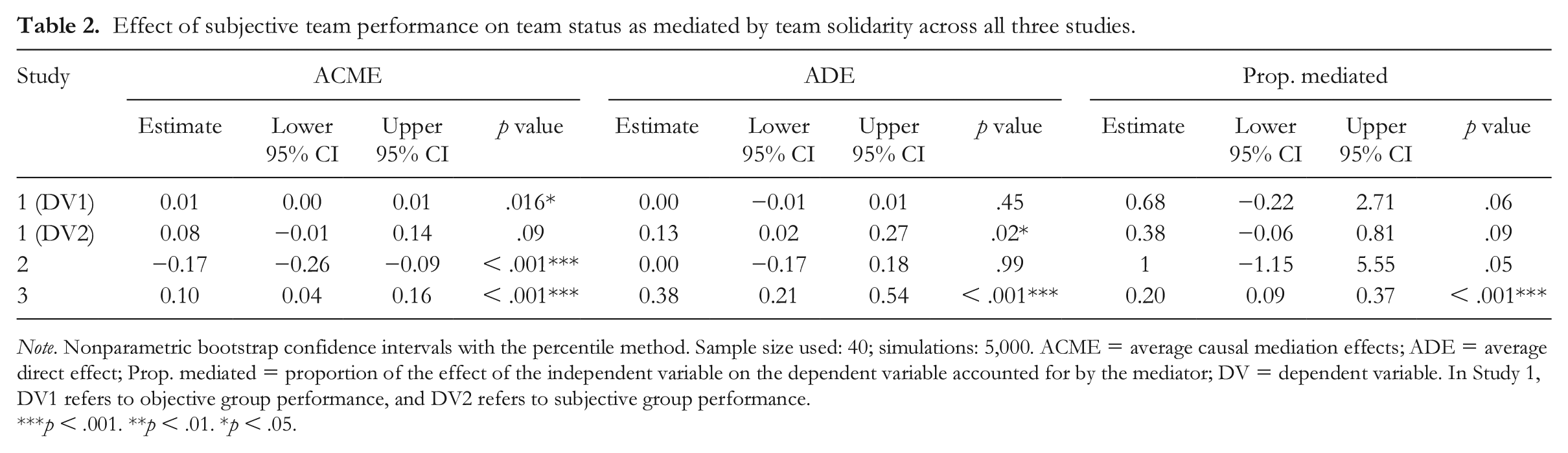
Note. Nonparametric bootstrap confidence intervals with the percentile method. Sample size used: 40; simulations: 5,000. ACME = average causal mediation effects; ADE = average direct effect; Prop. mediated = proportion of the effect of the independent variable on the dependent variable accounted for by the mediator; DV = dependent variable. In Study 1, DV1 refers to objective group performance, and DV2 refers to subjective group performance.
p < .001. **p < .01. *p < .05.
Discussion
In Study 1, we employed a carefully controlled setting to test our hypotheses. Given that the teams were randomly assigned, self-selection can be ruled out as an alternative explanation for the link between group performance and intragroup status. We also used multiple measures of performance, both objective and subjective, to strengthen our empirical tests. In each case, we showed that enhanced solidarity partly accounted for the positive effect of team performance on the average level of intragroup status. Overall, the results from Study 1 provide initial support for our hypotheses.
One alternative interpretation of the effects we found in Study 1 is that group success boosts individuals’ perceptions of their teammates across the board (i.e., a halo effect). To address this, in Study 2, we sought to isolate the effect of group performance on intragroup status in two ways: (a) by controlling for interpersonal liking, and (2) by measuring a desirable characteristic unrelated to group performance: perceived physical attractiveness. Our goal was to demonstrate that an increase in group performance translates into an increase in intragroup status, not attractiveness and not just likability. A second limitation of the first study is that we examined de novo groups of strangers working on a low-stakes task, which might limit the generalizability of our findings (e.g., these effects might dissipate over time, or when the stakes are higher). Thus, in Study 2, we sampled members of real work teams. Finally, in Study 2, we hoped to rely on a larger sample size for our analyses, which may have been underpowered in Study 1.
Study 2
In Study 2, we tested Hypotheses 1 and 2 using a different sample, one that would increase the generalizability of our findings. We recruited working professionals and asked them to recall a recent team experience that was either successful or unsuccessful. We captured our independent variable (i.e., team performance) and dependent variable (i.e., intragroup status) in two separate surveys (“presurvey” and “survey”) to minimize the influence of single-source bias. We added measures of physical attractiveness and liking. We expected that the effect of team performance on intragroup status would hold when controlling for liking, and there would be no correlation between team performance and perceived attractiveness. Finally, we examined our proposed mechanism by testing whether solidarity mediates the effect of group performance on intragroup status. We preregistered our hypotheses and analytic strategy (https://aspredicted.org/blind.php?x=q8m4uw).
Method
Participants
With respect to sample size, we aimed to have at least 100 participants per cell for our final analyses. Using a presurvey, we first recruited 600 U.S. citizens on TurkPrime who indicated that they were full-time employees. As an additional screening question, we asked participants if they could recall a specific teamwork experience. Participants were randomly assigned to one of two conditions. In one condition, they were asked if they could recall working in a face-to-face team with at least four members (including themselves) and where the team’s final performance was successful. In the other condition, participants were asked the same question except that the team’s final performance was unsuccessful. Our goal in using this design was to ensure a balance between good and bad team performance to test our hypotheses.
Only participants who reported that they could recall a successful/unsuccessful team experience were eligible to participate. We obtained a roughly equal number of participants who had successful and unsuccessful teamwork experiences. As part of the same presurvey, we asked participants to briefly describe their team experience, rate their team’s performance, and provide a few basic details, including their position in the team, team lifespan, and total number of team members (see supplemental material for analyses of these measures).
Of the 600 participants who took the presurvey, 28 failed the attention checks and were excluded from further analysis. Two independent coders read the remaining participants’ descriptions of their team experience to select eligible participants for our main survey. The eligibility criteria were determined ex ante. Participants were deemed eligible if they wrote about a legitimate and meaningful teamwork experience occurring in the past 6 months that involved at least four team members. Where disagreement occurred, a third coder acted as a tiebreaker.
Based on this coding, we invited 425 participants to take the main survey a week later. Of those invited, 377 responded (response rate: 88.7%). We had missing data from two participants (which condition they were assigned to), which left us with 375 responses. Of those, 17 failed the attention or manipulation checks. Overall, we included responses from 358 participants (185 men, 173 women; Mage = 36.4) in our analysis (see supplemental material for analyses that include participants who failed the checks): 217 participants were in the “successful team” condition, and 141 participants were in the “unsuccessful team” condition. A sensitivity analysis indicated that our sample size provided 80% power to detect a mean difference of d = 0.30 with α = .05, two-tailed (Faul et al., 2007).
Materials and procedure
We first presented participants with their own description of a recent teamwork experience and basic team information (taken verbatim from their presurvey responses; see supplemental material for additional analyses regarding basic team information). Next, we measured participants’ sense of solidarity with their teams. Finally, participants were asked to identify three teammates whose names appeared immediately after their own alphabetically, and then complete measures of status for each of these three individuals, in addition to measures of liking and physical attractiveness. For exploratory purposes, we also measured prestige-based and dominance-based status (see supplemental material for analyses of these variables).
Social status
We used the same measure described in Study 1 (Anderson et al., 2001; α = .87).
Liking
We measured liking with four items using a 7-point scale (1 = strongly disagree, 7 = strongly agree): (a) “I like this team member”; (b) “I get along with this team member”; (c) “Interacting with this team member is a pleasure”; (d) “I think this team member would make a good friend.” An average of these responses formed a reliable composite (α = .94).
Perceived physical attractiveness
We used three items with a 7-point scale (1 = strongly disagree, 7 = strongly agree): (a) “This team member is good-looking”; (b) “This team member is physically attractive”; (c) “This team member is unattractive in physical appearance” (reverse-coded). An average of these responses formed a reliable composite (α = .93).
Team performance
We used four items to capture team performance with a 5-point scale (1 = not at all, 5 = extremely): (a) “How effective was your team in achieving its performance goals?”; (b) “How efficient was your team in producing the results?”; (c) “How would you describe the quality of your team’s final product?”; (d) “How successful was your team’s final performance?” An average of these responses formed a reliable composite (α = .97).
Solidarity
We used the same measure described in Study 1 (α = .91).
Results
Each participant rated three team members on status, liking, and attractiveness. We used average scores of these variables for each ratee in subsequent analyses. We report results before and after controlling for interpersonal liking. We include analyses of exploratory variables in the supplemental material. All analyses followed the steps outlined in our preregistration and were conducted using R. Table 3 summarizes the descriptive statistics for Study 2.
Descriptive statistics and correlations among variables: Study 2.
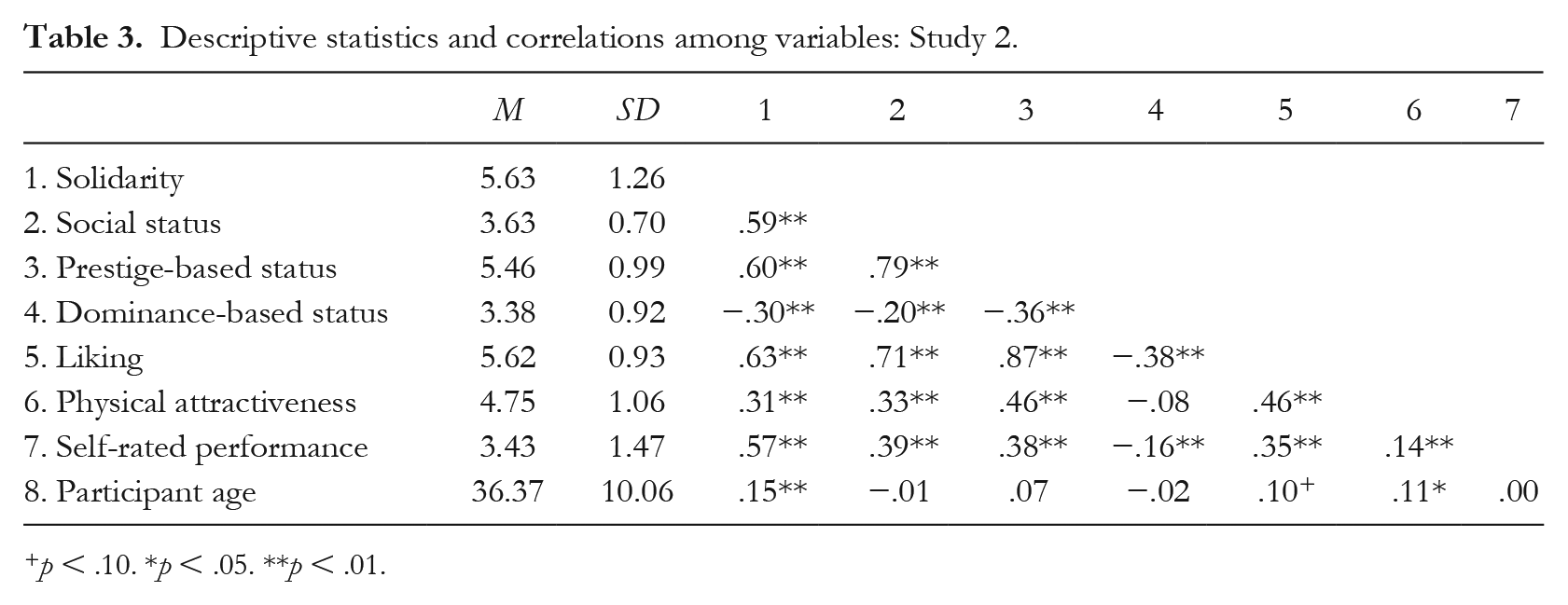
p < .10. *p < .05. **p < .01.
Validity check
We used two-tailed, independent samples t tests to check the validity of our team performance conditions. Participants who recalled a recent experience working in a high-performing team reported higher levels of team performance (M = 4.47, SD = 0.49) than did participants who recalled a recent experience working in a low-performing team (M = 1.83, SD = 0.93), d = 3.79, t(356) = 35.1, p < .001.
Social status
We used two-tailed, independent samples t tests to analyze the difference in status conferrals between the two conditions. Participants who recalled a successful teamwork experience conferred a greater amount of intragroup status, on average (M = 3.79, SD = 0.60), than did participants who recalled an unsuccessful teamwork experience (M = 3.38, SD = 0.76), d = 0.61, t(356) = 5.62, p < .001. We also constructed a linear regression to predict intragroup status based on team performance while controlling for liking. This relationship held after controlling for liking, t(355) = 2.07, p = .04. Using the continuous measure of team performance, we found that self-reported team performance positively correlated with intragroup status, r(356) = .39, p < .001. We also constructed a linear regression to predict intragroup status based on the continuous measure of team performance while controlling for liking. The continuous measure of team performance predicted status even after controlling for liking, t(355) = 4.11, p < .001.
Solidarity
We used two-tailed, independent samples t tests to analyze the difference in solidarity between the two conditions. Participants who recently worked with a successful team reported a higher level of solidarity (M = 6.13, SD = 0.75) than did participants who recently worked with an unsuccessful team (M = 4.87, SD = 1.50), d = 1.14, t(356) = 10.55, p < .001. We also constructed a linear regression to predict status conferral based on team performance while controlling for liking. This positive relationship between group performance and the experience of solidarity held after controlling for liking, t(355) = 8.32, p < .001.
Perceived physical attractiveness
We used two-tailed, independent samples t tests to analyze the difference in perceived physical attractiveness between the two conditions. Team performance did not predict perceived physical attractiveness. Participants who recalled an experience working in a successful team rated their fellow team members as more attractive (M = 4.82, SD = 1.06) than did participants who recalled working in an unsuccessful team (M = 4.63, SD = 1.06), d = 0.18, t(356) = 1.66, p = .10, but this difference did not reach the standard level of significance, suggesting that our results were not due to a general halo effect.
Mediation analysis
We examined whether solidarity would mediate the effect of team performance on intragroup status using the “Mediation” package in R (Tingley et al., 2014). As a conservative test of this hypothesis, we controlled for liking in the mediation model. Standardized indirect effects were computed for each of the 5,000 bootstrapped samples. The bootstrapped standardized indirect effect was −0.17, 95% CI [−0.26, −0.09], which indicates a significant indirect effect. After controlling for the indirect effect, the direct effect of team performance on intragroup status became nonsignificant. The bootstrapped standardized direct effect was −0.00009, 95% CI [−0.17, 0.18], which suggests that the effect of group performance on intragroup status was fully mediated by the experience of solidarity with the group, while controlling for the influence of liking. See Table 2 for a summary of these results (see supplemental material for alternative mediation models and analyses that do not control for liking).
Supplemental analysis
Group performance may be judged in isolation, or it may be judged in reference to the performance of other groups. We did not theorize that intergroup comparisons were a necessary factor in accounting for the effect of group performance on intragroup status but, given the nature of the data in Study 2, we felt it was worth exploring this possibility. To this end, we conducted an exploratory analysis (not preregistered) in which we instructed two coders to independently read participants’ descriptions of their teamwork experience and note whether participants referred to their team performance in comparison with that of other teams (1 = yes, 0 = no). The agreement rate was 93.3%, and there were 24 cases where the coders disagreed. To resolve these disagreements, we relied on a third coder to give a tiebreaker rating (see our OSF site for the coding results). Out of the 358 participants in our sample, only 15 explicitly referred to their own team performance in comparison with other teams.
We explored whether the relationship between team performance and intragroup status might be stronger in the context of these intergroup comparisons. Although the number of cases is limited, the correlation between team performance and status conferral was indeed stronger when participants explicitly mentioned intergroup comparisons, r(13) = .84, than when they did not, r(341) = .36. Further, when intergroup comparisons were explicitly mentioned, the effect size of team performance on intragroup status was nearly 8 times larger (η2 = .56) than when intergroup comparisons were not mentioned (η2 = .07). These results are intriguing. However, given the limited number of cases in which intergroup comparisons were explicitly made, we cannot draw any definitive conclusions from these analyses. Nevertheless, we explore this issue in more depth in the General Discussion section.
Discussion
In Study 2, using a more diverse sample of established teams, we found further evidence that group performance correlates positively with intragroup status, even after controlling for interpersonal liking. In addition, group performance did not lead to a universal boost in judgments of fellow team members, as evidenced by the finding that team performance did not predict the perceived attractiveness of one’s fellow team members (i.e., support for our hypothesis was not the result of a halo effect). Finally, we examined the mechanism underlying the effect of team performance on intragroup status and again found strong evidence in support of our second hypothesis that team performance strengthened group members’ feelings of solidarity, which then led to higher status conferrals, on average.
So far, the designs and empirical analyses of our studies have been correlational. To provide a true causal test of our main hypothesis in Study 3, we manipulated group performance and randomly assigned participants to either high- or low-performing groups.
Study 3
In this study, we examined the causal link between group performance and intragroup status by creating a novel virtual teamwork experience that enabled us to manipulate team performance. We preregistered our hypotheses and analytic strategy (https://aspredicted.org/blind.php?x=kc959m).
Method
Participants
We used a presurvey to share our cover story and ensure data quality. In this presurvey, respondents indicated their personal work values and domains of business expertise. We told respondents that they would be assigned to a team with two other individuals who had similar work values and different business expertise. Together, they would complete a task about managing organizational change. In the presurvey, respondents also read the rules for completing the team task and completed a few comprehension questions.
With respect to sample size, we again aimed to have at least 100 participants per cell for our final analyses. To account for those participants who would fail our comprehension and attention checks, we invited 799 adult American participants from TurkPrime to complete the presurvey, and 673 of these individuals passed all checks. From this group, we randomly selected 480 individuals to participate in the main study. Of the 359 participants who completed the study, 15 failed the comprehension and attention checks. In total, responses from 344 participants (196 men, 146 women, two “other”; Mage = 37.7) were included in the analyses (see the supplemental material for analyses that include all participants who failed the checks). One hundred seventy-three participants were in the “successful team” condition, and 171 participants were in the “unsuccessful team” condition. A sensitivity analysis indicated that our sample size provided 80% power to detect a mean difference of d = 0.30 with α = .05, two-tailed (Faul et al., 2007).
Materials and procedure
Each participant learned they would be paired with two other participants who signed up for the same study. In fact, participants acted alone, and communication from their teammates was scripted. As part of a purported “team,” participants were instructed to answer a series of 10 questions selected from the Managing Change Questionnaire (Burke & Church, 1992; see supplemental material for the exact wording of all 10 questions). Each question referred to a statement about organizational change (e.g., “People invariably resist organizational change”), and participants were asked to indicate whether each statement was true or false. The team’s performance would depend on the number of questions answered correctly by the majority of team members (at least two out of three). After submitting their responses, each participant was asked to post a comment to share with his or her teammates. Participants also had the option to post an emoji. After posting their own comments and emojis, participants read the responses and comments from their “teammates.” They were then given the option to change their responses if they wished. All scripted questions and comments can be found in the supplemental material.
We used this specific exercise about managing organizational change because people completing the exercise in the past have expressed a high level of uncertainty about how to answer the true/false questions. Given this degree of ambiguity, our experimental manipulation of group performance would be believable to participants. After completing the entire set of 10 questions, participants learned either that their team performed well, placed in the 92nd percentile among all teams, or that their team did not perform well, placed in the 18th percentile. At that point, participants were asked to complete measures of team solidarity and round-robin ratings of intragroup status, attractiveness, and interpersonal liking. After completing the survey, participants were fully debriefed. See supplemental material for the complete debrief script. For exploratory purposes, we also measured prestige-based and dominance-based status (see supplemental material for analyses of these variables).
Manipulation check
Following our manipulation, we measured participants’ perceptions of their team’s performance with one item using a 5-point scale (1 = terrible, 5 = excellent): “How would you describe your team’s final performance?”
Social status
We used the same overall measure of social status described in Studies 1–2 (α = .89).
Solidarity
We used the same measure described in Studies 1–2 (α = .95).
Liking and attractiveness
We used the same measures described in Study 2 (α = .93 and α = .85, respectively).
Results
Consistent with our previous studies, we used the average rating of intragroup status given by each participant (in this case, for each of their two teammates). We also controlled for interpersonal liking in all analyses. We note that the following analyses were consistent with the steps outlined in our preregistration, and we used R to conduct these analyses. Table 4 summarizes the descriptive statistics for Study 3.
Descriptive statistics and correlations among variables: Study 3.
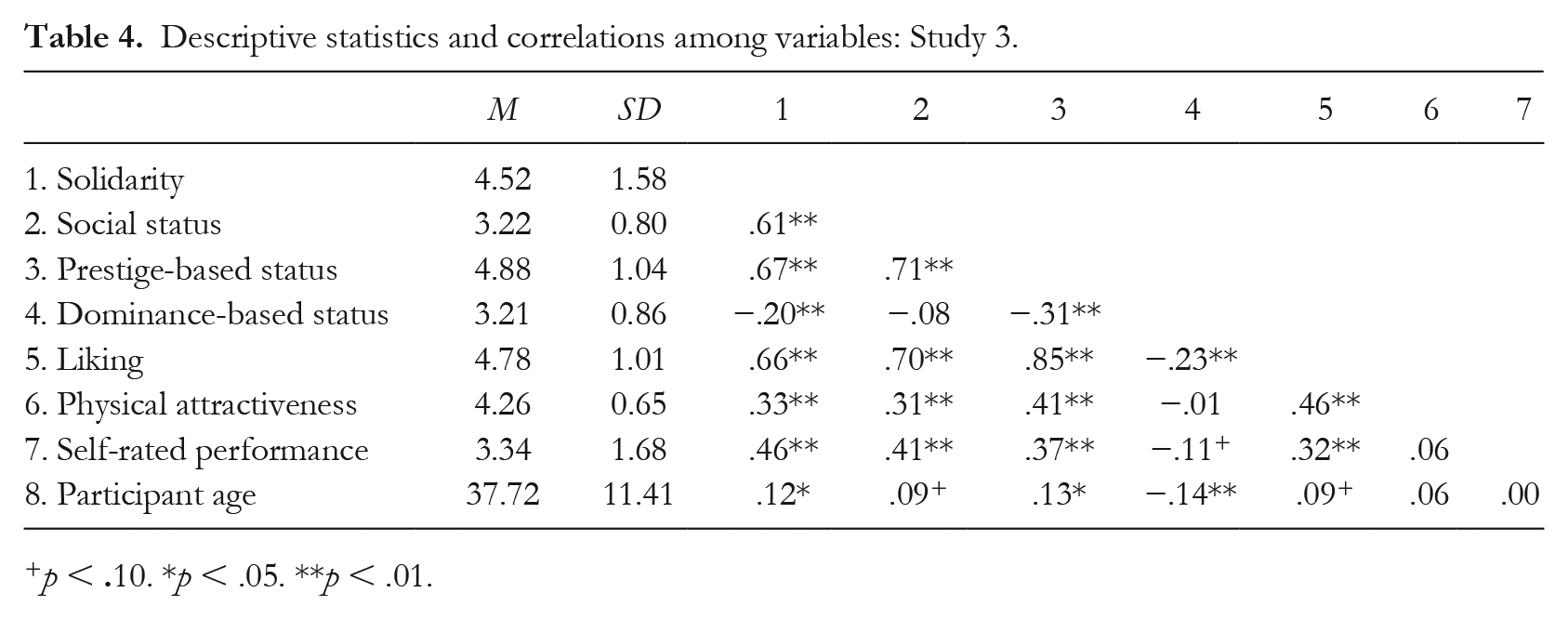
p < .10. *p < .05. **p < .01.
Manipulation check
Participants assigned to the high team performance condition reported higher levels of team performance (M = 4.91, SD = 0.30) than did participants assigned to the low team performance condition (M = 1.75, SD = 0.74), d = 5.63, t(342) = 52.25, p < .001, which indicated that our manipulation of team performance was successful.
Social status
Participants in the high team performance condition conferred higher status on their teammates (M = 3.56, SD = 0.73), on average, than did participants in the low team performance condition (M = 2.89, SD = 0.72), d = 0.92, t(342) = 8.54, p < .001. This relationship between team performance and intragroup status remained significant after controlling for liking, t(341) = 6.15, p < .001, which confirmed our main hypothesis.
Solidarity
Participants in the high team performance condition also reported higher levels of solidarity with their team (M = 5.20, SD = 1.23) than did participants in the low team performance condition (M = 3.84, SD = 1.61), d = 0.95, t(342) = 8.85, p < .001. Again, we note this relationship held after controlling for liking, t(341) = 6.54, p < .001.
Perceived physical attractiveness
Participants’ ratings of the physical attractiveness of their teammates were not significantly higher in the high team performance condition (M = 4.30, SD = 0.67) than in the low team performance condition (M = 4.22, SD = 0.63), t(342) = 1.19, p = .24, indicating that our results were not driven by an overall halo effect.
Mediation analysis
The relationship between group performance and intragroup status was partially mediated by team solidarity. We tested the significance of this indirect effect with bootstrapping procedures using the “Mediation” package in R (Tingley et al., 2014) while controlling for liking (see supplemental material for alternative mediation models and mediation analyses that do not control for liking). Standardized indirect effects were computed for each of the 5,000 bootstrapped samples. The standardized indirect effect was 0.10, 95% CI [0.04, 0.16], which indicates a significant indirect effect. After controlling for the indirect effect, the direct effect of group performance on status remained significant. The bootstrapped standardized direct effect was 0.38, 95% CI [0.21, 0.54], which suggests there may be other mediators besides solidarity that account for the effect of team performance on intragroup status. See Table 2 for a summary of these analyses.
Discussion
In Study 3, we employed a novel experimental paradigm to simulate teamwork and manipulate group performance. Using this tightly controlled design, we found strong causal evidence that an increase in group performance led to an increase in average intragroup status. We also replicated the mediation path documented in Studies 1–2. Taken together, these results suggest that an increase in group performance increased individual members’ sense of solidarity with their teammates, which, in turn, boosted the status of fellow team members above and beyond the influence of interpersonal liking. Along with the results from our previous two studies, these findings provide strong support for our hypotheses.
General Discussion
Having higher status yields many benefits, including better physical health, greater social influence, and increased subjective well-being (Anderson, Kraus, et al., 2012; Bales et al., 1951; Cooper et al., 2010). Not surprisingly, then, most people are desirous of status, hoping to climb higher in the social hierarchy (Anderson et al., 2015; Goodman et al., 2001). To boost one’s status, an individual can gain competence, acquire valued resources, or perform prosocial acts (Anderson & Brown, 2010; Flynn, 2003; Flynn et al., 2006). In the present research, we find that individuals can also increase their status by way of good group performance. The experience of group success leads group members to regard one another more highly, on average, because success engenders a stronger sense of solidarity, or a stronger socioemotional bond shared by fellow group members.
To date, no research has attempted to identify factors that account for the overall amount of status available to members of a group. Instead, past research has primarily conceptualized intragroup status as an individual property anchored to a fixed equilibrium (Berger et al., 1980; Ridgeway & Berger, 1986; cf. Frank, 1985). According to that view, the amount of status available in a group is limited, so that if one group member elevates his or her status, some other group member(s) must lose an equivalent amount. We suggest instead that the amount of status available in groups may be variable, not fixed. We found strong support for this alternative view using field data and controlled experiments, objective and subjective measures of performance, and preregistered study designs and analysis plans. The results confirm that an increase in group performance equates to an increase in intragroup status.
Broader Implications
Our findings offer a substantial contribution to the literature on status in small groups. Rather than assuming that the total amount of intragroup status is zero-sum in nature (e.g., Berger et al., 1972), status scholars should assume that this amount varies according to group experience—a distinction that can help make sense of past findings, or perhaps reframe their interpretation. For instance, some scholars suggest that a desire for intragroup status stifles collective learning because group members’ personal desire for status leads them to withhold information, which in turn undermines the achievement of collective goals. We suggest that individual status gains and the achievement of collective goals are not necessarily at odds with each other. Instead, a rising tide can lift all boats. That is, we lend support to a more sustainable, “socialized” view of status (see Bunderson & Reagans, 2011), where promoting collective goals can, in turn, lead to more status gains for each member of the collective, on average.
As another example, research on “status conflict” (Hays & Bendersky, 2015), a competitive jockeying for social position among individual group members, suggests that groups often are encumbered by disputes over relative levels of status and influence, and that such conflict hurts group performance by stymying information sharing (Greer et al., 2018). As Bendersky and Hays (2012, p. 326) explain, “because status is a fixed social resource, status conflicts have zero-sum outcomes; i.e., gaining status means lowering another’s rank in the hierarchy.” According to our view, the intensity of these disputes would depend on the strength of the group’s performance. Status conflicts would become more intense following a recent drop in performance because the amount of status available to group members has suddenly decreased. Reframing intragroup status as a variable resource that can wax and wane as group performance fluctuates might improve our understanding of such group dynamics.
Our findings may apply to other paradigms besides status characteristics theory and research on status dynamics in small groups. For example, a key tenet of social identity theory is the drive for “positive distinctiveness”—a favorable comparison between oneself and members of other groups (Tajfel & Turner, 1979). Group members are motivated to participate in intergroup competition, at least in part because they are intrinsically motivated by the potential gains in positive distinctiveness for themselves and the groups to which they belong. Our findings suggest that when the group succeeds, these potential gains indeed turn into real gains, as the focal individual’s standing among his or her peers becomes elevated.
Our findings also relate to past work on social comparison theory, which holds that people are sensitive to their social context in forming impressions of self-worth, self-confidence, and self-esteem (Festinger, 1954; Gerber et al., 2018). In particular, the big-fish-little-pond effect (Marsh & Parker, 1984) suggests that people evaluate themselves more favorably when they have high status in a low-ranking group rather than low status in a high-ranking group. We propose that this demoralizing self-view may not align with what others think. Indeed, according to our findings, members of high-ranking (i.e., better performing) groups think more highly of their peers than do members of low-ranking (i.e., worse performing) groups, on average. This fact suggests that the demoralizing self-views of being a “little fish in a big pond” may be completely unfounded, or at least somewhat exaggerated.
Limitations and Future Directions
We note some limitations in our empirical studies that suggest opportunities for future research. First, we theorized about the effect of group performance on intragroup status as a unidirectional pathway, but we suspect that this relationship may, in fact, be reciprocal. Just as stronger feelings of solidarity can lead to more generous conferrals of intragroup status, receiving respect and deference from fellow group members might engender positive emotions that further undergird feelings of solidarity. Noting this, we encourage future research to explore whether an increase in intragroup status can, in turn, cause a subsequent increase in group performance through the experience of solidarity. Such research may help shed more light on the psychological mechanisms by which certain groups maintain their success over the long term while others appear to be trapped in a vicious cycle.
Our theorizing hinges on an implicit assumption of stable group composition. However, turnover is expected, and even required, in many groups, and such changes to group composition might affect our predictions. As group composition stabilizes, the influence of group performance on status conferrals may decrease, presumably because group members’ shared history provides a salient reference point on which status conferrals become anchored. Along a related vein, group longevity may attenuate the influence of group performance on intragroup status. We explored this idea by examining the group tenure data gathered in Study 2, but we found no evidence that longevity moderates the link between group performance and intragroup status (see the supplemental material for this analysis). Nevertheless, future research might investigate this potential relationship more closely.
We hypothesized that intragroup status is higher, on average, in high-performing groups, but we did not hypothesize about how much status conferrals may vary among members of high-performing groups relative to low-performing groups. According to the “Matthew effect,” group members with higher status tend to benefit from an attributional advantage (Merton, 1948). Outsiders simplify their causal attributions by assuming that those who already possess high status are disproportionately responsible for group success. In contrast, we expect that judgments made by fellow group members may be more balanced. In particular, we believe that groups with high task interdependence may see less variability in intragroup status conferrals, especially when their performance improves. Individuals working in these groups will assume that many, if not all, group members are needed to create a successful group process and therefore all members are deserving of credit.
In our theorizing and in our studies, we did not distinguish between absolute and relative assessments of group performance, but this distinction may be worth further consideration. Studies 1 and 3 involved competitive contexts in which intergroup comparisons were explicit (e.g., participants in Study 1 knew whether their towers were taller than the towers constructed by other groups). It is unclear whether information about absolute or relative group performance accounted more heavily for our effects. In Study 2, we attempted to test this possibility more directly and, although there is some suggestive evidence indicating a stronger effect for relative group performance on intragroup status, the number of cases that involved intergroup comparisons was too small to draw definitive conclusions. In general, we assume that our results would still hold regardless of whether relative group comparisons were explicitly made, but this assumption needs to be tested in future research.
Finally, we used mediation analyses to identify solidarity as a mechanism that can account for the link between group performance and intragroup status. As noted elsewhere (Bullock et al., 2010), these analyses are suggestive rather than conclusive. Future research might employ an experimental manipulation of solidarity to establish stronger causal evidence. Relatedly, we do not believe that solidarity is the only mechanism that can account for the link between group performance and intragroup status. For example, feelings of threat might also play a role. When group performance decreases, group members often look for someone to blame, particularly if feelings of accountability are high (Fast & Tiedens, 2010). In contrast, when group performance increases, tensions among group members will likely ease, thereby fostering a sense of security. This lessening of perceived threat could lead group members to be more generous in bestowing status on others. Such alternative mechanisms should be considered in future tests of the link between group performance and intragroup status.
Conclusion
We challenge the long-standing assumption that intragroup status is zero-sum. Instead, the average level of social status conferred to an individual group member by fellow group members can vary from one group to the next. We hope that this finding—that the average level of intragroup status can fluctuate across groups—opens a fruitful line of inquiry for researchers interested in how social status in small groups can be gained or lost. We begin that inquiry here by identifying how an increase in group performance raises the overall amount of status available to group members because of enhanced solidarity. We look forward to seeing what future research discovers to help us better understand these intragroup status dynamics.
Supplemental Material
sj-docx-1-gpi-10.1177_13684302221122667 – Supplemental material for A rising tide lifts all boats: Group performance and intragroup status
Supplemental material, sj-docx-1-gpi-10.1177_13684302221122667 for A rising tide lifts all boats: Group performance and intragroup status by Francis J. Flynn and Chunchen Xu in Group Processes & Intergroup Relations
Footnotes

References
Supplementary Material
Please find the following supplemental material available below.
For Open Access articles published under a Creative Commons License, all supplemental material carries the same license as the article it is associated with.
For non-Open Access articles published, all supplemental material carries a non-exclusive license, and permission requests for re-use of supplemental material or any part of supplemental material shall be sent directly to the copyright owner as specified in the copyright notice associated with the article.
