







Abstract
The current research investigated an “ironic” consequence of a perceived procedural fairness climate vis-à-vis disadvantaged groups. Specifically, we examined whether the perception that societal institutions treat one’s underprivileged group in a procedurally fair way negatively impacts upon minority group members’ support for social change. Six studies (total N = 1,076) supported our claims. In survey Study 1 (Belgian ethnic minorities), procedural fairness climate perceptions were negatively related to support for social change. Cross-sectional Studies 2 (colored South Africans) and 3 (Hispanic Americans) further showed that this relationship is mediated by beliefs in minority mobility. Finally, Studies 4–6 (Asian and African Americans) provided experimental evidence corroborating our causal mediation model. Our findings align with literature demonstrating similar “ironic” effects of procedural fairness among advantaged group members, as they illustrate that the perception of a procedural fairness climate can analogously prevent disadvantaged group members from advocating changes that could alleviate their state of deprivation.
Keywords
The second decade of the 21st century has been characterized by increased numbers of disadvantaged group members voicing their discontentment about their underprivileged status and publicly supporting social change (Clayton, 2018; Hillstrom, 2018). The myriad of social activist initiatives that have recently seen the light, such as the Black Lives Matter movement in the United States (Leach & Allen, 2017; LeBron, 2017) or the Social Justice Initiative in South Africa (sji.org.za), are vivid manifestations of this collective demand for more favorable economic rights and social status. Despite this increase in public displays of social change advocacy, however, numerous contexts and situations remain wherein such engagement for collective action fails to materialize. In fact, a peculiar finding in this regard is that even members of low status groups can legitimize the system (Jost, 2019; Jost & Major, 2001; Jost et al., 2004; van der Toorn & Jost, 2014). Thus, a relevant question is: What factors compel disadvantaged group members to act against their own interests and rationalize the status quo?
In the current research, we focus on procedural fairness climate perceptions as a potential hurdle for the cultivation of support for social change among marginalized group members. By procedural fairness climate perceptions, we refer to the evaluation that societal institutions (e.g., the courts, the police, political stakeholders) implement fair procedures when making decisions that concern one’s social group (Valcke, van Hiel, Onraet, & Dierckx, 2020; Valcke, van Hiel, van Roey, et al., 2020). Specifically, in the present research, we put forth the novel hypothesis that stronger perceptions of a procedural fairness climate vis-à-vis one’s disadvantaged group are associated with the belief that society is open to the advancement of all individuals irrespective of their ethnic background, and thus also individuals pertaining to one’s disadvantaged group (beliefs in “minority individual mobility,” or simply, “beliefs in minority mobility” hereafter). We further hypothesized that beliefs in minority mobility are irreconcilable with, and hence undermine, support for social change. As such, the present research aims to illustrate that procedural fairness climate perceptions may curb support for social change among disadvantaged group members by promoting minority mobility convictions. Moreover, because inferences based on procedurally fair decision-making climates can be but are not necessarily diagnostic of societal equality, the present research thus highlights an “ironic” side effect of the perception of benevolent fair treatment among disadvantaged groups.
Procedural Fairness Climate Perceptions and Support for Social Change: The Mediating Role of Minority Mobility Beliefs
A well-documented phenomenon in social psychology is the observation that decision-makers can generate support for their decisions by applying the rules of procedural fairness (Leventhal, 1980; Tyler & Lind, 1992; van den Bos, 2001). For societal actors, procedural fairness is indispensable because the decisions that they face on a daily basis often involve multiple groups with competing interests. Of special relevance to the present research, the perception that societal institutions (e.g., the courts, the police, political stakeholders) implement fair procedures when making decisions that concern one’s social group has been coined a perceived “collective procedural fairness climate” (Valcke, van Hiel, Onraet, & Dierckx, 2020, p. 382), and recent research has started to document the benign effects of such procedural fairness climate perceptions among minority group members. For example, it has been shown that a collective procedurally fair societal climate not only creates compliance with the decisions and policies of societal actors (Dierckx et al., 2020; Grimes, 2006), but that it also promotes social cohesion by instilling a sense of belongingness to society (Valcke, van Hiel, Onraet, & Dierckx, 2020) and by improving social trust (Dierckx et al., 2021; Rothstein & Stolle, 2008). Although we do not contest its psychological benefits for members of disadvantaged societal groups, we argue in the current research that the perception of such well-intended institutional procedural fairness can have adverse practical side effects too. Specifically, we hypothesize that a perceived societal climate of fair treatment at the institutional level may negatively affect the willingness of the disadvantaged to support collective efforts to enhance their socioeconomic status (hereafter referred to as support for social change), because procedural fairness climate perceptions induce beliefs in minority (individual) mobility.
To ground our reasoning, we refer to the literature emphasizing the perceived context of intergroup relations (e.g., Doosje et al., 1999). According to this body of research, intergroup behavior is determined by the nature of the relationship social groups perceive to have with one another (Brewer & Campbell, 1976; Fisher, 1990) and the legitimacy they ascribe to their relative status relations (Hogg & Gaffney, 2018). Hence, this body of work suggests intergroup harmony (e.g., lack of collective action efforts) when the status differentials between a disadvantaged group and more privileged groups are perceived as legitimate. Furthermore, social identity theory (SIT; Tajfel & Turner, 1979) posits that people are, by default, motivated to protect the favorability of their social identities, and consequently, members of disadvantaged groups will naturally be inclined to protect and enhance their group’s status and prestige (Tajfel, 1981; Tajfel & Turner, 1979). However, SIT also holds that members of disadvantaged groups should be less motivated to engage in collective action when admission into a more prestigious group can be envisaged (Sturmer & Simon, 2004). In sum, both these theoretical frameworks would thus predict that support for social change will fail to materialize when the status quo is considered legitimate, or more importantly, when the probability of achieving an alternative more favorable status quo is deemed high (Ellemers, 1993; Ellemers et al., 1997). This implies that interventions that engender expectations of future progress will inevitably decline minority group members’ willingness to support social change. Therefore, in the present research, we argue that procedural fairness climate perceptions vis-à-vis one’s social group indirectly impact upon support for social change among disadvantaged group members because they elicit beliefs in minority mobility. Beliefs in minority mobility entail the conviction that society is open to the advancement of all social groups, and most importantly, of all individuals from the group to which one belongs (Major et al., 2002). It stands to reason that such beliefs—and the implicit prospect of future group progress—may erode support for social change.
Support for the hypothesis that procedural fairness climate perceptions engender beliefs in minority mobility can be found in the literature examining the underpinnings of a fairly judged procedure (e.g., Leventhal, 1980; Tyler, 1988). This line of research has established that whether a procedure is evaluated as fair, strongly depends on its perceived unbiasedness (defined as its capacity to grant each stakeholder an equal opportunity for a positive outcome; Barrett-Howard & Tyler, 1986). It can further reasonably be expected that ascribing such unbiasedness to decision processes at the societal level—and hence to the actors involved in these decisions—may reflect positively on society itself, because institutions are often considered to be representative of society (Turner, 2009). Consequently, such perception of a societal climate as unbiased may generalize into the idea that members of every group can get ahead in life, whatever their socioeconomic status may be. Indeed, some preliminary empirical evidence seems to corroborate this rationale. For example, a cross-country examination of fairness and mobility perceptions in 38 nations revealed that country-level perceived procedural justice is positively related to country-level mobility beliefs (Larsen, 2016). Analogously, at the individual level, it was found that those who believe they live in a fair societal climate tend to report more positive beliefs about (past) social mobility (Corneo & Gruener, 2002).
Beliefs in minority mobility, in turn, may decrease support for social change. Mobility beliefs promote the perception that the boundary between one’s disadvantaged group and more privileged groups is relatively permeable and temporally unstable (Jetten et al., 2017)—rendering support for social change less critical. Conversely, in the absence of mobility beliefs, the boundary between status groups is perceived to be impermeable, inflating the need for social change. In support of this premise, perceived boundary impermeability has been related to support for collective action (Wright, 1997), and even mild forms of permeability have been shown to hinder collective action (Wright, 2001; Wright et al., 1990). Relatedly, Wright and Lubensky (2009) found that positive intergroup contact with White people was negatively associated with support for collective action among African Americans, and that this relationship could be explained in terms of heightened perceived boundary permeability. Of particular relevance, Brandt et al. (2020) recently provided more direct evidence that, among low status individuals, perceived mobility for individuals of one’s disadvantaged group significantly predicted system legitimacy beliefs. Finally, and most importantly, Day and Fiske (2017) further showed that exposure to moderate and high (individual) mobility resulted in enhanced willingness to defend the societal system, compared to a condition with low individual mobility information.
In sum, we thus expected that (1) procedural fairness climate perceptions would be negatively related to support for social change, and (2) beliefs in minority mobility could help explain this relationship. Hence, we formulated the following hypotheses:
Hypothesis 1: Perceptions of a procedurally fair decision-making climate vis-à-vis their group are negatively associated with support for social change among disadvantaged group members.
Hypothesis 2: Procedural fairness climate perceptions among disadvantaged groups are positively associated with beliefs in minority (individual) mobility.
Hypothesis 3: Beliefs in minority (individual) mobility are negatively associated with support for social change.
Hypothesis 4: Beliefs in minority (individual) mobility mediate the relationship between the procedural fairness climate perceptions of disadvantaged group members and their support for social change.
The Present Studies
The present research thus aimed to investigate the hypothesized relationship between procedural fairness climate perceptions, beliefs in minority mobility, and support for social change among disadvantaged group members. Figure 1 presents an overview of our hypothesized model.
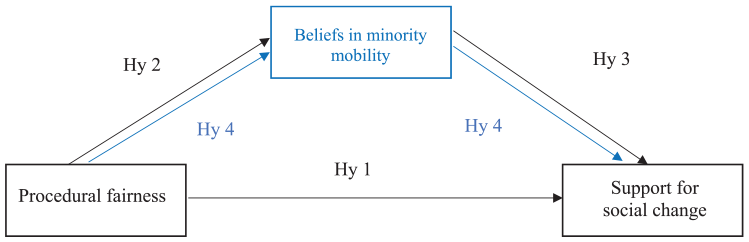
Hypothesized model of the relationship between procedural fairness climate perceptions, beliefs in minority mobility, and support for social change.
Six studies were conducted to investigate the relationships encapsulated in this model. In Study 1, amongst a Belgian snowball sample consisting of members of various ethnic minority groups, we assessed the direct relationship between procedural fairness climate perceptions and support for social change (test of Hypothesis 1). Next, cross-sectional Studies 2 (colored South African minority members 1 ) and 3 (Hispanic American minority members) examined the mediating role of beliefs in minority mobility (test of Hypotheses 1–4). Importantly, we additionally included perceptions of relative deprivation (Study 2) and perceptions and evaluations of socioeconomic inequalities (Study 3) as control variables, because the collective action literature has revealed that both these covariates are strong catalysts for support for social change (Jetten et al., 2020; van Zomeren et al., 2004).
Lastly, three additional experiments were conducted to establish causality in our hypothesized model. In Study 4, we manipulated procedural fairness climate perceptions (the independent variable) and measured Asian Americans’ beliefs in minority mobility (our mediator). Then, in Study 5, we manipulated beliefs in minority mobility and measured African Americans’ support for social change (our dependent variable). Finally, in Study 6, we once more manipulated procedural fairness perceptions and recorded both Asian Americans’ beliefs in minority mobility and their support for social change, in order to test our entire mediation chain in a single experiment.
All study materials, together with all data sets, codebooks, and scripts needed to reproduce the analyses can be found on our Open Science web page (https://osf.io/7y2qw/). We report all manipulations, measures, and exclusions in the studies.
Study 1
Method
Participants
A pilot study was conducted at a Belgian university as part of the thesis of a psychology undergraduate student. Participants were recruited through snowball sampling on social media. An initial 143 respondents completed the full survey. We were forced to exclude 25 participants because they failed at least one out of two attention checks (“Now please select the fifth response”), 2 which resulted in a final sample of N = 118 (31 males; age: M = 28.1, SD = 10.91, range = 15–70). A sensitivity analysis revealed that, given this sample size and under standard criteria (significance level α= .05), our study had approximately 79% power to detect an effect of size r = .25 (which corresponds to a medium effect size, given the empirical distributions of effect sizes in social psychological research; Lovakov & Agadullina, 2017).
The majority of the sample had a Turkish (32.2%) or Moroccan (10.2%) ethnic background; the remainder either originated from or possessed ancestral ties to Asia (22.9%), other European countries (18.6%), Africa (6.0%), or South (5.1%) or North America (1%). 3 Most respondents were first-generation minorities (41.5%; second = 40.7%; third = 15.3%) with a bachelor’s degree as the highest educational attainment (48.7%; primary education = 0.8%; secondary education = 21.7%; master’s degree = 27.0%; PhD or similar = 1.7%).
Measures
Unless stated otherwise, items were scaled from 1 (strongly disagree) to 5 (strongly agree).
Procedural fairness climate
This variable was measured with four items adapted from van den Bos et al. (2014): “My ethnic group . . .” “. . . is treated fairly [in Belgium],” “. . . is treated with respect,” “. . . is able to voice its opinions,” “. . . is seriously listened to” (Cronbach’s α = .85; M = 3.16, SD = 0.90).
Support for social change
We measured our outcome variable with three items adapted from Saguy et al. (2009). An example item is “I support legislation through which members of my ethnic group will be guaranteed equal work opportunities as members of the Belgian majority group” (α = .73; M = 4.13, SD = 0.81).
Socioeconomic status
Given that satisfaction with one’s own financial situation may compromise support for social change (Tausch et al., 2015), we included two measures of socioeconomic status (SES). The first was a subjective assessment of household SES: “Some people [in Belgium] are richer and have better jobs than others; compared to all other Belgians, where would you place yourself/your family” (1 = low degree of wealth and material comfort, 7 = high degree of wealth and material comfort; M = 4.38, SD = 1.01). The second item inquired about household financial troubles (“Do you or your family struggle to make ends meet at the end of the month?”; 1 = yes, 0 = no; 24.3% “yes” responses).
Data Analysis and Results
Covariate analysis
Table 1 reports the bivariate correlations between the Study 1 focal variables and demographic covariates.
Correlations among focal variables and demographic covariates: Study 1.
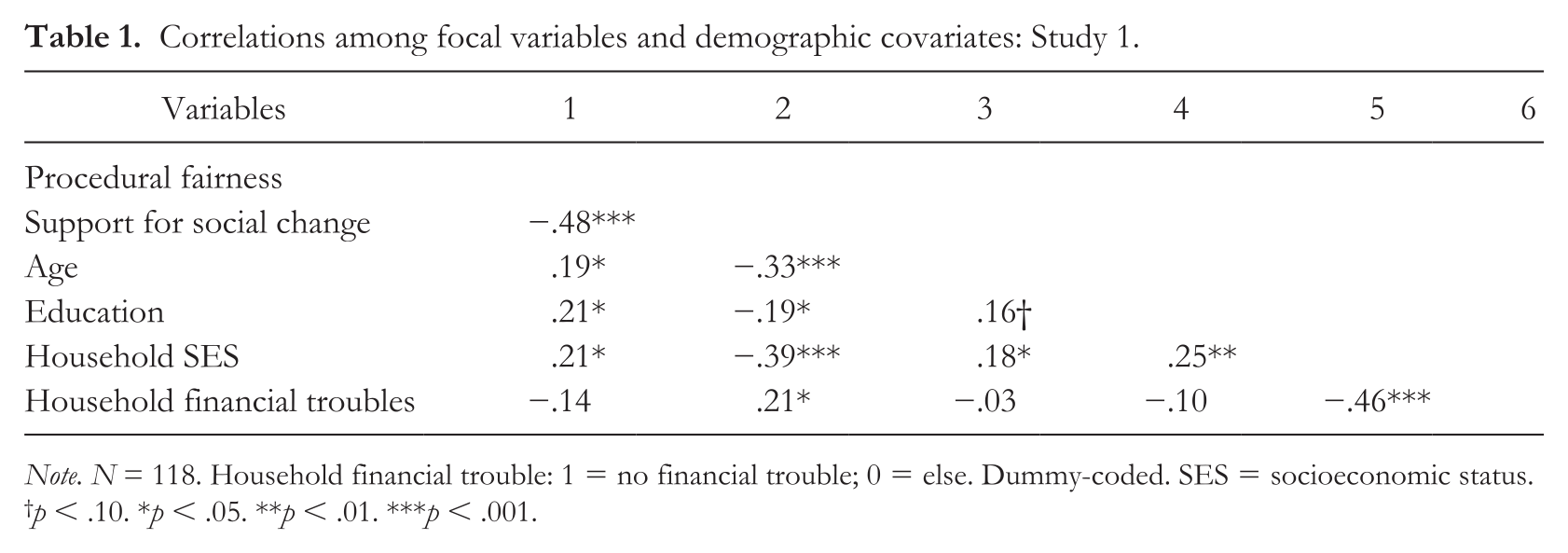
Note. N = 118. Household financial trouble: 1 = no financial trouble; 0 = else. Dummy-coded. SES = socioeconomic status.
p < .10. *p < .05. **p < .01. ***p < .001.
Support for social change correlated significantly with age (r = −.33, p = .040), household SES (r = −.39, p < .001), education (r = −.19, p = .040), and household financial troubles (r = .21, p = .021). Furthermore, support for change differed significantly between women (M = 4.25, SD = 0.70) and nonbinary individuals (M = 2.83, SD = 0.70; p = .040); and the difference approached significance between women and men (M = 3.90, SD = 0.99; p = .076) and between nonbinary individuals and men (p = .076). As such, we retained all these demographic variables in our main analyses.
Main analysis
To investigate our main research question, we fitted a hierarchical linear regression model with procedural fairness and our demographic variables as independent variables, and support for social change as the outcome. All covariates were entered in Step 1, and procedural fairness was entered as an additional predictor in Step 2. 4 The results of these analyses are shown in Table 2.
Results of hierarchical linear regression: Study 1.
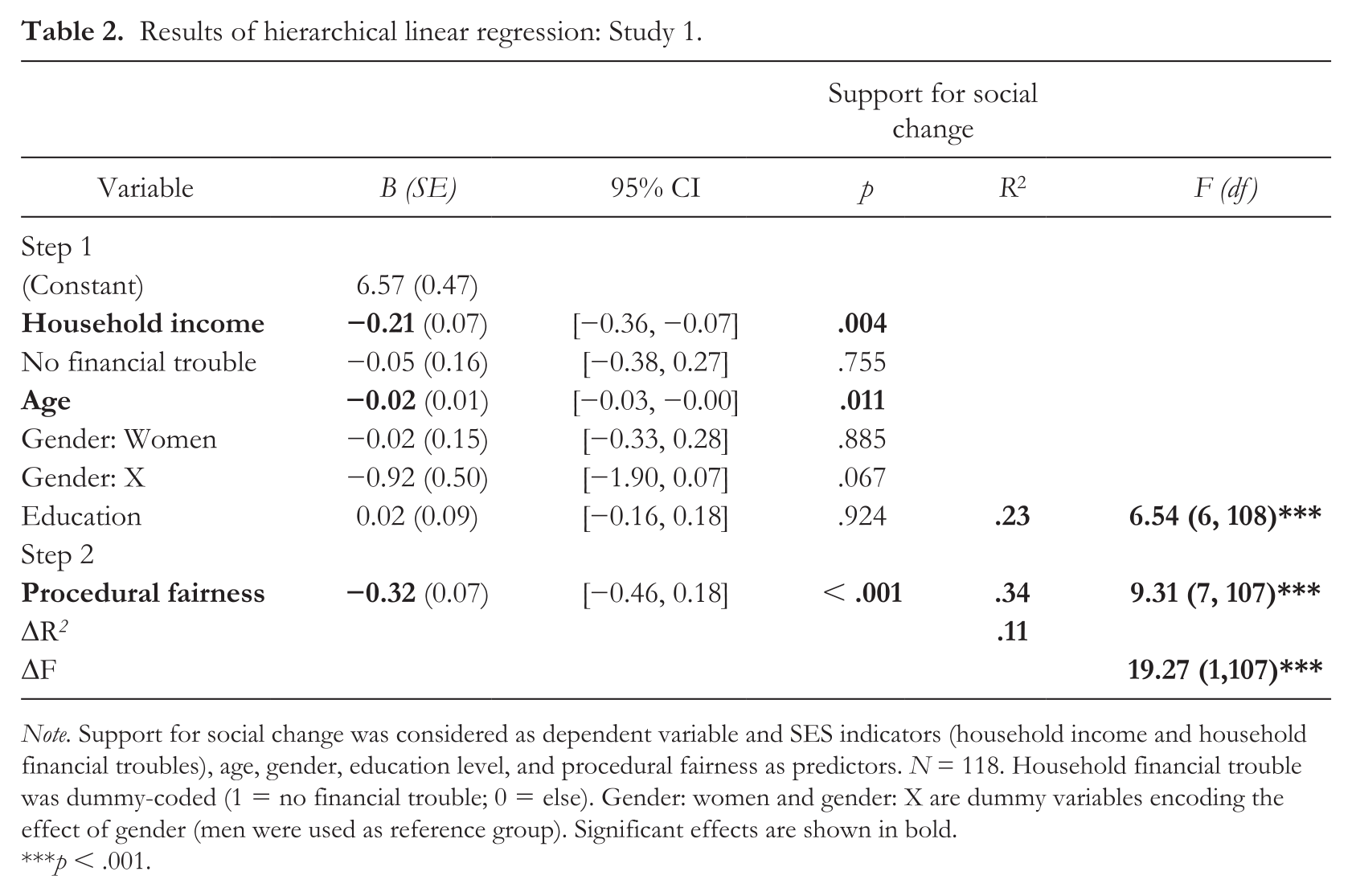
Note. Support for social change was considered as dependent variable and SES indicators (household income and household financial troubles), age, gender, education level, and procedural fairness as predictors. N = 118. Household financial trouble was dummy-coded (1 = no financial trouble; 0 = else). Gender: women and gender: X are dummy variables encoding the effect of gender (men were used as reference group). Significant effects are shown in bold.
p < .001.
As summarized in Table 2, all demographic variables together accounted for 23.0% (adjusted R2) of the total variance in support for social change, despite the fact that only the effect of income (b = −0.21, SE = 0.07, 95% CI [−0.36, −0.07], p = .004) and age (b = −0.02, SE = 0.01, 95% CI [−0.03, −0.00], p = .011) were significant. More importantly, and in line with Hypothesis 1, procedural fairness explained a significant amount of variance in support for social change as well, over and above the covariates (b = −0.32, SE = 0.07, 95% CI [−0.46, −0.18], p < .001; ΔR2 = 11%). This second regression model, F(7, 107) = 9.31, p < .001, outperformed the model with covariates only, F(6, 108) = 6.54, p < .001; likelihood ratio test (LRT): χ2 (1) = 19.05, p < .001, accounting for 34% of the total variance in our dependent variable.
Discussion
Study 1 provided preliminary support for our main research question (Hypothesis 1). It was shown that a perceived procedural fairness climate vis-à-vis one’s ethnic minority group was significantly related to decreased support for social change. Importantly, procedural fairness perceptions explained incremental variance in our dependent variable above and beyond a range of demographic characteristics, corroborating the validity of the association.
Taken together, results from Study 1 corroborated our account that procedural fairness climate perceptions may hinder support for social change among members of societal groups with a history of deprivation. To further unravel the psychological mechanisms involved in this “ironic” fair process effect, we conducted a second cross-sectional study wherein we additionally inquired about participants’ beliefs in minority mobility. Furthermore, in Study 2, we targeted a specific disadvantaged population (i.e., colored South Africans), in order to rule out potential minority-group-specific confounds and to expand the generalizability of our results. Moreover, Study 2 also aimed to control for relative deprivation perceptions as another potential confounding variable.
Study 2
Method
Participants
A sample of N = 152 colored South African students was recruited at a large university in the Western Cape. Although colored South Africans are targeted beneficiaries of South Africa’s Broad-Based Black Economic Empowerment program (along with members of other population groups that were previously disadvantaged under South Africa’s apartheid laws), their unemployment rate in the second quarter of 2021 (28.50%) was 3.3 times larger than that of White South Africans (8.60%; Statistics South Africa, 2021). Participants responded to an announcement made in a class taught by one of the authors. In return for participation, students could opt to be included in a cash prize draw. Thirteen participants failed our attentional check (“Please select the third response for this question”), resulting in a final sample of N = 139 (31 males; age: M = 24.5, SD = 8.82, range = 18–64). A sensitivity analysis using the powerMediation package (Version 0.3.4; Qiu, 2020) in R (R Core Team, 2021) revealed that, given this sample size and the observed relationships between our focal variables (see following lines), Study 2 had 80% power to detect a minimal slope for our mediator of size (b = 0.23) under standard criteria (α = .05).
The majority of our sample (42.4%) identified as middle-class South Africans, with a monthly household income between 25,601 and 51,200 South African rand (i.e., approximately between $1,750 and $3,500 per month; 23.0%; $0–1,750 = 58.5%; >$3,500 = 18.5%). Given that political conservatism is negatively associated with collective action aimed at equalizing status hierarchies (Choma et al., 2020), we included one question to assess this variable and include it in our covariate analysis (“Please indicate your political beliefs”; 0 = far left, 100 = far right; M = 46.6, SD = 17.55).
Measures
Unless stated otherwise, items were scaled from 1 (strongly disagree) to 5 (strongly agree).
Procedural fairness
We measured this variable with nine items adapted from Dierckx et al. (2020; α = .88; M = 2.54, SD = 0.79). Sample items included “Decisions that affect [my ethnic group] are made ethically” and “Personal motives or biases influence decisions that affect [my ethnic group]” [reverse-scored]). The reliability of this scale was good (α= .83; M = 2.42, SD = 0.60).
Beliefs in minority mobility
This variable was measured with four items adapted from Major et al. (2002). Sample items included “Advancement in the South African society is possible for individuals of all ethnic groups” and “Members of my ethnic group are often unable to advance in the South African society” (reverse-scored). The scale’s reliability was acceptable (α= .71; M = 2.46, SD = 0.72).
Support for social change
The same scale as in Study 1 was used to measure this concept (α = .55; M = 4.28, SD = 0.62).
Relative deprivation
This variable was measured with a single item based on Alexander and Ruderman (1987): “Would you say that over the last years people of your ethnic group have been [economically a lot worse off/worse off/the same/better off/a lot better off] than members of other ethnic groups living here?” (1 = a lot worse off, 5 = a lot better off; M = 2.80, SD = 0.93).
Data Analysis and Results
Covariate analysis
Table 3 reports the bivariate correlations between the Study 2 focal variables and demographic covariates.
Correlations among focal variables and demographic covariates: Study 2.
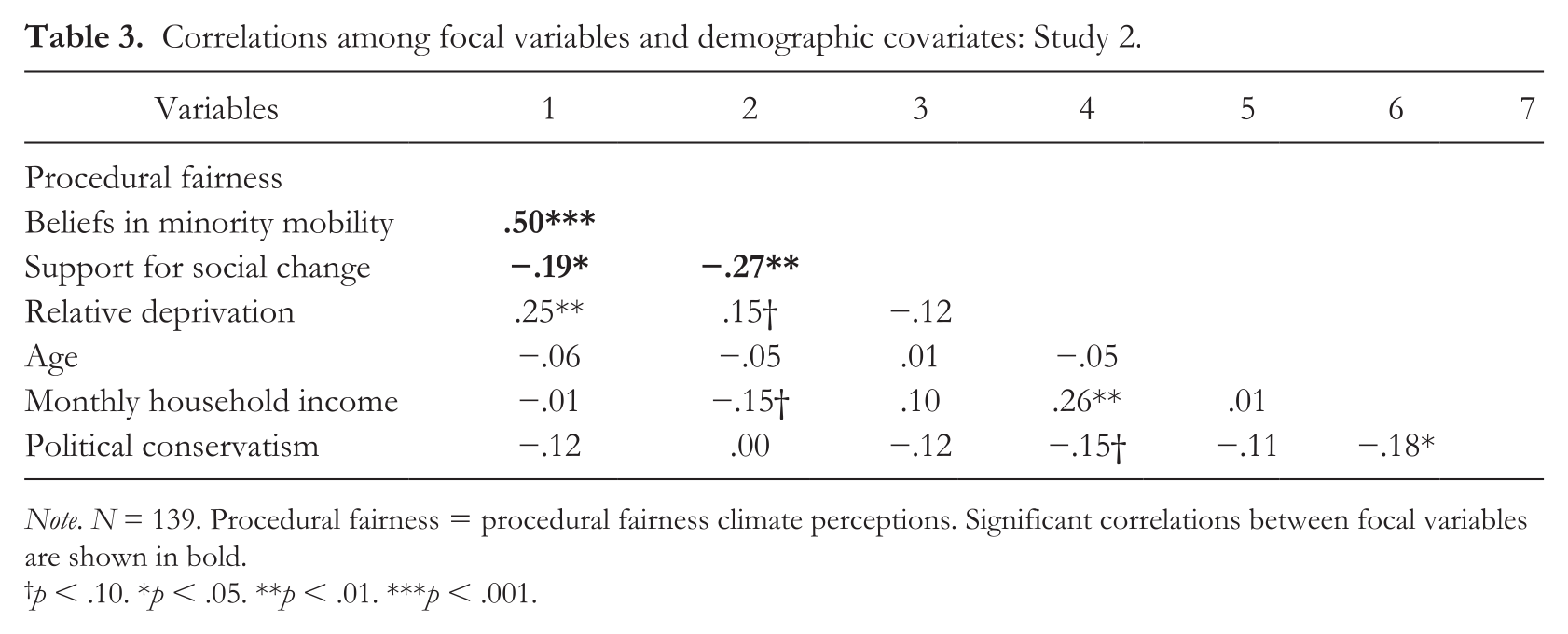
Note. N = 139. Procedural fairness = procedural fairness climate perceptions. Significant correlations between focal variables are shown in bold.
p < .10. *p < .05. **p < .01. ***p < .001.
The correlations between beliefs in minority mobility and relative deprivation perceptions (r = .15, p = .073) and between beliefs in minority mobility and monthly household income approached statistical significance (r = .15, p = .089). No other relationships between our covariates and hypothesized mediator or the outcome were found to be significant or approached significance (all rs < |.13|; all ps > .159). As such, we only retained these covariates in our main (mediation) analysis.
Main analysis
An inspection of the bivariate correlations revealed that, in line with Hypothesis 1, procedural fairness climate perceptions were significantly negatively related to support for social change (r = −.19, p = .026). Furthermore, procedural fairness was also significantly positively associated with beliefs in minority mobility (r = .50, p < .001; in line with Hypothesis 2), and beliefs in minority mobility were significantly negatively associated with support for social change (r = −.27, p = .001; in line with Hypothesis 3).
We then assessed the influence of beliefs in minority mobility as an intermediary variable (i.e., Hypothesis 4). To do so, we fitted a path analysis model with the Lavaan package (Version 0.6-9; Rosseel, 2012) in R, including the relevant covariates. 5 Results of this analysis are depicted in Figure 2. It was found that beliefs in minority mobility significantly mediated the relationship between procedural fairness climate perceptions and support for social change (b = −0.12 [−0.22, −0.02], SE = 0.05, p = .020), supporting Hypothesis 4.
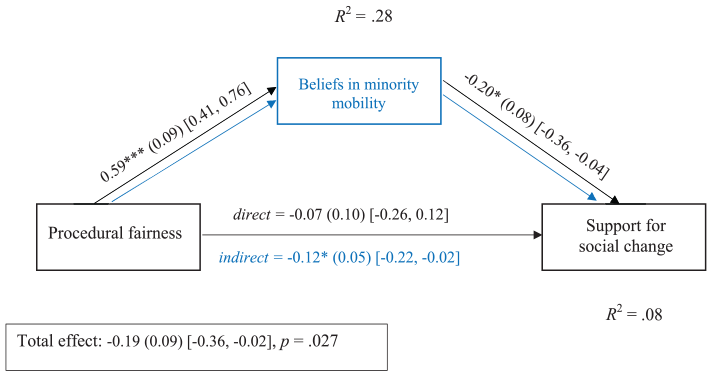
Results of path analysis: Study 2.
Discussion
Study 2 corroborated our hypotheses and the findings from Study 1. Procedural fairness climate perceptions were significantly related to decreased support for social change. Moreover, procedural fairness explained variance in our outcome variable above and beyond relative deprivation perceptions. Most importantly, and in line with Hypothesis 2–4, this direct relationship was fully mediated by beliefs in minority mobility.
Study 3 served two additional purposes. First, we aimed to replicate the effect of beliefs in minority mobility as an intermediary process variable. Moreover, we aimed to do so in another, substantially different, minority group—Hispanic Americans—to further enhance the external validity of our findings. Secondly, we controlled for another predictor of support for social change, namely (perceived) socioeconomic inequality. However, rather than solely gauging perceptions of such intergroup inequalities, as we did for the current study, we implemented a measure that incorporated a “blend” of perceptions and attitudes in Study 3, to simultaneously tap into both these aspects of socioeconomic inequality.
Study 3
Method
Participants
We recruited 241 Hispanic American citizens through Prolific, who were paid £0.60 for their cooperation. Hispanic Americans continue to be significantly overrepresented in poverty levels relative to their representation in the overall population (U.S. Census Bureau, 2020). Six participants were excluded from further analysis because they either came close to guessing the study’s hypothesis or because they gave a nonsensical answer to our data quality check question (“Please guess the hypothesis of our study”). Another four participants failed at least one out of two attentional checks (“Please select the third response for this question”). This resulted in a final sample of N = 231 participants (132 males; age: M = 28.3, SD = 9.68, range = 18–71). A sensitivity analysis using the powerMediation package revealed that, given this sample size and the relationships observed between our focal variables (see following lines), our study had 80% power to detect a minimal slope for our mediator of size b = 0.13, under standard criteria (α= .05).
The majority of participants had either obtained a high school diploma (47.6%) or a bachelor’s degree (42.4%; master’s degree: 7.8%; PhD: 1.7%; no degree: 4.3%), and earned over $50,000 annually (44.6%; $0–10,000: 7.4%; $10,000–20,000: 6.9%; $20,000–30,000: 11.7%; $30,000–40,000: 18.6%; $40,000–50,000: 10.8%). Furthermore, on average, participants rated their political beliefs as somewhat liberal (M = 2.64, SD = 1.32) on a 7-point Likert scale (1 = liberal, 7 = conservative).
Measures
The same scales as in Study 2 were used to measure procedural fairness climate (α= .88; M = 2.54, SD = 0.79), beliefs in minority mobility (α= .83; M = 2.49, SD = 0.99), and support for social change (α= .75; M = 4.36, SD = 0.75). Perceived socioeconomic inequality was measured with six generic items (1 = strongly disagree, 5 = strongly agree), measuring both perceptions of intergroup inequality between the White U.S. majority and the Hispanic minority group (sample items: “Over the last decades, Hispanic and White citizens have not become more equal in terms of resources” and “Compared to White people, Hispanic Americans’ position in society has not improved over the last decades”), as well as evaluations of this inequality as illegitimate (sample items: “I feel that differences in income between Hispanic Americans and White Americans in the United States are too large” and “Hispanic Americans’ economic situation has not yet become satisfactory, when compared to White people’s situation”). Item scores were reversed, such that higher scores indicated stronger perceptions and evaluations of socioeconomic inequality, before they were aggregated into a single reliable measure (α = .71; M = 2.63, SD = 0.71).
Data Analysis and Results
Covariate analysis
Table 4 reports the bivariate correlations between the Study 3 focal variables and demographic covariates.
Correlations among focal variables and demographic covariates: Study 3.
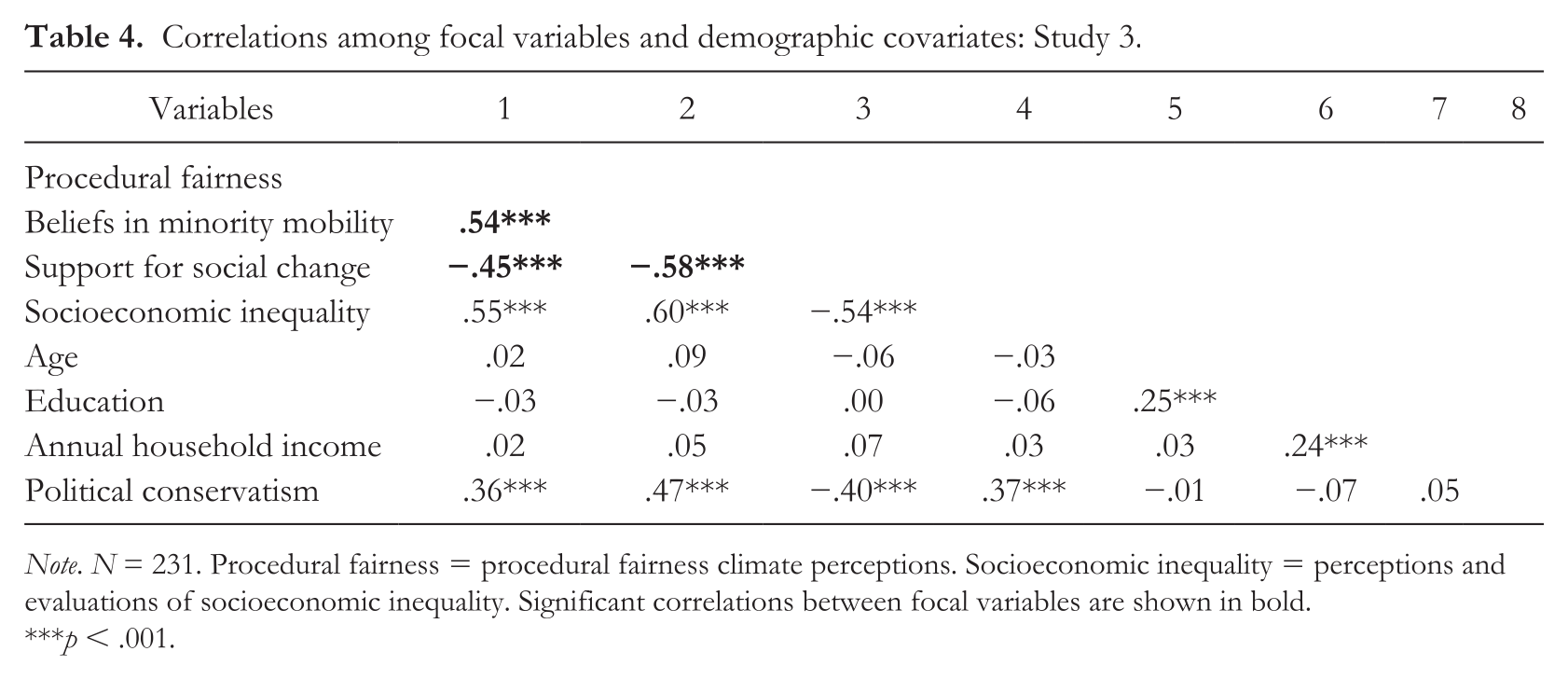
Note. N = 231. Procedural fairness = procedural fairness climate perceptions. Socioeconomic inequality = perceptions and evaluations of socioeconomic inequality. Significant correlations between focal variables are shown in bold.
p < .001.
Beliefs in minority mobility correlated significantly with perceived socioeconomic inequality (r = .60, p < .001) and political beliefs (r = .47, p < .001). Likewise, support for social change was also significantly associated with perceived socioeconomic inequality (r = −.54, p < .001) and political beliefs (r = −.40, p < .001). Furthermore, significant gender differences were found: Female participants reported weaker beliefs in minority mobility (M = 2.15, SD = 0.94) and stronger support for social change (M = 4.65, SD = 0.51) compared to male participants (M = 2.74, SD = 0.95 and M = 4.14, SD = 0.82, respectively; both Fs > 22.33, both ps < .001). As such, we retained these three covariates in our main (mediation) analysis.
Main analysis
Correlational analyses revealed that, in line with Hypothesis 1, procedural fairness climate perceptions were significantly negatively related to support for social change (r = −.45, p < .001). Furthermore, procedural fairness was significantly positively associated with beliefs in minority mobility (r = .54, p < .001; i.e., Hypothesis 2), which were, in turn, significantly negatively associated with support for social change (r = −.58, p < .001; i.e., Hypothesis 3).
As in Study 2, we fitted a path analysis model including the relevant covariates. As illustrated in Figure 3, beliefs in minority mobility significantly mediated the relationship between procedural fairness climate perceptions and support for social change (b = −0.06 [−0.10, −0.02], SE = 0.02, p = .004), providing additional support for Hypothesis 4.
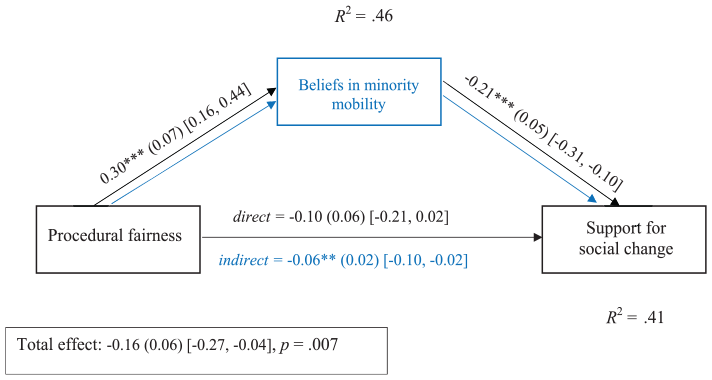
Results of path analysis: Study 3.
Discussion
Study 3 replicated the finding of Study 2 that beliefs in minority mobility are an explanatory process variable for the relationship between procedural fairness perceptions and support for social change. Importantly, the results in Study 3 were obtained among a different disadvantaged group in a very different societal landscape, while controlling for yet another set of confounding variables (i.e., gender, political beliefs, and perceptions and evaluations of socioeconomic inequalities). As such, Study 3 further underscores the generalizability and robustness of our mediation model.
Taken together, Studies 1 to 3 provide converging correlational evidence for the ironic effect of procedural fairness climate perceptions and its psychological underpinnings. Nevertheless, it should be noted that causal inferences based on cross-sectional samples alone can be misleading (Bullock et al., 2010), resulting in biased interpretations of causal chains (Gerber & Green, 2012). To circumvent such “common-method” pitfalls, Spencer et al. (2005) have suggested to design experiments wherein the effects of the independent variable itself are observed, and the hypothesized intermediary psychological process is experimentally manipulated (see also Bullock et al., 2008). As such, we conducted three additional experiments. In Study 4, Asian American participants read about a procedurally fair (vs. unfair) climate vis-à-vis people of Asian descent, and we measured their minority mobility beliefs. In Study 5, we experimentally manipulated minority mobility beliefs with a bogus news article, and we recorded the extent to which our (African American) participants were willing to support the Black Lives Matter (BLM) movement. Finally, in Study 6 (Asian Americans), we once more manipulated procedural fairness and simultaneously measured our mediator and dependent variable, in order to further test our key hypothesis that procedural fairness enhances minority mobility beliefs, and as such lowers support for social change (i.e., Hypothesis 4).
Study 4
Method
Participants
Study 4 was preregistered (https://aspredicted.org/zu6ve.pdf). Our power calculations were based on the Study 3 estimate of the direct relationship between procedural fairness climate and minority mobility beliefs (i.e., the smallest available effect size estimate). Using the pwr package (Version 1.3-0; Champély, 2018) in R, we calculated that we needed a sample of N = 76 to achieve 99% power (under standard criteria, α = .05) to detect an effect size of d = 1.01. However, given our data check, we initially oversampled by 30% and targeted a sample of N = 106 Prolific workers, who were paid £1.00 for their participation. We excluded n = 6 participants because they gave a nonsensical answer to our open question (“Please describe briefly in your own words the content of the report”), resulting in a final sample of N = 100 Asian Americans (25 males; age: M = 23.75, SD = 5.67, range = 18–54). Despite relatively high education levels, poverty rates among the bulk of Asian American ethnic groups are well above the national average (Vega, 2015), making them an “invisible” marginalized group (Yip et al., 2021).
Procedure
Participants were invited to complete a survey about “demographic preferences.” They were instructed to read a summary of a (bogus) scientific report describing the “democratic constellation” of a small country in the heart of Europe. Critically, it was conveyed that the country contained a large Asian minority population. In the fair climate condition (n = 50), the report described the country’s societal institutions as fair and unbiased towards people of Asian descent, whereas the reverse held in the unfair condition (n = 50).
Participants then completed two manipulation checks (see following lines), a few filler items—ostensibly gauging their preference for the country and its democratic configuration—and our dependent measure. Subsequently, the experiment ended, and they were debriefed and thanked for their participation. None of our participants guessed the study’s hypothesis.
Measures
Minority mobility beliefs
Participants completed the same items as in Study 3, which were specifically applied to the small European country (e.g., “[Country] is an open society where individuals of Asian descent can achieve higher status”; α= .94; M = 2.95, SD = 1.11).
Data Analysis and Results
Manipulation checks
A one-way analysis of variance (ANOVA) on the first manipulation check (“The report indicated a fair societal climate towards people of Asian descent”) revealed a significant effect of condition, F(1, 98) = 322.30, p < .001, η2 = .77; participants in the fair climate condition (M = 4.54, SD = 0.68) displayed stronger agreement with this statement compared to those in the unfair climate condition (M = 1.58, SD = 0.95, d = 3.58). Conversely, for the second item (“According to the report, the societal institutions in [country] often let personal motives or biases influence their decisions that involve the Asian minority population”), participants were less likely to agree in the fair (M = 1.70, SD = 1.02) versus the unfair condition (M = 4.16, SD = 1.00), d = 2.44; F(1, 98) = 194.4, p < .001, η2 = .60.
Dependent variable
An ANOVA revealed a significant effect of condition for minority mobility beliefs, F(1, 98) = 191.40, p < .001, η2 = .66; participants in the fair climate condition (M = 3.85, SD = 0.64) were more likely to display minority mobility beliefs than those in the unfair climate group (M = 2.05, SD = 0.66), d = 2.77.
Discussion
The results of our first experiment were in line with Hypothesis 2 and Studies 2 and 3: Describing an unknown society as procedurally fair (vs. unfair) towards participants’ ethnic minority group increased (vs. decreased) the belief that this society allowed one’s fellow group members to achieve a higher status. Having established a causal link between procedural fairness climate perceptions and beliefs in minority mobility, we moved on and tested the second part of our mediation chain in Study 5.
Study 5
Method
Participants
Study 5 was preregistered (https://aspredicted.org/5tb6a.pdf). Our power calculations were based on the Study 2 estimate of the direct relationship between minority mobility beliefs and support for social change (i.e., the smallest available effect size estimate). We calculated that we needed a sample of N = 234 to achieve 99% power under standard criteria (α = .05) to detect an effect of size d = 0.56. However, given our various data checks, we initially oversampled by 30% and targeted a sample of N = 312 Prolific workers, who were paid £0.50. We excluded n = 15 because they did not fully complete our questionnaire, n = 17 because they gave a nonsensical answer to our hypothesis check question (e.g., “Can you guess our study’s hypothesis?”) and/or because their description of our study’s hypothesis came close to our true objective, and another n = 11 because they failed our attention check (“Please select the third response for this question” 6 ), resulting in a final sample of N = 269 African Americans (120 males; age: M = 31.64, SD = 10.75, range = 18–79). Like their Hispanic minority counterparts, African Americans continue to be significantly overrepresented in poverty levels relative to their representation in the overall population (U.S. Census Bureau, 2020).
Procedure
Participants were invited to complete a survey about “scientific reporting.” As a cover story, we told them that we were investigating how the way scientific studies are summarized in the popular media affects laymen’s comprehension and interpretation of the results. To this end, they were requested to read a brief (bogus) news article that contained our experimental manipulation (based on Day & Fiske, 2017). In the high minority mobility condition (n = 135), participants read that a recent study had revealed an increasingly healthy level of social mobility in America for Black people. It was communicated that the main way to measure people’s ability to move up and down the societal ladder is to examine how similar one generation is to the next. It was also conveyed that the chances that a Black person who starts in the bottom 20% will move up are reasonably good and that most hard-working Black people at the bottom end up in a social class higher than their parents. Conversely, in the low minority mobility condition (n = 134), participants were told that the chances that a Black person who starts in the bottom 20% will move up are very slim (only 5%), and that most hard-working Black people at the bottom end up in the same social class as their parents. In this condition, it was noted that the evidence indicates a low level of social mobility in America for Black people (for a detailed description, see Day & Fiske, 2017). Participants then completed two manipulation checks (see following lines), a few filler items—ostensibly gauging their comprehension of the text and their interest in the topic—followed by our dependent measure. Subsequently, the experiment ended, and they were debriefed and thanked for their participation.
Measures
Support for BLM was measured with two items: “How likely are you to show your support for Black Lives Matter through social media (e.g., Facebook, Twitter, etc.) in the future?” and “How likely are you to participate in the Black Lives Matter protests in the future?” (1 = extremely unlikely, 5 = extremely likely; r = .76, M = 3.39, SD = 1.33).
Data Analysis and Results
Manipulation checks
A one-way ANOVA on the first manipulation check (“The report indicated a healthy level of social mobility for Black people in the American society”) revealed a significant effect of condition, F(1, 267) = 308.70, p < .001, η2 = .54; participants in the high minority mobility condition (M = 4.00, SD = 1.05) displayed stronger agreement with this statement compared to those in the low minority mobility condition (M = 1.62, SD = 1.17), d = 2.14. Conversely, for the second item (“According to the report, the chances that a Black person who starts in the bottom 20% will move up are actually very slim”), participants were less likely to agree in the high (M = 2.10, SD = 1.33) versus the low minority mobility condition (M = 4.63, SD = 0.75), d = 2.34; F(1, 267) = 369.01, p < .001, η2 = .58.
Dependent variable
An ANOVA revealed a significant effect of condition, F(1, 267) = 6.96, p = .009, η2 = .03); Participants in the high minority mobility condition (M = 3.18, SD = 1.40) were less likely to support BLM than those in the low minority mobility condition (M = 3.60, SD = 1.23; d = 0.32).
Discussion
In line with our expectations and the correlational results reported in Study 3, it was observed that experimentally manipulated perceived minority mobility influenced the extent to which participants supported the BLM movement, and hence, social change. Taken together, Studies 4 and 5 thus testified to both the hypothesized causality and directionality in our postulated model.
Study 6
Method
Participants
Study 6 was preregistered (https://aspredicted.org/84659.pdf). A priori power calculations were based on the smallest mediational effect obtained in our previous studies (i.e., in Study 2), and assuming standard criteria (α = .05), it was revealed that we needed at least 178 participants to achieve 80% power to detect mediation effects of a similar magnitude. Given our data exclusion criteria, we initially oversampled by approximately 20% and recruited 220 Asian American Prolific workers, who were paid £1.00 for their participation. We excluded n = 1 participant because he/she expressed suspicion about our study’s hypothesis, and another participant who failed at least one out of two attention checks, resulting in a sample of N = 219 (93 males; age: M = 28.51, SD = 9.57, range = 18–70).
Procedure and measures
Our procedure was identical to that in Study 4 with the exception that, next to the Beliefs in Minority Mobility Scale (M = 3.07, SD = 1.22; α = .94), participants also completed the Studies 1–3 Support for Social Change Scale (M = 4.05, SD = 0.74; α = .62).
Data Analysis and Results
Manipulation checks
An ANOVA on the first manipulation check (“The report indicated a fair societal climate towards people of Asian descent”) revealed a significant effect of condition, F(1, 217) = 988.50, p < .001, η2 = .82; participants in the fair climate condition (n = 112; M = 4.55, SD = 0.75) displayed stronger agreement with this statement compared to those in the unfair climate condition (n = 107; M = 1.31, SD = 0.78) d = 4.23. Conversely, for the second item (“According to the report, the societal institutions in [country] often let personal motives or biases influence their decisions that involve the Asian minority population”), participants were less likely to agree in the fair (M = 1.56, SD = 0.92) versus the unfair condition (M = 4.30, SD = 0.95), d = 2.93; F(1, 217) = 468.11, p < .001, η2 = .68.
Dependent variables
An ANOVA revealed significant effects of condition for minority mobility beliefs, F(1, 217) = 560.40, p < .001, η2 = .72, and support for social change, F(1, 217) = 32.48, p < .001, η2 = .13; participants in the fair climate condition were more likely to display minority mobility beliefs (M = 4.08, SD = 0.62) and less likely to support social change (M = 3.79, SD = 0.66) than those in the unfair climate group (M = 2.02, SD = 0.67, d = 3.19) and (M = 4.32, SD = 0.73, d = 0.76), respectively.
Mediation analysis
To directly test Hypothesis 4, we fitted a path analysis model including a dummy variable representing our procedural fairness manipulation (1 = fair climate, 0 = else). As illustrated in Figure 4, beliefs in minority mobility significantly mediated the relationship between this dummy and support for social change (b = −0.39 [−0.68, −0.10], SE = 0.15, p = .009) providing additional support for Hypothesis 4.
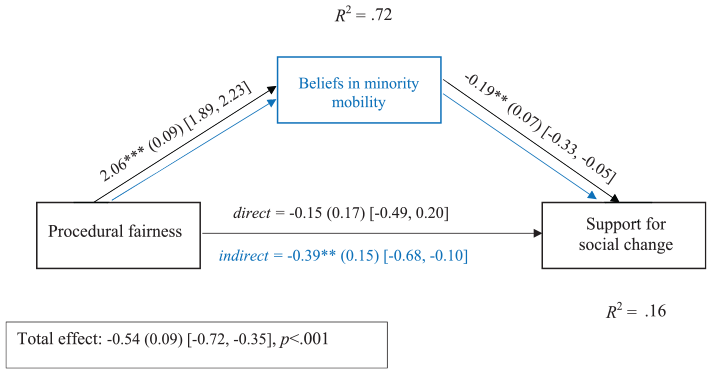
Results of path analysis: Study 6.
Discussion
The results of our final experiment were in line with our previous findings and key hypothesis. As before, describing an unknown society as procedurally fair (vs. unfair) towards participants’ ethnic minority group increased (vs. decreased) the belief that this society allowed one’s fellow group members to achieve a higher status. Furthermore, exposure to information about a procedurally fair (vs. unfair) climate also decreased (vs. increased) support for social change. Most importantly, and in line with our key hypothesis (i.e., Hypothesis 4), it was shown that beliefs in minority mobility fully mediated this relationship.
General Discussion
The present research investigated the relationship between perceived procedural fairness enacted by societal institutions and support for social change among disadvantaged group members. The results of six studies illustrate an “ironic” effect of procedural fairness climate perceptions. Specifically, Study 1 demonstrated that perceptions of procedural fairness are associated with reduced support for collective actions that counteract the underprivileged status of one’s social group. Moreover, Studies 2 and 3 revealed that this relationship can be explained by beliefs in minority mobility: Procedural fairness climate perceptions enhance the belief that one’s societal group can climb the social status ladder, which lowers support for social change. Importantly, these results remained robust after controlling for perceptions of relative deprivation (Study 2) and a blend of perceptions of and attitudes towards socioeconomic inequality between one’s disadvantaged group and the advantaged group (Study 3). Finally, Studies 4, 5, and 6 provided additional experimental evidence for this hypothesized causal chain. Taken together, our results illustrate that procedural fairness climate perceptions can entail negative side effects for the willingness of disadvantaged group members to challenge the social system.
Theoretical Contributions
The present results add at least three novel contributions to the literature. Firstly, the finding that disadvantaged people tend to refrain from challenging the established societal system when they perceive fair treatment by societal actors holds important consequences for research on system maintenance, and specifically system justification theory (SJT; Jost, 2019; Jost et al., 2004). Specifically, SJT’s central tenet is that societal disadvantage induces uncertainty and existential threat, which is resolved by rationalizing and defending the status quo (van der Toorn & Jost, 2014). Our results, however, offer an alternative motivation leading to system justification. We have shown that focus on benign treatment at the procedural level may also reassure and instill a sense of security, prompting disadvantaged group members, in turn, to reconcile with their unfavorable position. This observation aligns with a key explanation of the “fair process effect” in terms of psychological safety and trust: People use procedural information as a heuristic or “shortcut” to decide whether to trust authorities, and these trust judgments then attenuate the ego-threatening impact of a disadvantageous decision turnout (van den Bos, 2001). Thus, it appears that system justification beliefs may be both a direct and palliative reaction to ego-threatening circumstances as well as an indirect and more genuine byproduct of the psychological safety instilled by procedural fairness. Of course, which of these motivations gets prioritized and under which circumstances represents an interesting avenue for future research.
Secondly, and most importantly, the present research outlines a psychological pathway leading from perceived procedural fairness to support for social change. Specifically, our research is the first to empirically establish that perceptions of fair treatment among disadvantaged groups can be a precursor of minority mobility beliefs, which in turn reduce willingness to challenge the social system. This observed psychological causal chain aligns well with Georgeac and Rattan’s (2021) recent theoretical model about social progress perceptions. These authors argued that people erroneously perceive social progress as homogeneous in nature—i.e., consistent across various societal domains—leading them to mischaracterize the state of society in general (e.g., Georgeac & Rattan, 2021). This offers a plausible explanation for the present results. Due to such faulty conceptions about the fragmented nature of social progress, perceived advances in procedural fairness enactment by societal bodies may have been overgeneralized and mistakenly interpreted as a token to believe in minority mobility.
At first glance, the observed mediating role of minority mobility beliefs contrasts with prior research by van Zomeren et al. (2004, Experiment 1). Specifically, whereas these authors revealed an anger-based pathway leading from procedural (un)fairness perceptions to support for social change, in the current studies minority mobility beliefs were found to be the intermediary process variable, which seems indicative of positive inferences based on fair treatment, and thus, a positive emotional path. However, there are good theoretical arguments to conceive of both pathways as complementary rather than mutually exclusive. For example, it has been argued that (procedural) justice and injustice are not merely two sides of the same continuum, and that they each may be associated with a range of qualitatively different reactions (Colquitt et al., 2015). From this perspective, it could be speculated that exposure to fair treatment may well elicit a more positive emotional reaction whereby participants start to mentalize about social progress (as in our studies), whereas unfair treatment may be more likely to induce negative emotional responding (as in van Zomeren et al., 2004). Empirical scrutiny of this tentative premise was, however, beyond the scope of the present research.
Furthermore, the observation that exposure to information about minority mobility impacts upon one’s willingness to defend the system mirrors the work of Day and Fiske (2017). Moreover, the present research further extends these scholars’ findings in two ways. First, unlike Day and Fiske (2017), who used predominantly White (advantaged) samples, in the present studies we exclusively focused on disadvantaged populations. Secondly, our work also further validates that of Day and Fiske (2017) because we have shown that the conviction that society is open to the advancement of individuals of one’s disadvantaged group (i.e., minority mobility) erodes support for social change to a similar extent as the belief that society is open to the advancement of all individuals—ingroup or not (i.e., “general” individual mobility; as demonstrated by Day and Fiske, 2017).
Lastly, our research contributes to a growing body of literature investigating what can be coined “ironic” procedural fairness effects. Although procedural fairness has been praised for its potential to foster intragroup (Vermunt & Steensma, 2016) and intergroup cohesion (Valcke, van Hiel, Onraet, & Dierckx, 2020; Valcke, van Hiel, van Roey, et al., 2020), recent research seems to adopt a more nuanced stance. For example, some studies have revealed rather paradoxical reactions to fairness among advantaged group members. Specifically, it was found that isolated and unrepresentative instances of fairness (e.g., the mere presence of diversity-supporting structures, Obama’s 2008 election) were erroneously interpreted as indicative of broader societal justice, which consequently caused advantaged group participants to legitimize the status quo and act against disadvantaged groups’ interests (Dover et al., 2014; Kaiser et al., 2009, 2013). Our results add to these findings the notion that procedural fairness may analogously suppress support for social change among disadvantaged group members and thereby discourage actions that promote one’s group interest. In this regard, an analogy with the intergroup contact literature suggests itself. A rich body of evidence has shown that positive contact between advantaged and disadvantaged group members is a highly effective tool for prejudice reduction (e.g., Hewstone & Swart, 2011; Pettigrew & Tropp, 2006), yet for the latter group this can also create unrealistic expectations about perceived boundary permeability (to move from lower to higher status groups; Tausch et al., 2015) and curb support for collective action (Cakal et al., 2011; Dixon et al., 2010). What these studies and the present research thus have in common is that they all report ironic or “sedative” effects of positive and friendly treatment (Politi et al., 2020), which can eventually lead the disadvantaged to act in conflict with their own interests and help sustain structural inequalities.
Practical Implications
The present results also bear important practical consequences. Specifically, they underscore the need to move beyond sheer procedural justice enactment towards disadvantaged groups. Although fair minority-targeting procedures are useful to gauge a society’s equitability, one must also consider that procedural fairness alone does not have the potential to bring about greater actual equality. Moreover, current efforts to deliver procedural fairness do not exclude nor nullify contemporary inequalities resulting from historical distributive injustices. For example, although efforts have been made over the last decades to promote egalitarianism in various Western countries (e.g., Rankin, 2020), the reality is that often members of minority groups in these countries still do not find access to resources such as health services, education, and well-paid jobs (Kroll, 2015; Roser & Ortiz-Ospina, 2013). Thus, although procedural fairness can be regarded as a first, important step in the advancement of social justice, it can never substitute distributive fairness enactment (i.e., in terms of outcomes). Most importantly, as the present results show, procedural fairness perceptions may also “sedate” disadvantaged group members by creating overly positive expectations about group-based opportunities to advance in society. The resulting reduced willingness to challenge the status quo can be considered an extra obstacle for social transitions to take place, especially because peaceful, yet firm, expression of discontent by those most wronged by the social system has been proven critical for change to occur (Milan, 2013). In this regard, too, it seems imperative that societal institutions pay attention to, and strive to reduce, structural deprivation.
Limitations and Directions for Future Research
There are a few limitations associated with the present research. First, although we did experimentally verify the causal mediation chain leading from procedural fairness to support for social change, we did not empirically examine the reverse path. It nonetheless seems reasonable to assume that beliefs in minority mobility themselves could influence procedural fairness climate perceptions: If one sees society as more mobile and group boundaries as more permeable for disadvantaged group members, one might also infer that institutional procedures are more fair. Alternatively, mutually reinforcing pathways between these types of social attitudes and beliefs may exist. A potential way to disentangle these competing hypotheses is to implement longitudinal designs to assess the reciprocal, possibly reinforcing, paths between procedural fairness climate and the mediating and outcome variables. Secondly, we must admit that we limited our scope to ethnic minorities in the current research. Given that there is substantial variation between minority groups in structural deprivation and socioeconomic status (Campbell & Kaufman, 2006), it is imperative that future research targets other disadvantaged minority groups (e.g., sexual, religious, etc.), to verify the generalizability of our findings. Lastly, it should be noted that the reliability of our Study 2 index of social change was quite low (i.e., α= .55). This finding further raises the question whether our key dependent measure was interpreted similarly across the different minority groups. Although an analysis of measurement invariance fell out of the scope of the current research, future investigations could nonetheless implement more exhaustive and cross-culturally validated measures of support for social change, in order to enhance the comparability of their findings across disadvantaged groups.
Concluding Remarks
The present research investigated an ironic fair process effect, that is, the observation that perceived fair treatment by societal actors can curb disadvantaged group members’ support for actions that may bring social progress and tackle intergroup inequalities. Across six studies, using different methodologies and targeting various disadvantaged groups, we consistently found that perceptions of a procedurally fair climate vis-à-vis one’s disadvantaged group are negatively associated with support for social change. In addition, our results also revealed that this relationship can be explained in terms of enhanced beliefs that one’s societal group can climb the social status ladder. In sum, it can be stated that, although procedural fairness enactment is an indispensable tool to engineer positive intergroup relations, the present results also highlighted the limits of solely relying on such an approach.
Supplemental Material
sj-docx-1-gpi-10.1177_13684302231151941 – Supplemental material for The irony of fairness: How procedural fairness climate perceptions can hinder disadvantaged group members’ support for social change
Supplemental material, sj-docx-1-gpi-10.1177_13684302231151941 for The irony of fairness: How procedural fairness climate perceptions can hinder disadvantaged group members’ support for social change by Kim Dierckx, Alain van Hiel, Hermann Swart and Barbara Valcke in Group Processes & Intergroup Relations
Footnotes
Acknowledgements
We thank our thesis student Mon Dewulf for his help with the data collection of Study 1.
Correction (June 2023):
Article updated to correct the funding statement. Please see https://doi.org/10.1177/13684302231186395 for more details.
Funding
The author(s) disclosed receipt of the following financial support for the research, authorship, and/or publication of this article: This work was supported by the Special Research Fund of Ghent University (Grant No. BOF16/GOA/007) and the Flanders Research Foundation (Grant No. V417622N).

Supplemental material
Supplemental material for this article is available online.
Notes
References
Supplementary Material
Please find the following supplemental material available below.
For Open Access articles published under a Creative Commons License, all supplemental material carries the same license as the article it is associated with.
For non-Open Access articles published, all supplemental material carries a non-exclusive license, and permission requests for re-use of supplemental material or any part of supplemental material shall be sent directly to the copyright owner as specified in the copyright notice associated with the article.
