







Abstract
We examined whether perceived national status threat—i.e., perceiving that one’s country’s status on the international scene is in decline—predicts increased desire for a strong conservative or progressive leader through greater national nostalgia and collective angst. A pilot study on strong leaders’ speeches from the 2017 French presidential election campaign first revealed that both conservative and progressive strong leaders use the status threat narrative, albeit in another form. In four quantitative surveys conducted across France, Malaysia and Chile, we then found that national status threat predicted increased desire for both conservative and progressive strong leaders. In France and Chile, but not Malaysia, the underlying path was contingent on the type of leader, such that nostalgia predicted increased desire for a conservative but not a progressive strong leader. Although correlational, our data suggest that decline narratives might provide a fertile ground for the desire for diverse forms of strong leadership.
“Our country is in serious trouble. We don’t have victories anymore. We used to have them, but we don’t have them.”
When announcing his candidacy for the US presidency in 2015, Donald Trump began his speech by portraying the United States as a declining country, whose status as a global superpower was under threat. Building on this, Trump then extolled the need for “a truly great leader” who would come to rescue the country mired down a path of decline. He ended his announcement by praising his own ability to “make America great again.”
This narrative, whereby descriptions of a “once great country in decay” are used to justify the need for strong leadership, is not unique to the former US president. In fact, the use of this “status threat” rhetoric is quite common among populist leaders (Mols & Jetten, 2014; Mols & Jetten, 2020). Yet, limited empirical work has examined if a person’s perception that their country is losing its high-status position on the international scene—i.e., perceived national status threat—actually predicts increased desire for strong leadership.
Drawing on work on the supply-side of politics (i.e., research that focuses on the strategies used by political parties and leaders to mobilize voters; Mols & Jetten, 2014) and Social Identity Theorizing (Tajfel & Turner, 1979), the present research sought to address this gap. Across four correlational studies conducted in three countries (France, Malaysia, Chile), we tested if people’s perception of national status threat was associated with increased desire to elect two kinds of strong leaders (conservative and progressive) through two proposed mechanisms: greater feelings of national nostalgia and collective angst.
Perceived Status Threat
Social Identity Theory (Tajfel & Turner, 1979; Tajfel & Turner, 1986) provides insight into why perceptions of national status threat could predict increased desire for a “strong leader.” Indeed, this theoretical framework argues that members of high-status groups are typically motivated to maintain and protect their ingroup’s dominant position, especially when they perceive that their status is legitimate (Halabi et al., 2008; Outten et al., 2018; Turner & Brown, 1978). Hence, when the privileged status of one’s ingroup is perceived as being under threat, people—whose group memberships are internalized into their self-concept (e.g., Turner et al., 1994)—will strive to protect it (Outten et al., 2018; Tajfel & Turner, 1979). For example, perceived status threat occurring in response to anticipated racial demographic shifts in favour of minorities—i.e., racial status threat—has been found to foster defensive reactions among Whites, such as increased conservatism and support for the far-right (Craig & Richeson, 2014a; Isom et al., 2021; Major et al., 2018; Wetts & Willer, 2018; Willer et al., 2016; see however Stewart & Willer, 2022) as well as negative attitudes towards racial outgroups (Christiani, 2021; Craig & Richeson, 2014b; Craig et al., 2018; Outten, Lee et al., 2018; Outten, Schmitt et al., 2012).
While most research has focused on racially motivated status threat (mainly in the US; Craig & Richeson, 2014a; Craig & Richeson, 2014b; Craig et al., 2018; Major et al., 2018; Wetts & Willer, 2018) far fewer studies have examined if perceived national status threat—perceiving that one’s country privileged position on the international scene is threatened—contributes to our socio-political attitudes and desires. The few studies investigating this from a supply-side of politics (i.e., research centered on the strategies employed by political parties and leaders to engage the electorate) suggest that descriptions of a country in decline are frequently used as an argument to justify the need for radical change and strong leadership, especially among far-right leaders (Levinger & Lytle, 2001; Mols & Jetten, 2014).
However, work on national status threat from the demand-side of politics (i.e., research that focuses on the voters’ grievances and political preferences) is much more limited. Mutz (2018) provided, to our knowledge, the first empirical evidence that perceiving that America’s global dominance is threatened (i.e., perceived national status threat) was indeed positively associated with support for far-right populist leader Donald Trump in 2016. Building on these findings (Mols & Jetten, 2014; Mutz, 2018) and drawing from Social Identity Theorizing (Tajfel & Turner 1979; Turner et al., 1994) more generally, we aimed to expand this evidence base. As people are usually motivated to maintain and protect their ingroup’s position (e.g., Turner & Brown, 1978), we propose that they might respond defensively if they perceive that their country’s status on the international scene is threatened. Specifically, perceived national status threat could prompt a need to defend the group through increased desire for a “strong leader,” who might be deemed capable of reversing the downward trajectory in which the country is mired.
Desire for Strong Leaders
Strong leaders have been defined as those “who promise to overcome difficulties faced by a society by any means necessary, including forgoing traditional means or promising to shakeup existing political systems” (Crimston et al., 2022, p. 671). For example, they may undertake political actions that subvert existing norms, engage in more radical forms of decision-making that bypass traditional structures, or even break the law. Donald Trump, Jair Bolsonaro, Viktor Orbán or Vladimir Putin are a few examples of stereotypical strong leaders that have emerged in recent years. Although they can feed off each other, the concept of “strong leadership” differs from that of “leader prototypicality.” Whilst a prototypical leader is one who is perceived as representative of the ideal-type or average group member (Steffens et al., 2021), a strong leader is one who is perceived to be willing to do everything (for example, using unconventional means) to overcome the difficulties the country is facing, regardless of whether they embody the group prototype.
Several studies have shown that different kinds of collective threat lead to greater support for strong leaders (Mulder & Stemerding, 1963). For example, resource scarcity (Nettle & Saxe, 2021), perceptions of economic inequality (Sprong et al., 2019), moral polarization (Crimston et al., 2022), desired continuity of national culture (Selvanathan et al., 2022), perceived democratic decline (Lima et al., 2021), as well as ecological threats such as the COVID-19 pandemic (Contu et al., 2024) and wars (Contu et al., 2024; Nettle & Saxe, 2021) are all positively associated with the desire to elect a strong leader; this suggests that people may believe that a strong leader is needed when the ingroup’s integrity is being threatened.
Although very valuable, most of these studies appraised people’s desire for strong leadership without distinguishing between strong conservative leaders (e.g., Donald Trump in the US, Marine Le Pen in France) and strong progressive leaders (e.g., Bernie Sanders in the US, Jean-Luc Mélenchon in France). While both kinds of strong leader are perceived as effectively able to cope with threats and difficulties, strong conservative leaders aim to overcome present challenges by returning to a more glorious past, while strong progressive leaders are more future-oriented and aim to overcome present challenges through social progress (Crimston et al., 2022). To our knowledge, the only research that made this distinction was that of Crimston et al. (2022), who found that perceived moral polarization was associated with increased desire for both conservative and progressive strong leaders (in Australia, the US, and the UK), via the perceived breakdown of society, which indicated that perceptions of collective threat might not always trigger conservative responses but might sometimes be associated with more progressive political preferences (see also Brandt & Baker, 2022). Relatedly, prior work has shown that strong progressive leaders also use declinist narratives to justify the need for strong leadership, although these are more socioeconomic (e.g., decline of the welfare state) than sociocultural focused, in contrast to strong conservative leaders (March, 2017; Mudde & Kaltwasser, 2013).
In the current contribution, we aimed to test if perceived national status threat would be associated with increased desire for a strong leader, whether conservative or progressive, via two distinct mechanisms. Specifically, we focused on two collective emotions, national nostalgia and collective angst, and examined whether they would explain the differences in relationships between perceived national status threat and the desire for a strong conservative vs. progressive leader.
Mediating Role of National Nostalgia and Collective Angst
Collective emotions are experienced within the context of group memberships and contribute to shape peoples’ attitudes and behaviors as group members (Mackie et al., 2008). When it comes to perceived national status threat, collective emotions of national nostalgia (i.e., a longing for what the country was in the past; Baldwin et al., 2018; Smeekes et al., 2015) and collective angst (i.e., feelings of anxiety regarding the nation’s future vitality; Wohl et al., 2012) seem particularly relevant. Indeed, perceiving that one’s country is not as powerful as it used to be could be associated with a longing for “the good old days” and a concern for the future vitality of the nation. In line with this, previous work has shown that perceived racial status threat is positively associated with reactionary attitudes (e.g., increased support for conservative policies against greater social equality) suggesting a nostalgic inclination toward the past (Craig & Richeson, 2014a; Willer et al., 2016); as well as feelings of collective angst (Stefaniak & Wohl, 2021). We thus expected perceived national status threat to predict increased feelings of nostalgia for the nation’s past and angst regarding its future.
Both of these collective emotions are established predictors of political attitudes and behaviors. On the one hand, Lammers (2023) suggests that nostalgia is a “conservative” emotion (i.e., more often experienced at the right of the political spectrum: Behler et al., 2021; Lammers & Ugurlar, 2023; van Prooijen et al., 2022), notably because conservatism has historically been built in opposition to calls for societal progress. In fact, feelings of nostalgia for an undetermined national past are usually associated with conservative and exclusionary attitudes, such as anti-immigrant sentiments and collective action (Behler et al., 2021; Smeekes, Sedikides, & Wildschut, 2023; Smeekes, Verkuyten, & Martinovic, 2015) as well as support for far-right populist leaders (Smeekes et al., 2021). National nostalgia thus tends to be associated with conservative responses, such as increased support for a strong conservative leader.
On the other hand, when people are concerned about the future vitality of their ingroup—when they experience collective angst—they may be motivated to take action in order to secure its future. However, they might pursue this end by endorsing exclusionary and conservative attitudes (e.g., increased rejection of immigrants; Jetten & Wohl, 2012; Lucas et al, 2014; Smeekes et al, 2018; Stefaniak & Wohl, 2021) or by adopting more constructive behaviors, such as increased intentions to take part in collective action to advocate for progressive social change (Jaśkiewicz et al., 2021). The link between collective angst and conservatism is therefore less clear, and although it has been suggested that collective angst may be more pronounced among right-wing people (Wohl et al., 2012), some studies find no linear relationship between political orientation and collective angst (e.g., van Prooijen et al., 2022, Study 1). In other words, it is possible that both conservative and progressive responses might occur in response to feelings of collective angst (Jaśkiewicz et al., 2021; Wohl et al., 2012). Drawing on these insights, there are reasons to expect that while national nostalgia would positively predict increased desire for a strong conservative—but not progressive—leader, collective angst may predict increased desire for both kinds of strong leaders (conservative and progressive).
Overview
In an attempt to illustrate the use of the status threat rhetoric among strong conservative vs. progressive leaders, we first conducted a pilot study in which we analysed transcripts of pre-election speeches by two candidates in the 2017 French presidential election: Marine Le Pen (far-right candidate, strong conservative leader) and Jean Luc Mélenchon (radical-left candidate, strong progressive leader). Then, we examined if perceived national status threat would predict increased desire for a strong conservative leader (H1a) and a strong progressive leader (H1b) across four correlational studies conducted within French (Study 1a and 1b), Malaysian (Study 2a) and Chilean (Study 2b) samples. We additionally tested whether perceived national status threat would be associated with greater feelings of national nostalgia (H2a) and collective angst (H2b). Finally, we explored if the relationship between status threat and the desire to elect a strong conservative leader would be mediated by both national nostalgia and collective angst (H3a), while its link with the desire for a strong progressive leader would be mediated by feelings of collective angst only (H3b). All studies obtained ethical clearance from the University of Queensland (Approval number: 2017000288).
Data, material and supporting information (additional information regarding the samples, supplementary analyses) are available in the following OSF directory: https://osf.io/gq9mh/?view_only=a68d88b12d7d49588f8ee51bd2791939.
Pilot Study
In this pilot study, we aimed to demonstrate the use of the status threat rhetoric in a naturalistic setting by exploring whether and how two French conservative and progressive strong leaders frame national status threat in their political speeches. To do so, we collected and analysed transcripts of speeches by two candidates in the 2017 French presidential election: the far-right candidate Marine Le Pen, president of the Front National party (strong conservative leader), and the radical-left candidate Jean-Luc Mélenchon, president of the France Insoumise movement (strong progressive leader).
Analysis Strategy and Results
We retrieved 27 speech transcripts for Le Pen and 23 for Mélenchon from the “2017 presidential campaign” collection of speeches publicly available on the web version of Hyperbase (http://hyperbase.unice.fr). Hyperbase (Brunet, 2011) is a documentary and statistical text mining software that also allows users to download text corpuses. The transcripts included speeches from political meetings and interviews that took place between 2016 and 2017 (i.e., before the 2017 French presidential elections).
Two independent coders (the first and second author) identified and manually highlighted sections of the speeches’ transcripts that illustrated national status threat (i.e., is the candidate describing France as losing its privileged/powerful position on the international scene?). 1 Specifically, the two coders independently identified to what extent national status threat was present in the speeches (strong vs. medium vs. weak) and in what form (was it conveyed in a direct vs. indirect way?). The two coders largely agreed (percentage of agreement: 100%). 2 A more fine-grained qualitative analysis focusing on the content of the status threat and its illustration in the speeches was also performed by both coders. Tables containing more illustrating quotes are available on the OSF Supplemental material document (Tables S2 and S3).
Le Pen’s speeches (strong conservative leader). The idea that the status and “grandeur” of France on the international stage is threatened strongly stands out in Le Pen’s speeches. At times, she describes this threat to status in a direct way, by explicitly stating that France has lost its global influence (e.g., “The weakening of France, the decline of France’s positions in the world, have a common origin in the refusal to admit reality”); whereas at other times, she does it more indirectly, for example, by claiming that France must regain its greatness and sovereignty (e.g., “We want to recover the greatness of our country, we want to recover the independence of the nation [. . .]”). In most cases, Le Pen blames the European Union—and the previous French governments that served “the system”—for this loss of greatness and self-determination that once made France one of the greatest nations in the world.
Mélechon’s speeches (strong progressive leader). Mélenchon also portrays France as having lost standing vis-à-vis other countries, albeit less frequently and in a more indirect way than Le Pen. For example, France is depicted as losing status when Mélenchon criticizes the European Union for being a vehicle for globalization and free-market ideology (“When you have a European Commission that feels entitled to raise its voice to France, and to tell us: ‘What? You don’t want to privatize your dams? Well, now I’m giving them formal notice to do so!’”). Likewise, he regularly underscores that France gets dragged into wars started by other countries because of its affiliation with certain organizations (e.g., NATO) and creates the impression that this is evidence of a loss of standing as an independent country with an independent army (e.g., “France must be a power, politically and militarily independent. It must refuse to be dragged along by automatic alliance systems”).
Discussion
This pilot study showed that both conservative (Le Pen) and progressive (Mélenchon) strong leaders use the status threat narrative, albeit in another form. Indeed, our analysis pointed to some discrepancies in terms of frequency, strength, and the way the threat was framed. In Le Pen’s speeches, national status threat was more explicit and focused on the decline of France’s historical grandeur; whereas in Mélenchon’s speeches, it was less pronounced and revolved around a loss of standing in terms of independence.
After having illustrated the use of the status threat rhetoric in the speeches of a conservative and a progressive strong leader, the following studies aimed to test the process of interest, namely, the link between perceived national status threat and the desire for a strong conservative vs. progressive leader, as well as the mediating role of national nostalgia and collective angst in these relationships.
Studies 1a and 1b
Study 1a and 1b tested our hypotheses within two French samples. Study 1b initially aimed to extend the findings of Study 1a using an experimental design (see pre-registration: https://aspredicted.org/blind.php?x=g9938a). Specifically, we manipulated the order of completion of the status threat items, to make perceived national status threat salient or not (Bonnot & Jost, 2014). However, our manipulation was not successful (see Table S8 on the OSF Supplemental material document for detailed information). We therefore took the opportunity to replicate Study 1a findings in a second French sample, by using the continuous scores of perceived national status threat.
Method
Participants
Initially, 572 participants took part in Study 1a and 1,433 participants in Study 1b. After removing participants who (a) did not complete the measures of interest (i.e., participants for whom we did not have full data on measures of perceived national status threat, nostalgia, angst, desire for strong leaders and political orientation), (b) were not French, (c) were under 18 years of age, and (d) failed an attention check item, 3 the final sample of Study 1a was composed of 304 French participants (77% identified as female, 17% identified as male, 6% non-binary/other or who did not want to answer; Mage = 40.16 years, SDage = 12.37) and the final sample of Study 1b was composed of 680 French participants (79% identified as female, 16% identified as male, 5% non-binary/other or who did not want to answer; Mage = 40.49 years, SDage = 11.94).
For Study 1a, a sensitivity analysis conducted on G*Power (Faul et al., 2007) given α = .05, N = 304 and a desired power of 1–β = .80 (Cohen, 1990) showed that we were able to detect a small effect of perceived national status threat on the desire for strong leaders ( f 2 = .03). For study 1b, we performed an a priori power analysis (see pre-registration: https://aspredicted.org/blind.php?x=g9938a) to calculate the sample size needed to attain acceptable statistical power (1–β = .80). We assumed a small effect size (d = 0.20), given that our manipulation of status threat was subtle. A sample of 620 participants was needed to have an 80% chance to detect a small effect.
Procedure
Data for both studies were collected via online questionnaires shared on social media (mainly Facebook). Data collection occurred in October 2020 for Study 1a and between February and April 2021 for Study 1b. In both studies, participants first read an information sheet that introduced them to the project and were then invited to give their consent. Next, they completed the measures described below. In Study 1b, approximately half of participants (n = 375) were randomly assigned to begin the survey by completing the status threat items (Status threat salience) while the others (n = 305) completed the status threat items at the end of the survey (Control). Finally, participants filled in sociodemographic information and were debriefed and thanked for their participation.
Measures
Unless stated otherwise, participants indicated their level of agreement using a scale ranging from 1 = Strongly disagree to 7 = Strongly agree. For all scales, except political conservatism, the order of presentation of the items was randomized. Some measures that were included in the surveys will not be presented here, because they are not the focus of the present research but the complete data sets are available on the OSF. The scales (French and English versions) are available on the OSF Supplemental material document (pp. 19–20).
Perceived national status threat
We developed six items to assess the perception that the status of France on the international scene is threatened (e.g., “The leading position of France on the international scene is threatened”). Participants were asked to endorse each statement while thinking about France at the present time. After checking that the items loaded on a single latent component (via a principal component analysis), we computed an average score across the six items (α = .83 in Study 1a; α = .85 in Study 1b).
Desire for a strong leader
We adapted Crimston et al.’s (2022) measure to the French context. Participants endorsed five items tapping desire for a strong conservative leader (e.g., “France needs a strong leader who will return the country to its roots;” α = .81 in Study 1a, α = .80 in Study 1b) and five items designed to capture desire for a strong progressive leader (e.g., “France needs a strong leader who is willing to fight for progressive values;” α = .70 in Study 1a, α = .76 in Study 1b).
National nostalgia
We used four items (e.g., “I long for the way France was in the past;” α = .95 in both studies) adapted from previous work to assess feelings of national nostalgia (Baldwin et al., 2018; Smeekes et al., 2018).
Collective angst
Six items were used to assess feelings of collective angst (adapted from Sprong et al., 2019; e.g., “I am worried about the future vitality of France;” α = .89 in both studies).
Political conservatism
Participants were asked to position themselves on two scales ranging from 1 = Far-left to 11 = Far-right, regarding (a) economic and (b) social issues (Choma et al., 2010). As the correlations between the two scores were strong (r = .77, p < .001 in Study 1a; r = .72, p < .001 in Study 1b), we computed average scores of political conservatism (M = 5.05; SD = 2.29 in Study 1a; M = 5.18, SD = 2.26, in Study 1b).
Results
Correlation matrices and descriptive statistics are available on the OSF Supplemental material document (Tables S5 and S7).
Perceived national status threat and the desire for strong leaders
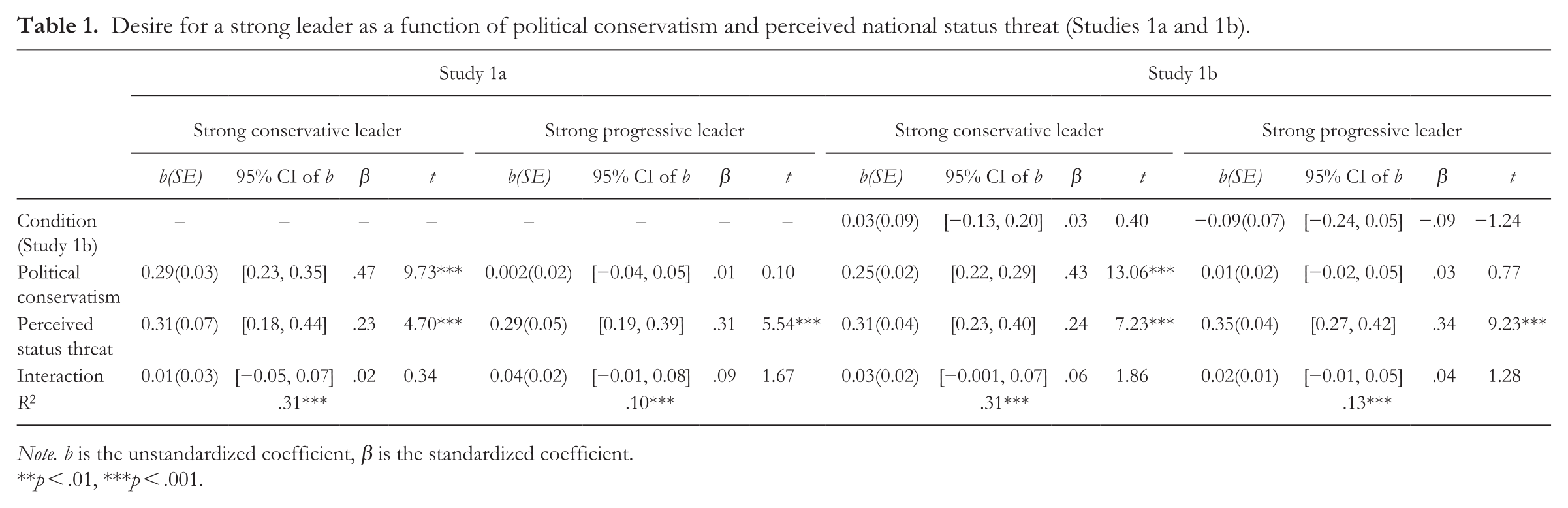
We first conducted two multiple regression analyses to examine if perceived national status threat predicted increased desire for a strong conservative leader and a strong progressive leader. We controlled for political conservatism (both studies) and condition (status threat salience vs. control in Study 1b) and included the centered status threat score and the interaction with political conservatism (i.e., to see if the relationship between status threat and the desire for a strong leader would depend on political conservatism). The results are displayed in Table 1.
Desire for a strong leader as a function of political conservatism and perceived national status threat (Studies 1a and 1b).
Note. b is the unstandardized coefficient, β is the standardized coefficient.
p < .01, ***p < .001.
Strong conservative leader
Both studies revealed a positive effect of political conservatism. In line with H1a, perceived national status threat predicted increased desire for a strong conservative leader in both studies, while the interactions were not significant.
Strong progressive leader
The effect of political conservatism was non-significant in both studies. Consistent with H1b, perceived national status threat predicted increased desire for a strong progressive leader in both studies, while the interactions were non-significant.
National Nostalgia and Collective Angst as Mediators
We then examined if feelings of national nostalgia and collective angst would explain the relationship between perceived national status threat and the desire for both kinds of strong leader. To do so, we conducted two mediation analyses using PROCESS (Hayes, 2022) in which we entered perceived national status threat as the independent variable, nostalgia and angst as parallel mediators, and the desire for a conservative and progressive strong leader as the two separate dependent variables (Model 4, parallel mediation; controlling for political conservatism in both studies and for condition in Study 1b). The indirect effects were estimated with bootstrapping procedures (5,000 samples, bias corrected). Results are displayed in Figures 1 (Study 1a) and 2 (Study 1b).
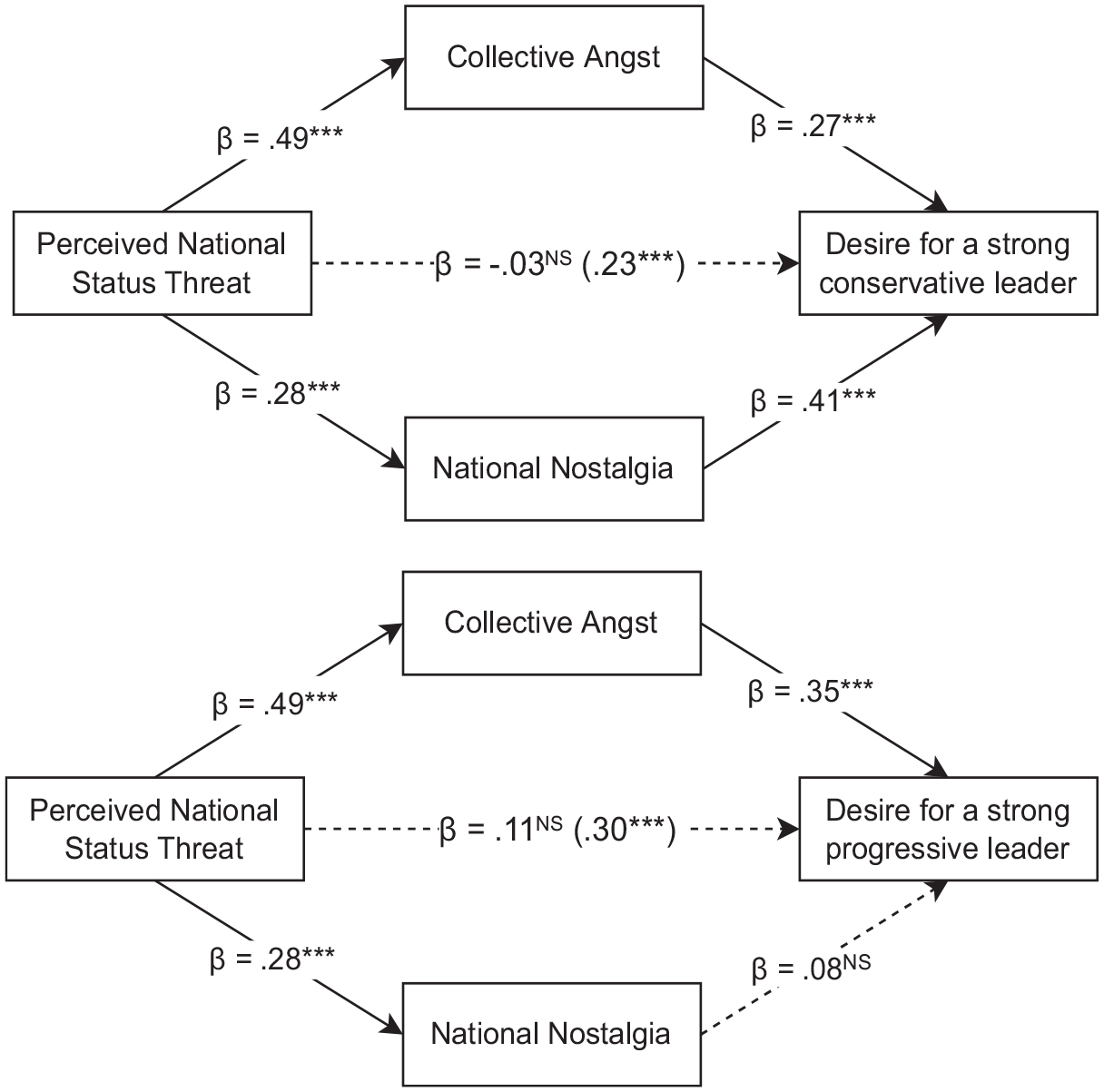
The relationship between perceived national status threat and the desire for a strong leader, via feelings of national nostalgia and collective angst (Study 1a).
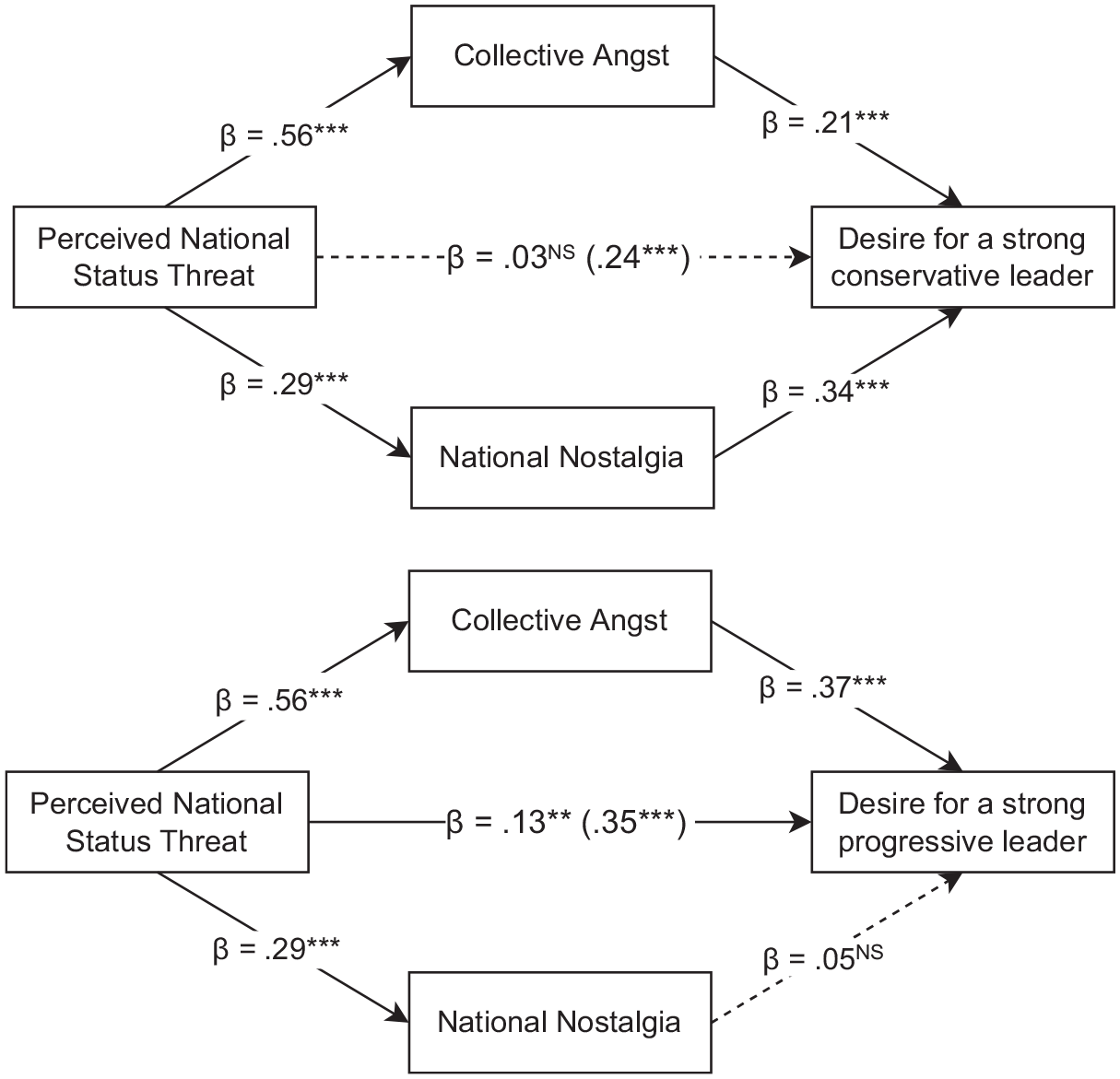
The relationship between perceived national status threat and the desire for a strong leader, via feelings of national nostalgia and collective angst (Study 1b).
The results were equivalent in both studies. In line with H2a and H2b, perceived national status threat was positively associated with national nostalgia and collective angst. Consistent with H3a, both nostalgia and angst predicted increased desire for a strong conservative leader, and both produced significant indirect effects (via nostalgia: IEboot = 0.16, 95% CI [0.09, 0.23] in Study 1a, IEboot = 0.13, 95% CI [0.09, 0.17] in Study 1b; via collective angst: IEboot = 0.18, 95% CI [0.10, 0.25] in Study 1a, IEboot = 0.15, 95% CI [0.09, 0.21] in Study 1b). Regarding the desire for a strong progressive leader, collective angst was the only significant predictor and produced significant indirect effects (IEboot = 0.16, 95% CI [0.09, 0.23] in study 1a, IEboot = 0.21, CI 95% [0.14, 0.28] in Study 1b), in line with H3b.
Discussion
Study 1a and Study 1b showed consistent findings. As expected, the perception that the dominant status of France on the international scene is threatened was associated with increased desire for a strong leader (both progressive and conservative) over and above political conservatism.
In both studies, perceived national status threat was associated with stronger feelings of nostalgia for France’s past and angst regarding its future, which in turn predicted increased desire for a strong leader. Specifically, while the relationship between perceived national status threat and the desire for a strong conservative leader was mediated by feelings of national nostalgia and collective angst, its link with the desire for a strong progressive leader was only mediated by feelings of collective angst. Our findings show that nostalgia could be more of a right-wing oriented emotion, triggering conservative responses from individuals (Lammers, 2023); whereas collective angst could have a less distinct ideological orientation. This is important, because while these two collective emotions may be prompted by the same national status threat perceptions, they might differently shape individuals’ socio-political attitudes—and specifically, their preference for a strong conservative leader vs. a progressive one. This pattern of results is consistent with our predictions and with previous work showing that national nostalgia is usually associated with conservatism (Smeekes et al., 2021), whereas collective angst can be linked to both conservative (Stefaniak & Wohl, 2021) and progressive (Jaśkiewicz et al., 2021) political attitudes.
In the next two studies, we examined whether the results found within two French samples would be replicated in other socio-political contexts: that of Malaysia and Chile—two countries that have experienced some form of political instability in recent years, placing significant emphasis on the issue of political leadership.
Studies 2a and 2b
Studies 2a and 2b tested our hypotheses in Malaysia (Study 2a) and Chile (Study 2b). Malaysia is a constitutional monarchy, while Chile operates under a presidential republic system. Compared to France, Malaysia and Chile have relatively less power on the international stage, although they wield a certain degree of influence locally. Hence, to better fit these contexts, Studies 2a and 2b focused on the perceived loss of status in the local region (Southeast Asia for Study 2a; Latin America for Study 2b) rather than internationally.
Both Malaysia and Chile have undergone political crises in the past few years. Specifically, data collection in Malaysia took place in February 2021, during a time of political turmoil. Internal divisions within members of parliament led to the collapse of the ruling coalition government, followed by the resignation of the Prime Minister, who was then replaced by a new leader. In Chile, data were collected between February and July 2021, which was a few months after a widespread series of protests against economic inequality and a year before a presidential election. In both countries, the ongoing political crises were exacerbated by the COVID-19 pandemic and prompted much discussion about the kind of leadership the country needed to overcome the crises.
Method
Participants
Initially, 896 participants took part in Study 2a (Malaysian sample) and 364 participants took part in Study 2b (Chilean sample). We removed participants who (a) did not complete the measures of interest, (b) were not Malaysian (Study 2a)/Chilean (Study 2b), or (c) were under 18 years of age. The analyses of Study 2a were conducted on a sample of 549 Malaysian participants (49% identified as female, 51% identified as male; Mage = 41.75 years, SDage = 13.44; 50% currently living in Malaysia 4 ) and those of Study 2b were conducted on a sample of 301 Chilean participants (39% identified as female, 57% identified as male, 4% non-binary/other or who did not want to answer; Mage = 27.06 years, SDage = 8.30).
Sensitivity analyses conducted on G*Power (Faul et al., 2007) given α < .05, our sample sizes (NStudy2a = 549 and NStudy2b = 301) and a desired power of 1–β = .80 showed that we were able to detect a small effect of perceived national status threat on the desire for strong leaders in both samples ( f 2 = .01 in Study 2a and f 2 = .03 in Study 2b).
Procedure and Measures
Study 2a data were collected via social media, while data for Study 2b were collected via both social media and Prolific. The procedure was identical to that of Study 1a. The measures used for the French studies were adapted and translated by native speakers (see OSF Supplemental material document: pp. 28–29 for Study 2a; pp. 33–34 for Study 2b).
Perceived national status threat
Out of the six items used in Study 1a and 1b, five of them were adapted so that they would fit the Malaysian and Chilean contexts, i.e., by focusing on the perceived loss of status in the local region (Southeast Asia for Study 2a and Latin America for Study 2b) rather than internationally (e.g., “The position of Malaysia/Chile as a powerful country in Southeast Asia/Latin America is threatened”). Two additional items captured the perceived loss of status on the international scene. However, principal component analyses revealed that all items loaded on a single latent component and confirmatory factor analyses subsequently confirmed that the two-factors models did not better fit the data than the one-factor models (see Tables S10 and S13 on the OSF Supplemental material document). We therefore computed an average score of perceived national status threat combining all items (α = .86 for Study 2a; α = .83 5 for Study 2b).
All other measures presented acceptable internal consistency: desire for a strong conservative leader (α = .77 for Study 2a; α = .68 for Study 2b), desire for a strong progressive leader (α = .86 for Study 2a; α = .78 for Study 2b), national nostalgia (α = .94 in both studies), collective angst (α = .85 for Study 2a; α = .83 for Study 2b). Regarding political conservatism, the correlations between the economic and social scales were strong in both samples (r = .71, p < .001 for Study 2a; r = .61, p < .001 for Study 2b) and the two scores were averaged into a composite political conservatism score (M = 3.99, SD = 2.41 for Study 2a 6 ; M = 4.37, SD = 2.01 for Study 2b).
Results
Correlation matrices and descriptive statistics are available on the OSF Supplemental material document (Tables S11 and S14).
Perceived National Status Threat and the Desire for Strong Leaders
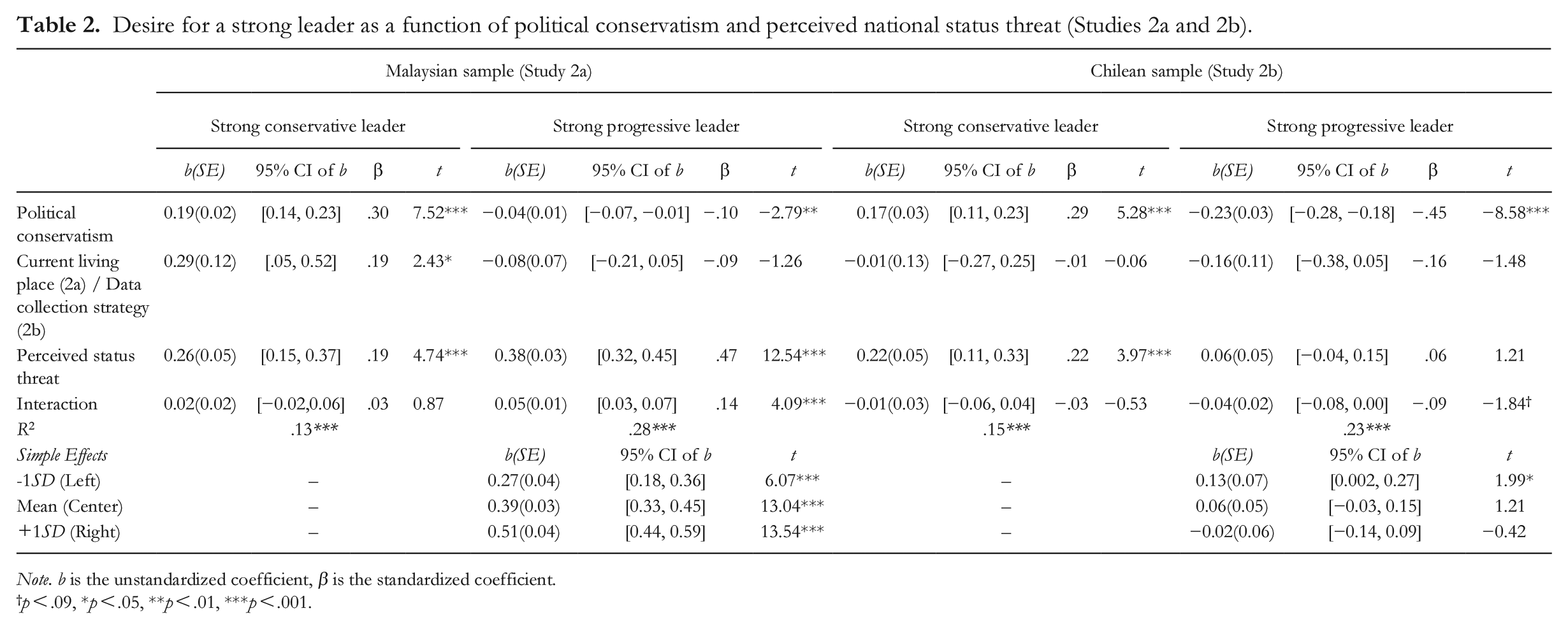
We followed the same analysis strategy as for Study 1a, except that we additionally controlled for current residency (living in Malaysia or not) in Study 2a and data collection strategy (Facebook vs. Prolific) in Study 2b. Results are displayed in Table 2.
Desire for a strong leader as a function of political conservatism and perceived national status threat (Studies 2a and 2b).
Note. b is the unstandardized coefficient, β is the standardized coefficient.
p < .09, *p < .05, **p < .01, ***p < .001.
Malaysian context (Study 2a)
Strong conservative leader
Political conservatism positively predicted the desire for a strong conservative leader, and so did participants’ current residency (i.e., participants who were currently living in Malaysia reported stronger desire for a strong conservative leader, M = 4.92, SD = 1.39, than those who were not, M = 4.64, SD = 1.55). In line with H1a, perceived national status threat predicted increased desire for a strong conservative leader while the interaction with political conservatism was not significant.
Strong progressive leader
There was a negative association between political conservatism and desire for a strong progressive leader. Consistent with H1b, perceived national status threat predicted increased desire for a strong progressive leader but this effect was qualified by a significant interaction with political conservatism. Specifically, simple effects analysis (conducted using PROCESS, Model 1) showed that while perceived national status threat significantly predicted increased desire for a strong progressive leader regardless of political conservatism, the effect was stronger at higher levels of political conservatism.
Chilean context (Study 2b)
Strong conservative leader
Political conservatism was positively linked to the desire for a strong conservative leader. In line with H1a, perceived national status threat predicted increased desire for a strong conservative leader while the interaction was not significant.
Strong progressive leader
Political conservatism was negatively associated with the desire for a strong progressive leader. Contrary to expectations (H1b), the main effect of perceived national status threat was not significant. However, there was a marginal interaction with political conservatism (p = .066). Although the interaction was not statistically significant, we decided to decompose it to determine whether the pattern of findings was in line with our hypotheses. Simple effects analysis (PROCESS, Model 1) indicated that perceived national status threat significantly predicted increased desire for a strong progressive leader among left-wing participants, but not among right-wing or centrist participants.
National Nostalgia and Collective Angst as Mediators
We then examined the mediating role of national nostalgia and collective angst by conducting parallel mediation analyses on PROCESS. We used Model 4 (controlling for political conservatism) when prior analysis had not highlighted a significant interaction between perceived national status threat and political conservatism and used Model 8 (political conservatism as a moderator) when prior analysis did so. The indirect effects were estimated with bootstrapping procedures (5,000 samples, bias corrected). Results are displayed in Figures 3 (Study 2a) and 4 (Study 2b).
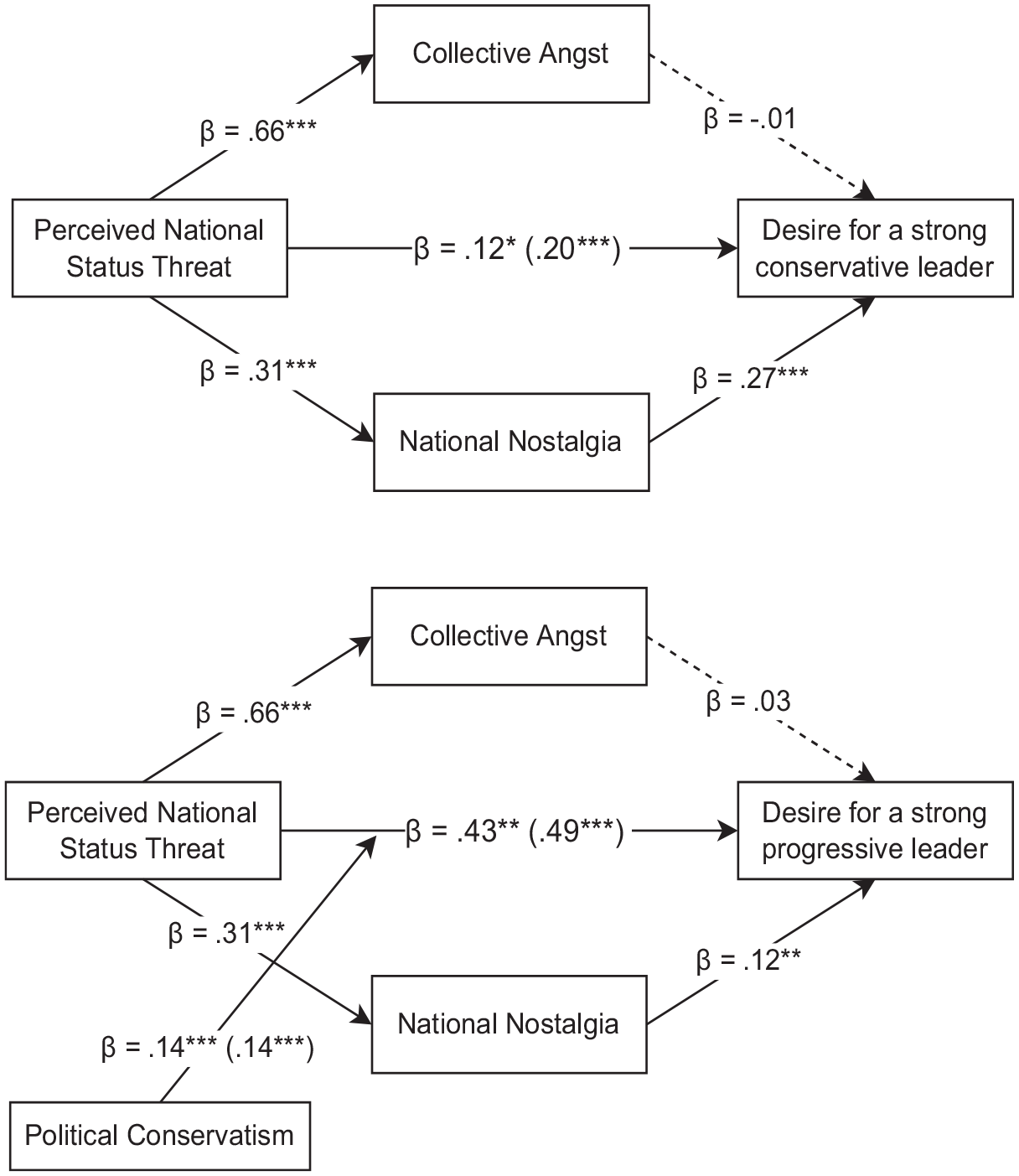
The relationship between perceived national status threat and the desire for a strong leader in Malaysia, via feelings of national nostalgia and collective angst (Study 2a).
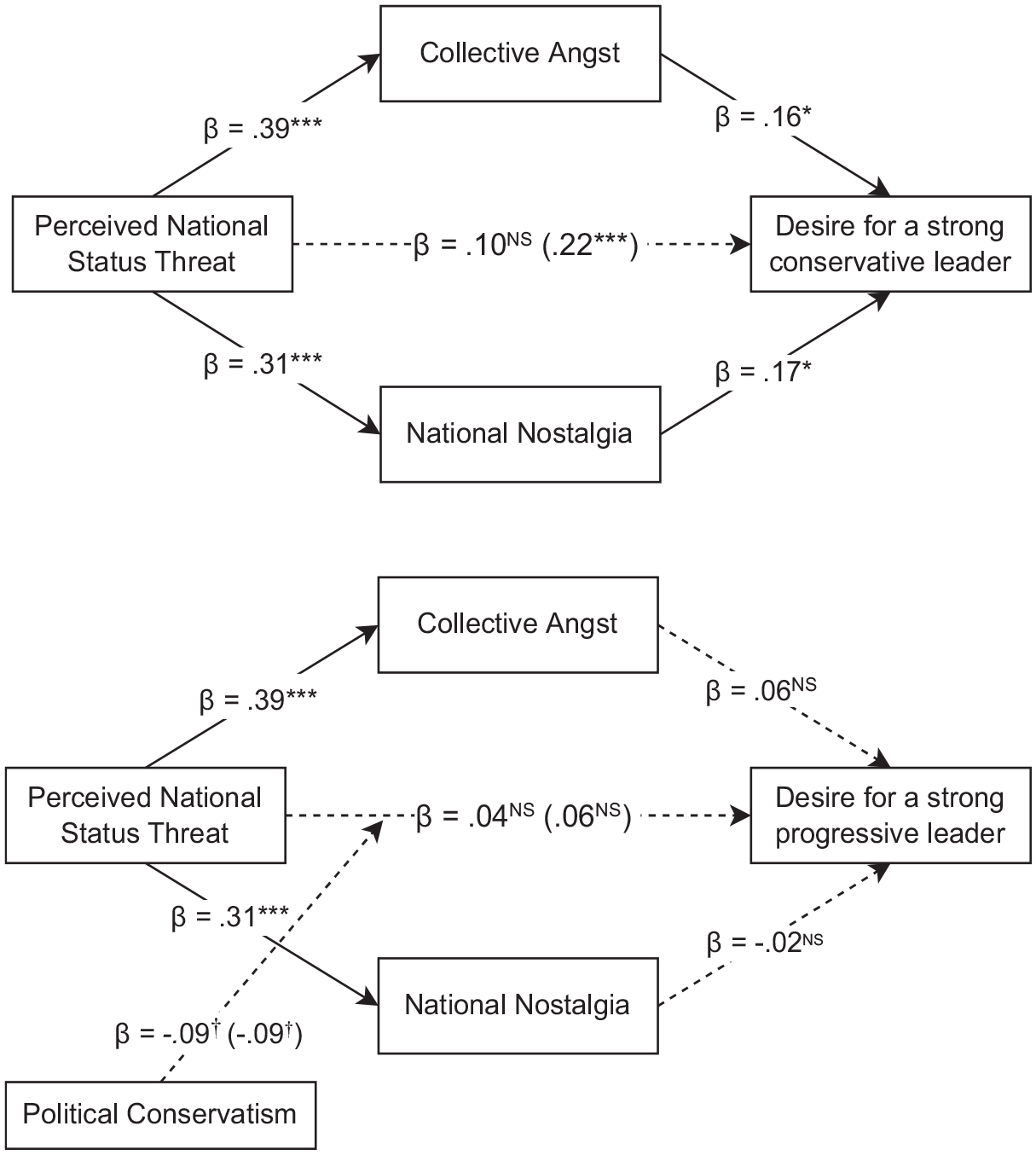
The relationship between perceived national status threat and the desire for a strong leader in Chile, via feelings of national nostalgia and collective angst (Study 2b).
Malaysian context (Study 2a)
Consistent with H2a and H2b, perceived national status threat was positively associated with feelings of national nostalgia and collective angst. Contrary to predictions (H3a and H3b), national nostalgia significantly predicted increased desire for both kinds of strong leaders (conservative and progressive) whereas collective angst was not a significant predictor of the desire for either type of strong leader. The indirect effects via national nostalgia were significant for the desire for a strong conservative leader (IEboot = 0.11, 95% CI [0.06, 0.17]) and the desire for a strong progressive leader (IEboot = 0.03, 95% CI [0.004, 0.06]).
Chilean context (Study 2b)
In line with H2a and H2b, perceived national status threat was positively linked to feelings of national nostalgia and collective angst. There was also a main effect of data collection strategy on collective angst, b = −0.45, t = −3.95, p < .001; indicating that social media participants reported higher angst, M = 4.93, SD = 1.12, than Prolific participants, M = 4.46, SD = 1.13.
Regarding the desire for a strong conservative leader, both nostalgia and angst were significant positive predictors, and both produced significant indirect effects (IEboot = 0.05, 95% CI [0.01, 0.10] via nostalgia; IEboot = 0.06, 95% CI [0.01, 0.12] via collective angst); thus, replicating the model found within the French samples and confirming H3a. However, neither national nostalgia nor collective angst predicted the desire for a strong progressive leader, contrary to predictions (H3b).
Discussion
In both Malaysian and Chilean samples, we replicated the findings of Study 1 showing that perceived national status threat was associated with increased desire for a strong leader (whether conservative or progressive). However, in the Chilean sample, perceived national status threat predicted greater desire for a strong progressive leader only among left-wing participants. In the Malaysian sample, this effect was significant regardless of political orientation but was unexpectedly stronger among right-wing participants.
As in the French samples, perceived national status threat was associated with greater feelings of national nostalgia and collective angst. However, how these collective emotions subsequently predicted the desire for strong leadership was different depending on the country. In the Malaysian sample, perceived national status threat was associated with increased desire for both kinds of strong leaders through higher feelings of national nostalgia. This is contrary to what was observed in the French sample studies (where nostalgia was only linked to support for a conservative strong leader), and what one might have expected from prior empirical work (Smeekes et al., 2021; but see General Discussion). In the Chilean sample, the findings of the French studies were replicated regarding the desire for a strong conservative leader, but neither of our proposed mediators was linked to the desire for a strong progressive leader.
These results might suggest contextual variations in how national nostalgia and collective angst shape people’s political preferences and are somehow consistent with previous work showing that the predictors of political choices sometimes vary depending on the country’s characteristics (e.g., group history, the level of ideological constraint and human development; Malka et al., 2014). However, as we did not systematically test these effects in the present studies, future research is needed to thoroughly examine whether and how national specificities affect the link between these collective emotions and the desire for a strong conservative vs. progressive leader. For example, recent work showed that in Turkey, the link between conservatism and nostalgia is weaker than in the US, presumably because the country has undergone regressive social changes and a conservative turn in recent years (Lammers & Uğurlar, 2023). The relationship between nostalgia and conservatism might therefore depend on the country’s historical trajectory (Lammers & Uğurlar, 2023); a useful starting point for this promising line of research.
General Discussion
In a world where the appeal of strong leaders is growing, understanding what drives this tendency is essential to combat worrying societal trends (e.g., decline in democracy, rise of international conflicts). Drawing on Social Identity Theorizing (Tajfel & Turner, 1979) and social identity work on the supply-side of politics (Mols & Jetten, 2014), we tested if perceived national status threat was associated with greater desire to elect a strong leader.
Across four correlational studies conducted in France, Malaysia, and Chile, we found that perceived national status threat predicted increased desire for both conservative and progressive-style strong leaders. These findings align with extant research showing that threat is not always associated with increased conservatism but can also sometimes be a motivating force for progressive change (e.g., Brandt & Baker, 2022; Brandt et al., 2021; Malka et al., 2014). Moreover, in the French and Chilean samples, the underlying emotional path was contingent on the type of leader. Specifically, in both countries, perceived national status threat predicted greater desire for a strong conservative leader through increased national nostalgia and collective angst, while its relationship with the desire for a strong progressive leader was explained only via increased collective angst in France, and via neither angst nor nostalgia in Chile. These results are consistent with previous work showing that national nostalgia is associated with stronger support for conservative policies (Smeekes et al., 2021) while collective angst can lead to both conservative and progressive responses (Jaśkiewicz et al., 2021; Wohl et al., 2012). They also suggest that how perceptions of national status threat translate into political leadership preferences might depend on the collective emotions that are aroused.
However, in the Malaysian sample, national nostalgia positively predicted desire for both kinds of strong leader. Aside from the explanations in terms of national characteristics that we mentioned in the discussion of Study 2, the measure of nostalgia we used, which was confined to capturing general feelings of national nostalgia, might also partially explain this result. It is indeed possible that participants were nostalgic about different Malaysian pasts, and that this variation in the content of the nostalgic reverie would explain why the latter predicted increased desire for both conservative and progressive strong leaders. Recent research in fact showed that homogeneity-focused nostalgia (i.e., nostalgia for a more culturally homogeneous society) fosters conservative responses whereas tolerance-focused nostalgia (i.e., nostalgia for a more open and tolerant society) leads to more inclusive attitudes (Stefaniak et al., 2021). This also resonates with the additional results of our pilot study (see OSF Supplemental material document, pp. 2–8) which revealed that, like LePen, Mélenchon (strong progressive leader) also evoked a longing for the French past in his speeches, even though this nostalgia was much less pronounced than in the strong conservative leader’s speeches and that the content of his nostalgic narrative was different. Although the latter finding needs to be taken with caution considering the limited generalizability of the pilot study, these results taken as a whole emphasize the need to consider the content of national nostalgia, as this emotion might not be specific to conservative ideologies but could take different forms depending on political orientation (Stefaniak et al., 2021). Future studies could therefore re-examine the processes identified in this research by distinguishing between different types of national nostalgia.
More generally, the differences between the results patterns in the Chilean and Malaysian samples compared to the French samples also lead us to question the transferability of our concepts—and especially that of strong leadership and the distinction between conservative vs. progressive strong leaders—to the Malaysian and Chilean political and historical contexts. Interestingly, while the correlations between the two types of leaders were quite strong in the French studies (around r = .50 in both samples), these relationships were much weaker in the Malaysian (r = .34) and Chilean (r = .18) studies. If the measures did not behave identically in the different contexts, this could indicate that the underlying concepts may not have translated as intended into the Malaysian and Chilean political settings. The content of ideology may differ depending on the context (Chen & Beattie, 2023) and future research might consider examining the link between perceived status threat and political preferences in a more grounded, bottom-up approach, rather than transferring notions—and their operationalizations—that have been developed in WEIRD (Western, Educated, Industrialized, Rich, Democratic) contexts to non-Western societies.
Limitations and Future Research
In addition to the limitations mentioned above, we must stress that the correlational nature of our data prevents us from making conclusions about the direction of the relationships between our variables. Although theoretical (Tajfel & Turner, 1979) and empirical arguments (Craig & Richeson, 2014a, 2014b) lead us to place perceived status threat as an antecedent of collective emotions and defensive group-based behaviors—such as the desire for a strong leader—mediation models based on correlational data are often ambiguous (Fiedler et al., 2011). Therefore, we cannot rule out based on the present data that causality may be reversed or that the relationships between perceived national status threat, national nostalgia, collective angst, and support for strong leaders might be multidirectional. For example, previous work showed bidirectional relationships between political preferences and perceived threat (Onraet et al., 2014), which suggests that political preferences might also shape threat perceptions (Brandt & Baker, 2022). Further experimental research is needed to determine the causal pathways of perceived national status threat on the appeal of strong leadership.
On another note, the pilot study relied on a small number of speeches constrained to two French leaders, which may call into question the generalizability of our findings. Future studies examining the status threat rhetoric among strong leaders from other countries are thus necessary to see how this concept is expressed in different contexts. In addition, our quantitative surveys’ data are based on convenience samples, and studies using representative samples might prove useful to confirm the generalizability of the present results.
The measure of desire for a strong leader was also not without limitations, including the fact that it required participants to have a representation of what constitutes a “strong” leader, without a prompt that would inform them of how to interpret the word “strong” in the items. Although the term “strong leader” is becoming increasingly well known, which reduces the chance of misinterpretation, future research could overcome this limitation by including brief prompts about the attributes of a strong leader (e.g., tough, uncompromising) to guide participants’ understanding.
Finally, we did not consider participants’ perceptions of status legitimacy, even though Social Identity Theory (Tajfel & Turner, 1979) argues that people who perceive that their group’s status is threatened should be more motivated to defend it when they believe that its dominance is legitimate (see, for example, Outten et al., 2018). Future work should examine if the effect of perceived national status threat on the desire for strong leaders is contingent on the degree to which people perceive that their country’s privileged position is legitimate.
Concluding Remarks
Despite these limitations, our results suggest that the national status threat narrative could indeed provide a fertile ground for diverse forms of strong leadership, thus bringing together work on the declinist rhetoric among populist leaders (Mols & Jetten, 2014), and research on the link between group status threat on political attitudes (Mutz, 2018). While research has so far mainly focused on far-right leaders (March, 2011), the present studies examined potential predictors of the desire for both conservative and progressive strong leaders; and did so in different national contexts. By doing so, this research contributes to the emergent literature applying social psychology insights—and specifically, Social Identity Theorizing—to the desire for strong leadership (Crano & Gaffney, 2021; Crimston et al., 2022; Selvanathan et al., 2022; Sprong et al., 2019), and suggests that perceptions of national status threat could help us grasp the growing popularity of strong leaders around the globe.
Footnotes
Funding
The author(s) disclosed receipt of the following financial support for the research, authorship, and/or publication of this article: This work was supported by an Australian Research Council Laureate Fellowship [Grant ID: FL180100094].

Supplemental Material
Supplemental material for this article is available online.