







Abstract
Three studies (N = 1,427) examine White Americans’ threat and stress appraisals and coping strategies in imagined inter- and intraracial interactions when a nearby White person does something racist. White individuals report heightened concern about being stereotyped as racist (i.e., metastereotyping) following an ingroup member’s stereotype-confirming (vs. neutral) behavior (Studies 1–3). Moreover, across studies, these heightened metastereotypes predict greater anxiety, which in turn predicts anticipated coping strategies (e.g., increased motivation to disprove the stereotype). Additionally, relative to imagined interactions with a White partner, these consequences of witnessing a White person’s anti-Black bias are significantly stronger with a Black or Latinx (Studies 1 and 2) but not an Asian (Study 3, preregistered) interaction partner. This work highlights how an ingroup member’s racist behavior is a situational stressor for White people during intergroup encounters, engendering coping strategies to protect the self and manage the ensuing interaction.
Keywords
When a White person tells an anti-Black “joke” in mixed-race company, they may face strong disapproval and derogation. How might other White people in this situation react to their ingroup member’s racist remarks? White Americans generally express dislike toward White people identified as racist (e.g., Crandall et al., 2002) and desire to distance themselves from the category racist (O’Brien et al., 2010; Sommers & Norton, 2006; cf. black sheep effect, Marques et al., 1988). These reactions likely reflect White people’s simultaneous awareness that they belong to a group that others stereotype as racist (Shelton et al., 2006; Vorauer et al., 1998) and their motivation to maintain a nonracist self-image (Devine et al., 1991; Plant & Devine, 1998). Moreover, a White person’s desire to distance themselves from a racist ingroup member is likely exacerbated when the racist behavior is witnessed alongside racially minoritized individuals.
In the current research, we integrate models of stress and coping (Lazarus & Folkman, 1984; Trawalter et al., 2009) to investigate White Americans’ threat appraisals, stress appraisals, and anticipated coping strategies during imagined inter- and intraracial interactions during which a nearby ingroup member expresses anti-Black bias. We conceptualize threat appraisals as metastereotypes: the extent of White people’s concerns about being seen stereotypically by their partner (see also Blascovich et al., 2001; Mendes et al., 2002; Shelton & Richeson, 2006; Vorauer, 2006). Metastereotypes threaten White people’s positive, nonracist self-image (O’Brien et al., 2010) and increase their self-presentational and impression management goals (Bergsieker et al., 2010; Johnson et al., 2009; Winslow, 2004)—all of which can exacerbate anxiety during interracial interactions (Plant, 2004). To manage this threat and anxiety, White people may attempt to compensate for their ingroup member’s transgression (i.e., show that they are not racist) and avoid future interactions with people from racially minoritized groups (Schmader & Lickel, 2006; Shelton et al., 2006). Thus, we test whether witnessing a nearby ingroup member’s anti-Black racism may differentially impact White Americans’ anticipated appraisals and coping strategies in interactions with Black people (Studies 1–3) and members of other racially minoritized groups (Latinx and Asian individuals; Studies 2–3). Examining this intergroup process is important because White people’s handling of such complex social situations has the potential to undermine cross-race friendship building and restrict racially minoritized group members’ access to various social networks. Additionally, the current work will inform our understanding of how the broader social context contributes to interracial (and intraracial) interaction quality and downstream outcomes.
Interracial Interactions: Cueing Identity Threat for White Americans
The often-violent history of U.S. race relations is foundational for understanding how people experience interracial interactions in the present. However, this historical context is less often considered or deemed relevant when examining White Americans’ interracial interaction experiences relative to those of racially minoritized groups (Kteily & Richeson, 2016; Taylor et al., 2019). Nonetheless, history is replete with documented evidence of White people’s overt and covert discriminatory and systemic racist practices (e.g., slavery; exclusion from neighborhoods and schools) and racist interpersonal behavior (verbal slights to physical violence) directed toward people from racially minoritized groups (Allport, 1954; Rothstein, 2017). Such past and contemporary manifestations of racism and systemic racial inequalities, combined with White Americans’ infrequent contact with racially minoritized groups (Hall et al., 2019), will necessarily influence intergroup relations in the present (Rucker & Richeson, 2021; Taylor et al., 2019; Trawalter et al., 2023).
Given this backdrop, White Americans often experience stereotype and social identity threat during interracial interactions (Richeson & Shelton, 2012). Specifically, White people’s metastereotypes are activated in interracial contexts: concern that racial outgroup members may assimilate them with the long-standing stereotype that White people are racist (e.g., Bergsieker et al., 2010; Goff et al., 2008; Shelton et al., 2005; Trawalter & Richeson, 2006; Vorauer et al., 1998; Vorauer & Turpie, 2004). This baseline experience of identity threat prompts vigilance to situational cues that signal an increased likelihood of being viewed through the lens of these group stereotypes (e.g., Murphy et al., 2007; Murphy & Taylor, 2012). We propose that an ingroup member’s stereotypical behavior is a potent cue that increases White people’s metastereotype concern during interracial interactions. Specifically, we expect that witnessing another White person behave in a racist (relative to nonracist) manner would exacerbate the cognitively and emotionally taxing nature of an ongoing interracial interaction.
Witnessing racism: Increased interracial interaction threat
Existing research supports the idea that in interracial contexts, an ingroup member’s stereotype-relevant behavior is a situational cue that increases White people’s metastereotyping concerns. In one study, White participants expected to share a recording with a racial minority partner of themselves and other White people responding to a neutral prompt (e.g., first impressions of fellow students) or a race-relevant prompt (e.g., do you think minorities are spoiled by welfare?; Vorauer, 2003). White individuals expressed greater concern about being seen as prejudiced by their racial minority partner when assigned to the race-relevant (vs. neutral) prompt, likely because their racial ingroup members’ responses could potentially include racist remarks. In another study, White people’s metaperceptual concern was exacerbated when they imagined that, during an interracial interaction, they witnessed another White person tell an anti-Black racist joke (stereotypically negative behavior), compared to when that ingroup member behaved in a neutral manner (i.e., knocking over and cleaning up food) or in a negative nonstereotypical manner (i.e., ignoring a person with a physical disability; Taylor & Yantis, 2021). Thus, witnessing the potentially or explicitly racist behavior of an ingroup member during an interracial interaction is a situational cue that increases White people’s concern that they will be viewed as similar to their racial ingroup member—that is, as prejudiced or racist. This work also suggests that witnessing ingroup behavior that confirms the Whites-as-racist stereotype is more threatening than witnessing non-stereotype-relevant behavior.
How, then, might White people respond to the increased threat elicited during interracial interactions that include a stereotype-confirming ingroup member? We draw upon the stress and coping framework to investigate these questions.
Stress Responses and Coping Strategies During Threatening Interracial Interactions
According to the stress and coping framework (Lazarus & Folkman, 1984), once people appraise a situation as threatening, they will exhibit psychological stress reactions and subsequently recruit coping strategies to mitigate that stress. Applying this to interracial interactions (Trawalter et al., 2009), we suggest that the increased threat appraisal (metastereotyping concern) elicited by stereotype-confirming ingroup members in an interracial interaction will heighten Whites’ emotional stress appraisal. Indeed, greater metaperceptual concerns during interracial interactions predict greater self-reported anxiety (Bodenhausen et al., 2009; Plant, 2004; Shelton, 2003; Shelton & Richeson, 2006) and physiological stress responses (Page-Gould et al., 2014; Trawalter et al., 2012). Moreover, witnessing racism during interracial interactions heightens Whites’ negative affect (e.g., nervousness, shame; Schmader et al., 2012; but see also Karmali et al., 2017; Kawakami et al., 2009). Thus, the more threatening White people appraise an interracial interaction to be, the stronger their self-reported and physiological stress.
Possible strategies to cope with the stress evoked by threatening interracial interactions include overcompensation/engagement, avoidance, freezing, or antagonizing one’s interaction partner (Trawalter et al., 2009). However, one’s ability to develop a coping response is directly tied to the demands being placed on the individual as well as the resources they have to manage these demands (Lazarus & Folkman, 1984). Resources can include previous experience with interracial interactions, which allow for the development of social scripts to manage future encounters (Avery et al., 2009; Trawalter et al., 2009). Resources also include basic physical, cognitive, and emotional energy to respond to one’s partner. Generally, when people have resources available to manage a threat, they are more likely to engage in approach-related coping strategies. In the context of interracial interactions, approach-oriented coping behaviors include engagement/overcompensation (e.g., effortful behaviors that attempt to disprove stereotypes) and antagonizing one’s partner (e.g., verbal insults or criticisms) given that they are the source of the threat (Trawalter et al., 2009). In contrast, when people lack the psychological and emotional resources to manage a threat, they are more likely to engage in avoidance-related coping strategies. Avoidance-related coping behaviors in interracial interactions include actively avoiding one’s partner (e.g., increasing physical distance, ending the interaction) and freezing (e.g., minimal gestures, behavioral rigidity; Trawalter et al., 2009). Therefore, aligned with the stress and coping framework (Lazarus & Folkman, 1984) and previous work examining these processes among Black participants (Taylor et al., 2021), we expect that the coping strategies people employ will be a function of an interaction between the stress experienced and the resources available to manage that stress. Critically, we expect such responses to be attenuated in intraracial interactions with a White partner, given that intraracial (vs. interracial) contexts are less likely to elicit metaperceptual/metastereotyping concerns and emotional stress (Frey & Tropp, 2006). White people’s coping strategies in interracial contexts are particularly important to consider because their behavior might not only derail the quality of an interracial encounter and undermine cross-race friendship building (i.e., via overcompensation; avoidance), but also intentionally or unintentionally restrict racially minoritized group members’ access and opportunities in interracial settings.
The Current Research
White people are sensitive to the threat of appearing racist, particularly when interacting with people from racially minoritized groups (Richeson & Shelton, 2012). Integrating and extending previous work on situational cues and social identity threat, we propose that White Americans’ cross-race encounters are influenced by the broader context, namely, the stereotype-confirming behavior of racial ingroup members. Using a stress and coping lens, we investigate how a nearby White person’s anti-Black racism impacts White Americans’ imagined interactions with a Black partner, and whether their expectations differ for imagined interactions with a White partner.
First, we predict that following a racial ingroup member’s stereotype-confirming (vs. neutral) behavior, White Americans will anticipate greater concerns about being seen as racist by their interaction partner (i.e., metastereotypes; threat appraisal). We also expect this ingroup behavior effect on metastereotypes will be stronger during interracial (vs. intraracial) interactions. Second, we hypothesize that increased metastereotypes will predict greater anxiety (i.e., emotional stress appraisal), followed by greater motivation to disprove stereotypes and antagonism among those with sufficient resources, as well as avoidance and freezing among those with low resources (see Figure 1 for conceptual model). Studies 2 and 3 examine the potentially far-reaching consequences of this intergroup situation by testing whether the effects of witnessing anti-Black racism might spill over to cross-race interactions with minoritized outgroup members whose racial group was not targeted by the racist act (i.e., Latinx and Asian partners). Generally, we expect that these processes will be stronger during imagined interracial interactions (with a Black, Latinx, or Asian partner) relative to intraracial interactions.
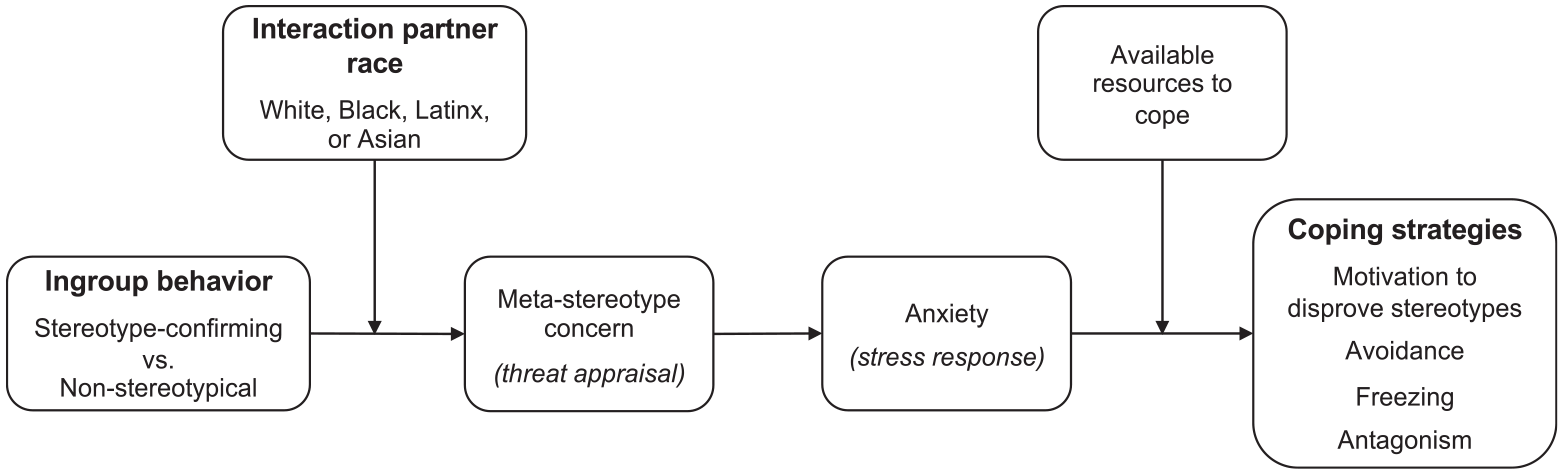
Theoretical model of stress and coping following an ingroup member’s stereotype-confirming behavior during inter- and intraracial interactions.
This work highlights how interracial interactions do not occur in a vacuum but unfold in a larger historical and sociocultural context. Thus, the stereotypical—specifically, racist—behavior of a nearby racial ingroup member can influence White Americans’ metaperceptual, emotional, and interpersonal processes during an interracial encounter.
Study 1
To test our proposed model (Figure 1), we asked White Americans to imagine what it would be like to witness another White person’s racist behavior in a workplace context while interacting with a previously unacquainted Black or White coworker. We predict that participants will report greater metastereotypes following an ingroup member’s stereotype-confirming (vs. neutral) behavior, and that this ingroup behavior effect will be significantly stronger during an imagined interracial (vs. intraracial) interaction.
We also assessed how these different threat appraisals impact White people’s anticipated anxiety and behavior in the encounter. Specifically, we test our hypothesis that heightened threat (i.e., metastereotyping) will elicit greater stress, as indicated by the amount of anxiety participants expect to feel in this situation. In turn, we expect that anxiety will predict participants’ coping strategies as a function of the resources they anticipate having in this encounter. Specifically, we hypothesize that participants who report higher resources will be more motivated to disprove stereotypes and antagonize their partner, whereas those who report lower resources will be more likely to anticipate freezing or avoiding their partner. Finally, we predict that these processes will be stronger for imagined interracial (vs. intraracial) interactions.
Method
Design and participants
The study used a 2 (ingroup behavior: stereotype-confirming, neutral) × 2 (partner race: White, Black) between-subjects factorial design. 1 Following previous work (Taylor et al., 2021), we aimed to analyze data from a minimum of 250 participants for at least 80% power to detect the hypothesized Ingroup Behavior × Partner Race interaction predicting metastereotypes. White, U.S. citizens completed the survey online through MTurk (N = 325). Fifteen participants (4.6%) incorrectly identified the race of their coworker, and an additional 11 participants (3.5%) incorrectly identified the behavior in the scenario and were thus excluded from analyses, leaving 299 participants (170 women, 129 men; Mage = 37.46, SDage = 11.57, age range = 19–71). A sensitivity power analysis for an ANOVA with interactions suggested that this sample was powerful enough to detect a small effect (f = .16; inputs: α = .05, power = 80%, N = 299, numerator df = 1, n groups = 4).
Procedure
Participants imagined themselves as the main character in a scenario (Amanda or Anthony), training for a new part-time job with other employees. During a break, Amanda/Anthony walks with a previously unacquainted White or Black coworker (partner race condition) to a cafeteria to get food. The pair witness a White man or woman talking on a cell phone, telling a racist joke about Black people while laughing (stereotype-confirming condition), or dropping a few coins on the floor (neutral condition). Afterwards, participants recounted the scenario’s details, completed dependent measures and manipulation checks, and were debriefed and compensated. Across studies, all characters in the scenario were binary gender-matched to the participant.
Dependent measures
Unless otherwise noted, items were assessed on 7-point scales (1 = strongly disagree, 7 = strongly agree).
Metastereotypes (threat appraisal)
Ten items assessed the extent to which participants thought their coworker would view them as representing traits stereotypically associated with White people in North America (e.g., prejudiced, arrogant; α = .83; 1 = very unlikely, 9 = very likely; Vorauer et al., 1998).
Intergroup anxiety (stress appraisal)
We operationalized stress as participants’ anticipated anxiety (six items) “I would feel worried [tense, frightened, self-conscious, awkward, defensive] after witnessing my ingroup member’s behavior” (Taylor et al., 2018); as well as stress appraisals (two items): “How taxing [stressful] would you find this situation?” (1 = not at all, 7 = very). We averaged responses to these eight items to form a composite score (α = .93).
Available resources
To assess psychological resources to cope, participants responded to four items following the prompt, “To what extent would you have the resources to interact [energy to interact, patience to interact, and the ability to manage the interaction] with your coworker afterward?” (1 = not at all, 7 = extremely; α = .95; Taylor et al., 2021).
Coping strategies
Participants indicated how they would behave while interacting with their coworker along the following four dimensions (Taylor et al., 2018; Taylor et al., 2021; cf. Trawalter et al., 2009).
Motivation to disprove stereotypes
Capturing participant’s overcompensation/engagement in the interpersonal context, six items assessed their motivation to disprove negative racial group stereotypes with their partner (e.g., “I would be motivated to represent my racial/ethnic group positively,” “I would feel pressure to show my coworker that I am not like the member of my racial/ethnic group that we observed”; α = .90).
Avoidance
Four items assessed participants’ desire to avoid their partner (e.g., “I would be motivated to avoid contact with my coworker,” “I would not want to engage in conversation with my coworker”; α = .88).
Freezing
Four items assessed the extent to which participants felt immobilized during the interaction with their partner (e.g., “I can imagine myself being stunned into silence after observing my racial/ethnic group member with my coworker,” “I can imagine myself being stiff after observing my racial/ethnic group member with my coworker”; α = .89).
Antagonism
Four items assessed the extent to which participants would show antagonism toward their partner (e.g., “I can imagine myself showing contempt toward my coworker after the observation,” “I can imagine myself being motivated to disregard my coworker after the observation”; α = .85).
Conceptual manipulation check: Ingroup behavior
To assess the strength of our ingroup member behavior manipulation, participants rated the extent to which White people as well as Black people would consider their ingroup member’s behavior stereotypical of White people (two items; 1 = not at all stereotypical, 7 = very stereotypical) as well as the valence of the behavior (1 = very negative, 7 = very positive). 2
Results
Conceptual manipulation check: Ingroup behavior
Independent samples t tests revealed that, as intended, participants believed that White people would consider the ingroup member’s stereotype-confirming behavior more stereotypical of White people in general (M = 3.16, SD = 1.64) compared to the neutral behavior (M = 2.23, SD = 1.58), t(266) = 4.69, p < .001, d = 0.57. Participants also rated the stereotype-confirming behavior as significantly more negative (M = 1.53, SD = 0.87) than the neutral behavior (M = 3.92, SD = 0.75), t(265) = 23.75, p < .001, d = 2.91. 3
Metastereotypes
We first tested our hypothesis that participants would report greater metastereotypes after witnessing stereotype-confirming (vs. neutral) behavior and that this effect would be exacerbated during interactions with a Black (vs. White) coworker. A 2 (ingroup behavior) × 2 (partner race) between-subjects ANOVA revealed a significant interaction effect, F(1, 295) = 7.78, p = .006, ηp2 = .03 (see Figure 2A). Consistent with predictions, during an imagined interaction with a Black coworker, participants reported significantly more metastereotypes following an ingroup member’s stereotype-confirming (vs. neutral) behavior, F(1, 295) = 32.67, p < .001, ηp2 = .10. In contrast, the effect of ingroup member behavior on metastereotypes was nonsignificant during the imagined interaction with a White coworker, F(1, 295) = 3.17, p = .076, ηp2 = .01.
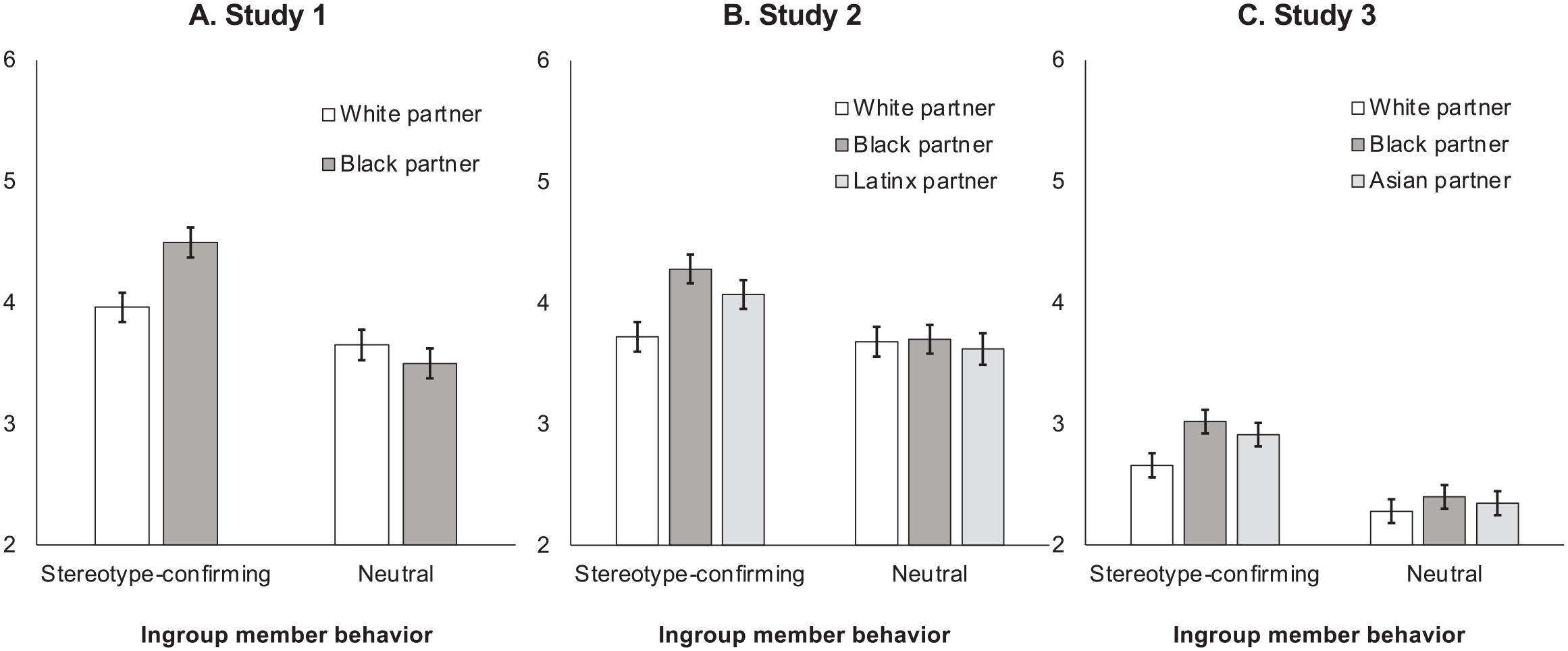
Effect of ingroup behavior on metastereotypes as a function of partner race: Studies 1–3.
Predicting coping strategies via metastereotypes and anxiety
Next, we tested our hypothesized model (Figure 1) by examining the indirect effects of ingroup behavior, moderated by partner race, on coping strategies via metastereotypes and anxiety with additional moderation by available resources to cope. For each coping strategy, we estimated a custom-programmed double moderated serial mediation model with the PROCESS (Version 4.3.1) macro for SPSS (Version 29) with 10,000 bias-corrected bootstrap resamples test hypotheses (Hayes, 2017).
Motivation to disprove stereotypes
Consistent with predictions, we observed a significant index of moderated, moderated mediation predicting motivation to disprove stereotypes, b = 0.04, SE = 0.02, 95% CI [0.0004, 0.09]. We thus examined the indirect effect of ingroup behavior on motivation to disprove stereotypes for each partner race condition at high and low levels of resources: 1 SD below (4.18) and above (6.77) the mean. See Figure 3 for path coefficients and Table 1 for indirect effects across studies. With a White coworker, there are no significant indirect effects of ingroup behavior on motivation to disprove stereotypes at high nor low levels of resources. In contrast, with a Black coworker, an ingroup member’s stereotype-confirming (vs. neutral) behavior indirectly predicts greater motivation to disprove stereotypes via increased metastereotypes followed by heightened anxiety. At high resources, this indirect path is significantly stronger, suggesting motivation to disprove stereotypes is a more viable coping strategy when people anticipate having sufficient resources (pairwise contrast of indirect effects at high vs. low resources with a Black partner: b = 0.14, SE = 0.07, 95% CI [0.01, 0.30]).

Moderated, moderated mediation model predicting motivation to disprove stereotypes: Study 1.
Indirect effects of ingroup behavior on coping strategies via metastereotypes followed by anxiety: Studies 1, 2, and 3.
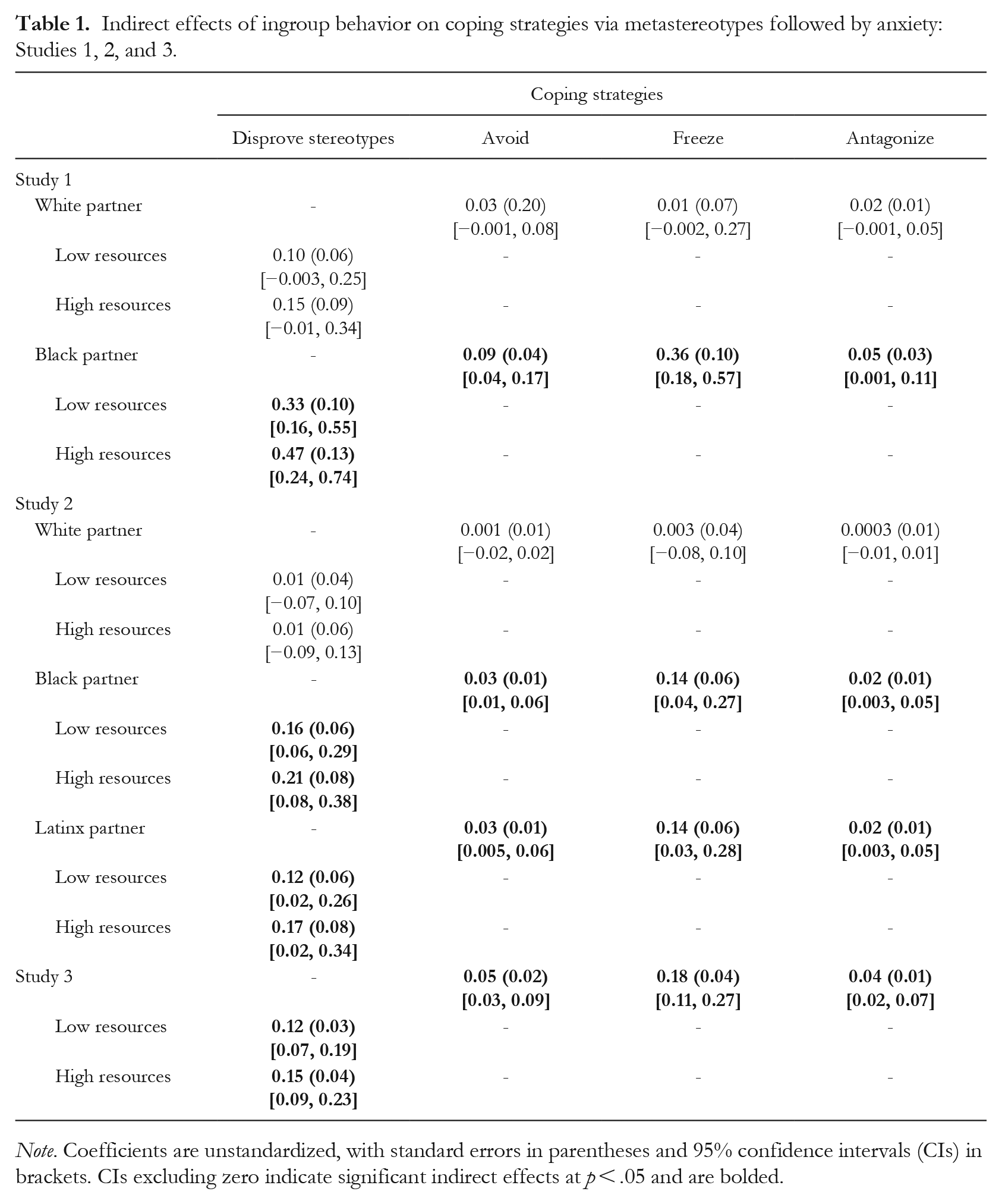
Note. Coefficients are unstandardized, with standard errors in parentheses and 95% confidence intervals (CIs) in brackets. CIs excluding zero indicate significant indirect effects at p < .05 and are bolded.
Avoidance, freezing, and antagonism
We did not observe moderated, moderated mediation predicting avoidance (b = −0.02, SE = 0.02, 95% CI [−0.04, 0.01]), freezing (b = 0.01, SE = 0.02, 95% CI [−0.01, 0.05]), or antagonism (b = −0.01, SE = 0.02, 95% CI [−0.05, 0.03]). We thus estimated trimmed models that included resources as a covariate rather than as a moderator (Hayes, 2017, pp. 511–512). In these trimmed models, we found evidence of mediation, moderated by partner race, for avoidance (b = 0.06, SE = 0.03, 95% CI [0.01, 0.13]), freezing (b = 0.24, SE = 0.10, 95% CI [0.06, 0.45]), and antagonism (b = 0.03, SE = 0.02, 95% CI [0.0002, 0.08]), such that the indirect effects of ingroup behavior on each coping strategy were significant in the Black, but not White, partner race condition (see Table 1). Specifically, during imagined interactions with a Black coworker, participants reported greater metastereotypes following an ingroup member’s stereotype-confirming (vs. neutral) behavior (b = 0.97, SE = 0.17, p < .001), and metastereotypes predicted greater anxiety (b = 0.50, SE = 0.08, p < .001), which predicted increased likelihood of avoidance (b = 0.19, SE = 0.05, p < .001), freezing (b = 0.75, SE = 0.05, p < .001), and antagonism (b = 0.10, SE = 0.05, p = .040). In contrast, during intraracial interactions, indirect effects of ingroup behavior on these coping strategies were nonsignificant.
Discussion
In Study 1, we found that an ingroup member’s stereotype-confirming (vs. neutral) behavior increased White participants’ metastereotypes in an imagined interracial interaction with a Black partner, but not in an intraracial interaction with a White partner. Moreover, our mediation results suggest a cascading psychological process in which stereotype-confirming (vs. neutral) ingroup member behavior during an interracial interaction indirectly increases White people’s anticipated coping strategies through heightened metastereotypes, followed by greater anxiety. Moreover, motivation to disprove stereotypes in response to a nearby White person expressing anti-Black sentiments was particularly strong when participants anticipated having high (vs. low) resources to cope with this situation. In contrast, witnessing the stereotype-confirming (vs. neutral) ingroup behavior in an interracial interaction heightened avoidance, freezing, and antagonism via greater metastereotypes and anxiety, regardless of available resources to cope. Consistent with hypotheses, these processes occurred during an interracial interaction with a Black coworker but not during an intraracial interaction with a White coworker. Therefore, anticipating an interaction with a racial ingroup member seems to buffer Whites’ negative psychological and interpersonal outcomes of witnessing another racial ingroup member confirm negative racial group stereotypes. Study 2 replicates Study 1 and extends it by examining the effect of anti-Black ingroup behavior on Whites’ experiences in interactions with other racial minority group members, namely Latinx individuals.
Study 2
Study 2 examines whether the consequences of witnessing an ingroup member’s anti-Black behavior also spill over into cross-race encounters with a Latinx coworker. Past work on stigma-by-prejudice-transfer and stereotype threat spillover effects provides support for the spillover hypothesis. For example, prior research found that members of gender and racially minoritized groups anticipated greater stigma concerns after learning about a former participant’s prejudice against other racially minoritized groups (e.g., Sanchez et al., 2017, 2018). Further, researchers have found evidence of lingering negative effects of stereotype and social identity threat in domains different than the one where the threat was originally experienced (Inzlicht et al., 2011). Taken together, previous work suggests that when Whites witness a racial ingroup member’s anti-Black bias in the presence of another negatively stereotyped racial outgroup member (akin to a domain change), it may heighten their metastereotype concern. Although Latinx individuals are not directly targeted by the racist act in this situation, they are a racially, ethnically, and culturally diverse social group whose members experience negative interracial encounters with White people (Taylor et al., 2019; Torres et al., 2011). They also contend with past and present systemic racist practices in the US (Canizales & Vallejo, 2021). For example, they experience worse educational outcomes and more negative police encounters (e.g., racial profiling, immigration experiences) relative to White Americans (Gavino & Akinlade, 2021; Torres et al., 2011). Latinx individuals are also rated as lower status relative to White people in the US, though often similar in status to Black people (Dupree et al., 2021; Kahn et al., 2009; Zou & Cheryan, 2017), which likely influences their interracial experiences with White people. Thus, the stress and coping process following an ingroup member’s stereotype-confirming behavior may not vary during Whites’ interactions with a Black versus Latinx partner.
However, a different pattern of responses is possible. Members of the Latinx and Black communities face distinct racialized stereotypes and experiences (e.g., foreignness; Zou & Cheryan, 2017). Likewise, the racial attitudes of members of Latinx communities born in the US have been found to be closer to those of White relative to Black Americans (Sears & Savalei, 2006), which may influence their interactions with White people. Thus, a White interaction partner may be less likely to assume that an anti-Black joke from a racial ingroup member necessarily signals to a Latinx person that other White people (including them) would behave similarly. Whites’ responses to a racial ingroup member’s anti-Black behavior may therefore be bound to interactions with other Black people, to the exclusion of Latinx individuals. However, the boundary hypothesis suggests that the stress and coping process will be stronger during White individuals’ interactions with a Black (vs. Latinx) coworker, as the ingroup member’s stereotypical behavior explicitly targets Black people.
In Study 2, we adopted the same protocol as in Study 1 but added a Latinx partner race condition. We attempt to replicate the processes observed in Study 1 while also testing the racial spillover and racial boundary hypotheses. Thus, Study 2 will begin to uncover the scope of potential damage following Whites’ responses to an ingroup member’s expressed anti-Black bias, and contribute to our understanding of how stereotypical ingroup members impact intergroup relations more broadly.
Method
Study 2 used a 2 (ingroup behavior: stereotype-confirming, neutral) × 3 (partner race: White, Black, Latinx) between-subjects factorial design. We aimed to analyze data from 423 participants for at least 80% power to detect the hypothesized Ingroup Behavior × Partner Race interaction predicting metastereotypes. White, U.S. citizens completed the survey online through MTurk (N = 499). Thirty-five participants (7%) incorrectly identified the race of their coworker, and an additional 11 participants (2.2%) incorrectly recalled the behavior in the scenario and were thus excluded from analyses, leaving 453 participants (272 women, 181 men; Mage = 40.82, SDage = 12.72; age range = 18–73). A sensitivity power analysis suggested that this sample was powerful enough to detect a small effect (f = .13; inputs: ANOVA with interaction, α = .05, power = 80%, N = 453, numerator df = 1, n groups = 6).
The procedure in Study 2 was identical to that in Study 1 with one exception: participants were randomly assigned to interact with either a Black, Latinx, or White partner prior to witnessing their racial ingroup member’s behavior (stereotype-confirming or neutral). All dependent measures were identical to Study 1 and were internally consistent: metastereotypes (α = .83), anxiety (α = .92), available resources (α = .95), and coping strategies (motivation to disprove stereotypes: α = .87; avoidance: α = .86; freezing: α = .87; antagonism: α = .83).
Results
Metastereotypes
First, we tested our hypothesis that participants would expect greater metastereotypes after witnessing an ingroup member’s stereotype-confirming (vs. neutral) behavior, and that this effect would be strongest in interracial (Black, Latinx partner) relative to intraracial (White partner) interactions. A 2 (ingroup behavior) × 3 (partner race) between-subjects ANOVA revealed a trending interaction effect, F(2, 447) = 2.71, p = .068, ηp2 = .01 (see Figure 2B). Consistent with predictions, during an imagined interaction with a Black coworker, participants reported significantly more metastereotypes following an ingroup member’s stereotypically negative (vs. neutral) behavior, F(1, 447) = 11.96, p < .001, ηp2 = .03. Supporting the spillover hypothesis, we found the same significant effect of ingroup behavior during an imagined interaction with a Latinx coworker, F(1, 447) = 6.59, p = .011, ηp2 = .02. In contrast, there was no effect of ingroup behavior during an imagined interaction with a White coworker, F(1, 447) = 0.05, p = .828.
Predicting coping strategies via metastereotypes and anxiety
We followed the same analysis steps as in Study 1 to test our hypothesized model (Figure 1).
Motivation to disprove stereotypes
Consistent with predictions and Study 1, we observed a significant index of moderated, moderated mediation predicting motivation to disprove stereotypes, b = 0.01, SE = 0.01, 95% CI [0.0003, 0.03]. We next examined indirect effects for each partner race condition at high (1 SD above mean = 6.80) and low (1 SD below mean = 4.32) resources. See Figure 4 for path coefficients and Table 1 for indirect effects. With a White coworker, there were no significant indirect effects of ingroup behavior on motivation to disprove stereotypes at high nor at low levels of resources. In contrast, with a Black coworker, an ingroup member’s stereotype-confirming (vs. neutral) behavior indirectly predicted greater motivation to disprove stereotypes via increased metastereotypes followed by heightened anxiety. Corroborating Study 1, this indirect path was significantly stronger when people anticipated having high (vs. low) resources (pairwise contrast of indirect effects at high vs. low resources with a Black partner: b = 0.06, SE = 0.03, 95% CI [0.01, 0.13]). We found the same pattern of indirect effects when participants imagined an interaction with a Latinx coworker, which is consistent with the spillover hypothesis (high vs. low resources contrast with a Latinx partner: b = 0.04, SE = 0.03, 95% CI [−0.002, 0.11]). Further, the indirect effects of ingroup behavior on motivation to disprove stereotypes were not significantly different among participants imagining an interaction with a Black versus Latinx partner (Black vs. Latinx at low resources contrast: b = 0.03, SE = 0.07, 95% CI [−0.11, 0.18]; Black vs. Latinx at high resources contrast: b = 0.05, SE = 0.10, 95% CI [−0.14, 0.25]).
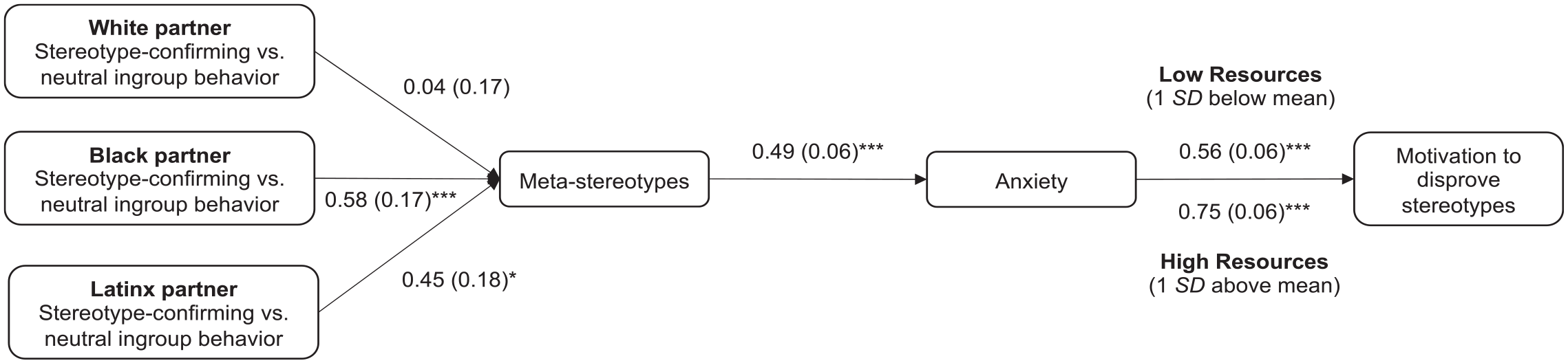
Moderated, moderated mediation model predicting motivation to disprove stereotypes: Study 2.
Avoidance, freezing, and antagonism
As in Study 1, we did not observe moderated, moderated mediation predicting avoidance (b = −0.01, SE = 0.01, 95% CI [−0.02, 0.01]), freezing (b = 0.01, SE = 0.01, 95% CI [−0.004, 0.02]), or antagonism (b = −0.001, SE = 0.004, 95% CI [−0.01, 0.01]). Again, we approached this by estimating trimmed models that included resources as a covariate instead of a moderator (Hayes, 2017). In these trimmed models, we again found evidence of mediation, moderated by partner race, for avoidance (b = 0.06, SE = 0.03, 95% CI [0.01, 0.13]), freezing (b = 0.24, SE = 0.10, 95% CI [0.06, 0.45]), and antagonism (b = 0.03, SE = 0.02, 95% CI [0.0002, 0.08]), such that indirect effects were significant during imagined interactions with a Black and Latinx, but not a White coworker (see Table 1). Specifically, when with a Black or Latinx coworker, participants expected greater metastereotypes following an ingroup member’s stereotypically negative (vs. neutral) behavior (Black partner: b = 0.48, SE = 0.16, p = .003; Latinx partner: b = 0.49, SE = 0.17, p = .004). Further, metastereotypes predicted greater anxiety (b = 0.41, SE = 0.06, p < .001), which predicted increased likelihood of avoidance (b = 0.13, SE = 0.04, p < .001), freezing (b = 0.71, SE = 0.04, p < .001), and antagonism (b = 0.10, SE = 0.04, p = .006).
Discussion
The results of Study 2 suggest that Whites’ anti-Black behavior in intergroup contexts may have farther reaching consequences for race relations than previously considered. Corroborating results of Study 1, we found that White Americans express greater concern that they will be seen stereotypically by a Black or Latinx (but not White) interaction partner when a nearby ingroup member makes a racist remark, despite the racist behavior being directed explicitly toward Black people. Providing additional support for stress and coping processes in interracial interactions (Taylor et al., 2021; Trawalter et al., 2009), an ingroup member’s stereotype-confirming (vs. neutral) behavior elicited heightened metastereotypes, which led to increased anxiety and greater use of various coping strategies to manage an imagined encounter with a Black or Latinx, but not White, person. Also corroborating Study 1, anxiety again predicted greater motivation to disprove stereotypes, particularly when available resources were high (vs. low). Thus, White Americans who witness a racial ingroup member confirm the racist stereotype are on high alert, resulting in a cascading chain of psychological experiences and behavioral intentions to cope with this stressful situation.
These findings provide preliminary support for the racial spillover hypothesis. It suggests that Whites are concerned that an ingroup member’s anti-Black sentiments bring the racist stereotype to the surface during interactions with other racial/ethnic minority group members, not just Black people. Study 3 extended this work to examine whether an ingroup member’s behavior might also impact anticipated interactions with a racial outgroup member positioned closer to White Americans on the U.S. social hierarchy, namely an Asian partner.
Study 3
Study 3 (preregistered) had two primary goals. First, to provide additional support for the stress and coping process among Whites in interracial interactions following a racial ingroup member’s stereotype-confirming behavior (replicating Studies 1 and 2). Second, to examine whether this process extends to interactions with Asian/Asian American individuals, a high-status racial/ethnic group in the US (Fiske et al., 2002; Zou & Cheryan, 2017), and again test the spillover and boundary hypotheses.
Like Black Americans, Asian/Asian Americans have experienced racist interpersonal interactions and systemic practices in the past and present (Cheryan & Monin, 2005; Holoien & Shelton, 2012; McMurtry et al., 2019). For example, though Asian/Asian American people are a culturally and ethnically diverse group who have distinct immigration histories (Gardner, 1992), they are negatively stereotyped by White perceivers (Kawai, 2005; Tran & Lee, 2014). Furthermore, they have been targeted by racist immigration policies (e.g., Immigration Act of 1924; Ngai, 1999), internment (e.g., Japanese Americans during WWII; Nagata et al., 2019), and most recently, racist rhetoric and physical violence during and following the height of the COVID-19 pandemic (Bresnahan et al., 2023; Chae et al., 2021) . Therefore, we might find evidence for the spillover hypothesis.
However, given differing racial stereotyping and racial positioning in the U.S. context, Whites’ responses to a racial ingroup member’s anti-Black behavior may be bound to interactions with other Black people, to the exclusion of Asian/Asian American people. For example, Asians are stereotyped as cold, foreign, and competent relative to Blacks, and have few, if any, overlapping negative stereotypes with Black people (Fiske et al., 2002; Zou & Cheryan, 2017). Moreover, Asian Americans are often cast as model minorities (Bresnahan et al., 2023; Cheryan & Bodenhausen, 2000) and are consistently rated higher in status than Black Americans (Dupree et al., 2021; Xu & Lee, 2013). Thus, the boundary hypothesis suggests that the stress and coping process will be significantly stronger during Whites’ interactions with a Black (vs. Asian) partner.
In Study 3, we adopted the same protocol as in Studies 1 and 2 but added an Asian partner race condition. Thus, we attempt to replicate the stress and coping process and again test the racial spillover and racial boundary hypotheses.
Method
Study 3 used a 2 (ingroup behavior: stereotype-confirming, neutral) × 3 (partner race: White, Black, Asian) between-subjects factorial design. Our desired analytic sample was 646 participants based on an a priori power analysis for a linear multiple regression testing the Ingroup Behavior × Partner Race interaction terms predicting metastereotypes with the following inputs: effect size f 2 = .02, five predictors, two tested predictors, 80% power. Of the 697 participants we recruited, 20 (2.87%) incorrectly recalled their coworker’s race and an additional two (0.30%) incorrectly recalled the observed behavior, leaving a final analytic sample of 675 participants. Participants all identified as White U.S. citizens, Mage = 41.92, SDage = 14.43, age range: 18–93; 337 men (49.93%), 338 women (50.07%).
The procedure in Study 3 was identical to that in Studies 1 and 2 with one exception: participants were randomly assigned to interact with a White, Black, or Asian partner prior to witnessing a racial ingroup member’s behavior (stereotype-confirming or neutral). All measures were identical to Studies 1 and 2 and were internally consistent: meta-stereotypes (α = .81), intergroup anxiety (α = .94), available resources (α = .93), and coping strategies (motivation to disprove stereotypes: α = .89; avoidance: α = .87; freezing: α = .90; antagonism: α = .88). Study 3’s preregistration and survey can be found on the Open Science Framework (OSF; https://osf.io/qus98/?view_only=1ae446bc9d3547ecb219f2158281e39f).
Results
Metastereotypes
First, we tested our hypothesis that participants would expect greater metastereotypes after witnessing an ingroup member’s stereotype-confirming (vs. neutral) behavior, and that this effect would be strongest in interracial (Black, Asian partner) relative to intraracial (White partner) interactions. However, inconsistent with Studies 1 and 2, a 2 (ingroup behavior) × 3 (partner race) between-subjects ANOVA revealed a nonsignificant interaction effect, F(2, 669) = 0.83, p = .436, ηp2 = .002 (see Figure 2C). However, there was a significant main effect of ingroup behavior, F(1, 669) = 42.49, p < .001, ηp2 = .06, such that participants expected more metastereotypes following an ingroup member’s stereotype-confirming behavior (M = 2.86, SD = 1.13) compared to neutral behavior (M = 2.34, SD = 0.95).
Predicting coping strategies via metastereotypes and anxiety
We followed the same analysis steps as in Studies 1 and 2 to test our hypothesized model (Figure 1).
Motivation to disprove stereotypes
In contrast to Studies 1 and 2, we did not observe a significant index of moderated, moderated mediation predicting motivation to disprove stereotypes, b = 0.001, SE = 0.002, 95% CI [−0.005, 0.01], as the effect of ingroup behavior on metastereotypes was not moderated by partner race, b = 0.03, SE = 0.10, p = .791. When removing partner race from the model, we found evidence of mediation, moderated by resources, b = 0.01, SE = 0.01, 95% CI [0.00, 0.03]. Therefore, we examined the indirect effect of ingroup behavior on motivation to disprove stereotypes at high (1 SD above mean = 6.49) and low (1 SD below mean = 3.73) levels of resources. See Figure 5 for path coefficients and Table 1 for indirect effects. When participants anticipated low resources to cope, ingroup behavior indirectly predicted motivation to disprove stereotypes such that metastereotypes were heightened following an ingroup member’s stereotype-confirming (vs. neutral) behavior, which predicted increased anxiety, which then predicted greater motivation to disprove stereotypes. Consistent with Studies 1 and 2, we found the same indirect effect among participants anticipating high resources to cope, but to a significantly greater extent (pairwise contrast of indirect effects at high vs. low resources: b = 0.03, SE = 0.02, 95% CI [0.0001, 0.07]).

Moderated mediation model predicting motivation to disprove stereotypes: Study 3.
Avoidance, freezing, and antagonism
As in Studies 1 and 2, we did not observe moderated, moderated mediation predicting avoidance (b = 0.00, SE = 0.001, 95% CI [−0.002, 0.002]), freezing (b = 0.0002, SE = 0.001, 95% CI [−0.002, 0.004]), or antagonism (b = −0.0003, SE = 0.001, 95% CI [−0.003, 0.003]). We also did not observe mediation moderated by partner race for avoidance (b = 0.003, SE = 0.01, 95% CI [−0.02, 0.02]), freezing (b = 0.01, SE = 0.03, 95% CI [−0.06, 0.08]), or antagonism (b = 0.002, SE = 0.01, 95% CI [−0.01, 0.02]). Therefore, we examined indirect effects of ingroup behavior on these coping strategies without moderation and controlling for resources. We found significant indirect effects of ingroup behavior on avoidance, freezing, and antagonism (see Table 1). Specifically, regardless of partner race, participants reported heightened metastereotypes following an ingroup member’s stereotype-confirming (vs. neutral) behavior (b = 0.53, SE = 0.08, p < .001), which predicted increased anxiety (b = 0.39, SE = 0.05, p < .001), followed by increased avoidance (b = 0.26, SE = 0.04, p < .001), freezing (b = 0.88, SE = 0.03, p < .001), and antagonism (b = 0.21, SE = 0.03, p < .001).
Discussion
In Study 3, we found that participants anticipated significantly more metastereotypes following an ingroup member’s stereotype-confirming (vs. neutral) behavior. However, unlike in Studies 1 and 2, this effect was not moderated by partner race, suggesting that stereotype-confirming ingroup behavior has the potential to exacerbate White people’s identity threat in interpersonal interactions generally, not just interracial interactions. Following the results of our previous studies, Study 3 also revealed that an ingroup member’s stereotype-confirming (vs. neutral) behavior indirectly predicts motivation to disprove stereotypes via increased metastereotypes and anxiety, and that these effects are stronger as anticipated resources increase. In contrast, stereotype-confirming (vs. neutral) ingroup behavior indirectly predicts avoidance, freezing, and antagonism via metastereotypes and anxiety, but this is not moderated by resources.
Although Study 3 results are in some ways consistent with the racial spillover hypothesis documented in Study 2, the stress and coping process extended to anticipated interactions with White, ingroup interaction partners as well. While unexpected, it is not wholly surprising given that we found evidence of the stress and coping process following an ingroup member’s stereotype-confirming behavior across studies among all interaction partners, though findings were significantly stronger during interracial (vs. intraracial) interactions in Studies 1 and 2.
These findings suggest that witnessing racism can also have important interpersonal consequences for White people’s intragroup relations (see also Schmader et al., 2012). For example, the timing of Study 3 (2022) compared to that of Studies 1 and 2 (2017 and 2018) might explain not only the consistency across partner race in Study 3, but also the lower levels of metastereotyping overall. Following the most recent incidents of racial violence against Black and Asian people before and during the COVID-19 pandemic, multiracial social justice protests included White allies (Anderson et al., 2020). The recent saliency of White people opposing racism and the intense scorn that being perceived as racist drew in this time period underscore the negative impact that witnessing an ingroup member’s racism might have on White individuals during intraracial interactions. It is therefore conceivable that participants were eager to contrast themselves from stereotypical ingroup members by reporting that members of racial outgroups would be less likely to assimilate them into the “Whites-as-racist” stereotype (see also Mendes et al., 2001). Thus, given public discourse, the Whites-as-racist stereotype may have been equally salient, though difficult to acknowledge, among participants in Study 3 as in Studies 1 and 2. It is conceivable, then, that imagining a White person’s anti-Black behavior in front of both racial outgroup and ingroup members initiates the stress and coping process among White witnesses. We revisit this idea in the general discussion.
General Discussion
White Americans are aware that others stereotype their group as racist. Thus, when White people witness another White person do or say something racist, it opens up the possibility that they may be seen as racist by association. In turn, the public nature of such a transgression can impact not only the self but also the dynamics of interracial interactions. Consistent with prior theorizing and empirical evidence using a stress and coping framework (Taylor et al., 2021; Trawalter et al., 2009), we find that an ingroup member’s stereotype-confirming behavior is particularly threatening during interracial interactions. First, we find support for our hypothesis that White people appraise an interaction as more threatening, as evidenced by heightened metastereotype concerns, when an ingroup member behaves in a stereotype-confirming (i.e., racist) versus neutral manner. Additionally, in Studies 1 and 2, we find the effect of ingroup behavior on threat is exacerbated during imagined interracial interactions with a Black or Latinx individual relative to a White individual.
Second, across all studies, we found that imagining an ingroup member’s racist (vs. neutral) behavior heightened metastereotypes (threat appraisal), which predicted increased anxiety (emotional stress appraisal), which in turn elicited more anticipated avoidance, antagonism, and freezing. Also consistent across studies, participants’ heightened anxiety in this context predicted more motivation to disprove stereotypes as their anticipated available resources increased. Consistent with the spillover hypothesis, these processes were significantly more pronounced when White people imagined interacting with a Black or Latinx (vs. White) partner in Studies 1 and 2, though outcomes did not vary by partner race in Study 3 (with a Black, Asian, or White partner). Thus, this work provides initial evidence that an ingroup member’s anti-Black racist behavior can “spill over” to impact Whites’ interracial interactions with racially minoritized outgroup members not targeted by the racist act. Though this general process was present across studies, unexpectedly, resources did not moderate the other coping strategies: avoidance, freezing, and antagonism. Perhaps the way resources were operationalized in these studies captured those that would be necessary for disproving stereotypes, but not the other actions. Moreover, though anxiety predicts the extent to which people desire to avoid, freeze, and antagonize, this anxiety may be so salient that regardless of resources, people can imagine engaging in these strategies to mitigate the threat. To investigate this issue, future research could measure resources in other ways, such as previous experience with interracial contact (Avery et al., 2009) or even physiologically (Blascovich & Mendes, 2000; Mendes et al., 2002).
Across studies, the stress and coping process among Whites was strongest following an ingroup member’s stereotype-confirming behavior during an interracial interaction. Nonetheless, given that the stress and coping process was evident regardless of partner race, an ingroup member’s racial transgression may universally increase White people’s concerns about being perceived as racist. Prior work finds that witnessing Whites’ racism increases self-reported and physiological assessments of anxiety and stress in inter- and intraracial contexts, in part because racists are very much disliked (Crandall et al., 2002; Schmader et al., 2012). Thus, we suspect that witnessing a racial ingroup member’s anti-Black behavior in front of ingroup and outgroup members can trigger broad (albeit different) self-presentational and impression management goals among White people who witness the transgression.
Theoretical Contributions
Our work extends existing theory and research in several ways. First, to our knowledge, we document for the first time White Americans’ metaperceptual, emotional, and anticipated behavioral outcomes following an ingroup member’s racist behavior during an ongoing interracial interaction. These findings build upon previous research demonstrating that White people experience greater metaperceptual concerns in interracial contexts when an ingroup member’s behavior is potentially race-relevant (Vorauer, 2003), and greater negative affect in intergroup interactions when an ingroup member’s behavior is explicitly racist (Schmader et al., 2012). Our findings clarify that White individuals’ responses to racial ingroup members’ racist behavior in interracial contexts identified in previous work occur, in part, because such behavior confirms the Whites-as-racist stereotype. Thus, in addition to discomfort due to violations of egalitarian norms caused by a racist ingroup member, we show that White people’s reactions are also driven by self-image and self-presentational concerns in interracial interactions (Johnson et al., 2009)—the possibility that their ingroup member’s racism will reflect poorly on themselves (cf. Schmader et al., 2015; Schmader & Lickel, 2006). Although there is initial evidence that an ingroup member’s racist, stereotypical behavior uniquely elicits these patterns beyond negative, nonstereotypical behavior (Taylor & Yantis, 2021), it will be important for future research to confirm this differentiation between White individuals’ responses to racist versus negative but nonstereotypical acts.
Additionally, the current work highlights that White people are racial actors: their race is consequential for their behavior and outcomes, as well as the outcomes of others (cf. Knowles & Marshburn, 2010; Knowles & Peng, 2005). White individuals’ various coping strategies (e.g., avoidance) have the potential to not only derail the immediate interracial interaction but also limit the quality and quantity of future interracial experiences. White people tend to have less experience with and opportunities for interracial contact (e.g., Hall et al., 2019; Mallett et al., 2016). Therefore, interracial contexts that include stereotypical ingroup members may make White people even less likely to engage in future interracial contact, limiting friendship-building opportunities and increasing stereotyping and prejudice. For minorities, White people’s responses may inadvertently limit access to important social networking opportunities necessary for advancement and success. Thus, considering what such responses might mean for intragroup relations as well as efforts to confront racism (e.g., Craig & Richeson, 2012) will be fruitful avenues for future work.
Limitations and Future Directions
The current research represents an important contribution to the study of intergroup relations, though there are several limitations. These limitations also provide several directions for future research.
First, it will be important to examine White people’s responses to stereotypical ingroup members in the context of live interracial interactions. In the current studies, White individuals reported (a) a desire to engage with their racially minoritized interaction partner to disprove negative stereotypes, (b) a desire to avoid their partner, (c) their likelihood of antagonizing their partner, and (d) their likelihood of freezing in the encounter. Live interracial interactions will clarify the prevalence and time course of these strategies. Studying live interracial interactions is also important because White people’s actual behavior may diverge from their anticipated behaviors. Indeed, people tend to experience and report more emotional distress when they imagine witnessing a White person make a racist comment than when they actually witness a White person make a racist comment (Karmali et al., 2017; Kawakami et al., 2009). However, these documented discrepancies between imagined and actual behavior were primarily directed toward the White racist transgressor and were confined to emotional responses, rather than directed toward an interaction partner including threat, stress, and coping responses. Thus, it will be important to test whether similar discrepancies occur regarding White people’s imagined and actual strategies for managing an ongoing interaction with a racial outgroup (vs. ingroup) acquaintance who also witnessed the racist act.
Future research should also explore the relationship between metastereotype concerns and anxiety, as well as additional emotional demands that may play a role in the stress and coping process. Our model positions metastereotypes as a predictor of anxiety, given past work demonstrating that concerns about being stereotyped as racist contribute to White individuals’ interracial interaction anxiety (e.g., Plant, 2004). However, it is also possible that anxiety predicts metastereotypes, or that metastereotypes and anxiety operate recursively. Moreover, anxiety is likely not the only emotional demand people experience in interracial interactions with stereotype-confirming ingroup members. Prior work has found that group-based anger, shame, and guilt in response to an ingroup transgressor’s actions can lead to avoidance of the situation, the transgressor, and the group (Schmader & Lickel, 2006). Thus, measuring anger, shame, and guilt in addition to anxiety may offer new insights into White people’s stress and coping experience following an ingroup member’s stereotype-confirming behavior. Adding these emotional responses may also clarify other mechanisms through which a stereotypical ingroup member’s behavior leads to various coping strategies during interracial relative to intraracial interactions.
Future research may also use other methods for assessing White people’s demand and resource appraisals during interracial interactions. Indeed, these appraisals may happen consciously or unconsciously and may shift as the situation unfolds (Blascovich & Mendes, 2000). Future study designs may thus supplement self-report measures with cardiovascular indices of demand and resource appraisals. These measures may better approximate participants’ level of threat (i.e., demands exceed resources) versus challenge (i.e., resources exceed demands) in the interaction (Blascovich & Mendes, 2000; Trawalter et al., 2009). Further, such indices could replicate and extend work by Schmader et al. (2012), who find consistency in self-reported and physiologically assessed emotional responses to witnessing racism in intergroup contexts.
Finally, there are several potential theoretically relevant moderators that can be examined to further clarify for whom stereotype-confirming behavior is the most impactful. For example, White individuals’ level of internal and external motivation to control prejudice (Plant & Devine, 1998) might impact the extent to which an ingroup member’s racist acts increase metastereotyping concerns, anxiety, and/or the coping strategies they employ to manage the interaction (cf. Schmader et al., 2015; Vorauer, 2003).
Concluding Remarks
When White Americans are engaged in an interracial interaction, their concerns about being perceived as racist are activated (Vorauer et al., 1998). In the current work, we demonstrate that a nearby ingroup member who confirms the Whites-as-racist stereotype exacerbates Whites’ metaperceptual concerns, particularly during interracial (vs. intraracial) interactions. Whites’ heightened evaluative concerns brought about by a racist ingroup member increase anxiety and direct their behavior, ultimately leading to a variety of nuanced coping strategies to protect the self from negative stereotyping and to salvage the interracial interaction. This research makes a novel contribution to the intergroup relations literature by examining how White people’s interracial interactions are necessarily influenced by the people around them. Specifically, White Americans’ racial group membership is consequential for their experiences and behaviors in interracial encounters, particularly when anti-Black racism surfaces.
Supplemental Material
sj-docx-1-gpi-10.1177_13684302241265260 – Supplemental material for “Will they assume I’m racist?” How racial ingroup members’ stereotypical behavior impacts White Americans’ interracial interaction experiences
Supplemental material, sj-docx-1-gpi-10.1177_13684302241265260 for “Will they assume I’m racist?” How racial ingroup members’ stereotypical behavior impacts White Americans’ interracial interaction experiences by Valerie Jones Taylor, Caitlyn Yantis and Juan V. Valladares in Group Processes & Intergroup Relations
Supplemental Material
sj-docx-2-gpi-10.1177_13684302241265260 – Supplemental material for “Will they assume I’m racist?” How racial ingroup members’ stereotypical behavior impacts White Americans’ interracial interaction experiences
Supplemental material, sj-docx-2-gpi-10.1177_13684302241265260 for “Will they assume I’m racist?” How racial ingroup members’ stereotypical behavior impacts White Americans’ interracial interaction experiences by Valerie Jones Taylor, Caitlyn Yantis and Juan V. Valladares in Group Processes & Intergroup Relations
Footnotes
Declaration of Conflicting Interests
The author(s) declared no potential conflicts of interest with respect to the research, authorship, and/or publication of this article.
Funding
The author(s) disclosed receipt of the following financial support for the research, authorship, and/or publication of this article: Portions of this research were supported by a National Science Foundation grant (BCS-1226930) awarded to Valerie Jones Taylor. The National Science Foundation had no involvement in this research.

Supplemental Material
Supplemental material for this article is available online.
Notes
References
Supplementary Material
Please find the following supplemental material available below.
For Open Access articles published under a Creative Commons License, all supplemental material carries the same license as the article it is associated with.
For non-Open Access articles published, all supplemental material carries a non-exclusive license, and permission requests for re-use of supplemental material or any part of supplemental material shall be sent directly to the copyright owner as specified in the copyright notice associated with the article.
