







Abstract
Recent research documents that thinking about God encourages intergroup prosociality among believers. An open question is whether such increased prosociality is dampened by intergroup conflict. We conducted preregistered field experiments with two ethno-religious populations in Fiji: indigenous Christian iTaukei (N = 324) and Hindu Indo-Fijians (N = 280). In each study, we manipulated (between-person) whether participants thought about intergroup conflict before completing a dictator game in which we manipulated (within-person) whether participants thought about God’s preferences when allocating real money to an outgroup member. Although participants who reflected on intergroup conflict gave less money away to outgroup members, thinking about God led to significant and comparable increases in intergroup prosociality regardless of whether participants thought about conflict. Results challenge widely-held assumptions about the role of religious belief in intergroup conflict and raise questions about mechanisms that are often theorized to explain the spread of religious beliefs themselves.
One need not be a historian to know that conflict often emerges between members of different religious groups. Perhaps for this reason, many influential thinkers often blame religion—and in particular, belief in God—as a source of intergroup conflict and propellant of violence (Armstrong, 2014; Dawkins, 2006; Harris, 2006; Huntington, 1993). While this thinking is certainly not universally held, and may itself be an artifact of Western biases, within the social scientific literature, theorists have even argued that religious belief may have become widespread throughout human history by conferring a selective advantage in intergroup conflicts by promoting a form of parochialism that allowed groups with strong religious beliefs to out-compete others in violent conquests (for a thorough review, see Norenzayan et al., 2016).
Despite much theorizing to this end, recent research suggests that belief in God may have a number of positive effects on intergroup relations, including increasing the perceived value of the life of members of ethno-religious outgroups and increasing generosity towards members of such outgroups (Ginges et al., 2016; Pasek et al., 2020, 2023; Smith et al., 2022). A natural question arising from this emerging body of work is whether such effects would hold when intergroup conflict is acute and salient. Even if belief in God tends to improve intergroup relations, this relationship might diminish or reverse in the face of intergroup threat.
We address this question with behavioral economic field experiments conducted with Christians and Hindus in Fiji. We focus on Fiji for four reasons. First, Fiji oscillates between periods of intense conflict between ethno-religious groups and periods of peace and stability, making it an ideal setting to manipulate conflict and threat salience in an externally valid way with direct relevance to people’s everyday lives. Second, conducting research in Fiji fulfills calls to expand social psychological research to populations that have historically been excluded by the field, such as people living in the Global South and people from diverse ethno-religious populations (Henrich et al., 2010a, 2010b; Rad et al., 2018), including indigenous peoples. Third, because Fiji is not just ethnically diverse, but also religiously diverse, this work expands research on religion, which has historically been limited to a narrow focus on Christianity (Anczyk & Grzymała-Moszczyńska, 2019). Fourth, because this research builds upon prior work conducted in Fiji (e.g., Pasek et al., 2023), the present research offers an opportunity to not only directly replicate earlier findings with the same populations, but to also expand theory by systematically testing for boundary conditions.
Results advance theory on the psychology of religion, intergroup conflict, prosociality, and their intersections by providing evidence among believers from different religious traditions that thinking about God promotes cross-group generosity even when conflict otherwise reduces intergroup prosociality.
Background
Most people around the world are theists (Zuckerman, 2007). Although conceptualizations of God differ across religious sects and traditions (e.g., some religions conceptualize God as a singular entity, whereas others conceptualize the existence of multiple gods), a defining feature of most world religions is a belief in omniscient, omnipotent, and omnipresent supernatural entities that police human moral behavior (Johnson, 2016; Lang et al., 2019; Norenzayan, 2013). The widespread nature of religious belief has led many scientists to ask why belief in God (or gods) became so ubiquitous (e.g., Boyer, 2008). On one hand, belief in supernatural entities appears to be facilitated by a suite of evolved cognitive biases such as hypersensitivity to agency detection, an overperception of purpose, and mind–body dualism (for review, see Mercier et al., 2018). However, nothing about these biases necessarily explains why humans tend to believe in moralizing (as opposed to nonmoralizing) deities, or why such beliefs are common now but were not in early societies (Roes & Raymond, 2003). Cultural evolutionary theory provides a complementary account for the widespread adoption of supernatural beliefs, suggesting that belief in God spread because it provided a selective advantage. Proponents of this theory suggest that moralizing supernatural entities allowed groups to prosper by promoting adherence to a set of moral norms that encouraged prosociality and cooperation among strangers, allowing groups to survive and grow (Norenzayan et al., 2016; Purzycki et al., 2016).
Aligned with the hypothesis that moralizing gods promote prosociality, a large body of research documents that thinking about God leads religious believers (but not nonbelievers) to be more generous to strangers (for a meta-analysis, see Shariff et al., 2016; see also Kelly et al., 2024). Notably, while there has been some debate about this effect, informed by null effects in studies using more subtle and implicit priming techniques (see Gomes & McCoullough, 2015; for a reply, see Sharrif & Norenzayan, 2015), there is consistent evidence that explicit primes asking people to think about God promote prosocial behavior (Billingsley et al., 2018). Thus, in this work, we focus our attention on such explicit primes.
While commitment to God is theorized—and has been demonstrated—to promote prosociality among coreligionists, dominant theories suggest that such religiously induced prosociality should be limited to within-group interactions. This hypothesis is informed by the idea that belief in moralizing gods promotes parochial social norms that aids groups in competition (e.g., Johnson & Bering, 2006; Roes & Raymond, 2003). As a result, groups with stronger moralizing god beliefs are hypothesized to have outcompeted groups with weaker moralizing god beliefs, allowing moralizing god beliefs to spread (Norenzayan et al., 2016).
This theory informs a parochial hypothesis, which argues that thinking about God should encourage prosociality within, but not across, group lines.
In contrast to this parochial hypothesis, recent research suggests that thinking about God promotes a set of universalizing moral norms that may facilitate, as opposed to impede, intergroup cooperation. For example, religious believers in the Middle East and Fiji believe that God prefers them to give greater value than they themselves do to the lives of outgroup members (Ginges et al., 2016; Pasek et al., 2020). Relatedly, believers in the United States (US) and Israel report believing that God discourages the dehumanization of outgroups, and thinking about God even reduces the extent to which believers themselves dehumanize members of different (a)religious groups (Smith et al., 2022).
More squarely challenging the parochial prosociality hypothesis, a large set of cross-cultural studies conducted with Christians, Hindus, Muslims, and Jews in Fiji, the US, and the Middle East provides evidence that such universalizing tendencies extend to financial sharing behavior (Pasek et al., 2023). In this work, religious believers completed a dictator game in which they were given the opportunity to allocate real money between themselves and either ingroup or outgroup strangers. They were then asked to think about God (and in some studies, what God would want them to do) before making a second set of allocations. While participants demonstrated ingroup bias, giving more money to ingroup members than to outgroup members, thinking about God increased their generosity to both religious ingroup and outgroup members. We note that these results are consistent with evidence from the US demonstrating that thinking about God (in contrast to thinking about religion more broadly) increases outgroup-focused prosociality and cooperation (Preston & Ritter, 2013); although work using more subtle priming methods yields mixed results (Lang et al., 2019). Collectively, emergent findings suggest that explicit primes to think about God can promote intergroup prosociality. In the current work, we investigated whether the salience of intergroup threat and conflict might moderate these findings.
Intergroup Conflict as a Potential Boundary Condition
One theorized possibility is that thinking about God may be more likely to promote parochialism when intergroup conflict and tension are salient. Why? When groups have relatively tolerant relations, intergroup cooperation should lead to benefits for all, and motivations for zero-sum thinking should be low (Davidai & Tepper, 2023). However, when intergroup tensions are high, groups may be better served by parochial tendencies that defend ingroup interests (Tajfel, 1982; Tajfel & Turner, 1979). This may be particularly true under conditions of intergroup threat and conflict (Stephan & Stephan, 2000), which might help to explain why conflict itself increases parochial prosociality (Bauer et al., 2014).
One influential line of thinking suggests that any prosocial tendencies encouraged by moralizing god beliefs might turn toxic in tense intergroup settings (Norenzayan et al., 2016). This perspective predicts that prosociality facilitated by god beliefs may be more or less parochial as a function of the nature of intergroup relations (Norenzayan et al., 2016). Specifically, as intergroup relations become more conflictual or threatening (regardless of the nature of this conflict or threat), God-induced prosociality would become more parochial in nature. Consistent with this hypothesis, war and conflict have been shown to promote greater religious participation (Henrich et al., 2019), as well as both belief in a more punitive God (Caluori et al., 2020) and prosociality that is more parochial (Bauer et al., 2014). To the extent that religious prosociality serves as a credibility-enhancing display (Henrich, 2009), and intergroup conflict and threat from an outgroup increase demands for ingroup cohesion and signals that demonstrate ingroup loyalty (Brewer, 1999; Lang et al., 2022), tension should also increase the extent to which religiously-induced prosociality is parochial (Atran & Henrich, 2010; Norenzayan & Shariff, 2008; Norenzayan et al., 2016; Sosis & Ruffle, 2003). Thus, prior research gives reason to believe that extended prosociality encouraged by thinking about God should be less likely to manifest when conflict with and threat from an outgroup are salient. We stress that this theory applies whether or not conflict is religious in nature (e.g., waged over religious beliefs vs. waged between groups who are divided along religious identity lines).
The above-discussed set of cross-cultural dictator game experiments (Pasek et al., 2023) began to address this question in two ways: by measuring individual differences in threat and conflict perceptions and by sampling participants from contexts with varying degrees of conflict. While Bayes factors provided evidence against moderation, we are unable to make strong conclusions due to a number of factors. First, nonsignificantly weaker effects in the Middle East (and a null effect among Israeli Jews, who perceived the highest levels of conflict and threat) leave open the possibility that conflict might still serve as a boundary condition. Second, while a key strength of this research was the selection of sites that varied in their nature of conflict, a limitation is that conflict levels were measured and not manipulated. In sum, despite the theoretical importance of the claim that levels of intergroup conflict should moderate extended prosociality effects encouraged by thinking about God, the literature published thus far does not allow us to conclusively evaluate the hypothesis. In this paper, we present research that attempted to directly test these ideas.
Present Research
We conducted two preregistered field studies with members of two ethno-religious groups in Fiji (indigenous Christian iTaukei and Hindu Indo-Fijians) to experimentally test whether making intergroup conflict and threat salient weakens (or even reverses) extended prosociality encouraged by thinking about God. Fiji is an ideal site to investigate these ideas because it oscillates between periods of peaceful intergroup relations and intense conflict. Understanding these dynamics requires attention to Fiji’s history (for one historical account, see Lal, 1992).
Fiji was colonized by the British, who missionized the indigenous iTaukei population. Today, almost all iTaukei identify as Christian (Fiji Bureau of Statistics, 2017), and Christianity plays a central role in iTaukei culture and life. In addition to colonizing and missionizing Fiji’s indigenous population, the British engaged in a campaign of forced migration, bringing large numbers of indentured servants from India to Fiji, largely to capitalize on Fiji’s sugarcane crop (D’Souza, 2000). In this way, both of these communities are victims of colonialism, and the conflict between them should be seen in such light. Naturally, interpretation of this conflict is contested, but, in general, we interpret that the essence of the clash is the value for iTaukei to protect indigenous rights damaged by colonialism versus the value for Indo-Fijians to obtain security and equal rights.
Since Fiji gained its independence in 1970, the country has experienced numerous violent military coups, beginning in 1987 with the election of a government with an Indo-Fijian prime minister (Lal, 2021). Each coup was orchestrated by Christian iTaukei leaders to prevent an Indo-Fijian from leading the country as prime minister. This violence led many Indo-Fijians to emigrate (Voigt-Graf, 2008). Today, Indo-Fijians make up about one-third, and iTaukei make up about two-thirds, of Fiji’s population (Fiji Bureau of Statistics, 2017). As Fiji is a small island country, Indo-Fijians and iTaukei regularly encounter one another and, despite periods of intense conflict, members of both groups often enjoy relatively tolerant and cooperative relations (Ramesh, 2008). Thus, for the purposes of our research, Fiji represents a religiously diverse context in which we can experimentally manipulate conflict salience in an externally valid way, while also testing for generalizability across faiths.
This research was conducted in June and July 2022 during a period of relative peace in Fiji. This allowed for a baseline in which conflict perceptions were unlikely to be especially salient. However, our research was also conducted shortly before what was widely anticipated to be a consequential and tightly-contested election. Given Fiji’s recent history of intergroup violence around elections, such timing also enabled us to manipulate conflict perceptions in a natural manner.
We hypothesized that, in the absence of an explicit prompt to think about intergroup tensions, thinking about God would lead Fijians to give more money to ethno-religious outgroup members. That is, we expected that we would replicate the extended prosociality effect observed in prior research (Pasek et al., 2023). We also hypothesized that increasing the salience of intergroup conflict would increase parochialism, such that Fijians asked to reflect on intergroup conflict and threat would give less money away to ethno-religious outgroup members than would Fijians who were not asked to do so. Critically, as is made clear in our preregistration, we were uncertain as to whether making intergroup conflict salient would moderate the prosocial effects of thinking about God, and if so, whether such moderation would manifest as an attenuation effect (i.e., a smaller increase in giving) or even a reversal (i.e., a decrease in giving). Given consistent effects among Christian iTaukei and Hindu Indo-Fijians observed in prior research, our hypotheses are also neutral with respect to ethno-religious groups.
We note that although both studies were preregistered together and conducted simultaneously, due to methodological differences between samples, we present results for each study independently before presenting preregistered analyses collapsing across studies. Study 1 was conducted with Christian iTaukei, and Study 2 was conducted with Hindu Indo-Fijians. The preregistration for this research can be found at the Open Science Framework (OSF; https://osf.io/b8apx/). Before presenting study-specific methods and results, we first overview our general approach to fieldwork, which applies to both studies.
General Approach to Fieldwork
Both studies were conducted as part of a larger field study carried out in June and July 2022. Permission to conduct this research was obtained from Fiji’s Ministry of Education, Heritage, and Arts, and from Fiji’s Ministry of iTaukei Affairs, which protects Fiji’s indigenous communities.
Prior to conducting field studies, we recruited two teams of research assistants—one team of nine 1 Christian iTaukei and one team of five Hindu Indo-Fijians—with whom we conducted extensive focus groups to finalize study designs and materials that were culturally appropriate and tailored to each group. We also note that two of these research assistants, one Christian iTaukei and one Indo-Fijian, are coauthors of this manuscript. These focus groups involved broad discussions of Fiji’s history and current social and political context, as well as detailed discussions on specific measures and materials to ensure that our measures were clear and relevant to the local context. Focus groups for each ethno-religious population were conducted in separate locations so that each group of research assistants felt comfortable speaking openly about sensitive topics. These focus groups were also conducted at the same time. This ensured that the perspective of one group would not be prioritized over the other. During this process, team members leading different focus groups took part in daily discussions to ensure that perspectives from one group could be introduced to the second group where appropriate.
Most central to this research, focus group discussions with our research partners from each group centered on what members of their respective communities thought of Fiji’s history of intergroup conflict, politics, and present-day tensions. These conversations revealed that, despite relatively tolerant everyday relations, both iTaukei and Indo-Fijians perceived a great deal of threat from each other, which, when activated, might amplify intergroup biases. These discussions gave shape to our interest in manipulating the salience of intergroup conflict. Together with local researchers, we used these discussions to inform contextually-specific intergroup-threat manipulations for each community, which we describe in more depth below.
All study materials were translated by research assistants and checked for consistency. Materials for Christian iTaukei (Study 1) were translated into Bau, a national dialect of Fijian. Materials for Hindu Indo-Fijians (Study 2) were translated into Fiji-Hindi, a local dialect of Hindi. Informed by prior research (Pasek et al., 2020, 2023), we used contextually-adapted sampling strategies for each community. We review these strategies in depth in study-by-study Method sections below.
Interviews were conducted by our research assistants with members of their own ethno-religious groups. All interviewers received in-depth multiday training, during which they not only practiced administering questions and recording answers on mobile tablets, but were also trained in how to ensure that they always allowed participants to answer questions without undue influence from the researchers, interviewers, or others, including family and community members. We note that, except for very rare cases where technical assistance was needed to troubleshoot malfunctioning mobile tablets used in interviews, non-Fijian members of our research team did not directly participate in the interview process. This helped to avoid external pressure that might have influenced participants’ responses.
Before starting any interview, our research assistants asked potential participants to find a quiet and private space. This ensured that their answers were not overheard or influenced by others within their household or community. It also ensured our ability to conduct multiple interviews in a single household, either simultaneously (with different research assistants conducting interviews with different individuals) or sequentially (e.g., first interviewing one household member and then trading places to interview a second). In rare cases where the participant was a caretaker and could not leave someone within their care unattended, interviewers were instructed to allow for the presence of another. These cases tended to involve children. Research assistants read a thorough explanation of our research, its sponsors, and broad purpose, and were asked to obtain verbal consent from the participants. Participants were assured that their answers would remain confidential to reduce concerns that community leaders might monitor their answers. Research assistants assigned each participant a unique identifier, which was recorded three places: a physical notebook, a Qualtrics offline survey administered via a tablet, and physical envelopes used to administer the behavioral economic experiments reported in this paper. At the conclusion of the interview, participants were compensated for their time. They were also asked not to discuss questions or tasks from the interview with others.
Study 1
Method
Participants and recruitment
We collected data from 324 Christian iTaukei (Mage = 44.58, SDage = 16.84; 47% male, 53% female). To identify and recruit Christian iTaukei participants, we partnered with the Nadroga-Navosa Provincial Council, a local branch of the Ministry of iTaukei Affairs, which coordinates outreach to iTaukei villages. We worked with the provincial council to identify some villages that were larger and closer to the coast, economic hubs, and Indo-Fijian communities, as well as others that were more remote and inland. The provincial council arranged for our team to meet with village chiefs (Toroga ni Koros) and other village leaders in each community to engage in a traditional Sevu Sevu ceremony, during which we explained the reason for our visit and received community-level permission to conduct interviews with village members. In accordance with local customs, village chiefs informed community members about our presence. We acknowledge that pressure from village chiefs may have influenced individuals’ desire to participate in our research, although we assured all prospective participants that the choice to participate or not in our research was theirs to make. Village chiefs were not informed about whether community members opted to participate.
Conflict and tension manipulation
Participants were randomly assigned to one of two between-subjects conditions. In the control condition, participants immediately participated in a dictator game after providing consent. In the experimental condition, research assistants began the interview by reading a brief preamble intended to make intergroup conflict and threat salient. Importantly, so as not to fuel intergroup conflict ourselves, we relied on focus group discussions to identify threat perceptions and points of intergroup tension that were widely held by members of the iTaukei community. Based on these discussions, we settled on a manipulation emphasizing iTaukei’s fears about what Indo-Fijians would do to iTaukei land.
In Fiji, while the literal translation for land is “vanua,” the cultural significance of vanua extends well beyond Western conceptualizations. Land in Fiji is seen as the binding force that connects iTaukei to each other, to a shared culture and set of values, and to ancestors. For this reason, land is not only a core part of iTaukei’s ancestral religion, but even plays a central role in Fijian Christian theology (Bush, 2000). Indeed, our focus groups made clear that land was more than a resource for iTaukei—rather, it was thought of in sacred terms.
Because of Fiji’s colonial history—and abuse to Fijian land as a result—iTaukei are highly protective of land rights. Today in Fiji, there are different classifications of land, and much of the land is legally reserved for exclusive ownership by iTaukei. This native land is contrasted with much scarcer free-hold land that Indo-Fijians are allowed to own. Protection of land is viewed as essential to preserve iTaukei peoplehood and culture. As such, many iTaukei worry that Indo-Fijians want to gain power and take over land. Indeed, land rights are often considered the paramount issue in Fiji, and fears about losing iTaukei control over the land have played a central role in motivating large-scale violence and multiple coups d’état (Kurer, 2001). Thus, for iTaukei, reflecting on land rights is equivalent to reflecting on an extreme form of intergroup conflict that affects the very core definition of their culture. Informed by this fear, our preamble for iTaukei participants, which was codrafted by iTaukei research assistants, read: As you know, there has been a lot of conflict in Fiji. Many iTaukei worry that Indo-Fijians want to control native land and take over the Fijian government. Recent changes in the law, like Bill 17, make it easier for Indo-Fijians to build on native land. As we know, the iTaukei land has eyes and ears but many Indo-Fijians want to make all iTaukei land freehold. I want you to take a minute to think about an Indo-Fijian who wants this and what they would do with iTaukei land if given the chance to determine Fiji’s future.
After being read their respective preambles and being given a brief amount of time to think, participants in the experimental condition then proceeded to participate in the dictator game.
Dictator game and god manipulation
The behavioral economics experiment reported here was conducted at the start of the interview, immediately following our conflict manipulation. First, participants were asked to divide money between two strangers who were either ingroup or outgroup members. This task was conducted for a related but separate study investigating how self- versus other-focused frames affect parochialism. Immediately following this task, we asked participants to partake in a dictator game in which they were provided $5.00 Fijian dollars (equivalent to about US$2.50). Participants were told that they could keep as much of the money as they wanted, or that they could give away as much of the money as they wanted to another person. This other person was always a Hindu Indo-Fijian living somewhere else in Fiji.
To ensure that participants could make their choice without undue influence from our research assistants, our research assistants provided participants with a large envelope (which contained the money) and two smaller envelopes. One of the smaller envelopes was labeled “mine.” The other was labeled “give to a Hindu Indo-Fijian” (translated into Bau). Our research assistants asked participants to divide the money as they saw fit, to keep the envelope (and money they put into it) labeled “mine,” and to return the envelope marked for someone else to the larger envelope. Research assistants walked away as participants allocated money. All money allocated in this dictator game was real. Allocations were distributed to real individuals at the conclusion of the study.
God manipulation
Participants completed this dictator game twice. The first time, they were instructed to allocate the money “however you would like to.” The second time, they were told that they were paired with different recipients (who, again, were always outgroup members). This time, participants were asked to “think about God and God’s preferences when you make your decision.” This within-subject god manipulation mirrors that used in prior research (Ginges et al., 2016; Pasek et al., 2020, 2023; Smith et al., 2022). We chose to have participants think about God’s preferences when making their decision, as opposed to merely thinking about God, because prior work shows that, even though both instructions yield significant increases in cross-group prosociality, thinking about God’s preferences yields stronger effects (Pasek et al., 2023). We suspect this is because the instruction is more tailored to the context of a dictator game, whereas thinking about God more broadly might influence other psychological constructs, such as inducing awe. We note that prior work has also established that effects of this type of within-person god manipulation are robust to order effects (Smith et al., 2022). Thus, to avoid carryover effects that would dilute the ability for our baseline condition to serve as a valid control, we did not manipulate the order of within-person conditions.
Dependent variable
We divided the sum of money that participants chose to give away in each round by the total stakes for each round, and then multiplied this percentage score by 100. For example, if a participant gave away four coins (and kept four coins), they received a score of 50. In rare cases, we discovered that participants neither gave away nor kept a coin (i.e., there was a coin lodged in the corner of the envelope that they may not have seen). In these cases, we adjusted the denominator accordingly. Because participants completed two rounds, they received two scores, one for their baseline giving, and one for their giving after being asked to think about God.
Additional measures
After completing the dictator game, participants continued to answer questions as part of a longer interview. These measures included participants’ age, sex (male, female [no nonbinary option was included due to cultural norms]), ethnicity, whether they believed in God (yes, no), and a measure asking participants how important God was in their life (1 = not at all important, 5 = extremely important). All participants reported believing in God and believed that God was important in their lives (MiTaukei = 4.96, SDiTaukei = 0.33).
Results
We tested our hypotheses using a multilevel model in which we regressed the percentage of money given to outgroup members on the conflict framing, the god manipulation, and their cross-level interaction. The intraclass correlation (ICC) for the two decisions within individuals (before and after thinking about God) was .58, indicating that a significant proportion of variability was attributable to individual differences, thus justifying the use of multilevel models (Hox, 1998). We attempted to fit random slopes for the god manipulation, but doing so resulted in a singular fit, suggesting that our model was too complex for our data. Thus, we included random intercepts only, following recommendations from Bates, Kliegl, et al. (2015). All analyses were conducted using the packages “lme4” (Bates, Mächler, et al., 2015) and “lmerTest” (Kuznetsova et al., 2017) in R (R Core Team, 2023), using the Satterthwaite method for estimating degrees of freedom. Results are shown in Figure 1 and Table 1. The results presented below correspond to model-predicted values.
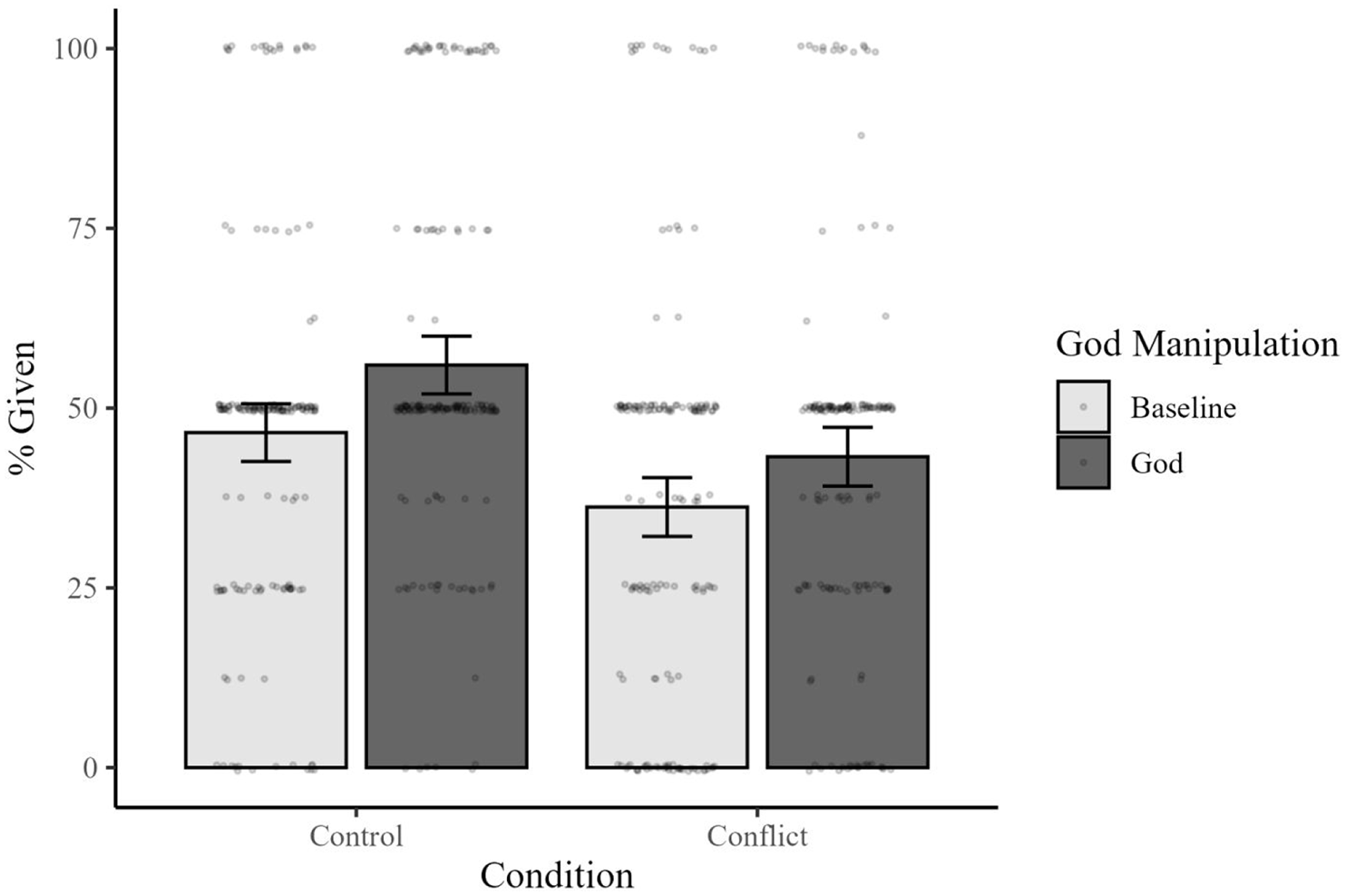
Estimated marginal means and 95% CIs: Study 1.
Results from multilevel models.
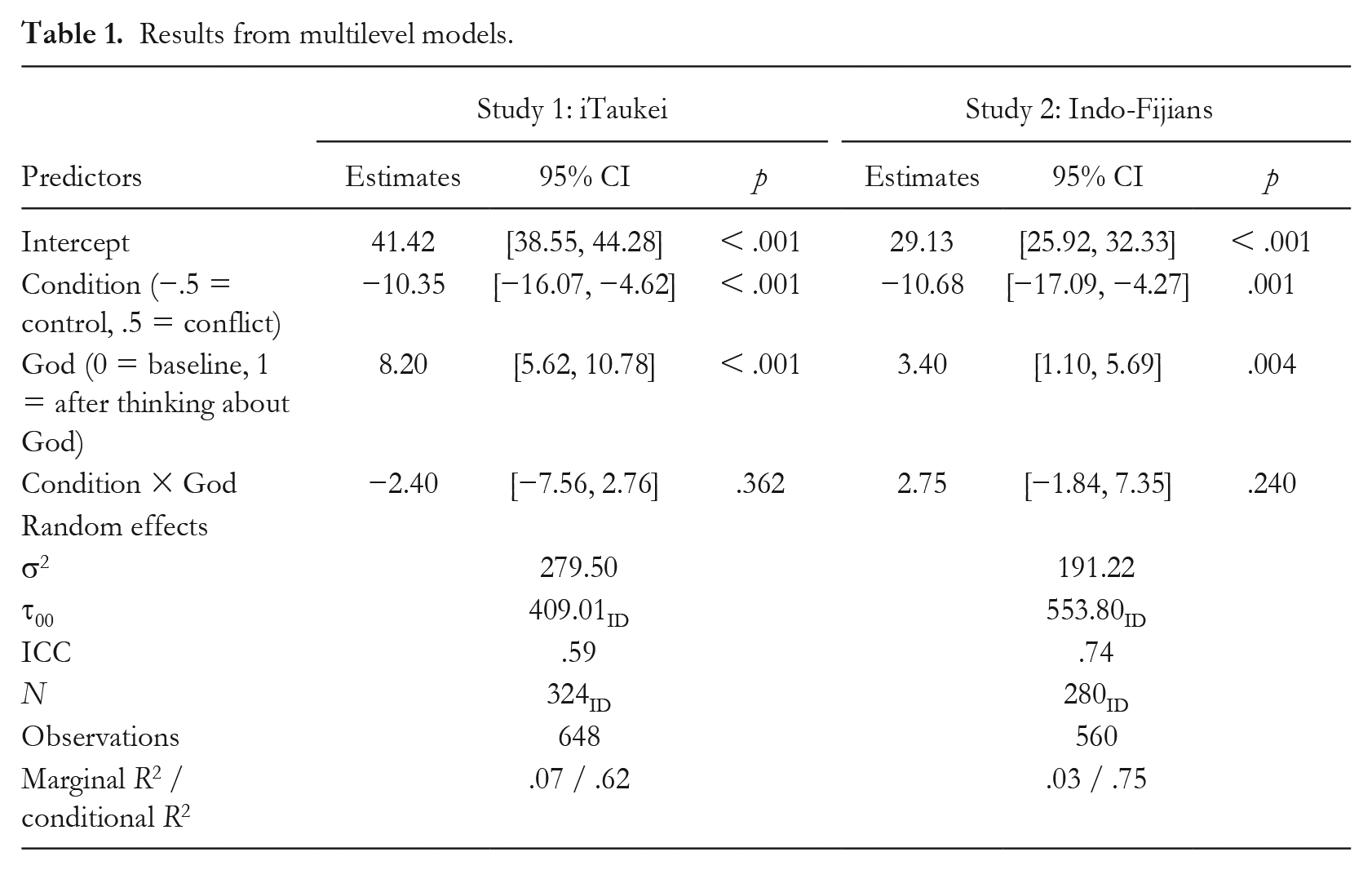
As the key contribution of this research is testing whether making intergroup tension salient serves as a boundary condition, we first sought to test whether our conflict manipulation had its intended effect of reducing cross-group prosociality at baseline. As hypothesized, participants who thought about conflict gave significantly less money (~10% of the total stake) to outgroup members than did those in the control condition, b = −10.35, 95% CI [−16.06, −4.04], t(476.02) = −3.55, p < .001. This serves as a behavioral manipulation check, providing confidence that we successfully increased intergroup tension.
We next sought to ascertain whether, in our control condition, we successfully replicated prior research showing that thinking about God increases generosity to outgroup members (Pasek et al., 2023). As hypothesized, participants in the control condition gave ~9% more money to outgroup members (relative to the total stakes) after thinking about God (compared to baseline), b = 9.39, 95% CI [5.79, 13.00], t(322) = 5.10, p < .001.
After establishing that our manipulations were successful, we sought to test our core question, which is whether increases in intergroup prosociality are moderated by the salience of intergroup tension. Notably, there was no significant interaction between the god manipulation and the conflict framing, b = −2.40, 95% CI [−7.55, 2.75], t(322) = −0.91, p = .362. That is, even though increasing the salience of intergroup tension reduced overall giving, the increase in giving induced by thinking about God remained robust in the conflict condition, b = 7.00, 95% CI [3.32, 10.67], t(322) = 3.73, p < .001.
Discussion
Consistent with prior research, we found that Christian iTaukei were more prosocial to Hindu Indo-Fijians after thinking about God and God’s preferences. Although reflecting on intergroup tension relating to contestation over land—a central aspect of Fiji’s ethno-religious conflict with core cultural and religious significance to iTaukei—reduced cross-group prosociality, even those iTaukei who actively reflected on intergroup tension were more prosocial to Hindu Indo-Fijians after thinking about God (compared to before). Thus, results suggest that intergroup conflict does not serve as a boundary condition as prior research had suggested it should (Norenzayan et al., 2016).
While land has many religious connotations for, and is of the utmost importance to, iTaukei, one reading of our manipulation may be that it skirted more direct forms of religious conflict, such as direct conflict over religious beliefs. Although our core theoretical test does not necessitate manipulating explicitly religious forms of intergroup tension, it is nonetheless an interesting theoretical question whether thinking about God’s preferences might be less likely to encourage cross-group prosociality when more explicit religious forms of tension are salient. It is possible that direct threats to religion might be more likely to dampen religiously induced intergroup prosociality. In Study 2, the conflict manipulation dealt with a specifically religious threat.
Study 2
While land rights represent a critical issue for both Christian iTaukei and Hindu Indo-Fijians, for the latter, land represents more of a material, as opposed to sacred, good. For Hindu Indo-Fijians, who are an ethno-religious minority in Fiji, intergroup conflict often takes more explicitly religious forms. For example, one major fear that was shared with our research team during focus group discussions concerns the right for Indo-Fijians to freely practice their religion without the threat of forced proselytization. Fueling this fear, there have been many cases of religiously motivated hate crimes, such as vandalism and desecration of Hindu temples in Fiji, leading to widespread insecurity (e.g., Vikram, 2017). Thus, in Study 2, which we conducted with Hindu Indo-Fijians, we were able to test whether thinking about God and God’s preferences would similarly increase Fijian Hindu’s cross-group prosociality even when a prompt to think about intergroup conflict referenced explicit religious threat.
Method
Participants and recruitment
We collected data from 280 Hindu Indo-Fijians (Mage = 47.11, SDage = 15.90; 43% male, 57% female). To identify and recruit Hindu Indo-Fijian participants, we partnered directly with our Hindu Indo-Fijian research assistants to select communities that, like our selection for iTaukei villages, varied along several dimensions, including community size, proximity to economic hubs (vs. more rural, inland communities), and degree of interaction with iTaukei communities. Indo-Fijian research assistants identified Hindu houses and businesses based on common markings, including red flags and shrines, as well as by word of mouth (e.g., through neighbors). Hindu participants were asked to confirm their religion before our research assistants commenced the consent process.
Conflict and tension manipulation
As in Study 1, participants were randomly assigned either to a control condition or to an experimental condition in which research assistants began the interview by reading a brief preamble intended to make intergroup conflict and threat salient. Because Indo-Fijians experience intergroup conflict differently from iTaukei, we relied on focus groups to appropriately target the prevailing feelings held by members of the Indo-Fijian community.
Our preamble for Indo-Fijian participants was informed by a broad set of fears concerning their felt status as second-class citizens (fueled in large part by prohibitions on their right to own native land), their exclusion from the national Fijian identity (which many reserve only for Christian iTaukei), fears about being robbed or vandalization, and, as described above, forced proselytization. Specifically, our preamble for Indo-Fijian participants read: As you know, there has been a lot of conflict in Fiji. Many Indo-Fijians feel like second-class citizens and believe that the typical iTaukei does not view Indo Fijians as truly being Fijian. Many Indians fear that they will be robbed or attacked, that iTaukei want to make it harder for Indo-Fijians to own and rent land, and that iTaukei want to force everyone to follow Christianity. I want you to take a minute to think about an iTaukei who wants these things and what they would do to Indo-Fijian rights if given the chance to determine Fiji’s future.
Dictator game and god manipulation
We followed the same dictator game procedures and implemented the same within-person god manipulation as described in Study 1, with three exceptions. First, Indo-Fijian participants were paired with Christian iTaukei recipients (who were also described as living somewhere else in Fiji). Thus, in addition to the envelope marked “mine,” the second envelope was marked “give to a Christian iTaukei” (translated into Fiji-Hindi). Second, consistent with prior research, we replaced the word “God” with “Baghavan,” which Fijian Hindus believe to be a singular supernatural entity from which other gods are derived (see also Pasek et al., 2020, 2023). The dependent variable was calculated just as in Study 1. Also as in Study 1, the money in this task was real, and all allocations were made at the conclusion of the study.
Additional measures
Just as in Study 1, after completing the dictator game, participants continued to answer the same questions as part of a longer interview. Almost all participants reported believing in God (99% of Indo-Fijians) and believed that God was important in their lives (MIndo-Fijian = 4.71, SDIndo-Fijian = 0.74).
Results
As in Study 1, we tested our hypotheses using a multilevel model in which we regressed the percentage of money given to outgroup members on the conflict framing, the god manipulation, and their cross-level interaction. The ICC for the two decisions within individuals (before and after thinking about God) was .74, indicating that a significant proportion of variability was attributable to individual differences, thus justifying the use of multilevel models (Hox, 1998). Unlike in Study 1, we were able to successfully fit random slopes for the god manipulation; however, the 50:50 mixture chi-squared test was not significant, 50:50χ2(0, 1) = 0.02, p = .441, indicating that there was no significant variation across individuals in the effect of thinking about God. Thus, we simplified our model by removing random slopes. Results are shown in Table 1 and Figure 2.
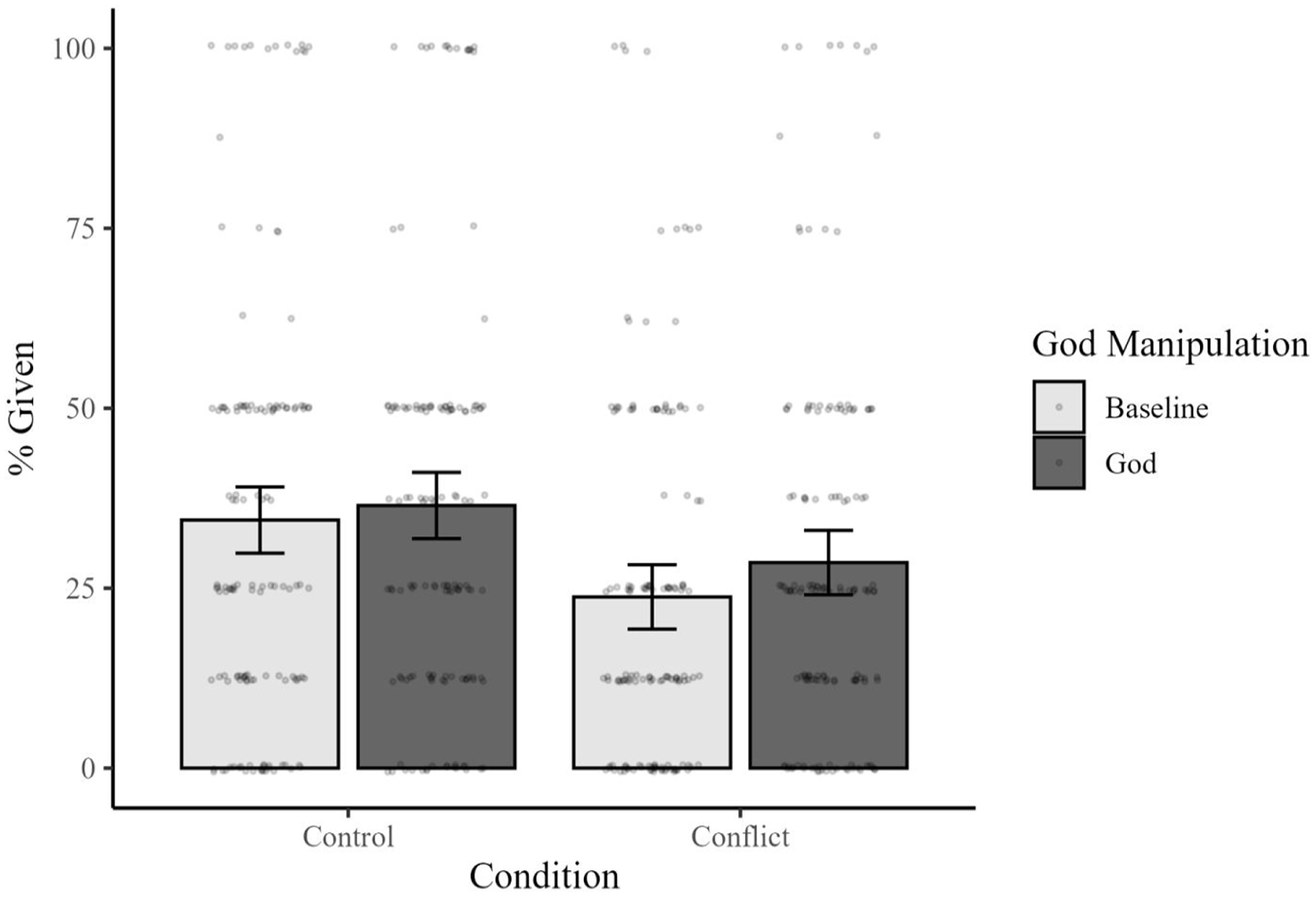
Estimated marginal means and 95% CIs: Study 2.
As in Study 1, participants who thought about conflict gave significantly less money (~11% of the total stake) to outgroup members than did those in the control condition, b = −10.68, 95% CI [−17.07, −4.29], t(358.12) = −3.27, p = .001. Collapsed across conditions, participants gave just over 3% more money to outgroup members (relative to the total stakes) after thinking about God (compared to baseline), b = 3.40, 95% CI [1.11, 5.69], t(278) = 2.91, p = .004. This increase in giving was not significantly moderated by whether participants were in the conflict or the control condition, b = 2.75, 95% CI [−1.83, 7.33], t(278) = 1.18, p = .240. Although this moderation was not significant, simple effects show that the effect of thinking about God trended to be stronger in the conflict condition, b = 4.77, 95% CI [1.58, 7.97], t(278) = 2.93, p = .004. By contrast, the effect of thinking about God trended to (but did not significantly) increase giving in the control condition, b = 2.02, 95% CI [−1.26, 5.31], t(278) = 1.21, p = .229.
Discussion
With a sample of Hindu Indo-Fijians, and using a different conflict manipulation, we replicated the core effects of Study 1. Hindu Indo-Fijians were less prosocial to outgroup members (in this case, Christian iTaukei) when they thought about intergroup conflict, but even so, those who reflected on intergroup conflict were more prosocial to outgroup members after (vs. before) thinking about God and God’s preferences. This is notable because in Study 2, our conflict manipulation included references not only to extreme forms of conflict, such as physical attack, but also an explicit form of religious conflict: forced proselytization. This provides further evidence that thinking about intergroup (and even interreligious) conflict does not dampen the effect of thinking about God found in prior work. Somewhat perplexingly, Hindu Indo-Fijians in the control condition in this study did not give significantly more money to Christian iTaukei after being asked to think about God. However, they still trended in this direction, and our observed increase in giving was not so dissimilar from some increases found in prior work (Pasek et al., 2023).
Integrated Analyses
In addition to analyzing results separately by study, we conducted an integrated analysis in accordance with our preregistered analytic plan. One benefit of doing so is that, by pooling responses across samples, we gain additional statistical power to detect whether conflict salience moderates the effect of thinking about God and God’s preferences on intergroup prosociality (Brysbaert, 2019). To conduct this analysis, we merged data from both studies together and followed the same multilevel modeling approach. In this combined analysis, the ICC for the two decisions within individuals (before and after thinking about God) was .68, indicating that a significant proportion of variability was attributable to individual differences. Random slopes for the god manipulation were considered; however, the 50:50 mixture chi-squared test was not significant, 50:50χ2(0, 1) = 0.01, p = .455, indicating that there was no significant variation across individuals in the effect of thinking about God.
Collapsed across studies, participants who thought about conflict gave significantly less money (~11% of the total stakes) to outgroup members than did those in the control condition, b = −10.79, 95% CI [−15.21, −6.37], t(818.97) = −4.78, p < .001. Participants in the control condition gave 6% more money to outgroup members (relative to the total stakes) after thinking about God (compared to baseline), b = 6.06, 95% CI [3.58, 8.55], t(602) = 4.79, p < .001. There was no significant interaction between the god manipulation and the conflict framing, b = −0.13, 95% CI [−3.63, 3.38], t(602) = −0.07, p = .945. That is, despite the fact that increasing the salience of intergroup tension reduced overall giving, the increase in giving induced by thinking about God remained robust in the conflict condition, b = 5.94, 95% CI [3.47, 8.41], t(602) = 4.71, p < .001.
General Discussion
We conducted preregistered field studies with Christian iTaukei as well as Hindu Indo-Fijians in Fiji—a setting that oscillates between periods of intergroup tolerance and conflict—to experimentally test whether the salience of intergroup conflict moderates extended prosociality induced by thinking about God. As hypothesized, making intergroup conflict salient significantly reduced intergroup prosociality. However, thinking about God led to comparable increases in cross-group prosociality in the control condition and when conflict was made salient. These effects replicated across different ethno-religious samples, using sample-specific conflict manipulations, and with different underlying religious beliefs.
Our findings build upon a growing body of research documenting how religious cognition, and thinking about God more specifically, can increase intergroup prosociality (e.g., Ginges et al., 2016; Pasek et al., 2020, 2023; Preston & Ritter, 2013; Smith et al., 2022). In contrast to research employing subtle priming techniques that has shown mixed results (e.g., Lang et al., 2019), we replicated the finding that explicit prompts to think about God’s preferences increase intergroup generosity, using two new samples of populations previously studied. Perhaps more importantly, while we found that experimentally increasing the salience of intergroup threat increased ingroup bias—as would be expected in line with social identity theory (Tajfel, 1982; Tajfel & Turner, 1979) and integrated threat theory (Stephan & Stephan, 2000)—it did not moderate the positive effect of thinking about God on intergroup generosity. Whereas Pasek et al. (2023) tested whether measured intergroup threat and conflict perceptions moderated effects of thinking about God on intergroup prosociality, here, we experimentally manipulated such perceptions, providing strong evidence that such perceptions do not reliably weaken or undo extended prosociality effects induced by thinking about God.
This research raises important questions for dominant theories about the role of religion in intergroup relations and the cultural evolution of religious belief. Significant theorizing suggests that belief in moralizing gods should promote parochialism, that such parochialism should be especially likely when intergroup tension and conflict is high, and that the ability for moralizing god beliefs to promote such parochialism likely conferred competitive advantages in intergroup conflict, allowing these beliefs to spread (e.g., Johnson & Bering, 2006; Norenzayan, 2013; Norenzayan et al., 2016; Roes & Raymond, 2003). Yet, we found no evidence that prosociality induced by thinking about God necessarily turns toxic under conditions of intergroup tension. To the extent that thinking about God can encourage more tolerant intergroup relations, as has been found in other recent studies (Ginges et al., 2016; Pasek et al., 2020, 2023; Preston & Ritter, 2013; Shackleford et al., 2024; Smith et al., 2022), it behooves scholars interested in the spread of moralizing god beliefs to consider whether such beliefs might have spread because they encouraged moral reasoning that could facilitate trade, migration, and the spread of ideas between populations (Pisor & Surbeck, 2019; Sahlins, 1972; Stark, 1996). Of course, the present research cannot provide direct evidence for such a cultural evolutionary account. It is also possible that the influence of religious beliefs on intergroup relations has shifted over time in response to changing social dynamics and needs. That is, the nature of religious beliefs and the extent to which they encourage parochialism or universalism may not be fixed, meaning that studying the contemporary influence of thinking about God may give limited insights into how such beliefs might have influenced intergroup relations centuries and millennia ago.
We acknowledge that the influence of thinking about God on interreligious relations may depend not only on the presence of intergroup conflict, but whether such conflict is theological in nature. Our research provides initial evidence that thinking about God can promote intergroup prosociality even when explicit forms of religious conflict are salient. However, we believe that it would be fruitful for future researchers interested in expanding our research to more directly manipulate the nature of religious conflict, such as by inducing threats to belief systems and practices. This may be particularly important in contexts where the primary drivers of interreligious conflict are based on theological disagreement, which is not the case in Fiji.
We highlight several important strengths of this research stemming from the fact that it was conducted in Fiji. First, we purposefully chose to conduct this research in Fiji because the country oscillates between periods of tension and tolerance, meaning that we could experimentally induce perceptions of real tension while also ensuring that tension was not so salient in our control condition to lead to ceiling effects. Second, this research fulfills important calls to expand the scope of psychological science to the Global South and beyond so-called WEIRD (Western, educated, industrialized, rich, and democratic) settings (Henrich et al., 2010a, 2010b; Rad et al., 2018). Third, conducting this research in Fiji allowed us to sample members of two different religious traditions, with followers of a monotheistic Abrahamic faith (Christians) as well as Hindus. In doing so, we were able to make more generalizable claims about religious belief than would be possible if we had conducted research with groups that shared more religious commonality. Thus, this research also fulfills calls to expand the study of religion to better represent global religious diversity (Anczyk & Grzymała-Moszczyńska, 2019), as religious beliefs vary widely across the globe.
Beyond the location of our research, we also note a key strength of our research process, which involved collaboration between researchers from the Global North and members of both ethno-religious groups that were sampled. This had practical, ethical, and theoretical advantages. At a practical level, it meant that we were able to codevelop research questions and materials in a culturally sensitive way, and that we were able to let members of the communities we were interested in studying lead interviews with members of their own communities in their own native languages. At an ethical level, this partnership guarded against the imposition of outside ideas and customs on local populations, ensuring that we were sensitive not only to the needs of the populations we studied but also their desires. And at a theoretical level, this partnership allowed us to develop materials that spoke to the lived experiences and beliefs of Fijians, making for more nuanced and ecologically valid manipulations and measures than would have been possible had all materials been predeveloped by outside researchers. Critically, feedback on this manuscript has also been given by Fijian authors to ensure that our representation of the research process is accurate.
We also highlight several possible limitations of our research. The first stems from methodological variation in the nature of our experimental manipulation. We aimed to tap into the psychology of both groups when developing our intergroup conflict manipulation. In so doing, we not only wanted to capture the ways that iTaukei and Indo-Fijians thought about conflict and intergroup threats, but also to find an ethical way to increase this salience without causing greater harm to intergroup relations in an already fragile context. As such, we relied on our local team members to guide us and opted for externally valid manipulations over consistency between manipulations for both groups. This created the potential that the manipulation might not have consistent effects across our two populations. Nevertheless, we found that participants in the conflict condition gave less money to outgroup members, and this effect was consistent across ethno-religious groups. Relatedly, there were other differences in methodology that might have influenced results. For example, Christian iTaukei were recruited via community leaders, whereas Hindu Indo-Fijians were not. This might help to explain why giving rates were generally higher among iTaukei, although prior research in these communities, which utilized the same methods of recruitment, did not find such a difference (Pasek et al., 2023).
Second, while Fiji represents a theoretically meaningful context to test the core question addressed in this research, it is nonetheless only a single context. As such, caution is warranted in judging whether effects reported here necessarily generalize to conflict salience in other settings. It is possible that similar manipulations could lead to different effects in contexts with more extreme conflict, such as the Israel–Palestine context. That said, prior experiments conducted in Israel and Palestine found no evidence that individual variation in perceived intergroup threat moderated the effect of thinking about God on intergroup generosity (Pasek et al., 2023). Future research should continue to explore potential boundary conditions.
A third set of limitations comes from the implementation of our god manipulation. For example, we chose to ask participants not only to think about God, but also to think about God’s preferences when deciding how to distribute money. We chose this framing to be consistent with prior research (e.g., Pasek et al., 2023). This framing is open to participant interpretation. If, in the context of intergroup conflict, people think that God would prefer them not to cooperate with outgroup members (i.e., god beliefs encourage parochialism), we should find lower intergroup prosociality after this manipulation. In the end, it seems clear that this framing encourages individuals to think about universal forms of morality, which encourage intergroup generosity. However, religious concepts are pliable (Atran & Ginges, 2012). It is possible that more specific alternative framings might have produced divergent results. For example, a prompt to think about God’s desire for the safety and protection of one’s ingroup might be more likely to amplify intergroup divisions. Future work should explore this possibility.
Also related to our manipulation, we opted to use a fixed order for our experimental manipulation, always having participants give as they themselves saw fit before introducing our god manipulation. We did so because we reasoned it would be hard to take away god salience after introducing it, and because prior work shows that the effect of thinking about God is robust to order effects (Smith et al., 2022). Nonetheless, this raises questions about how our manipulation might operate in more natural contexts. Indeed, for many religious individuals, thinking about God may be so natural that it affects all thoughts and behaviors. If true, we might expect that our experiments underestimate the true effect of thinking about God.
It is also possible that intergroup conflicts themselves might make god beliefs salient, particularly in contexts where conflict is waged along religious lines. Because we did not measure the salience of thinking about God, but instead manipulated it, we are unable to speak to this potential. However, prior work shows that intergroup conflict can increase belief in more punitive gods (Caluori et al., 2020). Thus, future researchers might explore whether different impetuses to think about God differentially affect intergroup behaviors.
We began this paper by discussing how belief in God is often considered, particularly in Western scientific discourse, to be a source of intergroup conflict. While conflict has often emerged between members of different religious groups, be they Jews and Muslims in the Middle East or Christians and Hindus in Fiji, our research suggests that belief in God need not necessarily exacerbate or fuel conflict. By demonstrating that thinking about God can encourage more prosocial intergroup relations, even when social identity processes fuel parochialism under conditions of conflict, we hope that our work encourages a more nuanced understanding of religious belief and its influence on our collective ability to promote social cohesion in diverse societies.
Positionality Statement
Two authors—one Christian iTaukei and one Hindu Indo-Fijian—are native Fijians who played integral roles in coleading focus group discussions, developing study materials, conducting interviews, and offering critical feedback on this manuscript to ensure accuracy and cultural sensitivity. However, five of the seven authors, including the first and senior authors, come from the Global North. Despite best efforts, we recognize that power differentials between researchers from the Global North and local team members may have echoed colonial influences, and this may have influenced the inferences that can be drawn from our research (Kim et al., 2022). We sought to offset this potential by actively collaborating with our local team members to cogenerate study designs and materials, by having local team members conduct interviews with members of their own ethno-religious groups, and by working with Fijian team members in the writing of this manuscript to ensure accuracy and cultural sensitivity.
Supplemental Material
sj-docx-1-gpi-10.1177_13684302241307011 – Supplemental material for Thinking about God encourages intergroup prosociality even when conflict is salient
Supplemental material, sj-docx-1-gpi-10.1177_13684302241307011 for Thinking about God encourages intergroup prosociality even when conflict is salient by Michael H. Pasek, Anne Lehner, Starlett Hartley, Jung Yul Kwon, Adiama Roselyn Mokosoi Israel, Reshmi Wati and Jeremy Ginges in Group Processes & Intergroup Relations
Footnotes
Acknowledgements
This research was made possible by Fiji’s Ministry of Education, Heritage, and Arts; Ministry of iTaukei Affairs; and dedicated research assistants: Ua Kaisau, Niumai Sovinilawe, Emi Gavidi, Apenisa Vatugata, Inise Sura, Alesi Gata, Naqiri Israel, Ranjana Kumar, Reshmi Wati, Rita Chand, Latchmaiya Naidu, and Renuka Naidu.
Author Contributions
MHP, AL, and JG developed the idea for the research, ran the focus groups relevant to the current study, and designed the research, with critical contributions from ARMI, RW, and other local research assistants. MHP, AL, SH, and ARMI led fieldwork with support from JG, JYK, and MHP led data analysis. MHP wrote the first draft of the manuscript with support from JYK on results. All authors provided critical edits. This paper is dedicated to Ranjana Kumar, may her memory be a blessing.
Declaration of Conflicting Interests
The author(s) declared no potential conflicts of interest with respect to the research, authorship, and/or publication of this article.
Funding
The author(s) disclosed receipt of the following financial support for the research, authorship, and/or publication of this article: This work was funded by a grant from the National Science Foundation to JG (SES-1949467).

Supplemental Material
Supplemental material for this article is available online.
Notes
References
Supplementary Material
Please find the following supplemental material available below.
For Open Access articles published under a Creative Commons License, all supplemental material carries the same license as the article it is associated with.
For non-Open Access articles published, all supplemental material carries a non-exclusive license, and permission requests for re-use of supplemental material or any part of supplemental material shall be sent directly to the copyright owner as specified in the copyright notice associated with the article.
