







Abstract
Why are some men attracted to misogynistic groups? Drawing on literature on intergroup threat, we hypothesize that men who perceive that their status is threatened are more likely to engage with misogynistic groups. We also hypothesize that anger reactions to such threats is an important mechanism explaining why perceived masculine status threats lead to such engagement. In a survey (N = 2,751) we find that perceived masculine status threat, measured as belief in a sexism shift, is related to higher engagement with the manosphere among Swedish men. In three survey experiments (Ns = 608, 661, 593) we manipulated masculine status threats, using fictive social media content, and measuring anger as an emotional reaction to the threat. We find an indirect effect of threat via anger in all three studies on intentions to engage with the manosphere (Study 2), with men’s rights groups (Study 3), and generally with groups working to improve men’s status (Study 4). The results provide a better understanding of why men may react to potential threats to their status with higher engagement with misogynistic groups, for example on the manosphere.
Introduction
Why do some men want to engage with misogynistic groups? Around the early 2000s, the so-called manosphere, a misogynistic and anti-feminist online milieu said to promote masculinity and men’s rights, moved from the fringes of the internet into the mainstream (Czerwinsky, 2023; Solea & Sugiura, 2023). A common theme in these online spaces is the claim that feminism and women’s liberation are responsible for men’s difficulties, ranging from finding romantic partners to a perceived loss of status (Schmitz & Kazyak, 2020). The manosphere promotes a narrative in which men are depicted as marginalized and disadvantaged by contemporary social changes, especially those linked to feminism and shifting power dynamics (Ging, 2019; Schmitz & Kazyak, 2016).
But what makes some men so intrigued by this idea that feminism is the main culprit in men’s lives that they are willing to engage with misogynistic groups? To answer this question, we must situate it in the present time and a Western cultural context, where gender equality and questioning of the white male privilege have led some men to perceive masculine status threats, aggrievances (Kalish & Kimmel, 2010), victimization (Bridges, 2021), and feelings of male oppression (O’Malley et al., 2022; Zehnter et al., 2021). Previous research has suggested that the misogynistic online milieu provides a sense of community that may have been absent in some men’s lives, and a narrative detailing the causes of their aggrievances (Cottee, 2021).
Previous research also suggests that masculinity threats may lead to hypermasculine displays, including aggression and misogyny (Renström & Bäck, 2024; Vandello & Bosson, 2013; Willer et al., 2013). We draw on such research and hypothesize that men who perceive threats to their masculine status are more likely to engage in misogynistic groups and online forums like the manosphere. We further explore the role of anger and hypothesize that anger is a mechanism underlying the effect of masculine status threat on such engagement.
Masculine Status Threats and Misogynistic Engagement
To understand what drives adherence to misogyny and the manosphere, we draw on the literature on threat perceptions and connect this to the literature on masculinity. Building on social identity theory (Tajfel & Turner, 1986), intergroup threat theory describes the processes by which intergroup threat influences intergroup hostility (Stephan et al., 2015). Ingroup threats arise when a group perceives that another group is in a position to threaten the ingroup.
Such threats could be both “realistic,” such as when people perceive that their jobs or security is under threat, or “symbolic,” such as when people perceive that their way of life is threatened. Importantly, threats are perceptions, meaning that an individual may perceive a threat if they believe their job is threatened, even though their job security may be unaffected by the other group. Regarding masculine status threats, men may perceive women as threatening their societal status even when women remain underrepresented in positions of power. Intergroup threat theory suggests that threats against the ingroup may strengthen ingroup identification and lead to increased intergroup hostility (Riek et al., 2006).
Thus, it can be expected that when men perceive a threat to their status as men, this results in increased hostility towards women. Such threats may come in different forms. For instance, men as a group may perceive intergroup threat when faced with women’s increased representation in power positions. In a zero-sum mindset, such progress would lead to men losing out on societal power and status, leading to aggrieved entitlement (Kimmel, 2018). In relation, young men express that they feel threatened by gender equality and that this is partly rooted in labor market competition (Off et al., 2022). However, threats may also be perceived as directed against the self, such as when men are reminded that women’s liberation has enabled women to reject them.
Manhood has been described as a precarious social status and something that needs to be performed to be maintained, which also implies that it could be easily lost (Vandello & Bosson, 2013; Vandello et al., 2008). Moreover, it has been suggested that men perceive gender threats more easily than women due to this precarity and because manhood is defined by social markers rather than by biology (Vandello & Bosson, 2013). Such social markers could include the societal status of men, but also individual relationship status such as having a romantic partner. Both signify public demonstrations of proof of masculinity. This implies that difficulties in finding a partner could be perceived as a threat to one’s masculine status.
While some social identities become salient by specific contextual factors, some identities are so important to the self that they are chronically salient. Concerns about the self interact with commitment to social groups when threats are perceived (Ellemers et al., 2002). To explicate this interaction, Ellemers et al. (2002) created a taxonomy for reactions to self- and group-directed threats, which are contingent upon the individual concerns and commitment to the group. Relevant to the present article is when the threat is directed towards the self and commitment to the group is high, for instance if a man feels that they may be seen as unmanly (i.e., not part of the group “men”), and they have a high commitment to the group “men”. In line with ideas from the literature on precarious manhood, reminders of both societal status loss and relationship failures may constitute such perceived threats to the self.
The other relevant situation is when the threat is directed towards the group, and group commitment is high. Two sources are important: threats to the group’s value (e.g., status loss), and threats to group distinctiveness. In terms of gender and masculinity, the latter implies a feminization or emasculation of men, which would reduce the distinctiveness of the group “men”.
Such fear of emasculation can also be explained by the concept of hegemonic masculinity. Hegemonic masculinity entails the existence of multiple variations of masculinities, which vary across time and social context, and can be seen as the enactment of behaviors and ideas that aim to legitimize men’s dominant societal status (Connell, 2005). If this status is threatened, by for instance progress in women’s liberation, and changes in the gender hierarchy, men may perceive a masculine status threat. When faced with such a threat, previous research has shown that men may overcompensate by displaying hypermasculine behaviors (Bosson et al., 2009; Willer et al., 2013). For men who perceive such status threats, the manosphere provides a narrative for both causes and solutions, as well as an arena for displays of hypermasculinity. It has been shown that such threats increase support for violence, male supremacist attitudes (Willer, 2013), and becoming less likely to identify sexual coercion (Munsch & Willer, 2012), but the specific mechanisms of how such status threats operate are largely unknown.
In line with the discussion about hegemonic masculinity, research has suggested that changes in status or power balances between women and men constitute one basis for men to perceive loss of status or power that they believe is rightfully theirs (Cousineau, 2021; Kalish & Kimmel, 2010). Power and status relations between women and men in society can be seen as a zero-sum game indicating that if women gain rights and liberties, men will lose out (Off et al., 2022; Zehnter et al., 2021). Drawing on the literatures described here, we hypothesize that,
H1: Men who perceive a masculine status threat will be more willing to engage with misogynistic groups.
Anger as an Underlying Mechanism of a Relationship between Threats and Engagement
Emotions play an important role in understanding motivation to act. For instance, the experience of negative emotions informs an individual what actions need to be taken to reduce this feeling (Frijda, 1986). Emotions are clearly important in discussing hegemonic masculinity, aggrievances, and masculine status threats. We argue that, in relation to appeal to misogynistic groups, emotions play a particularly important role. Moral emotions, such as anger, are evoked when individuals perceive transgressions, for instance when men perceive the gender structure to be changing to their disadvantage due to women having more choice. Hence, such status threats are associated with experiencing anger (Carian, 2022).
In the literature on emotions, anger is described as a goal-pursuing and approach-linked emotion, motivating action, decreasing cognitive processing, and increasing reliance on heuristics and stereotypes (Harmon-Jones et al., 2016). Anger is evoked by perceptions of unfairness and by attributing responsibility for one’s situation to others (Smith & Ellsworth, 1985), which makes anger particularly interesting in relation to individuals whose worldview is that they are not in control of their own circumstances (Cottee, 2021).
In their sociofunctional approach to intergroup emotions, Cottrell and Neuberg (2005) describe how different groups are seen as threatening, which evokes different emotional responses that in turn are linked to different behavioral motivations. In this theoretical framework, anger is the emotion resulting from events perceived as obstacles or barriers to desired outcomes. If the desired outcome is increased societal and relational status for men, then it follows that women’s liberation constitutes a clear obstacle to this goal.
One associated motivation is thus to reclaim the threatened liberties (Cottrell & Neuberg, 2005). So, how would one do this? One way would be to become engaged with others sharing the same grievances and organize into groups or engage politically. Relatedly, anger has previously been connected to political engagement and collective action (e.g., Valentino et al., 2011; van Zomeren et al., 2008). Thus, intergroup emotions can be functional in the sense that they help individuals and groups respond to, and handle, threats posed by outgroups. Therefore, it can be expected that men who perceive a masculine status threat will react to it with anger and become motivated to act upon this emotional experience. One way to do so is by engaging with the various groups or forums advocating men’s rights or misogynistic ideas.
Drawing on the literature presented here, we hypothesize that anger is an important mechanism underlying the effect of threat on engagement. Specifically, because anger is an approach-linked emotion, which is related to political engagement (Valentino et al., 2012), we hypothesize that,
H2: Men who perceive a masculine status threat are more likely to react with anger and this increased anger will, in turn, lead to a higher willingness to engage with misogynistic groups.
The Present Study
To test our hypotheses, we ran four studies in Sweden, 1 which is an interesting case when it comes to studying misogyny. While Sweden is rated as one of the world’s most egalitarian countries on aggregated measures (World Economic Forum, 2024), research shows that Sweden has the highest prevalence of users on misogynistic online forums per capita (Fernqvist et al., 2020). We conducted one survey, and three survey experiments with Swedish men. 2
In a large-scale survey, we focus on exploring whether perceived masculine status threat is related to more engagement with the manosphere (Study 1, N = 2,751). In a survey experiment (N = 608), performed among Swedish men, we manipulate a masculine status threat by presenting participants with a fictive social media post from a potential feminist, and analyze the effect of perceived status threats on manosphere engagement. In a second experiment, we perform a similar manipulation with younger Swedish men (N = 661), showing a fictive social media post by a potential manfluencer, and analyze whether masculine status threats influence engagement with men’s rights groups offline. Finally, in a third experiment (N = 593), we present young men with similar threats, presented as social media posts from an opinion institute, and test if threats influence more general engagement intentions. In all experimental studies, we analyze the indirect role of anger.
Further, because of recent studies showing that misogynistic attitudes may be more prevalent among younger men (Renström & Bäck, 2024), and research showing that mainly younger men seem to perceive gender equality as threatening (Off et al., 2022), we present exploratory analyses including age as a moderator in Studies 1 and 2 (presented in the Appendix).
Statistical Modeling, Power Analysis, and Sensitivity Analysis 3
For Study 1, a priori power analysis showed that a sample size of 1,302 would be sufficient to find a small effect size (0.2) with a power of .95, α = .05 for the regression. Given that engaging with the manosphere should be relatively uncommon among the population, we decided to oversample to ensure enough variation in the dependent variable. A sensitivity analysis revealed that the sample was large enough to detect a very small effect (f2 < 0.01) (G*power; Faul et al., 2007).
For Studies 2 to 4 (the experimental studies), which were similar in set-up with one experimental condition and one control condition, and one mediator, a priori power analysis showed that, for each study, a sample size of 652 would be sufficient to find a small main effect with a power of .95. For the mediation models, a sample size of 540 would be sufficient to find a pure mediation effect with a power of .95 (α = .05) (Qin, 2024).
We conducted a sensitivity analysis for the mediation effects following Imai et al. (2010), using the medsens function from the R package mediation (Tingley et al., 2014). The assumed residual correlation (ρ) between the mediator and outcome models was varied from −1 to 1 in increments of 0.1, and we also calculated the R²-product, which represents the proportion of residual variance in both the mediator and the outcome that a single unobserved confounder would need to explain in order to reduce the mediation effect to zero.
Study 1
Study 1 is a large-scale original survey aiming to test whether masculine status threat is associated with manosphere engagement, as postulated in H1. We here operationalize masculine status threat with the Belief in a Sexism Shift scale (Zehnter et al., 2021), which we argue can be used as a proxy for threat perceptions. This scale measures the beliefs that women’s advancement has come at the expense of men’s rights, and that there is a zero-sum game between the sexes. The belief that sexism has shifted effectively focuses on male victimization, “where men’s disadvantages are the product of a system that has relentlessly favored women” (Zehnter et al., 2021, p. 3). Thus, men who score high on this measure should perceive that women and feminism constitute a threat to their social status and entitlement. The aim was also to provide descriptive and generalizable patterns of how much Swedish men engage with the manosphere.
Methods
Participants and design
Swedish men were recruited to an online survey by the survey company Lysio. Based on background data, only men were invited, yet we asked about gender, and 142 responded “woman,” 11 responded “something else,” and 212 did not answer the gender question. We also asked about sexual orientation 4 as we believe that heterosexual men should be more concerned about the perceived threat of feminism, and we included only heterosexual men in the main analysis. However, we present analyses with men stating other sexual orientations in the Appendix (Tables A.11–A.12). The results did not substantially differ. The final sample consisted of 2,751 heterosexual men, mean age 38 (SD = 16.4, range: 18–96; population mean age for men was 41; Official Statistics Sweden, n.d.). 1,050 (37.8%) were single, 1,655 (59.6%) were in a relationship, 47 (1.7%) were widowed. About 7% of our sample had been raised outside of Sweden. Descriptive analyses for demographic variables and population data are shown in the Appendix (Tables A.1–A.3).
Participants were invited to a survey about societal issues and about women and men. First, participants were informed about the study and its ethical considerations, and their informed consent was verified upon starting the survey. Then, participants answered demographic questions, followed by questions about perceptions of a masculine status threat. Then we asked participants about visiting websites considered to be within the manosphere.
Measures
The main dependent variable was engagement with manosphere websites, measured by the question: “Have you ever visited any of the below listed websites or similar websites?.” Then the following list was presented: “TheRationalMale.com, r/ForeverAlone/, Incels.is, Incels.co, Looksmax.org, Tatehustlers.com, PUAhate.com, Lookism.net, Incels.wiki, Sluthate.com, Others?.” We coded manosphere engagement as an additive index, ranging from 0 (not visited any manosphere websites) to 10 (visited all ten websites). 5
The main independent variable was masculine status threat, which in this study is measured with eight items from the Belief in a Sexism Shift scale (Zehnter et al., 2021), which includes fifteen items. This scale measures “the perception that anti-male discrimination is pervasive, that it now exceeds anti-female discrimination, and that it is caused by women’s societal advancement” (Zehnter et al., 2021, p. 1). Hence, it can be assumed that men who perceive this shift interpret this new sexism directed against them due to their gender and originating in feminism, constituting an intergroup threat against their masculine status. We shortened the scale for two reasons. First, we did not want to fatigue the participants, and second, the scale has been shown to be uni-dimensional and fewer items may be required than the original fifteen to capture the concept. Sample items are “Discrimination against men is increasing in Sweden,” “In today’s society, men are often punished for acting manly,” and “All in all, men have more responsibilities and fewer benefits.” Answers ranged from 1 = do not agree, to 7 = completely agree. A mean index was calculated, and reliability was high (Cronbach’s α = .84).
We also included some control variables in our analysis. Age was measured with the question “What is your year of birth?.” Age was then calculated by subtracting year of birth from 2024. Being single has been shown to relate to misogynistic attitudes (Renström, 2024) and hence we included a question assessing relationship status: “What is your current relationship status?” with the options, single, in a relationship, and widowed. We re-coded this into a dummy variable coded as 1 for single and 0 otherwise.
We included a 10-level scale measuring highest education level, from not having completed basic schooling to having a PhD. Education was treated as a continuous variable in the analyses. We measured monthly income using an 8-level scale with 10,000 SEK increments from less than 10,000 SEK to over 70,000 SEK. Income was also treated as continuous. We also asked about the participants’ preferred political party. There are currently eight parties in parliament, and the participant was asked to select one of these as their preferred party. Misogyny has been closely connected to the far-right (DiBranco, 2020), and one of the major political parties in Sweden is a populist radical right-wing party, the Sweden Democrats. Finally, we asked about the participant’s roots, asking, “Where did you mainly grow up?” The answers were “in Sweden,” “other Nordic country,” or “other country outside Europe.” This was dummy coded such that 1 = grown up in Sweden, 0 = otherwise.
To make sure we only included self-identified, heterosexual men, we also measured gender and sexuality. Gender was measured with the item “What is your gender?” with the options, man, woman, nonbinary, and other. All participants answering something other than “man” were removed. Sexuality was measured with the question: “Which is your sexual orientation?” with the answer options, heterosexual, homosexual, bisexual, and other.
Results and Discussion
We first present descriptive analyses. In total, 776 (27.9%) participants had engaged with at least one of the listed manosphere forums. While most of the participants thus did not engage with the manosphere, a sizeable portion of the sample did (see Table A.4 in the Appendix for a breakdown of visits to the different websites). In Figure 1, we show the distribution of the belief in a sexism shift (M = 3.90, SD = 1.22).
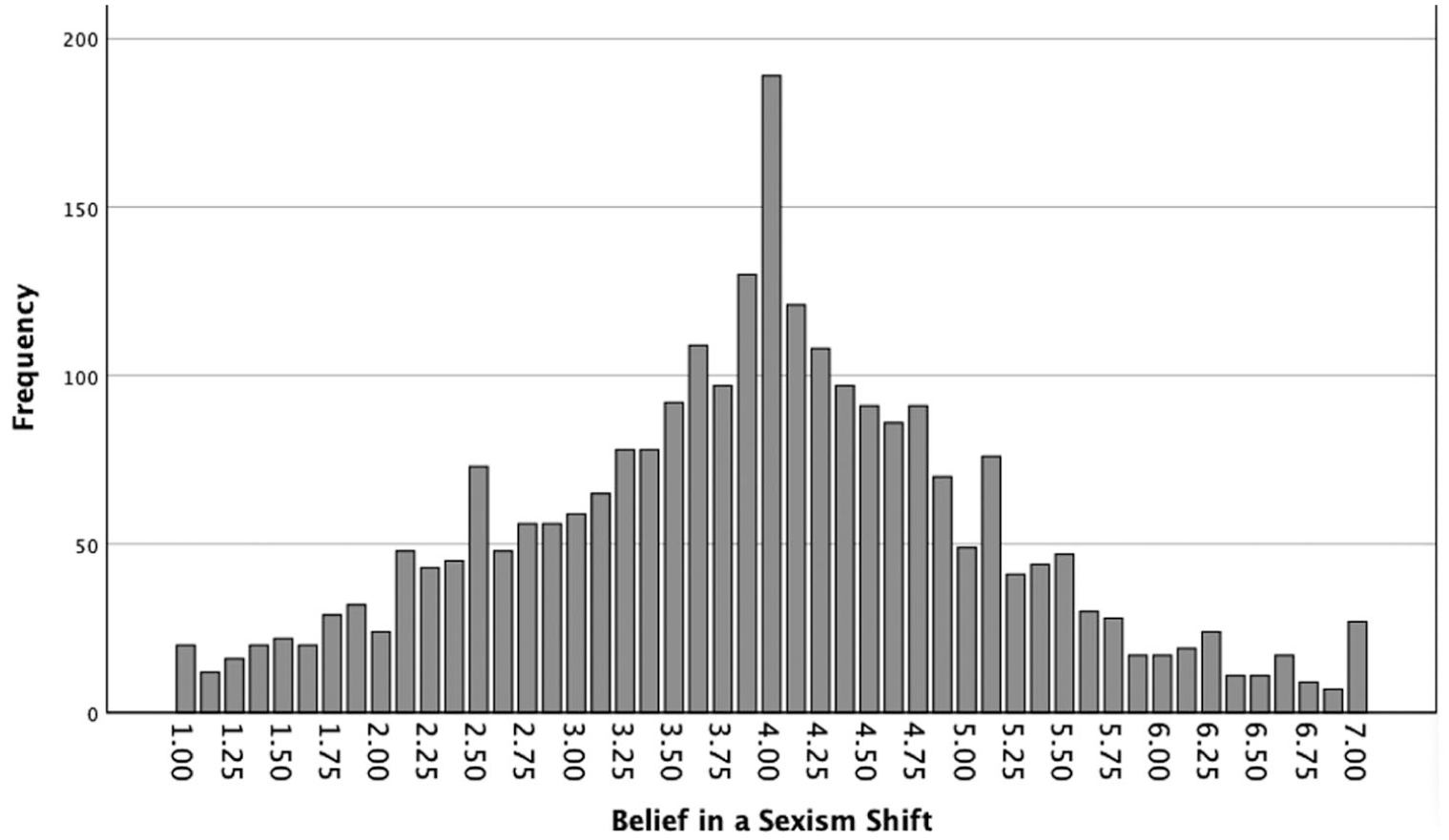
Distribution of belief in a sexism shift, Study 1.
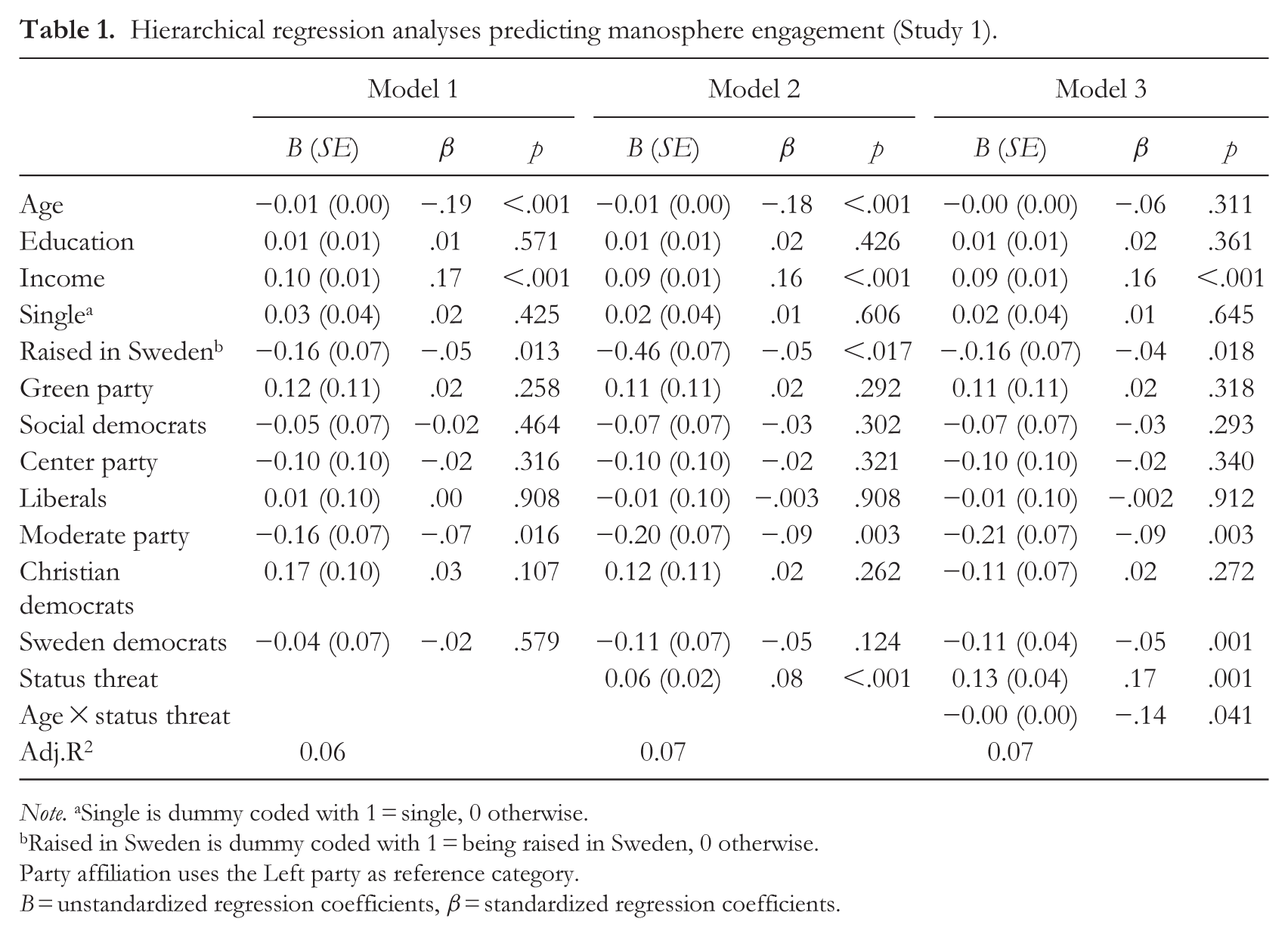
Our first hypothesis stated that perceiving a masculine status threat will be associated with higher misogynistic engagement. This hypothesis was tested with a hierarchical linear regression model with the manosphere engagement index as dependent variable. We first entered the control variables, age, education, income, single, raised in Sweden, and preferred party, followed by entering status threat. In the last model we entered the interaction between age and status threat as research indicates that misogyny is most common among young men (Renström & Bäck, 2024). The results are shown in Table 1.
Hierarchical regression analyses predicting manosphere engagement (Study 1).
Note. aSingle is dummy coded with 1 = single, 0 otherwise.
Raised in Sweden is dummy coded with 1 = being raised in Sweden, 0 otherwise.
Party affiliation uses the Left party as reference category.
B = unstandardized regression coefficients, β = standardized regression coefficients.
As can be seen in Table 1, younger men were more likely to engage with the manosphere, which resonates with earlier research that younger men are more affected by manfluencers (Renström & Bäck, 2024) and perceive gender equality as threatening (Off et al., 2022). There was no effect of education, nor being single, but those with a higher income, and raised outside of Sweden, were more likely to engage with the manosphere.
Looking at our main predictor in Model 2, status threat, it is significantly related to number of visited manosphere websites. In Model 3, we exploratorily entered the interaction between age and status threat, which was significant, indicating that young men who perceived a masculine status threat were more likely to visit the manosphere. 6
Hence, young Swedish men who perceive a masculine status threat have engaged with a higher number of manosphere forums. We have argued that the belief in a sexism shift measure can be used as a proxy for masculine status threat, but as this study was only correlational, we cannot say whether perceived threat leads men to seek out the manosphere, of if they are inspired by the narrative on the manosphere and acquire such attitudes after engaging. To better understand the causal influence of threat, we performed three experiments to analyze the effect of status threats on misogynistic engagement.
Study 2
Study 2 was designed to explore the causal effect of threat perceptions on intentions to engage with the manosphere. The status threats included in Study 2 were related to themes often discussed within the manosphere as threatening both to men as a privileged societal group and as individuals, such as struggles to find a romantic partner and have a family. Narratives often take the form of messages about how men are losing power, status, and rights in modern society, because of feminist politics (Ging, 2019). Thus, the messages were designed to evoke a threat towards men’s status. An example is that women’s status on the labor market has increased lately, or that more women choose to have children on their own (see Figure A.1. in the Appendix). The messages were presented to the participants as social media posts, posted by a potential feminist.
Methods
Participants and design
The design was a between-groups experiment where we manipulated masculine status threat. The threat manipulation was presented as fictive Facebook posts containing either information that could be perceived as a status threat or a control condition, containing neutral information. We chose the Facebook format because it provides an externally valid format, and because social media is a primary source where men are being drawn to misogynistic groups (Baker et al., 2024). We blurred the name and picture, but it was clear that the sender was a woman, so that the post could be interpreted as coming from a feminist. See the Appendix for an example of a post presented to the participants, as well as translations of the stimuli material. The experiment was programmed in Qualtrics, and data was collected by the survey company Lysio.
In total, 675 participants were recruited. While we recruited only men, we asked about participants’ gender and sexuality. All respondents who were not self-identified heterosexual men were excluded from the analysis. 7 The final sample consisted of 608 men, mean age 51 (SD = 18.4, range: 18–87). In total, 180 (29.6%) were single, 416 (68.4%) were in a relationship, and 11 (1.8%) were widowed. We also asked if the participant had been raised in Sweden and included a dummy such that 1 = raised in Sweden, and 0 = raised elsewhere (7% had been raised elsewhere). Education and income were measured as in Study 1. Descriptives are shown in the Appendix (Tables A.1–A.3).
As in Study 1, participants were invited to a survey about societal issues and about women and men. They were also informed that they would be shown a Facebook post and asked questions about the post. Then, general ethics information followed. Informed consent was verified upon starting the survey. Then, participants answered demographic questions including age, gender, sexual orientation, civil status, if they were raised in Sweden, education level, and income. They were then notified that they were about to see an anonymous Facebook post. Randomly, the participants were shown one out of 10 fictive posts, five of which were designed to constitute a masculine status threat, while the remaining five were constructed to be non-threatening. The non-threatening posts contained messages about neutral topics that were selected as unlikely to evoke any strong negative emotions (see the Appendix for survey materials). A pilot study confirmed that the threatening posts evoked anger more strongly compared to the control posts. 8
An example of a threatening post is: “According to a new survey, women’s salaries have increased more than men’s in the last few years. Researchers say this trend will continue in the future. This development towards a more gender equal society must be promoted!” After reading the post, participants were asked to what extent they experienced different emotions when reading the post, followed by answering questions regarding their willingness to engage on the manosphere. Finally, the participants were debriefed about the experiment and thanked.
Measures
The dependent variable manosphere engagement intentions was measured with four items. The question read: “There are different websites, blogs, and chat forums online where men meet, discuss, and share opinions on different matters. The posts and discussions often center around men’s rights. Examples of such websites are wiki4men.com, incels.is and tatehustlers.com, but there are also many others. Indicate how often you could see yourself engaging with such websites and do the following.” Then the following four items were stated: “sharing posts on social media,” “reading blogs and listen to podcasts,” “writing own posts,” and “commenting on others’ posts.” Answers ranged from 1 = never to 7 = several times a week. These items were combined into a mean index (Cronbach’s α = .92).
Anger was measured with five items, drawing on the Discrete Emotions Questionnaire (Harmon-Jones et al., 2016). The participants were asked the question “While reading the post, to what extent did you experience these emotions?,” followed by the items, presented in randomized order. Example items measuring anger are anger, rage and frustration. Answers ranged from 1 = did not experience at all to 7 = strongly experienced. These items were combined into a mean index (Cronbach’s α = .94).
The demographic variables included as controls were age, education, income, relationship status, and being raised in Sweden. These were the same ones as in Study 1 and they were measured as in Study 1. Age, education, and income were treated as continuous variables in the analyses, while relationship status was coded 1 for single men and 0 otherwise, and being raised in Sweden was coded 1, and 0 otherwise. We also measured ideological position using a scale from 1 = clearly to the left to 10 = clearly to the right. Descriptive statistics are shown in Tables A.1–A.3 in the Appendix.
Results and Discussion
Sensitivity analysis showed that the study sample was sufficiently large to be able to detect a main medium effect size (d = 0.29), with α = .05. The sensitivity analysis indicated that the mediation effect would be statistically significant until the residual correlation (ρ) reached approximately 0.50, at which point the 95% confidence interval included zero, B = 0.03, 95% CI [−0.00, 0.06], R²-product = .25. The mediation effect estimate itself crossed zero at ρ = 0.60, B = −0.02, 95% CI [−0.05, 0.01], R²-product = .36.
To test our second hypothesis, that anger will be a mechanism underlying the effect of a masculine status threat on engagement intentions with misogynistic groups, we ran a mediation model, using the PROCESS macro model 4 in SPSS (Hayes, 2018). In the mediation model, we used the status threat condition as independent variable, anger as mediator, and engagement intentions with the manosphere as dependent variable. As covariates we entered the control variables age, income, education, single, left–right position, and raised in Sweden. As suggested by Yzerbyt et al. (2018), we present each step of the model as well as the overall indirect effect. Thus, we first present the effects of status threat on anger, then the effect of anger on engagement intentions as well as total, direct, and indirect effects.
Table 2 presents regression results predicting anger (first path of the mediation model) and manosphere engagement (second path of the mediation model) from status threat and the control variables. The results show that there was an effect of status threat on anger such that men who were exposed to the potentially threatening social media posts experienced higher levels of anger, compared to men who were exposed to the control posts. Further, anger predicted engagement with the manosphere. Thus, angry men tended to be more willing to engage with the manosphere by, for instance, sharing posts or commenting on posts.
Regression results predicting anger and manosphere engagement, Study 2.
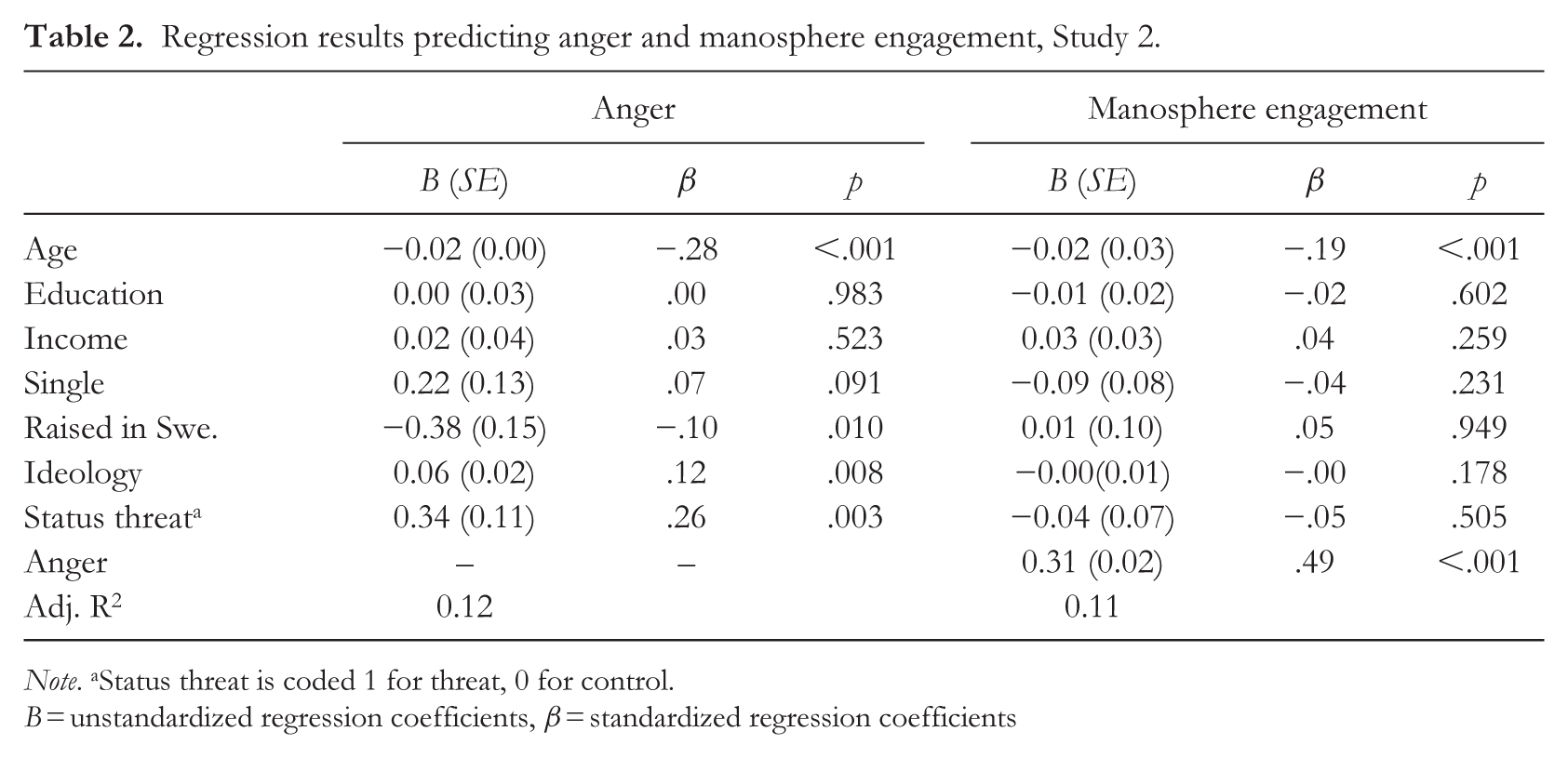
Note. aStatus threat is coded 1 for threat, 0 for control.
B = unstandardized regression coefficients, β = standardized regression coefficients
Figure 2 shows the paths in the meditation model. The total effect (c-path) was not significant, B = 0.07, β = .08, SE = 0.08, p = .331. Neither was the direct effect (c′-path), B = −0.04, β = .05, SE = 0.07, p = .505. However, the indirect effect was significant, B = 0.12, β = .13, SE = 0.04, LLCI = 0.04, ULCI = 0.20.
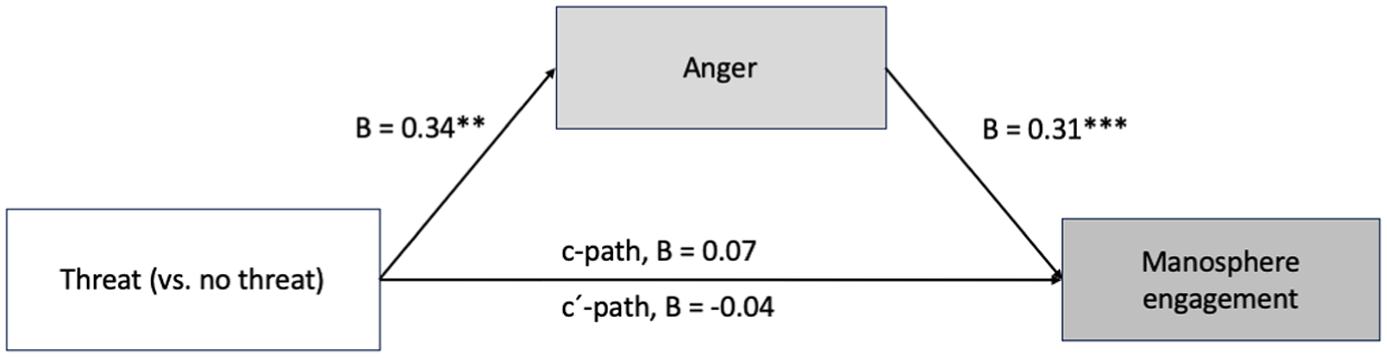
Results from mediation models with masculine status threat, anger, and manosphere engagement, Study 2.
In an exploratory analysis, we also ran a moderated mediation model including age as a moderator to explore if the found effects were mainly applicable to young men, as indicated by Study 1 and previous research (Off et al., 2022; Renström & Bäck, 2024). These results are presented in the Appendix. The results showed that the moderated mediation index did not reach conventional significance levels, but was close, and the mediated effect was significant for younger and middle-aged men but not for older men (see Tables A.8–A.10). Thus, we believe that there is reason to expect that the effects are more pronounced among younger men.
To explore if the different types of status threats we used had different effects on anger, we ran an additional analysis. We included five different individual posts in the status threat condition, where three focused on men’s and women’s status in society (e.g. women are taking over leading positions), and two focused on relationships (e.g. women choose to have children on their own). These two types of status threats may have different impact on men. Because the individual post cell sizes were small (ns = 53–59), we collapsed the “social status threats” (three posts, n = 168) and the “relationship threats” (two posts, n = 112) and compared the effect on anger with an independent t-test. This analysis showed that there was a significant difference between the types of status threat on anger, t(278) = 2.13, p = .030, Cohen’s d = 0.26, such that the relationship threats made the participants angrier (M = 2.47, SD = 1.61), than the social status threats (M = 2.08, SD = 1.41). Thus, threats against a man’s relationship status seems more potent in evoking anger reactions than societal status threats.
To sum up, the results indicated an indirect effect of anger, arising from masculinity threat, on intentions to engage with the manosphere. Hence, when men are exposed to a potential masculine status threat, they tend to react with anger, which in turn is associated with increased intentions to engage with the manosphere. This finding is in line with previous research on anger and political engagement (Valentino et al., 2011).
In this study we used items related to engaging with manosphere websites. Online engagement is sometimes seen as low-cost political engagement because it requires little effort on behalf of the individual. Some groups on the manosphere are, however, more politically engaged than others. One example of this is men’s rights activists, also referred to as MRA. The men’s rights movement, like other groups and movements on the manosphere, is mainly concerned with attributing men’s deprivation to women and feminism (Bates, 2020). However, this movement is outwardly presenting itself as being a support for men in, for instance, father’s rights cases and other areas where they believe men are being discriminated against. As implied by the general nature of these groups, activism is a more pronounced part of their operation. Thus, we wanted to further explore if men, upon perceiving a masculine status threat and becoming angry, would also be more willing to engage in political activity with men’s rights activists and potentially even illegal or violent actions.
Study 3
To further explore the relationship between masculine status threat, anger, and engagement intentions, we conducted an additional experiment. We made several changes compared to the second study. First, we developed the stimulus material and used a blurred picture of a man (i.e., a potential “manfluencer”). Second, we included a new engagement variable, focusing on engagement intentions with men’s rights groups offline, rather than online engagement with the manosphere. Third, as relationship threats seem more potent than societal status threats, we focused on relationship threats in this study. Finally, given that age seems to be an important factor in misogynistic attitudes among men (Off et al., 2022; Renström & Bäck, 2024), and that Studies 1 and 2 indicated that the effects may be particularly pronounced among young men, this study focused specifically on younger men. It is also plausible that young men are more concerned about relationship-oriented threats, compared to older men, as such threats are likely to have a greater impact on their perceptions of their own prospects for finding a partner and starting a family. We also believe that this would align with the outcome variable—engagement with men’s rights groups. If young men feel that their entitlement to have a partner and relationship is threatened, they may become more willing to engage in organizations working to inhibit women’s rights.
Methods
Participants and design
The research design was the same as in Study 2, that is, a between-groups experimental design with two conditions: potential masculine status threat and no threat. The stimulus material was like Study 2, using fictive Facebook posts. We extended the study in several ways. First, we used a male sender, although the name and picture were blurred (see Figure A.2 in the Appendix), to test generalizability of the status threat presentation. Research on social media influencers shows that they may have extensive political influence on their followers, which are most often those of similar opinions (Harff, 2022; Martin & Sharma, 2022) and that manfluencers increase young men’s misogynistic attitudes (Renström & Bäck, 2024).
We used two of the threats from Study 2 that focused on the potential that men will be left without a partner or family due to women’s liberation. We extended the control material to concern a societal issue and framed it as either positive or negative to make it more like the experimental stimulus (see Appendix for all materials). We also used another engagement measure that more directly taps into willingness to engage politically and potentially violently with men’s rights groups offline, rather than intentions to visit and engage with the manosphere.
In total, 819 participants were recruited. We removed 23 participants who identified as “woman” or “other,” and 135 participants who stated that their sexual orientation was other than heterosexual. The final sample consisted of 661 men, mean age 25 (SD = 3.56, range: 18–30). Of these, 310 (47%) were single and the other 350 (53%) were either in a relationship or widowed. Single was coded 1 if single, and 0 otherwise. Most respondents had been raised in Sweden (75%). This variable was coded so that 1 = raised in Sweden and 0 = otherwise. Education, income, and political affiliation were measured as in Studies 1 and 2 and are reported in the Appendix (see Tables A.1–A.3).
As in the previous studies, participants were invited to a study about societal issues and about women and men. The rest of the information was the same as in Study 2. We created two threatening Facebook posts and two control posts, which were balanced in valence (see the Appendix for all materials).
Measures
Willingness to engage in men’s rights groups was measured with three items adapted from Bélanger et al.’s. (2019) scale to measure intentions to join radical groups. The question read: “Sometimes people feel so strongly about some things that they want to engage to make changes. To what extent do you agree with the following statements?” Then the participants were shown the following three items (in randomized order): “I could support a group that is not afraid to defy the law to fight for men’s rights,” “I could join a group that is willing to use all means to defend men’s rights,” and “I could join a group working politically to increase men’s rights.” Responses were made on a scale from 1 = do not agree at all to 7 = completely agree, and a mean index was created (Cronbach’s α = .86).
Anger was measured as in Study 2 (anger α = .90), as were the control variables age, education, income, relationship status, and being raised in Sweden.
Results and Discussion
Sensitivity analysis showed that the study sample was sufficiently large to detect a main medium effect size (d = 0.25), with α = .05. The mediation sensitivity analysis indicated that the mediation effect would lose statistical significance at ρ = 0.50, when the 95% confidence interval included zero, B = −0.01, 95% CI [−0.04, 0.02], R²-product = .25. This was also the point at which the mediation effect estimate itself would cross zero.
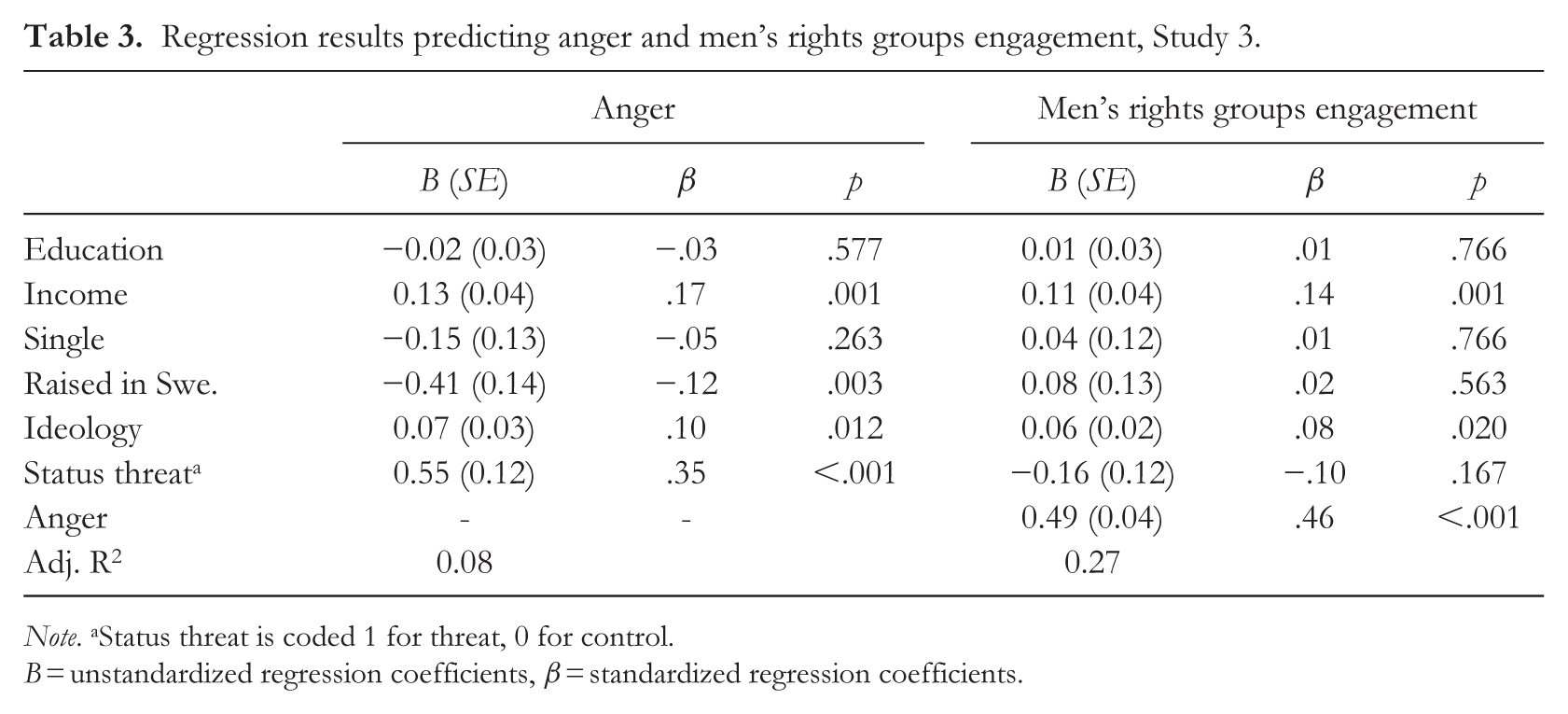
To test the hypothesis, we ran a mediation model, using PROCESS macro model 4 (Hayes, 2018). Anger was entered as mediator, and as covariates we entered income, education, single, ideology, and raised in Sweden. We first predicted anger from status threat, that is, the first part of the suggested model. As can be seen in Table 3, being exposed to the potential threat was associated with stronger experiences of anger.
Regression results predicting anger and men’s rights groups engagement, Study 3.
Note. aStatus threat is coded 1 for threat, 0 for control.
B = unstandardized regression coefficients, β = standardized regression coefficients.
Next, we analyzed the results of anger predicting engagement intentions with men’s rights groups, that is, the second part of the model, also shown in Table 3. The paths are illustrated in Figure 3. There was no main effect of status threat, but anger significantly predicted engagement with men’s rights groups, mirroring the results of Study 2. The total effect was not significant (c-path), B = 0.11, β = .07, SE = 0.13, p = .397, neither was the direct effect (c′path), B = −0.16, β = −.10, SE = 0.12, p = .167, as in Study 2. Again, the indirect effect was significant, B = 0.27, β = .16, SE = 0.06, LLCI = 0.15, ULCI = 0.40. Hence, the results from this study reflected those of Study 2, showing that men exposed to a masculine status threat tend to react with anger and this anger makes them increasingly willing to engage with men’s rights groups, specifically in a political context.
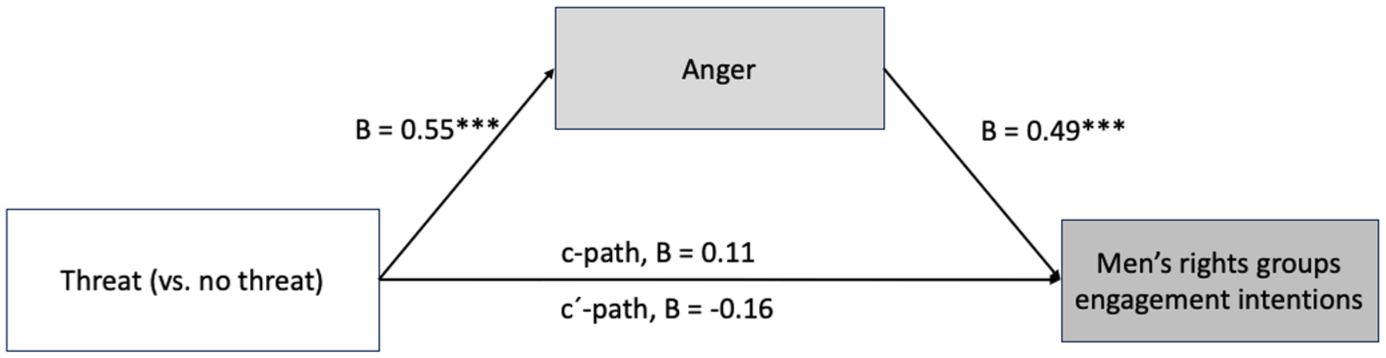
Results from mediation model with masculine status threat, anger, and engagement, Study 3.
As can be seen in Figure 3, the results from this study were in line with our expectations and the theoretical model that masculine status threats evoke anger which lead to higher willingness to engage in misogynistic groups. This was true for both low-level online manosphere engagement but also willingness to engage in real-life politics. While the presented studies support our hypotheses, we conducted a fourth study aiming to replicate our findings and to address some limitations in the two previously presented experimental studies.
Study 4
We made several changes in this study compared to the other two experimental studies. First, in the two previous experimental studies we used individuals as senders in the fictive social media posts, potentially a feminist in Study 2 or a manfluencer in Study 3. This was to test the generalizability of the threat perception in presentation format, but we cannot rule out that these senders may have influenced the participants. In Study 4, we thus used a more neutral sender, presenting “facts” rather than an individual’s opinion to make a cleaner manipulation of status threat. Second, as our previous control conditions were unrelated to gender, we cannot rule out that any gender information may influence men’s engagement intentions. Hence, in this study, we used a control condition related to gender. Third, our dependent variables assumed that the participants had knowledge about “men’s rights” and what that concept entails. To avoid any confusion, we formulated the dependent variables in more abstract terms. Fourth, one problem with our previous studies is that we did not include a measure of perceived status threat. Hence, in this study we included questions asking about threat perceptions. Finally, we used an Instagram template to improve external validity and because Facebook is mainly being used by the older generations in Sweden (Ohlsson, 2024).
Methods
Participants and design
The research design was the same as in Studies 2 and 3, that is, a between-groups experimental design with two conditions: potential masculine status threat and no threat. We used fictive social media posts from an “Opinion institute” (see Appendix for material). We extended the study by having control stimuli related to gender that presented boys and men in a more positive light. Thus, to formulate the same sentence but focusing either on boys’/men’s progress or girls’/women’s progress (status threat stimulus), we used topics such as grades, well-paid jobs, and acceptance rates to higher education.
We formulated three threatening posts and three non-threatening posts. All threatening posts started with “A new report finds that. . .” and in the threatening posts it was followed by “the trend goes on” and then ended with one of the following: “girls continue to get better grades than boys!/young women have better opportunities than young men to get a good job!/more young women than men are admitted to higher education!” In the non-threatening posts, the “A new report finds. . .” was followed by “that the trend has shifted” and one of the following: “boys are now getting better grades!/young men are getting good and well-paid jobs!/the number of young men who are admitted to higher education has increased!” Research indicates that when men are outperformed by women, they react with anger (Dahl et al., 2015), implying that these texts highlighting the competitive environment between women and men may function similarly.
In total, 604 participants were recruited. Eleven participants were removed due to having responded that they were women (n = 6) or did not answer the gender question (n = 5). Again, we included only self-identified heterosexual individuals, 9 and the final sample consisted of 513 men, mean age 22 (SD = 2.48, range: 17–30). Of these, 302 (51.4%) were single, 276 (46.9) were in a relationship, and 10 (1.7%) were widowed. Single was coded 1 if single, and 0 otherwise. Most respondents, n = 393 had been raised in Sweden (66%), and 27 (4.6%) had not. 173 participants did not respond to this question and hence we have dropped it from the analyses to not lose out on data. 10 Education, income, and political affiliation were measured as in Studies 2 and 3 and are reported in the Appendix (see Tables A.1–A.3).
As in the previous studies, participants were invited to a study about societal issues and about women and men. The rest of the information was the same as before. We created three threatening social media posts and three non-threatening control posts (see the Appendix).
Measures
Engagement intentions were measured with four items tapping into both online engagement (e.g., manosphere engagement) and offline engagement (e.g., men’s rights groups). The question about online engagement read: “There are different websites, blogs and chat forums online where people meet, debate and share tips and opinions on different topics. We are now interested in what you would consider doing online. I could write posts or comment on others’ posts on sites/blogs/forums dedicated to. . ..” Then they were shown two items: “improving men’s rights in society” and “improving men’s social status in society.” We then asked a similar question but focused on offline engagement: “Sometimes people feel so strongly about something that they want to engage to achieve changes. Would you consider joining an organization working to. . ..” Then they were showed similar items: “improving men’s condition in society and “improving men’s social status in society.” Response options varied from 1 = No, never, to 7 = Yes, absolutely for both types of engagement. Because these items were all highly correlated, rs from .61–.81, we decided to collapse all four items into one engagement intentions index (Cronbach’s α = .90).
Anger was measured as in the previous studies (anger α = .91), as were the control variables age, education, income, relationship status, and being raised in Sweden.
Finally, we added items intended to be used as manipulation checks to see that the threatening posts were indeed perceived as threatening and negative. We added the following question: “Earlier in the survey, you were shown an Instagram post. To what extent do you agree with the following statements?” Then the following four items were asked: “The content was threatening to men’s social status,” “The content was threatening to women’s social status,” The content was positive,” “The content was negative.” Response options varied from 1 = do not agree at all to 7 = completely agree.
Results
Sensitivity analysis showed that the study sample was large enough to detect a main medium effect size (d = 0.28), with α = .05. The mediation sensitivity analysis indicated that the mediation effect would remain statistically significant until the residual correlation (ρ) reached approximately 0.40, at which point the 95% confidence interval included zero, B = 0.02, 95% CI [−0.01, 0.05], R²-product = .16. The mediation effect estimate itself would cross zero at approximately ρ = 0.40 (interpolated); by the next evaluated point, ρ = 0.50, it would be negative, B = −0.02, 95% CI [−0.06, 0.01], R²-product = .25.
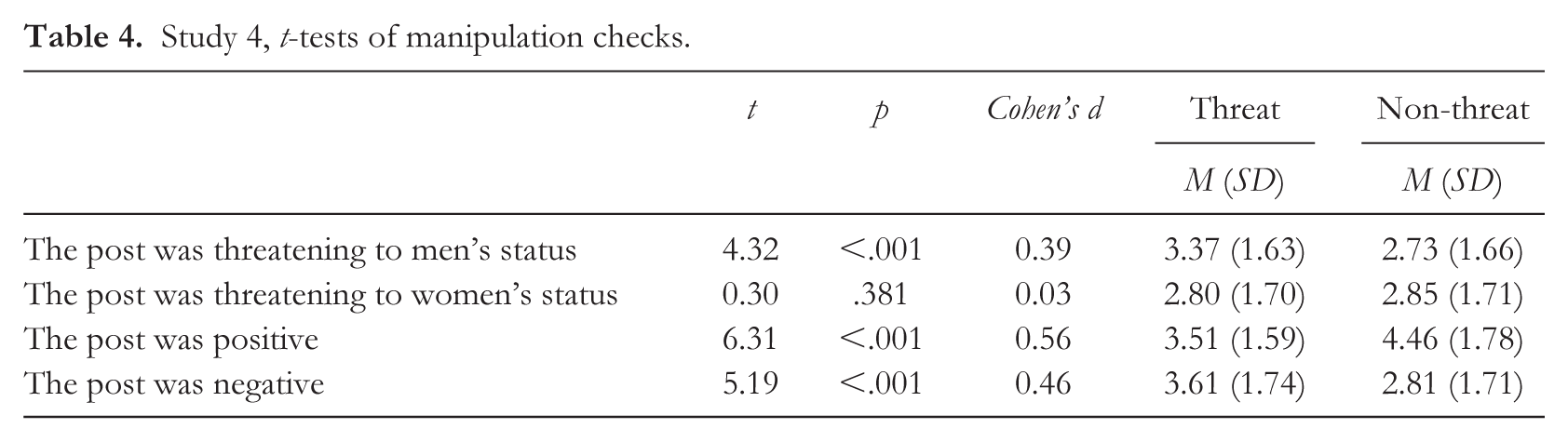
We first present the results from the manipulation check items. Using an independent t-test with treatment as independent variable and the manipulation check items as dependent variables, we find the expected effects. These are presented in Table 4. As can be seen in Table 4, participants in the status threat condition rated the posts as significantly more negative and more threatening to men’s status compared to the non-threatening posts. They also rated the non-threatening posts as more positive compared to the threatening posts. There was no effect on perceiving that the posts were threatening to women’s social status. Thus, we can conclude that the manipulations were successful in inducing threat perceptions.
Study 4, t-tests of manipulation checks.
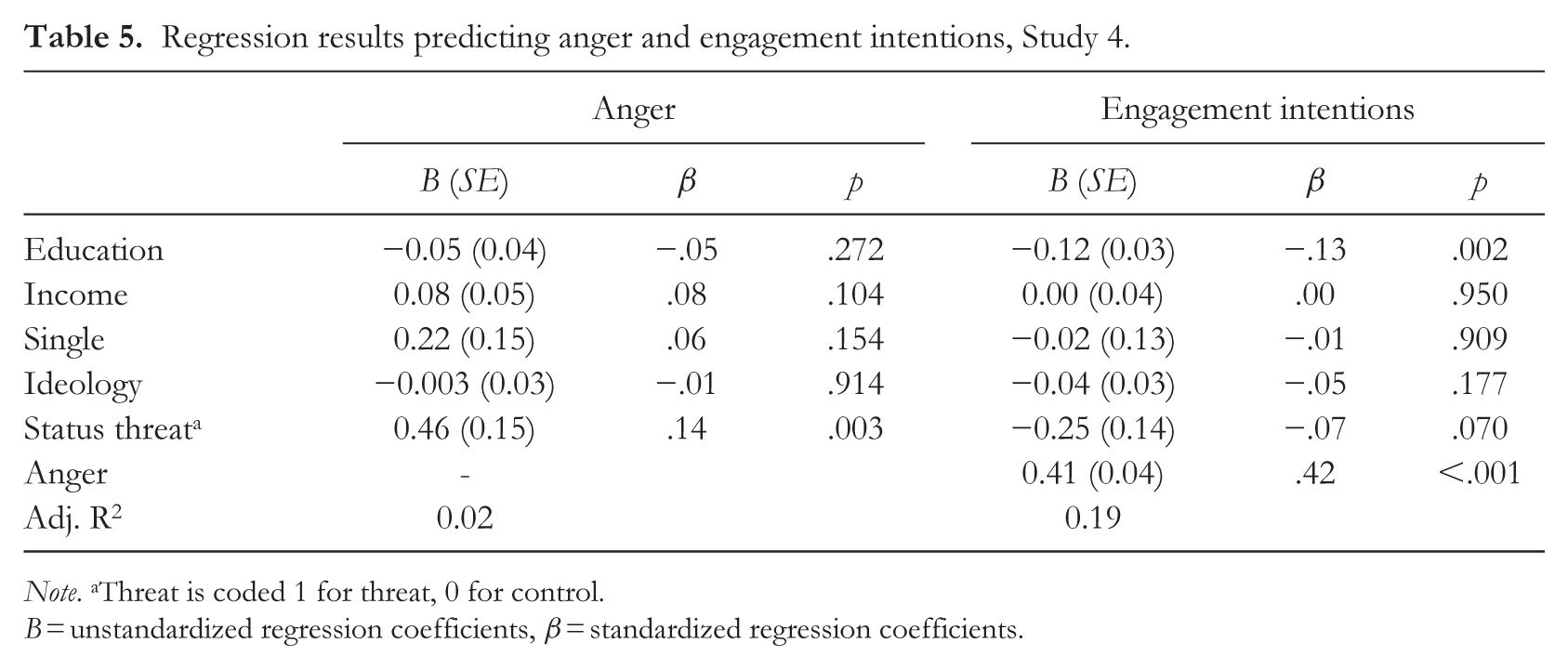
Next, we ran the mediation analysis using Model 4 in Hayes’ PROCESS macro. We used the engagement intentions index as dependent variable, the status threat condition as independent variable, anger as mediator, and controlled for education, income, being single, and ideological position. We first present the results for the effects of status threat on anger, that is, the first part of the model. The results are presented in Table 5. As can be seen, men exposed to the status threat reacted with more anger compared to men not exposed to the threat.
Regression results predicting anger and engagement intentions, Study 4.
Note. aThreat is coded 1 for threat, 0 for control.
B = unstandardized regression coefficients, β = standardized regression coefficients.
In Table 5, we also show the effects of anger on engagement intentions, that is, the second part of the proposed model. As can be seen, stronger anger experiences were associated with higher engagement intentions.
The paths are illustrated in Figure 4. The total effect was not significant (c-path), B = −0.06, β = −.04, SE = 0.15, p = .700, and neither was the direct effect (c′path), B = −0.25, β = −.15; SE = 0.14, p = .070, but the indirect effect was significant, B = 0.19, β = .11, SE = 0.07, LLCI = 0.06, ULCI = 0.32. The results from this study reflected those of the previous experiments, showing that men exposed to a masculine status threat tend to react with anger and this anger then makes them increasingly willing to engage with men’s rights groups, both online and offline.
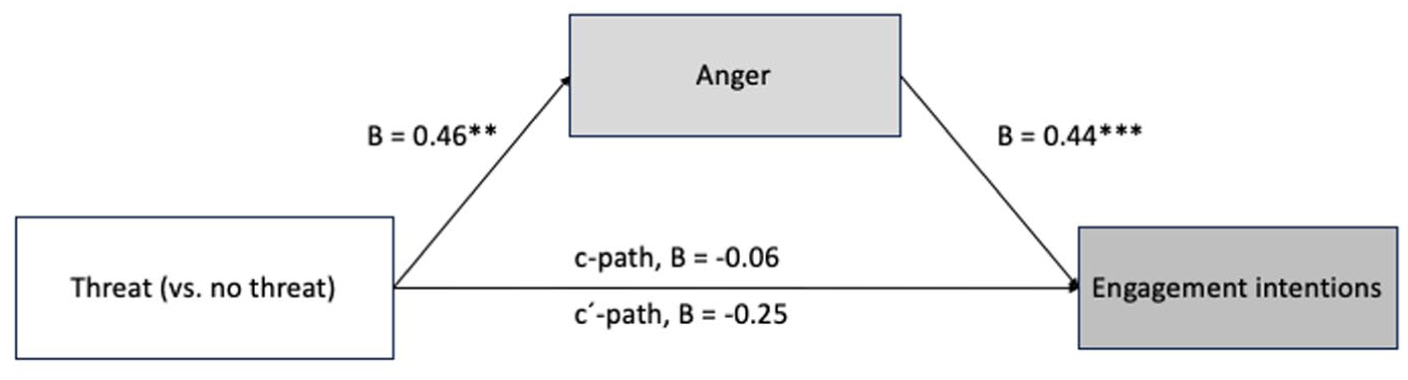
Results from mediation models with masculine status threat, anger, and engagement, Study 4.
Table 6 presents a summary of the mediation analyses across all three experiments. As can be seen, the effects are consistent across the studies. That is, there are significant positive effects of status threat on anger, and significant positive effects of anger on engagement, and the indirect effects were positive and significant across all studies. For all studies, the direct effect of status threat on engagement was negative and non-significant. The results also show that the total effects were non-significant across all studies.
Results from mediation analyses for all three experiments, Studies 2–4.
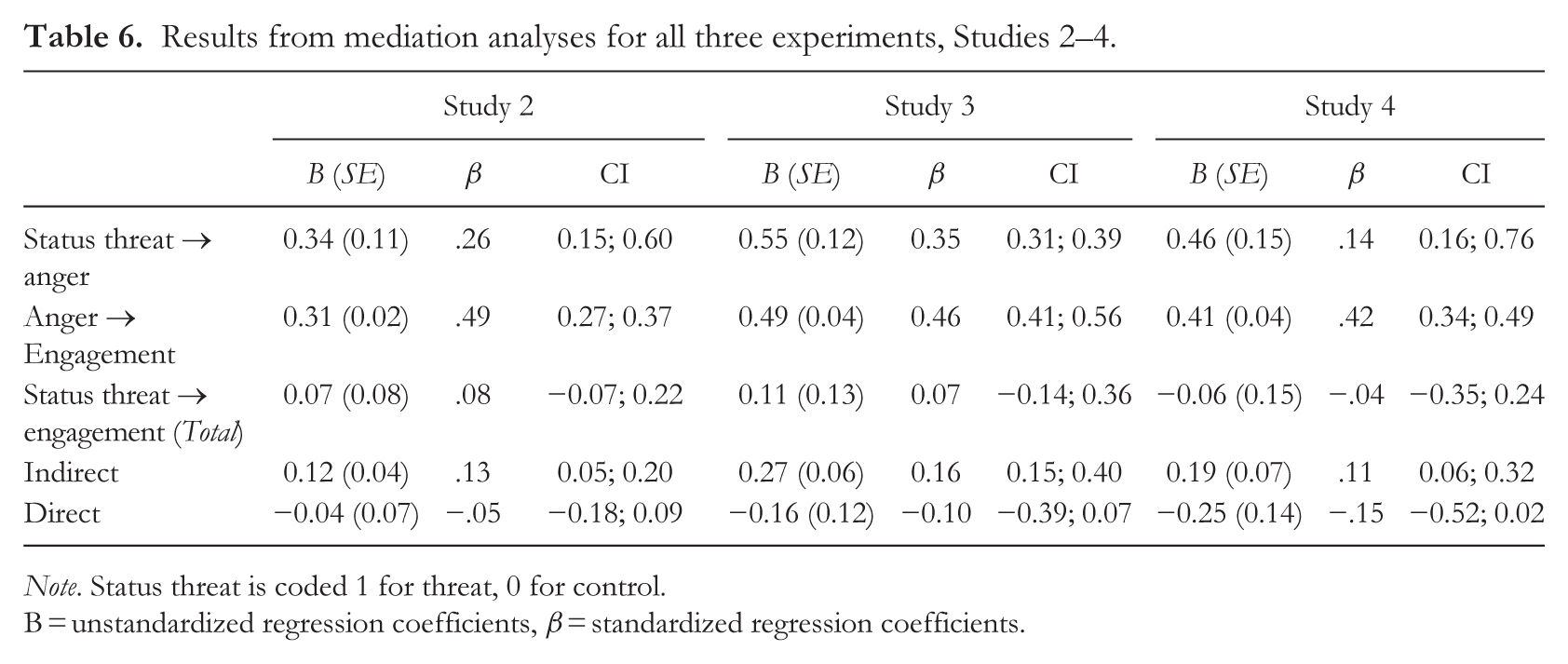
Note. Status threat is coded 1 for threat, 0 for control.
B = unstandardized regression coefficients, β = standardized regression coefficients.
In general, there are several reasons why there may be significant indirect effects without significant total effects. This could reflect an inconsistent mediation (Loeys et al., 2015; MacKinnon et al., 2000), whereby the direct effect is negative while the indirect effect is positive. These opposing effects may cancel each other out, resulting in a non-significant total effect. This lack of total effect could also be due to unmeasured variables influencing anger (Loeys et al., 2015). At the present time, we are unable to fully discern why we observe a non-significant total effect, and suggest that this should be explored in future research.
Overall, our findings support the idea that status threats result in anger reactions among men and that this anger makes them more willing to engage in misogynistic engagement.
General Discussion
In this article, we sought to contribute to a better understanding of what makes men attracted to and want to engage with misogynistic groups. We find that varying forms of masculine status threats are indirectly associated, via anger, with willingness to engage with misogynistic groups online and offline.
While we find these effects in general samples of Swedish heterosexual men, the results seem strongest among young men. We find a moderating effect of age in Study 1, where the effect of perceiving a masculine status threat is stronger among younger men. We also find a close to significant moderated mediation in Study 2, when we include age as a moderator. This implies that the indirect effect of anger when men are exposed to a masculine status threat on engagement is mainly present among young men. This corroborates previous research showing that younger men perceive gender equality as threatening (Off et al., 2022), and that young men are particularly influenced by manfluencers (Renström & Bäck, 2024). This finding is highly problematic given that the current study shows that these young men also seem willing to engage in potentially violent actions with men’s rights groups. Men’s rights groups are groups that exist on the manosphere and that are politically anchored in their fight against injustices against men. Topics include child custody, domestic violence against men, and false accusations of rape. These groups have been described as a backlash to feminism and clearly advocate misogyny and even violence against women (Schmitz & Kazyak, 2016).
This article contributes to a deeper understanding of the mechanisms and consequences involved in the belief that men nowadays are the main targets of sexism (Zehnter et al., 2021). In a large-scale survey, we find that the belief in a sexism shift, which we use as a proxy for perceived masculine status threat, is relatively widespread among Swedish men. Moreover, men who scored high on this measure also reported more engagement with the manosphere. While the belief in a sexism shift may not be the same as perceiving an intergroup threat, we argue that this concept shares some important similarities with intergroup threat. For instance, the belief that men are now the primary target of sexism is attributed to women’s advancement (Zehnter et al., 2021), which clearly pictures feminism as the culprit in men’s currently disadvantageous position. This measure thus entails the belief that gender and status relations are a zero-sum game, where men are losing out to women. Such beliefs have been shown to motivate men to feel threatened by gender equality (Off et al., 2022).
Hence, women as a social group constitute a threat to men as a social group, enabling the application of intergroup threat theory (Stephan et al., 2015) to understand how status threats may be associated with increased activity on the manosphere. In line with intergroup threat theory, we expected that men who perceive a masculine status threat would be more willing to engage with the manosphere as this is an arena that presents support for their perceptions of being threatened and provides both causes and solutions for this precarious situation. Thus, if an individual feels unfairly treated, they become motivated to seek out a remedy. Such unfair treatment is also likely to evoke anger (Carver & Harmon-Jones, 2009).
To further explore the effect of intergroup threat on manosphere engagement, and the mechanism of anger, we performed three survey experiments. By exposing men from a normal Swedish population to social media content that presented a potential masculine status threat, we sought to replicate narratives about men’s lost societal status and individual relationship struggles that flourish on misogynistic online forums and are attributed to women and feminism (O’Malley et al., 2022). Such narratives highlight the potential that the group “women” are in a position to threaten the group “men” both on an individual and societal level. Thus, in line with intergroup threat theory (Stephan et al., 2015), such threats are likely to increase outgroup hostility and may influence the willingness to do something to reduce the level of threat.
We have argued that anger should function as a mechanism underlying the effect of threat perceptions on engagement. There is much research in both the emotion literature and the political psychology literature indicating the motivating and engaging effect of anger (e.g. Carver & Harmon-Jones, 2009; Valentino et al., 2011). Thus, we suggest that to understand why status threats may lead men to want to engage, we must consider anger. We find an indirect effect of anger linking status threat to engagement, using different variations to the stimulus material, the dependent variable, and the age composition of the samples. This indicates that emotions play a key role in understanding the appraisal of such threats and when they lead to political engagement. Anger is an especially important negative emotion in this situation as it is involved in the ideas about hegemonic masculinities and about right and wrong (Cottee, 2021; Kimmel, 2018).
We expected anger to constitute an indirect effect between perceived status threat and engagement intentions, since anger motivates action (Carver & Harmon-Jones, 2009; Valentino et al., 2011). By engaging with manosphere forums, individuals are exposed to narratives that attribute their situation to women and feminism, as well as to proposed solutions that may include violence. The influence of online groups might lead to violence over longer time periods as members take on the values of a radical group (Habib et al., 2022; O’Malley et al., 2022).
But the question is why men react in such a way to these reminders of status loss? To understand this, the findings should be connected to ideas in the literature on masculinity which suggest that threats to the masculine position can lead to hypermasculinity such as engagement with misogynistic groups (Bosson et al., 2009; Carian, 2022; Connell, 2005; Kalish & Kimmel, 2010; Willer et al., 2013). Research shows that masculinity is fragile and needs to be performed and displayed to be valid. This also means that masculinity could be lost (Vandello & Bosson, 2013; Vandello et al., 2008). Perceptions that women constitute a source of losing masculinity or masculine status appear to increase men’s willingness to engage in actions aimed at preventing this loss. Our results suggest that connecting these ideas about masculinity to emotions is a fruitful way to understand the role of masculine status threats in the formation of misogyny.
Research also shows that masculinity threats increase men’s endorsement of ideologies justifying gender hierarchy, such as social dominance orientation (Dahl et al., 2015). Hence, it is possible that as women become freer to make decisions about their own lives and prefer to be single, we may see an increase in misogynistic political movements striving to control women. In a recent study of Norwegian youth, Mathisen (2025) found that the political gap between young girls and boys is the largest since the 1980s. Moreover, this gap was found to be connected to attitudes relating to gender equality. That is, young men may be moving toward the radical right because they oppose feminism, while young women are moving toward the progressive left because they support it. This trend is observed across Europe (Milosav et al., 2025), where young men in particular show increasing support for the radical right. This support is likely connected to the radical right’s conservative view of gender and gender roles.
Anger is connected to morally loaded situations (Rozin et al., 1999), suggesting that participants perceived the messages in the posts as morally wrong (Chapman & Anderson, 2013). Such an interpretation aligns with ideas about aggrieved entitlement and hegemonic masculinity, where men perceive their situation as unfair, denigrating, and women taking what is not rightfully theirs (Connell, 2005; Kalish & Kimmel, 2010). This is also in line with the sociofunctional approach to intergroup emotions (Cottrell & Neuberg, 2005). In our studies, anger is an important factor to include, consistent with previous research on masculinity threat (Dahl et al., 2015). When anger is not considered, we do not find any effects of threat, implying that anger is a necessary emotional reaction in understanding misogynistic engagement.
The findings also relate to the more classical collective action literature. The Social Identity Model of Collective Action (SIMCA) posits that individuals are most likely to engage in collective action when they are strongly identified with a group, when they perceive injustice towards their group, and when they have a belief that the group can bring about change (van Zomeren et al., 2008). This model also implies that anger is an important motivating emotion. That is, simply identifying with the group “men,” or feeling that this is an important social identity, may not be sufficient to engage with the manosphere or men’s rights groups. The feeling of unfair treatment, such as relative deprivation (Smith & Pettigrew, 2015), must also be present. According to the third tenet of the SIMCA, which specifies that one must also feel that engagement can be fruitful and lead to change, we can infer that men engaging with these sites and groups believe that this will bring about societal changes in the gender hierarchy, with the goal of subjugating women (Hoffman et al., 2020).
An interesting finding is that income seemed to matter for manosphere engagement (Study 1) and for engagement with men’s rights groups (Study 3). We can only speculate about this finding, but one potential explanation is that higher-earning men are afraid that women will want their money. That is, one idea on the manosphere revolves around women as “gold-diggers.” It would be interesting for future research to delve deeper into the relationship between income and misogyny.
Limitations and Future Research
Some limitations are worth noting. First, we did not include a measure of gender identification, that is, a measure assessing to what extent a masculine identification is important to the individual. This could be an important moderator defining who is likely to react to a status threat with anger. That is, men who place a high value on traditional masculinity may be more prone to perceiving intergroup threat and anger, compared to men who place less value on such an identity. This also relates to the Social Identity Model of Collective Action, which states that strong social identification with a group is an important predictor for engaging in collective action with that group (van Zomeren et al., 2008).
Second, we measured engagement intentions in our experimental studies (2–4), which yield more variability in the responses compared to actual engagement as in Study 1 but do not necessarily imply actual engagement. One possibility to measure actual engagement in an online survey could be to present participants with an opportunity to engage, for instance if they want to click on a link taking them to a manosphere website or sign up for a newsletter or similar. Such a measure could be used to complement the intentions measure. However, this may come with ethical issues that also warrant consideration. For instance, if participants are re-directed to a manosphere website, the researchers would contribute to spreading such material. Alternatively, this could be a fictive link, not taking them to an actual site, but this would be associated with deception problems. Nonetheless, intentions are fairly accurate indications of actual behavior, as stated by the theory of planned behavior (Ajzen, 1985).
We only provided the participants with the option to engage with the manosphere, men’s rights groups, or groups working to improve men’s position. That is, we do not know if the participants might have been equally willing to engage with other gender-related groups. Could the threatening cues in our studies simply motivate individuals to engage with any type of group or online space focused on gender? We suggest that future research should focus on designing an experimental study where participants may be able to choose from different groups, which they want to engage with.
Finally, we suggest that research looks at other important emotions, such as disgust. Like anger, disgust is a moral emotion, evoked when individuals perceive sociomoral transgressions (Chapman & Anderson, 2013). In relation to the manosphere, such transgressions are often presented in relation to, for instance, how many men a woman has previously had sex with, effectively violating ideas of female purity. Disgust has an important function in dehumanization, which in turn facilitates violence (Rousseau et al., 2023). Hence, we urge future research to consider the link between the manosphere, disgust, dehumanization, and violence against women.
An important statistical note is the lack of total effects in all the mediation analyses. While some scholars advocate for the need of a total effect (e.g. Baron & Kenny, 1986; Judd & Kenny, 1981), others argue that there are situations in which an indirect effect may be present without a total effect. In line with Loeys et al. (2015), this matters less when the main objective is to explore a mechanism, that is, a mediation only approach, which is what we aimed for in the experimental analyses. There may be different reasons as to why this situation may arise, such as the influence of unmeasured variables or a suppression effect (Loeys et al., 2015; MacKinnon et al., 2000; O’Rourke & MacKinnon, 2018). We suggest that future research focuses more on understanding the relation between threat, anger, and engagement.
Conclusion
In a cross-sectional survey we find that perceived masculine status threat is related to engagement with the manosphere (Study 1). Further, in three survey experiments, we find that perceived masculine status threat is, indirectly via anger, related to engagement intentions with the manosphere (Study 2), men’s rights groups (Study 3), and generally with groups and sites promoting men’s status, especially among younger men (Study 4). In all three experimental studies, masculine status threat indirectly influenced misogynistic engagement through anger. We thus conclude that anger reactions to status threats drive men’s engagement in misogynistic forums and groups. Hence, men react with anger when experiencing a masculine status threat which makes them more likely to engage with the manosphere and with the groups associated with it. This is troublesome since anger is also related to approach and action (Carver & Harmon-Jones, 2009; Valentino et al., 2011). That is, becoming angry may motivate these men to take action and not only be “keyboard warriors.”
The present results provide strong indications of the proposed mechanism, where masculine status threats lead men to become angry, which in turn motivates engagement. This was found across different threat conditions (threats to relationship status, societal status, and educational or professional success), with different senders (a potential feminist, a potential manfluencer, an objective opinion institute), and across different outcomes (manosphere engagement intentions, men’s rights engagement intentions, and groups improving men’s status generally).
These results highlight the mechanisms underlying the appeal to the manosphere and misogynistic ideas, but attention must also be given to addressing the toxic ideas about hegemonic masculinity that seems to flourish even in highly egalitarian societies, such as Sweden. Toxic ideas about hegemonic masculinity are not only associated with violence and denigration of outgroups but may also be related to decreased psychological well-being. Thus, it is particularly worrisome that the group that seems to be most concerned that increasing equality is threatening their own status is young men.
Supplemental Material
sj-docx-1-gpi-10.1177_13684302261426263 – Supplemental material for A threatened masculinity? The role of status threats and anger in misogynistic engagement
Supplemental material, sj-docx-1-gpi-10.1177_13684302261426263 for A threatened masculinity? The role of status threats and anger in misogynistic engagement by Emma A. Renström and Hanna Bäck in Group Processes & Intergroup Relations
Footnotes
Funding
The authors disclosed receipt of the following financial support for the research, authorship, and/or publication of this article: The present research was funded by The Swedish Research Council for Health, Working Life and Welfare (Forte), grant nr. 2022-00042.

Supplemental material
Supplemental material for this article is available online.
Notes
References
Supplementary Material
Please find the following supplemental material available below.
For Open Access articles published under a Creative Commons License, all supplemental material carries the same license as the article it is associated with.
For non-Open Access articles published, all supplemental material carries a non-exclusive license, and permission requests for re-use of supplemental material or any part of supplemental material shall be sent directly to the copyright owner as specified in the copyright notice associated with the article.
