







Abstract
In the last decade, the percentage of Americans who identify as atheists has almost doubled from 2% to 4%. Still, prejudice against this ever-growing group persists. Across four studies, we explored two distinct yet related correlates of antiatheist prejudice amongst American Christians: (a) the perception that atheists lack a moral compass and (b) the belief that faith in God is necessary to living a moral life. Grounded in moral foundations theory and big gods theory, we investigated this dual pathway to antiatheist prejudice in four samples. In Studies 1a and 1b, we found that Christians’ (total N = 389) distrust of atheists increased to the extent that they perceived atheists to lack individualizing (especially concerns about harm)—but not binding—moral foundations. Further, Christians who endorsed the idea that belief in God is necessary to behave morally tended to be more distrusting of atheists. In a subsequent study (N = 253), we replicated these findings using the new Moral Foundation Questionnaire-2. In a final, preregistered study (N = 663), we again replicated these findings in a larger, politically diverse sample. We discuss how internal and external guides to moral conduct are each associated with distrust of atheists.
If you don’t have heaven, you almost say, “What’s the reason? Why do I have to be good? Let’s not be good. What difference does it make?”
Atheists have long been the target of distrust and antipathy (Cragun et al., 2012; Jackson & Hunsberger, 1999; LaBouff & Ledoux, 2016; Moon et al., 2020; Pew Research Center, 2019; Simpson & Rios, 2017). A 2016 Pew Research Center poll, for example, found that 51% of Americans would be less likely to support a presidential candidate if that candidate was known to be an atheist (Pew Research Center, 2016), while a thermometer measure of warmth towards atheists ranging from 0 (most negative) to 100 (most positive) found an average rating of 49 for atheists (Pew Research Center, 2019). In fact, respondents deemed being an atheist to be more detrimental to a presidential candidacy than having an extramarital affair or having never held a political office.
Where does this distrust stem from? Existing literature has proposed multiple mechanisms to explain why religious individuals are so distrusting of atheists, including a lack of belief in a watchful God, differing reproductive strategies, perceived threat, or basic ingroup versus outgroup psychology (Burris & Petrican, 2011; Cook, Cohen, & Solomon, 2015; Cook, Cottrell, & Webster, 2015; Cragun et al., 2012; Edgell et al., 2006, 2016; Gervais, 2013; Grove et al., 2020; Moon et al., 2020; Norenzayan, 2013). But as the opening quote implies, distrust towards atheists may be driven by a broader perception that they lack a moral basis for good behavior. In the current research, we extend the existing literature by arguing that distrust is associated with two perceived deficits: a lack of an external moralizing agent to enforce morality (Gervais, 2013) and a lack of the internal moral foundations that make harmonious social life possible (Graham & Haidt, 2010; Graham et al., 2011, 2012; Haidt, 2008; Haidt & Graham, 2007; Simpson & Rios, 2017). By integrating these two pathways, we offer a broader framework for understanding distrust of atheists—one that highlights the perceived absence of both external enforcement and internal moral compass.
The Lack of an External Incentive for Moral Conduct
As a group, atheists are neither conspicuous nor clearly demarcated—they do not share gathering spaces, sacred texts, rituals, prescribed clothes or hairstyles, or other markers of collective identity (Gervais, 2011; Zuckerman, 2009). Aside from their lack of belief in God, atheists do not adhere to a clearly identifiable set of beliefs or practices. Despite their relative invisibility, atheists are among the most disliked and rejected groups in North America (Cragun et al., 2012; Edgell et al., 2006; Gervais, 2013; Hammer et al., 2012; Pew Research Center, 2014; Swan & Heesacker, 2012). According to Gervais et al., this antipathy is rooted in the high distrust of atheists (Gervais et al., 2011). Importantly, this distrust appears to be amplified by religiosity: individuals who are more religious are more likely to harbor suspicion toward atheists. For example, Gervais et al. (2011) showed that religiosity was associated with stronger belief in the prosocial effects of supernatural surveillance—and this belief, in turn, predicted heightened distrust of those who reject belief in a watchful God.
For many religious individuals, God is perceived to be the ultimate arbiter of approval and disapproval. Belief in God thus serves as a powerful external incentive for moral behavior and provides a heuristic for judging the trustworthiness of others (Gervais et al., 2011). 1 By definition, atheists reject the belief in God, and therefore, individuals who view divine surveillance as critical for moral conduct should perceive atheists as more prone to immoral behavior.
The Lack of Internal Guidance for Moral Conduct
In addition to the watchful God hypothesis, we must also consider the possibility that distrust may stem from perceived deficiencies in atheists’ internal moral character. In addition to atheists’ disbelief in a watchful God, they are perceived to lack much of the infrastructure that religious individuals often consider critical for the development of a sound moral perspective—namely moral community, official doctrine, and divine authority (Graham & Haidt, 2010; Piazza & Landy, 2013). Piazza and Landy (2013) found that religious individuals often believe morality is anchored in God’s authority rather than in human reason or intuition. Even when religious Christians are led to believe morality is innately human rather than a divine mandate, they continue to believe atheists are less moral than Christians (Mudd et al., 2015). Thus, for religious individuals, atheists’ nonbelief may signal not only the absence of supernatural surveillance but also an internal moral void (Preston et al., 2010). Nevertheless, limited research has directly examined perceptions of atheists’ moral values and whether such perceptions contribute to distrust of them.
To address this gap, we draw on moral foundations theory (Graham et al., 2011; Haidt, 2008; Haidt & Graham, 2007). This theory identifies six core moral intuitions: harm, proportionality, equality, purity, loyalty, and authority (Atari et al., 2023; Graham et al., 2009, 2011). The harm foundation reflects sensitivity to cruelty, disapproval of unwarranted aggression, and the capacity to feel compassion for others who are suffering (Haidt & Graham, 2007). Proportionality underscores the principle that rewards should match an individual’s effort or contribution, whereas equality stresses uniform treatment and access for everyone, irrespective of contribution. The purity foundation reflects disgust at carnal passions (e.g., lust, gluttony) and the maintenance of a spiritually minded control over one’s body (e.g., chastity), while the loyalty foundation reflects cooperation with members of one’s own group versus members of outgroups. It involves the virtues of patriotism and heroism in defense of the group. The authority foundation reflects the moralization of deference to those at higher levels of social hierarchies (e.g., parents, political leaders). The degree to which individuals endorse each of these foundations for themselves varies across nations, ethnicities, political affiliations, and sex (Atari et al., 2020, 2023; Graham et al., 2009).
These six moral foundations cluster into two superordinate groupings. The harm, proportionality, and equality foundations comprise the individualizing foundations, which focus on protecting people’s safety and security, preserving individual rights, and recognizing individuals’ efforts. The remaining three foundations are considered binding foundations—they function to unite people to create cohesive groups and institutional structures (Atari et al., 2023; Graham & Haidt, 2010). Much of the research concerning moral foundations has focused on the relations between individuals’ political orientation and their personal endorsement of the individualizing and binding foundations (Graham et al., 2009, 2011; Haidt & Graham, 2007; Iyer et al., 2012). But Graham et al. (2012) noted that people also form stereotypes about the moral foundations endorsed by different social groups. Supporting this idea, they found that Americans perceive liberals as stronger on the individualizing foundations, and conservatives as stronger on the binding ones. Importantly, they suggested that these perceived moral differences may fuel political distrust and animosity, as moral decisions made by the opposing side may be perceived as irrational or immoral.
Building on this reasoning, we propose that distrust of atheists may be linked to stereotypes about their moral foundations. Religious communities are often perceived as sources of both individualizing and binding foundations, providing normative frameworks for moral behavior and promoting cooperation within the group (Graham & Haidt, 2010). Indeed, religious individuals frequently regard faith in God as the cornerstone for moral development (Piazza & Landy, 2013). Consequently, atheists (by virtue of their lack of religious beliefs) may be stereotyped as lacking in certain foundations (e.g., low on authority because they do not believe in a higher power, low on harm because they do not believe in supernatural consequences of misdeeds). In turn, these beliefs about the origins of morality and the nature of atheism may be linked to religious individuals’ perception that atheists are relatively less endorsing of the individualizing and binding moral foundations.
Simpson and Rios (2017) found that religious people’s belief that atheists lack moral foundations (the harm foundation in particular) increased antiatheist prejudice. However, they did not assess the extent to which atheists possessed moral foundations relative to Christians’ own (religious) group—a comparison needed to assess whether and how Christians stereotype atheists’ (im)morality (Mallinas & Conway, 2022). Moreover, to our knowledge, no research has examined the predictive utility of the two superordinate foundation groupings (i.e., individualizing and binding foundations) for understanding distrust of atheists. The current research assesses the superordinate foundations, thus providing more parsimonious results compared to the six unique foundations.
Which moral foundations, the individualizing or the binding, are most relevant to the distrust of atheists? Past work suggests that perceptions of the individualizing foundations may primarily drive distrust (Cook, Cottrell, & Webster, 2015). This is in alignment with Simpson and Rios’ (2017) finding that the harm dimension, a component of the individualizing superordinate foundation, was on its own the strongest predictor of antiatheist sentiment. Still, the binding values may be relevant even though atheists represent an outgroup to religious individuals. Demonstrating commitment to one’s own ingroup can increase trust, even from outgroup members. In a study by Hall et al. (2015), researchers found that participants trusted a target more when they obeyed the rules of their religion, even if it was a different religion from their own.
We proposed that atheists would be perceived as lower on all moral foundations compared to religious individuals, with individualizing foundations serving as the primary predictor of distrust. Binding foundations apply to broader ingroups, such as one’s country, but they become less relevant when assessing those outside one’s religious group. However, if atheists are perceived to lack the individualizing foundations, they may be seen as untrustworthy because they are stereotyped as lacking an understanding of how to treat others fairly and kindly (Gray & Wegner, 2010). The consequences of this lack of concern for harm, equality, and proportionality may generalize across group boundaries to impact how atheists treat anyone, whereas violations of authority, purity, and loyalty are primarily concerned with how atheists are likely to treat fellow atheists. Thus, we predicted that the individualizing foundations, but not the binding ones, would predict distrust of atheists.
Overview of Current Research
We report the results of four studies that test our proposed dual route to distrust model: an external route, via perceptions of atheists’ lack of a moralizing and watchful God, as well as an internal route, via perceptions of atheists’ lack of moral foundations. In Studies 1a and 1b, we asked American Christians to report their perceptions of Christians’ and atheists’ endorsement of the moral foundations using the original Moral Foundations Questionnaire (MFQ), their belief in the importance of a watchful God, and their distrust of atheists. Given recent updates to moral foundations theory (e.g., the dissolution of the “fairness” domain into proportionality and equality), in Study 2, we replicated these findings using an updated version of the MFQ. In a final preregistered Study 3 (https://osf.io/ezyqn/), we replicated Study 2 using a well-powered, politically diverse sample. All materials from the presented research as well as supplementary analyses and tables are publicly available via the Open Science Framework (OSF; https://osf.io/ka8z7/). All studies were approved by institutional review boards at Carleton University (Protocol No. 14-091, Protocol No. 14-137) and University of Michigan (Protocol No. HUM00266131), and they were ratified by the Ethics Committee of the School of Psychology and Neuroscience, University of St. Andrews.
Study 1a
In Study 1a, we examined a heretofore untested hypothesis that Christians perceive atheists to be lower than fellow Christians on each of the moral foundations. We also hypothesized that religious people’s perceptions of atheists’ individualizing moral foundations would uniquely predict distrust of atheists (i.e., over and above perceptions of atheists’ binding moral foundations). Further, we tested the idea that there is a second route to Christians’ distrust of atheists—Christians’ belief that a watchful God is critical to moral behavior. Using multiple regression, we tested how these two factors—perceptions of atheists’ individualizing moral foundations and belief that a watchful God is necessary for moral behavior—are uniquely linked to distrust of atheists.
Method
Participants
Two hundred and nine American Christians participated in this study in 2014 via MTurk in exchange for US$0.50. Three participants were excluded from analyses because they did not correctly follow instructions (i.e., they failed attention check items) or they did not know what an atheist was. The final sample (N = 206) included 78 male and 127 female participants, with one person who did not report their gender (Mage = 38.42, SD = 14.02); 57.8% of participants indicated affiliation with a Protestant denomination, and 30.1% of participants were Catholic. An additional 12% of participants indicated that they identified as Christian but did not indicate affiliation with a religious denomination. With N = 202 participants and three predictors in our final regression model, a sensitivity analysis (α = .05) indicated 80% power to detect partial effects of approximately f² = 0.04, or a small effect size (Cohen, 1988).
Procedure
Participants were recruited via MTurk to complete this survey in Qualtrics. The survey consisted of a modified version of the MFQ, scales to assess belief in a watchful God and distrust of atheists, and demographics.
Materials
Moral Foundations Questionnaire
We adapted the MFQ (Graham et al., 2011) to assess Christians’ beliefs about the extent to which typical Christians and typical atheists have each of the five moral foundations: harm, fairness, purity, loyalty, and authority (for a similar adaptation, see Graham et al., 2012). The scale is composed of two parts. Presentation of items was randomized within each part. Part 1 assessed the perceived moral relevance of 15 statements for typical Christians (atheists)—three statements assessed each moral foundation. For example, items for the harm foundation were: “Christians [atheists] think about whether or not someone suffered emotionally,” “Christians [atheists] think about whether or not someone cared for someone weak or vulnerable,” and “Christians [atheists] think about whether or not someone was cruel.” Responses were given on a 6-point scale (1 = not at all relevant, 6 = extremely relevant). Part 2 assessed the perceived moral beliefs of typical Christians (atheists) with 15 statements—three statements addressed each moral foundation. For example, items for the harm foundation were: “Christians [atheists] think that it can never be right to kill a human being,” “Christians [atheists] think that compassion for those who are suffering is the most crucial virtue,” and “Christians [atheists] think that one of the worst things a person could do is hurt a defenseless animal.” Responses were given on a 6-point scale (1 = strongly disagree, 6 = strongly agree). To ensure there were no order effects, participants were randomly assigned to complete Part 1 for either Christians or atheists first. After completing Part 1 for the other target group, participants completed Part 2; again, the order was randomly assigned.
To create scores for each moral foundation, the three items targeting Christians (atheists) from Part 1 and the three items targeting Christians (atheists) from Part 2 were averaged (Table S1, supplemental material). Reliability scores for perceptions of atheists’ moral foundations were all acceptable (αs ⩾ .74). Additionally, we created an index of the two superordinate moral foundations (i.e., individualizing and binding foundations; Hirsh et al., 2010; Van Leeuwen & Park, 2009). For the individualizing foundations index score, we averaged the responses to the harm and fairness foundations, with α = .91 for atheists. For the binding foundations index score, we averaged responses to the purity, loyalty, and authority foundations, with α = .91 for atheists.
Belief in a Watchful God
To assess participants’ belief that a watchful God promotes moral behavior, they rated their agreement with two face-valid items on a 7-point scale (1 = strongly disagree, 7 = strongly agree): “People behave better when they feel that God is monitoring their behavior” and “When people believe that God watches over what they do, they try harder to be good” (Spearman–Brown prophecy formula, rSB = .70).
Attitudes Towards Atheists
Participants rated the extent to which they trusted atheists on a trust thermometer that ranged from 0 to 100 (Gervais et al., 2011; Wilcox et al., 1989). Maintaining the methodology used by Gervais et al., we reverse-scored this value to create a measure of distrust. We also included an alternative measure of negative affect towards atheists for exploratory purposes (e.g., the Negative Attitudes Towards Atheists Scale; Gervais, 2011), though we focus our results on trust.
Demographics
Participants completed a series of items that assessed age, sex, citizenship, ethnicity, religious affiliation, a four-item measure of strength of Christian identity (Doosje et al., 1995), religiosity (Gorsuch & McPherson, 1989), and political orientation.
Results
Perceived Moral Foundations of Atheists and Christians
We conducted five within-participants t tests (two-tailed) to compare perceptions of typical Christians’ and atheists’ moral foundations, with a Bonferroni correction for multiple comparisons (α < .01; see Table S1 for means). As predicted, participants perceived atheists as lower than Christians on four of the five moral foundations. Specifically, participants perceived that atheists were lower than Christians on the harm foundation, t(205) = −5.61, p < .001, Mdifference = −0.53, 95% CI [−0.72, −0.35], Cohen’s d = −0.39; the purity foundation, t(205) = −21.78, p < .001, Mdifference = −2.09, 95% CI [−2.28, −1.90], Cohen’s d = −1.52; the loyalty foundation, t(205) = −7.49, p < .001, Mdifference = −0.57, 95% CI [−0.72, −0.42], Cohen’s d = −0.52; and the authority foundation, t(205) = −10.95, p < .001, Mdifference = −0.88, 95% CI [−1.04, −0.72], Cohen’s d = −0.76. However, contrary to our hypothesis about fairness, participants perceived atheists as higher on the fairness foundation compared to Christians, t(205) = 2.75, p = .006, Mdifference = 0.29, 95% CI [0.08, 0.50], Cohen’s d = 0.19 (Figure 1a).
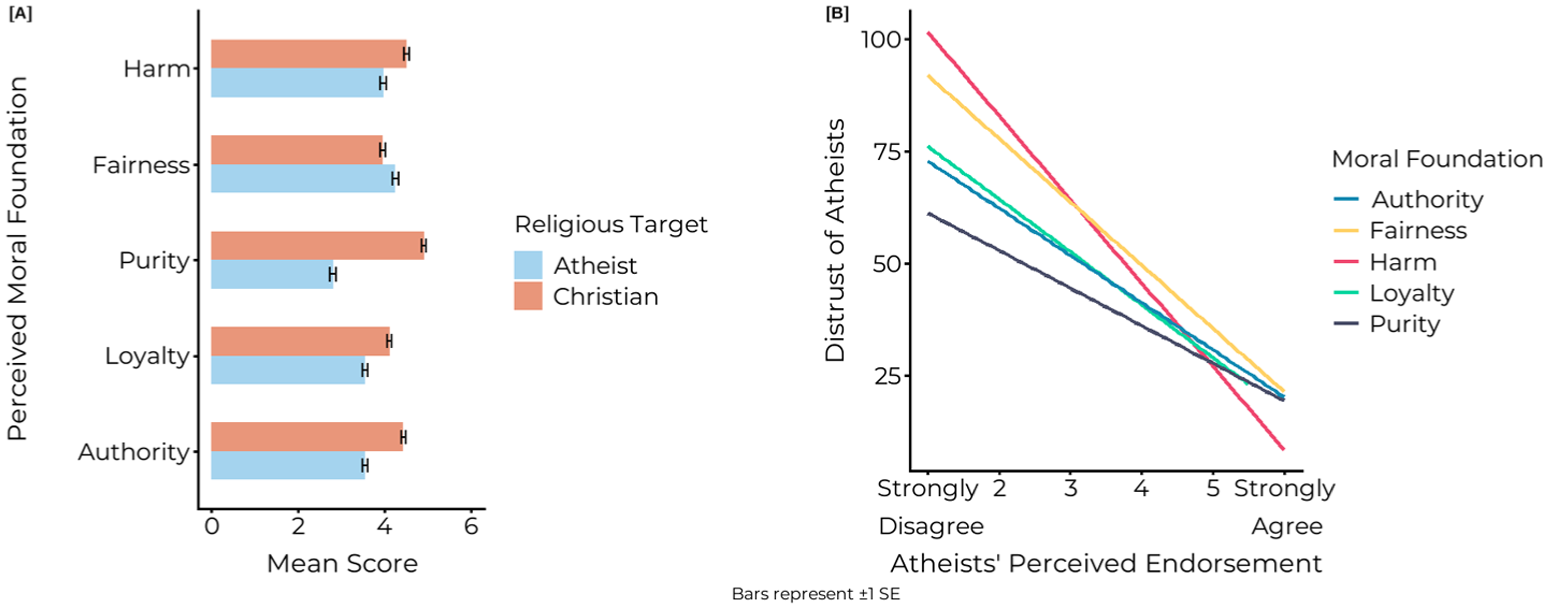
(a) Perceived moral foundations of Christians and atheists and (b) correlations between perceived atheists’ endorsement of the moral foundations and distrust of them: Study 1a.
Perceived Moral Foundations and Distrust
Next, we ran a series of correlations between the perceived moral foundations of atheists and Christians’ distrust of them. Each of these correlations was negative and significant, ranging from r(203) = −.28 for the purity foundation to r(203) = −.61 for the harm foundation. When all five foundations were entered simultaneously in a multiple regression model predicting distrust of atheists, only harm remained a significant predictor of distrust, b = −18.09, t = −6.09, p < .01 (Figure 1b, Table S2).
Dual Path to Distrust of Atheists
As with previous research (Crone & Laham, 2015; Hirsh et al., 2010), there was a high degree of correlation among each of the moral foundations that comprise the individualizing moral foundations as well as among each of the moral foundations that comprise the binding moral ones (Table S4). Moreover, we were interested in creating a more parsimonious model for understanding how moral stereotypes are associated with distrust. Therefore, we used the individualizing foundations index and binding foundations index as predictors in all subsequent analyses. By using the superordinate indexes, the correlation between predictors decreased, r(204) = .46, p < .01.
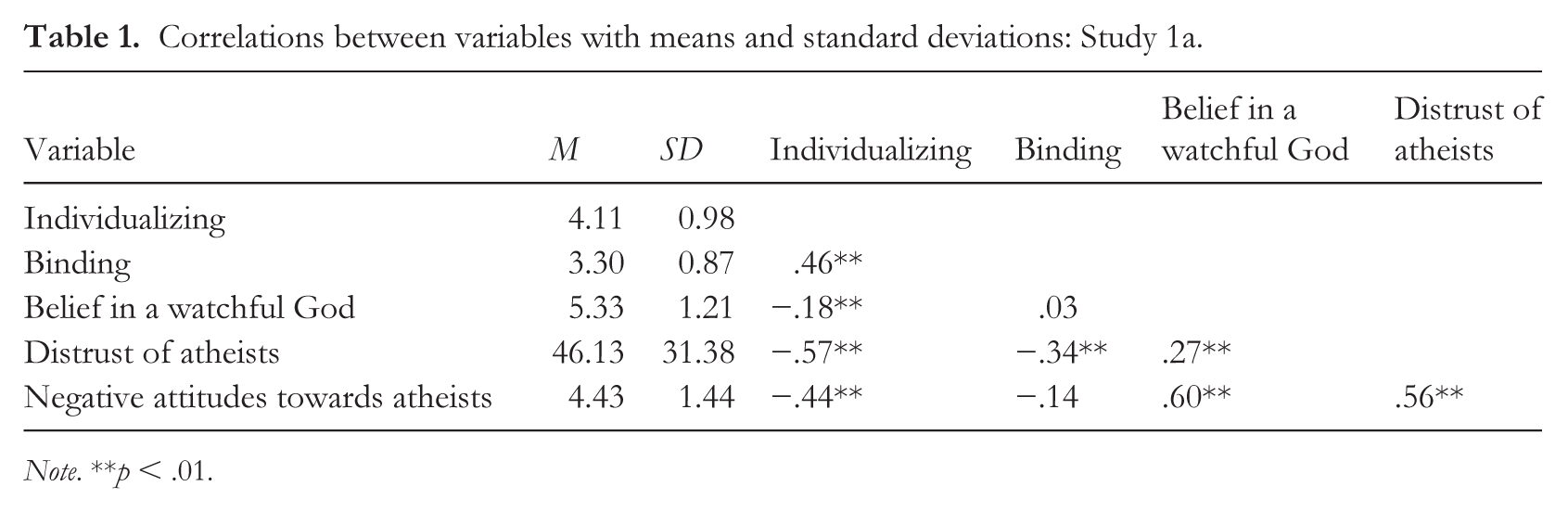
In line with our general hypothesis, both perceptions of atheists’ individualizing, r(203) = − .57, p < .001, and binding moral foundations were significantly negatively correlated with distrust of atheists, r(203) = −.34, p < .001 (Table 1). Next, we used multiple regression to examine whether the two superordinate moral foundations uniquely predict distrust. The individualizing moral foundations index and the binding moral foundations index were entered as independent variables, and distrust of atheists as the dependent variable. Perceptions of the individualizing and binding moral foundations of atheists accounted for 33% of the variance in distrust, F(2, 202) = 50.43, p < .001. However, the individualizing moral foundation index was the only unique predictor of distrust of atheists, b = −17.23, SE = 2.12, t = −8.12, p < .001, η²p = .33; the binding moral foundations index did not predict distrust, b = −3.61, SE = 2.36, t = −1.53, p = .13, η²p = .01. Participants who perceived atheists to be lower on the individualizing morals (i.e., harm and fairness) were more distrusting of them.
Correlations between variables with means and standard deviations: Study 1a.
Note. **p < .01.
In a second step, we added belief in a watchful God as a predictor of distrust of atheists, which accounted for an additional 3% of the variance in distrust, F(3,198) = 37.88, p < .01, R2 = .36. Believing that a watchful God promoted moral behavior was a significant predictor of distrust over and above the two moral foundation indexes; those who believed a watchful God was necessary for moral behavior were more distrusting of atheists, b = 5.00, SE = 1.54, t = 3.26, p = .001, η²p = .05. The individualizing moral foundations index remained a significant predictor, b = −15.72, SE = 2.14, t = −7.34, p = .001, η²p = .34 (Table S3).
Study 1b
In Study 1b, we sought to conceptually replicate and refine Study 1a. Specifically, we improved the belief in a watchful God index to include a third, reverse-coded item to strengthen the reliability of the measure and reduce response bias.
Method
Participants
We conducted an a priori power analysis to determine the minimum sample size needed to detect the smallest correlation from Study 1a (r = .27) with 80% power. The results suggested a minimum sample size of 105. We recruited beyond this minimum to account for anticipated exclusions and to increase the stability and precision of parameter estimates. To this end, 201 American Christians participated in this study via MTurk in 2014. Participants were compensated US$0.50. Eighteen participants were excluded from analyses because they failed the attention check question, could not define what an atheist was, or did not report that they believed in God. The final sample (N = 183) included 58 male and 125 female participants (Mage = 38.10, SD = 13.43). Regarding religious affiliation, 50.8% of participants indicated affiliation with a Protestant denomination, 30.6% indicated they were Catholic, and 18.6% identified as Christian but did not indicate affiliation with a religious denomination.
Procedure and Materials
The procedure and materials for Study 1b were identical to those used in Study 1a, except for the inclusion of an additional belief in a watchful God item, which was reverse-coded: “A person’s belief that God is watching them does NOT help them to behave morally.” This study also contained a measure of entitativity (i.e., groupiness) of atheists for exploratory purposes. However, we do not report those results in this manuscript.
Results
Perceived Moral Foundations of Atheists and Christians
We conducted five within-participants t tests (two-tailed) with a Bonferroni correction (α = .01) that compared perceptions of typical atheists’ and Christians’ moral foundations (Table S5). As in Study 1a, Christian participants perceived atheists to be lower than Christians on four of the five moral foundations. Specifically, participants perceived that atheists were lower on the harm foundation, t(182) = −8.29, p < .001, Mdifference = −0.73, 95% CI [−0.91, −0.56], Cohen’s d = −0.61; the purity foundation, t(182) = −23.37, p < .001, Mdifference = −2.21, 95% CI [−2.40, −2.02], Cohen’s d = −1.73; the loyalty foundation, t(182) = −8.65, p < .001, Mdifference = −0.68, 95% CI [−0.83, −0.52], Cohen’s d = −0.64; and the authority foundation, t(182) = −12.74, p < .001, Mdifference = −0.89, 95% CI [−1.03, −0.75], Cohen’s d = −0.94. In contrast with the results of Study 1a, participants did not perceive atheists to be different than Christians on the fairness foundation, t(182) = 2.31, p = .02, Mdifference = 0.21, 95% CI [0.03, 0.39], Cohen’s d = 0.17 (Figure 2a).
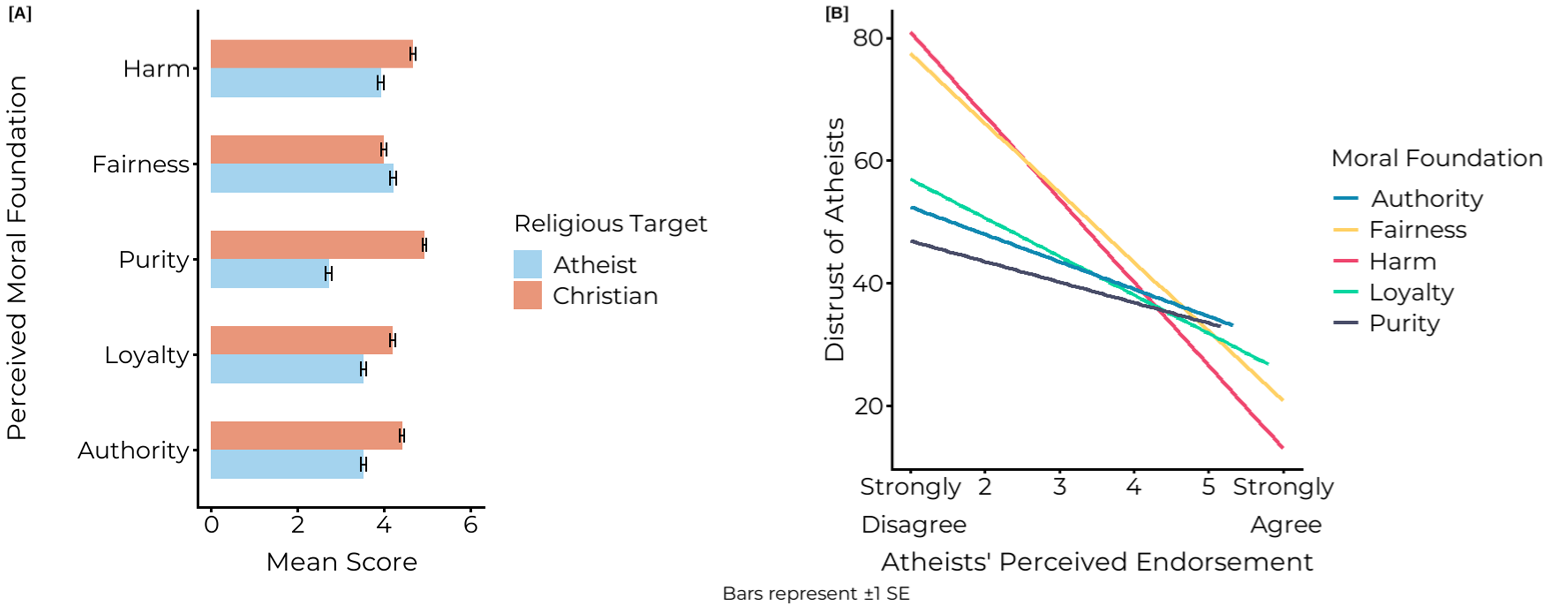
(a) Perceived moral foundations of Christians and atheists and (b) correlations between perceived atheists’ endorsement of the moral foundations and distrust of them: Study 1b.
Perceived Moral Foundations and Distrust
Largely replicating the results of Study 1a, we again found that perceiving atheists as less endorsing of each moral foundation typically predicted greater distrust of them. Again, we ran a series of correlations between each individual moral foundation and distrust of atheists. Harm, fairness, and loyalty were associated with significant distrust of atheists, −.52 < r(181) < −.20. However, unlike Study 1a, authority and purity were not significantly associated with distrust, r(181) = −.14, p = .05 and r(181) = −.12, p = .11, respectively (Figure 2b). In a subsequent analysis, when all five moral foundations were entered simultaneously in a multiple regression, perceived endorsement of harm was the only significant predictor of atheist distrust (b = −13.86, t = −5.28, p < .01; Table S2).
Dual Path to Distrust of Atheists
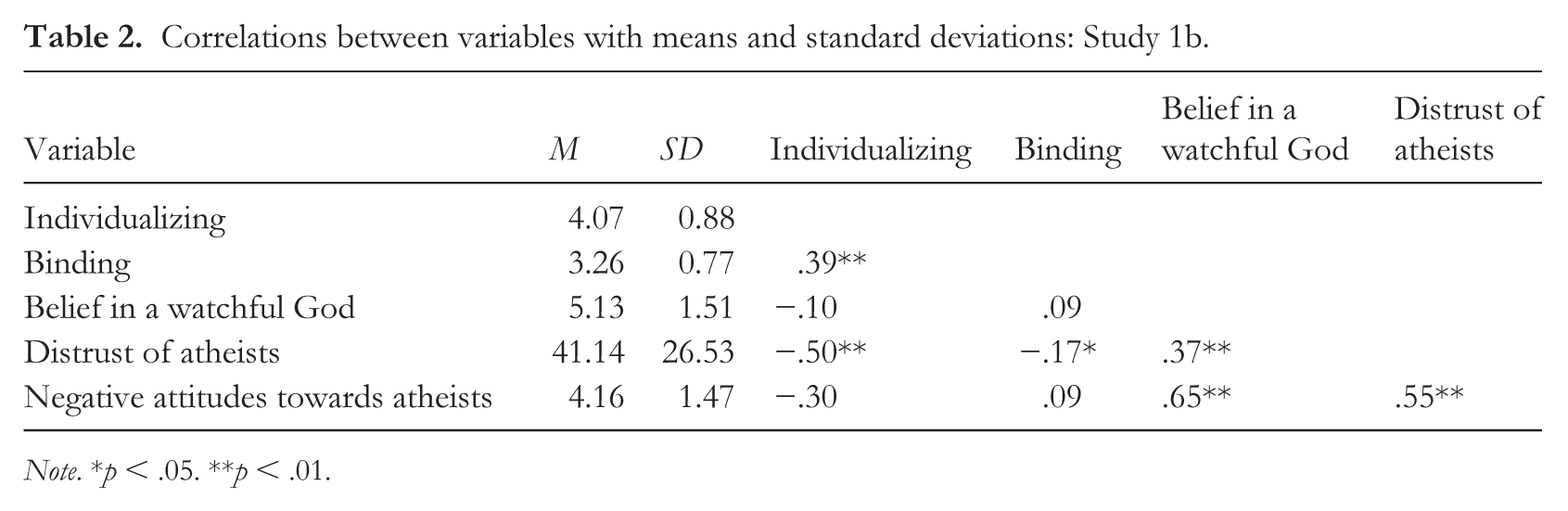
First, as in Study 1a, there was a high degree of association among the foundations that comprise the individualizing and the binding foundations indexes (Table S6). Consequently, we used the superordinate individualizing moral foundations index and the binding moral foundations index in all subsequent analyses. Using the superordinate indexes greatly reduced the correlation between the moral foundations indices, r(181) = .39, p < .01. Additionally, neither the individualizing foundations index, r(180) = −.10, p = .16, nor the binding foundations one, r(180) = .09, p = .25, were correlated with belief in a watchful God.
As predicted, both perceived level of individualizing, r(181) = −.50, p < .001, and binding, r(181) = −.17, p = .02, moral foundations negatively predicted distrust of atheists (Table 2). We then conducted a hierarchical linear regression with the individualizing foundations, binding foundations, and belief in a watchful God predicting distrust. In the first step, we entered participants’ perceptions of the individualizing and binding foundations among atheists. In the second step, we added belief in the importance of a watchful God. In Step 1, perceptions of the individualizing and binding foundations of atheists accounted for 25% of the variance in distrust, F(2, 180) = 30.12, p < .001. As in Study 1a, the Individualizing Moral Foundations Subscale was the only unique predictor of distrust of atheists, b = −15.34, SE = 2.11, t = −7.28, p < .001, η²p = .25; distrust was not uniquely predicted by the binding foundations, b = 0.97, SE = 2.42, t = 0.40, p = .69, η²p < .001.
Correlations between variables with means and standard deviations: Study 1b.
Note. *p < .05. **p < .01.
When we added belief in the importance of a watchful God at Step 2, individualizing foundations continued to predict distrust of atheists, b = −13.77, SE = 1.99, t = −6.91, p < .001, η²p = .27. In line with Gervais et al. (2011) and Study 1a, the moral importance of a watchful God also predicted distrust, b = 5.58, SE = 1.08, t = 5.18, p < .001, η²p = .13. The addition of belief in the importance of a watchful God accounted for an additional 10% of the variance in distrust. The more participants believed in the moral importance of a watchful God, the more they distrusted atheists.
Study 2
In Studies 1a and 1b, perceptions of atheists’ individualizing moral foundations consistently correlated with distrust: the lower participants perceived atheists’ endorsement of individualizing foundations, the more they distrusted them. In 2022, the domains underlying moral foundations theory were reassessed (Atari et al., 2023), following sustained critique regarding the factor structure of the MFQ, particularly its inconsistent performance across different cultural contexts (Iurino & Saucier, 2020; Nilsson, 2023; Wormley et al., 2025; Zakharin & Bates, 2021). This reevaluation led to two major revisions. First, the fairness domain was split into two distinct foundations—proportionality and equality—reflecting the insight that people differ in their conceptualization of fairness. Second, whereas the original MFQ (as featured in Studies 1a and 1b here) relied on both relevance-based and judgment-based items, the revised questionnaire focuses exclusively on participants’ moral judgments, to enhance psychometric precision.
Given these substantial theoretical and methodological updates, it was critical to test whether the patterns observed in Studies 1a and 1b (both run in 2014) would replicate using the revised MFQ. In particular, the division of fairness into proportionality and equality provided a valuable opportunity to clarify earlier findings: in Study 1a (but not Study 1b), fairness was the only domain on which Christians perceived atheists as higher in endorsement. By separately assessing proportionality and equality, we could determine whether the original fairness dimension masked important distinctions in how Christians view atheists’ moral commitments. Thus, we not only sought to replicate our dual-pathway model of distrust with an updated and more psychometrically robust measure, but also to deepen understanding of how different perceptions of fairness-related foundations may contribute to distrust of atheists.
Method
Participants
We conducted an a priori power analysis to determine the minimum sample size needed to detect a correlation of .20, the smallest effect from Study 1b, with 80% power. The results suggested a minimum sample size of 194. Again, we overrecruited to account for potential exclusions. Two hundred and seventy-eight American Christians participated in this study via Prolific in the spring of 2025. Participants were compensated US$2.00. Seven participants were excluded for not identifying as Christian, Catholic, or Mormon; and eight participants were excluded for reporting that they did not believe in God. The final sample (N = 263) included 102 men, 160 women, and one nonbinary person (Mage = 40.10, SD = 14.06). Regarding religious affiliation, 76.4% of participants identified as Christian, 22.8% indicated they were Catholic, and two participants identified as Mormon.
Procedure and Materials
The procedure and materials for Study 2 were similar to those used in Study 1b, except for the use of a modified MFQ-2 (MFQ-2) instead of the original MFQ, on a 5-point scale (1 = strongly disagree, 5 = strongly agree) instead of a 6-point scale. Participants first completed the modified MFQ-2 for Christians and atheists (presented in a random order), followed by the distrust thermometer scale, questionnaires about religious beliefs (including belief in a watchful God and intrinsic religiosity), and demographics.
Results
Perceived Moral Foundations of Atheists and Christians
As with Studies 1a and 1b, we ran a series of t tests to compare Christians’ perceptions of the average Christian’s and the average atheist’s endorsement of the moral foundations, with a Bonferroni correction for multiple comparisons (α = .01). Christian participants perceived atheists to be lower than Christians on most of the moral foundations. Specifically, participants perceived that atheists were lower than Christians on the harm foundation, t(262) = −13.99, p < .001, Mdifference = −0.94, 95% CI [−1.07, −0.80], Cohen’s d = −0.86; the purity foundation, t(262) = −22.45, p < .001, Mdifference = −1.50, 95% CI [−1.63, −1.37], Cohen’s d = −1.38; the loyalty foundation, t(262) = −11.71, p < .001, Mdifference = −0.67, 95% CI [−0.79, −0.56], Cohen’s d = −0.72; and the authority foundation, t(262) = −17.82, p < .001, Mdifference = −1.14, 95% CI [−1.26, −1.01], Cohen’s d = −1.10. Although the first two studies found that Christians rated atheists higher than Christians on the fairness domain, when using the new version of the MFQ, we found that perceived proportionality—but not perceived equality—differed significantly between atheists and Christians. Specifically, atheists were perceived to be lower than Christians on proportionality, t(262) = −4.46, p < .001, Mdifference = −0.25, 95% CI [−0.36, −0.14], Cohen’s d = −0.28, but not on equality, t(262) = 0.14, p = .89, Mdifference = 0.01, 95% CI [−0.14, 0.16], Cohen’s d = 0.01 (Figure 3a).
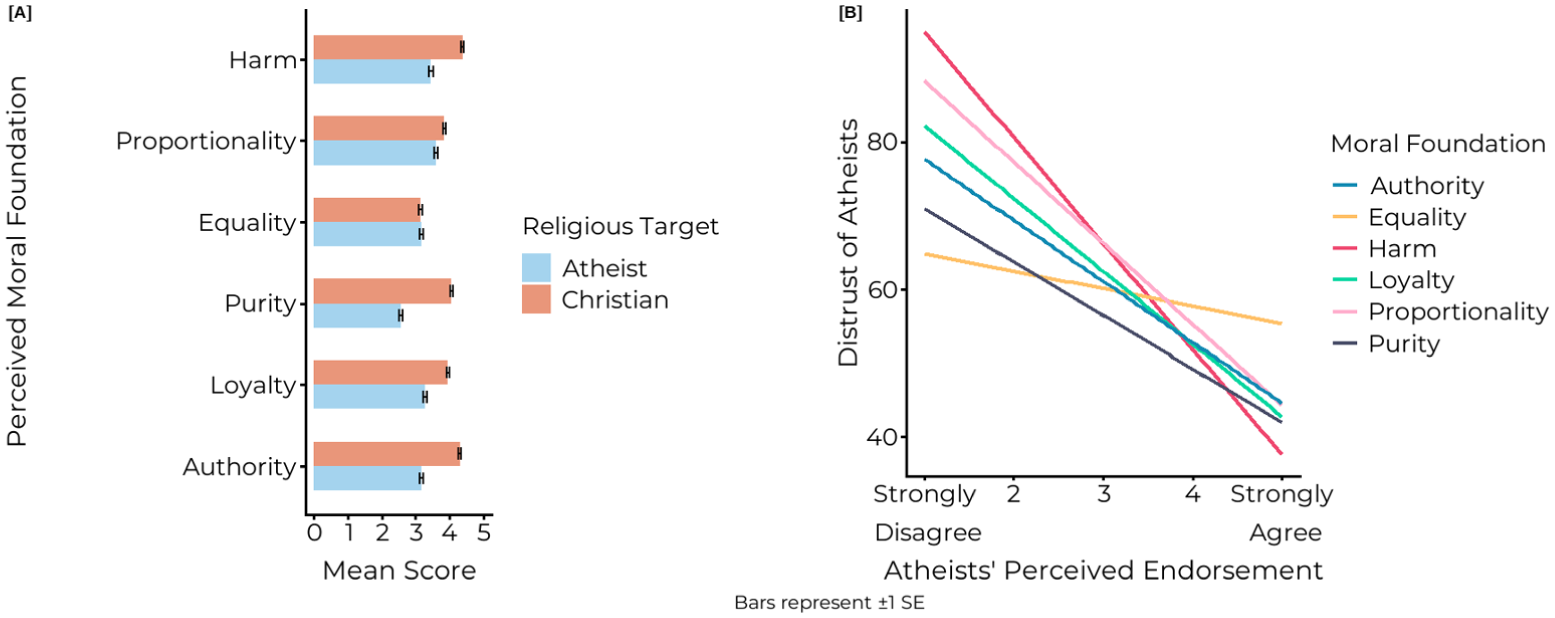
(a) Perceived moral foundations of Christians and atheists and (b) correlations between perceived atheists’ endorsement of the moral foundations and distrust of them: Study 2.
Perceived Moral Foundations and Distrust
Using the new scale, we found that perceived endorsement of each moral foundation (except equality) was significantly associated with distrust of atheists, −.49 < r(251) < −.24 (Figure 3b). The lack of significant correlation between perceived endorsement of equality and distrust of atheists may be attributable to the relatively equivalent scores on perceived endorsement of equality for Christians and atheists. In a multiple regression model predicting distrust of atheists from all six moral foundations simultaneously, both harm, b = −16.01, SE = 2.31, t = −6.92, p < .01, and equality, b = 4.27, SE = 1.87, t = 2.28, p = .02, were significant predictors of distrust. However, the effect of equality was in the opposite direction we predicted—perceiving atheists as being more endorsing of equality was associated with greater distrust among Christians (Table S2).
In Study 2, we also included a similar thermometer measure of trust in Christians. This gave us the opportunity to check for an inverse relationship—are Christians more distrusting of other Christians when they stereotype them as being less endorsing of each of the moral foundations? Indeed, we found that for each of the moral foundations, except equality and proportionality, less perceived endorsement predicted greater distrust, −.32 < r(261) < −.28. Here again, harm was the strongest predictor of distrust in fellow Christians, r(261) = −.32, p < .001.
Dual Path to Distrust of Atheists
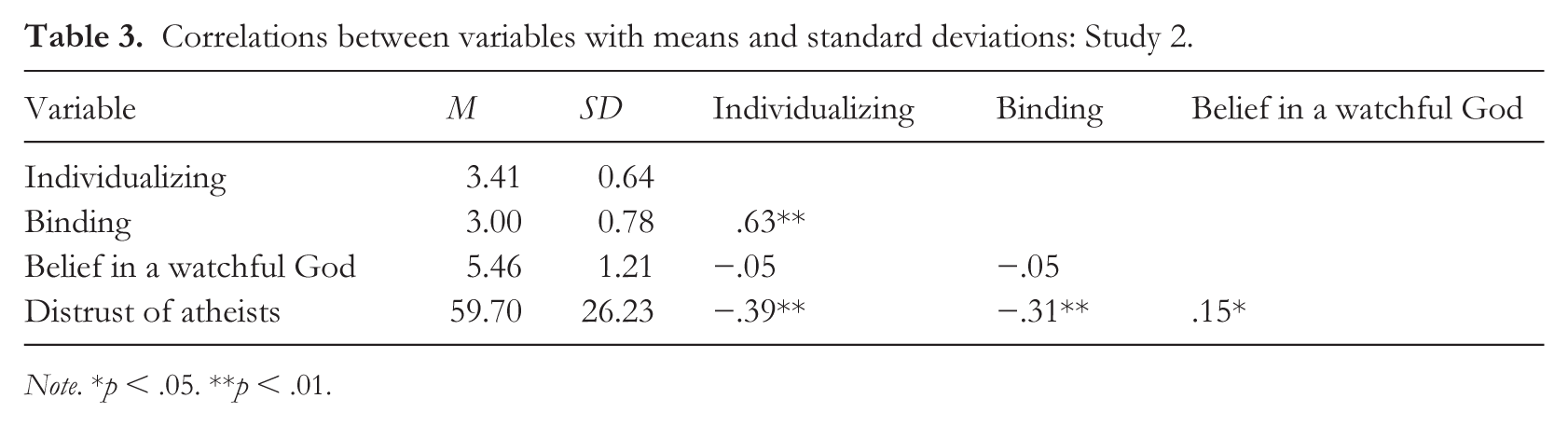
Again, both perceived level of individualizing, r(261) = −.39, p < .001, and of binding moral foundations negatively predicted distrust of atheists, r(261) = −.31, p < .001 (Table 3). In a hierarchical linear regression model, perceptions of the individualizing and binding foundations of atheists accounted for 16% of the variance in distrust, F(2, 260) = 24.47, p < .001. However, only the individualizing moral foundation was a significant predictor of distrust, bind = −13.20, SE = 2.98, t = −4.43, p < .01, η²p = .15; bbind = −3.54, SE = 2.44, t = −1.45, p = .15, η²p = .01. When belief in a watchful God was added to the regression model, the individualizing factor remained a significant predictor, b = −13.03, SE = 2.96, t = −4.40, p < .01, and belief in a watchful God was a significant predictor of distrust, b = 2.77, SE = 1.22, t = 2.27, p = .02, η²p = .02, and its addition increased the R2 to .17 (Table S3).
Correlations between variables with means and standard deviations: Study 2.
Note. *p < .05. **p < .01.
Study 3
As a final study, we sought to run a well-powered replication of Study 2 using a politically diverse sample of American Christians. This study was preregistered (https://osf.io/ezyqn/).
Method
Participants
We conducted an a priori power analysis to determine the minimum sample size needed to detect an effect of f2 = 0.016, the smallest effect from Study 2, with 90% power. The results suggested a minimum sample size of 659. We recruited 709 American Christians to participate in this study via Prolific in the fall of 2025; we chose to overrecruit to account for potential exclusions. We chose a quota sample to get an even distribution of self-identified political conservatives, moderates, and liberals. Participants were compensated US$1.50. Eighteen participants were excluded for not identifying as Christian, Catholic, or Mormon; and 28 were excluded for reporting that they did not believe in God. The final sample (N = 663) included 232 men and 431 women (Mage = 48.36, SD = 14.17). Regarding religious affiliation, 76.3% of participants identified as Christian, 23.1% indicated they were Catholic, and 0.6% identified as Mormon.
Procedure and Materials
The procedure and materials for Study 3 were similar to those used in Study 2. Additionally, we asked participants to rate their agreement with two additional, exploratory, face-valid items: “Fear of God’s punishment keeps most people from doing wrong” and “Without belief in God, atheists have less reason to avoid harming others.” We present the results of these two items in the supplemental material (Table S11).
Results
Perceived Moral Foundations of Atheists and Christians
Replicating the results of Study 2, we found that participants perceived atheists as less endorsing of all the moral foundations relative to Christians, except the equality foundation, t(662) = 2.284, p = .02, Mdifference = 0.10, 95% CI [0.01, 0.19], Cohen’s d = 0.09. Participants perceived atheists to be lower than Christians on the harm foundation, t(662) = −20.02, p < .001, Mdifference = −0.95, 95% CI [−1.04, −0.86], Cohen’s d = −0.78; the proportionality foundation, t(662) = −9.86, p < .001, Mdifference = −0.36, 95% CI [−0.43, −0.29], Cohen’s d = −0.38; the purity foundation, t(662) = −40.64, p < .001, Mdifference = −1.62, 95% CI [−1.70, −1.54], Cohen’s d = −1.58; the loyalty foundation, t(662) = −23.53, p < .001, Mdifference = −0.86, 95% CI [−0.93, −0.79], Cohen’s d = −0.91; and the authority foundation, t(662) = −33.53, p < .001, Mdifference = −1.38, 95% CI [−1.46, −1.29], Cohen’s d = −1.30 (Figure 4a).
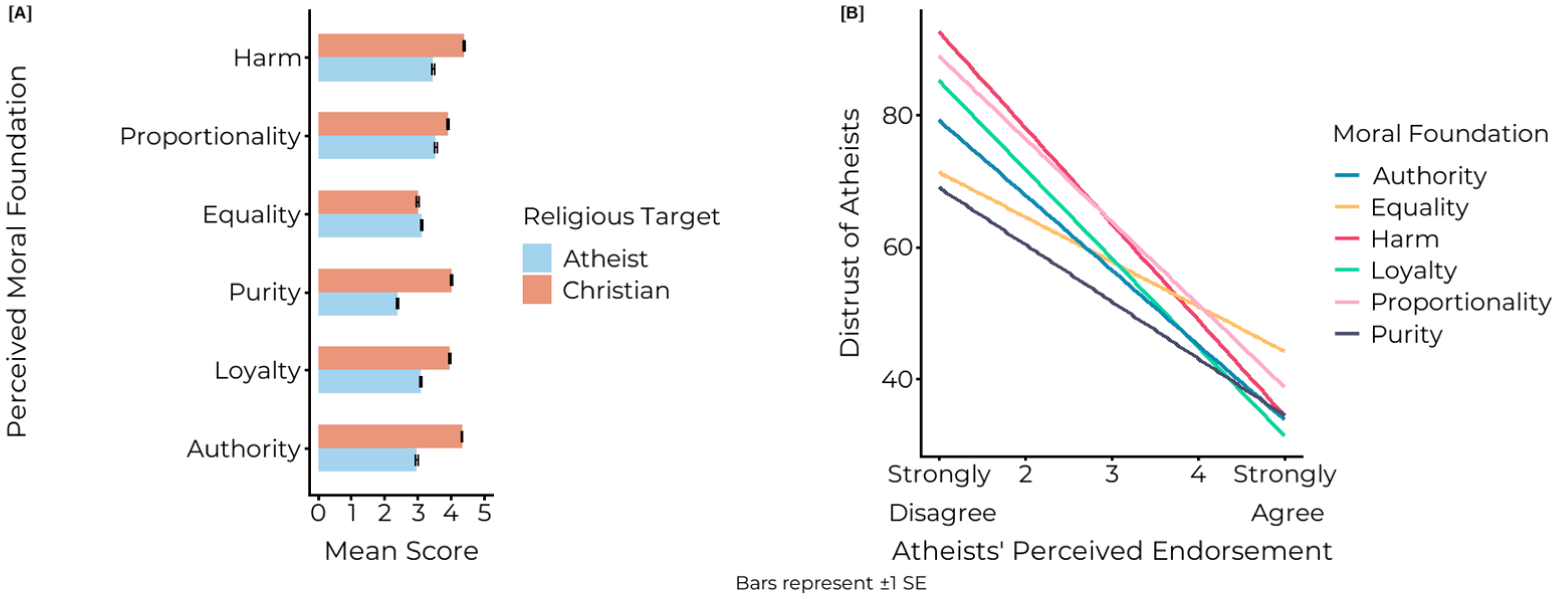
(a) Perceived moral foundations of Christians and atheists and (b) correlations between perceived atheists’ endorsement of the moral foundations and distrust of them: Study 3.
Perceived Moral Foundations and Distrust
All six moral foundations were significantly associated with distrust of atheists, −.54 < r(661) < −.21 (Figure 4b), including equality, which we did not observe in Study 2. In a multiple regression model predicting distrust of atheists from all six moral foundations simultaneously, only harm was a predictor of distrust, b = −12.74, SE = 1.27, t = −10.06, p < .01 (Table S2).
Again, we found that perceptions of lower endorsement of the moral foundations were associated with greater distrust even amongst Christians. Participants who tended to stereotype other Christians as less endorsing of each moral foundation were more distrustful of fellow Christians, −.46 < r(661) < −.12.
Dual Path to Distrust of Atheists
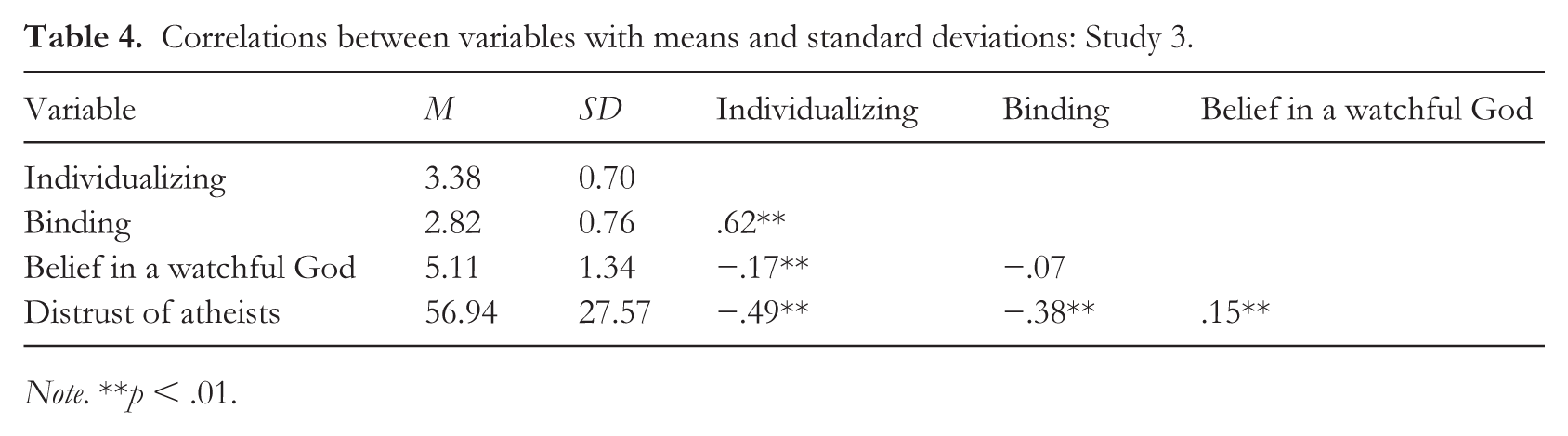
Perceived level of both individualizing, r(661) = −.49, p < .001, and binding moral foundations was negatively associated with greater distrust of atheists, r(661) = −.38, p < .001 (Table 4). In a hierarchical linear regression model, perceptions of atheists’ individualizing and binding foundations accounted for 25% of the variance in distrust, F(2, 660) = 109.75, p < .001. Both individualizing and binding moral foundations were significant predictors of distrust, bind = −16.02, SE = 1.68, t = −9.53, p < .001, η²p = .24; bbind = −4.68, SE = 1.56, t = −3.00, p = .003, η²p = .01. When belief in a watchful God was added to the regression model, both factors remained significant predictors; and belief in a watchful God was also a significant predictor of distrust, b = 1.57, SE = 0.70, t = 2.24, p = .03, η²p = .01; its addition increased the R2 to .26 (Table S3).
Correlations between variables with means and standard deviations: Study 3.
Note. **p < .01.
General Discussion
In the current research, we examined two routes to Christians’ distrust of atheists. Across four studies, we demonstrated that distrust of atheists is jointly and consistently associated with two factors: the perception that atheists place lower emphasis on individualizing moral foundations (i.e., harm and fairness) and the belief that a watchful God encourages moral behavior. We frame these factors as internal and external routes to moral distrust—an intrinsic motivation to do good and a belief in an external moral enforcer. The extent to which atheists are perceived as lacking both an intrinsic commitment to protecting others and the external pressure of divine surveillance is associated with a tendency to view them as fundamentally untrustworthy. It is worth noting that the magnitude of the associations differed across predictors: the effect size for belief in a watchful God was consistently smaller than that of endorsement of the individualizing moral foundations. Although both pathways independently predicted distrust of atheists, this difference in magnitude suggests that moral character concerns may play a comparatively stronger role than theological monitoring beliefs in explaining variation in distrust. At the same time, the consistent independent contribution of belief in a watchful God supports the theoretical distinction between these two routes. Importantly, these findings were consistent across different samples and replicated using both the original and updated versions of the MFQ, strengthening confidence in the robustness of the results.
Our findings make several contributions to the literature on distrust of atheists. First, the research reported herein represents the first systematic comparative examination of Christians’ perceptions of atheists’ moral foundations. Although previous work by Simpson & Rios (2017), Simpson et al. (2019) linked antiatheist prejudice to perceived deficits in the harm foundation, they did not compare perceptions of atheists’ moral endorsement to perceptions of the self-group’s morality. Here, we advance the literature by showing that Christians view atheists as endorsing most moral foundations to a lesser extent than their own group. This perception may stem from the view that atheists lack both a moral community from which to draw ethical values and a divine authority from which to internalize moral truths (Piazza & Landy, 2013). Furthermore, these beliefs were consistently correlated with distrust of atheists—a core component of antiatheist prejudice (Cuddy et al., 2008).
The present findings also clarify the psychological processes underlying why disbelief in God is so closely associated with perceptions of immorality. According to Preston et al. (2010), gods serve not only to monitor behavior through supernatural surveillance but also to establish the very standards by which moral conduct is judged. Thus, atheists may be perceived as morally deficient both because they lack an omniscient moral observer and because they lack access to divinely authorized moral standards. Although these two reasons are conceptually distinct, they converge on the common belief that faith in God is essential to moral reliability. Future research would benefit from disentangling these different forms of perceived moral deficiency of atheists.
Our results align with and extend the findings of Simpson et al. (2017, 2019) in that only the original Individualizing Moral Foundations Subscale—comprising harm and fairness (later, proportionality and equality)—uniquely predicted antiatheist sentiment across all four samples. Since binding moral foundations have theoretically evolved to serve the interests of the ingroup (Graham et al., 2011), it should follow that atheists’ binding values are of little relevance to evaluating their trustworthiness to an outgroup member (Christians, in this study). When using the updated MFQ in Studies 2 and 3, fairness was divided into proportionality and equality. Across both studies, proportionality showed a reliable positive association with distrust of atheists. The association between equality and distrust was smaller and less consistent across samples, emerging in Study 3 but not in Study 2. This pattern suggests that proportionality concerns are the more stable predictor of distrust, whereas the role of equality appears more context- or sample-dependent.
One possible reason for the predictive strength of the individualizing foundations is that religious individuals may believe that understanding how to treat others well—particularly in terms of compassion and protection from harm—can only be taught through religious doctrine. Indeed, most of the world’s moralizing religions include some version of the Golden Rule (i.e., “do to others as you would have them do to you”; Chilton & Neusner, 2008). However, this moral principle is not explicitly associated with atheism, potentially leading to perceptions that atheists are less committed to treating others with care and compassion.
Notably, Christians perceived atheists as lower on the harm foundation compared to fellow Christians, while we observed mixed results for Christians’ perceptions of atheists’ endorsement of the fairness dimension. Yet when harm and fairness were combined into a single individualizing index, perceptions of lower endorsement were generally associated with greater distrust of atheists. This suggests that the harm foundation may be the primary driver of distrust. Indeed, across both Studies 1a and 1b, the correlation between perceived harm endorsement and distrust was stronger than the correlation between perceived fairness endorsement and distrust. A similar pattern was observed in Simpson and Rios (2017), where perceptions of atheists’ harm foundation—but not fairness foundation—were correlated with antiatheist prejudice.
Though we ground this study in moral foundations theory, Gray and Keeney (2015a, 2015b) argue for a domain-general approach to morality centered around harm. The fact that harm seems to be the primary driver of distrust of atheists in our work may speak to the idea that concerns about harm primarily drive moral judgement. Indeed, we found that participants’ endorsement of the statement “Without belief in God, atheists have less reason to avoid harming others” explained approximately 5% of the variance in distrust of atheists, above and beyond other predictors (Table S11). Further consistent with this view, perceptions of atheists’ endorsement of the binding foundations (i.e., loyalty, authority, purity) did not uniquely predict distrust in any study. This likely reflects the outgroup status of atheists: concerns about group loyalty or authority are more relevant within the ingroup and less diagnostic for judging an outsider’s personal trustworthiness. More broadly, stereotypes of atheists as being low in the binding dimension may reflect a general association between religiosity and morality; LaBouff et al. (2017) found that low levels of religiosity are associated with lower endorsement of the binding moral foundations.
Theoretical Contributions
The critical contribution of our findings to the literature is the submission of a broader perspective on distrust of atheists. Here, we propose that because religious people believe that atheists lack an external moralizing agent, they see them as lacking a guide for moral behavior and trustworthiness. Our results support this theoretical proposition but also suggest that religious individuals use another (dis)trust cue—perceived individualizing morals of atheists. Thus, results of the current research suggest a concurrent, dual route to distrust of atheists: an external route through the belief that atheists lack supernatural surveillance and an internal route through perceptions of atheists’ individualizing moral foundations. These pathways are likely related; perhaps because atheists do not believe in a higher power, they are perceived as lower on the moral foundations since any moral violations would seemingly go unpunished. Still, our data suggest that these are distinct routes, each explaining a unique amount of variance in distrust of atheists.
It is important to note that, while the core form of prejudice toward atheists seems to be distrust, our findings concerning perceptions of atheists’ moral foundations may help to reveal and explain other forms of prejudice. For example, work by Franks and Scherr (2014) found that atheist political candidates elicit fear from Christian voters. The perception of atheists as having relatively low harm-based morals may help to explain this observation. Christians may fear atheists primarily because they do not think atheists care for their safety and security. In this light, atheists may also be feared outside of the political domain—a possibility that, alongside distrust, would have significant consequences for discrimination against atheists, with downstream negative consequences for social relationships and well-being (Doane & Elliott, 2015). However, it is also worth noting that atheists are more likely to identify as liberal than conservative (Pew Research Center, 2025). Therefore, politically conservative Christians may be distrusting of atheists’ differing political views, rather than their underlying moral values. Directly assessing perceived ideology of atheists would allow researchers to test this potential political-identity pathway to the distrust of atheists.
Our assessment furthers the relevance of the perceived moral foundations of outgroups by showing that they are useful for predicting distrust. It may thus be productive to examine the predictive capacity of moral foundations for other stereotyped and derogated religious groups. Muslims, for example, are another group that is the target of much prejudice in Western nations (Gerges, 2003; Moore, 2002; Park et al., 2007; Rowatt et al., 2005). Preconceptions held about the moral foundations of Muslims might play a role in negative attitudes toward them. However, this may be a somewhat different role than that played by perceptions of atheists’ moral foundations. It is possible, for example, that people feel threatened by perceptions of Muslims’ loyalty and authority morals because of the implications for adherence to a group that is often stereotyped as hostile toward the West. More generally, when a target person is noted to identify with an apparently threatening outgroup, loyalty and authority foundations may be seen in a more negative light and become negatively, rather than positively, correlated with trust. This remains to be tested.
Our series of studies is especially interesting given the decade that passed between conducting Studies 1a–1b and Studies 2 and 3. Although our results were robust, this is not the case for all studies of atheism. As an example, Mackey et al. (2025) did not replicate the results of Gervais (2011), namely that perceiving atheists as more common was associated with reductions in antiatheist prejudice. However, given changes in intergroup attitudes and a rise in atheism in America (Lipka et al., 2024), perhaps this failure to replicate is not surprising. Nevertheless, our findings remain consistent: believing in a watchful God and perceiving atheists as low on individualizing moral foundations predicts greater distrust of them.
Limitations and Future Directions
Although our studies offer important insights, several limitations warrant consideration. First, because our studies were correlational, causal conclusions cannot be drawn. Though we use the term “routes” to refer to correlated predictors, we were unable to formally test these paths as causal mechanisms. Our model proposes that perceptions of atheists’ moral values drive distrust of them. However, the reverse is equally plausible; Haidt (2001) proposes that moral judgements may be used to justify immediate intuitions (e.g., distrust of a person). Future experiments could utilize paradigms from research on the dual-process model of moral cognition to determine whether fast versus slow moral judgements are better predictors of distrust (Bago & De Neys, 2019). Second, our samples consisted exclusively of American Christians. It remains to be seen whether the dual-route model of distrust generalizes to other religious groups or cultural contexts (e.g., less religious countries than the United States). For instance, individuals from nontheistic traditions, such as Buddhism, may evaluate atheists differently. Even amongst American Christians, we should expect significant variability in distrust of atheists depending upon individual differences, exposure to atheists, and denomination-specific beliefs (Pew Research Center, 2019; Rowatt & Al-Kire, 2021). Nevertheless, we would suspect that this model would hold across cultural and religious contexts because past work has demonstrated that even atheists in secular societies implicitly hold religion in high regard (Gervais et al., 2017, 2025). Third, there may be important differences between the perceptions of never-religious individuals and formerly religious individuals (“religious dones”) who retain residual moral frameworks from their prior religious affiliations (Van Tongeren, 2024). Fourth, the measures used in this series of studies are quite common but not without their limitations. For example, statements around equality and proportionality in the MFQ-2 focus on economic fairness rather than other forms (e.g., social equality), and our measure of distrust was domain-general and not behavior-related (e.g., “Would you be willing to lend $20 to an atheist?”). Certainly, atheists may be more trusted in some domains of life (e.g., medicine) than others (e.g., politics), but this remains to be seen. Finally, future research should investigate whether atheists themselves internalize distrust of other atheists by way of moral perceptions.
Conclusion
Atheists have long been viewed with suspicion and distrust. Our research proposes a potential explanation: atheists are seen as lacking both an internal moral compass and an external moral enforcer. Distrust of atheists, therefore, may be rooted not simply in theological disagreement but in deep-seated concerns about their moral character. By articulating and testing a dual-pathway model of distrust, we move beyond the traditional focus on belief in God to highlight how perceptions of fundamental moral values—especially concern for others’ welfare—shape how nonbelievers are judged. As secularism continues to rise, understanding and addressing these moral stereotypes will be essential for fostering trust, reducing prejudice, and promoting social cohesion across religious divides.
Supplemental Material
sj-docx-1-gpi-10.1177_13684302261438589 – Supplemental material for A Dual Route to Distrust of Atheists: Perceiving Atheists to Lack Individualizing Moral Foundations and an External Moralizing Agent Heightens Christians’ Distrust
Supplemental material, sj-docx-1-gpi-10.1177_13684302261438589 for A Dual Route to Distrust of Atheists: Perceiving Atheists to Lack Individualizing Moral Foundations and an External Moralizing Agent Heightens Christians’ Distrust by Alexandra S. Wormley, Anna Stefaniak, Samantha Hollingshead and Michael J. A. Wohl in Group Processes & Intergroup Relations
Footnotes

Funding
The authors disclosed receipt of the following financial support for the research, authorship, and/or publication of this article: This research was supported by a Social Sciences and Humanities Research Council of Canada Insight Grant (435-2012-1135) to Wohl.
Declaration of Conflicting Interests
The authors declared no potential conflicts of interest with respect to the research, authorship, and/or publication of this article.
Supplemental Material
Supplemental material for this article is available online.
Notes
References
Supplementary Material
Please find the following supplemental material available below.
For Open Access articles published under a Creative Commons License, all supplemental material carries the same license as the article it is associated with.
For non-Open Access articles published, all supplemental material carries a non-exclusive license, and permission requests for re-use of supplemental material or any part of supplemental material shall be sent directly to the copyright owner as specified in the copyright notice associated with the article.
