






Abstract
Racial minorities are expected to be a majority of the U.S. population by 2044. We examined predictors of Americans’ perceptions towards this racial demographic shift (RDS), how accurately they estimate others’ perceptions, and whether an intervention corrects people’s misperceptions. In Study 1, in a nationally representative sample (N = 1,600), most Republicans, Independents, and Democrats viewed the RDS as neutral or good. Being White, conservative, a 2020 Donald Trump voter, endorsing minimization of racism, and endorsing competitive and dangerous worldviews predicted more negative perceptions. Meanwhile, having racially diverse social networks and positive feelings for racial minorities predicted more positive perceptions. In Study 2, a preregistered Prolific experiment (N = 819), Republicans underestimated other Republicans’ and Democrats’ perceptions of this shift. An information-based intervention corrected this, with this effect persisting 1 week later, albeit weaker. Our research suggests that emphasizing more positive ingroup perceptions of the RDS may help correct misperceptions and increase support for racial diversity.
Introduction
The United States (US) is becoming both more diverse and politically polarized. Black, Hispanic, Asian, Indigenous, and multiracial Americans are set to become a majority of the population within the next 20 years (Frey, 2018). Simultaneously, affective polarization in the US, or negative feelings directed towards the opposing political party, is currently higher than ever before (Nadeem, 2022). The confluence of these two realities is important, given that race in the US has been deeply intertwined with politics since the country’s inception, with disparate public policies promoting either discrimination or equity in American history. Today, race and politics continue to be intertwined and polarizing—perhaps especially so—with topics such as immigration and policies promoting racial equity and inclusion rising to the forefront of torrid political discourse (Trump, 2025). Given both the forthcoming racial demographic shift (RDS) and deepening polarization (Druckman et al., 2020; Santoro & Broockman, 2022), we sought to understand how Americans perceive the RDS and how politics and views toward race shape perceptions of this demographic transition.
We also examined how accurate people are in predicting their political ingroup’s and outgroup’s perceptions of the RDS. A rich literature on social influence suggests that people’s perceptions of social norms—what is typical of others within one’s social environment—fundamentally shape their understanding of the social realities in which they are embedded (Katz et al., 1931; Taylor, 1982). These perceptions of norms and social realities can have powerful downstream consequences for collective behaviors and personally held attitudes (Asch, 1956; Sparkman et al., 2022). Of relevance to the present investigation, pluralistic ignorance, which occurs when people live in a false social reality and misestimate the norms of their social groups (Miller, 2023), has been linked to reluctance to adopt new norms that promote greater social equity. For instance, people are less likely to accept women in political office or STEM fields if they perceive that their ingroup does not accept this change (De Souza & Schmader, 2022; Shamir & Shamir, 1997). Here, we explored whether we could correct Republicans’ pluralistic ignorance of their own ingroup’s attitudes towards the RDS and whether doing so would, in turn, affect their own perceptions of the shift.
The Racial Demographic Shift in the US
Burgeoning research on the imminent RDS has largely centered on the perceptions of White Americans, showing that exposure to information about the RDS heightens their perceptions of threat (e.g., Brown et al., 2022; Craig & Richeson, 2014, 2017; Danbold & Huo, 2015; Hodson et al., 2022; Krosch et al., 2022; Stefaniak & Wohl, 2022). Specifically, White Americans tend to perceive greater discrimination against their own racial ingroup (Craig & Richeson, 2014, 2017; Craig et al., 2018) and feel greater existential threat (Bai & Federico, 2021), collective angst (Stefaniak & Wohl, 2022), and nostalgia for their ingroup’s past (Earle & Hodson, 2020; Hodson et al., 2022) upon learning about the RDS. Similarly, White Americans exposed to information about this demographic transition report more negative attitudes towards outgroups, report stronger anti-immigrant sentiments, and render weaker endorsements of diversity (Danbold & Huo, 2015; Earle & Hodson, 2020, 2022).
A related line of inquiry has also begun to examine the intersection of the RDS and politics. Craig and Richeson (2014) found that White Americans who were exposed to the RDS—relative to those who were not—expressed greater conservativism, agreed more with conservative policies, and were more likely to identify with the Republican Party. More recently, a study found that political ideology moderates, rather than shapes, White Americans’ responses to the RDS. Specifically, Brown et al. (2022) showed that White conservatives perceive greater threat to their racial ingroup, while White liberals do not. In the current work, we sought to build on this prior work by collecting a nationally representative sample (stratified based on gender, age, race, and education) of Americans to deepen understanding of how individual factors predict their opinions of the RDS.
These studies also expand upon prior efforts from the Pew Research Center (Budiman, 2020; Krogstad et al., 2021) in which Americans were surveyed on their opinion towards the RDS in 2020 and 2021. In these surveys, 76–88% of Americans found the RDS to be good or neutral, with the majority finding it to be neutral (61–64%). When broken down by political ideology, the Pew Research Center found that Republicans were less likely to find the RDS to be good or neutral (66–81%) in comparison to Democrats (86–95%; Budiman, 2020; Krogstad et al., 2021). Additionally, Black, Asian, and Hispanic adults were also more likely to view the RDS as good or neutral in comparison to White adults (Budiman, 2020; Krogstad et al., 2021). In our first study, we expand on these findings by examining how a range of factors—specifically, race (including one’s racial identity, attitudes toward racial minorities, minimization of racism, and social network diversity), political orientation (ideology, having voted for Donald Trump, and being a viewer of Fox News), American identity, and worldviews (belief in a competitive world and a dangerous world)—predict perceptions of the RDS.
Our 10 hypotheses were preregistered (and can be located at https://aspredicted.org/9mvr-bbv5.pdf). Mirroring prior research, we hypothesized that White individuals (vs. people of color; H1a) and those expressing more politically conservative ideology (H1b) would perceive the RDS more negatively. Moreover, we predicted more negative perceptions among individuals who minimized racism more (H1c), reported less racially diverse social networks (H1d), and expressed colder feelings towards racial minority groups (H1e). In light of a documented increase in racial prejudice among supporters of President Donald Trump during his first presidency (Ruisch & Ferguson, 2022), we predicted that Trump voters would hold more negative views toward the RDS (H1f). Similarly, given that being a viewer of Fox News has consistently been associated with an increase in conservative beliefs (Ash et al., 2024), we also hypothesized that individuals who watched Fox News would report more negative perceptions of the RDS (H1g).
Furthermore, prior research has shown that individuals often conflate Americanness with Whiteness (Devos & Banaji, 2005; Devos & Mohamed, 2014). Accordingly, we hypothesized that individuals who strongly identify with being American would view the RDS more negatively (H1h). With respect to worldviews, previous studies have linked beliefs in a competitive or dangerous world to heightened prejudice toward racial outgroups (Cook et al., 2018) and to hierarchy-enhancing ideologies such as social dominance orientation and right-wing authoritarianism (Perry et al., 2013). Therefore, we predicted that stronger endorsement of a competitive worldview (H1i) and a dangerous worldview (H1j) would be associated with more negative perceptions of the RDS.
Pluralistic Ignorance and Social Issues
Beyond merely exploring the factors that drive perceptions of increasing trends toward racial diversity, we also explored whether a more fundamental, and perhaps even more malleable, social psychological phenomenon might be at play. Namely, although prior research has shown that Republicans, on average, hold more negative views of the RDS compared to Democrats, the majority of Republicans do not actually perceive the shift negatively (Budiman, 2020; Krogstad et al., 2021), a finding that may run counter to common assumptions. Thus, we also aimed to examine (a) whether Republicans might misperceive their ingroup’s (i.e., other Republicans’) views toward the RDS, and (b) whether providing accurate information about these views could correct this misperception and, in turn, improve Republicans’ own attitudes toward the RDS.
Decades of research on pluralistic ignorance, the tendency for individuals to misperceive the attitudes, values, and beliefs of their own group members (Miller, 2023), have shown that such misjudgments about social norms can significantly hinder progress by obstructing shifts toward a new normal. People are remarkably reluctant to dissent from the norms of their group (Asch, 1956), a phenomenon which can adaptively promote group cohesion and cooperation (Allison, 1992; Axelrod, 1986). But when people converge in misestimating the norms of their groups, a false social reality can come to characterize collective perceptions of the status quo, stifling dissent from norms that, albeit illusory, appear widely endorsed and therefore remain unchallenged (Miller, 2023). A striking example of pluralistic ignorance occurred in the aftermath of the Civil Rights Movement, when many White Americans mistakenly believed that most other White Americans still supported racial segregation (Fields & Schuman, 1976).
Yet the power of norms and the dangerous consequences of pluralistic ignorance are not merely relics of the past. Even today, people are less likely to personally endorse gender equality in the workplace when they believe others do not share their views (Bursztyn et al., 2020; De Souza & Schmader, 2022; Shamir & Shamir, 1997). Recent research on climate change and pro-environmental policies reveals a similar pattern: Republicans tend to underestimate the extent to which other Republicans support climate policies, in turn hampering their own willingness to publicly support climate action (Dixon et al., 2024; Goldberg et al., 2020). These effects are pervasive, having been replicated in nationally representative samples of the general American public (Sparkman et al., 2022) and in globally representative samples of countries spanning the globe (Andre et al., 2024; Geiger & Swim, 2016). Because perceived group norms powerfully shape individual behavior, leading people to often act in ways that align with what they believe their ingroup supports (Jachimowicz et al., 2018), correcting such misperceptions is essential. Left uncorrected, these misbeliefs may hinder collective action and stall progress in solving some of the most pressing ills facing society (Miller, 2023).
Building on prior work on pluralistic ignorance, our research is the first to investigate this phenomenon in the context of the RDS. Specifically, we examined whether Republicans misperceive their ingroup’s attitudes toward the RDS, anticipating that they would underestimate fellow Republicans’ support and assume others view the shift more negatively than they actually do. We further tested whether these misperceptions could be corrected, and whether accurate information would, in turn, increase personal support for the RDS. Prior research on climate change and concern for future generations has shown that correcting pluralistic ignorance can boost willingness to discuss climate issues (Geiger & Swim, 2016) and increase individual support for related initiatives (Law et al., 2025). Consistent with these findings, we hypothesized that correcting Republicans’ misperceptions about their ingroup’s views would lead to greater personal support for the RDS.
Ultimately, despite the growing literature on reactions to the racial demographic shift (e.g., Brown et al., 2022; Craig & Richeson, 2014, 2017; Danbold & Huo, 2015; Hodson et al., 2022; Krosch et al., 2022; Stefaniak & Wohl, 2022), several gaps remain. Prior work has largely examined how White Americans respond to information about the RDS, emphasizing perceived threat and downstream political consequences. Less is known about how perceptions of the RDS vary across the broader U.S. population; or how race, political orientation, and other influential factors (e.g., worldviews, media use, and social context) jointly shape these perceptions at scale. Study 1 addresses these gaps using a nationally representative sample to provide an integrative test of demographic, political, identity-based, and worldview predictors of RDS evaluations. This design allows us to assess the relative strength of these predictors and test whether prior patterns generalize beyond predominantly White samples and experimental settings. Study 2 then builds on these insights by evaluating an information-based intervention aimed at correcting misperceptions about the RDS.
The Present Studies
In the present research, we conducted two studies to examine (a) the factors that predict individuals’ support for the RDS toward a majority-minority America, (b) whether Republicans exhibit pluralistic ignorance by underestimating their ingroup’s support for the RDS, and (c) whether these misperceptions can be corrected. Study 1, a correlational, cross-sectional investigation utilizing a nationally representative sample, examined how race (participants’ own race as well as their views towards race), political ideology, American identity, and worldviews relate to support for the RDS. In Study 2, a longitudinal experiment, we recruited Republican participants and asked them to estimate the percentage of other Republicans who supported the RDS, as well as to report their own levels of support. At Time 1, participants were randomly assigned to either an experimental or control condition. Those in the experimental condition were presented with accurate information about actual levels of Republican support for the RDS and were then asked to provide updated estimates. At Time 2, conducted 1 week later, participants in both conditions again reported their perceptions of other Republicans’ support for the RDS, along with their own personal views.
Materials for both studies are available on the Open Science Framework (OSF; https://osf.io/tw6yj) platform. Preregistration links for the studies can be found before the Methods section of each study below.
Study 1
The goal of our first study was to assess how Americans perceive the projected RDS in the US—specifically, the transition toward a majority-minority population over the next 25 to 30 years. We measured whether individuals viewed this shift positively, neutrally, or negatively, and examined candidate factors that might predict these perceptions. Hypotheses, analyses, and measures used in the study were preregistered (and can be viewed at https://aspredicted.org/9mvr-bbv5.pdf). 1
Methods
Participants
A nationally representative U.S. sample of participants was recruited in 2021 through YouGov’s existing panel. This sampling strategy involved stratification based on demographic characteristics from various sources. 2 Prior to data delivery, YouGov screened responses for quality, excluding participants who responded too quickly, failed attention checks, provided nonsensical open-ended responses, or had missing data. The final dataset provided by YouGov included responses from 1,600 participants (Nmale = 717, Nfemale = 883; NWhite = 1,071, NBlack = 181, NHispanic = 207, NAsian = 56). The average age was 51.7 years (M = 48.53, SD = 17.32).
Measures
To gauge participants’ reactions to the forecasted shift in U.S. racial demographics, we asked them: According to the U.S. Census Bureau, in the next 25 to 30 years, African Americans, Latinos, multiracial Americans, and people of Asian descent will make up a majority of the population. In general, do you think that this change will be. . .
Their responses were captured on a 5-point Likert scale (1 = very bad for the country, 2 = somewhat bad for the country, 3 = neither good nor bad for the country, 4 = somewhat good for the country, 5 = very good for the country).
Predictors
We preregistered that the following variables would significantly and negatively predict positive attitudes toward the US becoming a majority-minority country. Specifically, we hypothesized that individuals who identified as White (measured with a binary item: 1 = White, 0 = other), were more politically conservative (measured on a 5-point Likert scale; 1 = very liberal, 5 = very conservative), and scored higher on a measure of minimization of racism (three items; α = .76; e.g., “Racial problems in the US are rare, isolated situations,” “White people in the US have certain advantages because of the color of their skin” [reverse-coded], “I am angry that racism exists” [reverse-coded]) would report less positive attitudes. We also expected less positive attitudes among those who ascribed greater importance to their American identity (single item; 1 = not at all important, 5 = extremely important), reported watching Fox News (binary; 1 = yes, 0 = no), and endorsed more competitive (four items; α = .47) and dangerous (four items; α = .61) worldviews, both measured on 5-point Likert scales (1 = strongly disagree, 5 = strongly agree). Additionally, we hypothesized that individuals with lower racial network diversity (three items; α = .67; i.e., how many of the participant’s friends were Black, Asian, or Hispanic, rated on a 5-point scale; 1 = none at all, 5 = all), those expressing more negative feelings toward racial minority groups (three items assessing feelings toward Black, Asian, and Hispanic people; α = .86; 1 = very negative, 5 = very positive), and those who reported voting for Donald Trump in the 2020 presidential election (binary; 1 = voted, 0 = did not vote) would express less positive attitudes toward the demographic shift.
Results
Weights provided by YouGov were incorporated in our analysis to approximate the demography of the U.S. population.
A Majority Of Americans Are Neutral or Positive Towards the Majority-Minority RDS
First, we inspected the frequency with which all Americans, Republicans, Democrats, and independents responded to our primary item assessing perceptions of the RDS in the US in the next 25–30 years. Figure 1a–c provides this breakdown for (a) the full sample, (b) White Americans, and (c) People of Color.
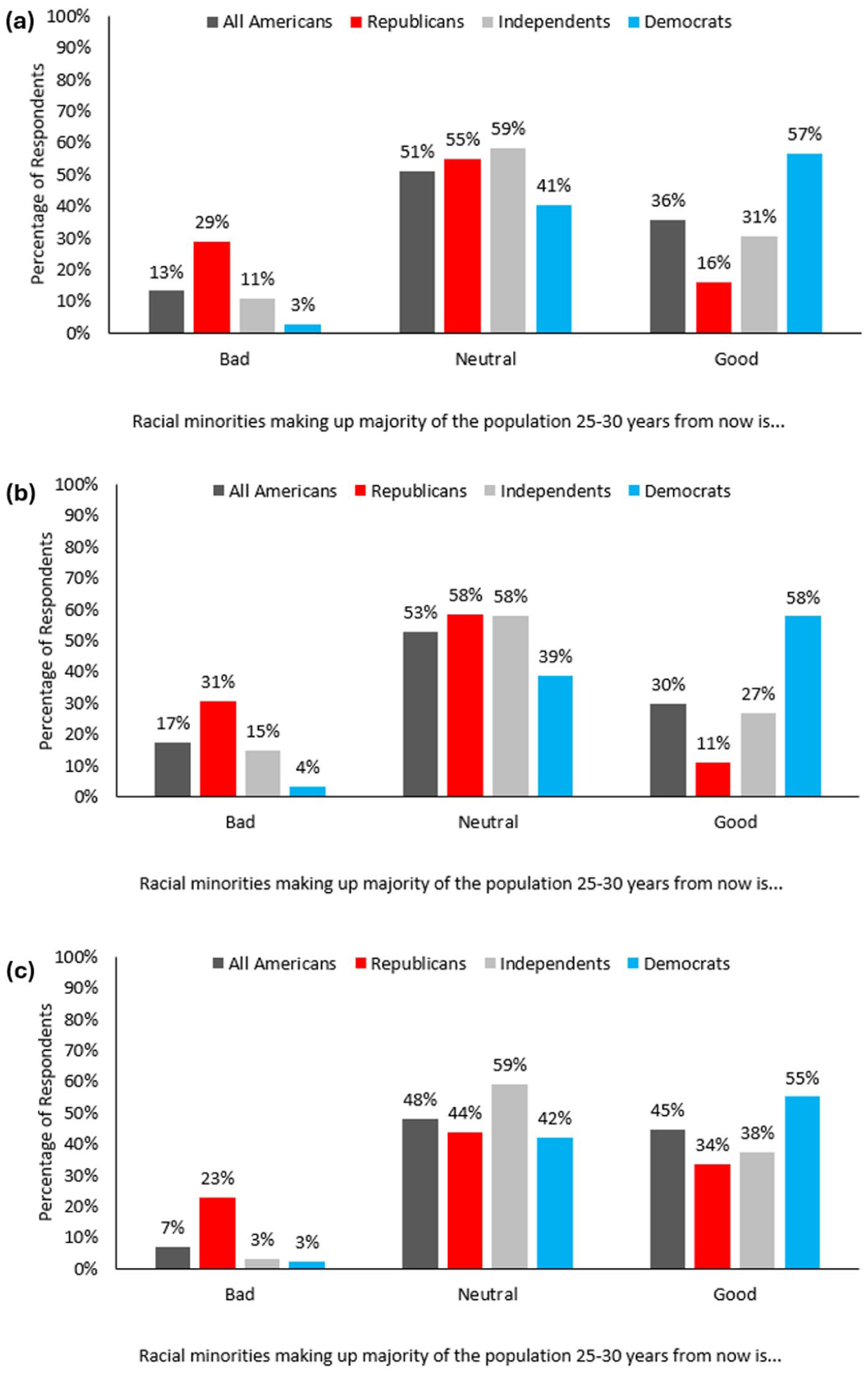
Perceptions of the majority-minority racial demographic shift in in the US across all races/ethnicities (a), for White Americans (b), and for People of Color (c).
Overall, across racial/ethnic groups, we found relatively consistent patterns in perception of the RDS. The vast majority of Americans tended to see the RDS as neutral or good (87% of all Americans, 83% of White Americans, 93% of People of Color). When we evaluated perceptions by political party affiliation, Democrats reported the most positive and/or neutral perceptions of the RDS (98%), followed by independents (90%), and, finally, Republicans (71%). Importantly, however, even for White Republicans, neutral and positive perceptions represented the majority perception (69%).
Predictors of Attitudes Towards the Majority-Minority RDS
We preregistered that we would evaluate the predictors both individually and concurrently. Table 1 presents the results of all estimated regression models. When examined independently, all hypothesized predictors were significantly associated with attitudes toward the majority-minority RDS in the preregistered direction. When entered simultaneously into a single model, the predictors collectively accounted for a greater portion of variance in the outcome (adjusted R² = .46). However, in this full model, two predictors—importance of American identity and Fox News consumption—were no longer statistically significant.
Linear Regressions Predicting Attitudes Towards the Majority Minority Racial Demographic Shift Separately for Each Predictor (Model 1) and Concurrently for All Predictors (Model 2).
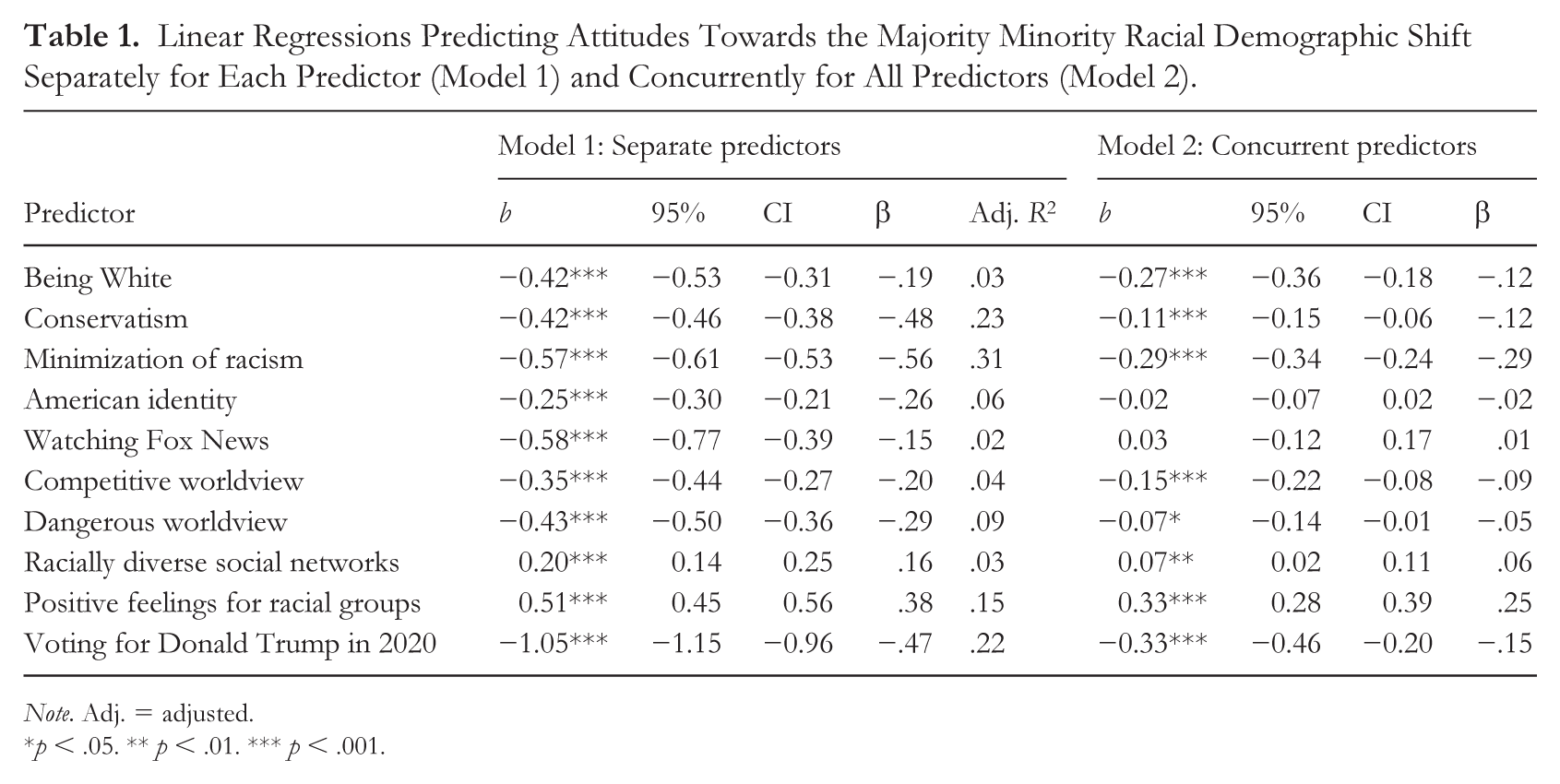
Note. Adj. = adjusted.
p < .05. ** p < .01. *** p < .001.
Discussion
Two key findings emerge from our first study. First, a projected shift in the U.S. racial demographic composition toward a majority-minority population is not perceived as explicitly negative by most Americans. Instead, attitudes toward this shift tend to be neutral or positive, largely outweighing negative attitudes. Importantly, this pattern holds across political affiliations and racial groups.
Second, the linear regression analyses reveal important insights into the psychological and ideological factors that underlie attitudes toward this demographic change. Identifying as White, holding conservative political beliefs, and having voted for Donald Trump each uniquely and negatively predicted attitudes toward the shift. These findings align with previous work showing that White conservatives tend to respond defensively to information about increasing racial diversity in the US (Craig & Richeson, 2014). Also in line with our predictions, higher minimization of racism was also associated with more negative evaluations of the demographic change. Moreover, stronger endorsement of competitive and dangerous worldviews was linked to more negative attitudes, suggesting that individuals may view the shift as posing a symbolic or realistic threat. These worldviews have been consistently associated with prejudice and threat sensitivity (Perry et al., 2013), offering a plausible framework for interpreting these results. Finally, consistent with intergroup contact theory (Van Assche et al., 2023), individuals who reported more racially diverse social networks and more positive attitudes toward racial minority groups expressed more positive attitudes toward the demographic shift.
Although multiple predictors were statistically significant, their associations with attitudes toward the RDS differed markedly in magnitude. The strongest correlates were variables most directly tied to intergroup affect and defensiveness about demographic change. In particular, more positive feelings toward racial minority groups showed the largest positive association with RDS evaluations, whereas indicators of perceived group threat or resistance to demographic change (e.g., such as minimization of racism, voting for Donald Trump, and identifying as White) showed comparatively larger negative associations. By contrast, broader, more distal belief systems (competitive and dangerous worldviews) were reliably related to RDS attitudes but with smaller effects. This pattern is consistent with the possibility that evaluations of the RDS are shaped most strongly by proximal intergroup attitudes and identity-relevant political orientations, while general worldview beliefs exert a weaker, downstream influence.
Ultimately, these findings point to potential ideological and psychological mechanisms that may underlie perceptions of increasing diversity, and also highlight potential pathways for reducing negative reactions to the RDS.
Study 2
In our second and final study, we conducted a preregistered experiment (https://aspredicted.org/vdp9-8wr2.pdf) in the lead-up to the November 2024 U.S. presidential election, followed by a postelection survey 1 week later (https://aspredicted.org/vy4c-tfmw.pdf). This study had three main goals. First, we tested whether Republicans, who we identified in our first study as the group least supportive of the projected majority-minority RDS, would underestimate the extent to which other Republicans hold neutral or positive attitudes toward the shift. Second, we examined whether simply presenting participants with accurate summary statistics about Republicans’ actual attitudes toward the RDS could reduce misperceptions and, in turn, increase participants’ own positive perceptions of the shift. Finally, in an exploratory analysis, we investigated whether individuals’ perceptions of how their ingroup feels about the RDS were associated with their own attitudes toward it. All data, code, and survey materials for Study 2 are publicly available on the OSF.
Methods
Participants
Utilizing Prolific’s screening criteria, we recruited participants who self-identified as Republican. A total of 820 participants were recruited. An additional participant completed the survey but did not submit it for remuneration. As per our preregistered exclusion criteria, two participants had duplicate IP addresses with identical age and gender values and were thus removed from the study. Thus, a total of 819 participants were retained (Nmale = 405, Nfemale = 410; NWhite = 651, NBlack = 113, NAsian = 28). The average age was 42.83 years (SD = 13.76). At T2, 609 participants (74% of the original sample) completed the survey (Nmale = 290, Nfemale = 316; NWhite = 495, NBlack = 78, NAsian = 20). At T2, the average age was 43.84 years (SD = 13.85). Data collection for T1 was conducted 4 days prior to the 2024 presidential election, and data collection for T2, 3 days after the 2024 presidential election.
Procedure
Participants were randomly assigned to one of two conditions at T1. In the treatment condition, participants provided a starting estimate of the percentage of Republicans who believe that the RDS in the US will be neutral (neither good nor bad) or good for the country. Then, we provided them with the actual percentage based on the estimates obtained from Study 1. Participants were provided with the following prompt and accompanying figure (see Figure 2): Below is the true percentage of Republicans who thought that African Americans, Latinos, multiracial Americans, and people of Asian descent making up a majority of the population of the US in the next 25 to 30 years would be good/neutral/bad for the country. The poll showed that 71% of Republicans find this shift to be neutral or good for the US.
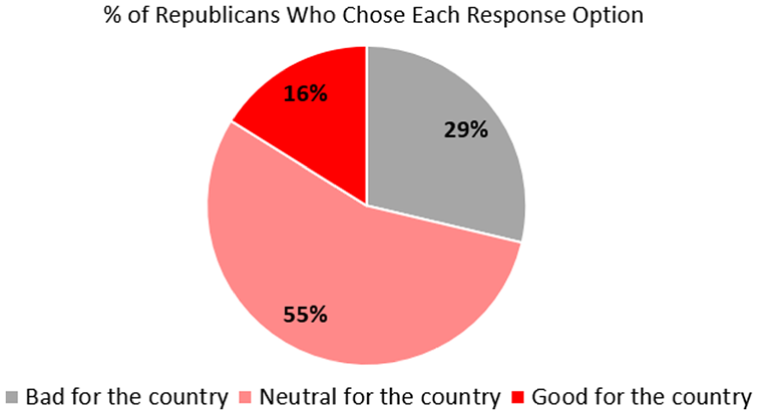
Stimulus used in the treatment condition based on results from Study 1.
Participants were then allowed to reestimate the percentage of Republicans who saw the RDS as bad, neutral, or good, and then provided their own personal views of the shift, as well as what they thought Democrats’ perceptions would be. In the control condition, participants only estimated Republicans’ perceptions once, skipping any exposure to stimuli and instead completing the remainder of the survey. At T2, participants again provided their estimate of Republicans’ views towards the RDS, as well as their own views towards it.
Materials
Table 2 offers an overview of the procedures for both conditions.
Overview of the Procedure and Measures Completed at Both Time Points for Each Condition.
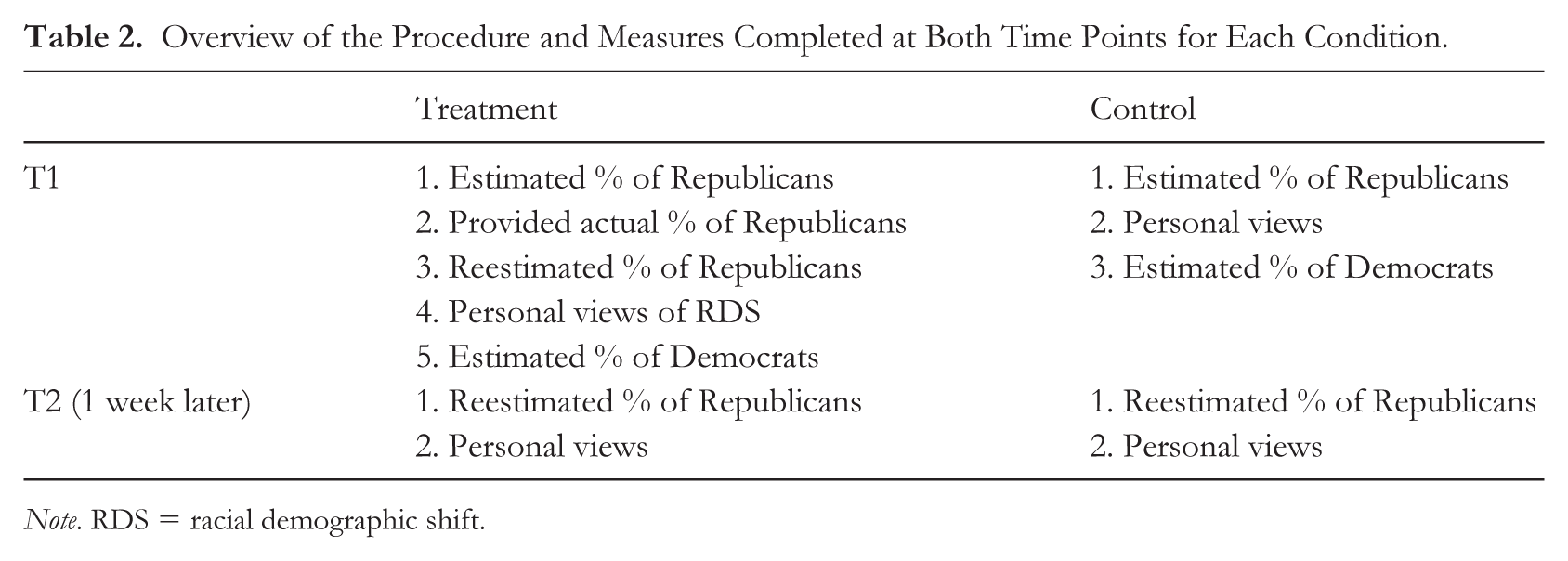
Note. RDS = racial demographic shift.
Perception of Other Republicans’ Views
The following prompt preceded the three items used to capture perceptions of other Republicans’ views of the RDS: YouGov, a global, nonpartisan public opinion and data company, surveyed a representative sample of Americans, asking them the following question: “According to the U.S. Census Bureau, in the next 25 to 30 years, African Americans, Latinos, multiracial Americans, and people of Asian descent will make up a majority of the population. In general, do you think that this change will be good/bad/neutral for the country?” We are interested in obtaining your best estimate of the percentage (%) of Republicans who indicated each response option. Please allocate the 100% to each of the three boxes below as you see fit. Please note that it must be a total of 100 across the three boxes. If you think a specific category is 100, then the rest would be 0.
Participants were then provided with three text boxes which allowed them to input values reflecting their estimates for the percentage of Republicans who saw the RDS as bad, neutral (neither good nor bad), or good. As preregistered, we averaged the neutral and good percentages to form our outcome of interest. For the treatment condition, measurement occurred twice (pre- and postintervention). For both conditions, this measure was repeated in the T2 survey.
Personal views
To capture participants’ personal views toward the RDS, they were provided with the following prompt: Now, consider your own personal belief to this statement, and express it using the scale provided below. “According to the U.S. Census Bureau, in the next 25 to 30 years, African Americans, Latinos, multiracial Americans, and people of Asian descent will make up a majority of the population. In general, do you think that this change will be. . .
The prompt above was followed by a 5-point Likert scale (1 = very bad for the country, 5 = very good for the country, with 3 = neither good nor bad for the country). This measure was repeated in the T2 survey.
Perceptions of Democrats’ Views
Participants were also provided with the following prompt, followed by three text boxes which allowed them to input values reflecting their estimates for the percentage of Democrats who saw the RDS as bad, neutral (neither good nor bad), or good: Finally, we want you to consider the same poll which asked the following question to a representative sample of Americans: “According to the U.S. Census Bureau, in the next 25 to 30 years, African Americans, Latinos, multiracial Americans, and people of Asian descent will make up a majority of the population. In general, do you think that this change will be good/bad/neutral for the country?” Now, we are interested in obtaining your best estimate of the percentage (%) of Democrats who indicated each response option. Please allocate the 100% to each of the three boxes below as you see fit. Please note that it must be a total of 100 across the three boxes. If you think a specific category is 100, then the rest would be 0.
This measure was not included in the T2 survey. Again, we averaged the neutral and good percentages to form our outcome of interest.
Results
Sensitivity Analysis
At T1, we had 412 participants in the control and 407 participants in the treatment group. Based on sensitivity analysis conducted with G*Power Version 3.1.9.7 (Faul et al., 2009), with power of .80 and alpha of .05 for a two-tailed test, we could meaningfully detect effect sizes as small as d = 0.20 for independent samples t tests, d = 0.14 for paired samples t tests, and ρ = .10 for bivariate correlations. At T2, 301 participants from the control and 309 participants from the treatment group completed the survey, allowing us to meaningfully detect effect sizes as small as d = 0.23 for independent samples t tests, d = 0.16 for paired samples t tests (for the control condition), and f = .07 for repeated measures analyses of variance (ANOVAs) with three measurements (for the treatment condition).
Republicans Misperceive Other Republicans’ Perceptions of the RDS
Supporting our hypothesis, Republicans underestimated the percentage of fellow Republicans who held neutral or positive views toward the RDS by an average of 12 percentage points, t(818) = −13.86, p < .001, d = −0.48, M = 60.29, SD = 24.19. 3
Exposure to the Correct Information Corrects Misperceptions but Does Not Increase Support
Within-Subjects Effect of Treatment
As predicted, participants in the treatment condition reported significantly greater and, on average, more accurate estimates of fellow Republicans’ perceptions of the RDS following the treatment stimulus, t(406) = 12.52, p < .001, d = 0.54; pretreatment: M = 60.31, SD = 25.08; posttreatment: M = 72.83, SD = 15.61.
Between-Subjects Effect of Treatment
Supporting our hypothesis, comparing the posttreatment score (M = 72.83, SD = 15.61) with the score from the control condition (M = 60.27, SD = 23.29) also revealed a significant difference, with the treatment group estimating the percentage of Republicans who had a neutral or positive view of the RDS more accurately, t(719.19) = 9.08, p < .001, d = 0.63. However, no significant effect of the treatment was observed for participants’ own perceptions of the RDS, t(815) = 0.99, p = .322, d = 0.07, with both groups reporting on average that the RDS would be “somewhat good for the country” (i.e., a value of 4; Mtreatment = 3.98, SDtreatment = 1.68; Mcontrol = 3.85, SDcontrol = 1.70).
Changes From Pre- to Postelection
Treatment Condition
Significant variation was noted across the three measurements, F(2, 616) = 46.91, p < .001, η2p = .13 (see Figure 3 for a visual depiction of these scores). Planned contrasts elucidated that participants’ estimates of the percentage of fellow Republicans who found the RDS neutral or good for the country were higher at T2 than the pretreatment scores at T1, F(1, 308) = 10.28, p = .001, η2p = .03. However, percentage estimates at T2 were lower than the posttreatment estimates measured immediately after the intervention stimulus, F(1, 308) = 38.58, p < .001, η2p = .11.
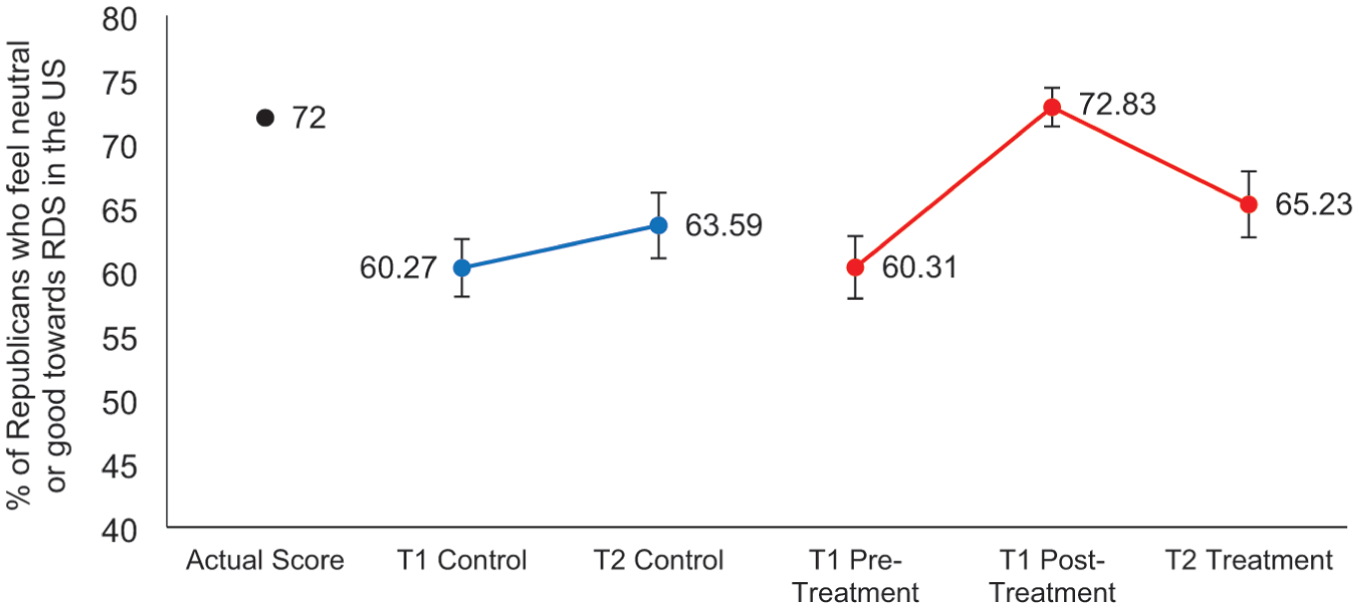
Scores and 95% CI for the actual percentage, and estimated percentages in the treatment and control conditions at T1 postintervention (for the treatment) and T2.
Control Condition
Unexpectedly, participants in the control condition scored significantly higher 1 week later, t(300) = 4.37, p < .001, d = 0.25.
Differences by Condition
Although T2 scores in the treatment condition were descriptively higher than T2 scores in the control condition—likely owing to the unexpected T1–T2 increase among controls—no significant condition difference was observed 1 week after the intervention for estimates of fellow Republicans’ views of the RDS, t(608) = 0.89, p = .375, d = 0.06.
Personal Views
Personal views regarding the RDS were stable from 4 days pre- to 3 days postelection, t = 0.45, p = .654. However, the correlation between the two scores was not strong, r(609) = .35, p < .001.
Republicans Misperceive Democrats’ Perceptions of the RDS
In both the control group (M = 78.73, SD = 19.38), t(411) = −20.17, p < .001, d = −0.68, and the treatment group (M = 81.76, SD = 18.12), t(406) = −18.08, p < .001, d = −0.56, Republicans significantly underestimated Democrats’ support for the RDS by 20% and 16%, respectively. Interestingly, the treatment also produced a spillover effect, increasing participants’ estimates of the percentage of Democrats who held neutral or positive views toward the RDS, t(817) = 2.31, p = .021, d = 0.16.
Republican, Not Democrat, Group Perceptions Correlate With Republicans’ Personal Views
We estimated a linear regression model in which participants’ estimates of the percentage of Republicans (ingroup) and Democrats (outgroup) who held neutral or positive views of the RDS were used to predict participants’ own views of the RDS. Results showed that ingroup estimates significantly predicted more positive personal views of the RDS (b = 0.01, 95% CI [0.01, 0.02], β = .18, p < .001), whereas outgroup estimates did not (b < 0.01, 95% CI [−0.00, 0.01], β = .05, p = .152). The model accounted for a modest amount of variance (adjusted R² = .03).
Discussion
Our second study yielded several noteworthy findings. First, we found that Republicans, the group reporting the most negative views of the RDS in Study 1, significantly underestimated both their own group’s and the political opposition’s positive or neutral views of the RDS. Second, an information-based intervention effectively corrected these misperceptions and, to a lesser extent, reduced misperceptions about the outgroup’s views as well. Although the intervention did not directly increase participants’ own support for the RDS, perceived support from others, particularly within one’s own group, was positively associated with greater personal acceptance of the RDS as beneficial for American society. On average, perceptions of the RDS fell within the “somewhat good” range, suggesting that even among Republicans, the demographic shift is not broadly viewed as negative and may even be seen as a societal positive. Consistent with prior research on the influence of descriptive norms (Geiger & Swim, 2016; Jachimowicz et al., 2018; Miller, 2023), we found that higher perceived ingroup support for the RDS predicted more favorable personal views. Finally, a 1-week follow-up showed that the treatment effects persisted, though the magnitude diminished over time and was not significantly different from an unanticipated increase in the control condition.
General Discussion
As political and societal discourse around immigration and racial diversity in the US grows increasingly polarized (Nadeem, 2022; Trump, 2025), we examined how Americans perceive the projected shift toward a majority-minority population and whether variation in factors related to politics and race predicts attitudes toward this demographic transition. While burgeoning psychological inquiry into perceptions of the RDS has largely focused on how contemplating this transition elevates White Americans’ threat perceptions (e.g., Brown et al., 2022; Hodson et al., 2022; Krosch et al., 2022; Stefaniak & Wohl, 2022), our work suggests that overall perceptions towards the RDS remain largely neutral or positive. In the nationally representative sample of Study 1, a vast majority of Americans (87%), including both Democrats (97%) and Republicans (71%), reported that a majority-minority RDS would be either neutral or positive for the country.
Despite finding remarkably positive perceptions of the RDS from Americans across the political aisle, we did find that attitudes toward the RDS were predicted by factors related to race, politics, and worldviews. Consistent with and extending prior research (e.g., Craig & Richeson, 2017; Earle & Hodson, 2022; Krosch et al., 2022), White participants, those with less racially diverse social networks, and individuals who endorsed more minimization of racism or expressed colder feelings toward racial minorities tended to view the RDS more negatively. Similarly, political conservatism, Fox News consumption, and having voted for Donald Trump were associated with more negative perceptions. Finally, participants who endorsed more competitive or dangerous worldviews, as well as those with a stronger sense of American identity, were also more likely to hold negative views of the RDS.
However, going beyond replicating what has been shown or peripherally suggested in prior research, we ventured deeper into why, despite widespread positive sentiment toward the RDS across ideological divides, racial discourse in the US remains deeply polarized. Drawing on foundational research in social psychology highlighting both the influence of social norms (Asch, 1956; Miller, 2023) and the barriers they can create when misperceived (De Souza & Schmader, 2022; Shamir & Shamir, 1997; Sparkman et al., 2022), we investigated whether American Republicans—the group reporting the lowest levels of support for the RDS in Study 1—exhibit pluralistic ignorance, misjudging their ingroup’s views toward the shift and thus inhabiting a false social reality. Namely, in Study 2, we found that Republicans systematically underestimate support for the RDS among other Republicans and, intriguingly, even among political outgroups (i.e., Democrats). In an experiment, we implemented an information-based intervention that provided participants with accurate data on Republican support for the RDS. This intervention successfully corrected ingroup misperceptions immediately, and the effects persisted 1 week later. Moreover, supporting the contention that attitudes are both personally and socially constructed (Shamir & Shamir, 1997; Taylor, 1982), perceptions of ingroup social norms predicted personal attitudes: Republicans who believed that fellow Republicans viewed the RDS more positively were themselves more likely to view the shift favorably.
The present work expands our psychological understanding of attitudes toward the RDS in several important ways. First, rather than examining the effects of simply presenting information about the RDS to White Americans, we focused on individuals’ existing perceptions of the RDS and explored how various individual-level factors shape those perceptions. While prior research has linked racial identity (e.g., Krosch et al., 2022) and political ideology (e.g., Craig & Richeson, 2014) to attitudes toward the RDS, we replicate and extend these findings by examining additional predictors, including racial attitudes and network diversity, political behaviors, worldviews, and American identity. Second, we applied the concept of pluralistic ignorance to the RDS for the first time, finding that Republicans, who are generally less supportive of the RDS than Democrats, significantly underestimated how much support existed within their own group. Importantly, we also demonstrated that an information-based intervention could correct these misperceptions, and that Republicans’ perceptions of ingroup norms were positively associated with their own support for the RDS.
Pluralistic ignorance in the context of social issues can lead individuals to resist social change when they perceive that members of their ingroup do not support such change (Miller, 2023). People are often reluctant to deviate from perceived group norms, a tendency that can promote cohesion and cooperation (Allison, 1992; Axelrod, 1986) but also stifle dissent when the norm is inaccurately perceived. When misperceptions become widespread, they can give rise to a false social reality in which outdated or unpopular beliefs appear more widely endorsed than they truly are, leading individuals to self-censor and reinforcing the status quo (Miller, 2023). Although correcting pluralistic ignorance has the potential to increase openness to change, prior research offers mixed evidence regarding the effectiveness of informational interventions.
Existing intergroup research increasingly uses information-based interventions (often framed around descriptive norms) to correct misperceptions about what political outgroups believe (e.g., Voelkel et al., 2024). In a large-scale “intervention tournament,” one such norm-correction approach was among the top performers for reducing both partisan animosity and antidemocratic attitudes (Voelkel et al., 2024); and related work suggests these interventions can also reduce legislators’ support for undemocratic policies (Druckman et al., 2023). At the same time, effects on antidemocratic attitudes are not always consistent across studies, even when reductions in animosity are robust (Dias et al., 2024; Voelkel et al., 2023). Emerging evidence also indicates that intervention effects may last longer when corrective information is delivered in more engaging formats, with effects persisting up to a month in some cases (Hall et al., 2025).
Nevertheless, most studies (including ours) rely on brief, minimalist messages. These approaches are typically effective at correcting misperceptions across domains, including intergroup beliefs and policy attitudes (Law et al., 2025), as well as perceptions of religious leaders (Syropoulos & Sparkman, 2025). However, as our results align with prior work, downstream changes in broader outcomes are often smaller than the correction itself (see also Barnfield et al., 2026). Future research could extend this approach by testing misperceptions about other consequential beliefs (including perceptions of the RDS), examining dynamic norms (i.e., perceived changes in norms over time; Sparkman & Walton, 2017), and evaluating whether richer delivery formats (e.g., videos, podcasts, large language model-based interactions) amplify and prolong intervention effects.
Similar to otherresearch on correcting pluralistic ignorance, we find that our intervention did not revise their own attitudes. For example, men who were informed that other men were concerned about gender bias did not report greater intentions to act as allies (De Souza & Schmader, 2022). Additionally, while individuals who received correct information about public support for gun reform were more likely to personally endorse gun safety policies, the intervention did not translate into behavioral expressions of support (Dixon et al., 2020). As Dixon et al. (2024) suggest, one reason these interventions may fall short is that even when individual misperceptions are corrected, the broader environment may continue to reinforce the illusion that one’s ingroup does not support the cause. In other words, if dominant narratives signal a lack of ingroup support, individuals may remain reluctant to revise their own attitudes or behavior.
In our investigation, while the informational intervention was successful in correcting Republicans’ pluralistic ignorance, it did not significantly increase their personal support for the RDS. This pattern suggests that even when individuals update their beliefs about what others think, they may not immediately revise their own attitudes. One possible explanation is that Republicans may continue to believe that their broader political ingroup holds negative or threatened views toward People of Color. These beliefs may be deeply entrenched and reinforced by political rhetoric, media narratives, and broader cultural cues, which could limit the impact of isolated corrections to perceived norms. In this sense, the corrected perception may coexist with a more dominant and enduring belief about what it means to be a Republican in contemporary America.
Implications
These findings highlight several important implications. First, interventions designed to correct misperceptions may benefit from increasing individuals’ exposure to ideologically diverse information sources, especially those that come from within their own political group. Because many people engage primarily with like-minded media, they may rarely encounter content that challenges their assumptions about ingroup attitudes. Without trusted voices from within the Republican Party expressing support for racial inclusivity and the RDS, individuals may remain unconvinced that such views are acceptable within their community, even after being presented with corrective information. Future interventions might be more effective if they feature ingroup messengers, such as Republican leaders, influencers, or local community figures, who openly support diversity-related demographic shifts.
Second, the norm-correcting information in our study may have been too brief or limited to meaningfully disrupt long-standing group narratives. Prior work suggests that perceptions of norms develop over time and are reinforced through repeated exposure (Allison, 1992; McBreen et al., 2011). A single moment of corrective feedback may not be enough to override years of consistent messaging portraying one’s group as skeptical of or threatened by increasing diversity. To improve impact, such interventions may need to highlight societal trends more consistently and visibly rather than relying on brief, one-time exposures.
Third, we found evidence that correcting misperceptions about ingroup norms can influence perceptions of outgroup norms as well. Specifically, Republicans who received accurate information about fellow Republicans’ views also adjusted their perceptions of Democrats, believing them to be more supportive of the RDS than initially assumed. This spillover effect suggests that correcting pluralistic ignorance can help shift beliefs more broadly, not only within one’s own group but also in how individuals understand their political opponents. Interventions that reduce misperceptions on both fronts may be especially useful in lowering intergroup tensions and polarization (Wojcieszak & Warner, 2020)
Finally, our findings reinforce the importance of perceived descriptive norms in shaping personal beliefs. Across both studies, Republicans’ perceptions of how many fellow Republicans supported the RDS were significantly associated with their own views. Although the intervention did not directly increase personal support, the link between norm perception and individual attitudes suggests that realigning these perceptions could still be a promising avenue for future efforts. When embedded within a broader ecosystem of social and political messaging, norm-based strategies may ultimately help promote greater acceptance of demographic change in American society.
Limitations
Despite the numerous strengths of the present research (e.g., preregistered studies, a highly powered nationally representative sample, a longitudinal experiment), several limitations in our Study 2 should be acknowledged. First, as discussed above, the effectiveness of the intervention may have been constrained by the method of its delivery. Participants were exposed to brief, text-based information, which may lack the vividness or emotional resonance needed to shift attitudes meaningfully. Future research should examine whether more engaging formats, such as videos or messages delivered by trusted ingroup messengers, might yield stronger effects. It will also be important to assess the impact of repeated exposure over time, as a one-time informational correction may not be sufficient to produce lasting change.
Second, the gap between Time 1 and Time 2 was constrained to a week, similar to prior work on misperception correction (e.g., Prike et al., 2023). We specifically chose a shorter time gap in order to maximize retention and because the effectiveness of correction interventions wanes over time (e.g., Swire-Thompson et al., 2023). Given that this study is also, to our knowledge, the first to examine misperceptions regarding people’s views of the RDS, we prioritized an initial design that could detect early attenuation (i.e., whether effects begin to wane even within days). However, future work should examine longer periods of time to test the long-term impacts of misperception corrections.
Third, the explicit focus of our investigation was on the perceived consensus of Republicans who did not perceive increased RDS as negative for American society. This prevents us from looking at under/overestimation of the percentage that finds the RDS to be positive for American society. Future research should consider this possibility, especially as recent events in American society might have influenced this perception. Future studies should also consider investigating whether Democrats misperceive their own group’s views of the RDS in the US. It is possible that Democrats, especially more moderate-leaning partisans, underestimate the extremely positive view noted in our results.
Lastly, we were unable to account for the unexpected increase in perceived support for the RDS among participants in the control condition from Time 1 to Time 2. One possible explanation is that external sociopolitical events, such as the recent presidential election or media coverage related to demographic change, may have influenced participants’ perceptions during the week between assessments. However, without additional data on participants’ media consumption or perceptions of specific sociopolitical events covered in the news cycle, any interpretation remains speculative.
Conclusion
Taken together, these findings offer a more nuanced picture of how Americans perceive the RDS toward a majority-minority society. Contrary to prevailing assumptions, most Americans—including Republicans—do not view this shift negatively. In fact, the average response across participants indicated a generally neutral to positive outlook on the RDS, suggesting broad societal acceptance of demographic change. At the same time, our findings underscore the importance of addressing misperceptions about group norms. Even when people personally feel neutral or positive, the belief that others in their ingroup are more negative can create a false social reality that inhibits open expression and reinforces division. Correcting these misperceptions, particularly through credible and repeated interventions, may hold promise not only for improving understanding of public opinion but also for fostering more inclusive and forward-looking intergroup dynamics in an increasingly polarized America.
Supplemental Material
sj-docx-1-gpi-10.1177_13684302261454594 – Supplemental material for Shifting Demographics, Shifting Perceptions: How Race and Politics Shape Reactions to the Majority-Minority Future
Supplemental material, sj-docx-1-gpi-10.1177_13684302261454594 for Shifting Demographics, Shifting Perceptions: How Race and Politics Shape Reactions to the Majority-Minority Future by Deborah J. Wu, Stylianos Syropoulos, Andrea Y. J. Mah, Kyle F. Law, Katherine L. Dixon-Gordon, Ezra M. Markowitz, Tatishe M. Nteta, Allecia E. Reid, Joel C. Ginn, Se Min Suh, Liane Young and Brian Lickel in Group Processes & Intergroup Relations
Footnotes

Ethical Considerations
These studies were approved by the University of Massachusetts Amherst IRB (Approval No. 2029) and the Boston College IRB (Approval No. 12.064.01).
Author Contributions
Conceptualization: SS, DJW
Methodology: SS, BL, SMS, JCG, AR, TN, EM, KDG, AM
Software, validation, and formal analysis: SS
Investigation: SS, DJW, BL, SMS, JCG, AR, TN, EM, KDG, AM
Resources: LY, BL, SMS, JCG, AR, TN, EM, KDG, AM
Data curation: LY, BL, SMS, JCG, AR, TN, EM, KDG, AM
Writing: Original draft: DJW, KFL, SS
Writing: Review and editing: All authors
Visualization, supervision, and project administration: SS
Funding acquisition: LY, BL, SMS, JCG, AR, TN, EM, KDG, AM
Funding
The authors disclosed receipt of the following financial support for the research, authorship, and/or publication of this article: This work was funded by the National Science Foundation (Award No. 2026922) and the John Templeton Foundation (Award No. 6221).
Declaration of Conflicting Interests
The authors declared no potential conflicts of interest with respect to the research, authorship, and/or publication of this article.
Data Availability Statement
Supplemental Material
Supplemental material for this article is available online.
Notes
References
Supplementary Material
Please find the following supplemental material available below.
For Open Access articles published under a Creative Commons License, all supplemental material carries the same license as the article it is associated with.
For non-Open Access articles published, all supplemental material carries a non-exclusive license, and permission requests for re-use of supplemental material or any part of supplemental material shall be sent directly to the copyright owner as specified in the copyright notice associated with the article.
