






Abstract
This study examines the social impact of political conspiracy theories, focusing on how media exposure and individual predispositions lead to negative spillover effects on unrelated outgroups. Using an online survey experiment (N = 1,973), we test how media coverage of a fictitious conspiracy theory alleging malicious actions by a foreign government affects participants’ willingness to ostracize a secondary outgroup: the uninvolved citizens of the same country. We also assess the role of conspiracy mentality. We first exposed participants to one-sided full debunking, two-sided partial debunking, or neutral coverage of the alleged conspiracy, and then measured their willingness to ostracize the secondary outgroup through self-reports, a list experiment, and a Cyberball game. We found that although media exposure type did not significantly affect ostracism overall, significant interaction emerged among participants high in conspiracy mentality. For this group, one-sided full debunking increased ostracism relative to other conditions. Conspiracy mentality also consistently predicted ostracism across all measures. Our findings highlight the potential backfire effects of certain debunking styles for specific audiences and underscore the importance of individual predispositions in shaping behavioral responses to conspiracy theory coverage.
Keywords
Introduction
Conspiracy theories are no longer confined to the fringes of our information ecosystem; they have permeated the mainstream. Once limited to alternative media outlets (de León et al., 2024) and radicalized social media groups (Mahl et al., 2023), these narratives now circulate widely in mainstream journalistic channels (Adam et al., 2025). This diffusion is troubling, as even mere exposure to conspiracy theories can produce adverse psychological, social, and political outcomes (Douglas & Sutton, 2023), including reduced institutional trust (Einstein & Glick, 2015), lower pro-social behavior, and diminished acceptance of scientific consensus (van der Linden, 2015). Particularly concerning is their capacity to fuel social division, as exposure to and endorsement of conspiratorial narratives is associated with heightened prejudice toward outgroups (Jolley et al., 2020; Klofstad et al., 2025).
In this article, we examine the latter social consequence of conspiracy theories by investigating how conspiratorial claims in news stories about a conspiring foreign government affect individuals’ tendencies to ostracize perceived secondary outgroups—uninvolved citizens of that same country. We focus on ostracism as an outcome for two reasons. First, ostracism, defined as being ignored or excluded by others, can threaten fundamental human needs such as belonging, self-esteem, and meaningful existence (Williams, 2007). Second, existing research shows that ostracized individuals are more likely to endorse conspiracy theories (Gkinopoulos & Uysal, 2021; Graeupner & Coman, 2017; Poon et al., 2020). However, the reverse relationship—whether exposure to conspiracy theories can lead individuals to engage in ostracism—has not yet been empirically tested. We address this gap by drawing on social identity theory to examine how conspiracy exposure in mainstream media can produce harmful outcomes through secondary transfer effects, ultimately leading to the exclusion of certain outgroups.
We situate our investigation within the context of mainstream media, a powerful catalyst that brings conspiratorial narratives into the public spotlight (Tsfati et al., 2020). Given that media profoundly shape emotions, attitudes, and behaviors (McCombs & Valenzuela, 2021; Sparks, 2013), it is essential to examine how different reporting strategies might influence key social outcomes. Drawing on research on journalistic reporting practices and message-sidedness literature (Hagen, 1993; Rucker et al., 2008; Xu & Petty, 2022, 2024), we conceptualize the reporting styles as follows: (a) neutral reporting, operationalized as non-refutational two-sided messages that both support and challenge the conspiracy account; (b) partial debunking, defined as refutational two-sided reporting that ultimately rejects the conspiracy theory while still acknowledging evidence or reasoning offered in its favor; and (c) full debunking, characterized as one-sided reporting that omits any supportive arguments and relies exclusively on expert accounts and evidence to discredit the conspiracy theory.
However, media effects are rarely uniform. Media exposure, as evidenced by many studies, affects our attitudes and behaviors, but these effects are usually small (Uscinski et al., 2022; see also Mitchelstein et al., 2020) and are conditional on individual predispositions. In case of conspiracy exposure, a critical predisposition to consider is conspiracy mentality (Enders et al., 2023). Conspiracy mentality, which is a personality-like trait or generalized political attitude, has been shown to explain the variation in people’s susceptibility to the allure of conspiracy theories and related behavioral measures (Imhoff & Bruder, 2014). People with a strong conspiracy mentality tend to interpret the world within the “us vs. them” conspiratorial lens. They have a higher likelihood of holding prejudicial views against different and powerful societal groups (Imhoff & Bruder, 2014). Thus, we posit that conspiracy mentality will both directly influence individuals’ willingness to ostracize outgroups and moderate how they react to different types of media reporting.
Guided by these considerations, our research seeks to answer two fundamental questions: First, to what extent do different media reporting strategies alleging malicious actions by a foreign government lead individuals to ostracize the citizens of the same country uninvolved in the conspiracy? Second, how does an individual’s conspiracy mentality affect this behavior, and how does it moderate the impact of journalistic reporting?
Government Conspiracies, Social Identity, and Ostracism
Conspiracy theories offer simplistic explanations for complex social and political events and typically revolve around powerful and malevolent elites (Douglas et al., 2019; Imhoff & Lamberty, 2020). The most common elite and alleged conspirators are political governments. Such claims cast governments as powerful entities that engage in a range of nefarious acts, including hiding information from the public, spreading political disinformation, and conducting secret programs. Conspiratorial rumors about potential government misconduct, whether completely unfounded or based on varying degrees of truth, can have far-reaching consequences. For example, Jolley et al. (2020) found that exposure to conspiracy theories about the malevolent actions of governments can lead to feelings of powerlessness and disenchantment, which, in turn, can decrease voting intentions. Exposure to government conspiracies can also undermine trust in institutions (Einstein & Glick, 2015; Kim & Cao, 2016).
Whereas this line of research has documented such direct negative attitudes towards the alleged conspirators, far less is known about how conspiracy exposure can have indirect consequences for third parties that become associated with—but are not involved in—the conspiracy (for an exception, see Jolley et al., 2020). Using the example of news credibility, van der Meer et al. (2023) conceptualize such a spillover effect from conspiracy exposure as “an unintended ripple effect of efforts to combat misinformation on other domains” (p. 808). We extend this notion to study the spillover effects of conspiracies to incidentally involved groups. What spillover effects do government conspiracies have on how people respond to citizens of those governments?
The literature on intergroup relationships, particularly social identity theory (SIT), provides useful insights into possible mechanisms that might be at play. SIT is a well-established framework addressing intergroup relations and the dynamics of conflict and cooperation between groups (Hogg et al., 2017; Tajfel & Turner, 1979; Turner et al., 1987). More specifically, group favoritism, or ingroup bias, describes the tendency to favor the groups to which we belong and is well documented across various research contexts related to intergroup relations (e.g., Judd & Park, 1988; see also Castelli et al., 2008). Ingroup bias is also strongly associated with the perception that outgroups are more homogeneous compared to our own groups (Judd & Park, 1988; Simon et al., 1990). Crucially, this tendency to view members of groups that are not our own as being all the same has been found to correlate with outgroup discrimination, negative stereotyping, and prejudice (Oliver et al., 2024).
Coming in contact with an outgroup can either mitigate these negative attitudes or exacerbate them depending on the quality and context of the contact (Allport, 1954; Paluck et al., 2019; Pettigrew & Tropp, 2013). Moreover, such attitudinal shifts are not limited to the main outgroup but can have spillover effects on secondary outgroups (Pettigrew, 2009; Pettigrew & Tropp, 2006). For example, Pettigrew (2009) found that positive contact with immigrants (the primary outgroup) also reduced prejudice toward unrelated groups, such as the homeless (the secondary outgroup). Similar findings apply to negative intergroup contacts (Brylka et al., 2016; Harwood et al., 2011), which can reduce the intention to engage with both the primary and secondary outgroups (Meleady & Forder, 2019). This phenomenon, called the secondary transfer effect, occurs through attitude generalization (Pettigrew, 2009; Tausch et al., 2010). Research suggests that secondary transfer effects are likely to occur and are the strongest for secondary outgroups that share similarities with the main outgroup (Harwood et al., 2011; see also Pettigrew, 2009; Tausch et al., 2010), including in the case of conspiracy exposure (Jolley et al., 2020).
We propose to apply SIT and the framework of intergroup contact and the secondary transfer effect to government conspiracies in three steps. First, government conspiracies present a (foreign) political elite as an outgroup with malevolent intentions who pose a threat to the ingroup, thus triggering outgroup bias. Second, exposure to a government conspiracy acts as an intergroup encounter, whereby individuals overgeneralize their perceptions of the outgroup beyond the conspirators to secondary outgroups. Third, negative responses transfer from the conspirators to citizens who are incidentally perceived as part of the conspiring outgroup due their similarity to the main outgroup. From this perspective, mere exposure to conspiracy theories is enough not only to promote prejudice toward the conspiring outgroup (i.e., the government) but also to extend such prejudice to, albeit uninvolved, outgroups (i.e., its citizens). By applying this secondary transfer effect to conspiracy exposure, the outgroup expands beyond just the conspirators—such as a foreign government—to include others, such as individuals from the same country as the alleged conspirators.
There is some preliminary research supporting this intergroup account of conspiracy exposure and beliefs. For example, in a survey, Swami (2012) found that belief in anti-Semitic conspiracies (e.g., “Jews are attempting to establish a secret world government”) was associated with anti-Israeli attitudes as well as prejudice against Chinese people in Malaysia, who were not implicated in the conspiracy. Jolley et al. (2020) found similar negative spillover effects from anti-Semitic conspiracy exposure: it predicted prejudice and discrimination not only against Jews but also against other groups unrelated to the conspiracy, such as Americans and Arabs.
Building on this evidence of how conspiracy exposure can foster prejudice and discrimination against different groups and exacerbate outgroup hostility, we turn our attention to one of its natural outcomes: ostracism. Defined as the act of willfully ignoring and excluding others, ostracism has evolved as a defensive mechanism for protecting the group from a threat (Hales et al., 2017; see also Kurzban & Leary, 2001). It has been compared to social death (Wesselmann & Williams, 2017) and has been found to threaten our basic psychological needs: self-esteem, control, meaningful existence, and belonging (Williams, 2007, 2009).
Unsurprisingly, feelings of being ostracized have been linked to detrimental outcomes. Ostracized individuals are more open to joining gangs (Hales & Williams, 2018), show less pro-social behavior (Schaafsma & Williams, 2012), and are more likely to develop suicidal ideation (Chen et al., 2020). Crucially, ostracism has been proposed as a predictor of endorsement in conspiracy beliefs. Ostracized individuals are more likely to believe in political conspiracy theories (Poon et al., 2020), as these theories help manage the uncertainty arising from their exclusion and regain a sense of control. In this study, we use the term “ostracism” to refer specifically to the act of ostracizing others rather than to the experience of being ostracized. We apply the SIT framework outlined above to examine the previously overlooked reverse pattern: how conspiracies drive ostracism as a spillover effect.
Conspiracy-Based Ostracism: The Role of Media and Journalistic Reporting
Having established that mere exposure to conspiracy theories may result in negative spillover effects, a key challenge is to understand the circumstances of such exposure. As only a few people actively seek out content on fringe platforms or social media groups (de León et al., 2024; Mahl et al., 2023), a key source of mass conspiracy exposure is journalistic mainstream media (Adam et al., 2025). People turn to journalists and the media when they have questions and doubts, particularly about events of public importance and high uncertainty (e.g., Pertwee et al., 2022). By the very tenets of their profession, journalists help the public make sense of current affairs and ensure accountability (Konkes & Lester, 2017). They are called upon to investigate rumors and claims, verify information, and uncover the truth.
Beyond the norms of journalistic practice, mainstream media are motivated to report on conspiracy theories for economic reasons. Uncertain and potentially explosive content comes with inherent news values; content that news outlets cannot afford to miss out on in highly competitive markets, anticipating that other outlets will not show restriction either (Konkes & Lester, 2017). Finally, not covering conspiracy theories might imply a lack of critical voices or even suggest an orchestrated attempt to cover up the truth alleged by conspiratorial claims (Bruns et al., 2022). The question then is how journalists can cover government conspiracies without triggering negative spillover effects.
In the following, we distinguish three ways in which classical journalists report about a conspiracy. First, there is neutral reporting, in which journalists report in a “he said, she said” style, giving equal voice to supporting and contradicting witness or expert accounts (Hagen, 1993). On the one hand, such a reporting style seems sensible, if information is scarce while at the same time the pressure to publish in time is high. When investigating conspiracy theories at an early stage, journalists face a fundamental challenge in distinguishing baseless conspiracy theories from credible claims that can be verified (Konkes & Lester, 2017). Yet such a dispassionate journalistic stance is likely to produce unintended effects in conspiracy reporting. For example, a content analysis of COVID-related coverage reveals that many mainstream media outlets featured voices from the emerging 5G conspiracy movement, motivated purely by a desire to be fair (Bruns et al., 2022). Experimental evidence also questions the effectiveness of this approach in curbing conspiracy theories, indicating this type of coverage can create the false impression of a lack of scientific or moral consensus on the controversial topic (Clarke et al., 2015; Cook et al., 2017). Nyhan (2012) explicitly advises journalists to refrain from reporting entirely on unfounded accusations; when they must cover a conspiracy theory, they should present it as a new allegation and clarify that it lacks credible evidence. Furthermore, Lyons et al. (2019) explicitly urge journalists to avoid including any information that could be misinterpreted as implying the involvement of malicious actors and sinister motives. All these unverified—and in initial stages unverifiable—details are likely to catalyze outgroup deindividuation and therefore legitimize ostracism.
On the other hand, mainstream media can assume a more proactive role in combatting dis- and misinformation and focus on debunking conspiratorial claims (Bruns et al., 2022; van der Meer et al., 2023). A second strategy thus consists of two-sided partial debunking, which refutes the conspiratorial claim while acknowledging arguments in its favor. Rooted in inoculation theory, this strategy seeks to “inoculate” audiences to conspiracy-supporting arguments in a controlled manner, thereby arming them against future exposure (Anderson, 1982). In contrast, the third strategy of one-sided full debunking does not make such concessions and exclusively presents arguments against the conspiracy, not leaving any room for uncertainty regarding the truthfulness of the conspiratorial claim.
Whereas empirical evidence shows that inoculation against misinformation can be an effective short- to mid-term strategy (Maertens et al., 2021) with emerging research suggesting that inoculation “booster shots” can produce longer-lasting resistance to misinformation (Maertens et al., 2025), meta-analyses indicate that the most effective debunking strategies are those that provide corrective messages that are clear, factual, and comprehensive (Chan & Albarracín, 2023; Janmohamed et al., 2021; Walter & Tukachinsky, 2020). For example, Bruns et al. (2022) warn that journalists’ failure to proactively and decisively curb the spread of COVID-19/5G conspiracy theories may have backfired.
In sum, though all exposure to government conspiracies can trigger ostracism, we expect the journalistic stance towards the conspiracy to affect this relationship. Specifically, we expect that debunking conspiracies will diminish the perceived threat posed by the outgroup and therefore reduce their ability to trigger intergroup dynamics. We thus posit the following hypothesis:
Conspiracy-Based Ostracism: The Role of Conspiracy Mentality
While media exposure to conspiracy theories, especially novel ones, is an important factor to consider, this approach would be overly simplistic and incomplete without accounting for other factors, such as individual predispositions, especially when studying potential non-normative behavioral outcomes. One predisposition that is crucial in understanding the effects of novel conspiracy exposure is conspiracy mentality. It helps us gauge how readily people will generalize from conspiratorial governments to ordinary citizens as this spillover effect is likely to be influenced by the extent to which individuals ascribe significance to conspiracy theories in general, i.e., their conspiracy mentality.
Conspiracy mentality (also referred to in the literature as conspiracy ideation, conspiracy worldview, conspiracy thinking) reflects an individual’s tendency to interpret world events and their underlying causes through a conspiratorial lens. It can be thought of as a personality-like trait reflecting individuals’ predisposition to believe that powerful, ill-intentioned groups are secretly responsible for important societal events (Bruder et al., 2013). Conspiracy mentality is also considered a generalized political attitude and predicts blame attribution to authorities for both intentional misconduct and unintentional errors as well as behavioral intentions aimed at undermining or influencing these authorities (Imhoff & Bruder, 2014). Moreover, it is positively linked to susceptibility to rumors or facts that are not backed up by the standards of evidence, regardless of their political ideology or partisanship, and is crucial in understanding why people believe in fake news (Halpern et al., 2019).
Crucially, conspiracy mentality is a robust predictor of belief in certain conspiracy theories, even after controlling for other relevant variables (Imhoff et al., 2022) as well as an endorsement of new and fictitious ones (Imhoff & Lamberty, 2017; Meuer et al., 2021). All else equal, the more inclined individuals are towards conspiratorial thinking, the more likely they are to accept a specific conspiracy theory when presented with an informational cue that clearly articulates conspiratorial logic (Uscinski et al., 2016). This has been shown to have a range of negative outcomes, including for intergroup relations. For example, Imhoff and Bruder (2014) found in a US sample that conspiracy mentality predicted prejudice against a range of perceived high-power groups, such as Jews, capitalists, and global elites. The authors caution that when action is motivated by a conspiratorial mindset, it carries a significant risk of devolving into the singling out and scapegoating of specific groups or individuals. Though not our focal causal variable, our second hypothesis follows existing research, therefore proposing a direct link between conspiracy mentality and ostracism irrespective of the type of conspiracy exposure:
Finally, there is reason to believe that media-based conspiracy exposure and conspiracy mentality act in concert; specifically, that individuals’ pre-existing proclivity towards conspiracy theories moderates the effect of journalistic conspiracy exposure on ostracism. A key component of conspiracy mentality is a heightened sense of perceived threat emanating from conspirators (Imhoff & Bruder, 2014). Theoretically, heightened threat perceptions provide a social motive for intergroup conflict by promoting behaviors that protect the ingroup from potential harm posed by an antagonistic outgroup (van Prooijen, 2020). Varying in the amount of uncertainty they convey regarding the truthfulness of the conspiratorial claim, journalistic reporting strategies leave readers with different baselines for threat perceptions. For people with conspiratorial predispositions, neutral reporting is therefore likely to translate into increased threat perceptions which, in turn, motivate negative behaviors towards the outgroup. Conversely, conspiracy mentality may also act as a motivational shield against journalistic debunking, as attitude-consonant information is disregarded or re-appraised to fit conspiratorial worldviews (Kunda, 1990) leading to backfire effects (Nyhan & Reifler, 2010). Guided by this reasoning and prior research, we therefore expect the following moderating effects of conspiracy mentality:
Data and Methods
Sample
A sample of 2,531 participants was recruited via DemoSCOPE, a leading Swiss research institute specializing in social and market research, from the German-speaking part of Switzerland, to take part in the online survey experiment in March 2024. The sample was recruited with national quotas set for gender, age, and education. Participants who failed attention checks (n = 388), provided straightlining responses (n = 71), indicated “I don’t know” in more than half of the items (n = 31), or finished the survey in less than one-third of the median response time of 19.2 minutes (n = 68) were excluded, resulting in a final sample of 1,973 participants (see Table A5 in the supplemental material for a sample overview). The study received ethical approval.
Materials and Procedure
After providing informed consent, participants answered a series of survey measures about their sociodemographic information, political attitudes, as well as their conspiracy mentality. They were then randomly assigned to the treatment conditions, which consisted of a fictional newspaper article covering a new conspiracy involving a foreign (Indian) government and a fictitious recent outbreak of the Nipah virus in India. We chose to invent this geographically remote, pandemic-related conspiracy theory for several reasons. First, the novelty of the conspiratorial claim simulates the common scenario where media coverage serves as the initial source of exposure to potential conspiracy theories. Second, the presumed lack of participants’ firsthand knowledge of the Indian context increases the hypothetical plausibility of the claim. Third, the choice of a foreign government is likely to increase the salience of an antagonistic outgroup.
Our main manipulation was the level of uncertainty in the journalistic reporting strategy, resulting in a between-subjects design with four conditions. The control condition informs participants about the (real) Nipah virus without claims of government conspiracies. The newspaper article used an impartial and factual reporting style, intending to inform the participants of the virus’s origins, and mentioned that global organizations are collaborating with the Indian government to manage its spread. The three experimental conditions, on the other hand, address a government conspiracy. The articles talked about an internal report leak accusing the Indian government of strategically redirecting medical aid to its supporters’ regions while letting the virus spread in opposition-held areas. We manipulated the level of uncertainty through the number of arguments that were either in favor or against this conspiracy.
In the neutral reporting condition, participants read an article in the “he said,” “she said” style of reporting. More precisely, participants read two paragraphs, each presenting an expert’s analysis of the report’s authenticity. The first expert, a researcher on India at the Institute for Asian Studies, deemed the report credible, referencing past instances where resource distribution appeared to be influenced by partisan motives. The second expert, a specialist in Indian government politics, questioned the report’s credibility, suggesting it could be a disinformation campaign designed to discredit the government before the upcoming election—a tactic purportedly used by the opposition in the past. A concluding paragraph highlighted the uncertainty of the claim.
The remaining two conditions debunk the government conspiracies in the newspaper article and differ in the number of arguments supporting or disputing the conspiracy’s validity. The two-sided partial debunking condition contains more arguments against the conspiracy theory while still incorporating some supportive elements, acknowledging existing doubts and questions. This article presents the same two arguments as previously mentioned but ends with a final paragraph indicating that the journalist’s own investigation found no evidence of the government strategically reallocating resources. Finally, the article in the one-sided full debunking condition includes only arguments against the conspiracy theory, reflecting a stance where the evidence overwhelmingly supports the conclusion that the conspiratorial claim lacks substance. Specifically, this article presents only the argument from the second expert, who claims the report is an attempt to misinform the public. It concludes with a final paragraph affirming that the outlet’s investigation found no proof to support the report’s accusations.
To increase the realism of the stimuli, we designed the newspaper article layout to mirror that of existing Swiss media outlets with different political leanings that were randomly varied within each treatment condition. We ensured a minimum exposure time of 30 seconds to prevent participants from bypassing the stimuli. After reading one of the articles, participants responded to questions regarding the treatment, were assigned to a list experiment (randomized within the treatment condition), and participated in a Cyberball game aimed at capturing ostracism (see section below for details). After collecting post-treatment data, participants underwent a comprehensive debriefing, which involved presenting factual information about the Nipah virus and clarifying that the conspiratorial claim was fictional. To avoid the spread of false conspiracy theories, participants were required to correctly answer a question about the debriefing to complete the study. If they answered incorrectly, they received a second debriefing.
Measures
Conspiracy reporting
We used each experimental treatment (neutral presentation, two-sided partial debunking, one-sided full debunking) as a dummy predictor with the control condition as a reference level.
Conspiracy Mentality
We assessed conspiracy mentality using a condensed version of the original scale developed by Bruder et al. (2013). This version has been translated and validated for German-speaking populations (Stojanov & Hannawa, 2023; see Table A4 in the supplemental material). The final scale was derived by averaging the responses to all seven 5-point Likert items and showed high internal consistency (Cronbach’s α = .93, McDonald’s ω = .95, M = 2.42, SD = 0.99).
Ostracism
We operationalized ostracism in three different ways, using a list experiment, a behavioral, and a self-report measure. First, list experiments have become a popular technique for improving accuracy in survey measures about sensitive behaviors, which includes ostracism (e.g., Blair & Imai, 2012). After the treatment, one-half of the participants saw a control list of four non-sensitive behaviors towards an Indian-looking person sitting down on the opposite seat on a train (e.g., “I offer the person help with their luggage” or “I don’t pay the person much attention”, “ ask the person where they are traveling”, “I look at the person every now and then”). The other half received a treatment list with identical behaviors and an additional fifth sensitive behavior (“I wouldn’t trust the person to watch my own bag if I have to leave for the bathroom”). All participants were then asked to indicate how many—but not which—of the behaviors they would likely engage in. Comparing the answers from both lists, we then obtained the estimated proportion of participants who would exhibit this mild form of ostracism.
Second, we operationalized ostracism with the Cyberball paradigm, an established virtual ball-passing game to measure social exclusion and ostracism (Williams & Jarvis, 2006). Whereas the game is traditionally used to induce feelings of being ostracized, we modified the standard protocol to measure their tendency to ostracize, as the game can also be used as a dependent variable to study discrimination and prejudice (Williams & Jarvis, 2006). To our knowledge, this has not been done before. Towards the end of the study, all participants were redirected to an in-survey game environment with instructions. Participants were told that they were about to be connected and play a game with people from all over the world. All participants followed the same protocol and were always connected to an Indian (Deepak) and a Canadian player (Thomas). The nationality was included in parentheses after the players’ names. 1 The two players, which were bots, were programmed to randomly select the person they passed the ball to. The component of interest was the participants’ repeated choice to pass the ball either to the Canadian or Indian player. We ensured a minimum of 12 pass decisions (M = 12.24, SD = 1.62). We then subtracted the share of passes to the Indian player (e.g., 45%) from the fair-play baseline (i.e., 50%) to measure ostracism as the share of withheld passes (e.g., 5% in this example). Details regarding the game configurations and instructions are available in section B of the supplemental material.
Third, we asked participants to self-report their ostracism by evaluating the fairness of their play upon finishing the Cyberball game. Specifically, we asked them to indicate whether they passed the ball significantly or slightly more often to the Canadian player (=1), equally to both players, or significantly or slightly more often to the Indian player (=0). Table 1 below shows the bivariate relationships between the three ostracism measures. The self-reported measure of ostracism is significantly and negatively related to both the Cyberball and list experiment measures, indicating a theoretically consistent discrepancy between self-reported and behavioral measures for socially undesirable behaviors. Furthermore, the Cyberball measure positively predicts ostracism in the list experiment, though this effect is not significant (p = .057).
Bivariate Relationships between Self-Reported, Cyberball, and List Experiment Measures of Ostracism.
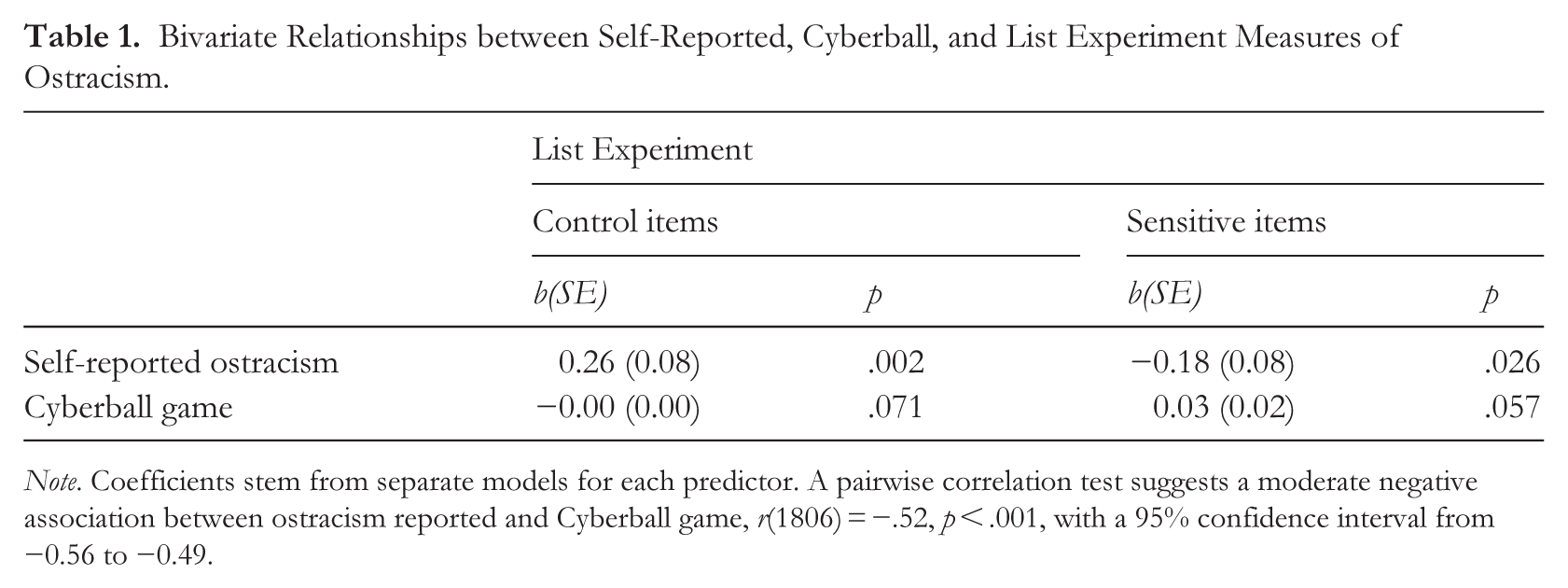
Note. Coefficients stem from separate models for each predictor. A pairwise correlation test suggests a moderate negative association between ostracism reported and Cyberball game, r(1806) = −.52, p < .001, with a 95% confidence interval from −0.56 to −0.49.
Controls
Following literature recommendations and findings, we control for the following sociodemographic information of participants that were measured in line with data collection schemes used by the Swiss government: age (years; M = 48.60, SD = 16.31), gender (woman, man), highest finished education 2 (obligatory, secondary, tertiary degrees), and residential context (urban, suburban, and rural). Furthermore, we also measured participants’ self-rated political ideology (slider from 1 = left to 10 = right; M = 5.13, SD = 2.12).
Data Analysis
We ran a series of regression models to predict ostracism. We used linear OLS regression for the normally distributed behavior measure, a Maximum Likelihood method for the list experiment measure (see Blair & Imai, 2012), and logistic regression for the binary self-report measure. We first ran the models without interaction terms to test for the main effects of our treatments (H1) and conspiracy mentality (H2). We then repeated the models with three interaction terms between the treatment dummies and conspiracy mentality to investigate the moderation effects. To probe the interaction effects, we also calculated the average marginal effect of the conspiracy mentality for each condition, along with their 95% Confidence Intervals, derived using the delta method. All models are weighted by population quota for gender, age, and education. Full regression tables are provided in the supplemental material (see Tables A1–3).
Results
We first assessed the impact of our key causal variable, which is exposure to different forms of journalistic reporting strategies about government conspiracies. Contrary to our first expectation (H1), we found little overall evidence of the idea that media exposure to government conspiracies results in ostracism towards uninvolved citizens in the general population (see Panel A of Figure 1 for an overview of effects). As illustrated in Figure 1, the only support of a negative spillover effect of media-based conspiracy exposure emerges for the self-report measure (see Panel B). Compared to the control condition, people are significantly more likely to admit to ostracism in all three treatment conditions (neutral presentation: OR = 1.93, CI [1.29–2.91], p = .002; one-sided full debunking: OR = 1.73, CI [1.11–2.69], p = .016; two-sided partial debunking: OR = 1.77, CI [1.15–2.72], p = .009). Yet this exposure effect does not vary between different conspiracy reporting conditions. Moreover, none of the conspiracy reporting strategies result in increased ostracism on the behavioral (Panel C) or list experiment measure (Panel D).

Overview of negative spillover effects of media-based conspiracy exposure on ostracism.
We then tested the known link between conspiratorial thinking and undesirable intergroup behavior. Our second expectation was that individuals with a pronounced conspiracy mentality were more likely to ostracize citizens of a government that is allegedly involved in a conspiracy (H2). The results lend consistent support for this idea and are illustrated in Figure 2. They suggest a robust positive effect of pronounced conspiracy mentality on all three measures (Cyberball game: b = 0.83, CI [0.28–1.38], p = .003; list experiment: b = 0.18, CI [0.12–0.24], self-report: OR = 1.49, CI [1.26–1.77], p < .001).
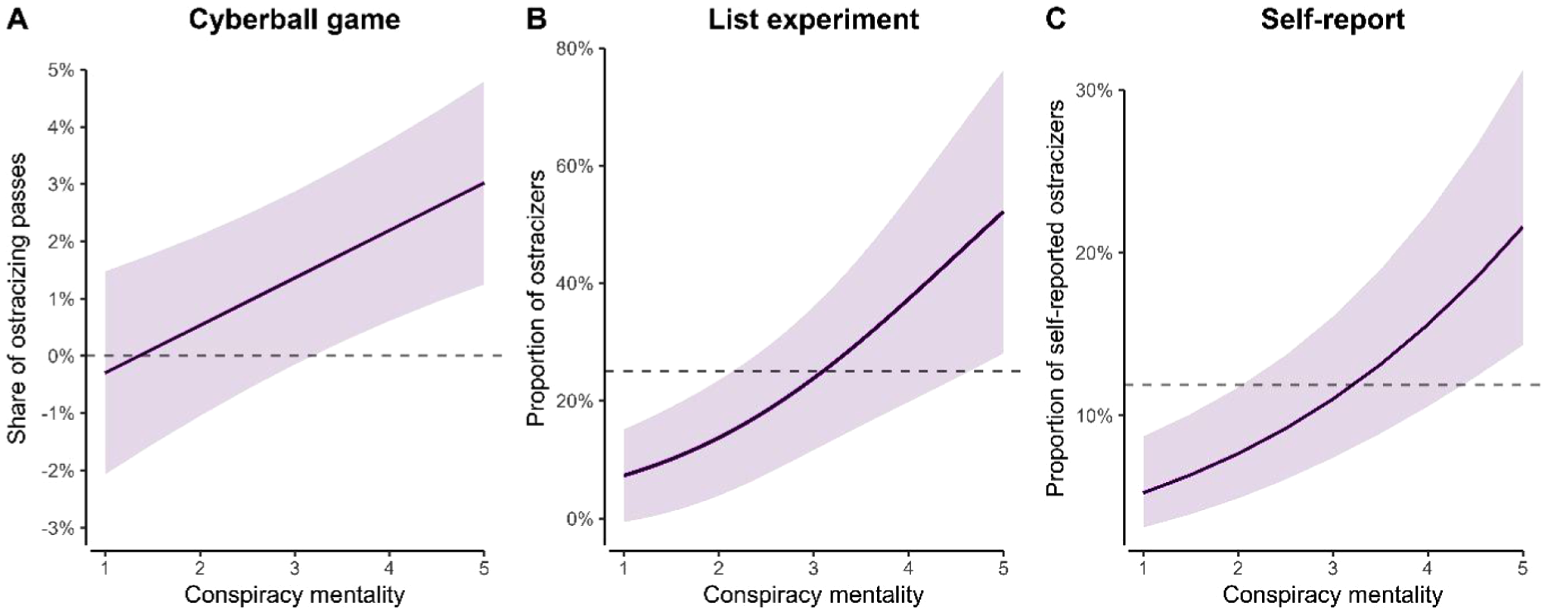
Marginal effects of conspiracy mentality on the behavioral.
Finally, we turn to the idea that conspiracy mentality might not only directly affect ostracism but also indirectly exacerbate the effect of conspiracy exposure (H3). Though we find no consistent support for such a general moderating effect of conspiracy mentality, the results show two instances of such reinforcing moderation effects. Specifically, we find two significant interaction terms between conspiracy mentality and the one-sided full debunking strategy (self-report: OR = 1.59, CI [1.09–2.38], p = .031; Cyberball game: b = 1.66, CI [0.34–2.99], p = .001). There is no evidence of moderating effects for the list experiment measure. The by-condition marginal effects are depicted in Figure 3, which shows that negative spillover effects of conspiracy exposure are particularly likely to manifest when people with strong conspiratorial predispositions are presented with journalistic messages that provide a one-sided refutation of the conspiratorial claim.
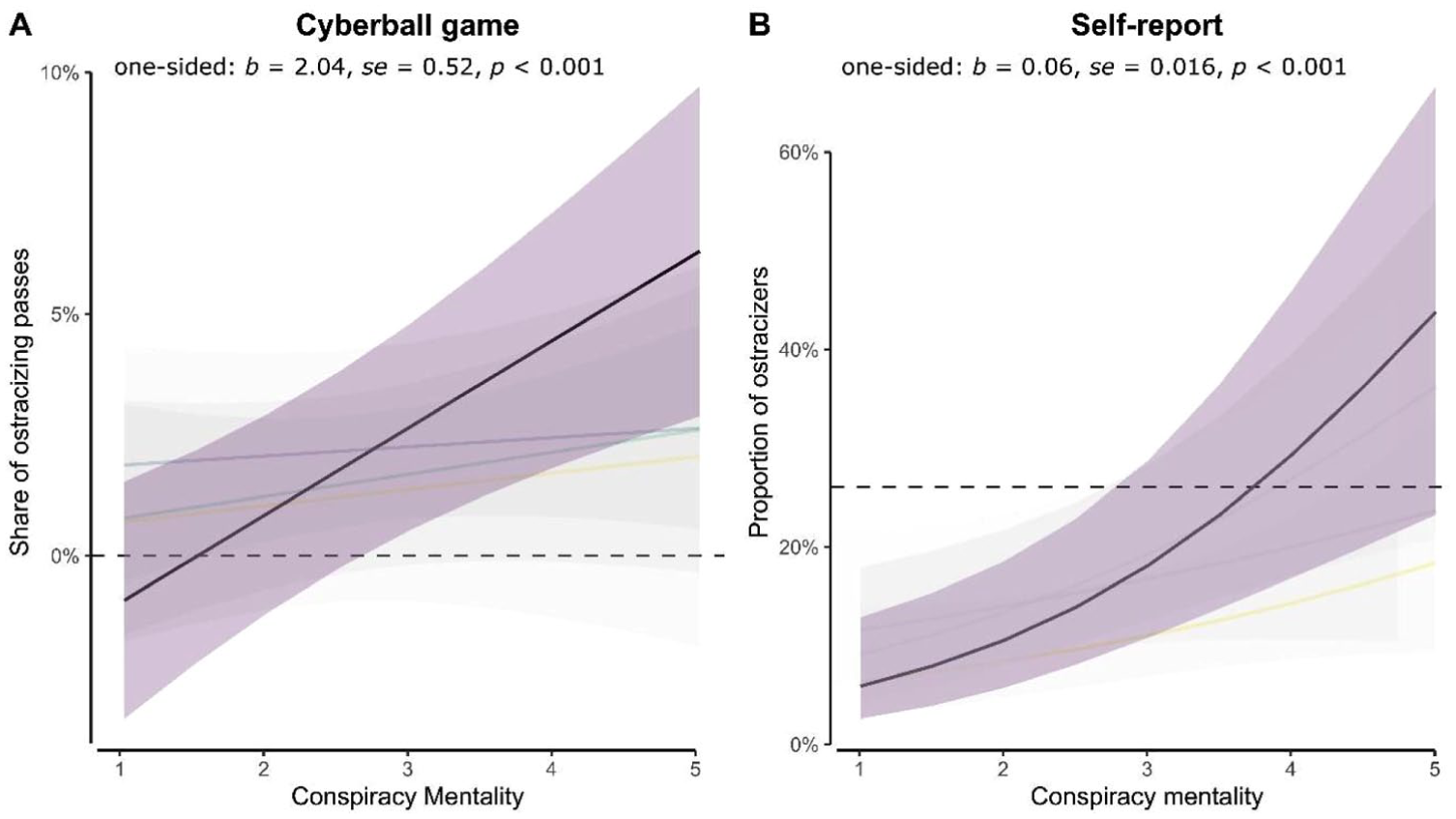
Interaction effects of conspiracy mentality and media-based conspiracy exposure on behavioral.
General Discussion
In this study, we explored the social impact of conspiracy theories by examining how media coverage of alleged foreign government collusion influences individuals’ tendency to ostracize perceived secondary outgroups. Specifically, we investigated whether different journalistic reporting strategies produce distinct outcomes and how predispositions, such as a conspiratorial mentality, shape these effects. In the following paragraphs, we discuss our findings in relation to our core research questions and the existing literature, reflect on the implications for our research design and measures, limitations of our study, and propose avenues for future research.
We begin with our first core question: whether exposure to conspiracy theories, depending on journalistic reporting style, can trigger ostracism. We hypothesized that media exposure to a government conspiracy would increase ostracism toward, and produce spillover effects for, the citizens of the implicated country (H1). Overall, our findings do not support this hypothesis. The only significant effect emerged in the self-reported measure, where participants in all three conspiracy treatment conditions indicated a greater likelihood of engaging in ostracism compared to those in the control condition. However, no variation appeared across reporting styles, and neither the behavioral measure (the Cyberball game) nor the list experiment showed a significant increase in ostracism. It is possible that our manipulation—different journalistic reporting styles—was simply not strong enough to induce ostracism, or that underlying attitudes remained largely unchanged despite momentary shifts in conscious reflection. The absence of effects may therefore reflect the limits of one-time media exposure. Although we cannot conclude that reporting styles differentially influence ostracism, the consistent elevation in self-reports across treatment conditions provides tentative evidence of a shift in how participants consciously frame or anticipate their treatment of the outgroup. Taken together, these findings do not support the conclusion that conspiracy exposure alone generates ostracism or that different journalistic reporting styles have differential effects on ostracism in the general population.
The role of journalistic reporting becomes more compelling when conspiracy mentality is incorporated into the analysis. Our results partially support our third hypothesis: negative spillover effects from exposure to conspiracy reporting are especially likely among individuals with a strong conspiratorial mindset—specifically when they encounter a one-sided, fully debunking report. This effect emerged in both the self-report measure and the Cyberball game, but was absent in the two-sided, partially debunking and neutral conditions. One possible explanation is that, for a novel conspiracy involving a powerful government, a journalistic investigation that leaves no room for alternative perspectives may provoke individuals who already score high on conspiracy mentality. In contrast, neutral or partially debunking treatments may have a “soothing” effect by acknowledging alternative viewpoints. From the standpoint of reactance theory (Brehm & Brehm, 1981), one-sided debunking could threaten individuals’ sense of autonomy and thereby trigger resistance. It thus appears that it is not uncertainty in reporting but rather full-fledged debunking that elicits backfire effects (Nyhan & Reifler, 2010). This finding is also in line with literature on message sidedness showing that two-sided messages can in fact make people with strong attitudes become more open to opposing positions both for moral and non-moral topics (Xu & Petty, 2022, 2024). Interestingly, this spillover effect disappears in the list experiment, indicating that once ostracism is assessed beyond the digital setting of the Cyberball game, it no longer manifests in the same manner, which opens up questions as regards the consistent measurement of ostracism. In practical terms, this finding raises questions about how journalists should cover novel conspiracy theories. While our findings do not justify strong recommendations regarding reporting style, they do, however, hint that fully debunking a conspiracy without acknowledging alternate perspectives might have unintended consequences for people predisposed to conspiratorial thinking. Such caution may be especially relevant for conspiracies reminiscent of real-world events dismissed at first but later validated (e.g., government efforts to conceal a potential pandemic). Although this finding is tentative and warrants further investigation, these patterns also hint at a possible vicious cycle for individuals high in conspiracy mentality, given that ostracized individuals are more likely to endorse conspiracy theories (Gkinopoulos & Uysal, 2021; Graeupner & Coman, 2017; Poon et al., 2020).
The most robust finding of our study is the direct link between conspiracy mentality and ostracism (H2), a predisposition that can translate into real-life intentions to ostracize. All three of our measures captured this effect. Specifically, we found strong evidence that conspiracy mentality predicts ostracism across all measures, reinforcing existing research (Imhoff, 2024; Uscinski et al., 2022) that emphasizes the importance of conspiracy mentality in understanding how conspiracy beliefs and exposure can shape behavior. By definition, conspiracy mentality entails a greater tendency to endorse various conspiracies, many of which posit hostile, powerful outgroups (e.g., governments, elites, hidden organizations). Individuals who endorse these views are therefore more likely to see the world in terms of “us” versus “them,” amplifying ingroup bias. Freelon (2024) similarly contends that conspiracy beliefs and prejudice are closely related, as both oversimplify complex realities, elevate one’s own group, and label an outgroup as the villain. Yet, as our findings indicate, the effect of conspiracy mentality on ostracism does not impact the relationship between exposure to conspiracy theories and ostracism (H3). Our design aimed to simulate a more “field-like” exposure scenario by embedding the dependent variable in a realistic media context—akin to the environment individuals encounter daily. We suggest that these effects should be understood within such an environment. Future research should further clarify how conspiracy mentality relates to ingroup bias and outgroup hostility, focusing especially on journalistic and media exposure settings that approximate real-life conditions. Future research should also take into account pre-existing attitudes towards outgroups and conspiracy actors as well as the ethnicity of the participants.
It is also important to reflect on our three measures of ostracism: the self-reported measure, the Cyberball game, and the list experiment. The self-reported measure was designed to capture discrepancies between participants’ perceptions of their behavior and their actual behavior. Future research should employ more explicit questions about behavioral intentions (e.g., items similar to Bogardus’ classic social distance scale). Because the Cyberball game has not commonly been used to study ostracism—and because social preference games can lack external validity and have limited predictive power for real-world outcomes (Galizzi & Navarro-Martinez, 2019)—we incorporated a list experiment to improve the external validity of our design. List experiments are considered effective for measuring sensitive behaviors in surveys (e.g., Blair & Imai, 2012), such as ostracism. By including the list experiment, we aimed to assess how closely the Cyberball game aligns with genuine ostracism. While excluding someone in a game may constitute a form of ostracism, actual behavior might differ significantly and resemble the scenarios presented in the list experiment more closely. Nonetheless, potential limitations of the list experiment should be acknowledged. The list experiment included neutral and pro-social items, which may be negatively affected by hostile attitudes towards the outgroup. Although we randomly assigned participants to list conditions within each treatment condition, some of the difference between the treatment and control list may be attributable to participants withholding prosocial behavior rather than actively engaging in ostracism. Whether the Cyberball game ultimately provides a valid measure of real-life ostracism remains an open question. Still, our findings offer preliminary evidence that certain predispositions, particularly in the context of media exposure, can be captured by the game. Future work should continue to investigate how the Cyberball game measures ostracism across different contexts and under various experimental manipulations.
Our stimuli also warrant some critical reflection. We used a fictitious, novel conspiracy theory that may have lacked the potency to trigger outgroup bias. While the conspiracy was designed to resemble COVID-19 pandemic scenarios, this may have introduced additional noise, as we did not control for COVID-related variables. Future research should employ established conspiracy theories to determine whether different types of exposure produce ostracism. We hypothesize that well-known intergroup conspiracy theories, even with one-time exposure, would trigger stronger and more detectable behavioral outcomes.
Turning our attention to the theoretical backbone of our study, we suggest that the mechanism behind the ostracism of secondary outgroups—the secondary transfer effect—requires further scrutiny. While our study was guided by the secondary outgroup similarity hypothesis (Harwood et al., 2011), a recent review by Vezzali et al. (2021) contests this, noting that attitude generalization can occur toward both similar and dissimilar outgroups (Pettigrew, 2009; Tausch et al., 2010). Furthermore, defining intergroup similarity is inherently subjective. Future work should therefore test a wider range of outgroups, including those dissimilar to the primary outgroup, to clarify the boundaries and mechanisms of the secondary transfer effect in the context of conspiracy exposure.
Lastly, future research should examine more closely what we labeled as two-sided partial debunking in our study that did not evoke backfire effects. As mentioned already, previous research by Xu and Petty (2022, 2024) on message sidedness suggests that two-sided arguments can make individuals with firmly held views more receptive to opposing perspectives, for both moralized and non-moralized issues. It would therefore be valuable to test the effectiveness of our two-sided partial debunking approach in altering the certainty with which people hold preexisting conspiracy beliefs, particularly those related to moral attitudes toward other groups.
Despite these limitations, our study highlights the harmful outcomes of a conspiracy worldview and exposure, specifically political conspiracies, providing preliminary evidence of how such exposure can influence non-normative behaviors such as ostracism. Our findings further indicate that certain journalistic debunking strategies may be counterproductive and underscore the importance of considering individual predispositions when attempting to mitigate the divisive societal impact of conspiracy theories in mainstream media contexts. Methodologically, we employ a novel adaptation of the Cyberball paradigm that can be refined for future research, not only to induce ostracism in participants, as it has traditionally been used, but also to measure ostracism exhibited by the participants. Finally, mainstream media as a site of conspiracy exposure warrant further attention, and we hope to see more research testing different messaging strategies within this paradigm.
Supplemental Material
sj-docx-1-gpi-10.1177_13684302261460770 – Supplemental material for You Can (Not) Play with Us: Conspiracy Theories, Media, and Ostracism
Supplemental material, sj-docx-1-gpi-10.1177_13684302261460770 for You Can (Not) Play with Us: Conspiracy Theories, Media, and Ostracism by Ani Baghumyan, Tobias Rohrbach and Silke Adam in Group Processes & Intergroup Relations
Footnotes
Acknowledgements
The authors are immensely grateful to Mykola Makhortykh for reading an early draft of this paper and providing useful feedback, and to every member of the Institute of Communication and Media Studies at the University of Bern, without whom this project would not have come to fruition. The authors would also like to thank the editor, Kimberly Rios, and two anonymous reviewers for their constructive reviews and feedback.

Funding
The authors disclosed receipt of the following financial support for the research, authorship, and/or publication of this article: This study was conducted as part of a larger project “Preparing the mainstream media for the next pandemic – understanding under which conditions conspiracy-related mainstream media content fosters conspiracy beliefs,” funded by the Multidisciplinary Center for Infectious Diseases at University of Bern and led by Silke Adam.
Declaration of Conflicting Interests
The authors declared no potential conflicts of interest with respect to the research, authorship, and/or publication of this article.
Data Availability Statement
All data and materials have been made publicly available via the Open Science Framework and can be accessed at 10.17605/OSF.IO/BRQY6.
Supplemental Material
Supplemental material for this article is available online.
Notes
References
Supplementary Material
Please find the following supplemental material available below.
For Open Access articles published under a Creative Commons License, all supplemental material carries the same license as the article it is associated with.
For non-Open Access articles published, all supplemental material carries a non-exclusive license, and permission requests for re-use of supplemental material or any part of supplemental material shall be sent directly to the copyright owner as specified in the copyright notice associated with the article.
