







Abstract
This article aims to present regret, an emotion to which sociologists so far have paid little attention, as having great sociological significance. First, it reviews recent research in social psychology and economics which cast anticipated regret as playing a major role in human decision-making. Second, it suggests a regret-based interpretation of the sunk-cost fallacy. Such an interpretation points to the need of a specifically sociological perspective on regret, calling attention to the cultural and institutional framings of regret-arousing events. The article further argues that secular changes in the types of regret imposed on individuals are paralleled by the spread of various forms of coping with it and that anticipated regret is responsible for both commitment to a chosen life-course and for sudden changes in it. The article ends with discussing the relationship between instrumental and moral regret, as well as the general implications of regret as a phenomenon for sociological understanding of rationality and human action.
Keywords
Arlie Hochschild noted in the Managed Heart that social theorists writing about emotions usually specialize on a specific feeling which they see as both the model for all feelings and central to explaining human conduct (Hochschild, 1983, p. 216; see also: Scheff, 2003). Thus, for Freud, this emotion was anxiety, while for Goffman it was embarrassment. So far, no sociologist has posited regret as a primary social feeling. Characteristically, it is absent from Hochschild’s own extensive list of 20 principal emotions (1983, pp. 230–233), and as of June 2022, only two recent papers featuring the combinations of words ‘sociology of regret’ could be located with Google Scholar, one of them by the present author (d’Ávelar, 2022; Sokolov, 2019).
And yet, as this text will argue, regret is an emotion of major sociological significance. As studies in neighbouring disciplines have demonstrated, regret – and anticipation of it – plays a major role in human decision-making (Zeelenberg, 1999; Zeelenberg & Pieters, 2007). This article will argue further that regret stands behind the phenomenon of sunk-cost fallacy, or the escalation of commitment to a failing course of action, long recognized as one of the major sources of organizational and biographical mistakes. Spectacular social catastrophes, however, are only the most dramatic expression of a much more widespread phenomenon. The mechanism underlying the sunk-cost fallacy also underlies a large degree of stability and persistence in social life (Becker, 1960). At the same time, I will argue further that the same mechanism may also stand behind unexpected changes in the course of individual actions.
One aim of this article is to stress the relevance of recent studies of regret phenomena in other social sciences (e.g. social psychology, microeconomics, organizational studies) for sociology. At the same time, it points to directions of research that require specifically sociological optics, adding a historical or macro-sociological focus to the micro-level focus of the neighbouring disciplines. This article begins by describing a regret situation summarizing what is known from psychological research on the conditions under which individuals experience regret. I then proceed to the phenomenon of anticipated regret and studies of its role in decision-making, as well as its underexplored link with the sunk-cost fallacy widely researched in organizational science. I then examine the cultural and institutional sources of regret and various forms of coping with it. The article concludes by addressing the theoretical challenges regret poses to our view of rationality and the models of human agency it suggests.
The regret situation
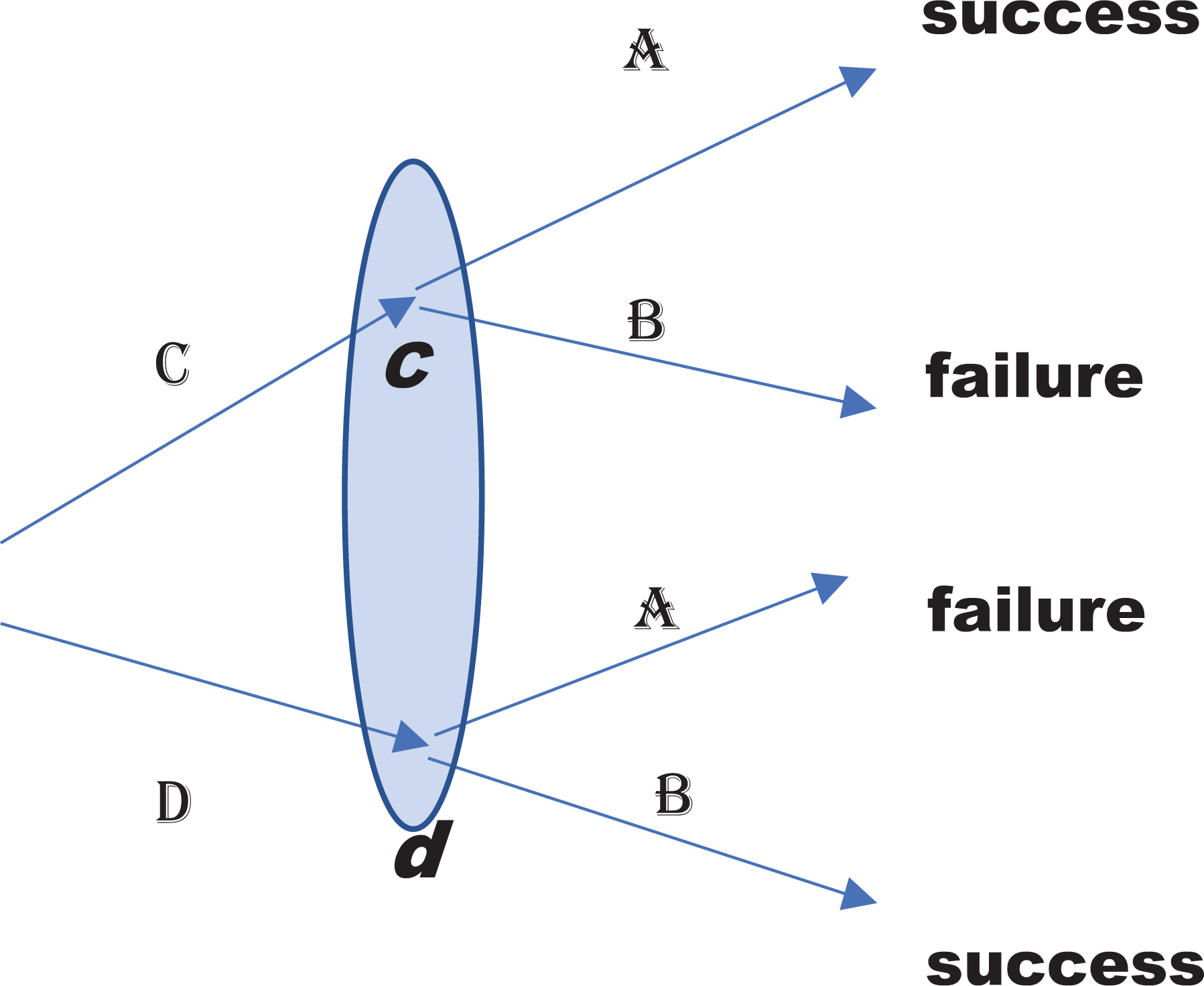
Figure 1 schematically presents a regret-arousing situation. Here a chooser – let’s call her Violetta – has to pick one of two mutually exclusive options or courses of action (‘prospects’ in terms of Kahneman and Tversky (1979) or ‘gambles’ in terms of Bell (1982) – A and B. Violetta’s outcome depends on moves she makes but also on moves C or D made by nature and/or other players. These other moves could take place either before, simultaneously, or after Violetta’s makes hers: what matters here is that she does not know for sure what these moves were/will be.
The regret situation.
At the moment she makes her choice, Violetta is situated in position
Psychological research has specified several factors responsible for the intensity of regret Violetta feels (see reviews in Connolly & Zeelenberg, 2002; Zeelenberg, 1999; Zeelenberg, 2018). First and foremost, to feel regret she must recognize that the unfavourable outcome was a result of her choice – that by choosing between the two boxes she made a ‘fateful move’ (Goffman, 1967) and that other moves were possible (Sugden, 1985; Zeelenberg, 1999; Zeelenberg, 2018). Most humans will probably feel terror when learning that a massive comet will hit Earth next Sunday, but not regret. They may feel regret, however, if in the remaining days they reflect about the ways they spent their lives.
The greater the feeling of agency involved in a decision is, the greater the feeling of regret will be, if the decision proves wrong. Thus, the more the option chosen deviates from what most people would choose in the situation, the stronger regret is. Regret is also stronger over acting, rather than over non-acting. In experiments simulating stock market exchanges, players who composed a portfolio significantly different from others felt more regret, even if the losses were the same. Players also felt more regret if loss resulted from recent changes they made in the portfolios of their assets, rather than from deprecation of assets they have already held for a long time (Zeelenberg & Pieters, 2007). Similarly, regret is stronger if individuals contemplate their choice for some time before making it, and if they thus can easily imagine themselves making another choice (Sugden, 1985). It is more likely that Violetta will feel more regret if she hesitantly decides to take the longer but more picturesque commute home from work and gets in an accident than if she unthinkingly chose the usual road and got into a similar accident.
One can hypothesize that the crucial variable in the intensity of regret would be the degree of predictability of the moves of nature and/or opponents. Thus, in choosing a wrong box, Violetta can be sorry about not getting a prize, but hardly can she accuse herself of making a mistake, because there were no ways in which she could reasonably figure out where the ball was. In contrast, her choice of a longer road could be retrospectively blamed as a mistake, if, say, the road was known to be dangerous. Some of those addressing this topic suggested decomposing regret into two parts, one part corresponding to the unpleasantness resulting from the loss of a more favourable opportunity as such and the other part corresponding to the unpleasantness associated with discovering that the individual made a poor choice (although the accuracy with which individuals retrospectively evaluate the predictability of outcomes was disputed – see below and (Connolly et al., 1997)). Sugden (1985) called the former ‘disappointment’, while the latter – ‘self-recrimination’, and Zeelenberg and Pieters (2007, p. 213) opposed ‘bad-outcome’ and ‘self-blame’ regret.
The second major condition of regret is that the consequences of making another move need to be easily recognizable. Indeed, the fact that we cannot know what marrying another spouse, or choosing another vocation would be like, may mercifully relieve us of what otherwise might be the greatest regrets in our lives. Real-life choice situations differ in how much they compel individuals towards learning the consequences of their choosing otherwise. Moreover, an asymmetry in this regard may exist between different courses of action available in the same situation, and this asymmetry may influence preference for one of the courses. As ingenious experiments reported by Zeelenberg demonstrated (Zeelenberg, 1999, pp. 96–98), the possibility of not learning the outcome of making an alternative move is in itself an argument in favour of making some moves. Imagine a situation in which experimental subjects are to choose one of two boxes, A and B, containing prizes of varying attractiveness. If they choose A, they are made aware of what the contents of B are. If they choose B, by contrast, they are not given the knowledge of what they missed out on. In such a situation, many would choose B, as that allows them to avoid possible regret. Zeelenberg used this example as an illustration of the important fact that most individuals are apparently strongly regret-aversive, expecting much more disappointment from learning that their choice was poor than joy from learning that it was good. Regret-avoidance fits well with the observation made already in Festinger’s studies of cognitive dissonance (Festinger, 1957) that, generally, individuals avoid gathering information about the rejected options (although important exceptions exist).
Anticipated regret
Zeelenberg and others’ experiments convincingly demonstrate that individuals anticipate regret emerging from certain decisions and that this anticipation influences their choices. Developing this possibility to the extreme, one can suggest that in making decisions, individuals seek to avoid regret, rather than maximize expected utility. This possibility was first explored by social scientists in the 1950s. In psychology, David McClelland (1961) hypothesized that achievement and failure avoidance have different motives, and their relative importance varies across individuals and even cultures. In economics, Savage (1951) is credited with originally discussing such possibility, although it was developed in a full-fledged theory of decision-making only in the 1980s, largely as a reaction to Daniel Kahneman and Amos Tversky’s groundbreaking work (1979).
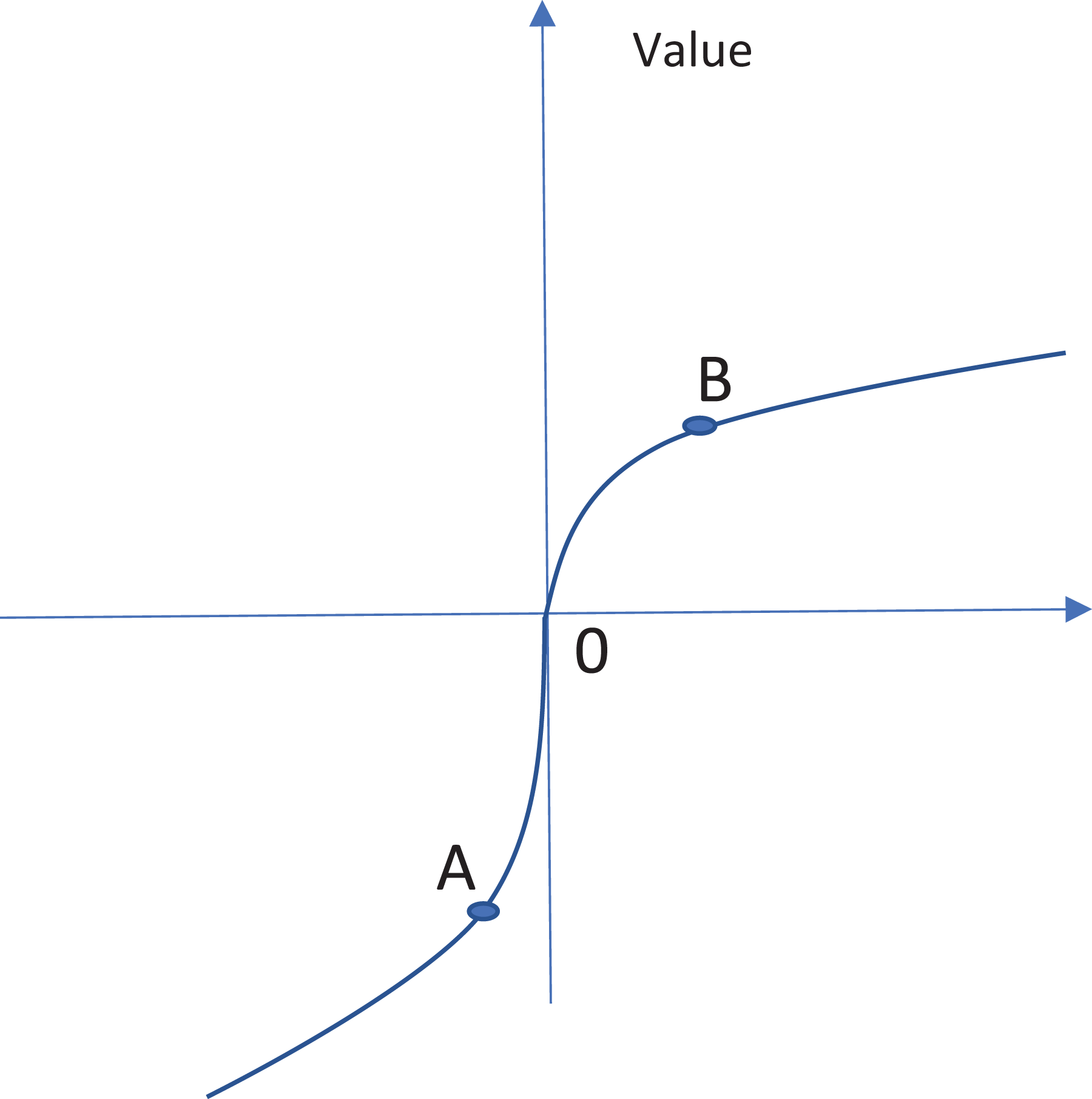
Kahneman and Tversky attributed deviation from expected utility maximization to a variety of psychological effects operating in two phases: editing or reformulating the choice situation at the first phase and the decision-making itself at the second phase. At the decision-making phase, which they studied more extensively, the principal effects according to them are that (1) humans systematically overvalue low probabilities, and (2) individuals are more risk-aversive when making decisions about prospective gains than when making decisions about prospective losses, with the present resource state serving as a reference point. The latter effect is due to two further ones. First, the negative value of losing a certain amount of good (e.g. sum of money) is always significantly greater than the positive value of winning an equivalent amount. This explains why most individuals would not take part in a gamble with equal chances of winning and losing US$100. Second, the function describing gains is concave and the function describing losses is convex (see Figure 2 below), so that most individuals prefer a sure win of $100 to a gamble with 50 per cent chances of winning 0 and 50 per cent of winning US$200; but also prefer a similar gamble with a 50 per cent chance of losing US$200 and 50 per cent chance of losing none, to a sure loss of US$100.
Kahneman and Tversky’s (1979) value function.
In the early 1980s, a variety of works appeared (Bell, 1982; Bleichrodt & Wakker, 2015; Loomes & Sugden, 1982) that attempted to explain the effects Kahneman and Tversky observed by a simpler and more elegant model in which the expected utility function included anticipated regret. Thus, Bell (1982) proposed that decision-maker’s utility function takes the form of
When in real-life situations does expected utility and anticipated regret favour markedly different courses? One such condition, which Bell pointed to, is the area of low-probability events, which many people decide not to prepare for and which may leave these individuals bitterly regretful if they occur. Thus, getting into a car accident soon after deciding against paying a small sum to insure one’s car would be a cause of major regret. This helps explain why many people, although realistically assessing that the purely financial expected utility of this act is lower than that of not buying the insurance (be that otherwise, insurance companies would go bankrupt), nevertheless still buy auto insurance. Importantly, they do so because they are regret-aversive, not because they are risk-aversive, for in other situations they can prefer riskier options if not choosing them may entail a more intensive regret.
Another type of situations in which expected utility and regret avoidance dictate different courses of action are the ones involving asymmetry in expected awareness of outcomes of making different choices. If the situation is recurring and individuals are already familiar with the consequences of choosing one, rather than the other option, then repeating the previously made choice reduces the risks of experiencing regret later.
Our ability to anticipate regret presents an interesting theoretical puzzle. Since Mead and Vygotskii, human thinking is often regarded in social sciences as a dialog with an internalized Other. In the case of regret anticipation, the Other whose reactions we are orienting our actions towards is our own future Self. Intriguingly, regret-avoiding individuals seemingly presuppose that this future Self’s judgment is heavily biased. Indeed, if Violetta’s future Self puts herself into the shoes of Violetta’s present Self – for example, today’s Violetta believes that tomorrow’s Violetta would accurately retrieve in her memory the process leading her to the present decision – then self-blame is never likely, as the future Self would have to recognize that, provided with the same information, it would make the same choice again. Nevertheless, our self-feeling suffers after making a bad decision, and, moreover, it seemingly suffers not much less in the case of decisions which we could not reasonably require from ourselves to be able to make better – for example, to choose one of two identical boxes hiding a single red ball (Connolly et al., 1997). There is thus at least a large grain of truth in our scepticism about our own ability to judge fairly our past moves. We know that our future Selves will be subject to fatalistic illusions, tend to regard any occurring event as the only possible one and will subsequently judge us harshly for our inability to prepare for it.
Sunk-cost fallacy
If studies of anticipated regret and its effects originate from psychology, market research and behavioural economics, research on sunk-cost fallacy, also known as ‘entrapment’ (Brockner and Rubin, 1985) or ‘escalation of commitment’ (Staw, 1976), originated in management and organizational studies. This is easily understandable if we take into account that the most visible expression of sunk-cost fallacy, the tendency of formal organizations to invest additional resources into a failing course of action or ‘to throw good money after bad’, is one of the most spectacular forms of bureaucratic failure. However, the scope of sunk-cost fallacy is much wider than that and includes a wide spectrum of behaviours, individual or collective, having in common that the awareness of previously made choices make individuals and groups continue in the same course of action, which they would not choose were this awareness absent. A familiar example are academics desperately trying to publish papers already rejected in many journals in full understanding that getting them through the peer-review process would take more time than to write new ones, which, moreover, could have much more impact. Abandoning them completely, however, requires recognizing that all the time already spent in writing and rewriting them was wasted, which most individuals find most uncomfortable. Sunk cost fallacy may be regarded as a specific form of path dependency (Mahoney, 2000) different from other forms in that previous moves do not change the objective nature of the choice individuals face but rather their subjective evaluations of the attractiveness of possible outcomes.
Perhaps, the most spectacular type of escalation of commitment is a con game called lokhotron in Russian. In lokhotron, victims are invited for a small fee to take part in a lottery in which the individual pulling the largest number wins a considerable prize. They pull the numbers, which turns out to be close to the largest possible, but at the moment when they are nearly sure of their winning, one more player – in reality, the scammer’s associate – pulls the same number. The fraudster then gives the victims the choice of leaving the game – and losing their fee – or continuing to the next round by doubling their stake, at which stage, not surprisingly, the draw repeats. During the 1990s in post-Soviet countries, there were multiple cases in which people spent hours getting deeper and deeper into trouble, and, finally, losing their apartments – the most important asset most people had – to the fraudsters operating the schema.
Reviews of studies on the escalation of commitment can be found in Brockner, 1992, Roth et al., 2015 and Sleesman et al., 2012. While the existence of the phenomenon is well established, there is surprisingly little consensus on why it exists. Returning to the sad example above, why do lokhotron victims stay in the game? Indeed, with every successive draw, their suspiciousness should increase. An explanation consistent with the expected utility theory is that the prize grows as well, as the winner takes the doubled stakes. This growth, however, is highly unlikely to match the declining expectation of winning resulting from the realization that what is occurring is probably a con game.
Other explanations proposed can be grouped into three categories. The first of these categories covers purely cognitive interpretations (Garland, 1990; Moon, 2001), suggesting that sunk cost is a continuation of a project completion effect (i.e. individuals feel discomfort about having to abort an already started behavioural sequence), or a result of the tendency to subconsciously regard returns from activity requiring larger investments as greater than from one which requires fewer resources. While possibly responsible for the escalation of commitment in some everyday situations, these accounts are hardly capable of explaining the persistency of individuals or organizations staying in a failing course of action for extended periods of time.
The second explanation originated in studies of bureaucracies. To change a course of action, an organization must recognize that the previous course of action was a failure, which may have adverse career consequences for those who are responsible for choosing it. Notably, Staw has already shown that in a group the actor who suggested the failing course of action is usually also the one who seeks to stick to it. Indeed, in bureaucracies not recognizing one’s mistakes may be individually rational for an executive in charge, first, because executives are not directly bearing the costs of mistakes, and, second, because persisting in any course of action increases the probability that some events would interfere, and the course would be aborted before its failure becomes evident (e.g. some reform project would be stopped due to changes in political priorities, not due to the realization of its being unfit for serving the previously held priorities). This explanation puts the sunk-cost fallacy into the area of principal-agent problems (Simester & Zhang, 2010). Again, while undoubtedly relevant to some situations, it is seemingly not applicable to others: Violetta continuing to work on a paper which is unlikely to be accepted can hardly be said to act as an agent to somebody else.
The third group of explanations relied on Kahneman and Tversky’s prospect theory as a source of insight. Thus, Arkes and Blumer (1985) pointed to the asymmetry discovered by Kahneman and Tversky in attitudes towards gains and losses as a possible explanation of the sunk-cost fallacy (see also Zeelenderg & Van Dijk, 1997). For Kahneman and Tversky, the reference point is always set at the present state or
Notably, these suggestions propose a far-reaching deviation from Kahneman and Tversky’s original model, which assumed that the reference point by which gains and losses are measured is always situated in one’s present. Another interpretation of Zeelenberg and Van Dijk’s experimental evidence is possible, however, which retains Kahneman and Tversky’s assumptions. This interpretation suggests – in line with Bell’s and Sugden’s work – that anticipated regret, rather than changing the subjective value of money at stake, is involved in estimating the attractiveness of various courses of action.
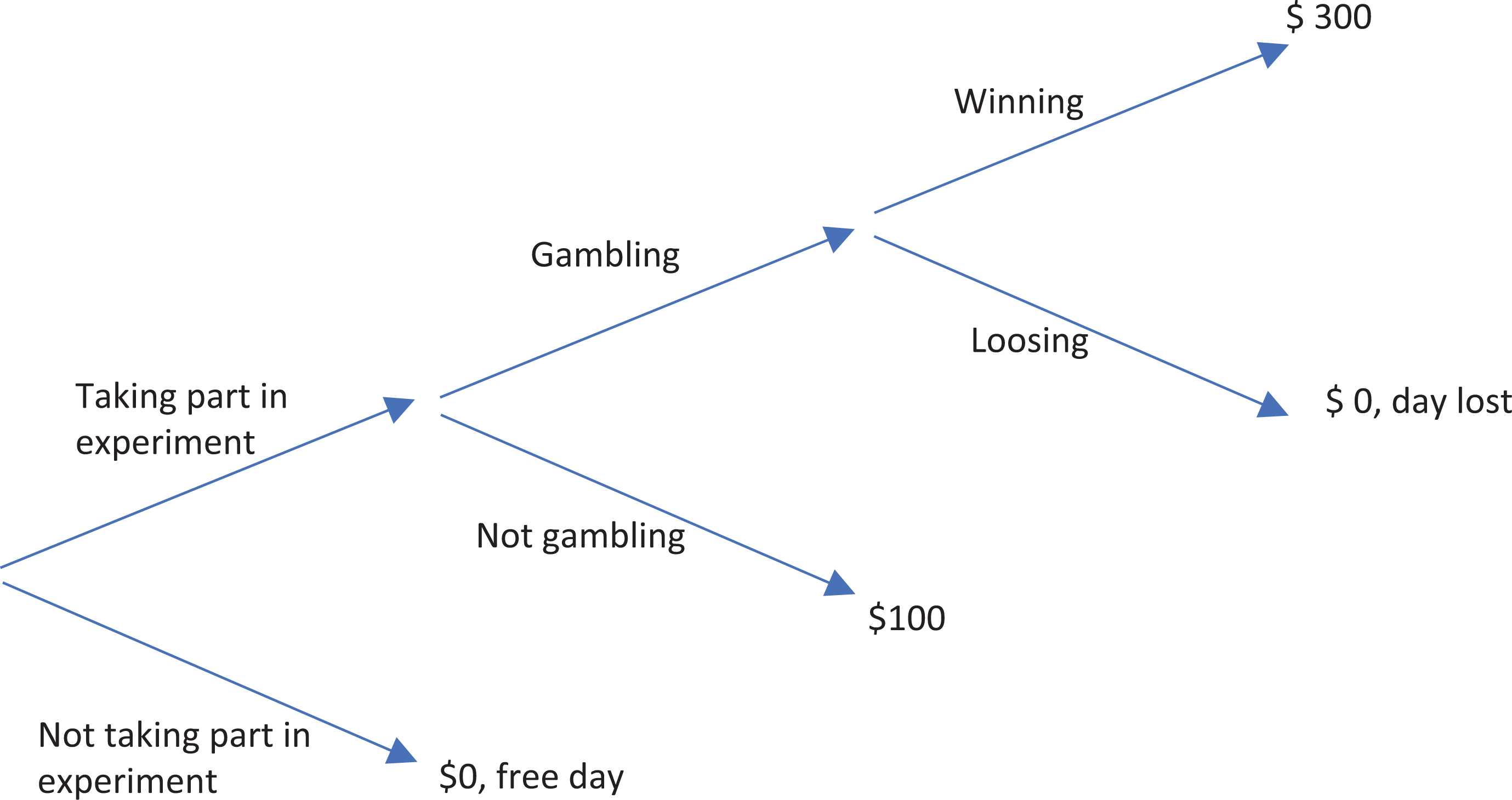
Let’s depict the situation of Zeelenberg and Van Dijk’s subjects in a visual form (Figure 3). There is a sequence of decisions they were to make. First, they were either to take part in an experiment or to skip it. Then they were proposed a gamble with a 50 per cent chance of winning $200 and a 50 per cent chance of losing US$100, which was their daily wage. Compared with individuals who were simply proposed a choice between a definite US$100 and a 50 per cent chance of getting US$200 and a 50 per cent chance of getting none, these individuals have two decisions to regret in the case of failure, rather than one: on the one hand, to take part in the gamble, on the other – to take part in the experiment. If regret follows from the awareness that one has made a bad decision, then unpleasant feelings over making two separate bad decisions can be expected to be greater than those arising from making one wrong decision – even though the ensuing loss remains exactly the same. In this case, the greater risk-aversiveness of the experimental groups becomes easily explainable.
A sunk-cost situation.
The argument can be put in a different way. The experimental subjects who chose to take the gamble and lose can compare their present state with two other states they could have been in if they had chosen differently. First, if they lose, they can compare their present state with the one which would obtain if they had chosen not to take the gamble. Second, they, financially wise, return to the same position they were at in the morning, but, of course, they have to face the fact that they spent the whole day working, rather than dedicated to more pleasant pursuits. Rather than one alternative state, y, here two, y and z, are to be added to Bell’s formula (see the experimental evidence that a multiplicity of possible outcomes by itself increases regrets in Sagi & Friedland, 2007). Importantly, this reasoning presumes that our decision-making is influenced not only by the anticipation of possible regret over present decisions but also over a series of previously made decisions, which may turn out to be bad if we choose one of the available now options.
This probably sheds some light on the behaviour of lokhotron victims who must regret, first, entering the game and, second, not terminating the gaming sequence earlier. At the same time, they must also regret all their efforts to earn and save the money which they have just lost. The game is maliciously designed in such a way that at each successive stage, the victims have a choice between a sure loss, associated with the moment of quitting, and staying in it. Staying offers a prospect of either losing somewhat more in terms of future regrets (as marginal regrets over similar mistakes probably diminish) or winning much. Here we can return to Kahneman and Tversky’s finding that individuals may become extremely risk-seeking in such situations, first, because of the general tendency to be riskier when losses are involved and, second, because of overestimation of low probabilities. In this way, we can reinterpret sunk cost as a predominantly regret phenomenon.
Intuitively, the connection between anticipated regret and the sunk-cost fallacy seemed obvious to those developing the regret theory of decision-making. Thus Bell (1982, p. 971), giving an imaginary example of a regret-arousing situation, described a man who bets on the same horse for many races and is afraid to stop because he fears self-recrimination if the horse finally wins right after he stops. Neither Bell’s nor Sugden and Loomes’s formulas, however, allow our present decisions to be governed by anticipating regret about our previous moves. Similarly, regret avoidance and the sunk-cost fallacy were seemingly not regarded as parts of the same phenomenon in the experimental literature. Some papers thus regarded anticipated regret as a factor facilitating the escalation of commitment, if feedback is provided which can show that an individual left the sequence right before the next move would bring him or her success (Wong & Kwong, 2007; Zeelenberg & Van Dijk, 1997). But there have been no attempts to draw more substantial parallels between these phenomena.
And yet, one can easily cite multiple real-life examples in which regret over past choices is contingent on our later decisions. Imagine Violetta who, after spending long years preparing for a prestigious medical school, starts doubting if medicine is her real calling. Quitting her studies would make her regret all her previous efforts, which, if she chooses to stay, would, objectively, remain a rational investment. Similarly, favourable outcomes of our present choices may make us rejoice over all our previous decisions which made the current choice situation possible. Finding out that what may have looked, for a moment, as a con game, proved not to be one after all, and that those who persisted ultimately made the right choice, promises rejoicing over all instances in which individuals decided to stay in the game, rather than to quit it. Such rejoicing is one of the favourite subjects of our popular culture, particularly biopic movies, glorifying characters believing in themselves and persisting in what others see as a hopeless course of action. Polar explorers, moving stubbornly into the uncharted lands, inventors, working on machines nobody else believes are possible, or artists developing art nobody understands, would be regarded as a prototypical lokhotron victim, had it not been for the fact that, ultimately, they succeeded in finding their technical solutions, their audiences and their way home. The stories of them are probably responsible for the fate of many lost expeditions and of many careers ending in misery and despair.
Under other names, the sunk cost fallacy’s effect on persistence in a chosen course of action was discussed in many studies, starting with Howard Becker’s (1960) adaptation of Schelling’s idea of commitment in explaining the stability of one’s life course. While the escalation of commitment was first studied in its most notorious forms involving extreme risk-seeking, it is arguably much more widely present in the form of a conservative force, inhibiting risky behaviour. Becker argued that any biographical choice contains multiple side bets predisposing an individual to proceed in the chosen direction. A similar idea surfaces in various studies of loyalty to the working place (Meyer & Allen, 1984), romantic relationships (Joel & MacDonald, 2021) and leisure preferences (Buchanan, 1985). Overall, it seems that the shadow of the past becomes darker as an individual successfully passes any recognizable course of action, including one’s life-course in general. Those living in Western societies are thus all entrapped within an inversion of con game, evoking an increasing fear that making a relatively minor mistake would ruin what otherwise would be a lifelong success story.
And yet, while regret-avoidance mostly makes its appearances in social sciences as a conservative force, committing an individual to a chosen course of action, it can explain not only stability in a life-course but also otherwise unexpected turns. Think of Violetta-the-scientist having a choice between two research projects. One of them may be somewhat more attractive in terms of her curiosity and the reputation outcomes it promises, but the other one allows her to use an approach which she studied when she worked on an abandoned line of research and learning which she previously regarded as a loss of time. Now, however, the prospect of rejoicing opens, as what she thought of as a bad choice – to put effort into studying the abandoned approach – retrospectively becomes a good one, if she decides to pick the project which requires using it. Intuitively, that would be a strong reason to favour this approach over the alternative one.
Note that, in this example, Violetta reacts to an opportunity offered by retrospective changes in the list of what can be regarded as possible outcomes of a previous choice. Experiencing regrets requires thinking in terms of bounded sequences of choices and events – like the one depicted in Figure 3 – entrances into and exits from which function as checkpoints. These boundaries, however, are movable and subject to constant reframing. And it is here that the specifically sociological outlook enters our picture.
Framing of sequences
To experience regret, individuals must perceive situations before them as having clear action alternatives and unambiguously identifiable outcomes contingent on these actions. Indeed, psychological experiments are designed to create exactly such sorts of occasions. The closest real-life counterpart to these experiments are salon games analysed in Goffman (1961) which unfold within a single face-to-face situation. Even within the experimental setting, however, the boundaries of a series of events are often uncertain. Indeed, the major point of Zeelenberg and Van Dijk’s experiment may be interpreted as suggesting that, in the eyes of many experimental subjects, participation in a gamble and the preceding period of work formed one sequence. Regarding the gamble as a continuation of the previous period of work, rather than as a stand-alone event, conditioned the reaction to it. The role of framing is even more salient in the case of real-life processes – from professional careers to political campaigns and to life-course in general. To be recognized as parts of a single sequence of events, they must be framed as such.
Tversky and Kahneman (1986) paid much attention to the role of framing in decision-making, focusing, however, predominantly on one of its forms, namely, the framing of events in terms of either gains or losses. But from the point of view of this article, a more essential form of framing would specify the general boundaries of frame sequences that individuals face. Indeed, event sequences recognized by one subculture may never be recognized as such by another one. A nice example is found in Kahneman’s own book (2011, p. 345). While describing the sunk-cost fallacy, he reports the following anecdote. Amos Tversky designed an experiment in which financial brokers were to decide which shares from their portfolio to sell to cover the costs of their child’s wedding. It turned out that brokers strongly preferred to sell stock the value of which was greater at the moment of selling than when they were bought, as this allowed them to regard their original purchase as a good investment. Indeed, the economic rationales for this move were extremely questionable: what should have counted according to normative theory was the prospect of future increases in value, not past increases. Brokers, however, seemingly regarded their ownership of each particular financial asset as a bounded story and preferred a happy ending.
While some framings may be purely idiosyncratic, most are probably produced by social processes. Such processes could be conventionally divided into cultural and institutional. Cultural processes make individuals recognize cause and effect relationships, turning actions previously regarded as inconsequential into fateful moves, and thus subject to consequent regret. Some of these relationships involve laws of nature, which were previously unknown or at least not salient in public mind. Thus, before the COVID pandemics, the predominant understanding in Russia was that viral respiratory infections are mostly a result of chilly weather (‘catching a cold’), and thus, their natives held that the fateful move leading to getting a virus like COVID was failing to dress warmly on the part of the ailing individuals. Over the last 2 years, the contagious nature of viruses got spotlighted, and responsibility shifted to those who, while infected, were appearing in public places and not wearing a mask. Overall, the development of medicine can be read as a story of changes in which and whose choices to hold responsible for one’s health outcomes.
Social sciences played a major role in the development of modern social imagination, similar to the role medicine played in our ideas about health, revealing new kinds of decisions and non-decisions that humans may regret. Thus, macroeconomics allows us to identify new culprits whose infelicitous actions are responsible for an ensuing crisis.
An institutional source of new framings is the emergence of new institutionalized sequences, which make opportunities available to individuals at later moments dependent on their earlier moves. A familiar example includes the proliferation of educational qualifications occurring in the course of rationalization of societies described by sociological neo-institutionalists (Meyer, 1977). Whatever else their influences on society have been, such qualifications turn early educational decisions into fateful moves, effectively closing for individuals many alleys they would possibly regret not being able to take later. Given its playing such a role in directing the life-course, it is hardly surprising that in a survey not getting sufficient education, or getting a wrong one, served as the most important source of regret in the life of Americans (Roese & Summerville, 2005). Institutionalized career sequences inevitably serve as regret-generating machines.
Another form of regret-producing institutions is various screening and evaluating devices that abound in contemporary society, from academic rankings and citation metrics to criminal records. From the point of view of the present article, their effects are twofold. First, they guarantee commensurability of outcomes (Espeland & Sauder, 2007). Second, as such devices are used in making decisions on the allocation of resources, they entail our earlier choices with far-reaching consequences (sometimes ones which decision makers could never have predicted at the time when the choices were made) and, thus, may make us regret that we had not chosen otherwise. Using an academic example again, the recent spread of bibliometric measures based on journal publications probably made many humanists regret their earlier decisions to write books (which, incidentally, in earlier decades was regarded as a much more prestigious form of scholarly output in many European countries).
Since Freud at least, it has been widely held that our modern world is characterized by the proliferation of repressive rationality and that we moderns live within a darker shadow cast by the future – and in the shadow of what will be our future’s past – than was the case in previous times. Here, however, a word of caution is necessary, as modern anxieties might replace earlier ones which were not less pressing. Indeed, some forms of fateful moves and far-reaching consequences which our predecessors grappled with have largely disappeared from the modern worldview. Medieval Christian believers were constantly reminded that when the Judgment Day comes, a minor sin or failing to perform a minor pious deed may shift the scales against their favour and result in their damnation. Seemingly, those seeking donations from them knew how to exploit for fundraising purposes the anticipation of eternal regret which poor souls would feel if they fell a penny short of salvation (Gurevich, 1985). But while the presence of some regret anxieties may be a constant in the life of historical societies, their shape differs.
Individual adaptations and cultural resistance
Individuals are not completely helpless in the face of regret anxieties, however. Festinger’s early work on cognitive dissonance (Festinger, 1957) demonstrated that humans are remarkably successful in changing their beliefs concerning the relative desirability of various outcomes so that, in retrospect, what they have chosen will appear best to them. Indeed, various practices producing commensurability discussed above are intended to suppress precisely this natural tendency to defensive re-evaluation – thus making subjects face the poverty of their outcomes and decisions. But while many beliefs and institutions of modern societies can be accused of increasing the burden of regret we experience or anticipate, others help us to cope with it, for commercial or humanitarian reasons.
Among institutions, this role is played by various warranties. Warranties are usually regarded in economics as a form of market signalling (Spence, 2002). They can be equally regarded, however, as an instrument minimizing possible regret and, thus, removing constraints to a consumer’s decision to purchase. In this sense, a warranty is a promise that returning to the entrance point of the event sequence with minimal losses is indeed possible. Such promises exist in many forms and include various contraceptive institutions, from pre-marriage cohabitation to the calling back of political representatives. Notably, liberal education, allowing individuals to avoid the sunk-cost fallacies associated with obtaining training in an area they may later regret choosing, counters the proliferation of educational requirements.
Likewise, some agencies are countering the prevailing cultural framing of event sequences and redrawing their boundaries so that individuals may look more favourably at their past choices. This can be done by several means. Some reframings may change the scope of all sequences extending into the indefinite future, so that all that is happening to an individual is regarded as a valuable experience, a means towards a vaguely defined happiness and personal fulfilment. As there are (luckily) so far no ways in which outcomes such as personal fulfilment can be measured or payoffs from alternative choices evaluated – and, in any case, the end point of these sequences is reached only at the moment of death – individuals using this reframing have little difficulty convincing themselves that their life leaves them little to regret. Another reframing, largely originating from the same brand of popular psychology, urges individuals to cultivate atemporality and to treat each moment as an end in itself, and none as a mean.
One more form of reframing, occupying a prominent place in mass culture, exploits the awareness that individuals cannot know for sure all the consequences of choosing an alternative course of action. On the Internet, one finds folklore accounts on individuals who – by an unfortunate gaffe, like a coffee spilled on a blouse during the breakfast – were prevented from arriving on time at the Manhattan World Trade Center on the fateful morning of 11 September 2001. What they possibly immediately regretted as a minor misstep to reproach themselves for retrospectively became the greatest luck in their life.
In the same way, imagining alternative futures may give past actions new moral meanings. Frank Capra’s It’s a Wonderful Life, in which the hero is allowed by his guardian angel to redefine his life as consisting not of personal failures but of sacrifices for the good of his family and community, is possibly the best-known fictional exploration of this topic. A non-fictional example of using the same technique is an excerpt from Viktor Frankl’s account of his practice of logotherapy, a brand of psychotherapy promising to return meaning to a client’s life.
“Once, an elderly general practitioner consulted me because of his severe depression. He could not overcome the loss of his wife who had died 2 years before and whom he had loved above all else. Now, how could I help him? What should I tell him? Well, I refrained from telling him anything but instead confronted him with the question, ‘What would have happened, Doctor, if you had died first, and your wife would have had to survive you?’ ‘Oh’, he said, ‘for her this would have been terrible; how she would have suffered!’ Whereupon I replied, ‘You see, Doctor, such a suffering has been spared her, and it was you who have spared her this suffering - to be sure, at the price that now you have to survive and mourn her.’ He said no word but shook my hand and calmly left my office. In some way, suffering ceases to be suffering at the moment it finds a meaning, such as the meaning of a sacrifice” (Frankl, [1959]1988, p. 135).
The effect of most of these techniques is somewhat limited by the fact that they change the perspective of individuals, not the estimates of others, who may still stigmatize those who fail what they regard as tests of ability or worthiness.
Collective actions
Others, however, play a much larger part in this story, than simply imposing certain framings on situations. Indeed, if events making the Ego’s choices good or bad are moves by other actors, then these other actors are responsible for the regrets and rejoices the Ego is exposed to. The ability to impose regret thus becomes a source of a specific kind of moral obligation and power individuals bear with and before each other. This relation is similar to the obligation to protect the public face of the others Goffman analysed in his works on etiquette (Goffman, 1956), in that it is based not only on empathy but also on the human ability to experience vicarious or second-hand regret. Indeed, it seems that as Fremdschämen, or shame for others, exists, there also exists regret for others, which somewhat go far beyond simply feeling compassion for others’ disappointments.
This specific relation becomes most visible when directed to already deceased people. While many obligations imposed by the norm of reciprocity become void with the death of those before whom we hold them, our obligations to continue the course of action they followed, particularly if their choosing this course had an aim of benefiting ourselves, remains, or even grows in its compelling force. In this way, according to Benedict Anderson (Anderson, 1983), sacrifices by unknown soldiers serve as a source of moral obligations cementing modern nations.
The spilling of blood of troops sent to war thus creates one of the most irresistible forms of escalating commitment, justifying sending more and more troops and spilling more and more blood (at least, as a recent study demonstrated, among those who supported the military adventure from the beginning – Boettcher & Cobb, 2009). It may also make those waging the war to commit themselves to more and more grandiose and unrealistic aims, to match in scale the gravity of already suffered losses.
The living thus feel that they possess the power of making other people’s choices right or wrong, transforming them into mistakes or into felicitous moves, even when the original actor is long dead. They also feel that not allowing the dead to fail is a proper expression of gratitude (and, correspondingly, that halting the dreams of their deceased enemies is an available form of posthumous vengeance).
The meaningfulness of human lives remains a subject for definition and redefinition long after the lives themselves are over. This idea was already familiar to the ancient world. Arendt (1958, pp. 184–198) reminds us that in the ancient heroic societies, in which ‘happiness’ was associated with winning fame among one’s compatriots, common wisdom held that no one can be proclaimed happy before dead, as a sudden calamity, especially brought by the unexpected consequences of one’s own actions, could deprive a hero’s story of a proper ending. It follows from Pericles’ famous funerary oratory Arendt cites, however, that even an undoubtedly heroic death was not a guarantee of happiness, as posthumous fame depended on the living: the poets (whom Pericles found lamentably unreliable) and the polis itself with its collective memory.
The moral duty of citizens of an ancient polis, as well as of other heroic societies, was cherishing memories of its deceased heroes. These memories were the reward heroes expected. Thus, as long as the memories lived, heroes’ efforts to immortalize themselves by serving their polis were not wasted. No doubt, having readily available evidence of a community’s obligation before its heroes being honoured helped in raising new heroes. School historical education in many militarized countries is still organized to serve this function (Potapova, 2015).
Finding an example closer to home, the view of one’s life projects as extending beyond one’s lifetime plays a major role in how creative workers, scientists notwithstanding, make sense of their own careers, as well in how they define their obligations before the deceased members of their communities. As one’s ideas can find their audience long after one’s own death, we have an advantage any victim of lokhotron would pay dear for, as we can through the very last moment cherish the hope that our work will bring us posthumous recognition. This view also puts on the living obligations arousing from their ability to decide whose ideas or work will be remembered and thus bear fruit. Elsewhere, the present author argued that such concerns have directed the development of sociology as a discipline over the decades (Sokolov, 2015).
Conclusions: On wider implications for a theory of action
Looking at the reference list for this article, a reader might notice that the literatures reviewed in it are predominantly non-sociological in their origins. Sociologists’ disregard of regret might be more than an accidental omission. Seen from the perspective of the sociological tradition, regret, and actions motivated by its anticipation, present a curious, perhaps even troublesome, anomaly. First, they cut across one of the cornerstones of sociological theorizing: Weber’s typology of action. In Weber’s view, human actions are either future-oriented and goal-rational (zweckrational), past-oriented (affective or traditional) or oriented to timeless norms (value-rational). It is difficult to define, however, to which of these types Violetta’s behaviours belong. On the one hand, she is acting in anticipation of future events. On the other hand, these future events largely consist of her own emotional reactions to the events which at that moment will belong to the past. Furthermore, while undoubtedly involving sometimes extremely complicated end-means calculations, they are not oriented to achieving any objective goal, but to avoiding subjective affective states. At the same time, while regret is undoubtedly an affect, the action oriented to the prospects of experiencing it might be emotionless (in this sense, Zeelenberg (2018) writes of it as of a ‘virtual affect’). Indeed, if regret avoidance is successful, the regret is never felt. As a final twist, while regret largely results from wishing to see our past actions as goal-rational, this wish becomes one of the major causes of irrational decisions.
Precisely because of this anomalous status, however, regret-oriented action provides a valuable extension of the vocabulary of models of action available to a sociologist. The value of the regret model is that while it has most of the strengths of rational-choice approaches, such as unambiguity and openness for formal analysis, it can shed some light on the processes which rational-choice sociology had little to say about, such as the persistence of false beliefs, identity formation and abrupt changes in revealed preferences.
Take the persistence of false beliefs as an example. Possibly, the most notable difference of the regret model from many earlier rational-choice models is that it reverses the conventionally presumed relation between information-gathering and acting. In it, the most important consequence of acting is not that it results in any kind of substantive payoffs but that it reveals to the actor if his or her previous decisions were good or bad. More specifically, if we assume that regret-avoidance prevails over rejoice-seeking – and there are good reasons to think so – it means that the actors will be primarily motivated by the desire not to find out that their previous choices were infelicitous. But finding out that one’s choices were bad often means also finding out that the beliefs they were based on were wrong (indeed, it could be said that behind any bad move there is a regrettable choice of beliefs). In this sense, regret-avoidance is also often the avoidance of putting one’s beliefs to test, explaining persistence of misconceptions.
Similarly, the regret-based model allows us to capture and explore further the idea put forward by Niklas Luhmann (Luhmann et al., [2002]2013) that social identity formation is neither a process of revealing inner qualities, nor a result of external labelling, but an outcome of a complex interplay between an individual and social environment, in which initially contingent moves become a kernel of a Self. Indeed, for the regret-based model of decision-making I propose here, past moves – including those made by chance, or for reasons no longer understood – still exert a strong pressure on further choices. This pressure usually takes the form of a commitment to a certain line of action, regarded as an expression of an individual’s innermost qualities, but it can also result in unexpected turns in it, probably the most spectacular in the cases in which moral regrets, or remorse, are involved.
One can notice that so far, we dealt with regret in the specific meaning of the word derived from psychological and economic literature, as describing an emotion resulting from recognition of one’s failure in decision-making. However, in colloquial English, the word is also used in a wider sense – as synonymous with any kind of disappointment (as in the letters starting with the words ‘I regret to inform you that…’, which authors hope never to receive from journal editors). It is also used as a synonym for remorse. In this latter sense, it appears in ‘Politics of Regret’ by Olick (2013), as well as in other works on historical memory, where ‘regret’ signifies recognition of one’s group’s (e.g. nation or state) past wrongdoings and readiness to make amends.
There are interesting parallels between remorse and the more instrumental definition of regret covered in this article, probably explaining the linguistic intuition behind using one word to describe them both. Most obviously, both result from a lack of unity of perspective between the present and the future Self. Could Lady Macbeth predict the moral reactions of her future Self, she would probably strongly advise her husband to forget what the three odd women had told him in the woods.
Here, however, we will limit ourselves to noting that the instrumental and moral dimensions of decisions are often intertwined. If Violetta breaks traffic rules and causes an accident with tragic outcomes, she will blame herself both for turning left rather than hitting the break (instrumental regret) and, at the same time, for carelessness (remorse). In such cases, an event being a subject of instrumental regret usually serves as a precondition for moral regret: if there were no accident, Violetta would be much more likely to forgive herself for dangerous driving. This logic becomes the most visible in the case of actions which are ethically questionable in themselves but are regarded as instrumental for a greater good. When they fail, they leave their actors regretting their inability to make correct decisions as well as feeling remorse for what, at the end of the day, they have done.
In this area lies the most spectacular possibility in which regret can lead to unexpected turns in human behaviour. It follows from what was said that not only instrumental but also moral aspects of previously made choices are subject to retrospective redefinition if the newly made choices recast them as means for a greater good. The organization of career sequences in progressive stages, in which the latter are associated with greater responsibilities and making decisions of greater importance, thus creates a curious indeterminacy in commitment of those who reach the top of such careers to the values which they apparently served during their rise, as they find themselves under temptation to rewrite the moral meaning of their past by using the powers they acquired to subvert these values. One may think here of Darth Vader whose long service to the Dark Side obtains a totally new meaning in the moment he uses his status as the Emperor’s right-hand man to destroy both the Emperor and the Empire. In the real life, Gorbachev and his allies would be remembered for the role they played in bringing down the Soviet dictatorship, not for their loyal service to it which brought them to its top. The moral weight of previous choices may thus press one to a sudden change of course as well as to a continuation of it, thus granting human history some of its unpredictability.
Footnotes
Acknowledgements
This article benefited from comments by Victor Allakhverdov, Alexander Filippov, Andrei Gerasimov, Daria Dimke, Oleg Kharkhordin, Danila Raskov, Viktor Vakhshtayn and Vadim Volkov. I also wish to thank Zachary Reina for editing the article and for many valuable suggestions. Its earliest version was presented at a summer school at Volkhov Most in July 2015, and I owe much to a fruitful discussion with its participants. I also benefited greatly from the discussion at the seminar on heterodoxal economics at Smolny Faculty of Liberal Arts of Saint Petersburg University in April 2019.
Declaration of conflicting interests
The author(s) declared no potential conflicts of interest with respect to the research, authorship, and/or publication of this article.
Funding
The author(s) received no financial support for the research, authorship, and/or publication of this article.
