







Abstract
Does gender matter in the way in which we ‘perform’ academia? Drawing on the results of a practitioner survey, we argue that gender does matter, culturally and structurally, and can be institutionalised so that women are disadvantaged. This is not to deny women’s agency or the advances that they have made. Rather, we highlight the inequality of the playing field in which the academic endeavour is conducted. Uniquely, we ask UK political scientists about their perceptions of the impact of gender in their working lives and explore their views on recommendations for change.
Men are descriptively and substantively over-represented in UK political science. They constitute well over four-fifths of the professoriate (Bates et al., 2012) and are more likely to get published and cited than women (Williams et al., 2015). In what follows, we seek to render explicit the ways in which male and female political scientists experience and perform gender. Drawing on the results of surveys of members of the Political Studies Association (PSA), we demonstrate that there is a complex combination of perceptions which feed in to performances of gender in the daily life of the profession. By unpacking colleagues’ own perceptions of the impacts of gender, we seek to identify ways in which women’s place in UK political science may be improved.
Our study builds on existing research that has documented the under-representation of women in the discipline. It makes an important contribution to our knowledge of political scientists’ own perceptions of gender in the profession and their beliefs about the barriers that face them. It also contributes to the broader debate over whether men and women are agents of their own careers or whether their careers are structured by social and institutional norms, practices and values. Our basic argument is that institutional practices and cultures, as well as the words and labels that underpin them, structurally disadvantage women political scientists. We find that male and female scholars appear to share similar values but different experiences of academic life and different perceptions of the barriers that affect their careers. These differences in turn make it harder for the profession as a whole to address those practices and cultures that work against women. However, we do not seek to deny agency to anyone seeking to tackle the over-representation of white men at senior levels in the profession. Women have risen to the top, as have scholars from other disadvantaged groups. Nevertheless, if we want to encourage a more pluralistic, diverse discipline, we argue it is not enough to sit back and wait for it to happen; rather we may need to think proactively about changing cultures.
We must also note at the outset that our focus on gender in this article is not intended to downplay the discrimination faced by other groups in academia. 1 Political scientists from Black, Asian and Minority Ethnic (BAME) backgrounds are likely to encounter distinctive barriers and biases during their careers. Indeed, intersectional accounts remind us of the ‘double whammy’ of discrimination facing women academics from BAME backgrounds (Crenshaw, 1994; Harley, 2008; Hirshfield and Joseph, 2012; Mirza, 2006; Sang et al., 2013; Wright et al., 2007). Across the entire British higher education (HE) sector, only 0.4% of the professoriate is made up from BAME women (Equality Challenge Unit, 2014). Unfortunately, the small number of BAME political scientists in Britain—which itself reflects a problematic lack of diversity—means that our survey-based approach is unable to shed much light on the way in which race and gender intersect in political science.
The remainder of the article proceeds as follows. We first review existing accounts of gender in political science and in academia more generally. We then describe our survey before reporting our findings, which address, in turn, perceptions of the discipline, personal experiences of discrimination and opinions about the causes of women’s marginalisation. We also investigate political scientists’ attitudes towards possible solutions. A final section discusses our findings and considers how the profession can best respond to the issues we identify.
Gender 2 gaps in political science
The under-representation of women in UK political science is both well-established and frequently lamented by scholars in the profession (e.g. Akhtar et al., 2005; Bates et al., 2012; Childs and Krook, 2006). Among students, women are less likely than men to pursue postgraduate study, partly because of their perceptions of what it entails and the absence of role models, and partly because of time constraints and the perceived incompatibility with family life (Akhtar et al., 2005). Among professional political scientists, men tend to predominate in terms of overall numbers, and they tend to predominate in greater numbers with every step up the career ladder (see Figure 1). According to data collected in 2011, men and women were equally represented at the most junior levels in UK political science, but there were huge disparities at the highest levels, with women holding only 15% of professorial positions (Bates et al., 2012).
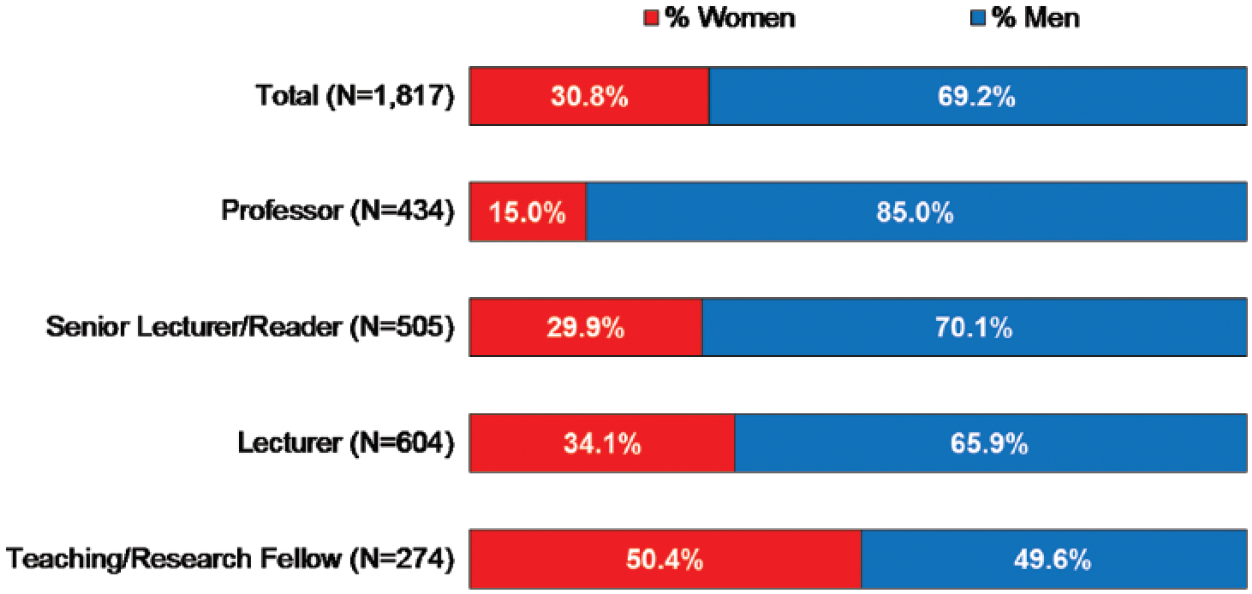
Percentage of positions in UK political science filled by men and women, 2011.
Numbers matter. The composition of any group is likely to affect its members’ behaviour and mindset. Or, as many scholars more widely have noted, the quality of descriptive representation—the extent to which a group resembles the broader population—is intimately connected to the quality of substantive representation—how that groups act towards or on behalf of others (Childs and Krook, 2006)—and to notions of constitutive representation (Squires, 2008)—how and where that representation occurs.
In the case of political science, the number of women in the profession certainly appears to affect practices and behaviour within the discipline. In terms of publishing, women have historically been under-represented in ‘mainstream’ political science journals (Kelley and Fisher, 1993) and over-represented in specialist gender journals, such as Women & Politics (Kelley et al., 1994). Women are less likely to publish in ‘top’ US political science journals (Breuning and Sanders, 2007; Evans and Moulder, 2011; Kaba, 2013) and are less likely to be cited (Maliniak et al., 2013). To be sure, much of the existing evidence relates to US political science, and the picture elsewhere is perhaps less gloomy. As one recent study of publishing patterns in UK political science finds, women are more likely to be lead or sole author than historically was the case (Williams et al., 2015). Yet, the picture is still far from rosy: the same study finds that women are still less likely to be cited than men.
There is also evidence of a gender gap among UK political scientists when it comes to men and women’s relative contribution to research and teaching. As Briggs and Harrison (2015: 4) note, ‘women are more likely to be [the] lecturers who focus on teaching, module and programme management, and student pastoral care’. Finally, in regard to teaching and curriculum design, there may be an even more obvious link between the descriptive under-representation of women and how the discipline acts for and substantively represents women. As one recent study finds, there is very little provision for the teaching of gender politics in UK political science (Foster et al., 2013). Since gendered constructions and norms are absolutely central to the everyday experiences of citizens and policymakers, this omission arguably risks undermining the relevance of the discipline itself.
Performing gender in academia
Gender is ‘done’ in all organisations (West and Zimmerman, 1987). It is performed (Butler, 1999), negotiated, contested, constructed and reconstructed in a complex set of social interactions. Gender also structures subsequent interactions. Even if it is not directly related to their relative numbers—although it is difficult to deny the relationship—men and women are likely to experience different challenges and fortunes over the course of academic careers. It has been widely noted that sex discrimination is entrenched in academia (Acker, 1990, 2006; Benschop and Brouns, 2003; Knights and Richards, 2003; Van den Brink and Benschop, 2012). Women seem to find it harder to get to the top, and women who do reach senior and leadership positions often find themselves marginalised (Le Feuvre, 2009; Van Anders, 2004; Van den Brink and Benschop, 2012).
Existing research into the gendering of academic careers has been pluralist in its methods but generally consistent in its findings of bias and discrimination in favour of men. Some studies have focused on the statistical over-representation of men, detailing, for example, the small number of women in senior positions, whether in the United Kingdom (e.g. Bates et al., 2012; Brooks, 1997; Williams et al., 2015), in the United States (Bannerji et al., 1991) or in Europe (Linková and Červinková, 2011; Vázquez-Cupeiro and Elston, 2006). Meanwhile, other studies have explored the ways in which gender is ‘performed’ within the academy (e.g. Knights and Richards, 2003; Parsons and Priola, 2013; Savigny, 2014; Søndergaard, 2005; West and Zimmerman, 1987), highlighting how, in terms of personal experiences, female academics are often ‘othered’ and confined to the ‘ivory basement’ (Eveline and Booth, 2004).
Explanations for the relative scarcity of women in senior academic positions, and their personal experiences of being confined to ‘ivory basements’, have focused largely on three mutually reinforcing factors: the role of institutions, women’s agency and cultural barriers. In terms of institutions, attention has been paid to issues such as workload allocation (Barrett and Barrett, 2011) and the practical difficulties of reconciling management-role demands with caring responsibilities (Devine et al., 2011). In terms of women’s agency, research has often focused on the importance of key choices, especially those pertaining to the work–life or family–career balance, which can determine success or failure in research and managerial careers (Park, 1996; Parsons and Priola, 2013; Priola, 2007; Raddon, 2002; Van den Brink and Stobbe, 2009). In terms of cultural barriers, scholars have highlighted how sexist norms and values, which often run counter to formal policies, can disadvantage women (Bird, 2011; Savigny, 2014), reinforce hegemonic masculinities (Pacholok, 2009), exclude women from ‘male’ support networks (Kjeldal et al., 2005) and gender the construction of academic knowledge (Benschop and Brouns, 2003).
It has become increasingly common in accounts of women’s disadvantaged place in universities to downplay the idea of ‘women as a problem’ and to emphasise ‘academia as problematic’ (Husu, 2001: 173). If we wish to understand why women are seemingly unable to flourish in academic life, it is more important to focus on the cultures, structures and practices within the sector rather than the identities and individual characteristics of female scholars. Joan Acker (1990) argues that gender operates through four dimensions in organisations: a gendered division of labour, gendered interaction, gendered symbols and gendered interpretation of one’s positions in the organisation (see also Kantola, 2008). Accepting that the way in which gender is performed and perceived within organisations comprises the constituent components, we are seeking to explore the interaction between the material and ideational aspects of gender within UK political science. While there are actual barriers facing women, as Van Anders (2004) finds, perceptions of these barriers may also have differential effects on women’s and men’s career aspirations—to the further detriment of women.
Surveying UK political scientists
While the likely barriers facing women in UK political science have been relatively well-documented, the ways in which people experience these barriers among political scientists have not. To address this shortcoming, we designed an online questionnaire with the aim of recording scholars’ perceptions, experiences and evaluations of gender in academic life. More specifically, we sought to investigate four theoretically or practically important aspects of their perceptions, experiences and evaluations. One battery of questions focused on respondents’ beliefs and perceptions about gender and the discipline. Such beliefs create and shape the cultural, institutional and normative context in which political science is ‘performed’ (West and Zimmerman, 1987); they are also likely to shape the career aspirations and choice of scholars. In a similar vein, another battery of questions investigated respondents’ personal experiences of sexism in the discipline. A third section, motivated by the extensive evidence of women’s marginalisation within the profession, sought to probe respondents’ beliefs about why women generally enjoy a disadvantageous position. Fourth, we probed respondents’ opinions about the possible remedies in a bid to ascertain what was considered acceptable or appropriate. Finally, we included an open-ended question which invited respondents to make any additional comments about their experiences or the issues raised in the survey.
Our target population were members of the PSA, the United Kingdom’s professional body for political scientists. A link to the online questionnaire was sent to the Association for distribution via its Newsletter and Heads of Department mailing list, as well as via its specialist groups’ mailing lists. The survey initially went live in September 2014. From a population of 1879, just 72 members responded to the invitation to take part. We then re-ran the survey in October 2015, inviting those who had not yet responded to do so. A further 117 PSA members responded this time. Separate analyses revealed few significant differences between the two groups (data available on request), although there were notably higher proportions of non-British respondents and colleagues in temporary and part-time posts among the 2015 respondents. For the analysis in this article, we merge responses from the two surveys and treat them as one sample.
Our total sample represented scholars from a range of Russell Group, 1994 and post-1992 Universities. Some 68% of respondents had permanent jobs, and 81% were on full-time contracts. A majority of our respondents, 61%, were women (see Table 1), and the average age was 41.2 years. Two of our respondents identified as being transgender and two preferred not to say. The high proportion of female respondents almost certainly reflects wider attitudes among political scientists and a relative reluctance among men to engage with the issue of how gender shapes the discipline. When it came to ethnicity, a small majority of respondents, 51%, said they were ‘White British’, while the category ‘Other’, usually meaning one of over two-dozen non-British nationalities, was the second largest group with 37%. Just 8% of respondents said they were from a Black, Asian or ‘Mixed’ British background. In terms of seniority, most of those who responded held relatively junior positions: professors constituted only 17% of the total, and many more female professors than male participated in the survey.
Respondents by age, ethnicity, position and gender (%).
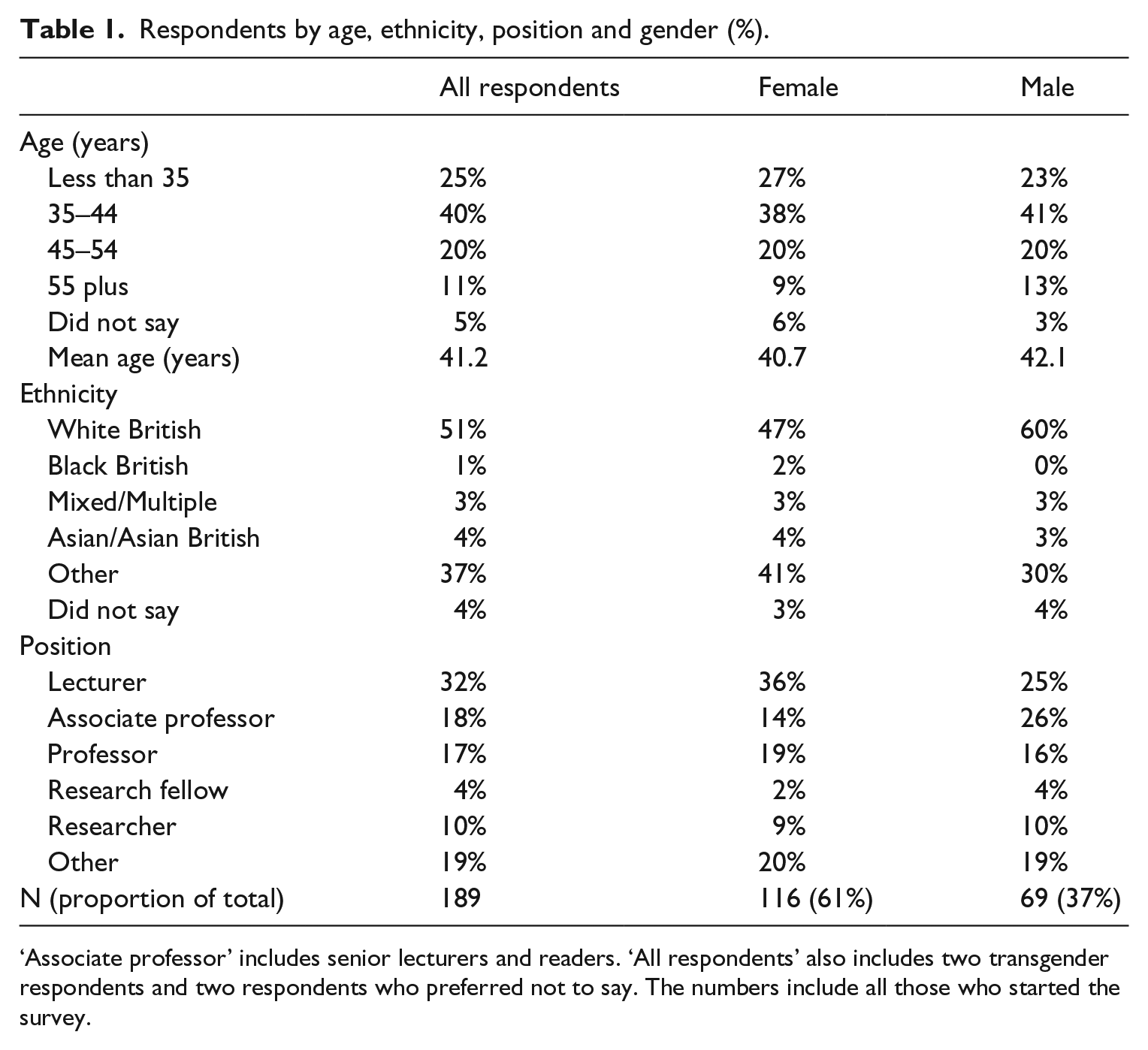
‘Associate professor’ includes senior lecturers and readers. ‘All respondents’ also includes two transgender respondents and two respondents who preferred not to say. The numbers include all those who started the survey.
The characteristics of our sample place obvious constraints on what we are able to infer from our data. The relatively small sample size and the predominance of female and junior political scientists mean that the responses are not necessarily representative of scholars’ experiences in UK political science. For similar reasons, the handful of BAME respondents, although indicative of the overwhelmingly ‘white’ nature of the profession, makes it impossible to analyse the influence of race. Instead, our findings should be regarded as an initial exploration of perceptions, and the responses should be treated as largely illustrative of the ways in which men and women perceive and perform gender in UK political science.
Perceptions and values
An initial tranche of questions asked respondents about the gender balance in the discipline and within their department. In line with existing evidence about the preponderance of men in general and especially in senior positions (Bates et al., 2012), it was perhaps not surprising that 85% of all respondents said that most political scientists were men, nor that 71% of respondents said that most of the faculty members in their department were men (see Table 2). It was also not surprising that three-quarters of all respondents answered that most senior positions in their department were held by men. Only in one respect did men not predominate: when it came to temporary positions in their department, 28% of all respondents said that most such posts were held by women compared with 19% who said the same of men. As Table 2 also shows, the perceptions of female and male respondents were remarkably similar: chi-square tests revealed no significant differences at the 5% level. 3
The perceived presence of men and women in UK political science.
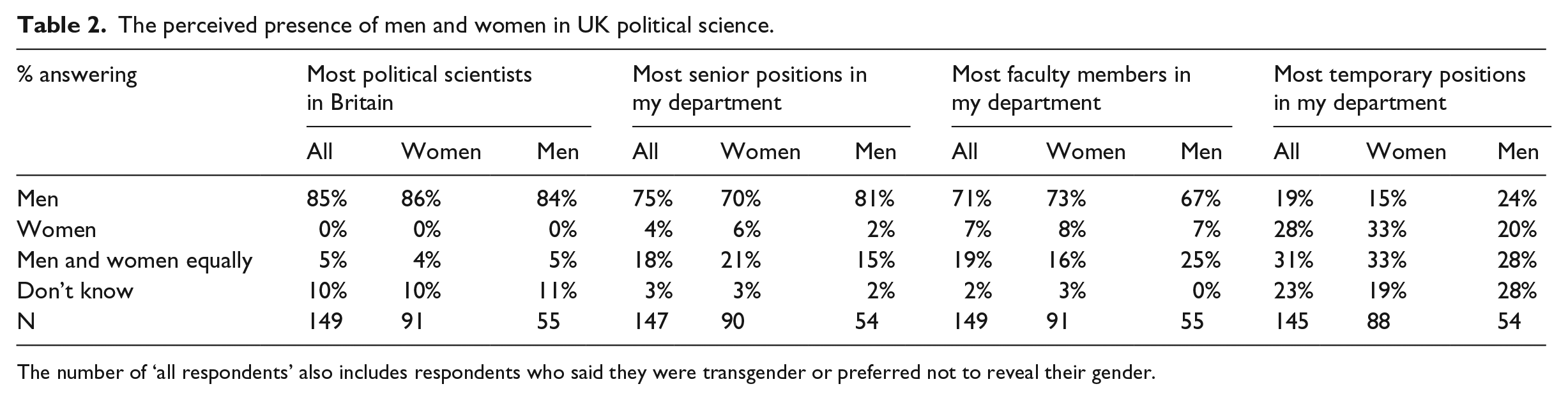
The number of ‘all respondents’ also includes respondents who said they were transgender or preferred not to reveal their gender.
On the face of it, the perceptions of all respondents should be a matter of concern for political scientists, in both a prescriptive and descriptive sense. We asked our respondents whether they agreed or disagreed with the statements: ‘It doesn’t matter if there are disproportionately too few women in my department’, and ‘Women are just as capable as men in performing leadership roles’. There was near-universal disagreement in response to the first statement, with some 93% disagreeing or strongly disagreeing and most, 59%, strongly disagreeing. There was also near-universal agreement with the second statement, with 90% of all respondents expressing strong agreement and all but one other respondent expressing agreement. In respect of both statements, chi-square tests revealed no significant differences (at the 5% level) in the responses of men and women.
Another tranche of questions explored perceptions of academic roles, in particular whether men or women were thought to perform disproportionate shares of key departmental responsibilities (see Table 3). For all three roles, most respondents said that each was performed proportionately by men and women, with nearly three-fifths of respondents saying this about teaching. Nevertheless, the spread of responses does accord with existing research about gender roles in the profession, especially the perceived tendency for women academics to focus more on house-keeping tasks—and thus finding themselves in the ‘ivory basement’—at the expense of research (Briggs and Harrison, 2015). The general perception was that men published disproportionately more than women, whereas women tended to undertake administrative work more than men. In respect of the latter, there was a significant association between responses and gender (χ2 = 16.13, df = 3, p < 0.01): 42% of female respondents and 20% of male respondents said women did disproportionately more administrative work than men, whereas 31% of male respondents and 8% of female respondents said men did disproportionately more administrative work than women. There was also a less pronounced but still significant difference (χ2 = 9.13, df = 3, p < 0.05) among men and women when it came to perceptions of teaching. Once again, female respondents (19%) were more likely than male respondents (2%) to say that women did disproportionately more teaching, whereas men (13%) were more likely than women (10%) to say men did disproportionately more teaching.
Are key roles performed disproportionately by men or women in your department?
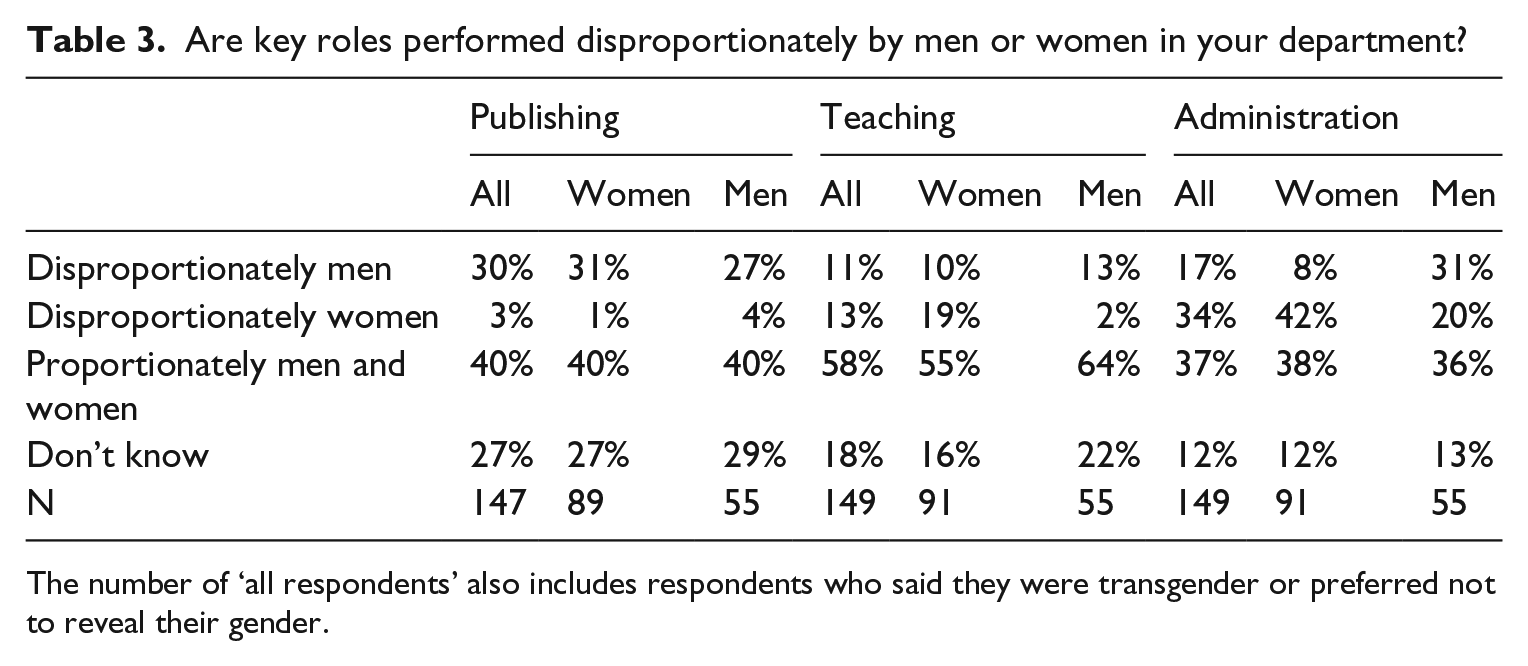
The number of ‘all respondents’ also includes respondents who said they were transgender or preferred not to reveal their gender.
Further insight into these perceived tendencies was provided in the responses to a question that asked whether women were more likely than men to volunteer for administrative work. A higher proportion of all respondents said ‘yes’ (44%) than ‘no’ (35%), the remainder (12%) answering ‘don’t know’. Again, there were significant differences between genders (χ2 = 26.20, df = 2, p < 0.001). Only 17% of male respondents answered in the affirmative, compared with 58% of female respondents. Conversely, 58% of men and 22% of women answered in the negative. There seems to be a widespread view among women that they are better departmental citizens than men and an equally widespread view among men that they are not.
The female perspective was developed at length in some of the responses to our open-ended question. One academic proffered a reason as to why women seemed to shoulder more than their fair share of the burden:
I think that part of the problem is that such a large percentage of the secretarial staff is female, there is a lot of administrative work, and so therefore if there is administrative work to do the men think of a woman.
Another respondent suggested an alternative explanation, implying that prevailing norms allow men to avoid the relatively humdrum work:
The classic male academic is scatty and chaotic, and maybe that is all part of his intellectual brilliance, but it is also a handy way of avoiding administrative roles. Chaotic men are tolerated, chaotic women almost certainly wouldn’t be. Our department now has an all women teaching administration team (i.e. including academics). We are great team: efficient and mutually supportive. We want to do a good job for students. But of course the time spent on administration is less time spent reading, writing, publishing and speaking on public platforms.
These views are significant in highlighting the importance of perceptions of capability in creating what is possible and not possible for an academic of either gender to achieve or to ‘be’ (Hay, 2005; Van Anders, 2004; West and Zimmerman, 1987).
A final tranche of questions sought to explore the perceived prevalence of sexual discrimination in political science departments, including whether or not gender affected the way academics were treated by students or were judged for promotion. Over four-tenths of all respondents said that sexual discrimination happens in their department, and a similar proportion said students respected male academics more than female academics (see Table 4). Over one-third of all respondents said that women were treated differently when it came to promotions and appointments. While these responses are noteworthy in themselves, differences in men’s and women’s points of view are perhaps of greater concern. Significantly larger proportions of female than male scholars perceived sexual discrimination, both generally and in its particular forms (all differences were significant at the 1% level). 4 These findings suggest that while men and women have equally good intentions when it comes to gender equality, many male political scientists are largely insensitive to, if not ignorant of, the concerns of female colleagues.
Perceived patterns of behaviour in academic life: % answering ‘yes’.
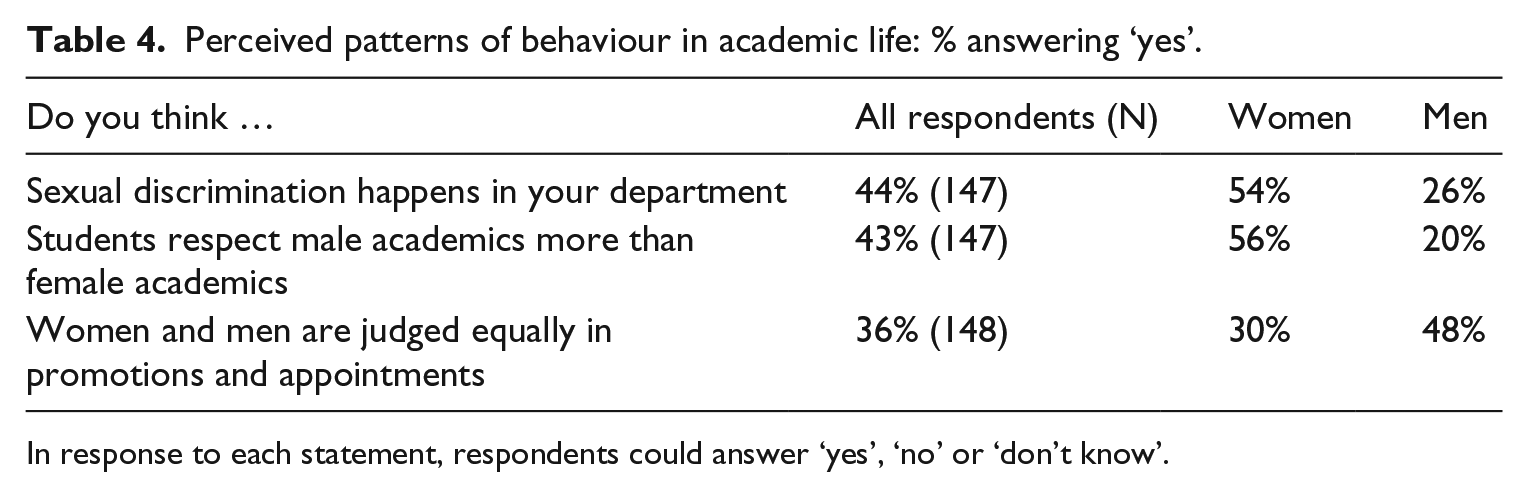
In response to each statement, respondents could answer ‘yes’, ‘no’ or ‘don’t know’.
Personal experiences of sexism
Our second battery of questions sought to investigate respondents’ personal experiences of gender or sexual discrimination in political science. As with general perceptions of the discipline, such experiences can shed light on the ways in which gender is performed in the profession. They may also highlight acute areas of concern that all scholars, regardless of gender, ought to be aware of.
Our survey thus included a number of items asking respondents whether or not they had experienced different types of discrimination, some subtle, others more blatant. Table 5 reports the proportion of male, female and all respondents who answered ‘yes’ to having had personal experience or knowledge of each of these forms of inequity. (Respondents could also answer ‘no’, ‘prefer not to say’ and ‘don’t know’.) Over four-tenths of all respondents said they had experienced sexual discrimination in the profession or had known colleagues who had been subjected to bullying/harassment because of their gender, and nearly four-tenths said they had been slotted for a particular job/duty because of their gender. Meanwhile, around three-tenths of all respondents said that their research had been devalued because of their gender or that their career had been held back because of their gender. Worryingly, one in five of all respondents said that they were afraid to speak up about the sexism they had experienced, while one-tenth had been warned that they would not get promoted if they had children. Although in each case the proportion of all respondents who had experienced a particular form of discrimination was in the minority, the overall numbers give cause for concern.
Direct and indirect experiences of sexism: % answering ‘yes’.
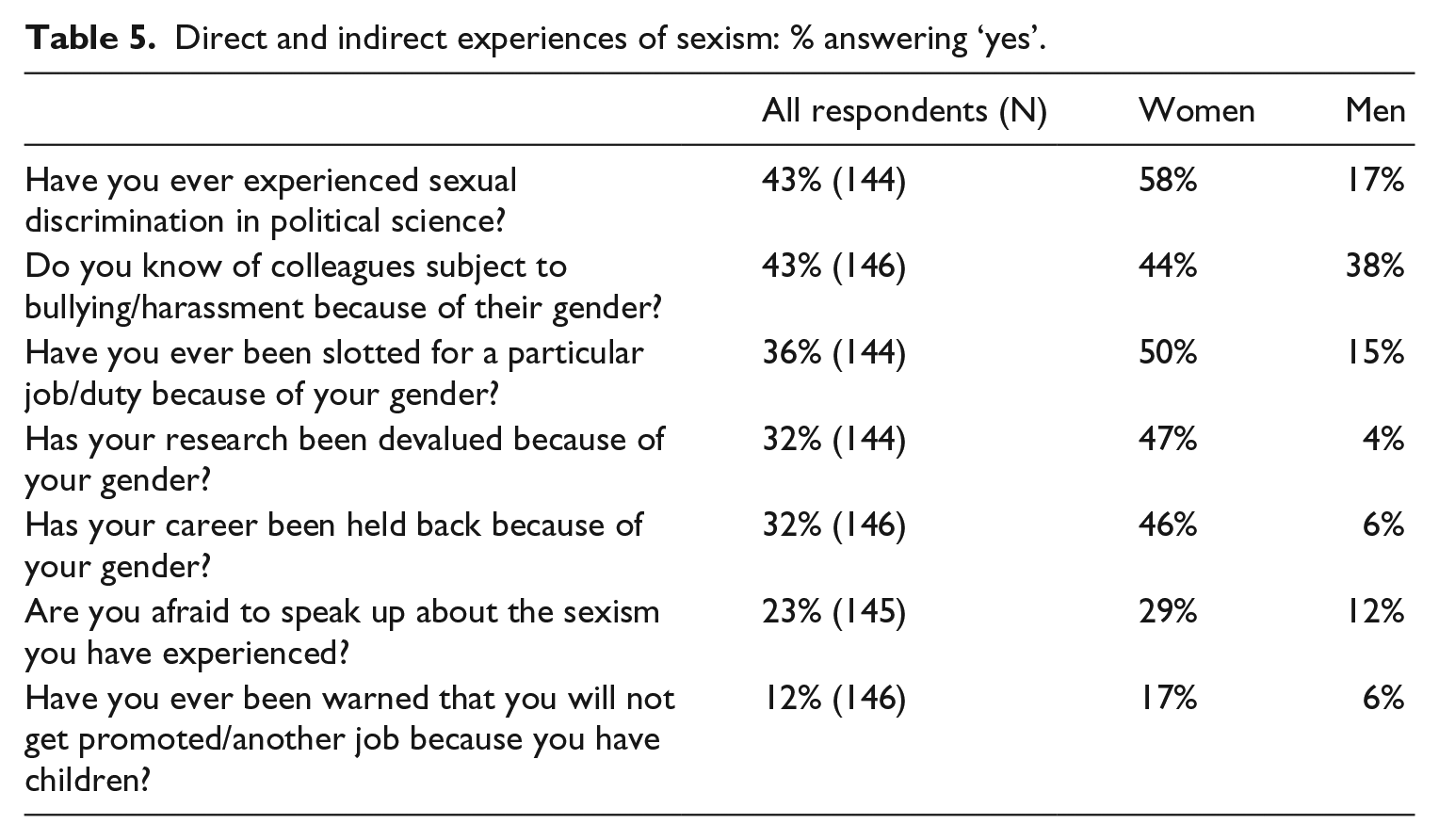
A clearer sense of the picture is revealed by looking at differences between men and women’s reported experiences. In essence, we found that if women were under-represented in senior positions, they were over-represented in their exposure to sexual discrimination. We found significant gender-related differences (at least at the 5% level) in responses to four statements: respondents having experienced sexual discrimination, having been assigned particular jobs, having had their research devalued and having had their career held back. 5 In all cases, far larger proportions of female than male respondents acknowledged such experiences. At the same time, the data suggest that women were not significantly more likely to have been warned that having children would weaken their chances of appointment of promotion.
On this last point, however, the qualitative comments revealed some disturbing experiences. One respondent reported an early-career experience in which she was told that
despite [having] good qualifications and experience I would never obtain a permanent or senior position because I was a parent and a lone parent at that (this was reported to me as having been said by a senior male colleague who said this in discussion with another male colleague who was shocked enough to report it directly to me having been particularly scandalised at the term ‘she’s ruined her career having a baby and it is a shame as she could have gone far’).
And while this highlights institutional biases which impact women, the following excerpt also reminds us of a marginalising professional culture, one that goes beyond HE institutions:
As a woman of colour raising a child on my own, I have found getting a full-time job extremely difficult; and people not always understanding. As I have no family support, have been the main caregiver and head of household, and have spent a lot of time raising my child, I have had difficulty keeping up my publications record. In addition, I work part-time, and rely on benefits for rent and daily living. As a result I have little money to attend conferences and to buy books, to be member of this and that association in the profession … I also do things as article reviews etc., as I feel I have to give back to the profession as others review my work; but in the end, I could have used the time for publishing my own work. The profession over-values publishing and this tends to favour the gender imbalance, given that women’s time is often divided between work, publishing and childcare … overemphasis on publishing tends to normalise ideas as well, rather than encourage real academic innovation and critical thinking, research and article-writing get tailored to suit the norm of high-ranking journals … I do feel like leaving the profession even though I am a good researcher … critical thinker and writer.
As with general perceptions, responses to our open-ended question provided further insight into the types of discrimination that are experienced within the profession. A recurring theme was the cumulative effect of small inequalities and the subtlety of everyday discrimination. One respondent reflected that discrimination in academia
… is often subtle in academia—and hard to prove. It often features neglect and exclusion (from information and consultation for instance) rather than aggression and rejection. Male colleagues collude with disrespectful attitudes from male students. Informal effective mentoring happens rarely. Accusations of bullying are not taken seriously when made by women. Assumptions are often made that women are not very competent at research until they actively demonstrate otherwise. Men get away with non-completion of administration, teaching and management tasks when they prioritise other agendas but women are publicly held to account and castigated if they try to do the same.
Together, the personal experiences of gender and discrimination that are captured by our questionnaire may reflect what has become known as a ‘chilly climate’ (Hall and Sandler, 1982; Prentice, 2000) for women in academia. It describes an environment in which women’s contributions are marginalised or devalued. In turn, this provides a context wherein ‘cultural sexism’ can become normalised and embedded in academic institutional values and operating practices (Savigny, 2014).
Beliefs about why women are marginalised
Our third battery of questions sought to gauge the conventional wisdom among political scientists about why women are under-represented at the higher levels of their discipline. We asked respondents to indicate whether they strongly agreed, agreed, disagreed or strongly disagreed with a range of reasons that might explain why women are disproportionately less likely to be promoted than men. Some of these reasons reflected the role of institutions, others the significance of women’s agency and yet others the importance of cultural barriers. The responses to the question are set out in Table 6.
Explaining the marginalisation of women.
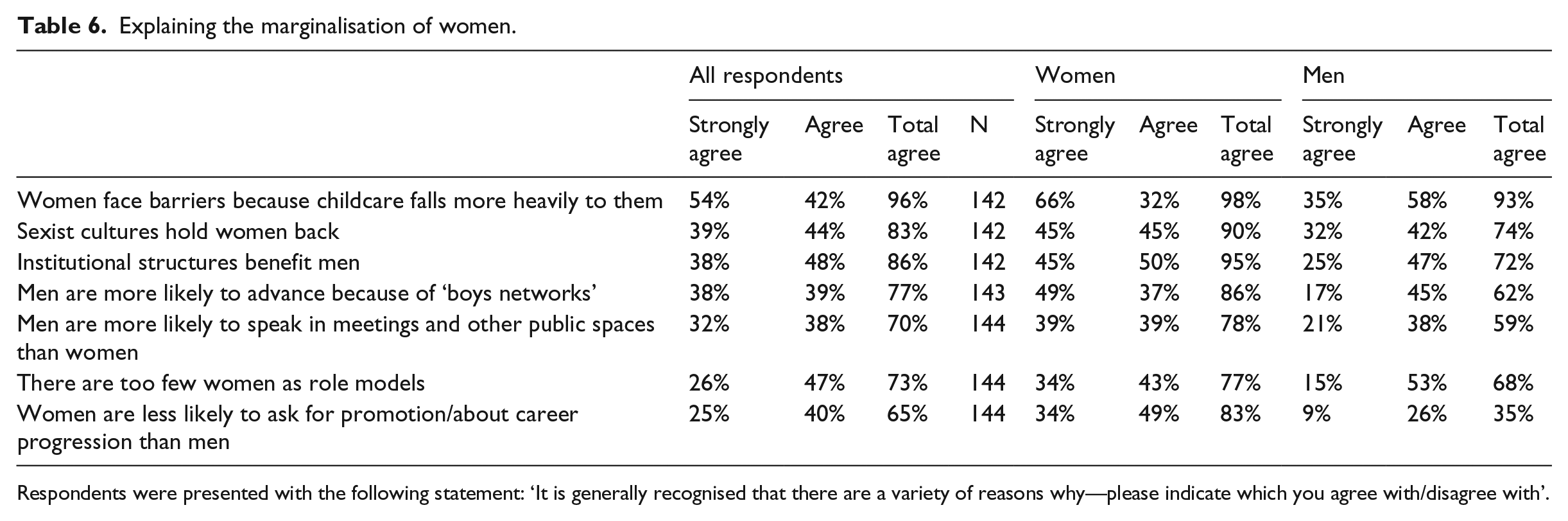
Respondents were presented with the following statement: ‘It is generally recognised that there are a variety of reasons why—please indicate which you agree with/disagree with’.
The reasons that elicited the highest degree of agreement were essentially institutional or cultural in their emphasis. Thus, over half of all respondents strongly agreed that ‘women face barriers because childcare falls more heavily to them’, and over one-third of respondents strongly agreed that ‘men are more likely to advance because of “boys networks”’, that ‘sexist cultures hold women back’ and that ‘institutional structures benefit men’. In contrast, smaller proportions strongly agreed with reasons relating more to women’s agency: just under one-third strongly agreed with the view that ‘men are more likely to speak in meetings and other places than women’, whereas only a quarter of respondents strongly agreed with the statements that ‘there are too few women as role models’ or ‘women are less likely to ask for promotion/career progression than men’.
The seven statements also elicited notable differences between male and female respondents: women were consistently more likely to agree with them than men, and they were also more likely to strongly agree. In this vein, there were significant differences (all at least at the 5% level) in response to the claims that men were more likely to advance because of male networks, that women were less likely to ask for promotion, that institutional structures benefit men, that childcare fell more heavily on women and that men were more likely to speak in meetings. 6 On some points, then, it seems that men and women interpret patterns of behaviour in very different ways and also hold different beliefs about the importance of factors that may impede their careers.
Sometimes, the most pronounced differences between men and women were revealed in the strength of their agreement. For example, nearly two-thirds of female respondents strongly agreed that women were disadvantaged because childcare fell more heavily on them, whereas only 35% of men said the same, although similar proportions tended to agree. Interestingly, this stratification in expressed opinions was not reflected in responses to a separate question that sought to tap attitudes towards childcare: when asked whether they agreed or disagreed with the view that ‘it’s better not to hire young women in case they need maternity leave’, all respondents disagreed, and virtually identical proportions of men and women (87% and 91%, respectively) strongly disagreed. In the case of childcare, men and women appeared to have similar values, but they also had differing beliefs about its career-disrupting potential.
Once again, responses to our open-ended question also help to illustrate the prevailing beliefs about how different factors can impede women’s careers. One female respondent linked childcare to institutional priorities:
A lot of the initial contracts are temporary which disproportionately puts off women finishing a PhD who want to have children … The REF accepting fewer submissions because of pregnancy was a very good start but it’s still very hard for female academics if they are the ones juggling the majority of child care commitments/home making tasks. I think that it has got a lot better—I have felt disadvantaged by having children (just because it hits my research outputs, ability to network and to do research) and it’s very hard juggling my career.
Another female respondent noted other issues surrounding childcare:
There are many networking events in the evenings and on weekends, which are very difficult to balance with childcare … My partner does not get flexibility from his work for childcare, so much of it falls to me.
Of course, it is not just women who experience problems juggling an academic career with childcare arrangements. A male respondent was keen to express disappointment at the attitudes of male colleagues:
They call research seminars for early evening and if you say that that is problematic for you they respond with ‘your wife should be doing/covering that’. It never seems to cross their mind that (a) as a father I may want to be an active parent or (b) that my wife has a job that is as important as mine, or could be better paid than mine.
Institutional–cultural factors were also highlighted in a number of open-ended comments, of which the following are just two examples:
So much of the sexist behaviour by male academics is so deeply embedded that it will be difficult to address. Speaking as a man I have found many male colleagues know what they have to be seen to say in the department and then outside in an all-male environment then reveal opinions that are opposite to what they will say in meetings. On several occasions over the past decades, although not in my present institution, I have felt that my opinion has been dismissed on gender grounds, especially in a committee situation where the overwhelming members were male.
The wider cultural context in which gender is performed was also noted by a number of respondents:
It’s not that you have to be male to get on, it’s more that you have to be a ‘lad’, regardless of whether you’re male or female. A common problem is lack of awareness by well-meaning men, along with a belief that inequalities can be managed by instinct and common sense.; Most academic colleagues (including managers) have no effective equalities training and do not even know the law, and are not given support to recognise let alone tackle sexism. The sexism from students is never tackled head-on and male colleagues do not notice it. There is no training or support for students who wish to challenge it either. Sexism in academia can be harsh and brutal but it often exists in the everyday, small interactions that women do not want to challenge as they would be seen as making a fuss about small things. But adding them all up can lead to a disempowering and undermining working environment, with serious impacts on mental health and work productivity.
Possible solutions
As noted in section ‘Perceptions and values’, there was universal or near-universal agreement across the gender divide that the under-representation of women matters. In separate questions, we also found some support for a measure of ‘positive discrimination’ to remedy the perceived marginalisation of women. Nearly three-quarters of respondents tended to disagree that gender inequalities in political science would eventually sort themselves out, implying that some form of action is necessary, and 60% of respondents tended to agree that positive discrimination should be used to ensure gender parity in their department.
Relatively interventionist forms of positive discrimination are, of course, just one approach for improving the position of women in political science. Work in this area has identified various other ways in which existing practices could be modified to increase the number of women scholars in general and women scholars in senior positions in particular (Monroe et al., 2014). In our survey, we presented respondents with a number of reformist proposals, drawn from the literature, in a bid to ascertain their perceived efficacy. Our logic was simple. If colleagues thought certain changes would be more likely to help women, then there was a good chance that they might, on the basis of collective experience, and there might also be more support for them within the discipline.
Table 7 reports responses to a number of possible solutions. The provision of childcare was perceived to be the most likely to help women, with nine-tenths of all respondents, men and women alike, adopting this position. This view was also commented on by an experienced academic, who was blunt in her views:
I am now a Head of Department but, in my view, a pair of testicles (if I may be so crude) would have meant a faster climb up the greasy pole. Younger women still have a struggle and I think the key issue is when women decide to have children. Male careers are not impacted upon in the same way.
Likely or unlikely to help the standing of women? % answering ‘likely to help’.
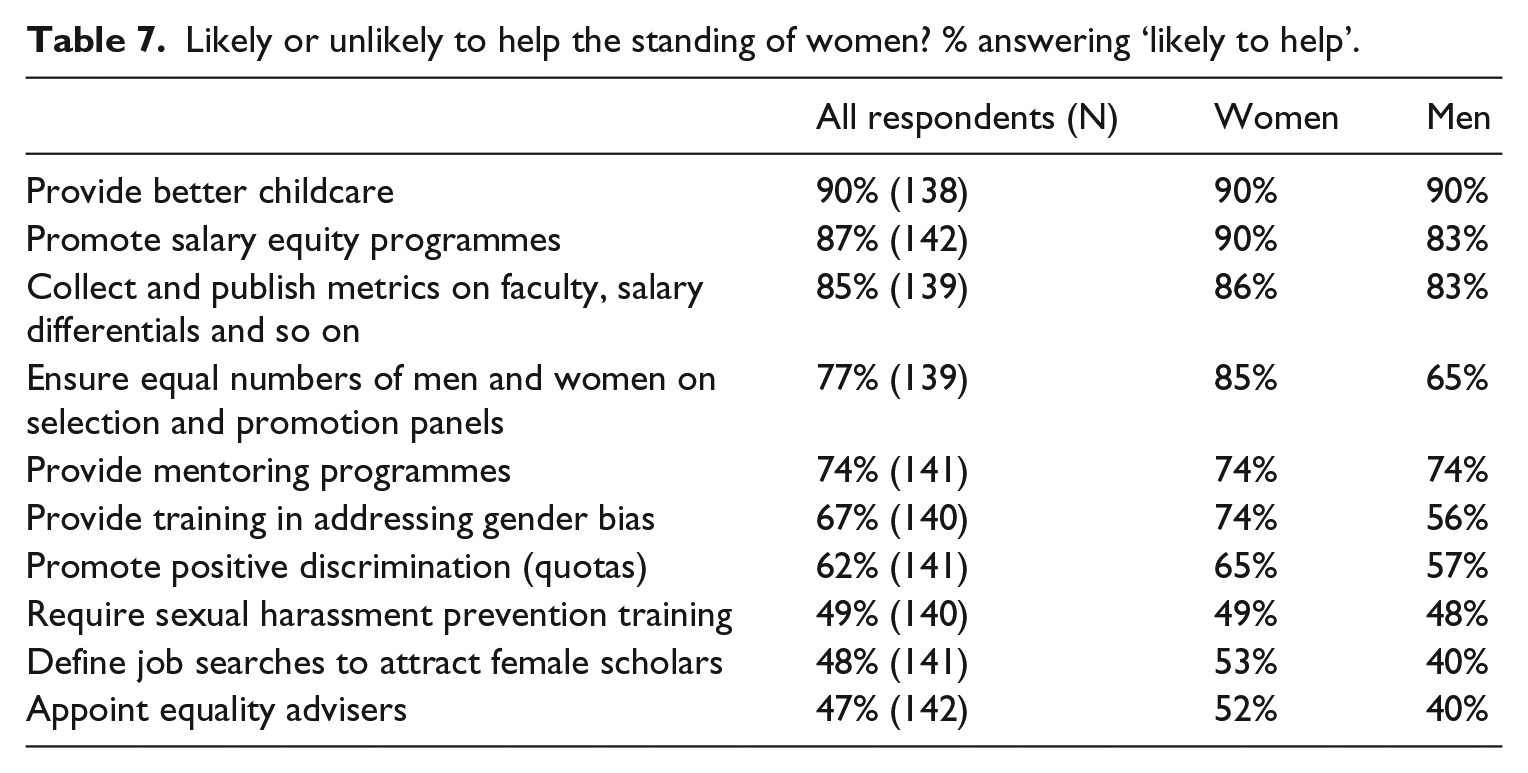
Just under nine-tenths of all respondents said the promotion of salary equity programmes would be likely to help, and a similar proportion said that the collection and publication of metrics on gender balances and salary differentials would be likely to help. With better education and awareness-raising, so the logic goes, male colleagues would become more conscious of the problems faced by women (e.g. Mauleón et al., 2013). A similar logic could be found in other suggested solutions: one of these, the provision of general training to highlight gender bias, was thought likely to help by two-thirds of all respondents, whereas just under half agreed that the provision of sexual harassment training and the appointment of more equality advisers would be likely to help.
The rationale for these solutions—and their limitations—were captured in some of the responses to our open-ended question:
At present, my department has only one woman above lecturer level and no female professors. I think this is a classic example of implicit bias and unacknowledged male privilege operating in a context where most, if not all, the men in my department would consider themselves to be ‘against’ sexism. I think these kinds of problems can only really be addressed with quite a significant root and branch transformation in the gendered cultures of academia which, unfortunately, I don’t see happening any time soon. Trainings, etc. do not work. It’s the culture and networks, especially when it comes to promotion, also the fact that (in my institution) a lot gets done via ‘conversations in the hallway’ and is not transparent.
The other solutions, including appointing equal numbers of women and men to selection and promotion panels, the provision of mentoring programmes, defining job searches to attract female scholars and promoting the use of quotas, offered more direct and practical ways to help women. Some were considered more efficacious than others. Over three-quarters of all respondents said that having gender equity on panels would be likely to help women; 74% and 62%, respectively, said the same of providing mentoring programmes and promoting positive discrimination; and only 48% said that using defining job searches would be likely to help.
On the basis of chi-square tests, only two solutions elicited significantly different responses from men and women: gender equality on selection and promotion panels (χ2 = 7.23, df = 2, p < 0.05) and the provision of training (χ2 = 6.83, df = 2, p < 0.05). However, the general pattern was clear: in all cases, women were at least as optimistic as men that the proposed solution would have some positive effect and in some cases notably more so.
For some respondents, however, it was clear that little would change until there were more women in the discipline and that some form of positive discrimination was therefore needed:
The sooner we get gender equality the better for a whole host of reasons, and I think gender quotas are the only way to achieve that … A progressive rule would be that for every dept that has under 1/4 of one gender they advertise for only the underrepresented gender every second job call until they get back above 1/3 or something like that. We have 1/4 women in our place and it is not enough—it is especially problematic the signal given to students who see mostly men in the academic offices and behind the lecterns.
In a different context, writing about descriptive representation and the potential use of gender quotas, Murray (2014) suggests that opposition to positive discrimination can be reduced if the debate is reframed as one about male over-representation. Is there anything wrong, for instance, in having a quota of 50% or even 60% for male colleagues in a department? This is perhaps a question worth considering as we move forward.
Conclusion
Authors have noted statistical progress in the advancement of women in political science (e.g. Bates et al., 2012; Childs and Krook, 2006). However, they also agree this progress has been slow. Through our survey, we wanted to unpack the ways in which UK political scientists perceive gender to be ‘performed’ in their working lives. As we have noted, men are over-represented at senior levels, yet it seems from our responses that they are under-represented in their experiences of gender impacting their working practice. Men and women all seem to agree on the need to improve the position and presence of women in the discipline, but they do not always agree how. Perhaps more importantly, they seem to have different experiences, interpret patterns of behaviour in different ways and hold different understandings about why women’s careers are so often impeded. The PSA is currently seeking to embed the Equality and Diversity agenda within the profession, but this is not something that they can achieve alone. More and better dialogue is needed across the gender divide if men and women are to understand better each other’s points of view and to create fairer working environments. And our survey also highlights the ways in which change needs to take place to reflect challenges to institutional norms, practices and cultures. Rendering explicit the ways in which gender is performed and the ways in which it may be experienced in the workplace, we hope, will open up space where dialogues about progressive measures can be conducted and change effected.
Footnotes
Acknowledgements
The author would also like to thank Josh Freeland for his RA support.
Funding
The authors would like to thank Bournemouth University for funding this survey (no grant award number).