







Abstract
The outcome of the UK’s EU referendum will have far-reaching implications for its foreign policy and diplomacy and raises fundamental questions of how ‘Brexit’ will impact its relationships with Europe and the world. This is even more pertinent when looked at from the perspective of the UN where the UK has benefited considerably from its membership of the EU. This article presents the challenges and opportunities of Brexit for the UK’s diplomacy, and influence, at the UN. First, we illustrate the importance of political and regional groups within the UN. Second, we analyse how the UK has worked within such groups, and above all the EU, in two cases: human rights and nuclear weapons issues. Finally, we reflect upon how Brexit is expected to impact UK diplomacy in a UN dominated by group politics, arguing that any rewiring of UK diplomatic channels must continue to account for EU positions.
Introduction
The outcome of the United Kingdom’s referendum of 23 June 2016 to leave the European Union (EU) will have far-reaching implications for British foreign policy and diplomacy. While considerable attention is being paid to the specifics of how the United Kingdom might negotiate its withdrawal from the EU, a fundamental question remains of how ‘Brexit’ will, in turn, impact the United Kingdom’s wider international role and its relationships with Europe and the world at large. This question is even more pertinent when looked at from the perspective of the United Nations (UN), where the United Kingdom has considerably benefited from its membership of the EU, which is widely recognised as a major pole and important political group within the UN. Group politics—that is, the actions, interactions and influence of regional and political groups—characterise diplomacy at the UN beyond the Security Council. Hence, the United Kingdom’s prospective exit from one of the most important of these groups will inevitably affect the way it engages with other UN member states and its potential influence on debates and outcomes at the UN.
This article analyses the challenges and opportunities of Brexit for the United Kingdom’s diplomacy, and influence, at the UN. It presents a look back at how the United Kingdom has worked within the EU at the UN to date, as well as a critical look ahead at what effect Brexit can be expected to have on UK diplomacy in this forum. Specifically, we seek to answer the following research questions:
To what extent has the United Kingdom worked within the EU at the UN thus far and how important has EU membership been for the United Kingdom?
Given the importance of group politics at the UN, what options are there for a country outside a major group to try to exercise influence?
What options does the United Kingdom have outside of the EU in terms of trying to influence debates and outcomes at the UN?
Focus is given explicitly in this article to two contrasting policy fields within which the United Kingdom might be expected to exert influence at the UN: human rights and nuclear weapons. On nuclear issues the EU has long been considered a highly variable and oftentimes weak actor within the UN’s multiple disarmament forums (see Blavoukos et al., 2015; Dee, in press; Müller, 2010, 2005). As a nuclear-weapon state and permanent member of the UN Security Council, expectations follow that the United Kingdom could therefore be in a better position to exert leverage without recourse to the EU. Within the Human Rights Council (HRC) however, where the EU is a prominent pole and influential group, expectation follows that Brexit could negatively impact UK leverage. We seek to test those expectations and to consider the implications that Brexit could have for the United Kingdom in these contexts. The research is based principally on official documents and records of the UN and interviews conducted by each of the authors over a period of several years with diplomats from UN member states. 1
The article begins by illustrating the importance of political and regional groups within the UN system. It then analyses the way in which the United Kingdom has worked within such groups, and above all the EU, in two cases: the HRC and the Nuclear Non-Proliferation Treaty (NPT) Review Conference and associated nuclear forums. Finally, we consider how Brexit can be expected to impact UK representation and influence in a UN dominated by group politics.
The UN context: Group politics to the fore
The United Kingdom is widely considered to be one of the most influential members of the UN. Its position is above all characterised by its permanent membership of the UN Security Council, which stems from its important role in the alliance that won World War II. As one of the P-5 (five permanent members) the United Kingdom can lay claim to a status as one of the world’s leading powers. The United Kingdom is seen as a constructive member of the Security Council: it has not vetoed a draft resolution there since December 1989 (nor has the other west European power, France). It is the sixth largest contributor to the UN’s general budget (contributing 4.7% of the budget) and to the peacekeeping budget (contributing 5.8%) (UK House of Lords, 2016: 41). Since 2013, the United Kingdom has also been one of the few developed countries that meets the UN target of giving 0.7% of its gross national income (GNI) in official development aid. But the United Kingdom’s ‘soft power’ at the UN also has limits, given, for example, its past as a colonial power, the controversial role it played in UN Security Council decision-making on the Rwandan genocide (Melvern and Williams, 2004) and the war in Bosnia and Herzegovina (Simms, 2002), and its support of the US-led war against Iraq in 2003 despite the absence of UN Security Council authorisation.
The United Kingdom’s influence at the UN has arguably been boosted by its membership of the EU, which is the most well-organised and well-resourced group at the UN. This status matters because regional and political groups play a significant role in the UN beyond the Security Council. Groups are prevalent actors in debates within intergovernmental bodies such as the UN General Assembly (UNGA) and its various committees and associated conferences. Diplomats in the UN often speak on behalf of groups, sponsor resolutions on behalf of groups, and spend a good deal of time exchanging information, coordinating positions, and agreeing on initiatives within the context of groups.
The reasons for the apparent popularity of groups are many (Laatikainen and Smith, 2017: 99–101). Groups amass ‘votes’, which is crucial when decisions are taken by a majority vote. As Diana Panke (2013: 287) notes, ‘the more members a group has, the more yes-buttons their members can push and the greater the chances that organization will be successful in the UNGA’. As a result, groups augment the influence and voice of the individual members, because they help to make it more likely that their preferences can be achieved. Where consensus, rather than majority vote, is required, groups are also critical in bringing the number of actors involved in negotiating often complex and politicised issues down to a more manageable number (Dee, 2017: 167; Elgström and Jönsson, 2005; Sjöstedt, 1999). Endgame bargaining thus often comes down to a select number of group representatives who, in turn, ensure their group’s support for any negotiated outcome. Groups also enable the exchange of information about other states’ or groups’ positions and preferences. The active groups are those generally composed of like-minded states which either share particular norms and identities or particular interests, or both.
There are, however, some disadvantages to working in groups (Laatikainen and Smith, 2017: 102). Reaching agreement within groups can be difficult. Where groups require consensus, a lowest common denominator, or no agreement at all, may result, thus disappointing some members. Where groups do not require consensus, states might defect from group positions, reducing the perception of group unity and perhaps undermining group effectiveness. To avoid defections, there may be much group pressure to maintain unity, thus creating uncomfortable dilemmas for diplomats. Group positions tend to be rigid: any agreement is difficult to change without returning to the intra-group negotiating table. Negotiations between groups are difficult if group positions are non-negotiable, and can lead to polarised politics within the UN.
A variety of regional and political groups are active in diplomacy in different UN settings. There are five regional groups in the UN system, which exist to help ensure an equitable geographical representation on those UN bodies to which states are elected (the Security Council, the Economic and Social Council, the HRC, and so on): the Africa Group, the Asia-Pacific Group, the East European Group (EEG), the Latin American and Caribbean Group (GRULAC), and the Western Europe and Others Group (WEOG). The core activity of these groups is to select states among their members to put forward for elections to UN bodies (see Daws, 1999). These groups can be active, to a greater or lesser degree, in other areas, such as the exchange of information and views, and even coordination of positions and presentation of joint positions to the UN. The Africa Group is very active, not only exchanging information but speaking with one voice in debates and presenting resolutions. WEOG in contrast usually limits itself to the exchange of information and views, while the Asia-Pacific Group only selects members for elections to UN bodies.
Political groups are essentially of two types. First, there are groups based on regional or other international organisations that have a life outside the UN: the EU, the Association of South-East Asian Nations (ASEAN), the Organization of the Islamic Conference (OIC), the Arab Group (based on the Arab League), the Non-Aligned Movement (NAM), the Nordic Group (based on the Nordic Council), and so on. Second, groups can be UN-based, formed either as permanent caucusing groups or as single-issue lobbying groups. An example of the former is JUSCANZ (a grouping composed initially of Japan, the United States, Canada, Australia and New Zealand, but now encompassing also non-EU European states such as Norway and Iceland); an example of the latter is the group of Small Island Developing States (SIDS) concerned particularly with climate change issues.
Of these various groups, the EU is by far and away the most powerful. There is virtually nothing at the UN on which the EU does not have a position. Through an intense coordination process, EU member states try to reach agreement on joint statements, the sponsorship of resolutions, and united voting positions. They are not always successful, and sometimes EU positions are unsatisfactory lowest-common-denominator compromises, or simply absent. But EU unity at the UN is striking, and contrasts favourably with the unity of many other political groups (Hug and Lukács, 2014; Jin and Hosli, 2013; Panke, 2013). In addition, several non-EU European countries routinely align themselves with EU positions, further boosting the EU’s role as an amasser of votes.
Until the Lisbon Treaty entered into force in 2009, the EU’s position at the UNGA and other UN intergovernmental bodies such as the HRC, would usually be presented by the member state holding the rotating presidency of the EU. The Lisbon Treaty conferred legal personality on the EU and stated that the new High Representative, supported by the new European External Action Service (EEAS), would represent the EU in international affairs. Instead of the rotating presidency (a state) acting as the voice of the EU in UN bodies and international negotiations, an EU delegation would do so—at least in principle. In practice, the EU’s representation has proven more difficult. At the UNGA in New York, the EU pressed for an enhanced observer status, to enable the EU delegation to participate more actively in proceedings. That request initially encountered resistance from other UN states, but since 2011, the EU delegation has the right to speak in debates, sponsor draft resolutions on behalf of the member states, submit amendments, and reply to other delegations, but not to vote or co-sponsor draft resolutions (Guimaraes, 2014; Laatikainen, 2015; UNGA, 2011).
It is worth nothing that the United Kingdom in fact contested the move to strengthen EU representation at the General Assembly, and in 2011 blocked the issuing of over 70 EU statements because it argued that where there were mixed competencies, the EU could not automatically speak on behalf of the member states (Borger, 2011). The issue was resolved in late October 2011, when the Council agreed how statements would be worded (Council of the European Union, 2011). For the United Kingdom, however, when and how the EU speaks for it at the UN has continued to be an issue requiring special attention. As one United Kingdom diplomat commented, ‘We [the UK] are always quite particular about what the EU says it can do and what the EU Member States, as parties of these treaties, actually do [because] the EU has only a limited policy role to play’ (interview, Geneva, June 2015). It is therefore in this context of EU coordination, representation, and effectiveness that Brexit will have an impact on British diplomacy at the UN. The United Kingdom’s permanent seat on the Security Council is not in question (the United Kingdom could veto any change to Security Council membership), though its influence may suffer as it is no longer explicitly or implicitly carrying the weight of the EU (see Hill, 2005, 2006; Lang, 2016). The more profound impact, however, will be seen in the United Kingdom’s self-exclusion from an important actor in UN diplomacy in other UN forums, as well as how, and with whom, the United Kingdom will speak and ally itself by way of alternative. In the next two sections, we analyse these challenges and opportunities for British diplomacy in two issue areas: human rights and nuclear issues.
UK diplomacy in the HRC
This section analyses the challenges for the United Kingdom’s post-Brexit diplomacy in the UN’s foremost intergovernmental human rights body, the HRC, which has a remit to promote and protect human rights worldwide. It was created in 2006 to replace the old (discredited) Commission on Human Rights. It is made up of 47 states elected from the UN’s five official regional groups, and meets three times a year in Geneva for no fewer than 10 weeks, in March, June, and September. The HRC can send fact-finding missions to countries, which can potentially influence developments on the ground, and it has an important role in examining states’ human rights records and developing new norms. The United Kingdom has been a prominent supporter of the HRC and has served on the HRC almost continuously since it was created: it has served three terms (2006–2008; 2008–2011; 2014–2016) and was elected for another 3-year term (2017–2019) in October 2016. Formal membership of the HRC matters because only members can vote on resolutions, and they speak first in proceedings, but all other UN states can also speak (as observers) and sponsor resolutions.
In the first few years after the HRC was launched, debates were highly polarised and major groups frequently clashed—principally the EU against the OIC and Africa Group. After joining the HRC in 2009, the US actively sought to break ‘bloc politics’ by sponsoring a resolution on the freedom of opinion with a country from each major region. The success of this initiative has led to a surge in cross-regional diplomatic activity. A considerable proportion of the resolutions presented in each session are now sponsored by cross-regional coalitions (see Table 1). Alongside this, groups that had not been previously very visible at the HRC are now increasingly active, especially in delivering statements during debates; such groups include the Nordic Group, the Organisation internationale de la Francophonie, the Gulf Cooperation Council, and Mercosur. In contrast, JUSCANZ, the CANZ (Canada, Australia and New Zealand) grouping, and the Commonwealth have not intervened in HRC debates.
Cross-regional activity in the September sessions of the Human Rights Council, 2006–2016.
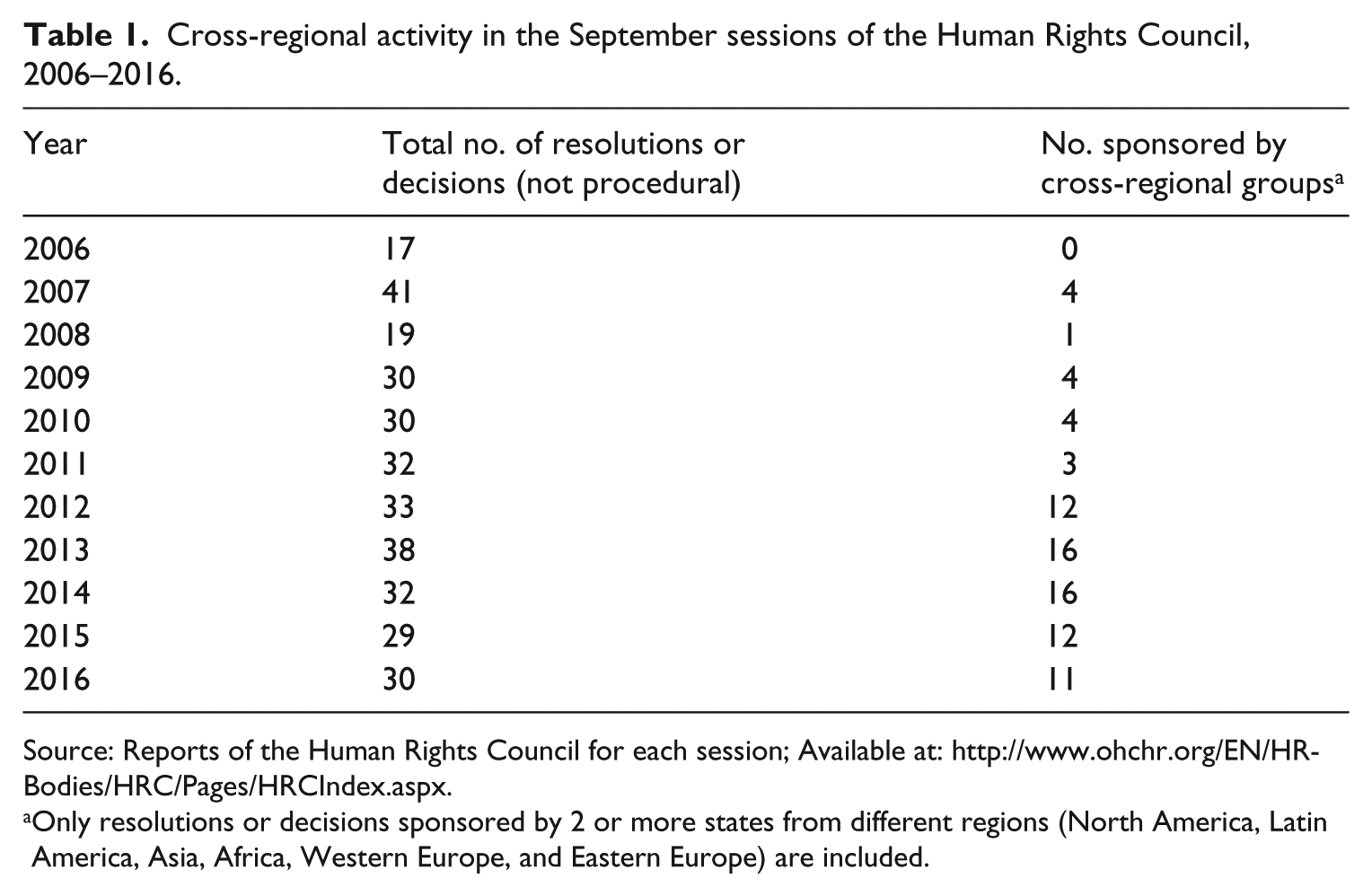
Source: Reports of the Human Rights Council for each session; Available at: http://www.ohchr.org/EN/HRBodies/HRC/Pages/HRCIndex.aspx.
Only resolutions or decisions sponsored by 2 or more states from different regions (North America, Latin America, Asia, Africa, Western Europe, and Eastern Europe) are included.
EU member states have been active in cross-regional diplomacy at the HRC for several reasons (Smith, 2017). Because the EU is seen to be so powerful, it can spark near automatic resistance by other HRC members, leading to polarised stand-offs as seen in the first few years of the HRC. In addition, the process of EU coordination can be frustrating, as it is time-consuming and therefore slow, and often results in lowest common denominator outcomes. Working outside of the EU framework is thus a way to circumvent these shortcomings, though it should be noted that EU activity continues in parallel alongside such national diplomatic activity. The EU remains an active participant in HRC debates, with the presidency usually presenting statements on behalf of the member states—around 40–50 per session. The EU also sponsors several resolutions a year: usually on the rights of the child, the freedom of belief, and the human rights situations in Belarus, Myanmar, and North Korea; in 2016, it also sponsored a resolution on the human rights situation in Burundi.
The EU was the principal forum through which British diplomacy worked on human rights in the early years of the HRC and its predecessor, the Commission for Human Rights (interview, New York, 2004). 2 The United Kingdom has been vocal and active in the EU at the HRC. But as cross-regional activity has grown at the HRC, it has acted more with other states from outside the EU. Table 2 lists all the resolutions that the United Kingdom has sponsored outside of the framework of EU diplomacy.
Resolutions/decisions sponsored by the United Kingdom at the HRC, 2006–2016.
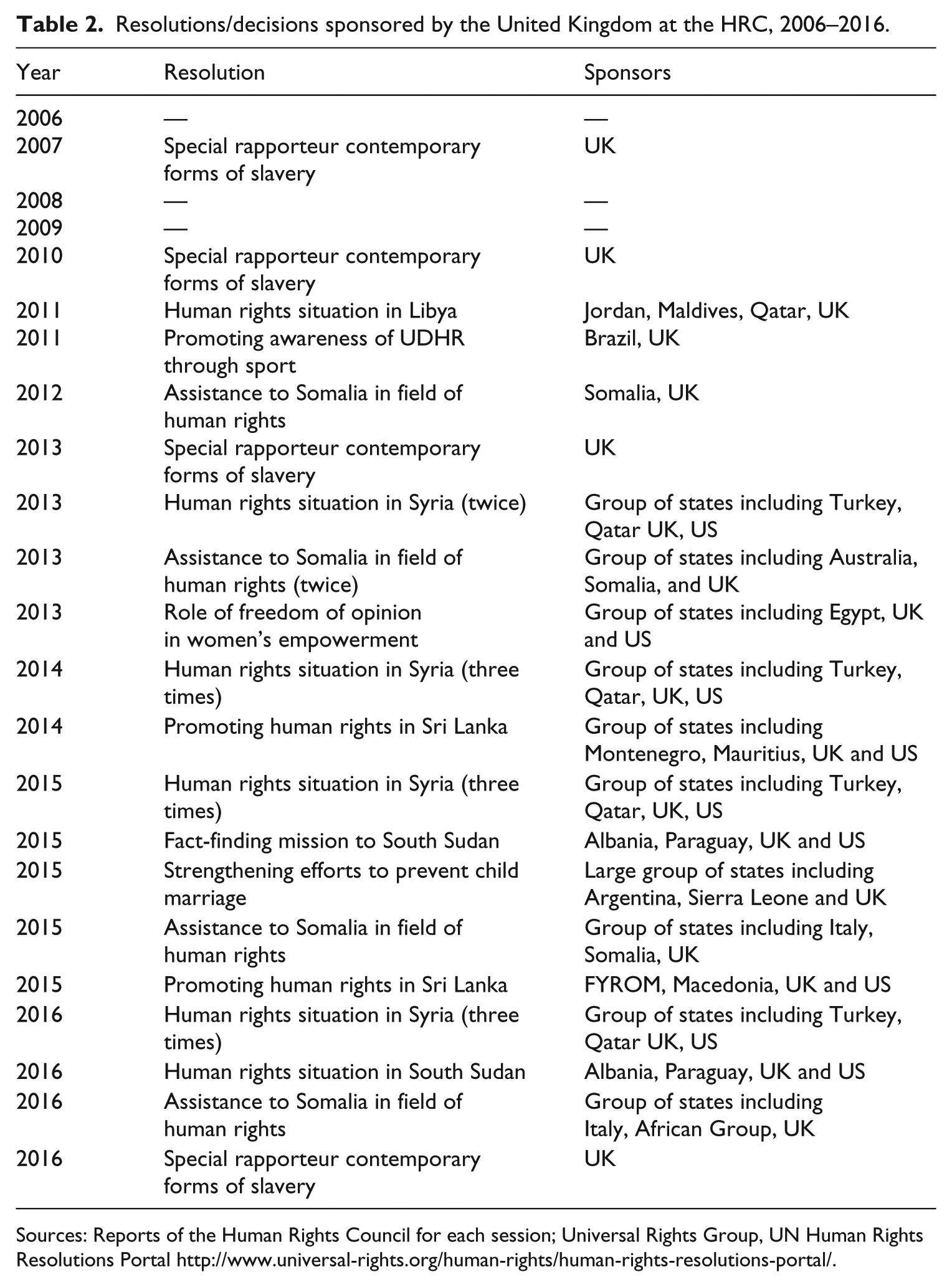
Sources: Reports of the Human Rights Council for each session; Universal Rights Group, UN Human Rights Resolutions Portal http://www.universal-rights.org/human-rights/human-rights-resolutions-portal/.
In 2016, the United Kingdom was also more active in requesting special sessions of the HRC. In December, together with Albania, Paraguay, and the United States, it called for a special session on the human rights situation in South Sudan. In October, the United Kingdom and the ‘core group’ (Germany, France, Italy, Jordan, Kuwait, Morocco, Qatar, Saudi Arabia, Turkey, the United Kingdom, and the United States) requested a special session on the deteriorating human rights situation in Aleppo, Syria.
Such trends seem to suggest that post-Brexit, the United Kingdom could exercise influence within the HRC, by working with cross-regional coalitions of countries. However, there are elements of the new cross-regional dynamics that indicate a more challenging context for UK diplomacy on human rights.
The EU and other established groups continue to be significant and influential actors in HRC debates, despite the rise of cross-regional diplomatic manoeuvring. How the United Kingdom situates itself vis-à-vis the EU will be important: the United Kingdom has rarely dissented from EU voting unity, and is presumably unlikely to do so more often after Brexit. The few issues on which achieving unity has been difficult almost all entail Israeli–Palestinian relations, and these have become less toxic over time as considerably larger issues in the Middle East (Libya, Syria, and so on) have loomed.
Given that United Kingdom and EU priorities are likely to continue to align, then the United Kingdom could simply support EU statements and resolutions in the HRC sessions. It could formally align with EU statements, though this would require a future EU–UK agreement to that effect. A variety of non-EU European states are given the chance to align with EU statements at the UN. The formulation then reads that the statement is being delivered ‘on behalf of the European Union, …’ with a list of the states that support the statement. Whether the United Kingdom, a relatively much more powerful state, will accept inclusion with this company remains to be seen.
Another potentially problematic issue for the United Kingdom’s relations with the EU within the UN is that third countries have expressed dissatisfaction with the extent to which the EU consults with them. Outreach has long been problematic for the EU, because the internal coordination process can be so time-consuming that EU member state diplomats have little time to engage with non-EU diplomats. The creation of the EU delegation has improved the EU’s outreach capabilities somewhat, but given that the HRC is in session so often throughout the year, interviewees (interviews, Geneva, May 2014) have indicated that the EU delegation has struggled with the demanding workload. Given the importance of the United Kingdom, the EU could make special arrangements for coordinating with it, though this again depends on the nature of the overall post-Brexit UK–EU relationship, as well as EU diplomatic capacity.
The option of working within alternative groups does not currently seem feasible. JUSCANZ and WEOG are mainly information sharing venues, and do not generally express positions within the HRC. JUSCANZ may coordinate on some human rights issues behind the scenes and is thus a possible alternative ‘home’ for the United Kingdom. The United Kingdom could try to turn JUSCANZ into a caucus, but could face resistance from other members of the group. A further difficulty here is that the Trump Administration has reportedly considered pulling the United States out of the HRC (the Bush Administration boycotted the HRC as well), which would deprive the United Kingdom of a partner (see Table 2) and destabilise JUSCANZ. The Commonwealth, which during the referendum campaign was mentioned as an organisation that the United Kingdom could lead more actively post-Brexit, has never intervened in HRC debates. Nor is it likely to do so, given that key members of the Commonwealth, such as India, Pakistan, Nigeria, and South Africa, are active in other groups that generally contest western dominance (NAM, the Africa Group or the OIC).
The increasing use of cross-regional informal groups to express positions and sponsor resolutions is somewhat more promising. But the aim of this diplomatic activity is usually—but not always—to work with one (or more) states from a region in the hope that the state can ‘bring along’ most of the rest of the regional or (in some cases) political group. States that are on the margins of groups are thus not as attractive (interviews, Geneva, May 2014). The inclusion of the United Kingdom in a cross-regional group would, therefore, no longer be premised on the possibility that the United Kingdom could bring along the EU. 3
It is therefore apparent that the challenges for UK diplomacy post-Brexit are many. It will need to focus carefully its efforts, given more limited diplomatic capacity. It will gain an independent voice, but lose influence. If the United Kingdom is to remain an important actor on human rights, it will have to work hard to establish itself as a good bridge across various groups—without being a member of one of the UN’s more important group players.
UK diplomacy in the UN’s nuclear forums
Nuclear politics has remained a hotly contested topic within the UN since the UNGA’s first resolution in 1946 (UNGA, 1946), and is today addressed through multiple forums including the UNGA First Committee, UN Disarmament Commission, Conference on Disarmament, the NPT Review Conference (RevCon) as well as numerous open-ended working groups and special sessions dedicated to the topic.
The United Kingdom is the world’s smallest recognised nuclear power, possessing around 1% of the world’s total stockpile of approximately 17,000 nuclear warheads (Ministry of Defence, 2016). The relative size of the United Kingdom’s arsenal nevertheless matters little in comparison to the institutional power that the United Kingdom’s nuclear weapons afford it within a UN context. With nuclear politics in the UN dictated by the age-old division between the ‘haves’ (the nuclear weapon-states) and ‘have-nots’ (the non-nuclear weapon states) (Mölling, 2010), the United Kingdom thus stands in a privileged position. The power symmetry of nuclear negotiations is significantly skewed in its, and the other nuclear weapon states’, favour. Such power asymmetry is further exacerbated by the fact that, within the UN, nuclear disarmament negotiations are conducted under a consensus rule and therefore requires the support of the nuclear-weapon states for any resolution to be adopted. In this context, therefore, the United Kingdom may be a small nuclear power, but it packs more than its fair share of punch in shaping the agenda and outcome of UN nuclear negotiations.
Under the 1993 Maastricht Treaty on EU, the United Kingdom is required to coordinate with other EU member states on all matters relating to foreign and security policy, including nuclear policy, within the UN. The EU is nevertheless a divided actor when it comes to nuclear politics. Its membership not only includes two nuclear-weapon states and North Atlantic Treaty Organization (NATO) members that benefit from a nuclear umbrella, but also several states that are staunchly anti-nuclear and have consistently campaigned for nuclear disarmament and even prohibition (Blavoukos et al., 2015). 4 EU coordination on nuclear issues is, as a consequence, often laborious, requiring extensive internal discussions through the Council Working Groups on Non-Proliferation (CONOP) and Disarmament (CODUN) to generate common language prior to key negotiating events (Dee, in press). Such labours, however, often produce little more than ambiguous language that specifies the EU’s support of the goal of nuclear disarmament, but studiously avoids specifying points of action or policy specifics that its own nuclear-weapon member states would be held to. Instead, the EU’s language frequently stresses ‘the special responsibility of the States who possess the largest arsenals’ (Council of the European Union, 2015), thus moving the focus away from the United Kingdom and France and onto the United States, Russia and China.
Since the entry into force of the Lisbon Treaty in 2009, EU coordination on all nuclear disarmament and non-proliferation issues has been bolstered to some extent by the new role of the EEAS, with its dedicated office for Disarmament, Non-proliferation and Arms Export Control. The extent of EU coordination, and in fact representation, nevertheless varies extensively across the UN’s nuclear forums (Dee, in press). The EEAS has exerted considerable energy to bring about an EU position within the UN on disarmament and non-proliferation, but it is restricted by what the EU’s member states will agree to, and by the UN and its different rules of procedure in recognising the EU, and the EEAS more explicitly, as an autonomous representative of its, oftentimes far more prominent, member states (Dee, in press). This situation has resulted in a notably limited performance by the EU (Dee, in press; Müller, 2010; Smetana, 2016) marked not only by its lowest common denominator position, but by the requirement for extensive EU coordination meetings, limited outreach to third countries, and a resultant tendency of many of the EU’s more active member states to work alongside other more like-minded groups (Dee, 2012), as demonstrated in Figure 1 below.
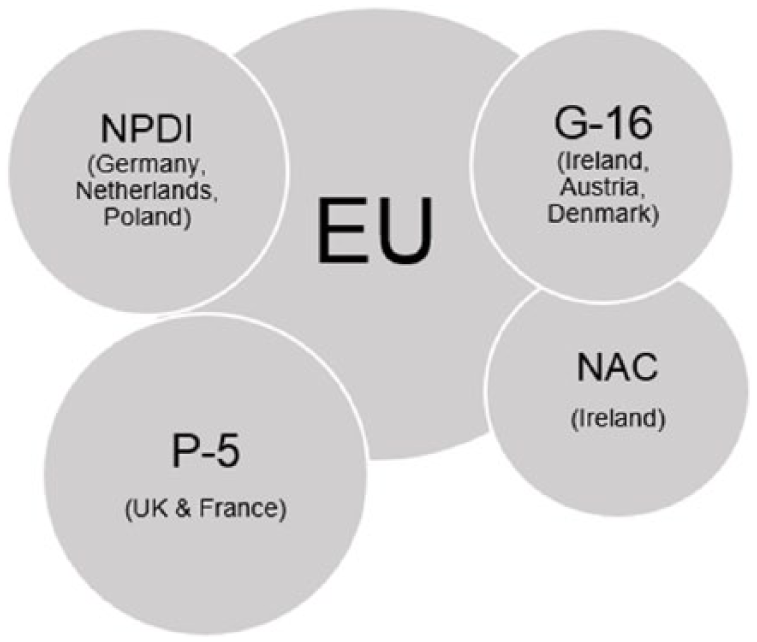
EU member state group affiliations within the NPT (2010–present).
This practice of cross-alignment by several EU member states has, on occasion, had its benefits for the EU as a group. During the 2010 NPT RevCon, it enabled the EU to act as a conveyor belt for information sharing between political groups, further allowing the EU to fine-tune its own consensus-based language, spread its voice, and contribute towards the wording of the widely lauded 2010 NPT Action Plan document (interviews, New York & Geneva, May-June 2011; Dee, 2012). During the 2015 NPT RevCon, however, this same practice of cross-alignment meant that the EU was reduced to a virtually irrelevant party (Dee, 2015); it could contribute little in the way of language or policy specifics, and several of its member states were much more actively involved within other groups prominent in shaping proceedings including the P-5 (France and the United Kingdom), the Non-Proliferation and Disarmament Initiative (NPDI) (Netherlands, Germany), the New Agenda Coalition (NAC) (Ireland), and the informal Group of Sixteen (Ireland, Austria, Denmark).
Despite these significant challenges to its performance in the UN’s nuclear politics, the EU is also widely recognised as a champion of the nuclear non-proliferation regime (Dee, in press), as well as being considered an important ‘laboratory for consensus’ (Anthony et al., 2010) to which the NPT can look for inspiration in building a wider consensus between nuclear and non-nuclear weapon states (interviews, New York, March 2015). In previous years, the EU has been active in promoting an Additional Protocol for the International Atomic Energy Agency’s (IAEA) Comprehensive Safeguard Agreement as the new international standard. The EU has also consistently pushed for the NPT to implement measures for tackling cases of withdrawal from the regime (as in the case of North Korea), and in financing regional nuclear security improvements (Dee, in press). While the United Kingdom can continue to back these issues in its own national capacity, 5 it will no longer be able to rely upon the coordinating efforts of the EEAS but must exert its own diplomatic energies if it is to demonstrate its continuing support for such multilateral initiatives. With the EU-28 widely agreed on the need for multilateral efforts to address the proliferation of nuclear weapons (Council of the EU, 2008), the EU has become an important flag-waver promoting consensus-building and progress within the UN’s multiple nuclear forums. As such, ‘When the EU speaks; we [that is, other countries] tend to listen’ (interview, New York, March 2011).
The United Kingdom’s exit from the EU will therefore present several challenges and opportunities. On the one hand, Brexit will enable the United Kingdom to remove itself from the laborious process of EU coordination which, all too often, produces such limited results in terms of language and outreach. This move is significant because, in addition to the extensive coordination required of the United Kingdom within the EU, the United Kingdom does also act in a leading role within the WEOG which, while purely intended for coordination and information sharing, still requires a considerable outlay of time and resources. On the other hand, Brexit removes the United Kingdom from an, at times, effective information sharing hub and widely respected group player when it comes to support for the global nuclear non-proliferation regime. The United Kingdom has also received a certain amount of political cover courtesy of its EU membership, enabling it to present itself as a responsible nuclear-weapon state working constructively with others to achieve NPT objectives. The EU’s language on nuclear disarmament particularly attests to this point, with EU council conclusions and statements mentioning the steps the United Kingdom has made in reducing its own nuclear arsenal, in line with its obligations under the NPT (see Council of the European Union, 2015). Removing itself from the EU will therefore limit the political support and cover that the United Kingdom has received to date.
UK diplomacy within the UN’s multiple nuclear forums will be dictated by group politics regardless of its membership of the EU. As a nuclear-weapon state the United Kingdom must contend with several highly organised non-nuclear weapon state political groups whose primary objective is the complete and immediate disarmament of all nuclear weapons. These groups, outlined in Figure 2 above, most prominently include the NAM comprising over 100 non-Western developing UN members; the NAC comprising six powerful interlocutor middle powers; 6 the G16 formed in 2010 to promote the Humanitarian Impact of Nuclear Weapons (HINW) agenda, which has successfully pushed for negotiations to commence on a Nuclear Weapon Prohibition Treaty; and the NPDI, also formed in 2010, whose members seek a progressive ‘building blocks’ approach to nuclear disarmament. 7 While the United Kingdom is considered to be a responsible and constructive player within UN nuclear politics and has even participated in a series of conferences organised by members of the G16 focused on promoting the ‘humanitarian initiative’, 8 it must nevertheless stand up to considerable pressure from these groups in order to defend its nuclear weapon status.
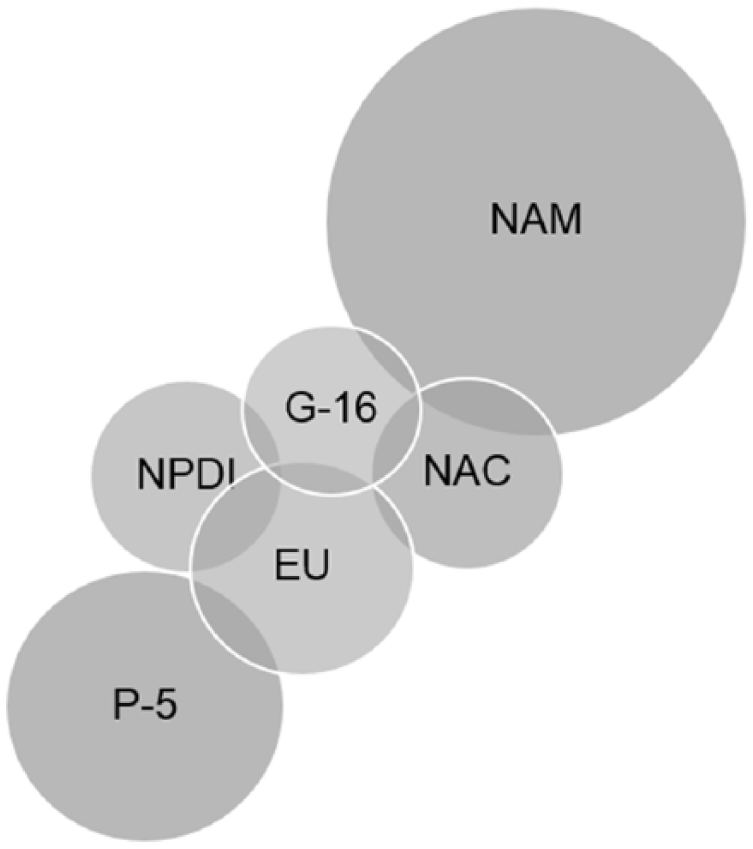
Political groups in the NPT since 2010.
One such effort by the United Kingdom has been to work more closely with the other four permanent members of the UN Security Council. Since 2009, the United Kingdom has actively sought coordination by the P-5 as a group in an effort ‘to foster dialogue, transparency and common approaches to strengthening the NPT’ (United Nations Office of Disarmament Affairs (UNODA), 2015b). The ‘P-5 process’ was an initiative first promoted by then UK Defence Secretary, Des Browne, in calling for a technical conference on verification of disarmament between the P-5 nuclear weapon states (Staley, 2015). This unprecedented call brought about an important change in how the P-5 were to present themselves within the UN’s nuclear forums, particularly in the case of the NPT review conferences, moving forward. The P-5 Process is now an annual exercise with its members each taking their turn to host conferences during which time they discuss shared issues of concern, engage with the wider disarmament community, including civil society, and formulate joint statements to present to the UN’s relevant nuclear forums.
As the P-5 Process attests, the United Kingdom is clearly aware of the significance of group politics within the UN’s nuclear forums and the necessity for it to work with others despite its privileged position as a nuclear-weapon state. Even with its unique status the United Kingdom cannot hope to exert influence by ‘going it alone’ but must work closely with other groups. While the P-5 is likely to form the backbone of UK diplomatic efforts within the UN’s nuclear forums, P-5 coordination is still no simple matter. Frustrations are increasingly prominent between the P-5 membership, not least as tensions between Russia and the West grow. As one P-5 diplomat candidly summarised: ‘The UK and Americans are more progressive than the French and the Russians and China sits in the middle and takes cover’ (interview, Geneva, June 2015). Further evidence of the challenges of presenting a unified P-5 front may also be seen in the fact that the P-5 statement to the 2015 NPT RevCon was a full 23 minutes long; reflecting ‘that we couldn’t boil it down to anything more meaningful’ (interview, Geneva, June 2015).
The United Kingdom would therefore be wise to look to other groups with whom it can work on an ad hoc basis. On specific matters relating to nuclear non-proliferation such as strengthening the IAEA, bolstering support for regional nuclear security, and promoting measures to tackle withdrawal from the NPT, the United Kingdom could keep the EU as the focal point for its diplomatic efforts. As with the HRC, within the NPT and other nuclear forums, the EU is increasingly garnering support from other non-EU European states, including Georgia, Ukraine, Iceland, Norway, Switzerland, Moldova, and Liechtenstein. It will remain to be seen, however, if the United Kingdom will be willing to be counted among these countries even where it shares common objectives, or if it will prefer to push for UK-EU joint initiatives whereby its special status as a nuclear-weapon state is recognised
Another group with which the United Kingdom may work constructively is the NPDI, which includes fellow NATO-members promoting a building blocks approach to nuclear disarmament. While the United Kingdom could not become a member of the NPDI due to its nuclear status, in 2015 the United Kingdom did encourage active engagement with the NPDI by the P-5 in the lead-up to the 2015 NPT RevCon (interviews, Geneva, June 2015). This outreach by the P-5 was helpful in promoting inter-group engagement and in trying to overcome the entrenchment of bloc politics between the P-5 and NAM and NAC particularly (Dee, 2017: 177). If the United Kingdom is therefore serious about upholding its obligations to disarm under Article VI of the NPT, and if it wishes to continue to present itself as a constructive and responsible power within the UN’s nuclear politics, promoting such inter-group exchange will be an important means of achieving this objective.
Conclusion
The United Kingdom is faced with several opportunities and challenges in its post-Brexit diplomacy at the UN. Returning to the three questions posed at the start of this article, these challenges and opportunities may be summarised as follows. First, the United Kingdom has, at various times, benefited from its EU membership with regards to representation and influence within the UN. The United Kingdom acts mostly through the EU at the HRC, which allows it to influence not just the EU but the wider HRC, because the EU is such an important actor there. Within the UN’s nuclear politics, the EU has, also at times, acted as a hub for information sharing between its diverse members, has provided a degree of political cover for the United Kingdom’s nuclear weapon status, and has been a constant champion of the global nuclear non-proliferation regime to which the United Kingdom is a major supporter. The EU has therefore been an important component of United Kingdom diplomatic activity within the UN’s human rights and nuclear politics thus far, and has bolstered the United Kingdom’s influence in these forums.
The EU is not, however, without its faults. Although it is a major power on human rights issues, and a champion of the nuclear non-proliferation regime, it has consistently faced criticism over the time it takes to undertake its own internal coordination and of the lowest common denominator positions those labours all too often result in. Many EU member states, including the United Kingdom, have looked to other like-minded political groups to pursue their interests, which not only weakens EU unity, but stretches the capacity of the member states involved. By removing itself from the EU, the United Kingdom would therefore be removing itself from the requirement, set out in the Treaty of European Union, to coordinate with the other EU-27 on multilateral matters. Such coordination is often a painstaking process, consuming of time and energy that could be better expended in outreach to other countries. Brexit could allow the EU to refocus its diplomatic activities onto other cross-regional activities, as has been seen in the HRC, or in developing its relationships with other like-minded states on a more ad hoc basis, as in the case of the P-5.
Group politics is, and will continue to be, fundamental to UN politics. Whether in the case of human rights, or on nuclear weapons, the United Kingdom cannot go it alone. In both contexts and across the UN more broadly, groups are becoming a driving force of multilateralism. The United Kingdom will therefore be severely limited if it seeks to pursue its interests within the UN without recourse either to the EU or to other groups.
The options for the United Kingdom are therefore variable yet complex. Within the HRC, the United Kingdom has already begun to develop cross-regional diplomatic activity which could be fostered further and enable it to exert leverage on the issues it cares about. Within the NPT and other UN nuclear forums, moreover, the United Kingdom has already taken seriously the trend towards group politics by creating the P-5 Process, and, in turn, by encouraging the P-5 to work constructively with others, as in the case of the NPDI. However, the United Kingdom’s options in both forums will also be largely dependent on its ongoing relationship with the EU. Even in the case of the UN’s nuclear forums where the EU is considered a divided and oftentimes weak actor, it is still a voice that many pay attention to and with whom the United Kingdom will most often find itself in agreement on matters of non-proliferation.
In her maiden speech to the UNGA in September 2016, British Prime Minister Theresa May stated that ‘when the British people voted to leave the EU, they did not vote to turn inwards or walk away from any of our partners in the world’ (UNGA, 2016). If the United Kingdom wishes to continue presenting itself as a responsible and constructive partner and a major player within the international community, then the UN matters. It will be within the UN that its post-Brexit international performance will be most starkly judged, and subsequently legitimised (see Claude, 1966), by its partners and the world at large. The UN also matters because there is virtually no issue in international politics upon which it does not take an interest. It is the world’s most prominent multilateral platform where the United Kingdom can showcase what its post-Brexit foreign policy and international relations will be, with whom it will be able to work, and, more importantly, what the United Kingdom can, in time, actually achieve.
An immediate dilemma nevertheless faces a post-Brexit United Kingdom: will the United Kingdom allow itself to work with, or even follow, the EU at the UN where matters of like-mindedness arise, or will it seek to take the lead itself separate from the EU? In walking away from the EU, the United Kingdom must now undertake a substantive review, and indeed overhaul of its international relations as a whole. Above all, it must undertake the complex task of rewiring its diplomatic channels separate from the EU. Such rewiring will be time-consuming and extensive and, in certain policy fields, being a follower of the EU may present the United Kingdom its only choice. In the longer-term, however, the United Kingdom may seek ways of partnering more formally with the EU on matters of common foreign and security interests and, in so doing, utilise elements of a previously successful relationship to mutual advantage.
Footnotes
Funding
The author(s) received no financial support for the research, authorship, and/or publication of this article.