







Abstract
Research on mixed-member legislatures demonstrates that members face different incentive structures when cultivating a personal vote. In this article, we examine how Scotland’s adoption of a mixed-member proportional system (MMP) and a change in ballot structure affect the legislative activities undertaken and emphasised by Members of Scottish Parliament (MSPs). Utilising a range of measures of legislative behaviour, we find that MSPs representing constituencies spend less time legislating and more time engaged in constituent service work. Regional members, conversely, lodge more parliamentary motions when not listed on the ballot and sponsor more members’ bills than constituency-based colleagues when on the ballot. We conclude that electoral structures directly affect the representational styles MSPs adopt, while calling for conceptual reconsideration of the personal vote.
Keywords
That institutional structures shape legislative behaviour is uncontroversial. 1 Campaign regulations shape messages candidates employ on the hustings (Parker, 2008; La Raja and Schaffner, 2015), selection procedures determine fidelity to the party on floor votes (Depauw and Martin, 2008), committee autonomy relates to the intensity of executive oversight (Fisher, 2015; House of Commons Political and Constitutional Reform Committee, 2013), and even the physical structures of and seating arrangements within parliaments shape political culture (Crosby, 2016; Goodsell, 1988). Institutional procedures establish the playing field upon which legislators compete for office and engage in policymaking. Most directly, legislative and electioneering arrangements incentivise the adoption of particular representational roles by parliamentarians.
Crucial to how legislators allocate scarce time, the representational roles they adopt, and how they craft a personal vote are the balloting arrangements governing selection of legislators. One popular method is mixed-member proportional (MMP). As representatives in an MMP system are elected in two distinct ways, how they are elected should affect the representational style they adopt. The Scottish Parliament, which elects some members in First Past the Post (FPTP) elections to represent single-member constituencies and others from closed party lists in multimember regions to reflect the party vote proportionately, provides an opportunity to examine how the incentive structures established by electoral systems affect the representational choices legislators make. 2
We make three contributions. First, we create measures of the policy-expertise and constituency-service propensities of Members of Scottish Parliament (MSPs) instead of relying on surveys of members. Specifically, we measure their willingness to revolt against their party, sponsor members’ bills, lodge parliamentary motions, and spend representational allowances on constituent surgery advertisements. Better measures of legislator activity may help resolve the conflict between theoretical expectations and mixed empirical findings in the literature on constituency service.
Second, we make the theoretical argument that a legislator’s efforts to develop a personal vote goes beyond engaging in casework alone and may be intended for audiences beyond constituents and general election voters. Although the literature on the personal vote emphasises that legislators undertake casework to develop an electoral advantage greater than the party’s expected support, legislators must also concern themselves with other constituencies beyond general election voters. This list of others includes party activists, members, and leaders making selection decisions and serving as a legislator’s primary constituency (Fenno, 1978), which is often distinct from the re-election constituency. The distinction between the two is perhaps most acute for regional members who must protect their position on the party list and for whom casework is difficult to perform effectively over a larger geographic area as compared to legislators representing smaller single-member constituencies. This contrast may necessitate that regional legislators selected from closed party lists take on a distinctively different, more policy-centric representational role compared to legislators directly elected to serve constituencies. We find that members directly elected to single-member constituencies are less likely to adopt a policy expert personal vote than their regional colleagues selected from party lists and representing multimember districts. Constituency-based members, alternatively, devote more resources crafting a traditional personal vote based upon casework and surgeries.
Finally, we take advantage of a natural experiment rising from a change in balloting procedure concerning regional members. Names of regional candidates for the Scottish Parliament appeared on the ballot before 2007 but not after. The removal of regional candidate names may have changed the incentives for how regional members cultivate a personal vote during their time in office. Collectively, we find support for the notion that Scotland’s MMP system and the change in the ballot structure after the 2003 elections affected how legislators allocate their time and the type of personal vote adopted, with constituency members less active on legislative issues and regional members more attentive to the constituency when their names appeared on the ballot. 3
Balloting and the personal vote reconsidered
Legislators utilise office resources to develop a personal vote or reputation to enhance their electoral prospects. Defined as ‘that portion of a candidate’s electoral support which originates in his or her personal qualities, qualifications, activities and record’ (9), Cain et al. (1987) examine how members of the US House of Representatives and the British House of Commons use constituent service and citizen contact to create an electoral advantage, protecting them from unfavourable partisan tides. Scholars have also identified factors across political systems associated with personal vote maximisation behaviour. Generally, they posit four key components affecting whether legislators engage in efforts to maximise a personal vote: electoral structures, district magnitude, the party system, and the role perceptions of the members themselves (Norris, 2004).
Mixed-member electoral systems provide differing incentives for the cultivation of a personal vote by legislators because the method of candidate selection and constituency size varies. Carey and Shugart (1995: 418) establish that balloting systems where parties control access to closed lists with single-member districts provide the fewest incentives for developing a personal vote. Conversely, open lists with little or no party control, vote pooling, and voters casting ‘a single vote below the party level’ are features of an electoral system maximising the incentives for the establishment of a personal vote.
Constituency size also affects the cultivation of a personal vote. Wessels (1999) finds that smaller districts drive personalised electoral competition, while larger districts push members to focus on regional concerns and party reputations. Carey and Shugart (1995) claim that the effect of district magnitude is not so clear; rather, the effect depends upon the balloting system and the number of members representing the district. In the case of the United States, Lee and Oppenheimer (1999) show that constituents in thinly populated states are more likely to contact their senators rather than their House members to express political views or seek assistance. In large states, however, constituents look to House members for help navigating the federal bureaucracy.
While the effect of the party system on personal vote cultivation is partly related to balloting structures, the strength of parties within the legislature can dampen enthusiasm for an independent electoral brand. Parliamentary democracies with fused executives should encourage more party discipline than presidential systems and, hence, less attention to personal vote enhancing activities (Carey and Shugart, 1995; Shugart and Carey, 1992). Finally, an extensive literature examines relationships among the role conceptions adopted by legislators, the various personal attributes of legislators, and the willingness of legislators to expend effort creating a personal vote (Matthews, 1984; Searing, 1994; Studlar and McAllister, 1994; Wessels, 1999).
Although Fenno (1978) documents in the American case that legislators spend considerable effort building distinctive home styles, there has been some debate concerning their electoral value (Cover and Brumberg, 1982; Johannes and McAdams, 1981; McAdams and Johannes, 1988). More recent scholarship, however, shows that constituents perceive the legislative activities as legislators would hope and members of US Congress successfully create the ‘impression of influence’ among constituents (Parker and Goodman, 2009, 2013; Grimmer, 2013; Grimmer et al., 2014). The importance of the traditional personal vote has also been documented elsewhere. Heitshusen et al. (2005) found that representatives in Australia, Canada, Ireland, New Zealand, and the United Kingdom have strong incentives to engage in constituency work because they cannot distinguish themselves on policy by voting against the party line without facing consequences. Members of Parliament (MPs) selected from a list, facing similar consequences, should nevertheless attend to constituency matters less because they are more insulated from electoral pressures. McLeay and Vowles (2007) show that list MPs in New Zealand have less contact with their constituents, and that list MPs more strongly represent minority groups and special interests than constituency MPs. In the German Bundestag, which also features a mixed-member electoral system, ‘MPs elected from districts engage in more constituency service work than those elected from lists’ (Cain et al., 1987: 220) and are more likely to choose committee assignments, allowing them to credit-claim for pork barrel projects aiding their constituencies (Stratmann and Baur, 2002). Ticket splitting by voters in New Zealand, Russia, Japan, and Lithuania is associated with the development of a personal vote by legislators (Moser and Scheiner, 2005). Finally, looking at the Comparative Study of Electoral Systems, Norris (2004: 244, emphasis in original) reports that ‘the use of candidate ballots does strengthen the extent to which individual politicians emphasize personalistic over party appeals’ as measured by increased rates of contact and knowledge of candidates among voters.
The personal vote at Westminster and Holyrood
Strong parties maintaining tight control over access to the ballot make it unlikely for legislators at Westminster or Holyrood to expend much effort building a personal vote, which perhaps explains why the United Kingdom ranks lowest on Carey and Shugart’s (1995: 425, Table 1) ranking of electoral systems with incentives to establish a personal vote. Yet, there is some evidence of efforts to establish a vote distinct from the party’s reputation among Westminster MPs and Holyrood MSPs (Carman and Shephard, 2007; Norris, 1997; Norton and Wood, 1993; Smith, 2013; Townsley, 2015; Umit, 2017). Why? Although control over the nomination process by the parties has not waned recently, the strength of loyalty to the Labour and Conservative parties among the electorate has. 4 This development creates added incentive, as Norton and Wood (1993: 144) noted two decades ago, for ‘today’s MP …[to] take more seriously the danger of losing the seat in an election’. In the case of the Scottish Parliament, MMP can encourage members to develop a personal vote based upon a reputation for constituency work, particularly among those MSPs representing constituencies or regional MSPs running with their names listed on the ballot. As dual candidacy is allowed and the majority of regional members run for constituency seats, there is some incentive for list members not listed on the ballot to provide casework and constituency service in the area surrounding their regional office where they hope to stand as a constituency candidate. 5 Those efforts, however, should still be less than those undertaken by constituency MSPs.
The effect of sitting in a regional seat on a member’s legislative behaviour.
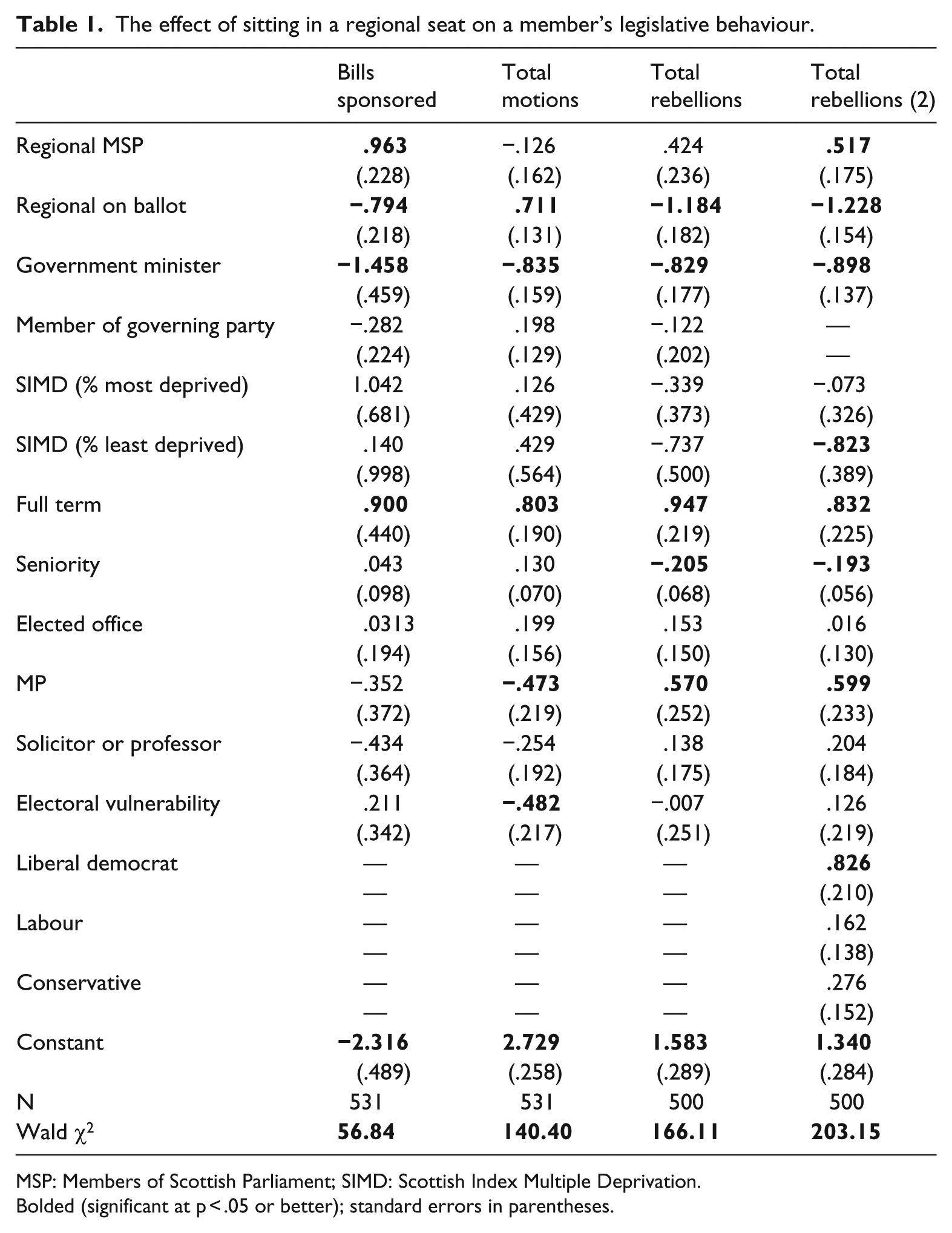
MSP: Members of Scottish Parliament; SIMD: Scottish Index Multiple Deprivation.
Bolded (significant at p < .05 or better); standard errors in parentheses.
Scholarship on the Scottish Parliament has examined behavioural differences between constituency and list MSPs. Battle (2010) found that constituency MSPs prioritise constituency work, and that list MSPs are more likely to do committee work. Bradbury and Mitchell (2007) surveyed MSPs to determine which aspects of their jobs they found the most important and how they allocate their time. They show that constituency MSPs rate the importance of engaging with constituents more highly, as well as spend a half day more a week doing constituency work, on average, as compared to their regional colleagues, who rank it lower and perform less. Constituency MSPs also spend more time on surgeries. Finally, Carman and Shephard (2007) reveal regional MSPs locate offices strategically, placing them in marginal constituencies to provide an opportunity to contest the constituency seat in future elections. Even in an electoral system where little benefit seems to accrue from cultivating a personal vote, there is evidence of legislators doing so.
Much of what we know about how MSPs represent their constituents—and the relationship between representational choices and the type of seat the MSP represents—is based upon surveys of MSPs (Heitshusen et al., 2005; Lundberg, 2006, 2007; Russell and Bradbury, 2007). A different strategy observes the actual representational choices members make. MSPs participate in legislative debate by lodging motions, making speeches, and sponsoring legislation. As the amount of time during each session is finite and representation is a zero-sum game, the more time devoted to legislating, the less time spent addressing constituency casework (Strøm, 1997). Put differently, MSPs more engaged in legislating are most interested in developing a reputation for policy expertise, while those devoting more resources to casework and surgeries are crafting a constituent servant reputation. But as much freedom as MSPs have to build a personal vote, the choice to cultivate a particular representational reputation is constrained by how MSPs are selected and the type of seat they hold. Our contribution is to test this claim with direct measures of legislative behaviour.
The personal vote is often associated with constituency-service activities alone, particularly casework. But parliamentarians can become policy advocates, ministerial aspirants, constituency members, and parliament men (women) in the House of Commons (Searing, 1994). Similarly, Fenno (1978) shows that members of Congress adopt policy-expert, constituent service or ‘one of us’ styles, reflecting not only the needs of their constituents but also their own skills. Parker and Goodman (2009) elaborate saying a representative allocates his or her official resources in different ways to reinforce his or her home style, such as hiring a large Washington, DC-centred staff to focus on policy, or frequently travelling back home to seek casework opportunities. These resource allocation decisions made by members of Congress generate positive constituent impressions. We emphasise that the personal vote has multiple dimensions; the key is that activities associated with a personal vote aid a member in crafting a reputation to maximise electoral prospects. 6
This crafting relates to a larger theoretical point: the audience to which these activities are directed may not be constituents alone. 7 Crucial is what Shugart (2001: 29) terms the ‘intraparty dimension’: To what degree does a candidate depend upon the party for his or her nomination and election? In the case of Scotland and MMP systems generally, the audience might always be the party selectorate (however constituted) as it determines access to the ballot for candidates contesting constituency and list seats. But election in the first instance is tied to party and candidate reputation since both are listed on the ballot, while in the second instance voters select only party and no candidate (after 2003). Candidates seeking constituency seats have some incentive to emphasise their personal brand, such as casework and representing constituency opinion when it differs from the party. As candidates to the Scottish Parliament are first selected locally and not nationally, this reinforces attention paid to constituency matters by candidates and constituency MSPs. 8 It also suggests that candidates seeking election on the list as regional members should demonstrate fidelity to the party selectorate and focus on activities burnishing the party’s collective brand to boost list position. This may be reinforced by the larger geographic size of the regions, which makes it difficult to concentrate on casework and receive credit.
Furthermore, the difference between regional and constituency representatives should be clearer after the 2003 election. In 1999 and 2003, the names of regional members selected by parties were listed along with the party on the ballots voters received and cast. After the 2003 election, the electoral commission changed the ballot to list only the party and not the regional candidates on the party closed lists. If balloting and institutional arrangements affect member behaviour, this minor change could have important consequences.
Measuring representational styles
To understand the relationship between MSP representational style and seat type, we develop three indicators of legislative activity and one measure of constituency service. Our unit of analyses are individual MSPs in each of the four sessions concluded to date. The Scottish Parliament has databases covering a variety of MSP activities. Using these resources, we created two measures of MSP engagement in the legislative process: whether an MSP proposed initiation of a member’s bill and the total number of parliamentary motions made during each parliamentary session. 9
MSPs rarely sponsor their own bills. Nevertheless, there is a process by which MSPs can draft a member’s bill, signalling particular policy interests. 10 We summed the number of member bill proposals made by each member during a parliamentary session. The total number of bill proposals for each member indicates policy entrepreneurship and expertise.
The second measure, total number of parliamentary motions made, was obtained from the Parliament’s open data portal. 11 Motions are coded by the Parliament’s staff into eight different types: standard, member’s business, motion for debate, timetable, committee, Scottish Parliamentary Corporate Body (SPCB), bill, and amendment. We summed the number of standard, committee, bill, and amendment motions made by each member in each session, as these motions signal policy expertise rather than attention to constituency concerns. The resulting variable indicates how extensively a member engages in legislative business on the chamber floor. 12
A third measure of a policy-centred representational style is willingness to rebel against the party. Less a measure of policymaking and more a measure of an individual MSP’s party unity, the rebellion score is the total number of votes in a given session on which the member voted against a majority of his or her fellow partisans. The rebellion score is a measure of a member’s policy independence. Expressing independence helps in developing a personal vote among constituents, while demonstrating responsiveness to unique constituency needs. Rebellion scores are calculated only for the Scottish National Party (SNP), Labour, Conservatives, and Liberal Democrats. 13
Observing a member’s willingness to develop a constituent servant profile is challenging. Casework files cannot be accessed, and it is difficult to account for the number of surgeries held. An indirect measure, however, is available: the amount spent each session on surgery advertisements. Each MSP receives a representational allowance from which they can deduct expenses related to official duties. There is a surgery advertisement expense line, which allows for advertising of constituency surgeries locally. In 2014–2015, the surgery advertising allowance was set at a maximum of £1720. 14 An online database allows a search of member expense reports by category for the current and preceding six fiscal years. 15 We totalled the amount each MSP spent on surgery ads for the seven fiscal years available: two in the third and five in the fourth parliament. This measure indicates a member’s willingness to establish a reputation for constituent service work.
Determining representational styles: A multivariate approach
Generally, we can conceive of three types of variables which impact MSP legislative decisions: individual, constituency-need, and institutional responsibilities. We use several variables to control for these factors. If we find that seat type influences the representational choices made by MSPs once we control for these other variables, we have evidence that the MMP system of balloting affects how constituents are represented at Holyrood.
Institutional independent variables
In the Scottish Parliament, the selection of constituency members by FPTP and regional members by Proportional Representation (adjusted by the constituency results) creates the strong possibility of a division of responsibilities between casework (left to constituency members) and policymaking (left to regional members). Early guidance from the parliament’s presiding officer created a potential division of responsibilities between constituency and regional MSPs. Bradbury and Mitchell (2007: 119) report that MSPs were expected to ‘represent themselves to the public clearly as a constituency or list member’ and ‘for the second and subsequent list representatives elected for the same party in a region, allowances were reduced on the expectation that list members would pool resources in a shared regional office’. Lundberg (2014: 356) notes that ‘the MSP’s code of conduct more explicitly cited an “expectation” that a constituency MSP would be the “usual point of contact” for constituents’. This guidance likely reinforced the underlying electoral structures encouraging constituency MSP primacy in addressing casework demand. 16 We expect that regional MSPs selected from party lists are more apt to engage in legislative activities, while leaving casework and surgeries to their constituency-based colleagues. In short, constituency-based MSPs have a stronger incentive to create a constituency-personal vote than their regional colleagues.
It is also important for MSPs to consider building a personal vote based not only on constituent service but also by taking alternative positions on issues if their party is at variance with constituency opinion. Although we expect that eschewing the party position is rare as access to the ballot in the Scotland is controlled by the parties, we do expect that constituency members are more likely to rebel against their party than regional members who are in a more perilous position concerning their position on the ballot and the difficulty voters have in rewarding them for their independence.
We include a dummy variable, indicating whether a member represented a region. We also include a dummy variable, indicating whether the regional member’s name appeared on the ballot in the last election, meaning all regional members serving in the first and second sessions of the Scottish Parliament. We anticipate that regional members listed on the ballot will rebel more than those not listed on the ballot. We also hypothesise that they will spend less time making parliamentary motions but draft more members’ bills than regional members elected after 2003. Regional members who may have their individual efforts rewarded by the electorate will do more to establish a constituent service personal vote, and sponsoring legislation to signal policy expertise is less costly than holding surgeries across a large geographic area.
MSPs who serve as ministers are drawn into more policymaking by preparing government bills, responding to questions from MSPs, and protecting government legislation during floor debate. We include variables indicating whether an MSP holds a cabinet or a junior ministerial position anytime during the parliamentary session and whether she or he is a member of the governing party. We expect members of the governing party, ministers or not, will perform less casework. We also anticipate that they will be less likely to make parliamentary motions, given their control over the legislative agenda. Alternatively, such motions are one of the few ways minority party members can insert themselves into the legislative process. Members of the governing party also should be less likely to rebel on divisions.
Constituency-need variables
Legislators are interested foremost in re-election (Mayhew, 1974), so a member’s electoral vulnerability plays a role in his or her attention to legislative and constituency matters. Electoral vulnerability in the Scottish Parliament is not easily measured given how seats are allocated. We adopt the procedure employed by André et al. (2015). If a member represents a single-member constituency, which is allocated to the winner of an FPTP election, we use the vote percentage separating the member from the second place finisher in the last election as our measure of vulnerability. 17 For members representing regions and selected from a party list, vulnerability is calculated as the member’s place on the party list divided by the total number of regional seats allocated to the party in the last election subtracted from one. Lower values indicate more vulnerability. We anticipate that members who are electorally vulnerable will favour developing a constituent service-based personal vote. We also expect, however, that the relationship between electoral vulnerability and parliamentary behaviour will be stronger for constituency-based members for whom voters directly cast a ballot.
How an MSP chooses to represent her constituency or region depends partially on citizen needs. Norris (1997) finds some support for the notion that MP attention to casework in the House of Commons relates to constituency pull factors. While there is debate on which pull factors generate additional casework (McAdams and Johannes, 1985; Parker and Parker, 1985), some evidence suggests older residents (Johannes, 1980) and those facing economic distress as important factors (Yiannakis, 1981). Other work claims that middle- and upper-class citizens, having the informational and leisure resources to devote to advocacy and advancement of their interests, tend to contact their legislators for assistance more readily than those who are poorer and less educated (Schlozman et al., 2013; Yiannakis, 1982).
To provide a comprehensive measure of constituency and regional casework need, we use the Scottish Government’s Index of Multiple Deprivation. This comprehensive index ‘combines 38 indicators across 7 domains’, including ‘income, employment, health, education, skills and training, housing, geographic access, and crime’. 18 The index is calculated for more than 6500 datazones, each of which consists of between ‘500 and 1,000 household residences’. 19 Each datazone is ranked from most to least deprived. We matched each datazone to its appropriate Scottish Parliamentary constituency and region, and then calculated the percentage of datazones in each constituency and region considered the most and least deprived. We used the 15th and 85th percentiles as cut points; datazones falling at or below the 15th percentile are among the most deprived areas of Scotland, while those at the 85th percentile or above are among the least. We suspect deprivation creates more traditional-type casework, with constituents seeking government assistance, while less socially deprived areas might call upon legislators to go beyond chasing down benefits and request legislative action in particular policy areas.
Individual
Pre-political careers also shape one’s legislative proclivities (Norris, 1997; Norton and Wood, 1993). Previous political or relevant professional experience can reduce the costs of entry into the legislative process. Seniority in the legislature familiarises one with intricate parliamentary procedures and helps MSPs to understand the policy interests and personalities of other members, aiding in the creation of coalitions to advance collective policy goals. Members with seniority might also see their interests shift away from creating a personal vote with casework to engaging more legislatively as they become electorally safer (Norton and Wood, 1993). Members of the legal and academic professions may also be drawn more to policymaking activities than the average member given the advantage derived from education and training.
To capture how previous experiences in politics or a profession impact representational choices, we include four experience variables. First, we include a variable coded one if the MSP was either an academic or solicitor prior to entering the Parliament. Second, we include two variables, indicating previous political experience in an MSP’s first term: the first (‘MP’) is coded one if the member served in the UK Parliament and the second (‘Elected Office’) is coded one if the member served in any other elected political office. We expect that solicitors, professors, former MPs, or those elected to some other political office are more likely to prefer policymaking as a representational style owing to the lowered costs of entry. 20
If the MSP serves in the Scottish Parliament for one or more terms, we capture this experience in a seniority variable—coded zero if the member is in his or her first term. If a member served more than one term in the Scottish Parliament, the previous elected experience and MP variables (but not the professor/solicitor variable) revert to zero in successive terms. Successive seniority in the chamber should become more important than previous elected office experience as an MSP learns chamber rules, exerting greater influence on representational style over time. Alternatively, career training should have a continued pull over a member’s career; hence, our decision to model the effect of career as a constant. Again, we expect members with additional seniority to spend more time engaging in parliamentary activity on the chamber floor and creating legislation than their junior colleagues, who are more apt to build a personal vote by attending surgeries back in their constituencies and regions. Finally, some members depart during their term, so we include a measure indicating whether an MSP served a complete term.
Dependent variables
We have four distinct dependent variables: the total number of members’ bills proposed, parliamentary motions made, the number of rebellion votes cast, and the total amount spent on advertising constituency surgeries for each member across four parliamentary sessions. Three variables are counts (bills, motions, and rebellion votes), and one is continuous (surgery advertisements). 21 We employ count-models for bills, motions, and rebellion votes, and Ordinary Least Squares (OLS) regression for surgery advertisements in the following models.
Results and discussion
Table 1 presents Poisson coefficients for members’ bills and negative binomial coefficients for total parliamentary motions and total rebellions. We find that ministers are less likely to propose members’ bills. Ministers are also less likely to make parliamentary motions or to cast a rebellious vote, while members of the governing party without ministerial responsibilities are not less likely to make parliamentary motions, to rebel, or to sponsor a member’s bill than those of the opposition. In the fourth column, we ran another version of the rebellion model with party indicator variables for the Liberal Democrats, Labour, and Conservatives (with SNP as the base category). Liberal Democrats are more likely to rebel on divisions relative to members of SNP, while there is no difference for Labour or Conservative MSPs.
A member’s previous elected office experience and career have little bearing on legislative activity. Neither do constituency pull factors matter much, other than members representing the least deprived constituencies rebelling less frequently than their colleagues—as do members with more seniority. Finally, members who are less vulnerable electorally offer fewer parliamentary motions.
Overall, the main drivers of legislative activity are the institutional incentives provided by the Scottish Parliament’s electoral system and ballot structure. Across our models, the ‘Regional MSP’ and ‘Regional on Ballot’ variables are significant in six out of eight occasions. The relationship between seat type, motions made, the number of members’ bills proposed, and rebellions on divisions cannot be understood by glancing at the coefficients as they are not directly interpretable. Even the direction of the relationship is hard to evaluate in isolation: regional members listed on the ballot may be less likely to sponsor bills compared to constituency members, but how large is the effect and how does it compare to regional members not listed on the ballot?
To better understand how regional members differ from constituency members and the effect of regional members being listed on the ballot, we calculated the probabilistic outcomes for our dependent variables, while allowing seat type to vary and holding other independent variables either at their mean values or at zero. We report these in Tables 2 and 3. The upper half of Table 2 shows the effect of representing a constituency, regional seat with the member’s name appearing on the ballot, and a regional seat with no name listed on the ballot on the probability of an MSP making zero to the mean number (40) of parliamentary motions as compared to making one standard deviation above the mean (92) or more motions. The lower half shows the same effect on the proposal of members’ bills, except we look at the probability of proposing zero as compared to any number of members’ bills.
The effect of constituency type on legislative behaviour, 1999–2016.
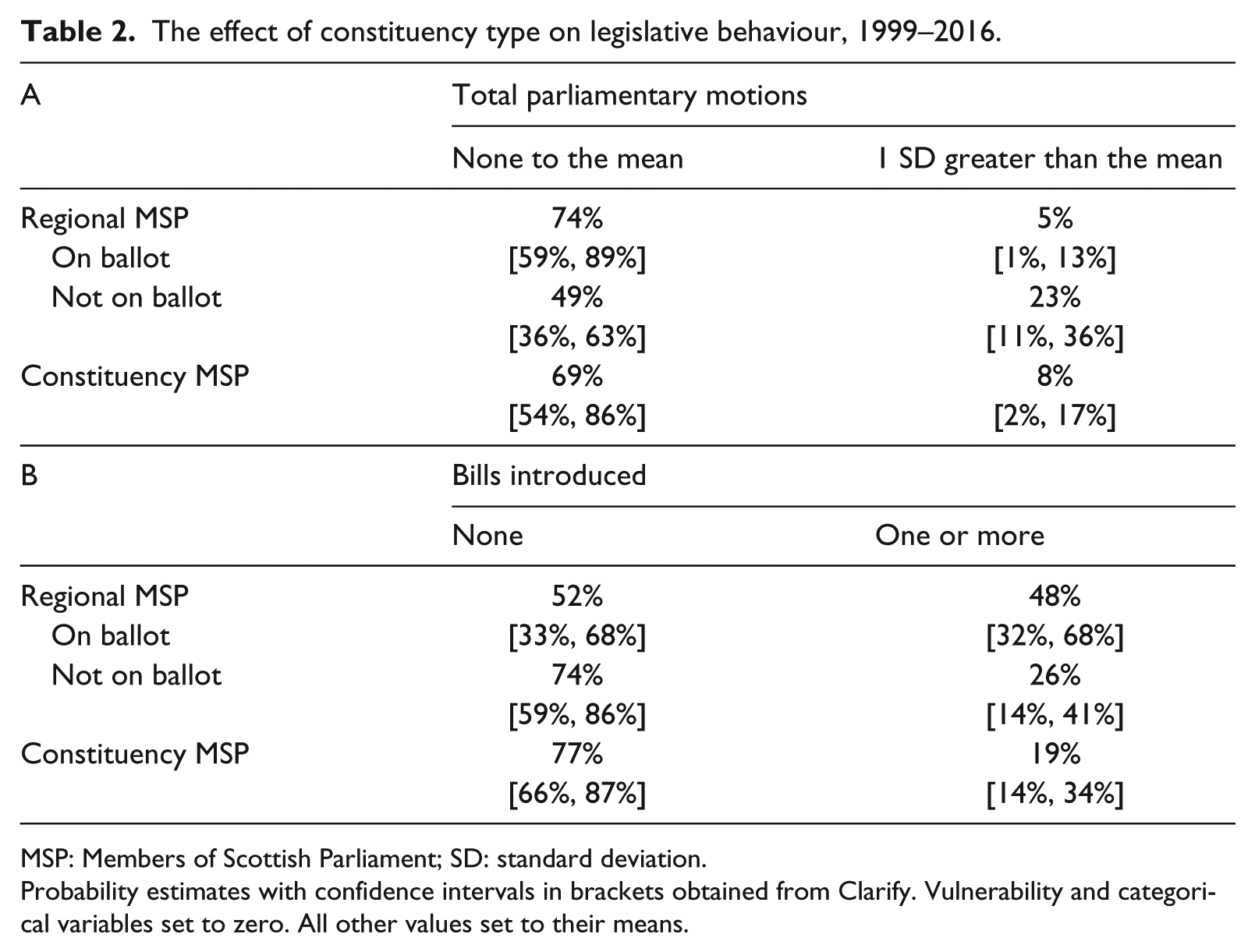
MSP: Members of Scottish Parliament; SD: standard deviation.
Probability estimates with confidence intervals in brackets obtained from Clarify. Vulnerability and categorical variables set to zero. All other values set to their means.
The effect of constituency type on rebellion, 1999–2016.
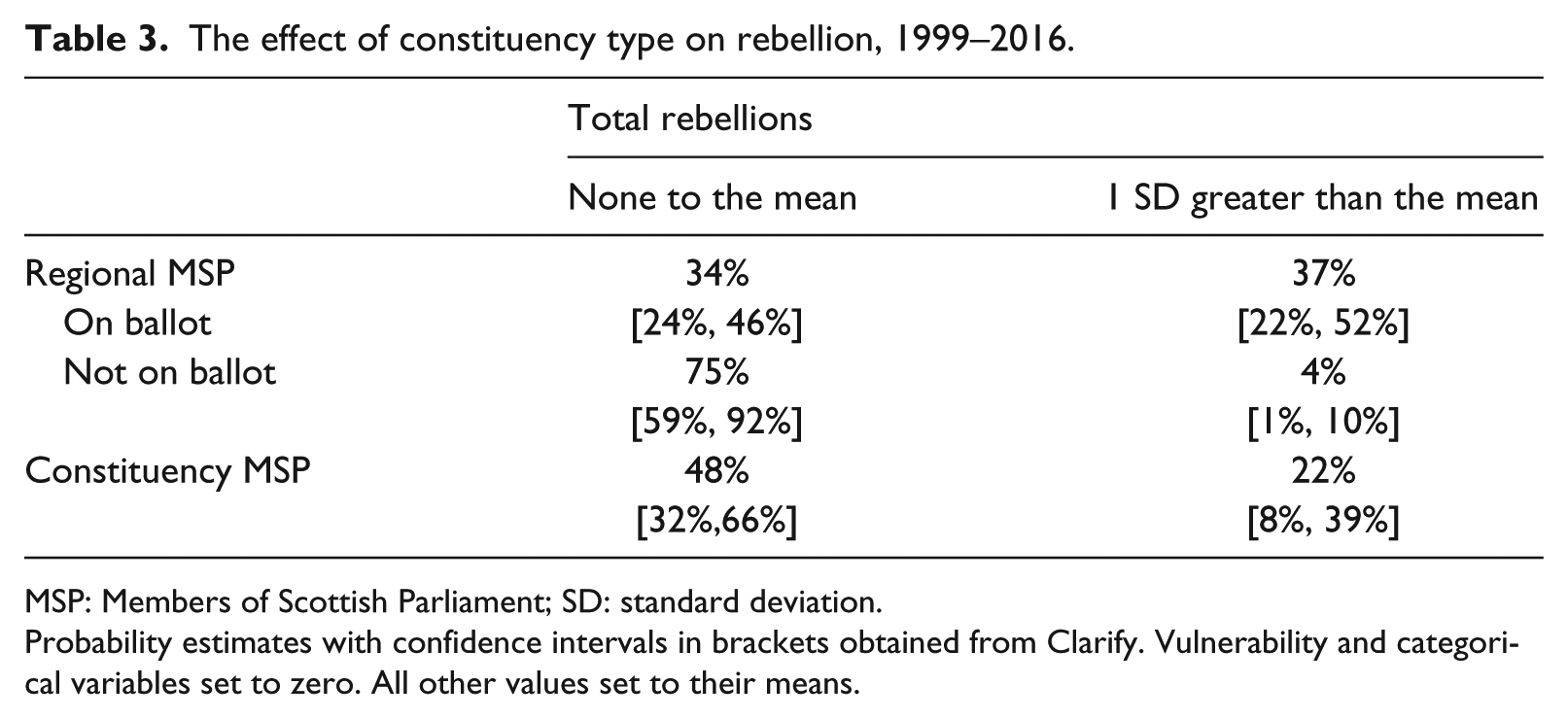
MSP: Members of Scottish Parliament; SD: standard deviation.
Probability estimates with confidence intervals in brackets obtained from Clarify. Vulnerability and categorical variables set to zero. All other values set to their means.
Constituency members are not active on the chamber floor. They have only an 8% chance of making motions greater than one standard deviation above the mean and only a 19% chance of initiating at least one member’s bill. Regional members listed on the ballot are just as unlikely to participate on the floor, with only a 5% chance of lodging 92 or more motions. Regional members not appearing on the ballot, however, have a 23% chance of making a large number of motions. These differences are as hypothesised: regional members not listed on the ballot are best placed to do floor work and advance the party brand on the floor as they need to demonstrate fidelity to the party to retain their position on the list.
The bottom half of Table 2 looks at the propensity to introduce members’ bills. Again, constituency members are the least likely to do so: 77% of the time, constituency members introduce no members’ bill proposals in a session. Regional members not on the ballot behave similarly, having a 74% chance of no members’ bill proposals initiated in a given session. Regional MSPs listed on the ballot, however, are equally likely to introduce at least one member’s bill (48% chance) as introducing no members’ bills (52%). Again, this supports our hypothesis as constituency members make direct connections with constituents by holding surgeries, making bill introduction less useful. Regional MSPs, with less opportunities for casework and representing larger geographic areas with more constituents, can craft a policy personal vote by introducing relatively cost-free members’ bills—but the signal is only useful if the member feels establishing a personal brand brings an electoral value. If a member’s name appears on the ballot, it is easier for voters to reward attention to constituency or policy matters, so it is unsurprising that regional members who ran for election with their names printed on the ballot were more likely to introduce at least one member’s bill in a session.
In Table 3, we repeat the process of generating predicted probabilities while varying seat type and appearance on the ballot but look here at the willingness of a member to rebel against his or her party using the first rebellion model presented in Table 1. Again, we find support for our hypothesis: constituency and regional members listed on the ballot—those with the greatest incentives to cultivate a personal vote—are much more likely to rebel on chamber votes than regional members not listed on the ballot. Regional members not on the ballot have only a 4% chance of rebelling 20 or more times in a parliamentary session. This probability increases by 18 percentage points if the MSP represents a constituency and by 33 percentage points if they are a regional member listed on the ballot. Rebellions are rare in the Scottish Parliament; nevertheless, members will break with the party if they perceive a possible electoral benefit. Regional members selected by local party committees and not listed on the ballot reap the fewest rewards from rebellion; hence, they are least likely to do so. 22
These findings are bolstered by the relationship between seat type and advertising spent on constituency surgeries (see Table 4). As we have only 7 years of expense reports, the number of cases for our analysis drops by roughly half. This decline also means we cannot examine changes in ballot structure on surgery advertisements. Nevertheless, we again see a clear difference in the behaviour of regional and constituent MSPs. Regional members in the fourth parliament spent roughly £900 less on surgery advertisements than constituent MSPs. Recall that surgery advertisements were capped annually at £1720 in 2014–2015, so this shift is a substantial one over the course of a 5-year parliament. This finding provides additional evidence that the representational choices of MSPs are shaped by the different incentive structures facing those representing regions versus those representing constituencies.
Effect of sitting in a regional seat on a member’s constituent service, 2009–2016.
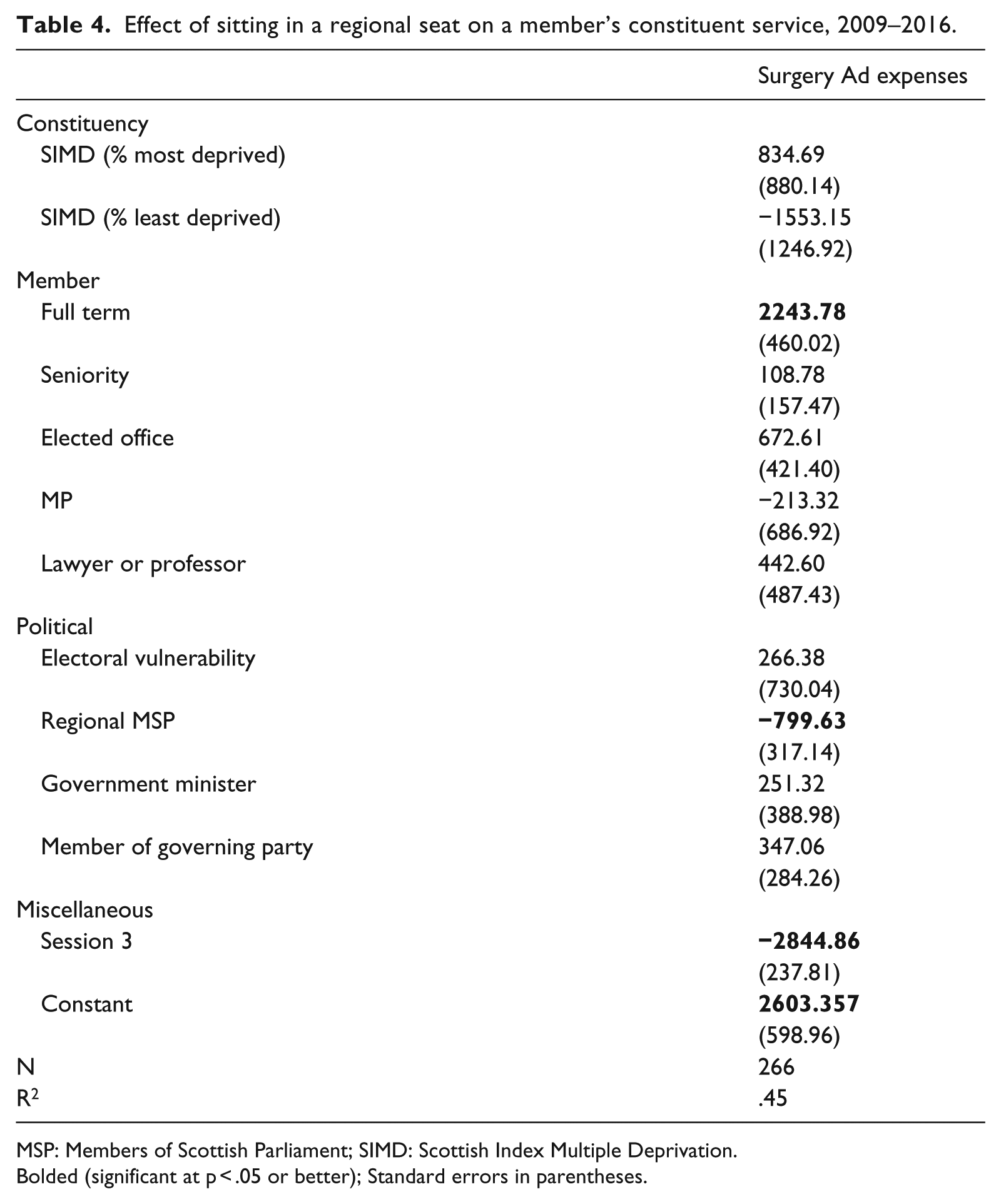
MSP: Members of Scottish Parliament; SIMD: Scottish Index Multiple Deprivation.
Bolded (significant at p < .05 or better); Standard errors in parentheses.
What to make of these findings? First, constituency members have the most to gain electorally from cultivating a traditional personal vote and their behaviour suggests they understand that. They spend more on surgery advertisements and, likely, hold more surgeries than their regional counterparts. They spend relatively little time making motions and are not likely to initiate a member’s bill. Regional member behaviour, on the other hand, is clearly affected by the decision to remove the names of candidates from the ballot in elections after 2003. When listed on the ballot, regional MSPs were the most likely to rebel against their party and to sponsor members’ bills—both relatively easy ways to cultivate an outward facing personal vote among voters back home by showing attention to particular regional or policy needs. Removing the names of regional members from the ballot seems to have altered the incentive structures members face, as regional MSPs post-2003 prefer to adopt legislative and policy entrepreneur representational styles advancing party interests first. They rarely rebel given the potentially high costs (deselection or a lower place on the list) and initiate far more parliamentary motions than their constituency colleagues. Most importantly, we find evidence that electoral structure and ballot format affect the type of personal vote members of the Scottish Parliament cultivate—and that members respond to changes in ballot format.
There are three important limitations of this study. First, the Scottish Parliament is a relatively new institution, so it is possible that the behaviour of regional members in the first two sessions had less to do with appearing on the ballot and more with an initial lack of clear behavioural standards, standards which develop over time as a legislative chamber becomes bounded, establishes universalistic procedures, and becomes more complex internally (Polsby, 1968).
Second, we do not know how much of a difference excluding regional member names on the ballot made to voters. 23 We do know that changes to ballot structure have consequences for the choices voters do make. Indeed, the shift to two ballot papers from one and vague written instructions in the 2007 Scottish Parliamentary elections led to a high number of spoiled ballots (Carman et al., 2008; Hepburn, 2007). If regional names mattered, it was most likely to matter to the most informed and engaged voters best equipped to know about the activities or personal qualities of regional MSPs or candidates (Dawson, 2006). 24
Third, although we control for the governing party in the foregoing analyses, it is hard to disentangle the effect of serving in the governing party from individual party effects and seat type on member behaviour. During the first two parliaments, Liberal Democrats and Labour served in a coalition government and nearly all the members of the governing coalition represented constituencies. When SNP governed as a minority after the 2007 election, most SNP members held regional seats. After 2011, many of these regional members successfully won constituency seats to create the first majority party government in the Scottish Parliament’s short history. Until more time has passed and more governments are formed with different mixes of parties and seat types, our findings should be viewed cautiously.
Conclusion
Those MSPs first elected to the new Scottish Parliament in 1999 were free to establish their own representational roles. The institution had neither an established political culture nor institutional norms. But as Mitchell (2014: 254) notes, ‘The politicians who designed it had experience of Westminster and consciously set out to be different or unconsciously copied it. Westminster loomed large in its creation ensuring that the Scottish Parliament would belong to the Westminster family of legislatures’. Those who had served as MPs had experienced first-hand the freedom of representational choice. The relative lack of guidance in the Scottish Parliament’s Code of Conduct on how to represent replicates that freedom for MSPs at Holyrood. One of the Code’s few clear statements indicated that constituency-based MSPs should serve as the first point of contact for citizens. This injunction may have pushed regional members actively to forgo casework in favour of other activities, such as sponsoring members’ bills, to develop a personal vote when they found themselves listed on the ballot. The removal of this language from the Code in 2008 seems to matter less than changes in ballot structure, given our findings that regional MSPs now make more legislative motions, introduce fewer members’ bills, and spend less on surgery advertisements.
A feature consciously different from Westminster is MMP. It is therefore not surprising that the freedom of MSPs to adopt a particular representational role is shaped by this institutional feature. The result of the Scottish experience with its mixed-member electoral system is MSPs who are equal in stature but unequal in representational incentives. Constituency-based members are more likely to hold surgeries and less likely to attend to legislative affairs, while the obverse is true for regional members not listed on the ballot. An under-appreciated accomplishment of the delegates at the Scottish Constitutional Convention, in rejecting Westminster bicameralism was adopting, perhaps, the most distinctive feature of it: legislators who are incentivised to respond directly to constituency needs and those who are allowed to engage in policy creation, debate, and deliberation because they are more insulated from the whims of a fickle electorate.
Our findings underscore what surveys of MSPs in the existing literature tell us: regional and constituency MSPs perceive their roles and responsibilities differently. We add to the literature on MMP legislatures by providing additional evidence based upon the actual activities of MSPs that electoral structures incentivise members to cultivate particular personal votes that best serve their need for re-election. This also suggests a broader theoretical point: legislative scholars studying mixed-member systems should consider recasting the personal vote conceptually and theoretically. A personal vote is not just casework. All members of a parliament craft a personal reputational brand composed of the activities in which they chose to engage and by allocating representational resources carefully. The question is for whom they are performing and how is that performance affected by electoral structures and the party system?
Footnotes
Acknowledgements
The authors thank MSP Linda Fabiani and former MSP Annabel Goldie who inspired this project and Arthur Spirling for help locating rebellions data. The staff at the Scottish Parliament’s Public Information Office answered multiple enquiries, as did Lindsey Hamilton at the Scottish Electoral Commission and Claire Turnbull, Head of Information Governance at the Scottish Parliament.
Funding
The author(s) disclosed receipt of the following financial support for the research, authorship, and/or publication of this article: The Political Studies Association’s Travel Grant allowed Parker to attend their annual conference. Dean of Letters and Science Nicol Rae, Vice President for Research and Economic Development Renee Reijo Pera, Provost Martha Potvin, Department Head Linda Young, and the Undergraduate Research Scholars Travel Grant programme at Montana State University defrayed the expenses of Richter’s travel to Brighton.