






Abstract

Albala A (2017) Bicameralism and Coalition Cabinets in Presidential Polities: A configurational analysis of the coalition formation and duration processes. The British Journal of Politics and International Relations 19(4): 735–754. DOI: 10.1177/1369148117727440
On page 748–750 of issue 4 (volume 10) The ‘Results and principal findings’ section contains multiple changes to the data owing to the methods used to calculate the data coming to light. The replacement section is corrected and reproduced in full below.
Results and principal findings
I carried out the testing of the hypothesis using the QCA package and the software R, elaborated by Duşa (2007). In order to determine which causal configurations should be classified as leading to DUR, I did a double test, first testing for the ‘necessary’ condition, with a 0.9 cut-off point, followed by the ‘sufficiency’ condition, with a cut-off point of 0.8. I opted for the parsimonious solution as I consider that these solution formulas help better to direct attention to hitherto unexplained (also called ‘remainders’) cases (Schneider and Wagemann, 2012: 108).
So far, I have stated that every condition should have an impact on the outcome. In other words, when the condition is present, we assumed that every condition listed would interfere with the result (DUR). To this effect, I opted for the parsimonious solutions. I proceed firstly to the sufficiency test and then I realise the necessary test.
Table 5 set out the results of the ‘Necessity’ test, Table shows the results of the “Necessity” test. The table shows several paths that appear with high levels of consistency (far above the 0.9 cutting line), like path 1 (~INST*MAJ, consistency = 0.943), 3 (MAJ*~PWP, consistency = 0.995), 6 (~PART+MAJ+PWP, consistency = 0.901), 7 (PART+~PWP+CONTXT, consistency = 0.928), 8 (MAJ+PWP+~CONTXT, consistency = 0.901), and 9 (~INST+PART+PWP+CONTXT, consistency = 0.929). However, none of these paths are theoretically consistent since all of them contain the negation of one condition (marked by the “~” sign). For instance, path 1 (~INST*MAJ) reads like this: the combination of an unfavourable institutional context together with holding a bicameral majority constitute a necessary condition for enduring conditions. As we can see, this sentence makes no sense, since an unfavourable institutional context cannot, logically, be “necessary” for producing a positive outcome. Therefore, these solution paths, despite presenting high consistency rate, are rejected.
Necessity test.
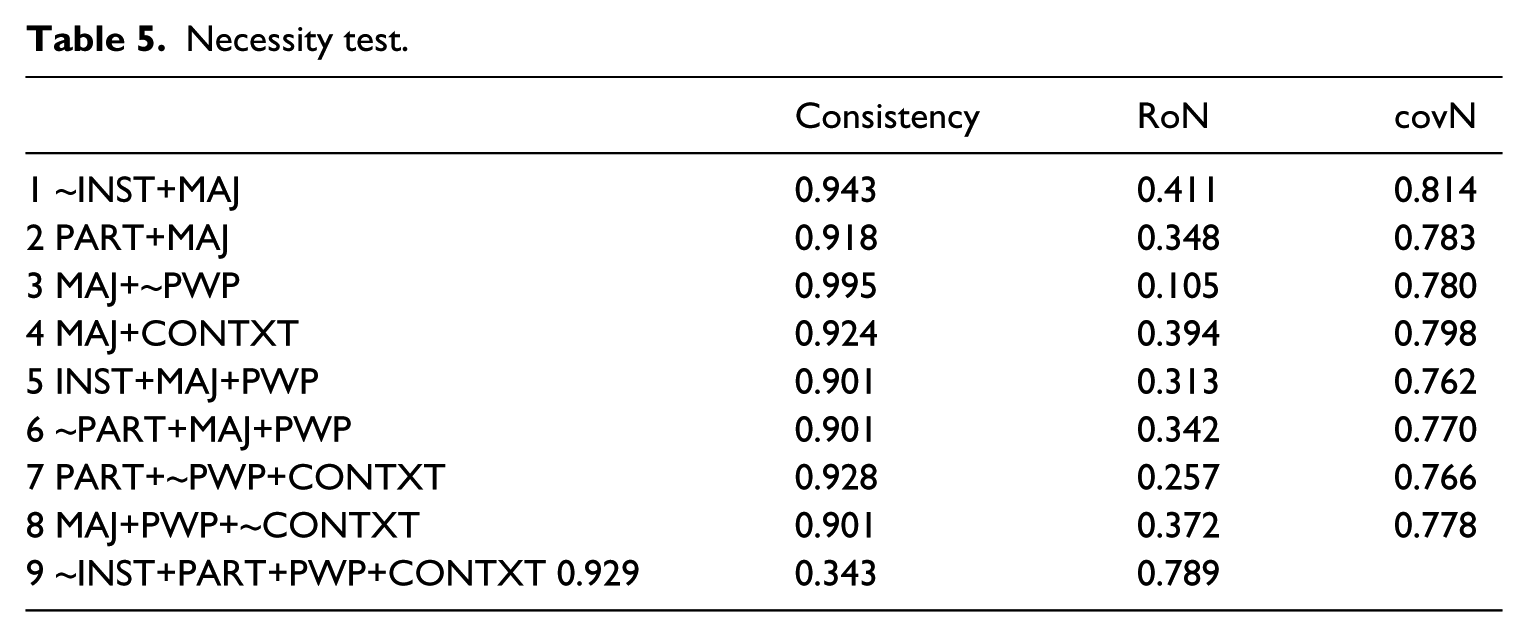
Furthermore, the remaining solution paths do not present satisfying scores of relevance (presented in the RoN column), since no one presents a relevance score above 0.350. These paths appear, thus, as irrelevant or trivial.
Finally, when considering each condition in isolation, the MAJ condition appears as the most relevant and barely necessary. As a matter of fact, the bicameral majority is the only condition that approaches the necessity line, since it presents a consistency value of 0.886, and a coverage score of 0.865, by far the highest scores for individual conditions. However, the Relevance score (0.500) limits somehow this finding. This is due to a low number of negative values in MAJ, that is few cases presenting low scores for this condition.
These findings are quite relevant as they point out that holding –or almost holding- a bicameral majority appears as a stronger condition for producing enduring coalitions under presidential regimes than any other one that used to be tested until then. However, these findings do not mean that the MAJ condition produces a successful coalition agreement each time. For instance, the case of Rousseff II (Dilma Rousseff’s second mandate) is proof of that despite enjoying a “super-bicameral majority”, the coalition agreement lasted only a few months (see Table 4).
The sufficiency test revealed, as a matter of fact, much more conclusive. Indeed, as Table 6 point out, the only sufficient condition to produce the RESULT outcome is the MAJ condition, with a total consistency value of 0.807, and a high coverage level of 0.883. In other words, it seems that having a bicameral majority or almost bicameral majority is sufficient to guarantee an enduring coalition agreement. I can summarise this sentence using the following causation: MAJ => RESULT. No other condition approached this score, meaning that they lack in causal relevance, contradicting most of the existing literature on the field.
Sufficiency test.
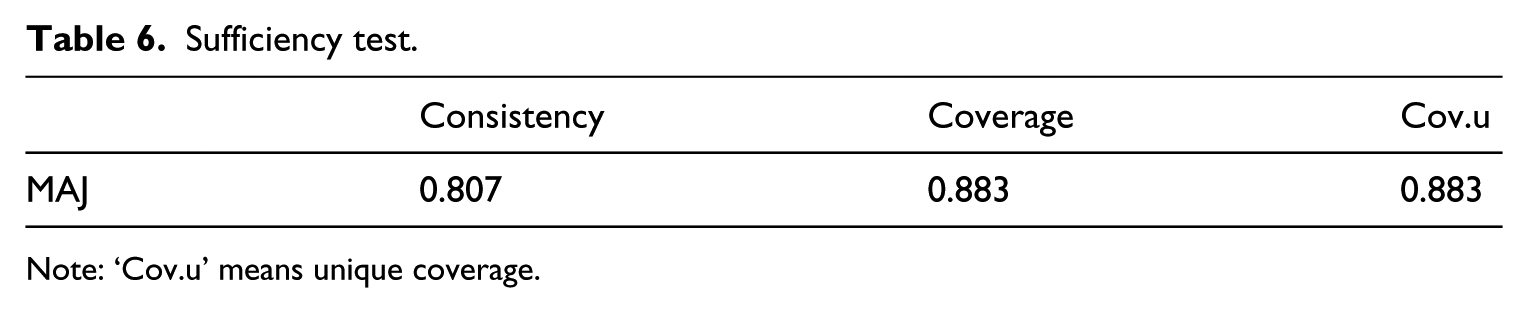
Note: ‘Cov.u’ means unique coverage.