






Abstract
Why do third-party states continue interventions in support of governments fighting civil wars even when continuing to do so appears futile from a military standpoint? To answer this question, we focus on third-party state domestic politics, theorising that institutional characteristics condition the likelihood that the third party will terminate support to a civil war government before a conflict ends. When a third-party state’s legislature and executive branches are controlled by opposing political parties, the third party’s executive is more likely to remain committed to an intervention in order to deny political opponents the opportunity to seize on the withdrawal as a basis for political advantage. To test this expectation, we assemble a data sample of third-party interventions in support of civil war governments during the period 1975–2009. The analysis suggests that the third-party divided government reduces the likelihood of an early termination of its support for a civil war government. Our analysis underscores the role of third-party domestic politics in understanding the dynamics of internationalised civil conflicts.
Keywords
Introduction
When US forces were withdrawn from Afghanistan in 2021, the intervention had endured for 20 years, persisting across three presidential administrations, the death of Osama bin Laden, and the eviction of al-Qaeda from Afghanistan (Sanger and Shear, 2021). One might expect that American presidents would terminate the intervention into Afghanistan earlier, either as a consequence of shifting domestic politics, the apparent completion of the original objective, or the continuing cost of defending the government in Kabul. Yet, the United States did not effect a rapid withdrawal from the conflict despite a stated desire to do so. Indeed, despite a stated desire to withdraw, President Donald Trump previously deployed 4000 new troops to the Afghan theatre merely 6 months after his 2017 inauguration and remained committed deep into his presidency (The Guardian, 2017). The inability of the United States to terminate the armed intervention in Afghanistan is not unique. For example, France began counterinsurgency intervention into Mali in 2013. Upon entry to office, French President Emmanuel Macron expressed a desire to withdraw his nation’s military forces after a few weeks, but later doubled-down by deploying additional forces that remain engaged in counterinsurgency operations as of fall 2021 (BBC, 2020). As such: France now finds itself stuck in the Sahel, much like the United States found itself in Afghanistan and Iraq – spending years and billions of dollars on fighting highly mobile Islamist groups in difficult, unfamiliar terrain, with no end in sight (Maclean, 2020).
Why do third-party state interveners continue to support central governments engaged in civil war, even when continuing such support appears futile? We approach this question by focussing on the domestic politics of third-party interveners. 1 Specifically, we examine how institutional accountability mechanisms in third-party states constrain the ability of their political leaders to terminate ongoing interventions. Accountability exists any time that one social actor is obliged to inform another about their ‘actions and decisions, to justify them, and to suffer punishment in the case of eventual misconduct’ (Schedler et al., 1999). We focus on the form of accountability that obtains when decisions by national leaders are subject to review and approval by rival institutions within government, particularly legislatures controlled by the political opposition. This logic pertains primarily, but not exclusively, to democratic third-party interveners.
We theorise that when control of the government in a third-party state is divided and the legislature is controlled by the executive’s political opposition, national leaders are less likely to terminate an intervention. Our logic is based on two basic assumptions. First, although third-party citizens are generally unaware of foreign affairs (e.g. Zaller, 1992), they are deeply concerned that involvement in foreign conflict is worth the attendant costs (Downs and Rocke, 1994). Leaders that fail to achieve victory are punished and removed from office (Bueno de Mesquita and Siverson, 1995; Caverley, 2010; Chiozza and Goemans, 2004; Chiozza and Goemans, 2011; Colaresi, 2004; Croco, 2011; Croco and Weeks, 2016; Debs and Goemans, 2010; Downs and Rocke, 1994; Goemans, 2000; Stanley, 2009; Wells, 2016). Third-party interventions in support of civil war governments represent a special class within this phenomenon because a third party’s national survival is rarely threatened and citizens may not understand the original policy justifications (Haass, 2009).
Second, when the national legislature is controlled by the opposition, elites within the opposition party may use the termination of a conflict as evidence of foreign policy failure and incompetence, thereby creating an issue that can be exploited to undermine the incumbent leader’s standing (Arena, 2008, 2015; Koch and Nicholson, 2016; Sullivan, 2008). Put differently, citizens may not be educated about international relations, but they are concerned about their leader’s reputation for competence. National leaders seek to retain office above all other priorities (Bueno de Mesquita et al., 2003), and are therefore more likely to remain committed to enduring interventions to avoid exacerbating political weakness. As a result, survival-seeking leaders will remain committed to interventions, even after the ostensible utility of interventions has been exhausted, to avoid being ‘blamed’ for their failure by the political opposition. This expectation is supported by an empirical analysis of third-party state interventions in support of civil war governments during the period 1975–2009.
The remainder of this article unfolds as follows. First, we elaborate upon the scope conditions of our study, highlighting pro-government third-party interventions as an empirical phenomenon in need of study. We then review the state of knowledge about the domestic politics of civil war interventions. Third, we theorise about how accountability affects third-party commitment to civil war interventions. Next, we describe a research design and undertake statistical analyses to test our expectation. Our results support our main expectation, although we find that a variety of factors exert greater substantive effects on the likelihood of third-party termination of an intervention. Last, we conclude by discussing the implications of our analysis for the broader study of internationalised civil war.
Third-party interventions in civil conflict
Third-party interventions involve the expenditure of resources to influence the trajectory and characteristics of a civil conflict. These resources vary considerably in type (or mode), ranging from the commitment of military personnel (troops), to the supply of weapons, to training of combatants, to supplying intelligence to combatants, to giving combatants access to territory to train and refit, and even to providing economic and diplomatic aid. Interventions may be undertaken in support of civil war governments ( ‘pro-government’), or in support of one or more rebel groups ( ‘pro-rebel’) (Regan, 2000; Regan and Aydin, 2006).
We focus solely on pro-government interventions. Although pro-rebel interventions are a significant feature of civil wars, these interventions reflect qualities that make them distinct from pro-government interventions and therefore less suitable for our theoretical expectation. Specifically, pro-rebel interventions violate norms of state sovereignty and may risk interstate conflict with the civil war state (Gleditsch et al., 2008). As such, they are more likely to be masked by a patina of plausible deniability and might escape the notice of a third-party state public. Indeed, recent studies demonstrate that pro-rebel interventions are more likely to manifest as less visible forms of commitment, such as the provision of training, especially during the Cold War (Heinkelmann-Wild and Mehrl, 2021).
By contrast, pro-government interventions are exercises in the defence of the status-quo in the civil war state; that is, they are undertaken to defend a government against rebel challengers. Third-party motivation may include defence of a strategic ally against such rebels, and the intervention may occur at the invitation of the civil conflict government or with the authorisation of an international organisation. As a result, pro-government interventions are likely to feature more significant and public commitments, including the deployment of flagged military personnel. 2 This more public style of third-party commitment to civil war governments is less likely to be ignored by the third-party public or legislature. As such, pro-government interventions provide the necessary conditions for testing our expectation regarding the timing of the termination of third-party interventions. We argue that pro-government third-party intervention is important for scholars interested in the domestic correlates of foreign policy. Indeed, third-party interventions are puzzling because they are often ‘wars of choice’, rather than wars that threaten state survival (Haass, 2009). Unlike interstate wars, interventions in support of civil war governments require third-party state leaders to make costly commitments to conflicts over matters that are, seemingly, of secondary importance to, and little understood by, their domestic constituents. Yet, these third-party constituents directly bear an intervention’s costs, and as such this burden figures into the continued political survival of third-party decision-makers. Moreover, recent research establishes that public casualty-averseness render democratic leaders less likely to intervene in foreign civil wars (Sakstrup and Tolstrup, 2020).
A limited body of research examines the duration and termination of third-party intervention. For instance, Karlén (2019) undertakes the first large-N study of the termination of pro-rebel interventions, finding that third-party states are likely to cease support for rebel groups if there are no ethnic ties between the two or if a major change occurs in third-party domestic politics. Similarly, Sawyer et al. (2017) demonstrate that if a rebel group receives external support, the civil war government is likely to continue fighting rather than enter into a negotiated settlement. Linebarger et al. (2020) examine the duration of pro-government interventions, concluding that they are likely to be terminated if the third-party state is subjected to terrorist attacks originating from within the civil conflict state. Finally democratic interventions result in shorter duration conflicts (Norrevik and Sarwari, 2021).
In assessing this body of scholarship it is notable that, save for a focus on democratic regimes and changes in political power, there is little study of the manner in which domestic political institutional characteristics of the third-party state condition termination of pro-government interventions. To do so, in the following section, we formulate an expectation regarding divided control of the government in a third-party state and its willingness to remain committed to an intervention.
Accountability and the termination of pro-government interventions
We formulate our expectation based on several assumptions. Our first assumption is that all political leaders must satisfy constituents to remain in office (Bueno de Mesquita et al., 2003). If a leader’s time-in-office is cut short, then all other political goals are moot. Although leaders are notionally beholden to their constituents, their relationship is afflicted by principal–agent problems (Downs and Rocke, 1994). Constituents are generally uninformed about foreign affairs, and leaders have access to privileged information, such as intelligence reports and classified information. As such, constituents are unable to judge the initial wisdom of using force abroad; instead, they must engage in retrospective assessment, judging the wisdom of a conflict based upon the course of the conflict so far. Stated differently, constituents are less concerned with the wisdom of a given policy than with the results of said policy.
Therefore, a leader’s incentive is to either deliver a successful outcome or at least avoid failure. Thus, even a foolish or ill-considered policy will not be punished so long as it results in success. This logic is well supported. For instance, Ferejohn (1986) demonstrates that the public engages in simplistic retrospective voting and holds leaders responsible for failing to obtain a favourable result, rather than for behaviour that led to such a result in the first place. Woon (2012) draws a similar conclusion, showing that voters punish leaders for selecting policies that generate a poor result. Beyond foreign policy, Healy and Malhotra (2009) show that voters reward governments for disaster relief spending, but not for disaster preparedness. These studies support the conclusion that constituents focus on basic policy results when evaluating the competency of leadership. Constituents appear to show little regard for the notion that their own myopia provides leaders with incentives to double-down on poor policies (Arena, 2015).
The well-known hypothesis of ‘gambling for resurrection’ draws from this logic in seeking to understand war-fighting (Chiozza and Goemans, 2004; Downs and Rocke, 1994; Goemans, 2000). From this perspective, if victory in war proves elusive, leaders have an incentive to recommit to conflict. When a defeat or lack of victory looks probable, leaders hope to widen the set of possible war outcomes by escalating the conflicts they have initiated (Debs and Goemans, 2010; Gelpi and Grieco, 2015; Smith, 1998; Goemans, 2000). Although gambling for resurrection has found support in the literature, it contrasts with findings on war casualties suggesting that the costs of war reduce the popularity of leaders (Gartner, 2008; Gartner and Segura, 1998; Gartner et al., 1997; Gelpi et al., 2006, 2009). Yet, war losses may agitate domestic politics, generating a rally among a leader’s supporters that may sustain them through difficult times. Indeed, once a third-party invests resources into a conflict, it can be harmful to a leader’s political survival if the leader chooses to reduce or even terminate their commitment to an ongoing conflict (Chiozza and Goemans, 2004; Goemans, 2000; Downs and Rocke, 1994).
Three additional conditions bear on this logic. The first additional condition concerns the unique nature of third-party intervention. As noted earlier, unlike interstate conflicts, the national survival is almost never at stake for the major power states that are the principal historical interveners, and the national security imperatives of intervention may not be obvious to the public (Haass, 2009). Supporting a government against a rebel challenge is also an inherently difficult policy. Rebel challengers frequently, although not always, wage a form of unconventional war whereby they hide in rough terrain or among a war zone’s civilian population (Fearon and Laitin, 2003). The goal of this behaviour is to deny both the civil conflict government and its third-party benefactors the opportunity to fight a decisive battle. Over time, then, a third-party state’s public may grow disillusioned and, in turn, increase pressure on their leader for policy change regarding intervention. Yet, constituents could punish a leader for squandering a state’s resources on the battlefield and for squandering sunk costs (Croco, 2011; Downs and Rocke, 1994).
The second condition concerns the role of legislatures. Scholarship establishes that partisan control of legislatures is relevant to decisions to use force internationally, particularly during third-party interventions (Arena, 2008, 2015; Koch and Nicholson, 2016; Sullivan, 2008). There are many actions a legislature may undertake in response to a faltering policy, including defunding an ongoing intervention. A legislature that adopts such a tactic, however, risks bearing the consequences of war defeat. An alternative to defunding an ongoing intervention is to generate public opposition to the leader’s policies. Because a state’s citizens are most often ignorant of foreign policy, they must instead rely upon signals from the political elite to update their assessments of an ongoing conflict (Berinsky, 2009; Zaller, 1992). Consensus among the elite signals that an ongoing conflict appears to be going well. Disagreement among the elite, however, signals to the public that a given conflict is not going well and that the leader should be punished. Thus, in the face of elite dissension, leaders might be reluctant to terminate war involvement, because the consequence of doing so is a ‘political tarring’ by opponents for having failed to deliver victory.
We reason that elite dissension most often manifests during periods of divided government; that is, when a third-party state’s legislature is controlled by the political opposition. Although domestic opposition can affect a leader’s decision-making calculus at any time, elite disagreement is most visible when a leader’s opposition controls the legislature. During such periods, we expect leaders to try to avoid accountability for losing a conflict. Arena (2015) shows that even if a warring party lacks resolve, as is likely the case during interventions waged over secondary interests, the presence of a strong political opposition can produce an unintended outcome in which the national executive declines to terminate the conflict.
Third, a possible counter-argument to our expectation is that divided government simply collapses into a discussion of regime-type. Bueno de Mesquita et al. (2003) and Reiter and Stam (2002) argue that democracies try harder to win their wars; thus, the counter-argument is that democracies will are more likely to remain committed to a civil war government until a favourable outcome can be achieved. Indeed, given that democratic regimes are those most likely to have a politically influential opposition in the legislature, our argument is especially relevant for such states. However, autocracies also share this quality. Gandhi and Przeworski (2006) show that dictators use legislatures to encourage opposition cooperation with the regime. Specifically, autocratic legislatures effectively funnels dissent into an institution of government, allowing dictators to entertain dissident demands rather than allowing said demands to be expressed by way of protest or rebellion. Fjelde (2010) reinforces these conclusions by showing that single-party dictatorships, the authoritarian regime most likely to feature a legislature, are least likely to experience civil conflict. Legislatures thus allow dictators to co-opt or even appease the opposition (Gandhi, 2008; Lust-Okar, 2005).
Our logic is thus applicable to autocracies. For example, the Iranian legislature, the Majlis, was controlled by reformists aligned with President Khatami during the period 1997–2005, in opposition to the executive controlled by Supreme Leader Ali Khamenei. 3 According to the External Support Data (ESD) constructed by the Uppsala Conflict Data Program (UCDP) (Högbladh et al., 2011), Iran provided external support, especially weapons and intelligence, to several governments engaged in civil conflict during this period, including those of Sudan and Turkey. From the logic discussed above, we formulate the following expectation linking divided government in a third-party state engaged in an intervention in support of a civil war government and the likelihood of a termination of the intervention:
Hypothesis 1. A third-party state engaged in ongoing intervention in support of civil war government will be less likely to terminate the intervention prior to the conclusion of the civil conflict under conditions of divided government.
Research design
Sample, dependent variable, and methodology
We are interested in how the condition of divided government in a third-party state conditions a third party’s continued intervention in support of a civil war government. To construct a suitable sample of interventions, we first identify pro-government third-party interventions into episodes of civil conflict recorded in the UCDP’s External Conflict Data (ESD) (Högbladh et al., 2011). 4 The ESD reports the start and end dates (years) of interventions, as well as information on ten modes of external support, namely: (1) Troops; (2) Access to military or intelligence infrastructure/joint operations; (3) Access to territory; (4) Providing weapons; (5) Providing materiel/logistics support; (6) Providing training/expertise; (7) Providing funding/economic support; (8) Providing intelligence material; (9) Providing other forms of support; and (10) Providing support of unknown type. 5 We include all ten modes of external support in our identification of third-party state interventions. The ESD is bounded temporally by the period 1975–2009. We adopt the third-party intervention-year as our unit of analysis.
Stated generally, our dependent variable measures the duration of a third-party state intervention. There are two concerns that bear on this dependent variable. First, we must appropriately model the priority that third-party states place on defending civil war governments from rebel challengers. Although interventions may be of secondary importance to third-parties, an intervener may wish to remain committed even after the conclusion of a civil conflict to deter future rebel challengers. It is therefore most appropriate to model termination of interventions prior to the conclusion of the civil conflict episodes in which they take place. We therefore combine our ESD sample with data on conflict termination as listed in the UCDP’s Conflict Termination dataset (CTD) (Kreutz, 2010). The CTD covers the entire period within our temporal domain and includes the start and end years of each civil conflict episode.
Second, it is likely that third-party states will find reason to supply assistance to civil war governments using a combination of one or more intervention modes. Commitment of troops, for example, is only the most visible mode a third party can undertake. However, when a third party sends troops into a civil war, it places the lives of its citizens at risk. As such, third-party leaders may instead supply weapons, materiel, training, or intelligence to the civil war government. Although these alternative types of third-party aid may be, and often are, funded and overseen by the legislature, such forms are less likely to attract the same level of citizen attention as troop deployments.
Given these concerns, we operationalised our dependent variable as the presence or absence of third-party troops during an intervention, in combination with their withdrawal relative other forms of support. This approach results in the following four outcomes that combine the troop/non-troop mode categories with interventions reflecting early departure and fulfilment by a third-party state:
Troops/Early Departure. The third-party state terminates an intervention that includes troops prior to the conflict episode’s terminal year.
Non-Troops/Early Departure. The third-party state terminates an intervention that excludes troops prior to the conflict episode’s terminal year.
Troops/Fulfil Episode. The third-party state maintains an intervention that includes troops until the conflict episode’s terminal year.
Non-Troops/Fulfil Episode. The third-party state maintains an intervention that excludes troops until the conflict episode’s terminal year.
Table 1 reports the frequency of the four outcomes, in addition to cases right-censored in 2009. The sample includes 495 third-party state intervention spells and 2267 intervention years. This number is slightly reduced in our analysis due to missing data in the covariates.
Mode and departure categories for third-party interventions in Support of Civil War Governments (1975–2009).

This categorisation of outcomes evokes an event history approach in which we model duration to a specified outcome (Box-Steffensmeier and Jones, 2004). Given the aforementioned four-category breakdown, a competing risks event history approach is a suitable. The competing risk model is also useful because it directly models duration dependence; that is, it gives us the hazard rate of an outcome conditional on a subject having survived to time t. In addition, the model allows us to explicitly set right-censoring as a competing, and fifth, outcome. Competing risks are used often in studies of conflict termination; thus, our use of this model facilitates some comparability (e.g. Greig et al., 2018; Keels et al., 2020). We select a Cox model for estimation. 6
Independent variables
Divided Party Control Index
We rely on the Varieties of Democracy (V-DEM) data to operationalised our measure of divided party control because it explicitly measures different forms of accountability (Coppedge et al., 2019). Specifically, V-DEM (version 11.1) codes ordinal variables that are then rendered into continuous, latent variables by way of a Bayesian item response theory (IRT) measurement model. 7 Two V-DEM variables are of interest to us.
The first variable is National Party Control (Coppedge et al., 2019: 91). 8 This variable poses the question: ‘How unified is party control of a national government?’ 9 National Party Control allows three possible responses to the question: (0) Unified coalition control, in which a multi-party coalition controls the executive and legislature; (1) Divided party control, in which different parties control the executive and the legislature or if the offices of head-of-state and head-of-government are held by separate parties; and (2), Unified party control, in which a single party controls both branches. National Party Control is then reordered to create the second variable of interest: Divided Party Control Index (Coppedge et al., 2019: 281). 10 Divided Party Control Index is then rendered into a continuous variable. After these procedures are complete, the positive extreme (1.609) of Divided Party Control Index reflects the condition of divided government, values near zero indicate multi-party coalition control of the executive and the legislature, and the negative extreme (− 1.698) indicates unified party control.
Two anecdotes confirm the validity of Divided Party Control Index. The United States is a highly active intervener and fluctuates between period of unified and divided government. A period of unified government is recorded after the start of George W. Bush’s second term in 2005. Divided Party Control Index records − 1.189 in said country-year. By contrast, a period of divided government is recorded in 2007 after the opposition took over the legislature. Divided Party Control Index is that case records a value of 1.447. By contrast, the United Kingdom, as a parliamentary government, records only unified governments during our study’s temporal domain. Divided Party Control Index is recorded at − 0.747 across all UK observations. Israel, containing a system noted for multi-party coalitions, consistently records a value of 0.405. 11
Our measure of divided government may share some similarities with measures of regime type. It is thus important to establish that divided government and regime type are not synonymous. In Figure 1, we report two plots in which Divided Party Control Index is compared against the Polity index of regime qualities. Polity rates states on a scale of −10 (most autocratic) to +10 (or most democratic) (Marshall and Jaggers, 2018). In Figure 1(a), we report a scatter of Divided Party Control Index and Polity by intervention-year, combined with a linear fit with 95% confidence intervals. As is evident, a greater Polity value is positively associated with a greater Divided Party Control Index value. However, Figure 1(b) reports a clear distinction in the two concepts. Specifically, we bin instances of divided government across the range of Polity. 12 The figure reports a high concentration of third-party intervention-years featuring divided government at the higher range of Polity, a pattern demonstrating that divided government is a feature of democratic states. However, divided government is found across all Polity values, and as such is not, we conclude, uniformly synonymous with regime type. 13

Correspondence between Divided Party Control Index and polity 2 Score.
Controls
We specify a set of control variables accounting for a variety of alternative explanations of the duration of third-party interventions in support of civil war governments. The controls account for third-party domestic politics, the dyadic qualities between third-party state and civil war state, as well as the qualities of rebels and are as follows:
- Government Divided in Year One. Selection effects potentially confound our results. Third-party leaders could choose their intervention strategy based upon expected conflict duration, as well as the anticipated effect of divided government. 14 One counterargument is that our analysis pertains only to realised interventions; however, it is plausible that policy-makers will anticipate the consequences of their decisions when deciding whether to intervene in the first place. To account for this issue, we operationalise the variable Government Divided in Year One, which we code a value of ‘1’ in interventions that experience divided government in the first year of an intervention in support of a civil war government, and zero otherwise.
- Third-Party Capability. Third-party states are likely to maintain long-term commitments if they have the military and industrial capability to do so. We therefore include a third-party state’s Correlates of War (COW) Composite Indicator of National Capability (CINC) score from the National Material Capabilities dataset (v5.0) (Singer, 1993; Singer et al., 1972). CINC scores are calculated by obtaining information about a state’s military expenditures, military personnel, energy consumption, iron and steel production, urban population, and total population. Each state’s index is then expressed as a proportion relative to all capabilities in the international system. We rescale the third-party CINC scores by multiplying the value by 100.
- Contiguity. Third-party states are less likely to maintain their intervention commitments if they are located far from the centre of their military power. As such, we operationalised a dichotomous variable coded ‘1’ if an intervening state has land contiguity with a civil conflict state, and zero otherwise. Data are obtained from the COW Direct Contiguity Data, version 3 (Stinnett et al., 2002).
- Regime Change. A core assumption in studies linking foreign policy to accountability is that leaders must maintain a sufficient ‘winning coalition’ of followers to remain in office (e.g. Bueno de Mesquita et al., 2003). States cycle through their winning coalitions and leaders beholden to new constituencies are brought to power. We therefore control for shifts in the political makeup of the third-party state engaged in an intervention. The Change in Sources of Leader Support data (CHISOLS) facilitates coding this variable (Mattes et al., 2016). We first make note of the fact that CHISOLS codes a variable, SOLSchange, that records whether a leader’s constituency support changes in a given year. We then code a dichotomous variable for each intervention-year after a third-party state’s first such change during an ongoing intervention.
- Defence Ties. Third-party states have strategic interests around the world and may form alliances to advance those interests. If a third party’s ally experiences a civil conflict, the third party may have an incentive to remain committed in spite of divided government (Bove et al., 2016; Chacha and Stojek, 2019; Koga, 2011; Stojek and Chacha, 2015). We rely on the COW Formal Alliance data to code a dichotomous variable indicating whether a given third-party state possesses a defence pact with a given civil conflict state’s government (Gibler, 2009).
- Ethnic Ties. A third-party state may have an interest in seeing that co-ethnic kin included within a civil conflict state’s governing coalition retain such status (Koga, 2011). Conversely, a third-party state and a civil conflict government may have an interest in repressing a mutually marginalised ethnicity. We utilise the Ethnic Power Relations (EPR) data, which facilitates the coding of these power constellations and identifies trans-border ethnic groups (Vogt et al., 2015). We create a dichotomous variable coded ‘1’ if either of these conditions obtain and zero otherwise.
- Simultaneous Interventions (ln). Interventions are costly endeavours. We expect that as the number of simultaneous interventions by a third party increases, so too will the probability that the third-party state will withdraw from a given conflict. We therefore compute the frequency of simultaneous interventions that a third-party state engages in at time t. We then compute this variable’s natural logarithm, adding a value of ‘1’ to reduce its skew.
- Lootable Resources. Prior research indicates that the availability of accessible, or ‘lootable’, resources in a conflict state may influence the decision by third-party states to intervene (Findley and Marineau, 2014). To proxy this concept, we rely on the DIAMONDATA to identify whether diamonds are present in a civil war state. We then code a dichotomous variable ‘1’ if diamonds are present, and zero otherwise (Gilmore et al., 2005).
- Rebel Support. Consistent findings in the literature show that interventions on one side of a civil war tend to attract opposing interventions (e.g. Balch-Lindsay and Enterline, 2000). Such balanced interventions may increase a third party’s resolve to continue supporting a civil war government. To control for these effects, we operationalised the variable Rebel Support. Rebel support is coded ‘1’ if any third party supports the rebel side of a civil war at time t, and zero otherwise.
- Territorial Control. Powerful rebel groups likely pose a greater threat to the governments of their states. Indeed, a rebel group powerful enough to hold territory is more likely to threaten the survival of the government and the civil war government’s international allies are therefore less likely to withdraw early from an intervention. We rely on the Non-State Actor data (Cunningham et al., 2013) to operationalise the variable Territorial Control, which is coded ‘1’ if rebels control territory and zero otherwise.
Descriptive statistics for the operationalised variables are reported in the Supplemental material.
Analysis
Given our theory, our paramount interest concerns the impact of divided government on the outcome of Troops/Early Departure relative to the other three outcomes. Therefore, we specify three event history models in which Troops/Early Departure competes individually against the alternative outcomes. A fourth model is then specified in which Troops/Early Departure competes against the alternative outcomes collectively. The competing risks model assumes that the risk of each outcome is conditionally independent; that is, if an intervention fails due to one of the risks, it might have experienced one of the other outcomes if the intervention lasted long enough. A failure time is therefore associated with each of the outcomes. Once an intervention ends, it exits the sample and is no longer at risk.
The results are reported as sub-hazard ratios. Sub-hazard ratios are similar to a hazard ratio in a conventional event history model; that is, they are interpreted as a ratio around a value of 1. Sub-hazard ratios less than 1 indicate that a given variable has a negative impact on the hazard of failure; those ratios greater than 1 reflect a positive impact on the hazard of failure. Table 2 reports our competing risks Cox model estimations. We specify robust standard errors clustered by third-party interventions. No violations of the proportional hazards violation are detected.
Cox competing risk models of third-party state intervention with troops in support of civil war governments and early departure, versus alternative modes and outcomes.

Results displayed as sub-hazard ratios with robust standard errors in parentheses; Two-tailed significance: (***p < 0.001; **p < 0.001; *p < 0.01; +p < 0.05.)
In Model 1, the outcome Troops/Early Departure competes against outcome Non-troops/Early Departure. As expected, Divided Party Control Index exerts a negative impact on the likelihood of an early withdrawal. Third-parties with legislatures under the control of opposition parties are associated with a reduced likelihood that troops will be withdrawn early from a civil war intervention. Specifically, the sub-hazard ratio indicates that Divided Party Control Index is associated with a 30% decrease in the likelihood that troops will be withdrawn at time t. Turning to Model 2, in which Troops/Early Departure competes against Troops/Fulfil Episode, similar performance is suggested although the model is not significant. Model 3, in which Troops/Early Departure competes against Non-troops/Fulfil Episode, reflects a 29% reduction in the likelihood of an early troop withdrawal. Combined, these models suggest consistent support for our expectation that divided government reduces the likelihood that a third-state intervention will terminate prior to the end of a conflict episode. As such, third-party leaders may instead provide arms, funds, training, and intelligence to client governments, rather than risk the dangerous and costly deployment of troops. Yet, Models 1 and 3 show that our expectation continues to hold when we account for the fact that leaders have a menu of available non-troop policy options for external support. In Model 4, Troops/Early Departure competes against all three alternative outcomes. Here, Divided Party Control Index is associated with a 33% reduction in the likelihood of early troop withdrawal.
These conclusions are confirmed visually in Figure 2 wherein we plot cumulative incidence functions (CIFs) derived from Model 4, with Divided Party Control Index set to three key values. All other control variables are set to their means in the case of continuous variables, or their modes in the case of dichotomous variables. Figure 2 demonstrates the negative impact of divided government on the likelihood that a third party will withdraw troops before the conclusion of a civil conflict. Figure 2 further demonstrates that the likelihood increases dramatically in the first 5 years of an intervention under unified government, and thereafter exerting a steady increase in the duration to failure. The opposite is true under the condition of divided government, wherein the CIF of Troops/Early Departure barely achieves a value of 0.01. We draw two general conclusions from Figure 2. First, divided party control inhibits the Troops/Early Departure outcome. Opposition controlled legislatures can use any attempt at withdrawal as a political cudgel against national leaders. Leaders therefore have incentives to avoid withdrawing troops. Second, unified party control of the government is more conducive to an early withdrawal.

Cumulative incidence functions (CIFs) of troops/early departure. (Ta ble 2, Model 4).
Another useful way of exploring our findings is by using our model to simulate a known empirical anecdote. We plot the CIFs of three scenarios for the American intervention in Afghanistan in Figure 3. This case is illustrative because the American intervention features variation in its patterns of divided government. Furthermore, the case has gained contemporary importance given US President Biden’s 2021 order to withdraw from Afghanistan during a period of unified Democratic control of the Congress. To execute this simulation, we first re-estimate Model 4, with the American intervention in Afghanistan excluded from our sample. 15 Second, we generate plots of the CIF holding the control variables at values designed to simulate the American intervention as it existed in the final year for which we have data. 16 The three scenarios for Divided Party Control Index are as follows: (1) Unified government; (2) Senate and President controlled by the same party and the House of Representatives by the opposition; and (3) Both houses of Congress controlled by the opposition.
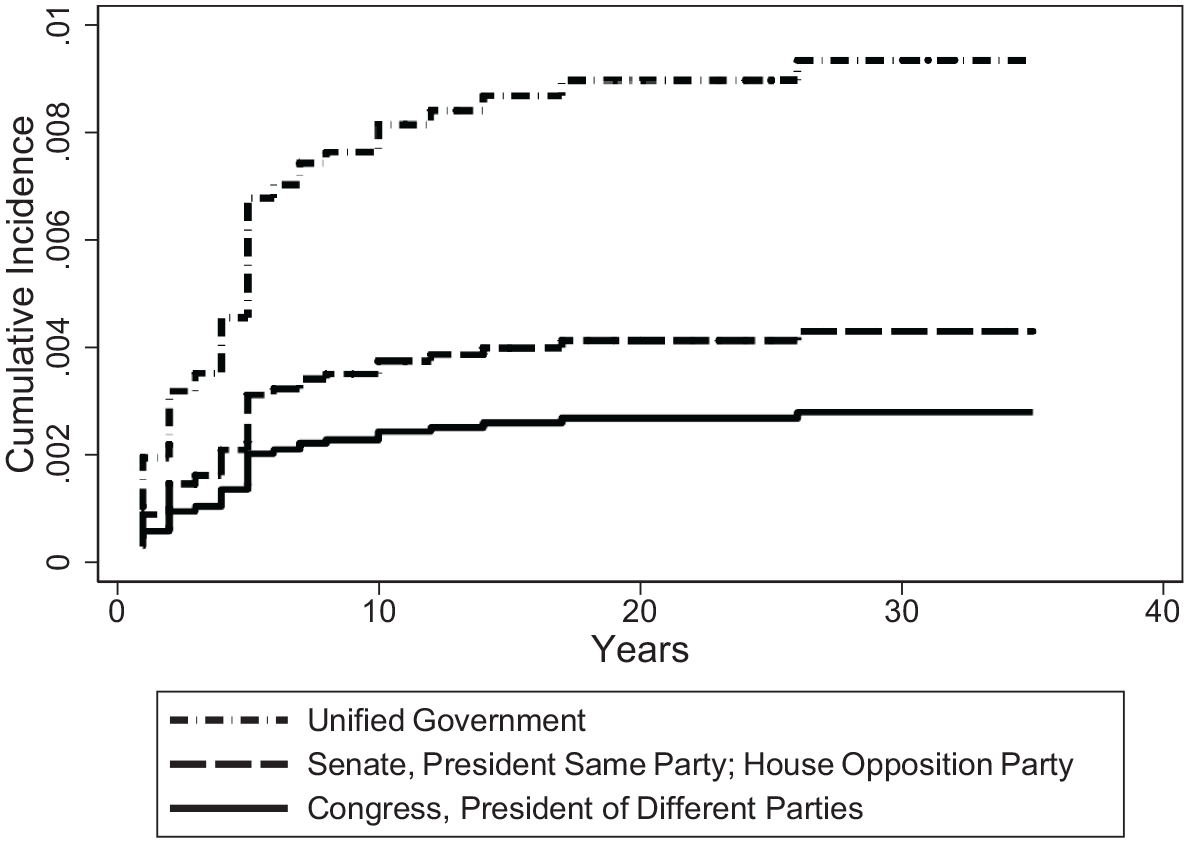
Simulated CIF of troops/early departure for the American intervention in Afghanistan (Table 2, Model 4).
Figure 3 records the marked impact of introducing opposition control to even one Congressional chamber. The effect of unified party control increases dramatically, reaching its maximum only 5 years into the intervention. The CIF of an early departure is nearly 0.01 20 years into an intervention in support of a civil war government. Should even one chamber come under opposition control, the likelihood drops to approximately 0.002. Interestingly, there is only a marginal difference between those scenarios representing opposition control of one or both Congressional chambers. This suggests that opposition control of even one veto point in the American government renders it less likely to terminate its commitment to an intervention.
These findings are reinforced by additional robustness checks reported in the Supplemental material. 17 Of particular note, we address the possibility that the effect of Divided Party Control Index is conditioned on regime type. As noted earlier, both Bueno de Mesquita et al. (2003) and Reiter and Stam (2002) argue that democracies are likely to achieve victory in interstate conflicts. To account for this counter-argument, our Supplemental material shows a model in which we interact Divided Party Control Index with a measure of democracy. The model indicates that Divided Party Control Index has an impact separate from regime type. We conclude that although regime type likely matters because the political opposition is more powerful in democracies, Divided Party Control Index still exerts its own independent effect.
Our control variables also yield important findings. Third-Party Capability is significant across all models, indicating that third parties with greater resources are better able to continue an intervention. Defence Ties is statistically significant in Models 3 and 4 only. Defence Ties is signed positively in these models, indicating a 75% likelihood that a third-party will remain committed with non-troop forms of aid in a given year (Model 4). Regime Change is significant across all models, increasing the hazard of an early departure by a full 447% (Model 4), the greatest substantive effect in our model, and an estimated result suggesting that a change in a leader’s political base is associated with a substantial likelihood of foreign policy change. Similarly, the performance of Lootable Resources indicates that civil conflicts with accessible resources are associated with a 389% increase in the hazard of early withdrawal (Model 4). This counter-intuitive result likely indicates that although third-parties may be interested in looting resources from conflict zones, they are unlikely to endure costs of an intervention over the long run to do so. Clearly, although Divided Party Control Index meets the standard of statistical significance, other variables that we specify in our Cox models exert greater magnitudes of impact on intervention termination.
The performance of Simultaneous Interventions demonstrates a 36% reduction in the hazard of early troop withdrawals in Model 4, although it is significant only in the first three models. This result is explained by the fact that pro-government third-parties often have global commitments. States that intervene in multiple conflicts fear for the consequences to their reputations that withdrawal represent, and so opt to endure the costs of those interventions. Rebel Support is associated with a 59% increase in the hazard of an early departure by third-party states supporting civil war governments (Model 4). This is likely because balanced interventions tend to be long in duration and often stalemated. Eventually, pro-government third-party states tire and terminate an intervention. Interestingly, Ethnic Ties is mainly insignificant, as is Territorial Control and Government Divided in Year One.
Conclusion
We began by exploring the persistence of third-party interventions in support of civil war governments. Such interventions often exhibit the qualities of ‘forever wars’. Anecdotal accounts of American and French experiences suggest that third-parties often continue their interventions despite the fact that, particularly in the case of the United States in Afghanistan, the original justification for the intervention was attained years before. We conjectured that this phenomenon was, in part, a function of third-party domestic institutional features. Additional research in this area remains. For example, in the case of the United States in Afghanistan, it was evident that the American military establishment did not prefer to end its support to the Afghan military forces and, as such, resisted efforts by civilian leaders to terminate the intervention. Future research should examine the role of such constituencies in shaping the decisions regarding continued engagement during interventions.
We conclude by noting that a common causal argument regarding the commitment of third-party states to civil war interventions is that high casualties and rising material costs stimulate domestic audiences to demand that their leaders terminate ongoing interventions of questionable national security value. As a result, third-party leaders are inclined to terminate an ongoing intervention to avoid these political costs. We propose that an additional domestic political condition, that of divided government, exerts a countervailing pressure on a third-party leader’s incentive to terminate an intervention. Leaders seek to deprive domestic political opponents of a political issue and, in so doing, may continue to pour ‘good money after bad’, thereby perpetuating intervention. Given the erosion of public trust in democratic institutions in the last several decades, a trend abetted by foreign policy, unpacking these and similar logics is relevant to contemporary policy-making.
Supplemental Material
sj-docx-1-bpi-10.1177_13691481211070172 – Supplemental material for Forever wars: Divided government and the termination of interventions in support of civil war governments
Supplemental material, sj-docx-1-bpi-10.1177_13691481211070172 for Forever wars: Divided government and the termination of interventions in support of civil war governments by Christopher Linebarger and Andrew J Enterline in The British Journal of Politics and International Relations
Footnotes
Funding
The author(s) received no financial support for the research, authorship and/or publication of this article.

Supplemental material
Additional Supplementary Information may be found with the online version of this article.
Content
Appendix A: Divided Party Control Index. Appendix A1: Distribution of Divided Party Control Index. Figure 4. Distribution of Divided Party Control Index for Third-party States Engaged in Interventions in Support of Civil War Governments, 1975–2009. Appendix A2: Divided Party Control Index in Three Key Cases. Figure 5. Divided Party Control Index, Three Prominent Third-party State Intervenors, 1975–2009. Appendix A3: Relationship Between Divided Party Control Index & Democracy. Figure 6. Relationship between Divided Party Control Index & Polity Scores. Appendix A4: Relationship Between Divided Party Control Index & Executive Type. Figure 7. Distribution of Divided Party Control Index by Type of Executive. Appendix B: Descriptive Statistics. Table 3. Descriptive Statistics, Third-Party Interventions into Civil Conflicts, 1975–2009. Appendix C: Robustness Tests. Appendix C1: Bivariate Models. Table 4. Bivariate Cox Competing Risks Models of the Duration of Third-party State Intervention with Troops in Support of Civil War Governments, Versus Alternatives. Appendix C2: Models of Pro-Rebel Intervention. Table 5. Outcomes for Third-party Interventions in Support of Rebels. Table 6. Cox Competing Risks Models of the Duration of Third-party State Intervention with Troops in Support of Rebels, Versus Alternatives. Appendix C3: Specifications of Pro-Government Intervention with a Three Category Outcome. Table 7. Three Category Outcomes for Third-party Interventions in Support of Civil War Governments. Table 8. Cox Competing Risks Models of the Duration of Third-party State Intervention with Troops in Support of Civil War Governments, Versus Alternatives. Appendix C4: Divided Party Control Index Treated Dichotomously. Table 9. Cox Competing Risks Models of the Duration of Third-Party State Intervention with Troops in Support of Civil War Governments, Versus Alternatives (Dichotomous Operationalisation of Divided Party Control Index). Appendix C5: Divided Party Control Index Interacted With Polity Score. Table 10. Cox Competing Risks Models of the Duration of Third-party State Intervention with Troops in Support of Civil War Governments, Versus Alternatives (Divided Party Control Index Interacted With Polity Score). Appendix C6: Models Excluding the United States as Influential Outlier. Table 11. Cox Competing Risks Models of the Duration of Third-party Intervention with Troops in Support of Civil War Governments, Versus Alternatives (American Interventions Excluded). Appendix C6: Logistic Regression Model. Table 12. Logistic Regression Models of Troops/Early Departure by Third-Party Interveners as a Function of Divided Government.
Notes
References
Supplementary Material
Please find the following supplemental material available below.
For Open Access articles published under a Creative Commons License, all supplemental material carries the same license as the article it is associated with.
For non-Open Access articles published, all supplemental material carries a non-exclusive license, and permission requests for re-use of supplemental material or any part of supplemental material shall be sent directly to the copyright owner as specified in the copyright notice associated with the article.
