







Abstract
Political science has no shortage of theories to explain ethnic majority support for radical right parties. This article enriches political psychology literature on the radical right by combining two prominent approaches – relative deprivation and social dominance theories. Evidence using data from a representative survey in the United Kingdom shows for the first time that feelings of group relative deprivation for White Britons are associated with an increase in social dominance orientation. Afterwards, as suggested by the established literature, social dominance orientation influences anti-immigrant prejudice, which then increases radical right support. This article contributes to the literature on political psychology and the radical right. It indicates that relative deprivation and social dominance theories can be used together rather than separately to explain why people support radical right parties.
Introduction
Why do socially dominant ethnic groups support the radical right? With the rise of the radical right in the Western world (Gest et al., 2018; Krause et al., 2023; Mudde, 2019), this question has become relevant to both researchers and the public. For the former, establishing a complete picture of radical right support will help answer one of the most widely discussed issues of today’s political scientists. For the latter, it offers a clearer insight into what motivates an individual to vote for the radical right, encouraging a deeper discussion about the rise of radical parties in society.
While the political science literature is already extensive in its research of the factors that constitute radical right support (Arzheimer et al., 2024; Crulli, 2024; Deppisch et al., 2022; Gest et al., 2018; Green et al., 2022; Hobolt, 2016; Inglehart and Norris, 2016; Rodríguez-Pose, 2018), it mainly focuses on economic, cultural and geographic factors. As such, psychological explanations are mostly left on the wayside. This risks posing an incomplete picture of radical right support. Drawing from a wide range of theories from political and social psychology that explain radical right support (Pettigrew et al., 2008; Urbanska and Guimond, 2018; Van Assche et al., 2019), I set out to explore psychological factors that explain radical right support. Specifically, I use group relative deprivation (GRD) and social dominance theories (SDTs), which are both popular approaches to explain radical right support in political psychology. The former emphasises subjective feelings of economic deprivation of dominant ethnic groups comparing themselves to ethnic minorities. Scholars, such as Urbanska and Guimond (2018) and Green et al. (2022), find that GRD is associated with supporting radical right presidential candidates and referendums. On the contrary, SDT argues that individuals, who wish to maintain arbitrary hierarchies, with their group(s) at the top (Ho et al., 2015), also tend to support the radical right. Scholars in this camp (i.e. Van Assche et al. (2019) and Undzenas et al. (2022)), find that those with high social dominance orientation (SDO) become more prejudiced against minorities, which then leads to radical right support.
I propose that both approaches are linked – economic threat envisioned as GRD influences SDO by making those who are economically threatened by minorities support hierarchies where these minorities are at the bottom. SDO influences prejudice against immigrants, and this prejudice is the major force increasing the probability of voting for a radical right party. To test this argument, I use data from the 15th wave of the British Election Study (BES) to analyse my research question and hypotheses. As research on these theories focuses on dominant ethnicities in countries, I focus on White Britons in the United Kingdom. However, I also conduct an analysis including the ethnic minorities in the dataset. The results do not change.
I find that higher GRD scores of White Britons influence factors that lead to radical right support. GRD is the catalyst that influences SDO. These beliefs then condense into prejudice against immigrants. Finally, prejudice is the catalyst for supporting the radical right. The study primarily speaks of two political psychology literatures, which explain radical right support with either indicators for relative deprivation (Green et al., 2022; Urbanska and Guimond, 2018) or SDO (Golec de Zavala et al., 2017; Undzenas et al., 2022; Van Assche et al., 2019). I show that these literatures can be combined to explain radical right support more rigorously.
The article proceeds as follows: first I provide a literature review and discussion of the most prominent theories of radical right support in various political science subdisciplines. I then move on to provide a theoretical argument as to why two prominent political psychology theories – social dominance and relative deprivation – can be combined into a united theoretical framework. Afterwards, I describe the data and methods used to test the main hypotheses of the article. Later, I show and discuss the results – GRD is positively associated with SDO. Furthermore, SDO is positively related to prejudice which predicts radical right voting in samples of the general English and Welsh population as well as only for White Britons. I later discuss the mechanism through which GRD functions – it both directly and indirectly influences radical right voting. Afterwards, I perform several robustness tests on the analysis and find that the results hold. Finally, I discuss the implications of the results as well as the limitations of the article and conclude.
Theories explaining radical right support
Popular and academic discourse on politics is often filled with phrases such as ‘extreme right’, ‘radical right’ and ‘far right’. They seem to be used almost interchangeably. However, research has to be precise about the definitions of concepts under study. To that end, one must define what the radical right actually is. Perhaps one of the most widely used definitions of the radical right comes from Mudde (2007: 26). He defines the radical right in the following way: . . . the term radical is defined as opposition to fundamental values of liberal democracy, while right is defined as the belief in a natural order with inequalities.
In this sense, ‘radical’ is meant to describe a party that is against the core values of liberal democracies, like political pluralism, or constitutional protections against disenfranchised minority groups (Mudde, 2007: 25). ‘Right’ here is a belief in some sort of natural order between groups, leading to socio-economic hierarchies (Mudde, 2007: 25). Allen (2017) shows that these positions among voters are primarily what lead voters to support radical right parties in Western Europe. Examples of parties with such philosophies and voter bases include the Front National (now known as National Rally) in France (Urbanska and Guimond, 2018), the United Kingdom Independence Party (UKIP) in the United Kingdom (Evans and Mellon, 2016) and the Trumpist wing of the Republican Party in the United States (Van Assche et al., 2019). Radical right parties are further characterised by nativism and authoritarianism as core features. Nativism is defined as outgroup rejection due to threat and wishing to live in a homogeneous society without foreign others while authoritarianism is defined as the submission towards the ingroup’s leaders (Mudde, 2007). This article is focused on the nativism feature. While nativism is a fundamental concept used to explain radical right support, it is very similar to the concept of prejudice in the political psychology literature. Allport (1954: 9) states that prejudice reflects a ‘faulty and inflexible generalization’ of ethnic groups. The definition of nativism for Mudde (2007: 19) stresses that ‘nonnative elements (persons and ideas) are fundamentally threatening to the homogenous nation-state’. While conceptually distinct, both terms capture outgroup rejection and, in this study, would be operationalised in the same way using BES anti-immigrant items. To remain consistent with the political psychology framework on which this article relies (Duckitt and Sibley, 2010), I use the term prejudice throughout, while recognising its overlap with what radical right scholars describe as nativism.
Since the drastic success of such parties in the Western world, scholars have been eager to explain what makes people support the radical right. Perhaps the most popular of these are the economic insecurity, cultural backlash and place-based theses (Hobolt, 2016; Inglehart and Norris, 2016; Rodríguez-Pose, 2018). Some scholars find support only for the cultural backlash thesis, that is, that ideology, anti-immigrant attitudes and trust in (inter)national institutions are the main drivers for radical right support (Inglehart and Norris, 2016). This is not the complete picture, as others find that attitudes towards economic issues like free trade or international economic organisations play a part in addition to cultural issues (Carreras et al., 2019; Green et al., 2022; Hobolt, 2016). Furthermore, some scholars expand these literatures by looking at other place-based considerations in addition to economic hardship and cultural issues. Examples of these include population decreases, the amount of young people living in an area and area type such as urban or rural (Arzheimer et al., 2024; Crulli, 2024; Rodríguez-Pose, 2018). As economic, cultural and place-based explanations of the radical right are in the spotlight, other approaches have been seldom considered in mainstream political science. This is quite surprising, as social and political psychology possess many theories that can help explain radical right support. I expand the radical right literature by combining approaches from social psychology that use theories of group-based economics – relative deprivation (Pettigrew et al., 2008) and group-based resource hierarchies – SDO (Pratto et al., 1994; Sidanius et al., 1992). I argue that socially dominant ethnicities who are threatened by immigrants become more predisposed to maintain hierarchies with their groups at the top. Supporting such hierarchies influences dominant groups to become more prejudiced against immigrants in both a cultural and economic sense. Finally, prejudice against immigrants is the catalyst through which the radical right gains support from dominant groups.
Relative deprivation is a concept dating back to the 1940s. The basic idea is that deprivation, whether it be economic or social, is judged relatively – people do not have a full view of the world and will make judgements based on comparisons between groups (Stouffer et al., 1949). In addition, the concept can be separated into two distinct factors – individual relative deprivation (IRD) and GRD (Pettigrew et al., 2008; Runciman, 1966). IRD measures an individual’s feelings of material deprivation in comparison with one’s ingroup. GRD, by contrast, measures how much one believes that their ingroup is deprived compared with outgroups. An individual can possess high levels of both GRD and IRD, be high in just one or be low in both. Higher IRD is primarily associated with individual outcomes such as increased levels of stress and poorer educational performance (Smith et al., 2012). By contrast, people who have higher levels of GRD tend to report more prejudice against immigrants and local minority groups as well as being more conservative (Osborne and Sibley, 2015; Pettigrew et al., 2008). In this case, it seems that feeling that one’s group is deprived compared with other groups makes one act out against others, both in attitudes and behaviour.
SDO is a construct based on SDT (Pratto et al., 1994; Sidanius et al., 1992). Socially dominant people express a wish to maintain hierarchies, with some groups in the dominant position and others in subservient positions (Sibley and Liu, 2010). The mechanism that motivates the value orientation is competition for resources and status (Cohrs and Asbrock, 2009). To put it simply, social dominators believe in a dog-eat-dog world, where resources are finite and every group is competing for them. Therefore, one is motivated to keep as many possible resources for their group as possible and create systems that uphold and legitimise hierarchies that support these wishes. In research, SDO is most prevalent in research on prejudice against various minority groups (Duckitt and Sibley, 2010; Michinov et al., 2005; Pratto et al., 2000).
In studies on the radical right using relative deprivation, only GRD predicts support for the radical right – IRD has no effect (Green et al., 2022; Urbanska and Guimond, 2018). While authors like Green et al. (2022) do not explicitly call their concept of group-based economic deprivation GRD, these concepts are functionally equivalent as they both measure deprivation experienced by the respondent’s ingroup to some sort of outgroup. Parallel relationships are observed by scholars who study SDO. Those with higher social dominance scores are more likely to support the radical right in the US and UK contexts (Undzenas et al., 2022; Van Assche et al., 2019). The observed effect is not direct but goes through intergroup prejudice. Put simply, SDO does not affect radical right voting directly, rather, people high in SDO are more prejudiced, and this drives their support for the radical right.
Combining psychological theories of radical right support
While used independently in the past, I argue that GRD and SDO are fundamentally linked. More perceived deprivation compared with minorities should increase the wish to maintain hierarchies. To see this, one has to return to one of the seminal texts of SDT. Duckitt and Sibley (2010: 1868) propose their dual-process model. They argue that environmental conditions can affect SDO. Duckitt and Sibley (2010:1869) write that . . . social environments characterized by, or making salient, issues of group dominance, competition, resource scarcity, and inequality will increase competitive-world beliefs and SDO . . .
This has been demonstrated in experimental and observational research. Those that believe that dominant social groups are disadvantaged because of competition from other groups become more socially dominant (Morrison and Ybarra, 2008). Gidron and Hall (2020) and Engler and Weisstanner (2021) argue that a perceived loss of social or economic status for dominant groups make them more susceptible to the radical right voting and prejudice against marginalised groups such as immigrants. Similarly, I argue that GRD can be considered as a perception of threat from outgroups due to a loss of social status as it deals with perceived economic disparities (Green et al., 2022: 331). People with high GRD are shown to perceive higher economic threat from immigrants (Meuleman et al., 2020). If ethnic majorities believe that immigrants are doing much better than them, they perceive a reality that highlights group competition and loss of status within the social hierarchy. This can socialise ethnic majorities into perceiving threat from ethnic minorities. As such, the perception of threat from minorities doing better than them should make ethnic majorities strive for a creation or maintenance of ethnic hierarchies, thereby increasing SDO. However, if ethnic minorities are objectively doing better than ethnic majorities, the measure might not reflect a subjective misperception of status, which leads to threat perceptions. This would mean GRD corresponds to the objective measure of the events. To address this concern, I analyse whether White Britons are more likely to be in higher income quartiles in the dataset. The results are given in the Supplemental Appendix, Section 1. I find that White Britons are more likely to report higher household incomes than ethnic minorities. This provides evidence that White Britons are doing objectively better than ethnic minorities, even when controlling for education, age and gender. As such, White Britons with high GRD scores misperceive objective economic circumstances, further cementing GRD as a measure of subjective economic evaluations.
Drawing from this I argue that GRD and SDO theories can be combined. GRD acts as a precursor to SDO – the more someone believes that ethnic minorities are succeeding economically compared with the dominant ethnic group, the more they will want to maintain hierarchies where dominant groups are at the top. Two contrary arguments can be made. The first is that SDO is a personality trait and as such, cannot be changed. The second is that SDO is the precursor of GRD – that is, the more someone wishes to uphold hierarchies, the more they will think that ethnic minorities are doing better than dominant majorities. In terms of the first argument, SDO was originally conceptualised as a personality variable that is not easily changeable (Pratto et al., 1994). However, later research into SDO (Duckitt and Sibley, 2010) has argued that it is more akin to an ideological orientation – stable over long periods of time (Osborne et al., 2021) – but can be changed in the short term via priming threat or in the longer term by changes in one’s social environment. In terms of experimental and quasi-experimental studies, evidence suggests that SDO is changeable at least in the short term by priming threat from outgroups (Morrison and Ybarra, 2008, 2009; Morrison et al., 2010; Undzėnas, 2025). In terms of changes to social status, works such as Guimond et al. (2003) experimentally show that making people believe they are in a higher status group makes them more socially dominant. Longitudinal studies (Haley and Sidanius, 2005) additionally provide evidence that one’s environment shapes SDO – working in hierarchy enhancing institutions such as the police increases individuals’ SDO by socialising them to uphold hierarchies. Conversely, hierarchy attenuating institutions such as sociology courses decrease individuals’ SDO over time. Given the empirical evidence, it is likely that while SDO is a relatively stable orientation, changes in social situations or threat perceptions can increase or decrease it.
This is also related to the second point of GRD being a consequence and not a precursor of SDO. As ethnic majority individuals who are high in GRD believe that their group is losing out to ethnic minorities economically, they start to believe in an environment where they are losing social status and are threatened by minorities (Green et al., 2022). Losing social status (Engler and Weisstanner, 2021; Gidron and Hall, 2020) and threat from outgroups (Morrison and Ybarra, 2008, 2009; Morrison et al., 2010; Undzėnas, 2025) are both ways that increase SDO. While it is possible that GRD can be influenced by SDO, the empirical literature is more in favour of the opposite – SDO is influenced by threat and loss of social status, not the opposite. As GRD measures loss of status – minorities doing better than majorities as well as threat, SDO should be influenced by GRD as well. In the BES data which this article relies on (Fieldhouse et al., 2019), GRD is measured as a relational item of how much White Britons have been doing compared with ethnic minorities financially in the last 12 months. The 1-year interval in feeling deprivation is likely to have resulted in social dominance increases due to perceived threat and loss of status socialising high GRD White Britons. Of course, reverse causality cannot be ruled out entirely. SDO might still affect GRD due to the fact that it is a relatively stable orientation (Osborne et al., 2021). As such, it is likely that the relationship between GRD and SDO is bi-directional. That is, people who believe in societies with ethnic minorities at the bottom may also feel that ethnic minorities are gaining unfairly financially compared with White Britons. To ameliorate this concern and present a more coherent theoretical picture, I present a model with SDO being the precursor of GRD in the Supplemental Appendix (Section 2). The substantive results of the analysis do not change besides the ordering of the two variables. Furthermore, I run a panel analysis of GRD affecting other value orientations (due to the lack of repeated SDO measurements). This analysis suggests that the effect between GRD and values such as right-wing authoritarianism (RWA) is bi-directional. As such, I acknowledge that the relationship between GRD and SDO is most likely bi-directional. This article focuses on the
Furthermore, SDO is not only affected by GRD, it affects other attitudes. Duckitt and Sibley (2010) view both prejudice and radical right wing politics as outcomes stemming from SDO (see Figure 1 in Duckitt and Sibley (2010: 1868). Wishing to maintain hierarchies between groups instils prejudices against ethnic minorities. This relationship arises because of ethnic majorities looking for justifications on why to maintain these hierarchies (Duckitt and Sibley, 2010). If one wants to maintain hierarchies with their group at the top, the other group must be somehow portrayed as negative. Hence, this leads to prejudice against lower-status groups. Prejudice influenced by SDO then leads to higher probabilities to vote for the radical right. Because radical right parties campaign on an anti-immigrant platform, it is unsurprising that those who are prejudiced against ethnic minorities would be more likely to support the radical right (Undzenas et al., 2022; Van Assche et al., 2019). The authors additionally show that SDO does not have a direct effect on radical right voting. In other words, believing in ethnic majorities being at the top does not by itself condition radical right support. It makes ethnic majorities more prejudiced against minorities, which then leads to radical right support. In line with the current literature on GRD, SDO, prejudice and the radical right, I propose a path from GRD to radical right support visualised in Figure 1. The theoretical innovation here is the

The proposed relationship between the main variables.
The model proposes that individuals subjectively interpret the economic environment in group terms. While SDO is an individual-level orientation found across both dominant and subordinate groups (Pratto et al., 1994), individuals who perceive minorities as doing better than themselves tend, on average, to score higher in SDO, reflecting stronger support for hierarchies that place dominant groups at the top. Those who have higher SDO scores are on average more prejudiced against any ethnic minority outgroups. Higher prejudice leads to higher probabilities of voting for a radical right party on average. With regard to research on economic drivers of the radical right, this has implications as well. Instead of viewing subjective economic evaluations and concerns about immigration as separate explanations for radical right voting (Green et al., 2022; Im et al., 2023), this theory posits that subjective economic evaluations indirectly influence prejudice against immigrants by making people more supportive of group-based hierarchies. Granted, subjective economic evaluations should only show this indirect effect when outgroups are perceived to be doing better than one’s own group (Pettigrew et al., 2008; Smith et al., 2012).
Of course the path in Figure 1 might not be straightforward and induce bias when estimating effects. For example, SDO might affect RR voting directly instead of through prejudice. As such, it is pertinent to address such concerns given the literature. As the
H1: Higher levels of GRD are associated with higher levels of SDO for dominant ethnic groups on average.
H2: Higher levels of SDO are associated with higher levels of prejudice against immigrants for dominant ethnic groups on average.
H3: Higher levels of prejudice against immigrants are associated with a higher probability of voting for radical right parties for dominant ethnic groups on average.
Data and method
I utilise observational data from the United Kingdom, specifically, the 15th
1
wave of the BES, which was administered in March 2019 (Fieldhouse et al., 2019). The case of the United Kingdom is chosen, as the country had a large ethnic minority population of around 15% in 2019, when the 15th wave of the BES was conducted (Office for National Statistics, 2021). In addition, the citizens in the United Kingdom feel most strongly that they are losing out to immigrants in Europe (Meuleman et al., 2020). A large immigrant population and high levels of ethnic threat make it a prime example of a society in which ethnic competition is prevalent. In other words, the proposed theory is most likely to be applicable to this case. Sadly, due to SDO data availability, I exclude Scotland and Northern Ireland, as its items were not applied to respondents from those two countries. Furthermore, I only focus on White Briton respondents as they are the main population of interest to test the theory due to occupying the role of dominant ethnicity. The full wording of all of the measures is available in the Supplemental Appendix, Section 3. GRD is measured as a relational measure of two variables – perceived financial success of White Britons minus the perceived economic success of ethnic minorities. Respondents had to rate how the economic situation changed for White Britons and ethnic minorities. The score for ethnic minorities was subtracted from that for White Britons to create the GRD measure. Note that extreme values contain very few actual cases. Therefore, the categories with low cases were merged with the next category that has more cases. The final variable is reversed and rescaled to range from 0 (No GRD) to 1 (High GRD) for ease of interpretation. SDO is measured using the
The reverse coded items were reversed (McDonald’s omega of 0.86 for all items) and every single item was added up to produce the SDO scale. It was then rescaled to range from 0 (no SDO) to 1 (Full SDO). For the prejudice scale, I combine two items that pertain to immigrants – one for whether immigration is good or bad for Britain’s economy and the other about whether immigration enriches Britain’s cultural life. These are added up, reversed and rescaled from 0 to 1, where 0 indicates no prejudice, while 1 indicates full prejudice. Finally, for voting intentions, respondents were asked to choose one party to vote for if a general election were held tomorrow. Due to the data only covering England and Wales, the choice set was between 7 options for those in England and 8 options for those in Wales.
The coding of control variables and the wording of the main items is discussed in the Supplemental Appendix, Section 3. The dataset has 2374 cases, with missing values listwise deleted. The relatively low number of respondents compared with the full BES panel is explained by the fact that SDO questionnaires were not applied to the whole panel, only a subset of it. The distributions for the variables of interest can be seen in Figure 2. I split the descriptive statistics by White and ethnic minority Britons. While analysing ethnic majority respondents is the main goal of this article, I also test whether the same effects are present for the full sample, including ethnic minorities to enhance generalisation in Section 4 of the Supplemental Appendix.
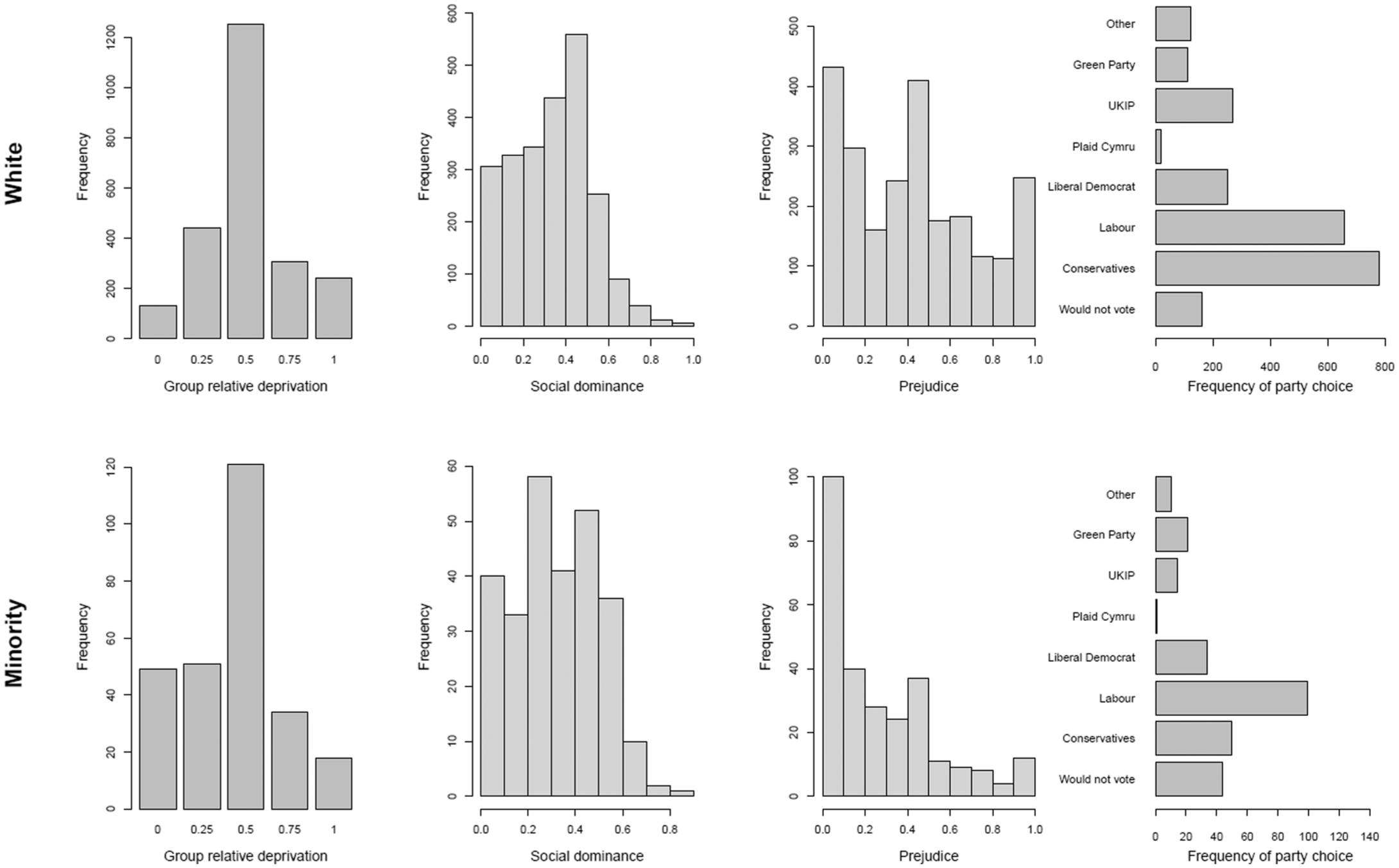
Distributions of the variables of interest for White and ethnic minority Britons.
One can see that GRD scores are approximately normally distributed. SDO scores, however, are heavily right-skewed. This means that there are very few people who are very socially dominant. In fact, there are only four people in the dataset who have the maximum SDO scores. For the prejudice scores, they have three peaks for White Britons: at the start, middle and end of the distribution. For ethnic minority respondents, prejudice scores are clustered at the minimum, with very few believing that immigration is very negative. For voting intentions of White Britons, it seems most people would vote for the Conservatives and Labour, an accurate representation of British politics at the time. The radical right party of interest in this dataset, the UKIP, comes in as the third most popular party. For ethnic minorities, Labour and the Conservatives are still the most popular parties, with the Liberal Democrats (LibDems) trailing closely behind. UKIP, however, is far less popular.
Analysis
To analyse the first hypothesis, I employ an ordinary least squares (OLS) regression. I take SDO as the dependent variable and GRD as the independent variable. I also control for age, gender, household income, education, IRD and whether the respondent lives in a rural or urban area. A detailed literature review on which control variables I select for every model can be found in the Supplemental Appendix, Section 5. To facilitate a better representation of the results, I employ simulation techniques (King et al., 2000) to get simulated SDO scores based on the regression coefficients and GRD values. To define the scenarios of interest, I use the observed value approach (Hanmer and Ozan Kalkan, 2013). In short, the method defines scenarios set to the actual value of the control variables for each individual varying only individual GRD scores. I am interested in comparing SDO scores between those who believe that White Britons are doing much better than minorities (no GRD) compared with those who believe that ethnic minorities are doing much better than White Britons (full GRD). I choose this scenario to get the full range of values for the effect of GRD. In addition, the ‘no GRD’ condition is the closest attitude to an objective measure of the financial situation of White Britons compared with ethnic minorities in the United Kingdom. This is because ethnic minorities, be they White or non-White, continue to be at a financial disadvantage compared with White Britons in the United Kingdom because of labour market discrimination (Heath and Di Stasio, 2019).
To get the estimated effect of GRD on SDO, one need only take the first difference between the expected value simulations and estimate their uncertainty (King et al., 2000). The results of 1000 simulations are visible in Figure 3(a), which contains the empirical distribution of first differences between the low GRD and high GRD scenarios. 2 The estimated effect of perceiving GRD compared with not perceiving GRD is 0.18 with the estimate varying between 0.15 and 0.22 due to estimation uncertainty. The first difference provides support for H1, because the confidence bounds do not include 0. In essence, even at the lowest confidence bound, there is a strong positive effect that GRD has on SDO as it is almost equal to one-fifth of the length of the SDO variable. Considering that most of the people in the sample have an SDO score that varies between 0 and 0.6, this is indeed a strong influence. Put simply, if a White Briton thinks that ethnic minorities’ financial situation has been improving much better than that of White Britons’, their support for maintaining resource hierarchies along group lines increases substantially.
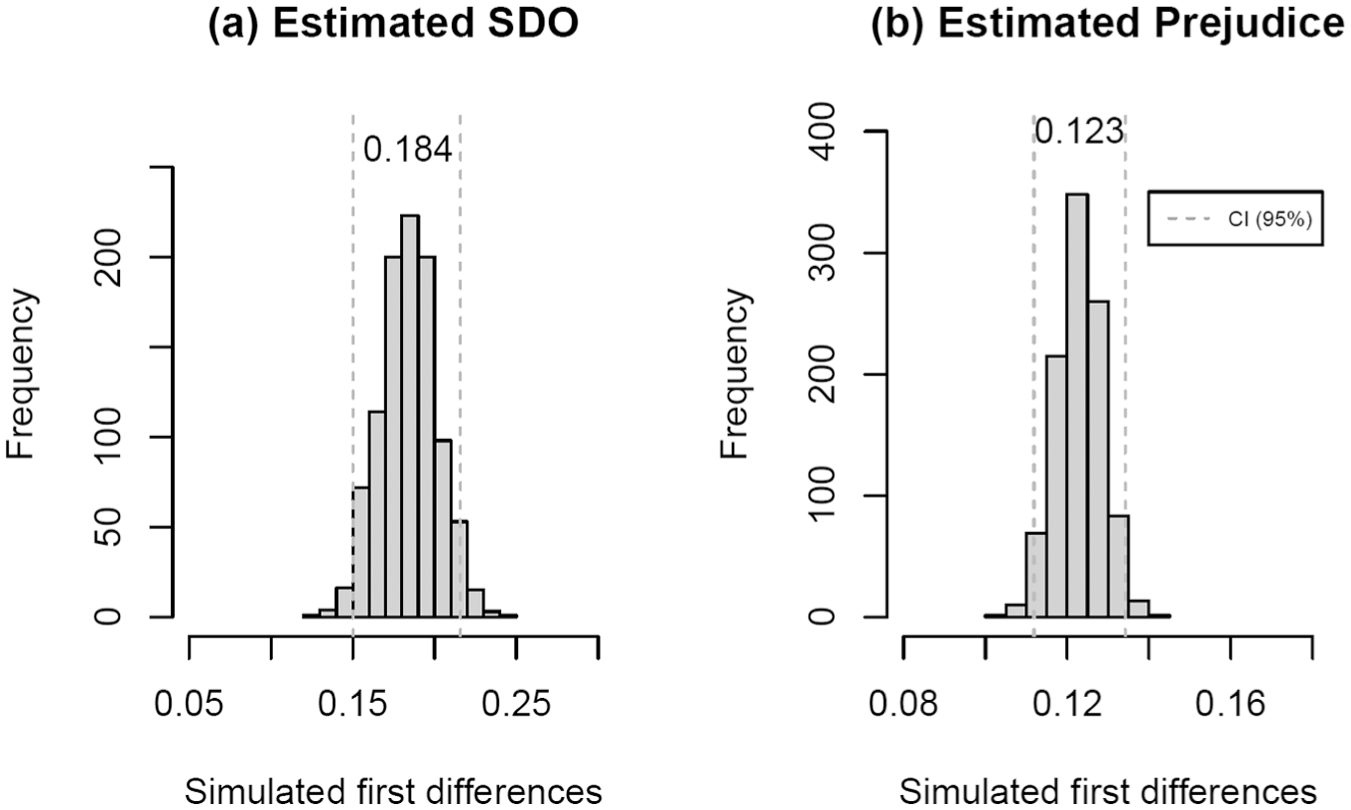
Empirical distributions of the estimated effects of GRD on SDO and SDO on prejudice. (a) Estimated SDO. (b) Estimated prejudice.
But what effect does this have on prejudice, and later, radical right voting intentions? To answer the first part of the question, I again run an OLS regression; however, this time I take SDO as the independent variable and prejudice as the dependent variable. The control variables this time are age, gender, household income, education and urban/rural residence. The simulation procedure remains largely the same, but there is one important change. Because I am interested in a realistic scenario, I do not take the difference in prejudice for the whole scale. After all, who cares about the effect of SDO on prejudice for the four most socially dominant people? Instead, I take the means of the simulated SDO scores from the previous simulation and their uncertainties and simulate SDO scores for every individual in the dataset, incorporating the uncertainty of the previous model. Again, there are two scenarios: those with low SDO (on account of low GRD) and those with high SDO (on account of high GRD).
The first differences between these scenarios are presented in Figure 3(b). The estimated effect between the two SDO scenarios is 0.12, with it varying between 0.11 and 0.13 in 95% of the simulations. Again, even at the lowest confidence bound the effect of SDO is remarkably strong, being more than one-tenth of the entire prejudice scale. This provides ample support for H2. To put it plainly, an increase in the belief that resource hierarchies between groups should be maintained or established is associated with a large increase in prejudice against immigrants among White Britons.
Finally, I test H3. To estimate the effect of prejudice against immigrants on radical right voting, I employ a multinomial logit regression. This is done because the vote intention variable is discrete and unordered. The control variables are age, gender, household income, education and urban/rural residence. To get the effects of how prejudice influences the predicted probability of voting for a certain party, I run simulations with the same logic as previously, employing 1000 simulations with the observed value approach (Hanmer and Ozan Kalkan, 2013). The scenarios this time are the prejudice score means from the previous model and their uncertainty.
The first difference results are visible in Figure 4. 3 Positive numbers indicate that there is an increase of probability to vote for a party when one is anti-immigrant, while negative numbers indicate a decrease; 95% confidence intervals depicted as lines are also provided. If the confidence interval includes 0, one can interpret these findings as varying too much, meaning that prejudice has a very small effect on voting for the specific party. As such, one can see that more prejudiced people, on average, tend to vote more for the Conservatives and UKIP, as well as choose not to vote. For the Conservatives, this increase is equal to 5.57 percentage points, with the estimate varying between 4.66 and 6.52. For UKIP the increase is equal to 3.54 percentage points, with the estimate varying between 3.13 and 3.99. Finally, prejudice also makes people indicate that they are more likely not to vote in the general election by 1.78 percentage points with the estimate varying between 1.35 and 2.2. All of the liberal immigration parties tend to lose out on votes in the same vein if a voter is prejudiced against immigrants. The results give credence to H3 – more prejudiced people are more likely to vote for the radical right in Britain. In addition, they are also more likely to vote for the Conservatives, as well as not to vote. It is not very surprising that GRD indirectly influences the vote towards the Conservatives as well. The party has tried to take issue ownership of immigration and promote anti-immigrant policies since the opening of borders to European Union (EU) immigrants after the 2004 ascension (Evans and Mellon, 2019). Evans and Mellon also show that UKIP rose as a challenger to the Conservatives due to what UKIP believed were insufficiently radical policies on immigration. As both parties focus strongly on immigration, it is not surprising that the Conservatives also indirectly benefit from voters threatened by immigrants. In terms of percentages, GRD through SDO and prejudice indirectly increases the vote probabilities of UKIP by 57.1%, and increase of over 50% to the probability of people voting for them. The Conservatives increase their vote probability by 16.52% on average. The probability to not vote increases by approximately 29.91% on average. While the absolute increases in vote probabilities are higher for the Conservatives, UKIP gains are much bigger in terms of percentages. This shows that UKIP is the winner proportionally, as they increase their support more compared with a scenario where people are not threatened by immigrants.
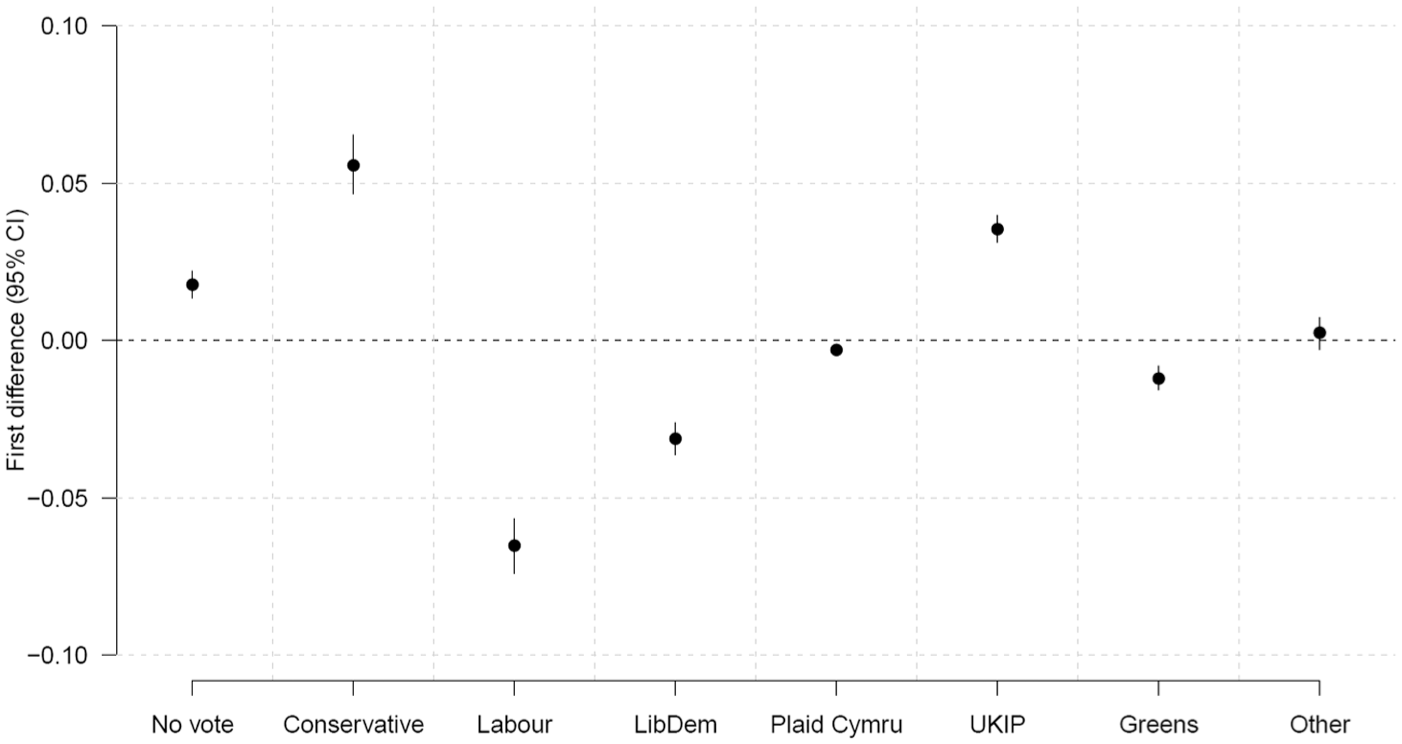
First differences in predicted probabilities of vote intention based on prejudice scenarios.
To test whether these effects are externally valid to the whole of the United Kingdom, I also rerun the analyses while including non-White Britons in the analyses and controlling for minority status in Section 4 of the Supplemental Appendix. Overall, the main results do not change when including ethnic minorities into the analysis. This shows that the results are generalisable to both ethnic majorities and minorities, even though ethnic majorities are the main focus of this article.
Mechanism
GRD works indirectly and directly to increase the radical right vote
Understanding how GRD affects social dominance and radical right voting is central to this article. So far, the theory and results have only considered its indirect effects on prejudice and radical right voting – mainly by influencing SDO. However, the literature analysing GRD proposes direct effects on prejudice and radical right voting. For example, Pettigrew et al. (2008) show that GRD increases prejudice directly. The same is the case for radical right voting. Urbanska and Guimond (2018) show that GRD is directly related to radical right support. It is the goal of this section to weave the model proposed by this article into the general and well-established literature on GRD.
To accomplish this goal I rely on structural equation modelling. This allows me to uncover both direct and indirect relationships that GRD has with all of these concepts. I rely on the local estimation approach and the piecewiseSEM package in R (Lefcheck, 2016). Due to SEMs not being able to handle multinomial models, the radical right voting measure is recoded to 1 for those who would vote for the radical right (UKIP) and 0 for those who would vote for any other party or not vote. This allows for an estimation of a binary logit model.
The results are presented in Figure 5. Here, only significant pathways between the main variables are demonstrated. The exact model specifications with controls are shown in Table A9 in the Supplemental Appendix, Section 7. The results show that in addition to the proposed indirect relationship, GRD also directly affects prejudice and the radical right vote as suggested in the broader research. GRD affecting SDO and this influencing prejudice and the radical right vote is the main contribution of this article. The SEM shows that this framework retains its significance even when combined with the relationships proposed in the broader literature.
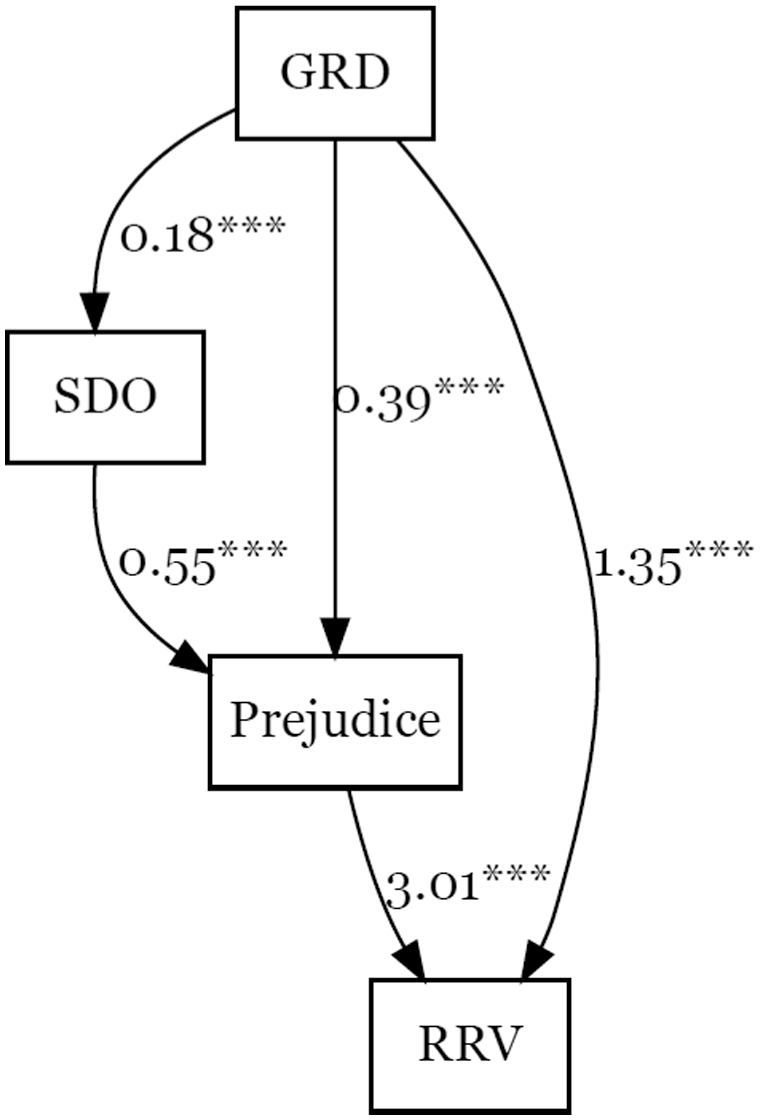
Direct and indirect relationships between GRD and the radical right vote.
For the first path, one can see that GRD also independently increases prejudice, which leads to a higher probability to vote for the radical right. This aligns strongly with the intergroup competition literature, which suggests that threats to majority status can activate anti-migrant prejudices and influence radical right voting (Bolet, 2020). In addition, GRD directly increases the probability to vote for the radical right. These results are in line with the literature in political psychology and political economy that show direct effects of GRD on radical right voting (Burgoon et al., 2019; Pettigrew et al., 2008; Urbanska and Guimond, 2018). Theoretically, this pathway reflects broader alienation, disaffection and cultural/economic threat. All of these feelings may motivate White British individuals to vote for the radical right in order to maintain their group status compared with outgroups (Gidron and Hall, 2020).
These findings contribute to the broader literature by showing that GRD not only directly influences SDO as proposed by social psychology models (Duckitt and Sibley, 2010); it also establishes the article’s model firmly within the broader literature on deprivation and the radical right. Modelling multiple pathways with a structural equation model shows that the proposed theories linking GRD to radical right support, whether directly or indirectly, are not mutually exclusive – they can be put together into a coherent framework in order to provide a more nuanced framework of radical right support.
A wish to maintain hierarchy or social conformity?
In many studies using SDO, another orientation is measured alongside it – RWA (Duckitt and Sibley, 2010; Undzenas et al., 2022). RWA is an orientation that measures a person’s proclivity towards social conformity to established authorities. It could be the case that RWA is also related to GRD. An alternative explanation could be that perceived competition between ingroups and outgroups could also result in White Britons perceiving a world that is dangerous to their ingroup as a minority group is gaining (economic) power (Duckitt and Sibley, 2010). This threat might increase RWA. As RWA and SDO tend to correlate (Duckitt and Sibley, 2010), this could impact the relationship between SDO and GRD because of omitted variable bias. As such, it is imperative to test whether the association between GRD and SDO still holds when taking into account RWA.
Sadly, the BES does not have measurements for RWA, SDO and GRD in the same wave, so a concrete test is impossible to do. Wave 15 does, however, include Wave 14 authoritarianism measures for those who answered both waves. As such, I control for Wave 14 RWA in the original model specification. The results are present in Table A11 in the Supplemental Appendix, Section 8. The model with RWA shows that GRD still significantly affects SDO even when controlling for RWA. The coefficient for GRD does become smaller, indicating that GRD does share some correlation with RWA. However, as Waves 14 and 15 are almost a year apart and the GRD asks questions about the economic situation in the last 12 months, strong conclusions about RWA and GRD should not be drawn. The most important thing that can be drawn is that GRD affects SDO even when controlling for RWA.
To estimate the effect of GRD on RWA, I use Wave 21 BES data. This wave is important because it contains RWA and GRD measures in the same dataset. The results are again present in Table A11 in the Supplemental Appendix, Section 8. What can be seen in this model is that GRD is associated with RWA as well as that the coefficient for GRD’s effect on RWA is larger than that for SDO. All of the combined results show that GRD affects SDO and RWA independently – perceiving that ethnic minorities are doing better economically increases wishes to maintain hierarchies and social conformity for Britons. The GRD link to RWA could be related to RWA’s being tied to the existing social order and wanting to preserve it (Duckitt and Sibley, 2010). Feelings of deprivation could make people believe that the social order where they are on top economically is being threatened and thereby increase RWA. While the results with RWA are interesting, they are not the main focus of this article. As such, further research investigating and theorising as to why GRD affects RWA is needed. Most importantly for current research, controlling for Wave 14 authoritarianism in the
Robustness
To see whether the proposed relationships hold, I run three robustness checks. First, I perform sensitivity analyses to test for possible effects of omitted variable bias for the effect of GRD on SDO (Cinelli and Hazlett, 2020). One of the biggest problems with making inferences using observational data is omitted variable bias. As one of the contributions of my study is to propose a path from GRD to SDO, this section focuses on this relationship. While the literature provides a large number of confounders to control for on this path, it may be the case that previous or current research has missed out on some confounders. For that reason, it is important to assess the impact that omitted variable bias can have on the estimate of GRD’s effect on SDO. To suggest possible confounders, I rely on sensitivity analysis based on the partial
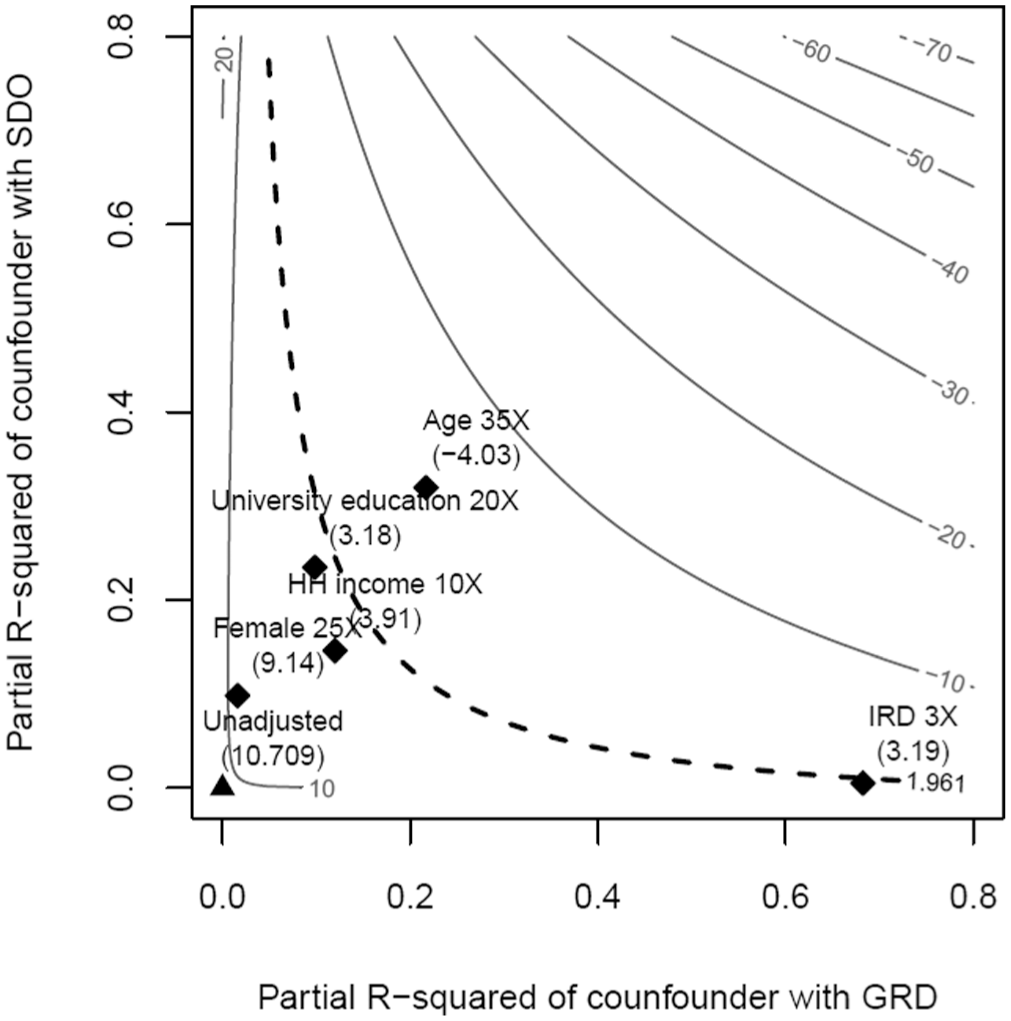
Hypothetical confounders on the GRD to SDO path and their effects on the t-values of the GRD estimate.
Figure 6 shows some of these hypothetical confounders. Confounders that were 20 times stronger than having a university education (compared with none), 10 times as strong as household income, 25 times as strong as the effect of being female (compared with males) and 3 times as strong as IRD would not make GRD’s effect on SDO non-significant. However, a confounder 35 times as strong as age would flip the GRD effect on SDO to be negative and statistically significant. The major point that one should take away from this section is that it is possible for certain confounders to exist, which would invalidate the results of this article. These confounders would, however, have to be quite strong compared with the ones already used. Whether such variables exist, should be part of the scholarly debate in the GRD and SDO literatures. In the current literature, however, there does not seem to be a mention of these hypothetical confounders. As such, I concur that my estimates may be biased due to omitted variable bias. However, this bias is very likely to be negligible, as a very strong confounder on the GRD to SDO path should have been discovered by literatures as old as those for GRD and SDO.
For the second robustness check, I rerun my analyses with data from Urbanska and Guimond (2018) and OLS regressions to test if the observable implications of my theory work with other datasets. The results are visible in Table A12 in the Supplemental Appendix, Section 9. However, the results have the same conclusions. GRD positively affects SDO, SDO positively affects prejudice and prejudice positively affects radical right voting intentions (this time a continuous variable).
I also use Google Trends data as a robustness check for the salience of certain topics related to the survey questions. If certain words are more popular, it could drive the salience of a topic and people’s answers in the survey. Figure A4 in the Supplemental Appendix, Section 10, shows these results in detail. It seems that during the BES Wave 15 fieldwork, UKIP was quite popular relative to its popularity in 2019, while the other parties and terms were not. This could have resulted in more people choosing to answer that they would vote for UKIP compared with other parties because of the higher salience of the party. However, UKIP’s largest popularity was after the fieldwork, just before the EU parliament elections. As such, the bias, if there is any, should not be too large.
Discussion
With the radical right gaining traction in the West and a myriad of theories aiming to explain its support, I contribute to the research by harmonising two social psychology theories and embed them within the wider political science literature. I propose a new idea that GRD can be interpreted as a measure of economic threat felt by dominant groups in the West. Individuals who feel more deprived compared with immigrants start to perceive the world as one of group competition for resources. Such perceptions lead them to become more supportive of hierarchies with their group at the top and others at the bottom. Because of this process, they have higher scores of SDO, which makes them more prejudiced against immigrants. This prejudice is the catalyst, which fuels radical right party support. Using data from the 15th wave of the BES, I test this new theory and its observable implications. I find support for all three proposed observable implications: higher scores in GRD are associated with an increase in SDO, higher SDO scores are associated with higher levels of prejudice and higher prejudice scores are associated with an increase in radical right voting intentions. These results are robust to a variety of tests for both the model specification and the mechanism. As such, this article offers important information about the radical right. It explains why the radical right, which campaigns on immigrants ‘stealing’ jobs from native populations gains support among them. Individuals who feel deprived compared with immigrants feel as if they are losing status and may wish to enforce or create hierarchies that keep them at the top (Gest et al., 2018). As this strategy continues to help radical right parties rise in the polls, parties that wish to gain support from native Whites may try to campaign on the notion that ethnic majorities are left behind compared with immigrants and ethnic minorities. Similarly, those who do not want radical right parties to succeed should try to convince people that immigrants are not an economic threat to ethnic majorities or implement policies that increase the incomes of ethnic majorities, making them less likely to hold beliefs of GRD. Pettigrew et al. (2008) show that lower incomes are related to holding stronger GRD attitudes (also replicated in the Supplemental Appendix, Section 11, with BES data). Put simply, ethnic majorities will be less likely to support the radical right if their financial situations improve.
There are also some ancillary results that should be discussed in the context of the United Kingdom. Along with increasing radical right voting intentions, higher scores of GRD also indirectly increase the probability of voting for the Conservative party as well as not voting. That the Conservatives are recipients of votes when GRD, SDO and prejudice increase should not be a surprise. The Conservative party has long tried to claim issue ownership of immigration; however, UKIP rose to prominence because some voters felt that the Conservatives were not living up to their promises about reducing immigration (Evans and Mellon, 2019). To that end, it is reasonable to assume that many voters will flock to the Conservatives as well as to UKIP if immigrants are thought to be an economic threat. While UKIP does not gain as many voters as the Conservatives in this case, the relative gains are much bigger for UKIP. The results in Figure 4 show that if immigrants were thought to be economically threatening, the Conservatives would have a 16.52% increase in their vote share, while for UKIP this number would be 57.1. That means UKIP would increase their vote share by more than half if White Britons perceived immigrants as economically threatening. Considering that the Conservatives tend to react to UKIP successes by giving in to their demands as happened with the Brexit referendum (Evans and Mellon, 2019), this has the potential to severely push Britain’s policies to the radical right. Another interesting finding is that perceiving ethnic minorities as threatening makes some White Britons not want to vote, an increase of 29.91%. Both Conservative gains and the rise in not voting are interesting findings, but have to be interpreted with care, given that during the BES fieldwork, the United Kingdom was in a difficult position. The fieldwork coincided with the premiership of Theresa May and the fierce Brexit negotiations. Given the structural difficulties of negotiation with the EU and the internal problems that Theresa May faced at the time (Byrne et al., 2021), it might be the case that these results are not reflective of the regular UK political scene. Prejudiced voters may have been fed up with the Conservative party and opted to support a more radical party on Brexit, such as UKIP or decided to not vote because of these frustrations. This would undoubtedly increase UKIP voteshares and non-voter numbers, biasing estimates of this article. As it stands, future research can determine if this is truly the case.
The study does come with some limitations. Perhaps the most important one is the lack of a causal test for the theory. The data used are observational and as such, it is difficult to ascertain whether GRD affects SDO causally. As such, the article should not be interpreted as one that is telling a causal story. Rather, it is meant to show correlational evidence for the proposed theory. Further research should test these relationships experimentally or by using panel data to be able to ascertain the direction of causality fully. Another problem is the representativeness of the data. The BES data do not contain SDO measures for people from Scotland and Northern Ireland. That means that the estimates are derived using only individuals from Wales and England. This is very likely to make the estimates biased unless one makes the unlikely assumption that people from Scotland and Northern Ireland behave exactly as those from England and Wales. However, these limitations do not break the study as England and Wales combined contain the vast majority (around 89%) of the UK population (Office for National Statistics, 2022). As such, the inferences of this article are still valid for a large part of the country. Further research should look into how these results replicate to the whole of the United Kingdom and other country contexts. In regard to measurement, the GRD scale is measured by one item. This is not the scale used in other research concerning GRD (i.e. Smith et al., 2012; Obaidi et al., 2019; Berntzen et al., 2024). The measures in these papers include more items as well as measuring lack of social recognition and unfair treatment. As such, the scale used in this article most likely suffers from measurement error as well as only reporting economic GRD. Potential measurement error could stem from a lack of knowledge of economic conditions when comparing minorities and White Britons. Empirically, this would mean that the GRD coefficient is smaller than expected, given that measurement error in the independent variable biases estimates downwards. Future research should explore how the conventionally used GRD scale relates to SDO and other items.
To reiterate the central question of this article: why do socially dominant ethnic groups support the radical right? The analysis shows that one of the most influential factors is feeling left behind compared with immigrants. White Britons, who believe that ethnic minorities are making more gains economically than White Britons become more predisposed to maintain hierarchies based on group status. As these hierarchies are against a group that is perceived as threatening (Cohrs and Asbrock, 2009), prejudice towards immigrants develops. It is this prejudice that makes people vote for the radical right in Britain.
Supplemental Material
sj-docx-1-bpi-10.1177_13691481261426791 – Supplemental material for What makes ethnic majorities support the radical right? A combination of relative deprivation and social dominance approaches
Supplemental material, sj-docx-1-bpi-10.1177_13691481261426791 for What makes ethnic majorities support the radical right? A combination of relative deprivation and social dominance approaches by Domantas Undzėnas in The British Journal of Politics and International Relations
Footnotes
Acknowledgements
The author thanks Thomas Gschwend, Oliver Rittmann, Marie-Lou Sohnius, Tim Allinger, Felix Münchow and all of the participants of the ECPR 2023 general conference panel on Political Psychology: Emotionality, Debates on Immigration, and Trust for their excellent suggestions on earlier versions of this manuscript.
Funding
The author disclosed receipt of the following financial support for the research, authorship and/or publication of this article: This work was supported by the University of Mannheim’s Graduate School of Economic and Social Sciences.

Supplemental material
Supplemental material for this article is available online.