






Abstract
Informal intergovernmental organisations (IIGOs) like the G20, the G7, and BRICS have become key pillars of the post-Cold War multilateral system. IIGOs lack a legal foundation and a permanent secretariat or staff—yet states now use them to govern global issues ranging from artificial intelligence to nuclear non-proliferation. This raises a critical question: are IIGOs viable vehicles for supporting sustained and structured state interactions? I address this question by theorising IIGOs’ functional scope. Building on the institutional design literature, I disaggregate the notion of formality into organisational properties (P)—centralisation and independence—and relate these to organisational functions (F). Because IIGOs lack independence from member states but may achieve centralisation, the P-F framework suggests that IIGOs can enhance negotiation stability, information dissemination, and issue linkage. In turn, they struggle to support cooperation through initiation and enforcement. A case probe of the G20’s organisational structure and operations lends plausibility to these conjectures.
Keywords
Introduction
Over the past years, history’s most prolific international institution builder exited and re-acceded to formal treaties and organisations—the Paris Agreement, the World Health Organization, and multiple United Nations organisations—with striking swiftness and ease (see, for example, Dwyer, 2018; Rogers and Mandavilli, 2020). 1 Yet, the United States remained a steadfast participant in informal venues like the Group of Twenty (G20). Unlike their formal counterparts (formal intergovernmental organisations (FIGOs)), informal intergovernmental organisations (IIGOs), such as the G20, lack a binding legal basis and permanent secretariat, staff, or headquarters (Vabulas and Snidal, 2013: 197; Vabulas and Snidal, 2021: 861–862). But while they are easy to exit de jure, they have, de facto, become an indispensable vehicle for state cooperation (Cooper et al., 2022; Hagebölling, 2024; Roger and Rowan, 2022, 2023; Vabulas and Snidal, 2013, 2021; Westerwinter et al., 2021).
Since the end of the Cold War, IIGOs have consolidated as a central pillar of international cooperation. One dimension of this development is their rapid proliferation. States have used IIGOs since at least the early 19th century (Vabulas and Snidal, 2021: 862). However, whereas the number of formal intergovernmental organisations (FIGOs) has oscillated around the same level since the early 1990s (Pevehouse and et al, 2020: 493), IIGOs have seen more than a threefold increase during this period (Vabulas and Snidal, 2021: 860). 2 This shift towards informal venues is also closely linked to the rise of minilateralism—formats in which a select group of states collaborate to address international issues (Fioretos, 2019; Kahler, 1992; Patrick, 2015).
Another dimension, qualitative in nature and arguably even more consequential, is the change in how states use IIGOs. Amidst imminent gridlock in formal bodies, major powers are looking to IIGOs like the G7, the G20, and BRICS to facilitate major power engagement, consensus formation, and orchestration of governance activities by multilateral organisations on issues ranging from artificial intelligence (AI) to nuclear non-proliferation (see, for example, Group of Seven, 2023; Proliferation Security Initiative, n.d.-c). For instance, the Club de Berne offers a platform for addressing intelligence and security challenges, such as responses to terrorist threats (Guttmann, 2018). The Global Partnership Against the Spread of Weapons and Materials of Mass Destruction develops and implements programmes to reduce risks associated with such weapons and materials (Heyes, 2013). Meanwhile, the Hiroshima AI Process—launched under the G7—established the first international framework for advancing safe, secure, and trustworthy AI systems (Group of Seven, 2023). In their analysis of a comprehensive dataset on intergovernmental international organisations, Vabulas and Snidal (2021: 863) demonstrate that IIGOs operate across all policy domains, including security, political, economic, and social affairs. Notably, states most frequently utilise IIGOs in ‘high politics’ areas, particularly security.
In this light, states’ continued resistance to formalising IIGOs is remarkable. Functional demands on IIGOs have changed drastically. Nevertheless, states often refrain from establishing a binding legal framework for their cooperation through IIGOs or from providing them with a permanent secretariat, staff, or headquarters. States have created many IIGOs, including ‘orchestrators’ such as the G20, the G7, and BRICS as vehicles for crisis management, typically in well-delimited issue areas and without plans for organisational permanence (Hagebölling, 2025; Vabulas and Snidal, 2013). By contrast, these organisations now structure extensive multilevel interactions—both among member states and with other international institutions—all year round (Hagebölling, 2024). Even as states continue to rely on formal organisations to carry out implementation tasks and the management of substantive operations (see Eccleston et al., 2015; Vabulas and Snidal, 2013; Woods, 2010), states are pushing IIGOs to facilitate state interactions well beyond what they were originally designed to support. In fact, in the decade following the 2008 Global Financial Crisis, the G20’s agenda expanded significantly—its number of issue areas tripled, with most commitments shifting away from the priorities for which the forum was originally established (Hagebölling, 2024: 130–131).
States’ increasing reliance on IIGOs raises a key question for international cooperation scholarship: are IIGOs viable vehicles for supporting sustained and structured state interactions? Studies have illustrated that IIGOs like the G20 adapt to changing requirements and can develop unique forms of transnational management and organisational centralisation (see, for example, Cooper, 2019a; Hagebölling, 2024; Luckhurst, 2016; Naylor, 2023). Scholars of institutional design have long recognised the importance of institutional adaptation and change (see, for example, Fioretos, 2017; Jupille et al., 2013). More recently, learning and adaptation have also been noted as possible explanations for the longevity of IIGOs (Vabulas and Snidal, 2021: 865). 3
Existing theoretical contributions, however, focus on the comparative advantages of FIGOs and IIGOs. They identify informality as a superior design choice for addressing cooperation problems with speed and flexibility as well as for managing periods of high levels of uncertainty (e.g., Patrick, 2015; Slaughter, 2004; Vabulas and Snidal, 2013). This research has been instrumental in understanding why states value informality, particularly during periods of rapid change (Roger et al., 2023; Vabulas and Snidal, 2020). However, it does not clearly delineate IIGOs’ functional scope, notably the extent to which IIGOs are able to adapt and support more sustained and structured state interactions. Thus, in light of states’ changing use patterns of IIGOs, the relationship between institutions’ design and functions re-emerges as a relevant theme for scholarship and practice alike.
In this article, I build on the institutional design literature to theorise IIGOs’ functional scope. I advance a Property-Function (P-F) framework that disaggregates the broad notion of (in)formality into two organisational properties (P): centralisation, which describes ‘a concrete and stable organisational structure and administrative apparatus’ (Abbott and Snidal, 1998: 9), and independence, which refers to an organisation’s ‘degree of autonomy, and often neutrality, in defined spheres’ (Abbott and Snidal, 1998: 9). The P-F framework relates these properties to specific functions (F) through which organisations support state interactions. In FIGOs, the presence of both properties circumscribes the functional scope. By contrast, IIGOs may achieve (some) centralisation but, devoid of a legal personality and a permanent staff, lack significant independence. The P-F framework infers that IIGOs will struggle to initiate cooperation and enforce agreements but, where (some) centralisation is achieved, can viably support sustained and structured state interactions by enhancing negotiation stability, information dissemination, and issue linkage.
I examine the plausibility of these conjectures through a brief case probe of the G20’s organisational structure and operations. The G20 is emblematic of the tension between states’ informal design preference and changing demands on IIGOs. Few informal organisations have seen such a substantial expansion of their agenda and focality—and yet, notwithstanding several high-level initiatives to create a permanent secretariat, members have resisted formalisation. 4 Importantly, however, the G20’s remarkable resistance to formalisation is also indicative of a general phenomenon: even as IIGOs have multiplied and are used more extensively, their rate of formalisation has decreased.
This article’s structure follows the steps of my argument as outlined above. In the following section, I briefly discuss the changing role of IIGOs in international cooperation. I then develop the P-F framework to theorise IIGOs’ functional scope, followed by a brief case probe of the G20.
What is in an IIGO?
The fabric of international organisation is undergoing a gradual but important change. FIGOs remain at the heart of interstate cooperation, in terms of both their sheer number and the indispensable role of universal organisations like the United Nations, the International Financial Institutions, and the World Health Organization in the provision of global public goods. At the same time, IIGOs have not just proliferated but have also graduated from being vehicles for crisis responses and issue-specific arrangements into much more extensively, frequently, and routinely used organisations (Roger and Rowan, 2022, 2023; Vabulas and Snidal, 2021). During the COVID-19 pandemic, major IIGOs such as the G20, the G7, and BRICS switched back into crisis management mode and coordinated members’ responses to this global health emergency (see BRICS Group, 2020; Group of Seven, 2020; and Group of Twenty, 2020). In normal times, however, these IIGOs have come to operate as platforms for regular coordination on an expansive range of issue areas. Today, they are central pillars of the multilateral institutional system and frequently take the role of ‘orchestrators’ (on orchestration, see Abbott et al., 2015a, 2015b), providing political guidance to and steering governance activities by other international institutions (see Cooper, 2019b; Kirton, 2010; Viola, 2015b).
International cooperation scholarship stresses the differential use cases for and complementarity of IIGOs and FIGOs. On the one hand, FIGOs are best suited to managing routine problems, offer greater capacity and stability, and are superior where binding commitments and ongoing implementation are required (Abbott and Snidal, 1998; Koremenos et al., 2001; Vabulas and Snidal, 2013: 211). On the other hand, IIGOs are preferable for managing crises and situations of high levels of uncertainty, involve lower costs, and are an optimal choice where flexibility and speed are important (Abbott and Faude, 2020; Vabulas and Snidal, 2013: 211). The principal distinguishing factor in this dichotomisation is the absence or presence of a permanent secretariat and legalisation in the form of a treaty (Abbott and Snidal, 2000; Goldstein and et al, 2000; Pevehouse and et al, 2020; Roger and Rowan, 2022; Vabulas, 2019). Where a secretariat and treaty are absent, as in IIGOs, states lower costs and gain speed and flexibility. In turn, they sacrifice the capacity required for the routine governance of complex issues.
Therefore, when states use IIGOs extensively and frequently, formalisation through the addition of a permanent secretariat is an obvious pathway for adaptation. Formalisation of an IIGO, as understood here, denotes its transition out of the informal category through one or both of two pathways: (i) legalisation via a binding treaty, and (ii) the establishment of a permanent secretariat, staff, or headquarters distinct from member states. So defined, formalisation is conceptually distinct from centralisation, which describes the development of an organisational structure and administrative apparatus that may exist within informal designs. It is also distinct from related processes of institutional change, including the ‘layering’ of arrangements within an existing IIGO (Rodriguez-Toribio and Zeitz, 2025) and the emergence of ‘contract institutions’ that adopt formal written rules without binding obligations under international law and may features secretariats or permanent staff (Linder and Rixen, 2025).
In 2002, for instance, the charter-based Shanghai Cooperation Organisation superseded the informal Shanghai 5 Mechanism (Shanghai Cooperation Organisation Member States, 2002). Given the goal of deepening joint security and military capabilities on the political as well as the operational level, informality represented a capacity bottleneck (Shanghai Cooperation Organisation, n.d.). Another example is states’ decision to add a permanent secretariat to the China–Japan–South Korea Trilateral Summit in 2010 (China–Japan–South Korea Trilateral, 2010). The formalisation followed an expansion of the organisation’s mandate and the establishment of a ‘quasi-secretariat,’ the Trilateral Cooperation Cyber-Secretariat, to archive and administrate agreements and documents a year earlier (Zhang, 2018: 250). Officials of the newly created secretariat later highlighted formalisation as a means for ‘reducing inefficiencies’ and ensuring that the growing number of interactions through dialogue mechanisms would be ‘better coordinated’ (The Korea Herald, 2011). In both instances, the growing scope and depth of interactions as well as regular usage of these organisations induced states to opt for formalisation.
Overall, however, states rarely formalise IIGOs. Out of 149 IIGOs created since the early 19th century, only 36 have undergone formalisation (see Table 1). In almost all cases, formalisation encompassed the addition of a permanent secretariat. In the large majority of cases (21), in fact, formalisation occurred through the addition of a permanent secretariat without legalisation. Only in a very small number of instances (4) do we see formalisation by legalisation. Overall, whereas most IIGOs remain informal, empirical evidence suggests that in some cases, states have reassessed the comparative benefits of (in)formality and added a permanent secretariat to cope with changing requirements for the organisational structure and administrative apparatus.
The fate of IIGOs, 1815–2017.
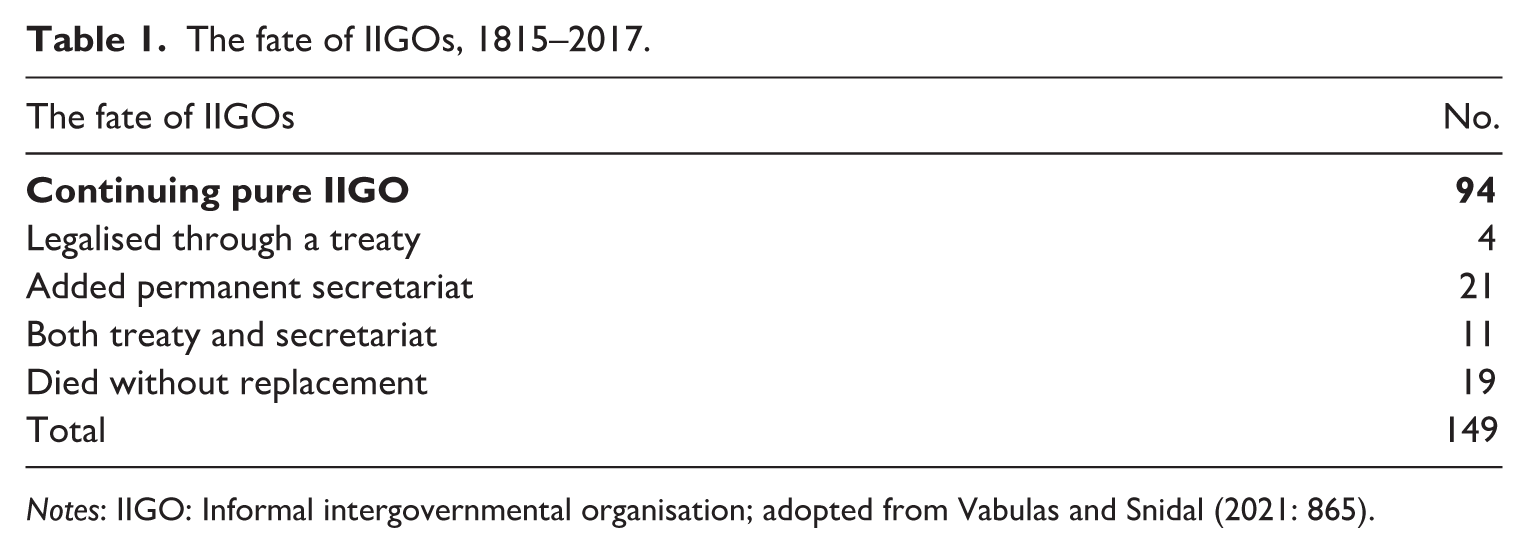
Notes: IIGO: Informal intergovernmental organisation; adopted from Vabulas and Snidal (2021: 865).
Moreover, it is a remarkable, albeit unacknowledged development, that states have increasingly refrained from formalising IIGOs. The number of IIGOs in existence has seen more than a fourfold increase over the past 30 years. Moreover, states have come to rely more routinely and extensively on many IIGOs for cooperation. As Roger and Rowan (2023) note, ‘[s]ince the early 1960s, virtually all states have become members of more formal and informal IOs’ (p. 1261). And while state membership and participation in IIGOs varies across world regions, it is spread across all major world regions, including Europe, North America, the Asia-Pacific, Latin America, and Africa (Roger and Rowan, 2023: 1251). They also observe a ‘tremendous growth of informal bodies across a range of areas’ (Roger and Rowan, 2023: 1249).
This suggests that states should more frequently encounter (informal) design-related capacity issues. Yet the likelihood of an IIGO undergoing formalisation has fallen markedly. During the 30-year period that stretches back to the end of the Cold War (1987–2017), the frequency of formalisation (in absolute terms) remained roughly the same—notwithstanding IIGOs’ continued and rapid proliferation (see Figure 1). In fact, because ‘IIGOs do not have their own bureaucracy to defend them and can be abandoned readily by dissatisfied states’ (Vabulas and Snidal, 2021: 865), their longevity instead suggests that states actively keep these organisations alive. 5 In short, states consciously refrain from formalising IIGOs even as their own use of and requirements regarding these organisations evolve.
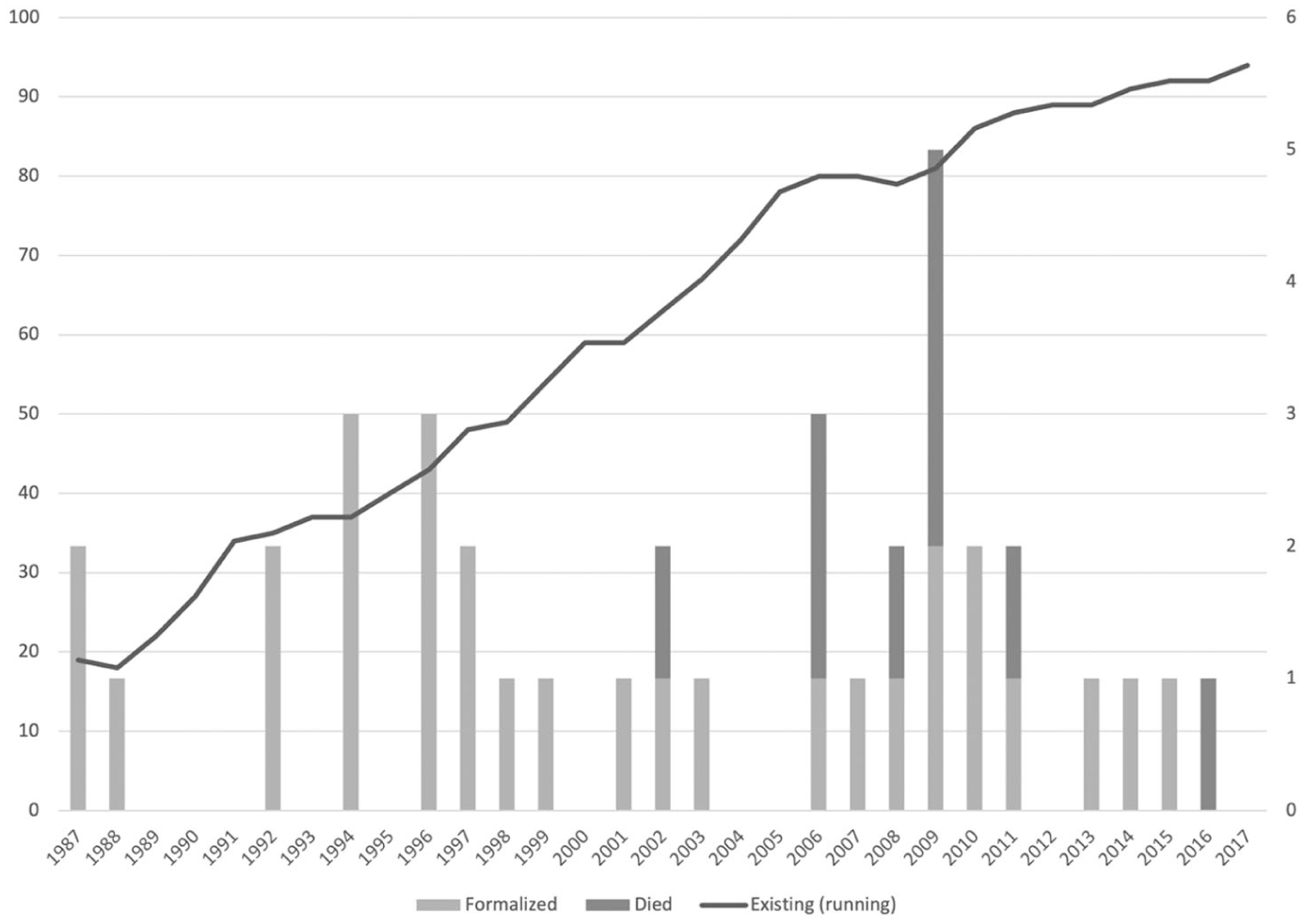
IIGO formalisation and death versus total number of existing IIGOs, 1987–2017.
The literature offers several complementary explanations as to why states may refrain from formalising IIGOs. One line of argument focuses on factors that make IIGOs more effective or efficient at supporting state cooperation and thus reduce the need for formalisation. Manulak and Snidal suggest that improvements in supply-side factors, most notably advances in transport and communications technology, enable states to dispense with a permanent secretariat or headquarters in some cases (Manulak and Snidal, 2021). Hagebölling shows that the G20 has undergone organisational adaptation to substitute for a permanent secretariat through mechanisms such as a troika rotating chair system and dedicated ‘Sherpa’ offices in member states as well as increased reliance on information technology (Hagebölling, 2024). In their study of the G20 Common Framework for Debt Treatments, Rodriguez-Toribio and Zeitz (2025) also demonstrate that informal bodies can become increasingly institutionalised over time—even in the absence of legalisation or the establishment of permanent staff, secretariat, or headquarters. Moreover, in their analysis of global financial governance institutions, Linder and Rixen (2025) show that entities such as the Basel Committee on Banking Supervision (BCBS) may evolve to adopt more ‘contractual’ governance structures and procedural changes, all without formalisation through legally binding commitments.
Another strand of research points to linkages between IIGOs and FIGOs, notably states’ use of formal organisations as governance ‘coral reefs’. Roger argues that FIGOs’ lending of resources or provision of services to IIGOs can sometimes make informal designs that would not be viable solutions on their own a preferred choice (Roger, 2022). Overall, this line of argument suggests that states may resist formalisation due to their improved ability to leverage informal design effectively for cooperation purposes. It has also been noted that governments may value IIGOs for their symbolic and communicative value, using high-profile summits—both in-person and virtual—as opportunities for international status-seeking and domestic signalling (Danielson and Hedling, 2022).
Another line of argument focuses on deep-running trends in international politics to explain states’ commitment to informality. Hale et al. argue that FIGOs struggle to sustain the provision of global public goods because of the concurrence of several major developments. These include greater multipolarity, increasing issue complexity, and inertia of multilateral institutions that limits their ability to adapt (Hale et al., 2013a, 2013b; Hale and Held, 2018). Arguments centred on power shifts specifically stress the limitations of FIGOs in the face of the current transition towards a more multipolar order. They problematise their slow adaptation to shifts in political power and the resulting discrepancy between de facto and de jure influence. This discrepancy leads to contestation and increases the incentives for states to shift cooperation to flexible and autonomy-preserving IIGOs during the transition to a reformed institutional system (Vabulas and Snidal, 2020). From this perspective, states avoid formalising IIGOs due to the prospect of trading greater capacity for a design that is susceptible to gridlock and contestation. Instead, they choose more adaptive institutions to—at least temporarily—mitigate these fundamental international trends.
While scholarship thus offers various lenses through which to explain states’ preference for informality and their reluctance to formalise IIGOs, it stops short of systematically delineating the functions that IIGOs may provide without a secretariat or legalisation. Current scholarship notably lacks a framework for assessing to what extent IIGOs can provide the functions necessary to sustain and structure state cooperation on complex, protracted global issues. In the following section, I further develop the functionalist approach to institutional design and informal organisations to theorise this functional scope.
Theorising the functional scope of IIGOs
The previous discussion raises a key question: are IIGOs viable vehicles for supporting sustained and structured state interactions? As previously discussed, existing contributions use a binary contrasting of formality and informality to identify unique strengths. This clarifies for which cooperation problem structure IIGO or FIGO ideal types represent the more effective choice. For the question at hand, by contrast, we are concerned with possibility rather than optimality. States prefer IIGOs because of their comparatively greater flexibility and lower sovereignty costs (optimality). Yet states’ changing use of IIGOs shifts our focus to the extent to which they can provide functions that support more sustained and structured state interactions, a capacity typically associated with formality (possibility). My starting point is, therefore, to examine the degree to which IIGOs can plausibly provide functions that support such state interactions—without formalising. By viability I thus refer specifically to the structural–functional capacity of an IIGO to provide the support functions necessary for sustained and structured interactions. This is a question of possibility that is analytically distinct from productiveness or substantive policy effectiveness.
The P-F framework
To theorise IIGOs’ functional scope, we may start by inverting the question and asking how functions that support state interactions depend on organisational formality. Abbott and Snidal’s (1998) seminal discussion of why states use (formal) intergovernmental organisations (IGOs) represents an ideal starting point in two respects. First, it distinguishes two categories of functions (F) that roughly correspond to the division of labour that manifests between IIGOs and FIGOs. Second, it breaks down the notion of formality into organisational properties (P), thereby facilitating a more graduated analysis of IIGOs’ functional potential and limitations vis-à-vis FIGOs.
Abbott and Snidal identify two basic categories of functions that render FIGOs valuable to states: their support for direct state interactions and their management of substantive operations (Abbott and Snidal, 1998: 10). Key functions that FIGOs provide in support of member state interactions are a stable negotiation environment, effective information dissemination, the linkage of issues to, for example, expand the space of possible agreements, the initiation of cooperation regarding neglected issues, and enforcement of compliance with agreed terms (Abbott and Snidal, 1998: 10–12, 17). The main functions that enable FIGOs to manage substantive operations are the pooling of risk and resources, the joint production of output such as scientific knowledge or military doctrine, the elaboration and coordination of norms, the laundering of policies for legitimation, and neutrality, for instance, as a trustee or allocator of resources (Abbott and Snidal, 1998: 12–16, 17–23; Cf. Chu et al., 2024).
IGOs’ ability to provide these functions is associated with their formality. Notably, formality defines IGOs’ functional scope through its manifestation in two key organisational properties: centralisation and independence. Centralisation describes ‘a concrete and stable organisational structure and an administrative apparatus managing collective activities’ (Abbott and Snidal, 1998: 9). Centralisation thus entails, on the one hand, the existence of an organisational structure through which members interact (as opposed to ad hoc engagement) and, on the other hand, the presence of an administrative apparatus that ensures the functioning of this structure. Independence designates an organisation’s ability to ‘act with a degree of autonomy, and often neutrality, in defined spheres’ (Abbott and Snidal, 1998: 9). In the sense used here, it thus refers to the organisation’s agency and ability to pursue goals in a (partially) autonomous way that is separate from its political principals, the member states. 6
I condense this discussion from the institutionalist literature into a P-F framework, which captures the relationship between the organisational properties and functions introduced above. Visually, I represent the P-F framework as a 2 × 2 matrix (see Table 2). Whereas the rows show the organisational properties (centralisation and independence), the columns indicate the category of functions (support for state interactions and managing substantive operations). The P-F framework links the various functions provided by IGOs to a primary property. In practice, functions may be partially dependent on the joint presence of centralisation and independence. Here, I adopt the primary dependencies established in previous work for analytical clarity.
The property-function framework of intergovernmental organisations.
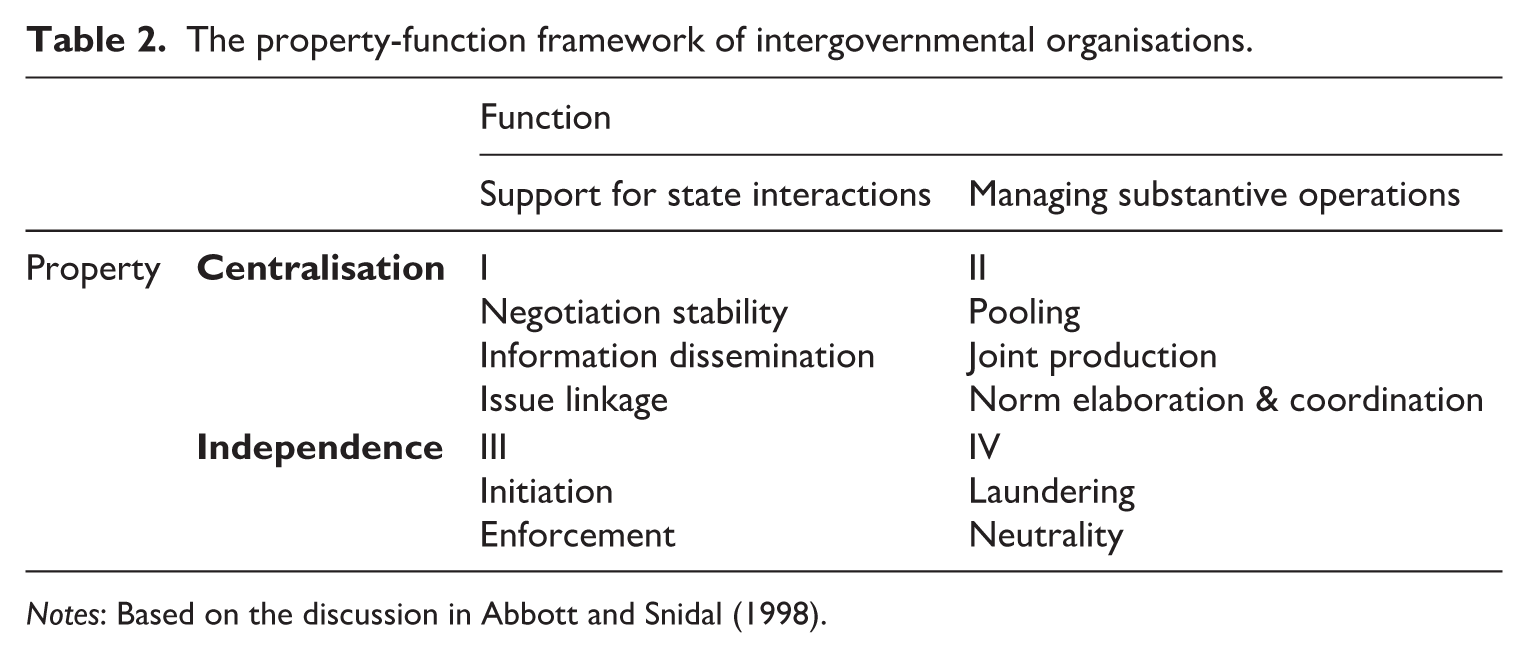
Notes: Based on the discussion in Abbott and Snidal (1998).
The P-F framework provides a cross-sectional view of an organisation’s properties at a given moment. Formalisation, by contrast, denotes a dynamic transition between institutional configurations. In particular, the acquisition by an IIGO of the independence-related properties typical of FIGOs (e.g., a permanent secretariat distinct from member states and/or a legally binding foundation). The framework is therefore complementary to dynamic accounts of institutional change: it specifies the structural possibilities available to states at each point along an organisation’s trajectory, and clarifies what is at stake when they either undertake or refrain from formalisation.
Notably, the P-F framework allows a focus on IIGOs’ functional scope for supporting state interactions (left column) in line with the previous discussion. States use IIGOs to craft agreements and coordinate (national) policies but rely on FIGOs for tasks related to support policy implementation and the management of substantive operations like the pooling of resources for technical assistance (see Eccleston et al., 2015: 302; Vabulas and Snidal, 2013: 211; Woods, 2010: 12). In some instances, as Manulak and Snidal have argued, states may avoid using FIGOs altogether by linking engagement and decision-making in IIGOs to implementation through lower-level informal or networked organisations (see Manulak and Snidal, 2021). The G7’s political steering of the informal Proliferation Security Initiative (PSI) is an example of this. Yet the limitations are evident: the PSI serves to structure regular interactions as well as to disseminate and collect information about critical interdiction capabilities and practices. However, it merely coordinates, rather than pools, activities, risks, or assets (Manulak, 2021: 204–209; Proliferation Security Initiative, n.d.-b). FIGOs thus remain central to implementation and the management of substantive operations.
Centralisation versus independence
Having established the fundamentals of the P-F framework, we can now proceed to leverage its disaggregation of organisational formality into centralisation and independence to contour IIGOs’ functional scope. To what extent may IIGOs display centralisation and independence? And how can this inform our expectations about IIGOs’ functional scope and, specifically, about their suitability for supporting sustained and structured state interactions?
Although FIGOs vary regarding the degree of their centralisation and independence, they feature both properties. FIGOs, by definition, are ‘formal entities’, that is, they have a legal personality and ‘possess a permanent secretariat or other indication of institutionalisation such as headquarters and/or permanent staff’ (Pevehouse and et al, 2020: 494). The presence of a permanent secretariat or staff entails centralisation in the form of an organisational structure and administrative support. While the existence of a permanent secretariat does not automatically entail a high level of independence and states may choose to exercise close supervision, the existence of bodies that are separate from member states invariably creates some level of autonomy, even if only in selected spheres. In fact, ‘in some cases, their delegated powers can be quite significant, granting bureaucrats important decision-making capabilities’ (Roger, 2020: 33). FIGOs’ functional scope is thus determined by the presence of both centralisation and independence.
By contrast, IIGOs, as organisations, possess no comparable independence from their member states. IIGOs, by definition, are delimited from their formal counterparts by the very absence of a legal personality (Roger and Rowan, 2022: 600; Vabulas and Snidal, 2021: 861). More importantly, they lack a permanent entity like a secretariat or staff that is distinct from the member states and able to develop proprietary agency in international politics (Vabulas and Snidal, 2013: 197). Indeed many IIGOs, including the G7, G20, BRICS, and the Paris Club, depend entirely on member state officials, which severely limits the development of any significant independence. In some instances, IIGOs compensate for the lack of a secretariat by, for instance, relying on a state’s administrative capacities or creating a rotating chair between members (Vabulas, 2019: 409). IIGOs may also operate in issue areas where FIGOs provide key resources and services (Roger, 2022). Yet, the lack of legalisation constraints the autonomy of IIGOs as agents and member states face few formal constraints on clawing back control. 7 Accordingly, the lack of independence and minimal infringement on state sovereignty have been established as key drivers of why states choose to cooperate through IIGOs (Abbott and Faude, 2020: 3; Vabulas and Snidal, 2013: 210; Vabulas and Snidal, 2020: 43).
In her comparison of formal and informal IGOs, Viola draws an insightful parallel with Scharpf’s distinction between collective and corporate actors (Viola, 2015b: 28). Scharpf defines collective actors as ‘dependent on and guided by the preferences of their members’ and contrasts this with corporate actors, who ‘have a high degree of autonomy from the ultimate beneficiaries of their action and whose activities are carried out by staff members whose own private preferences are supposed to be neutralised by employment contracts’ (Scharpf, 1997: 54). Similar to collective actors, IIGOs possess minimal independence from their member states. By contrast, formal IGOs resemble corporate actors and are based on a relationship involving (contractual or treaty-based) delegation that circumscribes a certain degree of autonomy. In Scharpf’s words, such actors (or organisations) ‘may thus achieve identities, purposes, and capabilities that are autonomous from the interests and preferences of the populations they affect and are supposed to serve’ (Scharpf, 1997: 57). This type of independence underlying several functions in the P-F framework is absent in IIGOs.
This comparative assessment of independence as a property of IGOs serves as a point from which to approach the scope of functions that we should expect IIGOs to be able to provide in support of state interactions. Given the reduced independence of IIGOs, the P-F framework suggests that they will struggle to provide primarily independence-related functions like the initiation of cooperation and the enforcement of agreed terms (see Abbott and Snidal, 1998: 17). An organisation possessing a strong degree of independence does not just facilitate interactions among its members but can actively invite states to consider issues it identifies as neglected but worth prioritising. This kind of initiation is distinct from the kind of catalytic role that IIGOs play in crisis situations. Here, as outlined earlier, the flexibility of informal design lowers the barriers to progression so that states can advance speedily on a jointly identified set of issues. By contrast, the initiation by IGOs fills a gap in cooperation that stems from states’ national heuristics or interests. A well-known instance of this is the level of autonomy of the UN Secretary-General, which extends to being able ‘to bring to the attention of the Security Council any matter which in his opinion may threaten the maintenance of international peace and security’ (United Nations, 1945: Chapter XV, Article 99). Another example is the Organisation for Economic Co-operation and Development’s (OECD) identification of pressing issues—from economic reforms (Prager, 2019) to internet freedoms (Pfanner, 2011)—and its calls for states to act on these jointly. This initiation hinges on independence, given the necessity of actorness being detached from parochial member state biases and interests.
Independence is also critical to IGOs’ ability to support member cooperation through enforcement. IGOs may still need states to self-report on their policies and disseminate information about compliance. However, greater autonomy from member states is key to ‘producing credible neutral information necessary for effective enforcement’ (Abbott and Snidal, 1998: 26). Major economies, for instance, rely heavily on monitoring by the International Monetary Fund to review members’ adherence to regulatory standards through the Financial Stability Board (see Financial Stability Board, 2020). Such credible information about noncompliance and ‘naming and shaming’ can amplify reputational effects, raise the costs of reneging on commitments, and improve compliance (see, for example, Hafner-Burton, 2008; Morse, 2019). Indeed, as Koremenos et al. (2001) note, ‘the informational capacities of international organisations to expose states’ behavior can influence the activities of even the most powerful states by imposing international reputational costs or, sometimes, domestic audience costs’. An independent IGO is also in a position to legitimate retaliatory action among member states in case of noncompliance. The World Trade Organisations’ Dispute Settlement Body is a point in case. If it deems a violation of laws to have occurred and the violator does not restore conformity, it entitles the losing member to temporary retaliatory measures (World Trade Organisation, n.d.). Thus, independent IGOs can play a central role in motivating, coordinating, and legitimising enforcement.
Notwithstanding these independence-related limitations on IIGOs, several key functions depend primarily on the presence of centralisation—that is, the development of an organisational structure and an administrative apparatus. The P-F framework stresses that centralisation underlies IGOs’ ability to support state interactions in a number of ways, including through enhanced negotiation stability, information dissemination, and issue linkage. 8 A centralised IGO can provide a stable forum for negotiation, thereby facilitating repeated interactions and, as a result, lengthening the ‘shadow of the future’ and allowing reputational effects to play out (Fearon, 1998: 270). It can disseminate relevant information to the parties and ensure a common basis for negotiation, for instance, by creating organisational memory through the tracking of past activities and agreements (Koremenos et al., 2001: 771–772). Centralised organisations can also create or strengthen issue linkages, thereby generating opportunities for tradeoffs and, consequently, a larger zone of possible agreement among members (compare Sebenius, 1983: 292–293).
Unlike independence, which is inherently constrained by IIGOs’ lack of legal personality and lack of an organisational entity that is distinct from member states, informal designs can display centralisation. Indeed, some level of centralisation unites all IIGOs, even those that are designed to take a deliberately minimalistic institutionalist approach, like the PSI. The PSI purposefully fosters networked interactions among member country representatives and even eschews placing any kind of hosting expectations on member states, privileging voluntary and situational contributions over predictability (see Manulak, 2021: 416–421). Nevertheless, it differentiates itself clearly from decentralised and ad hoc cooperation through the presence of both organisational structure and administrative support. The so-called Operational Experts Group (OEG)—a 21-state committee—effectively serves as an executive board coordinating activities that are distributed across a set of working groups and review teams (Proliferation Security Initiative, n.d.-a). The host country and the OEG also provide essential administrative support to sustain this structure (compare Manulak, 2021: 417). The PSI also maintains an online platform and a password-protected digital repository in support of its work (Proliferation Security Initiative, n.d.-b). Clearly, the PSI has basic centralisation properties that, in other instances, may be realised through a permanent secretariat or international staff.
Building on the institutional design literature, the P-F framework thus suggests that—even in the absence of significant independence—IIGOs can provide a robust set of functions to support sustained and structure state interactions, particularly negotiation stability, information dissemination, and issue linkage. In the following section, I provide a brief analysis of the G20’s organisational structure and operations to probe the plausibility of these conjectures.
An analysis of the 2017 G20 presidency
The P-F framework serves as a steppingstone to addressing the puzzle of states’ continued resistance to formalising IIGOs by clarifying IIGOs’ functional scope. Notably, it suggests that IIGOs can enhance negotiation stability, information dissemination, and issue linkage. How do these functions and the underlying organisational centralisation in IIGOs manifest in structuring state interactions in practice?
A key hurdle to understanding states’ preference for informality—and notably IIGOs’ ability to provide support for more regular and permanent state interactions—remains the current lack of systematic analyses of their organisational inner workings. Only recently has the literature begun to turn attention towards the significance of IIGOs’ organisational structure and operations underpinning their capacity—as political organisations—to support member state interactions. A key distinguishing factor of IIGOs, as opposed to other forms of informal cooperation like transgovernmental networks (TGNs), is the ‘high-level participation . . . with authority to make political commitments on behalf of their respective states’ (Vabulas and Snidal, 2021: 861). Cooper (2019a: 642) aptly notes that, correspondingly, the scholarly focus has been on the ‘top of the iceberg’ leaders’ meetings and Hagebölling (2024: 123) similarly finds that IIGOs’ functioning and adaptation remain ‘little explored’.
Against this background, I now proceed with a brief analysis of the organisational structure and operations of a crucial case: the G20. 9 Few IIGOs have seen a comparable expansion of their agenda and focality—yet G20 members have resisted formalisation. This makes the G20 a compelling case for assessing the conjecture that, while IIGOs may struggle to initiate cooperation and enforce agreements, they can still achieve a degree of centralisation sufficient to sustain structured state interactions. To that end, I leverage new data on its institutionalisation, meetings, and operations during the 2017 Presidency. 10 The goal of this analysis is twofold. First, it gauges ‘centralisation without independence’ as an organisational property of the G20 and examines its association with key functions identified by the P-F framework: negotiation stability, information dissemination, and issue linkage. Second, it serves to underscore the significance of analysing IIGOs’ inner workings beyond high-level political meetings. I begin by mapping the organisational structure of the G20 and then proceed to examine its operations throughout the year.
Mapping the G20’s organisational structure under the 2017 presidency reveals the scale of its institutionalisation (see Figure 2). Working-level interactions among government officials in 2017 were bundled in a total of 18 working groups and task forces. These, in turn, were collected under the umbrella of higher-level meetings, generally at the ministerial level, that set the political direction for issue complexes such as foreign, digital, and trade policy. At the top of this structure is the yearly summit meeting, which brings together heads of state and government. The so-called Sherpa teams—responsible for the overall coordination of the G20 process—and their regular meetings form the connective tissue between the working level, the political level, and the presidency. An important exception to their reach is the semiautonomous finance track, which is a remnant of the G20’s original conception as a forum for global financial governance. Here, the Sherpa functions are assumed by the Finance Deputies.
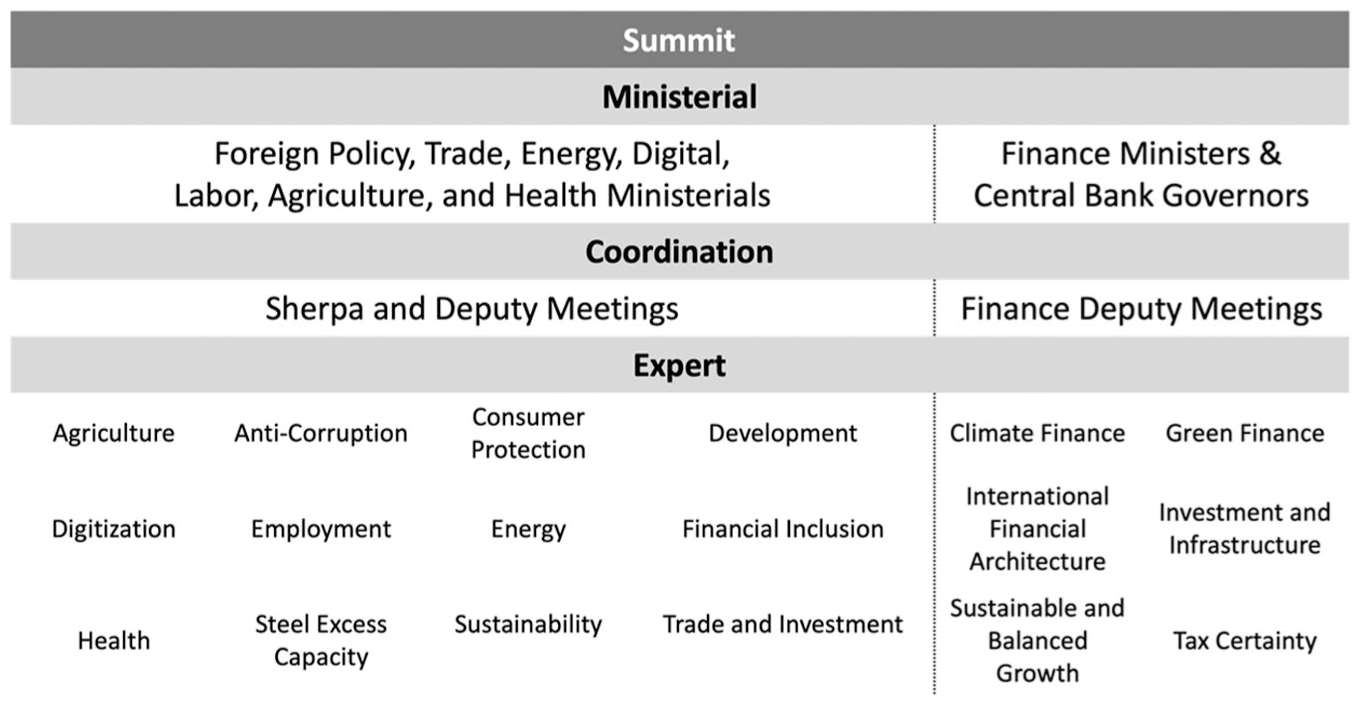
Organisational structure of the 2017 German G20 Presidency.
The mapping indicates that the G20’s organisational structure integrates interactions among the various parts of member states’ government apparatuses and creates opportunities for linkages between issues. In this structure, the summit serves primarily as a last-minute opportunity for firefighting severe disagreement and amending contentious wording in declarations. As an observer from the German federal government’s principal advisory think tank on foreign issues noted, ‘this means that summit declarations are prepared and agreed over months in tedious bureaucratic processes among member government’s officials’ (Maull, 2017, translated by author). The summit process functions as the focal point for the G20 machinery and an opportunity to establish links and tradeoffs between issue areas that are politically difficult or administratively cumbersome to create directly among government experts. The output of the summit meetings reflects their integrative function. At the Hamburg summit, the declaration made 37 references to the various ministerial meetings, dialogues, and working groups within the G20 organisational framework. Furthermore, in 31 references, it connected the G20’s work to outside organisations such as the OECD (Kirton and Warren, 2018: 22).
Moving beyond a static mapping of the 2017 G20 and towards a dynamic view of its operations provides further insights into how the G20 model operates. To illustrate its operations during the German Presidency, I compile a new dataset of the G20’s institutionalised face-to-face meetings. I code each meeting with respect to its timing and level in the organisational structure (Summit, Ministerial, Coordination, Expert). In addition, for each meeting, I code whether it is associated with the Sherpa or the Finance track. I use these data to visualise the temporal distribution of the G20’s face-to-face meetings during the German Presidency (see Figure 3). The figure shows the monthly number and types of meetings (bar chart height and pattern) and the month-to-month trend in the meeting frequency for each of the two tracks (line chart overlay). The figure also highlights the principal coordinatory meetings, namely the leaders’ summit (Summit) and the Sherpa and finance deputy meetings (Sherpa 1–5; Finance 1–5).
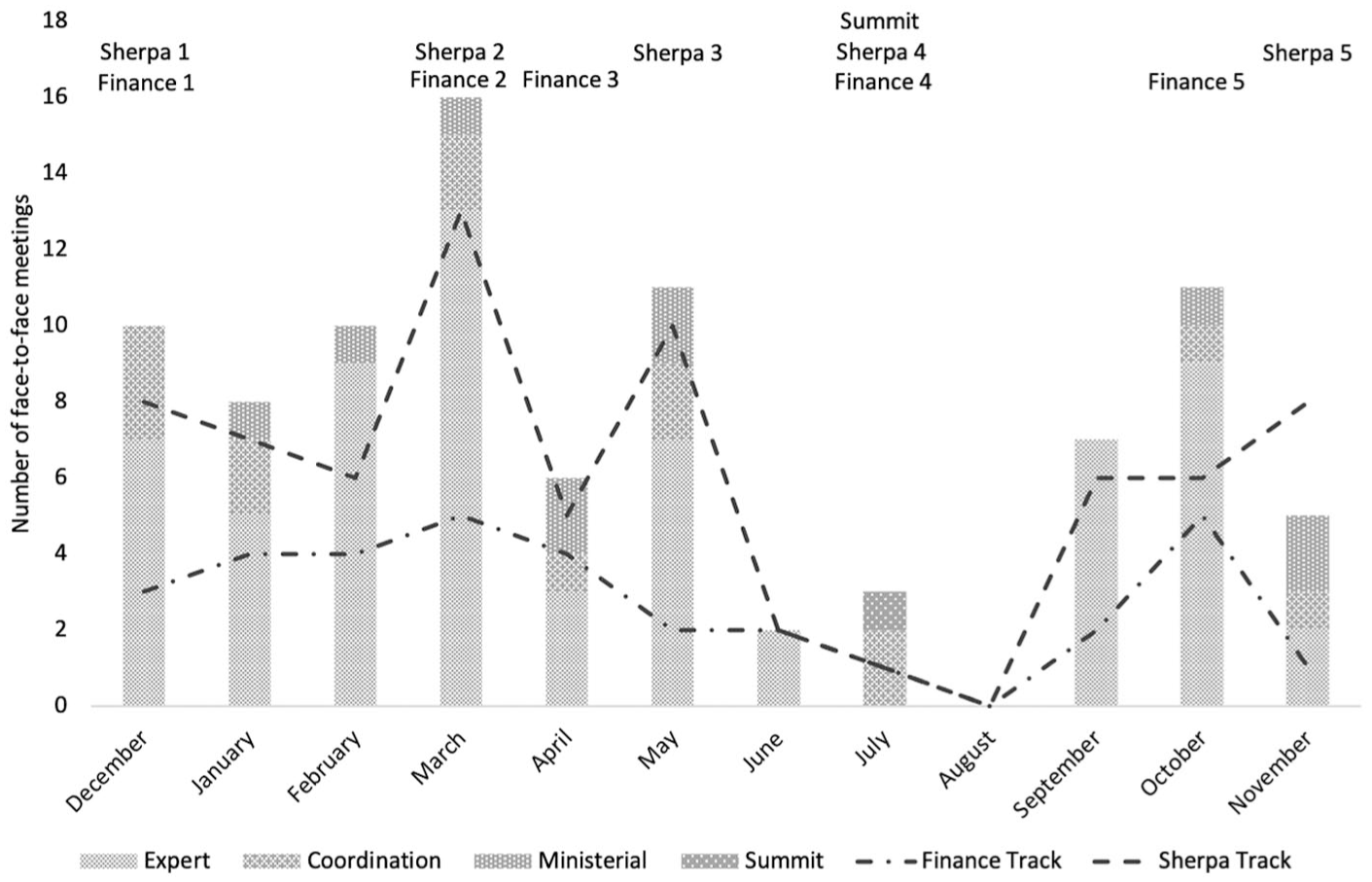
G20 face-to-face meetings during the 2017 German G20 Presidency.
The figure illustrates how the G20 integrates government-to-government interactions into a more stable and predictable environment for negotiations. The G20’s institutional mechanisms operate continuously and with relatively uniform intensity throughout the year, even in the absence of immediate political inertia in the run-up to the summit meeting. On average, around 10 face-to-face meetings—each involving between a few dozen to hundreds of participants—take place each month. Crucially, the transition from one presidency to another towards the end of a calendar year does not appear to lead to interruptions. After a month without significant activity following the summit, interactions pick up pace again immediately and continue at a normal level until the transition to the next presidency.
A second aspect that stands out is the regularity with which Sherpa teams (and finance deputies) distribute information and coordinate the G20 processes. We have seen earlier that the Sherpa teams and meetings form the connective tissue between the working level, the political level, and across presidencies. Besides their role as key negotiators for the heads of state and government, Sherpas assume a coordinating function and centralise information across the institutional architecture. Sherpa and finance deputy meetings pace year-round operations through five major meetings held at regular intervals of approximately 2 months. The Sherpa and finance deputy meetings form the framework for information dissemination within which individual institutional mechanisms—the working groups and task forces—have their own additional procedures and reporting requirements in place (see Hilbrich and Schwab, 2018: 17).
This brief analysis of the G20’s organisational model and operations thus indicates IIGOs’ scope for supporting sustained and structured state interactions through enhanced negotiation stability, information dissemination, and issue linkage—without relying on an independent organisational entity. At the same time, two qualifications regarding the case selection and scope are warranted. First, the 2017 German presidency represents a high-water mark of the G20’s post-2008 expansion of agenda and focality. It therefore offers a strong case for observing institutional centralisation. The Hamburg outcomes reflect these dynamics: the G7 process produced consensus on many agenda items that year, including the launch of the G20 Compact with Africa and the protracted multi-presidency engagement on sovereign debt that later matured into the Common Framework for Debt Treatments (Rodriguez-Toribio and Zeitz, 2025). Second, and relatedly, subsequent G20 presidencies have seen summit-level cohesion strained. This is illustrated by the 2023 New Delhi summit, which Presidents Putin and Xi did not attend, and the 2025 Johannesburg summit, which President Trump boycotted.
Nevertheless, the working-level architecture, Sherpa coordination, and Finance Deputy processes have continued to operate across these presidencies with broadly similar regularity (Hagebölling, 2024). Institutional centralization can sustain structured engagement across handovers even when leader-level participation is disrupted, while the absence of independence continues to circumscribe substantive outcomes related to initiation and enforcement. Crucially, these findings apply to other key IIGOs, including the G7 and BRICS. In fact, cursory accounts of these IIGOs’ inner working echo the findings in this article. Gstöhl, for instance, stresses the G7’s ‘complex network of close relationships in a process running 365 days/year, 24 h/day’ (Gstöhl, 2007: 2). Similarly, a Brazilian senior foreign service official recounts the development of the BRICS into an organisation ‘whose activities are not limited to an exercise from one Summit to the next but provides for intense and continuous activity among its members in different areas’ (Fontenele Reis, 2013: 61). This look into the inner workings of the G20 is thus only a first step towards a systematic understanding of design and function in the growing landscape of IIGOs.
Conclusion
Over the past three decades, IIGOs have not only rapidly proliferated, but they have also seen a drastic change and diversification in their use by states. Whereas some IIGOs remain issue-specific and lean fora, others have transformed into platforms that routinely structure state interactions concerning a complex set of global challenges. Strikingly, even as the requirements for IIGOs change, states show remarkable reluctance to formalise these bodies, either through legalisation or the creation of a permanent secretariat. For scholars of international cooperation, this raises questions about IIGOs’ limitations and specifically the functions that they can provide to support state interactions effectively. Hence, IIGOs’ functional scope crystallises as a critical aspect of international cooperation.
Accordingly, in this article, I built on the institutional design literature to advance our understanding of IIGOs’ functional scope. I introduced the P-F framework to analyse the relationship between (in)formal design and organisations’ capacity to support state interactions. The P-F framework captures that formality can be disaggregated into two key organisational properties—centralisation and independence—and relates these to specific functions. Arguing that IIGOs may develop (some) centralisation but lack significant independence, I identified a set of functions that informal organisations can plausibly provide to support sustained and structured state interactions, namely enhanced negotiation stability, information dissemination, and issue linkage. Leveraging new data on the crucial case of the G20, I probed the plausibility of the P-F framework’s conjectures. Specifically, I illustrated the G20’s organisational ‘centralisation without independence’ and related support for state interactions, including the stabilisation of repeated engagement and the linkage of transgovernmental work streams. This examination of the G20’s structure and operations also underscored the significance of analysing IIGOs’ inner workings beyond top-level political meetings. While the case study in this article provides an initial plausibility test, further empirical research is needed to generalise these findings across the full range of IIGOs with greater confidence.
The argument developed in this article complements existing explanations for the growing use of informal organisations and states’ continued reluctance to formalise them. Advances in transport and communications technology, external support by formal organisations, and systemic trends such as greater multipolarity are key to explaining states’ preference for IIGOs. Starting from observations that IIGOs display considerable adaptability to changing requirements, this article adds another piece to the puzzle: states may continue to rely on IIGOs because they can provide a surprisingly robust set of functions to support cooperation—even without hard legalisation and an independent secretariat. In future studies, combining this assessment of IIGOs’ functional scope with technological and systemic explanations promises to provide a more complete picture of states’ increasing preference for creating—and retaining—informal organisations.
Opening the black box of IIGOs matters. IIGOs’ ability to adapt to their changing role in the multilateral system has repercussions well beyond their immediate organisational realm. Organisation like the G20, the G7, and BRICS are orchestrators, that is, they provide political guidance to other organisations, including formal multilateral organisations like the United Nations, the International Monetary Fund, and the World Health Organization. A concrete concern is, as Viola points out with respect to the G20, that ‘the ad hoc and institutionally undisciplined G20 might exacerbate coordination and overlap problems’ (Viola, 2015a: 113). In view of this potential for global rippling effects, the functional scope of IIGOs and the organisational structure that underpins it emerge as an important frontier for the study of contemporary multilateralism.
Overall, as gridlock in formal multilateral organisations persists, the centrality of IIGOs in international cooperation is destined to grow. As a result of this, the study of IIGOs’ functions and design presents itself not only as a promising field of scholarly inquiry but also a basis for better-informed institutional choices by policymakers.
Footnotes
Acknowledgements
The author is grateful to Duncan Snidal, Walter Mattli, Karolina Milewicz, Bernhard Zangl, Felicity Vabulas, and Michael Manulak for their insightful comments and recommendations. He also thanks the participants at the 2020 American Political Science Association Annual Meeting and the University of Oxford’s IR Research Colloquium for their feedback on earlier versions of this paper. Finally, he thanks the members of the British Journal of Politics and International Relations editorial board and the anonymous reviewers for their valuable feedback.
Author’s Note
This research was conducted and funded at the University of Oxford, Department of Politics and International Relations.
Funding
The author disclosed receipt of the following financial support for the research, authorship, and/or publication of this article: Research for this article was assisted by funding from the UK Economic and Social Research Council and the University of Oxford’s Department of Politics and International Relations.
